Feeling uncertain about what to expect in your upcoming interview? We’ve got you covered! This blog highlights the most important Knowledge of Embroidery Stitching Techniques (e.g., Satin Stitch, Running Stitch) interview questions and provides actionable advice to help you stand out as the ideal candidate. Let’s pave the way for your success.
Questions Asked in Knowledge of Embroidery Stitching Techniques (e.g., Satin Stitch, Running Stitch) Interview
Q 1. Describe your experience with satin stitch and its applications.
Satin stitch is a versatile embroidery stitch used to create solid, smooth areas of color. It’s essentially a series of closely packed parallel stitches that completely cover the fabric underneath. Think of it as painting with thread! My experience with satin stitch spans numerous projects, from filling in the petals of floral designs to creating richly colored leaves and even lettering. I’ve used it on various fabrics, from delicate silk to sturdy linen, adjusting my technique to suit each material’s characteristics. The beauty of satin stitch lies in its ability to produce incredibly vibrant and consistent color blocks, offering a sharp contrast to other embroidery stitches.
Applications:
- Filling in shapes: flowers, leaves, and other design elements.
- Creating lettering: providing a bold and polished look.
- Adding texture: providing areas of solid color for visual depth.
- Producing lustrous effects: particularly effective on fabrics with a sheen.
Q 2. Explain the difference between a running stitch and a backstitch.
Running stitch and backstitch are both fundamental embroidery stitches, but they differ significantly in their appearance and function. Running stitch is a simple stitch created by making a series of evenly spaced straight stitches in a single direction. It’s quick, easy, and ideal for outlining, creating simple fills, or adding subtle textural details. Imagine it like sewing a straight seam by hand, but leaving visible gaps between each stitch.
Backstitch, on the other hand, creates a solid line that resembles a machine-sewn seam. Each stitch is made by going back over the previous stitch’s end. This creates a strong, continuous line that’s far less likely to unravel than running stitch. Think of it as weaving thread in a continuous line, each stitch securely anchored to the next.
In essence: Running stitch is faster but less durable, while backstitch is slower but stronger and more precise.
Q 3. How do you achieve even tension in satin stitch embroidery?
Achieving even tension in satin stitch is crucial for a clean, professional finish. Uneven tension leads to puckering or loose stitches that detract from the overall effect. My approach involves several key strategies:
- Consistent pressure: Maintain consistent pressure on the needle throughout the stitching process. Avoid pressing too hard or too lightly, which will lead to variations in stitch length and appearance.
- Proper needle size: Selecting a needle appropriate for your fabric type and thread weight is vital. A needle that’s too small may break, while one that’s too large can create holes.
- Smooth, even stitches: Aim for consistently sized stitches that are close together, ensuring complete coverage without gaps or overlaps.
- Stretching the fabric: Lightly stretching the fabric taut while stitching helps maintain even tension and prevents puckering.
- Using a hoop: Keeping the fabric taut in an embroidery hoop ensures consistent tension across the entire work area.
Practicing these techniques helps create beautiful, flawlessly executed satin stitch embroidery.
Q 4. What are the challenges of working with different fabric types for embroidery?
Different fabrics present unique challenges in embroidery. For example, a loosely woven fabric like linen might require a denser stitch count to prevent gaps, while a tightly woven fabric like silk could require a finer needle to avoid creating holes or splitting threads. Delicate fabrics, like silk or chiffon, require careful handling and gentle stitches to prevent damage, while heavier fabrics, such as denim or canvas, need sturdier needles and possibly a more forceful stitching style to ensure the stitches penetrate correctly. The thread choice also must adapt. A fine thread on a heavy fabric might get lost, whereas a heavy thread on a delicate fabric could tear it.
Experience helps in recognizing the characteristics of each fabric and adapting accordingly. Over time, I’ve developed a sense for how much pressure to apply and what type of needle is best for each fabric, minimizing damage and ensuring a successful project.
Q 5. How do you select the appropriate needle and thread for various embroidery stitches?
Selecting the appropriate needle and thread is essential for successful embroidery. The fabric type dictates needle size. For instance, fine fabrics like silk call for very fine needles (size 70/10 or finer), while heavier fabrics like canvas may need needles sizes 18-24. The thread must match the needle and fabric; a heavy thread with a fine needle will break, and a fine thread with a heavy needle may look lost. I typically use cotton, silk, or rayon embroidery threads, each suited to different effects.
For example, if I’m working with delicate silk, I’d choose a very fine needle and a thin, high-quality silk thread. For a heavier canvas project, a slightly thicker needle and a more robust cotton thread would be appropriate. This careful selection prevents thread breakage, creates cleaner stitches, and avoids damaging the fabric.
Q 6. Explain your experience with different embroidery hoops and their use.
Embroidery hoops are essential tools for keeping the fabric taut and preventing puckering during stitching. I’ve worked with various hoops, from small, inexpensive plastic hoops suitable for smaller projects to larger, more expensive wooden hoops for larger pieces. The choice depends on the project’s size and the fabric type. Wooden hoops are generally preferred for their ability to distribute tension more evenly over the fabric, minimizing stretching and distortion.
I often use a combination of hoops: starting with a smaller hoop to work on more intricate sections and then switching to a larger hoop as the project expands. The key is to choose a hoop that’s properly sized for your fabric, ensuring that the fabric remains taut but isn’t overstretched, which could cause distortion or damage.
Q 7. Describe your process for transferring a pattern onto fabric for embroidery.
Transferring a pattern onto fabric requires precision and care. My usual method depends on the pattern complexity and fabric type. For simple patterns, I might use a water-soluble pen or fabric marker to trace the design directly onto the fabric. For more complex designs, I prefer using transfer paper. I place the pattern underneath the fabric, secure the transfer paper on top, and trace the lines with a stylus or pen. Another reliable method involves using lightbox and tracing the design.
For delicate fabrics, I use the lightbox tracing method as it reduces the risk of damaging the fabric or leaving unwanted marks. Regardless of the method used, meticulousness ensures the pattern is transferred accurately and neatly, providing a clean foundation for the embroidery process.
Q 8. How do you troubleshoot common embroidery problems, such as skipped stitches or thread breakage?
Troubleshooting embroidery problems like skipped stitches or thread breakage involves a systematic approach. First, I examine the needle – a bent or dull needle is a common culprit for skipped stitches. I’d replace it with a sharp, appropriately sized needle for the fabric and thread. Thread breakage often points to tension issues. I check the tension on both the machine (if applicable) and my hands, ensuring it’s not too tight or loose. Sometimes, the thread itself is the problem; using a low-quality or damaged thread is a frequent cause. Switching to a fresh spool of high-quality thread often solves this.
For skipped stitches, I also consider the fabric. A dense fabric can sometimes cause problems. Using a stabilizer or a smaller stitch size can help. If the problem persists, I might check the bobbin tension and ensure it’s properly wound. In hand embroidery, a loose grip on the needle or inconsistent stitch length can lead to skipped stitches. I emphasize consistent hand movements and a gentle but firm grip. A detailed examination of the entire process, from needle to thread to fabric tension, is key to efficient troubleshooting.
For example, when embroidering on a delicate silk fabric, I always use a sharp, fine needle and a lightweight, high-quality thread like silk or a very fine cotton. Using a water-soluble stabilizer beneath the fabric can also help prevent skipped stitches.
Q 9. What are some common mistakes to avoid when executing satin stitch?
Satin stitch, while beautiful, requires precision. One common mistake is inconsistent tension. This leads to uneven stitches and gaps in the coverage. Maintaining consistent tension – neither too tight nor too loose – is crucial. Another frequent error is using too large of a stitch length. Small, closely packed stitches create a smooth, even surface. Long stitches create visible gaps and a less polished look. Finally, pulling the thread too tightly as you complete each stitch can distort the fabric and pucker the satin stitch itself. A gentle, even pull is key to maintaining the fabric’s integrity.
For instance, if I’m working on a design that requires a sharp edge on a satin stitch, I’ll use a smaller needle and gradually build up the satin stitch with tiny stitches to create a perfect edge. A final tip: Always start and end your satin stitch securely on the backside to prevent the satin stitch from unraveling.
Q 10. How do you maintain the quality and consistency of your embroidery work?
Maintaining quality and consistency in embroidery involves attention to detail across all stages. This begins with selecting high-quality materials: threads, needles, and fabric. Using a good quality hoop or frame to maintain even tension across the fabric is vital. Proper lighting is essential for precise stitching, and I always work in a well-lit area. Consistent stitch length and tension are paramount, as mentioned earlier. Regularly checking my work and correcting any inconsistencies is a crucial step in the process.
To maintain consistency, I often refer to stitch patterns or charts created beforehand. This ensures that every piece incorporates the same design and execution techniques. Further, taking notes during my work—including details about needle size, thread type, tension settings, and the time taken—is valuable for future replication. Finally, regular cleaning and maintenance of my equipment, such as needles and embroidery machines, is critical to long-term quality control. For example, I always clean my embroidery machine needles after every use to prevent clogging and damage.
Q 11. Describe your experience with different types of embroidery threads (e.g., cotton, rayon, silk).
I have extensive experience with various embroidery threads. Cotton threads are a versatile and readily available option, perfect for a range of projects. They offer good durability and come in a wide array of colors. Rayon threads offer a lovely sheen and drape well, creating a luxurious effect. However, they can be slightly more delicate than cotton. Silk threads are exceptionally luxurious; they have an unparalleled sheen and a beautiful drape, but they are also the most delicate and require careful handling. The choice of thread depends greatly on the project and desired aesthetic. I consider factors such as the fabric type, the design, and the desired look when selecting a thread. For instance, I might choose a cotton thread for a durable sampler, rayon for a flowing garment detail, and silk for a finely detailed piece with a shimmer.
Q 12. How do you adapt your embroidery techniques to meet different design requirements?
Adapting my techniques to different design requirements is fundamental to my work. For detailed designs, I use finer needles and threads, opting for small stitches to ensure precision. For larger, bolder designs, I might employ larger stitches and bolder threads. The fabric also significantly influences my choices. A delicate fabric might require a smaller stitch, a stabilizer, and a thinner needle to prevent damage. A sturdy fabric can handle larger stitches and more robust needles.
Different design styles might also call for varied stitching techniques. I may use a combination of techniques—such as satin stitch, French knots, and stem stitch—to create texture and depth. For instance, if a design involves intricate floral details, I’d use French knots to create the centers of flowers, using stem stitch for outlines, and filling the petals with satin stitch for a more complete picture. The design’s overall style will also determine my thread choices.
Q 13. How do you manage your time and workload when undertaking multiple embroidery projects?
Managing multiple embroidery projects requires careful planning and organization. I use a project management system to track all my ongoing projects, noting deadlines, materials required, and the progress made on each. This allows me to prioritize tasks and allocate my time effectively. I break down larger projects into smaller, manageable tasks, making the overall process less overwhelming. This also helps me to maintain focus and momentum, and to better track my progress. I also set realistic deadlines for each project, factoring in the complexity and time commitment involved. For example, I might dedicate specific days to working on projects with tight deadlines, or certain times of the day for projects requiring more detailed work.
Q 14. Explain your experience with different embroidery machines (if applicable).
While I primarily focus on hand embroidery, I have experience with several embroidery machines, including [Mention specific machine models if applicable. If not applicable, substitute with:] various computerized and free-motion embroidery machines. My experience with these machines has enhanced my understanding of the technical aspects of embroidery, such as tension regulation and stitch formation. It has also broadened my skills and capabilities, allowing me to complete projects more efficiently and explore different design possibilities. The experience with machines helped me to appreciate the nuances and differences between machine embroidery and hand embroidery, highlighting the strengths and weaknesses of each. This knowledge gives me a broader perspective when deciding the best approach for a given project.
Q 15. Describe your process for digitizing embroidery patterns (if applicable).
My digitizing process begins with a clear design concept. I use professional software like Wilcom or Embird, which allows for precise control over stitch density, thread color changes, and underlay creation. First, I import the artwork, ensuring its resolution is high enough for detailed embroidery. Then, I carefully trace the outlines, creating the base stitches. For example, a floral design might begin with a satin stitch outline for the petals. Next, I fill in the areas with appropriate stitch types; satin stitch for solid areas, fill stitches for larger spaces, and running stitch for details. The software allows for adjusting stitch density and underlay (a layer of stabilizing stitches beneath the main design) to prevent puckering and ensure the embroidered image looks smooth and sharp. I pay close attention to color changes, using the software’s color palette tools to minimize thread waste and optimize color transitions. Finally, I thoroughly test the digitized design on a sample fabric before proceeding to the final product. This process ensures that the stitch types and density work well together for the fabric type and gives me a chance to correct any issues before embroidering the final piece.
Career Expert Tips:
- Ace those interviews! Prepare effectively by reviewing the Top 50 Most Common Interview Questions on ResumeGemini.
- Navigate your job search with confidence! Explore a wide range of Career Tips on ResumeGemini. Learn about common challenges and recommendations to overcome them.
- Craft the perfect resume! Master the Art of Resume Writing with ResumeGemini’s guide. Showcase your unique qualifications and achievements effectively.
- Don’t miss out on holiday savings! Build your dream resume with ResumeGemini’s ATS optimized templates.
Q 16. How familiar are you with different types of embroidery designs (e.g., free motion, appliqué)?
I’m highly familiar with a variety of embroidery designs. Free-motion embroidery, where the needle moves freely to create organic shapes and lines, is a technique I frequently use for detailed elements or textural effects. Think of the delicate wisps on a flower petal or the subtle shading in a portrait. Appliqué, which involves sewing fabric pieces onto a base fabric, offers a beautiful way to incorporate different textures and colors into an embroidery project. I’ve extensively used it for projects involving animals, where various fabric textures provide a realistic look. Beyond these, I’m also proficient in traditional embroidery techniques like crewelwork, blackwork, and cross-stitch, and I often combine these in my projects for a layered and multi-textural effect.
Q 17. How do you incorporate different colors and shades effectively in your embroidery work?
Effective color incorporation is paramount to a successful embroidery design. My approach starts with careful color selection, considering the overall aesthetic and the mood I want to convey. For example, a vibrant, playful design might use bright, contrasting colors, while a more serene piece might employ softer, analogous hues. I often use a color wheel to identify complementary and analogous colors. I then strategically use blending techniques, such as using multiple threads of varying shades to create subtle gradients or shading within a single element. For instance, I might blend from a darker shade of blue to a lighter shade on a flower petal to add depth and dimension. I frequently utilize variegated threads that already have multiple shades blended together. Finally, I ensure careful color transitions between different areas of the design to maintain visual harmony.
Q 18. What methods do you use to ensure the longevity and preservation of your embroidery work?
Preserving embroidery requires careful attention to detail. First, I use high-quality fabrics and threads known for their durability. I always pre-wash my fabrics to prevent shrinkage after the embroidery is complete. After embroidery, I usually carefully press the piece from the back, using a pressing cloth to avoid damaging the stitching. For delicate fabrics and thread, I use a cool iron. For storage, I keep finished pieces in acid-free tissue paper within acid-free boxes to protect them from light and dust. For especially valuable pieces or for pieces that will receive heavy use, I may consider professional framing under UV-resistant glass.
Q 19. Explain your experience with hand embroidery versus machine embroidery.
Both hand and machine embroidery hold unique value in my practice. Hand embroidery offers unparalleled control and precision, allowing for intricately detailed work and personalized textures. The meditative process itself is appealing to many clients. I’ve found hand embroidery excels in creating delicate, bespoke pieces, for example, heirloom projects or personalized gifts. Machine embroidery, on the other hand, allows for quicker production, especially for larger or repetitive designs. It allows for consistent stitching and higher production output, making it ideal for projects requiring a larger quantity or more complex designs with many color changes. I choose the technique based on the project’s requirements and the desired aesthetic. Often, I blend the two; for example, I might use machine embroidery for base elements and then hand-embroider fine details on top.
Q 20. How do you handle client feedback and revisions on embroidery projects?
Client feedback is crucial to my process. I actively encourage communication throughout the project, from initial design consultations to final delivery. I’m always willing to make revisions. I start by actively listening to client concerns, asking clarifying questions to completely understand the desired changes. Then, I translate the verbal feedback into concrete design adjustments. For instance, a client might want a particular flower to be larger, or a color modified slightly. I make these adjustments within my design software and often provide digital mock-ups before making any changes to the physical piece. This iterative approach allows for constant refinement until the client is fully satisfied with the final product.
Q 21. What are your strengths and weaknesses as an embroiderer?
My strengths lie in my meticulous attention to detail, my proficiency in diverse embroidery techniques, and my ability to collaborate effectively with clients. I am adaptable and comfortable with both large-scale and highly detailed projects. However, one of my weaknesses is time management, particularly when working on extremely intricate hand-embroidery projects. I am constantly working to improve my time estimation skills and learn more efficient workflows to mitigate this. Another area for improvement is marketing my skills – I’m technically skilled but still working on effective marketing strategies.
Q 22. Describe a time you had to overcome a challenge in an embroidery project.
One of the most challenging projects I undertook involved embroidering a highly detailed hummingbird on silk. The sheer delicacy of the silk fabric made it prone to tearing, and the tiny details of the hummingbird’s feathers required incredibly precise stitching. My initial attempts resulted in several holes in the fabric. To overcome this, I switched to a much finer needle and a higher thread count fabric, using a thimble to prevent puncturing the silk with the needle. I also experimented with different thread tensioning techniques. I employed the French Knot stitch sparingly, utilizing it mainly for the eyes and a few accent feathers to add dimension without overly stressing the fabric. Gradually, through careful planning, precise execution, and a willingness to adapt my approach based on the materials, I completed the project with a stunning result. The experience reinforced the importance of selecting appropriate materials and techniques based on the project’s demands and my ability to adapt to challenges.
Q 23. How do you stay up-to-date with the latest trends and techniques in embroidery?
Staying current in the dynamic world of embroidery requires a multi-pronged approach. I regularly subscribe to embroidery magazines such as Embroidery and Threads, which feature the latest trends, techniques, and artist profiles. I actively participate in online embroidery communities on platforms like Instagram and Pinterest, engaging with other artists and designers. This allows me to see diverse styles and innovative techniques. Furthermore, attending workshops and conferences provides invaluable hands-on learning and networking opportunities. Lastly, I regularly explore contemporary art exhibitions and fashion shows, as embroidery often plays a significant role in both. This well-rounded approach ensures I remain at the forefront of the field.
Q 24. What software or tools are you proficient in using for embroidery design or production?
My proficiency extends to several software and tools integral to embroidery design and production. I am adept at using Adobe Illustrator for creating digital embroidery designs, particularly for vectorizing sketches and manipulating intricate patterns. For digitizing embroidery designs, I’m skilled in using software like Wilcom EmbroideryStudio and Bernina Embroidery Software. These programs allow me to control stitch density, underlay, and other technical aspects critical for high-quality embroidery. Beyond digital tools, I am highly proficient in using various embroidery machines, including both domestic and industrial models, and I’m comfortable working with a range of materials, from fine silks to heavy canvas.
Q 25. What are your salary expectations for this role?
My salary expectations for this role are in the range of $X to $Y annually, based on my experience, skillset, and the responsibilities outlined in the job description. I am open to discussing this further in consideration of the specific details of this position.
Q 26. Are you comfortable working under pressure and meeting deadlines?
Yes, absolutely. I thrive in fast-paced environments and have a proven track record of meeting tight deadlines. In my previous role, I successfully managed multiple projects simultaneously, ensuring timely delivery without compromising quality. I utilize project management techniques like breaking down tasks into manageable steps and prioritizing tasks based on urgency and importance. This systematic approach enables me to handle pressure effectively and deliver exceptional results.
Q 27. Why are you interested in this specific embroidery position?
This specific embroidery position appeals to me because of [Company Name]’s reputation for innovative design and its commitment to [mention specific company values or projects that resonate with you]. I am particularly drawn to [mention specific aspects of the job description, e.g., the opportunity to work with a diverse range of clients, the use of specific software/techniques, the creative freedom offered]. The chance to contribute my expertise to such a respected organization and work on projects that challenge and inspire me is a compelling opportunity.
Q 28. What are your long-term career goals related to embroidery?
My long-term career goals involve establishing myself as a leading figure in the contemporary embroidery field. This includes expanding my technical skills to incorporate new technologies and exploring the intersection of embroidery and other art forms. Ultimately, I aim to combine my artistic passion with my technical expertise to create innovative and impactful embroidery work. I’m also interested in exploring teaching and mentoring opportunities to share my knowledge and passion with the next generation of embroiderers.
Key Topics to Learn for Knowledge of Embroidery Stitching Techniques (e.g., Satin Stitch, Running Stitch) Interview
- Satin Stitch Mastery: Understanding the technique, variations (e.g., long and short satin stitch), appropriate fabric choices, and achieving a smooth, even surface. Include troubleshooting common issues like puckering.
- Running Stitch Proficiency: Exploring its uses – from outlining to filling – and variations in stitch length and tension for different effects. Discuss the role of running stitch as a foundational technique.
- Stitch Combination and Design: Demonstrate understanding of how different stitches can be combined creatively for texture and visual appeal. Explain how stitch selection impacts the overall design.
- Fabric and Thread Selection: Discuss the importance of selecting appropriate fabrics and threads for different stitch types and project requirements. Understand how thread weight and fiber content influence the final result.
- Embroidery Techniques for Different Materials: Explain how to adapt stitch techniques for various fabrics like linen, cotton, silk, etc. This includes considerations for fabric weight, weave, and drape.
- Troubleshooting and Problem-Solving: Discuss common embroidery challenges (e.g., uneven stitches, skipped stitches, thread breakage) and effective problem-solving strategies.
- Understanding the Tools and Equipment: Demonstrate familiarity with common embroidery tools, including needles, hoops, scissors, and thread organizers. Explain their proper use and maintenance.
- Embroidery Design Principles: Explain basic design principles like balance, rhythm, and emphasis as they relate to stitch placement and overall composition.
Next Steps
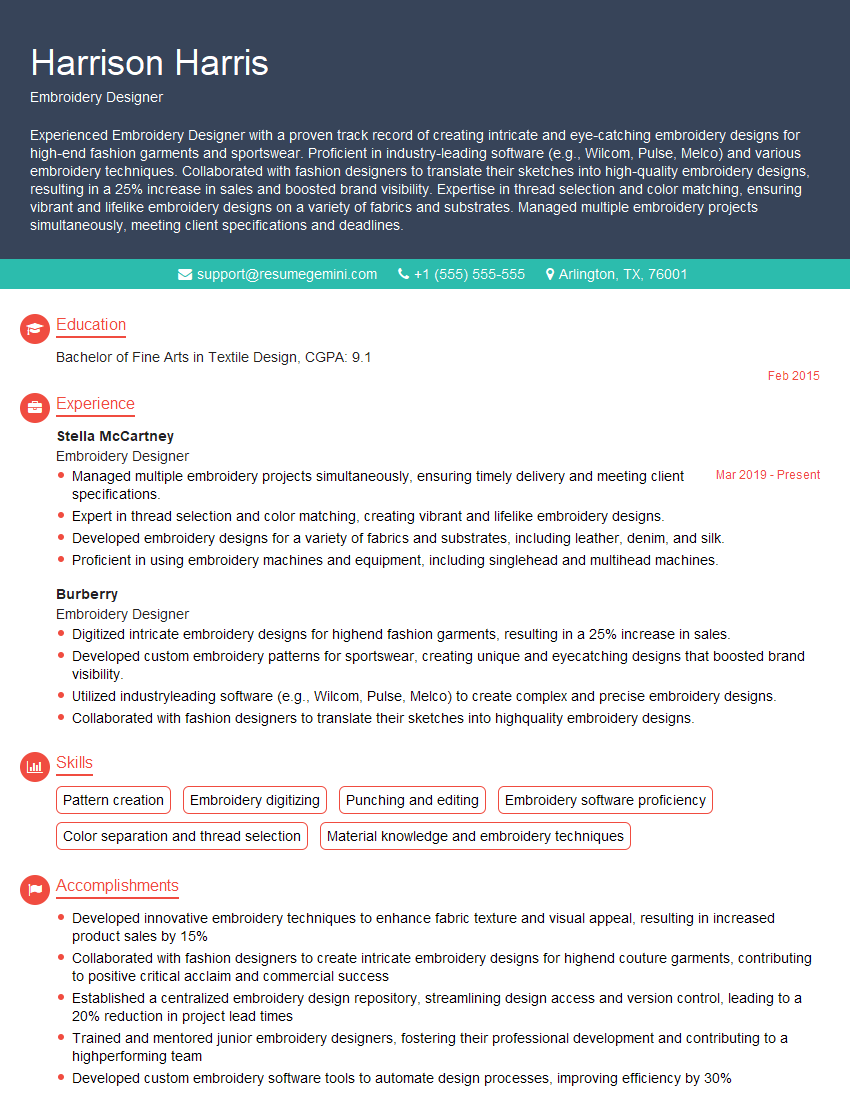
Mastering embroidery stitching techniques like satin stitch and running stitch is crucial for career advancement in the textile arts and related fields. A strong understanding of these fundamental techniques showcases your technical skills and creative potential to potential employers. To significantly enhance your job prospects, create an ATS-friendly resume that highlights your skills and experience effectively. ResumeGemini is a trusted resource to help you build a professional and impactful resume. We provide examples of resumes tailored to showcasing expertise in Knowledge of Embroidery Stitching Techniques, including Satin Stitch and Running Stitch, to help you get started.


Explore more articles
Users Rating of Our Blogs
Share Your Experience
We value your feedback! Please rate our content and share your thoughts (optional).
What Readers Say About Our Blog
Very informative content, great job.
good