Interviews are opportunities to demonstrate your expertise, and this guide is here to help you shine. Explore the essential Microsystems and Microelectronics interview questions that employers frequently ask, paired with strategies for crafting responses that set you apart from the competition.
Questions Asked in Microsystems and Microelectronics Interview
Q 1. Explain the difference between CMOS and BiCMOS technologies.
Both CMOS (Complementary Metal-Oxide-Semiconductor) and BiCMOS (Bipolar CMOS) are widely used semiconductor technologies for integrated circuit fabrication, but they differ significantly in their transistor types and resulting characteristics.
CMOS exclusively uses MOSFETs (Metal-Oxide-Semiconductor Field-Effect Transistors), both PMOS (P-type) and NMOS (N-type), arranged in complementary pairs. This complementary structure leads to very low static power consumption, as one transistor is always off in a given logic state. This makes CMOS ideal for low-power applications like mobile devices and embedded systems. However, CMOS transistors have limitations in high-speed switching, particularly for high current applications.
BiCMOS combines the best features of both CMOS and bipolar junction transistors (BJTs). It uses CMOS for its low power consumption and high density, but integrates BJTs for superior high-speed performance and high current drive capabilities. BJTs are significantly faster than MOSFETs, making BiCMOS ideal for applications requiring both speed and low power, such as high-speed memory interfaces or analog-to-digital converters. The downside is increased complexity and higher manufacturing cost due to the integration of two different transistor types.
Think of it like this: CMOS is a fuel-efficient car, great for city driving and long trips, while BiCMOS is a sports car, excellent for speed but potentially less fuel-efficient. The best choice depends on the application’s priorities.
Q 2. Describe the different types of memory used in microelectronics.
Microelectronics utilizes a variety of memory types, each optimized for different performance and cost trade-offs. These can be broadly categorized into volatile and non-volatile memories:
- Volatile Memory: This type of memory loses its stored information when power is removed. The most common example is RAM (Random Access Memory), which comes in two main varieties:
- SRAM (Static RAM): Uses flip-flops to store data; it’s faster and more expensive than DRAM.
- DRAM (Dynamic RAM): Uses capacitors to store data; it’s slower and cheaper than SRAM but denser.
- Non-Volatile Memory: This type retains data even when power is off. Examples include:
- ROM (Read-Only Memory): Data is programmed during manufacturing and cannot be easily changed. Used for storing firmware or boot code.
- PROM (Programmable ROM): Allows one-time programming by the user.
- EPROM (Erasable PROM): Data can be erased using ultraviolet light and reprogrammed.
- EEPROM (Electrically Erasable PROM): Data can be electrically erased and reprogrammed in-circuit, offering flexibility in updating settings.
- Flash Memory: A type of EEPROM that is organized in blocks and can be erased and reprogrammed in blocks rather than individually. Used extensively in solid-state drives (SSDs), USB drives, and embedded systems.
The choice of memory depends heavily on the application requirements. For example, high-performance computing systems heavily rely on fast SRAM, while embedded systems might use cost-effective flash memory for storage.
Q 3. What are the key challenges in designing low-power microchips?
Designing low-power microchips is crucial for extending battery life in portable devices and reducing energy consumption in data centers. Several key challenges exist:
- Leakage Current: Even when a transistor is switched off, a small current still flows, leading to power dissipation. Minimizing leakage requires advanced transistor design and process technologies.
- Switching Activity: The more a transistor switches states, the more power it consumes. Efficient algorithms and architectural designs can reduce switching activity.
- Clock Frequency: Higher clock frequencies consume more power. Lowering clock speed can significantly reduce power, though it might sacrifice performance.
- Voltage Scaling: Reducing the operating voltage lowers power consumption, but it can also reduce performance and necessitate careful circuit design to avoid reliability issues.
- Thermal Management: Power dissipation generates heat, which needs to be managed to prevent overheating and potential failures. Efficient heat sinks and thermal design are crucial.
Strategies to address these challenges include using low-power design techniques like power gating, clock gating, and using lower-threshold voltage transistors, but these often come with trade-offs in performance and area.
Q 4. Explain the concept of Moore’s Law and its implications.
Moore’s Law, proposed by Gordon Moore, observes that the number of transistors on a microchip doubles approximately every two years. This observation has driven exponential growth in computing power and capabilities over the past several decades.
Implications:
- Increased Computing Power: More transistors allow for more complex circuits and higher processing power.
- Reduced Cost: Increased production efficiency due to miniaturization lowers the cost per transistor.
- Miniaturization: Smaller chips lead to smaller and more portable devices.
- Improved Energy Efficiency: While not always directly proportional, advancements often lead to more efficient power usage.
However, Moore’s Law is facing physical limitations, as transistor scaling is nearing its limits due to quantum effects and manufacturing challenges. Continued growth will require innovations in materials science, architecture, and circuit design.
Q 5. Discuss various fabrication techniques used in semiconductor manufacturing.
Semiconductor manufacturing involves intricate processes to create integrated circuits. Key fabrication techniques include:
- Photolithography: Uses ultraviolet light to transfer patterns from a mask onto a silicon wafer, creating the transistor structures.
- Etching: Removes unwanted material from the wafer, using techniques like wet etching or dry etching (plasma etching).
- Ion Implantation: Introduces dopant atoms into specific regions of the wafer, modifying the electrical properties of the silicon.
- Thin Film Deposition: Deposits thin layers of materials, such as oxides, nitrides, or metals, onto the wafer, forming the various layers of the transistors.
- Chemical-Mechanical Planarization (CMP): Polishes the wafer surface to create a flat and uniform surface for subsequent processing steps.
- Chemical Vapor Deposition (CVD): Used to deposit thin films of various materials at high temperatures. This is crucial for creating insulators and conductors within the chip.
- Atomic Layer Deposition (ALD): A specialized CVD technique that deposits extremely thin and uniform films, one atomic layer at a time. This is critical for advanced nodes where precise control over layer thickness is essential.
These steps are repeated many times to create the complex three-dimensional structures found in modern integrated circuits. The precision and control required are incredibly high, necessitating highly sophisticated equipment and cleanroom environments.
Q 6. How do you perform static timing analysis?
Static timing analysis (STA) is a crucial step in verifying the timing correctness of a digital integrated circuit design. It involves analyzing the design to determine the maximum propagation delays and setup/hold times of all paths to ensure that the circuit operates correctly at the desired clock frequency.
The process generally involves these steps:
- Design Import: The design’s netlist (describing the connections between logic elements) and standard cell libraries (defining the timing characteristics of individual components) are input into the STA tool.
- Constraint Definition: Constraints specifying the clock frequency, input/output delays, and other timing requirements are provided. This defines the timing budget for the design.
- Timing Path Analysis: The tool analyzes all possible timing paths in the design, calculating the propagation delays for each path. This includes considering delays through gates, wires, and interconnects.
- Setup and Hold Time Analysis: The tool checks whether the timing constraints (setup and hold times) are met for all flip-flops and registers in the design. Setup time ensures the data is stable before the clock edge, while hold time ensures it remains stable after the clock edge.
- Report Generation: The tool generates a report detailing the timing analysis results, including critical paths (paths that violate timing constraints), slack (the difference between the required and actual timing), and other relevant metrics. The report pinpoints problem areas.
STA tools employ sophisticated algorithms to efficiently analyze large designs. If violations are found, design modifications are needed (e.g., resizing gates, adding buffers, or re-routing signals) and the analysis repeated until all timing constraints are met. This iterative process ensures the design’s reliability and functionality.
Q 7. Explain different types of semiconductor packaging.
Semiconductor packaging is critical for protecting the delicate die and connecting it to the outside world. Various packaging techniques exist, catering to different requirements of performance, size, and cost:
- Wire Bonding: Fine gold wires are used to connect the die’s bond pads to the package leads. This is a cost-effective method, but can limit bandwidth and performance.
- Flip-Chip Packaging: The die is flipped over and directly connected to the substrate using solder bumps. This improves interconnect density and performance but is more complex.
- System-in-Package (SiP): Integrates multiple dies, passive components, and other functionalities into a single package. Offers increased functionality and reduced footprint.
- Ball Grid Array (BGA): Uses solder balls to connect the die to the package. Provides high pin counts and compact form factors.
- Chip Scale Packaging (CSP): The package size closely matches the die size, minimizing space requirements.
- Through-Silicon Vias (TSV): Vertical interconnects through the silicon die, enabling 3D stacking of multiple dies, significantly increasing performance and density.
The choice of packaging depends on factors such as the die size, pin count, required performance, cost, and thermal requirements. For instance, high-performance CPUs may utilize advanced packaging techniques like TSV for increased bandwidth and power efficiency, while low-cost applications might opt for simpler wire bonding.
Q 8. What are the trade-offs between different transistor sizes?
Transistor size, often referred to as its gate length, significantly impacts performance and power consumption in integrated circuits. Smaller transistors generally offer advantages in speed and power efficiency due to reduced parasitic capacitances, leading to faster switching times and lower power dissipation. However, there are trade-offs.
Speed vs. Power: Smaller transistors are faster but more susceptible to leakage current, which increases power consumption at lower frequencies or when idle. Think of it like a smaller pipe – water (current) flows faster, but a tiny leak can still waste a lot of water.
Area vs. Density: Smaller transistors allow for higher transistor density on a chip, enabling more complex designs within a given area. This reduces the overall chip size and cost, but comes with increased design complexity and potentially higher manufacturing challenges.
Manufacturing Cost: Fabricating smaller transistors requires more precise and expensive manufacturing processes, increasing the cost per chip, especially at leading-edge nodes.
Reliability vs. Variability: Smaller transistors are more susceptible to process variations and random dopant fluctuations, potentially impacting their performance and reliability. This can lead to yield loss during manufacturing.
The optimal transistor size is a careful balance between these factors, often determined by the specific application requirements. For high-performance computing, smaller transistors are preferred, even if power consumption is slightly higher. In low-power applications, such as wearables, a larger transistor might be chosen to minimize power drain, even if it results in lower speed.
Q 9. Describe the process of designing a simple microcontroller.
Designing a simple microcontroller involves several key stages. Let’s consider a basic 8-bit microcontroller:
Architectural Design: Define the core architecture, including the CPU (Central Processing Unit), memory (RAM, ROM), peripherals (timers, serial communication interfaces, etc.). This stage involves choosing the instruction set architecture (ISA), register file size, and addressing modes.
Instruction Set Design (ISA): Define the set of instructions the microcontroller will execute. This involves determining the types of operations (arithmetic, logic, memory access, etc.) and their encoding.
Hardware Design (RTL): Using a Hardware Description Language (HDL) such as VHDL or Verilog, describe the hardware components in a register-transfer level (RTL). This defines the logic gates, registers, and data paths at a higher level of abstraction than the transistor level.
Synthesis and Optimization: The HDL code is passed to a synthesis tool which translates it into a gate-level netlist, representing the actual logic gates and connections. This stage involves optimizations for area, power, and performance.
Place and Route: The gate-level netlist is then physically placed and routed on a silicon die. This involves assigning locations to gates and interconnecting them based on the netlist.
Verification: Throughout the design process, extensive simulations and testing are performed to verify the functionality and performance of the microcontroller. This can involve functional simulations (checking the logic) and timing simulations (checking if the design meets timing constraints).
Fabrication: The design is then sent to a fabrication facility (fab) for manufacturing. This involves photolithography, etching, and other semiconductor processing steps to create the physical chip.
Packaging and Testing: After fabrication, the chip is packaged and undergoes final testing to ensure its functionality and reliability.
This is a simplified overview. A real-world microcontroller design is significantly more complex, involving various design considerations, such as power management, clocking schemes, and security measures.
Q 10. What are the key parameters to consider when selecting a microcontroller for an embedded system?
Choosing a microcontroller involves careful consideration of several parameters:
Processing Power: Measured in MIPS (Million Instructions Per Second) or DMIPS (Dhrystone MIPS), this determines the microcontroller’s ability to handle complex tasks. A higher MIPS rating indicates faster processing.
Memory: The amount of RAM (Random Access Memory) and flash memory available significantly influences the microcontroller’s capabilities. RAM stores data actively used by the program, while flash memory stores the program itself and persistent data.
Peripherals: Microcontrollers usually have various built-in peripherals, such as timers, analog-to-digital converters (ADCs), serial communication interfaces (UART, SPI, I2C), and general purpose input/output (GPIO) pins. The specific peripherals needed depend on the application.
Power Consumption: This is critical for battery-powered applications. Low power consumption extends battery life and reduces heat generation.
Operating Voltage and Frequency: The operating voltage determines the power supply requirements, while the operating frequency affects the speed and power consumption. These should be compatible with the application’s needs.
Package Type and Size: The physical size and pin count of the microcontroller package must be suitable for the PCB layout.
Cost: The microcontroller’s price should be balanced against its performance and features.
Development Tools and Support: Ease of programming, availability of development tools, and vendor support are important factors.
For instance, a simple sensor application might only require a microcontroller with limited processing power, minimal memory, and an ADC, while a complex industrial control system would necessitate a more powerful microcontroller with extensive memory, various communication interfaces, and robust real-time capabilities.
Q 11. Explain different types of analog-to-digital converters (ADCs).
Analog-to-digital converters (ADCs) transform continuous analog signals into discrete digital values. Several types exist, each with its strengths and weaknesses:
Flash ADC: The fastest type. It uses a parallel comparison of the analog signal against a set of reference voltages. High speed comes at the cost of high power consumption and large area.
Successive Approximation ADC (SAR): A common type that uses a binary search approach to find the closest digital representation of the analog signal. It offers a good balance between speed, resolution, and power consumption.
Sigma-Delta ADC (ΣΔ ADC): Over-samples the analog signal at a high rate, then uses digital filtering to reduce noise and improve resolution. It is known for its high resolution and low power consumption, but is generally slower than flash and SAR ADCs.
Pipeline ADC: A high-speed ADC that performs the conversion in multiple stages, pipelining the operations to improve throughput. It is complex but offers high speeds at moderate power consumption.
Integrating ADC: Measures the average value of the analog signal over a specific time period. This is robust to noise but is relatively slow and has lower resolution.
The choice of ADC depends on the application requirements. For example, high-speed data acquisition systems might use flash ADCs, while battery-powered applications often favor sigma-delta ADCs for their low power consumption. Applications requiring high resolution, such as audio processing, might employ sigma-delta or high-resolution SAR ADCs.
Q 12. Describe your experience with different EDA tools.
My experience with EDA (Electronic Design Automation) tools spans various platforms and applications. I’m proficient in using tools from major vendors such as Cadence, Synopsys, and Mentor Graphics. My experience includes:
Cadence Allegro: Extensive use in PCB design, including schematic capture, PCB layout, and signal integrity analysis.
Synopsys VCS/QuestaSim: Experienced in verifying digital designs using Verilog and SystemVerilog through functional and timing simulations.
Synopsys Design Compiler: Proficient in synthesis and optimization of RTL code for area, power, and performance.
Mentor Graphics ModelSim: Used for functional verification and co-simulation of digital and analog designs.
Cadence Virtuoso: Experience in analog circuit design and simulation, including schematic capture, layout, and simulation using Spectre.
I’m also familiar with other tools such as Altium Designer for PCB design and various scripting languages (Tcl, Python) for automating tasks within the EDA flow. My experience extends to using these tools in a collaborative environment, working with design teams to ensure consistent methodologies and efficient workflow.
Q 13. How do you handle signal integrity issues in high-speed PCB designs?
Signal integrity issues in high-speed PCB designs are critical and can lead to malfunction or data corruption. These issues are mainly caused by reflections, crosstalk, and impedance mismatch. Handling them effectively requires a multi-pronged approach:
Controlled Impedance Routing: Maintaining consistent impedance along signal traces is crucial to minimize reflections. This usually involves using controlled impedance microstrip or stripline routing techniques and specifying track widths and spacing carefully based on the PCB material and design frequency.
Decoupling Capacitors: Strategically placing decoupling capacitors near integrated circuits helps to suppress noise and voltage fluctuations, improving signal integrity.
Differential Signaling: Using differential signaling pairs reduces noise susceptibility by transmitting data as the difference between two signals. Careful matching of trace lengths and impedances is essential.
Grounding and Power Planes: A well-designed ground plane and power planes minimize noise coupling and provide a stable return path for signals. Proper placement of vias and careful consideration of plane discontinuities are necessary.
EMI/EMC Considerations: Incorporating EMI/EMC (Electromagnetic Interference/Electromagnetic Compatibility) considerations in the design minimizes external noise and ensures compliance with regulatory standards. This can include shielding, filtering, and proper cable management.
Signal Integrity Simulation: Using simulation tools such as HyperLynx or similar software is crucial to predict and mitigate signal integrity problems before manufacturing the PCB.
I’ve encountered and solved several signal integrity challenges in my career, ranging from high-speed serial links to memory interfaces. Effective signal integrity management relies on a strong understanding of high-frequency effects and careful consideration of the physical layout.
Q 14. What are the different types of noise in electronic circuits, and how do you mitigate them?
Noise in electronic circuits can severely affect performance and reliability. Several types of noise exist:
Thermal Noise (Johnson-Nyquist Noise): This inherent noise is caused by the random motion of electrons in a conductor. It is proportional to temperature and bandwidth. It is unavoidable, but its effect can be minimized by using low-noise amplifiers and careful circuit design.
Shot Noise: Caused by the discrete nature of charge carriers (electrons or holes) crossing a junction. This is more pronounced in devices with high current densities.
Flicker Noise (1/f Noise): Low-frequency noise with a power spectral density inversely proportional to frequency. It is often dominant at low frequencies and can be mitigated through careful component selection and circuit design.
Power Supply Noise: Fluctuations in the power supply voltage can introduce noise into the circuit. Decoupling capacitors and efficient power supply design are essential to mitigate this.
Crosstalk: Unwanted coupling between adjacent signal traces on a PCB, caused by electromagnetic fields. Proper routing and shielding are crucial to reduce crosstalk.
EMI/RFI Noise: Electromagnetic interference (EMI) and radio frequency interference (RFI) from external sources can be coupled into the circuit. Shielding, filtering, and proper grounding techniques are used to minimize these effects.
Mitigation strategies depend on the type and source of noise. Techniques include shielding, filtering, proper grounding, decoupling capacitors, differential signaling, and careful component selection. Simulation tools can play a crucial role in predicting and mitigating noise problems before manufacturing.
Q 15. Explain different power management techniques in integrated circuits.
Power management in integrated circuits (ICs) is crucial for extending battery life in portable devices and reducing heat dissipation in high-performance systems. Various techniques are employed, broadly categorized as:
- Voltage Scaling: Reducing the supply voltage (Vdd) directly reduces power consumption (Power ∝ Vdd²). This is a fundamental technique, but it also impacts performance, as lower voltages can lead to slower clock speeds. Dynamic Voltage and Frequency Scaling (DVFS) dynamically adjusts both voltage and frequency based on the workload, optimizing power and performance. For example, a smartphone might lower its CPU frequency and voltage when displaying a static image, saving power.
- Clock Gating: Turning off the clock signal to inactive parts of the circuit completely eliminates power consumption in those sections. This is particularly effective for infrequently used modules. Imagine a microcontroller with several peripherals; if only one is active, the clocks to the others can be gated off.
- Power Gating: This goes beyond clock gating by completely isolating a section of the circuit from the power supply, further reducing leakage current. This technique is more complex to implement but offers greater power savings, especially for larger blocks.
- Sleep Modes: ICs can enter low-power sleep modes where most components are turned off, waking up only when needed. Different sleep modes offer varying levels of power consumption and wake-up latency. Think of your laptop going into hibernation or your phone’s standby mode.
- Leakage Current Reduction: Minimizing leakage current, the current that flows even when a transistor is off, is critical. This involves careful transistor design and process optimization. Techniques include using low-leakage transistors and optimizing layout to reduce parasitic capacitance.
Choosing the right combination of these techniques depends on the specific application’s requirements for power consumption, performance, and cost.
Career Expert Tips:
- Ace those interviews! Prepare effectively by reviewing the Top 50 Most Common Interview Questions on ResumeGemini.
- Navigate your job search with confidence! Explore a wide range of Career Tips on ResumeGemini. Learn about common challenges and recommendations to overcome them.
- Craft the perfect resume! Master the Art of Resume Writing with ResumeGemini’s guide. Showcase your unique qualifications and achievements effectively.
- Don’t miss out on holiday savings! Build your dream resume with ResumeGemini’s ATS optimized templates.
Q 16. How would you debug a faulty integrated circuit?
Debugging a faulty IC is a systematic process. It begins with understanding the symptoms. Is the IC not functioning at all, or are there intermittent failures? What are the observed outputs compared to the expected ones?
- Visual Inspection: Start by visually inspecting the IC for any physical damage, such as cracks or short circuits. A microscope might be needed for finer details.
- Testing with known good inputs: Apply known good input signals and observe the outputs. This helps isolate the problem to a specific part of the circuit.
- In-Circuit Emulation (ICE): An ICE allows you to monitor internal signals of the IC while it’s running in its actual environment. This provides a detailed view of signal behavior.
- Logic Analyzers/Oscilloscope: These tools measure signals at various points on the IC, helping pinpoint timing or logic errors.
- Boundary Scan Testing (JTAG): Many ICs have JTAG interfaces that allow accessing internal test points without needing external probes. This is a very efficient technique for testing.
- Fault Injection: Sometimes injecting controlled faults can help localize the problem by observing the effects on the IC’s functionality.
- Simulation: If the fault cannot be traced to a physical defect, comparing the actual behavior with simulations can often uncover design errors.
The debugging approach depends heavily on the type of IC, available tools, and the nature of the fault. It often involves a combination of these techniques. For instance, I once debugged a faulty sensor IC by using an oscilloscope to pinpoint a timing issue in the communication protocol, ultimately traced back to a misconfigured clock signal.
Q 17. Describe your experience with Verilog or VHDL.
I have extensive experience with both Verilog and VHDL, using them for designing and verifying digital circuits. While both are Hardware Description Languages (HDLs), they have their strengths and nuances.
Verilog, with its C-like syntax, is more concise and generally easier to learn for programmers familiar with C or similar languages. I’ve used Verilog extensively for designing complex state machines and arithmetic logic units (ALUs). For example, I wrote a Verilog module to model a pipelined RISC-V processor core, utilizing its strengths in procedural modeling.
VHDL, on the other hand, is more strongly typed and follows a more formal, structured approach. This makes it better suited for large, complex projects where maintainability and code readability are crucial. I found VHDL particularly valuable when working on a large team developing a networking chip, where its strong typing helped catch errors during the design phase. A specific example is designing a VHDL model for a packet processing unit with complex data structures, where VHDL’s strong typing ensured data integrity.
My proficiency in both languages allows me to choose the most appropriate language based on the project’s needs and team expertise.
Q 18. Explain the concept of clock domain crossing.
Clock domain crossing (CDC) refers to the situation where data is transferred between two independent clock domains. This is a common occurrence in modern digital systems, where different parts of a system might operate at different clock frequencies or phases.
The problem with CDC is that metastability can occur. Metastability is an unstable state where a flip-flop, receiving a signal that changes near the clock edge, ends up in neither a ‘0’ nor a ‘1’ state for an unpredictable amount of time. This unpredictable state can lead to errors. Imagine a flip-flop trying to decide between 0 and 1; it could temporarily settle on a state not clearly 0 or 1 before ultimately deciding – potentially causing data corruption.
To mitigate metastability, several techniques are employed:
- Synchronization: The simplest approach is to use a series of flip-flops in the destination clock domain. Multiple flip-flops increase the probability of resolving the metastable state before the data is used.
- Asynchronous FIFOs (First-In, First-Out): FIFOs are specialized structures designed to handle data transfer between asynchronous clock domains reliably. They use handshaking signals to ensure data integrity.
- Gray Codes: Using Gray codes, where only one bit changes at a time during transitions, can minimize the impact of metastability.
The choice of technique depends on factors such as data rate, timing constraints, and area budget. Proper handling of CDC is critical to ensure the reliability of digital systems.
Q 19. What are the advantages and disadvantages of using FPGAs?
Field-Programmable Gate Arrays (FPGAs) are reconfigurable integrated circuits that offer significant advantages and disadvantages:
- Advantages:
- Flexibility: FPGAs can be reprogrammed multiple times, allowing rapid prototyping and design iteration. This makes them ideal for testing new algorithms or designs before committing to ASIC (Application-Specific Integrated Circuit) development.
- Time to Market: For prototyping and smaller-volume applications, FPGAs can significantly shorten the time to market compared to ASICs.
- Parallelism: FPGAs excel at parallel processing, making them suitable for applications requiring high throughput.
- Hardware acceleration: FPGAs can offload computationally intensive tasks from CPUs or GPUs, resulting in significant performance gains.
- Disadvantages:
- Cost: FPGAs are generally more expensive per unit than ASICs, especially in high-volume applications.
- Power Consumption: FPGAs can consume more power than equivalent ASICs, particularly for high-performance designs.
- Performance: While FPGAs are fast, they may not always match the performance of optimized ASICs.
- Design Complexity: Designing for FPGAs can be more complex than designing ASICs due to the need for resource management and timing closure.
The decision of whether to use an FPGA or an ASIC depends on factors such as volume, performance requirements, time-to-market constraints, and cost.
Q 20. How do you perform thermal analysis of integrated circuits?
Thermal analysis of integrated circuits is crucial to ensure reliable operation and prevent overheating. Overheating can lead to performance degradation, malfunction, and even permanent damage. The analysis typically involves:
- Power estimation: First, the power dissipation of each component in the IC needs to be estimated. This involves considering both static and dynamic power consumption.
- Thermal simulation: Specialized software tools, such as ANSYS Icepak or Flotherm, are used to simulate the heat transfer within the IC and its surrounding package. These tools employ computational fluid dynamics (CFD) to model the airflow and heat dissipation.
- Thermal modeling: A thermal model of the IC and its package is created, considering factors like material properties, geometry, and boundary conditions.
- Junction temperature calculation: The simulation calculates the junction temperature, which is the highest temperature within the IC’s active components. This temperature is crucial because exceeding the maximum junction temperature will lead to device failure.
- Design optimization: Based on the thermal simulation results, design modifications can be made to improve heat dissipation. This could include changes to the package design, heat spreader, or even the IC layout.
For example, in designing a high-power processor, we would simulate different heat sink designs and choose the one that best maintains the junction temperature within safe limits. Thermal analysis is not a separate activity, but rather an iterative process incorporated throughout the design process.
Q 21. What are the different types of semiconductor testing methods?
Semiconductor testing involves a range of methods to ensure the quality and functionality of integrated circuits. These methods can be broadly categorized as:
- In-circuit testing (ICT): ICT verifies the connectivity and functionality of components on a printed circuit board (PCB). It uses specialized probes to test individual components and their interconnections.
- Functional testing: This tests the overall functionality of the IC by applying various input patterns and checking the outputs. This is often done using automatic test equipment (ATE).
- Parametric testing: This method measures various electrical parameters such as voltage, current, and capacitance to ensure they are within specifications. This helps detect manufacturing defects that may not affect functionality.
- Wafer probing: Before packaging, ICs on a wafer are tested using probes that contact the pads on the die. This allows for early detection of defects and identification of faulty dies.
- Burn-in testing: This involves running ICs at high temperatures for an extended period to stress them and detect early failures due to latent defects.
- System-level testing: This is often the final step, where the IC is integrated into its final system and tested to ensure proper operation in the complete system environment.
- Design for Test (DFT): DFT is not a test method in itself, but a design approach that incorporates test structures and mechanisms to improve testability. This includes techniques such as scan chains and built-in self-test (BIST).
The specific testing methods used depend on various factors like the type of IC, its application, and cost constraints. Often, a combination of methods is used to ensure comprehensive testing.
Q 22. Explain the concept of yield in semiconductor manufacturing.
Yield in semiconductor manufacturing refers to the percentage of successfully manufactured chips that meet the specified quality and functionality standards. It’s a crucial metric for profitability because a low yield translates directly to higher production costs and reduced profit margins. Think of it like baking cookies – if you start with 100 cookie dough balls but only 80 come out perfectly baked and edible, your yield is 80%.
Several factors influence yield, including:
- Process variations: Slight imperfections in the manufacturing process can lead to defects in the chips.
- Design flaws: Issues in the chip design can cause manufacturing difficulties and failures.
- Material defects: Imperfections in the raw materials (silicon wafers) can propagate to the finished chips.
- Equipment malfunction: Problems with the manufacturing equipment can damage chips during the fabrication process.
Improving yield is a constant goal in semiconductor manufacturing. This is achieved through continuous process optimization, improved design for manufacturability (DFM), advanced materials and equipment, and rigorous quality control measures. For example, advanced lithography techniques allow for the creation of smaller, more densely packed circuits, leading to higher yields in advanced node chips. Implementing robust defect detection mechanisms during the fabrication process also helps to identify and remove faulty chips early on, improving the overall yield.
Q 23. How do you design for reliability in microelectronics?
Designing for reliability in microelectronics is paramount, as failures can have severe consequences, particularly in safety-critical applications like automotive systems or medical devices. Reliability encompasses the ability of a system to perform its intended function under specified conditions for a given period. It’s achieved through a multi-faceted approach encompassing:
- Robust design: Using design techniques that minimize sensitivity to variations in manufacturing processes and operating conditions. This often involves extensive simulations and stress testing.
- Redundancy: Incorporating backup components or systems to ensure continued operation even if one component fails. Think of having two batteries for a device: if one fails, the second takes over.
- Derating components: Operating components below their maximum specifications to increase their lifespan and reduce the likelihood of failure. For example, using a capacitor with a higher voltage rating than strictly required.
- Thermal management: Efficient heat dissipation is critical to prevent overheating, a major cause of electronic failures. This may involve using heat sinks, fans, or other cooling solutions.
- Failure analysis: Thoroughly investigating failures to identify root causes and prevent their recurrence. This often involves techniques like electron microscopy and fault injection.
A real-world example is the aerospace industry, where extreme reliability is mandatory. Here, extensive testing, redundancy, and robust design practices are implemented to ensure that critical systems do not fail in flight.
Q 24. What is the difference between a microprocessor and a microcontroller?
While both microprocessors and microcontrollers are integrated circuits (ICs) based on a central processing unit (CPU), they differ significantly in their architecture and applications.
- Microprocessor: A general-purpose processor designed for high computational power and flexibility. It typically has a complex instruction set architecture (CISC) or reduced instruction set architecture (RISC), a large address space, and numerous peripherals that need to be connected externally. They form the heart of powerful computers like desktops and laptops.
- Microcontroller: A specialized processor integrated with memory, peripherals (timers, analog-to-digital converters (ADCs), serial communication interfaces, etc.), and other features on a single chip. They are optimized for embedded systems, applications where a dedicated processor is embedded within a larger device to manage a specific task. Examples include washing machines, automotive systems, and industrial control systems.
The key difference lies in their application domain. Microprocessors are flexible and used for general-purpose tasks, while microcontrollers are specialized for embedded applications, emphasizing low power consumption, cost-effectiveness, and dedicated functionalities.
Q 25. Describe your experience with different design methodologies (e.g., top-down, bottom-up).
Throughout my career, I have extensively utilized both top-down and bottom-up design methodologies, selecting the approach best suited to the project’s complexity and requirements.
- Top-down design: Starts with the overall system specifications and gradually refines the design into smaller, more manageable modules. This is particularly effective for complex systems, enabling better organization and abstraction. Think of building a house; you start with an architectural plan (system specs) then design individual rooms (modules).
- Bottom-up design: Focuses on designing individual components or modules, which are then integrated to form the complete system. This is suitable when working with well-defined components or when reusing existing modules. Analogy would be building with Lego bricks – you start with individual bricks and assemble them.
In practice, I frequently use a hybrid approach, combining elements of both methodologies. For instance, a project might start with a top-down approach to define the overall architecture and then move to a bottom-up approach for the detailed design of individual modules. This allows for a flexible and efficient design process adaptable to various project scenarios. For example, in the development of a complex sensor network, I would start with a top-down approach to define the network architecture, communication protocols, and data processing strategy. Then, I would employ a bottom-up approach to design individual sensor nodes, optimize their power consumption, and develop their firmware.
Q 26. Explain different types of sensors used in microsystems.
Microsystems leverage a wide range of sensors to interact with the physical world. These sensors convert physical phenomena (such as pressure, temperature, or light) into electrical signals that can be processed by the system.
- Mechanical sensors: These include accelerometers (measuring acceleration), gyroscopes (measuring angular velocity), pressure sensors, and microphones.
- Thermal sensors: Thermocouples, resistance temperature detectors (RTDs), and thermistors measure temperature.
- Optical sensors: Photodiodes, phototransistors, and charge-coupled devices (CCDs) detect light intensity and wavelength.
- Chemical sensors: Gas sensors, pH sensors, and biosensors detect chemical species.
- Magnetic sensors: Hall effect sensors detect magnetic fields.
The choice of sensor depends on the specific application. For example, a smartphone uses accelerometers and gyroscopes for motion sensing, while a medical device may incorporate a biosensor for detecting biomolecules. The design of microsystems often involves integrating multiple sensors to collect comprehensive data.
Q 27. How do you ensure the security of an embedded system?
Ensuring the security of an embedded system is crucial, especially with the increasing connectivity of such systems. Security threats can range from unauthorized access to data breaches and system malfunctions. A layered security approach is necessary, incorporating several measures:
- Secure boot process: Verifying the integrity of the system software before execution to prevent malicious code from running.
- Hardware security modules (HSMs): Dedicated hardware components that perform cryptographic operations securely, protecting encryption keys and other sensitive data.
- Secure communication protocols: Using encryption and authentication to protect data transmitted over networks. For instance, employing TLS/SSL for secure communication over the internet.
- Regular software updates: Addressing vulnerabilities discovered in the system’s software through regular patching.
- Access control: Limiting access to the system’s resources based on user roles and privileges.
- Intrusion detection and prevention systems: Monitoring the system for suspicious activity and taking appropriate action to mitigate potential threats.
For example, in a smart home system, secure communication protocols are vital to prevent unauthorized access to the home network and control of appliances. The use of strong encryption and authentication methods is critical to protecting the user’s privacy and preventing malicious attacks.
Q 28. Describe your experience with any relevant software or hardware design tools.
My experience encompasses a broad range of software and hardware design tools. On the hardware side, I am proficient in Electronic Design Automation (EDA) tools such as Cadence Virtuoso for analog/mixed-signal IC design and Synopsys for digital IC design. I’m also experienced in using tools for PCB design like Altium Designer. I’ve utilized these tools to design and simulate various circuits, from simple amplifiers to complex integrated systems.
On the software side, I’m skilled in programming languages such as C, C++, and Python. These are indispensable for embedded system programming and system-level design. I’m familiar with various real-time operating systems (RTOS), including FreeRTOS and Zephyr, and utilize debugging and simulation tools such as JTAG debuggers and model-based design tools like Simulink for software development and verification. I have also used various software tools for circuit simulation, such as LTSpice and Multisim. My experience with these tools has been essential in the successful completion of numerous projects, from designing high-performance analog circuits to developing embedded systems for industrial applications.
Key Topics to Learn for Microsystems and Microelectronics Interviews
- Semiconductor Physics: Understand fundamental concepts like band theory, doping, carrier transport, and p-n junctions. This forms the bedrock of microelectronics.
- Device Physics and Fabrication: Gain a solid grasp of MOSFET operation, CMOS technology, and integrated circuit fabrication processes. Be prepared to discuss challenges and advancements in miniaturization.
- Analog and Digital Circuit Design: Explore operational amplifiers, comparators, digital logic gates, and flip-flops. Understand the trade-offs between different design choices.
- Microelectromechanical Systems (MEMS): Learn about the design, fabrication, and applications of MEMS devices, including sensors and actuators. Discuss relevant fabrication techniques like etching and deposition.
- Signal Processing and Embedded Systems: Understand the basics of signal acquisition, filtering, and digital signal processing. Familiarize yourself with microcontroller architectures and programming.
- System-on-a-Chip (SoC) Design: Explore the principles of integrating multiple functionalities onto a single chip. Discuss the challenges and benefits of SoC design.
- Problem-Solving and Design Methodology: Practice applying your knowledge to solve real-world problems. Be prepared to discuss your approach to design challenges and troubleshooting techniques.
- Emerging Technologies: Stay updated on the latest trends in microelectronics, such as nanotechnology, neuromorphic computing, and quantum computing.
Next Steps
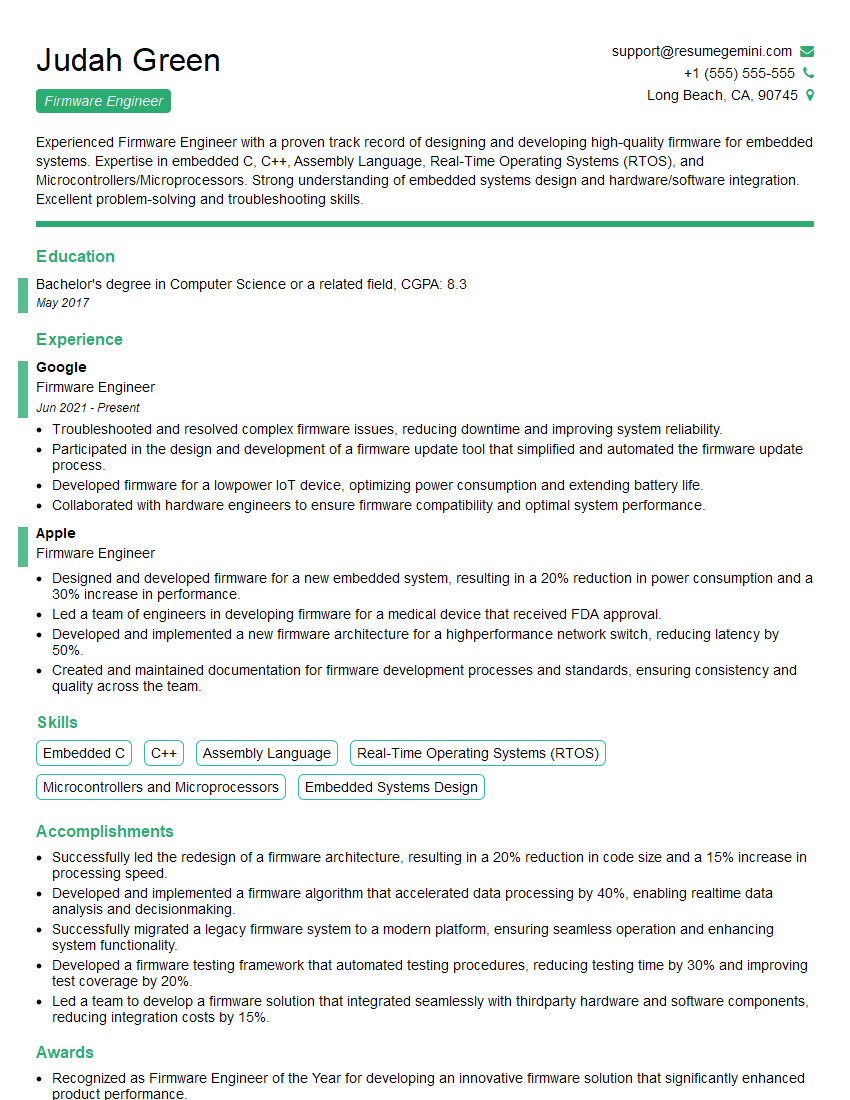
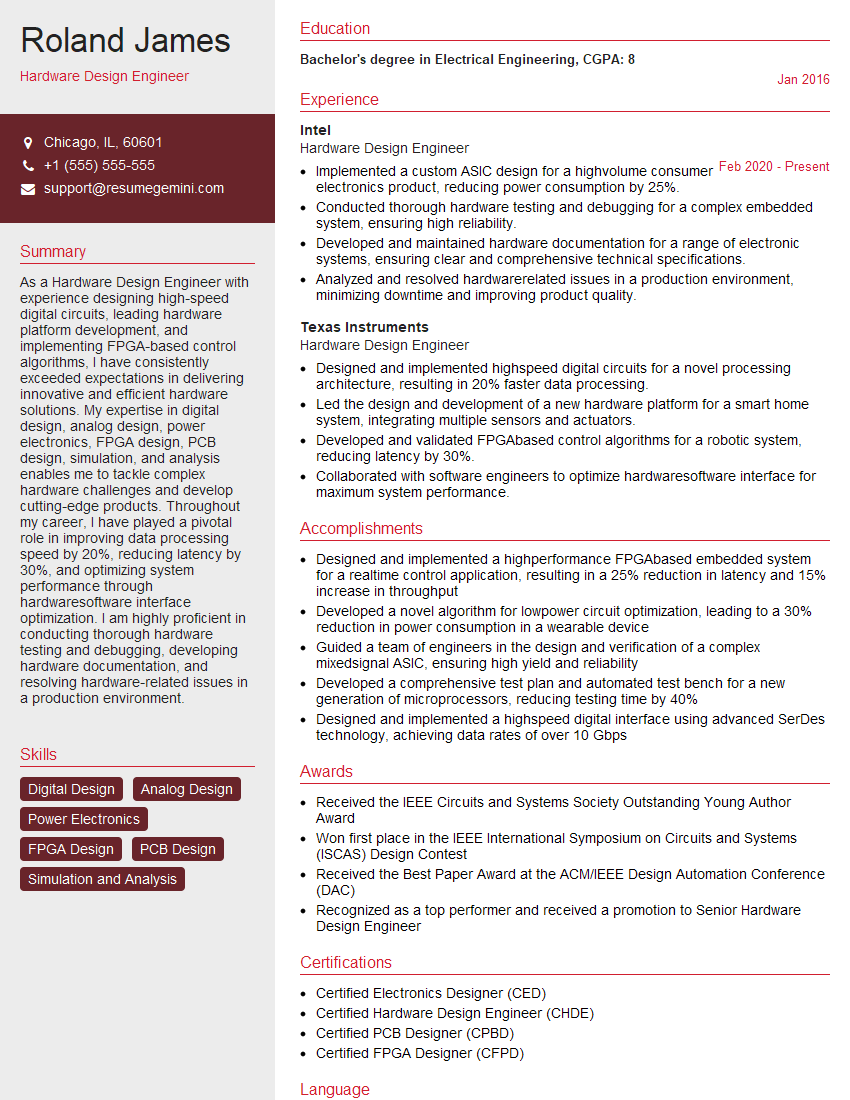
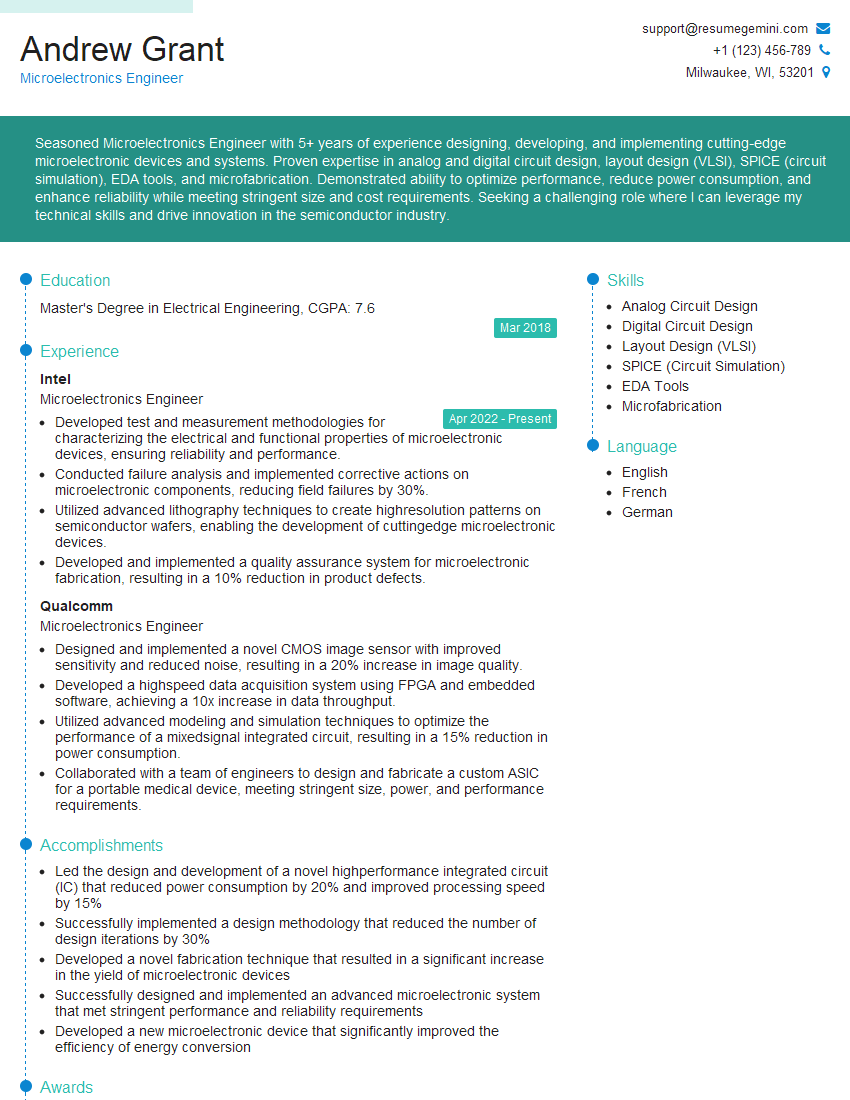
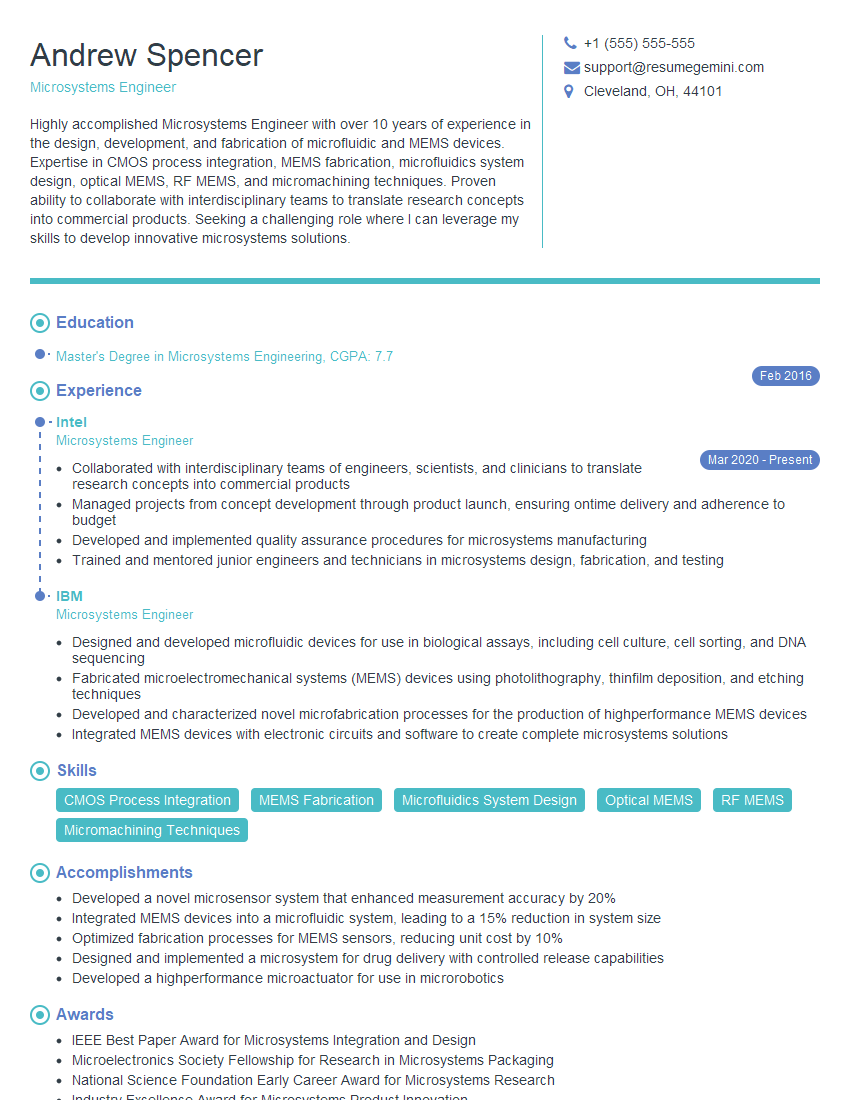
Mastering Microsystems and Microelectronics opens doors to exciting and impactful careers in a rapidly evolving field. To significantly boost your job prospects, invest time in crafting a compelling, ATS-friendly resume that highlights your skills and experience effectively. ResumeGemini is a trusted resource to help you build a professional resume that truly showcases your qualifications. Take advantage of our examples of resumes tailored to Microsystems and Microelectronics to gain a competitive edge in your job search. A well-structured resume is your first impression – make it count!

Explore more articles
Users Rating of Our Blogs
Share Your Experience
We value your feedback! Please rate our content and share your thoughts (optional).
What Readers Say About Our Blog
Very informative content, great job.
good