Cracking a skill-specific interview, like one for Knowledge of Missile System Components and Subsystems, requires understanding the nuances of the role. In this blog, we present the questions you’re most likely to encounter, along with insights into how to answer them effectively. Let’s ensure you’re ready to make a strong impression.
Questions Asked in Knowledge of Missile System Components and Subsystems Interview
Q 1. Explain the different types of missile guidance systems.
Missile guidance systems are the brains of the operation, directing the missile to its target. Different systems offer varying levels of precision and reliance on external factors. They can be broadly categorized as follows:
- Command Guidance: This system relies on an external source, like a ground station or aircraft, to continuously transmit commands to the missile, adjusting its trajectory. Think of it like remotely controlling a toy car, but with much higher stakes. An example is the early versions of some anti-aircraft missiles.
- Beam Rider Guidance: The missile follows a continuous beam of energy, like a laser or radar, that illuminates the target. Imagine a dog following a laser pointer; the missile stays locked onto the beam, guided towards the target. This system is relatively simple but susceptible to jamming or interference.
- Homing Guidance: This is arguably the most common type. The missile carries its own sensor (infrared, radar, etc.) to detect the target and navigate to it independently. There are two main types:
- Active Homing: The missile’s sensor actively transmits signals to illuminate and track the target, like a radar gun in reverse.
- Passive Homing: The missile’s sensor detects emissions from the target, such as heat (infrared) or radio waves, and homes in on that signature. This is stealthier because the missile doesn’t actively transmit.
- Inertial Guidance: This system uses internal sensors (accelerometers and gyroscopes) to measure the missile’s acceleration and rotation, calculating its position based on initial data. It’s highly accurate for short ranges, but errors can accumulate over time. Think of it as a sophisticated odometer and compass.
- GPS Guidance: Utilizing signals from the Global Positioning System, this system is very accurate for long-range navigation. Many modern missiles employ a combination of GPS and other guidance systems for increased accuracy and redundancy.
The choice of guidance system depends on factors like target type, range, cost, and the required level of accuracy.
Q 2. Describe the function of a missile’s propulsion system.
The propulsion system is the missile’s engine, responsible for generating the thrust needed to propel it to its target. The type of propulsion system employed varies greatly depending on the missile’s size, range, and intended use. Common types include:
- Solid-propellant rockets: These are simple, reliable, and relatively inexpensive. The propellant is a solid mixture that burns once ignited, providing a constant thrust. They’re commonly used in short-to-medium range missiles.
- Liquid-propellant rockets: These offer greater control and performance than solid-propellant rockets. The fuel and oxidizer are stored separately and mixed before combustion, allowing for throttleability and potential for restarts. They’re often used in longer-range missiles.
- Ramjets: These air-breathing engines compress incoming air to create thrust. They’re typically used at supersonic speeds and are more fuel-efficient than rocket motors at those speeds but require a certain initial velocity for operation.
- Scramjets: These are a variation of ramjets that operate at hypersonic speeds, compressing air at much higher velocities. They are still under development for use in advanced missile systems.
The propulsion system must deliver sufficient thrust to overcome gravity and air resistance, achieving the required velocity and range for the mission.
Q 3. What are the key components of a warhead and how do they function?
The warhead is the destructive element of a missile. Its key components and their functions are:
- Explosive Fill: This is the main charge, typically a high explosive like RDX or TNT, responsible for the destructive effect upon detonation. The type and quantity of explosive will vary widely depending on the target and intended effect.
- Fuze: This is the trigger mechanism, initiating the detonation of the explosive fill at the appropriate time and location. Different fuze types exist, including contact, proximity, and time fuzes. A proximity fuze detonates the warhead at a set distance from the target, maximizing the destructive effect of the blast and fragmentation.
- Warhead Case: This encloses the explosive fill and provides structural integrity. The material is selected for its ability to withstand launch forces and impacts. In some warheads, it’s designed to fragment, maximizing damage potential.
- Optional Components: Some warheads may also include additional components, like penetration aids (e.g., for hardened targets), shaped charges (for enhanced penetration), or nuclear material (in nuclear warheads).
The design and function of the warhead are critical to the overall effectiveness of the missile system.
Q 4. Explain the role of avionics in a missile system.
Avionics are the electronic systems within the missile that control and monitor its various functions. These systems are critical for all aspects of missile operation, from launch to impact. Key avionics components include:
- Guidance and Navigation System: This integrates data from various sensors and algorithms to determine the missile’s trajectory and guide it to its target. This often involves sophisticated computer processing and software.
- Flight Control System: This system uses actuators to control the missile’s fins or thrust vectoring, maintaining stability and directing the missile’s trajectory as commanded by the guidance system.
- Power Supply: Batteries or other power sources provide electricity to run the avionics. The power supply must be reliable and capable of functioning under extreme conditions.
- Communication System: In some missiles, the avionics include a communication system for receiving commands from external sources or transmitting data back to the launch platform.
- Sensor Systems: This encompasses all the sensors that aid in guidance, including radar, infrared, and other sensors. The data processing in avionics is crucial for accurate target identification and tracking.
Avionics are essential for ensuring the accurate and reliable operation of the missile system. Advances in microelectronics and software are continually driving improvements in missile avionics, leading to increased accuracy and reduced size and weight.
Q 5. Describe the process of inertial navigation.
Inertial navigation is a self-contained navigation system that doesn’t rely on external references like GPS or radio signals. It works by tracking a missile’s motion using highly sensitive accelerometers and gyroscopes. Here’s a breakdown:
- Accelerometers: These measure the missile’s acceleration in three dimensions (forward, sideways, and vertical). By integrating this acceleration over time, the system calculates the velocity.
- Gyroscopes: These highly precise devices measure the missile’s rate of rotation around three axes. This information is crucial for compensating for changes in orientation.
- Computation: A sophisticated computer processes the data from accelerometers and gyroscopes, using algorithms to continuously calculate the missile’s position, velocity, and orientation relative to its starting point. The initial position and orientation must be known accurately.
While incredibly precise initially, errors gradually accumulate over time due to sensor drift. This is a critical limitation of pure inertial navigation, making it often used in conjunction with other systems for longer missions.
Q 6. How does a missile’s flight control system work?
The flight control system is the muscle of the missile, responsible for executing the commands from the guidance system. This involves precise control over the missile’s attitude (orientation) and trajectory. The key elements are:
- Actuators: These are mechanical devices, often powered by hydraulics or electric motors, that move the control surfaces (fins) of the missile. These movements alter the aerodynamic forces acting on the missile.
- Control Surfaces: These are aerodynamic surfaces, usually fins or canards, that redirect the flow of air around the missile, producing forces that change its direction and attitude.
- Sensors: A variety of sensors (rate gyros, accelerometers) provide feedback to the control system, indicating the actual motion of the missile. This feedback loop is essential for precise control.
- Control Algorithm: A sophisticated computer algorithm processes sensor data and determines the necessary movements of the control surfaces to achieve the desired trajectory, correcting for disturbances and maintaining stability.
The design of the flight control system is critical for ensuring the missile’s stability, maneuverability, and accuracy. It must be able to respond quickly to guidance commands and compensate for external disturbances, such as wind gusts or atmospheric turbulence.
Q 7. What are the challenges in designing a reliable missile system?
Designing a reliable missile system presents numerous challenges, demanding meticulous attention to detail and rigorous testing:
- High Reliability Requirements: Missiles are often used in high-stakes scenarios where failure is unacceptable. Ensuring that all components function flawlessly under extreme conditions (high g-forces, extreme temperatures, vibrations) is paramount.
- Miniaturization and Weight Constraints: Modern missiles demand miniaturized components to increase range and maneuverability while staying within weight limitations for launch vehicles.
- Harsh Environmental Conditions: Missiles must function reliably in extreme temperatures, altitudes, and other harsh environmental conditions. Components must be designed to withstand these conditions.
- Integration Complexity: Modern missiles are highly complex systems, integrating numerous subsystems (propulsion, guidance, warhead, avionics, flight control). Ensuring seamless integration is a major challenge.
- Cost and Development Time: Missile development is a costly and time-consuming process. Balancing performance requirements, cost constraints, and development timelines requires careful planning and management.
- Countermeasures: Missile defense systems are constantly evolving, requiring designers to develop countermeasures to evade detection and interception.
Overcoming these challenges requires advanced engineering techniques, rigorous testing, and a commitment to continuous improvement. Simulation and modeling play crucial roles in minimizing risks and optimizing performance before physical testing.
Q 8. Discuss the importance of thermal management in missile design.
Thermal management in missile design is absolutely critical for ensuring reliable operation and extending the lifespan of the system. Missiles generate significant heat during operation, primarily from the propulsion system, avionics, and aerodynamic friction. This heat can damage sensitive components, reduce their performance, or even cause catastrophic failure. Effective thermal management involves strategies to control and dissipate heat, preventing overheating of key subsystems.
This is achieved through various techniques including:
- Passive Cooling: Using materials with high thermal conductivity to spread heat away from critical components, incorporating heat sinks, and designing the missile shape to optimize airflow for natural convection.
- Active Cooling: Employing liquid or gas cooling systems to circulate coolants through the missile, removing heat from hotspots. This often involves radiators to dissipate heat into the surrounding environment.
- Insulation: Utilizing insulating materials to minimize heat transfer between hot and cold regions within the missile. This helps maintain a stable temperature profile for critical components.
Imagine a computer; if it overheats, it crashes. Similarly, if a missile’s internal temperature exceeds safe limits, it could malfunction, leading to mission failure. Therefore, meticulous thermal management is essential for ensuring mission success and safety.
Q 9. Explain the concept of seeker guidance and different types of seekers.
Seeker guidance is the system that allows a missile to locate and track its target. It’s essentially the missile’s ‘eyes’ and ‘brain,’ guiding it to its objective after launch. Different types of seekers use various technologies to achieve this, each with strengths and weaknesses.
- Active Seekers: These seekers emit their own energy (e.g., radar) to illuminate the target and receive reflections. They’re effective in all weather conditions, but their emissions can be detected by the enemy.
- Passive Seekers: These seekers detect energy emitted or reflected by the target, such as infrared (heat) radiation. They are less likely to be detected but are limited by target signature and atmospheric conditions. Infrared seekers are prevalent in many air-to-air missiles.
- Semi-Active Seekers: These require a separate illuminator, often located on the launching platform, to illuminate the target. The seeker passively receives the reflections from the target, combining the advantages of both active and passive systems.
- Imaging Seekers: These use advanced imaging technology, like infrared or visible light, to create a detailed image of the target. This allows for more accurate target recognition and discrimination, reducing the risk of friendly fire.
For instance, an anti-tank missile might use an infrared seeker to target the heat signature of an enemy tank, while an anti-aircraft missile could use an active radar seeker to track a jet in all weather.
Q 10. Describe different types of missile propulsion systems (solid, liquid, hybrid).
Missile propulsion systems provide the thrust necessary to propel the missile to its target. The three primary types are solid, liquid, and hybrid propulsion systems, each with its own advantages and disadvantages.
- Solid-propellant rockets: These use a solid mixture of fuel and oxidizer, making them simple, reliable, and safe for storage. However, they are difficult to control once ignited, offering limited throttleability and cannot be restarted after shutdown.
- Liquid-propellant rockets: These use separate tanks of liquid fuel and oxidizer, offering greater control and the ability to throttle the engine and restart it. They’re more complex, however, requiring sophisticated pumps and valves and are more susceptible to leaks and damage during handling and storage.
- Hybrid-propellant rockets: These combine elements of both solid and liquid systems, using a solid fuel and a liquid oxidizer. They offer better controllability than solid rockets but are simpler and safer than liquid rockets. They are also environmentally friendlier than solid rockets in some cases.
The choice of propulsion system depends on factors such as range, maneuverability, storage requirements, and cost. For example, long-range ballistic missiles typically use solid propellants for their simplicity and reliability, while more maneuverable tactical missiles might utilize liquid or hybrid systems for improved control.
Q 11. How do you ensure the structural integrity of a missile during flight?
Ensuring the structural integrity of a missile during flight is paramount, given the extreme stresses it experiences from acceleration, high speed, and aerodynamic forces. This involves a multi-faceted approach:
- Material Selection: Utilizing high-strength, lightweight materials such as composites (carbon fiber, Kevlar) and advanced alloys (titanium, aluminum) that can withstand extreme loads and temperature variations.
- Structural Design: Employing advanced design techniques like Finite Element Analysis (FEA) to predict stress and strain on various parts of the missile, optimizing the structure for strength and weight efficiency. This often involves intricate computer models which are tested and improved over time.
- Testing: Conducting rigorous testing, including static load tests, vibration tests, and acoustic tests, to verify the structural integrity of the missile under simulated flight conditions. This is crucial in simulating the rigors of launch, flight, and any potential unexpected events.
- Quality Control: Implementing strict quality control measures throughout the manufacturing process to ensure that materials and components meet the required specifications and tolerances. Quality control minimizes the chance of defects which could compromise structural integrity.
Think of it like building a skyscraper – you need strong materials, a carefully designed structure, and rigorous testing to ensure it can withstand extreme weather conditions and high winds. The same principle applies to missile design, except the ‘winds’ are the aerodynamic forces and extreme accelerations during flight.
Q 12. What are the key considerations for missile system integration?
Missile system integration is the process of bringing together all the different components and subsystems of a missile into a functional and reliable system. It’s a complex undertaking requiring meticulous planning and coordination.
- Interface Compatibility: Ensuring all components are compatible with each other in terms of physical interfaces (e.g., connectors), data protocols (communication), and power requirements.
- Software Integration: Integrating the various software systems controlling the different subsystems and ensuring they work together seamlessly. This necessitates rigorous testing and debugging to avoid conflicts or inconsistencies.
- Testing and Verification: Conducting extensive testing at various levels, from individual component tests to system-level tests, to verify that the integrated system meets the required performance specifications. This often involves extensive simulations prior to real world testing.
- Reliability and Maintainability: Designing the system for easy maintenance and repair, minimizing downtime and maximizing operational readiness. This consideration affects the design of the physical system and the software interfaces.
Imagine assembling a complex piece of machinery – each part has to fit precisely, and the whole system has to work together harmoniously. Missile system integration is similar, but on a much larger and more complex scale, with significant implications for mission success.
Q 13. Explain the role of simulation and modeling in missile development.
Simulation and modeling play a crucial role in missile development, enabling engineers to design, test, and evaluate missile systems without the need for expensive and time-consuming physical testing. It significantly reduces development costs and risks.
- Aerodynamic Modeling: Simulating the aerodynamic performance of the missile at various flight conditions to optimize its design for stability and maneuverability. This allows for testing in countless virtual wind tunnel experiments.
- Propulsion Simulation: Modeling the performance of the propulsion system to predict thrust, fuel consumption, and exhaust plume characteristics. Simulations ensure that fuel and oxidizer are consumed at the appropriate rate.
- Guidance, Navigation, and Control (GNC) Simulation: Simulating the missile’s flight path and trajectory, assessing the accuracy and effectiveness of the guidance and control systems. This testing ensures the missile will reliably hit its target.
- Hardware-in-the-Loop (HIL) Simulation: Integrating real hardware components into a simulated environment to test their performance and interaction with the software systems. This allows for real world integration and testing in a safe controlled setting.
Before you actually build a prototype, simulations allow engineers to virtually test thousands of design configurations, identify potential problems, and refine the design iteratively. It’s like creating a virtual prototype of the missile, allowing engineers to experiment and optimize the design before committing to costly physical prototypes.
Q 14. What are the key performance indicators (KPIs) for a missile system?
Key Performance Indicators (KPIs) for a missile system vary depending on its specific purpose, but some common indicators include:
- Range: The maximum distance the missile can travel.
- Accuracy: The precision with which the missile hits its target, often measured as Circular Error Probable (CEP).
- Reliability: The probability that the missile will function correctly throughout its intended lifespan.
- Survivability: The probability that the missile will survive enemy countermeasures.
- Maneuverability: The ability of the missile to change its flight path during flight.
- Speed: The velocity of the missile during flight.
- Cost: The overall cost of development, production, and operation of the missile system.
These KPIs are essential for evaluating the overall effectiveness and value of a missile system. For example, a long-range, highly accurate, and reliable missile would be considered superior to a short-range, inaccurate, and unreliable missile, assuming other parameters are similar.
Q 15. How do you test and validate a missile system?
Testing and validating a missile system is a rigorous process encompassing various stages, from individual component testing to full-scale flight tests. It’s like building a complex puzzle where each piece must function perfectly for the whole to work. We begin with unit testing, meticulously examining each individual component – sensors, actuators, guidance systems, propulsion units – to ensure they meet their specifications. This is followed by integration testing, where we assemble these components and verify their interaction. System-level testing then validates the entire system’s performance against predetermined requirements. Finally, we conduct environmental testing, exposing the missile to extreme temperatures, vibrations, and other harsh conditions it might encounter during its operational life. Data is rigorously analyzed at each stage, identifying any defects or areas requiring improvement. This iterative process, employing both simulation and physical testing, is crucial for ensuring the system’s reliability, safety, and effectiveness.
For example, in testing the guidance system, we’d simulate various scenarios—target maneuvers, atmospheric disturbances—to ascertain its precision and robustness. Failures at any stage lead to design modifications and retesting, ensuring a robust and reliable final product.
Career Expert Tips:
- Ace those interviews! Prepare effectively by reviewing the Top 50 Most Common Interview Questions on ResumeGemini.
- Navigate your job search with confidence! Explore a wide range of Career Tips on ResumeGemini. Learn about common challenges and recommendations to overcome them.
- Craft the perfect resume! Master the Art of Resume Writing with ResumeGemini’s guide. Showcase your unique qualifications and achievements effectively.
- Don’t miss out on holiday savings! Build your dream resume with ResumeGemini’s ATS optimized templates.
Q 16. Describe your experience with different types of missile tests (e.g., captive carry, flight test).
My experience spans a wide range of missile tests. Captive carry tests involve mounting the missile on an aircraft and testing its systems while the aircraft is in flight. This allows us to assess the missile’s aerodynamic performance and the functionality of its onboard systems in a realistic flight environment without actually launching it. Think of it as a dress rehearsal before the big show. Flight tests, on the other hand, are the culmination of all previous testing efforts. These involve the actual launch and flight of the missile, allowing us to observe its complete performance characteristics, from launch to target impact or detonation. I’ve been involved in several flight tests, each requiring meticulous planning, execution, and post-flight data analysis. Data from these tests, including telemetry data from onboard sensors and tracking data from external sources, provides invaluable insights into the missile’s performance and helps identify areas for improvement. Specific examples include participation in tests evaluating the effects of different warhead designs and improvements in guidance algorithms, verifying their effectiveness through rigorous data analysis of the flight paths and impact characteristics.
Q 17. What are the safety considerations involved in working with missile systems?
Safety is paramount in working with missile systems. The inherent risks associated with handling high explosives, energetic materials, and potentially hazardous technologies necessitate stringent safety protocols at every stage. This starts with comprehensive risk assessments, identifying potential hazards and implementing mitigation strategies. We follow strict procedures for handling and storage of propellants and explosives, adhering to regulations and best practices to minimize the risk of accidental detonation or exposure to hazardous materials. Personnel are rigorously trained in safety procedures, emergency response, and the use of personal protective equipment. This includes specific training on handling sensitive components, understanding the safety systems incorporated into the missile design, and knowing how to respond to different types of emergencies. The entire testing process is conducted in controlled environments, with strict adherence to safety protocols and emergency plans to minimize risks and ensure the safety of personnel and the environment.
Q 18. How do you address reliability and maintainability issues in missile design?
Addressing reliability and maintainability is crucial for a successful missile system. We employ a combination of robust design principles, rigorous testing, and advanced diagnostics. Design for Reliability (DfR) methodologies, integrating reliability prediction models and fault tolerance mechanisms from the outset, are critical. This involves using high-reliability components, employing redundancy where necessary, and designing for ease of maintenance and repair. We also leverage Failure Mode and Effects Analysis (FMEA) to identify potential failure modes and their impact, enabling proactive mitigation strategies. Furthermore, built-in diagnostic capabilities and onboard monitoring systems allow for early detection of malfunctions, reducing downtime and increasing operational readiness. For example, a self-diagnostic system might alert ground crews to a failing component before it impacts the missile’s performance, allowing for timely maintenance or replacement. This proactive approach to reliability and maintainability is vital for mission success and cost-effectiveness.
Q 19. Explain your experience with missile system software development.
My experience in missile system software development is extensive. I’ve been involved in the entire software development lifecycle (SDLC), from requirements gathering and design to implementation, testing, and deployment. I have significant experience in developing and integrating embedded software for missile guidance, navigation, and control systems. This involves coding in languages such as C, C++, and Ada, using real-time operating systems (RTOS) and adhering to strict coding standards and safety critical software development guidelines like DO-178C. I’ve worked on developing algorithms for trajectory optimization, target acquisition, and autonomous navigation. Testing is a critical aspect; we use a combination of unit testing, integration testing, and simulation-based testing to ensure the software functions correctly and reliably under various conditions. For instance, I worked on a project where we developed a sophisticated guidance algorithm that significantly improved the missile’s accuracy, using advanced filtering and prediction techniques to compensate for uncertainties in the flight environment.
Q 20. Describe your experience with missile system hardware design.
My experience in missile system hardware design focuses primarily on the design and integration of critical subsystems such as guidance and control systems, propulsion systems, and warheads. This involves selecting appropriate components, designing circuits, and ensuring electromagnetic compatibility (EMC) and thermal management. We use Computer-Aided Design (CAD) tools extensively for designing physical components and simulating their behavior. For example, I’ve been involved in the design and implementation of high-precision inertial measurement units (IMUs), utilizing advanced sensor technologies and sophisticated signal processing techniques to ensure accurate navigation. Another area of focus is the design and testing of electronic components and circuitry under high-G and shock loads, ensuring their reliability in extreme environments. This requires a deep understanding of materials science, mechanical engineering principles, and electrical engineering concepts. My work often integrates closely with software development to ensure seamless interaction between hardware and software components.
Q 21. How do you handle conflicting requirements in missile system design?
Handling conflicting requirements in missile system design is a common challenge. These conflicts often arise from competing priorities, such as maximizing range versus minimizing weight, or improving accuracy versus lowering cost. To address this, we employ a systematic approach. We begin by clearly defining all requirements, identifying any conflicts, and assessing their relative importance. This involves prioritizing requirements based on mission needs and operational constraints. A thorough analysis of trade-offs is necessary to determine the optimal balance between competing requirements. This might involve using multi-criteria decision analysis techniques, simulation modeling to assess the impact of different design choices, or even employing negotiation and compromise between different stakeholders. For instance, if a conflict arises between minimizing weight and maximizing range, we might explore using lightweight, high-energy-density propellants or optimize the aerodynamic design to reduce drag. The final solution always involves a careful consideration of all relevant factors and a clear justification of the chosen approach.
Q 22. What is your experience with different types of missile seekers (e.g., infrared, radar, imaging)?
Missile seekers are the ‘eyes’ of a missile, guiding it to its target. My experience encompasses a broad range of seeker technologies, each with its strengths and weaknesses.
- Infrared (IR) Seekers: These seekers detect the heat signature of a target. I’ve worked extensively with both passive IR, which simply detects emitted heat, and active IR, which uses a laser to illuminate the target. For example, a passive IR seeker might be used to track a heat-emitting aircraft engine, while an active IR seeker might be more effective against targets trying to conceal their heat signature. The challenge with IR seekers is dealing with countermeasures like flares, which generate significant heat to confuse the seeker.
- Radar Seekers: These seekers use radio waves to detect and track targets. I’ve worked on both active radar seekers, which transmit their own signals, and semi-active radar seekers, which rely on an external radar to illuminate the target. Active radar offers greater independence but is more susceptible to detection; semi-active is stealthier but requires a designated illumination source. A practical example is an anti-ship missile using an active radar to track a vessel at sea.
- Imaging Seekers: These are advanced seekers that create an image of the target, allowing for greater target discrimination and reduced susceptibility to countermeasures. I’ve worked on seekers that use both visible and infrared wavelengths. A common challenge is processing the vast amount of image data quickly enough for real-time targeting. Imagine a missile using an imaging seeker to identify and target a specific building within a complex urban landscape.
My expertise includes not only the theoretical understanding of these seekers but also practical experience in their integration, testing, and performance evaluation within complete missile systems.
Q 23. Describe your experience with different types of missile warheads (e.g., high-explosive, nuclear, shaped charge).
Missile warheads are the destructive element of a missile. My experience covers several types, each designed for different effects and target types.
- High-Explosive (HE) Warheads: These warheads utilize a chemical explosive to generate a blast and fragmentation effect. I’ve been involved in designing and analyzing warheads using various HE formulations, focusing on factors like blast yield, fragmentation patterns, and the effects of different casing materials. HE warheads are effective against soft targets and lightly armored vehicles.
- Shaped Charge Warheads: These warheads concentrate the explosive energy into a high-velocity jet of molten metal, ideal for penetrating armor. I’ve worked on optimizing liner designs and explosive configurations to maximize penetration effectiveness. These are especially effective against heavily armored targets like tanks.
- Nuclear Warheads: While I have not worked directly on the design of nuclear warheads (due to the high security restrictions involved), my experience extends to understanding the effects of nuclear detonations on missile structures and nearby systems, including the nuclear effects calculation and hardening of components in order to sustain nuclear blast, radiation and other effects.
My experience also involves the safety and handling procedures associated with these warheads, as well as the development of fuzing mechanisms to control warhead detonation timing.
Q 24. What is your experience with missile system data acquisition and processing?
Data acquisition and processing are critical for missile system performance and evaluation. My experience includes designing and implementing data acquisition systems that collect data from various sources, such as inertial measurement units (IMUs), GPS receivers, and seeker sensors. This involves selecting appropriate sensors, designing data interfaces, and developing signal conditioning techniques to ensure data quality.
Data processing involves converting raw sensor data into meaningful information that can be used for guidance, navigation, and control. I have extensive experience with algorithms for sensor fusion, data filtering, and trajectory estimation. This often involves dealing with noisy data and implementing robust algorithms that can handle sensor failures. For example, Kalman filtering is often used to estimate the missile’s trajectory despite uncertainties in sensor measurements.
Further, I’ve used this data to develop post-flight analysis tools to evaluate missile performance, identify areas for improvement, and validate simulations. This is a crucial aspect of iterative missile development.
Q 25. Explain your experience with different types of missile flight control systems.
Missile flight control systems are responsible for maintaining the missile’s trajectory and stability. My experience includes designing and analyzing flight control systems using various techniques.
- Aerodynamic Control: This relies on manipulating control surfaces (fins or canards) to change the missile’s attitude and direction. I’ve worked on aerodynamic modeling, control law design, and stability analysis. This often involves using tools like MATLAB and Simulink to simulate and optimize control performance.
- Thrust Vector Control (TVC): This involves directing the exhaust plume of the rocket motor to control the missile’s trajectory. TVC offers superior agility but adds complexity. My experience encompasses modeling and simulation of TVC systems and their integration with other flight control elements.
- Guidance, Navigation, and Control (GNC): This involves integrating the flight control system with the guidance and navigation systems to ensure the missile follows the desired trajectory. My experience includes the design and implementation of GNC algorithms.
A crucial aspect of my work involves ensuring the flight control system is robust against disturbances and uncertainties. This may involve the use of adaptive control techniques, which adjust the control laws based on real-time performance data.
Q 26. Describe your experience with different types of missile launch systems.
Missile launch systems are responsible for safely and reliably launching the missile. My experience spans various launch systems:
- Ground-Launched Systems: These systems typically involve a fixed or mobile launcher, aiming systems, and associated launch controls. I’ve worked on the integration of these systems, focusing on factors like launch safety and precision.
- Air-Launched Systems: These systems require integration with aircraft platforms. This involves considering factors such as the effects of aerodynamic forces on the missile during launch, and the integration of the missile launch sequence with the aircraft’s flight control system. The secure and reliable release of a missile from a fast moving aircraft requires precise timing and a robust launch system.
- Sea-Launched Systems: These systems involve considerations unique to naval environments, such as ship motion compensation and environmental factors. Integrating the launch system with the ship’s combat management system is critical for operational effectiveness.
My work also encompasses the design and testing of safety mechanisms to prevent unintended launches. Reliability and safety are paramount in the design of missile launch systems.
Q 27. How do you ensure the cybersecurity of a missile system?
Cybersecurity is a growing concern for all complex systems, and missile systems are no exception. Ensuring the cybersecurity of a missile system involves a multi-layered approach.
- Secure Hardware Design: This involves incorporating tamper-resistant components and mechanisms to protect against physical attacks. This might involve encryption at the hardware level to protect sensitive data.
- Secure Software Development: Implementing secure coding practices, regular software updates, and penetration testing are essential to protect against software vulnerabilities. The code must be rigorously tested to ensure resistance against malware or attempts to modify its functionality.
- Network Security: If the system involves networked components, robust firewalls, intrusion detection systems, and encryption protocols must be employed to prevent unauthorized access. Limiting network exposure is a key principle.
- Access Control: Implementing strict access control measures, including multi-factor authentication, to limit who can access the system and its sensitive data. This requires a meticulous approach to user permissions.
Regular security audits and vulnerability assessments are also critical to proactively identify and mitigate potential threats. Cybersecurity is an ongoing process, not a one-time implementation.
Q 28. What are the environmental factors considered in missile design?
Environmental factors play a significant role in missile design and performance. Designing a missile that can withstand various environmental conditions is essential for its reliability and effectiveness.
- Temperature: Missiles must operate reliably across a wide range of temperatures, from extreme cold to extreme heat. This requires careful selection of materials and components with appropriate temperature ranges.
- Humidity: High humidity can cause corrosion and affect electronic components. Protective coatings and sealing techniques are employed to mitigate this.
- Altitude: The changing atmospheric pressure and temperature with altitude affect aerodynamic performance and engine combustion. The missile design must account for these variations.
- Vibration and Shock: Missiles experience significant vibration and shock during launch and flight. Robust design and vibration isolation techniques are crucial for ensuring component reliability.
- Salt Spray (for sea-launched missiles): Corrosion is a major concern for sea-launched missiles. Corrosion-resistant materials and protective coatings are essential.
- Radiation (for high-altitude or space-based missiles): High-altitude or space-based missiles are exposed to significant radiation. Radiation-hardened electronics are required to ensure reliable operation.
Environmental testing is a crucial part of missile development, ensuring the system can withstand the harsh conditions it may encounter during operation.
Key Topics to Learn for Knowledge of Missile System Components and Subsystems Interview
- Guidance, Navigation, and Control (GNC): Understand inertial navigation systems, GPS integration, and different guidance laws (e.g., proportional navigation). Explore practical applications like trajectory optimization and error analysis.
- Propulsion Systems: Master the principles of various propulsion systems (solid, liquid, hybrid rockets). Be prepared to discuss their advantages, disadvantages, and performance characteristics in different mission scenarios. Consider the impact of propellant selection on overall system performance.
- Warheads and Fuzes: Familiarize yourself with different warhead types and their functionalities. Understand the role of fuzes in initiating detonation and the factors influencing their design and operation. Explore the relationship between warhead design and target effectiveness.
- Airframes and Aerodynamics: Gain a solid understanding of missile aerodynamics, including stability and control. Be ready to discuss the impact of airframe design on flight performance and maneuverability. Consider the effects of different atmospheric conditions.
- Sensors and Data Processing: Learn about various sensors used in missile systems (e.g., radar, infrared, imaging). Understand how sensor data is processed and fused to provide accurate targeting information. Analyze the impact of sensor limitations on overall system performance.
- System Integration and Testing: Understand the complexities of integrating different subsystems into a complete missile system. Familiarize yourself with various testing methodologies (e.g., simulation, flight testing) and their importance in ensuring system reliability and safety. Be able to discuss troubleshooting strategies for system malfunctions.
Next Steps
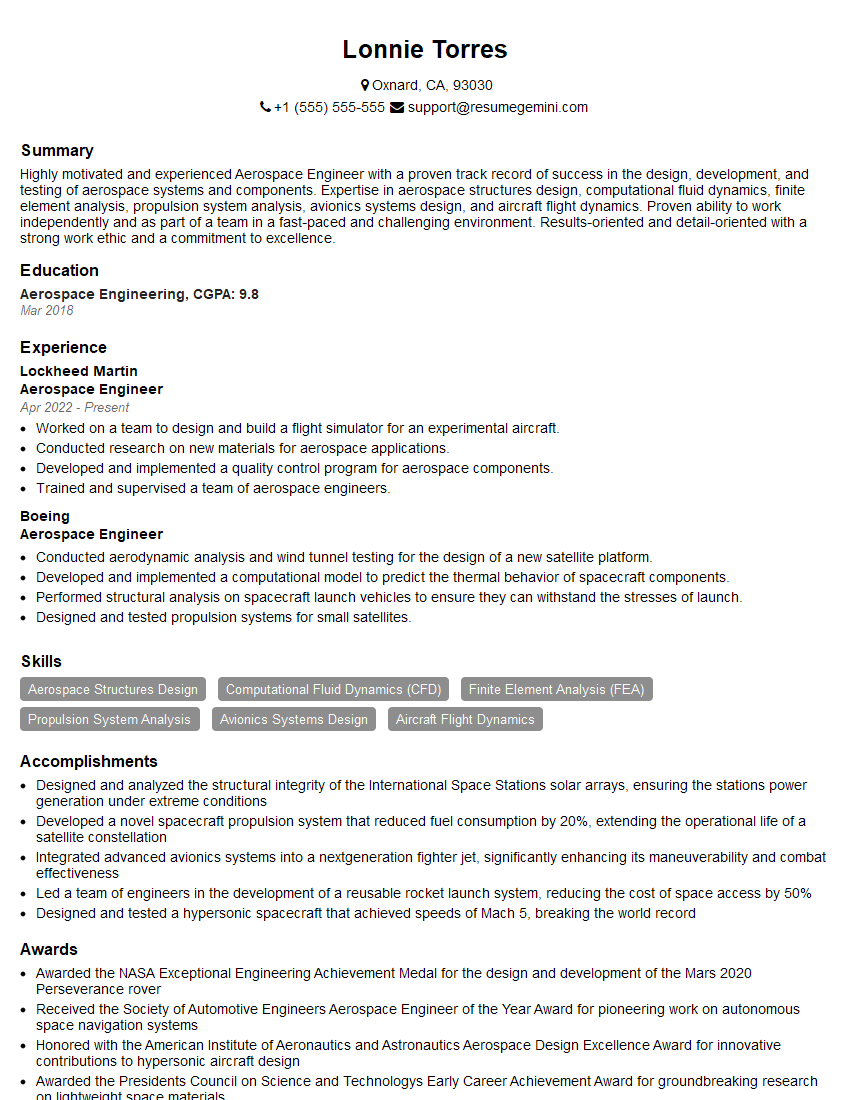
Mastering Knowledge of Missile System Components and Subsystems is crucial for advancing your career in the aerospace and defense industry. A deep understanding of these topics showcases your technical expertise and problem-solving skills, making you a highly sought-after candidate. To maximize your job prospects, create an ATS-friendly resume that highlights your key skills and experience effectively. ResumeGemini is a trusted resource that can help you build a professional and impactful resume tailored to the specific requirements of this field. Examples of resumes tailored to Knowledge of Missile System Components and Subsystems are available to guide you through the process.
Explore more articles
Users Rating of Our Blogs
Share Your Experience
We value your feedback! Please rate our content and share your thoughts (optional).
What Readers Say About Our Blog
Very informative content, great job.
good