Every successful interview starts with knowing what to expect. In this blog, we’ll take you through the top Knowledge of Music Publishing and Licensing interview questions, breaking them down with expert tips to help you deliver impactful answers. Step into your next interview fully prepared and ready to succeed.
Questions Asked in Knowledge of Music Publishing and Licensing Interview
Q 1. Explain the difference between mechanical and performance royalties.
Mechanical and performance royalties are two distinct types of royalties earned from the use of a musical composition. Think of it like this: mechanical royalties are paid for the right to reproduce the song, while performance royalties are paid for the right to publicly perform it.
- Mechanical Royalties: These are paid to songwriters and music publishers whenever their song is reproduced in physical formats (like CDs or vinyl) or digital formats (like downloads or streams). For example, if a recording artist releases a song on Spotify, the songwriter and publisher receive mechanical royalties for each stream and download.
- Performance Royalties: These are paid when a song is publicly performed, such as on the radio, in a concert, in a TV show or commercial, or in a nightclub. Different Performing Rights Organizations (PROs) like ASCAP, BMI, and SESAC collect these royalties on behalf of songwriters and publishers and distribute them based on usage data.
The key difference lies in the type of usage: mechanical royalties cover reproduction, while performance royalties cover public performances.
Q 2. Describe the process of securing a sync license for a song.
Securing a sync license – which allows a song to be used in a film, TV show, video game, commercial, or other visual media – involves several steps:
- Identifying the Rights Holder: This usually involves finding the music publisher who controls the synchronization rights. For well-known songs, this information is readily available. For lesser-known songs, some investigation might be necessary.
- Negotiating the License: This is where the terms of the license are hammered out. Negotiations include the fee, the length of the license, the territories covered, and the specific uses allowed. This process often involves legal representatives from both sides.
- Reviewing and Signing the Agreement: Once the terms are agreed upon, a formal synchronization license agreement is drafted and signed by both parties. This agreement outlines the specific uses, payment terms, and any restrictions on the use of the song.
- Delivery of Materials: After the agreement is signed, the rights holder delivers the necessary materials, such as the master recording and the publishing information, to the licensee.
- Monitoring Usage: The rights holder often monitors the use of the song to ensure compliance with the terms of the license agreement.
The process can be complex, and securing a sync license often depends on factors like the popularity of the song and the production budget of the project.
Q 3. What are the key elements of a music publishing agreement?
A music publishing agreement is a legally binding contract between a songwriter (or composer) and a music publisher. It outlines the terms under which the publisher will administer and promote the songwriter’s musical works in exchange for a share of the royalties generated.
- Term: The length of the agreement, usually a number of years.
- Territory: The geographical areas where the publisher will administer the works.
- Royalty Rate: The percentage of royalties the songwriter will receive. This is usually a percentage split, and it is important that both sides understand this split completely.
- Administrative Duties: The publisher’s responsibilities, such as collecting royalties, pitching songs, and licensing them.
- Advance: A payment the publisher might give to the songwriter upfront. This is an advance against future royalties.
- Ownership of Copyright: Clarification of who owns the copyright to the songs.
- Termination Clause: The circumstances under which the agreement can be terminated by either party.
A well-drafted agreement protects both the songwriter and the publisher and ensures a fair distribution of the royalties. It’s crucial to have legal counsel review the agreement before signing.
Q 4. How do you track and manage royalties for multiple songwriters?
Tracking and managing royalties for multiple songwriters requires a robust system. This often involves specialized software or a dedicated royalty accounting team.
Key elements include:
- Detailed Records: Maintain accurate records of each song’s ownership, including the percentage share of each songwriter. This includes all involved in writing the melody, lyrics, and any additional credits.
- Software or Services: Employ specialized royalty management software or outsource to a company specializing in music royalty administration. These tools automate data entry and calculations, minimizing errors.
- Clear Communication: Maintain transparent communication with all songwriters regarding royalties earned, payments made, and outstanding balances. Regular statements and transparent accounting are essential.
- Regular Audits: Perform regular audits to ensure accuracy in the recording of usage and royalty distributions. Regular auditing helps catch discrepancies and maintain accuracy.
Proactive management minimizes disputes and builds trust among songwriters. It is often critical to keep very detailed records and utilize modern software.
Q 5. Explain the concept of ‘work for hire’ in music publishing.
In music publishing, ‘work for hire’ refers to a situation where a songwriter creates a song as an employee of another entity, like a record label or advertising agency. In this scenario, the employer – not the songwriter – owns the copyright to the song.
Example: A songwriter is hired by a company to write jingles for their commercials. The company holds the copyright, and the songwriter’s compensation is usually separate from the ongoing royalties.
It’s crucial to clearly define ‘work for hire’ in any agreement, as it significantly impacts who owns and benefits from the song’s future use. The lack of this clarity can cause significant legal difficulties.
Q 6. What are the different types of music licenses?
Music licenses grant permission to use a musical work under specific conditions. Several types exist:
- Mechanical License: Allows reproduction of a song (e.g., on a CD or digital download).
- Performance License: Allows public performance of a song (e.g., on radio, TV, or live).
- Synchronization License (Sync License): Allows use of a song in conjunction with visual media (e.g., movies, commercials, video games).
- Print License: Allows reproduction of musical notation (e.g., in a sheet music book).
- Master Use License: Allows use of the master recording itself. This should be distinguished from publishing rights.
- Public Domain License: Allows use of songs whose copyrights have expired.
Each license type has specific requirements and fees. Understanding these distinctions is vital for legal and ethical usage.
Q 7. How do you handle disputes over song ownership or royalties?
Disputes over song ownership or royalties can be complex and require careful handling. The best approach is always to prevent these disputes by clearly documenting all agreements upfront.
If a dispute arises:
- Review the Agreements: Carefully review all relevant contracts, including songwriting agreements and publishing agreements. Look for clauses related to dispute resolution.
- Mediation: Attempt mediation with the help of a neutral third party to reach a mutually agreeable solution. Mediation can be faster and more cost effective than litigation.
- Arbitration: If mediation fails, arbitration provides a more formal process with a binding decision. Arbitration can be a faster, more flexible alternative to court.
- Litigation: As a last resort, legal action might be necessary. This can be a lengthy and expensive process, and should only be considered if other methods fail.
Having clear documentation and strong legal counsel is crucial in navigating these complex situations. Preventive measures are far better than needing to fight in a court of law.
Q 8. What are some common challenges in international music licensing?
International music licensing presents unique challenges compared to domestic licensing. The biggest hurdles often revolve around differing copyright laws, collection societies (PROs), and payment systems across various territories.
- Varying Copyright Laws: Copyright terms, ownership rights, and permitted uses can significantly differ between countries. Navigating these nuances is crucial to avoid infringement and ensure proper compensation.
- PROs and Reciprocity Agreements: Different countries have different PROs, and ensuring that these organizations have reciprocal agreements to collect and distribute royalties effectively is essential. Without these agreements, collecting royalties can become significantly more complex and time-consuming.
- Currency Fluctuations and Payment Systems: International transactions involve currency conversion, which introduces risk associated with exchange rate fluctuations. Securing reliable and efficient payment systems to receive royalties is another significant logistical challenge.
- Language Barriers and Cultural Differences: Communication barriers and cultural differences can complicate negotiations and licensing agreements. Clear and well-translated contracts are paramount.
For example, securing a license for a song in Japan requires understanding Japanese copyright law and working with the relevant Japanese PRO, which will differ from the process in the US or Europe.
Q 9. Explain the role of PROs (Performing Rights Organizations).
Performing Rights Organizations (PROs) are crucial intermediaries in the music industry. They represent songwriters, composers, and music publishers, collecting royalties for the public performance of their musical works. Think of them as collective bargaining agents for creators.
Their role involves:
- Licensing: PROs license the public performance rights of their affiliated members’ musical works to users (e.g., radio stations, bars, restaurants, streaming services).
- Monitoring and Collection: They monitor public performances (through various means, including audits and data collection from digital platforms) and collect royalties on behalf of their members.
- Distribution: After deducting administrative fees, PROs distribute royalties to their members based on the number of performances their songs receive.
- International Affiliation: Many PROs have reciprocal agreements with similar organizations in other countries, facilitating the efficient collection of royalties internationally.
Without PROs, collecting royalties from numerous users individually would be an incredibly complex and expensive undertaking for songwriters and publishers. They provide a crucial infrastructure for fair compensation for creators.
Q 10. How do you negotiate licensing fees?
Negotiating licensing fees is a multifaceted process, requiring a strong understanding of market value, comparable deals, and the licensee’s anticipated usage.
Key factors influencing the fee:
- Type of License: A synchronization license (for use in film or video) will command a different fee than a mechanical license (for reproduction of a song on a physical or digital product).
- Territory: Licensing a song globally will cost more than a license for a specific country.
- Term: The length of the license affects the fee, with longer terms generally costing more.
- Usage: How extensively the music will be used (e.g., prominent placement in a film vs. background music) impacts the fee significantly.
- Licensee’s Revenue Potential: A high-budget film might pay a larger fee than a low-budget independent project.
Negotiation involves presenting a justified fee based on the factors above and building a collaborative relationship with the licensee. Using comparable licenses for similar projects helps to establish a fair market value. It’s also crucial to have clear contracts outlining the scope of the license and payment terms. A strong negotiator may also incorporate profit-sharing or backend royalties into the agreement, depending on the circumstances.
Q 11. Describe your experience with digital music licensing platforms.
I have extensive experience working with various digital music licensing platforms, including those offering mechanical licenses (like CD Baby Pro), synchronization licenses (various platforms for film and video), and master use licenses. Each platform presents its own set of requirements and processes. Some are geared towards individual artists, while others cater to larger publishers and music supervisors.
My experience includes:
- Managing accounts and uploads: Registering works, ensuring accurate metadata, and efficiently uploading songs or tracks to the different platforms is crucial for effective licensing.
- Negotiating licensing terms online: The process can range from automated licensing systems (for certain types of uses) to direct negotiations for higher-profile projects.
- Tracking royalties and payments: Digital platforms often provide online dashboards to monitor performance and receive payments. Careful tracking of these payments is vital to ensure accurate accounting.
- Troubleshooting and dispute resolution: Occasionally, issues arise with licensing agreements or payments. Resolving these issues often involves close communication with the platform’s support team.
The use of digital platforms has streamlined the music licensing process to a great extent, but the challenges of metadata accuracy, proper usage tracking, and fair royalty allocation continue to be central issues.
Q 12. How do you stay up-to-date on music copyright law?
Staying current on music copyright law requires a multifaceted approach:
- Subscription to Legal Journals and Newsletters: Publications specializing in intellectual property law provide updates on significant case law and legislative changes.
- Professional Organizations: Organizations like the Copyright Society of the USA or equivalent organizations in other countries offer resources, webinars, and educational materials to keep professionals informed.
- Industry Conferences and Seminars: Attending conferences and seminars allows networking with legal experts and professionals in the field.
- Legal Counsel: Regular consultations with attorneys specializing in music law are vital for complex cases or significant licensing agreements.
- Monitoring Case Law: Staying informed about key legal cases helps to understand how courts interpret copyright laws.
Copyright law is constantly evolving, especially with the rapid technological advancements in the digital music space. Proactive and continuous learning is essential for avoiding legal pitfalls and ensuring the ongoing protection of musical works.
Q 13. What strategies do you use to maximize the value of a music catalog?
Maximizing the value of a music catalog involves a strategic approach encompassing multiple areas:
- Active Licensing and Placement: Aggressively pursue licensing opportunities across various media (film, television, advertising, video games, etc.) to generate revenue streams.
- Digital Strategy: Effective management of the catalog’s online presence on streaming platforms and other digital channels is crucial. This includes optimizing metadata, ensuring accurate registration and tracking royalties.
- Catalog Enhancement: Identify and develop underperforming assets within the catalog. This might involve remastering older recordings or creating new versions of songs to make them more appealing to current markets.
- Strategic Partnerships: Collaborating with other publishers, music supervisors, or creative agencies can expand licensing opportunities and market reach.
- Data Analysis: Utilizing data analytics to track the performance of songs and identify licensing trends allows for informed decision-making.
- Copyright Protection: Vigilantly protect the catalog against unauthorized use and infringement. This requires monitoring the use of songs and taking action against infringement.
The goal is to create a diversified revenue model that generates income from various sources and keeps the catalog’s value growing over time.
Q 14. Explain your understanding of music publishing accounting.
Music publishing accounting is complex, requiring a detailed understanding of royalty splits, income streams, and expense tracking.
Key components include:
- Royalties Tracking: Precise tracking of income from various sources, including mechanical royalties (for physical and digital sales), performance royalties (from public performances), synchronization royalties (from film, TV, advertising), and print royalties (for sheet music sales).
- Expense Tracking: Detailed records of administrative expenses, legal fees, and other costs associated with managing the catalog are necessary.
- Royalty Splits: Careful allocation of royalties based on songwriter and publisher agreements. This includes understanding the different percentages allocated to the songwriter(s), publisher(s), and any other stakeholders involved.
- Statement Preparation: Regular and accurate royalty statements must be prepared for songwriters and other rights holders, clearly outlining income and deductions.
- Tax Compliance: Accurate accounting is essential for complying with tax regulations related to music publishing income.
Accurate and efficient music publishing accounting ensures that all stakeholders receive their fair share of the royalties and that the publishing entity operates effectively.
Q 15. How do you identify and pursue potential licensing opportunities?
Identifying and pursuing licensing opportunities is a multifaceted process that begins with understanding the market and your catalog. I actively research potential placements for my clients’ music, looking beyond traditional avenues. This includes:
- Targeted Outreach: Directly contacting advertising agencies, film and television production companies, game developers, and brands known for using music in their projects. I tailor pitches to highlight how a specific song fits their needs and brand.
- Networking: Attending industry events, conferences, and workshops to build relationships with potential licensees and stay abreast of current trends. Building rapport with music supervisors is crucial.
- Online Platforms: Utilizing online music libraries and licensing platforms to increase the visibility of our catalog. These platforms offer direct access to a wider pool of potential licensees, but require careful metadata optimization to ensure accurate search results.
- Data Analysis: Tracking current licensing trends and analyzing data on successful placements to inform future strategies. Identifying which genres or styles are in high demand can help us focus our efforts.
For example, I recently secured a licensing deal for an indie-pop song in a major video game after directly contacting the game’s music supervisor and presenting a customized pitch highlighting the song’s upbeat and energetic feel. This was built upon existing relationships cultivated through previous industry events.
Career Expert Tips:
- Ace those interviews! Prepare effectively by reviewing the Top 50 Most Common Interview Questions on ResumeGemini.
- Navigate your job search with confidence! Explore a wide range of Career Tips on ResumeGemini. Learn about common challenges and recommendations to overcome them.
- Craft the perfect resume! Master the Art of Resume Writing with ResumeGemini’s guide. Showcase your unique qualifications and achievements effectively.
- Don’t miss out on holiday savings! Build your dream resume with ResumeGemini’s ATS optimized templates.
Q 16. Describe your experience with music publishing software or databases.
My experience with music publishing software and databases is extensive. I’m proficient in using platforms like SoundExchange for royalty processing, Harry Fox Agency (HFA) for mechanical licensing, and various custom-built internal systems. These tools are indispensable for managing a large catalog. I’m also familiar with database management systems (DBMS) like MySQL and PostgreSQL for tracking song information, songwriter contributions, and licensing agreements.
This includes effectively using these systems to generate royalty reports, track usage data, and manage complex licensing deals. Data accuracy and integrity are paramount, as they form the basis of accurate royalty calculations and transparent reporting to artists and songwriters.
Q 17. How do you build and maintain relationships with artists and songwriters?
Building and maintaining strong relationships with artists and songwriters is the cornerstone of successful music publishing. It’s about trust, transparency, and open communication. I achieve this through:
- Regular Communication: Consistent updates on licensing activity, royalty payments, and industry trends. I make myself readily available to answer questions and address concerns.
- Collaborative Approach: Working closely with artists and songwriters to develop strategies that align with their career goals. This includes brainstorming potential licensing opportunities and actively seeking feedback.
- Transparency and Accountability: Providing clear, accurate, and timely financial reporting, leaving no room for ambiguity.
- Legal and Contractual Clarity: Ensuring all agreements are fair and accurately reflect the expectations of both parties.
I view my role as a partner, not just a manager. For example, I recently helped a songwriter negotiate a significantly better licensing deal than they could have achieved independently, illustrating the value of a collaborative relationship.
Q 18. How do you handle royalty discrepancies or reporting errors?
Handling royalty discrepancies or reporting errors requires a meticulous and systematic approach. My process involves:
- Thorough Investigation: Carefully reviewing the discrepancy, examining all relevant data, including usage reports, licensing agreements, and accounting records.
- Data Reconciliation: Comparing the reported figures against the actual usage data to identify the source of the error.
- Communication and Collaboration: Working with the relevant parties, such as the licensee, to resolve the issue. This may involve requesting corrected reports or clarifying discrepancies in contractual terms.
- Documentation and Tracking: Maintaining detailed records of the investigation, resolution, and any adjustments made to ensure accountability and prevent future errors.
Accuracy is paramount. Even a small error can have a significant impact on an artist’s income, so addressing such issues promptly and thoroughly is essential.
Q 19. What is your experience with music sampling and clearance?
Music sampling and clearance are complex areas requiring a deep understanding of copyright law. My experience involves:
- Identifying Samples: Accurately identifying any samples used in a track, including the original source and copyright holder.
- Securing Clearances: Negotiating licenses with the copyright holders, ensuring all necessary permissions are obtained before the track is released or used in any commercial context. This often requires legal expertise.
- Negotiating Licenses: Determining fair and reasonable compensation for the use of the sample, considering factors such as the length of the sample, the prominence of its use, and the intended use of the track.
- Documentation: Maintaining comprehensive documentation of all clearances obtained, including licenses, agreements, and payment records. This ensures transparency and protects against future infringement claims.
Failure to secure proper clearances can result in costly lawsuits and reputational damage. Therefore, a proactive and meticulous approach is crucial.
Q 20. Explain your understanding of copyright infringement.
Copyright infringement occurs when someone uses copyrighted material without the permission of the copyright holder. This includes reproducing, distributing, displaying, performing, or creating derivative works based on a copyrighted song or musical composition. It’s a serious legal issue with potentially severe consequences.
In music publishing, this could involve unauthorized use of a song in a film, television show, advertisement, or online platform. The penalties for infringement can be significant, including legal fees, statutory damages, and even criminal charges in some cases. Understanding the nuances of fair use and the specific rights granted by copyright is crucial in navigating these complexities.
Q 21. How do you protect the intellectual property of your publishing clients?
Protecting the intellectual property of my publishing clients is a top priority, achieved through a multi-pronged strategy:
- Copyright Registration: Ensuring all musical works are properly registered with the relevant copyright offices (e.g., US Copyright Office) to establish a clear record of ownership.
- Contractual Agreements: Developing robust and comprehensive contracts with artists and songwriters that clearly define ownership, rights, and responsibilities. This includes specifying the scope of the publishing agreement and the allocation of royalties.
- Monitoring and Enforcement: Actively monitoring online platforms and other media to identify and address any unauthorized use of my clients’ music. This may involve sending cease and desist letters or pursuing legal action.
- Regular Legal Counsel: Consulting with experienced music lawyers to ensure compliance with copyright laws and to address any legal issues that may arise.
Proactive protection is always more cost-effective than reactive litigation. A strong legal framework coupled with vigilant monitoring ensures the long-term protection of my clients’ valuable assets.
Q 22. Describe your experience with music publishing contracts.
My experience with music publishing contracts spans over 15 years, encompassing a wide range of agreements from straightforward songwriter deals to complex co-publishing and administration agreements involving multiple parties and territories. I’ve negotiated and drafted hundreds of contracts, ensuring the protection of my clients’ intellectual property rights while maximizing their revenue potential. I’m intimately familiar with the nuances of various contract clauses, including copyright ownership, royalty splits, advances, term lengths, termination provisions, and dispute resolution mechanisms. I’ve also handled contract amendments, renewals, and litigations arising from contract disputes. A key part of my process involves thorough due diligence, ensuring every contract is tailored to the specific circumstances of the artist or songwriter and protects their long-term interests.
For example, I recently negotiated a co-publishing deal for a promising young artist. By carefully crafting the agreement, we ensured a favorable royalty split that reflected the artist’s growing popularity, included a robust reversion clause, and outlined a clear process for recouping advances. This careful approach ensured the artist had long-term control over their work and equitable financial compensation.
Q 23. What is your approach to identifying and mitigating legal risks in music licensing?
My approach to identifying and mitigating legal risks in music licensing involves a multi-step process that begins with a thorough understanding of the specific license type (mechanical, synchronization, print, etc.) and the intended use of the music. This ensures I accurately identify potential pitfalls and tailor appropriate risk-mitigation strategies. I conduct comprehensive due diligence, verifying the licensor’s ownership of the copyright and ensuring the license grant doesn’t violate any pre-existing agreements. I meticulously review the license agreement itself, paying close attention to clauses related to usage rights, territorial limitations, royalty rates, reporting requirements, warranties, indemnities, and dispute resolution.
Risk mitigation often involves negotiating favorable terms within the license agreement. This might include securing broader usage rights, clarifying ambiguous language, negotiating higher royalty rates, or including robust clauses protecting the licensor from potential liability. Clear documentation is paramount; ensuring the agreement is unambiguous and leaves no room for misinterpretation is essential. For instance, in a synchronization license, I would always explicitly define the permissible uses of the music in the audiovisual work, the duration of the license, and the exact media where the music will be used. This would prevent disputes down the line over unauthorized uses.
Q 24. How do you evaluate the market value of a song or catalog?
Evaluating the market value of a song or catalog is a complex process that requires a comprehensive understanding of several factors. It’s not simply a matter of assigning a monetary value; it’s about assessing the song’s or catalog’s potential for future revenue generation. Several key elements come into play.
- Past Performance: Analyzing historical data on streams, downloads, sales, and licensing revenue provides valuable insight into a song’s earning capacity.
- Current Popularity: Factors such as radio play, chart positions, social media engagement, and streaming numbers reflect a song’s current appeal and market demand.
- Future Potential: Assessing the song’s potential for future usage across different media, including films, television, advertising, and video games, is crucial.
- Catalog Quality and Diversity: In the case of a catalog, the overall quality, diversity, and age of the songs contribute to its value. A catalog with a mix of evergreen hits and newer songs generally holds greater value.
- Market Trends: Staying abreast of current market conditions, including royalty rates, licensing trends, and the overall health of the music industry, is essential for accurate valuation.
Often, a combination of quantitative data analysis and qualitative assessments are required. Consulting market experts and comparable sales data from similar catalogs can further refine the valuation process. For example, I might compare the royalty performance of a specific song to that of similar songs in the same genre with similar historical performance data.
Q 25. Explain your experience with different types of music publishing deals (e.g., co-publishing, administration).
I have extensive experience with various music publishing deals, including co-publishing, administration, and songwriter agreements. Each type offers distinct advantages and disadvantages depending on the songwriter’s goals and circumstances.
- Co-publishing: In a co-publishing deal, the songwriter partners with a publisher, sharing the copyright and associated income streams. This often allows songwriters to leverage the publisher’s resources, such as pitching capabilities, administrative support, and international networks, in exchange for a portion of their publishing royalties. The split of publishing royalties is negotiated, often 50/50 or some other percentage agreed upon by both parties.
- Administration: In an administration deal, the songwriter retains full ownership of the copyright, but they assign the rights to a publisher to administer the publishing rights and collect royalties. This is a common choice for songwriters who value the administrative support but prefer to retain full control of their copyrights.
- Songwriter Agreements: These are straightforward agreements where the songwriter retains complete ownership and the publisher has only a limited role, primarily focused on specific tasks like collecting royalties. This can be very beneficial for a songwriter with an established track record and a desire to retain maximum control.
I carefully tailor each deal to suit the specific needs and ambitions of the songwriter, weighing the pros and cons of each approach to ensure they achieve their individual objectives. The key is to establish clear terms and expectations from the outset.
Q 26. Describe a time you had to negotiate a difficult licensing deal. What was the outcome?
One particularly challenging negotiation involved securing a synchronization license for a song with a major film studio. The studio initially offered a significantly low royalty rate, far below the market value of the song. They argued that the song’s placement in the film was relatively minor, despite the song’s popularity. The key challenge was the studio’s resistance to budge on the royalty rate, citing their budget constraints and the relatively short usage duration.
My strategy involved demonstrating the song’s substantial value, highlighting its chart performance, streaming numbers, and its potential to enhance the film’s soundtrack and marketing appeal. I presented comparable licenses for similar songs used in high-profile films, demonstrating that their offer was significantly below market standard. I also emphasized the potential for increased revenue from the song’s use in trailers and promotional materials.
Ultimately, after several rounds of negotiation, we reached a mutually agreeable outcome. The studio increased their offer significantly, reflecting the true market value of the song, while still adhering to their budget restrictions. This was achieved by structuring the deal in a way that provided them with some flexibility while ensuring fair compensation for the songwriter. The success hinged on my ability to demonstrate the song’s value and effectively communicate its impact on the film’s commercial success.
Q 27. How familiar are you with the Harry Fox Agency (HFA) or other similar licensing agencies?
I am very familiar with the Harry Fox Agency (HFA) and other similar mechanical licensing agencies. The HFA, for example, plays a crucial role in facilitating mechanical licenses for the reproduction and distribution of musical works. Understanding their operations is essential for managing mechanical royalties efficiently. I regularly utilize their services to ensure compliance with copyright law and to secure accurate and timely royalty payments for my clients. I’m also well-versed in working with other performing rights organizations (PROs) like ASCAP, BMI, and SESAC, understanding how their functions complement those of the mechanical licensing agencies. Each agency has its own systems and processes; knowing how to navigate each efficiently is crucial in ensuring maximum return and effective royalty collection for songwriters.
My knowledge extends beyond simply using their services; I understand their licensing agreements, reporting procedures, and dispute resolution processes. This understanding is crucial in ensuring that my clients receive accurate royalty payments and that they are protected from potential infringements.
Q 28. What are some emerging trends in music publishing and licensing?
The music publishing and licensing landscape is constantly evolving. Several significant trends are shaping the future of the industry:
- The Rise of Streaming: Streaming services have dramatically altered royalty structures and revenue models, requiring a greater focus on data analysis and proactive revenue maximization strategies. Negotiating fair rates with streaming platforms is critical.
- Blockchain Technology: Blockchain’s potential to streamline royalty payments and enhance transparency is becoming increasingly relevant. This technology promises to revolutionize the way royalties are tracked and distributed, addressing some of the longstanding inefficiencies.
- Artificial Intelligence (AI) and Music Creation: The use of AI in music creation raises complex copyright and licensing questions. Understanding the legal implications of AI-generated music and establishing clear ownership guidelines are becoming increasingly important.
- Global Expansion of Licensing Markets: The growth of global markets necessitates a deeper understanding of international copyright laws and licensing agreements. Negotiating deals across different jurisdictions requires expertise in varying legal frameworks and cultural nuances.
- Focus on Data and Analytics: The use of data analytics to track song performance, identify licensing opportunities, and optimize revenue streams is becoming increasingly prevalent. Utilizing these tools effectively is becoming a critical skill.
Adapting to these changes requires staying informed about legal developments, technological advancements, and evolving market dynamics. Staying ahead of the curve is critical for success in this dynamic environment.
Key Topics to Learn for Knowledge of Music Publishing and Licensing Interview
- Copyright Law Fundamentals: Understanding copyright ownership, transfer, and duration as it relates to musical works and sound recordings. Practical application: Analyzing a publishing agreement to identify key rights and responsibilities.
- Mechanical Licenses & Royalties: Knowing the process of obtaining mechanical licenses for the reproduction and distribution of musical works. Practical application: Calculating royalty payments based on sales figures and license agreements.
- Synchronization Licenses & Royalties: Understanding the licensing of musical works for use in audiovisual media (films, TV, commercials). Practical application: Negotiating synchronization license terms and fees.
- Performance Royalties & Collection Societies (e.g., ASCAP, BMI, SESAC): Familiarizing yourself with how performance royalties are collected and distributed through these organizations. Practical application: Explaining the role of a PRO and how they benefit songwriters and publishers.
- Digital Music Licensing & Streaming Royalties: Understanding the complexities of licensing music for digital platforms and the various royalty structures involved. Practical application: Analyzing a streaming royalty statement and explaining its components.
- Publishing Agreements & Contracts: Ability to interpret and understand different types of publishing agreements, including co-publishing and administration deals. Practical application: Identifying potential risks and benefits within a proposed agreement.
- Music Industry Accounting & Financial Statements: Basic understanding of music publishing financial statements and royalty accounting procedures. Practical application: Reconciling a royalty statement and identifying potential discrepancies.
- International Music Licensing: Understanding the nuances of copyright and licensing across different territories and jurisdictions. Practical application: Identifying the necessary steps to secure international licenses for a musical work.
Next Steps
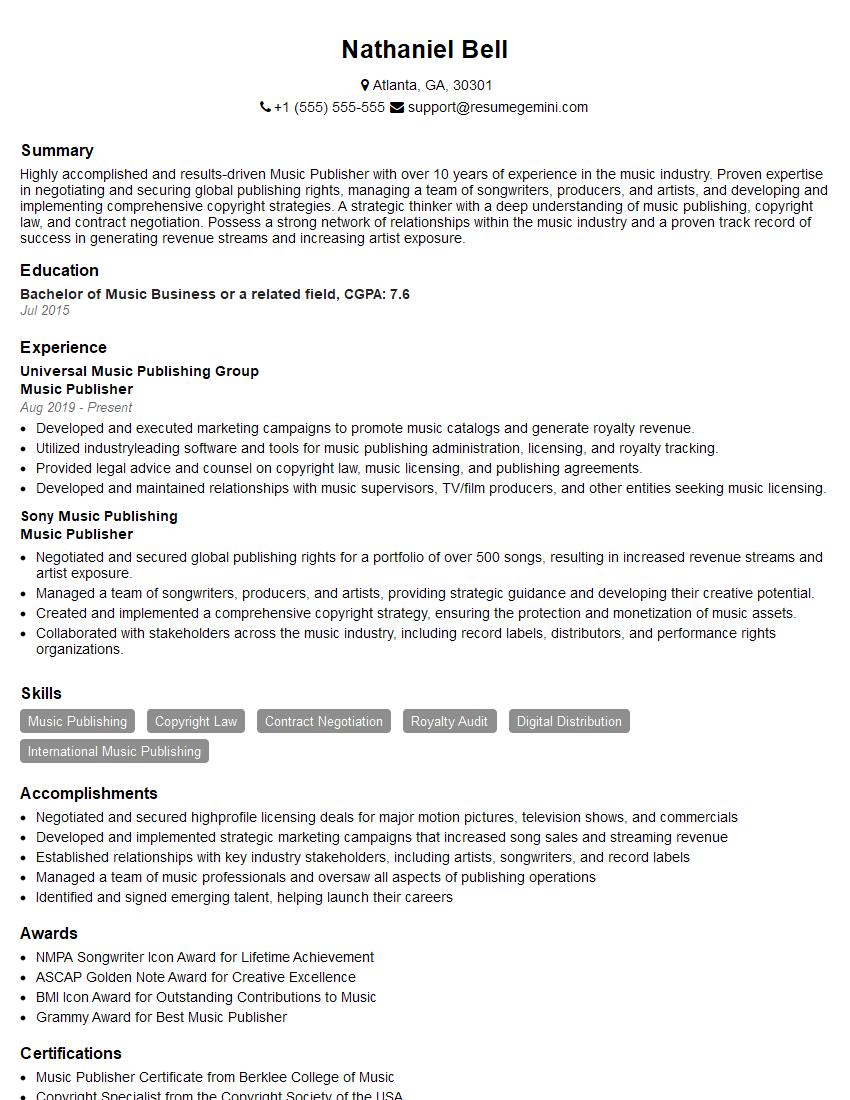
Mastering Knowledge of Music Publishing and Licensing is crucial for career advancement in the music industry, opening doors to exciting roles with greater responsibility and earning potential. A strong resume is your key to unlocking these opportunities. To significantly boost your job prospects, create an ATS-friendly resume that highlights your relevant skills and experience effectively. ResumeGemini is a trusted resource that can help you build a professional and impactful resume tailored to the music industry. Examples of resumes specifically designed for candidates with expertise in Music Publishing and Licensing are available to guide you. Take advantage of these resources and present yourself as the ideal candidate!
Explore more articles
Users Rating of Our Blogs
Share Your Experience
We value your feedback! Please rate our content and share your thoughts (optional).
What Readers Say About Our Blog
Very informative content, great job.
good