Preparation is the key to success in any interview. In this post, we’ll explore crucial Knowledge of Music Theory and Harmony interview questions and equip you with strategies to craft impactful answers. Whether you’re a beginner or a pro, these tips will elevate your preparation.
Questions Asked in Knowledge of Music Theory and Harmony Interview
Q 1. Explain the difference between major and minor scales.
Major and minor scales are the foundational building blocks of Western music, differing primarily in their characteristic intervals and emotional impact. A major scale is characterized by a bright, happy sound, while a minor scale tends to evoke feelings of sadness or contemplation. This difference stems from the arrangement of whole and half steps between the notes.
A major scale is built using the formula: W-W-H-W-W-W-H (where W represents a whole step and H represents a half step). For example, the C major scale is C-D-E-F-G-A-B-C. Notice the half steps between E-F and B-C.
A natural minor scale uses the formula: W-H-W-W-H-W-W. The A natural minor scale, for instance, is A-B-C-D-E-F-G-A. The half steps are between A-B and E-F. Other minor scales (harmonic minor and melodic minor) alter these intervals to create different melodic effects. The harmonic minor scale raises the 7th degree by a half step, creating a characteristic leading tone that pulls strongly towards the tonic (the first note of the scale). The melodic minor scale raises the 6th and 7th degrees ascending, but returns to the natural minor scale descending.
Think of it like this: Major scales are like sunshine – bright and uplifting. Minor scales are like a quiet evening – reflective and sometimes melancholy. The difference comes from just a couple of notes, but it transforms the entire mood.
Q 2. Describe the characteristics of a dominant seventh chord.
A dominant seventh chord is a powerful and inherently unstable chord that creates a strong sense of expectation. Its characteristic sound is largely due to its composition: it’s a major triad with a minor seventh added. This creates a strong pull towards resolution to the tonic chord (typically the I chord in the key).
Let’s break down its construction. Using the Roman numeral analysis, it is represented as a V7 chord. It’s built by stacking thirds on top of the dominant (the 5th degree of the scale): root, major third, perfect fifth, and minor seventh. For example, in the key of C major, the dominant seventh chord is G7 (G-B-D-F). The minor seventh interval (F in this case) creates the characteristic tension and drive towards resolution.
In a musical context, the G7 chord in C major frequently resolves to a C major chord (I). This resolution is satisfying because it releases the built-up tension. This type of progression is fundamental in many genres and styles, from classical music to jazz and pop.
Q 3. What are the different types of cadences?
Cadences are the concluding phrases of a musical passage, marking a sense of arrival or resolution. They are categorized based on their harmonic function and strength. Think of them as punctuation marks in musical sentences.
- Perfect Authentic Cadence (PAC): This is the strongest and most conclusive cadence. It consists of a dominant chord (V) resolving to a tonic chord (I) in root position. Example: G7 – C major in the key of C major.
- Imperfect Authentic Cadence (IAC): Similar to a PAC, but the V chord isn’t always a seventh chord. A V chord resolving to I is still considered an IAC.
- Plagal Cadence (Amen Cadence): This is a less conclusive cadence consisting of an IV chord resolving to a I chord. Example: F major – C major in the key of C major.
- Deceptive Cadence: This creates a sense of surprise. It uses a V chord that unexpectedly resolves to a vi chord instead of I, creating a momentary suspension. Example: G major – A minor in the key of C major.
- Half Cadence: This is an incomplete cadence, ending on the dominant (V) or sometimes the V7, leaving a feeling of suspension and expectation of further continuation.
Understanding cadences is vital for analyzing form and structure in musical compositions. They guide the listener’s ear and help create a satisfying narrative flow.
Q 4. Explain the concept of modulation.
Modulation is the process of changing from one key to another within a musical piece. It’s a sophisticated technique used to add variety, create dramatic shifts, and explore different emotional landscapes. Think of it as changing scenery in a story.
Modulations are typically achieved by using chords that share notes with both the old and new keys, creating a smooth transition. Common methods involve using a pivot chord, a chord that functions as both in the old key and in the new key. For example, a composer might modulate from C major to G major by using a chord containing notes common to both, such as an A minor chord (vi in C major and iii in G major). They might use this pivot chord and then gradually introduce more chords from the new key.
The effectiveness of a modulation depends on several factors, including the closeness of the related keys, the context within the piece, and how seamlessly the transition is handled. A well-executed modulation can enhance the expressive potential of the music significantly, surprising and delighting the listener.
Q 5. How do you analyze a chord progression?
Analyzing a chord progression involves systematically dissecting the harmonic structure to understand its function, progression, and overall effect. Several tools and techniques aid this process.
- Identify the Key: Determine the primary key of the piece by examining the majority of chords used.
- Roman Numeral Analysis: Assign Roman numerals to each chord based on its function within the key (I, ii, iii, IV, V, vi, vii°). This provides a concise representation of the harmonic framework.
- Identify Chord Functions: Determine the role of each chord: Tonic (I), Dominant (V), Subdominant (IV), etc. This reveals the harmonic direction and strength of each chord.
- Analyze the Voice Leading: Examine how the individual melodic lines move from one chord to the next. Smooth voice leading contributes to a pleasing sound, while awkward voice leading can create dissonance.
- Recognize Patterns and Cadences: Look for recurring chord progressions, standard cadences, and characteristic patterns. These can shed light on the overall structure and style.
For example, analyzing the progression I-IV-V-I in C major (C-F-G-C) reveals a classic, stable, and resolving progression. Conversely, a progression with frequent chromaticism or unexpected chord substitutions suggests a more complex and potentially dissonant harmonic language.
Q 6. What is functional harmony?
Functional harmony is a system of understanding how chords work together based on their function within a key. It’s not about the specific notes of each chord, but rather their harmonic role, their relationship to the tonic, and their tendency to move toward resolution.
The core concept is that chords have inherent ‘jobs’ within a key. The tonic (I) provides stability and rest, the dominant (V) creates tension and pulls strongly toward the tonic, and the subdominant (IV) acts as a transitional chord. Understanding these functions allows you to predict how chords will likely progress and why certain progressions sound natural while others feel jarring. For instance, the V-I cadence is highly predictable due to the dominant’s strong tendency to resolve to the tonic.
Functional harmony provides a framework for analyzing and composing music in a way that is intuitive and predictable, even when dealing with complex progressions. It’s a fundamental concept for any serious study of music theory.
Q 7. Describe the difference between diatonic and chromatic harmony.
Diatonic and chromatic harmony represent different approaches to chord construction and progression. The distinction lies in whether the notes used are within the diatonic scale (the seven notes of a major or minor scale) or outside of it.
Diatonic harmony utilizes only the notes found within the current key’s diatonic scale. This creates a sense of stability and tonal clarity. Most simple song structures rely heavily on diatonic harmony. The progressions are more predictable and easier to follow.
Chromatic harmony introduces notes from outside the diatonic scale – that is, notes that are not part of the main key. This creates dissonance, tension, and a heightened sense of drama or surprise. Chromatic chords often use notes from the chromatic scale (all twelve notes of the octave) to create unexpected harmonic turns and embellishments. Chromaticism is often found in more complex or expressive musical pieces.
Think of it this way: diatonic harmony is like staying within the lines of a coloring book – safe and predictable. Chromatic harmony is like stepping outside those lines – adding expressive splashes of color, creating exciting tension, and sometimes resulting in a bit of a mess if not carefully handled.
Q 8. Explain the concept of voice leading.
Voice leading is the art of smoothly connecting individual notes in a musical line, especially across chords in a harmony. Think of it like a graceful dance between the melodic and harmonic elements. Good voice leading aims for a pleasing, logical progression that avoids jarring leaps or awkward movements between notes. It involves considering factors such as melodic contour, stepwise motion (movement by steps rather than leaps), and avoiding parallel fifths and octaves (discussed further below). For instance, in a chord progression, you might smoothly lead a soprano voice from C to D, while a bass voice simultaneously moves from G to A, creating a connected and aesthetically pleasing effect. Poor voice leading, on the other hand, might create a sense of instability or tension, disrupting the overall musical flow.
Q 9. How do you identify parallel fifths and octaves?
Parallel fifths and octaves occur when two independent melodic lines move in parallel motion, maintaining a perfect fifth or octave interval between them. This is generally considered a compositional error because it creates a muddy, indistinct sound, lacking harmonic interest. Imagine two singers attempting to harmonize perfectly but creating a droning effect – that’s the effect of parallel fifths and octaves. To identify them, visually examine the score. Look for two voices moving concurrently in such a way that the interval between them remains constantly a perfect fifth or octave. For example, if one voice moves from C to G and another simultaneously moves from G to D (creating a perfect fifth between them throughout) or C to C and G to G (creating a perfect octave), you have parallel fifths and octaves respectively.
Q 10. What are secondary dominants and how are they used?
Secondary dominants are chords that function as dominant chords, but temporarily borrowed from outside the key. They add harmonic color and create dramatic tension before resolving back to the primary key. They’re like a detour on a musical journey, adding excitement and interest. They are typically built a fifth above the subdominant chord of a particular key and are followed by the chord they dominate. For instance, in the key of C major, a secondary dominant to the IV chord (F major) would be a G major chord (V of F major). This G major chord will create a pull towards the following F major chord. Secondary dominants are especially effective in creating more complex and engaging harmonic progressions. Their use introduces chromaticism and expands the harmonic possibilities beyond the diatonic scale of the primary key, lending a richer harmonic texture to the piece.
Q 11. Explain the concept of chromatic passing tones.
A chromatic passing tone is a non-chord tone that briefly passes through a chord in a melody and acts as a smooth transition between two diatonic notes. They create a sense of fluidity and connection between melodic notes, adding a subtle color to the harmonic movement. Unlike neighboring tones (which approach and depart from the same note), passing tones move from one diatonic tone to another, using a non-diatonic note for the transition. They usually resolve to the nearest chord tone. For example, in C major, a melody might move from E to G passing through F# (a chromatic passing tone). It creates a smooth transition between E and G within the harmonic context, albeit briefly introducing a note outside the diatonic collection.
Q 12. What are the different types of inversions?
Inversions refer to rearranging the order of notes within a chord while maintaining the same root. There are three main types: root position (the root is the lowest note), first inversion (the third is the lowest note), and second inversion (the fifth is the lowest note). Think of it like shuffling a deck of cards – you still have the same cards, but they are arranged differently. Each inversion of a chord has a unique sound and function. For example, a C major chord in root position is C-E-G, in first inversion E-G-C, and in second inversion G-C-E. The different inversions offer the composer various voicing options, providing a means to create different harmonic textures and avoiding unnecessary repetition of the same bass notes within a sequence.
Q 13. How do you determine the key of a piece of music?
Determining the key of a piece of music involves identifying the most prevalent tonic (home base) and scale. Several techniques can be applied: First, look for the most frequently occurring chord. The chords that usually indicate the key are the tonic, subdominant, and dominant chords. Second, the final cadence plays a vital role; it typically ends on the tonic chord in the primary key. Third, consider the melodic structure. The most frequently occurring notes in the melody often reflect the key. If there are a lot of sharps or flats, you need to check the key signature to identify the major or minor key. Finally, the use of the leading tone, which resolves up to the tonic, is another key element. Using a combination of these methods will help establish a more accurate identification of the key.
Q 14. Explain the concept of counterpoint.
Counterpoint is the art of combining two or more independent melodic lines simultaneously, creating a rich and harmonious texture. It’s like a musical conversation between different voices, each with its own character and personality. Effective counterpoint involves careful consideration of melodic independence, rhythmic interplay, and harmonic compatibility. Rules and guidelines exist to avoid clashes or dull passages. Think of a fugue or a canon – these are classic examples of counterpoint where multiple melodic lines weave together, each maintaining its melodic identity yet contributing to the overall harmonic structure. Good counterpoint is characterized by independence between the lines and a resulting pleasing texture, rather than merely a unison or octave doubling. The skill to write good counterpoint is one of the cornerstones of Western music theory.
Q 15. What are some common chord progressions in popular music?
Common chord progressions in popular music often rely on simple, yet effective, harmonic relationships. Think of them as musical building blocks. These progressions create a sense of expectation and resolution, driving the emotional arc of a song.
I-IV-V-I: This is arguably the most ubiquitous progression in popular music. The I chord (tonic) establishes the home base, the IV (subdominant) creates a sense of yearning or anticipation, the V (dominant) builds tension, and the I chord returns to resolve the tension. Think of many folk songs or rock anthems – this progression is often the foundation.
vi-IV-I-V: This progression offers a slightly more sophisticated feel. The vi (relative minor) chord adds a touch of melancholy or mystery before moving to the IV, I, and V for resolution. This is common in ballads and softer pop songs.
ii-V-I: Found frequently in jazz and blues, this progression uses the ii (supertonic) chord to create a smoother transition to the V (dominant) and back to the I (tonic). The ii-V-I progression provides a characteristic jazzy sound, full of implied movement and resolution.
I-vi-IV-V: This progression alternates between major and minor tonalities to evoke a wider emotional range. The major I chord provides a sense of stability, while the minor vi and resolution to the V add intrigue and dynamism.
These are just a few examples; countless variations exist, often employing secondary dominants, borrowed chords, and other harmonic devices for added complexity and interest.
Career Expert Tips:
- Ace those interviews! Prepare effectively by reviewing the Top 50 Most Common Interview Questions on ResumeGemini.
- Navigate your job search with confidence! Explore a wide range of Career Tips on ResumeGemini. Learn about common challenges and recommendations to overcome them.
- Craft the perfect resume! Master the Art of Resume Writing with ResumeGemini’s guide. Showcase your unique qualifications and achievements effectively.
- Don’t miss out on holiday savings! Build your dream resume with ResumeGemini’s ATS optimized templates.
Q 16. Describe the role of harmony in creating musical tension and release.
Harmony is the backbone of musical tension and release. It works by creating expectations and fulfilling or subverting them. Think of it like a conversation – a question and answer, or a buildup and payoff.
Tension is typically generated by using chords that create dissonance or instability. This can involve moving to chords that are far away from the tonic (the home chord), using secondary dominants which lead strongly to a chord outside the current key, or employing suspensions and passing chords. The listener feels a sense of unease or anticipation, awaiting resolution.
Release occurs when the tension is resolved. This usually happens by moving back to the tonic chord or a closely related chord, providing a sense of satisfaction and closure. A simple example is the progression from the dominant (V) chord to the tonic (I) chord. The dominant chord strongly implies the tonic, satisfying our musical expectation and creating a feeling of resolution.
The interplay of tension and release is crucial in structuring musical narratives. It allows composers and songwriters to manipulate the listener’s emotions, creating excitement, drama, and ultimately, a satisfying musical experience. A skillful musician uses this carefully to control the listener’s emotional journey.
Q 17. How do you analyze the harmonic rhythm of a piece?
Harmonic rhythm refers to the rate at which the harmony changes. Analyzing it involves identifying the duration of each chord. A slow harmonic rhythm might hold a chord for several measures, while a fast harmonic rhythm changes chords every beat or even faster.
To analyze harmonic rhythm, I would follow these steps:
Identify the chords: Determine the function and quality of each chord within the piece. Use Roman numerals to denote their function within the key.
Determine chord durations: Precisely measure the length of time each chord is held. Note whether this duration changes and how.
Analyze patterns: Look for patterns in the harmonic rhythm, including the regularity or irregularity of chord changes. Notice how the rhythm affects the overall feel of the music.
Relate to musical context: Consider the harmonic rhythm in relation to the melody, rhythm, and overall structure of the piece. How does it contribute to the musical expression and narrative?
For example, a piece with a slow harmonic rhythm might sound stately and reflective, whereas a piece with a fast harmonic rhythm might sound energetic or dance-like. Analyzing harmonic rhythm reveals a crucial aspect of a piece’s character and expressive intent.
Q 18. Explain the difference between homophonic and polyphonic textures.
Musical texture describes the way different musical lines are combined. Homophonic and polyphonic textures represent two fundamental ways to create these combinations.
Homophonic texture features a single melodic line accompanied by chords. The melody is clearly dominant, while the harmony provides support. Think of most pop songs, hymns, and many classical pieces – a clear melody with a background of chords.
Polyphonic texture features two or more independent melodic lines that are equally important. These lines may intertwine, contrast, or complement each other. A famous example is a fugue, where a single theme (subject) is presented in different voices, often overlapping. Many Renaissance and Baroque pieces are characterized by polyphonic textures.
The difference lies in the independence and prominence of the melodic lines. In homophony, one line reigns supreme; in polyphony, multiple lines share equal importance. Understanding the distinction helps in analyzing and interpreting musical works, highlighting the composer’s choices in creating particular moods and effects.
Q 19. What are some common harmonic progressions used in jazz music?
Jazz harmony is known for its sophisticated and often unexpected chord progressions. Many common progressions build upon the basic ii-V-I progression, incorporating substitutions, alterations, and extensions.
ii-V-I: This is the fundamental building block. In jazz, however, the ii and V chords often include 7ths, 9ths, 11ths, and 13ths, creating rich harmonic complexity.
Tritone Substitution: This involves replacing the V chord with a chord a tritone away. For example, in C major, the V chord is G7. A tritone substitution would use Db7, creating a surprising but functional harmonic movement.
Altered Dominants: Dominant 7th chords are frequently altered (e.g., with an altered 9th, 11th, or 13th) to increase harmonic tension and create more colorful sounds.
Coltrane Changes: This complex progression features altered dominants and substitutions, creating a highly chromatic and intense sound. It is named after the great saxophonist John Coltrane, who utilized it extensively.
Jazz harmonization is characterized by its improvisational nature, allowing musicians to explore a wide range of harmonic possibilities beyond these basic frameworks.
Q 20. Explain the concept of augmented sixth chords.
Augmented sixth chords are complex chords that create a strong sense of tension, often resolving to the dominant chord. They are characterized by a characteristic augmented interval between the root and the sixth degree.
The interval of an augmented sixth can be found in various inversions, each with different names and characteristic resolutions.
Italian Augmented Sixth: Resolves to the dominant chord.
French Augmented Sixth: Resolves to the dominant chord.
German Augmented Sixth: Resolves to the dominant chord.
These chords add color and sophistication to a progression. The specific type of augmented sixth chord dictates its resolution, creating a predictable yet intriguing harmonic movement. They are frequently encountered in the works of composers like Wagner and in later Romantic and 20th-century music.
Q 21. How do you notate a chord progression?
Chord progressions are typically notated using Roman numerals to represent chord functions within a key, and Arabic numerals to represent the chords themselves. The bass notes can also be included where useful.
For example, a simple I-IV-V-I progression in C major would be notated as:
I - IV - V - I (Cmaj7 - Fmaj7 - G7 - Cmaj7)This notation shows the function of each chord within the key. A more detailed notation might include the chord quality (major, minor, dominant, diminished) and any added notes (7th, 9th, etc.).
In a professional score, chord symbols would be placed above the staff, providing a clear and concise representation of the harmonic progression.
Q 22. What are the different types of scales beyond major and minor?
Beyond major and minor scales, a world of melodic possibilities opens up through modes and other scale types. Major and minor scales are just two of the seven modes derived from the diatonic scale—a seven-note scale with characteristic intervals. Each mode starts on a different note of the diatonic scale, resulting in unique melodic flavors. For example, the Dorian mode, starting on the second degree of the major scale, has a minor feel but with a major sixth, creating a characteristically haunting sound. The Phrygian mode, starting on the third degree, has a Spanish or exotic feel due to its characteristic leading tone a whole step below the tonic. Other modes like Lydian (with a raised fourth), Mixolydian (with a dominant seventh), Aeolian (natural minor), and Locrian (with a tritone between the root and fifth) all offer distinct harmonic possibilities.
Beyond the church modes, we also have other scale types like the harmonic minor scale (with a raised seventh degree creating a characteristic leading tone), melodic minor scale (with a raised sixth and seventh ascending, and a natural sixth and seventh descending), pentatonic scales (five-note scales, often used in folk music), and chromatic scales (all twelve notes of the octave without any specific pattern), each offering distinctive harmonic colours. Experimenting with these scales opens up many creative avenues in composition.
Q 23. Explain the concept of modal interchange.
Modal interchange is a powerful harmonic technique that involves borrowing chords from parallel keys (keys that share the same tonic) to add color and create unexpected harmonic movement. For instance, imagine you’re in C major. Instead of using chords only from C major, you might borrow a chord from the parallel minor key, A minor. This might involve using an A minor chord—which is the vi chord of C major— in a way that creates a brief but effective shift in mood or harmonic direction. Similarly, you might borrow chords from the relative minor (a minor) or the relative major (C major) to create interesting harmonic shifts.
The effectiveness of modal interchange relies on careful consideration of the context. A borrowed chord might act as a passing chord, a temporary diversion before returning to the home key, or it might create a more sustained modulation to a related key. The technique is commonly used in jazz and classical music, often adding sophistication and depth to the harmonic progression. Understanding the relationships between keys is crucial for effective modal interchange.
Q 24. How do you analyze a piece of music for its harmonic structure?
Analyzing a piece’s harmonic structure involves systematically identifying the chords, their functions, and how they relate to each other. Start by identifying the key or tonal center. Then, analyze the progression of chords, noting their Roman numeral designations (I, ii, iii, IV, V, vi, vii°) within the key. Pay attention to chord inversions and their effect on voice leading. For instance, a first inversion chord might create a smoother transition.
Next, examine the harmonic rhythm—the rate at which the chords change—and the overall harmonic direction. Are there clear cadences? Are there modulations to other keys? Identify any significant harmonic features such as secondary dominants (V/V), borrowed chords from parallel or relative keys, and altered chords. Analyzing a score often involves creating a harmonic reduction, simplifying a complex texture to show only the essential harmonic movement. Software tools can be invaluable here, providing automatic analysis and visualization of harmonic progressions.
Consider, for example, a simple four-chord progression in C major: I-IV-V-I (C-F-G-C). This is a common and satisfying progression. But if we add a secondary dominant (V/V), say D7 (V/V of G), before the G chord, we add some harmonic complexity and anticipation. This type of careful observation reveals the composer’s harmonic choices and their impact on the overall aesthetic effect of the piece.
Q 25. Describe the use of suspensions and appoggiaturas in harmony.
Suspensions and appoggiaturas are non-chord tones that add expressive color and rhythmic interest to harmony. A suspension is a dissonant note held over from a previous chord that resolves downward by step to a stable note in the following chord. Think of it as a ‘delayed resolution’. For example, a suspended fourth (4-3 suspension) in C major might involve holding a F (suspended fourth) over from a G major chord and resolving it down to an E in the following C major chord. This creates a sense of anticipation and release.
An appoggiatura, on the other hand, is a non-chord tone that approaches a chord tone from above or below. It’s usually a passing tone. Unlike a suspension, which is held over from the previous chord, an appoggiatura is approached from outside the chord and quickly resolves to a chord tone. The appoggiatura is typically played with a shorter note value than the following chord tone. Both suspensions and appoggiaturas can create rich textures and harmonic interest; the difference lies in their approach and resolution.
Q 26. Explain how to write a four-part harmony.
Writing effective four-part harmony involves several key considerations. First, choose a melody that is both singable and harmonically interesting. Next, establish a solid bass line that provides a strong harmonic foundation. The bass line should generally outline the root of the chords and move smoothly between chords. Then, add inner voices (alto and tenor) that complete the chord structures, creating full and resonant harmonies. These inner voices should also move smoothly, avoiding parallel fifths or octaves unless used deliberately for stylistic effect (though parallel fifths are generally considered undesirable).
The spacing between the voices should be balanced. Avoid excessive leaps or narrow intervals that create awkward voicings. Aim for smooth voice leading, where each voice moves as little as possible between chords. Root position chords are a great starting point, and later you might explore inversions to add variety. Analyzing existing four-part harmonies in the works of great composers can be incredibly helpful in developing your skills and understanding the principles involved. Remember to prioritize clarity and vocal comfort when crafting four-part harmonies.
Q 27. What software or tools do you use for music analysis and notation?
For music analysis and notation, I utilize a variety of software and tools. Sibelius and Finale are industry-standard notation software; I use them for creating scores and arranging music. For analysis, programs like Antares, and specialized music theory software can help visualize harmonic progressions, identify key signatures, and analyze melodic contours. Audacity, a free and powerful audio editor, is used for recording and analyzing audio files. Additionally, I often use digital audio workstations (DAWs) such as Logic Pro X or Ableton Live for sound design and audio manipulation during analysis, where necessary.
Q 28. How would you explain a complex harmonic concept to a beginner?
Explaining a complex harmonic concept to a beginner requires breaking it down into manageable steps, using analogies and avoiding jargon. For example, explaining chromaticism, a technique involving notes outside the key, could be done by comparing it to adding unexpected spices to a familiar dish. Instead of relying solely on the standard ingredients (notes within the key), the composer introduces a foreign element (chromatic note) to create a unique flavor. This unexpected spice might add a sense of tension or drama, then resolve back to the familiar taste (the home key) to create a more compelling musical experience.
Visual aids are also helpful. Using a piano or keyboard to show the relationship between notes and chords can make abstract concepts more concrete. By using relatable examples from popular songs the beginner is familiar with, the explanation becomes more accessible and engaging. For example, the use of the diminished seventh chord, often used to create heightened tension, could be illustrated with a familiar song that uses it effectively. Breaking down complex concepts through gradual steps and simple examples facilitates better understanding and appreciation.
Key Topics to Learn for Your Knowledge of Music Theory and Harmony Interview
Acing your interview requires a solid understanding of both the theoretical foundations and practical applications of music theory and harmony. Focus your preparation on these key areas:
- Scales and Modes: Understand major, minor, and modal scales; their construction, characteristics, and application in different musical contexts. Practice identifying them aurally and analyzing their use in musical scores.
- Intervals and Chords: Master the identification and function of intervals (major, minor, perfect, augmented, diminished) and chords (major, minor, dominant, diminished, augmented). Be prepared to discuss chord progressions and their harmonic implications.
- Key Signatures and Analysis: Develop proficiency in analyzing key signatures, identifying chord functions within a key, and understanding harmonic relationships between different keys (e.g., relative major/minor).
- Harmony and Voice Leading: Understand principles of voice leading, including parallel fifths and octaves, and how to create smooth and logical harmonic progressions. Analyze existing compositions to identify effective and ineffective voice leading.
- Form and Structure: Familiarize yourself with common musical forms (e.g., sonata form, rondo form, theme and variations) and be able to analyze the structure and formal design of musical pieces.
- Counterpoint and Compositional Techniques: Depending on the role, understanding basic counterpoint principles and compositional techniques can be beneficial. Be ready to discuss your approach to composing or arranging music.
- Aural Skills: Practice your aural skills, including interval recognition, chord identification, and melodic dictation. Sharpen your ability to analyze music by ear.
Next Steps
Mastering music theory and harmony is crucial for career advancement in the music industry. It demonstrates a deep understanding of musical principles and your ability to apply them creatively and critically. To significantly enhance your job prospects, creating a professional, ATS-friendly resume is essential. ResumeGemini is a trusted resource that can help you build a compelling resume that showcases your skills and experience effectively. We provide examples of resumes tailored to highlight expertise in Knowledge of Music Theory and Harmony – use them as inspiration to craft your own stand-out application.

Music Publisher Resume Sample
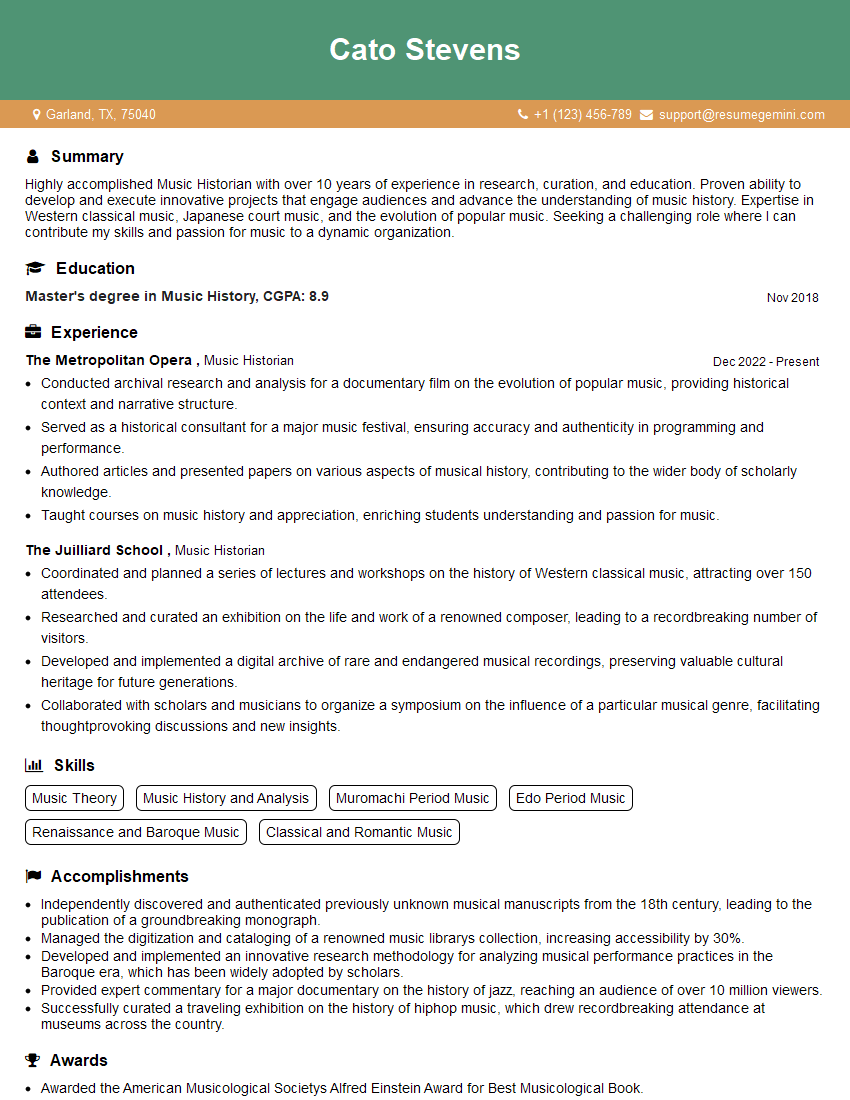
Music Historian Resume Sample
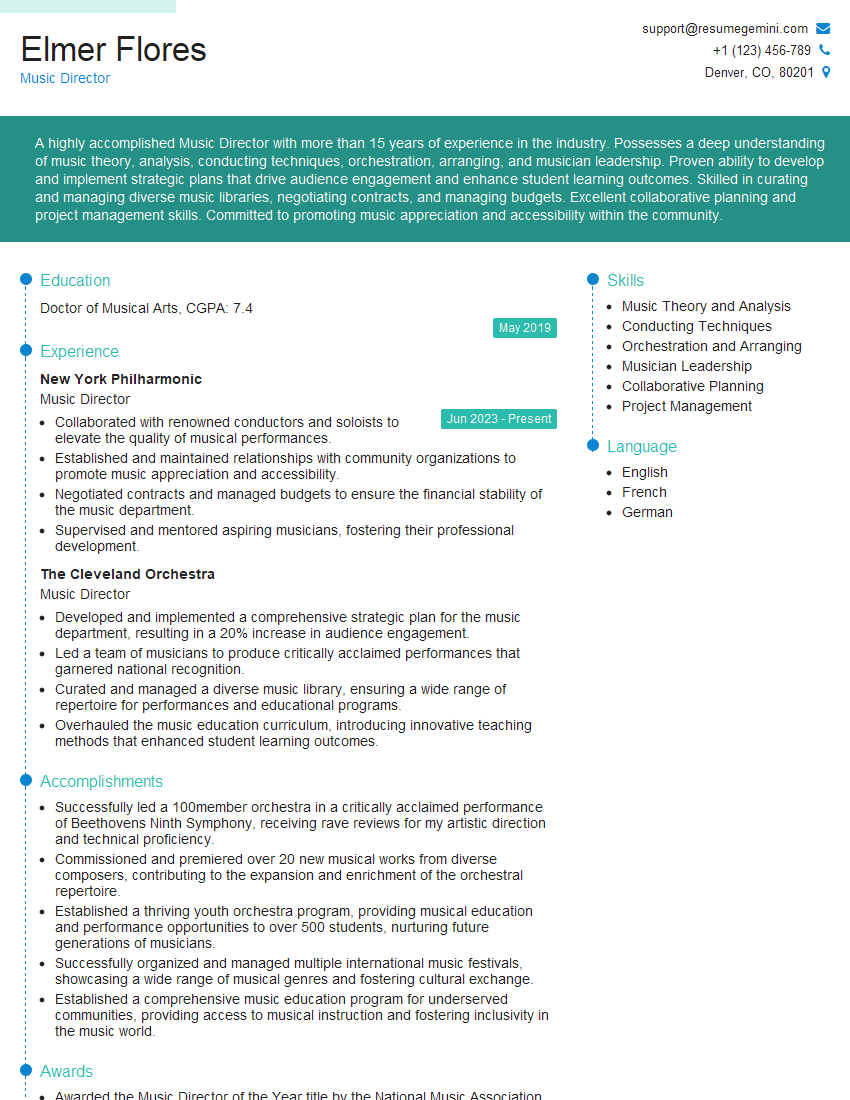
Music Director Resume Sample
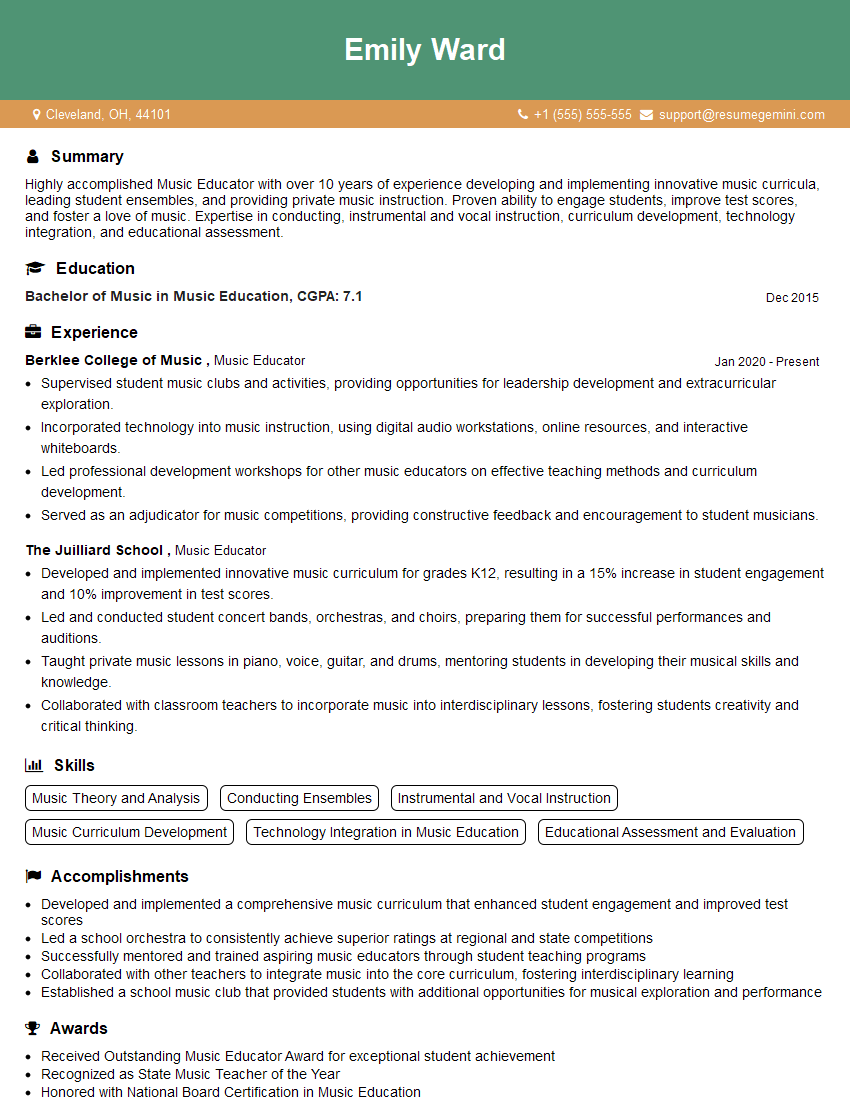
Music Educator Resume Sample
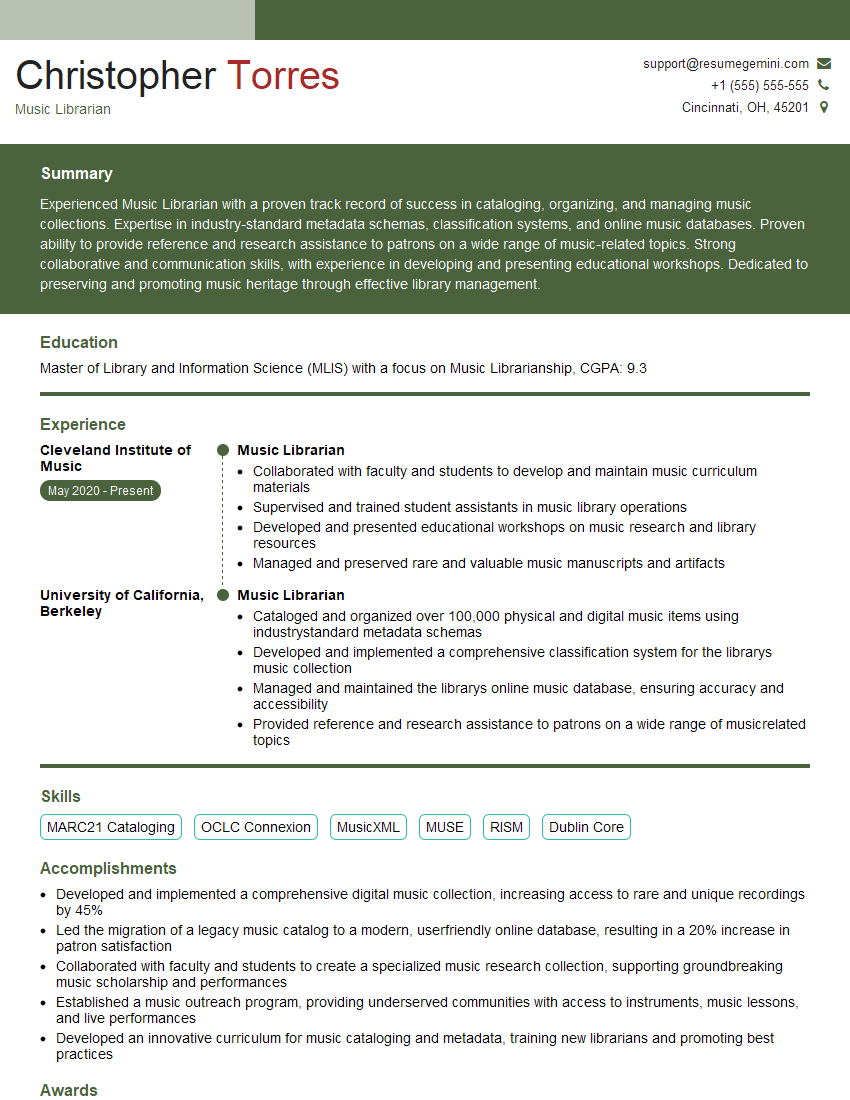
Music Librarian Resume Sample
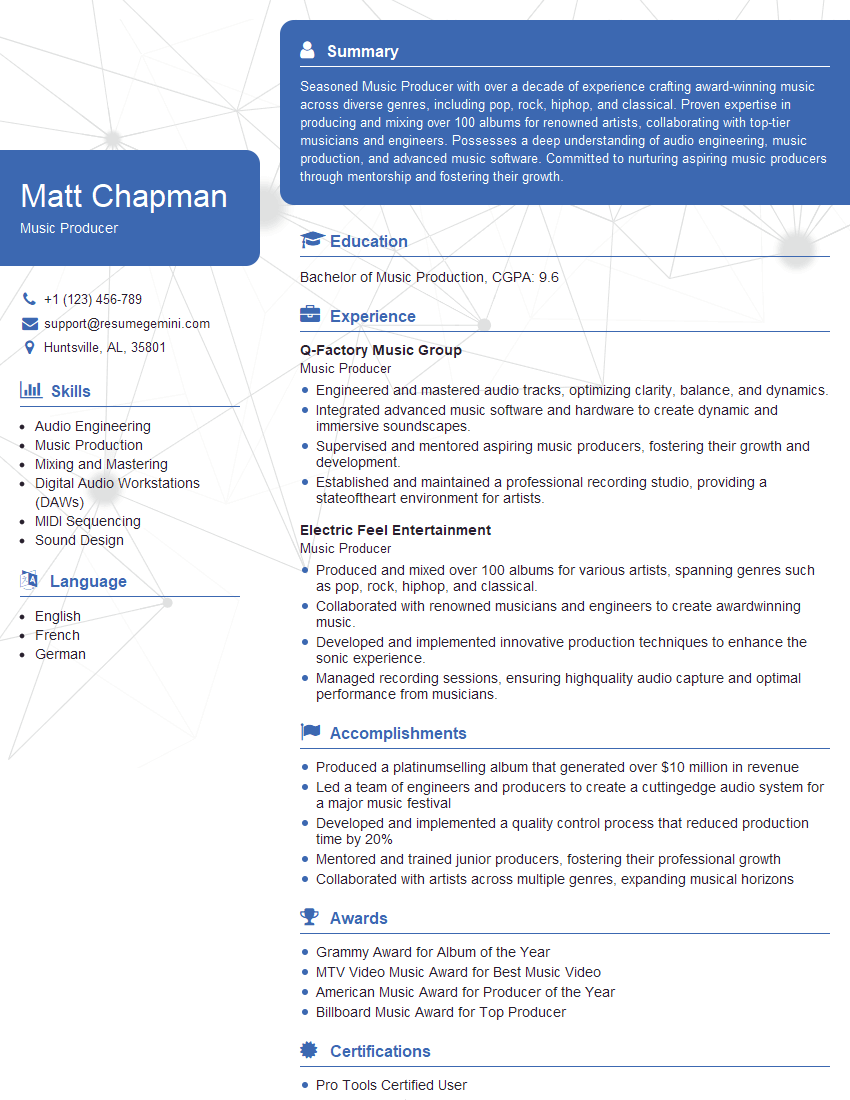
Music Producer Resume Sample
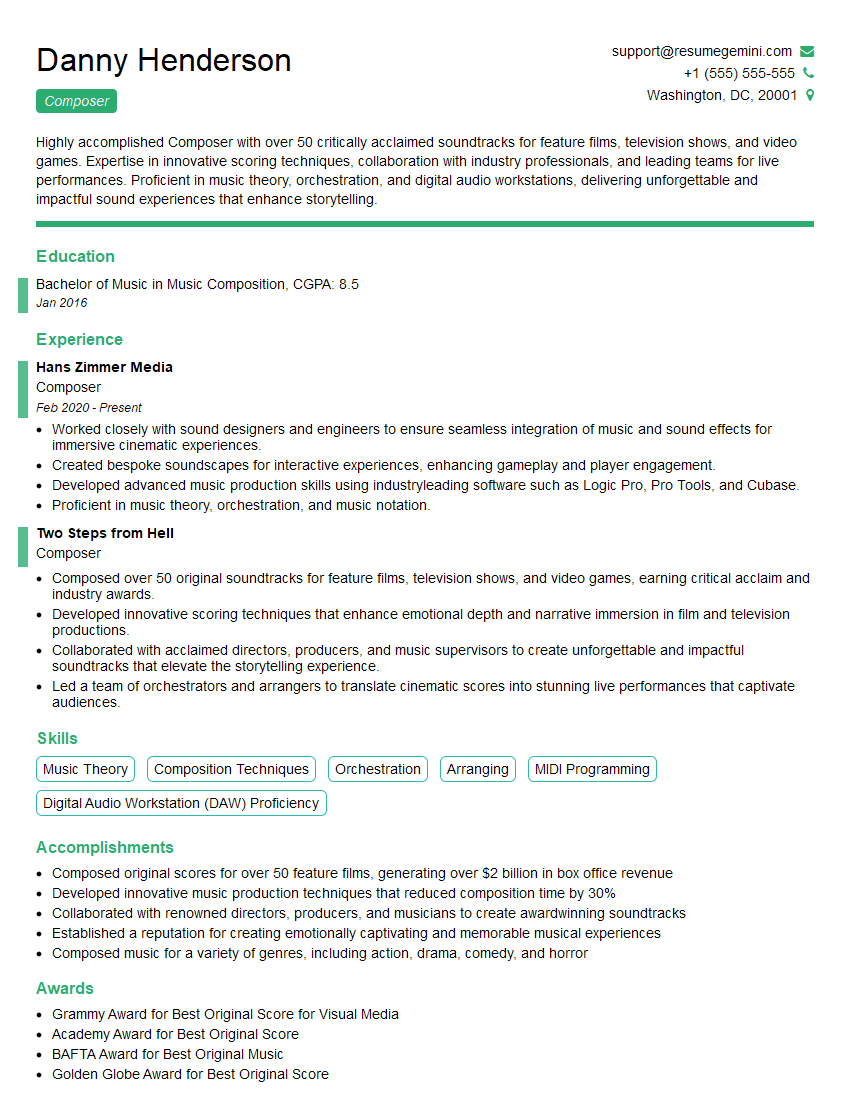
Composer Resume Sample
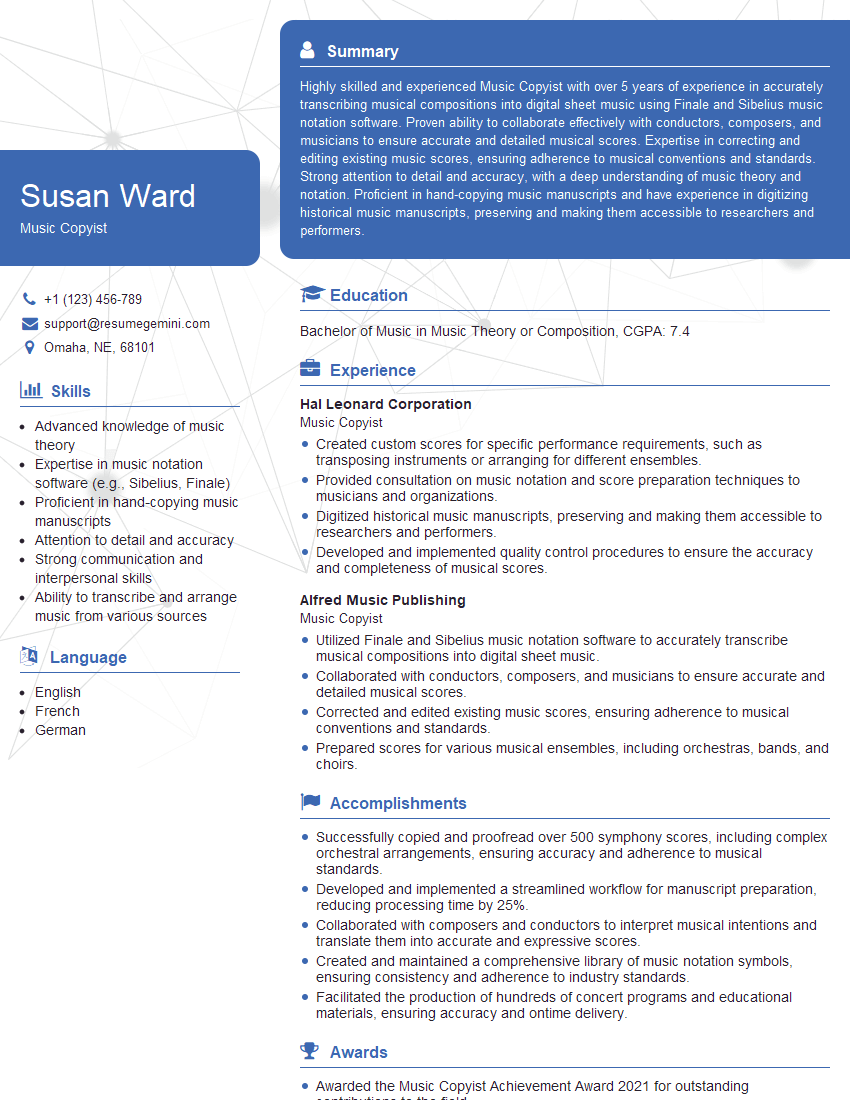
Music Copyist Resume Sample
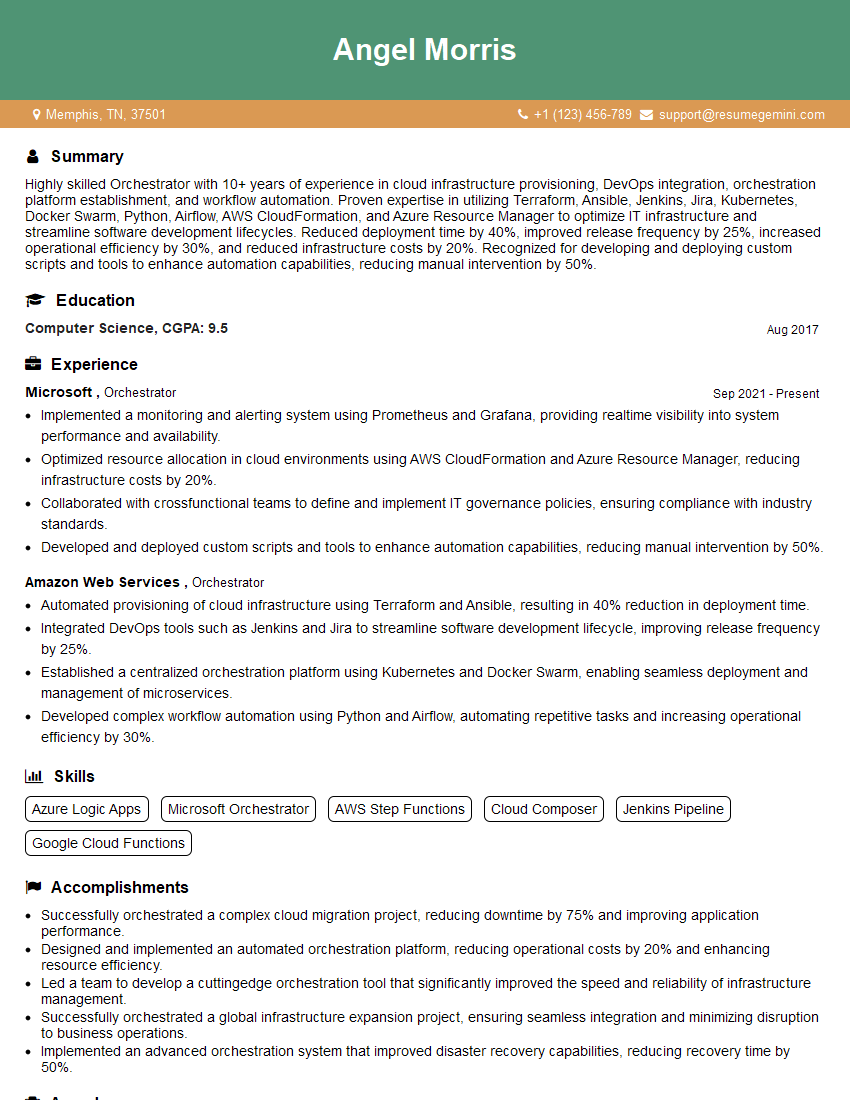
Orchestrator Resume Sample
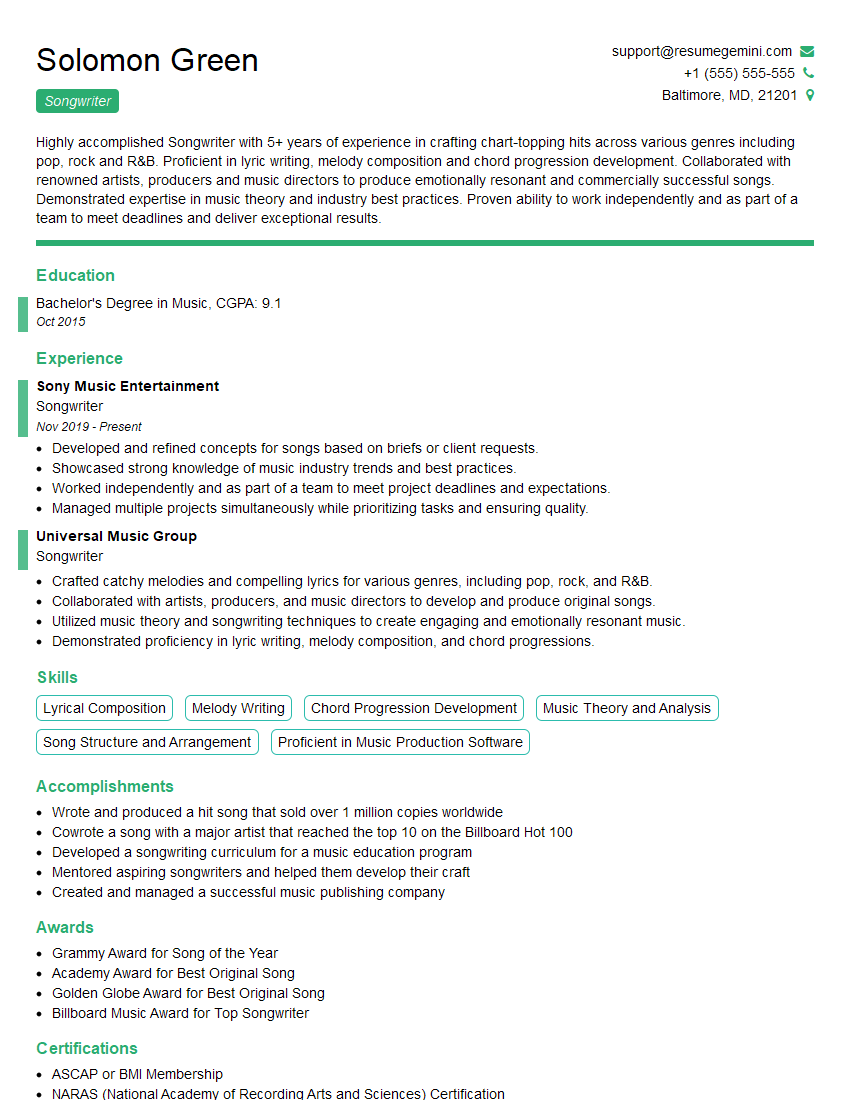
Songwriter Resume Sample
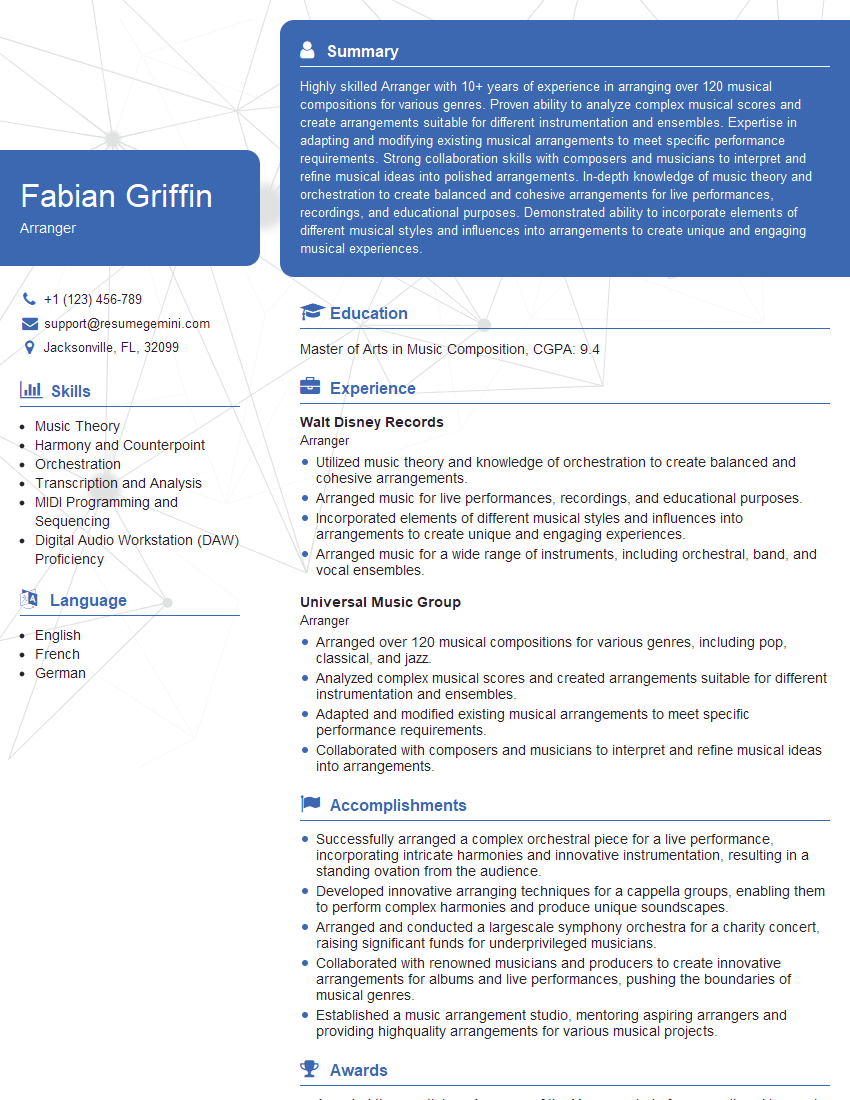
Arranger Resume Sample
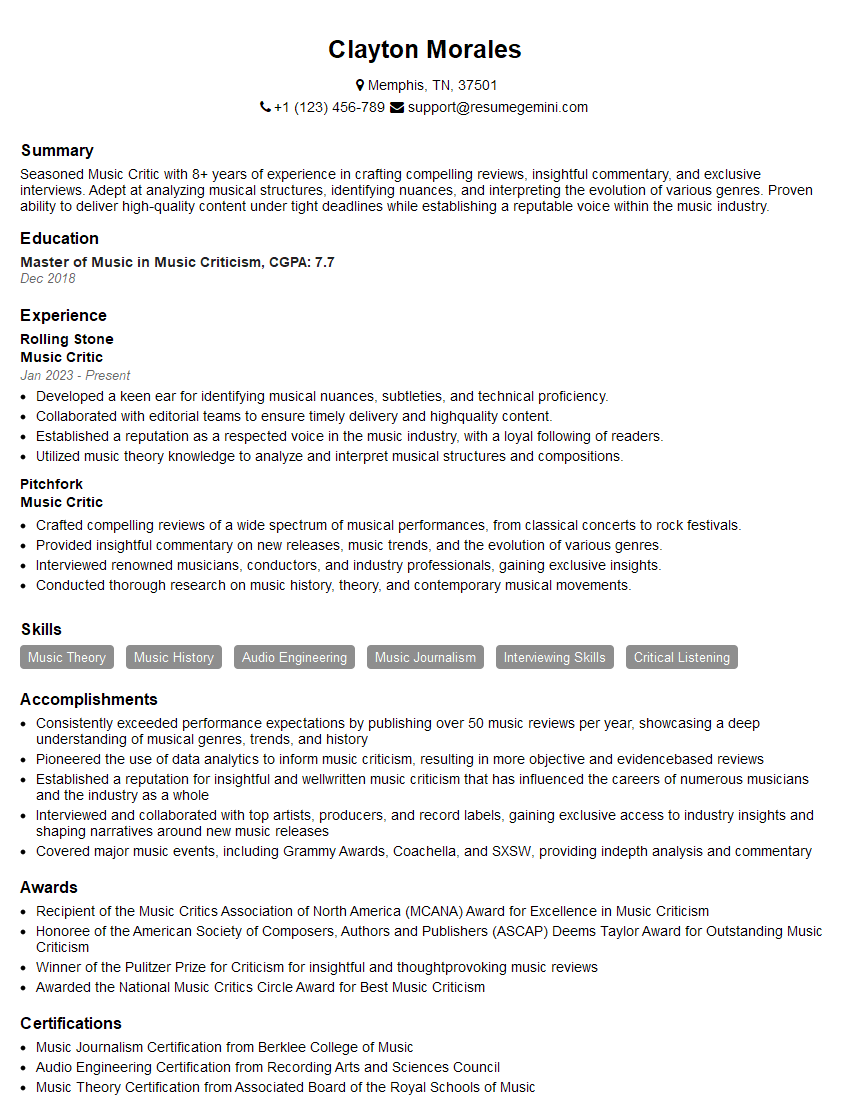
Music Critic Resume Sample
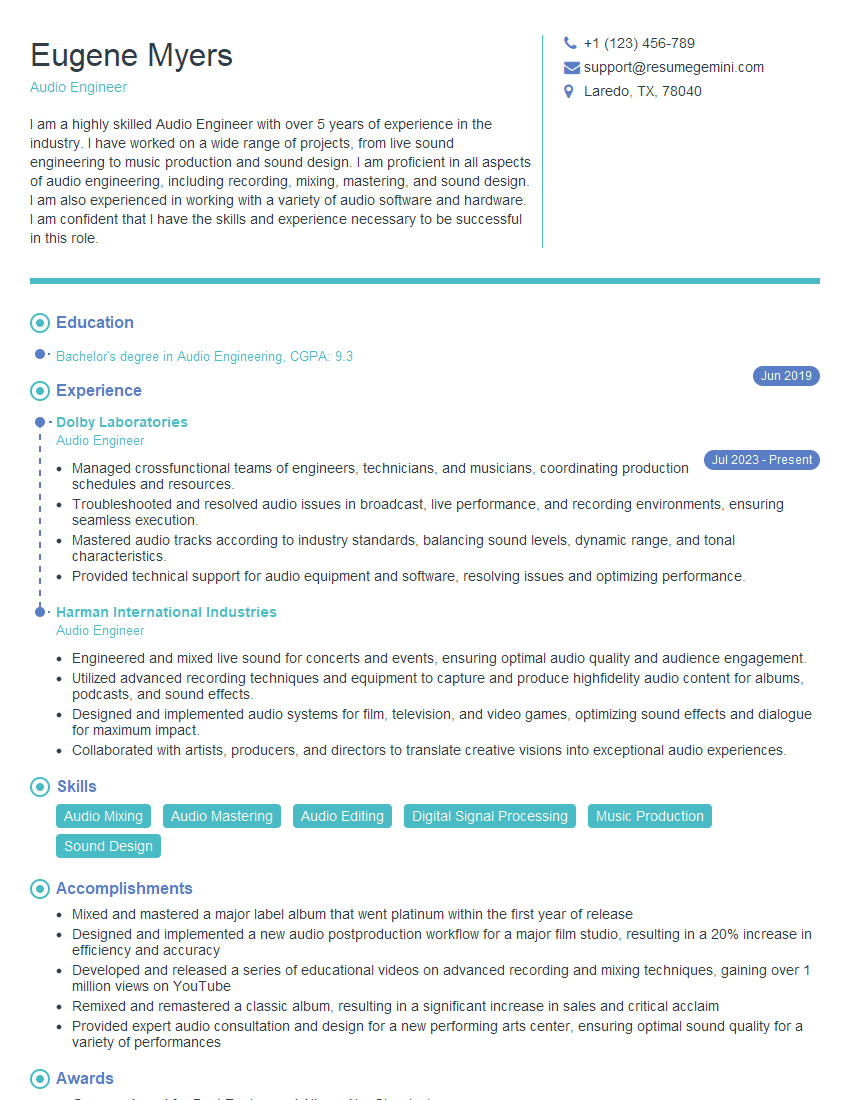
Audio Engineer Resume Sample
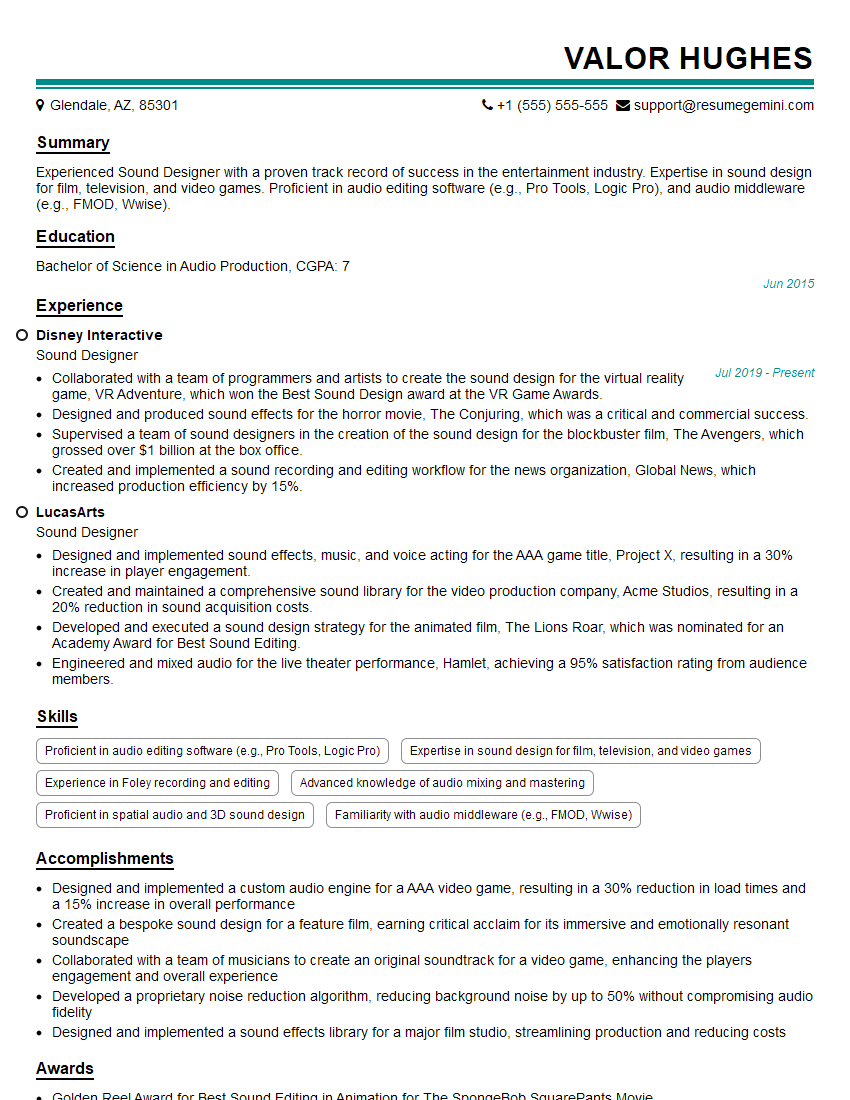
Sound Designer Resume Sample

Music Therapist Resume Sample
Explore more articles
Users Rating of Our Blogs
Share Your Experience
We value your feedback! Please rate our content and share your thoughts (optional).
What Readers Say About Our Blog
Very informative content, great job.
good