The right preparation can turn an interview into an opportunity to showcase your expertise. This guide to Knowledge of Numerology and Astrology interview questions is your ultimate resource, providing key insights and tips to help you ace your responses and stand out as a top candidate.
Questions Asked in Knowledge of Numerology and Astrology Interview
Q 1. Explain the core principles of numerology.
Numerology is the belief that numbers hold symbolic meaning and can reveal insights into personality, life path, and potential. At its core, it’s about reducing complex information – like your birthdate or name – into single-digit numbers, each carrying unique vibrations and interpretations. These numbers are then analyzed to understand the underlying energetic patterns influencing a person’s life. Think of it like a personalized vibrational fingerprint.
Core principles include the idea that numbers are not just quantitative but qualitative, possessing inherent energies and meanings. It also emphasizes the cyclical nature of life, reflected in the recurring patterns found in numerological calculations. Ultimately, numerology aims to provide self-awareness and guidance, highlighting strengths, weaknesses, and opportunities for personal growth.
Q 2. Describe the different numerology systems (e.g., Chaldean, Pythagorean).
Several numerology systems exist, each with its unique approach to number interpretation. Two prominent ones are:
- Pythagorean numerology: This system, attributed to the ancient Greek mathematician Pythagoras, assigns values to letters of the alphabet and then reduces them to single-digit numbers. It considers a broader range of numerical data including birthdates, full names, and even addresses. It analyses the individual numbers and the relationships between them for a comprehensive profile.
- Chaldean numerology: This system, tracing its roots to ancient Babylon, uses a different numerical assignment for letters. It’s often considered more mystical and focuses on the inherent qualities and spiritual vibrations associated with each number. It emphasizes a holistic interpretation of the numbers’ interplay within a chart.
While both systems use similar reduction techniques (adding digits until a single digit is achieved, except for the master numbers 11 and 22), their interpretations of the resulting numbers can differ slightly. Choosing between them depends on personal preference and the type of insight sought.
Q 3. How do you calculate a life path number?
Calculating a Life Path number involves reducing your birthdate to a single digit. For example, let’s take the birthdate October 26, 1985.
- Write out the full birthdate: 10/26/1985
- Sum the digits: 1 + 0 + 2 + 6 + 1 + 9 + 8 + 5 = 32
- Reduce to a single digit (or master number): 3 + 2 = 5. In this case, the Life Path number is 5.
If the sum results in 11 or 22, these are considered ‘master numbers’ and are not reduced further, retaining their unique significance. For example, a birthdate summing to 22 would have a Life Path number of 22.
Q 4. Interpret the significance of a life path number 7.
A Life Path 7 signifies a deeply introspective and analytical individual. Sevens are often intellectual, intuitive, and possess a strong spiritual inclination. They are natural thinkers, investigators, and seekers of knowledge and truth.
Strengths: Sevens excel at research, contemplation, and problem-solving. They often possess a keen eye for detail and an innate ability to see patterns others miss. They are independent and value solitude for introspection and creative pursuits.
Challenges: Sevens can be overly critical, both of themselves and others. They might struggle with expressing emotions and forming deep connections, often preferring intellectual pursuits to social engagements. They may also need to guard against becoming overly isolated or cynical.
Overall, a Life Path 7 indicates a journey of self-discovery and spiritual growth through intellectual exploration and deep inner reflection. A perfect career path might be research, writing, spiritual advising, or any profession that rewards analytical skills and independent thinking.
Q 5. Explain the concept of numerological compatibility.
Numerological compatibility examines the interplay between two individuals’ numerological profiles—primarily their Life Path numbers, but also other key numbers like Expression (name) numbers and Soul Urge (vowels) numbers. It’s not about predicting a perfect match, but understanding potential areas of harmony and friction.
For instance, a Life Path 1 paired with a Life Path 7 might experience challenges due to their differing natures. The independent and pioneering 1 might find the introspective 7 too reserved, while the 7 might find the 1’s directness overwhelming. However, this doesn’t mean incompatibility; it highlights areas where conscious effort and understanding are needed. Conversely, a Life Path 2 paired with a Life Path 6 often displays natural harmony, as both value relationships and collaboration.
Analyzing multiple numbers offers a more nuanced understanding than focusing solely on Life Path compatibility. It’s a tool for self-awareness and communication improvement within relationships.
Q 6. How do you use numerology to provide guidance in career choices?
Numerology can offer valuable insights into career choices by analyzing the vibrational energies associated with various career paths and comparing them to an individual’s numerological profile. By understanding their Life Path, Expression, and Soul Urge numbers, one can identify careers that align with their strengths, talents, and overall life purpose.
For example, someone with a strong 5 Life Path might be drawn to careers that emphasize change, travel, and freedom – potentially sales, entrepreneurship, or the travel industry. A person with a dominant 4 Life Path number might gravitate toward stability and structure, potentially finding fulfillment in architecture, engineering, or finance. It’s a valuable tool for self-reflection and identifying fulfilling work pathways, but it shouldn’t replace traditional career guidance.
Q 7. What are the twelve houses in astrology?
In astrology, the twelve houses represent different life areas or spheres of experience. They’re like 12 distinct ‘rooms’ in the chart, each governed by a zodiac sign and influencing specific aspects of a person’s life. Understanding these houses provides a holistic understanding of one’s personality and life trajectory.
- 1st House (Ascendant): Personality, self-image, physical appearance
- 2nd House: Possessions, values, finances
- 3rd House: Communication, siblings, short trips
- 4th House: Home, family, emotional security
- 5th House: Creativity, romance, children
- 6th House: Daily routine, health, work
- 7th House: Relationships, partnerships, marriage
- 8th House: Transformation, shared resources, intimacy
- 9th House: Higher education, travel, philosophy
- 10th House (Midheaven): Career, public image, life goals
- 11th House: Friendships, hopes, aspirations
- 12th House: Spirituality, subconscious, hidden enemies
The signs and planets residing in each house further elaborate on the house’s themes, providing a comprehensive astrological profile.
Q 8. Explain the significance of the Sun, Moon, and Ascendant in a birth chart.
The Sun, Moon, and Ascendant (rising sign) form the core trinity of a birth chart, representing fundamental aspects of personality and life experience. Think of them as the foundational pillars of your astrological profile.
The Sun: Represents your conscious self, your ego, your vitality, and your fundamental life purpose. It’s like the bright, central star that guides your actions and ambitions. For example, a Sun in Leo suggests a bold, charismatic, and creative individual.
The Moon: Represents your inner self, your emotions, your subconscious mind, and your reactions to the world. It’s your emotional landscape. A Moon in Cancer, for instance, might indicate a nurturing, sensitive, and home-oriented individual.
The Ascendant (Rising Sign): This is the zodiac sign rising on the eastern horizon at the time of your birth. It’s how you present yourself to the world, your initial impression on others, and your outward persona. Someone with an Aries Ascendant might appear energetic, assertive, and direct.
Together, these three points paint a vivid picture of your core being and how you interact with the world. The Sun shows your essence, the Moon your feelings, and the Ascendant your outward expression. Understanding their interplay is crucial in gaining a comprehensive understanding of your birth chart.
Q 9. Interpret the astrological significance of a planet in a specific house.
A planet’s placement in a specific house significantly modifies its expression. The house represents a life area – like career, relationships, or finances – while the planet adds its unique energetic flavor. Imagine the houses as rooms in a house, and the planets as the people inhabiting those rooms.
For example, let’s say Venus (planet of love and beauty) is in the 7th house (house of partnerships). This suggests a strong focus on harmonious relationships, a desire for beauty and balance in partnerships, and potentially a focus on attracting loving and aesthetically pleasing partners. However, if Mars (planet of action and aggression) is in the 7th house, it might indicate more conflict and passion in relationships, requiring a conscious effort to manage assertive energy.
Each house-planet combination has a unique interpretation, and the whole chart must be considered for a complete understanding. For instance, the aspects (planetary angles) other planets make to the planet in the house will further refine the meaning.
Q 10. Describe the meaning of planetary aspects (conjunction, square, trine).
Planetary aspects describe the angular relationships between planets in a birth chart, influencing how their energies interact. They are crucial in determining the flow and dynamics of energy within the chart.
Conjunction (0°): Planets are very close together, combining their energies. It can be a powerful blend, either harmonious or challenging depending on the planets involved. Think of it as two musicians playing in a duet – sometimes it’s beautiful harmony, sometimes it’s a chaotic clash.
Square (90°): Planets form a tense, challenging aspect, creating friction and potential conflict. It represents energy that needs to be resolved. This is like encountering a roadblock that requires effort and ingenuity to overcome.
Trine (120°): Planets form a harmonious, flowing aspect, creating ease and opportunity. It suggests natural synergy and effortless expression. This is like having a smooth, easy ride on an open road.
Other important aspects include the opposition (180°), which creates tension and challenges like the square, and the sextile (60°), which is a gentler, more supportive aspect than the trine.
Q 11. Explain the concept of astrological transits.
Astrological transits refer to the movements of planets across the sky, and how these movements impact our birth charts over time. They are like weather patterns affecting our personal landscape. A transit creates temporary energetic overlays on your natal chart.
For example, a transit of Saturn (representing responsibility and structure) through your 10th house (career) might bring challenges but also opportunities for significant career growth and development. It’s a time to buckle down, work hard, and build a solid foundation. Understanding these transits helps anticipate potential challenges and capitalize on opportunities.
Transit interpretations depend on numerous factors, including the planet transiting, the house it’s transiting through in your birth chart, and the aspects it makes to other planets in your chart. It is a dynamic and complex field.
Q 12. How do you use astrology to provide relationship advice?
Astrology offers valuable insights into relationship dynamics by comparing the birth charts of individuals involved. By comparing Sun signs, Moon signs, rising signs, and planetary placements, we can identify potential areas of harmony and conflict.
For example, comparing the Venus placement (love and values) and Mars placement (drive and assertiveness) can indicate how individuals approach love and intimacy. A strong synastry (chart comparison) in these areas can suggest compatibility, while challenging aspects can highlight areas requiring conscious effort and understanding. I also look at the overall energetic flow between charts, identifying complementary aspects and potential points of friction.
Relationship advice from an astrological perspective is not about predicting the future, but rather about highlighting potential strengths and challenges, promoting self-awareness, and fostering better communication and understanding.
Q 13. How do you interpret a natal chart for career guidance?
A natal chart provides a roadmap for career guidance by identifying talents, skills, and areas of natural aptitude. The 10th house (midheaven) is particularly significant, representing career aspirations and public image. The planets in the 10th house indicate the type of work that might bring fulfillment. However, it’s not just the 10th house that matters.
For example, a strong placement of Mercury (communication) in the 10th might suggest a career in writing, journalism, or public speaking, but also consider the Sun sign, the Moon sign and planetary aspects. A person with a strong emphasis on the earth signs (Taurus, Virgo, Capricorn) in their chart might be well-suited for practical, hands-on professions. The entire chart must be interpreted holistically to provide comprehensive career guidance.
Analyzing the whole chart provides a nuanced understanding of strengths, weaknesses, and preferred working styles. It’s a tool to enhance self-awareness and guide career choices that align with individual aptitudes and values.
Q 14. What is the difference between sidereal and tropical astrology?
Sidereal and tropical astrology are two different systems of astrology that differ primarily in their approach to calculating the zodiac. This difference stems from the precession of the equinoxes – the slow wobble of Earth’s axis.
Tropical Astrology: Uses the vernal equinox (the beginning of spring in the Northern Hemisphere) as the starting point of the zodiac, resulting in fixed zodiac signs that don’t change over time. It is the most commonly used system in the West.
Sidereal Astrology: Uses the fixed stars as its reference points, adjusting for the precession of the equinoxes. This means the sidereal zodiac is approximately 24 degrees behind the tropical zodiac. It is more commonly used in Vedic astrology (Jyotish).
The choice between these systems is a matter of personal preference and tradition. The interpretations within each system differ subtly because of the shift in zodiacal reference. Understanding this difference is crucial when comparing interpretations from different astrologers.
Q 15. Describe different astrological schools of thought.
Astrology boasts a rich tapestry of schools of thought, each with its unique approach to interpreting celestial influences. The most prominent include:
- Vedic Astrology (Jyotish): Originating in ancient India, Vedic astrology emphasizes the precise calculation of planetary positions and their impact on an individual’s life, often using a sidereal zodiac (different from the tropical zodiac used in Western astrology).
- Western Astrology: This system, prevalent in the West, uses a tropical zodiac, aligning the signs with the seasons. It focuses on the Sun’s position at birth (sun sign) and the interplay of all planets and their positions in the signs and houses of the birth chart to interpret personality and life events.
- Hellenistic Astrology: This ancient Greek approach emphasizes the importance of the whole chart, placing significant emphasis on the houses and their rulerships, and employing techniques like planetary dignities and debilities to assess planetary strengths and weaknesses.
- Modern Astrology: This encompasses various contemporary interpretations and techniques, often blending traditional approaches with modern psychological insights. It may incorporate aspects like progressed charts, solar return charts, and transits to understand life cycles and current influences.
Each school offers a distinct lens through which to view astrological influences, and understanding these differences is crucial for accurate interpretation and personalized guidance.
Career Expert Tips:
- Ace those interviews! Prepare effectively by reviewing the Top 50 Most Common Interview Questions on ResumeGemini.
- Navigate your job search with confidence! Explore a wide range of Career Tips on ResumeGemini. Learn about common challenges and recommendations to overcome them.
- Craft the perfect resume! Master the Art of Resume Writing with ResumeGemini’s guide. Showcase your unique qualifications and achievements effectively.
- Don’t miss out on holiday savings! Build your dream resume with ResumeGemini’s ATS optimized templates.
Q 16. How do you handle ethical dilemmas in your practice?
Ethical considerations are paramount in my practice. I adhere to a strict code of conduct, prioritizing client well-being above all else. I never make predictions that could cause undue distress or harm. For instance, if a client expresses suicidal ideation based on an astrological interpretation, I immediately refer them to a mental health professional, ensuring their safety takes precedence over astrological insights.
I always emphasize that astrology is a tool for self-understanding and growth, not a deterministic force. I avoid providing definitive predictions about the future, opting instead to explore potential paths and empower clients to make informed choices.
Transparency is key. I clearly explain the limitations of astrology and ensure clients understand that astrological guidance is not a substitute for professional medical or psychological advice.
Q 17. How do you maintain client confidentiality?
Client confidentiality is sacrosanct. I never discuss client information with anyone without their explicit consent. All client records, both physical and digital, are stored securely and are only accessible to me. I utilize secure platforms for communication and ensure all interactions maintain the highest level of privacy. I am committed to upholding the ethical standards of the astrological and numerological community and will never violate a client’s trust.
Q 18. Describe a situation where you had to deal with a difficult client.
I once worked with a client who was deeply skeptical of astrology, yet sought my services out of curiosity. During our session, she frequently interrupted and challenged my interpretations. While frustrating at times, I maintained a calm and respectful demeanor, patiently explaining my reasoning and acknowledging her doubts. I reframed her skepticism as an opportunity for deeper engagement, encouraging her to question the methodology and interpretations. By the end of the session, her perspective had shifted, and she expressed a greater appreciation for the complexities of astrology.
This experience reinforced the importance of active listening, empathy, and adapting my approach to suit individual client needs and personalities. It’s crucial to create a safe space where clients feel comfortable expressing themselves, even if it means challenging the astrological process itself.
Q 19. Explain your approach to providing spiritual guidance.
My approach to spiritual guidance integrates numerology and astrology to provide a holistic perspective on the client’s life path. I don’t impose my beliefs but help clients uncover their own inner wisdom. I see my role as a facilitator, assisting them in connecting with their intuition and exploring their spiritual potential.
I use numerological analysis to reveal patterns and life lessons embedded in their birth date and name, while astrology provides insights into karmic themes and planetary influences. I then integrate these findings to offer personalized guidance on areas such as relationships, career, and personal growth, enabling them to align their choices with their highest potential.
The process emphasizes self-discovery and empowerment, encouraging clients to take ownership of their lives and make conscious choices aligned with their spiritual aspirations.
Q 20. How do you stay current with the latest developments in numerology and astrology?
Staying current in the fields of numerology and astrology involves continuous learning. I regularly attend workshops, conferences, and online courses presented by leading experts in the field. I subscribe to relevant journals and publications, keeping abreast of new research and interpretations. I also actively engage in peer-to-peer learning and discussions, sharing knowledge and insights with other practitioners.
The ever-evolving nature of these fields necessitates a commitment to ongoing professional development to ensure I provide the most accurate and informed guidance to my clients.
Q 21. What resources do you utilize for ongoing learning and professional development?
My resources for ongoing learning and professional development include:
- Professional Associations: Membership in reputable astrological and numerological associations provides access to educational resources, conferences, and networking opportunities.
- Books and Journals: I regularly read books and articles by renowned astrologers and numerologists, exploring diverse perspectives and methodologies.
- Online Courses and Workshops: Numerous online platforms offer high-quality courses and workshops, providing opportunities for specialized training and skill enhancement.
- Mentorship and Collaboration: Engaging in discussions and collaborations with experienced practitioners provides valuable insights and perspectives.
This multi-faceted approach ensures my knowledge and skills remain sharp and current, enabling me to offer clients the most comprehensive and relevant guidance.
Q 22. Describe your experience with different astrological software or tools.
Throughout my career, I’ve utilized a variety of astrological software and tools, each offering unique functionalities. I’m proficient with programs like Astrodienst, which provides detailed birth chart calculations and interpretations, including aspects, house placements, and planetary transits. I also use Solar Fire, known for its advanced features in chart comparison and predictive techniques. Furthermore, I’m comfortable with simpler online tools for quick chart generation and basic interpretations, tailoring my selection to the specific needs of the client and the complexity of the consultation. For example, if a client simply wants to understand their sun sign, a quick online tool suffices; however, for in-depth analysis, software like Astrodienst or Solar Fire is essential. My experience spans both the technical application of these tools and the nuanced interpretation of their outputs.
Q 23. How do you integrate numerology and astrology in your readings?
Integrating numerology and astrology enhances the depth and accuracy of my readings. I view numerology as a complementary system, focusing on the vibrational energy associated with numbers derived from a person’s birthdate and name. This information reveals core personality traits, life path, and karmic lessons. I then cross-reference this numerological profile with the astrological birth chart. For example, if someone’s numerology points towards a strong drive for independence, I’d look for astrological confirmations – perhaps a prominent Aries influence or a strong emphasis on the first house. The convergence of these two systems creates a richer understanding of the individual’s potential, challenges, and life purpose. It’s like having two different lenses through which to view the same person, creating a more complete picture. This integrative approach often provides insights that would be missed if only one system were considered.
Q 24. Explain the concept of karmic astrology.
Karmic astrology explores the concept of past lives and their influence on the present. It investigates recurring patterns, challenges, and relationships that seem to repeat throughout a person’s life. In essence, it suggests that our current life is a continuation of our soul’s journey, and that unresolved issues from past lives may manifest as karma in this life. Key astrological indicators include the nodes of the moon (North and South Nodes), which represent our karmic destiny and past life patterns. For example, a strong South Node in a particular sign indicates patterns or tendencies from past lives that may still need to be addressed. The North Node, conversely, points to the direction we need to move toward for spiritual growth and karmic resolution. I use karmic astrology to help clients understand the root causes of their challenges and guide them toward more fulfilling paths.
Q 25. What is your understanding of astrological symbolism?
Astrological symbolism is a rich tapestry of archetypes, myths, and celestial imagery. Each planet, sign, and house carries its own symbolic meaning, representing different energies, personalities, and life experiences. The Sun represents our conscious self, the Moon our emotions, and the planets represent various aspects of our personality. Zodiac signs are associated with specific elemental energies (fire, earth, air, water) and modalities (cardinal, fixed, mutable) that describe distinct personality traits and behavioural patterns. Houses represent different areas of life, such as career, relationships, and finances. Understanding these symbols is crucial for interpreting a birth chart. For instance, a strong emphasis on the tenth house (career) combined with Saturn in Capricorn might indicate a disciplined and ambitious approach to career development. My understanding of these symbols allows for a profound and meaningful interpretation of the client’s chart.
Q 26. How do you use astrology for self-improvement?
Astrology can be a powerful tool for self-improvement by providing a personalized roadmap for personal growth. By understanding one’s astrological chart, individuals can identify their strengths, weaknesses, and potential challenges. This self-awareness is the foundation for positive change. For example, someone with a prominent Mars might use this understanding to channel their energy into productive activities and manage their impulsiveness. Someone with a strong emphasis on the sixth house (health and daily routine) might use astrological insights to improve their lifestyle and well-being. I help clients identify their astrological patterns and leverage this knowledge to make conscious choices that align with their authentic selves, fostering greater self-acceptance and growth.
Q 27. How do you adapt your approach to clients with diverse backgrounds and beliefs?
Adaptability is key when working with diverse clients. I approach each consultation with sensitivity and respect for individual backgrounds and beliefs, recognizing that astrology can be interpreted through many lenses. For clients with religious or spiritual beliefs that differ from my own, I ensure that my approach remains respectful and non-judgmental, integrating their perspective into the reading wherever possible. My focus remains on providing insights and tools that empower the client, irrespective of their specific beliefs. I avoid imposing my worldview and instead aim to create a collaborative space for exploration and self-discovery. Open communication and empathy are crucial in building trust and ensuring a positive experience for everyone.
Q 28. Describe your experience in creating personalized astrological reports.
Creating personalized astrological reports is a significant part of my practice. I craft detailed reports that integrate a client’s birth chart data, numerological insights, and transit information. These reports are not just technical analyses; they are narratives tailored to the individual’s life context. I include an explanation of the key astrological aspects and their significance, relating them to the client’s experiences, goals, and challenges. I might, for instance, explain how a challenging transit could impact a particular area of their life, and provide practical strategies for navigating the period. The final report is meticulously written to be clear, insightful, and easily understandable, ensuring that the client can use the information effectively to guide their decisions and enhance their understanding of themselves and their life path. I always provide a time for follow-up to answer questions and offer additional guidance.
Key Topics to Learn for Your Knowledge of Numerology and Astrology Interview
- Fundamental Principles of Numerology: Understanding core numerological systems (Pythagorean, Chaldean, etc.), number symbolism, and their interpretations in various contexts.
- Astrological Foundations: Grasping the basics of the zodiac, planets, houses, and aspects. Familiarity with different astrological schools of thought is beneficial.
- Chart Interpretation Techniques: Developing skills in natal chart analysis, transit interpretations, and predictive techniques (e.g., progressions, solar returns).
- Practical Application in Counseling/Consulting: Understanding how to apply numerological and astrological insights to provide guidance and support to clients. This includes ethical considerations and limitations.
- Integrating Numerology and Astrology: Exploring the synergistic relationship between these systems and how they can complement each other in providing a comprehensive understanding of an individual.
- Case Studies & Examples: Preparing examples of how you’ve used numerology and astrology to solve problems or offer insightful interpretations. Consider diverse case studies showcasing your range of skills.
- Ethical Considerations & Professionalism: Demonstrating awareness of ethical boundaries, responsible practice, and maintaining client confidentiality.
- Research and Continuing Education: Showcasing your commitment to ongoing learning and staying updated on the latest trends and advancements in the field.
Next Steps
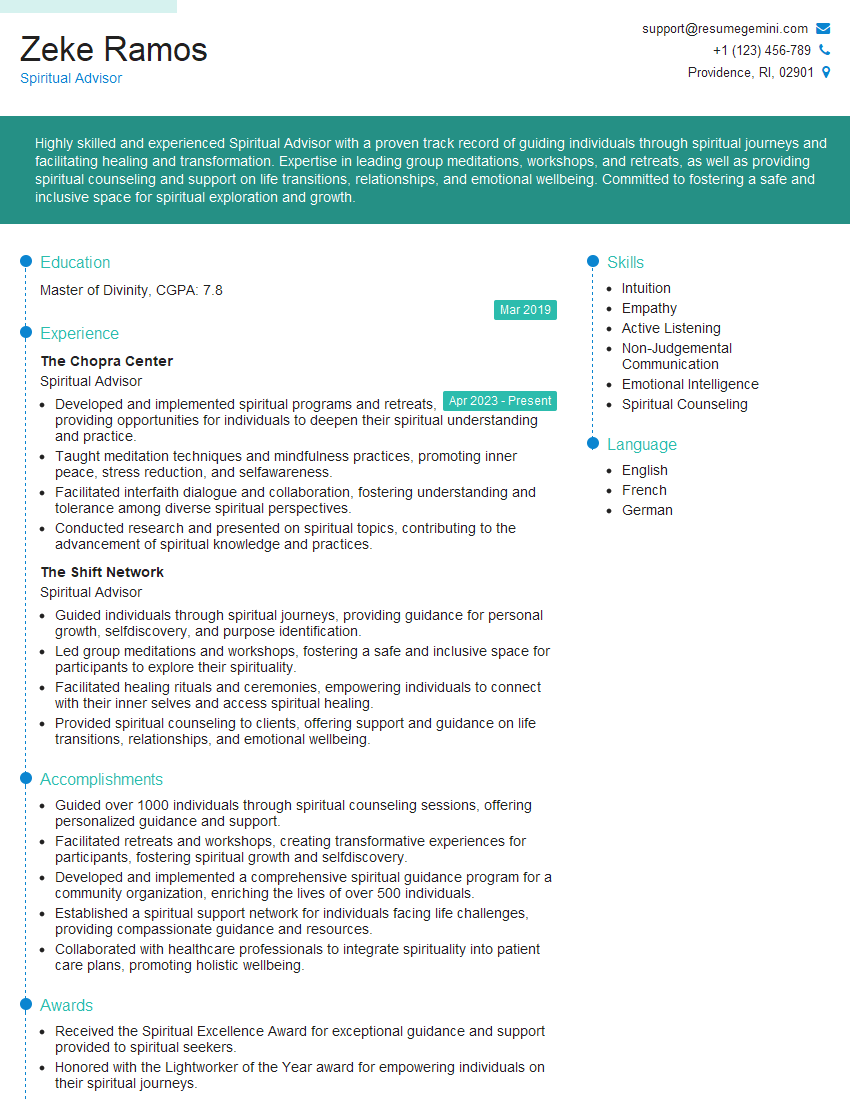
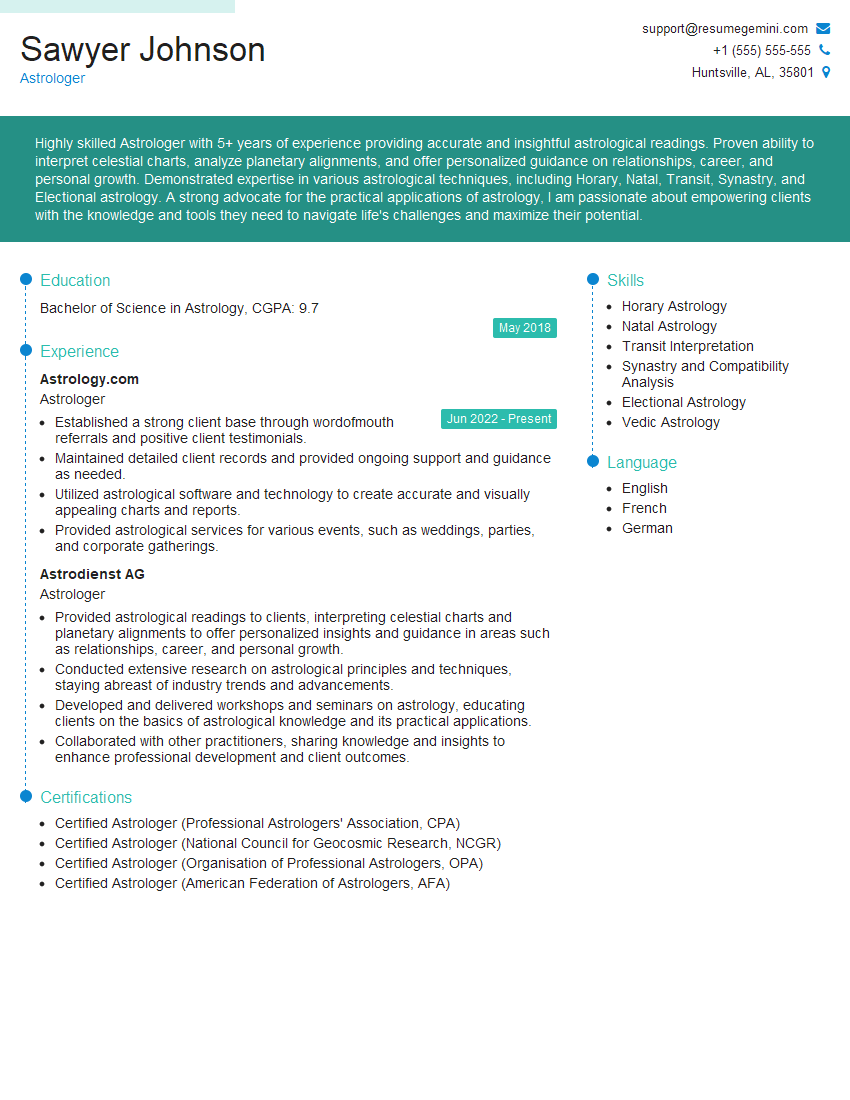
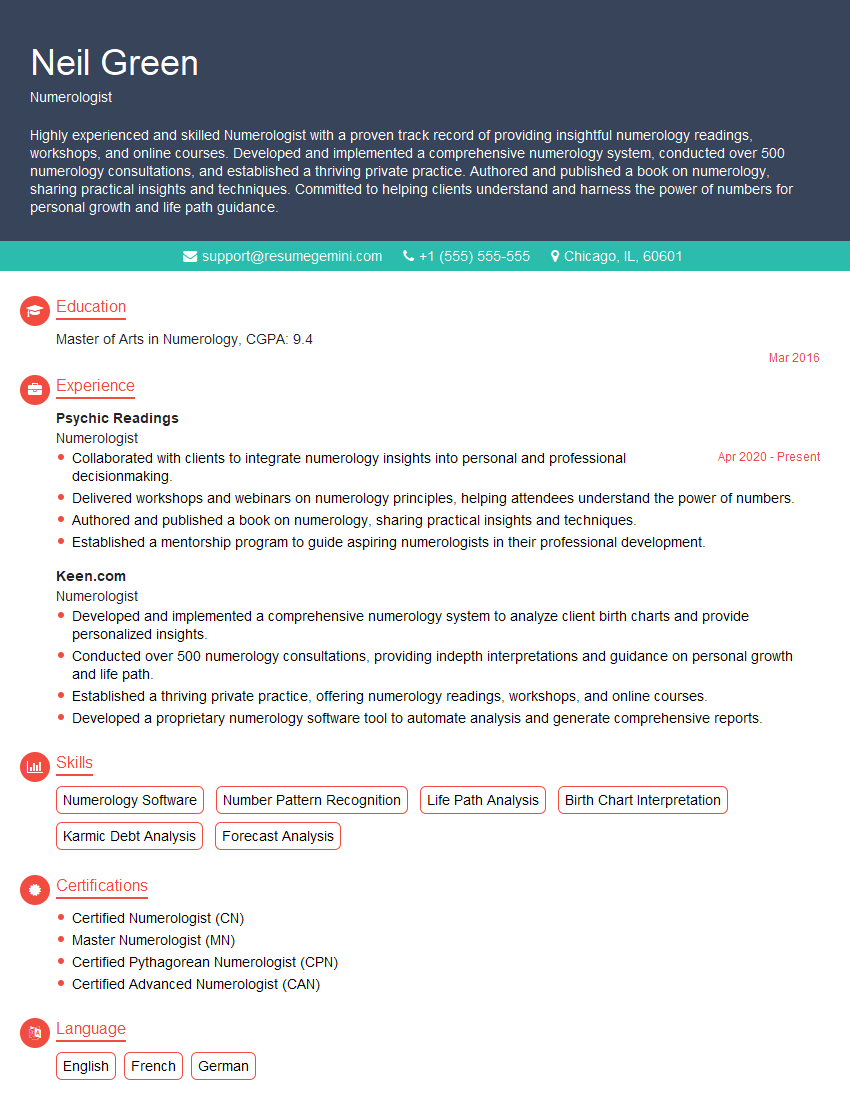
Mastering numerology and astrology opens doors to fulfilling careers in counseling, consulting, writing, and research. To significantly increase your chances of landing your dream role, a well-crafted, ATS-friendly resume is crucial. ResumeGemini can help you create a professional resume that highlights your unique skills and experience. We offer examples of resumes tailored specifically to showcase expertise in Knowledge of Numerology and Astrology – use our resources to create a compelling application that captures the attention of potential employers.
Explore more articles
Users Rating of Our Blogs
Share Your Experience
We value your feedback! Please rate our content and share your thoughts (optional).
What Readers Say About Our Blog
Very informative content, great job.
good