Preparation is the key to success in any interview. In this post, we’ll explore crucial Knowledge of Sewing Machine Components and Functions interview questions and equip you with strategies to craft impactful answers. Whether you’re a beginner or a pro, these tips will elevate your preparation.
Questions Asked in Knowledge of Sewing Machine Components and Functions Interview
Q 1. Describe the function of a sewing machine’s feed dogs.
The feed dogs are a pair of toothed metal bars located beneath the needle plate of a sewing machine. Their primary function is to move the fabric smoothly and evenly under the needle, ensuring consistent stitch length and preventing puckering or uneven feeding. Imagine them as tiny, synchronized claws gently pulling the fabric along at a controlled pace. Without properly functioning feed dogs, your stitches could be inconsistent, the fabric might bunch up, or you might have difficulty sewing thicker fabrics.
Q 2. What are the different types of sewing machine needles and when would you use each?
Sewing machine needles come in a variety of types, each designed for specific fabrics and stitch types. The most common are:
- Universal needles: These are the all-purpose needles, suitable for a wide range of fabrics, including cotton, linen, silk, and lightweight wool. Think of them as your everyday workhorse needle.
- Ballpoint needles: Designed for knit fabrics to prevent snagging or damaging the delicate loops of the yarn. Imagine using a blunt-ended pen to carefully write on a sheet of knitted material instead of a sharp pencil.
- Stretch needles: Similar to ballpoint needles but with a slightly different point shape for even better performance on stretch fabrics like jersey or spandex. They’re the go-to choice for any project involving stretchy materials.
- Jeans needles: These heavy-duty needles are designed for strong, tightly woven fabrics like denim and canvas. Their reinforced construction helps prevent breakage when sewing through thicker materials.
- Embroidery needles: These feature a larger eye for easy threading with thicker embroidery threads. They enable delicate and detailed stitching without pulling the threads tight and breaking them.
- Leather needles: Leather needles have a sharp point to pierce the leather easily and prevent slippage. They also have a strong shaft to resist bending under pressure.
Choosing the correct needle is crucial for preventing skipped stitches, broken needles, and damage to your fabric.
Q 3. Explain the purpose of the bobbin and how it interacts with the needle.
The bobbin is a small, spool-like component that holds the lower thread. It’s located in a case inside the sewing machine’s bed. The bobbin thread interacts with the needle thread above to create the stitch. As the needle pierces the fabric, it catches the bobbin thread, looping it around the needle thread to form the stitch beneath the fabric. Think of it as a delicate dance between the upper and lower threads. The interaction between the needle and the bobbin thread creates a lock stitch, which is stronger and more durable than other types of stitch, making the seams less likely to come undone.
Q 4. How do you adjust the tension on a sewing machine?
Adjusting tension involves balancing the upper and lower thread tensions to create even, neat stitches. Most sewing machines have a dial or knob to adjust the upper tension. The lower tension is adjusted by winding the bobbin correctly and ensuring it is properly seated. If the stitches look uneven with loops on the top, you need to reduce the upper tension. If the stitches pull to the bottom, you should increase the upper tension. This takes a little practice, but with experience, you’ll learn to recognize the signs of improper tension and make adjustments quickly and easily. It is crucial to remember that the tension needs to be adjusted depending on the fabric’s weight and weave, thread thickness and type of stitching.
Q 5. What are the common causes of skipped stitches and how do you troubleshoot them?
Skipped stitches are a common sewing machine problem with several possible causes:
- Incorrect needle: Using the wrong type of needle for the fabric can lead to skipped stitches.
- Bent or damaged needle: A bent or dull needle won’t pierce the fabric properly.
- Improper threading: Incorrect threading of the needle or bobbin can disrupt the stitch formation.
- Incorrect tension: Uneven tension between the upper and lower threads prevents proper stitch formation.
- Fabric thickness: Trying to sew excessively thick fabrics on a machine not designed for such heavy usage will likely produce skipped stitches.
- Dirty machine: Lint and dust can build up, interfering with the smooth movement of parts.
Troubleshooting involves systematically checking each possibility. Begin with inspecting the needle for damage, check your threading, then adjust the tension. Finally, consider cleaning and lubricating the machine if necessary.
Q 6. Describe the different types of sewing machine stitches and their applications.
Sewing machines offer a variety of stitches, each with its own application:
- Straight stitch: The most basic stitch, used for seams, topstitching, and basting.
- Zigzag stitch: Used for finishing seams, making buttonholes, and decorative stitching.
- Overlock stitch (serger stitch): Creates a professional-looking finish by sewing and cutting the fabric edge simultaneously, preventing fraying (this usually requires a serger machine, but some machines mimic the effect).
- Blind hem stitch: Makes an almost invisible hem finish on garments.
- Satin stitch: Creates dense, decorative stitches often used for embroidery.
Selecting the appropriate stitch depends on the project. Straight stitch is the workhorse, while others provide versatility and aesthetic appeal.
Q 7. How do you clean and lubricate a sewing machine?
Regular cleaning and lubrication are essential for maintaining your sewing machine’s performance and longevity.
- Cleaning: Turn off and unplug the machine. Use a soft brush or compressed air to remove lint and dust from all accessible areas, including the feed dogs, bobbin case, and needle plate. Pay close attention to the shuttle area where the bobbin is housed.
- Lubrication: Use a high-quality sewing machine oil, applying a small drop to the designated lubrication points. Check your machine’s manual for specific lubrication points. A well-lubricated machine will run smoothly, reducing friction and wear.
Cleaning and lubricating your machine every few projects will significantly extend its life and improve its performance. Remember to always unplug your machine before performing any maintenance. You can also use a lint brush and a small soft vacuum brush to clean out small crevices.
Q 8. What safety precautions should be taken when operating a sewing machine?
Sewing machine safety is paramount. Think of it like driving a car – you wouldn’t drive without a seatbelt, would you? Similarly, operating a sewing machine requires consistent awareness and adherence to safety protocols.
- Always unplug the machine before changing needles, bobbins, or making any adjustments. This prevents accidental shocks or injuries.
- Keep your fingers clear of the needle and presser foot. Use a thimble to protect your fingers when handling pins and needles.
- Keep your work area clean and organized. Clutter increases the risk of accidents. Make sure your machine is stable on a flat surface.
- Use the correct needle and thread for the fabric you are sewing. Using the wrong type can lead to broken needles and potential injury.
- Never sew over pins. They can break needles and cause injury. Remove pins from the fabric before placing it under the needle.
- Keep your machine properly maintained. Regular cleaning and oiling will help prevent malfunctions and keep the machine running smoothly.
- Supervise children around sewing machines at all times. Sewing machines are not toys.
Remembering these safety precautions will not only protect you from injury, but will also extend the life of your machine!
Q 9. What are the common problems associated with a broken needle?
A broken needle is more than just an inconvenience; it can lead to several problems. Think of the needle as the heart of the sewing machine; a broken one causes a ripple effect.
- Skipped stitches or inconsistent stitching: A bent or broken needle won’t penetrate the fabric evenly, resulting in irregular stitching. Imagine trying to write with a bent pen – your lines will be uneven.
- Damaged fabric: A broken needle can snag or tear the fabric, ruining your work.
- Needle plate damage: If a broken needle piece remains in the machine, it could damage the needle plate or other internal components, potentially leading to costly repairs.
- Injury: A broken needle can cause serious injury if a fragment flies off and hits your eye or skin.
Always inspect your needle before you begin sewing. Replacing it immediately if it shows even the slightest bend is crucial to prevent all these issues.
Q 10. Explain how to thread a sewing machine correctly.
Threading a sewing machine might seem daunting, but it’s a straightforward process once you understand the steps. Think of it like building a bridge – each step is essential for a successful outcome.
The exact steps vary slightly depending on the sewing machine model, so always consult your machine’s manual. However, here’s a general guide:
- Raise the presser foot and needle to its highest position.
- Locate the spool pin and place the spool of thread on it.
- Guide the thread through the tension discs. The number of tension discs and their placement vary between machines but the goal is to gently guide the thread through.
- Thread the take-up lever. This is usually a small hook or lever at the top of the machine.
- Thread the needle from front to back.
- Engage the thread in the bobbin case (if necessary). This is typically a separate process involving winding the thread onto a small bobbin then placing the bobbin into the machine.
Once threaded, gently pull the thread to ensure it passes through all the components smoothly. Practice makes perfect! If you encounter difficulties, consult your machine’s manual for model-specific instructions and diagrams.
Q 11. How do you change a sewing machine needle?
Changing a sewing machine needle is a simple but crucial maintenance task. Regular needle changes maintain optimal stitching quality and prevent machine damage.
- Turn the hand wheel to raise the needle to its highest position.
- Loosen the needle clamp screw. This is usually located just above the needle.
- Gently remove the old needle by pulling it straight upwards.
- Insert the new needle into the needle clamp, making sure the flat side of the needle faces the back of the machine.
- Tighten the needle clamp screw securely.
Always use the correct needle size and type for your fabric and project. Using the wrong needle can lead to broken needles, skipped stitches, and damage to your fabric and machine. It’s as straightforward as changing a lightbulb but with significant implications for your sewing projects.
Q 12. What are the different types of presser feet and their uses?
Presser feet are the unsung heroes of sewing. They’re the attachments that guide the fabric under the needle, enabling various sewing techniques. Each type is designed for a specific task, and selecting the right one dramatically impacts your stitching outcome.
- General-purpose foot: The workhorse, used for most straight stitching and zig-zagging.
- Zipper foot: Allows close-to-the-zipper stitching, crucial for neat zipper installations.
- Buttonhole foot: Creates evenly spaced buttonholes with perfect stitch consistency.
- Blind hem foot: Creates almost invisible hems on skirts and trousers.
- Rolled hem foot: Creates a narrow, rolled hem for delicate fabrics.
- Walking foot: Keeps multiple layers of fabric moving evenly under the needle, ideal for quilting or sewing thick materials.
- Overlock foot: Creates overlock or serger stitching, for finishing seam edges professionally.
Selecting the correct presser foot is like choosing the right tool for a job – using a screwdriver when you need a hammer won’t work well!
Q 13. How do you adjust the stitch length and width on a sewing machine?
Adjusting stitch length and width controls the appearance and functionality of your stitches. It’s akin to adjusting the font size and spacing in a word processor – you can change how it looks and its function.
Most sewing machines have dials or knobs for adjusting these settings. The stitch length dial controls the distance between stitches; longer stitch lengths are faster but less durable, while shorter ones are stronger and neater. The stitch width dial controls the width of zig-zag stitches.
- Stitch length: Shorter lengths (e.g., 1.5-2.0 mm) are perfect for seams that need to be strong and durable, while longer lengths (e.g., 3.0-4.0 mm) are good for basting or decorative stitches.
- Stitch width: This only applies to zig-zag stitches. The narrower the width the more the stitch will resemble a straight stitch. This setting can be adjusted to customize the appearance of your zig-zag stitch.
Experiment with different settings to find what works best for your projects and fabric types. Always consult your machine’s manual for the exact location and function of these adjustments.
Q 14. What is the purpose of the reverse stitch function?
The reverse stitch function is a crucial feature that allows you to sew backwards, locking stitches in place at the beginning and end of a seam. Imagine it as a knot to secure your stitches.
This prevents the seams from unraveling, adding durability and a professional finish to your work. The button or lever for this function is typically clearly labeled on your sewing machine. A few quick stitches backwards at the beginning and end of each seam significantly increases the strength of the seam by preventing unraveling.
This simple action significantly improves the longevity and overall quality of your sewing, making a huge difference in the final product.
Q 15. Explain how to use a walking foot.
A walking foot, also known as an even feed foot, is a specialized sewing machine presser foot designed to prevent fabric slippage, especially when sewing multiple layers of fabric or working with difficult-to-manage materials like leather or vinyl. It features a set of feed dogs on the foot itself, working in conjunction with the machine’s built-in feed dogs. This creates a more even feed of fabric from top to bottom, resulting in precise stitches and preventing puckering or shifting.
How to use it:
- Attach the walking foot: Remove the standard presser foot and attach the walking foot to your machine. The method varies depending on your machine’s model; consult your sewing machine’s manual for specific instructions. Usually, it involves raising the presser foot lifter and attaching the foot with a screw or snap-on mechanism.
- Adjust the pressure: Most walking feet have a screw to adjust the pressure. Start with the pressure moderately tight. Too loose, and the foot won’t grip the fabric effectively. Too tight, and it might damage delicate fabrics or make the machine work harder.
- Sew slowly: Begin by sewing slowly, especially when getting used to the walking foot. This allows you to feel the fabric feed and make any necessary adjustments to the pressure.
- Practice: Practice with scrap fabric first to get comfortable with the foot’s movement and adjust the pressure as needed.
Example: I once used a walking foot to sew together multiple layers of heavy denim for a quilt. Without it, the layers would have shifted and puckered, making the stitching uneven and difficult. The walking foot made the process smooth and the result was a professional-looking quilt.
Career Expert Tips:
- Ace those interviews! Prepare effectively by reviewing the Top 50 Most Common Interview Questions on ResumeGemini.
- Navigate your job search with confidence! Explore a wide range of Career Tips on ResumeGemini. Learn about common challenges and recommendations to overcome them.
- Craft the perfect resume! Master the Art of Resume Writing with ResumeGemini’s guide. Showcase your unique qualifications and achievements effectively.
- Don’t miss out on holiday savings! Build your dream resume with ResumeGemini’s ATS optimized templates.
Q 16. How do you troubleshoot a jammed sewing machine?
A jammed sewing machine can be frustrating, but systematic troubleshooting can usually pinpoint the problem. Always unplug the machine before attempting any repairs.
Troubleshooting steps:
- Check the needle: Bent, dull, or incorrectly inserted needles are a common cause of jams. Replace the needle with a new one of the correct type and size for your fabric and machine.
- Inspect the bobbin and bobbin case: Ensure the bobbin is properly wound and correctly inserted into the bobbin case. Clean the bobbin case, removing any lint or debris that might be obstructing its movement.
- Examine the fabric: Thick or multiple layers of fabric can overload the machine. Try sewing with a thinner fabric or fewer layers.
- Check the feed dogs: Make sure the feed dogs are clean and functioning correctly. Debris can jam the feed dogs, preventing the fabric from moving smoothly.
- Check the tension: Improper tension settings can cause the fabric to jam. Adjust the upper and lower tension dials, testing with a scrap fabric until the stitching is even on both sides.
- Look for broken parts: Carefully examine the machine for any broken or damaged parts, such as a broken needle plate or bent feed dogs. Professional repair might be necessary.
- Lubricate the machine: A well-lubricated machine runs smoothly and reduces friction. Consult your machine’s manual for lubrication instructions. Using the wrong lubricant can harm your machine.
Example: A recent jam I solved was due to a slightly bent needle. I replaced it, and the machine ran perfectly again. Often, the solution is simpler than you think!
Q 17. What are the signs that a sewing machine needs professional maintenance?
Regular maintenance is crucial for the longevity and performance of your sewing machine. Several signs indicate the need for professional attention:
- Inconsistent stitching: Skipping stitches, uneven stitch length, or inconsistent tension are common signs.
- Loud noises or unusual vibrations: Rattling, grinding, or excessive vibrations suggest internal problems that need a professional eye.
- Difficult to turn the handwheel: If turning the handwheel requires significant effort, the machine’s internal components might need lubrication or repair.
- Feed dogs malfunction: If the fabric isn’t feeding consistently, there might be a problem with the feed dogs.
- Frequent jams or needle breakage: Persistent jamming or frequent needle breakage implies underlying mechanical issues.
- Oil leaks: Any oil leaks are a clear sign that the machine needs professional service.
- Age of the machine: Even without significant problems, machines older than 5-10 years should receive a preventive maintenance check-up.
Ignoring these signs could lead to more serious, costly repairs. Professional maintenance involves a thorough cleaning, lubrication, and inspection of all parts by a qualified technician.
Q 18. What are the different types of sewing machine motors and their advantages?
Sewing machines use different types of motors, each with its own advantages:
- Direct-drive motors: These motors are directly connected to the internal machine components, eliminating the need for belts. This provides higher torque, smoother operation, quieter performance, and greater efficiency, often found in more advanced computerized machines. They’re better for heavy-duty sewing and more precise control.
- Belt-drive motors: These use a belt to transfer power from the motor to the machine’s internal parts. They are generally less expensive than direct-drive motors. However, belt-drive motors can be less efficient and generate more noise and vibration.
- Servo motors: A type of direct-drive motor, Servo motors are known for their precise speed and torque control, particularly useful for computerized machines with sophisticated stitch patterns and speeds.
Example: A direct-drive motor would be ideal for a professional tailor working with heavy leather, needing consistent power and quiet operation. A belt-drive motor is acceptable for a casual home sewer.
Q 19. Describe the function of the stitch regulator.
A stitch regulator, also known as a stitch length control or feed control, is a mechanism on advanced sewing machines that allows for precise control over the stitch length and feed rate. It maintains a constant stitch length even when sewing over varying thicknesses of fabric.
Function: It electronically manages the motor’s speed, adjusting the feed dogs’ movement to create consistent stitching. This is especially beneficial when sewing complex designs or handling thick fabrics where stitch length variations might occur due to differing fabric thickness.
Benefits: Eliminates stitch length inconsistencies, provides control over stitch density, improves the quality of decorative stitches, and greatly assists in achieving perfectly even stitches, reducing the need for manual adjustments during stitching.
Q 20. How do you identify different types of sewing machine fabric feeds?
Sewing machines use various fabric feed mechanisms to move the fabric under the needle. The most common types are:
- Rotary hook feed: Uses a rotary hook that smoothly moves the fabric, often found in industrial machines, excellent for high-speed and smooth stitching.
- Vertical hook feed: Characterized by a vertical hook that creates an upward and downward motion of the fabric, making it suitable for lighter and more delicate materials. Often used in home sewing machines.
- Three-point feed: A system of three feed dogs providing stable fabric movement and feeding consistency. It’s ideal for most fabrics and commonly found in home machines.
- Walking foot: As mentioned earlier, this isn’t strictly a fabric feed system, but an accessory that enhances feeding by adding its own feed dogs, especially useful for multiple layers.
Identification: You can typically identify the feed type by consulting your machine’s manual or examining the internal mechanisms of the machine (with the machine unplugged). The type of hook and the location and design of the feed dogs will indicate the feed mechanism used.
Q 21. What is the significance of proper timing in sewing machine functionality?
Proper timing in a sewing machine refers to the precise synchronization of the needle’s up-and-down motion with the hook’s rotation and the fabric’s feed. This synchronization is critical for creating well-formed stitches.
Significance: If the timing is off, the needle may strike the bobbin hook, leading to broken needles, skipped stitches, or poor-quality stitches. The hook may not properly pick up the upper and lower threads, resulting in loop formation or incomplete stitches. It affects stitch formation, the machine’s overall performance, and the quality of the final product.
Maintaining Timing: Precise timing is often factory set and shouldn’t require user adjustment. However, damage or wear to internal parts can throw off the timing. This is where professional maintenance is crucial. Attempting to adjust the timing without the proper knowledge or tools can cause significant damage to the machine.
Q 22. Explain the use of different types of bobbin cases.
Bobbin cases are crucial components that hold the bobbin and guide the lower thread in a sewing machine. Different types exist, primarily categorized by the type of sewing machine and the shuttle system used.
- Rotating Hook Bobbins: These are the most common type found in household sewing machines. The bobbin case is typically metal, with a spring-loaded latch to secure the bobbin, and has a specific design to interact with the rotating hook. A misaligned or damaged bobbin case will cause skipped stitches or thread breakage.
- Oscillating Hook Bobbins: These are used in some industrial and older household machines. The bobbin case design is different from a rotating hook, often featuring a more intricate shape to engage with the oscillating hook’s movement. Proper alignment is critical for consistent stitching.
- Vertical Hook Bobbins: This type is less common in home machines but prevalent in some industrial models. The bobbin case is designed to interact with a vertical hook, and it often has different features for precise thread guidance.
Choosing the correct bobbin case for your machine is paramount. Using the wrong one can lead to significant issues, including jammed threads and machine damage. Always consult your machine’s manual for the correct type.
Q 23. How do you diagnose and repair a broken timing belt?
A broken timing belt in a sewing machine leads to inconsistent stitching or complete machine failure. Diagnosing the problem starts with observing the symptoms: irregular stitch length, skipped stitches, or the machine failing to operate altogether.
Repair involves careful disassembly, replacing the broken belt with one of the exact specifications (size and tooth count matter!), and then reassembly.
- Disassembly: Carefully remove the machine’s casing and locate the timing belt. You’ll need appropriate tools, including screwdrivers and possibly pliers. Photographing each step is highly recommended.
- Belt Inspection: Examine the old belt for signs of wear, cracks, or breaks. Note its size and tooth count for ordering a replacement.
- Replacement: Install the new belt, ensuring its proper alignment with all the pulleys. Incorrect alignment will lead to further problems.
- Reassembly: Carefully put the machine back together, double-checking every component is secure.
- Testing: After reassembly, test the machine to ensure the belt functions correctly. Begin slowly and cautiously.
It’s important to note that timing belt replacement often requires significant mechanical aptitude. If you are uncomfortable performing this repair, it’s best to seek professional assistance.
Q 24. What are the common causes of inconsistent stitch formation?
Inconsistent stitch formation is a common sewing machine problem with several possible causes. It’s a process of elimination to find the culprit.
- Incorrect Thread Tension: This is the most frequent cause. Too loose or too tight tension on the upper or lower thread will create uneven stitches. Adjust the tension dials incrementally until you achieve balanced, even stitches.
- Bent or Damaged Needle: A bent needle will cause skipped stitches and inconsistent stitch length. Always inspect your needle before sewing and replace it as soon as you suspect damage.
- Incorrect Needle Type or Size: Using the wrong needle type (for example, using a ballpoint needle for denim instead of a denim needle) or size will hinder consistent stitch formation. Always use the correct needle for your fabric type and weight.
- Dirty or Damaged Hook: Build-up of lint and dust can affect the hook’s function. A damaged hook will also result in skipped stitches and inconsistent stitch length. Clean or replace the hook as necessary.
- Poorly Threaded Machine: Improper thread routing can cause tension issues. Double-check your threading path carefully, following your machine’s manual.
Systematic troubleshooting is key. Start with the simplest potential problems, like thread tension, and work your way through the list.
Q 25. What is the role of the take-up lever in the sewing process?
The take-up lever is a vital component controlling the upper thread’s movement. It plays a critical role in forming the stitch, ensuring that the thread is fed consistently and evenly during the sewing process.
Imagine it as a ‘thread elevator’. As the needle goes up and down, the take-up lever’s rhythmic movement pulls the upper thread along a precise path, ensuring it’s properly looped around the lower thread from the bobbin. This controlled movement is essential for stitch formation. Without a correctly functioning take-up lever, your stitches will be uneven, loose, or even skip entirely. A malfunctioning take-up lever may indicate issues with the machine’s internal mechanisms and requires professional attention.
Q 26. Explain how to identify and replace a worn-out hook.
Identifying a worn-out hook usually involves visual inspection. Look for signs of wear, such as noticeable scratches, burrs, or pitting on the hook’s surface. A worn-out hook will often lead to inconsistent stitch formation, thread breakage, or a loud, grinding sound during sewing.
Replacement requires careful disassembly of the machine’s internal components.
- Access the Hook: Refer to your machine’s service manual for precise instructions on how to access the hook. This often involves removing the faceplate and other components.
- Removal: Use the appropriate tools (usually a specific hook removal tool) to carefully remove the old hook.
- Installation: Carefully insert the new hook, ensuring it’s securely seated and properly aligned. Again, the service manual is indispensable.
- Reassembly: Reassemble the machine, ensuring all parts are correctly placed.
- Testing: Test the machine with a scrap piece of fabric to verify that the new hook is working correctly.
Replacing a hook requires precision and technical knowledge; if you’re unsure, seek professional assistance.
Q 27. What are some common issues with industrial sewing machines?
Industrial sewing machines, while robust, experience unique challenges.
- Needle breakage: High-speed operation and heavy-duty fabrics contribute to needle breakage. Using the wrong needle type or size, or encountering hidden debris in the fabric, exacerbates this.
- Tension problems: Consistent tension is critical for productivity. Variations in thread tension, often resulting from inconsistent fabric feed or thread quality, can cause significant slowdowns.
- Lubrication issues: Regular lubrication is paramount to prolong the lifespan of industrial sewing machines. Neglecting lubrication leads to increased friction, wear, and ultimately machine failure.
- Timing belt issues: As with domestic machines, timing belt problems can result in erratic stitching or total machine failure. Industrial machines often have more complex timing systems, making repairs more challenging.
- Motor problems: Continuous high-speed operation can stress motors, leading to reduced power or even motor failure.
Proper maintenance, regular inspections, and operator training are crucial for mitigating these common issues in industrial sewing.
Q 28. Describe your experience troubleshooting sewing machine problems.
My troubleshooting approach is systematic and thorough. I begin by listening carefully to the user’s description of the problem, noting specific symptoms like skipped stitches, uneven stitch length, loud noises, or thread breakage. I then perform a visual inspection, checking for obvious issues such as bent needles, damaged hooks, or thread tension problems.
I systematically check each component, starting with the simplest solutions (thread tension, needle condition) and progressing to more complex issues (timing belt, hook alignment, motor). I’ve resolved problems ranging from simple threading errors to more advanced issues like motor malfunctions. I’ve often used my experience to identify the problem’s root cause, rather than merely treating superficial symptoms. For example, a seemingly simple tension issue might be traced back to a poorly lubricated component or a worn-out part. Through years of hands-on experience, I’ve become proficient at identifying the subtle clues that indicate the specific cause, which saves both time and unnecessary repairs. I always prioritize thoroughness to prevent recurrent issues.
Key Topics to Learn for Knowledge of Sewing Machine Components and Functions Interview
- Understanding the Feed Dog: Learn about its function in fabric movement, its types (e.g., single, double), and troubleshooting issues like inconsistent feeding.
- Needle Systems: Explore different needle types (e.g., universal, ballpoint, stretch), their uses with various fabrics, and how to correctly select and install needles. Practical application: Describe scenarios where using the wrong needle would cause problems.
- Stitch Formation: Understand the interplay between the needle, bobbin, and feed dog in creating different stitches. Be able to explain the mechanics behind various stitch types (straight stitch, zigzag, etc.).
- Presser Foot Selection and Usage: Discuss the various presser foot types (e.g., zipper foot, buttonhole foot) and their applications. Explain how the correct presser foot impacts stitch quality and fabric handling.
- Tension Control: Learn how tension affects stitch quality and troubleshooting uneven stitching. Understand the interaction between upper and lower tension and its implications.
- Bobbin Winding and Insertion: Master the correct procedure for winding a bobbin and inserting it into the bobbin case. Discuss common problems and their solutions.
- Maintenance and Troubleshooting: Learn basic machine maintenance tasks (e.g., cleaning, oiling) and common troubleshooting techniques for problems like skipped stitches, broken needles, or jammed bobbin cases.
- Safety Procedures: Highlight essential safety practices when operating a sewing machine, including proper needle handling and machine maintenance.
- Different Sewing Machine Types: Familiarize yourself with the variations between mechanical, electronic, and computerized sewing machines, outlining their key features and operational differences.
Next Steps
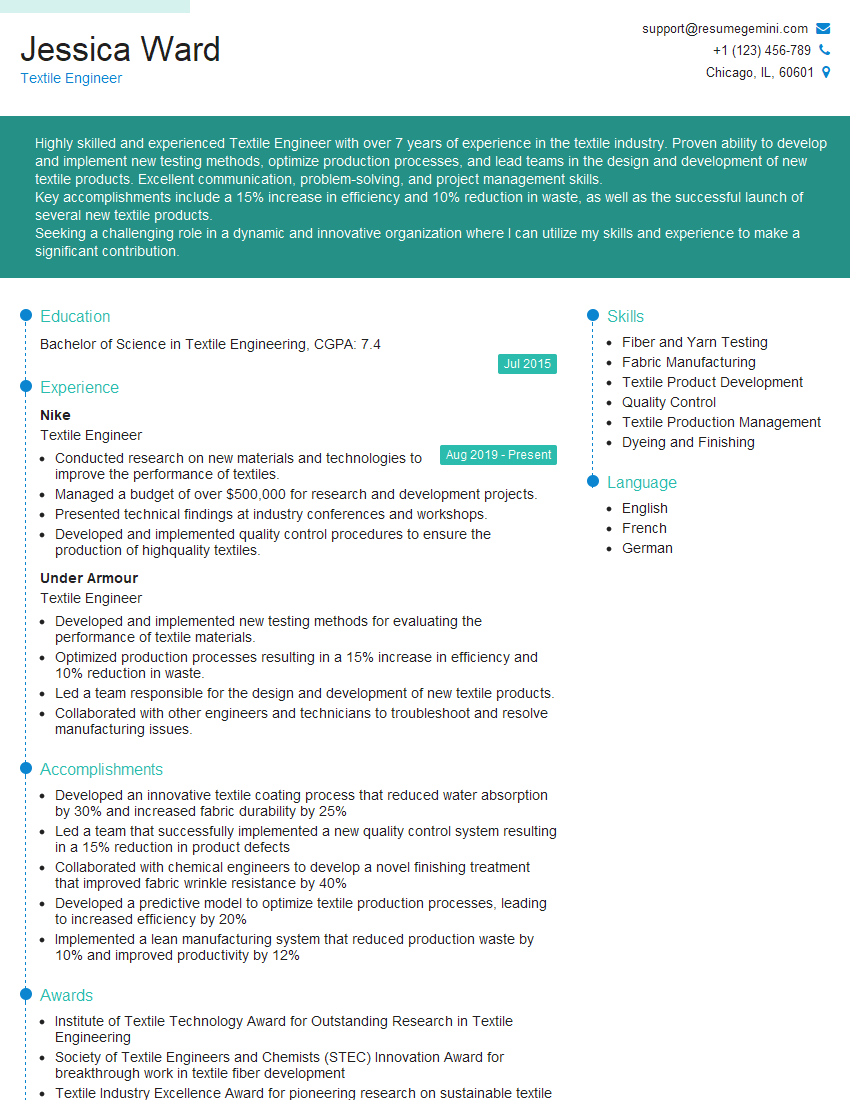
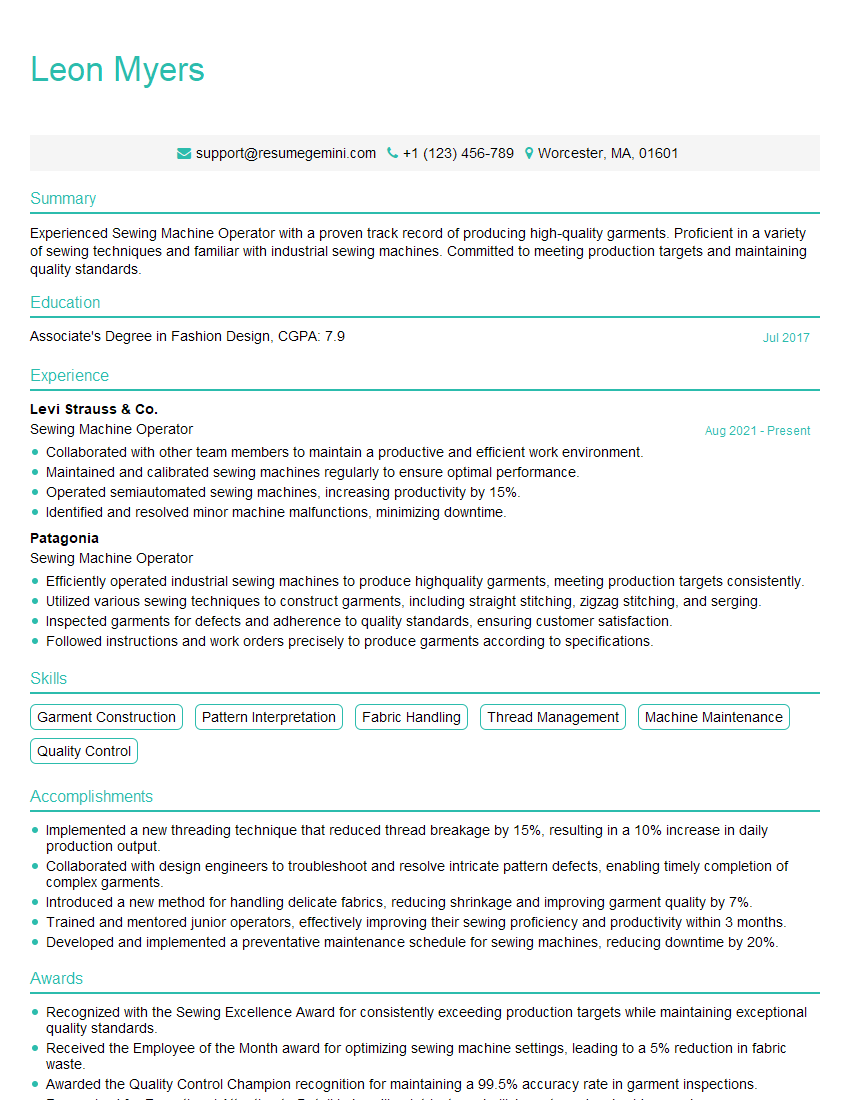
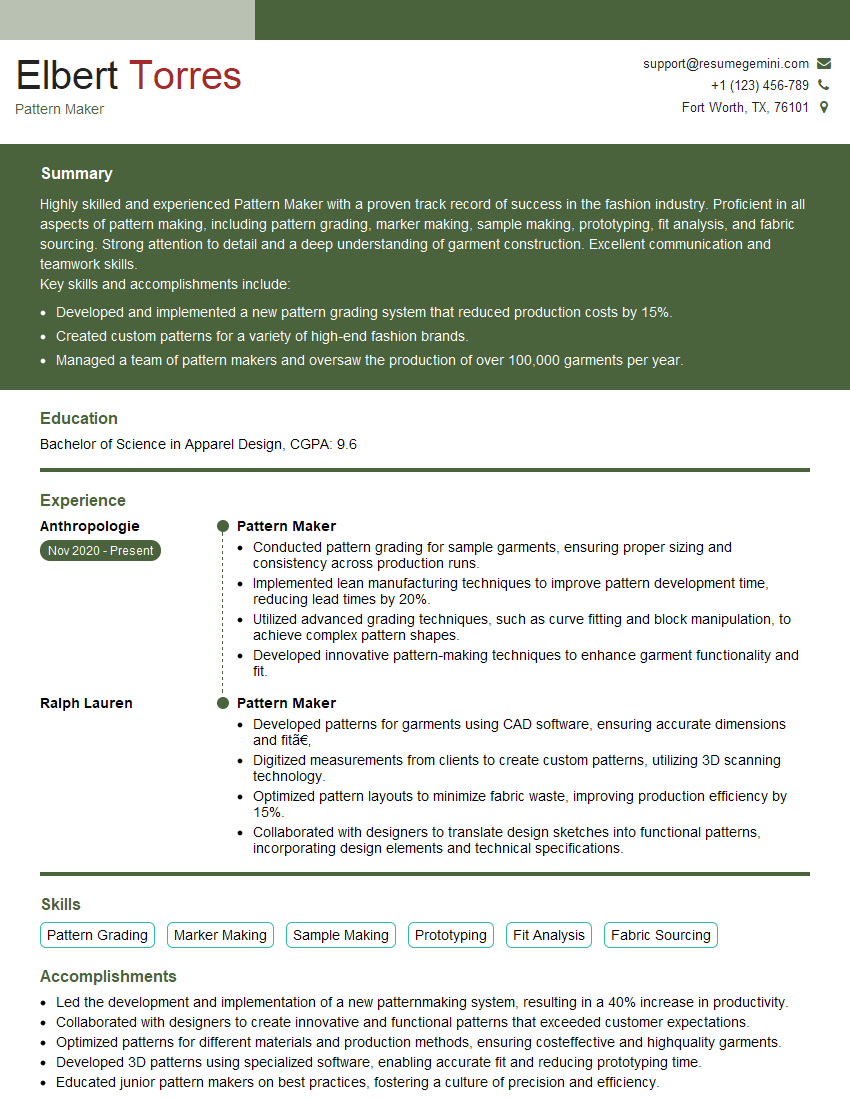
Mastering the knowledge of sewing machine components and functions is crucial for career advancement in the textile and garment industry, opening doors to specialized roles and increased earning potential. A well-crafted resume is your key to unlocking these opportunities. To significantly improve your job prospects, focus on building an ATS-friendly resume that highlights your skills and experience effectively. ResumeGemini is a trusted resource that can help you create a professional and impactful resume tailored to your specific skills and experience. Examples of resumes tailored to showcasing expertise in Knowledge of Sewing Machine Components and Functions are available to guide you. Use ResumeGemini to build a resume that stands out.
Explore more articles
Users Rating of Our Blogs
Share Your Experience
We value your feedback! Please rate our content and share your thoughts (optional).
What Readers Say About Our Blog
Very informative content, great job.
good