Interviews are opportunities to demonstrate your expertise, and this guide is here to help you shine. Explore the essential Knowledge of Structural Engineering Principles interview questions that employers frequently ask, paired with strategies for crafting responses that set you apart from the competition.
Questions Asked in Knowledge of Structural Engineering Principles Interview
Q 1. Explain the difference between dead loads and live loads.
Dead loads and live loads are two fundamental classifications of loads in structural engineering. Understanding the difference is crucial for ensuring structural integrity and safety.
Dead loads are permanent, constant forces acting on a structure. Think of them as the structure’s own weight – the weight of the beams, columns, walls, floors, and roofing materials. They’re relatively predictable and easy to calculate. For instance, the weight of a concrete slab is a dead load. We determine this by multiplying the volume of the concrete by its unit weight.
Live loads, on the other hand, are temporary and variable. These are forces that may or may not be present on a structure. Examples include the weight of people, furniture, equipment, snow, or even wind. They are less predictable and need to be considered using appropriate design codes and safety factors. For instance, the weight of cars in a parking garage is a live load, and we need to use design codes that specify live load requirements based on the intended use and location.
In designing a structure, engineers carefully consider both dead and live loads to ensure that the structure can safely withstand all anticipated forces. Ignoring either can have disastrous consequences.
Q 2. Describe your experience with different types of structural analysis methods (e.g., finite element analysis).
I have extensive experience with various structural analysis methods, including finite element analysis (FEA), which is my primary tool for complex structural designs. FEA allows for a highly detailed analysis of stress, strain, and deflection throughout a structure. I’ve used it extensively on projects ranging from high-rise buildings to complex bridge systems.
Beyond FEA, I am proficient in other methods such as:
- Simplified methods: For simpler structures, I use hand calculations and simplified methods like the cantilever method or the portal method for quick preliminary assessments.
- Matrix methods: I’m also familiar with matrix methods like the stiffness method, offering a more robust approach for larger, more complex systems.
For example, in a recent project involving a multi-story building with irregular geometry, FEA was essential to accurately model the complex load paths and stress distributions, ensuring optimal design efficiency and safety margins. The software provided invaluable visualizations that aided in identifying areas requiring reinforcement or design modifications. My experience spans various software packages, including ANSYS and SAP2000, ensuring I can choose the most appropriate tool for each project’s specific needs.
Q 3. What are the key considerations for designing structures in seismic zones?
Designing structures in seismic zones requires a deep understanding of earthquake behavior and its impact on structures. The primary considerations are:
- Seismic Load Determination: Accurately estimating the potential earthquake forces acting on the structure is crucial. This involves using appropriate seismic design codes and ground motion records relevant to the specific site location. The design must account for both horizontal and vertical seismic accelerations.
- Structural System Selection: Choosing a structural system appropriate for seismic resistance is paramount. Moment-resisting frames, shear walls, and base isolation are common strategies. The goal is to create a structure that can withstand significant lateral forces and deformation without collapsing.
- Ductility and Energy Dissipation: Incorporating ductility into the design is vital. Ductility is the ability of the structure to deform significantly without fracturing. This allows the structure to absorb seismic energy and reduce damage. Energy dissipation techniques, such as using dampers, can further enhance the seismic performance.
- Detailing for Seismic Resistance: Proper detailing of connections and elements is critical. Connections must be designed to accommodate significant deformations without failure. This often involves specific detailing requirements specified in seismic design codes.
- Soil-Structure Interaction: The interaction between the structure and the soil must be considered. Soft soils can amplify seismic ground motions, thus requiring special foundation design techniques.
Ultimately, the goal is to design a structure that can withstand an earthquake without collapsing, minimizing damage and ensuring the safety of occupants.
Q 4. How do you ensure compliance with building codes and regulations?
Compliance with building codes and regulations is paramount. My approach to ensure compliance involves a multi-step process.
- Thorough Code Review: Before starting any design, I conduct a comprehensive review of all applicable building codes, such as IBC (International Building Code) and local ordinances. This includes understanding the specific requirements for the project’s location and type.
- Code-Based Design: All design calculations and specifications are based on the relevant code provisions. I utilize software that incorporates these codes, and always double-check calculations to avoid errors.
- Documentation: Detailed documentation is essential. All design choices and calculations are meticulously recorded and included in the project plans. This ensures transparency and traceability for review by authorities and other professionals.
- Third-Party Review (When Necessary): For complex or high-risk projects, I recommend or engage a third-party engineer to review the design for compliance and to provide an independent assessment.
- Permitting Process: I’m actively involved in navigating the permitting process, addressing any queries from authorities and ensuring all documentation is complete and compliant.
Continuous professional development ensures that I’m updated on any code changes and best practices, ensuring that all projects meet current standards.
Q 5. Explain your experience with different structural materials (e.g., steel, concrete, timber).
My experience encompasses a wide range of structural materials, each with its own unique properties and applications:
- Steel: I’ve extensively used steel in various projects due to its high strength-to-weight ratio, ductility, and ease of fabrication. I’m familiar with various steel grades and their suitability for different applications. Steel is ideal for tall buildings, bridges, and other structures requiring high strength and slenderness.
- Concrete: Concrete is a versatile material used in a multitude of applications, from foundations to columns and slabs. My experience includes designing reinforced concrete structures, considering aspects like mix design, reinforcement detailing, and crack control. Concrete excels in compression, providing structural stability to buildings and infrastructure.
- Timber: Timber is a sustainable and aesthetically pleasing material. My experience includes designing timber structures, focusing on proper connections, durability, and the potential for wood decay or insect damage. Timber is well-suited for residential and some commercial applications.
Material selection involves careful consideration of factors such as strength, durability, cost, availability, environmental impact and aesthetics, always ensuring the chosen material optimally suits the specific design requirements and budget constraints.
Q 6. Describe your experience with structural detailing and drafting.
Structural detailing and drafting are integral parts of the structural engineering process. I’m proficient in using CAD software, such as AutoCAD and Revit, to create detailed shop drawings and construction documents. This includes developing drawings that clearly communicate the design intent to contractors and ensuring proper construction execution.
My detailing work focuses on:
- Clear and Concise Drawings: The drawings I prepare are unambiguous, clearly showing dimensions, material specifications, and connection details.
- Coordination with Other Disciplines: I ensure seamless coordination with architectural and MEP (Mechanical, Electrical, Plumbing) drawings to avoid conflicts during construction.
- Checking and Verification: Thorough checking and verification of drawings is vital to prevent errors and ensure accuracy. I utilize both manual and automated checking procedures.
- Construction Considerations: I consider practical construction aspects when detailing, ensuring the design is buildable and cost-effective.
Accurate and well-organized detailing significantly contributes to the success of any construction project, leading to reduced construction errors and increased efficiency.
Q 7. How do you handle design changes and revisions during a project?
Design changes and revisions are inevitable in any project. My approach to handling them is systematic and transparent.
- Formal Change Request Process: All design changes must be formally documented through change requests. This includes clearly outlining the reason for the change, its impact on the design, and any necessary revisions to drawings and calculations.
- Impact Assessment: A thorough impact assessment is performed to understand the implications of the change on other aspects of the design, including cost, schedule, and structural integrity. This may involve updating FEA models or performing additional calculations.
- Review and Approval: The change request and the updated design are reviewed and approved by relevant stakeholders, including the client and potentially relevant authorities.
- Clear Communication: Open and clear communication with all parties involved is crucial to ensure that everyone is aware of the changes and their implications.
- Version Control: I maintain rigorous version control of all drawings and documents to track changes and prevent confusion.
Effective management of design changes is essential to maintain project control and ensure the final design meets the client’s needs and complies with all applicable regulations.
Q 8. What software are you proficient in using for structural analysis and design?
My proficiency in structural analysis and design software is extensive. I’m highly experienced with industry-standard programs like ETABS, SAP2000, and RISA-3D. These programs allow for comprehensive modeling, analysis, and design of various structural systems, from simple beams to complex high-rise buildings. Beyond these, I’m also comfortable using specialized software for specific tasks like AutoCAD for drafting and detailing, and specialized concrete design software such as SAFE for foundation design. My experience isn’t limited to just using these tools; I understand their underlying theoretical foundations and can interpret the results critically, ensuring the accuracy and reliability of the designs produced. For example, in a recent project involving a complex steel frame, I leveraged SAP2000’s nonlinear analysis capabilities to accurately model the behavior under seismic loading, resulting in a more efficient and resilient design.
Q 9. Explain your understanding of load paths in a structural system.
Understanding load paths is crucial in structural engineering. It’s essentially tracing how loads – such as gravity, wind, or seismic forces – are transferred through a structure from their point of application to the ultimate support. Imagine a house: the roof’s weight (dead load) and the snow on it (live load) are transferred down to the rafters, then to the walls, and finally to the foundation. This is a simple load path. In more complex structures, multiple load paths can exist simultaneously, often interacting and redistributing forces. Effective design involves creating efficient and redundant load paths to ensure the stability and safety of the structure, preventing overloading of any single component. A poorly designed load path could lead to localized stress concentrations or even structural collapse. Consider a high-rise building – its load path involves columns transferring loads to beams, which then transfer loads to columns below, and so on until the loads reach the foundation. Understanding these load paths helps in strategically placing structural elements to manage stress effectively.
Q 10. Describe your experience with foundation design.
My foundation design experience encompasses a wide range of types, including shallow foundations (spread footings, strip footings, rafts), deep foundations (piles, caissons, piers), and retaining walls. I’m proficient in determining the appropriate foundation type based on soil conditions (obtained through geotechnical investigations), structural loads, and other relevant factors. My approach involves detailed analysis of soil bearing capacity, settlement calculations, and the design of foundation elements to ensure stability and prevent excessive settlement or failure. For example, I recently designed a piled foundation for a high-rise building located in an area with soft soil. By utilizing advanced geotechnical analysis and pile design software, I optimized the pile configuration to ensure the structural integrity and stability of the building under various loading conditions, including seismic loads.
Q 11. How do you approach the design of a reinforced concrete beam?
Designing a reinforced concrete beam involves a systematic process. First, I determine the loads acting on the beam (dead load, live load, etc.). Next, I calculate the required bending moment and shear force using structural analysis methods. This involves considering factors like support conditions and the beam’s span length. Based on these calculations, I select the beam’s dimensions, considering factors like deflection limits and serviceability requirements. The crucial next step involves designing the reinforcement. This includes determining the amount and placement of steel reinforcement to withstand the bending and shear stresses. I use design codes such as ACI 318 to ensure the design meets the required safety and performance standards. The design process also involves checking for crack control and detailing the reinforcement to ensure adequate bond between the steel and the concrete. Software like ETABS or specialized concrete design software can automate some of these calculations, but a deep understanding of the principles is essential to ensure accurate and efficient design. I always consider detailing aspects such as bar spacing, cover thickness, and anchorage details to ensure the structural integrity and constructability of the design.
Q 12. Explain your understanding of buckling in columns.
Buckling in columns is a critical failure mode, especially in slender elements. It occurs when a compressive load exceeds a critical value, causing the column to suddenly deform laterally. This critical load is dependent on the column’s length, cross-sectional properties (area and moment of inertia), and the material’s elastic modulus. Euler’s formula is a common method for calculating the critical buckling load for slender columns under ideal conditions. However, in reality, many factors such as initial imperfections, material nonlinearities, and end conditions affect the buckling behavior and the actual buckling load is often lower than the Euler load. Therefore, design often involves using more conservative approaches and employing safety factors to mitigate buckling risk. We use various techniques to prevent column buckling, including increasing the column’s cross-sectional area, reducing its length, using higher strength materials, or adding lateral bracing to improve its stability.
Q 13. Describe your experience with stability analysis.
My experience with stability analysis is substantial. It’s a crucial aspect of structural design, involving assessing the overall stability of a structure under various loading conditions. It goes beyond simply checking individual member strength; it focuses on the structural system’s behavior as a whole. This includes evaluating the behavior under various load combinations, considering second-order effects (P-delta effects), and accounting for potential instabilities like buckling or overturning. I typically employ both linear and nonlinear analysis methods depending on the complexity of the structure and the loading scenarios. For example, in the design of a tall building, nonlinear analysis is essential to account for the significant P-delta effects caused by the interaction between gravity loads and lateral deflections. Software like SAP2000 or ETABS allows for sophisticated stability analysis by incorporating geometric nonlinearities and material nonlinearities to provide a more realistic representation of the structural response. Careful attention to stability analysis is crucial for preventing catastrophic failures.
Q 14. How do you account for wind loads in your designs?
Wind loads are a significant consideration in structural design, especially for tall buildings and structures in exposed locations. I determine wind loads according to relevant building codes (like ASCE 7) and standards, considering factors such as the structure’s height, shape, location, and the local wind climate. The calculations involve determining the basic wind speed, exposure category, and the appropriate wind pressure coefficients. These coefficients depend on the building’s shape and orientation. The calculated wind pressures are then applied to the structure’s surface, and the resulting forces are used in the structural analysis. I often utilize wind tunnel testing for complex geometries to obtain more precise wind pressure distributions. The design then accounts for these wind loads to ensure the structure can withstand the expected wind forces without experiencing excessive deflections or failures. This involves appropriate detailing and the incorporation of wind bracing systems where needed to maintain structural stability. A thorough understanding of the principles of wind engineering and the appropriate use of wind load calculation software are crucial for effective wind load design.
Q 15. What are your strategies for managing risk in structural design?
Managing risk in structural design is paramount. My strategy is multifaceted and begins with a thorough understanding of the project’s context. This includes site investigations to assess geological conditions, environmental factors, and potential hazards. I then employ a layered approach to risk mitigation:
- Robust Design: I prioritize designs that inherently resist anticipated loads and potential failures, employing conservative safety factors based on relevant codes and standards. This often involves exploring multiple design options and comparing their performance under various load scenarios.
- Detailed Analysis: Sophisticated structural analysis techniques, including finite element analysis (FEA), are used to meticulously model the structure and predict its behavior under different load combinations. This allows for the identification of potential weak points and areas requiring special attention.
- Material Selection: Careful consideration is given to material properties, accounting for variability and potential degradation over time. I ensure that materials meet stringent quality standards and that their performance characteristics are adequately captured in the analysis.
- Construction Monitoring: Regular site visits and inspections during construction are crucial to ensure that the design is accurately implemented and that any unforeseen issues are addressed promptly. This minimizes the risk of construction errors that could compromise structural integrity.
- Redundancy: Where feasible, I incorporate redundancy into the design. This means designing the structure such that the failure of one component doesn’t necessarily lead to the collapse of the entire structure. Think of it like having backup systems in place.
- Regular Inspections and Maintenance: Post-construction, regular inspections and maintenance are recommended to identify and address any potential deterioration or damage before it becomes a significant threat.
For example, in designing a bridge, I would consider factors like seismic activity, potential flooding, and the impact of heavy vehicular traffic. The design would incorporate measures to mitigate each risk, resulting in a structure that’s not only safe but also resilient to unforeseen circumstances.
Career Expert Tips:
- Ace those interviews! Prepare effectively by reviewing the Top 50 Most Common Interview Questions on ResumeGemini.
- Navigate your job search with confidence! Explore a wide range of Career Tips on ResumeGemini. Learn about common challenges and recommendations to overcome them.
- Craft the perfect resume! Master the Art of Resume Writing with ResumeGemini’s guide. Showcase your unique qualifications and achievements effectively.
- Don’t miss out on holiday savings! Build your dream resume with ResumeGemini’s ATS optimized templates.
Q 16. Describe your experience with peer review of structural designs.
Peer review is an essential part of ensuring structural design quality and safety. I have extensive experience in this process, both as a reviewer and a reviewee. My approach is characterized by a thorough and critical examination of the design, encompassing all aspects from conceptualization to detailing.
As a reviewer, I meticulously check for compliance with relevant codes and standards, the accuracy and completeness of the analysis, the appropriateness of the material selection, and the clarity and completeness of the design documentation. I identify potential weaknesses, areas for improvement, and potential risks that might have been overlooked. I focus not only on detecting errors but also on suggesting effective solutions.
As a reviewee, I welcome constructive criticism. I view peer review as an opportunity for continuous learning and improvement. I engage actively with the reviewers to address their comments and incorporate their suggestions into the final design, ultimately leading to a safer and more robust structure.
A recent example involved reviewing a high-rise building design. My review highlighted a potential deficiency in the lateral load-resisting system during extreme wind events. This led to design modifications that enhanced the building’s stability and resilience.
Q 17. Explain your familiarity with different types of structural connections.
Structural connections are the critical elements that transfer loads between different structural members. My familiarity encompasses a wide range of connection types, categorized by material, behavior, and application:
- Bolted Connections: Common in steel structures, these utilize bolts to transfer shear and tensile forces. Different bolt types and configurations cater to varying load demands.
- Welded Connections: A prevalent method in steel structures, welding provides a permanent and strong connection, capable of efficiently transferring various load types. Careful consideration of weld geometry and quality control is vital.
- Riveted Connections: While less common now, riveted connections remain in older structures and are useful for certain applications. Their behavior and strength are well-understood.
- Moment Connections: These are designed to resist both shear and moment forces, offering greater stiffness and stability to the structure. Common in steel frames.
- Pinned Connections: Designed primarily to transfer shear forces and are often used in trusses and some bracing systems. They allow for rotation at the connection.
- Concrete Connections: In reinforced concrete structures, connections are achieved through various methods, including dowels, shear studs, and embedments. The design considerations here include concrete strength, reinforcement detailing, and crack control.
The choice of connection type depends heavily on the structural system, material properties, load requirements, and fabrication constraints. Selecting the right connection is crucial for overall structural performance and safety. A poorly designed connection can be a point of failure.
Q 18. How do you handle uncertainties in material properties?
Uncertainties in material properties are inherent in structural engineering. To address this, I employ several strategies:
- Statistical Methods: I incorporate statistical approaches to account for the variability in material strength and other properties. This often involves using probabilistic models and partial safety factors prescribed by relevant codes.
- Material Testing: Where feasible and cost-effective, material testing is conducted to obtain accurate property values for the specific materials used in the project. This provides more reliable input for the structural analysis.
- Conservative Design: When uncertainties are significant, I adopt a more conservative design approach, using higher safety factors or selecting materials with greater strength than the minimum required. This reduces the risk of underestimating material capacity.
- Load Combinations: The use of appropriate load combinations, as specified in relevant design codes, accounts for the combined effects of various loading conditions. This leads to more robust and reliable designs.
- Non-Linear Analysis: For critical projects, non-linear analysis techniques are used, which can better account for the material non-linearities and uncertainties in material properties.
For instance, in designing a concrete structure, I would use characteristic compressive strength of concrete (f’c) from the test results along with partial safety factors as per code provisions. This accounts for the inherent variability in the concrete’s strength.
Q 19. Describe your experience with failure analysis of structures.
Failure analysis involves investigating the causes of structural failures or near-misses. My experience includes performing root cause analysis using a combination of field investigation, laboratory testing, and numerical modeling. The process usually includes:
- Site Investigation: A thorough on-site examination to document the extent of damage, collect samples, and gather information about the construction history and loading conditions.
- Material Testing: Laboratory testing of material samples to assess their properties and determine if they met required specifications or degraded over time.
- Numerical Modeling: Utilizing FEA or other analysis methods to simulate the structural behavior and to investigate the factors leading to failure.
- Code Compliance Review: Reviewing the design to ascertain whether it complied with the relevant codes and standards.
- Report Writing: Preparing a comprehensive report outlining findings, causes, and recommendations for prevention of similar incidents.
In one instance, I investigated a collapsed retaining wall. Through a combination of field observations, soil testing, and FEA, we determined that inadequate soil compaction during construction was the primary cause of the failure. The analysis led to recommendations for stricter construction quality control measures.
Q 20. Explain your understanding of the principles of structural mechanics.
Structural mechanics is the foundation of structural engineering. It involves applying the principles of mechanics to understand the behavior of structures under load. My understanding encompasses:
- Statics: The study of structures at rest, involving equilibrium equations to determine internal forces and reactions.
- Dynamics: The study of structures subjected to time-varying loads, such as seismic events or wind gusts. This includes understanding concepts such as natural frequencies and damping.
- Strength of Materials: Analyzing the stresses and strains within structural elements under different loading conditions. This includes understanding concepts like bending moment, shear force, and torsional stress.
- Stress Analysis: Calculating the distribution of stresses and strains within a structure, identifying areas of high stress concentration and potential failure points.
- Elasticity and Plasticity: Understanding the elastic and plastic behavior of materials, which dictates how structures deform under load and their ultimate load-carrying capacity.
- Failure Theories: Applying appropriate failure theories, such as Von Mises or Tresca criteria, to predict when a material will fail under complex stress states.
These principles are essential for designing safe and efficient structures. For example, understanding bending moment diagrams is crucial in designing beams to ensure they are strong enough to resist the loads applied. Likewise, understanding dynamics is crucial for designing structures in earthquake-prone regions.
Q 21. What are the limitations of different structural analysis methods?
Various structural analysis methods have limitations that must be carefully considered. These limitations stem from the simplifying assumptions used in each method:
- Linear Elastic Analysis: This method assumes that the material behaves linearly elastically and that deformations are small. This assumption is violated when dealing with large deformations, non-linear material behavior (like plasticity), or complex material interactions. This analysis often underestimates deformations and stresses in such cases.
- Finite Element Analysis (FEA): While FEA is a powerful tool, its accuracy depends on the mesh quality, element type, and the constitutive models used to represent material behavior. An improperly refined mesh or inappropriate material models can lead to inaccurate results. Furthermore, FEA can be computationally intensive, requiring significant processing power and expertise.
- Simplified Methods: Methods such as the portal method or cantilever method provide quick estimations of forces but rely on significant simplifications and might not be accurate for complex structural systems or unusual loading patterns.
Therefore, choosing the appropriate analysis method depends on the complexity of the structure, material behavior, loading conditions, and the desired accuracy. It’s essential to understand the limitations of each method and to use the method that best suits the particular problem. Often a combination of methods might be needed for accurate analysis and design.
Q 22. How do you incorporate sustainability considerations in your designs?
Sustainability is paramount in modern structural engineering. It’s not just about using ‘green’ materials; it’s a holistic approach encompassing the entire lifecycle of a structure, from design and construction to operation and demolition.
Material Selection: We prioritize materials with low embodied carbon, like recycled steel or sustainably sourced timber. For example, instead of using conventional concrete, we might explore low-carbon alternatives like geopolymer concrete or consider using recycled aggregates in the concrete mix. This significantly reduces the carbon footprint associated with material production and transportation.
Design Optimization: Efficient design minimizes material usage without compromising structural integrity. Advanced analysis techniques like Finite Element Analysis (FEA) help us optimize designs, reducing waste and improving structural efficiency. For instance, by carefully analyzing load paths, we can design lighter structures that require less material, thus reducing the environmental impact.
Energy Efficiency: Designing structures to maximize natural light and minimize energy consumption for heating and cooling is crucial. This often involves strategic building orientation, incorporating passive design elements, and optimizing the building envelope to reduce thermal bridging. A good example is designing a building with a high thermal mass to reduce the need for air conditioning.
Demolition and Recycling: We consider the end-of-life phase of the structure, designing for easy deconstruction and maximizing the reusability and recyclability of materials. This involves choosing materials that can be easily separated and recycled at the end of the structure’s lifespan, reducing waste sent to landfills.
Q 23. Describe your experience with working on large-scale projects.
I have extensive experience working on large-scale projects, including a high-rise residential tower and a large-span stadium. The high-rise project involved coordinating with numerous subcontractors, managing complex schedules, and ensuring adherence to stringent safety regulations. We utilized BIM (Building Information Modeling) to facilitate efficient collaboration and to avoid clashes between different trades. The stadium project, on the other hand, focused heavily on optimizing the structural design to span an immense area with minimal support columns, optimizing the space for spectators while maintaining structural integrity. In both projects, effective communication and meticulous planning were crucial for successful completion. This involved detailed project management using tools like Gantt charts to track progress and identify potential bottlenecks, and regular progress meetings with all stakeholders to resolve any issues promptly.
Q 24. Explain your problem-solving approach when encountering unexpected challenges.
My problem-solving approach follows a structured methodology:
Identify the problem: Clearly define the challenge, gathering all relevant data and information.
Analyze the root cause: Investigate the underlying reasons for the problem, not just the symptoms. This might involve reviewing designs, conducting site inspections, and consulting with experts.
Develop potential solutions: Brainstorm multiple solutions, considering their feasibility, cost, and impact.
Evaluate and select the best solution: Analyze the potential solutions based on their effectiveness, cost-benefit ratio, and potential risks.
Implement the solution: Put the chosen solution into action, ensuring proper documentation and communication.
Monitor and evaluate the results: Track the effectiveness of the solution, making adjustments as needed.
For example, during the construction of the high-rise, we encountered unexpected soil conditions. By conducting thorough geotechnical investigation, we identified the problem, developed alternate foundation designs, and implemented the most cost-effective and structurally sound solution to ensure the project’s success.
Q 25. Describe your experience with collaborating with other disciplines (e.g., architects, MEP engineers).
Collaboration is essential in structural engineering. I have extensive experience working with architects, MEP (Mechanical, Electrical, and Plumbing) engineers, and contractors. On the high-rise project, close collaboration with the architects ensured the structural design complemented the architectural vision. Regular coordination meetings, detailed design reviews, and the use of BIM facilitated seamless integration. With MEP engineers, coordinating the location of building services within the structural elements was crucial to avoid conflicts and ensure efficient use of space. This required a thorough understanding of each discipline’s requirements and a willingness to compromise and find solutions that met everyone’s needs.
Q 26. How do you stay updated with the latest advancements in structural engineering?
Staying updated is crucial. I actively participate in professional organizations like the ASCE (American Society of Civil Engineers), attending conferences and workshops to learn about the latest advancements. I subscribe to industry journals and publications, regularly read research papers, and participate in online forums and communities to discuss emerging trends. I also engage in continuing education courses to earn professional development hours (PDHs) and maintain my professional license. Furthermore, I actively seek out opportunities to work on projects that expose me to new technologies and methodologies. This ensures I remain at the forefront of the field and continuously refine my professional expertise.
Q 27. Explain your understanding of finite element method (FEM) and its applications.
The Finite Element Method (FEM) is a powerful numerical technique used to analyze complex structural systems. It divides a structure into numerous small elements, approximating its behavior using mathematical equations. Each element’s behavior is analyzed, and the results are combined to obtain the overall response of the structure. FEM allows us to analyze complex geometries, material properties, and loading conditions that are difficult or impossible to solve using traditional methods. Software such as ANSYS and ABAQUS are widely used for FEM analysis.
Applications include:
- Stress and deflection analysis
- Buckling analysis
- Dynamic analysis (earthquakes, wind)
- Nonlinear analysis (material plasticity, large deflections)
For instance, in the stadium project, FEM analysis was crucial for optimizing the design of the long-span roof structure, ensuring it could withstand wind loads and snow accumulation while minimizing material costs. By running various simulations with different design parameters, we were able to refine the design to achieve optimal performance and cost-effectiveness.
Q 28. Describe your experience with structural health monitoring.
Structural health monitoring (SHM) involves using sensors and data analysis to assess the condition of a structure over time. This helps in detecting damage early, preventing catastrophic failures, and optimizing maintenance schedules. I have experience in deploying various sensors (strain gauges, accelerometers, fiber optic sensors) to monitor critical structural elements of bridges and buildings. The data collected is then analyzed using signal processing and statistical methods to identify anomalies and predict potential problems. This proactive approach allows for timely interventions, minimizing downtime and improving overall structural safety. For instance, we used SHM to monitor a bridge subjected to heavy traffic loads. By continuously monitoring its response, we identified subtle changes in its behavior indicative of potential fatigue cracking, allowing for timely repairs and preventing a potential failure.
Key Topics to Learn for Your Structural Engineering Principles Interview
Ace your next interview by mastering these fundamental concepts. Remember, practical application and problem-solving skills are just as crucial as theoretical understanding.
- Loads and Stresses: Understanding different types of loads (dead, live, wind, seismic), stress-strain relationships, and stress analysis techniques. Think about how these principles apply to designing safe and efficient structures.
- Structural Materials: Deep dive into the properties of concrete, steel, timber, and other common materials. Be prepared to discuss their strengths, weaknesses, and appropriate applications in different structural systems.
- Structural Analysis Methods: Familiarize yourself with methods like statically determinate and indeterminate analysis, including influence lines, moment distribution, and matrix methods. Be ready to explain how you would approach analyzing a simple structural system.
- Design Codes and Standards: Demonstrate knowledge of relevant building codes and standards (e.g., ACI, AISC). Understand how these codes guide design decisions and ensure structural safety.
- Stability and Buckling: Grasp the concepts of stability, buckling, and column design. Be able to discuss methods for preventing buckling failures.
- Connections and Joints: Understand the behavior of various structural connections (e.g., welds, bolts, rivets) and their impact on overall structural performance.
- Finite Element Analysis (FEA): If applicable to your experience, be ready to discuss your understanding of FEA and its applications in structural analysis and design.
- Sustainability and Green Building Practices: Discuss environmentally conscious design choices and the incorporation of sustainable materials and construction techniques.
Next Steps: Boost Your Career Prospects
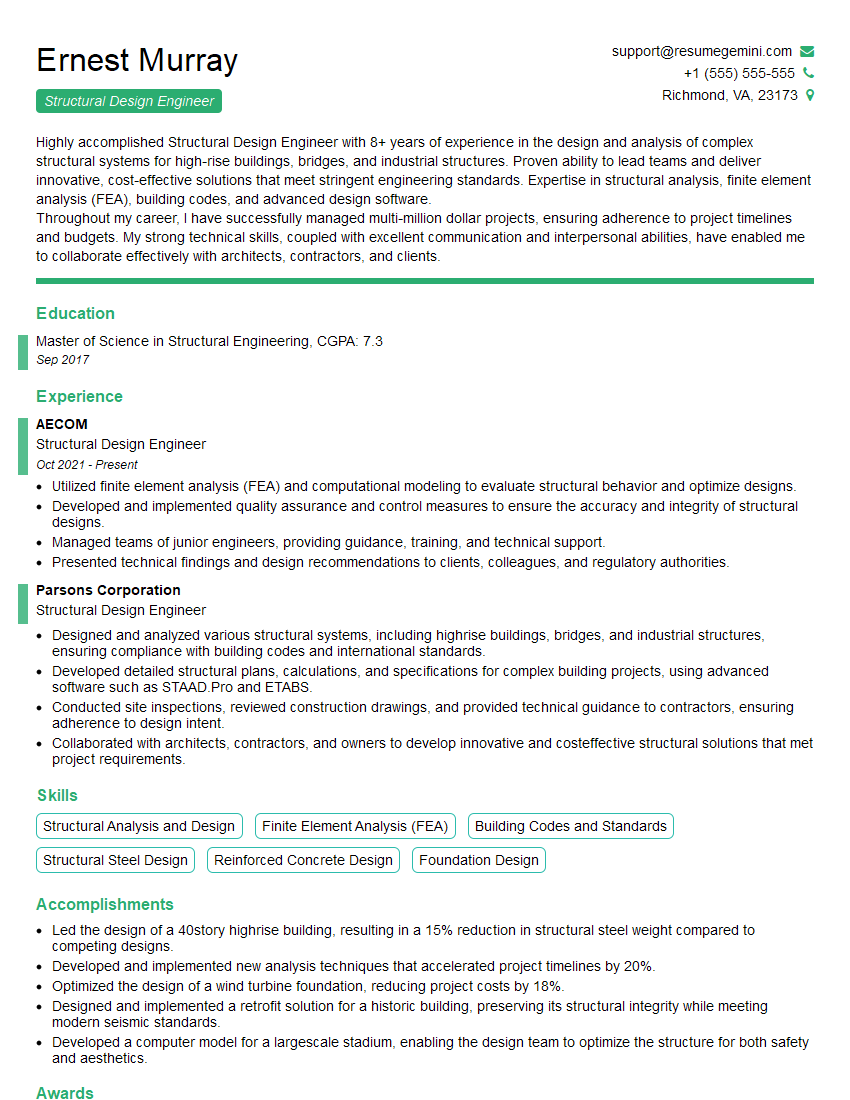
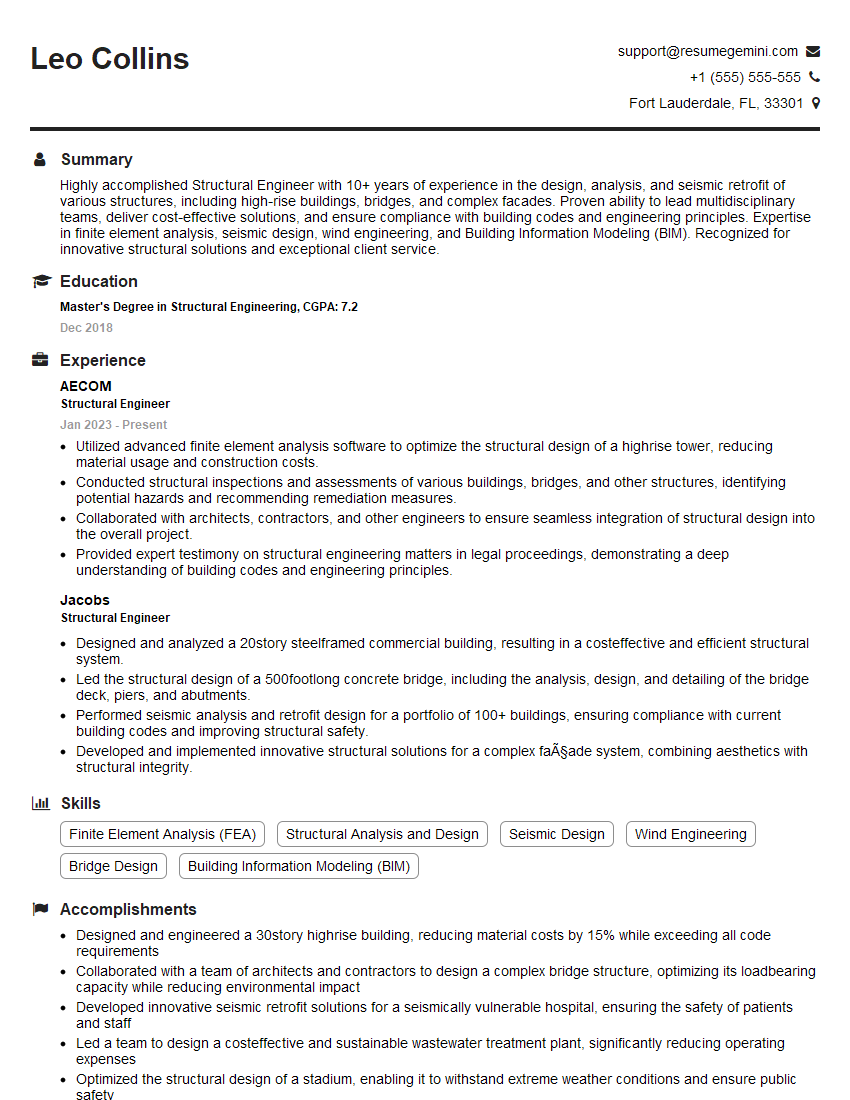
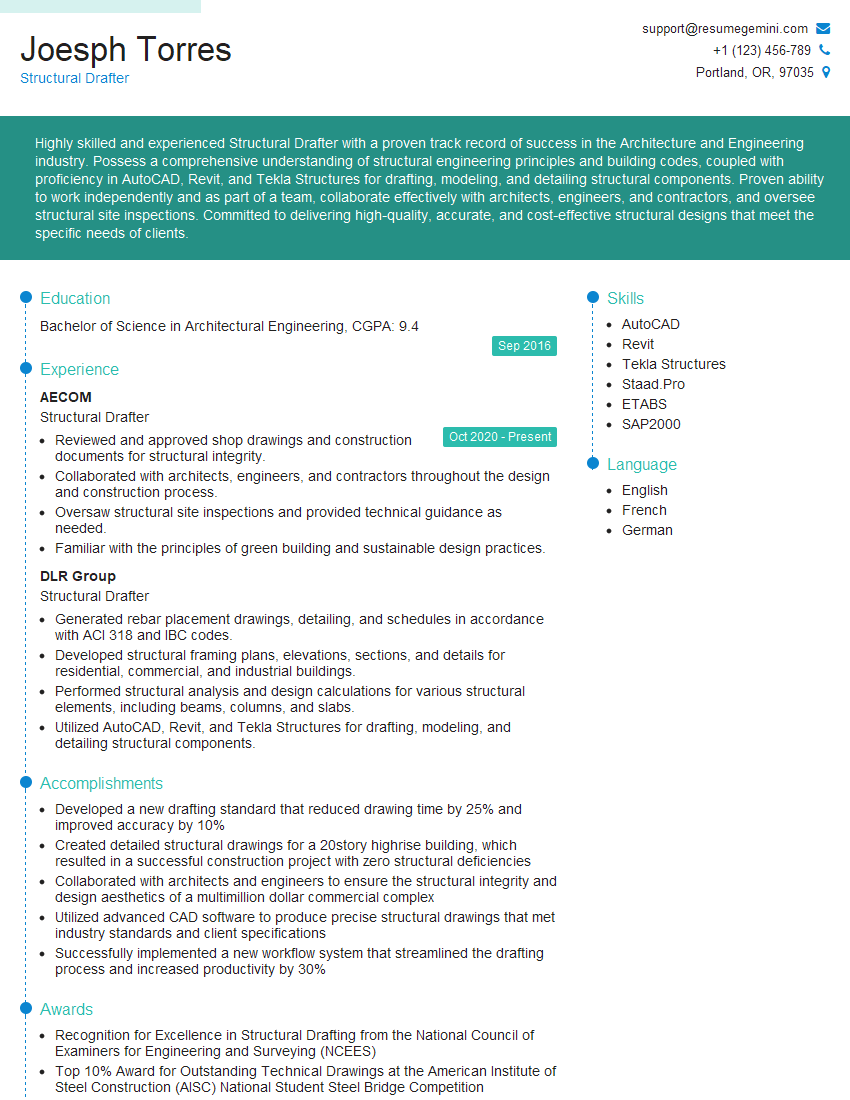
Mastering these structural engineering principles is paramount for career advancement. A strong foundation in these concepts will significantly increase your interview success rate and open doors to exciting opportunities. To further enhance your job search, create a compelling and ATS-friendly resume that highlights your skills and experience effectively. ResumeGemini is a trusted resource to help you build a professional resume that showcases your qualifications perfectly. We provide examples of resumes tailored specifically to structural engineering principles to help you get started. Invest in your future – craft a resume that truly reflects your expertise and secures your dream job.
Explore more articles
Users Rating of Our Blogs
Share Your Experience
We value your feedback! Please rate our content and share your thoughts (optional).
What Readers Say About Our Blog
Very informative content, great job.
good