Unlock your full potential by mastering the most common Knowledge of Water Conservation Techniques interview questions. This blog offers a deep dive into the critical topics, ensuring you’re not only prepared to answer but to excel. With these insights, you’ll approach your interview with clarity and confidence.
Questions Asked in Knowledge of Water Conservation Techniques Interview
Q 1. Explain the concept of water footprint and its calculation methods.
A water footprint represents the total volume of freshwater used to produce goods and services consumed by an individual, community, or business. It’s a crucial indicator of our impact on water resources. Think of it like a carbon footprint, but for water. It’s not just about the water we directly use at home, but also the ‘hidden’ water embedded in everything we consume – from the cotton in our clothes to the coffee we drink.
Calculating a water footprint involves several methods, broadly categorized into:
- Blue Water Footprint: This accounts for the surface and groundwater directly withdrawn for consumption (e.g., irrigation, industrial processes, and household use).
- Green Water Footprint: This measures the water evaporated from soil during crop production (rain or irrigation). This is often the largest component for agricultural products.
- Grey Water Footprint: This represents the volume of freshwater needed to assimilate pollutants generated during the production process. It considers water pollution from industrial activities or agricultural runoff.
The calculation itself can be complex, often requiring life cycle assessments (LCAs) to trace water use through the entire supply chain. Software and databases, such as the Water Footprint Network’s calculator, are available to assist with more precise estimations. For a simplified approach, you can utilize online calculators that provide estimates based on consumption patterns and lifestyles.
Q 2. Describe different water conservation techniques for agriculture.
Water conservation in agriculture is critical, given that agriculture accounts for a significant portion of global freshwater consumption. Many techniques focus on efficient irrigation and soil management.
- Drip Irrigation: This method delivers water directly to plant roots, minimizing evaporation and runoff, which is much more efficient than flood irrigation. Imagine precisely watering each plant instead of flooding a whole field.
- Sprinkler Irrigation: While less efficient than drip, sprinklers are still better than flood irrigation, especially when using low-pressure systems that reduce water loss.
- Rainwater Harvesting: Collecting and storing rainwater for later use during dry periods reduces reliance on groundwater or surface water sources.
- Soil Moisture Monitoring: Sensors and soil probes help farmers determine precisely when and how much to irrigate, preventing overwatering.
- Crop Rotation and Cover Cropping: These techniques improve soil health, water retention, and reduce the need for irrigation. Think of it as giving your soil a healthy diet.
- Drought-Resistant Crops: Selecting crops adapted to arid conditions reduces water demand.
- Water-Efficient Farming Practices: This includes techniques such as no-till farming (minimizing soil disturbance to preserve moisture) and mulching (reducing evaporation).
The specific techniques implemented will depend on factors like climate, soil type, crop, and available resources.
Q 3. What are the main challenges in implementing water conservation policies?
Implementing effective water conservation policies faces numerous challenges. Often, a lack of political will and inadequate funding hinder progress.
- Economic Barriers: Farmers and businesses might perceive water conservation technologies as costly and unaffordable, impacting their willingness to adopt them.
- Lack of Awareness and Education: Public understanding of water scarcity and the importance of conservation is crucial. Without awareness, behavioral changes are unlikely.
- Institutional and Regulatory Barriers: Complex bureaucratic processes and poorly defined water rights can impede the implementation of water-saving measures.
- Technological Limitations: Although technology is advancing, access to and affordability of water-efficient technologies remain barriers, especially in developing countries.
- Enforcement Challenges: Strict enforcement mechanisms are needed to ensure compliance with regulations, but such enforcement is often difficult to achieve.
Addressing these challenges necessitates a multi-pronged approach, including subsidies for water-efficient technologies, public awareness campaigns, improved water governance, and stronger enforcement of regulations.
Q 4. How can smart irrigation systems contribute to water conservation?
Smart irrigation systems significantly contribute to water conservation by optimizing water delivery based on real-time data. They use sensors, weather data, and soil moisture information to schedule irrigation precisely when and where needed, eliminating guesswork and reducing water waste.
- Reduced Water Consumption: Smart systems provide only the necessary amount of water, significantly reducing overwatering.
- Improved Crop Yields: By delivering water efficiently, smart irrigation systems often lead to healthier plants and increased crop yields.
- Data-Driven Decision Making: The data collected by smart systems allows farmers to make informed decisions about irrigation scheduling and water management.
- Remote Monitoring and Control: Farmers can monitor and adjust irrigation schedules remotely, enhancing flexibility and efficiency.
Examples of smart irrigation technologies include soil moisture sensors, weather stations, and automated controllers. These systems can be integrated with precision agriculture technologies for an even more comprehensive approach to water management.
Q 5. Discuss various methods for reducing water loss in urban water systems.
Reducing water loss in urban systems involves addressing leaks, improving infrastructure, and promoting water-wise practices among residents.
- Leak Detection and Repair: Regular inspections and advanced leak detection technologies are crucial to identify and repair leaks in pipes and other infrastructure quickly, minimizing significant water losses.
- Improved Infrastructure: Replacing aging and leaky pipes with more resilient materials can drastically reduce water loss. This is a significant long-term investment but yields substantial returns.
- Pressure Management: Maintaining optimal water pressure in the system prevents bursts and leaks.
- Public Awareness Campaigns: Educating residents about the importance of conserving water and identifying leaks in their homes can promote responsible water use.
- Water Metering: Implementing accurate water meters helps track water consumption, allowing users to monitor their usage and identify potential leaks promptly. This also encourages conservation through incentivization (e.g., lower bills for lower consumption).
- Water-Efficient Appliances: Promoting the use of low-flow toilets, showerheads, and other water-saving appliances further reduces water demand in households.
A comprehensive approach combining these methods is essential to significantly reduce water loss in urban areas.
Q 6. Explain the role of rainwater harvesting in water conservation.
Rainwater harvesting involves collecting and storing rainwater for later use. It’s a highly effective water conservation technique, especially in areas with variable rainfall patterns. Think of it as creating a personal, natural water reservoir.
Rainwater harvesting systems can range from simple collection barrels to sophisticated underground storage tanks. The collected water can be used for various non-potable purposes, such as:
- Irrigation: Watering gardens and lawns.
- Toilet Flushing: Reducing the demand on potable water supplies.
- Laundry: Non-potable water is perfectly suitable for laundry purposes.
- Cleaning: General cleaning tasks around the house or business.
The benefits extend beyond simply conserving water; it also reduces stormwater runoff, which can help prevent flooding and erosion. The implementation’s feasibility depends on factors like rainfall patterns, land availability, and regulatory requirements.
Q 7. What are the benefits and limitations of water recycling and reuse?
Water recycling and reuse involve treating wastewater to a certain standard and then using it for various purposes. While offering significant advantages, it also presents limitations.
Benefits:
- Reduced Freshwater Demand: Reusing treated wastewater significantly reduces reliance on freshwater sources.
- Environmental Protection: Recycling reduces the amount of wastewater discharged into water bodies, thereby protecting water quality and ecosystems.
- Economic Benefits: In some cases, water reuse can be more cost-effective than using freshwater, particularly in water-stressed regions.
Limitations:
- Treatment Costs: The cost of treating wastewater to the required standard for reuse can be substantial.
- Public Perception: Concerns about public health and acceptability of reused water can hinder implementation. It’s crucial to communicate effectively about water treatment processes to address these concerns.
- Technological Limitations: The effectiveness of treatment technologies varies depending on the type and quality of wastewater. Certain pollutants might be difficult to remove completely.
- Potential Health Risks: If the treatment process is not adequate, there can be potential health risks associated with the reuse of water.
Careful planning and appropriate technologies are essential for successful and safe water recycling and reuse programs. Public education and robust regulatory frameworks are also crucial.
Q 8. Describe different water auditing methodologies.
Water auditing methodologies systematically assess water use to identify inefficiencies and leaks. They range from simple visual inspections to sophisticated data analysis using smart meters. A crucial aspect is understanding the water balance – the inflow (supply) and outflow (demand) – for a specific system, be it a building, a farm, or an entire municipality.
- Level 1: Simple Audits: These involve visual inspections for leaks, checking water pressure, and reviewing bills to spot unusual consumption patterns. Think of this as a basic health check for your water system.
- Level 2: Detailed Audits: These go deeper, using flow meters to measure water usage at specific points, analyzing water pressure, and identifying water losses through pipe leaks or faulty fixtures. It’s like getting a more thorough medical examination.
- Level 3: Advanced Audits: These often involve sophisticated data logging, modeling, and analysis using advanced software to pinpoint even the smallest leaks and optimize water usage. This is akin to a specialized medical scan, providing extremely detailed information.
For instance, a Level 2 audit might reveal that a specific section of a building’s plumbing consistently shows unusually high water usage, suggesting a possible leak that can be pinpointed and rectified. An advanced audit could even model future water needs based on climate projections and building occupancy to proactively plan for water efficiency.
Q 9. How can water conservation be integrated into urban planning?
Integrating water conservation into urban planning is essential for creating sustainable and resilient cities. It requires a holistic approach, incorporating water-wise design principles from the initial stages of planning. This includes everything from infrastructure design to building codes and public education.
- Water Sensitive Urban Design (WSUD): This approach prioritizes minimizing runoff, maximizing infiltration, and using reclaimed water. For example, creating permeable pavements to allow rainwater to seep back into the ground, reducing strain on drainage systems and replenishing groundwater.
- Green Infrastructure: Incorporating green spaces, such as rain gardens and bioswales, helps manage stormwater runoff naturally, reducing the load on wastewater treatment plants and promoting biodiversity.
- Building Codes and Regulations: Implementing stricter building codes that mandate water-efficient fixtures, appliances, and landscaping designs can significantly reduce water consumption in new constructions.
- Water Pricing Strategies: Implementing tiered water pricing, where higher consumption levels incur higher costs, incentivizes water conservation among residents and businesses.
- Public Transportation and Density: Promoting public transportation and denser urban development patterns reduces the overall per-capita water footprint associated with sprawling suburbs.
Imagine a new urban development designed using WSUD principles: streets with permeable surfaces, green roofs capturing rainwater, and efficient irrigation systems in parks. This holistic approach minimizes environmental impact and creates a more sustainable city.
Q 10. What are the key performance indicators (KPIs) for water conservation programs?
Key Performance Indicators (KPIs) for water conservation programs provide crucial insights into the program’s effectiveness. They should be measurable, achievable, relevant, and time-bound (SMART).
- Water Use Reduction: Percentage reduction in water consumption compared to a baseline period. For example, a 20% reduction in per-capita water use within a year.
- Leak Detection and Repair Rate: Number of leaks detected and repaired per unit time, showcasing the success of leak detection and repair programs.
- Public Awareness and Engagement: Tracking the number of participants in educational programs or the reach of public awareness campaigns.
- Water Reuse and Recycling: Percentage of wastewater reused or recycled for non-potable purposes (e.g., irrigation).
- Groundwater Recharge Rate: Measuring the rate of groundwater replenishment due to conservation efforts.
- Cost Savings: Tracking the financial benefits of water conservation, such as reduced water bills or decreased maintenance costs.
For example, a city might track the percentage reduction in water consumption per household after implementing a public awareness campaign about water-efficient appliances. Another KPI could be the number of leaks detected and repaired per 1000 service connections, reflecting the effectiveness of leak detection programs.
Q 11. Discuss the impact of climate change on water resources and conservation strategies.
Climate change significantly impacts water resources, exacerbating existing water scarcity and increasing the urgency of effective conservation strategies. Changing precipitation patterns, rising temperatures, and increased evaporation rates all directly affect water availability and quality.
- Increased Frequency and Intensity of Droughts: Droughts become more frequent and severe, leading to water shortages and impacting agriculture, industry, and domestic water supplies. This necessitates developing drought-resilient strategies, such as water storage and efficient irrigation techniques.
- Changes in Precipitation Patterns: Alterations in rainfall patterns, with some regions experiencing more intense rainfall and others experiencing prolonged droughts, require adaptive strategies for water management, including improved water harvesting and storage infrastructure.
- Sea Level Rise and Saltwater Intrusion: Rising sea levels can contaminate coastal aquifers with saltwater, rendering them unusable for drinking water. This necessitates implementing measures to protect coastal aquifers from saltwater intrusion.
- Increased Evaporation Rates: Higher temperatures lead to increased evaporation from reservoirs and lakes, reducing water storage capacity. This highlights the need for better water storage management and improved water use efficiency.
For example, a region experiencing increased droughts might implement stricter water restrictions during dry periods and invest in water harvesting technologies to supplement water supplies. Coastal communities facing saltwater intrusion may need to invest in desalination plants or explore alternative water sources.
Q 12. Explain the principles of xeriscaping and its role in water conservation.
Xeriscaping is a landscaping approach that minimizes or eliminates the need for supplemental irrigation. It focuses on using drought-tolerant plants, efficient irrigation techniques, and soil improvements to create beautiful, water-wise landscapes.
- Plant Selection: Choosing native plants adapted to the local climate and soil conditions reduces the need for supplemental watering. These plants are naturally resistant to drought and require less maintenance.
- Efficient Irrigation: Implementing drip irrigation systems delivers water directly to plant roots, minimizing water loss through evaporation. Proper soil preparation, including adding organic matter, improves water retention.
- Mulching: Applying a layer of mulch helps retain soil moisture, reducing the frequency of watering. It also suppresses weeds, reducing competition for water.
- Soil Improvement: Amending the soil with organic matter improves its water retention capacity, reducing the need for frequent watering. Soil testing can identify deficiencies that need to be addressed.
Imagine a xeriscaped garden with native wildflowers, drought-tolerant shrubs, and a carefully designed irrigation system. This landscape requires minimal watering and thrives even during dry periods, conserving water and reducing the environmental impact of landscape maintenance.
Q 13. What are the different types of water meters and their applications?
Various types of water meters measure water consumption, providing essential data for billing, leak detection, and conservation efforts. The choice of meter depends on the application and desired level of detail.
- Mechanical Meters: These use a rotating mechanism to measure water flow. They are relatively simple, inexpensive, and widely used for residential and smaller commercial applications. However, they are less accurate than electronic meters and are susceptible to wear and tear.
- Electronic Meters: These use electronic sensors to measure water flow and transmit data digitally. They provide more accurate readings and can communicate data remotely, making them ideal for larger systems and leak detection programs. They are also often equipped with advanced features like tamper detection.
- Smart Meters: These are advanced electronic meters with data communication capabilities, enabling remote monitoring and real-time data analysis. They can detect anomalies such as unusual water usage patterns, suggesting potential leaks, and help optimize water management.
For instance, a residential property may use a simple mechanical meter for billing, while a large industrial complex may employ smart meters to monitor water usage across various departments and instantly identify leaks. Municipal water systems often employ a combination of meter types to provide comprehensive water usage data.
Q 14. How can public awareness campaigns contribute to water conservation?
Public awareness campaigns play a critical role in promoting water conservation by educating and motivating individuals and communities to adopt water-wise practices. Effective campaigns use various communication channels to reach a broad audience and deliver compelling messages.
- Educational Programs: Workshops, seminars, and online resources provide practical information on water conservation techniques and demonstrate how individuals can reduce their water footprint. This can include information on efficient irrigation, water-saving appliances, and leak detection.
- Media Campaigns: Advertisements, social media campaigns, and public service announcements use engaging visuals and storytelling to communicate the importance of water conservation and motivate behavioral change. These campaigns can target specific demographics or address local water challenges.
- Community Engagement Initiatives: Collaborating with local organizations and community leaders builds support for water conservation and facilitates the implementation of community-based conservation programs. Examples might include school programs and local competitions promoting water saving.
- Incentive Programs: Offering rebates or discounts for water-efficient appliances or landscaping encourages individuals to adopt water-saving measures. Financial incentives can encourage widespread adoption of conservation practices.
A successful campaign might showcase local success stories, illustrating the benefits of water conservation for both the environment and the community’s well-being. It’s also crucial to tailor campaigns to specific audiences, using appropriate language and channels to effectively convey information and inspire action.
Q 15. Describe different water pricing strategies to encourage conservation.
Water pricing strategies are crucial for influencing consumer behavior and encouraging water conservation. Instead of a flat rate, tiered pricing systems can be implemented, where the cost per unit of water increases as consumption rises. This incentivizes users to reduce their water footprint.
- Incremental Block Pricing: This involves charging progressively higher rates for each block of water consumed. For instance, the first 10,000 gallons might be priced at $1 per unit, the next 10,000 at $1.50, and so on. This directly discourages excessive consumption.
- Seasonal Pricing: Water rates can be adjusted based on the time of year. Higher rates during periods of high demand and low water availability encourage users to conserve during crucial times.
- Water Budget Allocation: Consumers are given a set water allowance based on factors such as household size and landscape. Exceeding this allowance leads to significantly higher charges, promoting mindful water usage.
For example, a city could implement a tiered system where households consuming less than the average receive a lower rate, while those exceeding the average face much higher costs. This strategy helps balance water usage with affordability, incentivizing responsible practices.
Career Expert Tips:
- Ace those interviews! Prepare effectively by reviewing the Top 50 Most Common Interview Questions on ResumeGemini.
- Navigate your job search with confidence! Explore a wide range of Career Tips on ResumeGemini. Learn about common challenges and recommendations to overcome them.
- Craft the perfect resume! Master the Art of Resume Writing with ResumeGemini’s guide. Showcase your unique qualifications and achievements effectively.
- Don’t miss out on holiday savings! Build your dream resume with ResumeGemini’s ATS optimized templates.
Q 16. What are the legal and regulatory aspects of water conservation?
Legal and regulatory aspects of water conservation are essential for ensuring sustainable water management. These frameworks range from national water policies to local ordinances. Key elements often include:
- Water Allocation Rights: Laws defining water rights and priorities, often concerning who can use water and how much, addressing issues like agricultural vs. domestic use.
- Water Quality Standards: Regulations to maintain water quality, impacting industrial discharge, agricultural runoff, and other pollution sources. This indirectly supports conservation by preventing water contamination, which requires extensive treatment and reduces usable water resources.
- Water Efficiency Standards: Regulations on water-using appliances and fixtures (toilets, showerheads, etc.), often mandating minimum efficiency levels to reduce overall water consumption.
- Conservation Programs and Incentives: Government-sponsored programs providing rebates, grants, or tax incentives for water-efficient technologies and practices, such as rainwater harvesting or drought-tolerant landscaping.
- Enforcement Mechanisms: Agencies and processes for monitoring compliance with water regulations and implementing penalties for violations.
For instance, California’s strict water restrictions during droughts demonstrate the power of legal frameworks in prompting conservation. Similarly, many municipalities offer rebates for installing low-flow fixtures, incentivizing individual water saving efforts.
Q 17. Explain the concept of water stress and its implications.
Water stress occurs when the demand for water exceeds the available supply, or when poor water quality restricts access to adequate quantities. This can stem from a combination of factors, including population growth, climate change, unsustainable agricultural practices, and inefficient water management.
Implications of Water Stress:
- Water Shortages: Reduced availability of water for drinking, sanitation, agriculture, and industry leads to economic and social disruption.
- Food Security Issues: Agriculture, a major water consumer, suffers, leading to crop failure, reduced food production, and increased food prices.
- Ecosystem Degradation: Reduced water flow impacts aquatic ecosystems, affecting biodiversity and habitat loss.
- Conflicts over Water Resources: Competition for limited water supplies can escalate into conflicts between individuals, communities, or even nations.
- Economic Impacts: Water scarcity negatively affects various industries, tourism, and overall economic productivity.
The Cape Town drought of 2018 serves as a stark example, highlighting how water stress can severely impact a region’s economy and social fabric, leading to severe water restrictions and near-day zero scenarios.
Q 18. How can technology be used to improve water management and conservation?
Technology plays a significant role in improving water management and conservation. Smart technologies are transforming how we monitor, manage, and conserve water resources.
- Smart Meters: These provide real-time data on water usage, enabling early detection of leaks and promoting awareness among consumers.
- Remote Sensing and GIS: Satellite imagery and Geographic Information Systems (GIS) aid in monitoring water levels, identifying water stress areas, and optimizing irrigation strategies.
- Weather Forecasting and Modeling: Accurate weather forecasts and hydrological models help predict water availability and guide water allocation decisions.
- Precision Irrigation: Technologies like drip irrigation and soil moisture sensors optimize water delivery to crops, reducing water waste by providing exactly how much water a plant needs.
- Leak Detection Systems: Advanced acoustic sensors and data analytics detect leaks in pipelines quickly, minimizing water loss.
- Water Treatment Technologies: Membrane filtration, reverse osmosis, and other advanced treatment methods improve water reuse and reduce water scarcity.
For example, precision irrigation using soil moisture sensors can significantly reduce water used in agriculture by tailoring irrigation to the specific needs of the plants. This contrasts with traditional flood irrigation, where large amounts of water are often wasted.
Q 19. Discuss the role of water conservation in achieving sustainable development goals.
Water conservation is integral to achieving many Sustainable Development Goals (SDGs). The UN’s SDG 6, “Clean Water and Sanitation”, directly addresses this, but water conservation also contributes to numerous other goals:
- SDG 1 (No Poverty): Improved water management enhances food security and livelihoods.
- SDG 2 (Zero Hunger): Efficient water use in agriculture boosts food production and reduces malnutrition.
- SDG 3 (Good Health and Well-being): Access to clean water and sanitation prevents waterborne diseases.
- SDG 6 (Clean Water and Sanitation): This goal is fundamentally about ensuring sustainable water management and sanitation for all.
- SDG 13 (Climate Action): Water conservation reduces greenhouse gas emissions associated with water extraction and treatment.
- SDG 15 (Life on Land): Conserving water protects terrestrial and aquatic ecosystems.
Investing in water conservation initiatives is directly linked to building resilient communities that can withstand the challenges of climate change and poverty. For example, projects that improve water access in drought-prone regions contribute to both SDG 6 (Clean Water and Sanitation) and SDG 1 (No Poverty).
Q 20. Explain the difference between greywater and blackwater recycling.
Greywater and blackwater are both wastewater streams from a household, but they differ significantly in their composition and suitability for recycling:
- Greywater: This is wastewater from showers, sinks, washing machines, and laundry, excluding toilet wastewater. It is relatively low in pathogens but may contain detergents, soaps, and other chemicals.
- Blackwater: This is wastewater from toilets, containing human waste and other contaminants. It contains high levels of pathogens and requires more stringent treatment before it can be reused.
Greywater Recycling: Greywater can be recycled for non-potable uses such as irrigation, toilet flushing (in some systems), or even laundry after proper filtration and treatment. This reduces the demand on potable water sources and conserves water. Simple filtration systems are often enough for many applications.
Blackwater Recycling: Blackwater requires advanced treatment processes, often involving multiple steps like anaerobic digestion, disinfection, and filtration, to remove pathogens and contaminants before it can be reused for irrigation or other non-potable applications. This is a more complex and costly process than greywater recycling.
The main difference lies in the level of treatment required. Greywater can often be treated using simpler, more affordable methods compared to the rigorous treatment necessary for blackwater to ensure its safe reuse.
Q 21. How can you assess the effectiveness of a water conservation program?
Assessing the effectiveness of a water conservation program requires a multi-faceted approach that combines quantitative and qualitative data. A thorough evaluation involves:
- Monitoring Water Use: Track water consumption before, during, and after program implementation using smart meters or other monitoring systems. This provides a clear picture of changes in water usage.
- Measuring Program Participation: Assess how many people or entities participate in the program and their level of engagement. High participation indicates program acceptance and potential for widespread impact.
- Evaluating Water Savings: Calculate the total amount of water saved due to the program. This can involve comparing water usage patterns in areas with and without the program.
- Assessing Cost-Effectiveness: Analyze the program’s cost relative to the water saved. This helps determine whether the investment in the program is justified based on its impact.
- Gathering Stakeholder Feedback: Conduct surveys or focus groups to gather feedback from residents, businesses, and other stakeholders about their experiences and perspectives on the program’s effectiveness.
- Analyzing Environmental Impact: Assess the ecological impact of the program by measuring changes in water quality, reduced strain on water resources, and improvement in related ecosystems.
For example, a city implementing a rainwater harvesting program could evaluate its success by tracking water usage reduction in participating households, comparing it against a control group and gathering feedback through surveys on program adoption and perceived impact.
Q 22. What are the potential environmental impacts of over-extraction of groundwater?
Over-extraction of groundwater, essentially depleting aquifers faster than they can replenish, has severe environmental consequences. Think of an aquifer like a giant underground sponge; over-pumping squeezes it dry. This leads to several problems:
- Land subsidence: As groundwater is removed, the land above it compacts, leading to sinking or settling. This can damage infrastructure, including buildings, roads, and pipelines.
- Saltwater intrusion: In coastal areas, over-extraction can allow saltwater to seep into freshwater aquifers, contaminating the water supply and making it unusable for drinking or irrigation. Imagine a straw sucking water out of a glass next to the ocean; eventually, the ocean water gets sucked in.
- Reduced streamflow and wetland degradation: Groundwater sustains rivers and wetlands. Over-extraction diminishes these sources, leading to drier riverbeds, reduced biodiversity, and the loss of vital ecosystem services. Think of a plant; with no groundwater, it wilts and dies.
- Depletion of water resources: The most obvious impact is the simple reduction in the available water supply, impacting agriculture, industry, and domestic use. This can lead to water scarcity and conflicts over water allocation.
For example, the San Joaquin Valley in California has experienced significant land subsidence due to extensive groundwater pumping for agriculture.
Q 23. Discuss the role of water conservation in mitigating drought conditions.
Water conservation plays a crucial role in mitigating drought conditions by reducing the demand for water during periods of scarcity. It’s about using water wisely, not necessarily using less water overall, but using the available water more efficiently. This reduces the strain on water resources and extends the availability of water during droughts. Effective strategies include:
- Implementing drought-resistant landscaping: Choosing native plants that require less water reduces irrigation needs. This also supports local biodiversity.
- Improving irrigation efficiency: Using drip irrigation or other water-saving methods minimizes water loss through evaporation and runoff. Think of watering a plant directly at the roots instead of spraying it overhead.
- Encouraging water-efficient appliances and fixtures: Low-flow showerheads and toilets conserve water in homes and businesses.
- Public awareness campaigns: Educating the public about water conservation practices and the importance of reducing water use during droughts. This fosters community participation and collective responsibility.
- Water restrictions and regulations: Implementing temporary or permanent restrictions on water use during drought periods to manage demand.
During the recent California drought, the state implemented strict water restrictions, encouraging residents to adopt water-wise practices and reduce their overall water consumption, which significantly helped in mitigating the drought’s impact.
Q 24. Explain how you would approach a problem of high water consumption in a specific building.
Addressing high water consumption in a specific building requires a systematic approach. I would follow these steps:
- Conduct a water audit: This involves measuring water usage in different areas of the building to identify the biggest water consumers. This could include analyzing water meter readings, inspecting plumbing fixtures, and observing water usage patterns.
- Identify and repair leaks: Leaks can significantly increase water consumption. A thorough inspection of pipes, faucets, and toilets is essential to detect and repair any leaks.
- Upgrade plumbing fixtures: Replacing old, inefficient toilets, showerheads, and faucets with low-flow models can substantially reduce water usage. For example, a low-flow toilet can use half the water of an older model.
- Implement water-saving technologies: Installing smart irrigation systems, rainwater harvesting systems, or greywater recycling systems can dramatically reduce water consumption.
- Educate building occupants: Raising awareness among building occupants about water conservation practices can encourage responsible water use. This can involve posting signage, providing educational materials, and holding workshops.
- Monitor and track water usage: Regularly monitoring water usage helps identify areas where further improvements can be made.
Imagine a building with consistently high water bills. A thorough water audit might reveal a leaky pipe in the basement, inefficient toilets, and excessive irrigation in the landscaping. Addressing these issues systematically would significantly reduce the building’s water footprint.
Q 25. Describe different methods for detecting and repairing water leaks.
Detecting and repairing water leaks involves a combination of methods:
- Visual inspection: Carefully examining pipes, faucets, toilets, and other plumbing fixtures for visible leaks or signs of moisture. This is the simplest method and often reveals obvious leaks.
- Listening for leaks: Using a stethoscope or simply paying close attention to unusual sounds coming from pipes or walls can help detect hidden leaks. A hissing sound often indicates a leak.
- Water meter test: Turning off all water-using appliances and observing the water meter. If the meter continues to run, there’s a leak somewhere in the system. This helps pinpoint leaks within the building’s plumbing.
- Pressure testing: This involves increasing the water pressure in the pipes and checking for pressure drops, which can indicate a leak. This is often used to detect leaks in underground pipes.
- Moisture meters: These devices measure the moisture content in walls or floors, which can indicate a hidden leak. This is particularly useful for detecting leaks behind walls.
Once a leak is identified, repairing it depends on its location and severity. Simple leaks in faucets or toilets can be fixed by replacing washers or O-rings. More significant leaks may require professional plumbers to repair or replace pipes.
Q 26. How can you promote water conservation in a community?
Promoting water conservation in a community requires a multi-pronged approach:
- Public awareness campaigns: Using various media channels (newspapers, radio, social media) to educate the community about the importance of water conservation and simple steps they can take to reduce their water usage. Using catchy slogans and relatable examples is key.
- Educational programs: Conducting workshops, seminars, and school programs to educate different segments of the population about water conservation techniques. Hands-on demonstrations and interactive activities are effective.
- Incentive programs: Offering rebates or discounts on water-efficient appliances and fixtures can encourage residents to adopt water-saving technologies. This makes water conservation economically attractive.
- Community engagement initiatives: Organizing community events and contests focused on water conservation to build community support and foster a sense of collective responsibility. This promotes social norms around water conservation.
- Collaboration with local businesses: Partnering with local businesses to promote water conservation practices in their operations and implement water-saving measures. This can create a ripple effect.
- Water-wise landscaping initiatives: Providing resources and guidance to residents on creating water-efficient landscapes. This promotes beautiful and sustainable gardens.
For example, a community might launch a ‘Water Wise Wednesday’ campaign featuring simple tips on social media, run a contest for the most water-efficient garden, and offer rebates on low-flow showerheads.
Q 27. What is your understanding of water rights and allocation?
Water rights and allocation are complex legal and social systems that govern the ownership, use, and distribution of water resources. They determine who has the right to use water and how much they can use. This is highly variable depending on location and legal systems. Key aspects include:
- Riparian rights: Water rights granted to landowners adjacent to a water source, typically rivers or streams. These rights are often tied to the land itself.
- Appropriative rights: Water rights granted to individuals or entities who have diverted water for beneficial use, such as irrigation or industry. These rights are often based on a ‘first-in-time, first-in-right’ principle, meaning those who historically used the water have priority.
- Permitting systems: Many jurisdictions require permits for the extraction or diversion of water, ensuring sustainable use and preventing conflicts.
- Water markets: In some regions, water rights can be bought and sold, allowing water to flow to its most efficient and valuable use.
The allocation of water is a critical aspect, often balancing the needs of agriculture, industry, domestic use, and environmental protection. This often requires careful management and conflict resolution to ensure equitable distribution and sustainable use.
Q 28. Discuss the ethical considerations related to water resource management and conservation.
Ethical considerations in water resource management and conservation are paramount. They involve questions of fairness, equity, and sustainability. Key ethical issues include:
- Intergenerational equity: Ensuring that future generations have access to sufficient water resources. This requires responsible management of existing resources and investment in sustainable practices.
- Intragenerational equity: Fair distribution of water resources among different users and communities, preventing discrimination and ensuring equitable access for all.
- Environmental stewardship: Protecting aquatic ecosystems and biodiversity, recognizing the intrinsic value of water resources beyond human use.
- Transparency and accountability: Open and transparent decision-making processes related to water allocation and management, fostering public trust and accountability.
- Corporate social responsibility: Encouraging businesses to adopt sustainable water practices and minimize their environmental impact.
For instance, a community might face a decision on allocating scarce water resources. An ethical approach would consider the needs of all stakeholders, including farmers, industries, residents, and the environment. Prioritizing human needs over economic profits would be an ethical choice.
Key Topics to Learn for Knowledge of Water Conservation Techniques Interview
- Water Audits and Assessment: Understanding methods for identifying water waste in various settings (residential, agricultural, industrial), analyzing data, and proposing solutions.
- Water-Efficient Technologies and Practices: Familiarity with low-flow fixtures, drip irrigation, rainwater harvesting, greywater recycling, and smart irrigation systems. Include practical applications like calculating water savings from implementing specific technologies.
- Water Management Policies and Regulations: Knowledge of local, regional, and national water conservation policies, regulations, and compliance requirements. Consider discussing the impact of these regulations on different sectors.
- Drought Management and Planning: Strategies for mitigating drought impacts, including water rationing, public awareness campaigns, and emergency response planning. Explore case studies of successful drought management.
- Water Conservation in Agriculture: Techniques for optimizing irrigation scheduling, selecting drought-tolerant crops, and improving soil moisture retention. Discuss the impact of precision agriculture on water usage.
- Data Analysis and Modeling for Water Conservation: Ability to analyze water usage data, identify trends, and use modeling techniques to predict future water needs and evaluate the effectiveness of conservation strategies. This could involve discussing different software or modeling approaches.
- Stakeholder Engagement and Communication: Skills in effectively communicating water conservation strategies to diverse audiences (homeowners, farmers, businesses, policymakers). Consider the role of public education and outreach.
Next Steps
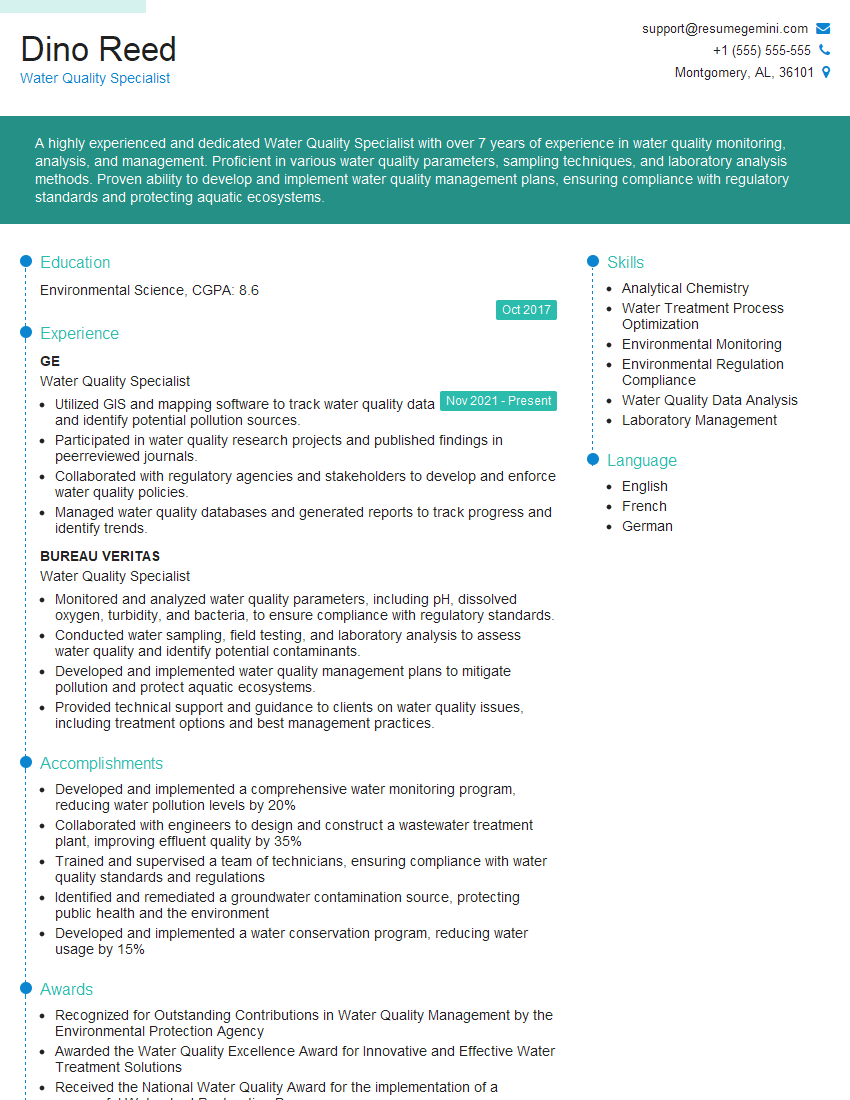
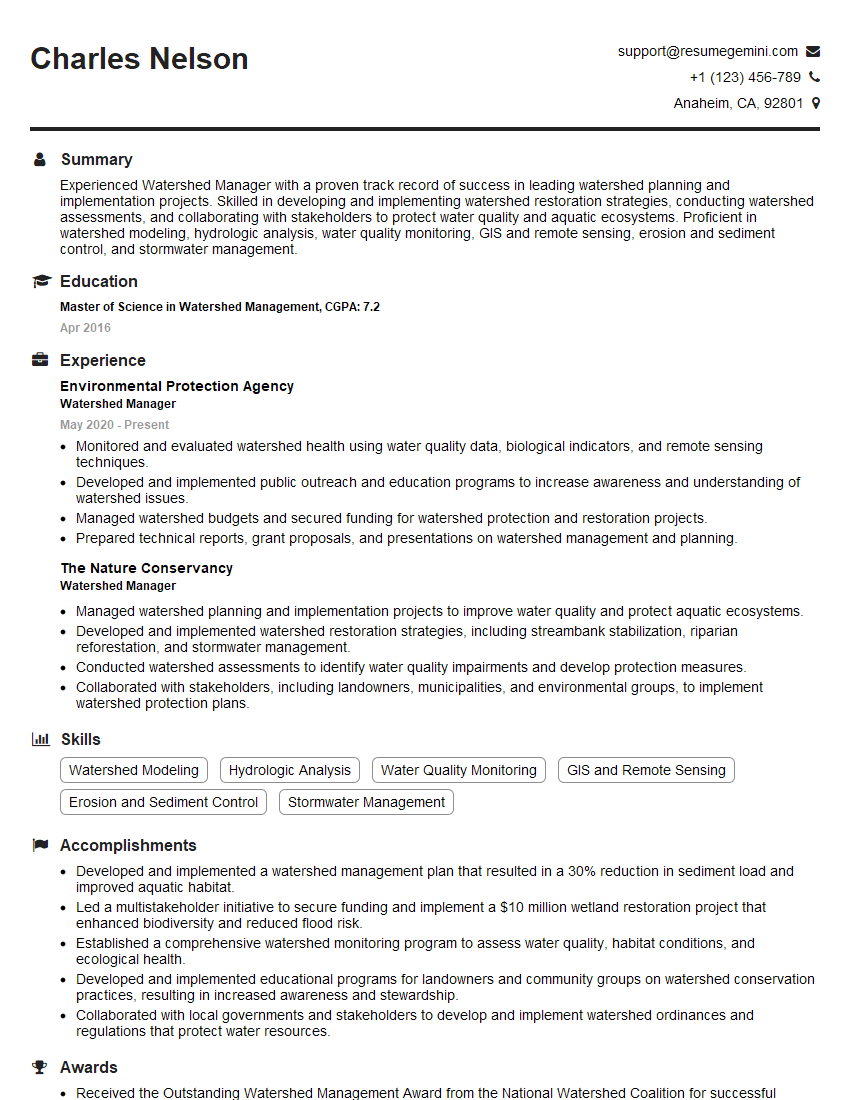
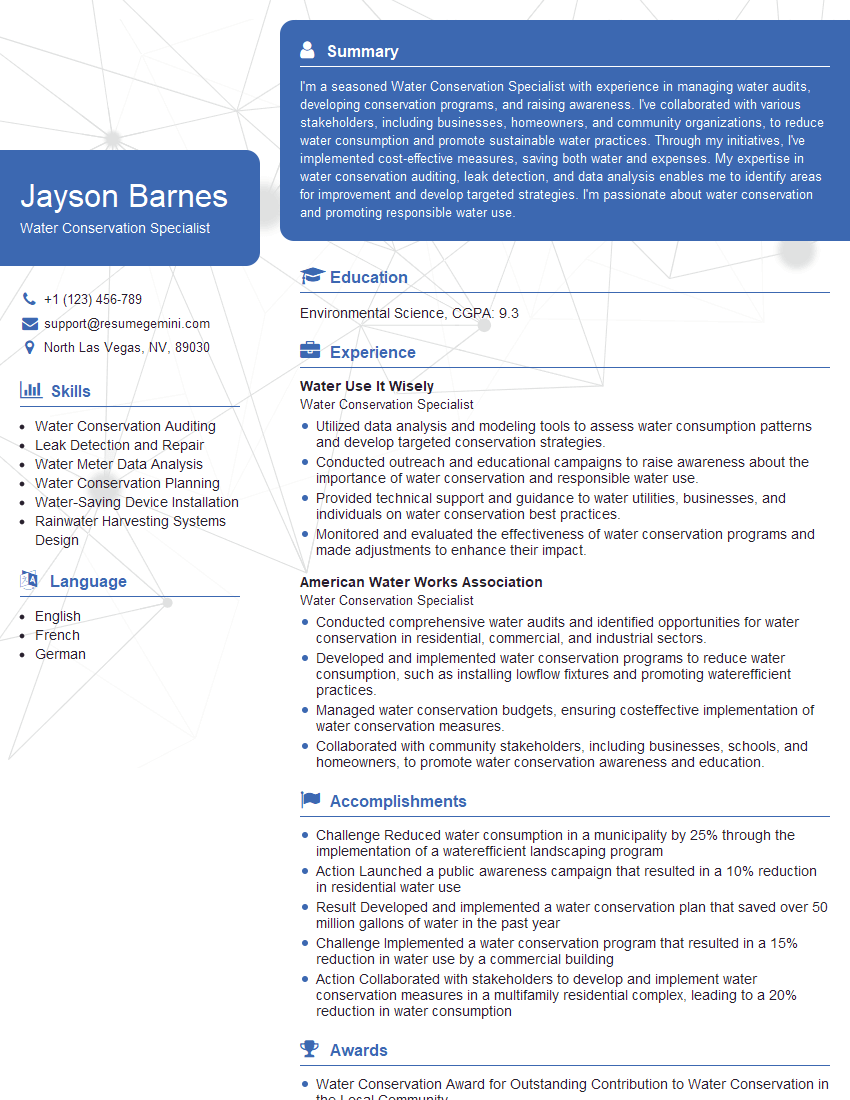
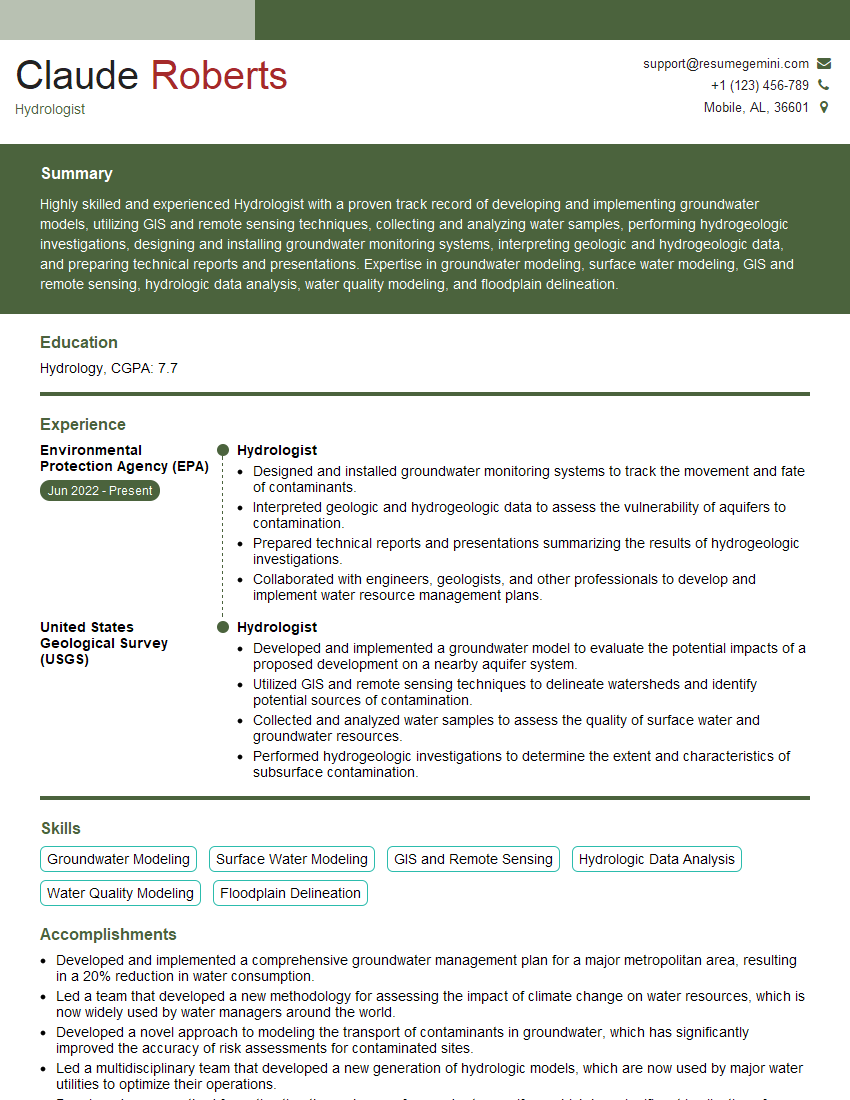
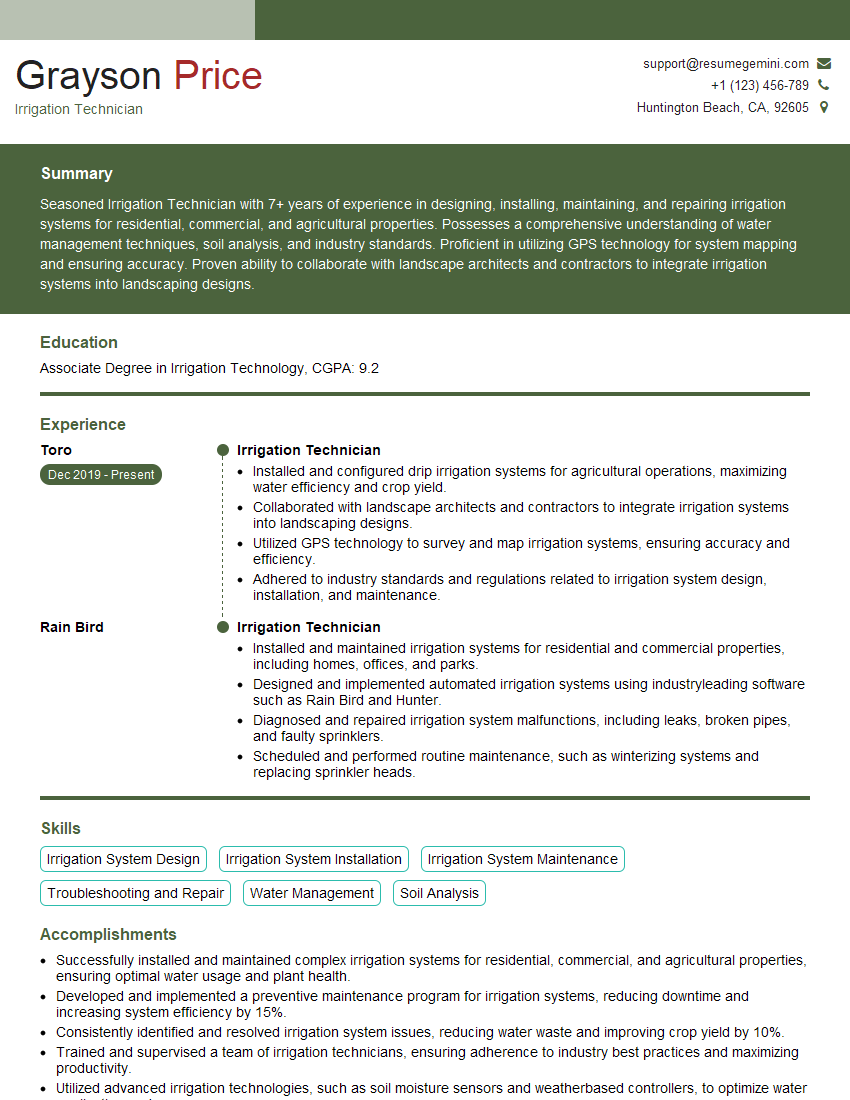
Mastering knowledge of water conservation techniques is crucial for a successful career in environmental science, engineering, agriculture, and related fields. A strong understanding of these principles demonstrates your commitment to sustainability and problem-solving skills highly valued by employers. To enhance your job prospects, crafting an ATS-friendly resume is essential. ResumeGemini is a trusted resource to help you build a professional and impactful resume that highlights your skills and experience effectively. Examples of resumes tailored to showcasing expertise in Knowledge of Water Conservation Techniques are available to help you get started.
Explore more articles
Users Rating of Our Blogs
Share Your Experience
We value your feedback! Please rate our content and share your thoughts (optional).
What Readers Say About Our Blog
Very informative content, great job.
good