Interviews are more than just a Q&A session—they’re a chance to prove your worth. This blog dives into essential Knowledge of window treatments and their applications interview questions and expert tips to help you align your answers with what hiring managers are looking for. Start preparing to shine!
Questions Asked in Knowledge of window treatments and their applications Interview
Q 1. What are the different types of window treatments available?
The world of window treatments is incredibly diverse, offering a wide array of options to suit any style and need. We can broadly categorize them into several major types:
- Blinds: These come in various materials (wood, faux wood, aluminum, vinyl) and styles (Venetian, mini, vertical, cellular). They offer excellent light control and privacy.
- Shades: These include roller shades (simple and versatile), cellular shades (honeycomb structure for insulation), Roman shades (fabric folds elegantly), and bamboo shades (natural and eco-friendly). They offer varying degrees of light filtering and privacy.
- Draperies/Curtains: These are fabric panels hung from a rod, providing a classic and elegant look. They come in various fabrics, styles (eyelets, pleats, etc.), and linings for light control and insulation.
- Shutters: These are durable, long-lasting options made of wood or synthetic materials. They offer excellent light control and privacy, and add a touch of elegance.
- Valances: These are decorative window coverings that sit above other treatments, adding a stylish and finished look.
The best choice depends on your budget, desired level of light control, style preferences, and the specific needs of your windows.
Q 2. Explain the difference between cellular shades and roller shades.
Cellular shades and roller shades are both popular choices, but they differ significantly in their construction and functionality. Roller shades are made of a single layer of fabric rolled up onto a tube. They offer basic light control and privacy. Think of them as the simplest, most affordable option.
Cellular shades, also known as honeycomb shades, have a unique honeycomb-shaped structure. This creates air pockets that provide excellent insulation, helping to reduce energy costs by minimizing heat loss in winter and heat gain in summer. They also tend to offer better light filtering and noise reduction than roller shades. Imagine the difference between a single-pane window and a double-pane window – that’s the insulating effect of the honeycomb structure. This makes them a premium choice for energy efficiency.
Q 3. Describe the installation process for vertical blinds.
Installing vertical blinds involves several steps. First, you need to accurately measure the window to ensure a proper fit. Then:
- Headrail Installation: The headrail, which holds the blinds, is usually mounted above the window frame. You may need to use screws or adhesive depending on the type of headrail and window frame.
- Carrier Installation: The vanes (or slats) of the vertical blinds hang from carriers that slide along the headrail. These are typically clipped or snapped into place.
- Vanes Adjustment: Once installed, you adjust the vanes to control light and privacy. Many vertical blinds have a wand or cord for this purpose.
- Weight Chain/Bottom Rail: A weight chain at the bottom keeps the blinds aligned. The bottom rail helps to maintain the shape and provides a finished look.
Detailed instructions are usually provided with the blinds. For complex installations or unusual window shapes, professional help might be recommended.
Q 4. How do you measure windows for custom window treatments?
Measuring windows for custom window treatments requires precision. You’ll need a tape measure and a notepad. For each window, measure the following:
- Width: Measure the width of the window at three points – top, middle, and bottom. Record the narrowest measurement.
- Height: Measure the height of the window at three points – left, center, and right. Record the shortest measurement.
- Inside Mount vs. Outside Mount: Decide if you want the treatment inside the window frame (inside mount) or outside the frame (outside mount). Inside mount usually requires slightly smaller measurements than outside mount.
- Depth: Measure the depth of the window recess if planning an inside mount to ensure sufficient space for the treatment.
For intricate window shapes like arches or angles, you might need to create a template for the fabricator.
Always double-check your measurements! A small error can lead to significant problems.
Q 5. What are the key factors to consider when choosing fabrics for window treatments?
Choosing the right fabric is crucial for both the aesthetic and functional aspects of your window treatments. Consider these key factors:
- Light Control: Do you need blackout fabric for bedrooms, sheer fabric for diffused light, or something in between?
- Privacy: Heavier fabrics offer better privacy than sheer fabrics.
- Durability: Some fabrics are more durable and resistant to fading and wear than others. Consider the level of traffic and sunlight exposure the treatment will receive.
- Maintenance: Some fabrics are easier to clean than others. Consider whether you need something machine-washable or dry-clean-only.
- Style and Design: The fabric should complement your overall interior design scheme.
- Budget: Fabrics range widely in price. Set a budget before you start shopping.
Working with a fabric sample book allows you to see the texture and color in your own lighting conditions.
Q 6. What are some common problems encountered during window treatment installation, and how do you solve them?
Common installation problems include:
- Incorrect Measurements: This leads to ill-fitting treatments. The solution is careful and accurate measurement before installation.
- Difficult Window Shapes: Unusual shapes can present challenges. Pre-fabrication of complex shapes is needed sometimes. Professional installation might be necessary.
- Mounting Issues: Problems with wall anchors or faulty hardware can arise. Using appropriate anchors for the wall type is crucial. Replacing damaged hardware is the solution.
- Hardware Malfunctions: Cords or mechanisms may malfunction. Carefully checking the hardware, and contacting the manufacturer or supplier for warranty repair are the best steps.
Prevention is key. Thorough planning and quality materials greatly reduce these issues.
Q 7. How do you handle customer complaints regarding window treatment installations?
Handling customer complaints requires professionalism and empathy. The first step is to actively listen to the customer’s concerns and validate their feelings. Next, thoroughly investigate the issue to understand the root cause. This might involve examining the installation, inspecting the materials, or reviewing the initial order specifications.
Depending on the nature of the complaint, the resolution might include:
- Reinstallation: If the problem stems from faulty installation, a reinstallation is often necessary.
- Repair: For minor issues, a repair may suffice.
- Replacement: In cases of defective materials or significant damage, replacement is the appropriate solution.
- Refund or Partial Refund: Depending on the severity and circumstances, a partial or full refund might be considered.
Documenting the entire process is vital for both legal and record-keeping purposes. Excellent communication with the customer throughout the process ensures a positive resolution and preserves your professional reputation.
Q 8. Explain the difference between lined and unlined curtains.
The key difference between lined and unlined curtains lies in the addition of a backing fabric. Unlined curtains are made from a single layer of fabric, offering a sheerer, more lightweight look. Lined curtains, on the other hand, consist of two layers: the main decorative fabric and a lining fabric, usually a heavier weight material like cotton or blackout fabric.
- Unlined Curtains: These are ideal for rooms where light filtering is not a primary concern, or for adding a touch of elegance without excessive insulation. They are generally less expensive and easier to clean.
- Lined Curtains: These provide better insulation, reducing heat loss in winter and heat gain in summer. They also offer increased privacy by blocking more light and providing better sound dampening. The lining also protects the main fabric from fading caused by sunlight.
Think of it like wearing a single t-shirt versus wearing a t-shirt under a light jacket. The jacket (lining) provides additional protection and warmth.
Q 9. What are the benefits and drawbacks of using motorized window treatments?
Motorized window treatments offer convenience and luxury, but come with certain considerations.
- Benefits: They are incredibly convenient, especially for hard-to-reach windows or large windows. They enhance home automation, allowing integration with smart home systems. They offer precise control over light and privacy, and can be programmed for specific times or even linked to sunrise/sunset.
- Drawbacks: The initial cost is significantly higher than manual treatments. They require electricity and may be susceptible to power outages. Maintenance might involve more specialized technicians, and potential malfunctions can be more costly to repair.
For instance, imagine a high-ceilinged room or a large bay window – motorized shades offer a seamless and effortless way to manage the light and privacy in these situations, even if physically reaching the controls is difficult. However, the potential for power outages to render them unusable is a significant downside to consider.
Q 10. How do you calculate the fabric requirements for a specific window treatment?
Calculating fabric requirements for window treatments is crucial to avoid shortages or excessive waste. The process varies depending on the style of the treatment but generally involves these steps:
- Measure the window: Accurately measure the width and height of the window including any frames or extensions you want the treatment to cover.
- Determine the fullness: This refers to how much extra fabric you’ll add to create soft folds. A 1.5 to 2 times fullness is standard for curtains, whereas Roman shades might have a 1.25 times fullness.
- Calculate fabric width: Multiply the window width by the fullness factor. For instance, if your window is 60 inches wide and you need 1.5 times fullness, you’ll need 90 inches of fabric width (60 x 1.5).
- Calculate fabric length: Add extra length for hems and header. The exact amount depends on the treatment style.
- Consider pattern matching: If using a patterned fabric, account for repeating patterns to ensure consistent design flow. This might require purchasing more fabric than a simple calculation would suggest.
Example: For curtains, you might add an extra 6-8 inches to the length for hems and header, and an extra 4-6 inches for the side hems. Always round up to the nearest whole number when purchasing fabric.
Q 11. What safety precautions should be taken during window treatment installation?
Safety is paramount during window treatment installation. Here are some key precautions:
- Use appropriate tools: Employ the correct tools for drilling, screwing, or cutting. Avoid using damaged tools.
- Secure ladders and scaffolding: Ensure stability and proper placement of ladders and scaffolding to prevent falls.
- Wear safety gear: Always wear safety glasses, gloves, and appropriate footwear.
- Secure cords and chains: Keep cords and chains out of reach of children and pets, especially for blinds and curtains with cords. Consider using cordless options where feasible.
- Avoid overreaching: Don’t overextend your reach when working at height. Use appropriate tools or ask for assistance if needed.
- Follow manufacturer instructions: Always carefully read and follow the manufacturer’s instructions for installation.
Failing to secure cords properly can lead to serious accidents. Always prioritize safety over speed during installation.
Q 12. How do you maintain and clean different types of window treatments?
Maintenance and cleaning procedures vary significantly depending on the type of window treatment.
- Curtains (Linen, Cotton, Silk): Most can be dry-cleaned or machine-washed on a gentle cycle (check care labels!). Regular vacuuming or dusting removes dust and allergens. For heavier stains, spot clean using a mild detergent.
- Blinds (Wood, Faux Wood, Vinyl): Dust regularly with a soft cloth or duster. For more thorough cleaning, use a damp cloth and mild detergent, ensuring they are completely dry before closing them.
- Shades (Roman, Roller, Cellular): Most can be dusted regularly. Spot clean stains with a damp cloth. Some can be wiped down with a slightly damp cloth, but always check the manufacturer’s instructions.
Regular cleaning helps prolong the lifespan of your window treatments and maintains their aesthetic appeal. Following specific care instructions prevents damage to delicate fabrics or materials.
Q 13. Describe your experience with various fabrics, such as linen, silk, and cotton.
My experience encompasses a wide range of fabrics, each with unique characteristics:
- Linen: A natural fiber with a beautiful drape and texture. It’s breathable but can wrinkle easily. It’s suitable for a relaxed, casual look and ages gracefully, developing a unique character over time. Ideal for curtains and Roman shades.
- Silk: A luxurious, delicate fabric with a beautiful sheen. It’s expensive and requires careful cleaning. Its delicate nature makes it best suited for light-use applications, such as sheer curtains or decorative panels.
- Cotton: A versatile, durable fabric that’s easy to care for. It comes in various weights and textures, suitable for a wide range of applications from heavy drapes to lightweight sheers. A cost-effective and practical option.
I’ve found that understanding the properties of each fabric is critical to recommending the right treatment for a client’s needs and budget. For example, a client seeking a luxurious look might appreciate silk, while a busy family might prioritize the durability and easy care of cotton.
Q 14. What are some common window treatment styles, such as Roman shades or Austrian shades?
Numerous styles of window treatments cater to diverse preferences and functional needs.
- Roman Shades: These offer a clean, tailored look with fabric folds that stack neatly when raised. They come in various fabrics and linings, offering varying levels of light control and insulation.
- Austrian Shades: Similar to Roman shades, but with a more romantic, gathered look. The fabric is gathered in soft scallops when raised. They are often made with delicate fabrics like silk or linen.
- Roller Shades: These are simple, functional shades that roll up smoothly. They are available in a vast range of fabrics, including blackout options for light control.
- Cellular Shades (Honeycomb Shades): These shades consist of honeycomb-shaped cells that trap air, offering excellent insulation and energy efficiency. They’re also good sound dampeners.
Choosing the right style depends on factors like the room’s design, desired level of light control, and budget. A traditional setting might suit Austrian shades, whereas a modern space might benefit from sleek roller shades or practical cellular shades.
Q 15. What are the best practices for measuring and ordering window treatments?
Accurate measurements are the cornerstone of successful window treatment installation. I always begin by emphasizing precision. We’ll measure the width and height of the window frame at multiple points, noting any inconsistencies. For inside mount (treatment fits within the window frame), we measure the width at the top, middle, and bottom, selecting the narrowest measurement to ensure a proper fit. Similarly, for outside mount (treatment covers the entire frame), we measure the width and height of the area where the treatment will be mounted, including any necessary additions for overlap or casing. We always add an extra inch or two on each side for a neat, professional look and account for any trim or molding.
Crucially, we also determine the mounting location – inside the window frame, outside the frame, or on the wall above the frame – as this significantly influences the measurements. We discuss with the client what type of installation they prefer and the impact on light control and overall aesthetics. We also document the type of window (casement, slider, etc.) which affects the choice of hardware and installation method. This detailed approach minimizes errors and ensures a perfect fit, regardless of the complexity of the window. Finally, detailed sketches and photos are included with every order to ensure clarity and prevent mistakes.
Career Expert Tips:
- Ace those interviews! Prepare effectively by reviewing the Top 50 Most Common Interview Questions on ResumeGemini.
- Navigate your job search with confidence! Explore a wide range of Career Tips on ResumeGemini. Learn about common challenges and recommendations to overcome them.
- Craft the perfect resume! Master the Art of Resume Writing with ResumeGemini’s guide. Showcase your unique qualifications and achievements effectively.
- Don’t miss out on holiday savings! Build your dream resume with ResumeGemini’s ATS optimized templates.
Q 16. How do you deal with difficult window shapes or sizes?
Difficult window shapes and sizes present exciting challenges! Arches, bay windows, and oddly-sized windows require creative solutions. For arches, we often use custom-shaped treatments, perhaps combining a curved valance with straight panels. We might create a template directly from the window, using precise measurements and careful sketching. For bay windows, we can use multiple panels of curtains or blinds, tailored to each individual section of the bay to create a cohesive look. We discuss with the client the impact of different types of hardware and how to make the treatment functional as well as aesthetically pleasing.
For unusually sized windows, we often employ a combination of techniques. Custom fabrication is sometimes necessary, but we also explore using standard components in creative ways. For example, we might use multiple smaller blinds or shades to cover a very wide window, or create a custom-sized valance to conceal any gaps. The key is to work closely with the client, presenting various options to fit their needs and budget while ensuring the final result is both beautiful and functional. We frequently employ computer-aided design (CAD) software to visualize these solutions before committing to materials.
Q 17. Explain your process for creating a custom window treatment design.
Designing a custom window treatment begins with a comprehensive consultation. We listen carefully to the client’s needs and preferences regarding style, functionality, and budget. We then assess the windows themselves – their size, shape, placement, and the amount of natural light they receive. This informs our suggestions for materials, styles, and hardware. We consider factors like the room’s décor, the client’s lifestyle (e.g., young children or pets), and the desired level of light control and privacy.
Next, I present various options – sketches, fabric samples, and hardware choices – tailored to the specific needs. The client can mix and match components to achieve their desired vision. This collaborative design process continues until we have a finalized plan, including detailed specifications for fabrication. Throughout the process, I provide realistic expectations, highlighting any potential challenges or limitations. Open communication and detailed visualizations help prevent misunderstandings and ensure client satisfaction.
Q 18. Describe your experience with working with different types of hardware.
My experience with window treatment hardware is extensive. I’ve worked with a wide variety of materials, including wood, metal (aluminum, steel, brass), and plastic. I’m knowledgeable about different mechanisms – cords, chains, motorized systems, and manual operation – and their respective benefits and limitations. For example, I understand the considerations involved in choosing between a simple cord-operated system versus a more complex motorized system, factoring in ease of use, budget, and the window’s accessibility.
Choosing appropriate hardware isn’t just about aesthetics; it’s also about ensuring durability, reliability, and safety, especially when dealing with heavier fabrics or large windows. I’m proficient in installation techniques for various hardware types, ensuring a secure and properly functioning installation. I always emphasize the importance of matching the hardware to the chosen window treatment type and the style of the room, ensuring a harmonious and refined design. The hardware selection is crucial to the longevity and smooth operation of the treatment.
Q 19. How do you handle situations where a client’s expectations are unrealistic?
Managing unrealistic client expectations requires tact, empathy, and strong communication skills. I begin by actively listening to their vision, acknowledging their enthusiasm. Then, I carefully and respectfully guide them towards realistic options, highlighting any potential limitations or challenges. For example, if a client wants a specific fabric that’s unsuitable for their window type or environmental conditions, I’ll explain the reasons and offer suitable alternatives.
I present my explanations with visual aids—fabric swatches, hardware samples, and design renderings—to clarify my reasoning. This collaborative approach allows the client to understand the practical implications of their choices and make informed decisions. My goal is to deliver a solution that meets their core needs while remaining realistic and achievable within their budget and the constraints of the project. It’s about finding a balance between fulfilling the client’s aspirations and producing a quality, functional outcome.
Q 20. What software or tools do you use for design and measurement?
I utilize several tools for design and measurement, leveraging technology to ensure accuracy and efficiency. For precise measurements, I employ digital measuring tapes that record readings accurately. For design visualization and creating detailed plans, I rely on CAD software, specifically SketchUp and AutoCAD. These programs allow me to create detailed 3D models of the window treatments, helping clients visualize the final product and making adjustments collaboratively.
Beyond design software, I also utilize project management software such as Asana or Trello to organize tasks, track progress, and manage multiple projects simultaneously. This streamlines the workflow, enhancing my efficiency and ensuring timely completion of each project. I believe that employing technology in this manner not only improves accuracy but also enhances the client experience by facilitating clear and transparent communication throughout the design and implementation process.
Q 21. How do you manage your time effectively when working on multiple projects?
Managing multiple projects effectively relies on a structured approach. My process involves prioritizing tasks based on deadlines and client needs, utilizing a project management system such as Asana or Trello to visualize progress and manage dependencies. This system allows me to track deadlines, allocate resources effectively, and proactively identify potential conflicts. I set realistic timelines for each project phase, breaking down complex tasks into smaller, manageable components. This granular approach helps me maintain focus and stay on track.
I also schedule dedicated time blocks for specific tasks, preventing multitasking and ensuring concentration. Regular communication with clients keeps them informed and helps to manage expectations. This proactive approach, combined with efficient task management tools, allows me to handle multiple projects simultaneously without compromising quality or timely delivery. This systematic strategy ensures that all projects receive the attention they deserve.
Q 22. What is your experience with different types of window treatment tracks and systems?
My experience encompasses a wide range of window treatment tracks and systems, from simple corded systems to motorized and automated solutions. I’m proficient with various materials, including aluminum, steel, and plastic tracks, each suited for different weights and styles of window treatments. For instance, heavier drapes require robust steel tracks capable of handling the weight, while lighter curtains may use a less substantial aluminum track. I’ve worked extensively with top-down/bottom-up systems, which offer flexible light control, and traverse rod systems that work smoothly with both curtains and drapes. My experience also includes working with ceiling-mounted tracks, ideal for large windows or where wall space is limited, and recessed tracks that provide a clean, integrated look. Understanding the strengths and limitations of each system is crucial for ensuring a successful installation that meets the client’s needs and aesthetic preferences. I consider factors like window size, weight of the treatment, and desired level of automation when selecting the appropriate track system.
Q 23. What are the different types of blinds available and their suitability for different rooms?
There’s a vast array of blinds available, each with its own pros and cons for different rooms.
- Venetian blinds: Classic, versatile, and offer excellent light control. Suitable for most rooms, but can be tricky to clean.
- Roller blinds: Simple, sleek, and available in various materials and opacities. Ideal for bedrooms or rooms needing privacy.
- Cellular shades (honeycomb blinds): Excellent insulators, great for energy efficiency. A good choice for any room, especially those that experience temperature fluctuations.
- Roman shades: Elegant and sophisticated, offering a soft, tailored look. Perfect for living rooms or formal dining areas.
- Bamboo blinds: Natural, eco-friendly, and provide a casual, relaxed vibe. Well-suited for bathrooms, kitchens, or sunrooms.
- Vertical blinds: Ideal for large windows or sliding glass doors, providing excellent light control. Commonly found in offices or rooms needing light diffusion.
The suitability of a blind type depends heavily on factors like the room’s function, desired level of light control, privacy needs, and overall design aesthetic. For example, while Venetian blinds might work well in a functional office space, Roman shades might be more suitable for a living room’s more refined aesthetic.
Q 24. Describe your process for preparing a detailed cost estimate for window treatments.
Preparing a detailed cost estimate involves a methodical approach. I begin with a thorough consultation to understand the client’s requirements: number and size of windows, desired window treatment style, fabric choices, hardware specifications (e.g., motorized or manual operation), and any special installation needs. I then obtain accurate measurements of each window. My cost estimate meticulously details each component:
- Materials cost: This includes the fabric (if applicable), the blinds or shades, tracks, hardware, and any additional components.
- Labor cost: This accounts for the time required for measuring, ordering materials, installation, and any necessary repairs or adjustments.
- Installation charges: This includes any special requirements like custom fabrication or difficult installations.
- Sales tax and any other applicable fees: I ensure complete transparency by explicitly listing all associated costs.
The final estimate is presented clearly and concisely, ensuring the client understands all costs involved before proceeding. Any potential additional costs are also clearly communicated to avoid surprises.
Q 25. How do you ensure that the installed window treatments meet the client’s expectations?
Meeting client expectations requires a multi-faceted approach beginning with clear communication and thorough planning. This starts with a comprehensive consultation where we discuss the client’s vision, style preferences, and budget. I present samples, discuss the pros and cons of different options, and ensure a complete understanding of the scope of the project. After installation, I conduct a thorough inspection to ensure everything is functioning as expected and meets the specified requirements. I always make myself available for any minor adjustments or questions post-installation, ensuring customer satisfaction.
Regular communication throughout the project is also critical. I provide updates on the order status, scheduling, and any potential challenges. This keeps the client informed and allows for addressing concerns proactively. In essence, exceeding client expectations is a combination of meticulous planning, detailed communication, and a commitment to post-installation support.
Q 26. What is your experience with dealing with suppliers and ordering materials?
I have strong relationships with several reputable suppliers of high-quality window treatment materials. These relationships have been cultivated over years of working in the industry and allow me to access competitive pricing and ensure timely delivery. My ordering process is streamlined: I use digital order management systems to track orders, ensuring accuracy and timely delivery. I regularly review supplier performance based on factors such as on-time delivery, quality of materials, and customer service. When selecting suppliers, I prioritize those that offer a wide selection of products, competitive pricing, and reliable service. Building strong relationships with suppliers is key to ensuring the smooth and successful completion of projects.
Q 27. Describe a time you had to troubleshoot a difficult window treatment installation problem.
One time, I encountered a challenging installation involving a set of heavy, custom-made drapes in a room with unusually high ceilings. The existing tracks were inadequate for the weight of the drapes, and the ceiling presented structural challenges.
My solution involved a phased approach: first, I assessed the ceiling’s structural integrity to determine the best points for mounting reinforced tracks. Second, I carefully selected high-strength, heavy-duty tracks specifically designed for this type of application. Third, I coordinated with a structural engineer to confirm the stability of the new mounting system. Finally, I installed the new tracks, ensuring that they were securely fastened and that the drapes hung evenly and smoothly. The result was a stunning and functional installation that overcame initial challenges thanks to a well-planned, problem-solving approach.
Q 28. What are your skills in communicating technical information to non-technical clients?
Communicating technical information clearly to non-technical clients is a vital part of my job. I avoid jargon and technical terms, opting for simple, easy-to-understand language. I use visual aids, like samples and diagrams, to help explain concepts. For example, instead of talking about ‘traverse rod mechanisms’, I’ll describe it as the system that allows the curtains to open and close smoothly. I use analogies and real-world examples to make complex information relatable and memorable. For instance, when discussing fabric weight and light control, I might compare different fabrics to the way different sunglasses filter sunlight. Active listening and patience are key to ensuring the client fully grasps the information and feels comfortable asking questions.
Key Topics to Learn for Window Treatments and Applications Interviews
- Types of Window Treatments: Understanding the differences between blinds (Venetian, Roman, Cellular), shades (roller, bamboo, cellular), curtains (drapes, panels), shutters, and awnings. Consider their materials (wood, fabric, vinyl, etc.) and operational mechanisms (cordless, motorized).
- Functionality and Applications: Knowing how each treatment impacts light control, privacy, insulation, and aesthetics. Be prepared to discuss the best choices for different room types (e.g., bedrooms, living rooms, bathrooms) and architectural styles.
- Measuring and Installation: Demonstrate a practical understanding of measuring windows accurately for proper treatment sizing and installation. Discuss different installation methods and potential challenges.
- Fabric Selection and Care: Discuss the properties of various fabrics (light filtering, blackout, sheer) and their appropriate care instructions. Be ready to address common fabric issues and maintenance.
- Budgeting and Client Consultation: Explain how to advise clients on choosing cost-effective solutions that meet their needs and aesthetic preferences. Discuss factors influencing pricing and how to manage client expectations.
- Troubleshooting and Repairs: Showcase your ability to identify and solve common problems with window treatments, such as broken cords, malfunctioning mechanisms, or fabric damage.
- Safety and Compliance: Discuss relevant safety regulations and best practices regarding window treatment installation, particularly for child safety (cord management).
- Current Trends and Styles: Stay updated on current trends in window treatment design, materials, and automation. Be prepared to discuss popular styles and their applications.
Next Steps
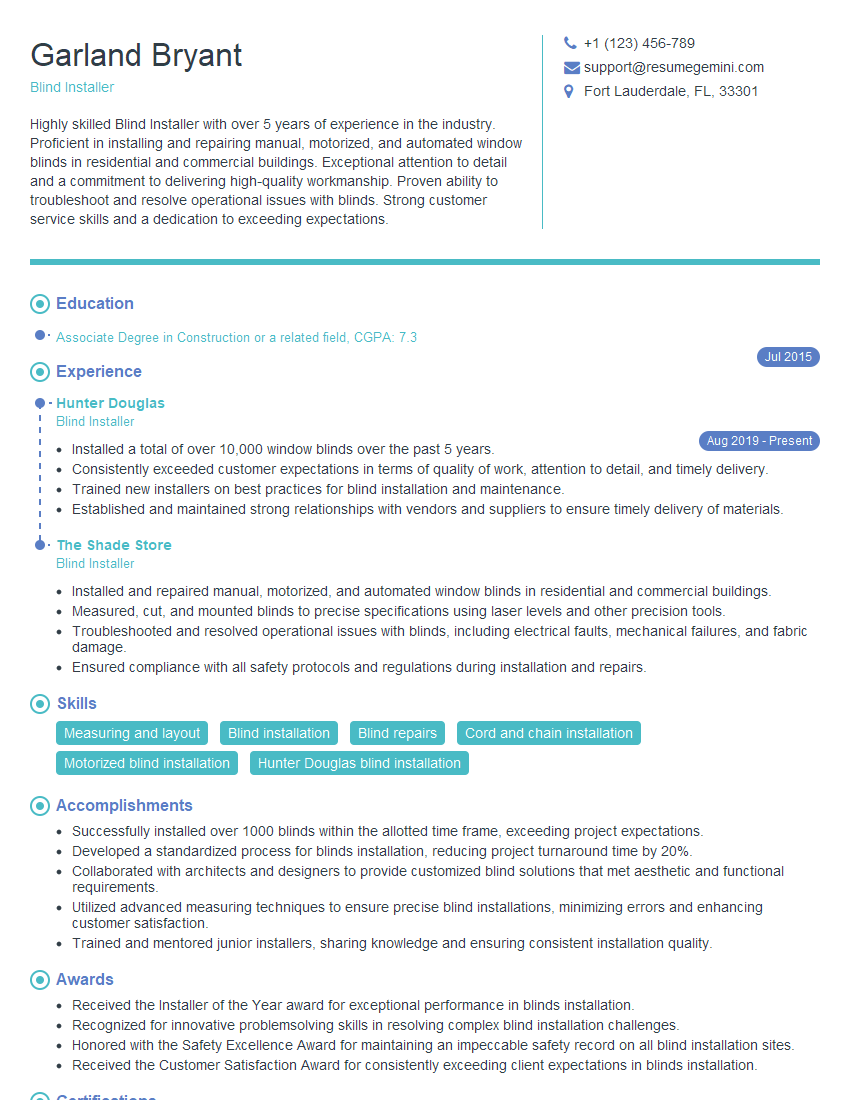
Mastering knowledge of window treatments and their applications is crucial for career advancement in interior design, home staging, or related fields. A strong understanding of these concepts will significantly improve your interview performance and job prospects. Creating an ATS-friendly resume is key to getting your application noticed. ResumeGemini is a trusted resource to help you build a professional and effective resume that highlights your skills and experience. Examples of resumes tailored to showcasing expertise in window treatments and their applications are available to guide you through the process.
Explore more articles
Users Rating of Our Blogs
Share Your Experience
We value your feedback! Please rate our content and share your thoughts (optional).
What Readers Say About Our Blog
Very informative content, great job.
good