Preparation is the key to success in any interview. In this post, we’ll explore crucial Laminate and Hardwood Flooring Installation interview questions and equip you with strategies to craft impactful answers. Whether you’re a beginner or a pro, these tips will elevate your preparation.
Questions Asked in Laminate and Hardwood Flooring Installation Interview
Q 1. Explain the difference between engineered hardwood and solid hardwood flooring.
The core difference between engineered and solid hardwood lies in their construction. Solid hardwood planks are made entirely from a single piece of wood, running from top to bottom. This makes them incredibly durable and can be sanded and refinished multiple times throughout their lifespan. Think of it like a sturdy, all-wood table – capable of withstanding a lot of wear and tear.
Engineered hardwood, on the other hand, is a multi-layered construction. A thin veneer of hardwood is bonded to a core of plywood or other wood composite materials. This makes it more dimensionally stable, meaning it’s less susceptible to warping or expansion/contraction due to humidity changes. This is especially important in basements or areas with fluctuating humidity. You can visualize it as a sturdy sandwich – the hardwood veneer providing the beauty, and the core offering stability.
In short: Solid hardwood offers superior refinishing potential and longevity, while engineered hardwood offers greater stability and often comes at a lower price point.
Q 2. Describe the proper acclimation process for hardwood flooring.
Acclimation is crucial for hardwood flooring to prevent expansion and contraction issues after installation. This involves letting the wood adjust to the temperature and humidity of the room where it will be installed. Ideally, the wood should be stored in the room for at least 72 hours, but preferably 5-7 days, or even longer depending on the wood type and climate. The flooring should be stacked flat and in its original packaging to allow even acclimation. The packaging should be opened only to take a sample or to work with in short intervals. Think of it like letting a new houseplant acclimate to its new home before transplanting.
Failure to properly acclimate wood can result in gaps appearing between boards after installation, as the wood shrinks to its optimal moisture content and dimensions. This is especially important in drier climates where the wood needs to absorb moisture from the room before installation. Ignoring acclimation can be a costly mistake; pre-planning is key to a successful project.
Q 3. What are the common types of underlayment used for laminate flooring?
Several underlayments are commonly used beneath laminate flooring to enhance its performance and longevity. These include:
- Foam Underlayment: This is the most common type, providing cushioning, sound insulation, and a moisture barrier. Different thicknesses offer varying levels of comfort and sound dampening.
- Cork Underlayment: Offers excellent sound insulation and comfort underfoot. It’s also a more environmentally friendly option.
- Fiberboard Underlayment: A denser and more rigid option providing better dimensional stability and sound control.
- Rubber Underlayment: Provides exceptional sound dampening, but can be more expensive.
Choosing the right underlayment depends on the specific needs of the project and the type of laminate being installed. For instance, if sound reduction is critical, cork or rubber might be preferred; if you are installing on a concrete slab, a moisture barrier is essential.
Q 4. How do you calculate the square footage needed for a flooring project?
Calculating square footage for flooring is straightforward. First, measure the length and width of each room in feet. Multiply the length and width of each room to get the area in square feet. Add together the square footage of all rooms where you will be installing flooring. Remember to account for doorways, closets, and other areas where flooring won’t be needed. Subtracting these areas from the total square footage avoids purchasing excessive materials.
Example: A room measuring 12 feet by 10 feet has an area of 120 square feet (12 x 10 = 120). If you have a 3×5 feet closet you’re not flooring, you subtract 15 square feet (3 x 5 = 15) giving you a net total of 105 square feet (120-15=105).
Always add extra to account for cuts, waste, and potential damage. A 10% overage is a good rule of thumb for most projects, but more may be necessary for complex layouts or rooms with many obstacles.
Q 5. What tools are essential for installing hardwood flooring?
Installing hardwood flooring requires specialized tools. Here are some essentials:
- Measuring Tape and Pencil: For accurate measurements and marking.
- Hand Saw or Circular Saw: To cut the planks to size.
- Wood Block and Mallet: To tap the planks into place without damaging them.
- Pull Bar: For pulling boards tight for proper alignment.
- Clamps: To hold boards in place during installation.
- Tape Measure and Speed Square: For accurate measurements and cutting angles.
- Moisture Meter: To check moisture content of both the subfloor and the wood flooring.
- Pneumatic Nailer (optional but recommended): For faster and more efficient installation.
Having the right tools ensures a clean, efficient, and professional finish.
Q 6. What tools are essential for installing laminate flooring?
Laminate installation requires a different set of tools compared to hardwood. Here’s what you’ll need:
- Measuring Tape and Pencil: For accurate measurements and marking.
- Circular Saw or Laminate Cutter: For precise cutting of planks.
- Laminate Flooring Tap Block and Mallet: To tap the planks together without damaging them.
- Spacer Blocks: To maintain consistent expansion gaps.
- Pull Bar: To pull boards together for tight alignment.
- Undercut Saw: For trimming around obstacles and doorways.
- Utility Knife: For cutting underlayment and making smaller adjustments.
The tools are generally less specialized than those needed for hardwood, but precision is still crucial for a seamless result.
Q 7. Describe the process of installing hardwood flooring around a doorway.
Installing hardwood around a doorway requires careful planning and precise cuts. The goal is to create a seamless transition that hides the cuts and maintains the flooring’s integrity.
Step-by-step process:
- Measure and Mark: Accurately measure the doorway opening and mark the cut lines on the flooring planks.
- Make the Cut: Use a hand saw or circular saw to make clean, precise cuts. Multiple, smaller cuts are usually preferred to avoid chipping.
- Fit the Pieces: Carefully fit the cut planks around the doorway, ensuring a tight fit and proper alignment.
- Secure the Planks: Secure the planks in place using appropriate nails or adhesive, depending on the installation method. Use a nail set to countersink nails and hide them.
- Caulk or Fill Gaps: Use wood filler or caulk to fill any small gaps between the planks and the door frame, ensuring a clean finish.
- Sand and Finish: If necessary, sand the edges of the cut planks to smooth them out and provide an even finish.
Careful planning and precise cutting are essential for a successful and professional looking finish around the doorway.
Q 8. Explain how to cut hardwood flooring around pipes and obstacles.
Cutting hardwood around pipes and obstacles requires precision and the right tools. Think of it like a delicate surgery for your floor! You’ll need a jigsaw with a fine-tooth blade for the cleanest cuts. Before you start sawing, trace the outline of the pipe or obstacle onto the wood. This is your roadmap. Then, carefully cut along the line, making slow, steady movements to avoid chipping. For complex shapes, you might need to make several cuts and carefully remove the waste pieces. Always use a sharp blade to prevent tear-out. A sharp blade makes all the difference in the world; it’s like comparing using a dull knife to chop vegetables versus a freshly sharpened one.
Once the cut is made, you’ll need to carefully fit the piece into place. Sometimes, a little sanding is necessary to ensure a perfect fit. Remember to always wear safety glasses to protect your eyes from flying wood chips!
Q 9. How do you handle expansion gaps when installing hardwood flooring?
Expansion gaps are crucial for hardwood flooring; they prevent buckling and warping caused by seasonal temperature and humidity changes. Imagine your floor as a living, breathing organism—it needs room to expand and contract. The standard gap is usually about 1/4 inch around the perimeter of the room and between walls and any fixed elements. You can maintain these gaps using spacers, which are small wedges of plastic or wood, placed between the flooring and walls throughout installation. These spacers are then removed once the installation is complete. Without expansion gaps, you risk costly repairs down the line. It’s like not leaving room for your clothes to breathe in your closet—they’ll get cramped and eventually damaged.
Q 10. What are the different types of hardwood flooring finishes?
Hardwood flooring comes in various finishes, each offering a different look and level of durability. The most common are:
- Unfinished: This requires on-site sanding and finishing, allowing for maximum customization. It’s like buying a blank canvas – you have complete control over the final look.
- Pre-finished: Factory-finished in a variety of colors and stains, it’s ready to install straight from the box, making it quicker and easier for installation. This is like buying a print – the artwork is already done.
- UV-cured finishes: Extremely durable and scratch-resistant, these finishes use ultraviolet light to cure the sealant, creating a very hard-wearing surface. This is like applying a very strong varnish layer – great for longevity.
- Oil-based finishes: These offer a more natural look and feel, allowing the wood grain to show through beautifully. These are more like natural waxes or oils – maintaining the feel of the wood.
Choosing the right finish depends on your lifestyle, budget, and the overall aesthetic you’re aiming for. A high-traffic area might benefit from a UV-cured finish, while a less-used room might look beautiful with an oil-based finish.
Q 11. How do you ensure proper moisture content for hardwood flooring installation?
Proper moisture content is essential for preventing issues like shrinking, expanding, cupping and crowning of your hardwood flooring. Ideally, the moisture content of the wood should match the moisture content of the surrounding environment. This is usually around 6-8%. This means you need to acclimate your flooring in your home for a few days before installation. A moisture meter is your best friend for this task; it’s like a doctor’s stethoscope for your wood—it checks the wood’s health and condition. Acclimation is crucial and will prevent a lot of long-term problems. Failing to acclimate the wood is like planting a flower in a harsh desert; it won’t thrive. The floor needs to adjust to the existing environment, ensuring stability for many years.
Q 12. Describe the steps for installing laminate flooring in a high-traffic area.
Installing laminate in a high-traffic area requires extra attention to detail. First, ensure the subfloor is perfectly level and clean. Imagine building a castle—you need a strong and stable foundation. Use an underlayment designed for high-traffic areas to provide additional cushioning and sound insulation. This is like adding extra padding to your shoes, increasing comfort and support. Then, follow the manufacturer’s instructions carefully, paying close attention to the interlocking system of the planks. Make sure each plank is tightly connected, leaving no gaps. Begin installing from the most visible area of the room to make sure the pattern looks good. In high-traffic zones, a higher-quality laminate with a thicker wear layer will stand up to the abuse better. This will reduce wear and tear over time. Proper installation will ensure durability and a long-lasting finish.
Q 13. What are the common problems encountered during laminate flooring installation?
Common laminate installation problems include:
- Uneven Subfloor: An uneven subfloor leads to gaps, clicks, and instability.
- Improper Acclimation: Failing to let the planks acclimate to the room’s temperature and humidity can cause expansion and contraction issues.
- Poor Cutting: Uneven cuts can create gaps and affect the overall appearance.
- Incorrect Click System: Not properly engaging the locking mechanism leads to loose planks and instability.
- Lack of Expansion Gaps: Failure to leave expansion gaps around the perimeter and near fixed objects results in buckling and warping.
Addressing these issues early on prevents major headaches down the line. Careful planning and attention to detail are key!
Q 14. How do you repair minor damage to hardwood flooring?
Minor hardwood damage can often be repaired without complete floor replacement. For scratches, a simple touch-up with a wood filler or stain that matches your existing floor can do the trick. It’s like applying a bit of makeup to hide a blemish. For small dents, carefully steam the area to raise the grain, and then sand it smooth. A final touch of stain and finish blends the repair seamlessly with the rest of the floor. For more significant damage, like a gouge, professional repair might be necessary to avoid a noticeable blemish on your floor. But for minor scratches and dents, you can often achieve a professional result using these simple methods.
Q 15. How do you repair minor damage to laminate flooring?
Repairing minor damage to laminate flooring depends on the type and severity of the damage. Small scratches can often be buffed out with a laminate floor repair kit, which typically includes a marker that matches your floor’s color. For more significant damage like chips or gouges, you may need to replace the damaged plank. This involves carefully prying up the damaged plank using a putty knife and replacing it with a new one from the manufacturer’s spare stock (if available) or a matching plank from another inconspicuous area. Remember to use adhesive designed for laminate flooring to securely reattach the replacement plank and ensure a seamless finish. If the damage is extensive, professional help might be necessary.
Example: A small scratch on a dark brown laminate floor can be effectively concealed using a dark brown repair marker. But a chipped plank will require replacement.
Career Expert Tips:
- Ace those interviews! Prepare effectively by reviewing the Top 50 Most Common Interview Questions on ResumeGemini.
- Navigate your job search with confidence! Explore a wide range of Career Tips on ResumeGemini. Learn about common challenges and recommendations to overcome them.
- Craft the perfect resume! Master the Art of Resume Writing with ResumeGemini’s guide. Showcase your unique qualifications and achievements effectively.
- Don’t miss out on holiday savings! Build your dream resume with ResumeGemini’s ATS optimized templates.
Q 16. What safety precautions are necessary during flooring installation?
Safety is paramount during flooring installation. Always wear safety glasses to protect your eyes from flying debris. Dust masks are essential, especially when working with hardwood, to prevent inhalation of sawdust and wood particles. Knee pads are highly recommended to protect against discomfort and injury. Wear sturdy, closed-toe shoes to protect your feet from dropped tools or sharp objects. When using power tools, ensure proper training and always follow the manufacturer’s instructions. For hardwood installation, ear protection is necessary because power tools can be very loud. Finally, always make sure the work area is well-lit and free of tripping hazards.
Example: A client once suffered a minor eye injury due to a flying wood chip; this highlights the crucial need for safety glasses.
Q 17. Explain the difference between floating and glue-down installation methods for laminate.
The key difference between floating and glue-down laminate installation lies in how the planks are secured to the subfloor. Floating installation involves laying the planks directly onto an underlayment without any adhesive. The planks interlock, creating a ‘floating’ floor that expands and contracts with changes in temperature and humidity. Glue-down installation, on the other hand, uses a specialized adhesive to bond each plank directly to the subfloor. This method results in a more rigid and stable floor but makes repairs more difficult. Floating installation is generally preferred for its ease of installation and ability to accommodate expansion and contraction. Glue-down is favored when superior stability is needed.
Example: In a climate with significant humidity fluctuations, floating installation is preferable to prevent buckling. In a high-traffic commercial setting, glue-down might be chosen for enhanced durability.
Q 18. Describe different methods for finishing hardwood floors.
Hardwood floors can be finished in several ways, each impacting the look, feel, and durability. Solid hardwood can be finished with various stains and sealants. Unfinished hardwood allows for on-site staining and finishing to perfectly match your design preference. The most common finishes include polyurethane (water-based or oil-based), providing a durable and protective layer, and penetrating oil finishes, which soak into the wood, highlighting the natural grain. Some prefer a more natural, matte look, while others opt for a high-gloss shine. The chosen finish should be tailored to the specific hardwood species and the desired aesthetic.
Example: A high-traffic area might benefit from a durable polyurethane finish, while a more rustic look might prefer a penetrating oil finish.
Q 19. How do you handle transitions between different flooring types?
Transitions between different flooring types require careful planning and execution to achieve a smooth, aesthetically pleasing, and functional result. Common transition methods include T-moldings, reducer strips, and threshold plates. T-moldings are used when two floors are of equal height, reducer strips when one floor is higher than the other, and threshold plates cover the gap between two floors of different heights or materials. The choice of transition piece depends on the height difference and the flooring types. Proper installation ensures a safe and seamless transition, preventing tripping hazards and maintaining a consistent aesthetic flow.
Example: Transitioning from hardwood to tile often utilizes a reducer strip to smoothly connect the different floor heights.
Q 20. What are the common causes of squeaking in hardwood floors?
Squeaking in hardwood floors often stems from movement between the floorboards and the subfloor. This movement can be caused by several factors including: Insufficient nailing or screwing during installation, leading to loose boards; Changes in humidity, causing wood to expand and contract; Dry subfloor, allowing boards to shift and rub against each other; or Foot traffic, creating friction. Identifying the source of the squeak involves carefully examining the floor to pinpoint the affected area, sometimes requiring the use of a flashlight to examine the spaces between boards. Solutions range from tightening loose nails or screws to injecting lubricating oil into the affected areas.
Example: A squeaking sound in a room with high humidity fluctuations often points to expansion and contraction issues. Tightening screws usually resolves squeaks caused by loose boards.
Q 21. How do you prevent gaps from forming in laminate flooring?
Preventing gaps in laminate flooring requires meticulous attention to detail during installation and maintaining proper environmental conditions. Acclimation of the laminate flooring to the room’s temperature and humidity before installation is crucial to prevent expansion and contraction. Ensure that the subfloor is level and clean, and that the underlayment is properly installed. Leaving the required expansion gap (specified by the manufacturer) around the perimeter of the room is essential to accommodate movement. Avoid installing laminate in areas with extreme temperature fluctuations or high humidity. Finally, choosing a high-quality underlayment is also crucial to prevent moisture from reaching the laminate, which could lead to expansion and gaps.
Example: Failing to leave expansion gaps can result in buckling or cracking during seasonal temperature changes. Properly acclimated flooring is less likely to gap.
Q 22. What are the advantages and disadvantages of using solid versus engineered hardwood?
The choice between solid and engineered hardwood hinges on several factors, primarily application and budget. Solid hardwood, being a single piece of wood from top to bottom, offers unmatched durability and can be refinished multiple times, extending its lifespan significantly. Think of it like a classic car – a well-maintained solid hardwood floor can last for generations. However, it’s more expensive, susceptible to moisture damage, and isn’t suitable for all subfloors, particularly those in basements or areas prone to moisture.
Engineered hardwood, conversely, is constructed with layers of wood veneer over a plywood core. This makes it more stable, resistant to moisture, and suitable for installation over concrete slabs or radiant heating systems – think of it as a more adaptable and cost-effective option. While it can be refinished, the number of times is usually limited by the thickness of the veneer. The choice depends on your priorities: longevity and refinishing potential point towards solid; stability, moisture resistance, and budget-consciousness favor engineered.
- Solid Hardwood Advantages: Durability, refinishable, classic look
- Solid Hardwood Disadvantages: Expensive, susceptible to moisture, limited subfloor compatibility
- Engineered Hardwood Advantages: More stable, moisture resistant, suitable for various subfloors, often more affordable
- Engineered Hardwood Disadvantages: Fewer refinishing possibilities, may not have the same character as solid hardwood
Q 23. How do you assess the levelness of a subfloor before installation?
Assessing subfloor levelness is crucial for a successful flooring installation. Uneven subfloors lead to squeaking, buckling, and premature wear. I use a combination of methods: a long straight edge (at least 6-8 feet), a level, and sometimes a laser level for larger areas. I place the straight edge across the subfloor in multiple directions, checking for gaps between the straight edge and the subfloor. Any gap larger than 1/8 inch indicates an unevenness that needs addressing. The level verifies that the straight edge itself is level. Laser levels allow for a quick and comprehensive assessment of larger areas, identifying high and low spots.
For minor imperfections, I might use self-leveling compound to fill in low spots. For significant unevenness, the subfloor might need repair or replacement. I always document my findings with photos and detailed notes, highlighting problem areas and proposed solutions. This ensures the client is informed and helps avoid future disputes.
Q 24. Describe your experience with various types of hardwood flooring (e.g., oak, maple, bamboo).
My experience encompasses a wide variety of hardwood species. Oak, for instance, is a classic choice known for its durability and versatility. I’ve worked with both red oak and white oak, noting the differences in color and grain patterns. Red oak generally has a warmer reddish hue, while white oak is lighter and possesses a tighter grain, making it slightly more resistant to dents. Maple is another popular choice, prized for its hardness and light color. It’s excellent for high-traffic areas, though it can be more prone to showing scratches. Bamboo, while technically a grass, is increasingly popular as a sustainable hardwood alternative. It comes in varying colors and styles and is generally very durable, but its expansion and contraction rates must be carefully considered during installation.
In each case, careful acclimation is key before installation to prevent issues after the floor is down. Acclimation allows the wood to adjust to the ambient temperature and humidity levels of the room, minimizing expansion and contraction.
Q 25. Describe your experience with various types of laminate flooring.
My experience with laminate flooring includes various thicknesses, wear layers, and finishes. I’ve installed everything from basic, budget-friendly laminate to higher-end options with realistic wood grain textures and enhanced durability. Key considerations include the wear layer thickness—a thicker wear layer means greater resistance to scratches and dents— and the type of locking system. Click-lock systems are generally easier and faster to install than glue-down systems. I always pay close attention to the manufacturer’s installation guidelines to ensure a proper fit and long-lasting result. One crucial aspect is understanding the expansion and contraction properties of the material, leaving appropriate expansion gaps around the perimeter.
I’ve also worked with various styles and designs, ranging from traditional wood looks to more contemporary designs, including stone and tile imitations. The choice depends on the homeowner’s personal preference and budget.
Q 26. Explain your experience working with different types of underlayment.
Underlayment plays a crucial role in ensuring a comfortable and long-lasting floor. I’ve worked with various types, each offering different benefits: foam underlayment provides cushioning and sound insulation; cork underlayment offers excellent insulation and sound dampening properties; and rubber underlayment provides superior moisture protection. The choice depends on factors such as the type of flooring being installed, the subfloor condition, and the homeowner’s priorities (comfort, soundproofing, or moisture resistance). I always assess the subfloor carefully before selecting an underlayment to ensure compatibility and optimal performance. For example, I would avoid foam underlayment over a subfloor with significant moisture issues.
Q 27. What is your experience with using different types of adhesives for flooring installation?
Adhesive selection is critical for both hardwood and laminate installations. For hardwood, I might use a water-based adhesive for better environmental friendliness or a moisture-cure urethane adhesive for greater strength and moisture resistance. The choice depends on the type of hardwood (solid vs. engineered), the subfloor material, and environmental conditions. For laminate flooring, I usually use a specialized laminate adhesive for glue-down applications, always adhering to the manufacturer’s specifications and ensuring proper ventilation during application and drying.
Proper application technique is crucial with all adhesives; I always ensure a consistent and even spread to avoid voids or uneven adhesion, which can result in problems down the line.
Q 28. Describe your experience in troubleshooting flooring installation issues.
Troubleshooting is a significant part of my work. Common issues include squeaking (often due to uneven subfloors or improper nailing/fastening), buckling (often due to moisture problems or improper acclimation), and gapping (often due to improper expansion gap allowance or insufficient adhesive). My approach involves systematically investigating the cause. I start by carefully inspecting the area, identifying the symptoms, and then examining the underlying cause. This may involve using tools like a moisture meter to check for moisture problems, examining the subfloor for unevenness, or evaluating the installation techniques used. I use this systematic approach to identify the root cause and provide targeted solutions, sometimes involving repairs or even partial or complete floor removal.
Effective communication with the client throughout the troubleshooting process is also crucial, keeping them informed every step of the way. Providing them with the reasoning for actions taken builds trust and understanding.
Key Topics to Learn for Laminate and Hardwood Flooring Installation Interview
- Substrate Preparation: Understanding the importance of a level and dry subfloor for both laminate and hardwood. This includes identifying and addressing common subfloor issues like unevenness, moisture, and existing damage.
- Acclimation Processes: Knowing how to properly acclimate hardwood flooring to the environment before installation to prevent expansion and contraction issues. This includes understanding the role of humidity and temperature.
- Underlayment Selection and Installation: Choosing the appropriate underlayment for different flooring types and subfloor conditions. Understanding the impact of underlayment on sound dampening, moisture protection, and overall installation quality.
- Measuring and Calculating Materials: Mastering accurate material calculations to minimize waste and ensure sufficient stock for the project. This includes understanding waste factors and efficient cutting techniques.
- Installation Techniques: Understanding the specific installation methods for both laminate (click-lock, glue-down) and hardwood (nail-down, glue-down, floating). This includes knowledge of proper tool usage and techniques for achieving a professional finish.
- Moisture Barriers and Vapor Retarders: Knowing when and how to use moisture barriers and vapor retarders to protect the flooring from moisture damage. Understanding the different types available and their applications.
- Troubleshooting Common Installation Problems: Identifying and resolving common issues such as gaps, squeaking, uneven surfaces, and expansion/contraction problems during and after installation.
- Safety Procedures and Regulations: Understanding and adhering to all relevant safety regulations and best practices for handling tools and materials.
- Finishing Touches: Understanding the importance of proper finishing, including trim work, transition pieces, and cleaning procedures to ensure a professional and completed installation.
- Understanding Different Wood Species and Grades: Familiarity with the properties of various hardwood species and their suitability for different applications. Understanding the grading systems used to assess wood quality.
Next Steps
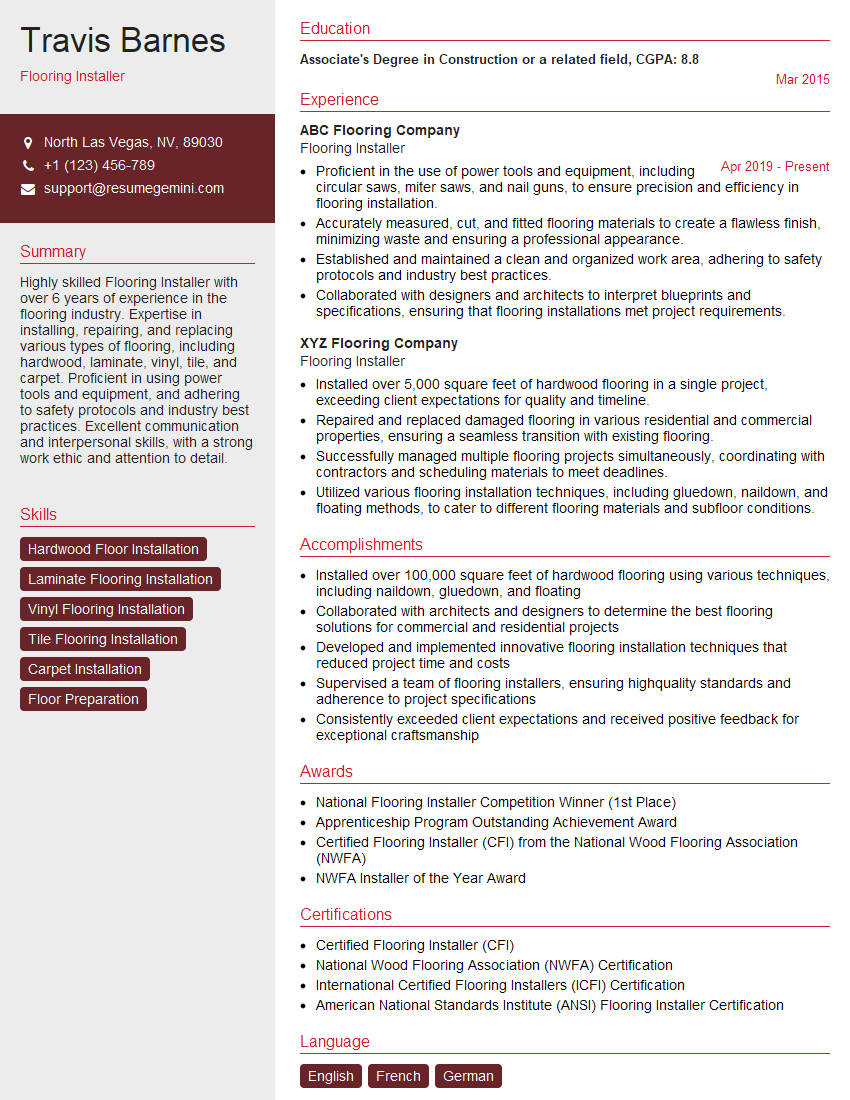
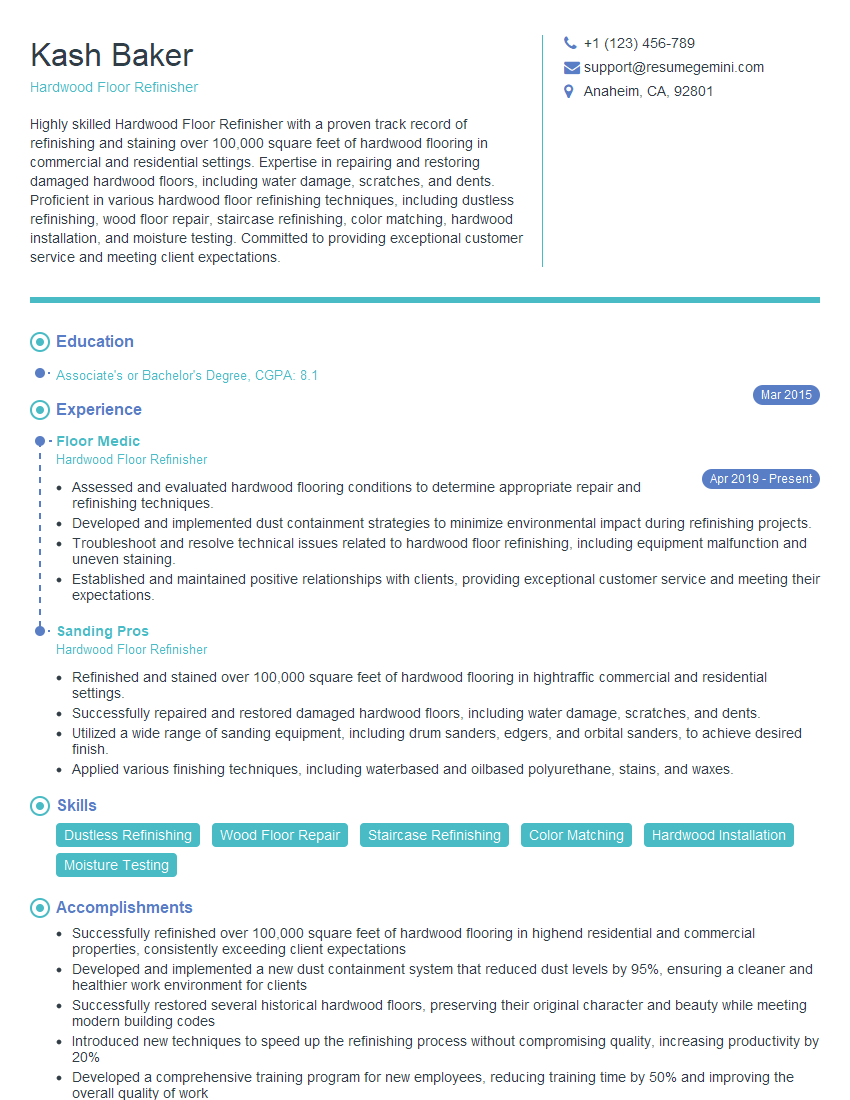
Mastering laminate and hardwood flooring installation opens doors to a rewarding career with excellent earning potential and opportunities for advancement. A strong resume is crucial for showcasing your skills and experience to potential employers. Creating an ATS-friendly resume, optimized for Applicant Tracking Systems, is key to increasing your chances of getting noticed. ResumeGemini is a trusted resource for building professional and effective resumes. They provide examples of resumes tailored to the Laminate and Hardwood Flooring Installation field, helping you present your qualifications in the best possible light.


Explore more articles
Users Rating of Our Blogs
Share Your Experience
We value your feedback! Please rate our content and share your thoughts (optional).
What Readers Say About Our Blog
Very informative content, great job.
good