Interviews are more than just a Q&A session—they’re a chance to prove your worth. This blog dives into essential REACH Regulation interview questions and expert tips to help you align your answers with what hiring managers are looking for. Start preparing to shine!
Questions Asked in REACH Regulation Interview
Q 1. Explain the main pillars of REACH Regulation.
REACH, the Registration, Evaluation, Authorisation and Restriction of Chemicals Regulation, is a cornerstone of the European Union’s chemical policy. Its main pillars are built around ensuring the safe use of chemicals throughout their lifecycle. These pillars can be summarized as:
- Registration: Manufacturers and importers must register their substances with the European Chemicals Agency (ECHA) if they manufacture or import them in quantities above one tonne per year. This involves providing extensive data on the substance’s properties and uses.
- Evaluation: ECHA evaluates the registered information to ensure it is accurate and complete, and assesses the risks associated with the substance. This can involve requesting further data from registrants.
- Authorisation: For substances of very high concern (SVHCs), manufacturers and importers need to obtain authorisation from ECHA before they can place them on the market. This is a stringent process to ensure that only essential uses continue.
- Restriction: ECHA can restrict the manufacture, placing on the market, or use of certain substances if they pose unacceptable risks to human health or the environment. This can include complete bans or limitations on specific applications.
Think of it like this: Registration is the paperwork, Evaluation is the inspection, Authorisation is the special permit, and Restriction is the outright ban for particularly dangerous chemicals.
Q 2. Describe the process of chemical registration under REACH.
The chemical registration process under REACH is complex and depends on factors like the volume of the substance produced, its inherent properties, and whether it’s already registered. However, it generally follows these steps:
- Substance Identification: Accurately identify the chemical substance. This includes determining its exact chemical identity and impurities.
- Data Collection: Gather necessary data on the substance’s properties (physical-chemical, toxicological, ecotoxicological). This data might require new testing or can be drawn from existing studies.
- Pre-registration (if applicable): For substances manufactured or imported above 1 tonne per year, pre-registration is mandatory before the registration deadline. This involves submitting basic information to ECHA.
- Registration Dossier Preparation: Compile a comprehensive dossier containing all relevant data, including chemical identity, manufacturing and use information, hazard and risk assessments, and exposure scenarios.
- Dossier Submission: Submit the registration dossier to ECHA through their online system, REACH-IT.
- ECHA Review and Evaluation: ECHA reviews the submitted dossier for completeness and quality. They might request additional data or clarifications.
- Registration Confirmation: Once ECHA confirms the registration is complete and acceptable, the registrant can place the substance on the market.
Imagine registering a new car – you need to provide detailed specifications, safety reports, and meet emission standards before it’s approved for sale. REACH registration is similar, but for chemicals.
Q 3. What are the key differences between REACH and CLP regulations?
While both REACH and CLP (Classification, Labelling and Packaging) regulations concern chemicals, they have distinct focuses:
- REACH focuses on the management of chemical risks throughout the lifecycle of substances – from production to disposal. It’s primarily concerned with regulating the manufacture, import, and use of chemicals.
- CLP focuses on the classification and labelling of chemical substances and mixtures to ensure hazards are clearly communicated to users. It harmonizes the classification and labelling of chemicals across the EU, using the Globally Harmonized System of Classification and Labelling of Chemicals (GHS).
Think of it this way: REACH is the overall regulation for controlling chemicals, while CLP is a system for labelling them to alert users to their potential dangers. They work together; the hazard information determined under CLP feeds into risk assessments under REACH.
Q 4. What is the role of the European Chemicals Agency (ECHA)?
The European Chemicals Agency (ECHA) is the implementing body for REACH and CLP. Its key roles include:
- Managing the registration process: Receiving and reviewing registration dossiers, ensuring data quality, and maintaining a database of registered substances.
- Evaluating chemicals: Assessing the risks associated with substances, and taking actions like requesting further information or proposing restrictions.
- Authorising substances of very high concern (SVHCs): Managing the authorisation process for SVHCs, ensuring that their use is controlled and justified.
- Restricting hazardous substances: Proposing and implementing restrictions on the manufacture, placing on the market, or use of substances that pose unacceptable risks.
- Providing information and guidance: Supporting companies in complying with REACH and CLP regulations, offering guidance documents, and training.
ECHA acts as the central hub for chemical safety in the EU, akin to a regulatory authority ensuring responsible chemical management across the region.
Q 5. Explain the concept of substance registration, evaluation, authorization, and restriction (REACH).
The acronym REACH itself encapsulates its core functions: Registration, Evaluation, Authorisation, and Restriction.
- Registration: As discussed earlier, this involves manufacturers and importers supplying comprehensive data on chemicals they handle above a certain quantity.
- Evaluation: ECHA assesses the data submitted to check for accuracy and completeness, identifying potential risks.
- Authorisation: For substances of very high concern (SVHCs) that pose significant risks, authorisation is needed to continue their use, ensuring only essential applications are permitted.
- Restriction: ECHA can restrict or ban the use of substances posing unacceptable risks to human health or the environment.
These four pillars ensure a tiered approach to chemical safety management, from initial registration and risk assessment to the restriction or authorization of particularly dangerous substances.
Q 6. What are the requirements for preparing a chemical safety report (CSR)?
A Chemical Safety Report (CSR) is a crucial document required under REACH for many substances. It provides a comprehensive assessment of the hazards and risks associated with a substance. The requirements for preparing a CSR depend on the substance’s tonnage band and classification. However, key elements generally include:
- Chemical Identity and Characterisation: Full details of the substance’s chemical identity, including composition and impurities.
- Hazard Characterisation: A detailed assessment of the substance’s hazards to human health and the environment based on available data. This involves classifying the substance according to the CLP criteria.
- Exposure Assessment: Estimating the exposure of humans and the environment to the substance during its lifecycle (manufacture, use, disposal).
- Risk Characterisation: Combining hazard and exposure information to determine the overall risks associated with the substance.
- Risk Management Measures: Proposing measures to mitigate the identified risks, ensuring safe handling and use.
- Conclusions and Recommendations: Summarizing the findings and providing recommendations for safe use and risk management.
Think of a CSR as a comprehensive safety manual for a chemical, providing all necessary information for safe handling and use.
Q 7. How are substances classified and labelled under CLP and how does it relate to REACH?
Under CLP, substances and mixtures are classified and labelled according to their hazardous properties. This classification is based on the Globally Harmonized System (GHS) and uses hazard classes such as flammability, toxicity, and corrosiveness. Each hazard class has specific criteria that must be met for a substance to be classified within that class. Once classified, substances receive corresponding labels providing pictograms, hazard statements, and precautionary statements, warning users of potential dangers. This ensures a consistent and harmonized system across the EU.
The relationship with REACH is that the hazard information determined under CLP directly informs the risk assessment conducted within the REACH process. The classification and labelling from CLP help to define the hazards, and are essential for evaluating the risks posed by a substance in various applications and determining whether further controls, such as authorization or restriction, are necessary under REACH.
For instance, a substance classified as carcinogenic under CLP will require much stricter scrutiny and potentially authorisation under REACH. The CLP classification and labelling is the foundation for the more extensive risk assessment and management under REACH.
Q 8. What are the obligations of importers under REACH?
Importers under REACH bear significant responsibility for ensuring the safe introduction of substances into the European Union (EU) market. Their obligations primarily revolve around ensuring that substances are registered if they meet specific tonnage thresholds, complying with restrictions, and providing accurate information throughout the supply chain.
- Registration: If an importer imports a substance above the tonnage thresholds set by REACH (1 tonne/year for most substances), they are legally obligated to register the substance with the European Chemicals Agency (ECHA). This involves submitting a comprehensive dossier containing extensive data on the substance’s properties, hazards, and safe use. Failure to register can lead to substantial fines.
- Compliance with Restrictions: Importers must ensure that the substances they import comply with all applicable restrictions imposed under REACH. This means they cannot import substances that are restricted unless they have obtained specific exemptions or authorisations.
- Information Provision: Importers are responsible for providing accurate and complete information about the substance to their downstream users, including providing compliant Safety Data Sheets (SDS).
- Traceability: Maintaining clear traceability throughout the supply chain is crucial. Importers need to be able to track the substances they import, from the manufacturer to the end user.
For example, imagine an importer bringing in a new type of plasticiser. If the quantity exceeds 1 tonne annually, they must conduct thorough testing to generate the data for a registration dossier. Failing to do so would represent a serious breach of REACH.
Q 9. What are the different types of downstream users under REACH?
Downstream users in the context of REACH are essentially all those who receive a substance after it has been supplied by a manufacturer, importer, or distributor. They use the substance for various purposes in their manufacturing processes or in the creation of their own products. REACH categorizes them broadly, but the specific responsibilities depend on their handling of the substance.
- Processors: These users transform the substance during manufacturing, altering its physical or chemical properties. For example, a company blending chemicals to create a new paint would be considered a processor.
- Formulators: These users incorporate the substance into a mixture or formulation, becoming a component of a larger product. Think of a cosmetics company adding a preservative to their lotion.
- Distributors: These businesses supply substances or mixtures to other businesses without significantly altering them. They play a crucial role in maintaining information flow.
It’s important to understand that the responsibilities of downstream users vary. While all need to be informed, some have stricter obligations depending on the substance’s hazard and their usage.
Q 10. Explain the concept of substance identity and its importance in REACH.
Substance identity is fundamental to REACH. It refers to the precise chemical characterization of a substance, including its chemical name (IUPAC name is preferred), CAS number, molecular formula, and structural formula. This precise identification is essential because the hazards and regulatory obligations are directly linked to the specific substance.
The importance stems from the fact that slight variations in chemical composition can significantly impact a substance’s properties and toxicity. REACH relies on accurate substance identification to ensure correct registration, risk assessment, and appropriate regulatory control. Using an inaccurate or incomplete description can lead to misclassification and potentially dangerous consequences.
For example, two substances might have similar names, but slight structural differences could mean one is safe and the other extremely hazardous. REACH’s detailed identification requirements prevent these critical errors. Using the correct CAS number is crucial for unambiguous identification within the system.
Q 11. What are the requirements for preparing a safety data sheet (SDS)?
A Safety Data Sheet (SDS) provides comprehensive information about the hazards of a substance or mixture and how to handle it safely. REACH mandates that SDSs meet specific requirements under the Globally Harmonized System of Classification and Labelling of Chemicals (GHS).
- Identification: Substance/mixture name, supplier details.
- Hazard Identification: Classification according to GHS, hazard statements, precautionary statements.
- Composition/Information on Ingredients: List of components with concentration ranges.
- First-aid measures: Procedures in case of exposure.
- Fire-fighting measures: Suitable extinguishing agents and precautions.
- Accidental release measures: Containment and cleanup procedures.
- Handling and storage: Safe handling practices and storage conditions.
- Exposure controls/personal protection: Protective equipment and engineering controls.
- Physical and chemical properties: Physical state, melting point, etc.
- Stability and reactivity: Stability, incompatibility, hazardous decomposition products.
- Toxicological information: Health effects of exposure.
- Ecological information: Environmental effects.
- Disposal considerations: Safe disposal methods.
- Transport information: Transportation regulations.
- Regulatory information: Relevant regulations and labeling requirements.
- Other information: Revision dates, references.
An SDS should be provided to all downstream users and must be kept updated. Inaccurate or incomplete SDSs can have serious safety implications.
Q 12. How does REACH impact supply chains?
REACH significantly impacts supply chains by increasing transparency and accountability. It requires companies to understand the composition of the substances they use and handle throughout the entire chain, forcing better communication and information sharing.
- Increased Data Requirements: Manufacturers and importers need to generate significant data, impacting research and development costs and timelines.
- Supply Chain Mapping: Companies must map their supply chains to identify the substances used and their potential risks.
- Improved Communication: Effective communication is crucial for ensuring compliance throughout the chain.
- Substitution Strategies: Companies might need to adapt products and processes to substitute hazardous substances with safer alternatives.
- Potential Cost Increases: Compliance with REACH regulations can increase production costs.
For instance, a company might need to source alternative raw materials from different suppliers that can provide the necessary information on the substances they provide. This could lengthen lead times and require investment in new relationships. It necessitates a more proactive and collaborative approach to supply chain management.
Q 13. Describe the process of authorization under REACH.
Authorization under REACH is a process for controlling the use of substances identified as Substances of Very High Concern (SVHCs) that present unacceptable risks, even when used safely. It restricts their use unless specific conditions are met, requiring a detailed authorization application.
- Identification of SVHCs: The ECHA identifies SVHCs based on criteria such as carcinogenicity, mutagenicity, or reproductive toxicity.
- Inclusion in the Candidate List: Identified SVHCs are added to a candidate list, triggering downstream obligations like information requirements.
- Authorization Application: If an SVHC is included in the Authorization List (after a period following its inclusion in the candidate list), companies intending to place it on the market must apply to ECHA for authorization. This requires a comprehensive risk management plan and justification for continued use.
- ECHA Evaluation: ECHA evaluates the application, considering the risk assessment and the availability of safer alternatives.
- Granting or Refusal of Authorization: ECHA grants authorization only if the applicant demonstrates that the benefits of using the SVHC outweigh its risks and no suitable alternatives are available.
The authorization process is rigorous and involves extensive data submission and evaluation. It aims to phase out the use of hazardous substances, driving innovation towards safer alternatives.
Q 14. What are the criteria for restricting a substance under REACH?
REACH allows for the restriction of substances if they present an unacceptable risk to human health or the environment, even when used as intended. The criteria for restriction are broad, allowing the EU to address a wide range of hazards.
- Risk assessment: A thorough risk assessment must demonstrate that the substance poses unacceptable risks under realistic exposure scenarios.
- Socioeconomic considerations: While primarily focused on risk, the EU also considers the socioeconomic impact of a potential restriction. Restrictions are carefully weighed against the potential economic consequences.
- Availability of alternatives: While not a strict requirement, the availability of safer alternatives heavily influences the decision-making process. If suitable alternatives exist, a restriction is more likely.
For example, the restriction on certain types of phthalates in children’s toys aimed to minimise exposure of vulnerable populations to known hormone-disrupting chemicals.
Q 15. What is the role of joint submissions under REACH?
Joint submissions under REACH are a crucial mechanism for companies to share the burden and cost of registering substances. Essentially, if multiple companies are manufacturing or importing the same substance, they can pool their resources and submit one registration dossier jointly, rather than each company preparing a separate one. This collaborative approach significantly reduces redundancy and administrative workload.
Think of it like a carpool – instead of everyone driving their own car, several people share one, saving on fuel and parking costs. Similarly, joint submissions under REACH save companies time and money by sharing the data generation and registration process.
For a joint submission to be successful, all participants must agree on the content of the dossier and share responsibility for its accuracy and completeness. The lead registrant takes the primary responsibility for the overall submission, while other participants have designated roles and responsibilities.
Career Expert Tips:
- Ace those interviews! Prepare effectively by reviewing the Top 50 Most Common Interview Questions on ResumeGemini.
- Navigate your job search with confidence! Explore a wide range of Career Tips on ResumeGemini. Learn about common challenges and recommendations to overcome them.
- Craft the perfect resume! Master the Art of Resume Writing with ResumeGemini’s guide. Showcase your unique qualifications and achievements effectively.
- Don’t miss out on holiday savings! Build your dream resume with ResumeGemini’s ATS optimized templates.
Q 16. Explain the concept of data sharing under REACH.
Data sharing under REACH is a fundamental principle that ensures efficient use of resources and prevents unnecessary animal testing. The regulation encourages companies to share data on the hazards and risks of substances they are registering. If one company has already generated data on a particular substance, other companies planning to register the same substance can access and utilize that data, reducing costs and animal testing.
REACH establishes a data-sharing system where companies can access previously generated data through the registrant. Data sharing is not optional. There are specific provisions governing how data sharing should be handled, including payment for the data and protection of confidential business information (CBI).
Consider a scenario where two companies want to register the same chemical. Instead of both conducting expensive and time-consuming toxicity tests, one company can perform the testing, and the second company can access that data, paying a reasonable fee. This is a critical aspect of REACH’s sustainability goals.
Q 17. What are the penalties for non-compliance with REACH?
Non-compliance with REACH can result in severe penalties, reflecting the seriousness of the regulation. These penalties can include:
- Warnings and administrative orders: These are often issued for minor infringements, requiring companies to rectify the non-compliance.
- Fines: Significant financial penalties can be imposed, dependent on the severity and duration of the non-compliance. The fines can be substantial, impacting the company’s profitability.
- Prohibition of placing a substance on the market: This is a serious consequence where the relevant authorities can prohibit the company from selling a substance.
- Criminal prosecution: In certain cases of serious or willful non-compliance, criminal charges can be brought against individuals or the company itself.
The specific penalties imposed depend on factors such as the nature of the infringement, the company’s history, and the potential environmental or human health risks associated with the non-compliance. It’s therefore crucial for companies to maintain robust REACH compliance programs to minimize the risk of penalties.
Q 18. How does REACH address substances of very high concern (SVHCs)?
REACH addresses Substances of Very High Concern (SVHCs) through a robust system aimed at managing and controlling the risks they pose to human health and the environment. SVHCs are substances identified as meeting specific criteria, such as being carcinogenic, mutagenic, or toxic to reproduction (CMR) or possessing other hazardous properties.
Once a substance is identified as an SVHC and added to the Candidate List, several obligations trigger for manufacturers and importers. These include:
- Information requirements: Companies must inform their customers in the supply chain about the presence of the SVHC in their articles above a concentration of 0.1% weight by weight.
- Authorization: For the use of SVHCs in certain applications, companies may need to apply for authorization from the European Chemicals Agency (ECHA). This authorization process involves a detailed risk assessment and demonstrates the safe use of the substance.
- Substitution: Companies are strongly encouraged to find and utilize safer alternatives to SVHCs wherever possible.
The Candidate List is regularly updated, and the process of identifying and managing SVHCs is an ongoing one, reflecting the evolving understanding of chemical risks.
Q 19. Explain the role of the Authorised Representative (AR) under REACH.
An Authorised Representative (AR) acts as the legal representative of a non-EU company within the EU for REACH compliance purposes. If a company outside the EU manufactures or imports substances into the EU, they are legally required to appoint an AR located within the EU. The AR is responsible for handling all communication with ECHA and national competent authorities on behalf of the non-EU company.
The AR assumes several responsibilities, including:
- Registering substances on behalf of the non-EU company.
- Complying with information requirements under REACH.
- Responding to requests from ECHA and national authorities.
- Ensuring the non-EU company complies with all REACH obligations.
Essentially, the AR is the point of contact for all REACH-related matters within the EU for the non-EU company, simplifying communication and compliance procedures. Choosing a qualified and experienced AR is crucial for ensuring compliance.
Q 20. Describe the process of updating a registration under REACH.
Updating a REACH registration is necessary when new information becomes available or when there are changes in the substance’s manufacturing process or use. This is a crucial aspect of ensuring that the registration remains accurate and reflects the current understanding of the substance’s hazards and risks.
The process generally involves:
- Identifying the need for an update: This could be due to new data, changes in production, new uses or significant changes in the company.
- Assessing the required updates: Determine what specific information needs to be updated in the registration dossier.
- Preparing the update: This may involve generating new test data, reviewing existing data and updating sections of the registration dossier.
- Submitting the update: The updated information is submitted to ECHA via their online system.
- ECHA review: ECHA reviews the updated information to ensure compliance with REACH requirements.
Regular updates are essential for maintaining compliance and demonstrate the registrant’s commitment to responsible chemical management. Failure to update the registration can lead to non-compliance penalties.
Q 21. What are the key elements of a REACH compliance program?
A comprehensive REACH compliance program is essential for any company manufacturing or importing substances into the EU. The program should be tailored to the specific substances handled and should cover several key elements:
- Substance identification and classification: Accurate identification and classification of all substances handled is paramount.
- Data management: A robust system for managing all relevant data, including test data and safety data sheets, is critical.
- Registration process: A clear understanding of the registration process and the requirements for preparing a registration dossier is essential.
- Supplier communication: Effective communication with suppliers to ensure the supply chain’s compliance is vital.
- Customer communication: Clear communication with customers about the properties and safe handling of the substances is necessary.
- Internal training: Training staff on REACH requirements is critical to ensure that everyone understands their responsibilities.
- Auditing and review: Regularly auditing and reviewing the compliance program to ensure its effectiveness is crucial.
A well-structured REACH compliance program proactively minimizes the risk of non-compliance, protects the company’s reputation and reduces the likelihood of facing financial penalties.
Q 22. How do you identify and manage potential risks associated with REACH compliance?
Identifying and managing REACH compliance risks involves a proactive, multi-step approach. It starts with a thorough substance inventory, identifying all substances used in our products and processes. This is crucial because REACH focuses on the properties and potential hazards of individual chemicals. We then perform a risk assessment for each substance, considering its inherent properties (toxicity, flammability, etc.), the amount used, and the potential exposure routes for workers, consumers, and the environment. This often involves using tools like exposure scenarios and classification and labelling according to CLP.
For example, if we find a substance of very high concern (SVHC) in our product, we need to determine if it’s above the threshold of 0.1% w/w. If it is, we have legal obligations like informing the supply chain and consumers, and potentially exploring safer alternatives. We continuously monitor changes in legislation and scientific understanding, updating our risk assessments as needed. Regular internal audits and external expert reviews help us ensure robust risk management. Finally, we implement control measures, from engineering controls to personal protective equipment, to minimise any identified risks. This comprehensive approach allows us to maintain compliance and minimise the potential for penalties or reputational damage.
Q 23. Explain the importance of accurate and reliable data in REACH compliance.
Accurate and reliable data are the bedrock of REACH compliance. Without it, the entire process crumbles. Imagine trying to build a house without precise measurements – the result would be unstable and potentially dangerous. Similarly, inaccurate data in REACH reporting can lead to incorrect classifications, inadequate risk assessments, and ultimately, non-compliance. This can result in hefty fines and damage to the company’s reputation.
For instance, incorrect information on the quantity of a substance used or its properties can lead to a failure to register the substance correctly or trigger unnecessary and costly investigations. We ensure data accuracy through robust data management systems, validated analytical methods, and well-trained personnel. Proper documentation, including chain of custody for samples, is crucial. Regular data audits and cross-checking with different sources are essential to prevent errors and maintain reliability. We also invest in advanced analytical techniques to provide precise and reliable data, ensuring our submissions to ECHA are accurate and complete.
Q 24. How do you ensure compliance with REACH across a global supply chain?
Ensuring REACH compliance across a global supply chain requires a collaborative and transparent approach. Simply put, we cannot achieve this alone. We work closely with our suppliers to ensure they understand their obligations under REACH and provide the necessary information on the substances they supply to us. This often involves sharing our substance lists and requesting safety data sheets (SDS) that conform to the REACH requirements.
We use contractual agreements to ensure that our suppliers meet our requirements, including providing accurate information on the composition of their products and their commitment to REACH compliance. Regular communication, audits of our suppliers’ facilities and processes, and close monitoring of their compliance status are vital. We also work to establish a culture of transparency and collaboration throughout the supply chain, fostering a shared understanding of our mutual responsibilities. For example, we provide training to our suppliers on REACH requirements and offer support in obtaining necessary information. This collaborative approach safeguards both our business and the environment.
Q 25. Describe your experience with REACH compliance audits.
I have extensive experience with REACH compliance audits, both internal and external. Internal audits are crucial for identifying potential weaknesses in our compliance system, allowing for proactive adjustments. These audits involve checking our documentation, verifying the accuracy of our risk assessments, and assessing the effectiveness of our control measures.
External audits, conducted by independent bodies or ECHA, are naturally more rigorous and involve a deeper dive into our processes and records. In preparation for these audits, we ensure our documentation is completely up-to-date and readily accessible. We maintain a meticulous record-keeping system, which is crucial in demonstrating our compliance efforts. My experience has shown that a well-organized, transparent system significantly reduces the stress and potential issues arising during these inspections. A successful audit isn’t just about avoiding penalties; it’s a testament to our commitment to responsible chemical management.
Q 26. Explain your understanding of the ongoing developments and amendments to REACH.
REACH is a dynamic regulation, constantly evolving to reflect scientific advancements and societal concerns. I closely monitor developments such as the ongoing identification and restriction of Substances of Very High Concern (SVHCs) and amendments to the authorisation process. The inclusion of new SVHCs necessitates updating our substance inventory and conducting new risk assessments for any affected products. The introduction of new restrictions requires us to find suitable substitutes or to implement alternative control measures.
For example, the recent focus on PFAS (per- and polyfluoroalkyl substances) has led to numerous restrictions and calls for alternative materials. We proactively monitor ECHA’s website, scientific publications, and industry news to stay informed about these updates. We also participate in industry working groups and conferences to engage with other experts and learn about emerging trends and best practices. This ongoing vigilance allows us to anticipate changes and proactively adapt our processes to maintain compliance.
Q 27. What is your approach to problem-solving in the context of REACH compliance?
My approach to problem-solving in REACH compliance is systematic and risk-based. When a compliance issue arises, I first identify the nature of the problem and assess its potential impact. This involves clearly defining the scope of the problem, identifying the affected substances or processes, and evaluating potential risks.
Then, I systematically investigate the root cause. This might involve reviewing our internal procedures, consulting technical literature, and collaborating with internal and external experts. Once the root cause is understood, I develop and implement corrective and preventive actions. This could include updating our risk assessment, modifying our processes, implementing new control measures, or even substituting the substance in question. Throughout the process, I meticulously document all steps taken, ensuring transparency and accountability. Continuous monitoring and evaluation of the implemented solutions are crucial to ensure long-term effectiveness.
Q 28. How do you stay updated on the latest changes and developments in REACH legislation?
Staying updated on REACH developments is an ongoing process. I regularly monitor the European Chemicals Agency (ECHA) website, which is the central hub for all REACH-related information, including updates on legislation, guidance documents, and decisions on SVHCs and authorisations. I also subscribe to relevant newsletters and alerts from ECHA and other authoritative sources.
In addition, I actively participate in industry associations and conferences, allowing me to network with other experts and stay abreast of the latest industry practices and interpretations of the legislation. This combination of official sources and industry insights ensures a comprehensive understanding of the ever-evolving REACH landscape, enabling us to proactively address any potential challenges.
Key Topics to Learn for REACH Regulation Interview
- Registration, Evaluation, Authorisation and Restriction of Chemicals (REACH): A thorough understanding of the overall framework and its purpose.
- Substance Registration: Practical application of registration procedures, including data requirements and submission processes. Understanding different roles within the registration process (e.g., registrant, downstream user).
- Chemical Safety Assessment (CSA): Theoretical concepts behind CSA, including hazard identification, dose-response assessment, and risk characterisation. Ability to interpret and apply risk assessment results.
- Authorisation: Understanding the authorisation process for substances of very high concern (SVHCs) and the criteria for granting or refusing authorisation.
- Restriction of Substances: Knowledge of the process for restricting the use of hazardous substances and the implications for businesses.
- Supply Chain Management under REACH: Understanding the responsibilities of different actors in the supply chain, from manufacturers to importers and downstream users. Practical application of supply chain communication and compliance.
- REACH Compliance: Practical problem-solving skills related to compliance issues, including identification and remediation of non-compliance situations.
- Data Sharing and Confidentiality: Understanding the legal aspects of data sharing and confidentiality within the context of REACH.
- Enforcement and Penalties: Awareness of potential penalties for non-compliance and the enforcement mechanisms used by regulatory authorities.
- Import and Export Aspects of REACH: Understanding the implications of REACH for importing and exporting chemicals.
Next Steps
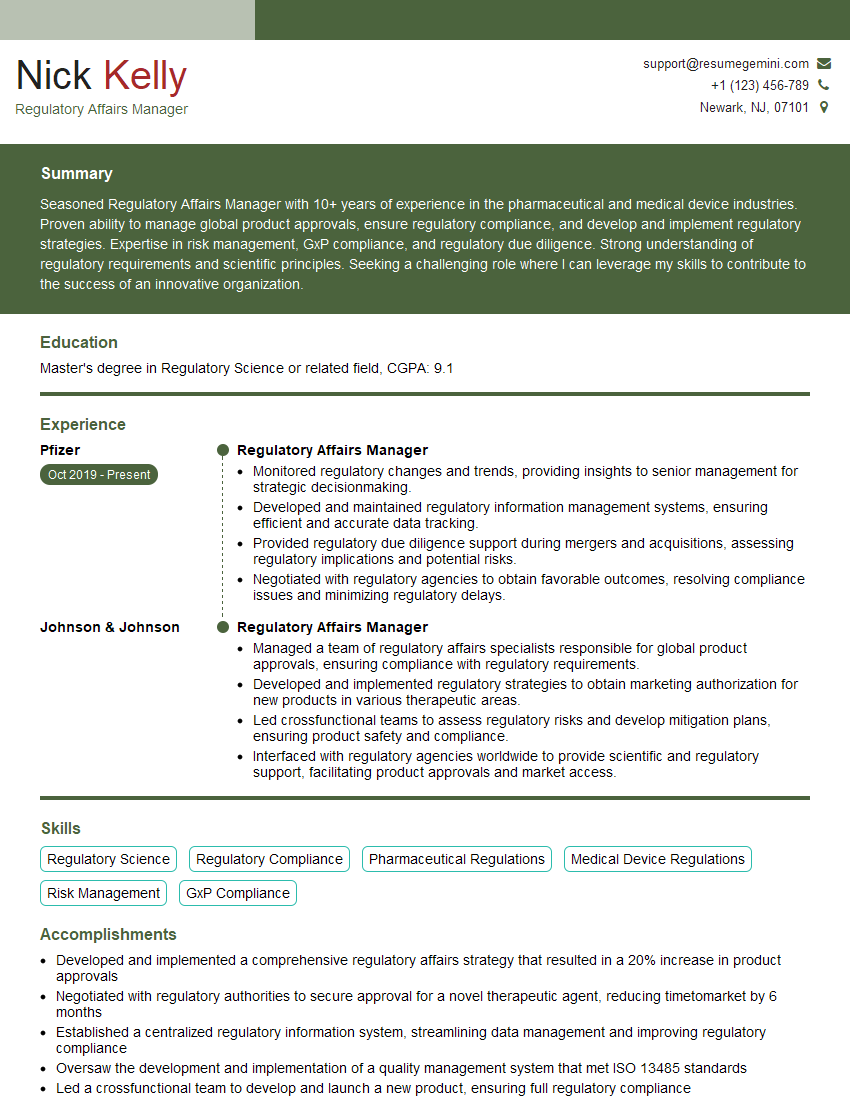
Mastering REACH Regulation is crucial for career advancement in the chemical industry, opening doors to roles with increased responsibility and higher earning potential. A strong understanding of REACH demonstrates your commitment to safety, compliance, and sustainability, making you a highly desirable candidate. To maximize your job prospects, create an ATS-friendly resume that highlights your relevant skills and experience. Use ResumeGemini, a trusted resource, to build a professional resume that effectively showcases your qualifications. Examples of resumes tailored to REACH Regulation are available to help guide you.
Explore more articles
Users Rating of Our Blogs
Share Your Experience
We value your feedback! Please rate our content and share your thoughts (optional).
What Readers Say About Our Blog
Very informative content, great job.
good