Preparation is the key to success in any interview. In this post, we’ll explore crucial Landfill Construction interview questions and equip you with strategies to craft impactful answers. Whether you’re a beginner or a pro, these tips will elevate your preparation.
Questions Asked in Landfill Construction Interview
Q 1. Explain the different types of landfill liners and their applications.
Landfill liners are crucial for preventing leachate (contaminated water) from escaping into the environment. There are several types, each with its own application:
- Compacted Clay Liners (CCL): These are the most traditional and cost-effective option. They rely on the low permeability of clay to restrict leachate migration. The effectiveness depends heavily on the clay’s properties and the quality of compaction. Think of it like a natural barrier – the denser the clay, the less water can seep through. CCL are often used as a primary liner in simpler landfills or as a secondary liner to enhance the protection offered by geomembranes.
- Geomembranes: These are synthetic, high-density polyethylene (HDPE) or polyvinyl chloride (PVC) sheets that provide an almost impenetrable barrier to leachate. They’re incredibly effective but more expensive than clay liners and require careful installation to avoid punctures or tears. Imagine them as a giant, tough plastic sheet wrapping the landfill. They are typically used as the primary liner in modern landfills.
- Composite Liners: These combine the benefits of both clay and geomembranes. A geomembrane is placed on top of a compacted clay liner, providing multiple layers of protection. This offers redundancy – if one layer fails, the other provides backup. It’s like having two separate security systems protecting a building – one is a fence, the other is an alarm system.
- Geocomposites: These are prefabricated liners that integrate a geomembrane with a geotextile. The geotextile acts as a protective layer, preventing damage to the geomembrane during installation and providing drainage. These are convenient for installation but generally more expensive.
The choice of liner depends on factors like site conditions, regulatory requirements, budget, and the expected lifespan of the landfill.
Q 2. Describe the process of leachate collection and management in a landfill.
Leachate collection and management is critical to prevent groundwater contamination. The process involves:
- Leachate Collection System: A network of pipes and drainage layers is installed beneath the waste. These layers are usually made of gravel or geonet, facilitating the movement of leachate towards the collection points.
- Collection Sumps and Pumps: Leachate collects in sumps at strategic locations within the landfill. Submersible pumps then transfer the leachate to a storage tank.
- Leachate Storage and Treatment: The collected leachate is temporarily stored in a lined tank. Before being released, it undergoes treatment to remove pollutants. This treatment can range from simple processes like equalization and neutralization to more complex methods such as biological treatment, activated carbon adsorption, and reverse osmosis, depending on the leachate characteristics and environmental regulations.
- Disposal or Reuse: After treatment, the leachate can be either disposed of in a permitted wastewater treatment facility or, if regulations and quality allow, reused for non-potable applications, such as irrigation.
Regular monitoring of the leachate collection system and its quality is vital to ensure its effectiveness and prevent leaks. Any malfunctions or high pollutant levels must be addressed promptly to avoid environmental damage. We regularly inspect the collection system, taking leachate samples for analysis. Any deviations from acceptable parameters trigger immediate action plans.
Q 3. What are the key considerations for landfill gas management and control?
Landfill gas (LFG) is primarily methane (CH4), a potent greenhouse gas. Effective management is crucial for environmental and safety reasons. Key considerations include:
- Gas Collection System: A network of vertical and horizontal wells is installed within the waste mass to extract LFG. The system needs to be designed to adequately capture the gas throughout the landfill’s lifespan. A well-designed system prevents the build up of dangerous levels of LFG.
- Gas Extraction and Treatment: The collected LFG can either be flared (burned) to reduce methane emissions or processed to produce energy (e.g., electricity). Flares are a common approach for smaller facilities or as temporary measure while a more permanent solution is established. Energy recovery is a more sustainable and beneficial option from an economic and environmental point of view.
- Gas Monitoring: Continuous monitoring of gas composition and pressure is vital to detect leaks and maintain the system’s effectiveness. This includes both ground level and wellhead monitoring using equipment like gas detectors.
- Safety Measures: LFG is flammable and explosive. Safety measures must include emergency shutdown systems, ventilation, and regular inspections to prevent accidents. Routine checks on the gas collection and control equipment are paramount.
The optimal LFG management strategy depends on the size and type of the landfill, and the availability of local energy infrastructure.
Q 4. How do you ensure compliance with environmental regulations during landfill construction?
Ensuring compliance is paramount. This involves:
- Pre-construction Site Investigation: Conducting a thorough site investigation to assess soil conditions, groundwater levels, and other environmental factors that influence design and construction practices. This assessment ensures the design and construction can meet all regulatory criteria.
- Detailed Design and Engineering: Developing a design that meets or exceeds all applicable environmental regulations. This includes obtaining permits, using appropriate liner systems, and incorporating robust leachate and gas management plans. The design must comply with the guidelines set out by the permitting authority.
- Quality Control and Assurance: Implementing rigorous quality control measures during construction to ensure adherence to the design specifications. This includes regular inspections and testing of materials and workmanship. Third-party audits provide another level of assurance.
- Record Keeping: Maintaining detailed records of all aspects of construction, including material testing results, inspection reports, and any deviations from the approved plans. Thorough documentation is crucial for demonstrating compliance.
- Post-construction Monitoring: Conducting post-construction monitoring to ensure the landfill’s long-term performance and environmental integrity. This includes monitoring ground and surface water for contamination, gas levels, and settlement of the landfill.
Failure to comply can lead to significant penalties, legal actions, and environmental damage.
Q 5. Explain the process of landfill site selection and permitting.
Landfill site selection and permitting is a complex process involving numerous steps:
- Site Screening: Identifying potential sites based on criteria such as proximity to waste sources, accessibility, hydrogeology, and land use. This often involves geographic information systems (GIS) analysis.
- Detailed Site Investigation: Conducting thorough investigations to assess the site’s suitability, including geotechnical, hydrological, and environmental assessments. This often includes drilling boreholes, performing geophysical surveys, and analyzing groundwater samples.
- Permitting Application: Submitting a detailed permit application to the relevant regulatory authorities. The application must demonstrate that the project meets all environmental regulations and protects human health and the environment.
- Regulatory Review: The permit application undergoes rigorous review by regulatory agencies. This may involve public hearings and environmental impact assessments.
- Permit Issuance: If the application is approved, the permitting authority will issue a permit authorizing landfill construction and operation.
The process can take several years and requires close coordination with regulators and stakeholders. A well-prepared application greatly increases the chance of successful permitting.
Q 6. Describe your experience with landfill design, including cell construction and compaction techniques.
My experience in landfill design encompasses all phases, from initial conceptual design through detailed engineering and construction oversight. I’ve overseen projects ranging from small municipal landfills to large regional facilities. Cell construction typically involves:
- Base Preparation: Grading and shaping the site to provide a stable base for the landfill cells. This often includes importing fill material to create a level platform.
- Liner Installation: Installing the chosen liner system, including the necessary geomembranes, compacted clay liners, drainage layers, and protective geotextiles. Careful attention is paid to seam details and quality control to avoid leaks.
- Waste Placement: Waste is carefully placed and compacted in layers, using heavy equipment such as bulldozers and compactors. Compaction is crucial for maximizing waste volume and reducing settlement. Optimal compaction is achieved through layered compaction using different levels of compaction depending on the waste type.
- Daily Cover: At the end of each day’s operation, a layer of soil or other approved cover material is placed over the waste to control odour, pests, and prevent wind dispersal.
- Final Cover: Once a cell is filled, a final cover is placed, typically consisting of a compacted clay liner, a drainage layer, vegetation, and erosion control measures.
I’ve worked with various compaction techniques, optimizing them based on waste characteristics and site conditions. For example, in one project with a high percentage of organic waste, we implemented a layered approach, compacting the organic materials separately to avoid anaerobic conditions and minimize gas generation.
Q 7. What are the common geotechnical challenges encountered during landfill construction?
Several geotechnical challenges can arise during landfill construction:
- High Water Table: A high water table can complicate liner installation and lead to leachate generation. Drainage measures and specialized construction techniques are often required to address this.
- Unstable Soil Conditions: Weak or unstable soils require careful design and construction techniques, such as ground improvement methods (e.g., soil stabilization, deep mixing) to ensure stability and prevent settlement.
- Expansive Soils: Expansive clays can swell and shrink with changes in moisture content, potentially causing damage to liners and other landfill components. Special design considerations and control measures are necessary to mitigate this.
- Seismic Activity: In seismically active areas, the landfill design must account for potential ground shaking and liquefaction to ensure structural integrity. This often involves special design criteria for embankments and liner systems.
- Subsidence: Settlement of the waste mass over time can impact the performance of the landfill’s components. Proper compaction and design measures are crucial to minimize subsidence.
Addressing these challenges requires a thorough geotechnical investigation, a well-designed foundation, and appropriate construction methods. Regular monitoring is essential throughout the project to ensure the landfill’s structural integrity and environmental performance.
Q 8. How do you monitor and mitigate the risks of groundwater contamination from a landfill?
Groundwater contamination is a serious risk associated with landfills. To mitigate this, we employ a multi-layered approach starting with site selection. We carefully assess the hydrogeology of the area, identifying the location and direction of groundwater flow. This allows us to select a site with minimal risk of contamination and design appropriate protective measures.
Next, we construct a robust liner system. This typically involves a composite liner made of a geomembrane (a high-density polyethylene liner) placed over a compacted clay layer. This liner acts as a barrier to prevent leachate (the liquid that percolates through the waste) from reaching the groundwater. We meticulously monitor the integrity of this liner during and after construction using methods such as visual inspections and leak detection systems.
Regular monitoring of groundwater quality is crucial. We install a network of monitoring wells around the perimeter and downgradient of the landfill. These wells are sampled regularly to analyze the presence of any contaminants. If contamination is detected, we implement remediation strategies, which could include pump-and-treat systems or in-situ bioremediation techniques.
Finally, a leachate collection system is essential. This system collects the leachate, which is then treated and disposed of appropriately. The treatment process often involves biological, chemical, or a combination of both methods to remove harmful contaminants.
Q 9. What are your strategies for managing construction waste generated during landfill development?
Construction waste management is a key aspect of responsible landfill development. We aim for zero waste to landfill during construction itself! We begin with detailed planning, carefully estimating the quantities and types of waste generated. This allows us to establish effective segregation and recycling strategies.
On-site sorting and recycling are essential. We use dedicated containers for different waste streams such as wood, concrete, metals, and plastics. Recyclable materials are diverted for reuse or recycling, reducing the overall volume of waste sent to a disposal facility. For materials that cannot be recycled, we explore options such as beneficial reuse, perhaps using crushed concrete as base material for roads within the landfill site itself.
We regularly audit our construction contractors to ensure they adhere to our waste management plan. This includes tracking the waste generation rates, ensuring proper documentation, and regular inspections. This rigorous approach minimizes the environmental footprint and contributes to the overall project sustainability.
Q 10. Explain the process of landfill closure and post-closure care.
Landfill closure is a critical phase that ensures long-term environmental protection. It involves several steps, starting with the final placement of waste, carefully shaping and compacting the final layer to ensure stability.
Next, we implement a final cover system. This typically includes a compacted clay layer, a geomembrane liner, and a vegetative layer. The clay layer minimizes water infiltration, while the geomembrane provides an extra barrier. The vegetative layer helps to promote erosion control and aesthetics.
Once the cover is in place, we install a gas collection system to mitigate the generation and release of methane. This system collects the gas, which can be flared or used to generate energy. Post-closure care involves ongoing monitoring of groundwater quality, leachate levels, and gas production. This monitoring continues for decades to ensure the long-term integrity of the landfill and protection of the surrounding environment.
Regular inspections and maintenance are also part of post-closure care to address any potential issues such as settlement or cover damage promptly. This ensures the landfill remains a safe and environmentally sound site even years after its operation ceases.
Q 11. How do you ensure the safety of workers during landfill construction?
Worker safety is paramount throughout the entire landfill construction process. We begin by conducting thorough risk assessments, identifying potential hazards such as heavy machinery, hazardous materials, and confined spaces.
We provide comprehensive safety training to all workers, covering topics such as personal protective equipment (PPE) use, hazard recognition, emergency procedures, and safe operating practices for machinery. This training is mandatory before starting any work and is refreshed regularly.
We implement stringent safety protocols on site, including regular safety inspections, enforced use of PPE, and clear signage indicating potential hazards. We have strict rules regarding heavy machinery operation, requiring trained operators and adherence to speed limits. Emergency response plans are in place, with readily accessible first aid kits and communication systems.
We foster a strong safety culture on site, encouraging workers to report any hazards or near misses without fear of reprisal. Regular safety meetings are held to discuss safety concerns and best practices, ensuring that safety is a shared responsibility.
Q 12. What are the different types of landfill cover systems and their effectiveness?
Several landfill cover systems exist, each with varying degrees of effectiveness. The choice of system depends on several factors including site-specific conditions, climate, and regulatory requirements. Common types include:
- Compacted Clay Liner: This is a relatively simple and cost-effective system using a thick layer of compacted clay to reduce water infiltration. Its effectiveness depends on the clay’s hydraulic conductivity, which can be affected by factors like rainfall and temperature.
- Geomembrane Liner: A high-density polyethylene (HDPE) membrane provides a virtually impermeable barrier, significantly reducing leachate generation and migration. However, it is more expensive than clay and requires careful installation to avoid punctures.
- Composite Liner: This combines a compacted clay layer with a geomembrane liner, offering a high degree of protection. It provides the benefits of both systems, minimizing permeability and offering redundancy in case of damage to one layer.
- Vegetative Cover: A layer of topsoil and vegetation helps stabilize the cover, promote erosion control, and improve aesthetics. This reduces wind and water erosion, protecting underlying layers.
The effectiveness of any cover system is ultimately assessed based on its long-term performance in reducing water infiltration and leachate generation, monitored through regular inspections and groundwater monitoring.
Q 13. Describe your experience with landfill monitoring and reporting systems.
My experience involves utilizing a range of landfill monitoring and reporting systems, from basic manual data logging to sophisticated automated systems. We use monitoring wells to collect groundwater samples at specified intervals, which are then analyzed for various parameters including pH, conductivity, and the presence of specific contaminants. Gas monitoring systems continuously measure methane and carbon dioxide levels, alerting us to any potential issues.
Data is typically logged using a computerized database system, often with GPS coordinates to pinpoint the location of monitoring points. We utilize GIS (Geographic Information Systems) to map and visualize this data, providing an overall picture of landfill performance. Reporting requirements vary depending on regulations, but generally include regular summaries of monitoring data, any corrective actions taken, and an assessment of landfill stability.
Automated systems, while more expensive initially, can significantly improve data quality and reduce the time spent on manual data collection and analysis. This enables proactive management and faster response times to any detected anomalies. Data analysis can reveal trends over time, enabling predictive modeling and further optimizing management strategies.
Q 14. How do you manage potential conflicts with stakeholders during landfill development?
Managing stakeholder conflicts during landfill development is a critical aspect of successful project delivery. We use a proactive and transparent approach, engaging with stakeholders early and often in the process.
We begin with community outreach, holding public meetings to present our plans and address any concerns. This transparency helps build trust and foster a collaborative relationship. We actively listen to stakeholder concerns, incorporating their feedback into the project design where appropriate.
We also establish clear communication channels, promptly responding to questions and concerns. This could involve regular newsletters, online forums, or dedicated contact points. We work to address potential conflicts through negotiation and mediation, seeking mutually agreeable solutions that minimize negative impacts. When necessary, we engage independent experts to provide impartial assessments and recommendations.
Following all relevant regulations and adhering to the highest environmental standards is crucial in mitigating potential conflicts. By demonstrating our commitment to environmental protection and community well-being, we strive to build consensus and support for the project.
Q 15. What is your experience with different types of landfill waste (municipal solid waste, industrial waste, etc.)?
My experience encompasses a wide range of landfill waste types, primarily focusing on municipal solid waste (MSW) and industrial waste. MSW presents a diverse challenge, including residential trash, commercial refuse, and construction debris, each requiring specific handling and processing considerations within the landfill design. Industrial waste is far more complex, varying greatly depending on the industry. I’ve worked with everything from hazardous industrial byproducts (requiring stringent regulations and specialized cells) to less hazardous industrial waste like demolition materials and manufacturing scraps. A key aspect of my work involves understanding the waste stream’s composition to design appropriate landfill liners, leachate management systems, and gas collection infrastructure. For instance, a landfill designed for MSW will differ significantly from one designed to accept industrial waste containing heavy metals or other hazardous substances, requiring distinct barrier systems and monitoring protocols.
One project I recall involved a large industrial facility that generated significant amounts of chemically treated wood waste. We had to conduct extensive testing to determine the leachate characteristics and potential environmental impact, leading to the design of a special containment cell with multiple layers of engineered barriers and rigorous leachate monitoring to protect groundwater resources. This example highlights the critical need for a tailored approach to each specific waste type and its potential consequences.
Career Expert Tips:
- Ace those interviews! Prepare effectively by reviewing the Top 50 Most Common Interview Questions on ResumeGemini.
- Navigate your job search with confidence! Explore a wide range of Career Tips on ResumeGemini. Learn about common challenges and recommendations to overcome them.
- Craft the perfect resume! Master the Art of Resume Writing with ResumeGemini’s guide. Showcase your unique qualifications and achievements effectively.
- Don’t miss out on holiday savings! Build your dream resume with ResumeGemini’s ATS optimized templates.
Q 16. Explain the concept of landfill capacity and its calculation.
Landfill capacity refers to the total volume of waste a landfill can safely accommodate throughout its operational lifespan. Calculating this capacity is a complex process involving several factors. Firstly, we need to determine the available land area. Next, we consider the design’s vertical dimensions – how high the waste will be piled, considering slope stability and compaction. The density of the waste plays a critical role; compacted waste occupies less space. We use historical data or perform waste characterization studies to estimate the density. Finally, we factor in the necessary space for engineering elements like liners, leachate collection systems, and cover materials. This isn’t a simple addition; it’s an iterative process involving geotechnical engineering, hydrological modeling and often sophisticated 3D modeling software.
For example, consider a landfill with a 10-hectare area designed to a height of 20 meters. If the compacted waste density is estimated at 800 kg/m³, and we account for 15% of the volume for liners and other infrastructure, the final usable capacity would be substantially less than the simple calculation suggests. The actual calculation would involve complex geometrical considerations and multiple iterations to refine the estimate.
Q 17. How do you incorporate sustainability principles into landfill design and construction?
Sustainability is paramount in modern landfill design and construction. We aim to minimize environmental impact across the entire life cycle. This starts with waste reduction and diversion strategies, promoting recycling and composting to lessen the volume going to landfill. During design, we prioritize engineered systems to prevent leachate and gas migration into the surrounding environment. These include multiple layers of geomembranes, compacted clay, and other low-permeability materials. We also incorporate innovative gas collection systems to capture methane, a potent greenhouse gas, which can be used for energy generation (renewable energy source), reducing the landfill’s carbon footprint. Finally, post-closure plans are critical for long-term sustainability, involving proper cover design to promote soil formation, vegetation establishment, and minimizing surface water infiltration.
One innovative approach involves using landfill gas to power nearby communities or industrial facilities. This transforms a waste product into a valuable energy resource. We also explore using recycled materials in the construction of landfill infrastructure. These sustainable practices, however, should be balanced against cost-effectiveness and regulatory compliance. It’s not always about the most advanced or expensive technology; it’s about a holistic and carefully planned strategy.
Q 18. What are the key performance indicators (KPIs) for a successful landfill project?
Key performance indicators (KPIs) for a successful landfill project are multifaceted. They focus on environmental protection, operational efficiency, and financial performance. Environmentally, we monitor leachate quality (chemical composition and volume), landfill gas emissions (methane and carbon dioxide), and groundwater monitoring data. Operationally, waste acceptance rates, compaction efficiency, and maintenance costs are crucial. Financially, the project’s budget adherence, return on investment, and long-term cost estimations are assessed. Other KPIs might include safety records, regulatory compliance, and community relations.
For instance, a low leachate volume indicates effective liner performance, while consistent gas production and capture show the effectiveness of the gas management system. A high safety record demonstrates adherence to protocols and a commitment to worker well-being. All these indicators, taken together, provide a holistic view of the landfill’s performance and its long-term viability.
Q 19. Describe your experience with using GIS technology in landfill management.
GIS technology is indispensable in modern landfill management. We use GIS to manage spatial data related to the landfill’s design, construction, and operation. This includes mapping waste disposal areas, monitoring leachate and groundwater plumes, visualizing gas collection networks, and tracking the movement of waste within the landfill. GIS enables real-time monitoring and analysis, leading to efficient management decisions. For example, we can overlay waste disposal data with geological information to better understand subsurface conditions. This integrated approach allows for better prediction of landfill behavior and potential issues.
In one project, we utilized GIS to model the potential impact of a heavy rainfall event on the landfill’s stability and leachate generation. This predictive modeling allowed us to proactively adjust our operation plans and prevent potential environmental risks. We can also use GIS for public engagement, presenting data in accessible ways and improving community understanding of the landfill’s operation and environmental impact.
Q 20. How do you address unexpected geological conditions during landfill construction?
Unexpected geological conditions are a major challenge in landfill construction. These could include unstable soil formations, unexpected groundwater levels, or the presence of underground utilities or abandoned structures. Our approach involves a thorough pre-construction site investigation, including detailed geotechnical and geophysical surveys. This includes soil sampling, boreholes, and ground-penetrating radar (GPR). If unexpected conditions are encountered during construction, we employ a contingency plan, potentially involving redesigning the landfill’s foundation, adjusting the liner system, or incorporating additional stabilization measures. This often requires consultation with geotechnical engineers and regulatory agencies to ensure continued safety and compliance.
For example, if we encounter unexpectedly high groundwater levels, we might need to install a more extensive drainage system or modify the liner system to handle increased hydrostatic pressure. Proper documentation of all modifications is vital for regulatory reporting and long-term management.
Q 21. What are the common causes of landfill failure and how to prevent them?
Landfill failure can manifest in several ways, from leachate leaks and gas emissions to slope instability and structural collapses. Common causes include inadequate liner systems (compromised integrity or insufficient design), insufficient compaction of waste, improper drainage design, and unforeseen geological conditions (as previously discussed). Preventing these failures requires meticulous planning, rigorous construction oversight, and continuous monitoring. Pre-construction site characterization is paramount. Choosing appropriate liner materials, implementing proper compaction techniques, and designing robust leachate and gas collection systems are crucial steps. Regular inspections and maintenance, as well as prompt response to unexpected events, are also vital for a successful landfill project. Regulatory compliance is essential; adhering to regulations will greatly reduce risks of failure. Moreover, using advanced monitoring tools and adopting a proactive maintenance plan ensures long-term integrity of the landfill.
A classic example of failure is a leachate leak due to a liner puncture or inadequate design. This can contaminate groundwater and have severe environmental consequences. Preventing this requires stringent quality control during liner installation and regular monitoring of the liner system for any signs of damage or degradation.
Q 22. Explain your experience with various soil stabilization techniques used in landfills.
Soil stabilization is crucial in landfill construction to ensure the integrity of the waste containment system. My experience encompasses a range of techniques, selected based on site-specific soil conditions and project requirements. These include:
- Compaction: This is the most fundamental technique, involving the use of heavy machinery to compact the soil layers, reducing permeability and increasing shear strength. I’ve overseen projects where we utilized different compaction methods – from vibratory rollers for cohesive soils to sheepsfoot rollers for granular materials – achieving optimal compaction levels verified through in-situ density tests.
- Lime Stabilization: Lime reacts chemically with clay minerals, improving their strength and reducing permeability. On a recent project with expansive clay soils, we successfully incorporated lime stabilization to create a more stable base for the landfill liner. We carefully monitored the lime content and curing time to ensure optimal performance.
- Cement Stabilization: Similar to lime, cement provides significant strength gains and reduces permeability. This is especially effective in situations requiring high bearing capacity, like areas supporting heavy machinery. I’ve used this technique successfully in the construction of landfill access roads, ensuring long-term stability under heavy traffic.
- Geosynthetics: These synthetic materials – geotextiles, geomembranes, and geocomposites – play a crucial role in enhancing soil strength and reducing permeability. They’re often integrated with compacted soil layers to create a robust composite liner system. My expertise lies in selecting the appropriate geosynthetics based on the specific soil properties and environmental conditions.
Choosing the right technique is crucial for landfill stability and environmental protection. It involves careful site investigation, laboratory testing, and the consideration of long-term performance and cost-effectiveness.
Q 23. Describe your familiarity with relevant environmental legislation and regulations.
My familiarity with environmental legislation and regulations governing landfill construction is extensive. I stay updated on changes in relevant laws and regulations at both national and local levels. Key regulations I regularly work with include those concerning:
- Waste Management: Regulations governing the types of waste accepted, waste characterization, and landfill operational procedures.
- Leachate Management: Regulations mandating the design and operation of leachate collection and treatment systems. These often involve stringent standards for the quality of treated leachate before discharge.
- Groundwater Protection: Strict requirements for liner systems, leachate management, and groundwater monitoring programs are in place to prevent contamination of underground aquifers. This includes regular testing and reporting of groundwater quality.
- Air Quality: Regulations regarding methane emissions, particularly the design and operation of methane collection and utilization systems. This involves monitoring and reporting methane concentrations regularly.
- Site Closure and Post-Closure Care: Stringent regulations addressing the procedures for landfill closure, including final cover design, long-term monitoring, and post-closure maintenance.
Compliance is not just a matter of avoiding penalties; it’s about protecting public health and the environment. I integrate regulatory requirements into every phase of the project, from planning and design to construction and closure.
Q 24. What are your strategies for managing potential risks associated with landfill fires?
Landfill fires are a significant risk, posing environmental hazards and operational challenges. My strategies for managing these risks are multi-pronged:
- Waste Characterization and Segregation: Careful sorting of waste before landfilling helps minimize the risk of spontaneous combustion by reducing the presence of combustible materials.
- Proper Compaction and Cover: Thorough compaction and daily cover of waste significantly reduce the risk of fire by limiting oxygen availability. Daily cover using inert material prevents the accumulation of methane and other flammable gases.
- Gas Monitoring and Control: A robust methane and other gas monitoring system is critical. The early detection of elevated gas levels allows for proactive measures to mitigate the risk of fire. Implementing a gas extraction and flare system can significantly minimize the chances of ignition.
- Emergency Response Plan: A detailed plan must be in place that outlines procedures for fire detection, suppression, and post-fire remediation. This plan needs regular review and drills with site personnel. I have extensive experience developing and implementing such plans.
- Perimeter Firebreaks and Access Roads: Strategic placement of firebreaks and access roads allows for easier access for firefighting equipment and personnel in case of a fire.
Preventing landfill fires is far more cost-effective than dealing with the consequences of one. My approach is always proactive and risk-based.
Q 25. How do you ensure the long-term stability of a landfill after closure?
Ensuring long-term stability after landfill closure requires meticulous planning and execution. Key elements include:
- Final Cover Design: A well-designed final cover, consisting of compacted soil layers, a drainage system, and vegetation, is essential for preventing erosion, controlling leachate generation, and promoting gas migration. The design should consider local climatic conditions and the long-term stability of the cover materials. I always perform extensive hydrological modelling to assess the long-term performance of the cover system.
- Gas Management System: A long-term gas management system, usually involving extraction wells and a flare or beneficial use system, is crucial for controlling methane emissions and mitigating the risk of fire for decades after closure. I’ve been involved in projects utilizing biogas for energy generation, transforming a liability into a valuable resource.
- Leachate Management System: A post-closure leachate management system needs to be designed to collect, treat, and dispose of leachate for a considerable period. The system should account for the expected leachate generation rate over the long term and be readily accessible for maintenance.
- Groundwater Monitoring: An extensive groundwater monitoring program is needed for decades after closure to ensure the integrity of the liner system and prevent contamination of groundwater resources. I ensure the monitoring network is designed strategically to capture potential pathways of contaminant migration.
- Post-Closure Care Plan: A comprehensive plan outlines long-term maintenance and monitoring activities, including inspection of the final cover, gas monitoring, leachate management, and groundwater monitoring. The plan is crucial for ensuring the continued protection of human health and the environment.
Long-term stability isn’t just a technical challenge; it’s a legal and ethical responsibility. Proper planning and robust monitoring are paramount.
Q 26. Explain your experience with budgeting and cost control in landfill projects.
Budgeting and cost control are integral aspects of successful landfill projects. My experience involves:
- Detailed Cost Estimation: I develop comprehensive cost estimates based on detailed design plans, including earthwork, liner installation, leachate management system, gas management system, final cover, and post-closure care. I utilize specialized cost estimation software and consider various contingency factors.
- Value Engineering: I actively seek ways to optimize designs and construction methods without compromising safety or environmental protection. This involves exploring alternatives in materials, construction techniques, and equipment selection. For example, using readily available local materials can significantly reduce transportation costs.
- Cost Tracking and Reporting: Throughout the project lifecycle, I maintain meticulous records of all expenses and monitor progress against the budget. I regularly generate reports for clients to ensure transparency and facilitate proactive decision-making.
- Risk Management: I incorporate risk assessment into the budgeting process to identify and mitigate potential cost overruns. This includes contingency planning for unforeseen issues like unexpected site conditions or material price fluctuations.
- Contract Management: I’m experienced in negotiating contracts with subcontractors and suppliers to ensure competitive pricing and compliance with project specifications. I understand the importance of clear contract terms and efficient project management to control costs.
Cost control is not just about minimizing expenses; it’s about maximizing value and ensuring the project’s financial viability without compromising quality or safety.
Q 27. How do you maintain accurate records and documentation throughout the landfill lifecycle?
Maintaining accurate records and documentation is critical throughout the landfill lifecycle. My approach involves:
- Digital Documentation: I utilize a comprehensive digital system to store and manage all project documents, including design drawings, specifications, construction logs, inspection reports, test results, and regulatory permits. This system ensures easy access, efficient retrieval, and version control.
- Geospatial Data Management: I incorporate geospatial technologies, including GIS (Geographic Information Systems), to map landfill features, track construction progress, and manage data related to groundwater monitoring and gas management. This enhances data visualization and analysis capabilities.
- Database Management: I utilize database management systems to organize and analyze large datasets related to waste characterization, leachate quality, gas emissions, and groundwater monitoring. This facilitates efficient data analysis and reporting.
- Regular Audits and Quality Control: Regular internal audits and quality control checks ensure the accuracy and completeness of the records. This involves validating data against field observations and ensuring compliance with regulatory requirements.
- Data Backup and Security: I prioritize data backup and security to protect against data loss or unauthorized access. Secure cloud storage and robust cybersecurity measures are implemented.
Comprehensive and well-maintained records are essential for ensuring compliance with regulations, facilitating future maintenance and operations, and protecting against potential liability. It provides a detailed history of the landfill, which is crucial for assessing its long-term performance and environmental impact.
Q 28. Describe your experience in using various software and tools for landfill design and analysis.
My experience with software and tools for landfill design and analysis is extensive. I am proficient in using various software packages, including:
- AutoCAD and Civil 3D: For creating detailed design drawings, site plans, and cross-sections. I leverage the tools within these software to generate accurate topographical models and detailed landfill designs.
- GIS Software (ArcGIS, QGIS): For managing geospatial data, analyzing spatial relationships, and visualizing landfill features and environmental data. This is crucial for groundwater modelling and planning monitoring well locations.
- Hydrogeological Modeling Software (MODFLOW, FEFLOW): For simulating groundwater flow and contaminant transport to predict potential impacts on groundwater resources. I’ve frequently used these modelling tools to assess the effectiveness of liner systems and to optimize the design of leachate collection systems.
- Finite Element Analysis (FEA) Software: For analyzing the structural stability of landfill slopes, embankments, and other critical structures. FEA software is often used to validate the stability of the landfill cover and access roads, especially in seismically active regions.
- Specialized Landfill Design Software: I have experience with software packages specifically designed for landfill design and analysis, including those capable of modeling gas flow, leachate generation, and cover performance over time.
The selection of appropriate software is driven by the specific requirements of the project. My proficiency in using these tools ensures efficient and accurate design and analysis, leading to safer and more environmentally sound landfills.
Key Topics to Learn for Landfill Construction Interview
- Site Selection and Planning: Understanding geological surveys, hydrological assessments, and environmental impact studies. Practical application: Analyzing site suitability reports and identifying potential challenges.
- Design and Engineering: Familiarization with liner systems (clay, geomembrane), leachate collection and removal systems, gas management systems, and final cover design. Practical application: Calculating liner thicknesses based on site-specific conditions and regulatory requirements.
- Construction Methods and Equipment: Knowledge of earthmoving techniques, compaction procedures, geomembrane installation, and quality control measures. Practical application: Troubleshooting common construction issues like liner punctures or inadequate compaction.
- Waste Management and Regulations: Understanding waste characterization, waste acceptance criteria, and relevant environmental regulations (e.g., RCRA). Practical application: Developing a waste management plan that complies with all applicable regulations.
- Environmental Monitoring and Remediation: Knowledge of groundwater monitoring, leachate analysis, gas monitoring, and remediation techniques. Practical application: Interpreting monitoring data and identifying potential environmental hazards.
- Health and Safety: Understanding and implementing safety protocols, hazard identification, and risk assessment procedures within a landfill construction environment. Practical application: Developing a comprehensive site-specific safety plan.
- Cost Estimation and Project Management: Developing accurate cost estimates, managing project timelines, and adhering to budgets. Practical application: Using project management software to track progress and identify potential cost overruns.
Next Steps
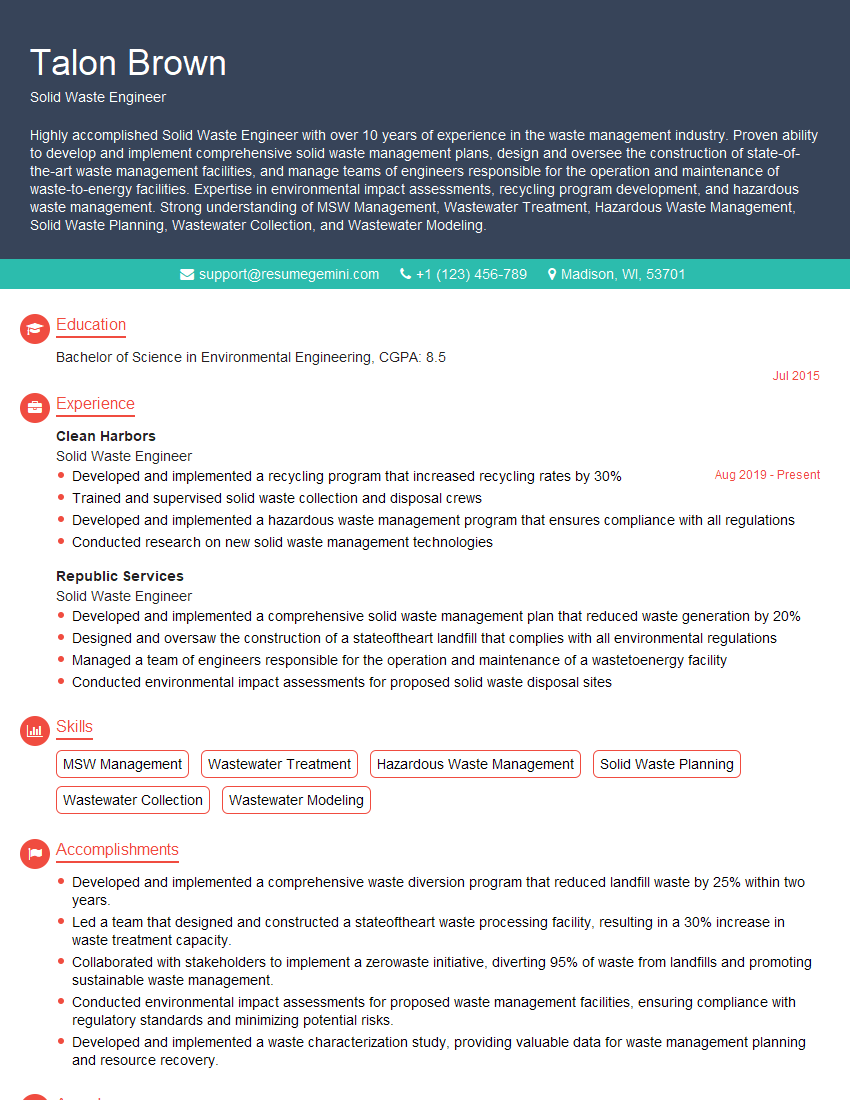
Mastering Landfill Construction opens doors to a rewarding career with excellent growth potential in a vital industry. To maximize your job prospects, a strong, ATS-friendly resume is crucial. ResumeGemini can help you craft a professional and impactful resume that highlights your skills and experience effectively. We provide examples of resumes tailored to the Landfill Construction industry to help you create a document that stands out from the competition. Invest in your future and build the perfect resume today.
Explore more articles
Users Rating of Our Blogs
Share Your Experience
We value your feedback! Please rate our content and share your thoughts (optional).
What Readers Say About Our Blog
Very informative content, great job.
good