Every successful interview starts with knowing what to expect. In this blog, we’ll take you through the top Landfill Management interview questions, breaking them down with expert tips to help you deliver impactful answers. Step into your next interview fully prepared and ready to succeed.
Questions Asked in Landfill Management Interview
Q 1. Describe the different types of landfills and their suitability for various waste streams.
Landfills are categorized based on the type of waste they accept and their design features. The most common types include:
- Municipal Solid Waste (MSW) Landfills: These are designed to handle everyday trash from households and businesses. They often incorporate multiple layers of waste, with different sections for various materials (e.g., a separate area for yard waste composting).
- Industrial Landfills: These landfills accept non-hazardous industrial wastes, which can range from construction debris to manufacturing byproducts. They often have more stringent design and monitoring requirements due to the potential for more complex contaminants.
- Hazardous Waste Landfills: These facilities handle dangerous and toxic materials requiring specialized liners, leachate collection systems, and stringent monitoring to prevent environmental contamination. Regulations are exceptionally rigorous for these sites.
- Sanitary Landfills: This is a general term often used interchangeably with MSW landfills, emphasizing the engineering controls implemented to minimize environmental impact. They’re carefully engineered to prevent groundwater contamination and gas emissions.
Suitability depends on waste characteristics. Hazardous waste, for instance, absolutely requires a hazardous waste landfill due to its potential to leach harmful substances into the environment. Construction debris is usually suitable for industrial landfills. MSW is ideal for MSW landfills designed to manage the varied composition of household waste.
Q 2. Explain the principles of leachate management and control.
Leachate, the liquid that percolates through waste in a landfill, contains dissolved and suspended materials that can contaminate groundwater. Effective leachate management revolves around:
- Prevention: This involves designing and building the landfill with a robust liner system (clay and geomembranes), a leachate collection system, and proper waste placement techniques to minimize leachate generation. Think of it like creating a waterproof container for the waste.
- Collection: A network of pipes and sumps collects leachate from the landfill base. Regular inspection and maintenance are crucial to ensure the efficient functioning of this system.
- Treatment: Collected leachate needs treatment before it can be safely disposed of or released. Common treatment methods include physical processes (filtration, sedimentation), chemical processes (neutralization, oxidation), and biological processes (aerobic and anaerobic treatment).
- Disposal/Reuse: Treated leachate can be discharged to a municipal wastewater treatment plant, reused for irrigation (after careful analysis), or disposed of in a designated location, depending on the quality and local regulations.
Imagine a well-designed leachate management system as a sophisticated filtration system for a giant, underground container. It ensures that the potentially harmful liquids are captured and treated before they can reach valuable resources like groundwater.
Q 3. How do you monitor and control landfill gas emissions?
Landfill gas (LFG), primarily methane and carbon dioxide, is a byproduct of anaerobic decomposition. Its uncontrolled release contributes to climate change. Monitoring and control strategies include:
- Monitoring Wells: These measure gas concentrations at various points within the landfill to identify hotspots and potential leaks.
- Gas Extraction Wells: These are strategically placed to extract LFG, preventing its release into the atmosphere. The extracted gas can be used for energy generation (e.g., powering nearby facilities), reducing greenhouse gas emissions and providing a valuable resource.
- Flare Systems: In some cases, extracted gas is burned in a flare, reducing the methane concentration but producing carbon dioxide. This is usually a temporary measure until more efficient energy recovery methods are implemented.
- Regular Inspections: Visual inspections and pressure testing help to detect leaks or other issues in the gas collection system.
Effective LFG management minimizes environmental impact and can turn a potential liability into a renewable energy source. Imagine a giant vacuum cleaner sucking up the gas and converting it into electricity – a cleaner and more sustainable approach.
Q 4. What are the key regulatory requirements for landfill operations in your region?
Regulatory requirements vary significantly by region but generally include:
- Permitting: Obtaining all necessary permits before starting operations, covering aspects like location, design, and operational procedures.
- Design Standards: Adherence to specific requirements for liner systems, leachate management, gas collection, and monitoring wells.
- Operational Standards: Regular monitoring of leachate and gas levels, waste acceptance criteria, and reporting requirements.
- Closure and Post-Closure Care: Detailed plans for landfill closure and long-term monitoring after closure, ensuring long-term environmental protection.
- Environmental Monitoring: Regular testing of groundwater, soil, and air quality to ensure compliance with environmental standards.
These regulations are often set at the state or even local level. Non-compliance can lead to hefty fines and legal actions. It’s essential to stay abreast of the ever-evolving regulatory landscape.
Q 5. Describe your experience with landfill liner design and installation.
My experience encompasses various aspects of landfill liner design and installation, from initial site assessment to final geomembrane seam welding. Key aspects include:
- Site Characterization: Thorough investigation of the soil’s properties to ensure the liner system is adequately designed to meet the specific site conditions.
- Liner Design: Designing a multi-layered system comprising a compacted clay liner (CCL) and a geomembrane layer, tailored to meet the specific needs of the landfill and considering factors like hydraulic conductivity and waste type.
- Construction Oversight: Ensuring compliance with the design specifications during construction, including careful placement of the clay liner and installation of the geomembrane, and proper quality control measures.
- Quality Control Testing: Utilizing various tests such as hydraulic conductivity testing to assess the liner’s performance and ensure it meets design criteria. Seam welding of the geomembrane is critical and must be tested for integrity.
A properly installed liner is the first and most vital line of defense against leachate migration into the environment. It is crucial to view liner installation as a complex engineering challenge that demands precision and attention to detail.
Q 6. Explain the process of landfill closure and post-closure care.
Landfill closure and post-closure care are critical for long-term environmental protection. The closure process involves several steps:
- Final Cover Installation: A final cover system, typically including a compacted clay layer and vegetative layer, is placed on the top of the waste. This prevents infiltration of rainwater and protects the landfill from erosion.
- Gas Management System Adjustment: The existing gas collection system is modified or shut down to accommodate the final cover and prevent gas migration.
- Leachate Management System Modifications: The leachate collection system is either decommissioned or adapted to handle the reduced leachate generation during post-closure.
- Monitoring System Implementation: A comprehensive monitoring program is put in place to monitor groundwater, surface water, and gas migration for an extended period.
Post-closure care involves long-term monitoring and maintenance of the landfill and its surrounding environment, often for decades, to ensure the protection of human health and the environment. It’s a vital but often overlooked aspect of landfill management, demonstrating responsible long-term environmental stewardship.
Q 7. How do you manage and mitigate risks associated with landfill settlement?
Landfill settlement, the gradual compaction of waste, is inevitable. Managing and mitigating its risks involves:
- Proper Waste Compaction: Appropriate compaction techniques during waste placement can minimize the overall settlement and uneven settling.
- Design Considerations: The landfill design must account for anticipated settlement, ensuring that structures like the liner system and gas collection system can withstand the expected movement.
- Monitoring and Assessment: Regular monitoring using survey techniques helps track settlement patterns, allowing for timely interventions if significant problems arise.
- Mitigation Measures: In cases of excessive or uneven settlement, mitigation measures may include additional compaction, soil placement, or other engineering solutions.
Imagine a settling landfill like a slowly deflating balloon. Effective management anticipates this settling and incorporates design strategies and monitoring to ensure the integrity of the landfill’s protective layers and its surroundings, preventing potential hazards and environmental issues.
Q 8. What are the methods used for landfill gas energy recovery?
Landfill gas (LFG), primarily methane and carbon dioxide, is a byproduct of decomposing organic waste in landfills. Energy recovery from LFG is crucial for environmental sustainability and resource utilization. The primary methods employed are:
- LFG-to-energy (LFGTE) power generation: This involves collecting LFG via a network of wells, cleaning it (removing contaminants like siloxanes and moisture), and using it to fuel engines that generate electricity. This electricity can then be fed into the power grid or used onsite. Think of it like a small-scale power plant fueled by landfill gas.
- Combined heat and power (CHP): This system simultaneously produces both electricity and heat. The heat generated during power generation can be used to heat nearby buildings or industrial processes, maximizing energy efficiency. It’s like getting two benefits – electricity and warmth – from a single source.
- Flare systems: While not a true energy recovery method, flaring burns off LFG to reduce methane emissions to the atmosphere. This is typically a temporary or emergency measure, and while it prevents greenhouse gas release to the atmosphere it doesn’t recover any energy.
The choice of method depends on factors like the volume of LFG generated, proximity to power grids, and economic viability. For example, a large landfill producing a significant amount of LFG might opt for an LFGTE plant to sell electricity to the grid, while a smaller landfill might choose a smaller scale CHP system for local use.
Q 9. Describe your experience with landfill site investigation and characterization.
My experience in landfill site investigation and characterization spans over 15 years, encompassing projects ranging from small municipal landfills to large industrial waste disposal sites. The process typically starts with a thorough desk study reviewing historical data, aerial photographs, and existing environmental reports. This helps define the scope of the investigation. Fieldwork then involves:
- Geotechnical investigations: Soil sampling and testing to determine soil properties, bearing capacity, and potential for settlement.
- Hydrogeological investigations: Drilling boreholes, installing monitoring wells, and conducting groundwater sampling to assess the extent and quality of groundwater resources and define the hydrogeological conditions of the site.
- Geophysical surveys: Employing techniques like ground-penetrating radar (GPR) to map subsurface features and identify potential contamination sources.
- Environmental sampling: Collecting soil, groundwater, and LFG samples for laboratory analysis of various contaminants including heavy metals, volatile organic compounds (VOCs), and semi-volatile organic compounds (SVOCs).
The data gathered informs the site characterization report, a crucial document for determining the landfill’s suitability, designing appropriate mitigation measures, and ultimately permitting the project. For example, in one project, we discovered an unexpected subsurface clay layer during drilling, requiring a redesign of the landfill liner system to ensure integrity.
Q 10. How do you ensure compliance with environmental regulations during landfill operations?
Ensuring compliance with environmental regulations is paramount in landfill management. This requires a proactive and multi-faceted approach, including:
- Obtaining necessary permits: This involves thorough environmental impact assessments and submitting detailed applications to regulatory bodies, demonstrating compliance with all applicable laws and regulations.
- Implementing robust monitoring programs: This includes regular monitoring of LFG emissions, groundwater quality, surface water runoff, and leachate generation and treatment. Data is meticulously recorded and reported to regulatory agencies as per the established schedules and formats.
- Maintaining comprehensive records: Detailed records are kept of all aspects of landfill operations, including waste acceptance, gas collection, leachate management, and environmental monitoring. These records must be accessible to auditors and regulatory agencies.
- Employee training: Regular training ensures that all personnel are aware of and comply with environmental regulations, operating procedures, and safety protocols. For instance, workers are trained on proper waste handling techniques to minimize the risk of groundwater contamination.
- Emergency response planning: Developing and regularly testing emergency response plans for potential incidents, such as LFG leaks or leachate spills, to minimize environmental impact and public safety risks.
Regular audits and inspections by regulatory authorities are a key part of this process. We also employ a strong internal compliance program to stay ahead of the curve.
Q 11. What are the common challenges faced in landfill management, and how have you addressed them?
Landfill management faces numerous challenges, some of the most common being:
- Leachate management: Controlling and treating leachate, the liquid that percolates through the waste, is a significant operational and environmental challenge. Treatment options range from simple equalization basins to sophisticated treatment plants employing technologies like activated sludge or membrane bioreactors. In one project, we faced a leachate volume exceeding the treatment plant’s capacity, requiring us to implement an aggressive source control strategy to minimize leachate generation.
- LFG management: Efficient collection and utilization of LFG is vital to reduce greenhouse gas emissions. Challenges include ensuring sufficient well coverage, maintaining the integrity of the gas collection system, and addressing seasonal variations in gas generation.
- Financial sustainability: Balancing operational costs, capital investments, and long-term closure costs requires meticulous financial planning and resource allocation. This includes planning for post-closure care, which can span several decades.
- Public perception: Landfills often face negative public perception due to concerns about odor, aesthetics, and environmental impact. Active community engagement and transparent communication are essential to building trust and support.
Addressing these challenges often involves integrated solutions, combining engineering expertise, environmental monitoring, and community engagement. For example, we addressed public concerns about odor at one site by implementing a state-of-the-art odor control system and conducting regular community meetings to discuss concerns and update residents on our progress.
Q 12. Explain the role of GIS in landfill management.
Geographic Information Systems (GIS) are indispensable tools in modern landfill management. GIS allows for the spatial analysis and visualization of vast amounts of data, enabling better decision-making and improved operational efficiency. Its applications include:
- Site mapping and design: GIS facilitates the creation of detailed site maps, showing waste placement, gas collection systems, leachate management infrastructure, and monitoring well locations. This improves site planning and minimizes operational risks.
- Environmental monitoring: GIS integrates data from various environmental monitoring programs (e.g., groundwater quality, LFG emissions, surface water quality) to identify trends, potential issues, and areas requiring further investigation. The ability to visualize this data spatially provides a quick overview of the site’s environmental performance.
- Waste tracking and management: GIS can track waste inflow, helping optimize waste placement and enhance efficiency. This is particularly useful for sites receiving different waste streams with varying characteristics.
- Regulatory compliance: GIS helps document compliance with environmental regulations by visualizing monitoring data and permitting boundaries. This aids in effective reporting and communication with regulatory agencies.
For instance, in one project, using GIS to analyze groundwater monitoring data revealed a localized plume of contamination that might have been missed using traditional methods. This allowed for prompt remediation and prevented further environmental damage.
Q 13. Describe your experience with landfill leachate treatment and disposal.
My experience with landfill leachate treatment and disposal involves a range of technologies and strategies. Leachate treatment aims to reduce the concentration of pollutants to levels suitable for discharge or reuse. Common treatment methods include:
- Physical treatment: Techniques like screening, sedimentation, and filtration remove suspended solids and other large particles.
- Chemical treatment: Processes like neutralization, coagulation-flocculation, and precipitation reduce the concentrations of various pollutants.
- Biological treatment: Aerobic or anaerobic biological processes, such as activated sludge or anaerobic digestion, break down organic matter and reduce BOD (Biochemical Oxygen Demand) and COD (Chemical Oxygen Demand).
- Advanced treatment: Technologies like membrane filtration (microfiltration, ultrafiltration, reverse osmosis), activated carbon adsorption, and advanced oxidation processes can further reduce pollutant concentrations for discharge or reuse.
Disposal options for treated leachate depend on local regulations and the level of treatment achieved. Treated leachate may be discharged to a municipal wastewater treatment plant, reused for irrigation (after careful consideration and testing), or disposed of via deep well injection. In one instance, we implemented a multi-stage treatment system incorporating anaerobic digestion, followed by membrane filtration, allowing for safe reuse of the treated leachate for irrigation of non-food crops.
Q 14. How do you monitor groundwater quality around a landfill site?
Monitoring groundwater quality around a landfill is critical for preventing contamination and protecting human health and the environment. This involves a comprehensive program that includes:
- Establishing a network of monitoring wells: Wells are strategically located upgradient (before the landfill) and downgradient (after the landfill) to assess the background groundwater conditions and detect any potential contamination plumes. The well placement is based on a hydrogeological assessment.
- Regular groundwater sampling: Groundwater samples are collected at regular intervals (e.g., quarterly or semi-annually) from monitoring wells and analyzed for a suite of parameters, including various contaminants that might be present in the landfill leachate (e.g., heavy metals, VOCs, nitrates, etc.).
- Data analysis and interpretation: Groundwater data is analyzed to detect trends, identify potential contamination sources, and assess the effectiveness of any remedial measures. Statistical analysis is often employed to identify significant changes in groundwater quality.
- Reporting and regulatory compliance: Monitoring results are meticulously documented, analyzed and reported to regulatory agencies according to applicable requirements. Any exceedances of regulatory standards trigger further investigations and potential remedial actions.
For example, we once detected elevated levels of a specific VOC downgradient of a landfill. This triggered further investigations, leading to the identification of a leak in the landfill liner system. Prompt remediation averted a significant environmental problem.
Q 15. What are the different types of waste accepted in landfills?
Landfills accept a wide range of waste materials, categorized broadly as municipal solid waste (MSW), construction and demolition (C&D) waste, and industrial waste. MSW includes everyday trash from households and businesses – think food scraps, paper, plastics, yard waste, etc. C&D waste encompasses materials from construction sites like concrete, wood, drywall, and metals. Industrial waste varies significantly depending on the industry, and may include hazardous materials requiring specific handling and disposal protocols. However, the specific types of waste accepted vary greatly depending on local regulations and landfill design. For instance, some landfills may specialize in certain types of waste, like hazardous waste, while others may only accept MSW. It’s crucial that landfills adhere strictly to regulations to prevent environmental contamination and protect public health.
- Municipal Solid Waste (MSW): This is the most common type, encompassing household trash.
- Construction and Demolition (C&D) Waste: This includes materials from building projects.
- Industrial Waste: This can vary significantly based on the industry and may include hazardous materials.
- Special Waste: This category includes waste that requires special handling, such as medical waste or asbestos.
Career Expert Tips:
- Ace those interviews! Prepare effectively by reviewing the Top 50 Most Common Interview Questions on ResumeGemini.
- Navigate your job search with confidence! Explore a wide range of Career Tips on ResumeGemini. Learn about common challenges and recommendations to overcome them.
- Craft the perfect resume! Master the Art of Resume Writing with ResumeGemini’s guide. Showcase your unique qualifications and achievements effectively.
- Don’t miss out on holiday savings! Build your dream resume with ResumeGemini’s ATS optimized templates.
Q 16. Explain the importance of waste characterization in landfill management.
Waste characterization is absolutely crucial for effective landfill management. It’s the process of identifying and quantifying the different types and properties of waste entering a landfill. This includes determining the composition (e.g., percentage of paper, plastic, organic materials), physical properties (e.g., density, particle size), and chemical properties (e.g., presence of hazardous substances). Without accurate characterization, it’s impossible to design a safe and efficient landfill, predict leachate generation, and plan for gas management. Think of it like building a house – you wouldn’t start construction without knowing the type of soil or the dimensions of the foundation. Similarly, you can’t manage a landfill effectively without understanding its ‘contents’. This information is used to optimize landfill cell design, predict landfill settlement, and model gas generation, crucial for long-term sustainability and environmental protection. For example, knowing the high organic content allows for better planning of bioreactor landfill designs, which can speed up decomposition and reduce greenhouse gas emissions.
Q 17. Describe your experience with landfill design and construction.
I have extensive experience in landfill design and construction, having been involved in several large-scale projects. My experience encompasses all stages, from the initial site selection and geotechnical investigations to the final capping and closure. This includes working with engineering teams to design appropriate liner systems, leachate collection systems, and gas management systems. One key project involved designing a landfill for a rapidly growing municipality. We had to consider factors like soil conditions, groundwater flow, proximity to residential areas, and future expansion needs. We used sophisticated modeling software to predict landfill settlement and optimize the liner system to minimize environmental impact. Another crucial aspect was stakeholder engagement. This involved community consultations, environmental impact assessments, and permit applications. Ensuring compliance with all relevant environmental regulations is paramount throughout the entire process, ensuring safety for the community.
Q 18. How do you ensure the safety of landfill workers?
Ensuring the safety of landfill workers is a top priority. This involves implementing a robust safety management system that encompasses several key aspects. First, comprehensive training programs are crucial, covering topics such as hazard identification, personal protective equipment (PPE) use, and emergency response procedures. Regular safety inspections and audits are conducted to identify potential hazards and ensure compliance with safety regulations. Furthermore, engineering controls, such as improved access roads, well-maintained equipment, and proper lighting, are vital. Clear communication channels and protocols for reporting incidents and near misses are also essential to fostering a strong safety culture. For instance, we use daily toolbox talks to reinforce safety procedures and address any specific concerns. We also utilize a system of incident reporting and investigation to identify root causes and prevent recurrence. Ultimately, a strong safety culture, supported by comprehensive training and proactive management, creates a significantly safer working environment.
Q 19. What are the key performance indicators (KPIs) for a successful landfill operation?
Key Performance Indicators (KPIs) for successful landfill operations are multifaceted. They include indicators related to environmental performance, operational efficiency, and financial sustainability. Examples of environmental KPIs are leachate generation rates (lower is better), methane emissions (lower is better), and groundwater quality. Operational efficiency KPIs could include waste acceptance rates, compaction efficiency, and equipment downtime. Financial sustainability is assessed through metrics such as operating costs, waste disposal fees, and landfill closure cost estimates. Regular monitoring of these KPIs is essential for identifying areas for improvement and ensuring the landfill is operating efficiently and sustainably. For example, tracking leachate generation helps identify potential issues with the liner system, while monitoring methane emissions allows for timely adjustments to gas management practices. Regularly analyzing and reporting on these KPIs is also essential for compliance with regulations and promoting stakeholder trust.
Q 20. How do you handle unexpected events or emergencies at a landfill site?
Handling unexpected events and emergencies requires a well-defined emergency response plan. This plan should detail procedures for various scenarios, such as equipment malfunctions, fires, leachate spills, and even severe weather events. It’s crucial to establish clear communication channels and roles, enabling rapid response and coordination. Regular drills and training exercises are essential to ensure the plan’s effectiveness and that personnel are familiar with their responsibilities. For example, we conduct regular fire drills, involving both internal personnel and emergency services. In the event of a leachate spill, our plan outlines the steps for containment, cleanup, and reporting. The plan also ensures clear communication with regulatory authorities, stakeholders, and the local community, maintaining transparency during a crisis. Having a well-rehearsed and regularly reviewed plan is crucial to minimizing the impact of any unexpected event.
Q 21. What is your experience with environmental impact assessments for landfill projects?
I have extensive experience conducting and reviewing environmental impact assessments (EIAs) for landfill projects. EIAs are critical for identifying and evaluating the potential environmental consequences of a proposed landfill. This involves a thorough assessment of various factors, including air quality, water quality, soil contamination, noise pollution, and impacts on local ecosystems. The process usually includes baseline data collection, modeling potential impacts, and developing mitigation strategies. I’ve been involved in EIAs from inception to completion, ensuring the process is rigorous and complies with all relevant regulations. A significant aspect is the community consultation process, ensuring that local concerns and potential impacts on residents are carefully considered and addressed. For example, in one project, we identified a potential impact on a nearby wetland. Through detailed modeling and mitigation measures, including changes to the landfill design and the implementation of buffer zones, we minimized the environmental impact and secured project approval.
Q 22. Describe your understanding of soil mechanics and its importance in landfill design.
Soil mechanics is the application of engineering principles to understand and predict the behavior of soil. In landfill design, it’s absolutely crucial. We’re essentially building a massive structure on soil, containing potentially hazardous materials. Understanding soil properties like shear strength, permeability, and compressibility is vital to ensure the stability and long-term integrity of the landfill.
For example, the liner system – a critical component preventing leachate (liquid waste from the landfill) from contaminating groundwater – relies heavily on soil mechanics. We need to select a suitable subgrade soil with low permeability to minimize leakage. The design of the landfill’s base, slopes, and supporting structures also depend on soil strength and behavior to prevent settlement, slope failures, and overall structural instability. Failure to consider these factors can lead to costly repairs, environmental contamination, and even catastrophic failures.
In my experience, I’ve worked on several projects where detailed geotechnical investigations were paramount. One project involved a landfill situated on expansive clay. By carefully analyzing the soil properties and incorporating appropriate design modifications, such as deeper foundations and improved drainage systems, we successfully mitigated the risk of settlement and cracking.
Q 23. What are the different methods for landfill liner leak detection?
Several methods exist for detecting leaks in landfill liners. These methods are crucial for environmental protection and regulatory compliance. A layered approach is often employed, combining different techniques for optimal detection.
- Passive Leachate Collection Systems: These systems consist of a network of pipes and collection points within the liner system. Regular monitoring of the leachate collected provides early warnings of leaks. Any increase in leachate volume or changes in its composition can be a significant indicator.
- Active Leachate Detection Systems: These systems involve introducing a tracer (e.g., a dye or salt) into the landfill cover or liner and monitoring for its appearance in the leachate collection system or groundwater monitoring wells. This provides a more direct indication of liner integrity.
- Groundwater Monitoring Wells: Wells strategically placed around the landfill permit regular sampling and analysis of groundwater. The presence of landfill contaminants (e.g., elevated levels of specific chemicals) can indicate leakage.
- Geophysical Surveys: Methods like ground-penetrating radar (GPR) can be used to identify potential voids or breaches in the liner system. This provides a non-invasive way to assess the liner’s overall condition.
- Direct Visual Inspection: Regular inspections of exposed liner sections during construction and maintenance can uncover visible damage or weaknesses.
Combining these methods provides a comprehensive approach to leak detection, enabling timely responses to any potential issues.
Q 24. Explain the importance of proper waste compaction in landfill management.
Proper waste compaction is vital for efficient landfill management. Think of it like packing a suitcase—the more you compress your clothes, the more you can fit. Similarly, compacting waste maximizes the volume of waste that can be accommodated within a given landfill area, extending its lifespan and reducing the need for new landfills.
Compaction also reduces the amount of air within the waste mass. This minimizes the production of methane, a potent greenhouse gas generated by the anaerobic decomposition of organic waste. Reducing methane emissions is a critical step in mitigating the environmental impact of landfills. Furthermore, better compaction leads to greater stability of the waste mass, reducing the risk of settlement and slope instability within the landfill.
In practice, we use heavy machinery like compactors to achieve optimal compaction. The type and level of compaction employed depend on the type of waste being disposed of. For example, inert materials might require less compaction than easily compressible organic waste.
Q 25. How do you manage and minimize the environmental impact of landfill operations?
Minimizing the environmental impact of landfill operations requires a multi-pronged approach that integrates environmental considerations into every stage of the process, from design and construction to operation and closure.
- Liner Systems: Employing robust and impermeable liner systems is fundamental to preventing leachate from contaminating groundwater and soil.
- Gas Management: Installing gas collection systems to capture and utilize landfill gas (primarily methane) for energy generation (e.g., via biogas-to-energy projects) reduces greenhouse gas emissions and can even generate revenue.
- Leachate Management: Effective leachate collection, treatment, and disposal systems are essential for protecting water resources.
- Erosion and Runoff Control: Implementing measures to control erosion and runoff from the landfill site minimizes water pollution.
- Revegetation and Land Reclamation: After closure, restoring the site with native vegetation and integrating it back into the landscape minimizes the long-term environmental impact.
- Waste Diversion Programs: Encouraging waste reduction, reuse, and recycling programs reduces the volume of waste going to landfills, extending the landfill’s lifespan and minimizing environmental impact.
A successful landfill management strategy always focuses on minimizing environmental impacts while ensuring public safety and regulatory compliance.
Q 26. Describe your experience with public engagement and communication related to landfill projects.
Public engagement and communication are vital for successful landfill projects. Building trust and transparency with local communities is essential. Without it, projects can face significant delays and even opposition.
My experience involves a wide range of strategies, including public meetings, informational workshops, website development, and newsletters. I’ve found that proactive communication, addressing concerns openly and honestly, and actively seeking feedback from the community are key to fostering positive relationships. In one instance, I addressed community concerns regarding potential odor issues by implementing an advanced odor control system and transparently communicating its effectiveness. This built trust and significantly reduced opposition to the project.
Effective communication needs to be tailored to the audience, using plain language and visual aids to ensure everyone understands the project’s benefits and mitigation strategies for potential impacts. Ultimately, a collaborative approach, involving the community from the planning stage onwards, is crucial for ensuring project success.
Q 27. What are your skills in using landfill modelling software?
I’m proficient in several landfill modelling software packages, including LeachM, SWMM, and GeoStudio. These tools are invaluable for predicting landfill behavior, assessing liner performance, evaluating leachate migration, and optimizing landfill gas management strategies. They enable us to simulate different scenarios and evaluate the effectiveness of different design choices before construction, reducing risks and costs.
For instance, I used LeachM to model leachate migration in a landfill situated near a sensitive aquifer. The model helped identify potential pathways for leachate movement and informed the design of the leachate collection system, ensuring its effectiveness in protecting groundwater quality.
My proficiency extends to using these tools to generate reports and presentations for regulatory agencies and stakeholders, demonstrating the project’s environmental safety and compliance.
Q 28. How do you ensure the long-term stability and integrity of a landfill site?
Ensuring the long-term stability and integrity of a landfill requires a holistic approach encompassing various aspects, from design and construction to ongoing monitoring and maintenance. The goal is to prevent environmental damage for decades after closure.
- Proper Site Selection: Selecting a suitable site with stable geology and minimal risk of flooding or seismic activity is crucial.
- Robust Design: Using appropriate engineering designs for the landfill base, liner system, cover system, and supporting structures is vital. This includes incorporating appropriate safety factors to account for uncertainties.
- Quality Construction: Strict adherence to design specifications during construction is paramount to prevent defects and ensure proper functionality of the landfill system.
- Regular Monitoring: Ongoing monitoring of leachate, landfill gas, and groundwater quality is essential to detect and address any potential problems promptly.
- Maintenance and Repair: Addressing any identified issues through timely maintenance and repair is vital to ensure the long-term integrity of the landfill.
- Post-Closure Care: Developing a comprehensive post-closure care plan including long-term monitoring, maintenance, and gas management is crucial to ensuring the site remains stable and environmentally sound for years to come.
Long-term stability and integrity are not just about engineering design, they also demand a strong commitment to compliance, ongoing monitoring, and appropriate post-closure management. It’s a testament to the long-term responsibility we bear as landfill managers.
Key Topics to Learn for Landfill Management Interview
- Site Design and Engineering: Understanding landfill cell design, liner systems (geomembranes, leachate collection), and gas management systems. Practical application: Evaluating the effectiveness of different liner systems in preventing environmental contamination.
- Waste Characterization and Management: Analyzing waste composition, predicting decomposition rates, and implementing waste reduction strategies. Practical application: Developing a plan to optimize waste acceptance criteria based on landfill capacity and environmental regulations.
- Leachate and Groundwater Management: Understanding leachate collection, treatment, and disposal methods; monitoring groundwater quality. Practical application: Troubleshooting a malfunctioning leachate collection system and proposing solutions to minimize environmental impact.
- Gas Management and Energy Recovery: Designing and operating landfill gas collection and extraction systems; exploring options for biogas utilization (e.g., energy generation). Practical application: Calculating the potential energy recovery from a landfill based on its gas generation rate.
- Environmental Regulations and Compliance: Familiarity with relevant environmental laws and permits (e.g., solid waste management regulations). Practical application: Conducting a compliance audit to ensure adherence to regulatory requirements.
- Closure and Post-Closure Care: Understanding the procedures and regulations for landfill closure, including final cover design and long-term monitoring. Practical application: Developing a post-closure care plan that meets regulatory requirements and ensures environmental protection.
- Financial and Operational Management: Budgeting, cost control, and overall landfill operations management. Practical application: Analyzing the financial implications of different landfill management strategies.
- Health and Safety: Implementing and maintaining safe working practices and emergency response procedures within the landfill environment. Practical application: Developing a comprehensive safety plan to mitigate potential risks associated with landfill operations.
Next Steps
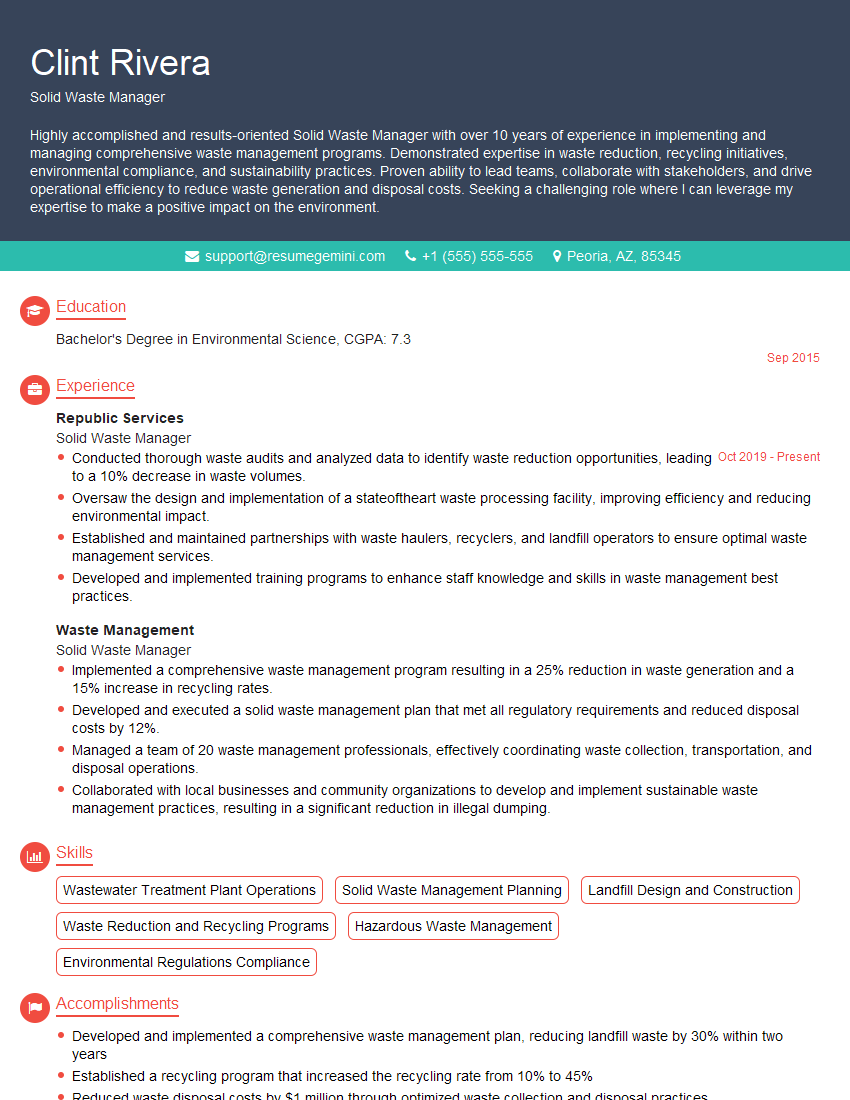
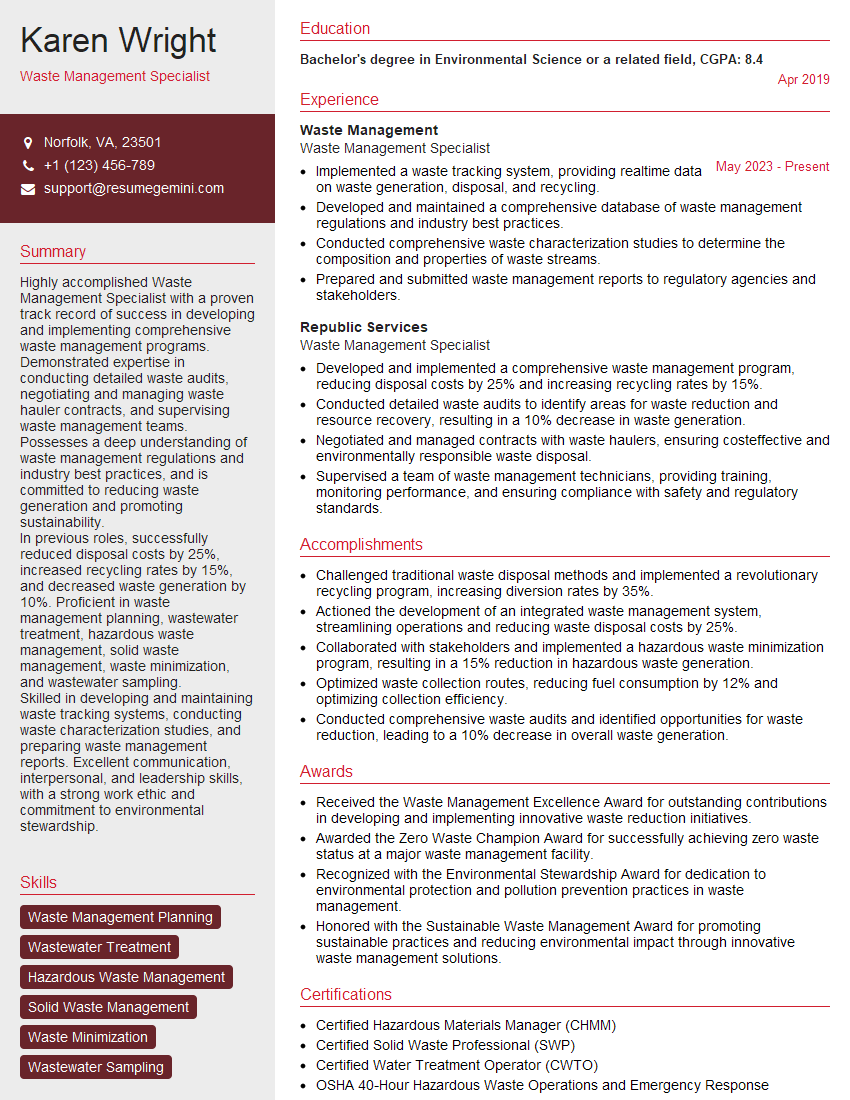
Mastering Landfill Management opens doors to rewarding and impactful careers in environmental protection and resource management. To significantly improve your job prospects, create an ATS-friendly resume that highlights your skills and experience effectively. ResumeGemini is a trusted resource that can help you build a professional and compelling resume that stands out to recruiters. We provide examples of resumes tailored to Landfill Management to help you craft the perfect application. Take the next step towards your dream career today!
Explore more articles
Users Rating of Our Blogs
Share Your Experience
We value your feedback! Please rate our content and share your thoughts (optional).
What Readers Say About Our Blog
Very informative content, great job.
good