Every successful interview starts with knowing what to expect. In this blog, we’ll take you through the top Laser Process Monitoring and Control interview questions, breaking them down with expert tips to help you deliver impactful answers. Step into your next interview fully prepared and ready to succeed.
Questions Asked in Laser Process Monitoring and Control Interview
Q 1. Explain the principle of laser beam characterization.
Laser beam characterization is the process of measuring and analyzing the properties of a laser beam to ensure its suitability for a specific application. Think of it like getting a detailed profile of your laser – understanding its strengths and weaknesses. This involves quantifying several key parameters that affect the quality and consistency of the laser processing.
- Beam Profile: This describes the spatial intensity distribution of the laser beam. Common profiles include Gaussian, top-hat, and flat-top. Knowing the profile is crucial for predicting the resulting material interaction and process outcome.
- Beam Diameter: This is typically the diameter at which the intensity drops to 1/e2 (approximately 13.5%) of its peak value. It directly influences the spot size on the workpiece and the resulting feature size.
- Beam Divergence: This measures how much the beam spreads out as it propagates. A smaller divergence is desirable for long-distance applications or when maintaining a tight focus is critical.
- Beam Power: The total power of the laser beam, usually measured in watts (W). This determines the energy density delivered to the workpiece and influences the process efficiency and speed.
- Beam Wavelength: The specific wavelength of the laser light, expressed in nanometers (nm). This impacts the absorption and interaction with the target material. For instance, CO2 lasers (10.6 μm) are highly absorbed by many non-metals, while Nd:YAG lasers (1.06 μm) are more suitable for metals.
Characterization methods involve using specialized instruments like beam profilers (CCD cameras or knife-edge techniques) and power meters. The data obtained is crucial for optimizing laser parameters, ensuring process repeatability, and diagnosing issues.
Q 2. Describe different types of laser sensors used in process monitoring.
Various laser sensors are employed in process monitoring, each designed to measure different aspects of the laser-material interaction. The choice depends on the specific application and the information needed for process control.
- Pyrometers: These measure the temperature of the workpiece during processing, providing insights into the heating and cooling rates. They are particularly useful in laser welding, cutting, and surface treatment.
- Photodiodes: These are highly sensitive detectors that measure the intensity of reflected or scattered laser light. They can be used for monitoring laser power stability and detecting process anomalies.
- Spectrometers: These analyze the spectral characteristics of the emitted light during the process. This is valuable for understanding plasma dynamics during laser ablation or identifying material phases during laser melting.
- Cameras (high-speed): High-speed cameras are indispensable for visualizing the dynamic processes involved. They provide valuable visual data for understanding process mechanisms, identifying defects, and optimizing parameters. This can range from simple CCD cameras to more complex systems employing advanced imaging techniques.
- Acoustic sensors: These measure sound generated during laser processing, which can provide valuable information about the process state. For example, they are useful for detecting spatter during laser welding.
Often, a combination of sensors is used to provide a comprehensive understanding of the laser processing.
Q 3. How do you calibrate a laser power meter?
Calibrating a laser power meter ensures accurate power measurements, critical for consistent laser processing. The procedure typically involves using a traceable standard, often a calibrated power meter or a NIST-traceable power sensor.
- Prepare the equipment: Ensure the laser power meter is properly warmed up and stable according to the manufacturer’s instructions. Set the appropriate measurement range.
- Use a calibrated standard: Introduce a known power source, such as a calibrated power meter or attenuator, into the laser beam path. The power of this standard should be within the range of your meter.
- Compare readings: Record the reading from the standard and compare it to the reading of the laser power meter you want to calibrate. Calculate the calibration factor.
- Adjust (if necessary): Some power meters allow for adjustments to their internal calibration. If adjustments are necessary and the meter allows for them, adjust accordingly based on the calculated factor, always ensuring adherence to manufacturer guidelines.
- Record the calibration: Document the calibration date, calibration factor, and any other relevant information. Retain this record for future reference.
Regular calibration is vital for maintaining the accuracy and reliability of power measurements. The frequency of calibration depends on factors like usage frequency and the required level of accuracy. Consult the manufacturer’s guidelines for recommended calibration intervals.
Q 4. What are the common methods for controlling laser beam parameters (power, position, focus)?
Controlling laser beam parameters is crucial for consistent and high-quality processing. Several methods are employed depending on the specific parameter and system:
- Power Control: Achieved through adjustments to the laser’s excitation source (e.g., current or voltage for diode lasers, gas flow for gas lasers) or by incorporating optical attenuators (e.g., neutral density filters or acousto-optic modulators (AOMs)). AOMs offer fast and precise control, ideal for dynamic applications.
- Position Control: Typically uses galvanometer scanners or motorized stages. Galvanometers provide fast and precise beam deflection, while stages offer larger travel ranges. Feedback control loops, using sensors to monitor the beam position, ensure accuracy and stability.
- Focus Control: Can be achieved with motorized focusing lenses or by adjusting the distance between the focusing lens and the workpiece. Precise focus control is essential for applications requiring tight spot sizes and consistent depth of focus.
These control mechanisms are often integrated into a computer-controlled system, enabling automated processing and real-time parameter adjustments based on process monitoring data.
Q 5. Explain the concept of feedback control in laser processing.
Feedback control in laser processing involves using sensors to monitor the process in real-time and using that information to adjust laser parameters, ensuring the process stays within the desired specifications. Think of it like a self-correcting mechanism. Imagine a thermostat controlling room temperature: the sensor (thermometer) measures the temperature, and the controller (thermostat) adjusts the heating/cooling system accordingly.
In laser processing, a sensor (e.g., pyrometer, camera) monitors a process variable (e.g., temperature, melt pool depth), and this information is fed back into a control algorithm. The algorithm compares the measured value with the setpoint (desired value) and calculates the necessary adjustments to the laser parameters (e.g., power, position, or focus) to maintain the process within the desired range. Different control algorithms (PID, for instance) are used depending on the application and desired performance.
Feedback control improves process consistency, reduces defects, and enables adaptive control to compensate for variations in material properties or environmental conditions.
Q 6. What are the challenges associated with real-time laser process monitoring?
Real-time laser process monitoring presents several challenges, primarily stemming from the high speeds and dynamic nature of the processes involved:
- High data rates: Sensors often generate large volumes of data at high speeds, demanding high-bandwidth data acquisition and processing capabilities.
- Data processing: Extracting meaningful information from the raw sensor data requires sophisticated algorithms and real-time processing. This can be computationally intensive.
- Sensor limitations: Sensors may have limitations in terms of speed, accuracy, and robustness in harsh process environments.
- Environmental influences: External factors like vibrations, dust, and temperature variations can affect sensor readings and complicate accurate monitoring.
- Process variability: The laser-material interaction is a complex process with inherent variability. Accurate modeling and prediction can be challenging.
Overcoming these challenges requires advanced sensor technologies, efficient data processing techniques, robust control algorithms, and careful system design.
Q 7. How do you handle unexpected laser process deviations?
Handling unexpected deviations requires a layered approach combining preventive measures, real-time monitoring, and appropriate responses. Think of it as a safety net with multiple layers of protection.
- Preventive measures: Thorough process planning, careful selection of laser and materials, and meticulous setup procedures significantly reduce the likelihood of deviations.
- Real-time monitoring: Implementing a comprehensive monitoring system with multiple sensors provides early warnings of potential problems. This allows for timely interventions.
- Control algorithms: Sophisticated control algorithms can actively compensate for minor deviations. PID controllers are frequently employed, adjusting laser parameters dynamically.
- Automated shut-down: Safety mechanisms are critical. Automated shutdown systems are necessary to protect the equipment and personnel in case of major deviations or emergencies.
- Diagnostic tools: Detailed data logging and analysis are invaluable for understanding the root causes of deviations, allowing for improved process optimization and preventive measures.
- Manual intervention: Even with advanced systems, manual intervention may be needed in some cases. Well-trained personnel are essential for dealing with unexpected situations.
A structured approach, combining preventative measures, real-time feedback, and emergency procedures ensures a safe and efficient laser processing environment.
Q 8. Describe your experience with different laser process monitoring software.
My experience encompasses a wide range of laser process monitoring software, from basic data acquisition systems to sophisticated, integrated solutions. I’ve worked extensively with software packages like Precitec's OPC UA server for real-time data acquisition and control, Trumpf's TruControl for managing laser parameters and process optimization, and custom-built solutions integrating various sensor data (e.g., from cameras, pyrometers, and acoustic sensors). Each software platform offers unique capabilities, such as real-time visualization of process parameters, statistical process control (SPC) tools for quality monitoring, and advanced algorithms for predictive maintenance. For example, I used Precitec's software to analyze weld seam quality in real-time during automotive part production, adjusting laser power and speed dynamically to maintain consistent results. In another project, a custom solution integrating Python libraries with a vision system allowed for automated defect detection and correction during laser cutting. The selection of the software depends heavily on the complexity of the laser system, the specific application, and the desired level of automation.
Q 9. Explain the importance of safety protocols in laser processing and monitoring.
Safety is paramount in laser processing. Laser radiation poses significant hazards to eyes and skin, requiring stringent safety protocols. These protocols include:
- Class 1 laser safety enclosure: Completely shielding the laser beam and preventing any radiation leakage. This is essential for high-power lasers.
- Laser safety eyewear: Appropriate eyewear must be worn by all personnel in the laser area, offering protection against the specific laser wavelength and power levels in use.
- Interlocks and emergency stops: These mechanisms ensure the laser is immediately shut down in case of malfunctions or unauthorized access.
- Warning signs and labels: Clearly indicating the presence of laser radiation and safety precautions.
- Regular safety training: Personnel must receive comprehensive training on laser safety, proper procedures, and emergency responses.
- Environmental controls: Managing potential hazards from laser-material interactions, such as fumes and fire hazards. This might involve extraction systems and fire suppression equipment.
Ignoring these protocols can lead to serious injuries, equipment damage, and production downtime. A robust safety program is a fundamental aspect of responsible laser processing and monitoring, ensuring both worker safety and the integrity of the laser system.
Q 10. What are the common laser-induced damage mechanisms in materials processing?
Laser-induced damage mechanisms are complex and depend on several factors, including laser parameters (wavelength, pulse duration, fluence), material properties (absorption coefficient, thermal conductivity), and environmental conditions. Common mechanisms include:
- Thermal damage: Excessive heat generated by laser absorption causes melting, vaporization, or even thermal shock, leading to cracks or fractures. Think of it like using a magnifying glass to focus sunlight and burn a piece of paper – intense localized heating is the culprit.
- Plasma formation: At high laser intensities, the material can ablate, creating a plasma plume. This plasma can interact with the material surface, leading to further damage. This is particularly relevant in laser ablation processes.
- Photochemical damage: The laser’s photons can directly alter the chemical bonds within the material, causing degradation or discoloration. This is more prevalent with shorter wavelengths such as UV lasers.
- Stress-induced damage: Rapid heating and cooling cycles during laser processing can introduce significant thermal stresses, leading to cracking or spalling. This is often a concern in laser hardening or cladding processes.
- Multiphoton absorption: With high peak intensities achievable with ultrafast lasers, this can initiate damage even in materials with low linear absorption at the given wavelength.
Understanding these mechanisms is crucial for optimizing laser processing parameters and preventing unwanted material damage.
Q 11. How do you optimize laser processing parameters for specific material types?
Optimizing laser processing parameters for specific materials requires a systematic approach. It involves careful consideration of the material’s properties, the desired outcome, and the laser system capabilities. The process typically involves:
- Material characterization: Understanding the material’s absorption coefficient, thermal conductivity, melting point, and other relevant properties at the laser wavelength.
- Process simulation: Utilizing software to model the interaction between the laser and the material, predicting the resulting temperature distribution and material changes.
- Experimental design: Conducting a series of experiments, systematically varying laser parameters (power, pulse duration, repetition rate, spot size, scan speed) to determine the optimal settings for the desired outcome (e.g., cut depth, weld strength, surface finish). Design of Experiments (DOE) methods are highly beneficial here.
- Real-time monitoring and adjustment: Using process monitoring techniques (e.g., pyrometry, vision systems) to track the process in real-time and make adjustments to the laser parameters as needed to maintain consistency and quality.
For example, welding stainless steel requires significantly different parameters than welding aluminum due to differences in their thermal conductivity and reflectivity. Similarly, cutting thin sheet metal requires a lower power and faster scan speed than cutting thick plates. Iterative optimization based on feedback from monitoring systems is key to achieving consistent results.
Q 12. Describe different techniques for laser beam profiling.
Several techniques are available for laser beam profiling, each offering different advantages and levels of precision:
- Scanning slit method: A thin slit scans across the beam, measuring the power transmitted through the slit at various positions. This method provides a one-dimensional profile.
- CCD camera-based methods: A CCD camera equipped with a beam splitter and appropriate optics captures an image of the laser beam. The image is then processed to obtain the two-dimensional beam profile, offering higher resolution and more detail than the scanning slit method.
- Rotating knife-edge method: A knife edge is moved across the beam, and the transmitted power is measured. The derivative of the power measurement yields the beam profile. This method is robust and relatively simple.
- Pyroelectric camera method: A pyroelectric camera can directly measure the power density distribution of the laser beam, allowing for rapid and high-resolution beam profiling even with high-repetition rate pulsed lasers. This method is gaining popularity due to its non-destructive nature.
The choice of technique depends on the specific requirements of the application, such as the desired accuracy, spatial resolution, and the type of laser beam (continuous wave or pulsed). For instance, the pyroelectric camera method is extremely useful in high-power pulsed lasers where other methods can be impractical or destructive.
Q 13. How do you troubleshoot a laser system malfunction during operation?
Troubleshooting a laser system malfunction requires a systematic approach, combining practical experience with diagnostic tools. The process usually begins with:
- Safety first: Ensure the laser is turned off and the area is safe before commencing any troubleshooting.
- Check interlocks and safety systems: Verify that all safety interlocks are functioning correctly and that the emergency stop is responsive.
- Review the error messages: Many laser systems have diagnostic error codes that provide clues about the nature of the malfunction. Refer to the system’s documentation or contact the manufacturer for clarification if necessary.
- Check the laser power supply: Verify that the power supply is functioning correctly and providing the required voltage and current.
- Inspect the cooling system: Many laser systems require cooling, and malfunctions can lead to overheating and damage. Check the cooling water flow, temperature, and cleanliness.
- Verify the laser beam path: Inspect the optics, mirrors, and other components in the beam path for misalignment, dust, or damage. Alignment tools, such as power meters and beam profilers, are useful here.
- Check the control system: Verify that the control software and hardware are operating correctly. This might involve reviewing log files, checking communication links, and re-booting the system.
If the issue persists, more specialized diagnostics might be needed, potentially involving the expertise of a laser system engineer or manufacturer. Documenting the troubleshooting steps and observations helps ensure efficient problem resolution and prevents recurrence.
Q 14. Explain the role of statistical process control (SPC) in laser processing.
Statistical Process Control (SPC) plays a vital role in maintaining consistent quality and efficiency in laser processing. SPC involves using statistical methods to monitor and control the process parameters and the resulting product characteristics. Key aspects include:
- Data acquisition: Collecting data on key process parameters (e.g., laser power, scan speed, material thickness) and product characteristics (e.g., weld depth, cut width, surface roughness).
- Control charts: Plotting the collected data on control charts (e.g., X-bar and R charts, X-MR charts) to identify trends, variations, and potential process shifts. This helps visualize the stability and capability of the process.
- Process capability analysis: Evaluating the ability of the process to meet the specified tolerances and quality requirements. This might involve calculating Cp and Cpk values.
- Process optimization: Identifying and eliminating the sources of variation to improve the process consistency and reduce defects. This could involve adjusting laser parameters, improving material handling, or optimizing the machine setup.
By implementing SPC, manufacturers can minimize defects, reduce waste, and improve the overall efficiency and reliability of their laser processing operations. For example, continuous monitoring of laser weld penetration with real-time adjustments based on SPC analysis can guarantee consistently strong welds, reducing production rejects and saving significant time and resources.
Q 15. What are the key performance indicators (KPIs) you track in laser process monitoring?
Key Performance Indicators (KPIs) in laser process monitoring are crucial for ensuring consistent product quality and process efficiency. They are carefully selected to reflect the specific goals of the laser process. For example, in laser cutting, we might track KPIs such as:
- Cut Quality: This includes kerf width (the width of the cut), edge roughness, and the presence of any defects like dross (molten material adhering to the cut edge). We use imaging systems and automated measurement tools to quantify these aspects.
- Process Speed: This measures the speed at which the laser completes the cutting process. Faster speeds are generally desirable, provided cut quality is maintained. We track it using laser control system data and workpiece throughput.
- Laser Power Stability: Fluctuations in laser power can significantly impact cut quality and repeatability. We monitor this using power meters and look for deviations from the setpoint.
- Assist Gas Flow Rate and Pressure: The assist gas (often air or nitrogen) plays a vital role in removing debris and preventing oxidation. Monitoring its flow rate and pressure is key to maintaining consistent cut quality. We use flow meters and pressure sensors for this.
- Throughput: This reflects the overall efficiency of the laser cutting process, expressed as the number of parts produced per unit time.
For other laser processes like welding or marking, the specific KPIs will differ. For instance, weld strength, penetration depth, or marking depth and contrast might be primary KPIs. The choice of KPIs depends heavily on the application and the desired output.
Career Expert Tips:
- Ace those interviews! Prepare effectively by reviewing the Top 50 Most Common Interview Questions on ResumeGemini.
- Navigate your job search with confidence! Explore a wide range of Career Tips on ResumeGemini. Learn about common challenges and recommendations to overcome them.
- Craft the perfect resume! Master the Art of Resume Writing with ResumeGemini’s guide. Showcase your unique qualifications and achievements effectively.
- Don’t miss out on holiday savings! Build your dream resume with ResumeGemini’s ATS optimized templates.
Q 16. Describe your experience with laser process simulation software.
I have extensive experience using laser process simulation software, primarily using packages such as [Mention specific software, e.g., LMD-Simulation, or others relevant to the context]. These software packages allow for predicting the outcomes of different processing parameters before executing them on the actual equipment. This predictive capability is invaluable for optimizing processes and reducing material waste.
For example, in a recent project involving laser welding of titanium, we used simulation software to model the heat transfer and melt pool dynamics under various laser power, scan speed, and focal position combinations. This allowed us to identify the optimal parameters for achieving the desired weld strength and penetration depth before commencing the actual welding process. The simulation results significantly reduced the number of experimental runs required for optimization, saving both time and material costs. The software allowed us to visualize the temperature profiles and melt pool behavior, providing valuable insights into the underlying physics of the process.
Q 17. How do you ensure the accuracy and reliability of laser process measurements?
Ensuring the accuracy and reliability of laser process measurements is paramount. This requires a multi-pronged approach:
- Calibration and Verification: All measurement instruments, such as power meters, gas flow meters, and imaging systems, must be regularly calibrated against traceable standards. We maintain detailed calibration records to demonstrate traceability and accuracy.
- Data Acquisition and Processing: Data acquisition systems need to be carefully selected to ensure appropriate sampling rates and resolution. Data processing algorithms must be validated to minimize errors and ensure consistency.
- Environmental Control: External factors like temperature and vibration can affect the accuracy of measurements. Maintaining a stable and controlled environment is therefore crucial. We use climate-controlled labs whenever precise measurements are needed.
- Redundancy and Cross-Verification: We often employ multiple measurement techniques to cross-verify the results. For example, we might use both optical microscopy and profilometry to assess surface roughness. This redundancy helps identify and mitigate potential errors.
- Statistical Process Control (SPC): Implementing SPC methods allows for continuous monitoring of process stability and the early detection of any deviations from acceptable limits.
In summary, accuracy and reliability are achieved through meticulous attention to detail throughout the entire measurement process, from instrument selection and calibration to data analysis and interpretation.
Q 18. What are the advantages and disadvantages of different types of laser sources in material processing?
Different laser sources, such as CO2 lasers, Nd:YAG lasers, fiber lasers, and ultrafast lasers, each have their own advantages and disadvantages for material processing:
- CO2 Lasers: High power, relatively inexpensive, suitable for cutting and engraving many materials (especially non-metals). Disadvantages include lower beam quality and difficulty in focusing to small spot sizes.
- Nd:YAG Lasers: Good beam quality, versatile for a range of processes (welding, cutting, marking), can operate in various modes (continuous wave or pulsed). Disadvantages are higher costs and lower efficiency compared to fiber lasers.
- Fiber Lasers: Excellent beam quality, high efficiency, high power capability, increasing popularity for a wide array of applications. Disadvantages can include a relatively smaller range of wavelengths available compared to other laser types.
- Ultrafast Lasers: Extremely short pulse durations, minimal heat-affected zones, precise micromachining capabilities. Disadvantages include relatively lower average power and higher cost.
The optimal choice of laser source depends on the specific material being processed, the desired outcome (cutting, welding, marking, etc.), and the required precision and speed. For example, fiber lasers are becoming very popular for cutting sheet metal, while ultrafast lasers are ideal for delicate micromachining tasks.
Q 19. Explain the concept of adaptive optics in laser processing.
Adaptive optics in laser processing involves dynamically correcting for aberrations in the laser beam to maintain a high-quality focal spot. Aberrations are distortions in the wavefront of the laser beam that can be caused by atmospheric turbulence, optical imperfections, or even the material being processed itself. These distortions can lead to a degraded focal spot, reduced precision, and inconsistent results.
Adaptive optics systems use deformable mirrors or other wavefront-shaping elements to compensate for these aberrations in real-time. Sensors, such as Shack-Hartmann wavefront sensors, measure the distortions in the beam, and a control system adjusts the deformable mirror to correct them. This ensures that the laser beam maintains its optimal shape and focus, even under changing conditions.
The practical impact of adaptive optics is significant, especially in high-precision applications like laser micromachining, laser surgery, and long-distance laser communication. It enables superior processing accuracy, reduced thermal damage, and improved throughput compared to systems without adaptive optics.
Q 20. How do you maintain and calibrate laser processing equipment?
Maintaining and calibrating laser processing equipment is crucial for ensuring consistent and reliable performance. This involves a structured approach that combines preventative maintenance and scheduled calibrations:
- Preventative Maintenance: This includes regular cleaning of optical components, checking for loose connections, verifying the cooling system functionality, and monitoring the laser gas purity (where applicable).
- Scheduled Calibrations: Laser power and beam parameters (beam diameter, divergence) are regularly calibrated using traceable standards. The calibration frequency is dictated by the equipment manufacturer and the application’s criticality.
- Safety Procedures: Safety is paramount. All maintenance procedures are strictly adhered to, following manufacturer’s guidelines and established safety protocols to prevent accidental exposure to laser radiation.
- Record Keeping: Detailed records of all maintenance and calibration activities are maintained. This ensures traceability and aids in identifying any potential trends or recurring issues.
- Operator Training: Operators are regularly trained in the proper operation and maintenance of the laser system.
A well-maintained laser system will deliver consistent results, minimize downtime, and increase overall productivity. Neglecting maintenance can lead to decreased accuracy, reduced output, and even equipment failure.
Q 21. Describe your experience with different types of laser-material interactions.
My experience encompasses a wide range of laser-material interactions, spanning various processing techniques. These interactions fundamentally depend on the laser parameters (wavelength, pulse duration, power, etc.) and the material properties (absorption coefficient, thermal conductivity, etc.).
- Ablation: This involves the removal of material by vaporization or ejection. I’ve worked extensively with laser ablation for micromachining applications, where precise control of the laser parameters is essential for achieving the desired feature size and surface finish. For example, ultrafast lasers are particularly well-suited for this due to their minimal heat-affected zone.
- Melting and Solidification: Laser welding and additive manufacturing rely on the melting and controlled solidification of the material. Understanding the melt pool dynamics and the resulting microstructure is crucial for achieving the desired mechanical properties of the welded joint or 3D-printed component. Simulation software greatly aids in this understanding.
- Heat Treatment: Lasers can be used for surface modification, such as hardening or annealing, by selectively heating the material. Controlling the heat input and cooling rate is vital for achieving the desired changes in the material’s microstructure and properties.
- Chemical Reactions: Laser-induced chemical reactions can be used for material synthesis or surface functionalization. Understanding the chemical processes induced by laser irradiation is essential for optimizing the reaction yield and product quality.
Each of these interactions requires a detailed understanding of the underlying physics and chemistry to optimize the laser processing parameters for achieving the desired outcome. My experience has provided me with a strong foundation in these areas.
Q 22. How do you interpret and analyze data from laser process monitoring systems?
Interpreting data from laser process monitoring systems involves a multi-step process. First, we need to understand the specific sensors employed – they might include power meters, spectrometers, thermal cameras, or even acoustic sensors, each providing a unique perspective on the laser-material interaction. The raw data from these sensors, often high-dimensional and noisy, requires careful pre-processing. This might involve filtering out noise, calibrating sensor readings, and aligning data streams from multiple sensors to account for time discrepancies.
Next comes data analysis, often utilizing techniques from signal processing, statistical analysis and machine learning. For example, we might look for correlations between laser parameters (power, pulse duration, frequency) and process outcomes (e.g., depth of cut, surface roughness, heat-affected zone). This might involve computing statistical measures like mean, standard deviation, and correlations to assess process stability. More advanced methods, such as Principal Component Analysis (PCA) or clustering algorithms, can be used to identify patterns and anomalies that may indicate problems within the laser process.
Finally, visualization is key. Plots, charts, and other visual representations help us communicate insights from the data and aid in identifying trends, patterns, and potential sources of variation. This could include time-series plots showing laser power over time, scatter plots showing the correlation between laser energy and material ablation rate, or even 3D visualizations of surface topography post-processing.
Q 23. What are the environmental factors that can affect laser process stability?
Environmental factors can significantly impact laser process stability. Temperature fluctuations, for instance, can affect the laser’s output power and beam quality, leading to inconsistencies in the processing outcome. Humidity can influence the optical properties of the laser beam and even affect the material being processed, especially for materials sensitive to moisture.
Air currents or vibrations can also lead to instability by affecting the beam path and causing movement of the workpiece. Dust and airborne particles can scatter or absorb the laser beam, leading to inconsistencies in energy delivery and potentially damaging the optical components. Electromagnetic interference (EMI) could also affect the performance of sensitive electronic components within the laser system, interfering with the precise control of laser parameters.
To mitigate these effects, we often use controlled environments for laser processing. This could involve temperature-controlled rooms, vibration isolation platforms, cleanrooms to minimize dust, and appropriate shielding to reduce EMI.
Q 24. Describe your experience with data acquisition and analysis techniques for laser processing.
My experience with data acquisition and analysis for laser processing is extensive. I’ve worked with a variety of data acquisition systems, including both proprietary and open-source solutions. We typically employ high-speed data loggers to capture real-time sensor data, along with custom software to synchronize the data streams and conduct preliminary processing.
For analysis, I routinely use programming languages like Python and MATLAB, along with specialized software packages such as LabVIEW and OriginPro. Common data analysis techniques I employ include signal filtering (e.g., Fourier transforms, Kalman filtering), statistical analysis (e.g., hypothesis testing, regression analysis), and machine learning algorithms (e.g., Support Vector Machines, Neural Networks) for tasks such as predictive modeling and anomaly detection.
For instance, in one project involving laser welding, we used high-speed cameras and thermal imaging to capture the weld pool dynamics. Then we employed image processing techniques to extract quantitative features like weld bead width, penetration depth, and surface roughness. This data was then used to build a predictive model to optimize welding parameters for consistent and high-quality welds.
Q 25. How do you ensure the repeatability and reproducibility of laser processing results?
Ensuring repeatability and reproducibility in laser processing is crucial for consistent product quality. This relies on several key strategies. First, precise control of laser parameters is paramount. We need stable power sources, accurate beam delivery systems, and robust control software to maintain consistency in laser energy, pulse duration, and spot size across multiple runs. Calibration and regular maintenance of the laser system are also essential.
Second, precise control of the workpiece environment is important, addressing factors like temperature, humidity, and cleanliness, as discussed earlier. Maintaining a consistent material feed system prevents inconsistencies related to workpiece handling.
Finally, meticulous documentation and process control are essential. This includes detailed records of laser parameters, environmental conditions, and process outcomes for each run, enabling traceability and facilitating identification of process variations. Implementation of statistical process control (SPC) techniques helps to monitor the process for drifts and deviations from target values and implementing feedback loops for adjustments.
Q 26. Explain different methods for laser beam delivery and manipulation.
Laser beam delivery and manipulation involve various methods, each tailored to the specific application. The simplest is direct beam delivery, where the laser beam is directly focused onto the workpiece using a lens. This is suitable for many applications but limits flexibility.
More sophisticated methods use optical components like mirrors and beam splitters to guide the beam along complex paths, enabling scanning, marking, or multi-beam processing. Scan heads with galvanometers or other scanning mechanisms allow for precise control over the beam’s position and path, enabling intricate patterns and shapes.
Fiber optics offer flexible beam delivery, particularly valuable for applications requiring beam transport over longer distances or access to confined spaces. Beam shaping optics, like diffractive optical elements (DOEs), transform the beam profile from a Gaussian profile into other shapes like top-hat or custom profiles that improve the quality and consistency of laser processing. Adaptive optics systems dynamically adjust the beam wavefront, compensating for aberrations and achieving high precision even in challenging conditions.
Q 27. How do you integrate laser process monitoring data with other manufacturing systems?
Integrating laser process monitoring data with other manufacturing systems requires careful planning and execution. We often utilize industry-standard communication protocols like OPC UA or Modbus to establish seamless data exchange between the laser system and other parts of the production line, such as Computer Numerical Control (CNC) machines, robotic arms, or supervisory control and data acquisition (SCADA) systems.
The data integration process typically involves defining data exchange formats and structures and then implementing software to facilitate data transfer and transformation. Real-time data streams from the laser monitoring system can be used for closed-loop process control, adjusting laser parameters based on real-time feedback to ensure optimal performance and product quality. Historical data can be used for statistical process control (SPC) and predictive maintenance.
Databases play a critical role, consolidating data from various sources for analysis, trend identification, and historical process tracking. This integrated approach enables optimization of the overall manufacturing process, leading to improved efficiency, higher product quality, and reduced downtime.
Q 28. Describe a challenging laser process monitoring problem you solved and your approach.
One challenging problem I encountered involved laser micromachining of a delicate polymer material. The material exhibited significant variations in its laser absorption characteristics, leading to inconsistent results, even with precise control of laser parameters. The problem was that these variations weren’t readily apparent through standard visual inspection, only showing up as quality issues later in the assembly process.
My approach involved implementing a multi-sensor approach. In addition to standard power meters and process cameras, we incorporated a spectrometer to analyze the spectral signature of the laser-material interaction in real-time. We then developed a machine learning model using this spectral data to predict the quality of the micromachined features before any visible defects appeared.
This predictive model enabled real-time adjustments to laser parameters, compensating for material variations and significantly improving the consistency and yield of the process. This illustrates the power of combining advanced sensor technologies with machine learning for addressing subtle issues in complex laser processes.
Key Topics to Learn for Laser Process Monitoring and Control Interview
- Laser Fundamentals: Understanding laser types (e.g., CO2, fiber, solid-state), beam characteristics (power, wavelength, divergence), and safety protocols.
- Sensor Technologies: Familiarity with various sensors used in laser process monitoring, including photodiodes, pyrometers, and cameras, and their applications in different laser processes.
- Signal Processing and Data Acquisition: Knowledge of data acquisition techniques, signal conditioning, filtering, and noise reduction methods for accurate process monitoring.
- Control Systems: Understanding feedback control loops, PID controllers, and advanced control algorithms used to regulate laser power, beam position, and other process parameters.
- Process Optimization: Applying statistical process control (SPC) techniques and process capability analysis to improve efficiency and reduce defects in laser-based manufacturing.
- Specific Laser Applications: Practical experience or theoretical understanding of laser applications relevant to your target role (e.g., laser cutting, welding, marking, material processing). Be prepared to discuss specific challenges and solutions.
- Troubleshooting and Diagnostics: Ability to identify and diagnose common issues in laser systems, such as beam misalignment, power fluctuations, and process inconsistencies.
- Software and Programming: Proficiency in relevant software and programming languages used for laser control and data analysis (e.g., LabVIEW, MATLAB).
- Safety Regulations and Compliance: Understanding relevant safety regulations and standards for operating laser systems and ensuring workplace safety.
Next Steps
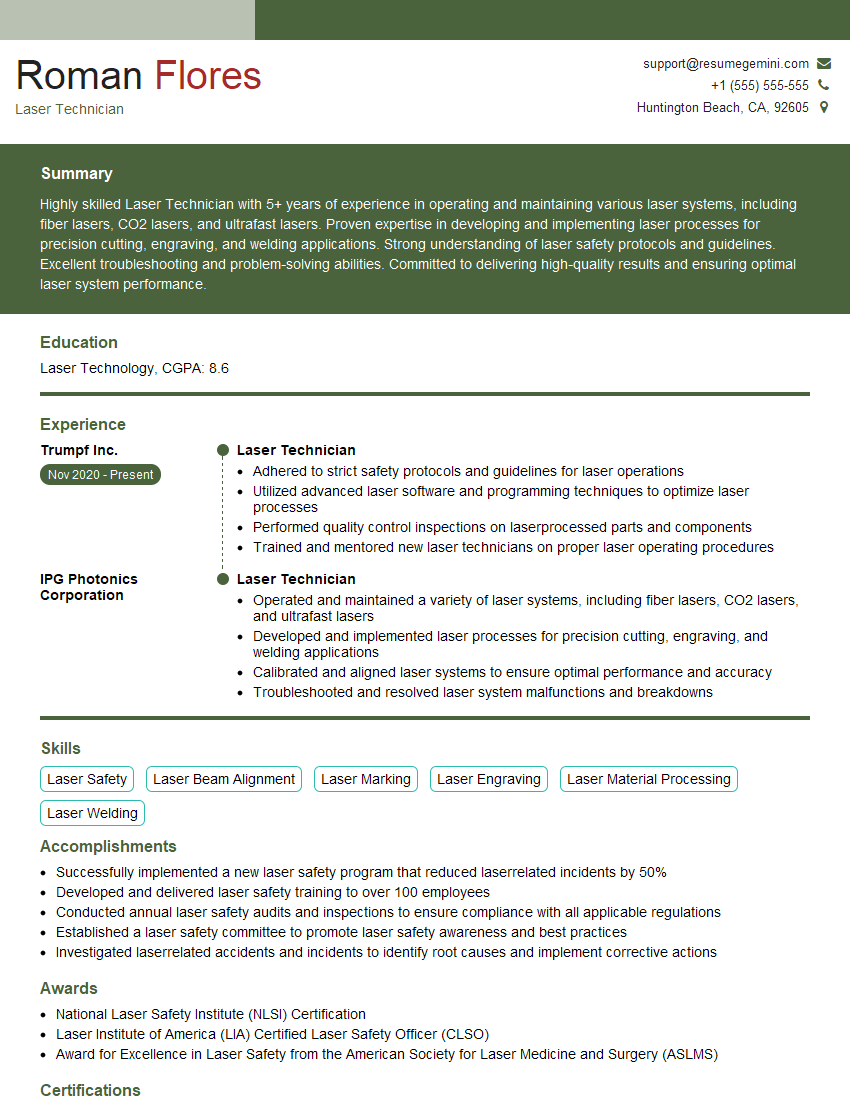
Mastering Laser Process Monitoring and Control opens doors to exciting career opportunities in advanced manufacturing, research, and development. A strong understanding of these principles significantly enhances your employability and potential for career growth. To maximize your chances, crafting an ATS-friendly resume is crucial. ResumeGemini can help you build a powerful, impactful resume that highlights your skills and experience effectively. ResumeGemini provides examples of resumes tailored to Laser Process Monitoring and Control to guide your process, ensuring your qualifications shine through.
Explore more articles
Users Rating of Our Blogs
Share Your Experience
We value your feedback! Please rate our content and share your thoughts (optional).
What Readers Say About Our Blog
Very informative content, great job.
good