Unlock your full potential by mastering the most common Laser Rangefinding interview questions. This blog offers a deep dive into the critical topics, ensuring you’re not only prepared to answer but to excel. With these insights, you’ll approach your interview with clarity and confidence.
Questions Asked in Laser Rangefinding Interview
Q 1. Explain the principles of time-of-flight laser rangefinding.
Time-of-flight (ToF) laser rangefinding is based on a simple principle: measuring the time it takes for a laser pulse to travel to a target and reflect back to the sensor. Knowing the speed of light, we can calculate the distance. Imagine shouting into a canyon and timing how long it takes to hear your echo – it’s the same concept, but with much higher precision and speed.
The process involves emitting a short laser pulse, precisely timing its departure, and then detecting the reflected pulse. The time difference between emission and reception is directly proportional to the distance. The formula is straightforward: Distance = (Speed of Light * Time of Flight) / 2. The division by two accounts for the round-trip nature of the measurement.
To ensure accuracy, sophisticated electronics are employed for precise timing. These systems often incorporate high-speed counters and low-jitter clocks. The accuracy of ToF rangefinders is directly linked to the precision of this timing mechanism and the quality of the laser pulse generation.
Q 2. Describe different types of laser rangefinders (e.g., pulsed, continuous wave).
Laser rangefinders come in various types, primarily categorized by their signal modulation technique.
- Pulsed Laser Rangefinders: These emit short bursts of laser light. They are accurate and widely used because the clear start and stop of the pulse make timing relatively simple. Think of a camera flash – it’s a short, intense burst of light.
- Continuous Wave (CW) Laser Rangefinders: These emit a continuous laser beam, modulating its frequency or intensity to determine the distance. They often employ techniques like phase-shift measurement, comparing the phase difference between the emitted and received signals. This method is particularly suitable for shorter ranges and can offer high precision, akin to measuring the distance with a very fine ruler.
- Frequency Modulated Continuous Wave (FMCW) Laser Rangefinders: These transmit a continuous wave whose frequency changes linearly over time. The difference in frequency between the transmitted and received signal is proportional to the distance. FMCW provides high accuracy and resolution, and is commonly used in applications demanding fine distance measurements, like autonomous driving.
The choice of rangefinder type depends heavily on the application’s requirements. Pulsed rangefinders excel in long-range applications, while CW and FMCW are better suited for higher precision measurements at shorter distances.
Q 3. What are the limitations and sources of error in laser rangefinding?
Laser rangefinding, while highly accurate, is subject to several limitations and error sources:
- Atmospheric Effects: Temperature, humidity, and atmospheric pressure affect the speed of light, introducing errors in distance calculation. Think of sound traveling differently through warm and cold air – similar effects occur with light.
- Target Reflectivity: The reflectivity of the target greatly influences the signal strength of the return signal. A dark, non-reflective surface will return a weaker signal, potentially resulting in a missed measurement or decreased accuracy.
- Multiple Reflections: Reflections from multiple surfaces can cause errors, especially in cluttered environments. The rangefinder might pick up a reflection from an unintended object before reaching the primary target.
- Sensor Noise: Electronic noise in the receiver can introduce errors in the timing measurement.
- Beam Divergence (explained further in Question 5): The spreading of the laser beam affects the accuracy, especially at longer distances.
Careful calibration, signal processing techniques, and environmental considerations are crucial to mitigate these errors.
Q 4. How does ambient light affect laser rangefinding accuracy?
Ambient light significantly impacts laser rangefinding accuracy, particularly in bright sunlight or other intense light sources. This is because the receiver can detect not only the reflected laser signal but also the ambient light. This unwanted light acts as noise, interfering with the detection of the weak reflected laser signal and leading to inaccurate distance measurements or missed detections.
To mitigate this, rangefinders employ various techniques. These include using narrowband optical filters to select only the specific wavelength of the laser light, enhancing signal-to-noise ratio (SNR) through sophisticated signal processing, and using high-sensitivity detectors. In extreme ambient light conditions, the rangefinder may be limited in its effective range or accuracy.
Q 5. Explain the concept of laser beam divergence and its impact on rangefinding.
Laser beam divergence refers to the spreading of the laser beam as it propagates. A perfectly collimated (parallel) beam is ideal, but in practice, all lasers exhibit some degree of divergence. This divergence is typically specified as an angle (e.g., milliradians) or as a beam diameter at a given distance.
The impact of divergence on rangefinding is significant. As the beam spreads, the laser power density decreases, reducing the strength of the reflected signal, particularly at longer distances. This weakens the signal-to-noise ratio, potentially leading to missed detections or inaccurate measurements. Larger divergence angles also increase the likelihood of detecting reflections from unintended targets.
To minimize the effects of divergence, rangefinders often employ lenses or other optical systems to collimate the beam, creating a more focused and concentrated laser spot on the target.
Q 6. Discuss different methods for signal processing in laser rangefinding.
Signal processing is crucial for accurate and reliable laser rangefinding. It involves several steps:
- Signal Amplification: Weak return signals are amplified to improve the signal-to-noise ratio.
- Noise Reduction: Techniques like averaging, filtering, and background subtraction are used to eliminate noise and interference.
- Thresholding: A threshold is set to discriminate between signal and noise, identifying the actual return pulse.
- Peak Detection: The peak of the received pulse is located to determine the time of arrival precisely.
- Time-of-Flight Calculation: The time difference between the transmitted and received pulse is precisely calculated, directly leading to the distance measurement.
Advanced signal processing techniques, such as pulse shape analysis and adaptive filtering, can further enhance the accuracy and robustness of laser rangefinding systems, particularly in challenging environmental conditions.
Q 7. How do you calibrate a laser rangefinder?
Calibrating a laser rangefinder is essential for ensuring accurate measurements. The process typically involves:
- Zero-Point Calibration: Determining the offset in the measurement at zero distance. This is often done by placing a highly reflective target very close to the sensor.
- Distance Calibration: Using targets of known distances to verify and adjust the rangefinder’s distance readings. This can involve comparing measurements with a reference measuring system (e.g., a high-precision tape measure) at various distances.
- Environmental Calibration: This compensates for environmental factors like temperature and humidity, which can affect the speed of light and thus the distance calculation. This usually involves setting the environmental parameters within the rangefinder’s control system.
- Signal Strength Calibration: This step calibrates the threshold of the returned signal. This allows the system to differentiate between actual returns and noise. This often requires adjusting sensitivity levels for different surface types and lighting conditions.
The specific calibration procedure will vary depending on the rangefinder’s design and capabilities. Calibration should be performed regularly, especially in harsh environments, to maintain accuracy.
Q 8. What safety precautions are crucial when working with laser rangefinders?
Safety is paramount when working with laser rangefinders. The most crucial precaution is always to avoid direct eye exposure to the laser beam. Lasers, even low-power ones used in many rangefinders, can cause serious eye damage. Think of it like looking directly at the sun – it’s incredibly harmful. Therefore, always use appropriate eye protection, such as laser safety goggles with a wavelength rating that matches or exceeds the rangefinder’s laser wavelength. This is non-negotiable.
Beyond eye protection, we need to consider the environment. Never point a laser rangefinder at reflective surfaces, like mirrors or polished metal, as the reflected beam can be just as dangerous as the direct beam. Additionally, be mindful of your surroundings and ensure no one is in the path of the laser beam, especially children or animals. Always follow the manufacturer’s safety guidelines included in the user manual. These often include power-on warnings, safe operating distances, and proper disposal procedures.
During my time working on a large-scale construction project, we had a strict protocol for laser rangefinder use. Before each use, the operator would announce their intention to use the device and ensure the area was clear. This simple precaution helped prevent any accidents.
Q 9. Explain the role of optical components (e.g., lenses, mirrors) in laser rangefinding.
Optical components are the heart of a laser rangefinder, responsible for emitting, directing, and receiving the laser beam. Lenses are crucial for collimating (making the beam parallel) the outgoing laser beam, ensuring accuracy over long distances. A well-collimated beam minimizes divergence, preventing the signal from spreading out and weakening. Think of it like a flashlight – a focused beam travels further than a spread-out one. The receiver also uses lenses to focus the reflected laser light onto a detector, increasing the signal strength and improving the accuracy of the distance measurement.
Mirrors, often used in more complex systems, help redirect the laser beam. For example, in some designs, a mirror might split the laser beam, sending a portion to the target and another portion to a reference detector, enabling more precise measurements. In some applications, a periscope-like setup with mirrors might be used to safely point the laser at difficult-to-reach areas.
Q 10. Describe different types of lasers used in rangefinding applications.
Several laser types are used in rangefinding, each with its advantages and disadvantages. Common choices include:
- Class 1 lasers: These are inherently safe, even with direct eye exposure, and often used in low-power, short-range devices. Examples might include some laser pointers that are not used for rangefinding.
- Class 2 lasers: Low-power visible lasers, the aversion response (blinking) is sufficient to prevent damage with typical exposure. These find use in some handheld rangefinders.
- Class 3R lasers: Moderate power, and require eye protection for prolonged exposure. Many commonly used rangefinders fall into this category.
- Class 3B lasers: Higher power visible lasers. Direct viewing is hazardous, and diffuse reflection is usually safe.
- Class 4 lasers: High-power lasers, capable of causing significant eye and skin damage both directly and through diffuse reflection. These are generally not used in handheld rangefinders, but in industrial and scientific equipment.
The choice of laser depends on factors such as the required range, accuracy, and safety considerations for the application.
Q 11. What are the advantages and disadvantages of different laser rangefinding technologies?
Several laser rangefinding technologies exist, each with its strengths and weaknesses:
- Time-of-Flight (ToF): This measures the time it takes for the laser pulse to travel to the target and return. It’s simple, relatively inexpensive, but can struggle with accuracy in adverse weather conditions.
- Phase-shift: This measures the phase difference between the emitted and returned laser signal. It’s more precise than ToF, especially at shorter ranges, but more susceptible to multi-path interference.
- Triangulation: This technique uses a laser and a sensor to create a triangle. By measuring the angle of the laser and the position of the spot on the sensor, the distance to the target is calculated. It’s often used in low-cost, short-range rangefinders.
The best technology depends heavily on the application. For instance, ToF is suitable for long-range applications like surveying, while phase-shift might be preferred for precision robotics applications. Triangulation often works well for shorter-range tasks like autofocus systems in cameras.
Q 12. How do you determine the appropriate laser rangefinder for a specific application?
Selecting the right laser rangefinder involves carefully considering several factors:
- Required Range: How far do you need to measure? Longer ranges demand more powerful lasers and potentially more sophisticated technologies.
- Accuracy: What level of precision is needed? Different technologies offer varying levels of accuracy.
- Operating Environment: What are the environmental conditions (temperature, humidity, weather)? Some technologies perform better in certain conditions.
- Target Type: The reflectivity of the target influences the accuracy and range. Dark, non-reflective targets might need more powerful lasers.
- Budget: Rangefinders vary significantly in price, depending on features and technology.
For example, a construction worker might need a robust, long-range rangefinder with high accuracy, while a golfer might only require a compact, short-range device for distance to the green.
Q 13. Describe your experience with data acquisition and analysis in laser rangefinding.
My experience with data acquisition and analysis in laser rangefinding spans various projects. We typically use specialized software and hardware interfaces to capture data from the rangefinder, often converting raw signal data into distance measurements. This usually involves considerations for noise reduction and signal processing techniques to improve the reliability of the data.
Data analysis often includes statistical methods to assess the accuracy and precision of the measurements. We might calculate standard deviations, evaluate uncertainties, and perform error analysis to identify potential sources of errors. Visualization techniques such as creating 3D point clouds from multiple measurements are commonly used. In one project involving autonomous vehicle navigation, I developed algorithms to filter noisy rangefinder data and combine it with other sensor data (like GPS and IMU) to create a robust map of the environment. We used Python and MATLAB extensively for this data processing and analysis. We also regularly utilized statistical tools to analyze the accuracy and precision of our final maps.
Q 14. Explain the concept of multi-path interference and how to mitigate it.
Multi-path interference occurs when the laser beam reflects off multiple surfaces before returning to the receiver. This creates multiple signals that arrive at slightly different times, leading to inaccurate distance measurements. Imagine throwing a ball in a room with many walls; the ball might bounce off several surfaces before returning to you, making it difficult to determine the direct distance.
Mitigating multi-path interference involves several strategies:
- Signal Processing Techniques: Advanced algorithms can analyze the received signals and identify and filter out secondary reflections, prioritizing the direct return signal.
- Narrower Laser Beams: Using a laser with a narrower beam reduces the likelihood of it encountering multiple surfaces.
- Signal Filtering: Using electronic filters to isolate the direct return signal is essential.
- Choice of Wavelength: Certain wavelengths are more susceptible to multi-path effects than others.
- Careful Environmental Control: Minimizing the number of reflective surfaces in the environment around the target can help.
In a project involving precision distance measurements for robotic arm calibration, we addressed multi-path interference using a combination of signal processing algorithms and careful positioning of the rangefinder to minimize reflections.
Q 15. How do you troubleshoot common issues encountered in laser rangefinding systems?
Troubleshooting laser rangefinding systems involves a systematic approach. It starts with understanding the symptoms – is the system not powering on, are the readings inaccurate, or is there an error message? Then, we can move to targeted diagnostics.
No Power: Check power supply, connections, and the laser itself for any physical damage.
Inaccurate Readings: This could be due to several factors. First, check the calibration – laser rangefinders often need periodic recalibration. Then, consider environmental factors (discussed later) like fog, dust, or extreme temperatures affecting the signal. Finally, examine the target’s reflectivity; a highly reflective or absorptive surface can lead to inaccurate readings.
Error Messages: Consult the system’s manual for error codes and their corresponding solutions. Common errors relate to sensor faults, communication issues between components, or software glitches.
Systematic Checks: A step-by-step approach, starting with the simplest checks (power, connections) before moving to more complex issues (sensor alignment, software updates) is crucial. Using diagnostic tools provided by the manufacturer can greatly aid in identifying the root cause.
For example, I once worked on a system where inaccurate readings were traced to a loose connection in the signal processing unit. A simple tightening of the screw solved the problem.
Career Expert Tips:
- Ace those interviews! Prepare effectively by reviewing the Top 50 Most Common Interview Questions on ResumeGemini.
- Navigate your job search with confidence! Explore a wide range of Career Tips on ResumeGemini. Learn about common challenges and recommendations to overcome them.
- Craft the perfect resume! Master the Art of Resume Writing with ResumeGemini’s guide. Showcase your unique qualifications and achievements effectively.
- Don’t miss out on holiday savings! Build your dream resume with ResumeGemini’s ATS optimized templates.
Q 16. Describe your experience with different programming languages used in laser rangefinding systems (e.g., C++, Python).
My experience spans several programming languages commonly used in laser rangefinding systems. C++ is frequently used for real-time processing and control due to its efficiency and speed. I’ve used it extensively for embedded systems where low-level control over hardware is vital for precise timing in laser pulse emission and signal acquisition. The speed is essential for capturing and processing the return signals quickly, which is critical for accurate ranging.
Python, on the other hand, is excellent for data analysis, algorithm development, and creating user interfaces. After data acquisition and initial processing in C++, I often use Python to analyze the data, creating visualizations and statistical models to assess measurement accuracy and reliability. Its rich libraries (like NumPy and SciPy) are invaluable for this stage.
I also have experience with MATLAB, which is exceptionally well-suited for prototyping and simulating different algorithms used in laser rangefinding, including signal processing techniques like filtering and noise reduction.
// Example C++ code snippet for timer interrupt handling: ISR(TIMER1_COMPA_vect){ // Code to trigger laser pulse and start timing }Q 17. How do you ensure the accuracy and reliability of laser rangefinding measurements?
Accuracy and reliability in laser rangefinding hinge on several factors. The first is proper calibration. Regular calibration, using traceable standards, ensures that the system consistently provides accurate readings. This involves comparing the system’s measurements to known distances using precision measurement equipment. The frequency of calibration depends on the application and environmental conditions.
Signal processing algorithms play a crucial role. Advanced algorithms can help mitigate noise and filter out spurious signals caused by reflections from other objects or environmental effects. Techniques such as time-of-flight calculations, combined with advanced filtering techniques, are essential for obtaining precise measurements.
Environmental compensation is critical for maintaining accuracy. Software corrections can be implemented to account for variations in temperature, humidity, and atmospheric pressure. For example, the refractive index of air changes with temperature and pressure, and these changes must be factored into the distance calculation.
Sensor quality and precision are paramount. High-quality sensors with low noise and high sensitivity are necessary for reliable performance. Moreover, careful consideration must be given to the laser’s characteristics (wavelength, pulse width, power) to optimize its performance for the intended application.
Q 18. Discuss your experience with different types of sensors integrated with laser rangefinders.
My experience includes working with various sensors integrated into laser rangefinding systems. These sensors often go beyond just distance measurement and provide supplementary information for better context and improved overall accuracy.
Inertial Measurement Units (IMUs): IMUs, comprising accelerometers and gyroscopes, provide information about the system’s orientation and movement. This is invaluable for applications needing positional accuracy, such as robotics and autonomous navigation. By combining range data with IMU data, we can build a robust pose estimation system.
Cameras: Integrating cameras provides visual data to correlate with range measurements. This allows for the creation of 3D point clouds, enabling more sophisticated scene understanding. For example, we can use it to identify the target more precisely, particularly in cluttered environments.
GPS Modules: When operating outdoors, GPS modules provide geospatial context. GPS coordinates can be used to build comprehensive maps incorporating range data. This is very useful for surveying and mapping applications.
The choice of sensors depends on the application. For a simple indoor application, a basic laser rangefinder might suffice, whereas for a sophisticated autonomous vehicle application, an integrated system with multiple sensors and advanced fusion algorithms would be needed.
Q 19. How do environmental factors (e.g., temperature, humidity) affect laser rangefinding performance?
Environmental factors significantly impact laser rangefinding performance. Temperature affects the refractive index of air, leading to errors in distance calculations. Humidity can cause absorption and scattering of the laser beam, reducing signal strength and accuracy. Atmospheric pressure also affects the refractive index. Dust, fog, and rain scatter and absorb the laser beam, causing attenuation and potential signal loss. This can lead to inaccurate readings or even prevent detection of the target altogether.
To mitigate these effects, we use several strategies. First, we employ sophisticated algorithms that compensate for changes in temperature, humidity, and pressure. These algorithms use sensor readings to adjust the distance calculations accordingly. Second, we select laser wavelengths that are less susceptible to absorption and scattering by atmospheric particulates. Third, we incorporate robust signal processing techniques to filter out noise and spurious signals caused by environmental interference.
For example, in high-humidity environments, we might use a wavelength less prone to absorption by water vapor. In dusty environments, more powerful lasers or improved signal processing techniques are required. The performance in fog or snow is almost always reduced, and the application design needs to take into account the potential inaccuracies or limitations.
Q 20. Explain your understanding of laser safety regulations and standards.
Laser safety is paramount. My understanding of laser safety regulations and standards, such as those defined by the International Electrotechnical Commission (IEC), is thorough. These standards classify lasers based on their output power and potential hazard. They specify safety measures to protect users and bystanders from potential eye or skin damage.
Key aspects include:
Laser Class: Understanding the laser class of the device is crucial. Class 1 lasers are inherently safe, while higher classes (Class 2, 3R, 3B, 4) require increasing levels of safety precautions, including the use of safety eyewear and controlled access areas.
Safety Eyewear: Appropriate eye protection must be provided and worn whenever there’s a risk of exposure to laser radiation. The eyewear must be specifically designed for the wavelength of the laser being used.
Warning Labels and Signage: Clear warning labels and signage are required to alert individuals of potential laser hazards.
Operational Procedures: Safe operational procedures must be developed and followed to minimize the risk of accidental exposure. This includes proper alignment procedures and avoiding directing the laser beam toward reflective surfaces.
Ignoring laser safety regulations can lead to serious injury. A rigorous adherence to safety protocols is absolutely non-negotiable in my practice.
Q 21. Describe your experience with testing and validation of laser rangefinding systems.
Testing and validation are crucial for ensuring the performance and reliability of laser rangefinding systems. My approach involves a multi-stage process:
Unit Testing: Individual components (laser, sensor, processing unit) are tested independently to verify their functionality.
Integration Testing: The entire system is tested to ensure that all components work together seamlessly.
Environmental Testing: The system’s performance is evaluated under different environmental conditions (temperature, humidity, vibration) to assess its robustness. We simulate various environmental stresses to understand the system’s operational limits.
Accuracy and Precision Testing: Extensive tests are conducted to measure the system’s accuracy and precision under controlled conditions using precision targets at known distances. These tests often use statistical methods to analyze the data and quantify the measurement uncertainty.
Field Testing: The system is deployed in realistic scenarios to evaluate its performance in real-world environments. This allows us to identify any limitations or weaknesses not detected during lab testing.
During a recent project, field testing revealed an unexpected sensitivity to sunlight. We subsequently developed a software compensation algorithm to mitigate this effect, significantly improving the system’s outdoor performance. Comprehensive testing and validation are essential for the successful deployment and long-term reliability of these systems.
Q 22. What is your experience with laser rangefinding in different industries (e.g., robotics, surveying, automotive)?
My experience with laser rangefinding spans several industries. In robotics, I’ve worked extensively on integrating LiDAR systems into autonomous navigation platforms, focusing on real-time obstacle avoidance and precise mapping. This involved dealing with the challenges of noisy data, varying environmental conditions (e.g., sunlight, rain), and the need for robust algorithms to process the range data quickly and efficiently. For example, I developed a Kalman filter-based system that significantly improved the accuracy of a robot’s localization in a dynamic warehouse environment.
In surveying, my work has centered on using laser rangefinders for precise distance measurements in large-scale mapping projects. This required a deep understanding of error sources (like atmospheric refraction and instrument calibration) and the use of advanced techniques to minimize their impact. One significant project involved using multiple laser rangefinders in a triangulation system to accurately map a challenging mountainous terrain.
Within the automotive sector, I’ve contributed to the development of advanced driver-assistance systems (ADAS). This includes work on sensor fusion algorithms that integrate data from laser rangefinders with other sensors (like cameras and radar) to create a comprehensive understanding of the vehicle’s surroundings, enabling features such as autonomous emergency braking and adaptive cruise control. A key challenge was ensuring reliable operation across a wide range of lighting conditions and weather scenarios.
Q 23. How would you handle a situation where a laser rangefinder is malfunctioning?
If a laser rangefinder malfunctions, my approach involves a systematic troubleshooting process. First, I would verify the power supply and all connections to rule out simple hardware issues. Next, I’d check the laser’s output power and beam alignment, often using a calibrated power meter and alignment tools. Then, I’d examine the data acquisition process, inspecting the signal quality and looking for anomalies. This might involve checking the sampling rate, analyzing the signal-to-noise ratio, and ensuring proper signal processing is occurring. Simultaneously, I’d check the rangefinder’s internal diagnostics and error codes, using the manufacturer’s documentation as a guide.
Depending on the nature of the problem, software fixes might be possible, which would involve updating firmware or adjusting processing parameters within the control software. If the issue is hardware-related, a repair or replacement might be necessary. Throughout this process, detailed logs and documentation would be maintained, aiding in the identification and resolution of the malfunction. In complex scenarios, I would leverage simulation and modeling to recreate the malfunction, pinpointing the source of the error.
Q 24. Explain the process of selecting and integrating a laser rangefinder into a larger system.
Selecting and integrating a laser rangefinder involves a careful consideration of several factors. The first step is defining the system requirements – what accuracy, range, field of view, and update rate are needed? This dictates the type of rangefinder (e.g., time-of-flight, triangulation) and its specifications. We then consider environmental factors, including temperature variations, potential for dust or fog, and the need for eye safety compliance. The next step involves selecting a suitable rangefinder based on these specifications, ensuring it meets the performance requirements and fits within the budget constraints.
Integration requires meticulous attention to detail. This includes designing the mechanical mounting, considering the power requirements and interfaces (e.g., serial communication, Ethernet), and developing the software to process the data. Careful calibration is critical, ensuring the rangefinder’s readings are accurate and consistent. Finally, extensive testing is performed to verify the proper functionality and performance of the integrated system, under various operating conditions. This can involve both laboratory testing and field trials.
Q 25. Discuss your understanding of the different signal processing techniques used to improve range accuracy.
Several signal processing techniques enhance range accuracy. Averaging is a simple method where multiple range measurements are taken and averaged to reduce random noise. Median filtering is more robust against outliers by selecting the middle value in a sequence. Kalman filtering is an advanced technique that predicts future measurements based on a model of the system and updates the estimate as new data arrives. It’s especially useful in tracking moving objects or handling noisy data.
Adaptive thresholding can help eliminate spurious reflections and noise by dynamically adjusting the threshold for signal detection based on the current conditions. Signal-to-noise ratio (SNR) enhancement techniques, like matched filtering or wavelet denoising, improve the clarity of the signal by reducing the noise level. Each technique has its strengths and weaknesses; the best choice depends on the specific application and characteristics of the laser rangefinder and its environment.
Q 26. What are the key performance indicators (KPIs) for a laser rangefinder system?
Key performance indicators (KPIs) for a laser rangefinder system include:
- Accuracy: How close the measured distance is to the true distance. This is often expressed as a percentage of the measured range or in absolute units (e.g., millimeters).
- Precision: The repeatability of measurements; how consistent the readings are under the same conditions.
- Range: The maximum distance the system can accurately measure.
- Field of view (FOV): The angular extent of the area the system can measure.
- Update rate: How frequently the system provides new range measurements.
- Measurement time: The time required to obtain a single measurement.
- Signal-to-noise ratio (SNR): A measure of the strength of the signal relative to background noise.
- Power consumption: Important for battery-powered applications.
- Reliability: The probability of the system operating without failure over a specified period.
Q 27. Describe your experience with designing and implementing algorithms for laser rangefinding.
I have extensive experience designing and implementing algorithms for laser rangefinding. This includes developing algorithms for signal processing, such as those mentioned earlier (averaging, filtering, Kalman filtering). I’ve also worked on algorithms for target detection and classification, using techniques like edge detection, clustering, and machine learning. In one project, I developed a novel algorithm for compensating for atmospheric effects on range measurements, significantly improving accuracy in outdoor applications. The algorithm employed a combination of atmospheric models and real-time measurements of temperature and pressure to correct for refraction and scattering.
Another project involved developing algorithms for data fusion, integrating range data from multiple laser rangefinders to create a more complete and accurate representation of the environment. This is particularly useful in applications where a single rangefinder may not provide sufficient coverage. My algorithms are typically implemented using C++ or Python, with a strong emphasis on efficiency and real-time performance. I also have experience using various libraries and frameworks for signal processing and machine learning.
Q 28. How familiar are you with different types of laser modulation techniques?
I am familiar with various laser modulation techniques, each with its strengths and weaknesses. Amplitude modulation (AM) is a simple method where the intensity of the laser beam is varied. It is relatively easy to implement but susceptible to noise and interference. Frequency modulation (FM) varies the frequency of the laser light, offering better resistance to noise and enabling longer ranges. Pulse modulation transmits short pulses of light, allowing for precise time-of-flight measurements. This method is common in time-of-flight rangefinders.
Phase modulation uses changes in the phase of the laser light to encode information; it’s beneficial for high-accuracy, short-range applications. The choice of modulation technique depends heavily on the specific application requirements. For instance, pulsed systems are well-suited for long ranges and high-speed applications, while phase-modulated systems are preferred for high-accuracy and resolution in shorter distances. My experience covers the design, implementation, and analysis of systems using these various modulation techniques.
Key Topics to Learn for Laser Rangefinding Interview
- Fundamentals of Laser Technology: Understand the principles of laser operation, including stimulated emission, population inversion, and optical resonators. Explore different types of lasers used in rangefinding (e.g., diode lasers, Nd:YAG lasers).
- Time-of-Flight (ToF) Measurement Techniques: Master the core principles of ToF ranging, including pulse modulation, phase-shift measurement, and frequency modulation continuous wave (FMCW) techniques. Analyze the advantages and limitations of each method.
- Signal Processing and Data Analysis: Learn about techniques used to process the received laser signals, including noise reduction, signal amplification, and data filtering. Understand how to interpret the processed data to accurately determine the distance.
- Error Sources and Calibration: Identify potential sources of error in laser rangefinding systems, such as atmospheric effects (temperature, humidity, pressure), target reflectivity, and sensor noise. Explore calibration methods to minimize these errors.
- Practical Applications of Laser Rangefinding: Explore diverse applications like surveying, robotics, autonomous vehicles, construction, and industrial automation. Be prepared to discuss specific examples and challenges in these fields.
- System Design and Integration: Gain a conceptual understanding of the design considerations involved in building a laser rangefinding system, including optical design, electronic components, and software integration.
- Safety Considerations: Familiarize yourself with laser safety regulations and practices, including Class designations and safe operating procedures.
Next Steps
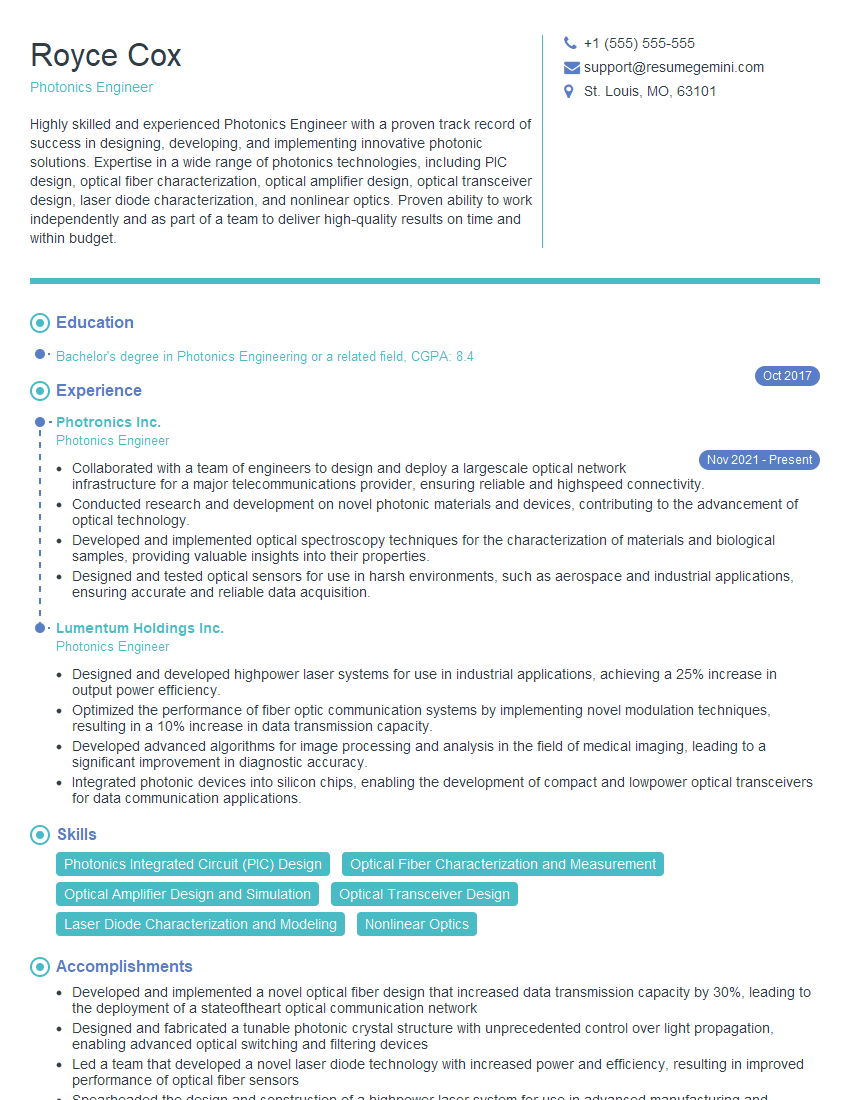
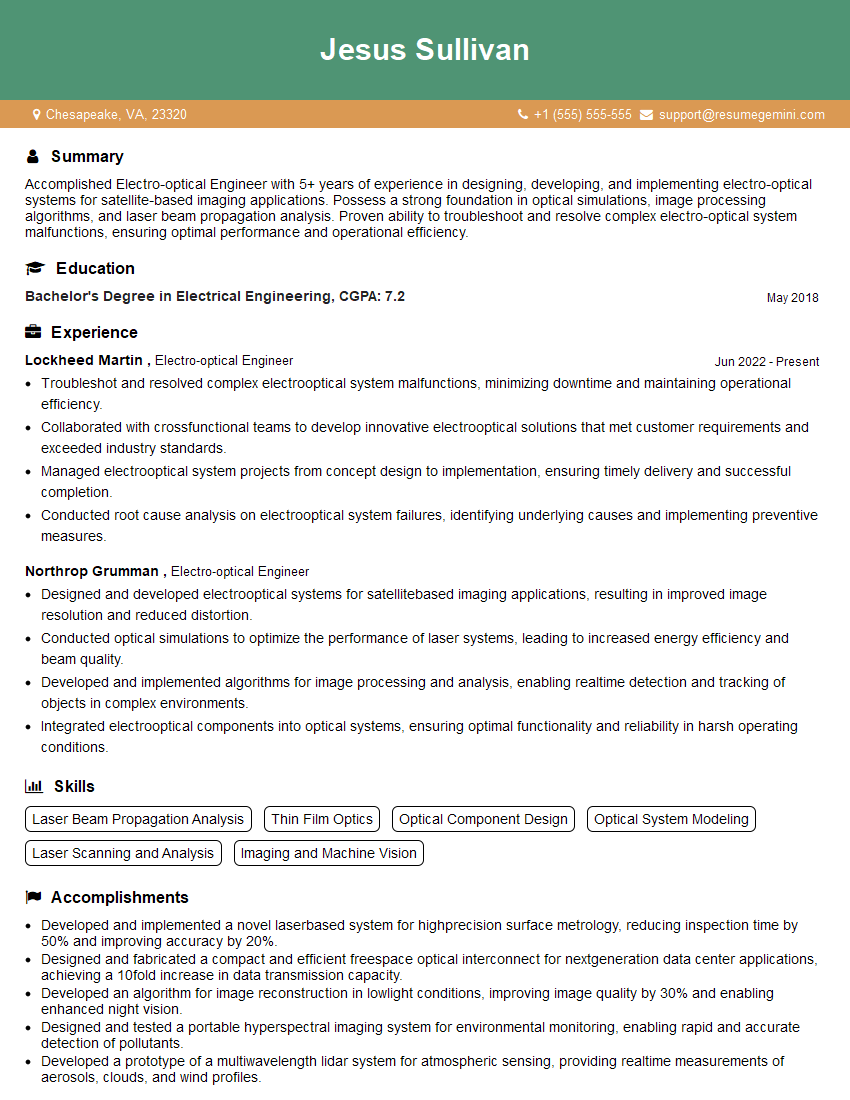
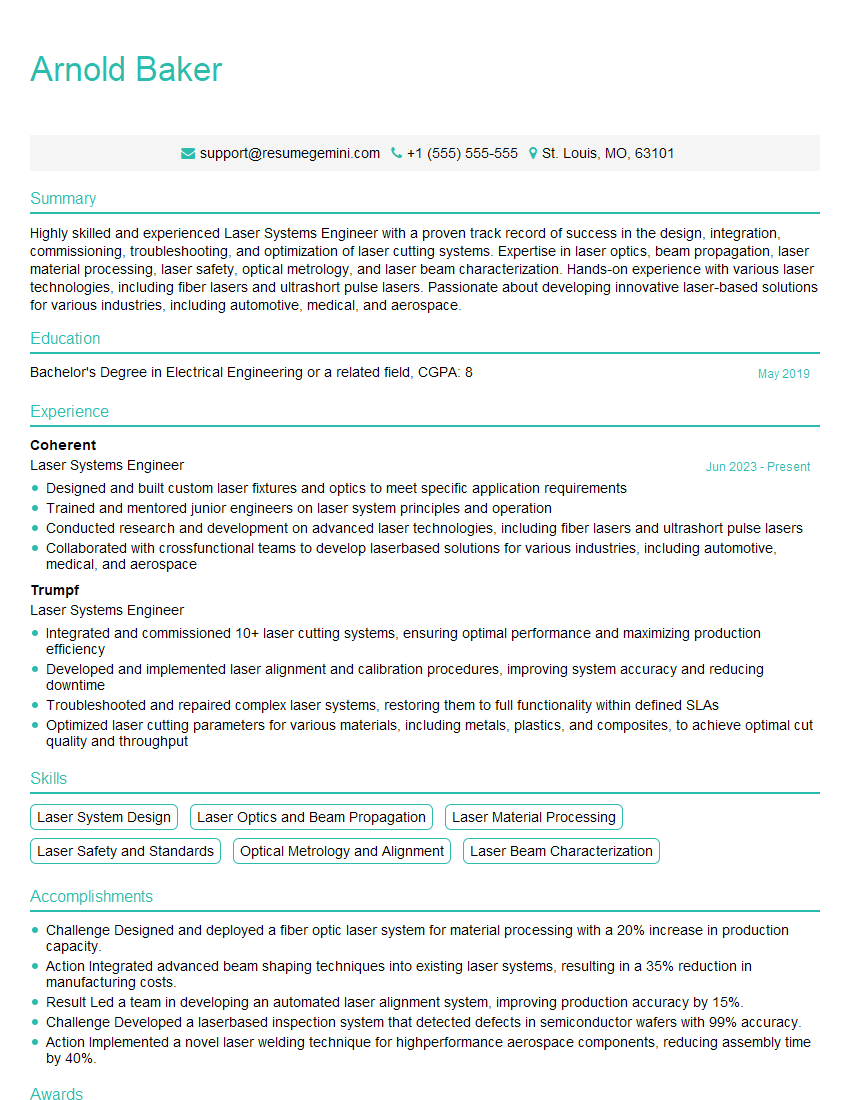
Mastering laser rangefinding opens doors to exciting and rewarding careers in cutting-edge technologies. To maximize your job prospects, it’s crucial to present your skills effectively. Creating an ATS-friendly resume is paramount in today’s competitive job market. ResumeGemini is a trusted resource to help you build a professional and impactful resume that highlights your expertise in laser rangefinding. Take advantage of their tools and resources, and review the provided examples of resumes tailored to this specific field. A well-crafted resume is your first step towards landing your dream job.
Explore more articles
Users Rating of Our Blogs
Share Your Experience
We value your feedback! Please rate our content and share your thoughts (optional).
What Readers Say About Our Blog
Very informative content, great job.
good