Are you ready to stand out in your next interview? Understanding and preparing for Laser Tip Repair interview questions is a game-changer. In this blog, we’ve compiled key questions and expert advice to help you showcase your skills with confidence and precision. Let’s get started on your journey to acing the interview.
Questions Asked in Laser Tip Repair Interview
Q 1. Describe the different types of laser tip damage you have encountered.
Laser tip damage varies significantly depending on the application and the type of laser. In my experience, the most common types include:
- Melting or pitting: This occurs when the laser tip overheats, often due to improper use or insufficient cooling. You’ll see small craters or melted areas on the tip’s surface.
- Cracking or chipping: Mechanical stress, such as accidental impacts or excessive pressure during operation, can cause cracks or chips to appear on the tip. This significantly affects the laser’s beam quality.
- Contamination: Dust, debris, or spatter from the material being processed can accumulate on the tip, reducing its efficiency and potentially causing damage. This is particularly prevalent in laser cutting or welding.
- Erosion: Prolonged use can lead to a gradual erosion of the laser tip’s material, causing a dulling of the surface and a decrease in beam intensity. This is a common wear-and-tear issue.
- Coatings degradation: Many laser tips have specialized coatings to improve performance. Damage to these coatings can severely impact the laser’s effectiveness.
I’ve encountered these types of damage across various laser systems, from fiber lasers used in micromachining to CO2 lasers employed in industrial cutting applications. Each type requires a different approach to repair or replacement.
Q 2. Explain the process for diagnosing a faulty laser tip.
Diagnosing a faulty laser tip involves a systematic process. First, we assess the laser’s overall performance: Is the power output lower than expected? Is the beam quality compromised (e.g., irregular shape, divergence)? Is there unusual noise or vibration?
Then, we move to a visual inspection (which I’ll detail in the next answer). Microscopic examination is sometimes necessary to identify very subtle damage. If the visual inspection reveals issues, we might use specialized testing equipment to quantify the extent of the damage. For instance, we can measure the surface roughness of the tip or assess the integrity of its coating using optical microscopy or profilometry.
Finally, we correlate the observed damage with the laser’s performance issues. For example, pitting on the tip might explain a decrease in power output, whereas cracking could lead to beam instability. This diagnostic process allows us to determine the most effective repair or replacement strategy.
Q 3. What are the common causes of laser tip degradation?
Laser tip degradation is typically caused by a combination of factors:
- Overheating: Inadequate cooling systems or excessive use can lead to overheating and melting of the tip.
- Mechanical stress: Collisions with the workpiece, improper handling, or excessive pressure during operation can cause cracking or chipping.
- Contamination: Dust, debris, or spatter from the workpiece can accumulate on the tip, leading to reduced efficiency and damage.
- Chemical reactions: In certain applications, chemical reactions between the laser tip material and the workpiece material can cause degradation.
- Abrasion: The continuous contact with the workpiece can lead to gradual abrasion of the laser tip’s surface.
For example, in laser welding of stainless steel, spatter can quickly coat the tip, reducing the efficiency and causing uneven heating. Proper cleaning and maintenance protocols are crucial to minimize this effect. Understanding the specific application and the material being processed helps prevent such degradation.
Q 4. How do you perform a visual inspection of a laser tip?
A visual inspection is the first and often crucial step in assessing laser tip condition. It’s typically done under a microscope, ideally a stereomicroscope offering both magnification and illumination control. This allows for detailed observation of the tip’s surface.
We carefully examine the tip for:
- Surface imperfections: Cracks, pits, chips, scratches, or any other irregularities.
- Contamination: Deposits of dust, debris, spatter, or other foreign material.
- Erosion: A gradual wearing away of the tip’s surface material.
- Coatings degradation: Any signs of damage, delamination, or discoloration of any protective coatings.
Proper lighting is critical, using both bright field and possibly oblique illumination to highlight surface features. Documentation, often with photography or video, provides a record of the tip’s condition before and after any intervention. Think of it like a thorough medical examination—every detail counts.
Q 5. What safety precautions are essential when repairing laser tips?
Safety is paramount when handling laser tips. Laser systems themselves pose inherent risks, and working on the laser head adds another layer of complexity. Here are some crucial precautions:
- Eye protection: Always wear appropriate laser safety eyewear rated for the specific laser wavelength and power. This protects against accidental exposure to the laser beam.
- Personal protective equipment (PPE): Use gloves to prevent contamination and injury. Depending on the type of repair, additional PPE like lab coats or safety glasses might be necessary.
- Laser safety interlocks: Ensure all laser safety interlocks are engaged before handling the laser head or components. This prevents accidental activation of the laser.
- Proper grounding: Ensure the laser system and all associated equipment are properly grounded to prevent electrical shocks.
- Clean work area: Maintain a clean and organized work area to prevent accidental contamination of the laser tip or other components.
- Trained personnel: Laser tip repair should only be performed by trained and qualified technicians who understand laser safety protocols.
We treat every repair as a potentially hazardous procedure, taking the necessary steps to mitigate all foreseeable risks.
Q 6. Describe your experience with different laser tip cleaning methods.
Laser tip cleaning methods vary depending on the type of contamination. Gentle methods are always preferred to prevent further damage.
- Compressed air: For loose dust or debris, compressed air is effective but requires caution to avoid damaging the tip.
- Isopropyl alcohol (IPA): IPA is a good solvent for many types of contamination and is relatively gentle on the laser tip material. It’s applied with a lint-free swab or tissue.
- Ultrasonic cleaning: For more stubborn contamination, ultrasonic cleaning can be used, but parameters must be carefully controlled to avoid damaging the tip. This involves immersing the tip in a cleaning solution and exposing it to ultrasonic waves.
- Specialized cleaning solutions: For specific types of contamination (e.g., organic materials), specialized cleaning solutions may be required. The choice of solution depends greatly on the tip material.
I’ve successfully used all these methods, always starting with the gentlest approach. The key is to assess the situation and choose the most appropriate method to avoid damaging the delicate laser tip further.
Q 7. Explain the procedure for replacing a damaged laser tip.
Replacing a damaged laser tip is a precise procedure. The exact steps will vary depending on the laser system’s design, but the general process remains similar.
First, we ensure the laser is completely shut down and power disconnected. We then carefully remove the old tip using the appropriate tools. This often involves loosening screws, removing protective caps, and potentially using specialized extraction tools. Then, the new tip is carefully aligned and installed, often requiring precision alignment tools to ensure the beam path remains optimal.
Finally, we visually inspect the installed tip to ensure there’s no damage or misalignment and we perform functional testing to ensure optimal laser performance. This might involve measuring the beam power, beam profile, and spot size. Replacing a laser tip is a delicate operation and requires adherence to safety protocols and specific manufacturer instructions for the laser system.
Q 8. How do you ensure the proper alignment of a laser tip after repair?
Ensuring proper alignment after laser tip repair is crucial for optimal performance and preventing damage to the laser system. Think of it like aligning the sights on a rifle – even a slight misalignment significantly impacts accuracy. We use a multi-step process involving precise optical instruments. First, we use a high-precision optical microscope to visually inspect the tip for any imperfections or misalignments. Then, we employ a laser beam profiler to measure the beam quality and divergence after the repair. Any deviation from the manufacturer’s specifications indicates misalignment. Finally, we use micro-adjustment screws (if the tip design allows) or specialized alignment tools to carefully realign the tip. This involves iterative adjustments, constantly monitoring the beam profile until the desired parameters are achieved. The whole process is meticulously documented, recording each adjustment made and its effect on the beam quality.
Q 9. What tools and equipment are essential for laser tip repair?
Laser tip repair demands a specialized toolkit. Essential equipment includes:
- Optical microscopes: High-magnification microscopes with adjustable lighting are vital for inspecting the tip’s condition and identifying damage.
- Laser beam profilers: These instruments provide precise measurements of beam quality, divergence, and other critical parameters, essential for confirming alignment.
- Micro-manipulators: These allow for incredibly fine adjustments during the realignment process.
- Specialized cleaning tools: These include swabs, compressed air, and cleaning solutions designed for delicate optical components. Contamination is the enemy!
- Precision measuring instruments: Calipers and micrometers are crucial for accurate measurements during the repair.
- Cleanroom environment: Dust and particles can severely impact the laser’s performance. A cleanroom minimizes this risk.
- Safety equipment: Laser safety glasses are paramount to protect the technician’s eyes from potentially harmful laser radiation.
The specific tools will vary depending on the type of laser and the nature of the repair, but these are fundamental.
Q 10. How do you troubleshoot a laser system with a malfunctioning laser tip?
Troubleshooting a malfunctioning laser tip involves a systematic approach. We start with visual inspection under the microscope, looking for obvious damage such as cracks, chipping, or contamination. Next, we analyze the laser beam profile. A distorted or irregular beam is a clear indication of a problem with the tip. We then check the laser’s power output. A significant drop in power often points to a tip issue. If the problem persists, we might examine the laser cavity alignment, as a misaligned cavity can affect the tip’s performance. Finally, we consider other components in the system. Sometimes, what appears to be a laser tip problem is actually a failure in another part of the system. For instance, a faulty power supply could mimic the symptoms of a defective tip. A clear understanding of the entire laser system is crucial for effective troubleshooting.
I once encountered a case where a seemingly faulty laser tip actually had a tiny dust particle obstructing the beam path. A simple cleaning resolved the issue, highlighting the importance of thorough examination.
Q 11. What are the key performance indicators (KPIs) you monitor during laser tip repair?
Key Performance Indicators (KPIs) during laser tip repair are centered around beam quality and system performance. These include:
- Beam quality (M2): This measures how close the beam is to a perfect Gaussian profile. A higher M2 indicates poorer beam quality.
- Beam divergence: This measures how quickly the beam spreads out. A lower divergence is desirable.
- Power output: A consistent power output within the manufacturer’s specifications is critical.
- Repair time: Efficient repair processes are vital. We track this to identify areas for improvement.
- First-time repair success rate: This metric helps us assess the effectiveness of our repair methods.
By monitoring these KPIs, we ensure the repaired laser tip meets the required specifications and performs optimally.
Q 12. Describe your experience with different types of laser systems.
My experience spans a wide range of laser systems, including:
- Solid-state lasers: I’ve worked extensively on repairing tips for Nd:YAG, fiber, and diode lasers, each requiring slightly different techniques.
- Gas lasers: Experience with HeNe and CO2 lasers, focusing on the unique challenges of handling these gas-based systems.
- Excimer lasers: These high-powered UV lasers require extra precautions due to their potential for damage to both the system and the technician. Specific procedures are in place to handle these safely and efficiently.
Each laser type presents its own set of challenges and repair considerations. For example, the delicate nature of excimer laser tips requires a more refined approach compared to the more robust tips found in some solid-state lasers. My expertise lies in adapting my techniques to the specific requirements of each laser type.
Q 13. How do you document the repair process for a laser tip?
Thorough documentation is paramount. We use a standardized repair form that includes:
- Laser system details: Manufacturer, model number, serial number.
- Initial problem description: Detailed description of the reported malfunction.
- Visual inspection notes: Detailed observations during the microscopic examination, including any damage found.
- Measurements taken: All beam quality and power output measurements before and after repair.
- Repair steps: A step-by-step record of all actions taken during the repair process.
- Parts replaced: A list of any parts replaced, including their serial numbers.
- Final test results: Confirmation that the repaired tip meets performance specifications.
- Technician’s signature and date: Ensuring accountability and traceability.
Digital imaging is also used extensively to document the condition of the tip before, during and after repair. This detailed documentation ensures traceability, aids in troubleshooting future problems, and assists in continuous improvement of our repair processes.
Q 14. What are the common materials used in laser tips?
Laser tips utilize a variety of materials, chosen for their optical properties, durability, and thermal conductivity. Common materials include:
- Sapphire: Known for its high hardness, excellent thermal conductivity, and resistance to scratching. Commonly used in high-power laser systems.
- Quartz: Offers good optical transmission and resistance to thermal shock, making it suitable for various laser types.
- Zinc selenide (ZnSe): Excellent for infrared lasers (e.g., CO2 lasers) due to its high transmission in the infrared spectrum.
- Diamond: Used in specialized applications demanding high resistance to wear and tear and excellent thermal conductivity. However, its cost is a significant factor.
The choice of material depends largely on the wavelength and power of the laser, as well as the specific application. For instance, a high-power infrared laser would likely utilize ZnSe, while a visible laser might use sapphire.
Q 15. Explain the importance of maintaining laser tip cleanliness.
Maintaining laser tip cleanliness is paramount to ensuring optimal performance and longevity. Think of it like this: a dirty lens on your camera will produce blurry pictures. Similarly, a contaminated laser tip will lead to inconsistent cuts, poor quality welds, or even damage to the workpiece. Contaminants like dust, debris, spatter from the material being processed, or even fingerprints can scatter the laser beam, reducing its intensity and precision. This can manifest as inconsistent energy delivery, causing defects in the final product or even premature tip failure.
Regular cleaning protocols, using appropriate cleaning solutions and tools specific to the laser tip’s coating (discussed further in the next answer), are crucial. Failing to maintain cleanliness leads to increased downtime, reduced throughput, and ultimately, higher costs associated with repairs, replacements, and rework.
Career Expert Tips:
- Ace those interviews! Prepare effectively by reviewing the Top 50 Most Common Interview Questions on ResumeGemini.
- Navigate your job search with confidence! Explore a wide range of Career Tips on ResumeGemini. Learn about common challenges and recommendations to overcome them.
- Craft the perfect resume! Master the Art of Resume Writing with ResumeGemini’s guide. Showcase your unique qualifications and achievements effectively.
- Don’t miss out on holiday savings! Build your dream resume with ResumeGemini’s ATS optimized templates.
Q 16. How do you handle different types of laser tip coatings?
Handling different laser tip coatings requires a nuanced approach, as each coating material has specific properties and sensitivities. For instance, some coatings are extremely delicate and require gentle cleaning with specialized solvents and soft materials like lint-free wipes. Others might be more robust and allow for slightly more aggressive cleaning methods.
- Gold-coated tips: These are often used for high-power applications and are relatively durable, but even these benefit from gentle cleaning with isopropyl alcohol and compressed air.
- Diamond-coated tips: These tips offer superior wear resistance, but require careful cleaning to avoid scratching the delicate diamond layer. Using abrasive materials is strictly forbidden.
- Ceramic-coated tips: Ceramic coatings can withstand higher temperatures, but inappropriate cleaning agents may damage or degrade the coating.
Each cleaning process should be documented, and manufacturers’ recommendations must be followed to avoid damaging the coating and compromising the performance of the laser tip. Improper handling can lead to rapid degradation and necessitate premature replacement.
Q 17. What is your experience with laser tip testing and verification?
My experience with laser tip testing and verification encompasses a wide range of techniques. Initial verification often involves optical microscopy to assess the surface condition of the tip for any defects like chipping, cracking, or significant contamination. More advanced methods include power measurement using a power meter to ensure the tip delivers the expected output. We also perform beam profile analysis to evaluate the beam’s shape and uniformity, a key indicator of the tip’s condition. This helps us identify subtle issues that might not be apparent through visual inspection.
In cases where the laser tip is suspected to have a more severe issue, a sophisticated technique like scanning electron microscopy (SEM) is used. SEM provides high-resolution images that can reveal microscopic defects or changes in the coating that would otherwise be invisible. Ultimately, rigorous testing ensures the repaired tip performs to its intended specifications and meets our quality standards.
Q 18. How do you identify the root cause of recurring laser tip failures?
Identifying the root cause of recurring laser tip failures requires a systematic approach. We don’t just fix the immediate problem; we investigate to prevent future occurrences.
- Detailed History: We meticulously gather information on the application, material being processed, processing parameters (power, speed, focal length), and the pattern of failures. For instance, consistent damage at a specific point might indicate a problem with the material alignment or a flaw in the work piece itself.
- Visual Inspection: A thorough visual inspection of both the failed tip and the affected area of the workpiece is carried out. This helps identify potential sources of contamination or improper setup.
- Advanced Analysis: If the initial investigations don’t pinpoint the cause, we may employ advanced techniques like SEM or spectroscopic analysis to pinpoint the nature of the damage or contamination at a microscopic level.
This multifaceted approach allows us to address the fundamental cause of the failure, rather than simply treating the symptom. Ultimately, this leads to improved operational reliability and reduced maintenance costs.
Q 19. Describe your experience working with different laser wavelengths.
My experience encompasses a broad range of laser wavelengths, from the near-infrared (NIR) used in fiber lasers to ultraviolet (UV) wavelengths used in micromachining. Different wavelengths require different approaches in repair techniques and preventative measures.
For instance, UV lasers operate at much shorter wavelengths, making the laser tip significantly more sensitive to contamination. A small amount of debris could scatter the beam more severely compared to a longer NIR wavelength. Likewise, the material properties of the laser tip and its coatings might need to be specifically suited to the high energy of a UV laser. The selection of cleaning agents and techniques must also be carefully chosen based on the laser wavelength to avoid potential damage to the coating.
Understanding the unique characteristics of each wavelength is crucial for determining the most effective methods of repair, maintenance, and preventing future failures.
Q 20. How do you ensure the repaired laser tip meets quality standards?
Ensuring a repaired laser tip meets quality standards involves a rigorous process of verification and validation. It goes beyond just fixing the physical damage. We adhere to a multi-stage approach that includes:
- Visual Inspection: Thorough examination under magnification to ensure the repair is complete and there are no residual defects.
- Functional Testing: Rigorous testing under operational conditions to verify the tip’s output power, beam quality, and consistency. This often involves using a power meter, beam profiler, and sometimes even the actual manufacturing process to test the tip in a real-world scenario.
- Comparison with Standards: The results of our testing are compared against established standards and specifications to ensure the repaired tip performs at least as well as a new tip.
- Documentation: All procedures, results, and deviations from the norm are meticulously documented to provide full traceability and ensure compliance with industry best practices.
This rigorous process minimizes the risk of errors and ensures the repaired tip meets or exceeds the original specifications, leading to improved efficiency and reliability in the production process.
Q 21. What is your familiarity with laser safety regulations and standards?
Laser safety is of paramount importance in my work. I am extensively familiar with relevant regulations and standards, including ANSI Z136.1 (American National Standard for Safe Use of Lasers) and relevant local or regional regulations.
Understanding these standards means adhering to strict safety protocols throughout the entire process: from the initial inspection of the damaged tip to the final testing and packaging of the repaired component. This includes using appropriate personal protective equipment (PPE), such as laser safety eyewear specific to the laser’s wavelength, ensuring proper enclosure and shielding of the laser system during operation and repair, and handling the laser tip with care to prevent injury.
Moreover, I am trained in laser safety procedures and hazard assessment. This means knowing how to identify potential hazards and implementing appropriate control measures to mitigate any risk. The combination of adhering to international safety standards and maintaining a deep understanding of laser safety best practices enables me to perform laser tip repair efficiently and safely.
Q 22. Explain the process of recalibrating a laser system after tip repair.
Recalibrating a laser system after tip repair is crucial for ensuring accuracy and safety. The process involves a series of precise steps, varying slightly depending on the laser system’s make and model. Generally, it begins with a thorough visual inspection to confirm the tip is correctly installed and free from damage. Then, the laser’s power output needs to be checked and adjusted to factory specifications using calibrated power meters. This is often followed by beam profiling to verify the beam’s shape and size, correcting any aberrations introduced during the repair process. Finally, the system’s alignment is meticulously checked and adjusted, often involving adjusting mirrors or lenses to optimize the laser beam’s path and focus. This may require specialized alignment tools and a deep understanding of the optical system. For example, in a fiber laser system, we might use an optical power meter to measure the output power and then adjust the gain control to achieve the required power level. Following this, a beam profiler will give us a visual representation of the beam profile ensuring there are no significant distortions or asymmetries, which would affect cutting precision. Any deviations from the specifications necessitate further adjustments until optimal performance is restored. Detailed calibration procedures are usually documented in the system’s manual.
Q 23. Describe your experience with preventative maintenance for laser tips.
Preventative maintenance is paramount for extending the lifespan of laser tips and preventing costly downtime. My experience involves a multi-pronged approach. This includes regular visual inspections for signs of wear and tear, such as chipping, cracking, or contamination. We also monitor the laser’s performance parameters, such as power output and beam quality, for any degradation that may indicate tip deterioration. Cleaning procedures are critical; the type of cleaning method depends on the tip material and the type of contamination. This might involve using specialized cleaning solutions, compressed air, or even ultrasonic cleaning for delicate tips. Proper handling and storage are crucial. Tips should be stored in clean, dust-free environments, ideally in protective cases. Additionally, using the correct laser parameters during operation – avoiding overloading the tip – significantly extends its lifespan. For example, in a high-volume manufacturing setting, I instituted a daily visual inspection checklist and a weekly cleaning schedule which resulted in a 20% reduction in tip replacements.
Q 24. What are the limitations of laser tip repair?
Despite advancements, laser tip repair has limitations. The extent of repairable damage depends on the material of the tip and the nature of the damage. Small scratches or minor pitting might be polished out, but severe damage, like fractures or significant material loss, usually renders the tip unusable. Repairing highly specialized or expensive tips might not be economically viable compared to replacing them. Moreover, even after repair, the tip’s performance might not be fully restored to its original state, potentially leading to slightly reduced cutting accuracy or efficiency. For instance, while we can polish away minor imperfections on a sapphire laser tip, a significant chip or crack will compromise its structural integrity and cannot be safely repaired. The material properties might also be altered after a repair attempt, which might lead to the early failure of the repaired tip.
Q 25. How do you handle emergency laser tip repairs?
Emergency laser tip repairs require a rapid response and a systematic approach. First, I assess the extent of the damage and determine if a temporary fix or immediate replacement is needed. If a temporary fix is feasible, I might use readily available tools and materials to restore minimal functionality until a proper repair or replacement can be arranged. This might involve carefully cleaning the tip, realigning it, or even using a protective cover to shield the damaged area. Simultaneously, I initiate the procurement process for a replacement tip and prepare the system for the replacement. Effective communication with the operations team is crucial to minimize downtime and mitigate further impact. For example, a small crack in the nozzle might be temporarily sealed with a high-temperature epoxy to allow operations to continue while a replacement is ordered and fitted. This prevents a major production delay.
Q 26. Describe a time you had to troubleshoot a complex laser tip issue.
One memorable challenge involved a high-power fiber laser cutting system where the beam profile was significantly distorted after a tip replacement. Initial tests showed a significant loss of power and inconsistent cutting quality. We meticulously checked the alignment of all optical components, but the problem persisted. After careful examination, we discovered a minute misalignment in the fiber connector at the tip’s base. A simple adjustment using specialized fiber alignment tools resolved the issue completely. This highlighted the importance of thoroughness and a systematic troubleshooting approach, checking all possible sources of error, even seemingly insignificant ones. It also emphasized the need for using the right tools and having a deep understanding of the entire optical system, not just the laser tip itself.
Q 27. What are your strategies for minimizing downtime during laser tip repairs?
Minimizing downtime during laser tip repairs relies on proactive strategies. Having a readily available inventory of spare tips is crucial. Furthermore, establishing well-defined repair procedures and training technicians ensures quick and efficient repairs. Implementing preventative maintenance significantly reduces the frequency of repairs. Utilizing efficient repair techniques and having backup systems or alternative processing methods in place provides redundancy in case of prolonged repair times. Investing in robust laser systems with easily replaceable tips and modular designs reduces downtime associated with complex repair procedures. For example, having a standardized repair kit with all necessary tools and spare parts readily accessible reduces the time spent on searching and preparing for the repair procedure.
Q 28. How do you stay updated with the latest advancements in laser technology?
Staying current in laser technology is essential. I actively participate in industry conferences and workshops to learn about the latest advancements in laser tip materials, designs, and repair techniques. Reading relevant scientific journals and industry publications keeps me informed about new research and developments. Networking with colleagues and experts in the field provides valuable insights and allows for the exchange of knowledge and best practices. Manufacturer training courses are also beneficial for learning about specific laser systems and their maintenance requirements. By continually updating my knowledge, I ensure I am equipped to tackle challenges with the most efficient and effective methods.
Key Topics to Learn for Laser Tip Repair Interview
- Laser Tip Physics: Understanding the principles of laser operation, including beam characteristics, wavelength, and power output, is fundamental. Prepare to discuss how these factors influence repair techniques.
- Damage Mechanisms: Familiarize yourself with common types of laser tip damage (e.g., pitting, cracking, contamination) and their root causes. Be ready to explain how different damage types necessitate varying repair approaches.
- Repair Techniques: Master the various methods used in laser tip repair, such as polishing, reshaping, recoating, and replacement. Understand the advantages and limitations of each technique and when they are most appropriately applied.
- Material Science: Develop a strong understanding of the materials used in laser tips and their properties. This includes knowledge of material degradation and how to select the best repair method based on the tip’s composition.
- Quality Control and Testing: Learn about the methods used to assess the quality of a repaired laser tip, including optical testing and performance evaluation. Be prepared to discuss quality control measures and how they ensure optimal laser performance.
- Troubleshooting and Problem-Solving: Practice diagnosing and resolving common issues encountered during laser tip repair. This includes identifying the source of the problem, selecting the appropriate repair technique, and verifying the success of the repair.
- Safety Procedures: Demonstrate knowledge of safety protocols and best practices related to handling lasers and laser components. This is crucial for ensuring a safe and efficient working environment.
Next Steps
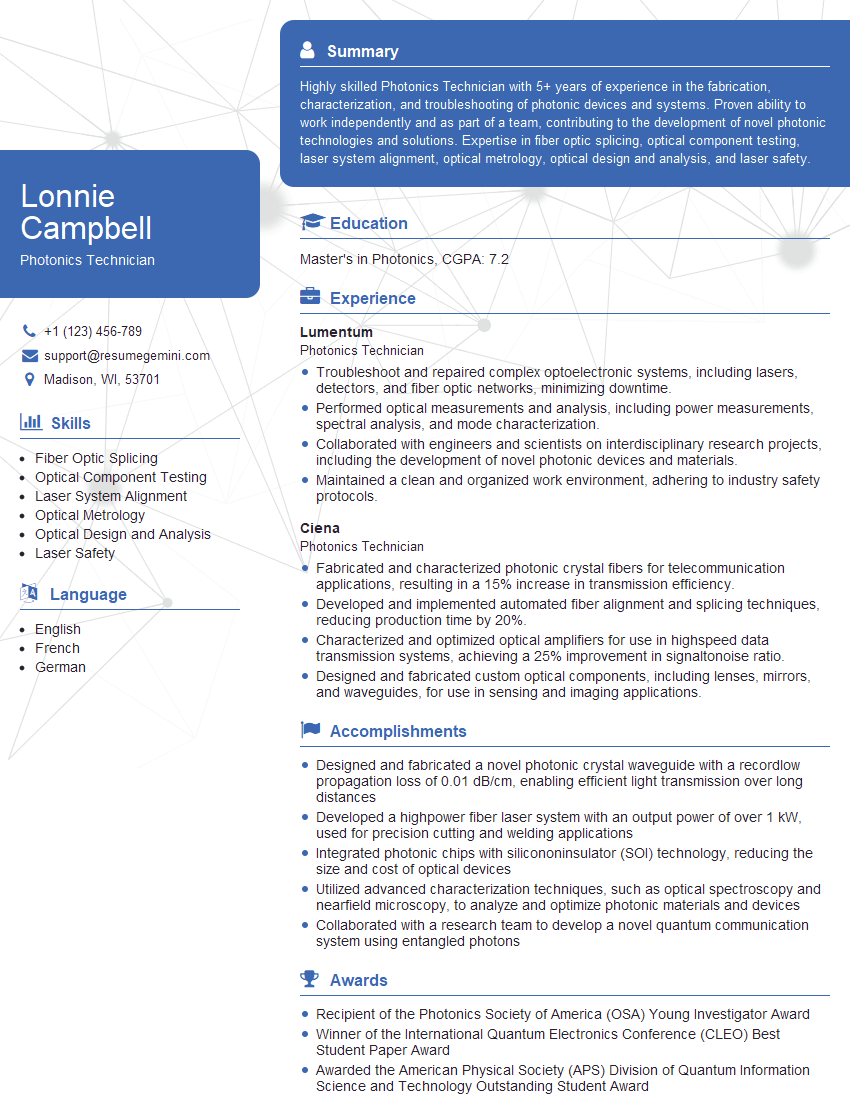
Mastering Laser Tip Repair opens doors to rewarding and challenging career opportunities within the advanced manufacturing, medical, and scientific sectors. To maximize your job prospects, it’s essential to present your skills effectively. Creating an ATS-friendly resume is critical for getting your application noticed by recruiters. We strongly recommend utilizing ResumeGemini to build a professional and impactful resume. ResumeGemini offers a user-friendly platform and provides examples of resumes specifically tailored to the Laser Tip Repair field, helping you showcase your expertise and land your dream job. Explore the provided examples to learn how to best highlight your skills and experience.
Explore more articles
Users Rating of Our Blogs
Share Your Experience
We value your feedback! Please rate our content and share your thoughts (optional).
What Readers Say About Our Blog
Very informative content, great job.
good