Cracking a skill-specific interview, like one for Laser Welding and Cutting, requires understanding the nuances of the role. In this blog, we present the questions you’re most likely to encounter, along with insights into how to answer them effectively. Let’s ensure you’re ready to make a strong impression.
Questions Asked in Laser Welding and Cutting Interview
Q 1. Explain the difference between laser welding and laser cutting.
Laser welding and laser cutting are both material processing techniques using a highly focused laser beam, but they achieve vastly different results. Laser welding uses the laser’s energy to melt the edges of two materials, fusing them together to create a strong joint. Think of it like using a tiny, incredibly precise blowtorch. Laser cutting, on the other hand, uses the laser’s intense energy to vaporize or melt the material, removing it completely to create a precise cut. Imagine using a super-fine, extremely hot scalpel.
The key difference lies in the power density and the interaction with the material: welding aims for localized melting and fusion, while cutting aims for material removal through vaporization or melting.
Q 2. Describe the types of lasers used in welding and cutting.
A variety of lasers are employed in welding and cutting, each with its own advantages and disadvantages. Common types include:
- Nd:YAG lasers (Neodymium-doped Yttrium Aluminum Garnet): These are solid-state lasers, known for their high power output and ability to be fiber-delivered, making them versatile for both welding and cutting various materials, especially metals. They are robust and reliable.
- CO2 lasers (Carbon Dioxide): These gas lasers offer high power and are particularly well-suited for cutting non-metals like wood, plastics, and fabrics due to their longer wavelength. Their power efficiency is sometimes higher than Nd:YAG, but their beam delivery systems tend to be bulkier.
- Fiber lasers: These are a type of solid-state laser that use optical fibers for beam delivery. They offer high beam quality, efficiency, and compactness, making them increasingly popular for both welding and cutting applications, particularly in automated systems.
- Diode lasers: While individually lower in power than the others, diode lasers can be combined (diode laser arrays) to achieve higher power output, which are frequently used in welding and sometimes cutting applications.
The choice of laser depends on factors such as the material being processed, the desired precision, the required speed, and the overall cost.
Q 3. What are the advantages and disadvantages of laser welding compared to other welding methods?
Laser welding offers several advantages over traditional welding methods like arc welding or resistance welding:
- High precision and accuracy: Laser welds are extremely precise, allowing for fine control over the weld bead geometry.
- Reduced heat-affected zone (HAZ): The concentrated heat input minimizes the area affected by the welding process, preserving the material’s properties.
- High speed: Laser welding can be significantly faster than other methods.
- Automated capability: Easily integrated into automated systems for high-volume production.
- Minimal distortion: Less distortion due to lower heat input.
However, laser welding also has some disadvantages:
- High initial investment cost: Laser welding systems can be expensive to purchase and maintain.
- Sensitivity to surface conditions: Surface cleanliness and preparation are crucial for successful welding.
- Requires specialized expertise: Operating and maintaining laser welding systems requires specialized training.
For instance, in automotive manufacturing, laser welding is preferred for joining thin sheet metals due to its precision and minimal distortion, vital for maintaining car body integrity.
Q 4. What are the advantages and disadvantages of laser cutting compared to other cutting methods?
Laser cutting boasts numerous advantages over conventional cutting methods like waterjet cutting, plasma cutting, or mechanical sawing:
- High precision and accuracy: Laser cutting provides very fine and detailed cuts, creating intricate shapes with high accuracy.
- Non-contact process: The laser doesn’t physically touch the material, minimizing damage and wear.
- High speed: Faster cutting speeds than many other methods, especially for thin materials.
- Wide range of materials: Can cut a variety of materials, from metals and plastics to wood and fabrics (with appropriate laser selection).
- Clean cuts: Often produces cleaner cuts with minimal burrs or roughness.
Nevertheless, laser cutting presents some drawbacks:
- High initial investment: Similar to laser welding, laser cutters can be expensive.
- Material limitations: Certain materials may be difficult or impossible to cut cleanly with a laser.
- Edge quality concerns: Depending on material and settings, edge quality can sometimes be less desirable than alternative methods like waterjet for certain applications.
- Safety precautions: Requires careful safety procedures due to the high-powered laser beam.
For example, in the aerospace industry, laser cutting is extensively used to create precise components for aircraft due to its ability to handle intricate designs and maintain dimensional accuracy.
Q 5. Explain the concept of laser beam quality (M²).
The beam quality of a laser, represented by the M2 factor (also known as the beam propagation ratio), quantifies how much the laser beam diverges from an ideal Gaussian beam. An ideal Gaussian beam has an M2 value of 1. A higher M2 value indicates a greater divergence – the beam spreads out more quickly over distance. This is crucial in laser processing because it directly impacts the achievable spot size and the power density at the workpiece.
A low M2 value is desirable for applications demanding a tight focus, like micro-welding or fine laser cutting. A higher M2 beam might be acceptable for applications where a larger interaction zone is beneficial, for instance, some types of welding processes that need broader heating.
Imagine shining a flashlight: a high-quality beam (low M2) will stay focused over a long distance, like a laser pointer. A low-quality beam (high M2) will spread out quickly, losing its intensity.
Q 6. How does laser power affect the welding/cutting process?
Laser power is the rate at which the laser delivers energy. It’s a critical parameter in both welding and cutting. Higher power generally leads to:
- Faster processing speeds: More power melts or vaporizes material faster.
- Deeper penetration (welding): Greater power allows deeper welds.
- Wider kerf width (cutting): More power results in a wider cut.
However, excessively high power can lead to:
- Excessive heat: Causing material distortion or damage.
- Porosity in welds: Rapid vaporization might trap gases in the weld pool.
- Unwanted heat-affected zones (HAZ): Larger HAZ can compromise material properties.
The optimal laser power must be carefully selected for the specific material, thickness, and desired outcome. A thin sheet metal might require significantly less power than a thick steel plate.
Q 7. How does laser focus affect the welding/cutting process?
Laser focus, determined by the focal length of the focusing lens, directly influences the power density at the workpiece. A tighter focus (shorter focal length) results in a smaller spot size and a higher power density.
- Welding: Tighter focus is usually preferred for deep penetration welds, achieving a high power density to melt the material deeply. A less tight focus might be needed for broader welds or surfacing operations.
- Cutting: A tight focus is typically essential for precise cuts, particularly for intricate shapes or thin materials. The cut edge quality is highly influenced by the focal point accuracy.
Improper focus can lead to:
- Insufficient penetration (welding): If the spot is too large or out of focus, the power density might be insufficient for deep penetration.
- Rough or tapered cuts (cutting): A poorly focused beam can result in uneven cuts and burrs.
- Incomplete cutting (cutting): The laser energy might not be sufficiently concentrated to vaporize the material completely.
Precise focus control and adjustment are critical for optimal laser welding and cutting performance and require skilled operators and properly maintained equipment.
Q 8. Describe the role of assist gas in laser welding and cutting.
Assist gas plays a crucial role in both laser welding and cutting. It’s a controlled flow of gas introduced at the laser interaction zone. Its primary functions are to remove molten material, shield the weld pool or cut kerf from atmospheric contamination, and control the laser beam’s focus.
Think of it like this: in welding, the assist gas acts as a protective blanket, keeping oxygen away from the hot weld pool to prevent oxidation and porosity. In cutting, it helps to blow away the molten or vaporized material, ensuring a clean, precise cut.
Q 9. What are common assist gases used in laser processing, and when would you choose one over another?
Common assist gases include nitrogen, argon, helium, oxygen, and air. The choice depends heavily on the material being processed and the desired outcome.
- Nitrogen (N2): Inert, widely used for welding most metals due to its ability to prevent oxidation and offer good keyhole stability. It’s a good all-around choice for many applications.
- Argon (Ar): Also inert and often preferred for welding reactive metals like titanium and aluminum where even the slightest oxidation is unacceptable. Its higher density compared to Helium can improve keyhole stability in deeper welds.
- Helium (He): An inert gas with superior thermal conductivity; useful for high-speed welding or for situations needing rapid heat dissipation.
- Oxygen (O2): Used primarily in laser cutting of steels, it aids in the oxidation reaction, which enhances the cutting process and leads to faster speeds. However, it’s not suitable for welding ferrous metals as it introduces oxides.
- Air: A cost-effective option, sometimes used for laser cutting less demanding materials, but its composition makes it less predictable than pure gases.
For example, you wouldn’t use oxygen when welding aluminum, as it would lead to brittle welds. Conversely, using nitrogen when cutting steel wouldn’t be as efficient as oxygen.
Q 10. Explain the concept of heat-affected zone (HAZ) in laser welding.
The Heat Affected Zone (HAZ) in laser welding is the region of the base material surrounding the weld that has been heated to a temperature sufficient to cause microstructural changes, but not melted. These changes can affect the material’s properties, such as hardness, toughness, and ductility, potentially leading to reduced overall performance.
Imagine heating a metal pan: the area directly under the flame gets the most heat (the weld), but the surrounding area also warms up, albeit to a lesser degree, affecting its structure (HAZ).
Q 11. How do you control the HAZ in laser welding?
Controlling the HAZ involves manipulating several welding parameters. The key is to minimize the heat input while ensuring adequate weld penetration. This can be achieved through:
- Lowering the laser power: Reduces the extent of heat diffusion.
- Increasing the welding speed: Less heat is applied to a given area.
- Using shorter pulse durations (for pulsed lasers): Reduces the overall heat exposure.
- Optimizing the focus lens: To achieve a concentrated heat source.
- Employing pre-heating or post-heating treatments: These can refine the HAZ microstructure and mitigate unwanted changes.
- Choosing appropriate materials: Some materials are inherently more susceptible to HAZ formation than others.
The optimal control strategy often involves careful experimentation and adjustments based on material characteristics and desired weld properties.
Q 12. What are some common defects found in laser welding and cutting, and how can they be prevented?
Common defects in laser welding and cutting include:
- Porosity: Small holes within the weld caused by trapped gases. This can be prevented by using appropriate assist gas and ensuring clean surfaces.
- Lack of fusion: Incomplete bonding between the base material and the weld. This is usually due to insufficient laser power or inadequate penetration.
- Spatter: Ejection of molten material from the weld pool, potentially caused by excessive laser power or improper assist gas flow.
- Undercutting: Material removal from the edges of the cut (in laser cutting) due to excessive laser power or inappropriate assist gas pressure.
- Dross: Molten material clinging to the underside of the cut (in laser cutting). It results from insufficient assist gas pressure or speed.
- Keyhole instability (in laser welding): Fluctuations in the keyhole shape leading to uneven welds. This can be mitigated by controlling the laser parameters and assist gas flow.
Preventing these defects requires careful selection of laser parameters, assist gas, and materials, along with meticulous control of the process and regular quality checks.
Q 13. Describe different laser welding techniques (e.g., keyhole welding, conduction welding).
Laser welding techniques can be broadly classified into:
- Keyhole Welding: This technique uses high laser power density to create a deep, vaporized channel (the keyhole) through the material. Molten material flows around the keyhole, solidifying to form a weld. It’s suitable for deep penetration welds.
- Conduction Welding: This technique uses lower power density to melt the material via heat conduction. Heat is transferred to the material gradually, leading to shallower penetration welds suitable for thin materials or where minimal HAZ is critical.
- Hybrid Welding: Combining techniques like laser and arc welding to leverage their respective advantages.
The choice of technique hinges on material thickness, desired weld depth, required weld quality, and the specific application.
Q 14. Describe different laser cutting techniques (e.g., melt cutting, vaporization cutting).
Laser cutting techniques are primarily categorized based on the interaction between the laser beam and the material:
- Melt Cutting: The laser beam melts the material, and the assist gas removes the molten material. This is suitable for metals with lower melting points.
- Vaporization Cutting: The laser beam’s energy vaporizes the material, effectively cutting it without melting. It is commonly used for materials with higher melting points.
- Oxidation Cutting: This is a specialized technique used primarily for cutting steel, where the oxygen in the assist gas helps oxidize the material, facilitating faster cutting.
The optimal technique depends on factors such as material type, thickness, desired cut quality, and speed requirements.
Q 15. How do you select the appropriate laser parameters for a specific material and application?
Selecting the right laser parameters is crucial for successful laser welding and cutting. It’s like choosing the right tools for a specific job – a hammer for nails, not a screwdriver. The process involves considering several factors related to the material and the desired outcome. First, we need to identify the material’s properties: its absorptivity at the laser wavelength, thermal conductivity, and melting point. These properties dictate the laser power, pulse duration, and frequency needed. For instance, a highly reflective material like stainless steel needs higher power and potentially shorter pulses to achieve sufficient absorption and melting. A material with high thermal conductivity will require higher energy input to compensate for heat dissipation.
Secondly, the application itself defines the parameters. Welding requires a specific heat input to melt and fuse the materials without vaporizing them, leading to a strong weld. Cutting, on the other hand, aims for rapid vaporization and removal of material. This requires higher power density and potentially faster scanning speeds. We usually start with established parameters for similar materials and then fine-tune them through experimentation, employing methods like design of experiments (DOE) to optimize the process.
For example, if I’m welding thin aluminum sheets, I’d use a lower power and longer pulse duration compared to thicker steel plates. With steel, I’d need significantly more power and potentially a shorter pulse to reach the required melting temperature. Finally, the use of assist gases like oxygen or nitrogen significantly impacts the process, requiring further parameter adjustments. Oxygen enhances cutting speed by increasing the exothermic reaction with the molten material, while nitrogen helps minimize oxidation during welding.
Career Expert Tips:
- Ace those interviews! Prepare effectively by reviewing the Top 50 Most Common Interview Questions on ResumeGemini.
- Navigate your job search with confidence! Explore a wide range of Career Tips on ResumeGemini. Learn about common challenges and recommendations to overcome them.
- Craft the perfect resume! Master the Art of Resume Writing with ResumeGemini’s guide. Showcase your unique qualifications and achievements effectively.
- Don’t miss out on holiday savings! Build your dream resume with ResumeGemini’s ATS optimized templates.
Q 16. Explain the importance of laser safety procedures.
Laser safety is paramount. Laser beams carry immense power; even a small fraction of the beam can cause severe eye damage or skin burns. Think of it like handling a high-voltage power line – a single mistake can have devastating consequences. We must treat lasers with the utmost respect and adhere to strict safety protocols to protect ourselves and others. Failing to prioritize safety not only jeopardizes health but can also lead to costly equipment damage and production downtime.
Our primary goal is to prevent any exposure to direct or reflected laser beams. This involves a multi-layered approach encompassing proper training, engineering controls, and administrative controls. We need to create a controlled environment with proper shielding, interlocks, and warning systems. A single lapse in safety protocol can result in potentially permanent injury.
Q 17. What are the different types of laser safety equipment?
Laser safety equipment varies greatly depending on the laser class and application. For Class 4 lasers, which are the most powerful and dangerous, we employ a range of protective measures.
- Laser safety eyewear: Essential for protecting the eyes from laser radiation. Eyewear must be specifically rated for the laser’s wavelength and power level.
- Laser safety enclosures: These completely enclose the laser system, preventing accidental exposure to the beam.
- Beam blockers and attenuators: Used to block or reduce the intensity of the laser beam when the system is not in operation or during maintenance.
- Warning signs and labels: Clear and visible warnings are crucial to alert personnel to the presence of laser hazards.
- Interlocks and safety switches: Prevent the laser from operating unless safety conditions are met.
- Emergency shut-off buttons: Quickly stop the laser in case of an emergency.
The specific equipment required will be determined by a risk assessment, which carefully analyzes the potential hazards associated with the laser system and the work environment.
Q 18. Describe your experience with laser safety protocols and regulations.
Throughout my career, I’ve worked extensively with laser safety protocols, adhering to ANSI, ISO, and other relevant standards. I’ve participated in numerous laser safety training courses and have been involved in developing and implementing safety programs for laser facilities. This includes conducting regular safety inspections, performing risk assessments, and documenting all safety procedures. I’ve always been a strong advocate for a safety-first culture in my work, ensuring that everyone understands and follows the safety protocols.
For instance, in a previous role, we implemented a comprehensive laser safety training program for all personnel involved in operating or maintaining laser systems. The program included practical demonstrations of safe operating procedures and emergency responses. This initiative dramatically reduced the risk of accidents and improved the overall safety culture of the facility. I believe continuous training and education are crucial for maintaining high standards of laser safety.
Q 19. How do you ensure the quality of laser welds and cuts?
Ensuring quality in laser welds and cuts relies on a combination of process control and post-process inspection. We start by meticulously controlling the laser parameters as discussed earlier. Consistent parameter settings are crucial to get repeatable results. In addition to parameters, material quality, cleanliness, and proper fixturing play a vital role. Contamination, imperfections, or misalignment can significantly affect the weld or cut quality.
Post-process inspection is equally important. We employ various methods depending on the application and requirements. Visual inspection is often the first step, checking for surface defects, porosity, and lack of fusion in welds. For critical applications, we utilize non-destructive testing (NDT) methods, such as ultrasonic testing or X-ray inspection, to assess internal defects. Dimensional measurements are often performed to ensure the cut or weld conforms to the specified dimensions. Regular maintenance of the laser system also plays a crucial role, as worn components or misaligned optics can greatly impact process consistency and quality.
Q 20. How do you troubleshoot common problems encountered in laser welding and cutting?
Troubleshooting in laser welding and cutting requires a systematic approach. It’s like diagnosing a car problem – you need to identify the symptoms before you can find the cause. We start by examining the weld or cut quality, noting any defects or inconsistencies. Are there porosities, lack of fusion, excessive spatter, or inaccurate dimensions? Then we systematically check the following:
- Laser parameters: Are the power, pulse duration, frequency, and scanning speed within the optimal range for the material and application?
- Material properties: Is the material clean, properly prepared, and free from defects?
- Assist gas: Is the correct gas being used at the appropriate flow rate and pressure?
- Optics: Are the lenses and mirrors clean and properly aligned? Dirty optics can reduce beam quality and power, leading to poor results.
- Focus: Is the laser beam focused correctly onto the workpiece? An incorrect focus can cause inconsistent results.
- Fixturing: Is the workpiece properly fixtured to prevent movement during processing?
By systematically investigating these potential issues, we can usually pinpoint the root cause and make the necessary corrections. Sometimes, it requires a combination of adjustments to achieve optimal results. For example, if a weld shows porosity, it might be due to a combination of low power and insufficient assist gas. We adjust both to obtain a dense and sound weld.
Q 21. What is your experience with different types of laser control systems?
I’ve worked with a range of laser control systems, from simple analog controls to sophisticated digital systems with closed-loop feedback. Analog systems offer basic control over parameters like power and pulse duration, but digital systems provide far greater precision and flexibility. Digital systems often allow for advanced control strategies like adaptive control, which automatically adjusts parameters in real-time to compensate for variations in the process. This feature improves consistency and reduces defects.
My experience includes working with systems employing various programming languages, such as specialized laser control software and even integrating with robotic systems. For instance, I’ve used systems that allow for complex contour cutting and welding using CAD/CAM software. This enables precise control of the laser beam path and allows for automated production of complex parts. Closed-loop systems offer real-time feedback, allowing for immediate adjustments based on sensor data, ensuring a high-quality output even with variations in material or environment.
Q 22. Describe your experience with programming and operating CNC laser machines.
My experience with CNC laser machines spans over ten years, encompassing both programming and operation. I’m proficient in various control software packages, including but not limited to Lantek, Trumpf, and Bystronic. I’ve programmed complex parts requiring intricate nesting algorithms to optimize material utilization and reduce waste. For example, I once programmed a job involving hundreds of uniquely shaped parts for a medical device manufacturer, requiring precise placement and orientation to ensure consistent quality. My operational experience includes setting up the machine, loading materials, monitoring the cutting or welding process, and performing quality checks. I’m familiar with all safety protocols and regularly conduct preventative maintenance to maximize machine uptime.
Beyond basic operation, I’m comfortable with advanced programming techniques such as variable power and speed control for optimizing cutting quality and speed depending on material thickness and geometry. I’m also experienced in using various types of cutting heads and lenses, adjusting them based on the specific application requirements.
Q 23. What materials have you worked with using laser processing?
I’ve worked with a wide range of materials using laser processing, including various metals like stainless steel, mild steel, aluminum, titanium, and copper alloys. I’ve also processed non-metals such as plastics (acrylic, polycarbonate), wood, and ceramics. The choice of laser type (CO2, fiber, etc.) and process parameters are crucial and vary significantly depending on the material properties. For instance, cutting thin stainless steel requires a higher precision and potentially a lower power setting compared to thicker sheets of mild steel. The properties of the material, such as reflectivity and thermal conductivity, directly impact the effectiveness of the laser process.
Q 24. What are the limitations of laser welding and cutting?
Laser welding and cutting, while highly precise, do have limitations. One major limitation is the heat-affected zone (HAZ) in welding. This zone experiences metallurgical changes that can affect the mechanical properties of the weld. The size of the HAZ is dependent on the material, laser power, and welding speed. Also, the process can be sensitive to material surface conditions; contaminants or imperfections can significantly impact the weld quality or lead to inconsistencies in the cut.
Cutting limitations often include kerf width (the width of the cut), which is influenced by the laser power, focal length, and material thickness. Very thin materials can be challenging to cut cleanly, while very thick materials may require multiple passes, leading to increased processing time and potential distortions. Additionally, some materials are highly reflective, requiring specialized techniques or pre-treatments to improve absorption and enhance the cutting or welding process. Finally, the high cost of laser systems compared to other fabrication techniques can be a limiting factor for some applications.
Q 25. How do you maintain and calibrate laser systems?
Maintaining and calibrating laser systems is critical for ensuring consistent performance and safety. Regular maintenance includes checking gas purity and flow rates (for gas-assisted processes), lens cleanliness, and alignment. I use specialized cleaning tools and procedures to avoid scratching or damaging delicate optical components. Alignment is crucial and often involves adjusting mirrors and lenses using precision tooling to ensure the laser beam is focused correctly on the workpiece. Calibrating the system typically involves using precision gauges to measure the laser beam’s position and power, adjusting parameters in the control software to compensate for any drift or inconsistencies.
Preventative maintenance, such as regular cleaning of the exhaust system and checking the cooling system, is vital for the longevity of the machine. Following the manufacturer’s recommended maintenance schedules and documenting all procedures is a best practice.
Q 26. Describe your experience with different types of laser sensors and their applications.
My experience with laser sensors includes various types, each with its applications. For example, I’ve utilized height sensors to automatically adjust the focal point of the laser based on the varying thickness of the workpiece, improving cut quality and consistency. These sensors are critical for automating the process and reducing the risk of human error. I’ve also worked with power sensors to monitor the laser output power in real-time, ensuring it remains within the specified range and providing feedback for process optimization. Furthermore, I have experience with keyhole monitoring systems in laser welding applications, which help in maintaining a stable keyhole and providing real-time feedback on weld pool dynamics.
Other sensor types I have some familiarity with include those used for monitoring the material’s position and orientation, facilitating precise and efficient processing, especially in automated systems.
Q 27. Explain your understanding of process optimization for laser welding and cutting.
Process optimization in laser welding and cutting involves systematically improving various parameters to enhance efficiency, quality, and cost-effectiveness. This is a multi-faceted approach. It begins with a thorough understanding of the material’s properties and the desired outcome. Then, a series of experiments are conducted by systematically varying parameters such as laser power, speed, focal position, and assist gas pressure (if applicable). The results of these experiments are carefully analyzed, often using statistical methods, to identify the optimal combination of parameters. For instance, increasing laser power might increase cutting speed but also lead to increased HAZ and reduced cut quality. Finding the balance is key.
Software simulations are increasingly used in process optimization, offering a cost-effective way to predict the outcome of various parameter combinations before physical experiments are conducted. This significantly reduces the time and resources required for optimization.
Q 28. How would you approach solving a problem with inconsistent weld quality?
Inconsistent weld quality is a common issue that requires a systematic approach to troubleshooting. My strategy would involve a structured investigation, starting with visual inspection of the weld to identify the nature of the inconsistency. Is it porosity? Lack of penetration? Excessive spatter? The visual clues provide important insights into the potential root causes.
Next, I would review the process parameters—laser power, speed, focus, assist gas type and pressure—to see if there have been any changes or deviations from the established settings. I would examine the material itself for inconsistencies in thickness, composition, or surface condition. The cleanliness of the surfaces to be welded is also critical. If the problem persists after checking these factors, I would investigate the laser system itself, checking for proper alignment, beam quality, and the condition of the optics. If necessary, I’d employ specialized diagnostics tools to pinpoint the issue. It’s often a combination of factors, so a methodical approach, carefully eliminating possibilities, is crucial to identifying and resolving the issue.
Key Topics to Learn for Your Laser Welding and Cutting Interview
- Laser Fundamentals: Understanding laser beam characteristics (wavelength, power, beam quality), laser types (CO2, fiber, solid-state), and their suitability for different welding and cutting applications.
- Material Interactions: Exploring the physics of laser-material interaction, including absorption, reflection, and heat transfer. Knowing how material properties (thermal conductivity, reflectivity) influence the welding and cutting process.
- Welding Processes: Mastering various laser welding techniques like keyhole welding, deep penetration welding, and conduction welding. Understanding the parameters involved (laser power, speed, focal position) and their impact on weld quality.
- Cutting Processes: Familiarizing yourself with laser cutting processes such as fusion cutting, oxidation cutting, and vaporization cutting. Understanding the factors affecting cut quality (kerf width, edge roughness, heat-affected zone).
- Joint Design & Preparation: Knowing the principles of proper joint design for optimal weld strength and quality. Understanding different joint types and their suitability for laser welding.
- Process Control & Monitoring: Understanding the role of sensors and control systems in maintaining consistent weld and cut quality. Familiarity with common process monitoring techniques and troubleshooting strategies.
- Safety Procedures: Demonstrating awareness of laser safety regulations and procedures, including the use of appropriate personal protective equipment (PPE).
- Quality Control & Inspection: Understanding methods for inspecting weld quality (visual inspection, destructive and non-destructive testing). Knowing relevant quality standards and specifications.
- Troubleshooting & Problem Solving: Being able to identify and address common issues encountered during laser welding and cutting operations. Developing analytical skills to diagnose problems and implement effective solutions.
- Applications & Industries: Having a broad understanding of the various applications of laser welding and cutting across different industries (automotive, aerospace, medical, electronics).
Next Steps
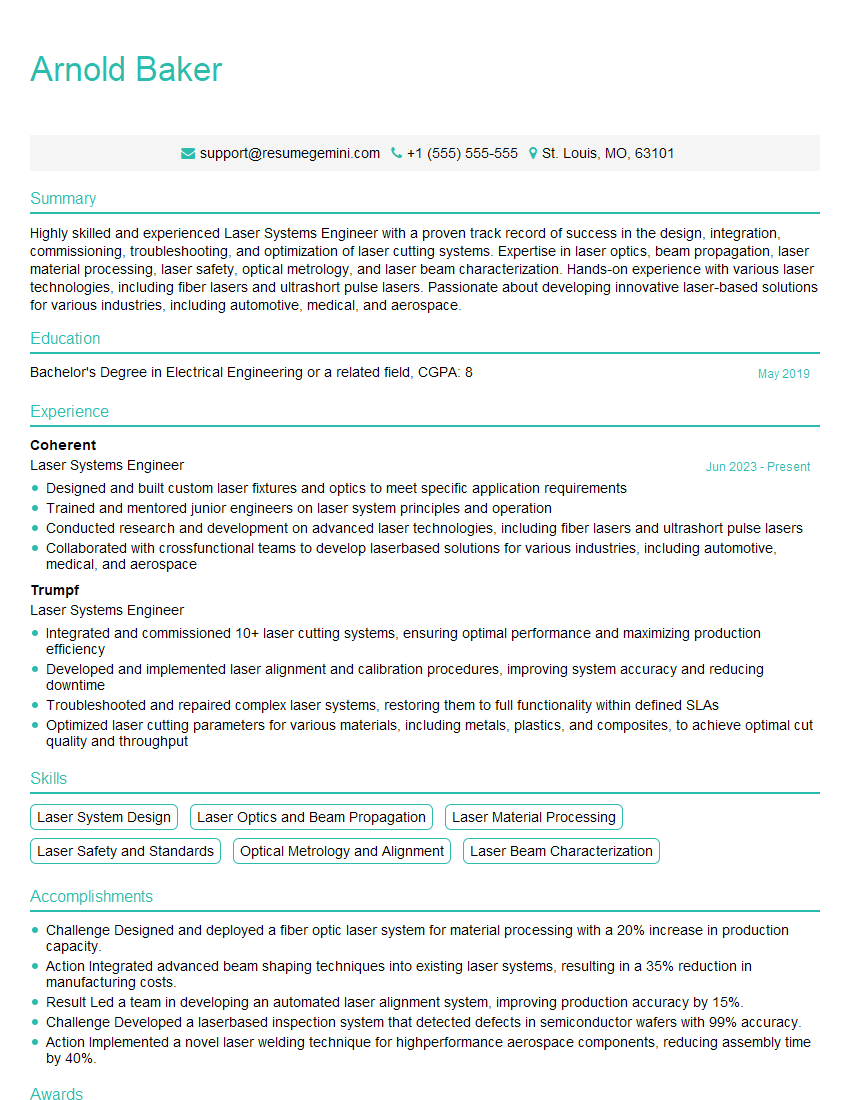
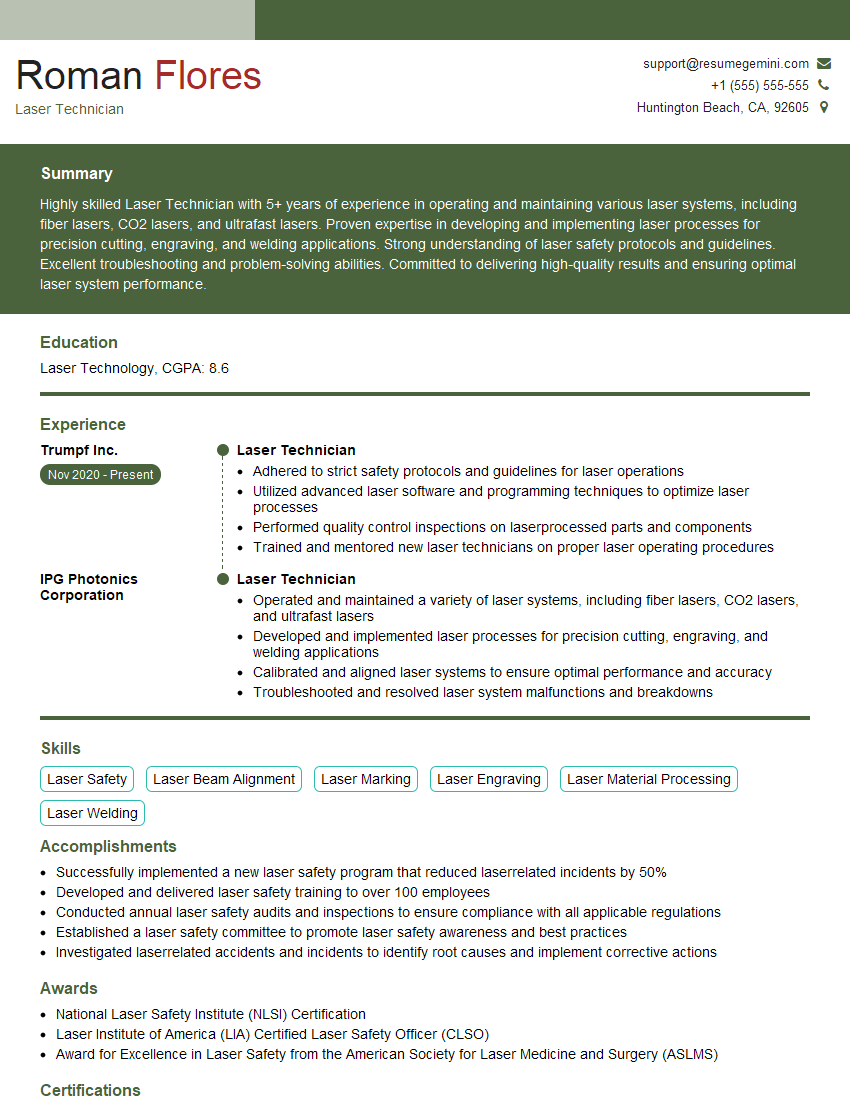
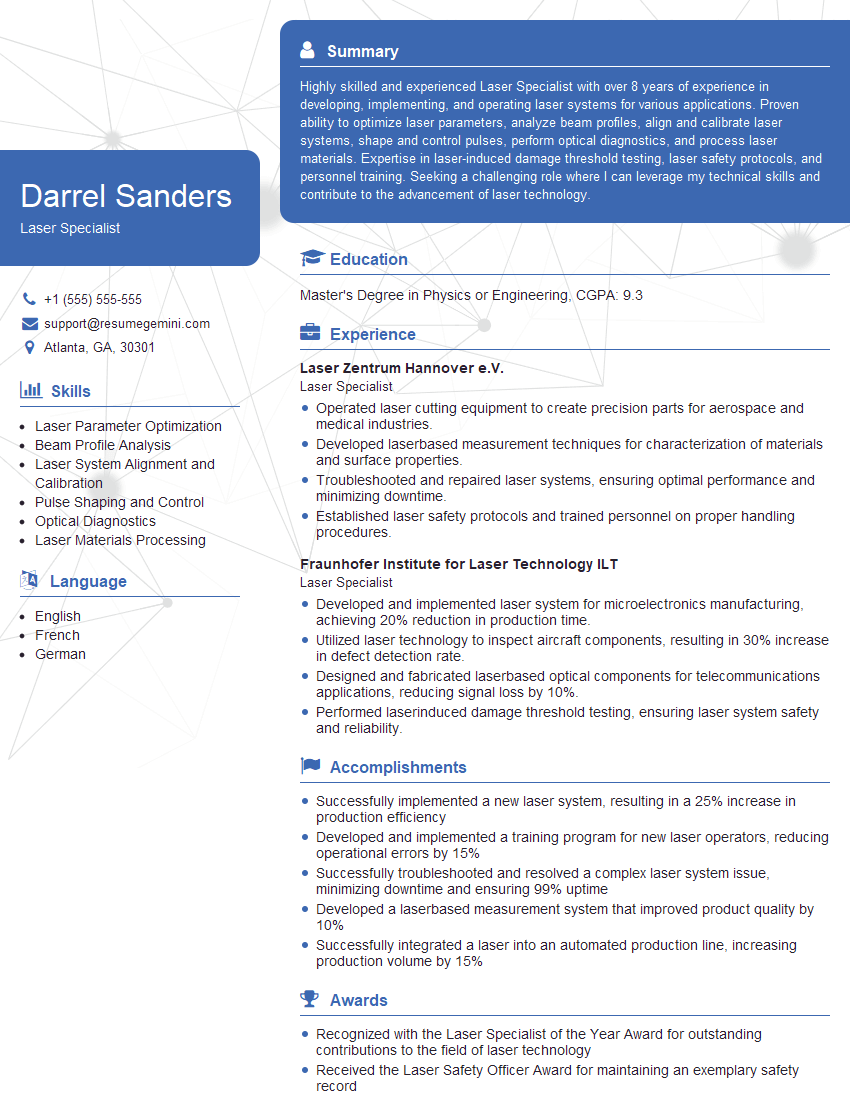
Mastering laser welding and cutting opens doors to exciting career opportunities in advanced manufacturing and technology. To significantly boost your job prospects, focus on crafting an ATS-friendly resume that highlights your skills and experience effectively. ResumeGemini is a trusted resource to help you build a professional and impactful resume. We provide examples of resumes tailored specifically to the Laser Welding and Cutting field to give you a head start. Take the next step towards your dream career today!

Explore more articles
Users Rating of Our Blogs
Share Your Experience
We value your feedback! Please rate our content and share your thoughts (optional).
What Readers Say About Our Blog
Very informative content, great job.
good