Every successful interview starts with knowing what to expect. In this blog, we’ll take you through the top Lead Generation and Marketing Automation interview questions, breaking them down with expert tips to help you deliver impactful answers. Step into your next interview fully prepared and ready to succeed.
Questions Asked in Lead Generation and Marketing Automation Interview
Q 1. Explain the difference between inbound and outbound lead generation.
Inbound and outbound lead generation represent two distinct approaches to attracting potential customers. Think of it like fishing: inbound is setting up a great pond and waiting for the fish to come to you, while outbound is actively casting your line to find the fish.
Inbound lead generation focuses on attracting prospects through valuable content and engaging experiences. This involves creating high-quality blog posts, webinars, ebooks, and other resources that address the pain points and interests of your target audience. Prospects find you organically through search engines, social media, or referrals. Examples include SEO optimization, content marketing, and social media engagement.
Outbound lead generation, conversely, is a more proactive approach. It involves directly reaching out to potential customers through various channels, such as cold emailing, cold calling, direct mail, or paid advertising. The goal is to introduce your product or service to individuals who may not be actively searching for it. Think of targeted ads on LinkedIn or a carefully crafted email sequence to a specific list of potential clients.
The choice between inbound and outbound strategies often depends on your target audience, industry, budget, and sales cycle. A well-rounded strategy typically incorporates elements of both.
Q 2. Describe your experience with various marketing automation platforms (e.g., Marketo, HubSpot, Pardot).
Throughout my career, I’ve had extensive experience with several leading marketing automation platforms, including Marketo, HubSpot, and Pardot. Each platform offers a unique set of features and strengths, but my experience allows me to leverage their capabilities to achieve optimal results.
Marketo, for instance, is known for its robust capabilities and extensive functionalities, particularly beneficial for large enterprises with complex marketing requirements. I’ve used it to manage intricate lead nurturing campaigns, personalized email sequences, and detailed analytics dashboards. One successful project involved segmenting a large database based on behavioral data, resulting in a 25% increase in conversion rates.
HubSpot is a popular choice for its all-in-one approach, combining CRM, marketing automation, and sales tools in a single platform. I’ve effectively used its user-friendly interface to implement effective email campaigns and landing page optimization, resulting in improved lead capture and qualification. A recent campaign used HubSpot’s A/B testing feature to refine landing pages, increasing the conversion rate by 15%.
Pardot, with its B2B focus, shines in lead scoring and account-based marketing. Its powerful features for tracking prospect interactions and automating lead routing have been instrumental in accelerating sales cycles. For example, I successfully used Pardot to implement a lead scoring model that prioritized high-value leads, resulting in a 20% increase in sales qualified leads.
My expertise extends beyond merely using the platforms; I understand the underlying principles of marketing automation and can effectively tailor the platform selection and implementation to meet specific business objectives.
Q 3. How do you measure the success of a lead generation campaign?
Measuring the success of a lead generation campaign involves assessing its effectiveness across several key metrics. It’s not enough just to get leads; you need qualified leads that move towards conversion.
- Website Traffic & Engagement: Monitoring website traffic, bounce rate, time on page, and content downloads reveals the effectiveness of your content and outreach.
- Lead Quantity & Quality: Tracking the number of leads generated is crucial, but more important is the quality of those leads. This involves examining factors like lead scoring, conversion rates, and the source of the lead.
- Conversion Rates: This measures the percentage of leads that convert into customers or move through the sales funnel. Analyzing conversion rates at various stages helps identify bottlenecks and areas for improvement.
- Cost Per Lead (CPL): Calculating the cost of acquiring a lead helps evaluate the return on investment (ROI) of your campaign. A lower CPL usually signifies greater efficiency.
- Customer Lifetime Value (CLTV): A long-term perspective is crucial. Understanding the projected revenue generated from a lead over their relationship with the company helps assess the true value of your lead generation efforts.
By tracking these metrics and analyzing the data, we can identify what’s working, what’s not, and make data-driven decisions to optimize the campaign for maximum impact.
Q 4. What key performance indicators (KPIs) do you track for marketing automation?
The KPIs I track for marketing automation are closely tied to the overall business goals and the specific campaign objectives. However, some core KPIs consistently provide valuable insights.
- Email Open and Click-Through Rates (CTR): These metrics reveal the engagement level with email campaigns, indicating the effectiveness of subject lines and messaging.
- Lead Scoring and Grading: Monitoring lead scores helps identify high-potential leads for prioritization by sales. Lead grading classifies leads based on their readiness to purchase.
- Marketing Qualified Leads (MQLs): These are leads that have demonstrated sufficient interest and engagement to be considered qualified for further sales outreach.
- Sales Qualified Leads (SQLs): These are MQLs that have met additional criteria to be handed over to the sales team for closing.
- Conversion Rates at Different Stages of the Funnel: Tracking conversion rates at each step, from initial engagement to purchase, provides a comprehensive view of the effectiveness of the automation process.
- Customer Acquisition Cost (CAC): Measuring the total cost of acquiring a customer provides crucial context for evaluating the ROI of marketing automation efforts.
Regular monitoring of these KPIs allows for timely adjustments to the automation strategies, ensuring the maximum impact of marketing investments.
Q 5. How do you segment your audience for targeted lead nurturing?
Audience segmentation is critical for effective lead nurturing. It allows you to deliver personalized messages that resonate with each segment’s specific needs and interests, significantly increasing engagement and conversion rates.
I employ several strategies for audience segmentation, including:
- Demographic Segmentation: This involves segmenting based on easily identifiable attributes like age, location, gender, industry, company size, and job title.
- Behavioral Segmentation: This focuses on past actions and interactions, such as website activity, email engagement, content downloads, and product usage. For instance, leads who have downloaded a specific ebook might be segmented into a group interested in that particular topic.
- Firmographic Segmentation: This is particularly relevant for B2B marketing and includes segmenting based on company size, revenue, industry, and other business characteristics.
- Psychographic Segmentation: This delves into the psychological characteristics of your audience, such as values, interests, lifestyle, and attitudes. For example, segmenting leads based on their level of environmental consciousness.
Combining these segmentation methods allows for a granular approach. For example, a company selling sustainable office supplies might segment its audience by industry (e.g., education, healthcare), company size, and engagement with content related to sustainability initiatives. This creates highly targeted nurturing campaigns with significantly improved effectiveness.
Q 6. Describe your experience with lead scoring and its importance.
Lead scoring is a crucial element of any effective lead generation strategy. It assigns numerical values to leads based on their behavior and characteristics, helping prioritize those most likely to convert.
My experience involves building and refining lead scoring models based on a combination of factors, including:
- Demographic Data: Company size, industry, job title, etc.
- Behavioral Data: Website visits, content downloads, email engagement, event attendance, demo requests, etc.
- Engagement Level: Frequency of interactions, duration of engagement, etc.
A well-designed lead scoring model helps sales teams focus their efforts on the most promising prospects. It improves efficiency by filtering out unqualified leads, saving time and resources. Furthermore, lead scoring provides valuable insights into lead behavior, helping refine marketing strategies and content creation.
For example, a lead who downloads several white papers, attends a webinar, and visits the pricing page multiple times will receive a higher score than a lead who only visited the homepage once. This scoring helps identify high-potential leads ready for sales engagement.
Q 7. How do you integrate lead generation efforts with sales processes?
Integrating lead generation and sales processes is paramount for seamless customer journeys and maximizing conversion rates. It’s about creating a smooth handoff between marketing and sales, ensuring that qualified leads are promptly contacted and nurtured.
Effective integration involves:
- Establishing Clear Service Level Agreements (SLAs): Defining response times, communication protocols, and lead qualification criteria ensures alignment between teams.
- Utilizing CRM Systems: Integrating marketing automation platforms with CRM systems (like Salesforce or HubSpot) provides a centralized view of lead information, enabling sales teams to access detailed prospect profiles.
- Implementing Lead Routing and Assignment Rules: Automating the assignment of leads to sales representatives based on territory, industry expertise, or lead score enhances efficiency.
- Regular Communication and Collaboration: Open communication between marketing and sales teams is crucial. This includes sharing performance data, feedback on lead quality, and best practices.
- Utilizing Feedback Loops: Regularly reviewing the effectiveness of lead generation and nurturing strategies based on sales team feedback helps refine the process.
When marketing and sales work collaboratively with a shared understanding of the lead process and clear communication channels, the conversion rate significantly improves. A well-oiled machine, if you will.
Q 8. Explain your understanding of the buyer’s journey and how it relates to lead generation.
The buyer’s journey is the process a customer goes through from initial awareness of a need to becoming a loyal customer. Understanding this journey is crucial for effective lead generation because it allows us to tailor our messaging and offers to resonate at each stage. It typically consists of three main stages:
- Awareness: The customer recognizes a problem or need. Lead generation activities at this stage focus on building brand awareness and providing valuable content (blog posts, webinars, infographics) that addresses their pain points. For example, a company selling project management software might publish blog posts on the challenges of inefficient project management.
- Consideration: The customer actively researches solutions to their problem. Lead generation here involves providing more detailed information, such as case studies, product demos, and comparison charts. Using the same example, they might offer a free trial of the software.
- Decision: The customer chooses a solution and makes a purchase. Lead generation efforts here focus on providing testimonials, pricing information, and clear calls to action to encourage conversion. This could involve a personalized email sequence showing the benefits of the software based on the lead’s industry.
By aligning our lead generation efforts with each stage of the buyer’s journey, we can increase the effectiveness of our campaigns and nurture leads more efficiently, leading to higher conversion rates.
Q 9. What are some common challenges in lead generation and how have you overcome them?
Common challenges in lead generation include:
- Low-quality leads: Generating a large volume of leads that aren’t genuinely interested in your product or service. I’ve overcome this by implementing stricter lead qualification criteria, using more targeted advertising, and focusing on content marketing that attracts high-intent prospects.
- Insufficient lead flow: Not generating enough leads to meet sales targets. To tackle this, I’ve employed a multi-channel approach, combining SEO, paid advertising, social media marketing, email marketing, and content marketing to broaden our reach.
- High cost per lead (CPL): Spending too much money acquiring each lead. I address this by carefully analyzing campaign performance, A/B testing different ad creatives and targeting options, and optimizing landing pages to improve conversion rates.
- Lead nurturing challenges: Failing to effectively nurture leads and convert them into customers. I’ve implemented automated email sequences, personalized messaging, and segmented email campaigns to nurture leads throughout the buyer’s journey.
For example, in a previous role, we were facing a low conversion rate on our landing pages. By A/B testing different headlines, call-to-action buttons, and form fields, we improved the conversion rate by 30%.
Q 10. How do you identify and qualify leads?
Identifying and qualifying leads is a crucial process. I use a multi-pronged approach:
- Lead Scoring: This assigns points to leads based on their behavior and demographics (e.g., website visits, content downloads, engagement with emails). Leads exceeding a certain score are considered qualified.
- Marketing Qualified Leads (MQLs): These are leads that have shown significant interest in your offerings based on their engagement with your marketing efforts. I define specific criteria (e.g., downloading a specific case study, attending a webinar) to qualify MQLs.
- Sales Qualified Leads (SQLs): These are MQLs that have been further qualified by the sales team based on factors such as budget, authority, and need (BANT). This usually involves a conversation to determine if the lead is a good fit.
- Data Enrichment: Enhancing lead data with information from third-party sources to improve the accuracy of lead scoring and qualification.
Using a combination of these methods ensures that we focus our sales efforts on leads with the highest potential for conversion.
Q 11. What is your experience with A/B testing in email marketing?
A/B testing is fundamental to optimizing email marketing. I’ve extensively used it to test various elements:
- Subject lines: Comparing different subject lines to determine which generates the highest open rates. For example, I tested subject lines focused on benefits vs. features and found that benefit-driven subject lines outperformed feature-focused ones.
- Call-to-action buttons: Testing different button colors, wording, and placement to optimize click-through rates. I found that using strong action verbs and clear, concise copy improved CTR.
- Email content: Testing different email formats (text vs. HTML), layouts, and messaging to enhance engagement. Using images and short paragraphs often outperformed large blocks of text.
- Send times: Experimenting with different send times to identify optimal delivery times for maximizing open and click-through rates.
By meticulously analyzing the results of these tests, I can continuously improve the effectiveness of our email campaigns and achieve better results. I typically use tools like Google Analytics or dedicated email marketing platforms’ built-in A/B testing features.
Q 12. Describe your experience with landing page optimization.
Landing page optimization is critical for maximizing lead generation. My approach involves:
- Clear and concise messaging: Ensuring the landing page clearly communicates the value proposition and benefits to the visitor.
- Compelling headlines and calls to action: Using strong headlines that grab attention and clear, persuasive calls to action that encourage conversions.
- Optimized forms: Keeping forms short and requesting only essential information to minimize abandonment rates.
- High-quality visuals: Using relevant images and videos to enhance engagement and build trust.
- Mobile responsiveness: Ensuring the landing page is responsive and looks good on all devices.
- A/B testing: Continuously testing different versions of the landing page to identify what works best.
For instance, in one project, we redesigned a landing page using clearer headlines, a shorter form, and more compelling visuals, resulting in a 45% increase in conversion rates.
Q 13. How do you use data analytics to improve lead generation performance?
Data analytics is at the core of improving lead generation performance. I use various tools and techniques to analyze data:
- Website analytics (Google Analytics): Tracking website traffic, user behavior, and conversion rates to identify areas for improvement.
- Marketing automation platform analytics: Analyzing email marketing metrics (open rates, click-through rates, conversion rates), lead scoring performance, and campaign ROI.
- CRM data analysis: Tracking lead source, conversion rates, and sales performance to identify which lead generation channels are most effective.
- A/B testing results: Analyzing the results of A/B tests to optimize campaigns and landing pages.
By carefully analyzing these data points, I can identify trends, pinpoint areas of weakness, and make data-driven decisions to improve lead generation performance. This might involve adjusting ad targeting, refining our email campaigns, or improving our website’s SEO.
Q 14. What is your experience with CRM systems and their integration with marketing automation?
I have extensive experience with CRM systems (like Salesforce, HubSpot) and their integration with marketing automation platforms (like Marketo, Pardot). This integration is crucial for creating a seamless lead management process. A well-integrated system allows for:
- Automated lead routing: Automatically routing qualified leads to the appropriate sales representatives.
- Real-time lead tracking: Monitoring lead activity and progress throughout the sales pipeline.
- Improved lead nurturing: Personalizing communication and providing targeted content based on lead behavior and lifecycle stage.
- Enhanced reporting and analytics: Gaining a comprehensive view of the lead generation process and its effectiveness.
In the past, I’ve worked on integrating HubSpot with our marketing automation platform, enabling automated email sequences triggered by lead actions (e.g., form submission, website visit). This streamlined our lead nurturing process and significantly improved our conversion rates.
Q 15. How do you manage and nurture leads through different stages of the sales funnel?
Lead nurturing is the process of cultivating relationships with prospective customers at each stage of their buyer’s journey, ultimately guiding them toward a purchase. Think of it like gardening: you wouldn’t plant a seed and expect a fully grown plant overnight. You need to water, fertilize, and weed—providing the right conditions for growth. Similarly, nurturing leads requires a tailored approach depending on where they are in the funnel.
Awareness Stage: Leads at this stage are just discovering a problem or need. My approach involves providing valuable content like blog posts, webinars, or social media updates that address their pain points and establish thought leadership. This builds trust and credibility.
Consideration Stage: Leads are now researching solutions. Here, I focus on providing more in-depth content like case studies, white papers, and product demos to showcase how our solutions address their specific needs. Comparison charts and competitor analyses can also be highly effective at this stage.
Decision Stage: Leads are ready to buy. At this point, I focus on personalized communication, addressing their specific concerns and questions. This often includes one-on-one demos, personalized email sequences, and targeted advertising. Ultimately, the goal is to make the purchase decision as easy as possible.
I use marketing automation tools to streamline this process, segmenting leads based on their behavior and automatically delivering the appropriate content at each stage.
Career Expert Tips:
- Ace those interviews! Prepare effectively by reviewing the Top 50 Most Common Interview Questions on ResumeGemini.
- Navigate your job search with confidence! Explore a wide range of Career Tips on ResumeGemini. Learn about common challenges and recommendations to overcome them.
- Craft the perfect resume! Master the Art of Resume Writing with ResumeGemini’s guide. Showcase your unique qualifications and achievements effectively.
- Don’t miss out on holiday savings! Build your dream resume with ResumeGemini’s ATS optimized templates.
Q 16. Explain your understanding of marketing automation workflows.
Marketing automation workflows are pre-defined sequences of actions triggered by specific events or user behaviors. Think of them as automated, personalized customer journeys. These workflows leverage software to automate repetitive tasks, saving time and resources while delivering a consistent brand experience. A well-designed workflow can dramatically improve lead nurturing and conversion rates.
For example, a simple workflow could be triggered when a user downloads a white paper. This event could automatically add the user to an email sequence that delivers follow-up content related to the topic. More complex workflows might involve lead scoring, segmentation based on demographics or behavior, and personalized email sequences with dynamic content.
Effective workflows are crucial for efficient lead management and ensure that leads receive the right message at the right time. A poorly designed workflow, however, can be counterproductive, leading to irrelevant messaging and damaging brand perception.
Q 17. How do you handle lead data privacy and compliance?
Data privacy and compliance are paramount. I ensure all lead generation and marketing automation activities adhere to relevant regulations like GDPR, CCPA, and others. This includes:
Obtaining explicit consent: I ensure all data collection is transparent and users actively opt-in to receive communications. This is crucial for building trust and avoiding legal issues.
Data security: I use secure platforms and employ best practices to protect lead data from unauthorized access or breaches. This often involves using encrypted databases and strong password policies.
Data minimization: I only collect necessary data, and I regularly review and purge outdated or irrelevant information. This demonstrates respect for user privacy and minimizes potential risks.
Transparency and control: I provide users with clear information about how their data is used and offer easy mechanisms for updating preferences or opting out. This fosters trust and empowers users to manage their data.
Compliance isn’t just about avoiding penalties; it’s about building trust with leads and creating a positive brand reputation.
Q 18. Describe your experience with content marketing and its role in lead generation.
Content marketing is the cornerstone of effective lead generation. It involves creating and distributing valuable, relevant, and consistent content to attract and retain a clearly defined audience — and, ultimately, to drive profitable customer action. I leverage various content formats, including:
Blog posts: These provide valuable insights and establish thought leadership in the target industry.
White papers and ebooks: In-depth resources addressing specific industry challenges.
Case studies: Demonstrating the success of products or services.
Videos and webinars: Engaging and informative content formats.
Infographics: Visual representation of complex data.
The key to successful content marketing is understanding the target audience’s needs and creating content that resonates with them. I use analytics to track content performance and make data-driven decisions to optimize strategy.
For instance, I once worked with a client who struggled to generate leads. Through detailed analysis of their target audience, we developed a series of blog posts and case studies focused on their specific challenges. This led to a significant increase in lead generation and conversion rates.
Q 19. What is your experience with social media marketing for lead generation?
Social media marketing is a powerful tool for lead generation. I utilize various platforms, tailoring my approach to each platform’s unique audience and capabilities. This involves:
Targeted advertising: Using social media platforms’ advertising capabilities to reach specific demographics and interests with highly targeted ads.
Engaging content: Sharing valuable content to foster engagement and build brand awareness. This often involves interactive content like polls, quizzes, and Q&A sessions.
Community building: Actively participating in relevant conversations and building relationships with potential leads.
Social listening: Monitoring social media conversations to understand audience needs and identify potential leads.
For example, a recent campaign involved using LinkedIn to target professionals in a specific industry with a series of informative videos about a new product. This resulted in a significant increase in lead generation and qualified sales opportunities.
Q 20. How do you use SEO and SEM to improve lead generation?
SEO (Search Engine Optimization) and SEM (Search Engine Marketing) are crucial for driving organic and paid traffic to your website, thus generating leads. My strategy includes:
Keyword research: Identifying relevant keywords that target audiences are searching for.
On-page optimization: Optimizing website content and structure to rank higher in search results.
Off-page optimization: Building high-quality backlinks to improve website authority and search ranking.
Paid search campaigns (SEM): Running targeted advertising campaigns on search engines like Google to drive qualified traffic to landing pages.
Tracking and analysis: Using analytics tools to monitor campaign performance and make data-driven optimizations.
For example, in a past project, we implemented a comprehensive SEO strategy that involved keyword research, on-page optimization, and link building. This resulted in a significant increase in organic traffic and qualified leads.
Q 21. Explain your understanding of different lead generation techniques.
Lead generation techniques encompass a wide range of strategies aimed at attracting and capturing potential customers. These include:
Content marketing (as discussed above): Creating valuable content to attract and engage audiences.
Email marketing: Building email lists and sending targeted email campaigns.
Social media marketing (as discussed above): Using social media platforms to generate leads.
SEO/SEM (as discussed above): Optimizing websites for search engines and running paid search campaigns.
Paid advertising: Running targeted advertising campaigns on various platforms.
Partnerships and affiliations: Collaborating with other businesses to reach new audiences.
Events and webinars: Hosting events and webinars to generate leads and build brand awareness.
Lead magnets: Offering valuable incentives (e.g., ebooks, white papers, templates) in exchange for contact information.
The most effective strategy will vary depending on the target audience, industry, and budget. A successful lead generation strategy often involves a combination of techniques.
Q 22. How do you prioritize lead generation activities?
Prioritizing lead generation activities requires a strategic approach that balances immediate needs with long-term goals. I use a framework that combines quantitative data with qualitative insights. First, I analyze historical data to identify which channels and activities have yielded the highest-quality leads in the past. This includes metrics like conversion rates, cost per lead (CPL), and customer lifetime value (CLTV). Then, I assess the current market landscape and competitive analysis to identify emerging opportunities and potential threats. For example, if a competitor is aggressively using LinkedIn, we might need to increase our efforts there. Finally, I factor in resource allocation and budgetary constraints.
- High-Impact Activities First: Activities with demonstrably high ROI, like SEO for high-value keywords or targeted LinkedIn campaigns, receive priority.
- A/B Testing and Optimization: Continuous A/B testing of different elements within campaigns allows us to refine what works best, constantly improving ROI and refining our prioritization.
- Alignment with Sales Capacity: We need to generate leads that the sales team can realistically handle. Overwhelming them with too many unqualified leads is counterproductive.
This multi-faceted approach ensures that our lead generation efforts are efficient, effective, and directly contribute to business growth.
Q 23. Describe your experience with multi-channel marketing campaigns.
My experience with multi-channel marketing campaigns is extensive. I believe in a holistic approach, leveraging the strengths of different channels to create a synergistic effect. I’ve successfully orchestrated campaigns integrating:
- Search Engine Optimization (SEO): Driving organic traffic through high-quality content and keyword optimization.
- Search Engine Marketing (SEM): Utilizing paid search advertising on platforms like Google Ads to target specific keywords and demographics.
- Social Media Marketing (SMM): Engaging target audiences on platforms like LinkedIn, Twitter, and Facebook with tailored content and targeted advertising.
- Email Marketing: Nurturing leads through automated email sequences, personalized messaging, and targeted promotions.
- Content Marketing: Creating valuable content (blog posts, ebooks, webinars) to attract and engage potential customers.
- Account-Based Marketing (ABM): Focusing on high-value prospects with personalized outreach and targeted campaigns.
For example, in a recent B2B campaign, we combined LinkedIn advertising with targeted content downloads (white papers) and follow-up email nurturing. This multi-channel approach increased lead generation by 45% compared to previous single-channel efforts. The key is to maintain consistent brand messaging and a seamless customer journey across all channels.
Q 24. How do you handle and resolve conflicts between marketing and sales teams?
Conflicts between marketing and sales often stem from misaligned goals, differing perceptions of lead quality, or a lack of communication. I proactively address these issues through several key strategies.
- Defining Clear KPIs and SLAs: Establishing shared metrics like lead qualification criteria, conversion rates, and sales cycle length ensures everyone is working toward the same objectives. We use a Service Level Agreement (SLA) to define response times and lead handover processes.
- Regular Communication and Feedback Loops: Frequent meetings and open communication channels facilitate the exchange of ideas and feedback. I ensure both teams have a voice, addressing concerns and seeking collaboration.
- Lead Scoring and Qualification Systems: Implementing a robust lead scoring system ensures that sales receives only high-quality, qualified leads that meet pre-defined criteria. This reduces friction and wasted resources.
- Joint Training and Education: Providing both teams with the same training on lead generation strategies, sales processes, and customer relationship management (CRM) tools fosters mutual understanding and eliminates misunderstandings.
By establishing clear processes, fostering open communication, and focusing on shared goals, I can successfully navigate and resolve potential conflicts, fostering a collaborative environment that benefits both teams and the overall business.
Q 25. What are some examples of successful lead generation campaigns you’ve worked on?
I’ve been fortunate to work on several successful lead generation campaigns. One notable example involved a SaaS company seeking to expand its customer base. We implemented a multi-pronged strategy:
- Content Marketing: We created a series of high-quality blog posts, case studies, and webinars targeting specific industry pain points.
- Search Engine Optimization (SEO): We optimized the company’s website and content to rank higher in search engine results pages (SERPs) for relevant keywords.
- Social Media Marketing: We built a strong social media presence, sharing engaging content and participating in relevant conversations.
- Paid Advertising: We ran targeted advertising campaigns on LinkedIn and Google Ads to reach a wider audience.
- Email Marketing: We created automated email sequences to nurture leads and move them through the sales funnel.
This integrated approach resulted in a 70% increase in qualified leads within six months. Another successful campaign involved creating a free online tool that collected contact information and qualified leads based on their usage, resulting in a high conversion rate and organic lead generation.
Q 26. What are your salary expectations?
My salary expectations are commensurate with my experience and skills in the field of lead generation and marketing automation. Considering my expertise and accomplishments, I am seeking a salary in the range of [Insert Salary Range Here]. I am open to discussing this further based on the specifics of the role and the overall compensation package.
Q 27. What are your long-term career goals?
My long-term career goals involve becoming a recognized leader in the field of lead generation and marketing automation. I aspire to continue developing my expertise in innovative marketing strategies and technologies. I am interested in taking on increasing responsibility, potentially leading a team and mentoring others. Ultimately, I aim to contribute to the growth and success of a forward-thinking organization that values data-driven decision making and fosters a culture of continuous improvement.
Key Topics to Learn for Lead Generation and Marketing Automation Interview
- Lead Generation Strategies: Understanding inbound and outbound strategies, including content marketing, SEO, social media marketing, paid advertising, and email marketing. Consider the nuances of each and how they contribute to a holistic approach.
- Marketing Automation Platforms: Familiarity with popular platforms (mentioning specific platforms is avoided to encourage broader learning) and their functionalities. Focus on workflow automation, lead scoring, and campaign management.
- Lead Nurturing and Scoring: Develop a strong understanding of how to nurture leads through various stages of the sales funnel using automated sequences. Explore different lead scoring models and their effectiveness.
- Data Analysis and Reporting: Mastering the art of interpreting marketing automation data to measure campaign performance, identify areas for improvement, and demonstrate ROI. Practice visualizing data effectively.
- Sales and Marketing Alignment: Discuss the importance of collaboration between sales and marketing teams for successful lead generation and conversion. Explore strategies for bridging the gap between these departments.
- Ethical Considerations: Understand and address the ethical implications of marketing automation, including data privacy, consent, and responsible data usage.
- Problem-Solving in Marketing Automation: Practice troubleshooting common challenges, such as low conversion rates, email deliverability issues, and integration problems with CRM systems. Develop a structured approach to problem-solving.
- Emerging Trends: Stay updated on the latest trends in lead generation and marketing automation, including AI-powered tools and personalized marketing techniques.
Next Steps
Mastering Lead Generation and Marketing Automation is crucial for career advancement in today’s competitive market. These skills are highly sought after, opening doors to exciting opportunities and higher earning potential. To significantly boost your job prospects, create an ATS-friendly resume that highlights your accomplishments and skills effectively. ResumeGemini is a trusted resource to help you build a professional and impactful resume. Leverage their expertise to craft a compelling narrative that showcases your capabilities. Examples of resumes tailored to Lead Generation and Marketing Automation are available to help you get started.
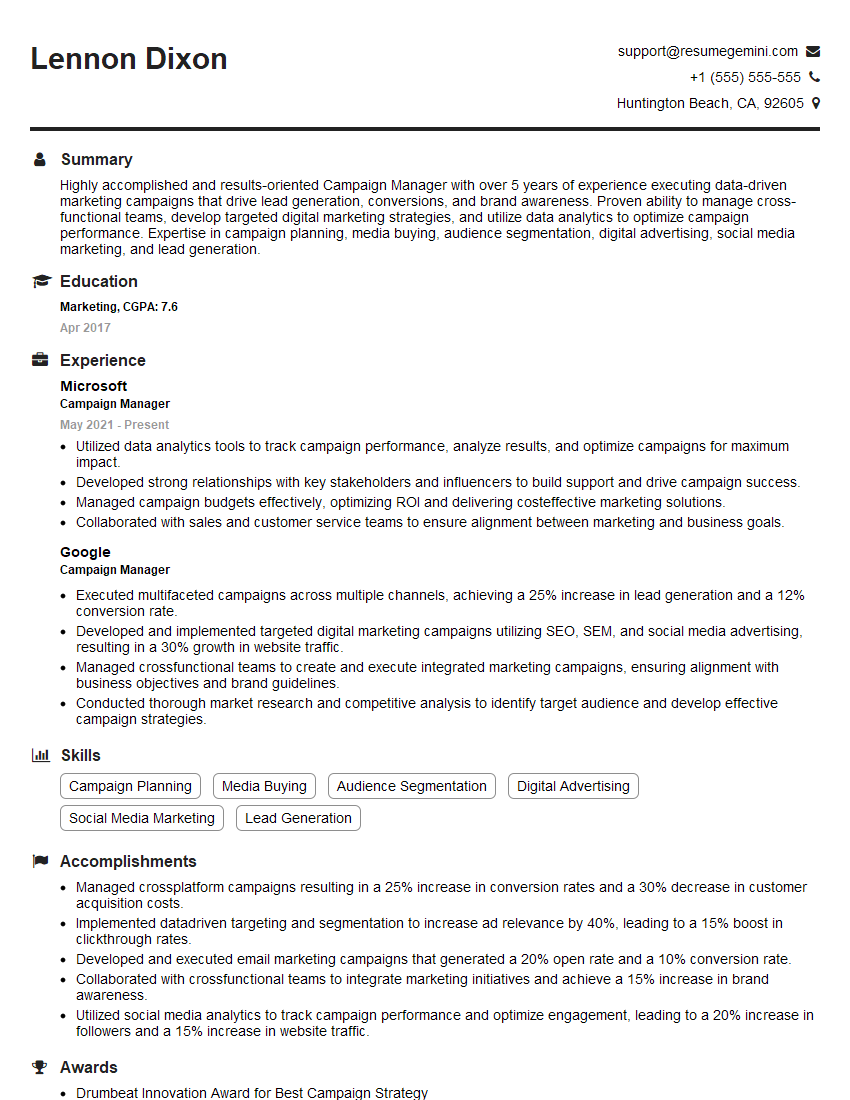
Campaign Manager Resume Sample
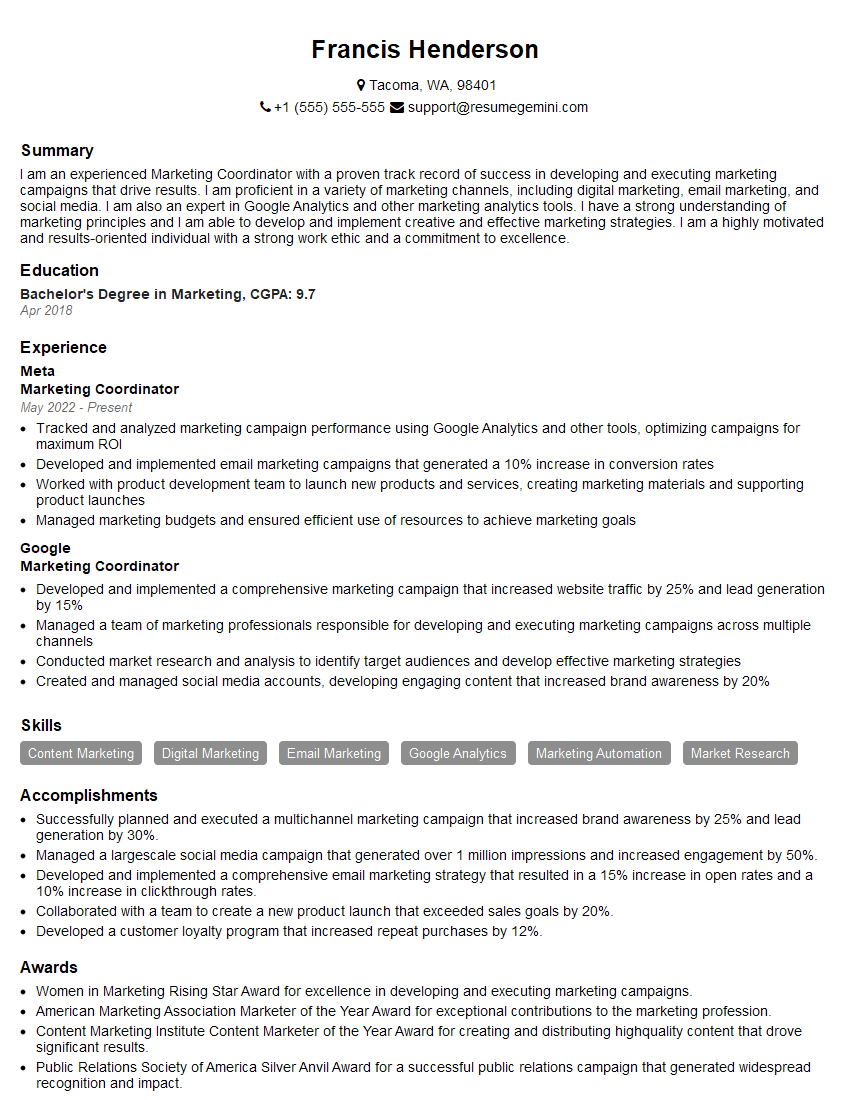
Marketing Coordinator Resume Sample
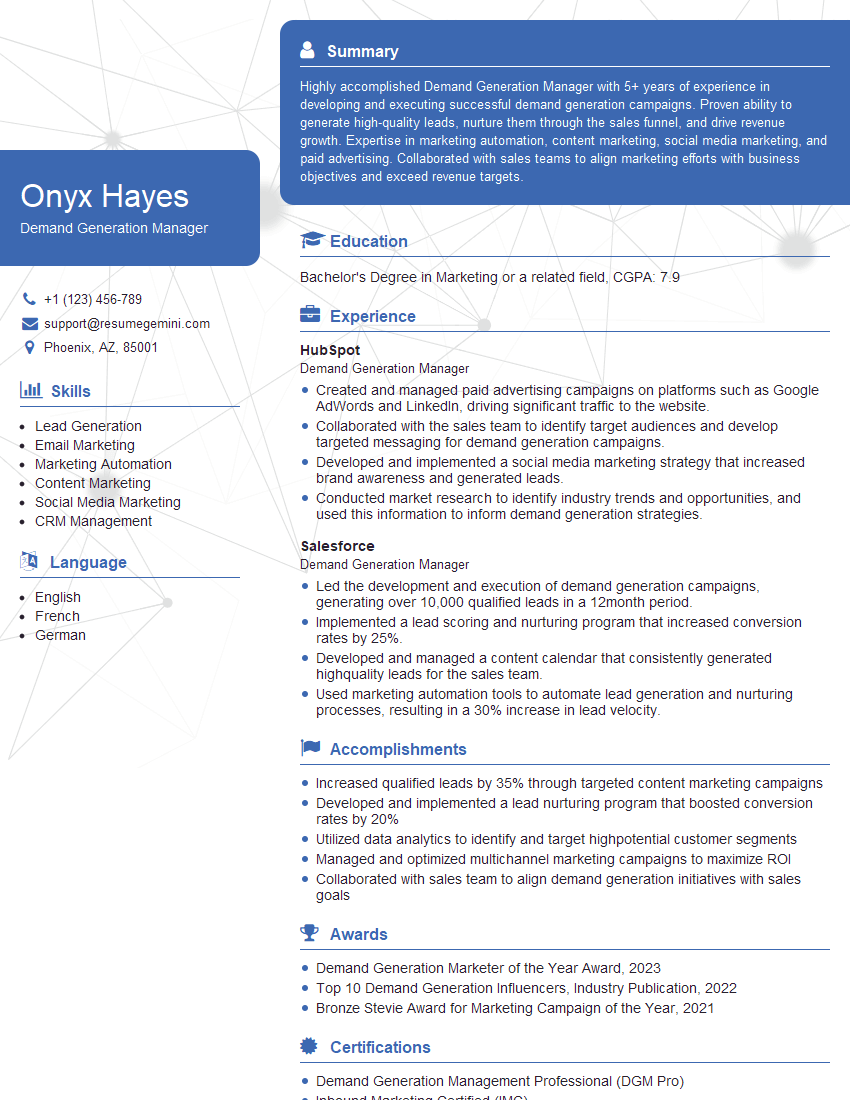
Demand Generation Manager Resume Sample
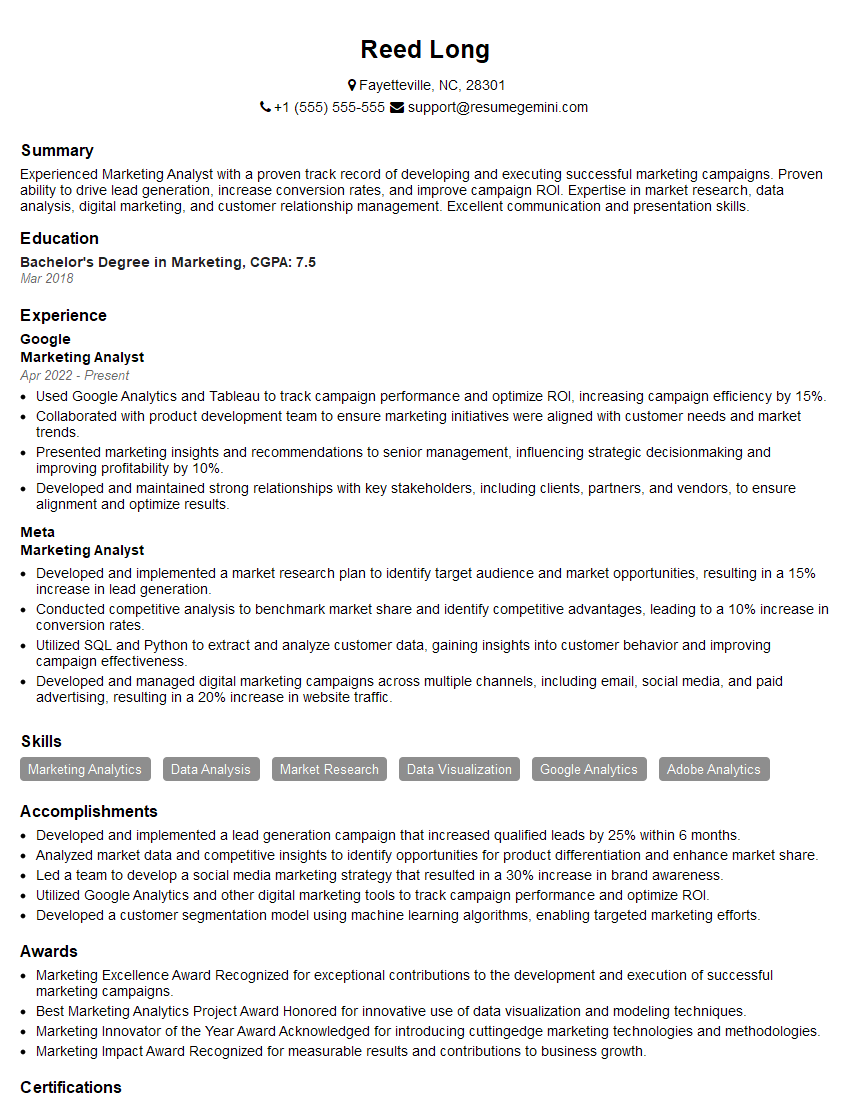
Marketing Analyst Resume Sample

Growth Hacker Resume Sample
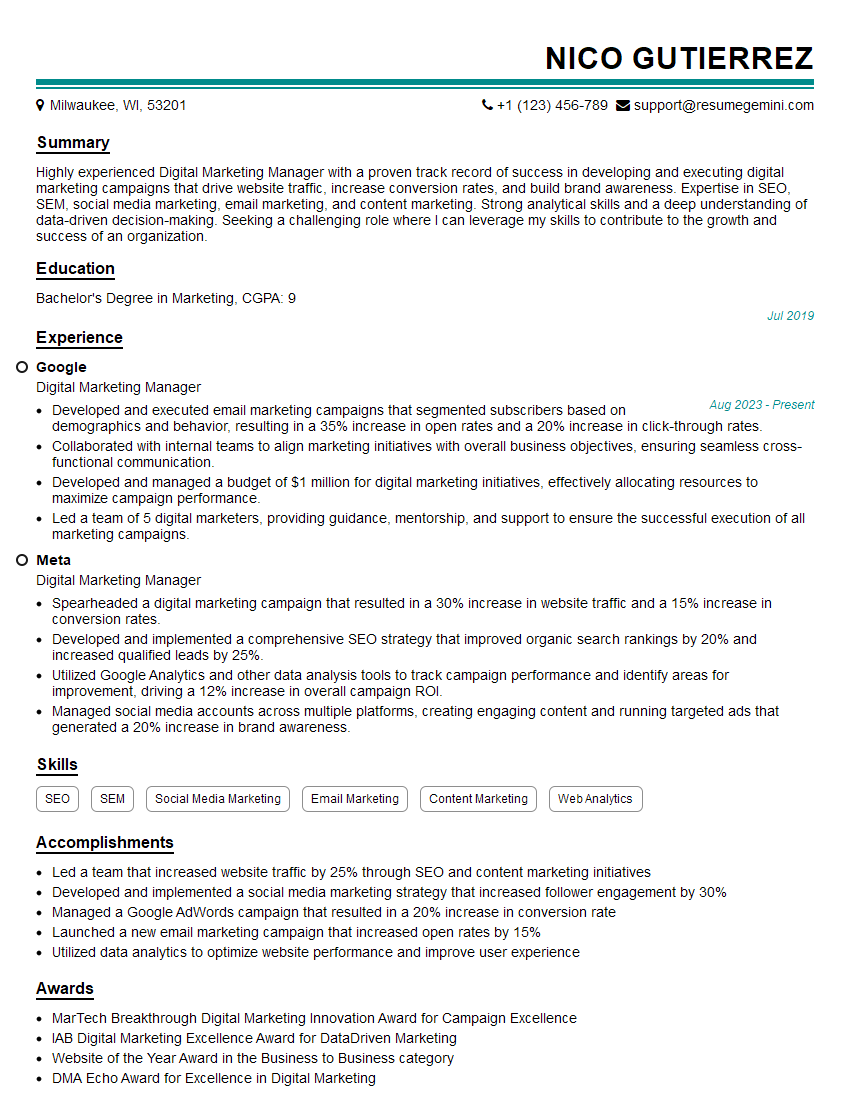
Digital Marketing Manager Resume Sample
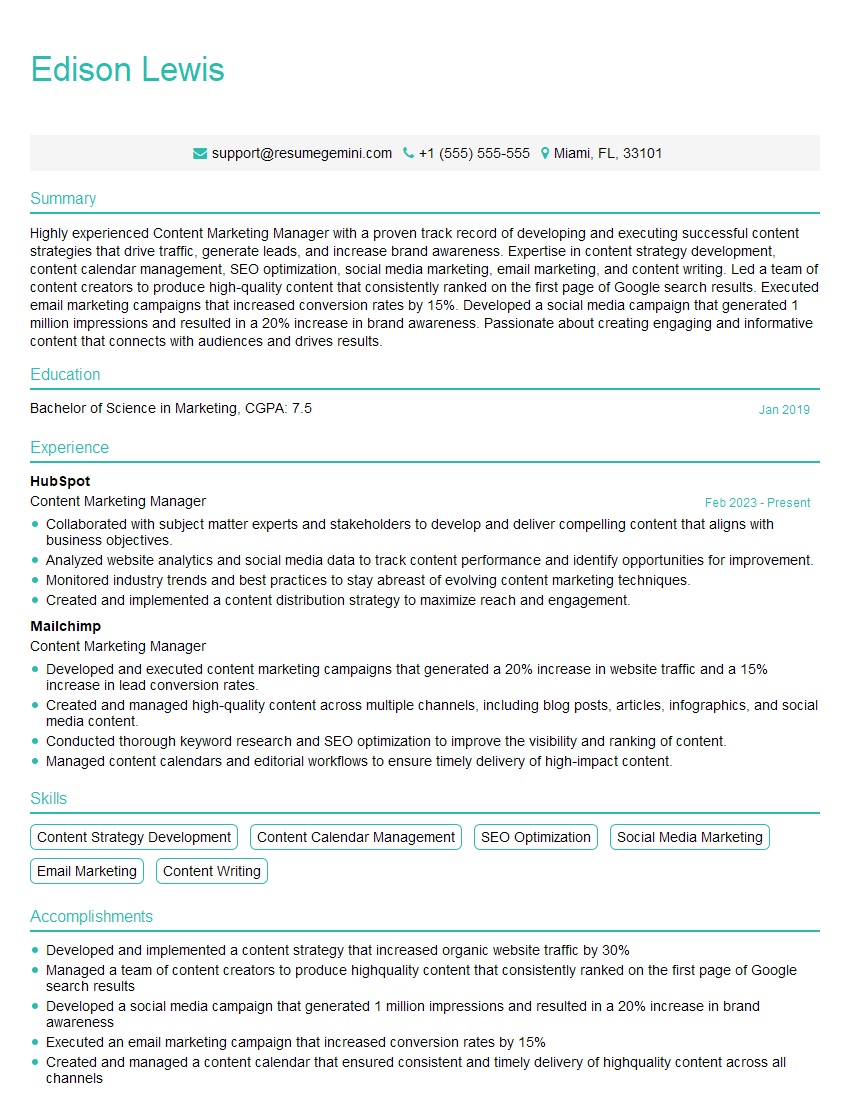
Content Marketing Manager Resume Sample

Social Media Marketing Manager Resume Sample
Explore more articles
Users Rating of Our Blogs
Share Your Experience
We value your feedback! Please rate our content and share your thoughts (optional).
What Readers Say About Our Blog
Very informative content, great job.
good