Are you ready to stand out in your next interview? Understanding and preparing for Light-Matter Interaction interview questions is a game-changer. In this blog, we’ve compiled key questions and expert advice to help you showcase your skills with confidence and precision. Let’s get started on your journey to acing the interview.
Questions Asked in Light-Matter Interaction Interview
Q 1. Explain the concept of absorption and emission of light by matter.
Absorption and emission are fundamental processes in light-matter interaction where an atom or molecule interacts with light, leading to a change in its energy state.
Absorption occurs when a photon of light with energy precisely matching the energy difference between two energy levels of the atom or molecule is absorbed. This excites the atom or molecule to a higher energy level. Think of it like a ball being lifted to a higher shelf – energy is added. The energy of the absorbed photon is directly proportional to its frequency, as described by Planck’s equation: E = hf, where E is energy, h is Planck’s constant, and f is frequency.
Emission is the opposite process. An excited atom or molecule in a higher energy state can release a photon and transition back to a lower energy state. This emitted photon carries away the energy difference between the two levels. It’s like the ball falling back from the shelf, releasing its potential energy. Emission can be spontaneous or stimulated (explained in a later question). The color of the emitted or absorbed light corresponds directly to the energy difference between the energy levels involved, explaining why different materials absorb and emit light at characteristic wavelengths.
An everyday example is the chlorophyll in plants absorbing sunlight (primarily red and blue light) and using its energy for photosynthesis. The green light is reflected, which is why plants appear green.
Q 2. Describe different types of light-matter interactions (e.g., Rayleigh scattering, Raman scattering).
Light-matter interactions encompass various processes, depending on the energy of the light and the properties of the matter. Here are some examples:
- Rayleigh Scattering: This occurs when light interacts with particles significantly smaller than its wavelength. The light is scattered in all directions, with intensity inversely proportional to the fourth power of the wavelength. This explains why the sky appears blue (blue light is scattered more than red light). It’s why sunsets are often red, as the blue light is scattered away leaving longer wavelengths like red and orange more prominent.
- Raman Scattering: A weaker effect, Raman scattering involves inelastic scattering of light. The scattered light has a different frequency (and therefore energy) than the incident light, resulting from vibrational or rotational transitions within the molecule. This technique provides valuable information about molecular structure. The energy difference between the incident and scattered light gives insights into vibrational modes, serving as a fingerprint for molecular identification.
- Absorption and Emission (discussed above): These are the fundamental processes underlying many phenomena such as fluorescence and lasers.
- Brillouin scattering: This is similar to Raman scattering, but involves interactions with acoustic phonons (vibrations of the crystal lattice) in solids rather than molecular vibrations.
These interactions are critical in various fields: Rayleigh scattering explains atmospheric optics; Raman spectroscopy is a powerful analytical tool used in chemistry and materials science; absorption and emission are essential for lasers, LEDs, and various optical devices.
Q 3. What is the role of the electromagnetic field in light-matter interaction?
The electromagnetic field is the key mediator in all light-matter interactions. Light itself is an electromagnetic wave, a fluctuating electric and magnetic field propagating through space. When light interacts with matter, its oscillating electric field interacts with the charges (electrons and nuclei) within the atoms or molecules.
This interaction perturbs the electronic structure of the atoms or molecules, causing transitions between different energy levels. The strength of the interaction depends on the amplitude of the electric field (intensity of the light) and the nature of the material’s response to the electromagnetic field, characterized by its dielectric properties and conductivity.
Consider a simple model where an oscillating electric field drives the electrons within an atom, causing them to oscillate at the same frequency. If this frequency matches a resonant frequency of the atom, the absorption is maximized (strong light-matter coupling). This is fundamentally how atoms absorb and emit light at specific wavelengths corresponding to their energy level differences. The electromagnetic field is the essential bridge facilitating the exchange of energy between light and matter.
Q 4. Explain the concept of spontaneous and stimulated emission.
Both spontaneous and stimulated emission are types of emission, where an excited atom or molecule returns to a lower energy state by releasing a photon. The key difference lies in the trigger:
- Spontaneous Emission: This occurs randomly. An excited atom or molecule spontaneously decays to a lower energy level, emitting a photon in a random direction and with a random phase. It is a purely probabilistic event. Imagine a ball on a shelf spontaneously falling down.
- Stimulated Emission: This is triggered by an incoming photon of specific energy. When an excited atom or molecule encounters a photon whose energy matches the energy difference between the excited state and a lower state, it is stimulated to emit an identical photon (same energy, phase, and direction) alongside the incoming photon. It’s like hitting a ball already perched on the edge of a shelf; it falls down in a predictable direction.
Stimulated emission is the cornerstone of laser operation, as it leads to the amplification of light. This amplification effect results from the coherent emission of photons all sharing the same phase, leading to an intense and collimated beam.
Q 5. Describe the principles behind laser operation.
Lasers (Light Amplification by Stimulated Emission of Radiation) are based on the principle of stimulated emission. Key components include:
- Gain medium: A material with an energy level structure that allows for population inversion, meaning more atoms are in a higher energy state than a lower energy state.
- Pumping mechanism: A process that excites atoms to the higher energy level (e.g., electrical discharge, optical pumping).
- Optical resonator: Typically a pair of mirrors that trap the light within the gain medium, allowing for multiple passes and stimulated emissions, leading to amplification. This creates positive feedback. One mirror is partially transparent to allow a laser beam to escape.
The operation involves pumping the gain medium to achieve population inversion. Spontaneous emission creates photons that then stimulate further emissions from other excited atoms. These photons bounce between the mirrors of the resonator, stimulating more emission and amplifying the light. The resulting light is highly coherent (same phase and frequency), directional, and intense, which distinguishes laser light from other light sources.
Q 6. What are the key differences between fluorescence and phosphorescence?
Both fluorescence and phosphorescence are types of luminescence, where light is emitted after the absorption of light, but they differ in the mechanism of the emission:
- Fluorescence: The excited state decays to the ground state via a radiative transition (emission of light) relatively quickly, typically within nanoseconds to microseconds. The emitted light has lower energy (longer wavelength) than the absorbed light (Stokes shift). This is a spin-allowed transition, meaning the spin of the electron doesn’t change during the transition.
- Phosphorescence: The excited molecule first goes to a metastable (long-lived) triplet state before eventually decaying to the ground state, emitting light. This process can take milliseconds to seconds, or even longer. It is a spin-forbidden transition (a change in spin), meaning there is a smaller probability of transition back to the ground state. This delay explains the persistence of glow after the light source is removed.
Imagine fluorescence as a quick flash, like a camera flash, and phosphorescence as a slow, fading glow, like glow-in-the-dark stickers.
Q 7. Explain the concept of quantum efficiency.
Quantum efficiency (QE) is a measure of the efficiency of a light-emitting process. It’s the ratio of the number of photons emitted to the number of photons absorbed. For example, a QE of 100% indicates every absorbed photon results in an emitted photon. A QE of 30% means only 30% of absorbed photons result in emitted photons, while the remaining 70% are lost via non-radiative processes (e.g., heat).
Quantum efficiency is a crucial parameter in evaluating the performance of various optical devices: LEDs, photodiodes, solar cells, and scintillators. A high quantum efficiency is desirable for efficient light generation or detection. In solar cell design, a higher QE indicates more efficient conversion of sunlight into electricity, while high QE in LEDs implies brighter and more efficient lighting solutions.
QE depends on various factors, including the material properties, device design, temperature, and excitation intensity. Optimizing the QE is a central goal in the design and development of many photonic technologies. The formula for QE is often expressed as: QE = (Number of photons emitted) / (Number of photons absorbed).
Q 8. How does the refractive index affect light propagation in a material?
The refractive index (n) of a material is a measure of how much the speed of light is reduced when it passes through that material. It’s the ratio of the speed of light in a vacuum to the speed of light in the material: n = c/v, where c is the speed of light in a vacuum and v is the speed of light in the material. A higher refractive index means light travels slower and bends more significantly when entering the material. This bending is described by Snell’s Law.
Imagine throwing a ball from air into water. The ball’s path changes direction at the air-water interface because it slows down. Similarly, light bends when passing from one medium to another with a different refractive index. This bending, or refraction, is crucial in many optical devices like lenses, prisms, and optical fibers. For example, a lens uses the varying refractive index of glass to focus light onto a point, enabling us to see clearly through microscopes and telescopes.
The refractive index also depends on the wavelength of light, a phenomenon called dispersion. This is why a prism can separate white light into its constituent colors – each color experiences a slightly different refractive index and bends at a different angle.
Q 9. Describe the phenomenon of total internal reflection.
Total internal reflection (TIR) is a phenomenon where light traveling from a denser medium (higher refractive index) to a less dense medium (lower refractive index) is completely reflected back into the denser medium instead of being refracted or transmitted. This occurs when the angle of incidence exceeds a critical angle, which depends on the refractive indices of the two media.
Think of shining a flashlight into a swimming pool from underwater. At a certain angle, the light beam will no longer emerge from the water’s surface; instead, it’s reflected back into the water. This is TIR. The critical angle is the angle at which this complete reflection begins. It’s calculated using Snell’s Law, setting the angle of refraction to 90 degrees.
TIR is essential in fiber optics. Optical fibers are designed such that light traveling down the core undergoes repeated TIR at the core-cladding interface, allowing for efficient long-distance light transmission. This principle minimizes signal loss and enables high-speed data communication through optical networks.
Q 10. Explain the concept of birefringence.
Birefringence, or double refraction, is the optical property of a material having a refractive index that depends on the polarization and propagation direction of light. These materials, called birefringent materials, exhibit two refractive indices; one for light polarized parallel to the optical axis (extraordinary ray) and one for light polarized perpendicular to the optical axis (ordinary ray). This means that light entering a birefringent crystal will split into two orthogonal polarized beams, each traveling at a different speed.
Imagine shining a beam of unpolarized light through a calcite crystal. The light will split into two beams. If you view these beams through a polarizer, you will observe that their polarization states are perpendicular to each other. This is directly related to the difference in refractive indices experienced by the two polarization components of the light.
Birefringence is utilized in various applications, such as polarizing filters (used in sunglasses and cameras), wave plates (for manipulating the polarization of light), and certain types of optical microscopes that exploit the birefringence of some biological samples to study their structure.
Q 11. What are metamaterials and how do they interact with light?
Metamaterials are artificially engineered materials with electromagnetic properties not found in nature. They’re composed of sub-wavelength structures, typically much smaller than the wavelength of light they interact with, which are arranged in a periodic or quasi-periodic manner. These structures collectively create effective permittivity and permeability that can be negative, leading to unusual optical properties.
Unlike natural materials, metamaterials can have a negative refractive index, meaning light bends in the opposite direction compared to conventional materials. This allows for the design of ‘superlenses’ with the potential to overcome the diffraction limit of conventional lenses, enabling far better resolution in imaging. Another important property is the ability to manipulate light at will, creating unique functionalities such as invisibility cloaks or perfect absorbers.
Research on metamaterials is still ongoing, but their potential impact on fields like optics, photonics, and telecommunications is significant. They offer the possibility of creating devices with functionalities that aren’t achievable with natural materials.
Q 12. Describe different types of optical fibers and their applications.
Optical fibers are thin, flexible strands of glass or plastic that transmit light signals over long distances with minimal loss. They work on the principle of total internal reflection (TIR). There are several types, primarily categorized by their core composition and refractive index profile:
- Single-mode fibers: Have a small core diameter, allowing only one mode (path) of light propagation. This results in low dispersion and allows for high bandwidth transmission, crucial for long-distance communication and high-speed data transmission.
- Multi-mode fibers: Have a larger core diameter, supporting multiple modes of light propagation. This results in higher signal dispersion and limitations on transmission distance, but they are less expensive and easier to connect.
- Step-index fibers: Have a sharp change in refractive index at the core-cladding boundary. These fibers are simpler to manufacture but suffer from more significant modal dispersion compared to graded-index fibers.
- Graded-index fibers: Have a gradual change in refractive index across the core. This reduces modal dispersion, leading to better signal quality and higher bandwidth over longer distances compared to step-index fibers.
Applications of optical fibers are widespread and include telecommunications (high-speed internet, cable television), sensing (temperature, pressure, strain), medical imaging (endoscopes), and illumination (fiber optic lighting).
Q 13. Explain the principles of optical microscopy.
Optical microscopy utilizes lenses and light to magnify and visualize small objects or structures that are otherwise invisible to the naked eye. The basic principle is to illuminate the sample with light, collect the transmitted or reflected light using lenses, and magnify the resulting image to be viewed through an eyepiece or captured by a detector.
Different types of optical microscopes exist, including bright-field, dark-field, phase-contrast, and fluorescence microscopy. Bright-field microscopy is the most common type, where light directly illuminates the sample. The contrast depends on the differences in the sample’s absorption of light. Other techniques use different illumination and imaging methods to enhance contrast or visualize specific features of the sample.
For example, fluorescence microscopy uses fluorophores that emit light at specific wavelengths when excited by light of a different wavelength. This allows for visualizing specific molecules or structures within a sample. Resolution is a key limitation in optical microscopy. The resolution limit is dictated by the diffraction of light, making it difficult to resolve features smaller than about 200 nanometers. Advanced techniques like super-resolution microscopy are pushing beyond this limit.
Q 14. Describe various spectroscopic techniques used to study light-matter interaction.
Spectroscopic techniques are used to study light-matter interaction by analyzing the absorption, emission, or scattering of light by a sample as a function of wavelength or frequency. This reveals information about the sample’s composition, structure, and dynamics.
- Absorption spectroscopy: Measures the amount of light absorbed by a sample at different wavelengths. This reveals information about the electronic structure and energy levels of molecules or materials (e.g., UV-Vis spectroscopy).
- Emission spectroscopy: Measures the light emitted by a sample after excitation (e.g., fluorescence spectroscopy, phosphorescence spectroscopy). This provides insights into the excited states and energy transfer processes.
- Raman spectroscopy: Measures the inelastic scattering of light by a sample, revealing vibrational and rotational information about molecules and their environment.
- Infrared (IR) spectroscopy: Measures the absorption of infrared light by molecules, providing information about their vibrational modes and functional groups.
- Nuclear Magnetic Resonance (NMR) spectroscopy: Uses magnetic fields and radio waves to study the magnetic properties of atomic nuclei. This provides information about molecular structure and dynamics.
These techniques are widely used across various scientific fields such as chemistry, biology, materials science, and environmental science to analyze samples and understand their properties. The choice of technique depends on the specific information needed and the nature of the sample.
Q 15. How can light-matter interaction be used in solar cell technology?
Solar cells harness light-matter interaction to convert sunlight into electricity. The process begins when photons (light particles) strike a semiconductor material, like silicon. If a photon has enough energy (higher than the bandgap of the semiconductor), it excites an electron in the material, moving it to a higher energy level. This leaves behind a ‘hole,’ a positively charged region. These separated electrons and holes are then collected by electrodes, creating an electrical current. Different solar cell designs optimize this interaction, for example, by using multiple layers of different semiconductors to absorb a broader range of wavelengths, thus increasing efficiency. The efficiency hinges on how effectively the material absorbs light, separates charges, and transports those charges to the electrodes with minimal energy loss. Think of it like a carefully designed water wheel; the sunlight is the water, the semiconductor material is the wheel, and the electricity is the energy generated by the turning wheel.
Advanced techniques such as surface texturing to enhance light trapping and the use of nanostructures to improve light absorption are continuously being developed to boost solar cell efficiency. For example, incorporating nanoparticles of different materials can broaden the range of wavelengths absorbed, leading to more efficient energy conversion.
Career Expert Tips:
- Ace those interviews! Prepare effectively by reviewing the Top 50 Most Common Interview Questions on ResumeGemini.
- Navigate your job search with confidence! Explore a wide range of Career Tips on ResumeGemini. Learn about common challenges and recommendations to overcome them.
- Craft the perfect resume! Master the Art of Resume Writing with ResumeGemini’s guide. Showcase your unique qualifications and achievements effectively.
- Don’t miss out on holiday savings! Build your dream resume with ResumeGemini’s ATS optimized templates.
Q 16. Explain the concept of plasmonics.
Plasmonics is the study of the interaction between light and free electrons in a metal. When light interacts with a metal nanostructure, it excites collective oscillations of these electrons, called surface plasmon polaritons (SPPs). These SPPs are essentially waves of electron density that propagate along the metal-dielectric interface. Imagine a sea of electrons; when light hits the metal, it creates ripples (SPPs) on the surface of this electron sea. Because these SPPs confine light to a very small volume, far smaller than the wavelength of light itself, plasmonics allows for manipulating light at the nanoscale, leading to significant enhancement of light-matter interactions. This has enormous implications for various technologies.
A key application is in surface-enhanced Raman scattering (SERS), a technique that significantly enhances the Raman signal from molecules adsorbed on plasmonic nanostructures. This heightened signal allows for the detection of extremely small quantities of molecules, critical for applications like chemical sensing and biomedicine.
Q 17. Discuss applications of light-matter interaction in biosensing.
Light-matter interaction plays a crucial role in biosensing by enabling the detection and characterization of biological molecules and structures. Many biosensing techniques exploit changes in light properties (absorption, scattering, fluorescence) upon interaction with biological targets. For instance, fluorescence-based biosensors utilize fluorescent probes that emit light at specific wavelengths when they bind to a target molecule. The intensity and wavelength of the emitted light provide information about the presence and concentration of the target. Another example is surface plasmon resonance (SPR) biosensing, where changes in the refractive index near a metal surface, caused by the binding of biomolecules, alter the resonance condition of surface plasmons, providing a sensitive measure of binding events.
Label-free detection methods using interferometry and optical waveguide technology are also prevalent in biosensing. These techniques detect changes in optical properties (e.g., refractive index) directly without requiring labeling of the target molecule. This is particularly advantageous for studying biological systems in their native state without the potential perturbation of labels.
Q 18. What are the challenges in developing efficient light-emitting diodes (LEDs)?
Developing highly efficient LEDs faces several challenges. One major hurdle is achieving high internal quantum efficiency (IQE), which represents the ratio of photons emitted to electrons injected into the LED. Losses in IQE can occur due to several factors, such as non-radiative recombination of electron-hole pairs (where the energy is lost as heat instead of light), Auger recombination (where energy is transferred to another electron, again leading to heat loss), and defects in the semiconductor crystal structure. Another challenge is extracting light efficiently from the LED. Light emitted internally can be trapped by total internal reflection within the semiconductor material, reducing the external quantum efficiency (EQE).
Strategies to address these challenges include improving material quality through epitaxial growth techniques, designing nanostructured light-extraction schemes to reduce reflection, and optimizing the LED structure to minimize non-radiative recombination pathways. For example, employing photonic crystals or surface plasmon resonance can significantly enhance light extraction. Furthermore, research into new semiconductor materials with improved properties is constantly underway.
Q 19. How does light interact with nanoparticles?
Light interaction with nanoparticles is significantly influenced by the nanoparticle’s size, shape, and material properties. Due to their small size, nanoparticles exhibit unique optical properties compared to their bulk counterparts. For example, the interaction of light with metallic nanoparticles can lead to surface plasmon resonance, as discussed earlier. This resonance results in strong light scattering and absorption at specific wavelengths, depending on the nanoparticle’s size and shape. Conversely, semiconductor nanoparticles (quantum dots) exhibit quantum confinement effects, meaning their electronic energy levels are discrete rather than continuous. This leads to size-dependent absorption and emission of light, making them valuable in applications like fluorescence imaging and LEDs.
The interaction also depends on the wavelength of incident light; smaller nanoparticles generally interact more strongly with shorter wavelengths. For example, gold nanoparticles typically exhibit a strong plasmon resonance in the visible region, while silver nanoparticles exhibit it at slightly shorter wavelengths. Careful design and control over nanoparticle size and shape allow for fine-tuning of their optical properties for specific applications.
Q 20. Explain the concept of optical trapping.
Optical trapping, also known as optical tweezers, uses highly focused laser beams to trap and manipulate microscopic objects, such as dielectric particles, cells, and even atoms. The trapping force arises from the interaction of light with the object. When a highly focused laser beam is incident on a dielectric particle, it induces a dipole moment in the particle. The gradient in the light intensity near the focus exerts a force on the dipole, pulling the particle towards the region of highest intensity, thus trapping it at the focus point. Think of it as a tiny optical ‘cage’ that holds the particle.
Optical tweezers have revolutionized many fields. In biology, they are used to study single-molecule biomechanics, cell manipulation, and intracellular transport. In physics, they’re used for studying colloidal interactions and creating complex structures at the microscale. The strength of the trapping force can be controlled by adjusting the laser power, allowing for controlled manipulation of the trapped object.
Q 21. Describe different methods for manipulating light at the nanoscale.
Manipulating light at the nanoscale involves techniques that overcome the diffraction limit of light, which traditionally restricts the resolution of optical systems. Several methods are employed:
- Near-field scanning optical microscopy (NSOM): This technique uses a tiny aperture at the end of an optical fiber to create a confined light spot smaller than the diffraction limit, allowing for high-resolution imaging and manipulation of light at the nanoscale.
- Plasmonics: As discussed earlier, plasmonic nanostructures can confine light to nanoscale dimensions by exciting surface plasmon polaritons. This enables manipulating light beyond the diffraction limit.
- Metamaterials: These artificially engineered materials have unique optical properties not found in nature, enabling control over light propagation and interaction at the nanoscale. For example, metamaterials can be designed to achieve negative refractive index, leading to novel optical devices.
- Photonic crystals: These periodic dielectric structures can control light propagation by creating photonic band gaps, regions where light of certain wavelengths is forbidden to propagate. This allows for the design of nanoscale waveguides and optical cavities.
These methods are crucial for developing advanced optical devices and technologies such as nanoscale lasers, optical sensors, and super-resolution microscopy.
Q 22. Discuss the role of light-matter interaction in quantum computing.
Light-matter interaction is fundamental to quantum computing because it allows us to control and manipulate quantum states of matter using light. Quantum computers leverage the superposition and entanglement properties of quantum bits (qubits). One promising approach uses photons (light particles) as qubits, or to control the state of matter-based qubits like trapped ions or superconducting circuits. For example, a laser pulse can be precisely tuned to excite an atom to a specific quantum state, creating a qubit. Further interaction with precisely controlled light pulses can then perform quantum gates – the fundamental operations of quantum computation. Another crucial application is using photons to transfer quantum information between different qubits, enabling the creation of more complex quantum systems.
Imagine it like this: you have a set of switches (qubits) that can be either on or off, or in a superposition of both. You use a carefully crafted beam of light (the control) to flip the switches (perform quantum gates) according to specific instructions, allowing you to solve complex problems beyond the capabilities of classical computers. The precision and control over light are vital to the success of these quantum operations.
Q 23. Explain the phenomenon of nonlinear optical effects.
Nonlinear optical effects arise when the response of a material to light is not proportional to the light’s intensity. In classical optics, we assume a linear relationship: doubling the light intensity doubles the effect. But at high intensities, materials exhibit nonlinear behavior. This often involves the generation of new frequencies of light not present in the incident beam. Common examples include:
- Second-Harmonic Generation (SHG): Two photons of the same frequency combine to create a photon with double the frequency. Think of it like two waves merging to create a wave with twice the frequency.
- Third-Harmonic Generation (THG): Three photons combine to generate a photon with triple the frequency.
- Optical Parametric Amplification (OPA): A high-intensity pump beam interacts with a weaker signal beam to amplify the signal beam. This is like using a strong wave to boost a weaker one.
- Four-Wave Mixing (FWM): Multiple photons interact to generate new photons at different frequencies. It’s a more complex interaction involving more waves mixing together.
These effects are crucial in various applications, including frequency conversion for lasers, optical switching in telecommunications, and optical microscopy.
Q 24. How can we control the polarization of light?
Controlling the polarization of light involves manipulating the orientation of the electric field vector in the light wave. Light can be linearly polarized (electric field oscillates along a single line), circularly polarized (electric field rotates in a circle), or elliptically polarized (a combination of linear and circular). Several techniques exist for polarization control:
- Polarizing filters: These filters only allow light of a specific polarization to pass through. Think of them as sieves for light waves, only letting certain orientations through.
- Polarization beam splitters (PBS): These devices separate light into its orthogonal polarization components (e.g., horizontal and vertical). It’s like sorting light waves based on their orientation.
- Waveplates (retarders): These optical elements introduce a phase shift between the orthogonal components of polarized light, changing the overall polarization state. They adjust the ‘timing’ of the light waves.
- Pockels cells and Kerr cells: Electro-optic and magneto-optic devices that allow for dynamic control of polarization by applying an electric or magnetic field, respectively. These are like electrically or magnetically controlled polarization switches.
Controlling polarization is essential in various applications, including optical communication, microscopy, and laser technology.
Q 25. What are the applications of optical coherence tomography?
Optical Coherence Tomography (OCT) is a non-invasive imaging technique that uses low-coherence light to create high-resolution cross-sectional images of biological tissues. It’s like an ultrasound for the eyes, but using light instead of sound waves.
It works by measuring the backscattered light from different depths within a sample. The coherence length of the light source determines the depth resolution. OCT’s applications include:
- Ophthalmology: Imaging the retina and other ocular structures to diagnose conditions like macular degeneration, glaucoma, and diabetic retinopathy.
- Cardiology: Imaging coronary arteries to detect plaque buildup.
- Dentistry: Assessing the health of teeth and gums.
- Dermatology: Imaging skin layers to diagnose skin cancer and other skin conditions.
- Gastroenterology: Imaging the gastrointestinal tract to detect polyps and tumors.
The non-invasive nature and high-resolution imaging capabilities make OCT a valuable diagnostic tool in various medical fields.
Q 26. Describe the principles of holography.
Holography is a technique for recording and reconstructing a three-dimensional image of an object. Unlike conventional photography, which records only the intensity of light, holography records both the amplitude and phase information of the light wave scattered by the object. This is achieved by interfering the light scattered from the object with a reference beam.
The interference pattern is recorded on a photosensitive material (like a photographic plate or a digital sensor). When the recorded interference pattern (the hologram) is illuminated with the same reference beam, the original light wave is reconstructed, creating a three-dimensional image of the object. It’s like capturing the ‘ghost’ of a light wave and then recreating it later.
Applications of holography include:
- Data storage: High-density data storage using holographic memory.
- Security: Creating holograms for authentication and anti-counterfeiting purposes.
- Art and display: Creating realistic 3D images for artistic displays and entertainment.
- Microscopy: Holographic microscopy allows for high-resolution imaging of transparent objects.
Q 27. Discuss the limitations of classical optics in describing light-matter interaction.
Classical optics, based on Maxwell’s equations, provides an excellent description of light-matter interaction in many scenarios, especially at low light intensities. However, it fails to explain several phenomena at the quantum level where the discrete nature of light and matter becomes significant:
- Quantization of light and matter: Classical optics treats light as a continuous wave, neglecting its particle-like nature (photons). Similarly, it doesn’t account for the discrete energy levels of atoms and molecules.
- Spontaneous emission: Classical optics cannot explain the spontaneous emission of light by excited atoms, a purely quantum effect.
- Quantum entanglement: Classical optics cannot describe the entanglement of photons or other quantum systems, where two or more particles are linked in a way that their fates are intertwined, even when separated by large distances.
- Nonlinear effects at low intensities: While classical optics can describe some nonlinear effects at high intensities, it often struggles to accurately predict these effects at low intensities, where quantum fluctuations play a more important role.
To fully understand light-matter interaction at the fundamental level, we need to employ quantum mechanics, which provides a more complete and accurate description of these phenomena.
Q 28. How can we enhance light-matter interaction using photonic crystals?
Photonic crystals are periodic structures that can strongly modify the interaction of light with matter. They are essentially artificial materials designed to control the flow of light. They achieve this by creating photonic band gaps – ranges of frequencies where light propagation is forbidden. This allows for enhanced light-matter interaction in several ways:
- Increased interaction time: By trapping light within the photonic crystal, the interaction time between light and matter is increased, leading to stronger interactions.
- Enhanced spontaneous emission: Photonic crystals can modify the spontaneous emission rate of atoms or molecules embedded within them, controlling the way light is emitted.
- Localized light fields: Photonic crystals can create highly localized light fields, increasing the intensity of light at specific locations and enhancing light-matter interactions in those regions.
- Control of light propagation: Photonic crystals can be designed to guide, filter, or direct light in specific ways, allowing for precise control of the interaction between light and matter.
These capabilities are exploited in various applications, including:
- High-Q resonators for quantum optics: Trapping light for extended durations to enable highly efficient quantum operations.
- Enhanced light sources: Increasing the efficiency of light emission from LEDs and lasers.
- Optical sensors: Enhancing the sensitivity of optical sensors by trapping light near the sensing element.
Key Topics to Learn for Light-Matter Interaction Interview
- Absorption and Emission: Understand the mechanisms behind absorption and spontaneous/stimulated emission, including Einstein coefficients and their implications for lasers and other optical devices. Consider different interaction regimes (weak vs. strong coupling).
- Scattering: Master Rayleigh, Mie, and Raman scattering, their dependence on wavelength and particle size, and their applications in areas like remote sensing and material characterization.
- Refraction and Reflection: Develop a strong grasp of Snell’s law, Fresnel equations, and their applications in optical design, including lenses, prisms, and waveguides. Explore phenomena like total internal reflection.
- Diffraction and Interference: Understand the principles of diffraction gratings, interferometry, and their use in spectroscopy and high-resolution imaging. Be prepared to discuss the resolution limits of optical systems.
- Nonlinear Optics: Familiarize yourself with fundamental nonlinear processes like second-harmonic generation, sum-frequency generation, and their applications in areas like optical frequency conversion and ultrafast optics.
- Quantum Optics: Explore concepts like quantized light fields, photon statistics, and their relation to light-matter interactions at the single-photon level. This includes topics such as cavity quantum electrodynamics (CQED).
- Practical Applications: Be prepared to discuss applications of light-matter interaction in areas like photonics, optoelectronics, optical sensing, and medical imaging (e.g., fluorescence microscopy, optical coherence tomography).
- Problem-Solving Approaches: Practice solving problems involving energy transfer, rate equations, and the application of relevant physical laws to real-world scenarios.
Next Steps
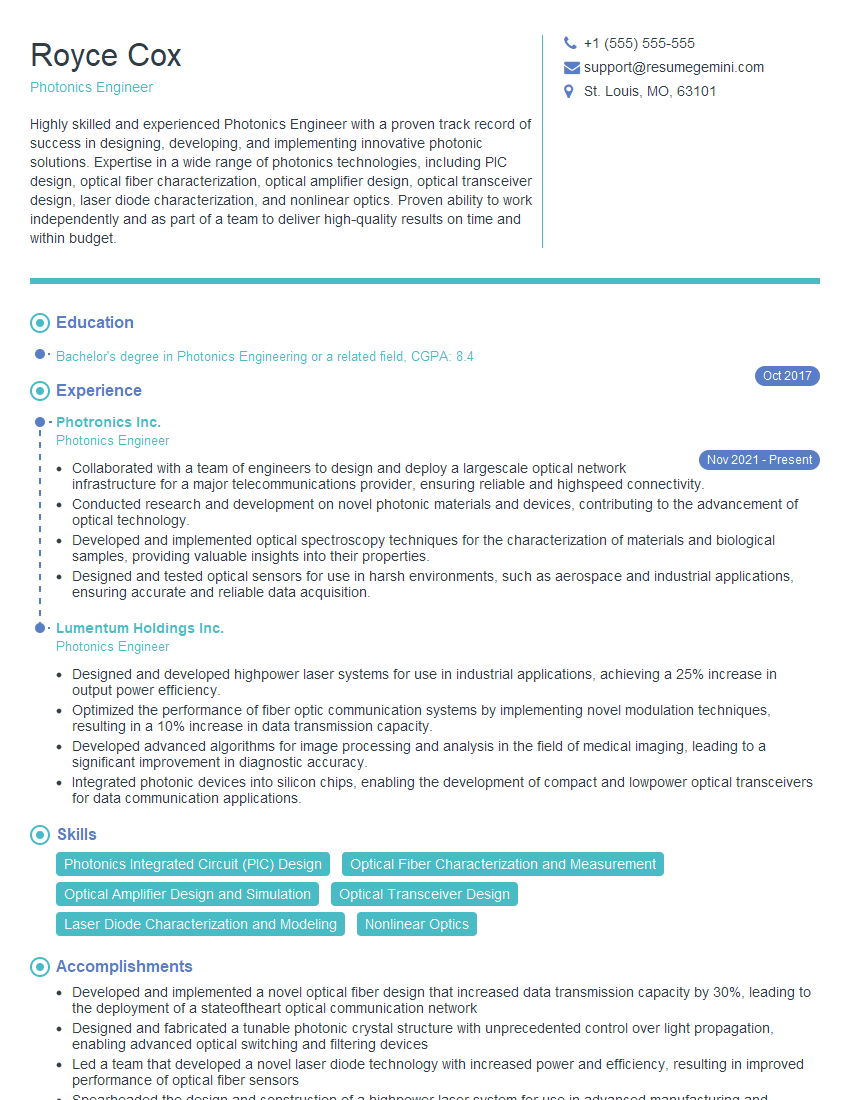
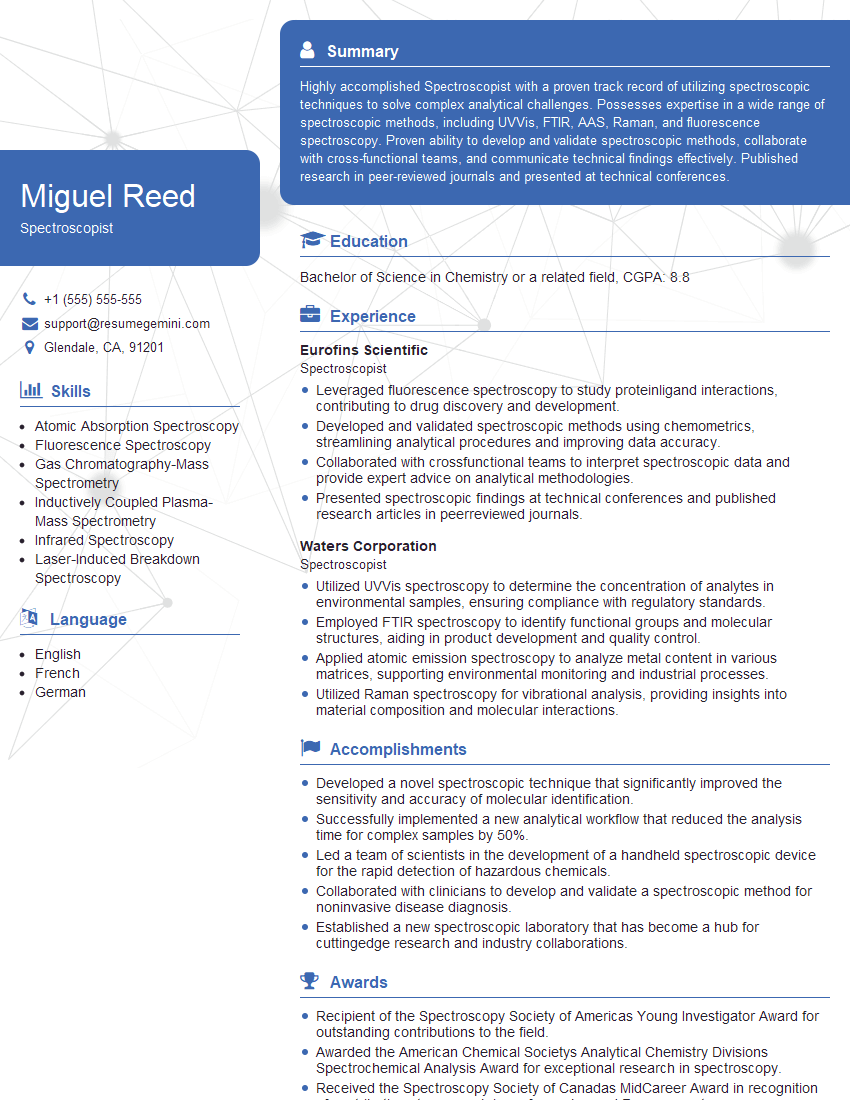
Mastering Light-Matter Interaction opens doors to exciting careers in cutting-edge fields. A strong understanding of these principles is highly sought after in research, development, and engineering roles. To maximize your job prospects, create a compelling and ATS-friendly resume that highlights your skills and experience effectively. ResumeGemini is a trusted resource for building professional resumes that make a lasting impression. They offer examples of resumes tailored specifically to Light-Matter Interaction to help you showcase your expertise and land your dream job.
Explore more articles
Users Rating of Our Blogs
Share Your Experience
We value your feedback! Please rate our content and share your thoughts (optional).
What Readers Say About Our Blog
Very informative content, great job.
good