The thought of an interview can be nerve-wracking, but the right preparation can make all the difference. Explore this comprehensive guide to Tap Installation and Removal interview questions and gain the confidence you need to showcase your abilities and secure the role.
Questions Asked in Tap Installation and Removal Interview
Q 1. What types of taps are you familiar with installing and removing?
I’m experienced in installing and removing a wide variety of taps, including compression taps (the older, more common type), ceramic disc taps (known for their smooth operation and durability), cartridge taps (which use a single cartridge containing all internal parts), and ball taps (a less common type relying on a ball valve). I also have experience with both single-lever mixer taps (controlling both hot and cold water with a single handle) and separate hot and cold taps.
- Compression Taps: These use separate hot and cold taps with individual compression valves that operate using O-rings and washers.
- Ceramic Disc Taps: These utilize ceramic discs to control water flow and temperature. They are known for their long life and drip-free performance.
- Cartridge Taps: These use a replaceable cartridge for easy repairs. They usually have a single lever to control both temperature and flow.
- Ball Taps: These operate using a ball valve, offering smooth operation but may be more complex to repair.
Q 2. Describe the process of replacing a standard compression tap.
Replacing a standard compression tap is a fairly straightforward process, but precision is key. Here’s a step-by-step guide:
- Turn off the water supply: Locate the isolation valves for both hot and cold water under the sink and turn them fully clockwise.
- Disconnect the water supply: Carefully disconnect the flexible hoses from the tap tails. Have a bucket or cloth handy to catch any residual water.
- Remove the tap: Unscrew the nuts securing the tap to the basin, using an appropriate wrench. It’s often helpful to loosen them slightly before completely removing them, to avoid damaging the basin.
- Install the new tap: Carefully insert the new tap into the holes in the basin, ensuring the tap is sitting correctly. Secure it using the new nuts and washers, tightening gently and evenly to avoid cracking the basin or damaging the tap.
- Reconnect the water supply: Attach the flexible hoses to the tap tails and tighten securely, but not excessively.
- Turn on the water supply: Slowly turn on the isolation valves and check for any leaks. Tighten any connections if necessary. If there are still leaks, check for damaged washers or O-rings.
Remember to always use appropriate size wrenches to avoid stripping the nuts. Using PTFE tape on the tap tails before connecting the hoses can prevent leaks. This is like adding a bit of extra insurance.
Q 3. How do you identify and address leaks during tap installation?
Identifying and addressing leaks during tap installation is crucial. Leaks can be detected visually (obvious dripping) or through sound (a subtle hissing). Here’s how I would approach it:
- Visual Inspection: Carefully examine all connections for wetness. Any visible dripping immediately indicates a leak. Pay close attention to the tap itself and the connections to the water supply lines.
- Listen for Leaks: If visual inspection doesn’t show a problem, listen closely near all joints for subtle hissing or dripping sounds, which can indicate a slow leak.
- Tightening Connections: The most common cause of leaks is loose connections. Carefully tighten all nuts and fittings, but avoid overtightening which could damage the tap or the basin. If the leak persists, move to the next step.
- Check Washers and O-rings: Often, damaged washers or O-rings cause leaks. Replace these parts if they show signs of wear or damage. This is a very common problem that’s easy to fix.
- Check for Cracks: In some cases, the tap itself could be cracked or damaged. If this is suspected, the tap needs replacement.
Addressing leaks involves meticulously tightening connections, replacing worn-out seals, and identifying any cracks or damage. It’s better to take the time to resolve leaks during installation rather than dealing with them later.
Q 4. What tools are essential for tap installation and removal?
The right tools are essential for a safe and efficient tap installation or removal. Here’s a list of essentials:
- Adjustable Wrenches: For tightening and loosening nuts and fittings.
- Basin Wrenches: Specifically designed for working in tight spaces under sinks.
- Screwdrivers (Phillips and Flathead): For removing and installing screws.
- PTFE Tape (Teflon Tape): To seal threaded connections and prevent leaks.
- Plumber’s Putty or Sealant: To create a watertight seal between the tap and the basin.
- Bucket and Towels: To catch any water spillage.
- Safety Glasses: To protect your eyes from debris and water.
Having the right tools ensures a smoother and safer installation and minimizes the risk of damage to the tap or the plumbing system. Improper tools may lead to damaged parts or even injuries.
Q 5. Explain the different types of tap cartridges and their repair.
Tap cartridges are the heart of many modern taps, containing the mechanisms that control water flow and temperature. There are several types:
- Ceramic Disc Cartridges: These use two ceramic discs to control water flow. Repairs often involve simply replacing the entire cartridge. This is the most common type and usually quite simple to replace.
- Ball Cartridges: These use a ball and a series of seals to control water flow. Repair typically involves replacing worn seals within the cartridge.
- Compression Cartridges: These function similarly to compression taps but are housed within a cartridge. Repair might involve replacing O-rings or other internal parts.
Repairing tap cartridges often involves identifying the specific type of cartridge, locating the correct replacement part, and carefully following the manufacturer’s instructions. A simple cartridge replacement usually just involves removing the old one and screwing in the new one. It’s often cheaper and easier to replace the entire cartridge than attempting more complicated internal repairs.
Q 6. How do you ensure proper water pressure after tap installation?
Ensuring proper water pressure after tap installation requires attention to detail. Here’s how to handle it:
- Check Isolation Valves: Make sure both hot and cold isolation valves under the sink are fully open.
- Check for Blockages: Ensure there are no blockages in the pipes or flexible hoses. Sometimes debris can build up.
- Inspect the Aerator: The aerator (the small part at the end of the tap spout) can become clogged, reducing water pressure. Remove and clean the aerator if necessary.
- Check Water Pressure in the House: If low water pressure persists, the problem might be with the main water supply to the house, not just the tap itself. This would require further investigation of the broader plumbing system.
- Check for Leaks: Leaks often indicate a restriction in the water flow, lowering pressure at the tap.
By systematically checking these points, you can isolate the cause of low water pressure and address it effectively. Low pressure after an installation can be frustrating, so a methodical approach is important.
Q 7. What safety precautions are crucial during tap installation and removal?
Safety is paramount during tap installation and removal. Here are some key precautions:
- Turn off the water supply: Always turn off the water supply before starting any work. This prevents potential flooding or injury from unexpected water flow.
- Use appropriate personal protective equipment (PPE): Wear safety glasses to protect your eyes from debris and water. Gloves can protect your hands from sharp edges or chemicals.
- Be careful with tools: Use the right tools for the job, and always use caution to avoid injuring yourself or damaging the tap or basin. If you are using power tools, be extra careful.
- Work in a well-lit area: Good lighting helps prevent accidents and ensures that you can see what you’re doing clearly.
- Be mindful of sharp edges: Taps and plumbing components often have sharp edges. Handle them carefully to avoid cuts or injuries.
- Dispose of waste properly: Dispose of old parts and packing materials responsibly.
Prioritizing safety not only prevents injuries but also ensures a smoother, more efficient project. A small cut or injury can seriously disrupt the project.
Q 8. How do you handle different types of pipe materials during tap installation?
Handling different pipe materials during tap installation requires careful consideration to ensure a secure and leak-free connection. The key is to use the appropriate fittings and techniques for each material. For example, copper pipes often require soldering or compression fittings, while plastic pipes (like PVC or PEX) typically use push-fit or compression fittings. Working with galvanized steel pipes can be more challenging, often requiring the use of pipe sealant and specialized tools to ensure a strong, leak-proof connection. I always ensure I have the correct tools and materials on hand for the specific pipe type before starting the job.
- Copper: Soldering, compression fittings.
- Plastic (PVC, PEX): Push-fit fittings, compression fittings.
- Galvanized Steel: Teflon tape, pipe sealant, compression fittings.
For instance, I recently installed a tap in a home with older galvanized steel pipes. I carefully cleaned the threads, applied a generous amount of pipe sealant, and used compression fittings to ensure a secure and leak-free connection. This careful attention to detail is essential to prevent leaks and ensure the longevity of the installation.
Q 9. Describe your experience with installing taps in various settings (e.g., bathroom, kitchen).
My experience spans a wide range of settings, from modern kitchens with intricate mixer taps to older bathrooms with simpler designs. Kitchen installations often involve higher-pressure taps and more complex plumbing systems, potentially requiring specialized tools. Bathroom installations might focus on aesthetics and water conservation features. I’ve tackled projects in everything from new constructions to older renovations, each presenting unique challenges. I adapt my approach based on the specific needs and constraints of each space. One project stands out – a complete bathroom renovation where I replaced a leaky, old tap with a modern, energy-efficient model, transforming both functionality and appearance.
In each setting, safety is paramount. I always follow strict safety procedures when working with water and electricity, ensuring the area is properly isolated before commencing work. This not only protects the property but also ensures my own safety.
Q 10. How do you troubleshoot common tap problems (e.g., dripping, low water pressure)?
Troubleshooting common tap problems starts with careful observation and a systematic approach. A dripping tap often points towards a worn-out O-ring, cartridge, or washer. Low water pressure could indicate a clogged aerator, a problem further upstream in the plumbing system, or a partially closed valve. My process involves:
- Identify the Problem: Is it dripping, low pressure, or something else?
- Isolate the Source: Check the tap components for wear or damage.
- Gather Tools: Assemble the necessary tools, including screwdrivers, wrenches, and replacement parts.
- Repair or Replace: Depending on the issue, I may clean the aerator, replace a washer, or even change the entire cartridge.
For example, a customer once reported low water pressure. After checking the aerator (which was indeed clogged), I cleaned it thoroughly, restoring the water pressure to normal. In another instance, a persistent drip was traced to a worn-out O-ring, which I replaced, solving the problem quickly and cost-effectively.
Q 11. What are the common causes of tap failures, and how can they be prevented?
Tap failures are often caused by mineral buildup, corrosion, or simply wear and tear from prolonged use. Hard water deposits can clog aerators and restrict water flow, while corrosion can damage internal parts. Regular maintenance is key to preventing these issues. This includes regularly cleaning the aerator, checking for leaks, and using appropriate water filtration systems to minimize mineral buildup. Additionally, choosing high-quality taps made from durable materials will extend their lifespan. Preventing sudden failures often involves recognizing signs of wear and tear and addressing them proactively, for example, changing a washer before a leak develops into a full-blown replacement job.
Preventive maintenance is an important aspect of my work; it helps minimize costly repairs and ensures client satisfaction. I regularly advise customers on the importance of regular checks and the simple steps they can take to maintain their taps.
Q 12. Explain the process of isolating water supply before tap replacement.
Isolating the water supply before tap replacement is crucial to prevent flooding and damage. The process depends on the plumbing setup. Usually, there are isolation valves located either under the sink or on the supply pipes leading to the tap. These valves are typically quarter-turn valves, meaning a 90-degree turn will completely shut off the water supply. Before turning off the valves, I always check for any additional supplies linked to the same pipe to ensure I only isolate the necessary water supply. I then open the tap to allow any remaining water in the pipes to drain out.
If there are no isolation valves, I would need to turn off the main water supply to the entire house, which involves identifying the main shut-off valve, usually located near the water meter. This is a less ideal scenario, as it disrupts the water supply to the entire house. This necessitates careful planning and communication with the client. Safety is always a priority, and I make sure to clearly communicate the process to the client before turning off any water supply.
Q 13. How do you choose the appropriate tap for a specific application?
Choosing the right tap involves considering several factors: budget, style, functionality, and water pressure. For a kitchen, a high-pressure mixer tap with a pull-out spray head might be suitable, while a bathroom might benefit from a more compact, energy-efficient tap. I always discuss the client’s needs and preferences before suggesting any specific model. This includes factors such as the desired finish (chrome, brushed nickel, etc.), the type of handle (lever, cross), and any additional features like a temperature limiter or water-saving technology.
I also carefully consider the water pressure. A high-pressure tap in a low-pressure system might not work efficiently, and a low-pressure tap in a high-pressure system could lead to leaks or damage. A thorough understanding of the client’s needs and plumbing system is key to selecting the perfect tap for any specific application.
Q 14. What are the steps involved in installing a mixer tap?
Installing a mixer tap is a multi-step process:
- Turn off the water supply: Isolate the water supply to the tap using the isolation valves under the sink.
- Disconnect the old tap: Carefully disconnect the water supply lines and remove the old tap, taking note of the connections for reassembly.
- Prepare the new tap: Install the mounting components for the new tap, ensuring they are securely fastened.
- Connect the water supply lines: Attach the flexible water supply lines to the new tap, ensuring tight connections and the use of appropriate sealant.
- Mount the tap: Securely mount the tap in place, double-checking that it is straight and aligned correctly.
- Turn on the water supply: Slowly turn on the water supply and check for any leaks.
- Test the tap: Ensure the tap is functioning correctly, checking the water temperature and pressure.
Throughout this process, I emphasize precision and attention to detail. Double-checking every connection before turning on the water is essential to prevent any leaks. I carefully explain each step of the process to the client, promoting understanding and transparency.
Q 15. How do you seal tap connections to prevent leaks?
Sealing tap connections is crucial to prevent leaks and water damage. Think of it like sealing a window – you wouldn’t want air leaking out, and similarly, you don’t want water leaking from your taps. We achieve this primarily through the use of PTFE (polytetrafluoroethylene) tape, commonly known as plumber’s tape, and/or a suitable sealant paste. The tape creates a tighter seal on the threads, preventing water from escaping. Sealant is applied to the threads or the tapered fitting surfaces to fill any microscopic gaps and provide an additional barrier against leakage.
Process: First, clean the threads thoroughly. Then, wrap the PTFE tape around the male fitting (the pipe thread) in the direction of the thread, ensuring each layer overlaps slightly. Two to three wraps are usually sufficient. For added security, particularly with older or compromised fittings, a sealant paste can be applied as well, ensuring a complete seal around the threads. Carefully screw in the female fitting (tap connector) tightly, being mindful not to overtighten, which can damage the fitting.
Example: I once worked on a tap that was leaking consistently. After careful investigation, I found that the previous installer had neglected to use any sealant and had applied the PTFE tape inconsistently. By cleaning the threads, applying a generous amount of PTFE tape, and adding a small amount of sealant paste, the leak was completely resolved.
Career Expert Tips:
- Ace those interviews! Prepare effectively by reviewing the Top 50 Most Common Interview Questions on ResumeGemini.
- Navigate your job search with confidence! Explore a wide range of Career Tips on ResumeGemini. Learn about common challenges and recommendations to overcome them.
- Craft the perfect resume! Master the Art of Resume Writing with ResumeGemini’s guide. Showcase your unique qualifications and achievements effectively.
- Don’t miss out on holiday savings! Build your dream resume with ResumeGemini’s ATS optimized templates.
Q 16. What are the different types of tap connectors and their applications?
Tap connectors come in various types, each suited for different applications. The choice depends on factors like pipe material, water pressure, and the type of tap being installed.
- Compression Fittings: These use compression rings to create a watertight seal around the pipe. They are simple to install and require no special tools, making them ideal for DIY projects. However, they aren’t suitable for high-pressure applications.
- Push-Fit Fittings: Also known as push-fit connectors or compression fittings, these are quick and easy to install. You simply push the pipe into the fitting until it clicks into place. They’re great for smaller pipes and flexible applications, but again, check pressure ratings.
- Threaded Fittings: These use threads to create a secure seal. They are very strong and reliable, even in high-pressure situations. However, they require the use of PTFE tape or sealant.
- Solder Fittings: These require soldering the fitting to the pipe, creating a very strong and permanent joint. They are ideal for high-pressure applications but necessitate specialized tools and expertise.
Applications: For instance, compression fittings are suitable for household taps under standard water pressure. Threaded fittings are frequently used in commercial settings or situations requiring very high pressure. Push-fit connectors are handy for quick repairs or where time is critical. Solder fittings are often used for underground or permanent plumbing installations.
Q 17. Explain the importance of using appropriate sealant and thread tape.
Using the appropriate sealant and thread tape is paramount for leak prevention and the longevity of your tap installation. It’s akin to using the right adhesive when building a structure; you wouldn’t use glue for a brick wall. Improper sealant or tape choice can lead to leaks, corrosion, and potentially costly repairs down the line.
PTFE Tape: Provides a smooth, slippery surface that helps the fitting thread smoothly while also creating a watertight seal. It’s important to use the correct amount and to wrap it in the correct direction. Too little won’t create a good seal, and too much can interfere with the thread’s engagement.
Sealant: Provides an additional layer of protection, especially in areas where there might be slight imperfections in the pipe threads. Sealants fill microscopic gaps and prevent corrosion. Choosing a sealant compatible with the pipe material is essential. Some sealants work best with copper, while others are suitable for plastic pipes.
Example: If you attempt to connect a brass tap using sealant designed for PVC pipe, it could result in a weak, leaking connection. Conversely, excessive PTFE tape will compromise the seal and still lead to leaks. Therefore, knowing which products to use and how much is key to a successful tap installation.
Q 18. Describe your experience with different types of tap handles and their installation.
Tap handles vary significantly in style, material, and mechanism. The installation process varies slightly depending on the type of handle and the tap itself.
- Lever Handles: These are the most common type, and their installation usually involves simply screwing them onto the tap spindle.
- Cross Handles: These offer more precise temperature control and require a little more care when fitting, ensuring the handles are aligned correctly.
- Ceramic Disc Handles: Often found in modern taps, these are highly durable and leak-resistant, typically featuring a quick-release mechanism for easy removal and installation.
Installation Process: Regardless of the handle type, careful attention should be paid to the alignment and tightening. Over-tightening can damage the handle or the tap itself. I always start by hand-tightening, checking the operation, and then gently using a tool to tighten further if needed. I’ve seen many cases of stripped screws and broken handles resulting from over-zealous tightening.
Example: I once worked on a restoration project where the original cross-handled tap needed to be repaired. Finding replacement handles wasn’t easy, requiring meticulous attention to match the correct size and threading to the existing spindle. I also discovered that the spindle had some minor corrosion, requiring gentle cleaning and application of appropriate lubricant before fitting the handles to ensure smooth operation.
Q 19. How do you dispose of old taps responsibly?
Responsible disposal of old taps is crucial for environmental protection and public health. Old taps often contain various metals, which if improperly discarded, can contaminate the environment.
Disposal Process: Many local authorities have dedicated recycling programs for scrap metal. Taps should be disassembled to separate the various components—metal bodies, ceramic cartridges, plastic handles etc.—for easier sorting and recycling. Avoid throwing them in regular bins. Check with your local waste management service for specific guidelines. They might have dedicated collection points or even offer curbside pickup for certain types of waste.
Example: I often advise my clients to separate metal components (brass, copper) from plastic ones for distinct recycling. In certain cases, specialized recycling facilities might handle the disposal of old cartridges or other parts containing specific materials that might be more complicated to recycle independently.
Q 20. Describe your experience working with different water supply systems.
My experience encompasses a variety of water supply systems, from standard household plumbing to more complex commercial setups. This includes working with different pipe materials like copper, PVC, and PEX, and understanding the nuances of pressure variations within each.
- Household Systems: These usually involve low-pressure systems with relatively simple configurations. I’m comfortable working with compression fittings, flexible hoses, and standard tap connections.
- Commercial Systems: These systems often involve higher pressures and more complex plumbing setups. I’ve worked on systems involving larger diameter pipes, different types of valves, and more rigorous safety procedures.
Example: In a recent project for a restaurant, we upgraded their old tap system to handle significantly increased water demand during peak hours. This involved not only installing high-capacity taps but also working with a larger-diameter copper piping system and installing pressure regulators to maintain an optimal water pressure throughout.
Q 21. How do you handle situations where the tap connections are corroded or damaged?
Dealing with corroded or damaged tap connections requires careful assessment and potentially specialized tools and techniques. It’s like working on a car that’s rusted – it takes patience and the right tools.
Assessment: I start by evaluating the extent of the damage. Minor corrosion can often be addressed by cleaning the threads, applying sealant, and potentially replacing the affected parts. However, severe corrosion might require replacing the entire tap connector or even sections of the pipe.
Techniques: For minor corrosion, I use wire brushes and specialized pipe cleaners to remove the rust and debris. For severely corroded parts, using penetrating oil can sometimes help loosen seized fittings. In some cases, using a pipe wrench or specialized tools to remove damaged fittings is necessary. However, extreme caution must be exercised to avoid further damage.
Example: In one instance, I encountered a tap where the connection to the angle stop was severely corroded and seized. After numerous attempts with penetrating oil and specialized tools, I had to resort to cutting the pipe close to the fitting and installing a new section of pipe with a fresh fitting. This required extra skill and care to ensure a watertight seal, and I had to temporarily shut off the main water supply during the repair.
Q 22. What is your process for checking for leaks after tap installation or repair?
Checking for leaks after tap installation is crucial to prevent water damage and ensure the tap’s functionality. My process involves a multi-step approach, starting with a visual inspection for any obvious signs of dripping or seepage. I then use a thorough pressure test. This involves turning the water supply on fully and carefully examining all connections, including the tap body, hoses, and any valves, for even the smallest leak. A damp cloth can help highlight even minor leaks. If a leak is detected, I meticulously trace its origin and use the appropriate sealant or repair method. A final check, after allowing the tap to run for a few minutes, confirms the repair. For example, I recently installed a new kitchen tap and noticed a slight drip from the base. A closer inspection revealed a slightly loose connection, which I tightened with a wrench, resolving the issue. I always advise clients to monitor their new taps for at least 24 hours post-installation as a precautionary measure.
Q 23. How do you ensure the proper alignment and function of tap handles?
Ensuring proper alignment and function of tap handles is vital for both aesthetics and usability. I start by ensuring the tap is securely mounted, as misalignment often stems from an improperly fitted tap. Then, I carefully check the handle’s movement – it should turn smoothly without any resistance or binding. If there is any stiffness, I investigate and address any potential interference or obstructions. Finally, I check the hot and cold markings are correctly aligned with the water flow – a simple but often overlooked detail. I use a combination of visual checks and practical testing. For instance, I recently worked on a bathroom tap where the hot and cold handles were reversed. I carefully disassembled and reassembled the tap, ensuring the internal components were correctly aligned before testing for correct water flow. This systematic approach guarantees both form and function.
Q 24. What are the regulations and standards you follow when installing taps?
Adherence to regulations and standards is paramount in tap installation. I always follow local plumbing codes and the Water Regulations Advisory Scheme (WRAS) guidelines in the UK, or equivalent standards in other regions. This involves using approved materials, ensuring water tightness of all connections to prevent leaks, and ensuring proper water pressure management to prevent damage. I meticulously document all work completed, including the materials used and any deviations from standard practice. Proper installation procedures are critical for safety and compliance. This ensures the installation is both functional and legally sound, protecting both the client and myself from potential liabilities. For example, I’ve had to replace taps previously installed incorrectly because they did not comply with water safety regulations.
Q 25. Explain your experience with working with thermostatic mixing valves.
Thermostatic mixing valves (TMVs) are sophisticated devices that maintain a constant water temperature. My experience with TMVs includes both installation and repair. Installation requires careful attention to detail; correct connection of hot and cold water supplies is crucial. I always follow the manufacturer’s instructions meticulously, paying close attention to flow rate settings and balancing valves. During repair, identifying the source of a malfunction – be it a faulty cartridge, a scale buildup, or a leaking seal – necessitates a thorough understanding of the TMV’s internal mechanics. I use appropriate tools and diagnostic techniques to pinpoint the problem and then perform the necessary repairs. For example, I once repaired a TMV that was failing to maintain a consistent temperature. After careful inspection, I discovered a buildup of limescale within the cartridge, which I cleaned to restore its functionality.
Q 26. What are the common problems encountered with installing sensor taps?
Sensor taps, while convenient, present unique installation challenges. Common problems include incorrect sensor alignment, which can result in inconsistent or unresponsive operation. Power supply issues can also lead to malfunction, as can faulty sensors or wiring. Interference from other electronic devices can sometimes be an issue as well. Furthermore, maintaining proper water pressure to ensure consistent activation of the sensor is crucial. Careful planning, precise installation, and thorough testing are essential to avoid these issues. I always test sensor taps thoroughly after installation, checking responsiveness and water flow, and ensuring that interference does not affect performance. Troubleshooting often involves systematically checking the power supply, the sensor itself, and any wiring connections.
Q 27. How do you maintain a clean and organized workspace during tap installations?
Maintaining a clean and organized workspace is a key element of efficient and safe tap installation. Before I begin, I lay down drop cloths to protect the surrounding surfaces and gather all necessary tools and materials. I use designated containers to hold screws, fittings, and other small parts, preventing them from getting lost or mixed up. As I work, I regularly clear away debris and unused materials, keeping the work area free from obstructions. A neat workspace prevents accidents and ensures a smooth workflow. This organized approach reduces the risk of damage to the surrounding area and ensures a professional appearance. I also ensure that any tools are correctly stowed away safely when not in use. I dispose of all waste materials responsibly after completing the job. This contributes not only to a clean and efficient job, but also highlights my professionalism.
Q 28. Describe your experience with diagnosing and repairing tap malfunctions.
Diagnosing and repairing tap malfunctions requires systematic troubleshooting. I start by carefully observing the symptoms, noting whether the tap leaks, has low water pressure, or fails to function altogether. I then use a combination of visual inspection, listening for unusual sounds (like rattling or groaning), and physical manipulation of the tap handles to isolate the problem. Common issues include worn-out O-rings, damaged cartridges, scale buildup, or faulty valves. I utilize appropriate tools to disassemble the tap and identify the source of the malfunction. I also regularly check the water pressure and check the water supply lines. For example, I recently repaired a tap with very low water pressure. I traced the problem to a partially blocked aerator, which I cleaned, restoring the tap to full functionality. A methodical approach, combined with experience, allows for efficient and effective repairs.
Key Topics to Learn for Tap Installation and Removal Interview
- Understanding Tap Types and Components: Familiarize yourself with various tap designs (e.g., compression, cartridge, ceramic disc), their internal mechanisms, and individual components. Knowing the differences is crucial for proper installation and troubleshooting.
- Water Supply Systems: Grasp the fundamentals of domestic water supply systems, including pressure regulators, shut-off valves, and pipe types. This understanding is essential for safe and efficient tap installation and repair.
- Installation Techniques: Master the practical steps involved in installing different tap types, including connecting water supply lines, securing the tap to the basin or sink, and testing for leaks. Practice makes perfect!
- Troubleshooting Common Issues: Learn to diagnose and resolve common problems like leaks, low water pressure, and dripping taps. Be prepared to discuss your methodical approach to troubleshooting.
- Health and Safety Regulations: Understand and adhere to relevant safety regulations and best practices for working with water systems, including the use of appropriate tools and personal protective equipment (PPE).
- Tools and Equipment: Become familiar with the essential tools and equipment required for tap installation and removal, and understand their proper usage and maintenance.
- Material Selection: Understand the properties of different materials used in tap construction (e.g., brass, chrome, stainless steel) and their impact on durability and longevity.
- Waste Disposal and Recycling: Understand environmentally responsible methods for disposing of old taps and related materials.
Next Steps
Mastering tap installation and removal opens doors to a rewarding career with excellent growth potential in plumbing and related fields. A strong understanding of these skills demonstrates your practical abilities and problem-solving aptitude to potential employers. To significantly boost your job prospects, crafting a compelling and ATS-friendly resume is paramount. ResumeGemini is a trusted resource that can help you build a professional resume that highlights your skills and experience effectively. Examples of resumes tailored to Tap Installation and Removal are available to help guide your resume creation process.
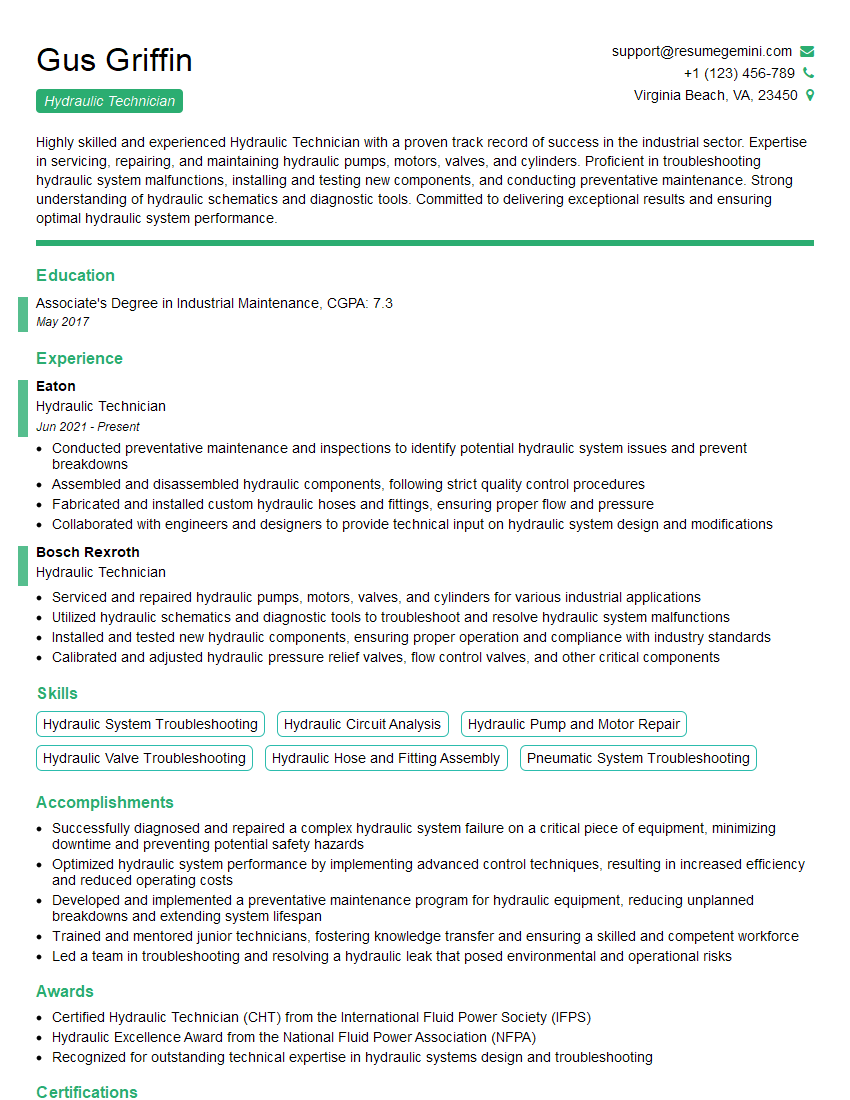
Hydraulic Technician Resume Sample
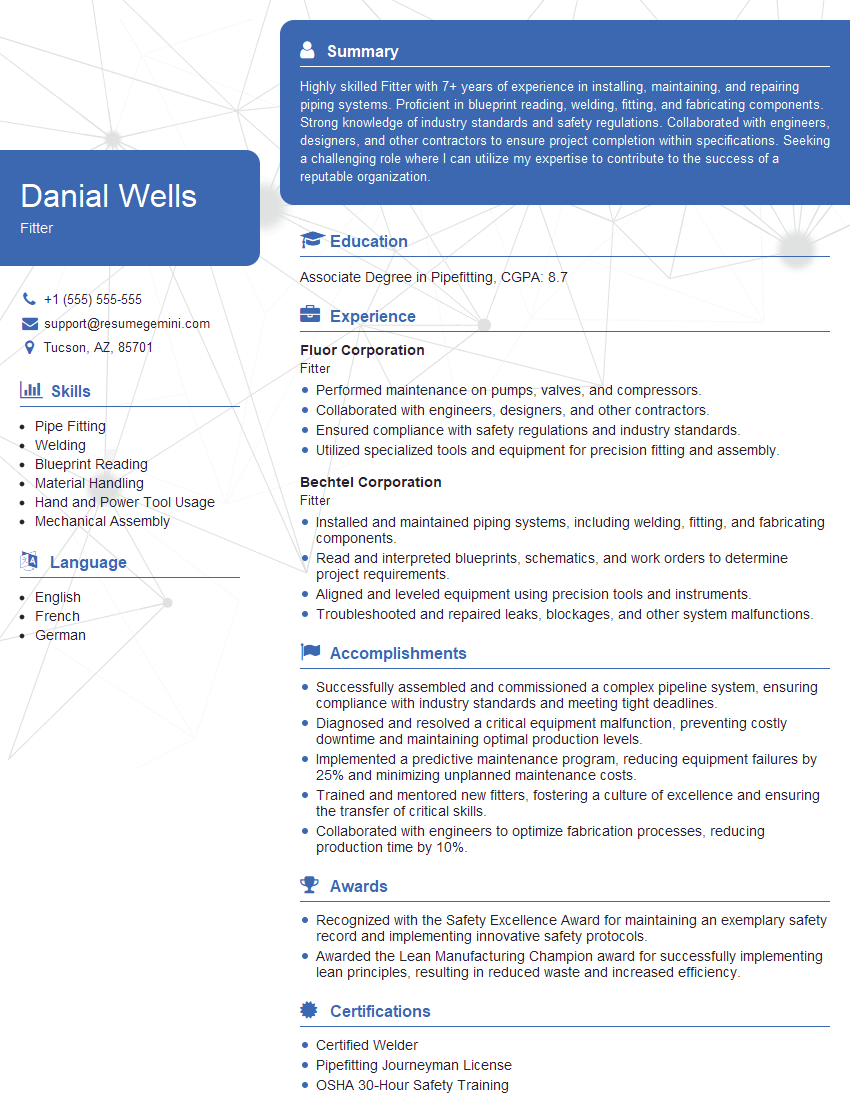
Fitter Resume Sample
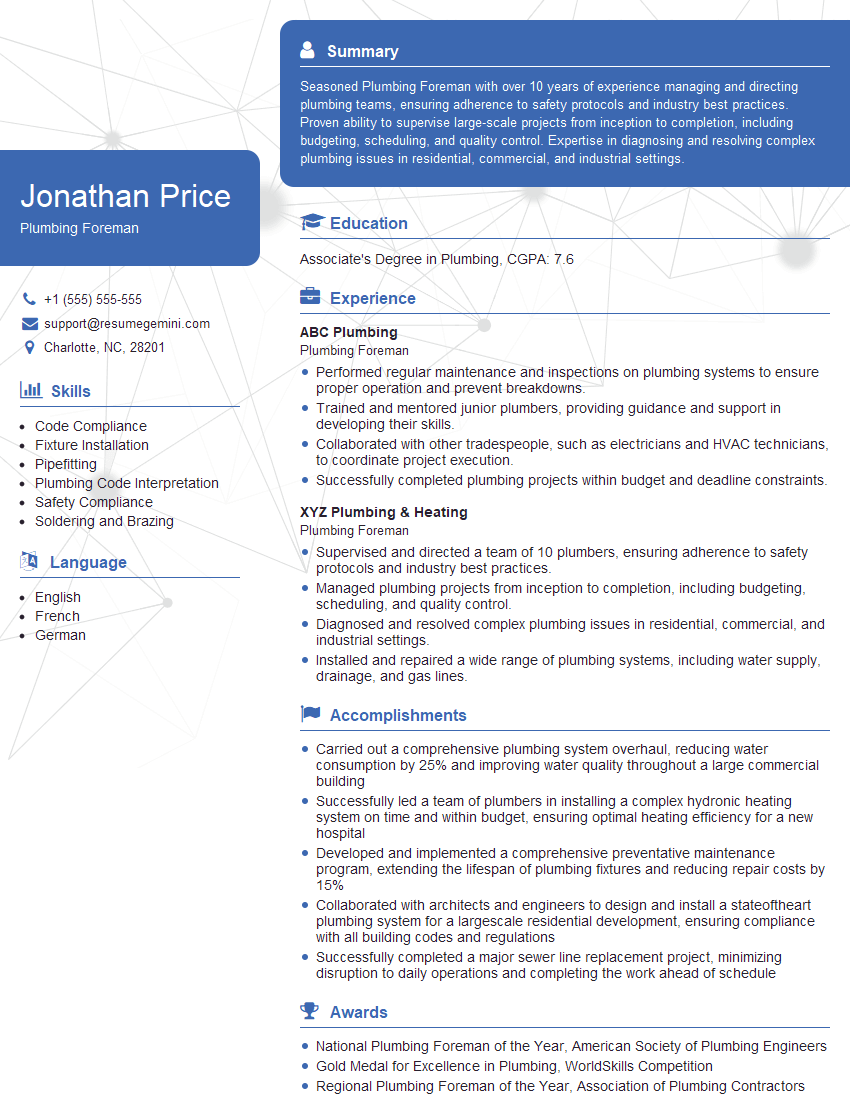
Plumbing Foreman Resume Sample

Plumbing Technician Resume Sample
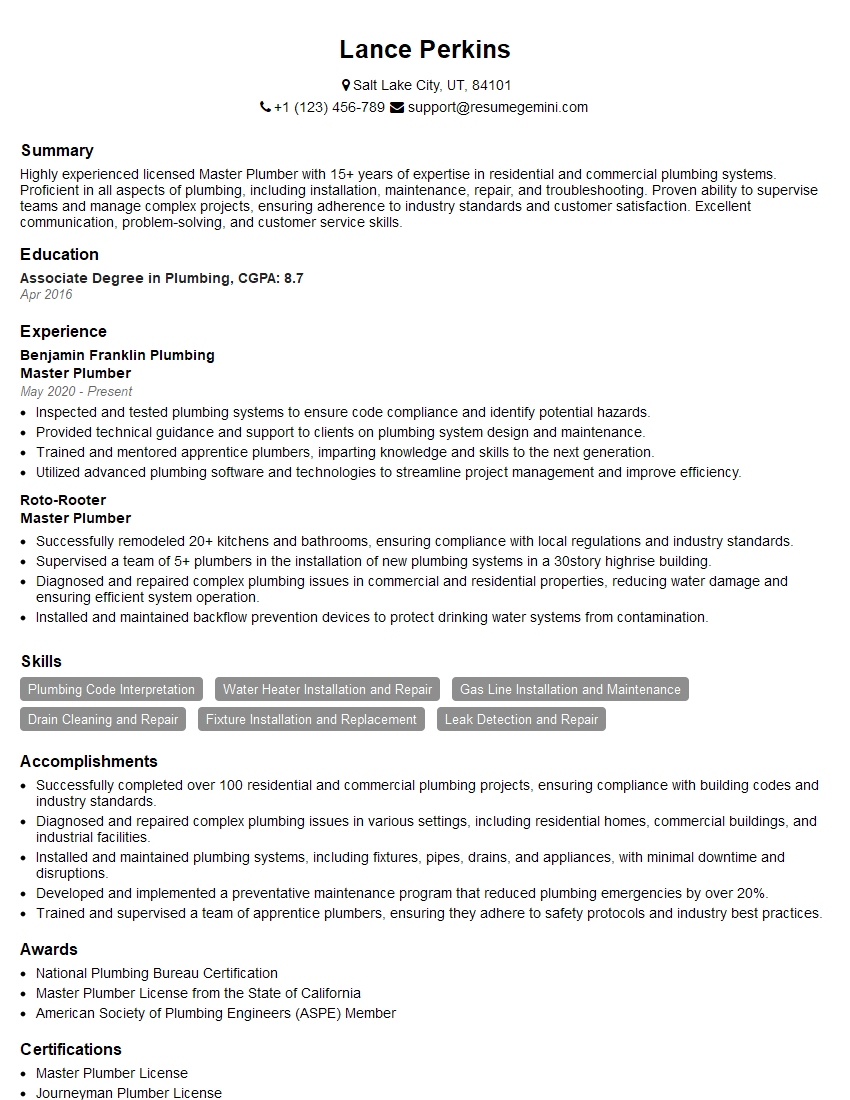
Master Plumber Resume Sample
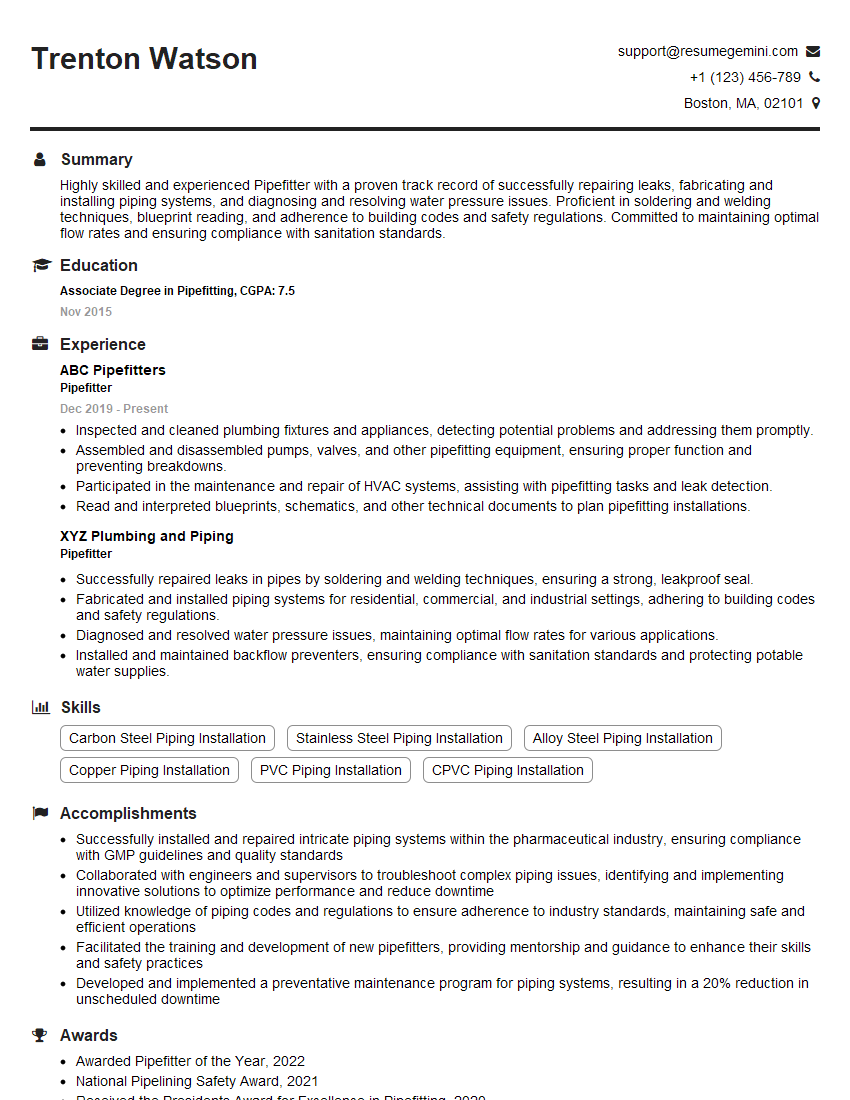
Pipefitter Resume Sample
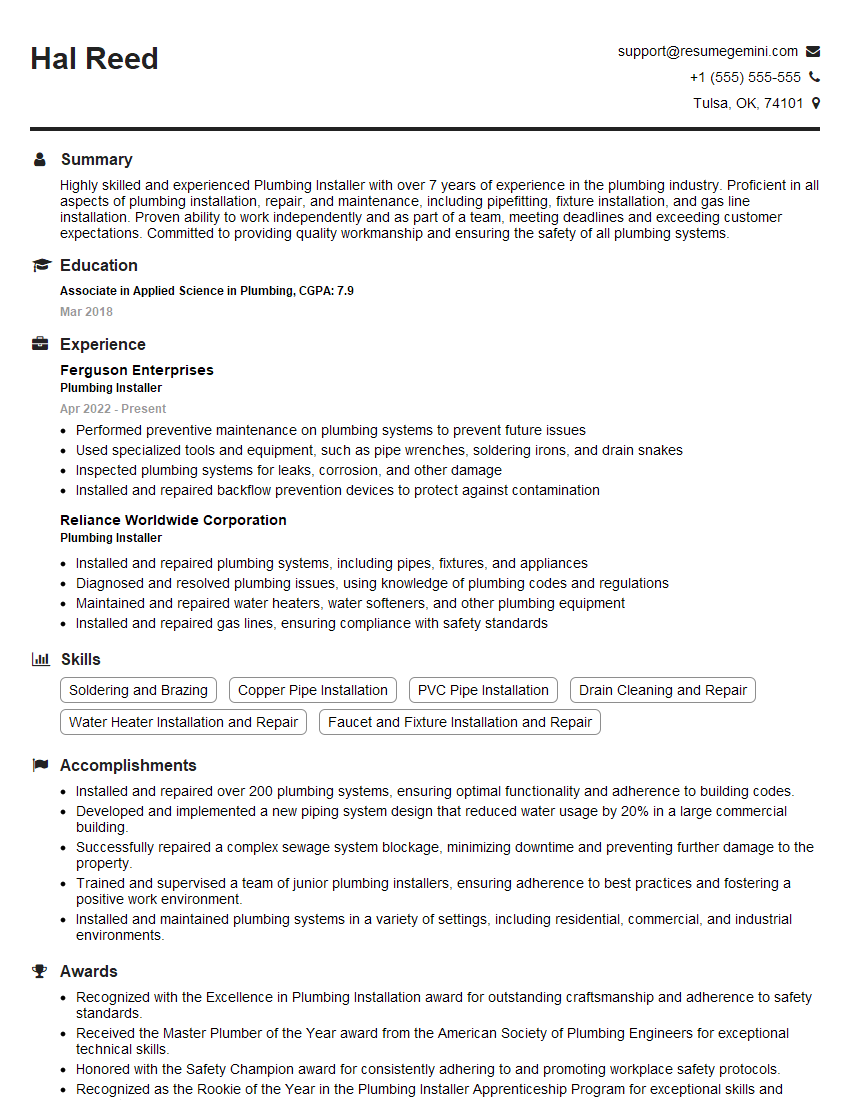
Plumbing Installer Resume Sample
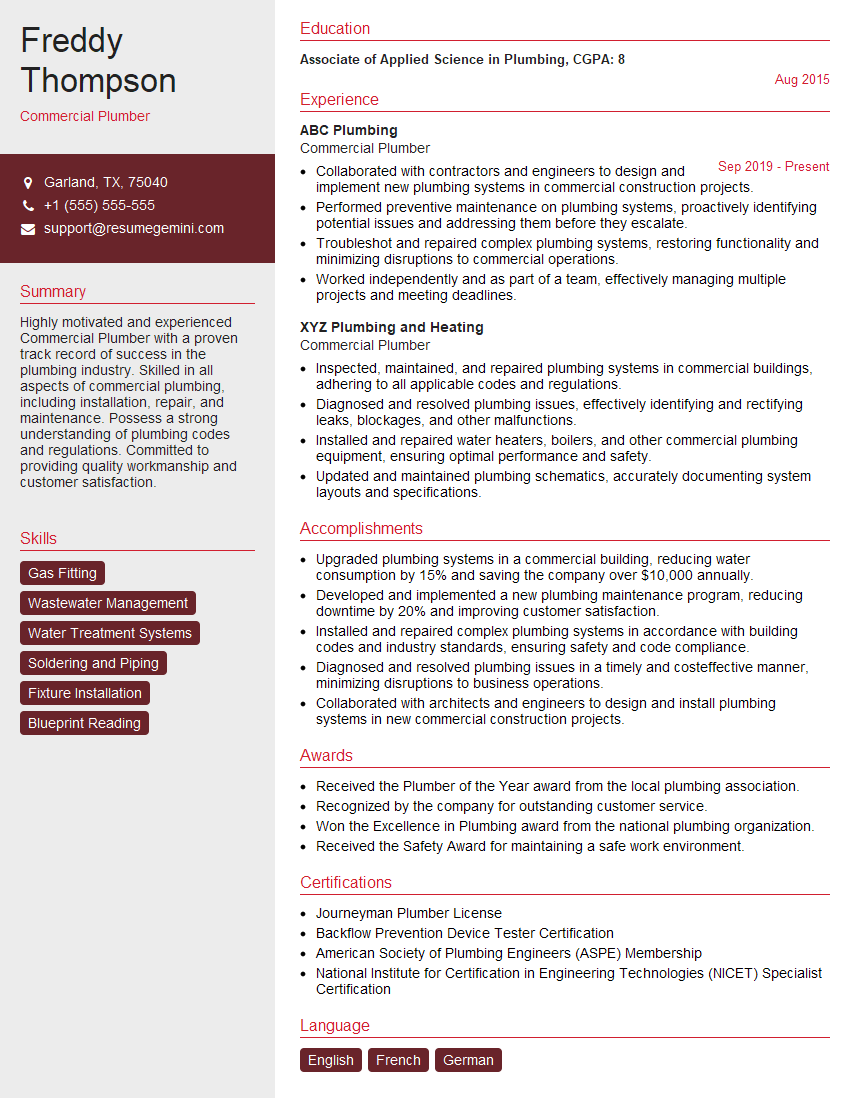
Commercial Plumber Resume Sample
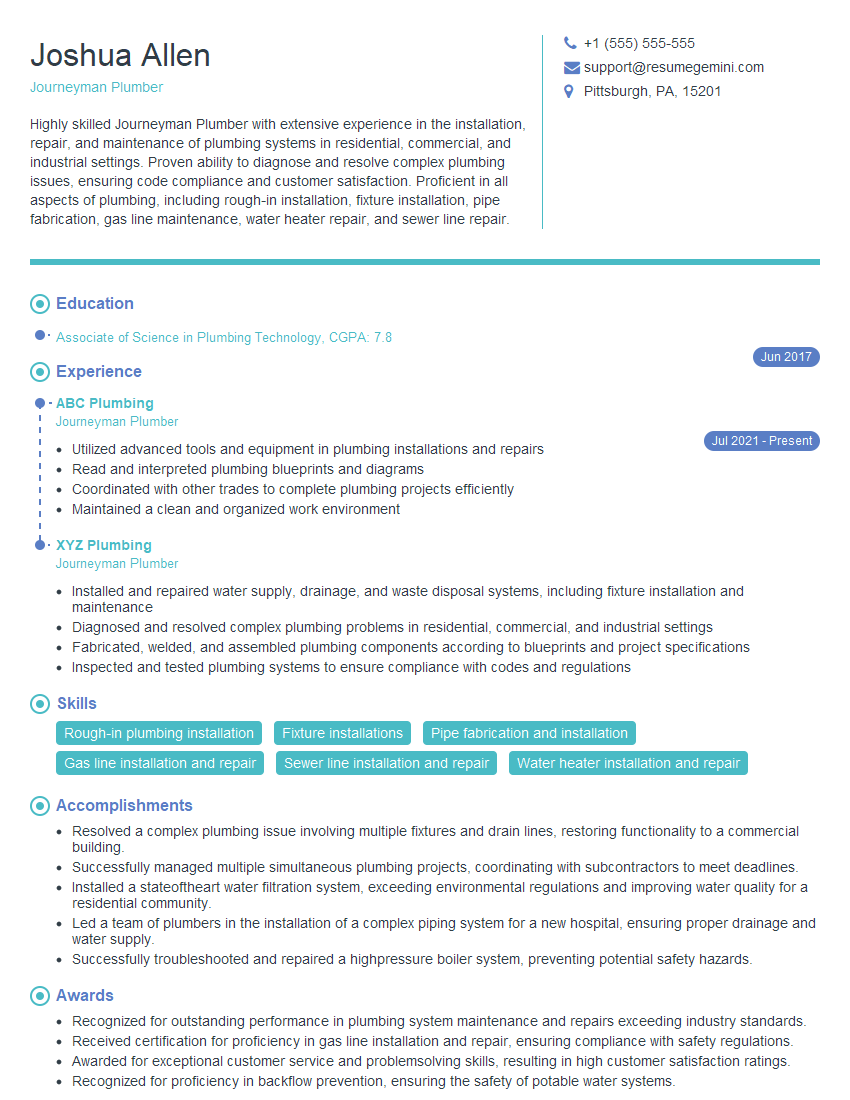
Journeyman Plumber Resume Sample
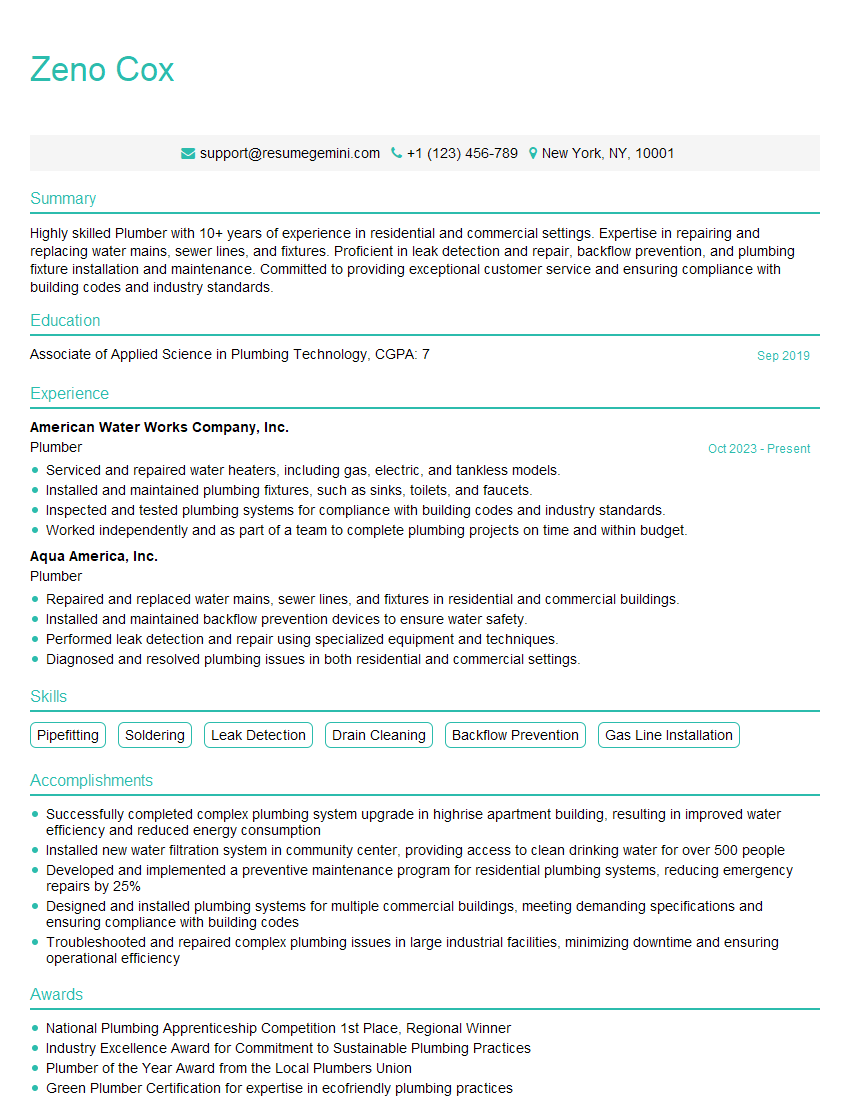
Plumber Resume Sample

Residential Plumber Resume Sample
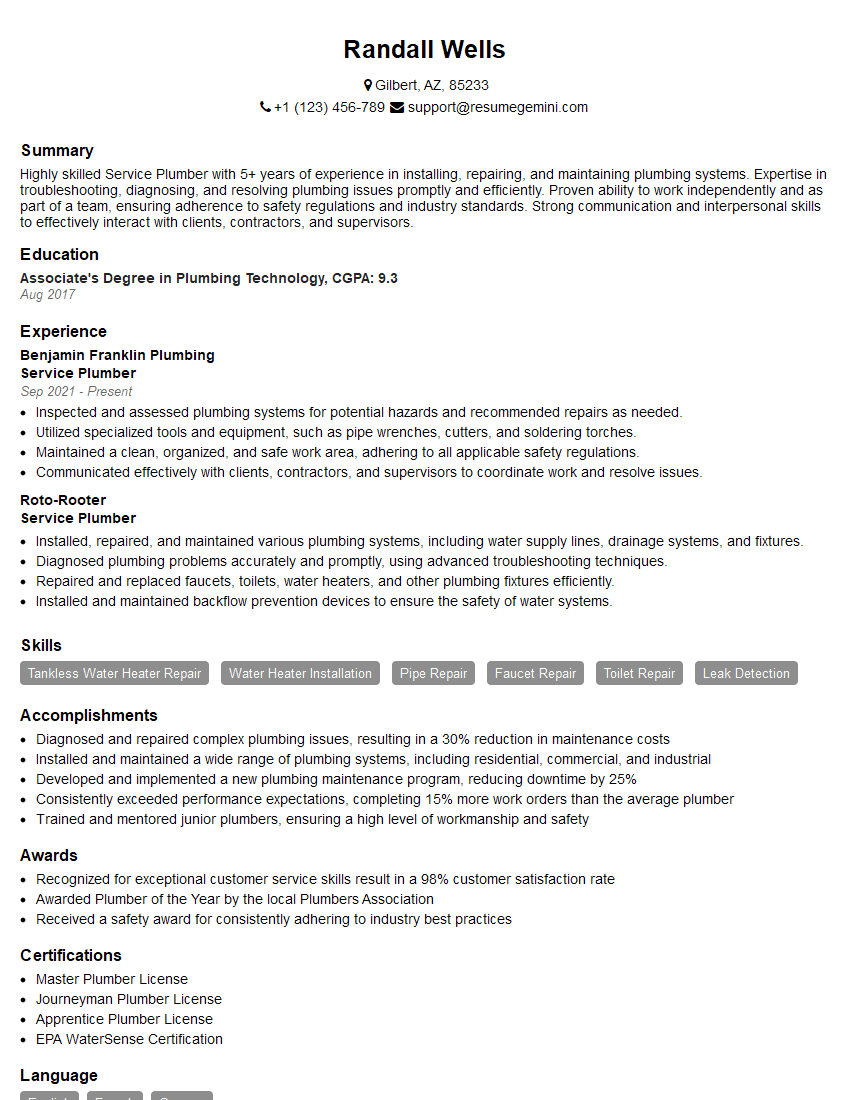
Service Plumber Resume Sample
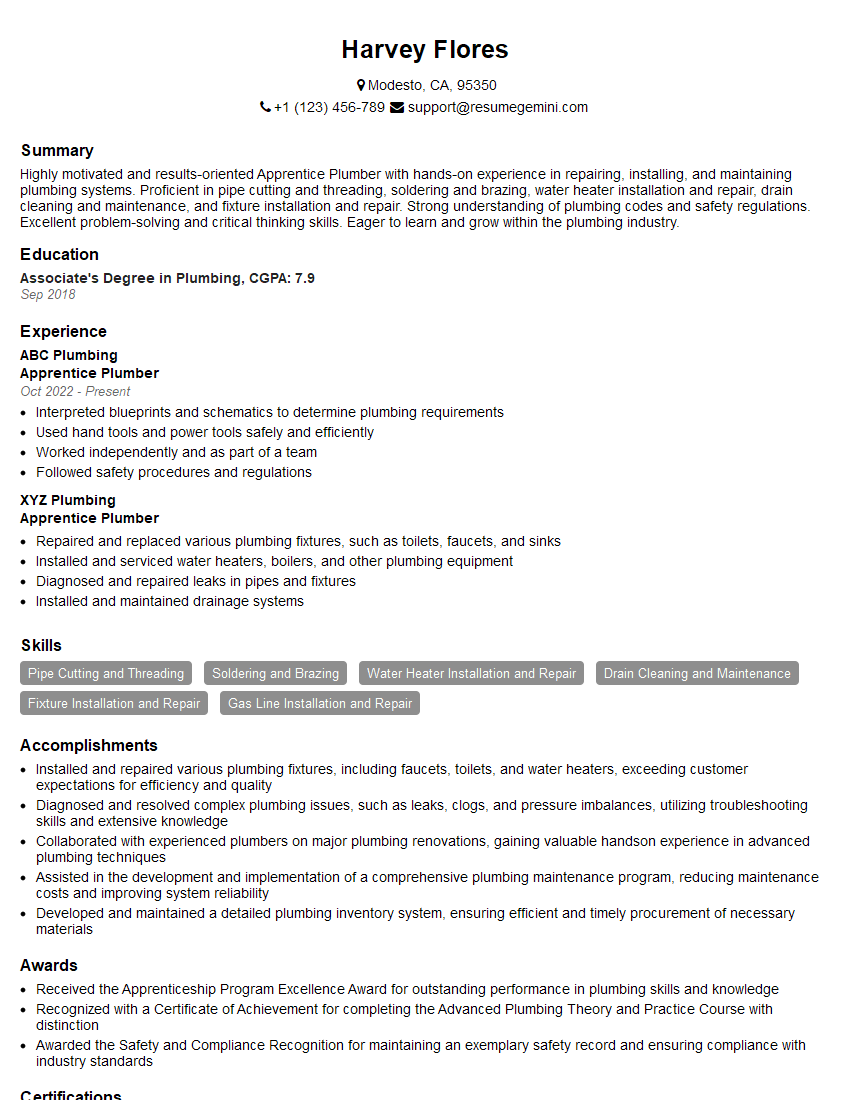
Apprentice Plumber Resume Sample
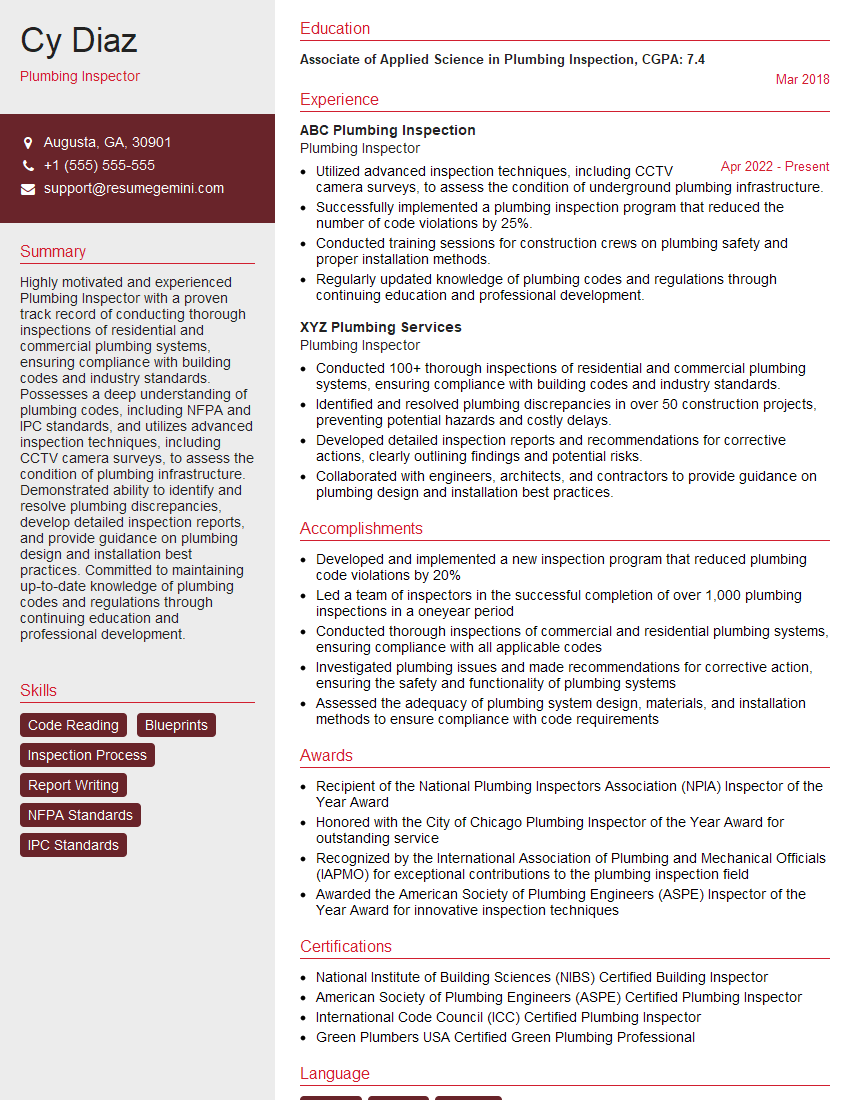
Plumbing Inspector Resume Sample
Explore more articles
Users Rating of Our Blogs
Share Your Experience
We value your feedback! Please rate our content and share your thoughts (optional).
What Readers Say About Our Blog
Very informative content, great job.
good