The right preparation can turn an interview into an opportunity to showcase your expertise. This guide to Light Propagation Analysis interview questions is your ultimate resource, providing key insights and tips to help you ace your responses and stand out as a top candidate.
Questions Asked in Light Propagation Analysis Interview
Q 1. Explain the concept of ray tracing and its applications in light propagation analysis.
Ray tracing is a powerful technique in light propagation analysis that simulates the path of light rays as they interact with objects in a scene. Imagine shining a laser pointer – ray tracing follows the laser beam as it bounces off mirrors, passes through lenses, or gets absorbed by surfaces. It’s based on the principles of geometrical optics, assuming light travels in straight lines until it encounters an interface.
In essence, it involves tracing individual rays originating from a light source and calculating their interactions with surfaces according to Snell’s law (refraction) and the law of reflection. The final image is constructed by collecting the information from all the traced rays.
- Applications: Ray tracing finds widespread use in computer graphics (rendering realistic images), lighting design (predicting light distribution in rooms), optical system design (optimizing lens systems for cameras and telescopes), and medical imaging (simulating light propagation in biological tissues).
For example, designing a complex lighting system for a stage involves using ray tracing to simulate how light from various spotlights will illuminate actors and scenery. This allows designers to optimize placement and intensity before physically installing the equipment.
Q 2. Describe different types of light sources and their impact on propagation.
Light sources are broadly categorized based on their spatial and spectral characteristics. The type of source significantly impacts light propagation.
- Point sources: These emit light from a single point, like an idealized star or a tiny light bulb. Light from a point source spreads radially outwards.
- Extended sources: These emit light from a finite area, such as a fluorescent tube or the sun. The resulting illumination is more diffuse.
- Lambertian sources: These emit light uniformly in all directions. A perfect Lambertian source would appear equally bright from all viewing angles.
- Directional sources: These emit light predominantly in one direction, like a laser pointer or a highly focused spotlight.
Spectral impact: The wavelength (color) of the emitted light also matters. Different materials absorb and scatter light of different wavelengths differently. For instance, a red laser pointer will appear red because it emits primarily red light; however, its propagation may be affected by the absorption properties of the medium through which it travels. A white light source, on the other hand, contains a wide spectrum of wavelengths, each interacting uniquely with its environment.
Q 3. How do you model the scattering of light in different media?
Modeling light scattering requires considering the interaction of light with microscopic particles within a medium. The scattering process depends heavily on the size of the particles relative to the wavelength of light.
- Rayleigh scattering: When particles are much smaller than the wavelength of light (e.g., air molecules scattering sunlight), Rayleigh scattering dominates. It results in preferential scattering of shorter wavelengths (blue light), explaining why the sky is blue.
- Mie scattering: When particles are comparable in size or larger than the wavelength of light (e.g., water droplets scattering light in clouds), Mie scattering is more significant. This scattering is less dependent on wavelength, leading to a whiter or less colored appearance.
Modeling approaches: These scattering phenomena are often modeled using Monte Carlo simulations, which trace numerous light rays and probabilistically determine their scattering events based on the scattering properties of the medium. More sophisticated methods involve solving the radiative transfer equation, which provides a more rigorous description of light propagation in scattering media.
Example: In medical imaging techniques like optical coherence tomography (OCT), accurately modeling light scattering in biological tissues is crucial for producing high-resolution images. Different tissue types exhibit different scattering properties, which the model needs to capture accurately for proper image reconstruction.
Q 4. Explain the phenomenon of diffraction and its relevance to optical systems.
Diffraction is the bending of light waves as they pass through an aperture or around an obstacle. It’s a wave phenomenon that arises from the interference of light waves. Unlike reflection and refraction, which are well-described by geometrical optics, diffraction requires a wave optics approach.
Relevance to optical systems: Diffraction limits the resolution of optical instruments like microscopes and telescopes. The ability to distinguish between closely spaced objects is limited by the size of the aperture and the wavelength of light. This is described by the Airy disk, a diffraction pattern formed by a point source of light passing through a circular aperture.
Example: The resolving power of a telescope is directly related to the diameter of its objective lens and the wavelength of light being observed. A larger aperture reduces the effect of diffraction, allowing for better resolution and the ability to distinguish finer details.
Q 5. What are the key differences between geometrical optics and wave optics?
Geometrical optics and wave optics offer different perspectives on light propagation, each with its own strengths and limitations:
- Geometrical optics treats light as rays traveling in straight lines, neglecting the wave nature of light. It’s a good approximation when dealing with objects much larger than the wavelength of light. It simplifies calculations of reflection and refraction, making it suitable for designing lenses and mirrors.
- Wave optics considers light as electromagnetic waves, incorporating phenomena like interference and diffraction, which are not accounted for in geometrical optics. It provides a more accurate description of light propagation, especially when dealing with apertures or objects comparable in size to the wavelength of light.
In essence, geometrical optics is a simplified model that’s computationally efficient but less accurate in certain situations, while wave optics offers a more complete, albeit more complex, description of light behavior.
Q 6. Describe the concept of polarization and its effect on light propagation.
Polarization refers to the orientation of the electric field vector of an electromagnetic wave. Unpolarized light has electric field vectors vibrating in all directions perpendicular to the direction of propagation. Polarized light, on the other hand, has its electric field vector confined to a specific plane or direction.
Effect on light propagation: Polarization can significantly affect how light interacts with matter. Certain materials, like polarizing filters, selectively transmit light with a specific polarization while absorbing or reflecting others. This property is widely utilized in applications such as sunglasses (reducing glare), liquid crystal displays (LCDs), and stress analysis in materials science.
Example: Polarized sunglasses reduce glare by blocking horizontally polarized light, which is often reflected from surfaces like water or roads. This improves contrast and reduces eye strain.
Q 7. How do you model the reflection and refraction of light at an interface?
Modeling reflection and refraction at an interface involves applying Snell’s law and the law of reflection. Snell’s law governs refraction, relating the angles of incidence and refraction to the refractive indices of the two media:
n1 * sin(θ1) = n2 * sin(θ2)
where n1 and n2 are the refractive indices of the two media, and θ1 and θ2 are the angles of incidence and refraction, respectively.
The law of reflection states that the angle of incidence equals the angle of reflection. Both laws assume smooth, planar interfaces.
Modeling techniques: These laws are incorporated into ray-tracing algorithms, finite-difference time-domain (FDTD) methods, and other numerical techniques to simulate light propagation across interfaces. More complex models account for surface roughness and the wavelength-dependent nature of refractive indices.
Example: Designing lenses for cameras or microscopes requires careful modeling of reflection and refraction at the lens surfaces to achieve desired focal lengths and image quality. The design process often involves sophisticated software that uses numerical methods based on these fundamental laws.
Q 8. Explain the concept of Snell’s law and its application in optical design.
Snell’s Law describes the relationship between the angles of incidence and refraction when light passes from one medium to another with different refractive indices. Imagine throwing a ball from the sand onto a smooth, hard surface – its path bends. Similarly, light bends as it changes media. The law states: n₁sinθ₁ = n₂sinθ₂, where n₁ and n₂ are the refractive indices of the two media, and θ₁ and θ₂ are the angles of incidence and refraction, respectively, measured relative to the normal (perpendicular) to the interface.
In optical design, Snell’s Law is fundamental. It’s used to design lenses, prisms, and optical fibers. For example, in designing a camera lens, we need to precisely calculate the angles of light rays as they pass through different lens elements made of glasses with varying refractive indices to achieve sharp focus. Accurate application of Snell’s Law ensures that light rays converge at the desired focal point, creating a clear image.
Q 9. What are the limitations of ray tracing?
Ray tracing, while a powerful tool, has limitations. It treats light as rays, ignoring wave phenomena like diffraction and interference. This simplification means ray tracing struggles to accurately model situations involving very small apertures or features comparable to the wavelength of light. For example, it can’t accurately predict the diffraction pattern observed when light passes through a narrow slit.
Another limitation is its computational cost for complex geometries. Tracing a vast number of rays to accurately represent light distribution in a complex optical system can be computationally intensive and time-consuming. Finally, ray tracing generally doesn’t handle scattering or polarization effects with high fidelity, requiring more sophisticated techniques for comprehensive analysis in these cases.
Q 10. Describe the principles of Fresnel equations and their use in light propagation analysis.
Fresnel equations describe the reflection and transmission of light at an interface between two media. Imagine shining a flashlight onto a glass window; some light reflects, and some transmits. Fresnel equations quantify these proportions. They consider the polarization state of the light, the angles of incidence and refraction, and the refractive indices of both media.
These equations are crucial in analyzing the performance of optical coatings, anti-reflection layers, and polarizers. For example, designing anti-reflective coatings on lenses involves carefully choosing the refractive indices and thicknesses of the coating layers to minimize reflections predicted by the Fresnel equations, thereby maximizing light transmission. Without a proper understanding of these equations, designing efficient optical components would be nearly impossible.
Q 11. How do you model the absorption and attenuation of light in different materials?
Light absorption and attenuation are modeled using Beer-Lambert Law. This law states that the intensity of light decreases exponentially as it passes through a material. The law can be expressed as: I = I₀e⁻αx where I₀ is the initial intensity, I is the intensity after passing through a distance x, and α is the absorption coefficient of the material. α is material-specific and depends on the wavelength of light. For instance, glass is highly transparent in the visible spectrum (low α), but absorbs strongly in the ultraviolet.
In practice, we use tabulated values of absorption coefficients or computational models to incorporate material properties into the simulations. The choice of model depends on the level of detail required; simple models suffice for basic analysis, while more complex models accounting for wavelength dependence and temperature effects may be needed for precise simulations.
Q 12. Explain the concept of coherence and its role in interferometry.
Coherence refers to the correlation between the phases of a light wave at different points in space and time. Imagine two perfectly synchronized waves – they are highly coherent. Conversely, if the phases are random, the light is incoherent. The degree of coherence impacts the visibility of interference fringes.
In interferometry, coherence is paramount. Interferometry techniques like Michelson interferometry exploit the interference of coherent light waves to measure extremely small distances or changes in optical path length. The higher the coherence, the sharper and more easily measurable the interference fringes will be. Lack of sufficient coherence leads to washed-out fringes, making precise measurements impossible. Laser light, possessing high coherence, is ideally suited for interferometric applications.
Q 13. Describe different types of optical fibers and their propagation characteristics.
Optical fibers are categorized primarily by their refractive index profile and mode of operation. Single-mode fibers have a small core diameter, guiding only one propagation mode, leading to low dispersion and high bandwidth. Multi-mode fibers have larger cores, supporting multiple modes, leading to higher signal attenuation and lower bandwidth compared to single-mode fibers. Step-index fibers have a sharp change in refractive index at the core-cladding boundary, while graded-index fibers have a gradual change, minimizing modal dispersion.
Their propagation characteristics are influenced by factors such as core diameter, refractive index profile, and wavelength. Single-mode fibers are preferred for long-distance telecommunications due to their low dispersion, while multi-mode fibers are often used for shorter distances and applications where bandwidth is less critical. Graded-index fibers offer a compromise between dispersion and ease of coupling compared to step-index multimode fibers.
Q 14. What are the advantages and disadvantages of using different numerical methods for light propagation analysis?
Various numerical methods exist for light propagation analysis, each with advantages and disadvantages. Ray tracing is computationally efficient for simple systems but struggles with wave phenomena. Finite-difference time-domain (FDTD) methods accurately model wave phenomena including diffraction and scattering but can be computationally expensive for large systems. Finite element methods (FEM) offer flexibility in handling complex geometries but can also be computationally demanding.
The choice of method depends on the specific application and desired accuracy. For a quick design evaluation of a simple optical system, ray tracing might suffice. However, for detailed simulations requiring accurate modeling of diffraction or scattering effects, FDTD or FEM would be necessary. The trade-off often lies between accuracy and computational cost; selecting the method involves careful consideration of the problem’s complexity and available computational resources.
Q 15. How do you handle boundary conditions in light propagation simulations?
Boundary conditions are crucial in light propagation simulations because they define how light interacts with the edges of the simulated environment. Imagine shining a flashlight into a room – the light doesn’t just disappear at the walls; it reflects, is absorbed, or transmits through the material. We need to model this accurately.
Common boundary conditions include:
- Perfect Reflectors: Light reflects completely, with no loss. This is a simplification, useful for mirrors or highly reflective surfaces. In simulations, this often involves reversing the light’s direction vector.
- Absorbing Boundaries: Light is completely absorbed, with no reflection. This is used to simulate light trapping or blackbody conditions. In simulations, this involves simply terminating the ray’s propagation.
- Periodic Boundary Conditions: Useful for simulating infinite or repeating structures like photonic crystals. Light exiting one side of the simulation area re-enters from the opposite side.
- Transmitting Boundaries: Light passes through to a different medium with a change in direction according to Snell’s Law. This is crucial for simulating lenses and other refractive elements. The simulation needs to account for the refractive indices of the different media.
Choosing the right boundary condition is vital for accurate simulation results. Incorrect boundary conditions can lead to significant errors, particularly in simulations involving cavities or optical components with specific surface treatments.
Career Expert Tips:
- Ace those interviews! Prepare effectively by reviewing the Top 50 Most Common Interview Questions on ResumeGemini.
- Navigate your job search with confidence! Explore a wide range of Career Tips on ResumeGemini. Learn about common challenges and recommendations to overcome them.
- Craft the perfect resume! Master the Art of Resume Writing with ResumeGemini’s guide. Showcase your unique qualifications and achievements effectively.
- Don’t miss out on holiday savings! Build your dream resume with ResumeGemini’s ATS optimized templates.
Q 16. Explain the concept of optical path length and its significance in optical systems.
Optical path length (OPL) represents the distance light travels through a medium, accounting for the medium’s refractive index. Think of it as the effective distance light ‘sees’. In a vacuum, the OPL is simply the geometrical distance. However, in a denser medium (like glass), light slows down, increasing the OPL. This is because the speed of light in a medium is c/n, where ‘c’ is the speed of light in a vacuum and ‘n’ is the refractive index.
Mathematically, OPL = n * d, where ‘n’ is the refractive index and ‘d’ is the geometrical distance.
Significance: OPL is fundamental in designing optical systems. Fermat’s principle states that light takes the path with the shortest OPL between two points. This principle guides lens design, fiber optics, and many other optical elements. For example, understanding OPL is critical for designing lenses to focus light accurately; a lens’s shape manipulates OPL to converge or diverge light.
Q 17. Describe the concept of Gaussian beams and their propagation characteristics.
Gaussian beams are a fundamental model for describing the propagation of laser light. Unlike plane waves which have uniform intensity across a wavefront, Gaussian beams have a characteristic bell-shaped intensity profile. Their intensity is highest at the center and decreases gradually towards the edges.
Key Characteristics:
- Beam Waist (ω0): The radius at which the intensity drops to 1/e2 (approximately 13.5%) of its maximum value at the beam’s narrowest point.
- Rayleigh Range (zR): The distance from the beam waist to the point where the beam area doubles. It’s a measure of the beam’s divergence.
- Divergence Angle (θ): The angle at which the beam spreads as it propagates. It’s related to the beam waist and wavelength.
Propagation: As a Gaussian beam propagates, its waist expands, and its intensity profile changes. The beam’s evolution can be described using analytical equations, making them particularly useful in simulations. The characteristics of Gaussian beams are crucial in laser applications, optical communication, and metrology.
Q 18. How do you model the propagation of light in complex optical systems?
Modeling light propagation in complex optical systems involves combining several techniques and considerations. The complexity arises from multiple optical elements, scattering, diffraction, and non-linear effects.
Common approaches include:
- Ray Tracing: This method tracks the path of individual light rays as they interact with optical components (refraction, reflection). It’s computationally efficient for systems dominated by geometrical optics, but may not accurately capture diffraction effects.
- Beam Propagation Method (BPM): BPM solves the paraxial wave equation, modeling the evolution of the optical field as it propagates. It’s well-suited for analyzing guided-wave systems like optical fibers, but can be computationally intensive for large or complex systems.
- Finite-Difference Time-Domain (FDTD): A powerful numerical method that directly solves Maxwell’s equations on a discrete grid. It can handle complex geometries, materials, and wavelengths but requires significant computational resources.
- Physical Optics Propagation (POP): This method uses the angular spectrum representation to propagate the optical field; it accounts for both diffraction and interference effects and can be computationally efficient for certain scenarios.
Often, a combination of these methods is used. For example, ray tracing can be used for the initial design and then BPM or FDTD for fine-tuning and detailed analysis of specific regions.
Q 19. Explain different techniques for measuring light intensity and polarization.
Measuring light intensity and polarization requires different techniques, depending on the desired accuracy and the characteristics of the light source.
Intensity Measurement:
- Photodiodes: These semiconductor devices convert incident light into an electric current, whose magnitude is proportional to the light intensity. They are widely used for various applications, offering a good balance of sensitivity and cost-effectiveness.
- Photomultiplier Tubes (PMTs): Extremely sensitive detectors capable of measuring very low light levels. However, they are more complex and expensive than photodiodes.
- Bolometers: Measure light intensity based on the change in temperature caused by absorbed light. They can be used to measure a wide range of wavelengths, but their response time can be slow.
Polarization Measurement:
- Polarizers: These components transmit light with a specific polarization state (e.g., linear or circular) and block other polarization components. Measuring the transmitted intensity with a polarizer rotated at different angles allows determination of the polarization state.
- Polarization-Sensitive Detectors: Specialized detectors like Wollaston prisms or birefringent crystals can directly measure the intensity of different polarization components.
Choosing the appropriate technique depends on factors like wavelength range, desired accuracy, intensity levels, and cost constraints.
Q 20. How do you design an experiment to validate your light propagation model?
Validating a light propagation model requires careful experimental design and comparison with measured data. The design should include:
- Defining a specific system: Start with a relatively simple system that can be readily constructed and measured. The model’s prediction and the experiment’s measurement should be comparable. This could be a simple lens system, a fiber optic setup, or a specific photonic structure.
- Controlled environment: Minimize external factors that might affect measurements, such as stray light, vibrations, or temperature fluctuations. Use controlled optical components.
- Accurate measurements: Utilize appropriate instruments and calibration procedures to ensure accurate measurement of light intensity, polarization, and beam profile. Include error analysis to evaluate uncertainties in measurements.
- Comparison with model predictions: Compare the experimental results with the results predicted by the model. The extent of agreement determines how well the model captures the light propagation phenomena.
- Iterative refinement: If discrepancies exist, analyze the sources of error. Refine the model or experimental setup to improve the agreement between simulation and measurement. This process is iterative, leading to a more accurate model.
A good validation process is crucial for building confidence in a light propagation model and establishing its reliability for future predictions and design purposes.
Q 21. What are some common errors in light propagation analysis and how can they be avoided?
Several common errors can arise in light propagation analysis:
- Ignoring diffraction effects: In many situations, diffraction is significant and cannot be ignored. Ray tracing, for instance, only captures geometrical optics and may fail to predict diffraction patterns accurately.
- Incorrect boundary conditions: Using inappropriate boundary conditions in simulations can lead to inaccurate results. For example, using perfect reflectors when the surface has some absorption or scattering properties can lead to considerable errors.
- Neglecting polarization: Polarization effects are important in many optical systems. Ignoring polarization can lead to inaccurate predictions, especially in systems with anisotropic materials or polarization-dependent elements.
- Numerical errors in simulations: Numerical methods used in simulations (FDTD, BPM) can introduce errors due to discretization and truncation. Careful selection of numerical parameters and convergence studies are essential to mitigate these errors.
- Inaccurate material properties: Using inaccurate values for refractive indices, absorption coefficients, or other material parameters can significantly affect the accuracy of the results. Using verified and reliable material data is very important.
Mitigation Strategies: These errors can be avoided by careful consideration of the system’s characteristics, employing appropriate modeling techniques, performing thorough validation experiments, and utilizing accurate material data. Regularly verifying the validity and limits of the chosen approach is key.
Q 22. Describe your experience with different optical simulation software packages.
My experience with optical simulation software spans several leading packages. I’m highly proficient in COMSOL Multiphysics, particularly its wave optics module, which I’ve used extensively for modeling complex light propagation scenarios in integrated photonics and fiber optics. I’ve also worked extensively with Lumerical FDTD Solutions, leveraging its capabilities for simulating nanoscale optical devices and metamaterials. My experience further extends to Zemax OpticStudio, which I utilize for designing and analyzing optical systems, focusing on ray tracing and tolerancing. Each package has its strengths; COMSOL excels in coupled physics simulations, Lumerical in high-resolution electromagnetic simulations, and Zemax in system-level design and optimization.
For example, in one project, I used COMSOL to model the propagation of light through a silicon-on-insulator waveguide, accurately predicting transmission losses and modal characteristics. In another, Lumerical was crucial in optimizing the design of a plasmonic nanoantenna for enhanced light absorption. Finally, I leveraged Zemax to design a high-precision imaging system for a microscopy application, optimizing for aberration correction and field of view.
Q 23. Explain your experience with different optical measurement techniques.
My expertise in optical measurement techniques encompasses a wide range of methods. I have extensive experience with interferometry, both in its classic Michelson and Mach-Zehnder configurations, for precise measurements of optical path differences and surface profiles. I’m also highly skilled in using optical power meters and spectrometers to characterize light sources and their spectral content. Furthermore, I’m proficient in scattering measurements using goniometers to analyze the angular distribution of scattered light, useful for determining the size and morphology of particles.
Beyond these, I’ve employed techniques like ellipsometry for measuring the thickness and refractive index of thin films, and near-field scanning optical microscopy (NSOM) for investigating sub-wavelength optical phenomena. Each technique offers unique advantages and limitations, and the choice depends heavily on the specific application and measurement requirements. For instance, interferometry is ideal for high-precision measurements of surface roughness, while scattering measurements provide information about particle size distributions in colloidal suspensions.
Q 24. How do you handle uncertainty and noise in optical measurements?
Handling uncertainty and noise in optical measurements is critical for obtaining reliable results. My approach is multi-faceted and begins with careful experimental design to minimize sources of noise. This includes using appropriate shielding to reduce environmental influences, employing stable light sources, and carefully calibrating equipment. Data acquisition is also optimized to maximize the signal-to-noise ratio. For example, averaging multiple measurements significantly reduces random noise.
Post-acquisition, statistical analysis plays a crucial role. I routinely use techniques such as error propagation to quantify the uncertainty in calculated quantities. Furthermore, advanced data processing techniques, such as filtering algorithms (like moving average or Savitzky-Golay filters) and outlier rejection, are applied to remove or mitigate the effects of noise and spurious data points. Finally, I use robust statistical methods, less susceptible to outliers, to derive meaningful results from potentially noisy datasets.
Q 25. Describe a challenging light propagation problem you have solved.
One particularly challenging problem I solved involved characterizing light propagation in a complex photonic integrated circuit (PIC) containing multiple waveguides and integrated components. The challenge stemmed from the strong coupling between the waveguides, leading to complex interference patterns and mode mixing. Traditional ray tracing methods were inadequate; a full-wave electromagnetic simulation was necessary.
My solution involved using Lumerical FDTD Solutions to model the entire PIC with high accuracy. The simulation involved optimizing the meshing strategy to accurately capture the sub-wavelength features of the device while maintaining computational feasibility. Careful consideration of boundary conditions was also crucial to accurately model the behavior of the PIC. The results provided a detailed understanding of the light propagation within the PIC, enabling accurate prediction of its performance and providing critical insights for design optimization. This improved the device’s efficiency significantly and reduced power loss.
Q 26. How do you stay up-to-date with the latest advancements in light propagation analysis?
Staying current in the rapidly evolving field of light propagation analysis requires a multi-pronged approach. I regularly attend conferences such as CLEO and Photonics West, where leading researchers present their latest findings. I actively follow key journals, including Optics Letters, Optics Express, and the Journal of the Optical Society of America, meticulously reading relevant articles.
Furthermore, I maintain a strong online presence, regularly consulting reputable websites and online databases for the latest research publications and technological developments. I also actively participate in online forums and professional networking groups, engaging in discussions and sharing knowledge with colleagues worldwide. This combined approach ensures I remain at the forefront of advancements in the field.
Q 27. Explain your understanding of the electromagnetic theory of light propagation.
My understanding of the electromagnetic theory of light propagation is grounded in Maxwell’s equations, which govern the behavior of electromagnetic fields. These equations describe how electric and magnetic fields interact and propagate through space and matter. Light, being an electromagnetic wave, is described by the solutions to these equations. In free space, these solutions are plane waves characterized by their frequency, wavelength, polarization, and direction of propagation. The propagation is governed by the speed of light.
In materials, the behavior of light is more complex, influenced by the material’s permittivity and permeability. These parameters determine the refractive index, which governs the speed and direction of light propagation within the material. Phenomena like reflection, refraction, diffraction, and scattering all arise from the interaction of light with matter, as described by Maxwell’s equations and their associated boundary conditions. A deep understanding of these principles is crucial for accurate modeling and analysis of light propagation in various scenarios.
Q 28. Describe the applications of light propagation analysis in your field of expertise.
Light propagation analysis has a broad range of applications across various fields. In my work, its applications primarily focus on the design and optimization of photonic devices and systems. This includes designing integrated photonic circuits for telecommunications, developing novel optical sensors, and optimizing the performance of optical microscopes and imaging systems. For example, I’ve worked on designing highly efficient optical couplers for use in optical communication systems, ensuring minimal signal loss.
Beyond my specific area, light propagation analysis is fundamental in fields like medical imaging (e.g., optical coherence tomography), remote sensing (e.g., LIDAR), and solar energy (e.g., designing efficient solar cells). The principles of light propagation are also critical in understanding and manipulating light at the nanoscale, opening exciting possibilities in areas like nanophotonics and metamaterials. Essentially, any technology that involves generating, controlling, or detecting light relies on a thorough understanding of light propagation.
Key Topics to Learn for Light Propagation Analysis Interview
- Fundamental Principles: Master the basics of wave optics, including Snell’s Law, Fresnel equations, and diffraction theory. Understand the differences between ray tracing and wave-based simulations.
- Ray Tracing Techniques: Familiarize yourself with various ray tracing algorithms and their applications in different scenarios (e.g., geometrical optics, non-imaging optics). Be prepared to discuss their strengths and limitations.
- Wave Propagation Methods: Explore different numerical methods for solving Maxwell’s equations, such as Finite-Difference Time-Domain (FDTD) and Finite Element Method (FEM). Understand their underlying principles and computational costs.
- Material Properties and Modeling: Gain a thorough understanding of how material properties (refractive index, absorption, scattering) influence light propagation. Be able to model different material types and their impact on simulation results.
- Practical Applications: Be ready to discuss real-world applications of light propagation analysis, such as optical fiber design, lens design, medical imaging, and remote sensing. Prepare examples of your experience (if any) in these fields.
- Problem-Solving & Simulation Tools: Demonstrate proficiency in using relevant software packages for simulating light propagation (e.g., COMSOL, Lumerical). Be prepared to discuss your approach to troubleshooting and interpreting simulation results.
- Advanced Topics (Optional): Depending on the role, you might also consider exploring topics like polarization effects, non-linear optics, or coherence theory.
Next Steps
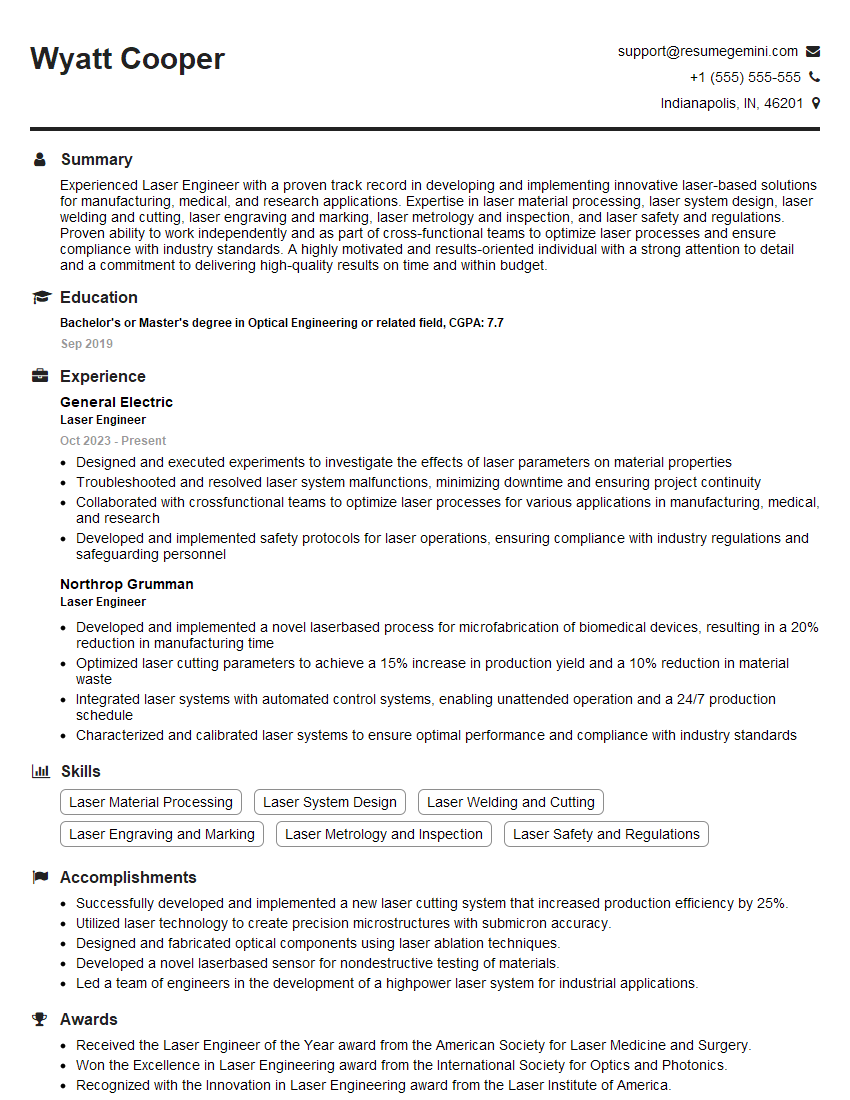
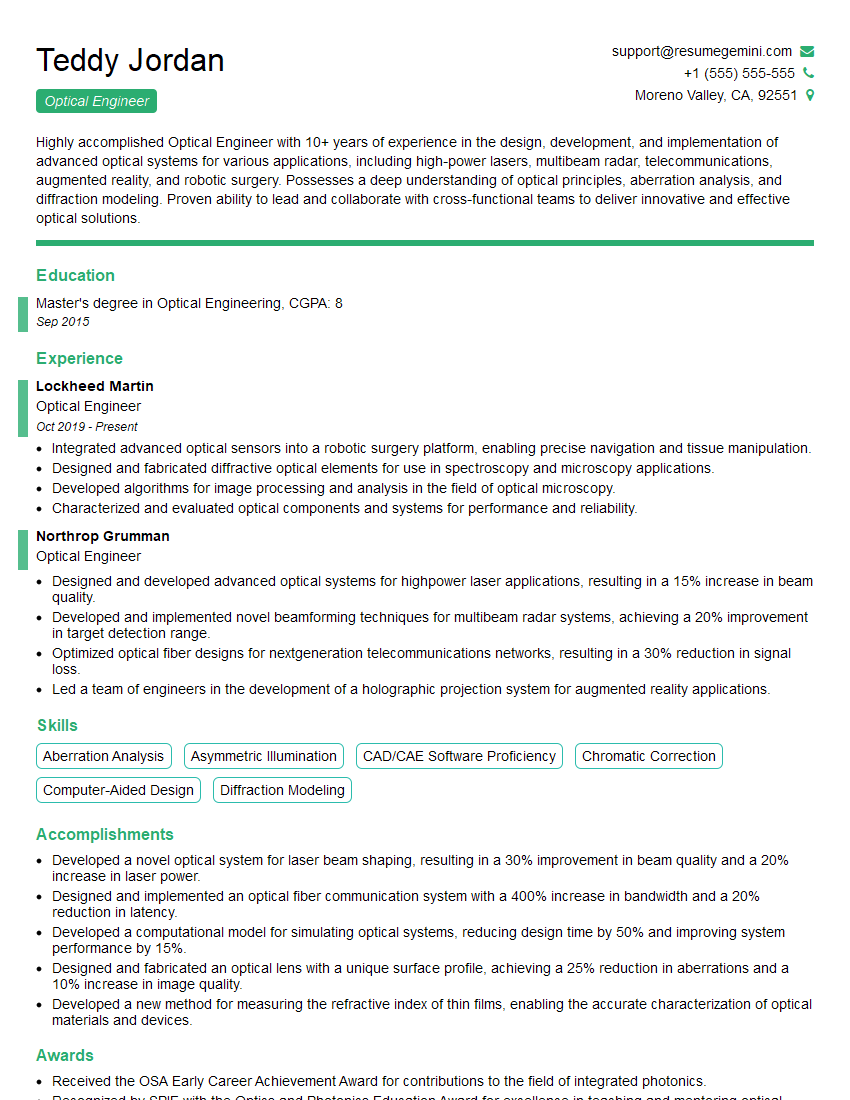
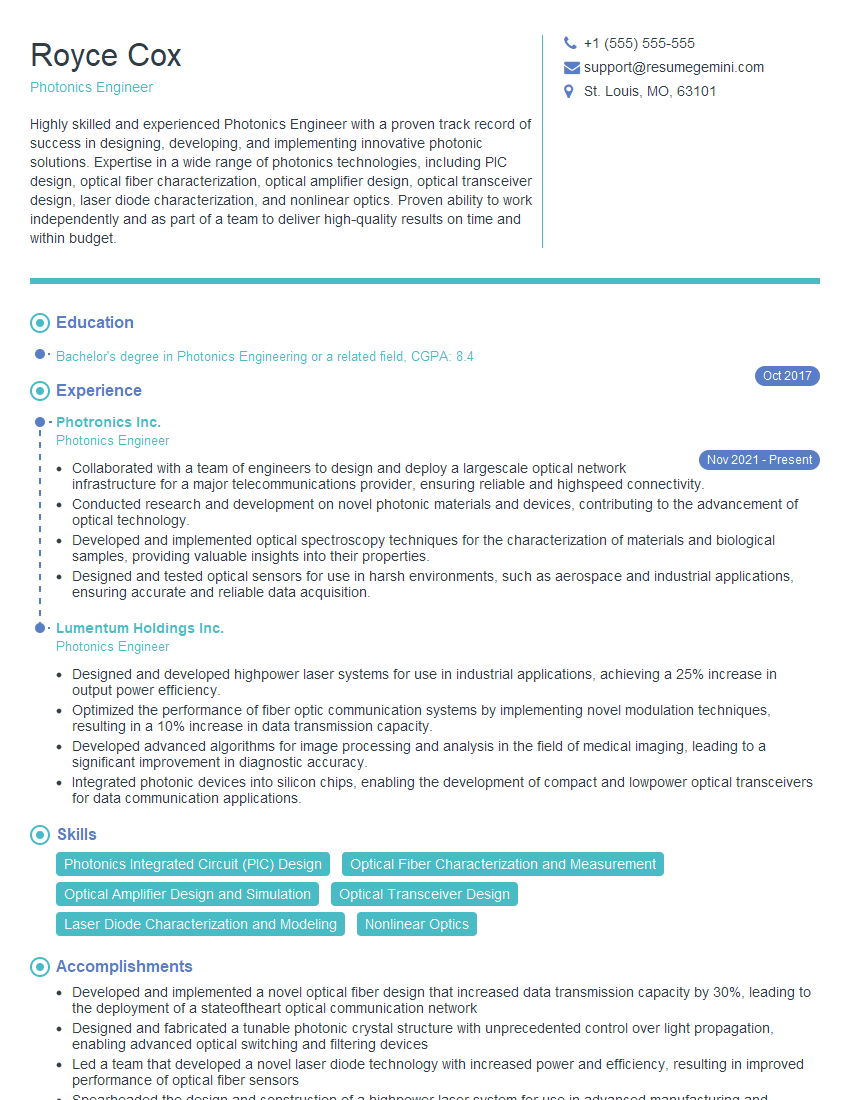
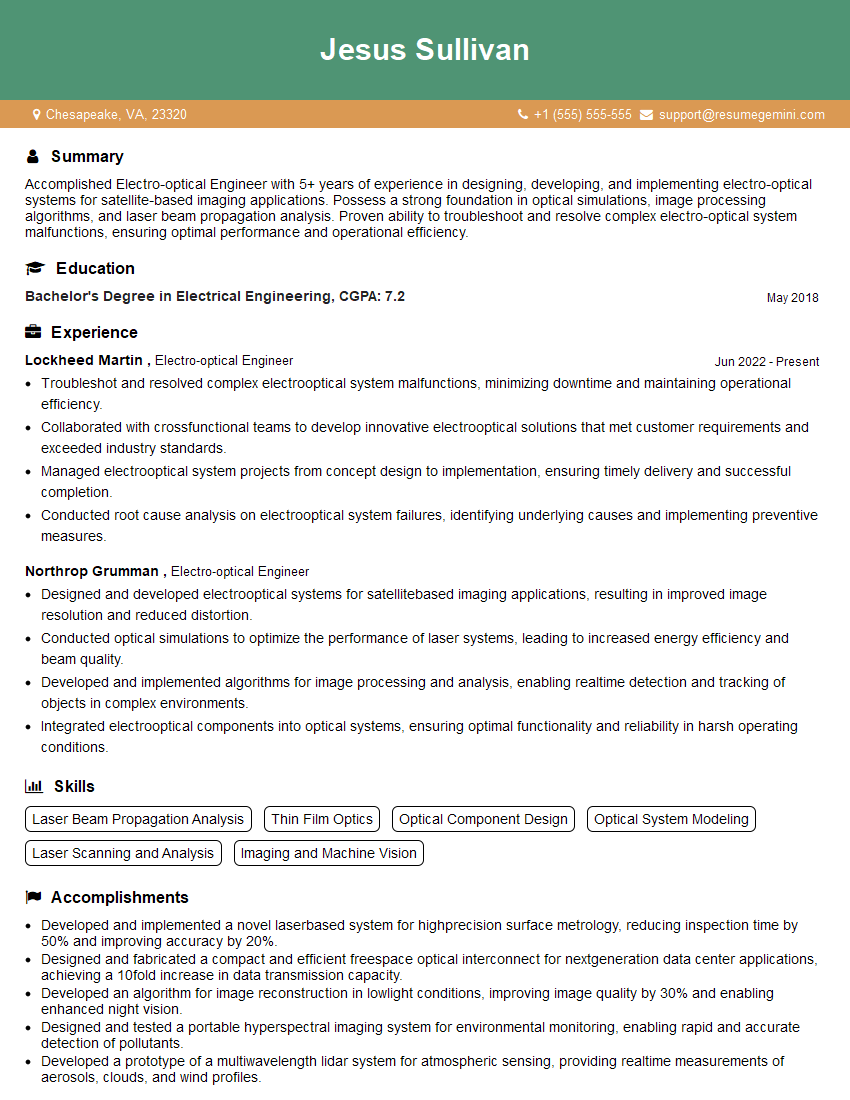
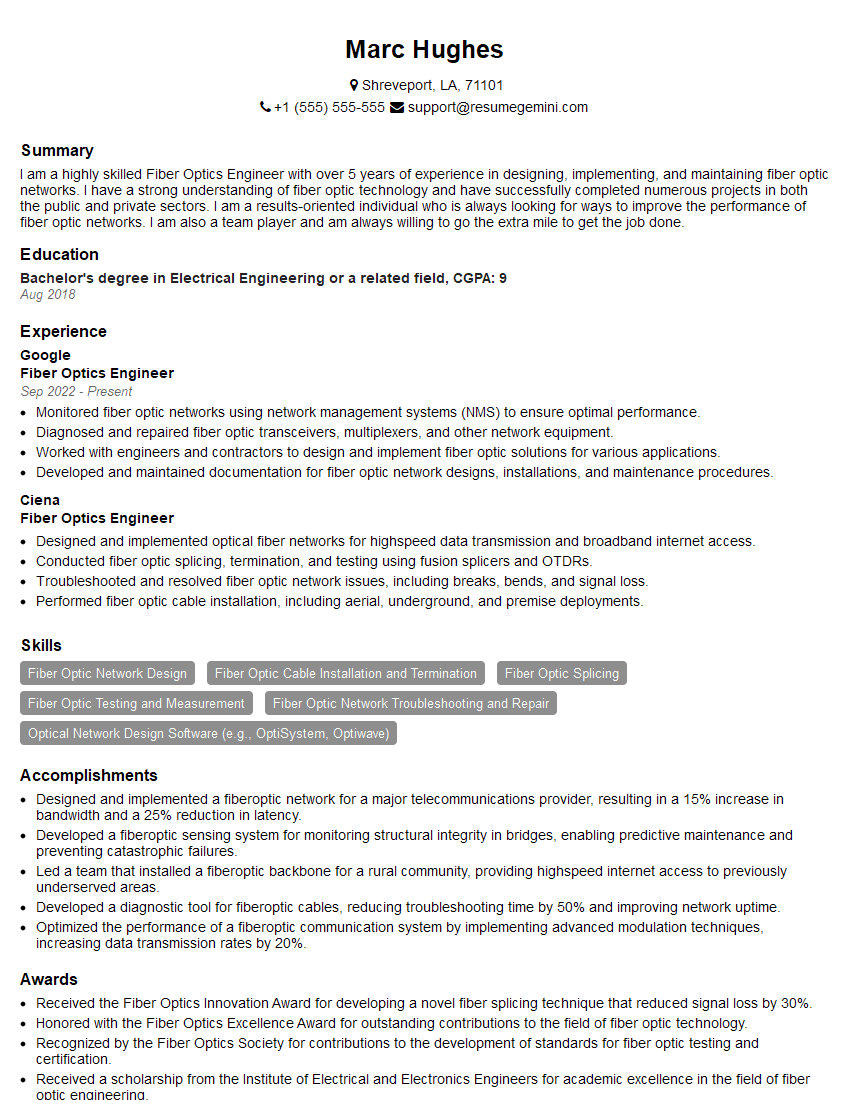
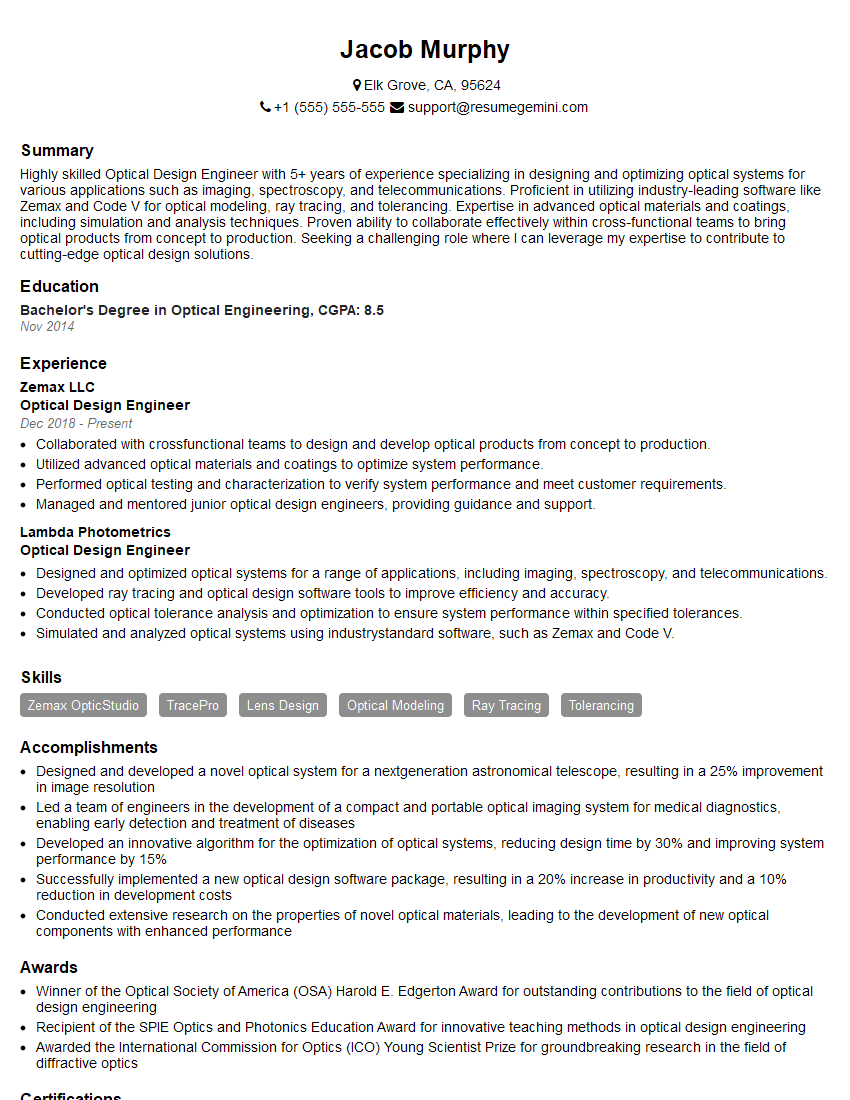
Mastering Light Propagation Analysis opens doors to exciting career opportunities in diverse fields, offering significant growth potential and competitive salaries. To maximize your job prospects, it’s crucial to present your skills effectively. Creating an ATS-friendly resume is essential for getting your application noticed by recruiters. ResumeGemini is a trusted resource to help you build a professional and impactful resume that showcases your expertise in Light Propagation Analysis. Examples of resumes tailored to this specific field are available through ResumeGemini to guide you.

Explore more articles
Users Rating of Our Blogs
Share Your Experience
We value your feedback! Please rate our content and share your thoughts (optional).
What Readers Say About Our Blog
Very informative content, great job.
good