Feeling uncertain about what to expect in your upcoming interview? We’ve got you covered! This blog highlights the most important Specialized Lifting and Rigging Operations interview questions and provides actionable advice to help you stand out as the ideal candidate. Let’s pave the way for your success.
Questions Asked in Specialized Lifting and Rigging Operations Interview
Q 1. Explain the different types of slings and their appropriate applications.
Slings are the critical link between the load and the lifting equipment. Choosing the right sling is paramount for safety and efficiency. Different sling types offer varying strengths, flexibility, and suitability for different load shapes and materials.
- Polyester/Nylon Web Slings: These are incredibly versatile, relatively lightweight, and easy to handle. They’re ideal for general lifting, especially when the load has sharp edges or irregular surfaces as the webbing distributes the load more evenly. Think of lifting a pallet of bricks – a web sling is perfect for that. They come in various widths and lengths, providing flexibility for different applications.
- Chain Slings: Extremely strong and durable, chain slings are suitable for heavy-duty lifting, especially with harsh or abrasive materials. Imagine lifting large pieces of steel or heavy machinery; a chain sling is a great choice. They are less prone to damage than webbing, but require careful inspection for wear and tear. Proper lubrication is also important.
- Wire Rope Slings: These are often used for very heavy loads and harsh environments. They are incredibly strong but can be more difficult to handle safely and require regular inspection for fraying or broken strands. Think of lifting heavy components in a construction project or in a shipyard.
- Round Slings: These are made from synthetic materials like nylon or polyester. They offer excellent flexibility, making them suitable for lifting awkward-shaped or cylindrical loads. They conform to the shape of the object being lifted, distributing pressure more evenly than a chain or wire rope sling.
The selection of sling type depends heavily on the load’s weight, shape, and material, as well as the lifting environment.
Q 2. Describe the process of calculating the safe working load (SWL) for a lift.
Calculating the Safe Working Load (SWL) is crucial to prevent accidents. It’s the maximum load a piece of lifting equipment can safely lift under normal conditions. The process involves several factors:
- Equipment Rating: Each sling, crane, or hoist has a clearly marked SWL. This is the starting point.
- Angle of Lift: Lifting at an angle reduces the effective SWL. The more acute the angle, the lower the SWL. For example, lifting with two legs at a 60-degree angle reduces the SWL significantly compared to a vertical lift. There are readily available charts and calculators that provide these reduction factors based on the angle.
- Number of Legs: Using multiple slings increases the SWL. For instance, using two legs effectively doubles the load capacity (assuming it is equally distributed).
- Environmental Factors: Consider temperature, humidity, and other environmental conditions that might affect the strength of the lifting equipment. Extreme temperatures can weaken synthetic slings, for instance.
- Load Distribution: Ensure the load is evenly distributed across the sling(s). A poorly balanced load can lead to catastrophic failure.
Example: If a sling has a SWL of 10,000 lbs, and you lift using two legs at a 45-degree angle, the SWL per leg would be reduced. You must consult the appropriate chart for the reduction factor and multiply it by the SWL of each leg to get the total safe lifting capacity for the load. Never exceed the reduced SWL.
Q 3. What are the key safety regulations and standards you must adhere to during rigging operations?
Adherence to safety regulations is non-negotiable. These regulations vary by location but generally include:
- OSHA (Occupational Safety and Health Administration) regulations (in the US): These outline detailed requirements for crane operation, rigging, and load handling.
- ASME (American Society of Mechanical Engineers) standards: Provide guidelines for the design, manufacture, and inspection of lifting equipment.
- Local and national regulations: These will vary and must be strictly followed. Regular inspections and certifications of equipment are frequently mandated.
Key aspects of these regulations include:
- Proper training and certification of personnel: Riggers and crane operators must be adequately trained and certified to handle the equipment safely.
- Regular inspection and maintenance of equipment: Equipment must be inspected before each use and regularly maintained according to manufacturer guidelines.
- Risk assessments and safe work procedures: A detailed risk assessment is required before any lift, and safe work procedures must be followed.
- Use of appropriate personal protective equipment (PPE): Hard hats, safety glasses, and other appropriate PPE are essential.
Failure to comply with these regulations can lead to severe penalties, injuries, or fatalities.
Q 4. How do you select the appropriate lifting equipment for a specific task?
Equipment selection is based on a thorough understanding of the lifting task’s specifics:
- Load Weight and Dimensions: This is the most critical factor. The equipment must have an SWL exceeding the load weight, considering all factors mentioned earlier.
- Load Characteristics: Is the load bulky, fragile, or hazardous? Different types of slings and lifting devices are suitable for different loads.
- Lifting Environment: Is it an indoor or outdoor setting? Are there environmental factors (wind, temperature) that might affect the lift?
- Accessibility: Is there sufficient space for maneuverability? The crane’s reach and capacity must be adequate for the working area.
- Lifting Height: The height of the lift determines the type of crane or hoist required.
Example: Lifting a heavy, irregularly shaped piece of machinery indoors would require a crane with sufficient capacity and reach, suitable slings to handle the shape and weight, and perhaps additional safety measures to account for the machinery’s potential instability.
Q 5. Explain the importance of pre-lift planning and risk assessment.
Pre-lift planning and risk assessment are critical for a safe lift. It is about thinking through each aspect of the lift before it ever happens.
- Detailed Site Survey: This includes identifying potential hazards, evaluating access routes, and considering the environment.
- Load Analysis: Determining the load’s weight, dimensions, center of gravity, and any potential instability.
- Equipment Selection: Choosing appropriate cranes, slings, and other equipment based on the load and site survey.
- Rigging Plan: Developing a detailed plan illustrating how the lift will be executed, including the positioning of the crane, slings, and personnel.
- Risk Assessment: Identifying potential hazards and developing mitigation strategies.
- Communication Plan: Establishing clear communication protocols between crane operators, riggers, and other personnel.
A thorough pre-lift plan will often prevent accidents from even being a possibility. It makes the entire operation safer and more efficient.
Q 6. Describe your experience with different types of cranes and their limitations.
My experience encompasses various crane types, each with unique capabilities and limitations:
- Tower Cranes: Excellent for high-rise construction, offering significant reach and lifting capacity. However, they require significant setup time and space.
- Mobile Cranes (Truck, All-Terrain, Crawler): Highly versatile and easily transported to various sites. Capacity and maneuverability vary greatly depending on the type. Ground conditions are critical for crawler cranes.
- Overhead Cranes: Ideal for factory or industrial settings, allowing for efficient material handling within a defined area. They are limited to the space they occupy.
- Gantry Cranes: Similar to overhead cranes but often used for larger spans or outdoor applications. They need to be adequately supported.
Understanding the limitations of each crane type is crucial. For instance, a tower crane may have a limited slewing radius (ability to rotate), and mobile cranes have limitations based on ground stability and wind conditions. A thorough risk assessment should account for each of these factors.
Q 7. How do you ensure the safe handling and storage of lifting equipment?
Safe handling and storage are critical to maintaining equipment integrity and preventing accidents. This involves:
- Regular Inspection: Equipment should be inspected before and after each use for any damage, wear, or defects. This includes visual checks and possibly more thorough examinations.
- Proper Storage: Lifting equipment should be stored in a designated area, protected from the elements, and away from potential hazards. Slings should be stored neatly and protected from sharp objects.
- Preventative Maintenance: Regular lubrication and maintenance according to manufacturer’s instructions are crucial to extend the lifespan of equipment and maintain safety.
- Clear Labeling and Identification: Each piece of equipment should be clearly labeled with its SWL and any other relevant information.
- Decommissioning and Disposal: Damaged or obsolete equipment must be safely decommissioned and disposed of according to regulations.
These practices reduce the risk of damage and ensure that equipment remains in optimal working condition, ready for safe use on a project.
Q 8. What are the signs of damaged or worn lifting equipment, and how do you handle them?
Recognizing damaged lifting equipment is crucial for safety. Think of it like this: a damaged tool is as dangerous as a blunt knife in the kitchen. We look for several key indicators:
- Visible damage: Cracks, bends, gouges, or distortions in the metal are obvious red flags. This includes slings, chains, hooks, and shackles. Even small cracks can significantly weaken the equipment.
- Wear and tear: Excessive wear on wire ropes (broken or severely worn wires), frayed synthetic slings, or flattened or deformed links in chains all point to reduced strength and increased risk of failure. We regularly inspect for wear exceeding acceptable limits as defined by manufacturers’ guidelines and relevant safety standards.
- Corrosion: Rust and corrosion weaken the structural integrity of the equipment, especially in high-humidity environments. This significantly reduces the load-bearing capacity.
- Improper repairs: Any unauthorized repairs or modifications to lifting equipment are unacceptable. Only certified professionals should perform repairs using approved methods.
If any of these signs are detected, the equipment is immediately taken out of service. It’s tagged as ‘out of service’ and reported to the supervisor. A thorough inspection and, if necessary, replacement or repair by a qualified technician are mandatory before the equipment is returned to use. We meticulously document all inspections and repairs.
Q 9. Explain your understanding of load charts and how to interpret them.
Load charts are the bible of safe lifting. They’re essentially tables or graphs showing the safe working load (SWL) limits for specific pieces of equipment at different angles and configurations. Think of it as a recipe—following it ensures a successful lift.
Interpreting a load chart requires understanding the variables: the type of equipment (e.g., sling, chain, hook), its size and material, the angle of the lift, and the type of load. The chart will show the maximum weight that can be safely lifted under various conditions. For example, a sling’s SWL might be 10 tons vertically but only 8 tons at a 30-degree angle. We always check the chart before every lift, ensuring that the load we’re handling is well within the safe working load specified for that particular configuration.
Ignoring load charts is extremely dangerous and can lead to catastrophic equipment failure, property damage, or serious injury. We treat these charts with utmost respect and make sure everyone on the crew understands how to use them correctly.
Q 10. How do you communicate effectively with crane operators and other crew members during a lift?
Effective communication is paramount in rigging operations. It’s not just about talking; it’s about ensuring clear and concise communication to prevent accidents. We use a combination of methods:
- Pre-lift planning meetings: We discuss the lift plan, including the type of equipment, load weight, lifting sequence, and potential hazards. Everyone involved clarifies their roles and responsibilities.
- Hand signals: Standard hand signals are used to communicate instructions to the crane operator, such as ‘hoist,’ ‘lower,’ ‘swing,’ and ‘stop.’ We ensure all crew members are familiar with these signals and know how to use them correctly and ensure all are communicating with hand signals.
- Two-way radios: Radios allow for constant communication, especially during complex lifts or in noisy environments. This allows for clear communication for any issues that arise.
- Clear and concise language: Avoiding jargon and using plain language ensures everyone understands the instructions. We always confirm the operator understands the instructions before beginning the lift. If there is ever any doubt, the lift is stopped.
A simple example: instead of shouting ‘Raise it slowly!’ we might use ‘Hoist slowly, confirm.’ This encourages feedback and confirmation. Miscommunication is a leading cause of accidents, so clear and consistent communication is our highest priority.
Q 11. Describe your experience with different types of rigging hardware (e.g., shackles, hooks, etc.)
My experience encompasses a wide range of rigging hardware. Each piece has specific applications and limitations. I’m thoroughly familiar with the capabilities and limitations of different materials and designs:
- Shackles: I’m experienced with various types, including bow shackles, D-shackles, and screw pin shackles. I understand the importance of selecting the correct size and type based on the load and application, ensuring the shackle’s SWL is never exceeded. We regularly inspect them for signs of deformation or damage.
- Hooks: I’m proficient in using different hook types, like eye hooks, clevis hooks, and grab hooks. I understand the criticality of inspecting the hook’s throat opening for wear and damage. A damaged hook is a serious safety risk.
- Slings: I’ve worked with various sling materials, including wire rope, synthetic fiber (nylon, polyester), and chain slings. I understand their respective strengths, weaknesses, and limitations under different loads and environmental conditions. The proper care and maintenance of slings are paramount to their effectiveness and longevity.
- Wire rope clips: I’m experienced with the proper installation and inspection of wire rope clips which are used to secure the end of a wire rope to prevent unravelling.
I know that proper selection, inspection, and usage of rigging hardware are crucial for safety. Before every lift, we carefully check every piece of equipment for any signs of wear and tear and ensure it’s appropriately rated for the load.
Q 12. What are the different types of hitches used in rigging, and when would you use each?
Rigging hitches are essential for distributing the load evenly and securely. Different hitches are used depending on the load’s characteristics and the required lifting angle:
- Basket hitch: Used for lifting symmetrical loads, distributing the weight evenly across multiple slings. Think of lifting a large piece of machinery with multiple slings.
- Choker hitch: Used when only one leg of a sling is wrapped around the load. Offers a more secure grip than a single vertical lift, but the SWL of the sling is reduced. This is useful when you need a snug fit around an irregularly shaped object.
- Vertical hitch: The simplest hitch, where a sling is directly attached to the load vertically. Offers maximum SWL for the sling but is less versatile than other hitches.
- Bridle hitch: Used for lifting loads that require more than one sling, ensuring even weight distribution. Frequently used to stabilize heavy, irregularly shaped objects during a crane lift.
The choice of hitch depends on several factors, including the load’s shape, weight, and the rigging equipment available. Selecting the appropriate hitch is crucial to ensure the safety and stability of the lift. It’s a key skill that helps prevent accidents.
Q 13. How do you handle unexpected situations or emergencies during a lift?
Unexpected situations are part of the job. Our training emphasizes preparedness and swift, decisive action:
- Immediate Stop: The first response to any unexpected event (e.g., sling failure, load shift) is always to stop the lift immediately. Safety is paramount.
- Assess the Situation: Quickly evaluate the situation to identify the problem and the level of risk.
- Implement Contingency Plan: We have established procedures for various scenarios, such as load shifts, equipment failure, or unforeseen obstacles. We follow those established procedures to mitigate the issue.
- Communicate Effectively: Keep everyone informed about the situation and the actions being taken. Clear communication is critical during an emergency.
- Secure the Area: Isolate the area to prevent further accidents or injuries.
- Report and Document: After the emergency is resolved, we document the incident thoroughly, including the cause, actions taken, and any damage or injuries.
For example, if a sling breaks during a lift, the first action is to stop the hoist. We then carefully assess the damage, secure the load to prevent further issues, and then communicate with the team and supervisors to develop a plan to rectify the situation. We emphasize thorough training so everyone knows their responsibilities during an emergency.
Q 14. What is your experience with load stability and load balancing?
Load stability and balancing are fundamental to safe lifting. An unbalanced load is a recipe for disaster. My experience involves:
- Center of Gravity: Accurately determining the center of gravity of the load is critical. If it’s not centered, the load can swing during the lift, causing instability. We use various methods, including calculations and visual inspections, to determine the center of gravity.
- Proper Sling Placement: Ensuring the slings are correctly positioned to support the load’s center of gravity and provide even weight distribution is essential. Improper sling placement can lead to unbalanced loads or equipment damage.
- Load Stabilization Techniques: We use various techniques to maintain load stability, such as using taglines (auxiliary ropes) to control the load’s movement and additional slings for better support.
- Environmental Factors: I account for environmental factors like wind speed and direction, which can significantly affect load stability. High wind can cause significant load swing even with perfectly balanced load.
Imagine lifting a long, narrow beam—proper sling placement is crucial to prevent it from swinging and causing an accident. We take extra precautions with loads that are unevenly distributed or susceptible to wind. Load balancing is a continuous process, not a one-time check.
Q 15. Explain the importance of proper load securing and tensioning techniques.
Proper load securing and tensioning are paramount in specialized lifting and rigging operations, ensuring the safety of personnel, equipment, and the load itself. Improper techniques can lead to catastrophic accidents, including load slippage, equipment failure, and potential injuries or fatalities.
Effective load securing involves using appropriate methods to prevent movement during lifting and transportation. This includes choosing the right type and quantity of securing devices – such as chains, straps, wire ropes, or nets – based on the load’s weight, shape, and characteristics. Proper tensioning ensures that the load is adequately supported and prevented from shifting or swinging. Think of it like tightening a seatbelt – you want enough tension to keep you secure, but not so much as to damage the belt or cause discomfort.
For instance, imagine lifting a large, oddly-shaped steel component. We wouldn’t just sling it haphazardly. We’d use spreader beams to distribute the load evenly across multiple attachment points and multiple straps or chains for redundancy and to prevent unwanted rotation. The tension on each strap would be checked and adjusted to ensure even distribution and prevent slippage, carefully monitored using tension gauges or load cells.
Career Expert Tips:
- Ace those interviews! Prepare effectively by reviewing the Top 50 Most Common Interview Questions on ResumeGemini.
- Navigate your job search with confidence! Explore a wide range of Career Tips on ResumeGemini. Learn about common challenges and recommendations to overcome them.
- Craft the perfect resume! Master the Art of Resume Writing with ResumeGemini’s guide. Showcase your unique qualifications and achievements effectively.
- Don’t miss out on holiday savings! Build your dream resume with ResumeGemini’s ATS optimized templates.
Q 16. Describe your experience with different types of lifting accessories (e.g., spreader beams, shackles, etc.)
My experience encompasses a wide range of lifting accessories. I’m proficient with various types of shackles (bow, dee, and D-shackles), each chosen based on load requirements and orientation. I have extensive experience using spreader beams of different designs to accommodate diverse load configurations and distribute weight evenly, avoiding stress concentrations. I’m familiar with the application and limitations of different types of slings – wire rope slings for high-strength applications, synthetic web slings for flexibility and abrasion resistance, and chain slings for their durability in harsh environments. I’ve also worked with specialized lifting accessories like lifting beams, shackles, and eyebolts, always selecting equipment appropriate for the specific load and lifting environment.
For example, during a recent project involving the lifting of a heavy transformer, we used a custom-designed spreader beam to distribute the load across four attachment points. The selection of the spreader beam and associated shackles was carefully calculated to ensure a sufficient safety factor and to account for the transformer’s center of gravity.
Q 17. What are the common causes of lifting accidents, and how can they be prevented?
Lifting accidents often stem from a combination of factors. Common causes include using incorrect or damaged equipment, inadequate planning, improper rigging techniques, exceeding equipment capacity, and insufficient training or supervision. Human error, such as miscommunication or overlooking safety precautions, plays a significant role.
- Preventing Accidents:
- Pre-lift planning: Thoroughly plan each lift, considering load weight, center of gravity, rigging points, and environmental factors. Develop detailed lifting plans.
- Equipment inspection: Rigorous inspection of all equipment before each lift. This includes visual checks for damage and load testing.
- Proper training: All personnel involved in lifting operations must receive thorough training on safe lifting practices, equipment usage, and emergency procedures.
- Supervision: Qualified supervisors should oversee all lifting operations to ensure adherence to safety protocols.
- Communication: Clear and concise communication among team members is crucial to prevent misunderstandings and errors.
For instance, a failure to properly inspect a shackle for damage before a lift could result in its failure under load, leading to a dropped load and potential injuries. Similarly, insufficient training could result in incorrect slinging methods leading to an unstable load and potentially hazardous situations.
Q 18. How do you inspect and verify the condition of rigging equipment before each lift?
Before each lift, I perform a meticulous inspection of all rigging equipment. This inspection includes visual checks for signs of wear, damage, corrosion, distortion, cracks, or any other defects. I carefully examine all components, including slings, shackles, hooks, and other lifting accessories. I check for proper lubrication where applicable and verify that all safety devices are functioning correctly. Furthermore, I examine the equipment’s certification labels to ensure they are valid and that the equipment is rated for the intended load.
The process involves a visual inspection followed by a thorough examination of any suspected issues. This might involve using specialized tools to detect hidden damage or assessing the material’s integrity in areas showing wear. Documentation is crucial – I record my findings in a formal inspection report, identifying any defects or concerns.
For example, before lifting a particularly heavy piece of machinery, I would not only visually inspect the wire rope sling, but also measure its diameter at various points to check for any significant wear. I’d then check for any kinks or damage to the wire strands. If even a minor concern is identified, I’d immediately replace that component rather than risk a potentially hazardous lift.
Q 19. What is your experience with using load monitoring devices?
I have extensive experience with load monitoring devices, including load cells, dynamometers, and electronic load indicators. These devices are vital for ensuring that the load remains within the safe working limits of the lifting equipment. Load cells measure the force exerted on the load and provide accurate weight readings. Dynamometers measure tension in ropes or chains. Electronic load indicators provide real-time displays of the weight, allowing for continuous monitoring and immediate identification of any overload conditions.
The data from these devices allows us to make informed decisions concerning the lift, adjust rigging techniques as needed, and take appropriate safety precautions. For example, during a heavy lift operation, the load cell’s readings helped us to ensure that the load was properly distributed amongst the multiple lifting points, preventing any undue stress on any single point. This real-time data prevents us from exceeding equipment limits and enables immediate adjustments.
Q 20. Explain your understanding of different types of lifting plans and their importance.
Lifting plans are crucial documents that detail the procedures and safety measures for each lift. They vary in complexity depending on the load’s characteristics and the lifting environment. Simple lifts might only require a basic checklist, while complex lifts may necessitate detailed plans including engineering calculations, equipment specifications, personnel assignments, and emergency procedures.
- Types of Lifting Plans:
- Simple Lifting Plans: These are suitable for straightforward lifts involving standard equipment and well-defined procedures.
- Complex Lifting Plans: These plans include detailed engineering calculations, risk assessments, and emergency procedures, necessary for high-risk lifts involving heavy loads, specialized equipment, or complex rigging arrangements.
The importance lies in mitigating risks. A well-prepared lifting plan serves as a roadmap to ensure a safe and efficient lift, reducing the probability of accidents. It provides a common understanding among all personnel involved, specifying roles, responsibilities, and communication protocols. Furthermore, the plan serves as a valuable record for post-lift analysis, facilitating continuous improvement of safety procedures.
Q 21. How do you ensure compliance with company safety policies and procedures?
Compliance with company safety policies and procedures is non-negotiable. I actively participate in safety meetings and training sessions, ensuring I’m updated on all relevant regulations and best practices. Before every lift, I review the applicable safety policies and ensure that my actions align with them. I report any unsafe conditions or non-compliant practices immediately to my supervisor. I also conduct regular self-assessments to ensure I’m maintaining a high standard of safety and compliance.
For example, if I notice a piece of equipment that isn’t properly maintained or labeled, I immediately report this to my supervisor. This proactive approach prevents potential accidents and demonstrates a commitment to a safe work environment. My adherence to safety rules and regulations is always my top priority, exceeding mere compliance to ensure the safety of myself and my team.
Q 22. What is your experience with using different types of signaling systems?
My experience with signaling systems is extensive, encompassing hand signals, two-way radios, and more sophisticated systems like light signals. Hand signals, though seemingly basic, are critical for precise communication in noisy environments where radio interference might occur. I’m proficient in both the standard ANSI/ASME B30.5 signals and any company-specific modifications. For instance, on a recent project involving the placement of heavy HVAC units on a high-rise building, hand signals were essential for coordinating the crane operator with the ground crew. Any miscommunication could have resulted in a serious incident. We used a designated signal person to ensure clear, concise communication. Two-way radios are invaluable for larger projects or situations requiring more complex instructions, but we always maintain a backup system – often hand signals – to prevent communication breakdowns. More advanced projects might use specialized light signaling systems to ensure clear communication across longer distances or in areas with poor radio reception. Understanding the limitations and strengths of each system is crucial for ensuring safety and efficiency.
Q 23. Describe your experience with working at heights and in confined spaces.
Working at heights and in confined spaces requires meticulous adherence to safety protocols. My experience includes extensive training and certification in fall protection systems, confined-space entry procedures, and rescue techniques. I’ve worked on numerous projects involving elevated platforms, scaffolding, and rope access systems. For example, while installing large industrial ventilation equipment on a refinery, we used specialized harnesses, fall arrestors, and safety nets. In confined spaces, such as during the inspection and repair of underground pipelines, we followed strict entry procedures, including atmospheric monitoring, lockout/tagout procedures, and having a designated standby person. I emphasize risk assessment before every job, ensuring all necessary precautions are in place. A thorough understanding of the specific hazards of each environment and employing appropriate PPE (Personal Protective Equipment) is paramount. Regular training and refresher courses keep my skills sharp and ensure I am always up-to-date on the latest safety procedures.
Q 24. How do you manage multiple lifts simultaneously on a complex project?
Managing multiple lifts simultaneously requires meticulous planning and coordination. I utilize a collaborative approach, involving detailed lift plans, load charts, and clear communication protocols between all team members. We start by breaking down the project into manageable phases, identifying critical path activities and potential conflict points. This may involve using a Gantt chart to visualize timelines and dependencies between lifts. Each lift is assigned a dedicated team with clear responsibilities and assigned a leader who is responsible for overseeing the lift safely. During the execution of the lifts, I ensure continuous monitoring of all lifts, actively communicating with each team to address any unforeseen issues. For example, on a large-scale construction project, we had to manage the simultaneous lifting of structural steel, precast concrete elements, and mechanical equipment. Effective communication, detailed planning, and robust risk assessment were key to avoid any collisions or delays. Clear communication channels and a designated supervisor overseeing all the lifts are essential for maintaining order and mitigating potential hazards.
Q 25. What is your experience with working with various materials and their different lifting requirements?
My experience working with various materials is broad, encompassing steel, concrete, glass, and specialized equipment. Each material presents unique challenges; for example, steel requires careful consideration of its weight, center of gravity, and potential for deformation. Concrete elements, because of their fragility and irregularity, need specialized rigging techniques and equipment. Glass requires extreme care due to its fragility and susceptibility to breakage. Understanding material properties, including weight, strength, and center of gravity, is essential for selecting appropriate lifting gear and techniques. I’ve worked with oversized and oddly shaped components requiring custom rigging solutions. For example, we once had to lift a massive transformer using a combination of spreader beams, slings, and specialized lifting points to ensure safe and stable transportation. Always meticulously checking load capacities, using appropriate slings and shackles, and selecting the right lifting equipment are crucial steps to ensure safe and damage-free material handling.
Q 26. Describe your problem-solving skills in a high-pressure rigging situation.
Problem-solving in high-pressure rigging situations requires a calm, methodical approach. My strategy involves a structured process: first, I assess the immediate situation, identifying the root cause of the problem. Then, I develop several potential solutions, weighing the risks and benefits of each option. Next, I select the best course of action, communicating it clearly to the team. Finally, I implement the solution, closely monitoring the results and making adjustments as necessary. For example, during a lift, a critical sling failed. My team and I immediately stopped the operation and initiated a thorough risk assessment. We quickly determined that replacing the failed sling with a redundant system was the safest option. While the timeline was impacted, prioritizing safety ensured no damage to equipment or injuries to personnel. Experience, training, and a strong understanding of rigging principles are crucial for effective problem-solving under pressure. Maintaining calm and clearly communicating decisions to the team is crucial to minimizing stress and promoting effective teamwork.
Q 27. What are your strengths and weaknesses related to rigging operations?
My strengths include a deep understanding of rigging principles, excellent problem-solving abilities, and a commitment to safety. I am proficient in a wide range of rigging techniques and experienced in managing complex projects. However, my weakness might be delegating tasks – I tend to be detail-oriented and sometimes take on more responsibility than necessary. I am actively working on improving this by more effectively trusting my team’s expertise and fostering a collaborative environment. I believe that ongoing self-assessment and continuous improvement are vital in any field, particularly one as demanding and safety-critical as rigging operations.
Q 28. How do you stay updated on the latest safety regulations and best practices in rigging?
Staying updated on safety regulations and best practices is a continuous process. I actively participate in professional organizations, such as the Association of Crane and Rigging Professionals, and regularly attend industry conferences and workshops. I maintain subscriptions to relevant trade publications and online resources, keeping abreast of emerging technologies and changes in regulations. Regularly reviewing safety manuals and manufacturer’s guidelines for equipment ensures the team and I remain compliant. Furthermore, participating in regular training sessions and actively seeking feedback from peers and supervisors ensures best practices are consistently implemented and refined. Staying informed about industry advancements is essential for maintaining a high level of competence and ensures the safety and efficiency of all operations.
Key Topics to Learn for Specialized Lifting and Rigging Operations Interview
- Planning & Risk Assessment: Understanding the critical path method, hazard identification (SWIMS, JSA), and developing comprehensive lifting plans. This includes considering environmental factors and potential contingencies.
- Equipment Selection & Operation: Familiarity with various lifting equipment (cranes, derricks, hoists, winches), their operational limits, and appropriate selection based on load capacity, weight distribution, and site conditions. Practical experience with pre-operational checks and safe operating procedures is crucial.
- Load Calculations & Stability: Mastering load calculations, center of gravity determination, and understanding the principles of stability, including the effects of wind and ground conditions on lift operations. Be prepared to discuss specific calculation methodologies and their application.
- Rigging Techniques & Hardware: Knowledge of different rigging techniques (e.g., slings, shackles, wire ropes, chains), their proper use, inspection, and limitations. Understanding the importance of selecting appropriate hardware for specific load types and lift configurations is vital.
- Lifting Procedures & Communication: Thorough understanding of safe lifting procedures, including pre-lift inspections, signaling systems, and effective communication protocols among the lifting team. Practical experience with coordinating lift operations is highly valuable.
- Troubleshooting & Problem Solving: Ability to identify and address potential problems during lift operations, including malfunctioning equipment, unexpected load shifts, and adverse weather conditions. Showcase your ability to think critically and make sound decisions under pressure.
- Regulations & Compliance: Familiarity with relevant safety regulations, industry best practices, and legal compliance requirements related to specialized lifting and rigging operations. Demonstrate awareness of OSHA, ASME, or other applicable standards.
Next Steps
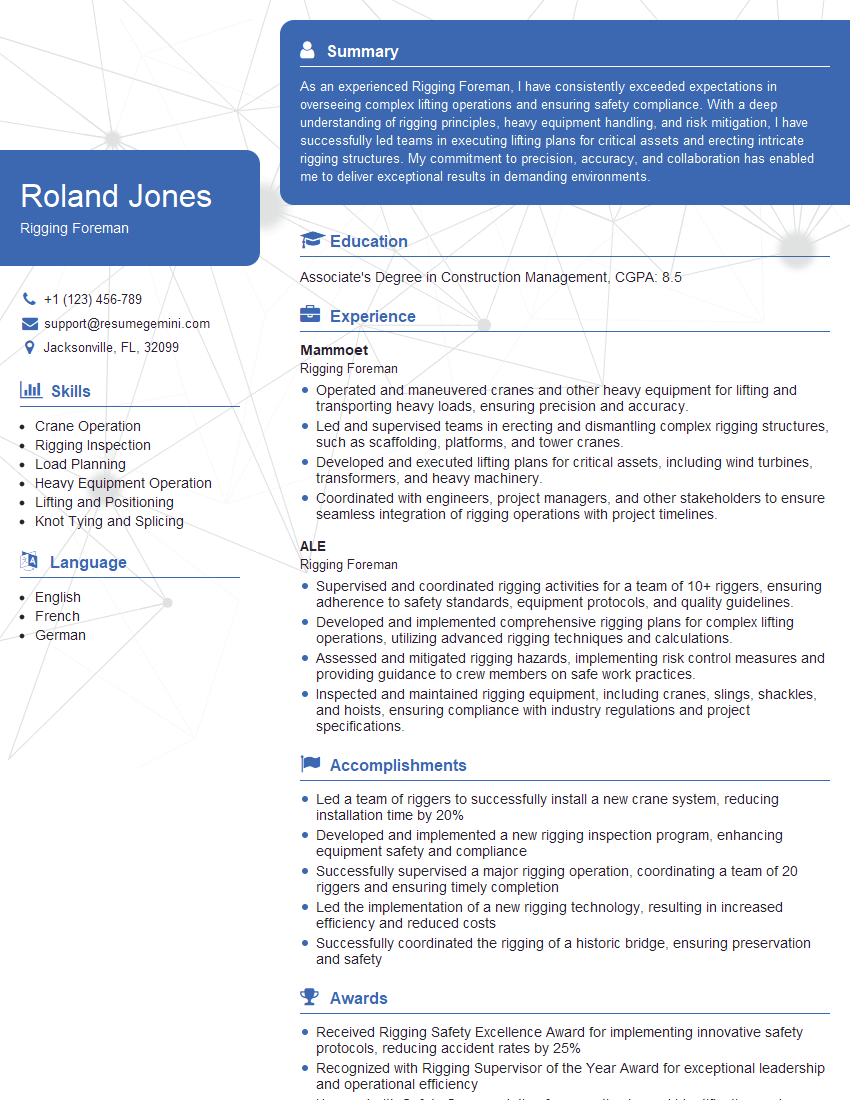
Mastering Specialized Lifting and Rigging Operations is key to advancing your career in a high-demand field offering excellent opportunities for growth and specialization. To maximize your job prospects, it’s vital to create a resume that highlights your skills and experience effectively. An ATS-friendly resume is crucial for getting past applicant tracking systems and reaching the hiring manager. ResumeGemini is a trusted resource that can help you build a professional, impactful resume tailored to the specific requirements of the Specialized Lifting and Rigging industry. Examples of resumes specifically designed for this field are available to guide you. Take this opportunity to showcase your expertise and secure your dream role.






Explore more articles
Users Rating of Our Blogs
Share Your Experience
We value your feedback! Please rate our content and share your thoughts (optional).
What Readers Say About Our Blog
Very informative content, great job.
good