The thought of an interview can be nerve-wracking, but the right preparation can make all the difference. Explore this comprehensive guide to Lighting Design and Integration interview questions and gain the confidence you need to showcase your abilities and secure the role.
Questions Asked in Lighting Design and Integration Interview
Q 1. Explain the difference between illuminance and luminance.
Illuminance and luminance are both measures of light, but they describe different aspects. Think of it like this: illuminance is how much light falls on a surface, while luminance is how much light that surface reflects or emits.
Illuminance is measured in lux (lx) and represents the amount of luminous flux (light energy) incident on a surface per unit area. It’s essentially how bright the light source appears on the surface. A high illuminance value means a lot of light is hitting the surface. For example, a brightly lit office desk might have an illuminance of 500 lux.
Luminance, measured in candelas per square meter (cd/m²) or nits, describes the intensity of light emitted or reflected from a surface in a particular direction. It’s how bright the surface appears to the observer. A highly reflective white wall under high illuminance will have a higher luminance than a dark, absorbent surface under the same illuminance.
In simple terms: Illuminance is about the light falling on a surface, while luminance is about the light leaving a surface.
Q 2. Describe your experience with various lighting control systems (e.g., DALI, DMX).
I have extensive experience with various lighting control systems, including DALI, DMX, and BACnet. My experience spans both design and implementation phases of projects of varying scales, from small retail spaces to large-scale commercial buildings.
- DALI (Digital Addressable Lighting Interface): I’ve used DALI extensively for sophisticated control of individual luminaires in commercial projects. Its ability to address each fixture individually allows for precise light level adjustments, scene setting, and fault detection, resulting in significant energy savings and improved user experience. For instance, I implemented DALI in an office building to enable personalized lighting control at each workstation, adapting to individual preferences and daylight availability.
- DMX (Digital Multiplex): DMX is my go-to for dynamic lighting effects, primarily in entertainment and architectural applications. I’ve used it to create stunning lighting shows in theaters and museums, controlling moving heads, LED strips, and other dynamic lighting fixtures. One memorable project involved programming a DMX system to synchronize lighting with a live music performance.
- BACnet (Building Automation and Control Networks): I leverage BACnet for seamless integration of lighting controls within a larger building management system (BMS). This enables centralized monitoring and control of all building systems, including HVAC, security, and lighting, improving efficiency and reducing operational costs. In a recent hospital project, we integrated the lighting system with BACnet to optimize energy consumption and ensure appropriate lighting levels for different areas.
My expertise also includes programming and troubleshooting these systems, ensuring seamless operation and optimal performance.
Q 3. How do you calculate the required lighting level for a specific space?
Calculating the required lighting level for a space is crucial for creating a functional and comfortable environment. It’s not a one-size-fits-all calculation; it depends on several factors.
The process generally involves these steps:
- Identify the space’s function: A library needs lower illuminance than a factory floor. Lighting standards (like IES) provide recommended illuminance levels for various spaces.
- Consider the visual task: The level of detail required for a task influences the illuminance needed. Fine detail work needs higher illuminance than general ambient lighting.
- Account for the room’s reflectance: Lighter-colored walls and ceilings reflect more light, requiring fewer luminaires to achieve the desired illuminance.
- Determine the room’s dimensions: This is essential for calculating the total luminous flux (light output) required.
- Choose the lighting fixtures: Select fixtures with appropriate luminous efficacy (lumens per watt) and light distribution.
- Use lighting design software: Software like DIALux or Relux can simulate lighting conditions, helping optimize fixture placement and energy efficiency. This step is crucial to avoid over- or under-lighting.
Example: Let’s say we’re designing an office space. The IES standard might recommend 500 lux. Using lighting design software, we input the room dimensions, wall reflectance, and chosen fixtures. The software then helps determine the number and placement of fixtures to achieve the desired 500 lux while accounting for factors like light loss due to absorption.
Q 4. What are the key considerations when designing lighting for energy efficiency?
Energy-efficient lighting design is paramount, and it requires a holistic approach focusing on several key considerations:
- High-efficacy luminaires: Using LED lights with high lumens per watt is crucial. LEDs significantly outperform incandescent and fluorescent lights in terms of energy efficiency.
- Lighting control systems: Implementing occupancy sensors, daylight harvesting, and dimming controls significantly reduces energy consumption. These systems ensure lights are only on when and where needed.
- Proper lighting layout and fixture selection: Careful planning minimizes energy waste by directing light effectively to the task area. Consider the light distribution pattern of the fixtures—a direct-light fixture is more energy-efficient than a diffuse one if aiming for task lighting.
- Daylight harvesting: Maximizing natural daylight reduces the need for artificial lighting, resulting in substantial energy savings. Strategically placed windows and light shelves can significantly increase daylight penetration.
- Energy-efficient materials: Using high-reflectivity paints and finishes on walls and ceilings increases the effective use of available light, lowering the required energy input.
- Regular maintenance: Cleaning luminaires and replacing ballasts regularly improves the light output and energy efficiency of the system.
By carefully integrating these strategies, we can design lighting systems that are both visually appealing and environmentally responsible.
Q 5. Explain your experience with different types of lighting fixtures (LED, fluorescent, incandescent).
My experience encompasses a wide range of lighting technologies, and I’m well-versed in the advantages and disadvantages of each:
- LED (Light Emitting Diode): LEDs are my preferred choice for most projects due to their high energy efficiency, long lifespan, and design flexibility. Their ability to be integrated into various form factors and controlled precisely makes them versatile for various applications. I’ve used LEDs in everything from accent lighting to general illumination, exploiting their ability to produce various color temperatures and light distributions.
- Fluorescent: Fluorescent lighting has a place in certain applications, particularly in areas requiring high illuminance and where cost is a primary factor. However, their lower efficacy and shorter lifespan compared to LEDs make them less desirable in many new installations. I’ve primarily used fluorescent lighting in older buildings where replacement was not feasible or cost-prohibitive, often opting for more energy-efficient T5 or T8 options.
- Incandescent: Incandescent lighting is largely obsolete due to its very low energy efficiency and short lifespan. It’s primarily used for decorative purposes in niche applications now. I rarely specify incandescent lights in new projects unless there’s a specific stylistic requirement, and even then, I advocate for more energy-efficient alternatives.
My selection of lighting fixtures always considers factors like energy efficiency, lifespan, color rendering, and the overall aesthetic requirements of the project.
Q 6. How do you incorporate daylight harvesting into your designs?
Daylight harvesting is a crucial aspect of sustainable lighting design. It involves strategically using natural daylight to reduce or eliminate the need for artificial lighting during the day. My approach involves a combination of design strategies:
- Strategic window placement and sizing: I carefully analyze the building’s orientation and the path of the sun to optimize window placement and size for maximum daylight penetration.
- Light shelves and light tubes: Light shelves reflect daylight deeper into the space, while light tubes redirect daylight from the roof or other areas to interior spaces lacking direct sunlight.
- Automated dimming systems: These systems constantly monitor daylight levels and adjust artificial lighting accordingly, providing seamless transitions between natural and artificial light sources. This reduces energy consumption while maintaining appropriate illuminance levels.
- Light color tuning: I also factor in how the color temperature of natural light changes throughout the day, optimizing artificial lighting to maintain color consistency.
- Building materials: The use of highly reflective materials on walls and ceilings maximizes daylight diffusion, reducing the need for artificial light.
A recent project involved designing a school classroom where we used a combination of light shelves, automated dimming systems, and carefully placed windows to maximize daylight penetration, resulting in a significant reduction in energy consumption for classroom lighting.
Q 7. Describe your proficiency in lighting design software (e.g., DIALux, Relux, AGI32).
I am proficient in several leading lighting design software packages, including DIALux, Relux, and AGI32. My expertise extends beyond simply using these tools; I understand their underlying principles and limitations, allowing me to leverage them effectively for optimal design outcomes.
- DIALux: I use DIALux extensively for calculating illuminance levels, generating photorealistic renderings, and optimizing fixture placement. Its user-friendly interface and extensive library of luminaires make it ideal for a wide range of projects.
- Relux: Relux is my preferred choice for complex projects requiring detailed analysis of daylighting and glare. Its sophisticated algorithms enable precise simulations of lighting conditions, helping optimize energy efficiency and visual comfort.
- AGI32: AGI32 is valuable for visualizing and documenting large-scale lighting projects. Its powerful visualization capabilities help communicate design intent clearly to clients and stakeholders. I’ve used it to create compelling presentations and construction documents for large commercial projects.
My experience with these software packages enables me to create efficient, effective, and visually appealing lighting designs that meet the specific requirements of each project.
Q 8. How do you address glare issues in lighting design?
Glare, that uncomfortable brightness that interferes with vision, is a significant concern in lighting design. We tackle it using a multi-pronged approach focusing on both the luminaire (light fixture) design and the overall lighting layout.
- Shielding: Using luminaires with baffles, louvers, or diffusers to prevent direct light from reaching the eyes. Think of sunglasses for your lights; they redirect the light away from direct viewing angles. For example, recessed downlights with appropriate shielding angles are often used in offices to minimize glare on computer screens.
- Light Placement: Strategically placing light sources to minimize direct line-of-sight. Indirect lighting techniques, where light bounces off ceilings or walls before reaching the visual field, are excellent for reducing glare. Imagine a softly lit room with light reflecting from the ceiling, creating a more even and comfortable illumination.
- Control of Luminance: Managing the brightness of light sources. This involves selecting appropriate lumens and using dimming controls to adjust brightness levels according to the task and environment. For instance, dimming task lighting in a kitchen prevents glare while still providing adequate illumination for food preparation.
- Proper Positioning of Fixtures in Relation to Viewing Angles: Careful consideration needs to be given to the location of light sources in relation to potential viewing angles, especially for task lighting. This prevents direct light from shining into someone’s eyes while working.
Ultimately, addressing glare involves a combination of these strategies, tailored to the specific space and its intended use.
Q 9. What are the common lighting design standards and codes you follow?
Adherence to lighting design standards and codes is paramount for safety and optimal performance. The specific standards vary by location but commonly include:
- IES (Illuminating Engineering Society) standards: These provide guidance on lighting levels, glare limits, and energy efficiency. They are widely adopted globally and offer best practices.
- ASHRAE (American Society of Heating, Refrigerating and Air-Conditioning Engineers): While primarily focused on HVAC, ASHRAE standards often touch upon lighting’s impact on building energy efficiency and thermal comfort.
- LEED (Leadership in Energy and Environmental Design): LEED certification incorporates lighting design criteria promoting sustainable and energy-efficient practices. Achieving LEED certification often involves demonstrating adherence to specific lighting energy performance benchmarks.
- Local Building Codes: Each region has its specific codes relating to electrical safety, fire safety, and accessibility, all of which impact lighting design.
- NFPA (National Fire Protection Association): NFPA standards related to electrical installations are crucial for ensuring the safe installation of lighting systems.
My design process always starts with a thorough review of all applicable codes and standards for the project’s location to ensure compliance and create a safe, functional, and code-compliant lighting scheme.
Q 10. Explain your understanding of color rendering index (CRI) and its importance.
The Color Rendering Index (CRI) is a metric that quantifies how accurately a light source renders the colors of objects compared to a reference light source (typically daylight). A higher CRI indicates better color rendering.
CRI ranges from 0 to 100, with 100 being perfect rendering. A CRI of 80 or higher is generally considered good for most applications, while lower CRI values can result in dull, washed-out colors, affecting the overall ambiance and functionality of the space. For instance, in a retail setting, where color accuracy is crucial for product presentation, a high CRI light source (above 90) is essential to accurately showcase the merchandise. In contrast, less demanding applications might tolerate a CRI of 70.
The importance of CRI varies with the application. For tasks requiring precise color assessment, such as in art galleries or medical settings, a high CRI is crucial. However, in less critical environments, such as some industrial settings, a lower CRI may be acceptable, prioritizing energy efficiency.
Q 11. Describe your experience with lighting simulations and rendering.
Lighting simulations and rendering are integral parts of my design process, allowing for detailed visualization and analysis before implementation. I’m proficient in software such as Dialux evo, AGI32, and Revit to create realistic renderings of lighting schemes, predict light levels, and identify potential problems early on.
For example, in a recent museum project, simulations helped optimize the lighting placement to prevent glare on precious artifacts while ensuring adequate illumination for visitors. We could experiment with various fixture types and positions, analyze illuminance levels at specific points, and refine the design until we achieved the optimal balance between light levels, color rendering, and glare control. This minimized costly on-site adjustments and ensured client satisfaction.
Furthermore, these simulations help with client presentations, providing a visual and technical validation of the proposed design. This allows clients to visualize the final lighting environment before its implementation.
Q 12. How do you manage a lighting project’s budget and timeline?
Managing a lighting project’s budget and timeline necessitates a structured approach. It begins with a thorough understanding of the client’s budget limitations and project specifications.
- Detailed Budgeting: A detailed breakdown of costs for each phase, including design fees, fixture costs, installation labor, and potential unforeseen expenses. This allows for transparent cost tracking and effective budget management. Contingency planning for unexpected costs is also essential.
- Phased Approach: Breaking down the project into phases, each with a clearly defined timeline and budget. This allows for effective monitoring and control of progress.
- Value Engineering: Identifying cost-effective alternatives without compromising the design’s quality or functionality. This could involve exploring more cost-efficient luminaires while maintaining the same level of illumination and aesthetic appeal.
- Regular Progress Meetings: Scheduling frequent meetings with contractors and clients to monitor progress, address any potential delays, and make necessary adjustments to the timeline and budget.
Effective communication is key to keeping both the budget and schedule on track. Transparent communication with all stakeholders minimizes misunderstandings and potential conflicts.
Q 13. What are your preferred methods for communicating design ideas to clients?
Clear and effective communication is crucial in lighting design. My preferred methods include:
- Presentation Boards: Visually appealing boards showcasing the proposed design, including mood boards, fixture selections, and rendered images. These create a shared understanding of the design concept.
- 3D Renderings and Simulations: As mentioned previously, these are powerful tools for visualizing the final lighting effect, allowing clients to experience the space before installation.
- Interactive Presentations: Utilizing software to demonstrate different lighting scenarios and adjust parameters in real-time, allowing clients to actively participate in the design process.
- Written Reports: Detailed reports explaining the design rationale, technical specifications, and budget breakdown, ensuring clarity and traceability of decisions.
- Client Workshops: Interactive sessions where we discuss preferences, address concerns, and fine-tune the design to perfectly match client needs and expectations.
Tailoring the communication style to each client’s preferences is crucial for ensuring successful project delivery.
Q 14. Explain your experience with different lighting styles and their applications.
My experience spans various lighting styles, each with its own unique applications:
- Ambient Lighting: Providing overall illumination to a space, often using recessed downlights or cove lighting. It sets the mood and makes the space functional. Think of the soft, even light in a living room.
- Task Lighting: Focused illumination for specific tasks, like desk lamps for reading or under-cabinet lights in a kitchen. It ensures adequate illumination for specific activities.
- Accent Lighting: Highlighting architectural features or artwork, usually employing directional spotlights. It creates visual interest and drama, showcasing specific elements of the space.
- Decorative Lighting: Using lighting fixtures as design elements themselves, like ornate chandeliers or stylish pendant lights. It contributes to the overall aesthetic of the space.
- Biophilic Lighting: Mimicking natural daylight cycles to improve well-being and circadian rhythm. This involves using dynamic lighting systems that shift color temperature throughout the day.
- Industrial Lighting: Employing rugged, durable fixtures suitable for demanding environments, such as warehouses or factories.
Selecting the appropriate lighting style and technique depends heavily on the project’s context, function, and desired atmosphere. Often, a combination of styles is used to achieve a well-balanced and effective lighting scheme.
Q 15. How do you ensure the safety and accessibility of your lighting designs?
Safety and accessibility are paramount in lighting design. We achieve this through a multi-pronged approach focusing on compliance with relevant codes and standards, and incorporating user-centric design principles.
- Compliance: We strictly adhere to codes like the International Building Code (IBC) and the Americans with Disabilities Act (ADA) Standards for Accessible Design. This includes considerations for emergency lighting, glare control, and appropriate illuminance levels for various spaces. For example, ADA requires specific lighting levels in accessible pathways to ensure sufficient contrast and visual clarity for people with visual impairments.
- Glare Control: We carefully select fixtures and luminaires to minimize glare, using techniques like proper shielding and strategic placement. Direct glare can be fatiguing and even dangerous, so we prioritize indirect or diffused lighting wherever possible.
- Emergency Lighting: Proper emergency lighting systems are crucial for safety in case of power outages. We design these systems to comply with all relevant codes, ensuring adequate illumination of escape routes and assembly areas. This often involves the use of battery-backup systems and strategically placed exit signs.
- User-Centric Design: We consider the needs of diverse users, including those with visual impairments or other disabilities. This includes providing sufficient contrast between surfaces and objects, using appropriate color temperatures and avoiding harsh shadows.
For instance, in a hospital, we’d prioritize glare-free lighting in operating rooms for surgeons’ comfort and accuracy, while simultaneously ensuring sufficient illumination in hallways for easy navigation by patients and staff.
Career Expert Tips:
- Ace those interviews! Prepare effectively by reviewing the Top 50 Most Common Interview Questions on ResumeGemini.
- Navigate your job search with confidence! Explore a wide range of Career Tips on ResumeGemini. Learn about common challenges and recommendations to overcome them.
- Craft the perfect resume! Master the Art of Resume Writing with ResumeGemini’s guide. Showcase your unique qualifications and achievements effectively.
- Don’t miss out on holiday savings! Build your dream resume with ResumeGemini’s ATS optimized templates.
Q 16. Describe a challenging lighting design project you worked on and how you overcame the challenges.
One challenging project involved illuminating a historical church with intricate stained glass windows. The challenge was preserving the beauty of the stained-glass while providing sufficient illumination for the congregation and highlighting architectural details. Simply increasing the overall light level would have washed out the colors and details of the glass.
To overcome this, we employed a layered lighting approach:
- Accent Lighting: We used strategically placed fiber optic lighting to highlight specific architectural details and stained-glass panels without washing out the colors. This provided a subtle but effective enhancement.
- Ambient Lighting: Low-level, warm-toned ambient lighting was used to create a welcoming atmosphere without overpowering the stained glass. We carefully selected fixtures to minimize upward spill light, reducing reflections on the glass.
- Task Lighting: Task lighting, specifically in the aisles and near seating areas, was provided to ensure adequate illumination for reading and movement without affecting the overall ambience.
- Color Temperature Control: We used dimmable LED fixtures with adjustable color temperature, allowing us to fine-tune the lighting for different times of day and events. This flexibility ensured a balance between preserving the glass’ integrity and providing suitable illumination for various purposes.
The result was a beautifully illuminated space that respected the historical significance of the building while meeting the functional lighting needs. The layered approach ensured a harmonious balance, highlighting both the architectural features and the exquisite stained glass without compromising either.
Q 17. What are your strategies for integrating lighting with building management systems (BMS)?
Integrating lighting with Building Management Systems (BMS) offers significant energy savings and enhanced control. Our strategies involve selecting compatible lighting fixtures and utilizing appropriate control protocols.
- DALI (Digital Addressable Lighting Interface): DALI is a widely adopted protocol for controlling individual luminaires. It allows for precise control of lighting levels, scenes, and individual fixture parameters.
Example: Using DALI, we can program different lighting scenes for various times of day or events (e.g., a dimmed setting for evening events). - BACnet: BACnet is another popular protocol for building automation. Integrating lighting into a BACnet system allows for centralized monitoring and control of the entire lighting system alongside other building systems such as HVAC and security.
- Sensor Integration: We integrate occupancy sensors and daylight harvesting sensors to further optimize energy consumption. Occupancy sensors automatically switch off lights in unoccupied areas, while daylight harvesting sensors adjust lighting levels based on the available natural light.
- Data Logging and Analytics: BMS integration provides valuable data on energy consumption and lighting usage patterns. This data can be analyzed to identify areas for improvement and optimize future designs.
For example, in a large office building, BMS integration allows for automated dimming of lights during daylight hours, occupancy-based control in individual offices, and remote monitoring of the entire lighting system for immediate fault detection.
Q 18. How do you select appropriate lighting fixtures for different architectural styles?
Selecting appropriate lighting fixtures is crucial for complementing different architectural styles. The style of the fixture, its material, and its light distribution should all align with the building’s aesthetic.
- Modern/Contemporary: Clean lines, minimalist designs, and energy-efficient LED fixtures are typically favored. Recessed lighting, track lighting, and linear fixtures are popular choices.
- Traditional/Classic: More ornate fixtures with detailed designs and warm light temperatures are often used. Chandeliers, pendant lights, and wall sconces with traditional materials like brass or crystal are commonly chosen.
- Industrial/Loft: Exposed bulbs, metal fixtures, and a raw aesthetic are characteristic. Pendant lights with exposed filaments and track lighting are popular options.
- Rustic/Farmhouse: Natural materials like wood and stone, along with warm light temperatures, are prevalent. Recessed lighting, pendant lights with Edison bulbs, and wrought iron fixtures are common choices.
For instance, a modern office building might use sleek, recessed LED lights, while a historic mansion might require elaborate chandeliers and wall sconces to maintain its character.
Q 19. Explain your understanding of lighting zoning and its benefits.
Lighting zoning divides a space into distinct areas with different lighting requirements and control strategies. This approach enhances flexibility, energy efficiency, and user experience.
- Flexibility: Zoning allows for independent control of lighting levels in different areas. This means that you can brighten a workspace while keeping a lounge area dimmed, for example.
- Energy Efficiency: By only illuminating the areas that are in use, zoning reduces energy consumption compared to illuminating the entire space at a uniform level.
- User Experience: Zoning enables the creation of distinct ambiances and moods in different areas of a space. This enhances the overall user experience and creates a more dynamic environment.
- Improved Aesthetics: Zoning often allows for more targeted lighting solutions, showcasing specific architectural features or artwork within the zoned area.
Consider a restaurant: you might have separate zones for the bar, dining area, and restrooms, each with its own lighting scheme optimized for the function of that specific area.
Q 20. How do you incorporate sustainable and eco-friendly practices into your lighting designs?
Sustainable and eco-friendly practices are integral to our designs. We focus on energy efficiency, responsible material sourcing, and lifecycle considerations.
- Energy-Efficient Fixtures: We prioritize high-efficiency LED lighting, which consumes significantly less energy than traditional lighting technologies. We also optimize fixture placement and control strategies to minimize energy waste.
- Daylight Harvesting: Maximizing the use of natural light reduces the need for artificial illumination. We design spaces to take advantage of natural light and use sensors to adjust artificial lighting accordingly.
- Smart Lighting Controls: Implementing smart controls like occupancy sensors and dimmers further optimizes energy consumption. This allows lights to turn on and off automatically based on occupancy and ambient light levels.
- Recyclable and Sustainable Materials: We favor fixtures made from recycled or sustainably sourced materials whenever possible. We also consider the end-of-life disposal of fixtures and aim for designs that facilitate easy recycling.
- Long-Life Components: We select fixtures and components with long lifespans to minimize replacement frequency and reduce waste.
For example, we’d specify LED luminaires with a high color rendering index (CRI) to ensure optimal lighting quality while minimizing energy consumption. We’d also work closely with contractors to ensure proper installation and commissioning to maximize energy efficiency.
Q 21. What are the key factors you consider when designing lighting for a museum or art gallery?
Designing lighting for museums and art galleries requires a delicate balance between providing sufficient illumination for viewing and protecting the artifacts from light damage. Key factors include:
- Color Rendering Index (CRI): A high CRI (ideally above 90) is crucial for accurate color reproduction. This ensures that artworks are displayed as intended by the artist.
- Light Levels: Illuminance levels must be carefully controlled to prevent light damage to sensitive artifacts. This often involves using low illuminance levels and limiting exposure time.
- UV Filtration: UV filters are essential to prevent UV radiation from damaging artwork. We specify fixtures with built-in UV filters or use protective glazing.
- Glare Control: Minimizing glare is vital for comfortable viewing. We use techniques like diffused lighting and careful fixture placement to avoid harsh reflections.
- Spectral Control: Precise control over the spectral composition of light is sometimes necessary to minimize specific wavelengths that could harm particular materials.
- Lighting Zones: Zoning is often used to provide different lighting levels and spectral compositions for various areas based on the needs of the specific artifacts.
For example, a museum might use different lighting strategies for oil paintings (lower illuminance) versus sculptures (slightly higher), carefully controlling the spectral composition and using UV filtration to safeguard the artifacts while ensuring a pleasant and informative experience for visitors.
Q 22. Describe your experience with the design and implementation of emergency lighting systems.
Designing and implementing emergency lighting systems involves a deep understanding of building codes and safety regulations. It’s not just about placing lights; it’s about ensuring reliable illumination during power outages, enabling safe evacuation and emergency response.
My experience encompasses various scenarios, from designing systems for high-rise buildings, where we consider factors like stairwell illumination and exit sign placement, to smaller spaces like retail stores, where we might use battery-backed LED downlights and strategically placed exit signs. I’ve worked with diverse technologies, including central battery systems, individual unit systems, and even wireless solutions for greater flexibility. A recent project involved designing a complex system for a hospital, incorporating sophisticated testing and monitoring systems to guarantee continuous operation. Each system requires detailed calculations to ensure adequate illuminance levels are maintained throughout the space, taking into account factors like room size, wall reflectivity, and the type of luminaire used. Testing and maintenance schedules are also crucial to guarantee longevity and efficiency.
Thorough documentation and compliance with relevant standards (like NFPA 101 and IBC) are paramount. I always make sure that the system is thoroughly documented, including detailed schematics, component specifications, and testing protocols. This is essential for future maintenance and upgrades.
Q 23. How do you handle conflicts between design aesthetics and lighting performance requirements?
Balancing aesthetics and performance is a constant challenge in lighting design. It’s like composing a beautiful piece of music while ensuring every instrument plays its part perfectly. Sometimes, a seemingly perfect aesthetic choice might compromise performance, and vice versa. My approach involves early collaboration with architects and interior designers. We use rendering software to visualize the impact of different lighting options on the overall design, allowing for iterative adjustments.
For example, a client might want a minimalist design with recessed lighting, but this could lead to insufficient illumination in certain areas. In such cases, we explore alternative solutions like using higher-efficiency LEDs or strategically incorporating indirect lighting to enhance brightness without sacrificing the minimalist aesthetic. We might also propose using decorative luminaires that blend seamlessly with the interior design while achieving the required illumination levels.
Compromise is key. It’s about finding creative solutions that meet both functional and aesthetic requirements. This might involve proposing custom-designed fixtures, exploring innovative lighting techniques, or suggesting adjustments to the architectural design itself.
Q 24. Explain your knowledge of different light sources and their spectral characteristics.
Understanding light sources and their spectral characteristics is fundamental to effective lighting design. Different light sources emit light across a range of wavelengths, creating variations in color rendering and perceived warmth.
- Incandescent: Produces warm, yellowish light with a continuous spectrum. However, they are inefficient and generate significant heat.
- Fluorescent: More efficient than incandescent, offering cooler light. However, they can have a less natural color rendering and may flicker.
- LED: Highly efficient and versatile, offering a wide range of color temperatures and color rendering indices (CRI). LEDs allow for precise control over light output and are increasingly popular due to their longevity and energy efficiency.
- High-Intensity Discharge (HID): These include metal halide and high-pressure sodium lamps, known for their high lumen output, but they are less efficient than LEDs and have longer startup times.
The spectral characteristics influence how colors appear under the light. The Color Rendering Index (CRI) measures how accurately a light source renders colors compared to natural daylight. A higher CRI (closer to 100) indicates better color rendering. Choosing the right light source depends heavily on the application. For example, a high CRI is crucial in art galleries, while a lower CRI might be acceptable in a warehouse.
Q 25. What are some common troubleshooting techniques for lighting systems?
Troubleshooting lighting systems requires a systematic approach. I often follow these steps:
- Visual Inspection: Start by checking for obvious issues like burnt-out bulbs, loose connections, or damaged wiring.
- Circuit Testing: Use a multimeter to check voltage and current at various points in the circuit to identify any breaks or shorts.
- Ballast Check (for fluorescent and HID): Faulty ballasts are a common cause of lighting problems. Testing the ballast is essential.
- Control System Check: If the system is controlled by a dimmer or other automated system, check its functionality.
- Light Meter Measurements: Use a light meter to measure illuminance levels and identify areas with insufficient or uneven lighting.
Documentation is crucial. If the system has a detailed as-built drawing, it’s much easier to pinpoint the problem. For example, a recent project involved a flickering light in a large office. By tracing the wiring diagram, we discovered a faulty connection in the junction box, easily resolved by tightening the screws.
Q 26. How familiar are you with the latest advancements in lighting technology?
I’m very familiar with the latest advancements in lighting technology. The field is rapidly evolving, and staying current is essential. Key advancements include:
- Smart Lighting Controls: These systems offer sophisticated control over lighting, enabling energy savings and enhanced user experiences through features like occupancy sensing, daylight harvesting, and remote control.
- Human Centric Lighting (HCL): This approach focuses on using lighting to improve well-being and productivity by adjusting color temperature and intensity throughout the day to mimic natural daylight cycles.
- LiFi: Using light waves to transmit data, LiFi offers a high-speed, secure alternative to Wi-Fi, especially useful in environments sensitive to radio waves.
- Tunable White LED: These LEDs allow for seamless adjustment of color temperature, providing dynamic lighting capabilities.
- Improved LED Efficiency and Longevity: LED technology continues to improve, offering higher lumen output, longer lifespans, and better color rendering.
I’m actively exploring the implementation of these technologies in my projects, always aiming to leverage the latest innovations to create more sustainable, efficient, and user-friendly lighting solutions.
Q 27. Explain your approach to creating a lighting design that enhances the overall atmosphere of a space.
Creating a lighting design that enhances the atmosphere of a space is a holistic process. It’s about understanding the intended mood and function of the space and using lighting to complement it. This goes beyond just providing illumination; it’s about crafting an experience.
I start by analyzing the space’s architecture, its use, and the desired ambiance. For example, a restaurant might require warm, inviting lighting to create a cozy atmosphere, while an office might need brighter, more focused lighting to enhance productivity. I use different lighting techniques to achieve the desired effect:
- Ambient Lighting: Provides overall illumination, setting the general mood.
- Accent Lighting: Highlights specific features or artwork.
- Task Lighting: Provides focused illumination for specific activities, like reading or working.
I also consider factors like light levels, color temperature, and light distribution. For instance, I might use warm-toned lighting in a living room to create a relaxing atmosphere and cooler-toned lighting in a kitchen to enhance visibility. Layering different types of lighting allows for flexibility and control, ensuring the lighting adapts to various needs and times of day.
Q 28. Describe your experience collaborating with architects, engineers, and other stakeholders on lighting projects.
Collaboration is the cornerstone of successful lighting projects. I have extensive experience working with architects, engineers, and other stakeholders. Effective communication is key. I believe in transparent and open communication from the initial design phase to project completion. I actively seek feedback and input from all stakeholders.
Early involvement with architects is crucial to ensure the lighting design integrates seamlessly with the overall building design. With engineers, I collaborate closely to ensure the lighting system is safe, efficient, and complies with building codes. Other stakeholders, such as clients and interior designers, provide valuable insights into their vision and preferences. I use collaborative software and regular meetings to facilitate seamless communication and ensure everyone is on the same page.
A recent project involved designing the lighting for a museum. Close collaboration with the museum curator and the architectural team was essential to ensure the lighting effectively showcased the artwork while protecting it from damage. By actively listening to the concerns and suggestions of all involved, we were able to deliver a lighting scheme that met all stakeholders’ expectations.
Key Topics to Learn for Lighting Design and Integration Interview
- Illumination Principles: Understanding concepts like illuminance, luminance, color temperature, and color rendering index (CRI). Practical application: Calculating the appropriate lighting levels for different spaces based on their function and occupant needs.
- Lighting Technologies: Familiarity with various lighting technologies, including LED, fluorescent, incandescent, and high-intensity discharge (HID) lamps. Practical application: Selecting the most energy-efficient and appropriate lighting technology for a specific project considering factors like cost, lifespan, and light quality.
- Lighting Control Systems: Knowledge of various dimming and control systems, including DALI, DMX, and wireless control protocols. Practical application: Designing and implementing lighting control systems to optimize energy efficiency and enhance user experience.
- Energy Codes and Regulations: Understanding relevant building codes and energy efficiency standards related to lighting. Practical application: Designing lighting systems that meet or exceed energy efficiency requirements while maintaining optimal illumination levels.
- Design Software Proficiency: Demonstrating proficiency in lighting design software such as DIALux, AGi32, or Relux. Practical application: Creating detailed lighting designs, simulations, and renderings to visualize and analyze lighting schemes.
- Sustainability and Green Lighting: Understanding sustainable lighting practices, including energy-efficient designs and the use of recycled materials. Practical application: Incorporating sustainable principles into lighting design projects to minimize environmental impact.
- Problem-Solving and Troubleshooting: Demonstrating the ability to diagnose and resolve lighting system issues, such as flickering lights or inadequate illumination levels. Practical application: Identifying and correcting lighting system failures effectively and efficiently.
Next Steps
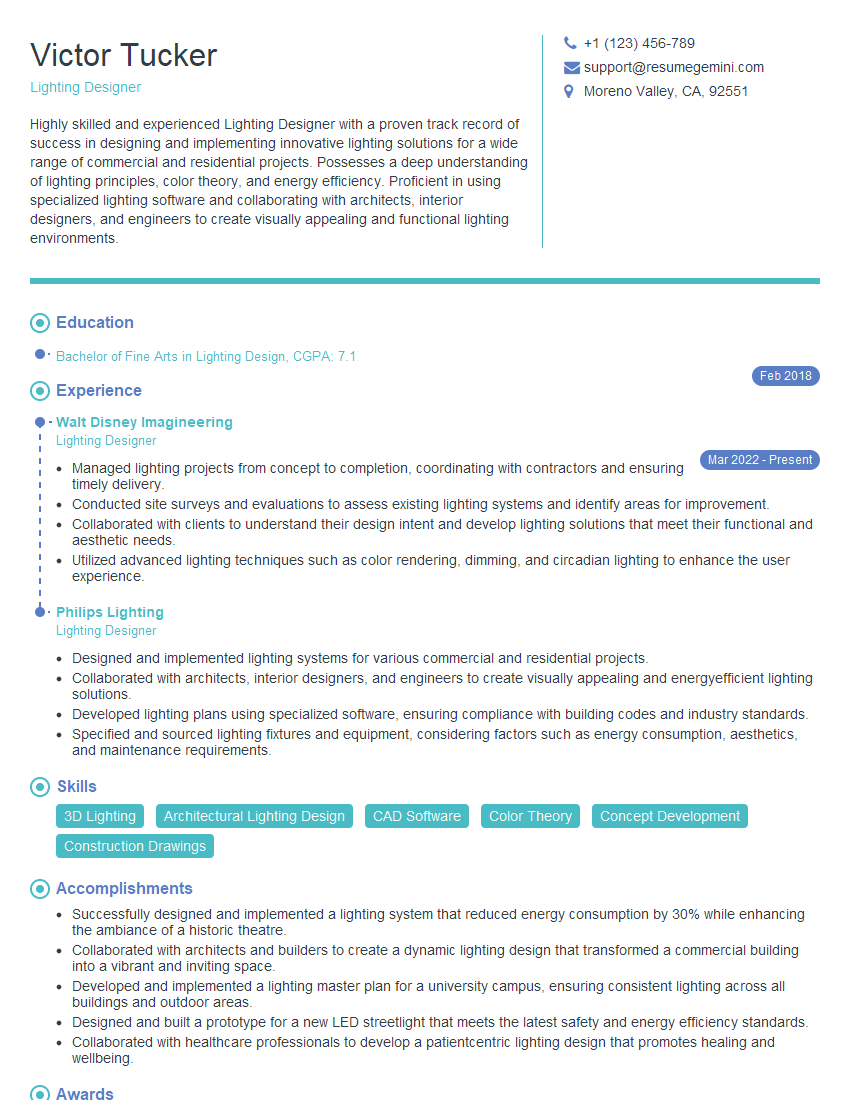
Mastering Lighting Design and Integration opens doors to exciting career opportunities with significant growth potential in a constantly evolving field. A strong, ATS-friendly resume is crucial for maximizing your job prospects. To create a compelling resume that showcases your skills and experience effectively, leverage the power of ResumeGemini. ResumeGemini provides a user-friendly platform to build a professional resume and offers examples of resumes specifically tailored to Lighting Design and Integration, helping you present yourself confidently to potential employers. Take the next step towards your dream career today!
Explore more articles
Users Rating of Our Blogs
Share Your Experience
We value your feedback! Please rate our content and share your thoughts (optional).
What Readers Say About Our Blog
Very informative content, great job.
good