Are you ready to stand out in your next interview? Understanding and preparing for Lighting for Landscape and Urban Lighting interview questions is a game-changer. In this blog, we’ve compiled key questions and expert advice to help you showcase your skills with confidence and precision. Let’s get started on your journey to acing the interview.
Questions Asked in Lighting for Landscape and Urban Lighting Interview
Q 1. Explain the difference between illuminance and luminance.
Illuminance and luminance are two fundamental photometric quantities often confused, but they describe different aspects of light. Illuminance measures the amount of light falling on a surface, essentially how brightly a surface is lit. Think of it as the light received. It’s measured in lux (lx). Luminance, on the other hand, measures the amount of light emitted or reflected from a surface in a particular direction. It’s how bright a surface appears to an observer. Think of it as the light seen. It’s measured in candelas per square meter (cd/m²), also known as nits.
Example: Imagine a streetlamp illuminating a wall. The illuminance measures the light falling on the wall’s surface. The luminance measures how bright that section of the wall appears to a person looking at it from a specific angle. A highly reflective surface will have a higher luminance than a matte surface, even if both receive the same illuminance.
Q 2. Describe various types of light sources used in landscape and urban lighting (e.g., LED, HID, etc.).
Landscape and urban lighting utilizes a variety of light sources, each with its own advantages and disadvantages:
- LED (Light Emitting Diode): LEDs are becoming the dominant light source due to their high energy efficiency, long lifespan, and ability to produce various color temperatures. They offer excellent control over light distribution and are available in a wide range of wattages and color options.
- HID (High-Intensity Discharge): HID lamps, including metal halide and high-pressure sodium, were traditionally popular for their high light output. However, they are less energy-efficient than LEDs and have shorter lifespans. They also take longer to reach full brightness.
- Incandescent: These are simple, inexpensive, and produce warm light. However, they are highly inefficient and have very short lifespans, making them unsuitable for large-scale outdoor applications.
- Fluorescent: Though efficient compared to incandescent, fluorescent lighting is less efficient than LEDs and is rarely used outdoors due to fragility and the need for specialized fixtures.
The choice of light source depends on factors like budget, desired aesthetic, energy consumption targets, and maintenance requirements.
Q 3. What are the key considerations for selecting appropriate lighting fixtures for different applications?
Selecting the right lighting fixture is crucial for achieving the desired lighting effect and ensuring safety and efficiency. Key considerations include:
- Light Distribution: Fixtures are designed with different light distributions (e.g., narrow beam, wide flood, symmetrical, asymmetrical) to meet specific needs. A pathway might need a narrow beam for precise illumination, while a large area like a park might benefit from a wide flood.
- Light Output (lumens): The total amount of light emitted by the fixture must be sufficient for the area being illuminated. This is influenced by the light source and the fixture’s optical design.
- Color Temperature (Kelvin): Color temperature affects the ambiance. Cooler temperatures (e.g., 5000K) appear bluish-white, suitable for functional lighting, while warmer temperatures (e.g., 2700K) create a more inviting, yellowish ambiance.
- Durability and Material: Fixtures must withstand environmental conditions (rain, snow, wind). Materials like die-cast aluminum or stainless steel are often preferred for their robustness.
- Mounting Style: Options include bollards, wall mounts, poles, and suspended fixtures. The choice depends on the specific location and aesthetic requirements.
- Energy Efficiency: Choosing energy-efficient fixtures is crucial for minimizing operational costs and reducing environmental impact.
For instance, a pathway might use low-wattage LED bollard lights with a narrow beam angle, while a parking lot would necessitate high-wattage LED floodlights for wider area illumination.
Q 4. How do you calculate the light levels required for a specific outdoor space?
Calculating required light levels involves several steps:
- Determine the desired illuminance level (lux): This depends on the function of the space. Illumination levels for walkways are typically lower than those for parking lots or sports fields. Relevant standards and guidelines provide recommended illuminance levels for different applications.
- Measure the area to be illuminated (m²): Accurately determine the size of the space needing lighting.
- Calculate the total luminous flux needed (lumens): This is done by multiplying the desired illuminance level (lux) by the area (m²). This gives you the total lumens required for the space.
- Select appropriate lighting fixtures: Choose fixtures that provide the necessary luminous flux. Consider their light distribution to ensure even illumination.
- Factor in light loss: Light loss occurs due to various factors like dirt accumulation, lamp depreciation, and light absorption by surrounding objects. A light loss factor (LLF) is applied to the calculated luminous flux to account for these losses (typically ranging from 0.7 to 0.9). Adjust the total lumens required by dividing by the LLF.
- Determine the number of fixtures: Divide the total adjusted luminous flux by the luminous flux of each fixture. This gives the minimum number of fixtures required. Consider spacing and arrangement to ensure uniform illumination.
Example: A 100m² parking lot needs 20 lux. Total lumens = 20 lx * 100 m² = 2000 lumens. Applying a LLF of 0.8, we get 2000 lumens / 0.8 = 2500 lumens. If a fixture outputs 500 lumens, you’d need at least 5 fixtures.
Q 5. Discuss the importance of light pollution and its mitigation strategies.
Light pollution refers to excessive or inappropriate artificial light. It has several negative consequences:
- Disrupts ecosystems: Artificial light interferes with the natural behaviors of nocturnal animals, impacting their migration, foraging, and breeding patterns.
- Impacts human health: Exposure to excessive light at night can disrupt sleep cycles and increase the risk of certain health problems.
- Reduces energy efficiency: Wasted light contributes to unnecessary energy consumption.
- Reduces astronomical visibility: It obscures the night sky, hindering astronomical observation.
Mitigation strategies focus on minimizing unnecessary light:
- Shielding: Using shielded luminaires that direct light downwards, preventing upward spill.
- Motion sensors: Illuminating areas only when needed.
- Dimming and controls: Adjusting light levels based on occupancy and ambient light conditions.
- Appropriate color temperature selection: Choosing warmer color temperatures (e.g., amber) which have less impact on ecosystems and human health.
- Strategic placement: Careful placement of lights to minimize light trespass into unwanted areas.
Implementing these strategies requires collaboration between lighting designers, urban planners, and policymakers.
Q 6. Explain the concept of glare and how to minimize its impact in outdoor lighting designs.
Glare is excessive brightness that causes discomfort or reduces visibility. It can be categorized as:
- Discomfort glare: This is a subjective feeling of annoyance or discomfort caused by bright light sources.
- Disability glare: This reduces visibility and impairs visual performance by reducing contrast and obscuring details.
Minimizing glare involves:
- Proper shielding: Using light fixtures with properly designed shields or diffusers to control the distribution of light and prevent direct light from reaching the eyes. This prevents direct light sources from being visible.
- Limiting luminance: Keeping the luminance of light sources within acceptable limits, to reduce the brightness reaching the eye.
- Careful fixture placement: Positioning fixtures to avoid directing light directly into the eyes of observers or towards reflective surfaces.
- Appropriate color temperature: Warmer color temperatures generally produce less glare.
- Controlling contrast ratios: Avoiding excessive differences in brightness between the light source and the surrounding environment.
Imagine a poorly designed streetlight shining directly into a driver’s eyes – that’s disability glare. A bright light source that is not directly in your vision but still causes discomfort is discomfort glare. Proper design minimizes both.
Q 7. What are the different types of lighting controls and their applications?
Lighting controls offer various ways to manage light levels and optimize energy efficiency and ambiance:
- Manual controls: Simple on/off switches or dimmers allow for basic control. They are inexpensive and easy to install but lack flexibility.
- Timers: These automatically switch lights on and off at predetermined times, useful for security lighting or creating an ambient effect.
- Photocells: Light-sensitive sensors turn lights on at dusk and off at dawn, conserving energy.
- Occupancy sensors: These detect the presence of people and switch lights on only when needed, maximizing energy savings.
- Astronomical timers: These adjust lighting schedules based on sunrise and sunset times, automatically adapting to seasonal changes in daylight hours.
- Centralized control systems: These allow for remote monitoring and control of numerous lighting fixtures, offering sophisticated management of energy consumption and light levels across large areas. This is especially crucial in smart cities.
The best control system depends on the scale and complexity of the project. A small residential garden might only require a timer or photocell, while a large city park or commercial development might benefit from a sophisticated centralized system.
Q 8. Describe your experience with photometric software and analysis.
Photometric software is crucial for accurate lighting design. I have extensive experience using programs like AGi32, Dialux evo, and Relux. These tools allow me to model the lighting environment, predict illuminance levels, and analyze glare and uniformity. For example, in a recent project designing the lighting for a large city square, I used AGi32 to simulate various luminaire placements and orientations, ultimately optimizing for both energy efficiency and pedestrian comfort. The software’s ability to visualize light distribution in 3D is invaluable in understanding how light interacts with the environment. This allows for detailed analysis of spill light, light trespass, and overall efficacy, leading to a more precise and effective design.
My analysis goes beyond simply generating reports. I interpret the data generated by the software to make informed decisions about fixture selection, placement, and aiming. I also utilize photometric data to comply with relevant standards and regulations, ensuring the design meets the specified requirements for illuminance, uniformity, and glare control.
Q 9. How do you ensure the safety and security aspects of lighting design?
Safety and security are paramount in lighting design. I incorporate several strategies to ensure both. For pedestrian safety, this includes providing adequate illumination levels on walkways and roadways to prevent accidents and improve visibility at night. Specifically, I follow guidelines to ensure sufficient illuminance levels and uniform distribution to eliminate dark spots. For example, in designing lighting for a pedestrian bridge, I’d use IES standards to calculate required illuminance levels and use high-quality luminaires with appropriate light distributions to prevent dark areas that could be a safety hazard.
Regarding security, strategic lighting placement can deter crime. Well-lit areas make it harder for criminals to hide, creating a safer environment. We use techniques like layering illumination – combining high-mast lighting with lower-level lighting – for greater effectiveness. Also, I incorporate motion sensors and timers to increase efficiency and improve security by only illuminating areas when needed.
Q 10. Explain the principles of energy-efficient lighting design.
Energy-efficient lighting design prioritizes minimizing energy consumption without compromising the quality of illumination. Key principles include:
- Using high-efficiency luminaires: This includes selecting fixtures with high lumens per watt (LPW) ratings. LEDs are currently the most energy-efficient option.
- Optimizing light distribution: Careful consideration of light distributions and aiming angles minimizes wasted light. We use precise photometric data to ensure light falls where it’s needed, reducing spill light and light trespass.
- Implementing intelligent controls: Systems like occupancy sensors, dimming controls, and daylight harvesting significantly reduce energy use by adapting lighting levels to actual needs.
- Choosing appropriate light sources: LED technology offers a broad range of color temperatures and CRI, but careful selection is essential for achieving the desired effect while remaining energy efficient.
For example, in a recent park lighting project, we implemented a system that dimmed the lights based on ambient daylight levels, significantly lowering energy consumption during the day and twilight hours.
Q 11. What are some common lighting design standards and regulations (e.g., IES, CIE)?
Several standards and regulations guide lighting design, ensuring safety, energy efficiency, and visual comfort. The Illuminating Engineering Society (IES) in North America and the Commission Internationale de l’éclairage (CIE) internationally are key organizations.
IES publications provide guidance on lighting calculations, design practices, and recommended illuminance levels for various applications. The CIE is involved in defining colorimetry, photometry and other important concepts in lighting. For instance, the IES document RP-8-00, “Recommended Practice for Roadway Lighting,” is heavily referenced when designing roadway lighting to ensure adequate visibility and safety. Local building codes and energy codes often incorporate these standards and may have additional requirements, which must be taken into consideration. Compliance is critical for obtaining permits and ensuring the design is legally sound.
Q 12. Describe your experience working with different lighting control systems.
I have experience with various lighting control systems, ranging from simple on/off switches to sophisticated, networked systems. These systems significantly influence energy efficiency, flexibility, and security.
I’ve worked with systems like Dali (Digital Addressable Lighting Interface), DMX (Digital Multiplex), and wireless control systems using Zigbee or Z-Wave protocols. For example, a recent project involved designing a smart lighting system for a museum using Dali, allowing for individual control of each light fixture, enabling fine-tuning of lighting scenes for various exhibits and minimizing energy use during off-peak hours. The selection of a control system is based on factors such as project scale, budget, and the desired level of control. A comprehensive understanding of these systems is essential for successful implementation and operation.
Q 13. How do you incorporate sustainable practices in your lighting designs?
Sustainability is integrated throughout my design process. This involves selecting energy-efficient luminaires, optimizing light distribution to minimize light pollution, and utilizing sustainable materials.
Specific examples include specifying luminaires made from recycled materials, choosing LEDs with long lifespans to reduce waste, and designing systems that minimize light trespass into neighboring properties or the night sky. I also focus on minimizing the environmental impact of the entire lighting lifecycle, from manufacturing to disposal. The use of smart controls further promotes sustainability by reducing energy consumption and ensuring that lights are only on when needed. The long-term implications of environmental friendliness are a key consideration in all my designs.
Q 14. Explain your understanding of color rendering index (CRI) and its significance.
The Color Rendering Index (CRI) is a measurement of how faithfully a light source renders the colors of objects compared to a reference source (typically daylight). It ranges from 0 to 100, with higher values indicating better color rendering. A CRI of 80 or higher is generally considered good for most applications, particularly where accurate color perception is important, such as museums, retail spaces, or residential settings.
Its significance lies in its impact on the perceived quality of light and the visual experience. A low CRI light source can wash out colors, making them appear dull or unnatural. For example, food displayed under a low-CRI light source might look less appealing, and artwork might lose its vibrancy. In contrast, a high-CRI light source enhances color fidelity, creating a more pleasant and accurate visual environment. When designing lighting, I carefully select light sources with appropriate CRI values based on the specific application and desired aesthetic effect.
Q 15. How do you handle challenging site conditions (e.g., difficult terrain, existing structures) in your designs?
Addressing challenging site conditions in landscape and urban lighting design requires creativity and a thorough understanding of both the limitations and opportunities presented by the environment. My approach involves a multi-step process that begins with a comprehensive site analysis.
- Thorough Site Survey: This includes detailed measurements, photographic documentation, and an assessment of existing structures, vegetation, and terrain. For example, I’ll identify areas with significant slope or uneven surfaces to determine the best placement and type of lighting fixtures. I also consider the impact of existing trees on light distribution.
- Creative Fixture Selection: Difficult terrain might necessitate the use of low-profile, ground-mounted fixtures or specialized poles that can adapt to uneven surfaces. Existing structures can be incorporated into the design, possibly using them as mounting points for architectural lighting, minimizing the need for additional structures.
- Adaptive Lighting Strategies: Instead of fighting the limitations, I often embrace them. For example, a sloped hillside can be dramatically illuminated by utilizing strategically placed uplights that highlight the natural contours. Existing walls or buildings can be used as backdrops to create stunning light effects.
- Detailed Modeling and Simulation: Software like Dialux allows me to model the site precisely, including obstacles and terrain, to predict the light distribution and ensure adequate illumination levels while minimizing light pollution and glare. I can then make adjustments to fixture placement and design based on the simulation results.
For example, on a recent project with a steep, rocky hillside, we used low-profile bollard lights integrated into the retaining walls to safely and effectively illuminate the pathways, while uplights highlighted the natural texture of the rocks, creating a dramatic aesthetic effect.
Career Expert Tips:
- Ace those interviews! Prepare effectively by reviewing the Top 50 Most Common Interview Questions on ResumeGemini.
- Navigate your job search with confidence! Explore a wide range of Career Tips on ResumeGemini. Learn about common challenges and recommendations to overcome them.
- Craft the perfect resume! Master the Art of Resume Writing with ResumeGemini’s guide. Showcase your unique qualifications and achievements effectively.
- Don’t miss out on holiday savings! Build your dream resume with ResumeGemini’s ATS optimized templates.
Q 16. Describe your experience with different lighting fixture mounting methods.
My experience encompasses a wide range of lighting fixture mounting methods, each chosen based on the specific project needs and site conditions. Choosing the right method is crucial for both aesthetics and functionality.
- Surface Mounting: Simple and cost-effective, ideal for walls, poles, and other vertical surfaces. This is commonly used for floodlights, wall washers, and area lights.
- Recessed Mounting: Provides a clean, integrated look, often used in ceilings, walls, and steps. This is frequently employed for downlights and accent lighting.
- Pendant Mounting: Fixtures are suspended from the ceiling or a higher point, providing flexibility in placement and allowing for adjustable heights. This is perfect for illuminating large areas or creating focal points.
- Ground Mounting: Suitable for pathways, gardens, and other ground-level applications. Bollards, path lights, and in-ground fixtures are common examples. This approach minimizes visual clutter and provides safety lighting.
- Pole Mounting: Utilizes poles of varying heights for wider illumination coverage, often used for area lighting, security lighting, and streetlights. Careful consideration of pole height, location, and light distribution is vital.
- Truss Mounting: Used extensively for large events, where high-powered lighting fixtures are suspended from a truss structure to illuminate a large area. This method necessitates detailed planning and safety precautions.
For instance, in a recent museum project, we used recessed mounting for interior lighting to maintain the architectural integrity of the building, while pendant lighting was used in the central atrium to create a dramatic focal point.
Q 17. How do you collaborate with other design professionals (e.g., architects, landscape architects)?
Collaboration is fundamental to successful lighting design. I believe in a proactive, integrated approach that fosters open communication and mutual respect among all design professionals.
- Early Engagement: I strive to participate in the project from the initial conceptual stages, working closely with architects and landscape architects to understand their design vision and incorporate lighting seamlessly into the overall plan.
- Shared Design Goals: Discussions focus on establishing shared aesthetic and functional goals for the lighting, ensuring that the lighting design complements and enhances the architectural and landscape elements.
- Regular Communication: Frequent meetings, presentations, and design reviews facilitate continuous feedback and ensure that the lighting design evolves in line with the project’s progress.
- Integrated Design Documents: Coordination of lighting plans with architectural and landscape plans is crucial. This is achieved through the use of shared models and coordinated drawings, ensuring seamless integration of all disciplines.
- Respect for Expertise: I value the perspectives and expertise of other professionals. For example, understanding the structural implications of proposed lighting fixtures with the structural engineer is vital to avoid unforeseen complications.
In a recent park renovation, collaborative efforts with the landscape architect allowed us to integrate pathway lighting seamlessly with the planting scheme, creating a harmonious and visually appealing environment.
Q 18. Explain your process for creating lighting design documents and specifications.
Creating comprehensive lighting design documents and specifications is a meticulous process that ensures the successful implementation of the design vision. The process involves several key steps:
- Lighting Design Report: This document outlines the project goals, design concepts, and lighting strategies. It includes an overview of the site, justification for lighting choices, and energy efficiency considerations.
- Lighting Plans and Elevations: Detailed drawings illustrating the location of all lighting fixtures, their mounting methods, and their orientation. These plans are coordinated with architectural and landscape drawings.
- Lighting Sections and Details: Detailed drawings that show the cross-sections of lighting fixtures and their installation methods, ensuring that all aspects of the installation are clearly defined.
- Lighting Specifications: A comprehensive document outlining the technical requirements for all lighting fixtures, including their type, wattage, lumen output, color temperature, and other relevant parameters. This ensures consistent and reliable performance of the installed lighting.
- Photometric Calculations: These calculations predict the light levels at various points on the site, confirming that the design meets the required illumination levels and minimizes light pollution.
- Energy Calculations: Determining the energy consumption of the lighting system is important to demonstrate compliance with relevant energy codes and promote sustainability. This also forms a crucial part of the budget and cost analysis.
These documents are essential for the contractor to accurately bid on the project and subsequently install the lighting system according to the specifications.
Q 19. What software programs are you proficient in (e.g., AutoCAD, Revit, Dialux)?
Proficiency in various software programs is essential for efficient and effective lighting design. My expertise includes:
- AutoCAD: Used for creating detailed drawings and plans, including site plans, lighting plans, and sections.
- Revit: For integrated building information modeling (BIM), allowing for coordination with architectural and engineering disciplines. This is particularly useful for large and complex projects.
- Dialux: A powerful lighting simulation software used to predict light levels, analyze glare, and optimize lighting design for energy efficiency. Dialux helps to create realistic renderings and visualizations of the lighting scheme.
- Relux: Another lighting design and simulation software that allows for accurate light calculations and energy estimations.
- AgI32: A lighting design software that is frequently used for large-scale projects, allowing users to create photorealistic renderings.
The use of these software programs ensures accuracy and precision, allowing me to create optimal lighting solutions tailored to each project’s specific requirements.
Q 20. How do you manage project budgets and timelines for lighting projects?
Effective budget and timeline management are crucial for successful lighting projects. My approach involves:
- Detailed Cost Estimation: Accurate costing of lighting fixtures, installation labor, and other project-related expenses is critical. This includes contingency planning for unforeseen costs.
- Value Engineering: Exploring different fixture options and installation methods to find cost-effective solutions without compromising the design’s quality or performance. This is an iterative process involving close collaboration with contractors and clients.
- Phased Implementation: For larger projects, phasing the installation can help to manage costs and minimize disruption. This helps to break down a large task into smaller manageable parts.
- Project Scheduling: Developing a detailed project schedule that outlines all tasks, their dependencies, and deadlines. This allows for effective monitoring of progress and proactive identification of potential delays.
- Regular Monitoring and Reporting: Tracking project expenses and progress regularly to ensure that the project stays on budget and on schedule. This process involves regular updates and meetings to review progress.
By employing these strategies, I ensure that lighting projects are delivered on time and within budget without sacrificing quality or performance.
Q 21. Describe a time you had to troubleshoot a lighting problem on a project.
On a recent project illuminating a historic plaza, we experienced unexpected glare from several uplights illuminating a nearby building. The initial design had not adequately accounted for the building’s reflective surface.
- Problem Identification: The issue was discovered during the initial testing phase through on-site observations and photographic documentation. We used a lux meter to measure the glare levels.
- Cause Analysis: We analyzed the photometric data and determined that the angle of the uplights and the building’s reflective material were contributing to the glare. We also confirmed this by conducting further site surveys and checking the specifications of the installed lights.
- Solution Implementation: Instead of replacing the fixtures completely, which would have been expensive and time-consuming, we adjusted the light fixture angles. This was achieved by using adjustable mounting brackets and slight repositioning of the fixtures. We also explored using different light filters to reduce glare.
- Verification and Testing: After making the adjustments, we performed another thorough test to verify that the glare problem was resolved and light levels were sufficient. The results were carefully documented to prevent similar issues in future projects.
This experience highlighted the importance of thorough site analysis and the flexibility required to address unforeseen challenges during project execution. The ability to adapt to these challenges and come up with a viable solution that meets the client’s needs is critical to the success of any lighting project.
Q 22. Explain your understanding of light trespass and how to avoid it.
Light trespass is the unwanted intrusion of light onto neighboring properties or into the night sky. Think of it like noise pollution, but with light. It can disrupt sleep, negatively impact wildlife, and detract from the aesthetic beauty of a location. Avoiding light trespass involves careful planning and the selection of appropriate lighting fixtures and controls.
- Proper Fixture Selection: Using fully shielded fixtures that direct light downwards and prevent upward spill is crucial. For example, choosing bollard lights with downward-directed optics instead of unshielded spotlights greatly reduces trespass.
- Precise Aiming and Positioning: Careful placement of luminaires ensures light only illuminates the intended target area. This requires detailed site analysis and potentially using lighting design software for precise simulations.
- Control Systems: Implementing smart lighting controls, such as timers, motion sensors, or astronomical timers, significantly reduces energy consumption and minimizes light trespass during non-operational hours. For instance, a park’s lighting could be dimmed or switched off entirely after midnight.
- Low-Intensity Lighting: While achieving sufficient illumination, aiming for the lowest possible light levels still achieving the functional requirement helps mitigate trespass. This involves selecting appropriately rated fixtures and using a dimming system when necessary.
- Careful Color Temperature Selection: Warmer color temperatures (e.g., 2700K to 3000K) generally produce less harsh light, reducing the perceived impact of trespass compared to cooler temperatures (e.g., 4000K and above).
For instance, during a recent project illuminating a residential street, we carefully selected low-glare, fully-shielded LED bollards with downward optics and implemented timer controls to ensure minimal light trespass into adjacent homes and maintained a desired level of safety.
Q 23. How do you incorporate the needs of diverse users (e.g., people with disabilities) in your designs?
Designing inclusive lighting considers the needs of all users, especially those with disabilities. This requires going beyond basic illumination and incorporating principles of accessibility.
- Visual Impairments: We incorporate tactile paving and audible signals along walkways, providing wayfinding cues for visually impaired individuals. Clear contrasts in lighting and paving materials enhance spatial awareness. We avoid sudden changes in brightness that might be disorienting.
- Mobility Impairments: Good lighting ensures safe navigation for people using wheelchairs or other mobility aids. Uniform and adequate illumination along pathways and ramps prevents trip hazards. We carefully consider the placement of lighting to avoid glare and shadow issues.
- Cognitive Impairments: Well-defined lighting zones and simple, predictable lighting patterns improve orientation and reduce confusion for people with cognitive impairments. We avoid overstimulation by using subtle changes in light levels and color.
- Sensory Sensitivities: We minimize light flicker, which can trigger seizures in some individuals. We also consider the overall brightness levels, ensuring that they are not overly intense or overwhelming.
For example, in a recent park renovation, we worked closely with disability advocacy groups to ensure that pathways were well-lit, providing ample illumination while minimizing glare and shadows, creating a safe and welcoming space for all park users, including those with varied needs.
Q 24. Discuss the importance of maintaining lighting systems and equipment.
Maintaining lighting systems is crucial for several reasons: safety, energy efficiency, and aesthetic appeal. Regular maintenance prevents failures, extends the lifespan of equipment, and reduces overall costs.
- Safety: Malfunctioning lighting can create hazards, especially in walkways and parking areas. Regular inspections identify and address potential safety risks before they escalate.
- Energy Efficiency: Clean lenses and reflectors maximize light output and minimize energy waste. Regular maintenance ensures optimal performance and reduces energy consumption.
- Aesthetics: Dirty or damaged fixtures diminish the visual appeal of a space. Maintenance ensures that lighting systems maintain their intended aesthetic impact.
- Longevity: Proactive maintenance, including cleaning, adjusting, and repairing components, significantly extends the useful life of lighting equipment, delaying costly replacements.
A simple analogy is maintaining your car – regular checkups and oil changes prevent major issues and extend its lifespan. Similarly, regular cleaning, testing, and repairs of lighting systems prevent costly and potentially hazardous failures.
Q 25. Explain your knowledge of different lighting technologies and their advantages and disadvantages.
Lighting technology has advanced significantly. Several key technologies are commonly used in landscape and urban lighting:
- High-Pressure Sodium (HPS): Once a common choice, HPS lamps offer good light output but suffer from poor color rendering and relatively short lifespans. They are being phased out in many areas.
- Metal Halide (MH): MH lamps provide better color rendering than HPS but are less efficient and have shorter lifespans than LEDs. They are also becoming less prevalent.
- Light Emitting Diodes (LEDs): LEDs are the dominant technology today. They offer high energy efficiency, long lifespans, excellent color rendering, and a wide range of color temperatures. However, initial investment can be higher.
Advantages and Disadvantages Summary:
| Technology | Advantages | Disadvantages |
|---|---|---|
| HPS | High lumen output, low initial cost | Poor color rendering, short lifespan, inefficient |
| MH | Better color rendering than HPS | Shorter lifespan than LEDs, less efficient than LEDs |
| LED | High efficiency, long lifespan, excellent color rendering, versatile color temperatures | Higher initial cost |
The choice of technology depends on the project’s specific requirements, budget, and environmental considerations. In most cases, the long-term benefits of LEDs outweigh their higher initial cost, making them the preferred choice for new installations.
Q 26. How do you balance aesthetic considerations with functional requirements in lighting design?
Balancing aesthetics and functionality in lighting design is a crucial aspect of creating successful projects. It involves a delicate interplay between artistic expression and practical illumination needs.
- Layered Lighting Approach: Using a combination of ambient, task, and accent lighting creates a dynamic and aesthetically pleasing environment while satisfying functional needs. Ambient lighting provides overall illumination, task lighting focuses on specific areas needing illumination, and accent lighting highlights architectural features or landscaping.
- Fixture Selection: Choosing fixtures that are both aesthetically pleasing and appropriate for their function is essential. For instance, using elegant bollard lights for pathway illumination while employing spotlights to highlight trees maintains both functionality and beauty.
- Light Color and Temperature: Selecting appropriate color temperatures influences the mood and ambiance. Warmer tones create a cozy atmosphere, while cooler tones create a more energetic feel. Carefully chosen color temperatures can both illuminate and enhance the aesthetic.
- Light Distribution: Careful control of light distribution minimizes glare and maximizes visual comfort. This requires using appropriately designed optics and positioning fixtures strategically.
Imagine designing a plaza: functional lighting ensures safe navigation, while aesthetic lighting highlights the plaza’s architecture, making it a visually appealing space to spend time in. This requires balancing the needed brightness with the appropriate selection of fixtures that complement the space’s overall design.
Q 27. What are the latest trends and innovations in landscape and urban lighting?
The field of landscape and urban lighting is constantly evolving. Some key trends and innovations include:
- Smart Lighting Controls: Integration of smart controls allows for dynamic adjustments to lighting levels based on occupancy, time of day, and environmental conditions. This improves energy efficiency and enhances safety.
- Human-Centric Lighting: This focuses on using light to positively impact human well-being. This includes adjusting color temperature throughout the day to mimic natural daylight patterns and improve circadian rhythm.
- Connected Lighting Systems: Networks of interconnected lights enable remote monitoring, control, and diagnostics. This reduces maintenance time and improves system reliability.
- Sustainable Lighting Solutions: Increased emphasis on energy-efficient technologies and sustainable materials. This includes using LED lighting, renewable energy sources, and recycled materials in fixture construction.
- LiFi Technology: Using light waves to transmit data, offering an alternative to Wi-Fi for communication and control of lighting networks.
These innovations are transforming urban and landscape lighting, creating more sustainable, efficient, and user-friendly environments.
Q 28. Describe your experience with lighting simulations and visualizations.
Lighting simulations and visualizations are invaluable tools in my design process. I extensively utilize software like DIALux evo, AGi32, and others to create accurate representations of lighting schemes before implementation.
- Illuminance Calculations: Simulations allow me to precisely calculate light levels at various points within a space, ensuring sufficient illumination while avoiding over-illumination.
- Glare Analysis: The software helps predict glare, enabling me to optimize fixture placement and optics to minimize discomfort and enhance visual comfort.
- Energy Consumption Estimation: Simulations estimate energy consumption, enabling informed decisions regarding fixture selection and control strategies to minimize energy costs and environmental impact.
- Visualizations: I use the software to create realistic visualizations, allowing clients to see exactly how the lighting scheme will appear before installation. This aids in communication and ensures the design meets their expectations.
For a recent city park project, simulations helped us optimize lighting levels for different areas (playgrounds needing higher illumination vs. quieter seating areas needing softer light). The visualizations were instrumental in demonstrating our design to the city council and securing their approval.
Key Topics to Learn for Lighting for Landscape and Urban Lighting Interview
- Illumination Design Principles: Understanding concepts like luminance, illuminance, and light pollution; exploring different lighting techniques (direct, indirect, etc.) and their applications in various landscape and urban settings.
- Lighting Technologies: Familiarity with various light sources (LED, HID, etc.), their characteristics (color temperature, CRI, efficacy), and suitability for different applications. This includes understanding the benefits and drawbacks of each technology.
- Energy Efficiency and Sustainability: Knowledge of energy-efficient lighting practices, including controls (dimmer switches, sensors), and sustainable lighting design strategies to minimize environmental impact.
- Safety and Regulations: Understanding relevant safety codes and regulations concerning lighting design and installation, ensuring compliance with local and national standards.
- Light Pollution Mitigation: Strategies for minimizing light trespass and sky glow, preserving natural darkness, and promoting environmentally responsible lighting design.
- Practical Applications: Experience with designing lighting schemes for parks, streets, pathways, buildings facades, and other urban environments. Consider how different lighting affects the mood, safety, and aesthetics of a space.
- Project Management & Collaboration: Demonstrating understanding of the project lifecycle, from initial concept to final installation. Highlighting teamwork and communication skills crucial for successful projects.
- Problem-Solving & Troubleshooting: Ability to identify and resolve lighting issues, including fault finding and maintenance strategies. Showcasing practical problem-solving skills.
- Software Proficiency: Demonstrating familiarity with relevant lighting design software (e.g., Dialux, AGi32) and their application in practical scenarios.
Next Steps
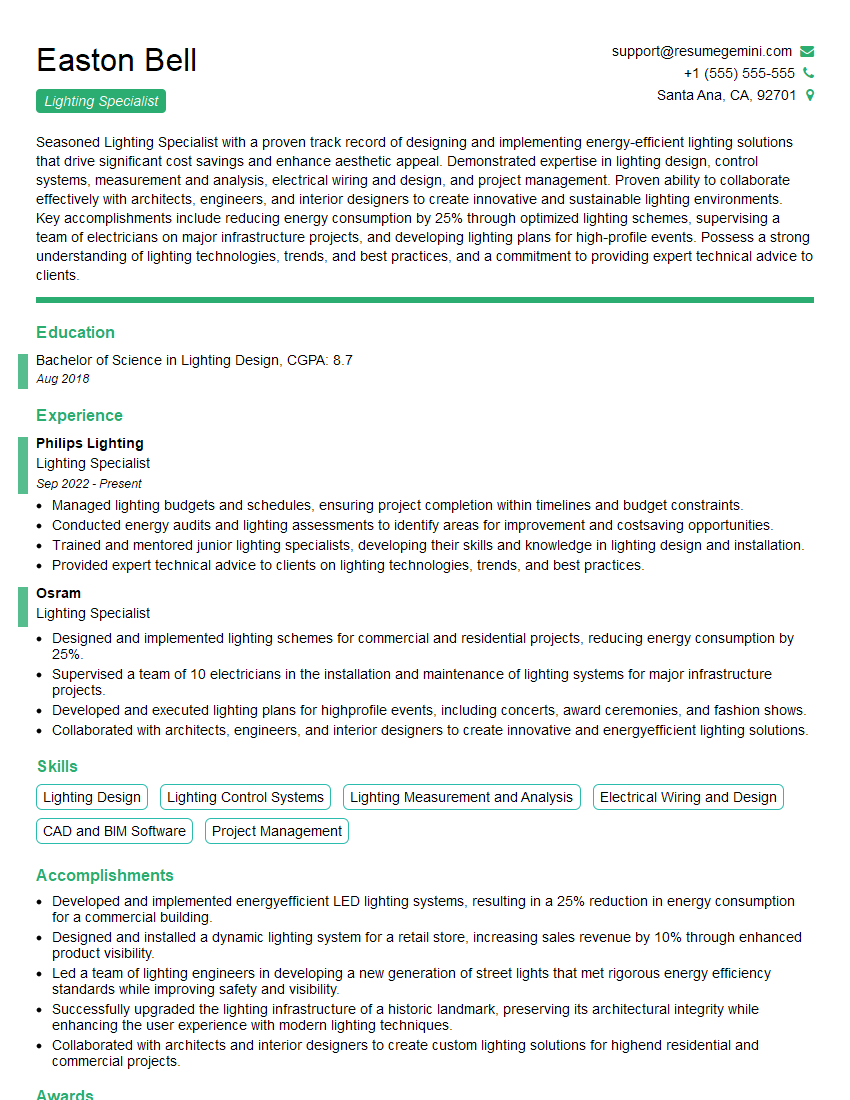
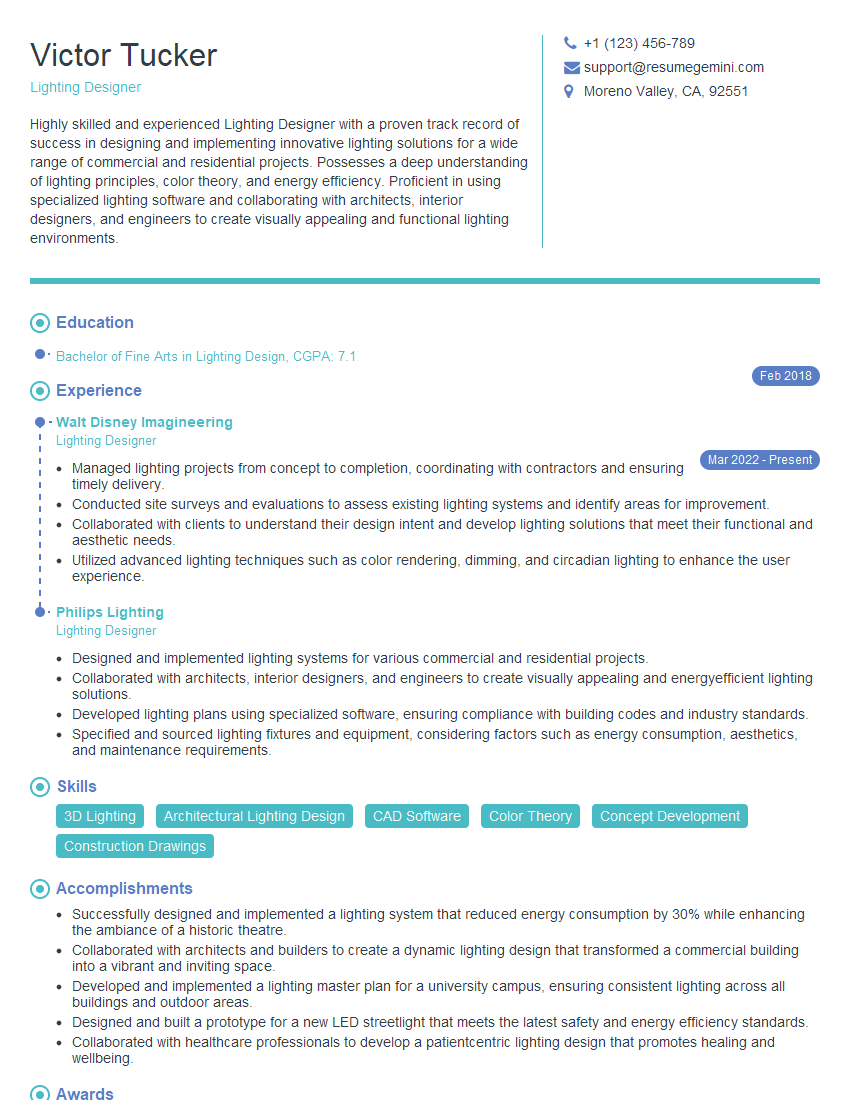
Mastering Lighting for Landscape and Urban Lighting opens doors to exciting career opportunities in a growing field. A strong understanding of these key concepts will significantly enhance your interview performance and career prospects. Creating a well-structured, ATS-friendly resume is crucial for getting your application noticed. ResumeGemini is a valuable resource to help you build a compelling and professional resume that showcases your skills and experience effectively. Examples of resumes tailored to Lighting for Landscape and Urban Lighting are available to help guide you.
Explore more articles
Users Rating of Our Blogs
Share Your Experience
We value your feedback! Please rate our content and share your thoughts (optional).
What Readers Say About Our Blog
Very informative content, great job.
good