The right preparation can turn an interview into an opportunity to showcase your expertise. This guide to Linear Algebra and Calculus interview questions is your ultimate resource, providing key insights and tips to help you ace your responses and stand out as a top candidate.
Questions Asked in Linear Algebra and Calculus Interview
Q 1. Explain the concept of eigenvalues and eigenvectors.
Eigenvalues and eigenvectors are fundamental concepts in linear algebra that describe the behavior of linear transformations. Imagine a linear transformation as a function that stretches, shrinks, or rotates a vector. Eigenvectors are special vectors that, when acted upon by this transformation, only change in scale; they don’t change direction. The scaling factor is the eigenvalue.
More formally, for a square matrix A, an eigenvector v satisfies the equation Av = λv, where λ is the eigenvalue. This means that applying the transformation A to v results in a vector that’s parallel to v, scaled by λ.
Example: Consider the matrix A = [[2, 0], [0, 3]]. The vector v = [1, 0] is an eigenvector with eigenvalue λ = 2 because Av = [2, 0] = 2v. Similarly, v = [0, 1] is an eigenvector with eigenvalue λ = 3.
Practical Application: Eigenvalues and eigenvectors are used extensively in various fields like physics (vibration analysis, quantum mechanics), computer graphics (image compression, rotation), and machine learning (principal component analysis).
Q 2. What is the significance of the determinant of a matrix?
The determinant of a square matrix is a single number that reveals crucial information about the matrix and the linear transformation it represents. Think of it as a measure of how much the transformation scales the area (in 2D) or volume (in 3D) of a shape.
A determinant of zero indicates that the transformation collapses the shape onto a lower-dimensional space (e.g., a 2D square becomes a line, a 3D cube becomes a plane). This means the matrix is singular and doesn’t have an inverse.
A non-zero determinant signifies that the transformation is invertible; the original shape can be recovered. The magnitude of the determinant reflects the scaling factor of the transformation’s effect on the area/volume.
Example: The determinant of a 2×2 matrix A = [[a, b], [c, d]] is ad - bc. If ad - bc = 0, the matrix is singular.
Practical Application: Determinants are used to solve systems of linear equations (Cramer’s rule), check for matrix invertibility, and calculate areas and volumes.
Q 3. Describe different methods for solving systems of linear equations.
Solving systems of linear equations is a cornerstone of linear algebra with several methods offering different advantages depending on the context.
- Gaussian Elimination (Row Reduction): This is a systematic method involving elementary row operations (swapping rows, multiplying rows by non-zero constants, adding multiples of one row to another) to transform the augmented matrix into row-echelon form or reduced row-echelon form. This allows us to directly read the solution.
- Gauss-Jordan Elimination: A variant of Gaussian elimination, it transforms the augmented matrix to reduced row-echelon form, making the solution even more explicit.
- Cramer’s Rule: This method utilizes determinants to find the solution. It’s elegant but computationally expensive for larger systems.
- Matrix Inversion: If the coefficient matrix is invertible, we can find the solution by multiplying the inverse of the coefficient matrix by the constant vector.
- LU Decomposition: This method decomposes the coefficient matrix into a lower triangular matrix (L) and an upper triangular matrix (U). This simplifies solving multiple systems with the same coefficient matrix.
Example (Gaussian Elimination): Consider the system: x + y = 3 and 2x - y = 3. The augmented matrix is [[1, 1, 3], [2, -1, 3]]. Row reduction leads to the solution x = 2, y = 1.
Practical Application: These methods are essential in various fields, including network analysis, circuit design, and economic modeling.
Q 4. How do you find the inverse of a matrix?
The inverse of a square matrix A, denoted as A⁻¹, is a matrix such that A * A⁻¹ = A⁻¹ * A = I, where I is the identity matrix. Not all matrices have inverses; a matrix is invertible (or non-singular) if and only if its determinant is non-zero.
Several methods exist for finding the inverse:
- Adjugate Method: This involves calculating the adjugate (transpose of the cofactor matrix) and dividing it by the determinant. It’s conceptually straightforward but computationally expensive for large matrices.
- Gaussian Elimination (Row Reduction): Augment the matrix A with the identity matrix I,
[A|I]. Perform row operations to transform A into I. The resulting augmented part will be A⁻¹,[I|A⁻¹]. - LU Decomposition: Decompose A into LU and solve for the inverse using forward and backward substitution.
Example (Gaussian Elimination): To find the inverse of A = [[2, 1], [1, 1]], augment it with the identity: [[2, 1 | 1, 0], [1, 1 | 0, 1]]. Row reduction gives [[1, 0 | 1, -1], [0, 1 | -1, 2]]. Therefore, A⁻¹ = [[1, -1], [-1, 2]].
Practical Application: Matrix inversion is crucial for solving linear systems, cryptography, and computer graphics.
Q 5. Explain the concept of matrix diagonalization.
Matrix diagonalization is the process of expressing a square matrix as a product of three matrices: A = PDP⁻¹, where P is a matrix whose columns are the eigenvectors of A, D is a diagonal matrix whose diagonal entries are the eigenvalues of A, and P⁻¹ is the inverse of P. Not all matrices are diagonalizable; a matrix is diagonalizable if and only if it has a complete set of linearly independent eigenvectors.
Significance: Diagonalization simplifies matrix operations. For example, powers of a diagonalizable matrix are easily calculated: Aⁿ = PDⁿP⁻¹, where Dⁿ is simply the diagonal matrix with the eigenvalues raised to the power n.
Example: If a matrix A is diagonalizable as described above, then calculating A10 becomes significantly simpler than performing the matrix multiplication ten times.
Practical Application: Diagonalization is used in solving systems of differential equations, Markov chains, and in various applications involving repeated matrix multiplications.
Q 6. What is a vector space, and what are its properties?
A vector space is a collection of objects called vectors, along with two operations: vector addition and scalar multiplication. These operations must satisfy certain axioms (rules) to qualify the collection as a vector space.
Properties:
- Closure under addition: The sum of any two vectors in the space is also in the space.
- Associativity of addition: (u + v) + w = u + (v + w) for all vectors u, v, and w.
- Commutativity of addition: u + v = v + u for all vectors u and v.
- Existence of a zero vector: There exists a vector 0 such that v + 0 = v for all vectors v.
- Existence of additive inverses: For every vector v, there exists a vector –v such that v + (-v) = 0.
- Closure under scalar multiplication: The product of a scalar and a vector is also in the space.
- Associativity of scalar multiplication: a(bv) = (ab)v for all scalars a and b, and vector v.
- Distributivity of scalar multiplication with respect to vector addition: a(u + v) = au + av for all scalars a and vectors u and v.
- Distributivity of scalar multiplication with respect to scalar addition: (a + b)v = av + bv for all scalars a and b, and vector v.
- Scalar multiplication identity: 1v = v for all vectors v.
Example: The set of all 2D vectors (x, y) with real components forms a vector space under standard vector addition and scalar multiplication.
Practical Application: Vector spaces are fundamental in many areas, including computer graphics, quantum mechanics, and machine learning.
Q 7. Explain the concept of linear transformation.
A linear transformation is a function that maps vectors from one vector space to another, preserving the operations of vector addition and scalar multiplication. In essence, it’s a way to transform vectors while maintaining their linear relationships.
Key Properties:
- Additivity: T(u + v) = T(u) + T(v)
- Homogeneity: T(cv) = cT(v), where c is a scalar.
These properties ensure that the transformation doesn’t introduce any non-linear distortions. Linear transformations can be represented by matrices. The transformation of a vector v is then given by the matrix-vector product Av, where A is the transformation matrix.
Example: Rotation, scaling, and shearing are all examples of linear transformations in 2D or 3D space. Each of these transformations can be represented by a specific matrix.
Practical Application: Linear transformations are ubiquitous in computer graphics (transforming objects), image processing (applying filters), and machine learning (feature extraction).
Q 8. What is the rank of a matrix, and how is it calculated?
The rank of a matrix is a fundamental concept in linear algebra that represents the maximum number of linearly independent column vectors (or row vectors) in the matrix. Think of it as a measure of the matrix’s ‘dimensionality’ or the number of independent directions it spans. A matrix with a higher rank possesses more ‘degrees of freedom’ than one with a lower rank.
Calculating the rank involves several methods. One common approach is to perform Gaussian elimination (row reduction) to transform the matrix into row echelon form or reduced row echelon form. The rank is then equal to the number of non-zero rows in the resulting echelon form. Another method is to compute the determinant of all possible square submatrices (minors) of the matrix. The rank is the largest order of a non-zero minor.
Example: Consider the matrix [[1, 2, 3], [4, 5, 6], [7, 8, 9]]. After performing Gaussian elimination, we might obtain a row echelon form with only two non-zero rows. Thus, the rank of this matrix is 2. This signifies that the three column vectors are linearly dependent; one can be expressed as a linear combination of the others.
Q 9. Describe the process of performing Gaussian elimination.
Gaussian elimination, also known as row reduction, is an algorithm used to solve systems of linear equations and to find the rank of a matrix. It involves systematically transforming a matrix into a simpler form, typically row echelon form or reduced row echelon form, through a series of elementary row operations.
The process involves three main types of row operations:
- Swapping two rows.
- Multiplying a row by a non-zero scalar.
- Adding a multiple of one row to another row.
These operations are applied strategically to create zeros below the main diagonal of the matrix. Once the matrix is in row echelon form, the solutions to the system of equations (if any exist) can be easily obtained through back-substitution. If the matrix is reduced to reduced row echelon form, the solution is even more directly apparent.
Example: Consider solving the system of equations: x + 2y = 5 and 2x + y = 4. We can represent this system as an augmented matrix [[1, 2, 5], [2, 1, 4]]. Through Gaussian elimination, we can reduce this to row echelon form and find the solution for x and y.
Q 10. Explain the concept of orthogonal matrices.
An orthogonal matrix is a square matrix whose inverse is equal to its transpose. In simpler terms, if you multiply an orthogonal matrix by its transpose, you get the identity matrix. This property has significant implications in linear algebra and its applications.
Orthogonal matrices represent transformations that preserve lengths and angles. Geometrically, this means that rotations and reflections are represented by orthogonal matrices. This preservation of geometric properties makes them incredibly useful in various fields.
Example: Rotation matrices in 2D or 3D space are classic examples of orthogonal matrices. They describe how vectors are rotated around an axis without changing their lengths. The columns (and rows) of an orthogonal matrix form an orthonormal basis, meaning the vectors are mutually orthogonal (their dot product is zero) and have a unit length.
Q 11. What is the difference between a scalar and a vector?
The distinction between scalars and vectors lies in their dimensionality and how they behave under mathematical operations.
A scalar is a single number. It has magnitude but no direction. Think of temperature, mass, or speed – these are all scalars. Scalars are typically denoted by lowercase letters.
A vector, on the other hand, possesses both magnitude and direction. It can be represented geometrically as an arrow pointing in a specific direction. Vectors are often used to represent quantities like force, velocity, or displacement. Vectors are often denoted by bold lowercase letters or letters with arrows on top.
Example: The speed of a car (say, 60 mph) is a scalar. The velocity of the car (60 mph due north) is a vector. The key difference is that velocity includes directional information, while speed only provides the magnitude.
Q 12. Explain the concept of limits in calculus.
In calculus, a limit describes the value that a function ‘approaches’ as its input approaches a certain value. It’s a fundamental concept that underlies many other calculus ideas like continuity and derivatives. We use the notation limx→a f(x) = L to express that the limit of the function f(x) as x approaches a is L.
Intuitively, imagine getting closer and closer to a point on a graph. The limit tells us where the function is ‘heading’ as we approach that point. It’s important to note that the function doesn’t necessarily have to be defined at the point itself for the limit to exist. The limit only concerns the behavior of the function nearby.
Example: Consider the function f(x) = (x² - 1) / (x - 1). This function is undefined at x = 1, but we can still find the limit as x approaches 1. By factoring and simplifying, we find that limx→1 f(x) = 2. This means the function’s value gets arbitrarily close to 2 as x gets arbitrarily close to 1.
Q 13. What are derivatives, and how are they used?
Derivatives measure the instantaneous rate of change of a function. Geometrically, the derivative at a point represents the slope of the tangent line to the function’s graph at that point. It tells us how much the output of the function is changing with respect to a small change in the input.
Derivatives are crucial for optimization problems (finding maximums and minimums), analyzing rates of change, and modeling various physical phenomena. The derivative of a function f(x) is often denoted as f'(x) or df/dx. The process of finding a derivative is called differentiation.
Example: If f(x) = x², then its derivative f'(x) = 2x. This means that at any point x, the slope of the tangent line to the parabola y = x² is 2x. In physics, the derivative of displacement with respect to time gives velocity, and the derivative of velocity with respect to time gives acceleration.
Q 14. Explain the concept of integration.
Integration is the reverse process of differentiation. It’s used to find the area under a curve, or more generally, to calculate the accumulation of a quantity over an interval. The result of integration is called an integral, often denoted as ∫f(x)dx.
There are two main types of integrals: definite and indefinite. A definite integral calculates the area under a curve between two specified limits, giving a numerical value. An indefinite integral represents a family of functions whose derivative is the original function; it includes an arbitrary constant of integration.
Example: The definite integral ∫01 x² dx = 1/3 represents the area under the curve y = x² from x = 0 to x = 1. The indefinite integral of x² is (x³/3) + C, where C is the constant of integration. Integration has numerous applications in areas such as physics (calculating work or displacement), probability, and engineering (finding center of mass).
Q 15. What is the fundamental theorem of calculus?
The Fundamental Theorem of Calculus is a cornerstone of calculus, bridging the seemingly disparate concepts of differentiation and integration. It essentially states that differentiation and integration are inverse operations of each other. There are two parts:
Part 1 (The First Fundamental Theorem): This part connects differentiation and definite integrals. If we have a function F(x) defined as the definite integral of a function f(t) from a constant a to x, then the derivative of F(x) is simply f(x). Mathematically:
F(x) = ∫ax f(t) dt => F'(x) = f(x)
This means the rate of change of the accumulated area under the curve of f(t) at a point x is equal to the value of the function f(t) at that point.
Part 2 (The Second Fundamental Theorem): This part provides a method for evaluating definite integrals. If F(x) is an antiderivative of f(x), then the definite integral of f(x) from a to b is simply F(b) – F(a). Mathematically:
∫ab f(x) dx = F(b) - F(a)
Imagine calculating the area under a velocity-time graph. The definite integral gives you the total displacement, and the fundamental theorem lets you calculate this efficiently using the antiderivative (position) function.
Career Expert Tips:
- Ace those interviews! Prepare effectively by reviewing the Top 50 Most Common Interview Questions on ResumeGemini.
- Navigate your job search with confidence! Explore a wide range of Career Tips on ResumeGemini. Learn about common challenges and recommendations to overcome them.
- Craft the perfect resume! Master the Art of Resume Writing with ResumeGemini’s guide. Showcase your unique qualifications and achievements effectively.
- Don’t miss out on holiday savings! Build your dream resume with ResumeGemini’s ATS optimized templates.
Q 16. Describe different methods for finding derivatives.
Several methods exist for finding derivatives, each suited to different situations:
- Power Rule: Used for functions of the form xn. The derivative is nxn-1. For example, the derivative of x3 is 3x2.
- Product Rule: Used for finding the derivative of a product of two functions. If h(x) = f(x)g(x), then h'(x) = f'(x)g(x) + f(x)g'(x). This is useful when dealing with more complex expressions.
- Quotient Rule: Used for finding the derivative of a quotient of two functions. If h(x) = f(x)/g(x), then h'(x) = [f'(x)g(x) – f(x)g'(x)] / [g(x)]2. Essential when dealing with fractions of functions.
- Chain Rule: Used for composite functions (functions within functions). If h(x) = f(g(x)), then h'(x) = f'(g(x))g'(x). Think of it as differentiating the ‘outside’ function first and then multiplying by the derivative of the ‘inside’ function.
- Implicit Differentiation: Used when it’s difficult or impossible to solve explicitly for one variable in terms of another. It involves differentiating both sides of an equation with respect to the variable of interest and then solving for the derivative.
Choosing the right method depends heavily on the form of the function being differentiated. Practice with diverse examples strengthens your ability to recognize the most efficient approach.
Q 17. Describe different methods for finding integrals.
Finding integrals, or antiderivatives, often requires a combination of techniques:
- Power Rule of Integration: The inverse of the power rule for differentiation. The integral of xn is (xn+1)/(n+1) + C, where C is the constant of integration.
- Substitution (u-substitution): A technique for simplifying integrals by replacing a part of the integrand with a new variable, ‘u’. This often transforms the integral into a more manageable form.
- Integration by Parts: Used for integrals of products of functions. It’s based on the product rule for differentiation and is particularly useful for integrals involving logarithmic, exponential, or trigonometric functions. The formula is:
∫ u dv = uv - ∫ v du - Partial Fraction Decomposition: A technique to break down rational functions (fractions of polynomials) into simpler fractions that can be integrated more easily.
- Trigonometric Substitution: Used for integrals involving certain trigonometric functions or expressions that can be simplified using trigonometric identities.
- Numerical Integration (e.g., Trapezoidal Rule, Simpson’s Rule): These methods provide approximate solutions for integrals that are difficult or impossible to solve analytically. They are particularly useful when dealing with complex functions or when an analytical solution is not readily available.
Mastering integration involves understanding when to apply each technique and developing intuition through practice. Often, a problem might require a sequence of these methods to achieve a solution.
Q 18. How do you find the maximum or minimum of a function using derivatives?
Derivatives are crucial for finding the maximum or minimum values of a function. Here’s how:
- Find the critical points: These are points where the derivative of the function is zero or undefined. To find them, set the first derivative f'(x) equal to zero and solve for x. Points where the derivative is undefined often occur at sharp corners or discontinuities.
- Use the second derivative test (optional but recommended): The second derivative, f”(x), helps determine whether a critical point is a maximum, minimum, or neither. If f”(x) > 0 at a critical point, it’s a local minimum. If f”(x) < 0, it’s a local maximum. If f”(x) = 0, the test is inconclusive, and further analysis is needed (e.g., first derivative test).
- Consider endpoints (if applicable): If the function is defined on a closed interval, you also need to evaluate the function at the endpoints of the interval. The maximum or minimum could occur at an endpoint rather than a critical point within the interval.
- Compare values: Once you have identified all critical points and endpoints, substitute the x-values into the original function, f(x), to find the corresponding y-values. The largest y-value is the global maximum, and the smallest is the global minimum.
For example, consider f(x) = x3 – 3x. f'(x) = 3x2 – 3 = 0 yields critical points at x = ±1. f”(x) = 6x; f”(1) = 6 > 0 (minimum at x=1), and f”(-1) = -6 < 0 (maximum at x=-1).
Q 19. Explain the concept of partial derivatives.
Partial derivatives extend the concept of derivatives to functions of multiple variables. Instead of finding the overall rate of change, a partial derivative measures the rate of change with respect to a single variable, holding all other variables constant. Imagine a landscape; the partial derivative with respect to ‘x’ would be the slope if you walked along a line of constant ‘y’.
For a function f(x, y), the partial derivative with respect to x is denoted as ∂f/∂x or fx, and it’s calculated by treating y as a constant and differentiating with respect to x. Similarly, ∂f/∂y or fy is calculated by treating x as a constant and differentiating with respect to y. Higher-order partial derivatives are also possible (e.g., ∂²f/∂x², ∂²f/∂x∂y).
For example, if f(x, y) = x²y + sin(x), then:
∂f/∂x = 2xy + cos(x)
∂f/∂y = x²
Partial derivatives are essential in optimization problems involving multiple variables, such as finding the maximum profit given constraints on production resources.
Q 20. What is a gradient, and how is it used?
The gradient is a vector that points in the direction of the greatest rate of increase of a scalar-valued function at a given point. For a function f(x1, x2, …, xn) of multiple variables, the gradient is denoted as ∇f (pronounced ‘nabla f’) and is a vector whose components are the partial derivatives of the function:
∇f = (∂f/∂x1, ∂f/∂x2, ..., ∂f/∂xn)
Think of it like this: if you are on a mountain, the gradient at your current position points directly uphill, showing you the steepest ascent. The magnitude of the gradient vector represents the steepness of that ascent.
Uses of the Gradient:
- Optimization: Gradient descent algorithms use the gradient to iteratively find the minimum of a function. This is widely used in machine learning for training models.
- Image Processing: Gradient calculations are used for edge detection in images.
- Physics: The gradient is used in fluid dynamics and other areas to describe the flow of quantities like temperature or pressure.
- Vector Calculus: The gradient is fundamental for understanding concepts like directional derivatives and the divergence theorem.
The gradient is a powerful tool for understanding the behavior of multivariable functions and finding optimal solutions in various fields.
Q 21. Explain the concept of Taylor series expansion.
The Taylor series expansion is a way to approximate a function using an infinite sum of terms, each involving a derivative of the function at a specific point. It’s essentially a powerful tool for representing a function as a polynomial, allowing us to approximate its value at points near the point of expansion.
The Taylor series expansion of a function f(x) around a point a is given by:
f(x) ≈ f(a) + f'(a)(x-a) + f''(a)(x-a)²/2! + f'''(a)(x-a)³/3! + ...
where f'(a), f”(a), f”'(a), … represent the first, second, and third derivatives of the function evaluated at a, and n! is the factorial of n. The more terms you include, the more accurate the approximation becomes, especially for values of x close to a. When the point of expansion is 0, the series is called a Maclaurin series.
Applications:
- Approximating function values: Calculating complicated functions can be computationally expensive. The Taylor series provides an efficient way to approximate the function’s value.
- Solving differential equations: Taylor series can be used to find approximate solutions to differential equations that don’t have exact closed-form solutions.
- Signal processing: The Taylor series is used in the analysis and design of digital filters.
- Physics: Taylor series expansions are used extensively in physics to simplify complex equations.
The accuracy of the Taylor series approximation depends on the function’s behavior and how far x is from a. It’s particularly useful for functions that are smooth (infinitely differentiable) in the vicinity of the expansion point.
Q 22. What are multiple integrals and how are they applied?
Multiple integrals extend the concept of single integrals to functions of multiple variables. Imagine trying to find the volume of an oddly shaped object. A single integral calculates the area under a curve; a multiple integral calculates the volume (or hypervolume in higher dimensions) under a surface (or hypersurface).
For example, a double integral over a region R in the xy-plane of a function f(x,y) is represented as:
∬R f(x,y) dAwhere dA represents an infinitesimal area element. This is calculated by iterated integration, integrating first with respect to one variable, then the other. Multiple integrals are applied extensively in physics (calculating center of mass, moments of inertia), engineering (calculating fluid flow, stress analysis), and probability (finding probabilities over multi-dimensional spaces).
Example: Calculating the volume of a sphere with radius r can be done using a triple integral in spherical coordinates.
Q 23. Describe the concept of line integrals.
A line integral calculates the integral of a function along a curve. Instead of integrating over an area or volume, we’re integrating over a path. Think of it like summing up the values of a function along a specific route. This route could be a straight line, a curved path, or even a closed loop.
There are two main types: scalar line integrals (integrating a scalar field along a curve) and vector line integrals (integrating a vector field along a curve, often representing work done by a force). The formula for a scalar line integral is:
∫C f(x,y) dswhere C is the curve and ds represents an infinitesimal arc length along the curve. Vector line integrals involve the dot product of the vector field and the tangent vector to the curve.
Example: Calculating the work done by a force field in moving a particle along a curved path is a classic application of vector line integrals.
Q 24. Explain the difference between definite and indefinite integrals.
The key difference lies in the presence of limits of integration. An indefinite integral represents the family of all antiderivatives of a function. It gives a general solution and includes an arbitrary constant of integration. Think of it like finding the general formula for the area under a curve, without specifying the starting and ending points.
A definite integral, on the other hand, gives a numerical value representing the area under a curve between two specific points (the limits of integration). It provides a precise measure of the integral over a defined interval.
Example:
Indefinite Integral: ∫ x² dx = (1/3)x³ + C (where C is the constant of integration)
Definite Integral: ∫01 x² dx = [(1/3)x³]01 = 1/3
Q 25. How can you use calculus to model real-world phenomena?
Calculus is the language of change, making it invaluable for modeling real-world phenomena. Many natural processes evolve continuously, and calculus provides the tools to describe and predict their behavior. Here are some examples:
- Population Growth: Differential equations, based on calculus, can model how populations change over time, considering factors like birth rate, death rate, and resource availability.
- Projectile Motion: Calculus helps calculate the trajectory of a projectile, considering factors like gravity, air resistance, and initial velocity.
- Fluid Dynamics: Partial differential equations, an extension of calculus to multiple variables, are essential for understanding fluid flow, turbulence, and heat transfer.
- Economics: Calculus is used to analyze marginal cost, marginal revenue, and optimize production levels for maximum profit.
In essence, whenever we have a quantity that changes continuously, calculus offers the mathematical framework to understand, quantify, and predict its behavior.
Q 26. Explain the concept of optimization in calculus.
Optimization in calculus involves finding the maximum or minimum value of a function. This is crucial in many fields as it helps to find the ‘best’ solution among many possibilities. This often involves finding critical points (where the derivative is zero or undefined) and classifying them as local maxima, local minima, or saddle points using the second derivative test (for functions of one variable) or the Hessian matrix (for multivariate functions).
Example: A company wants to minimize its production costs. By modeling the cost as a function of the number of units produced, calculus can be used to find the production level that minimizes the cost.
Q 27. Describe Lagrange multipliers and their use in constrained optimization.
Lagrange multipliers are a powerful technique for solving constrained optimization problems. These problems involve finding the maximum or minimum of a function subject to one or more constraints. Imagine trying to find the highest point on a mountain range (your function) while staying on a specific trail (your constraint).
The method introduces an extra variable (the Lagrange multiplier) for each constraint. A system of equations is then solved to find the critical points that satisfy both the function’s gradient and the constraints. This allows us to find the optimal points even when restricted by limitations.
Example: Finding the dimensions of a rectangular box with a fixed surface area that maximizes its volume uses Lagrange multipliers to incorporate the surface area constraint.
Q 28. Discuss the applications of Linear Algebra and Calculus in Machine Learning.
Linear algebra and calculus are fundamental to many aspects of machine learning.
- Linear Algebra: Forms the bedrock of many machine learning algorithms. Vectors and matrices are used to represent data, and linear transformations are used to manipulate and analyze this data. Examples include principal component analysis (PCA), linear regression, and support vector machines (SVMs).
- Calculus: Crucial for training many machine learning models. Gradient descent, a core optimization algorithm, relies on calculus to iteratively adjust model parameters to minimize a loss function. Calculus is also important in understanding concepts such as backpropagation in neural networks.
In essence, linear algebra provides the structural framework for representing data and applying algorithms, while calculus provides the tools for optimization and model training. The synergy between these two areas is key to the success of many machine learning approaches.
Key Topics to Learn for Linear Algebra and Calculus Interview
- Linear Algebra: Vectors and Matrices: Understanding vector spaces, linear transformations, matrix operations (addition, multiplication, inverse, determinant), eigenvalues and eigenvectors. Practical application: Data analysis, machine learning algorithms, computer graphics.
- Linear Algebra: Systems of Linear Equations: Solving systems of linear equations using various methods (Gaussian elimination, LU decomposition). Practical application: Solving real-world problems modeled by linear equations, optimization problems.
- Calculus: Derivatives and Applications: Mastering differentiation rules, understanding the concept of limits, applying derivatives to optimization problems, related rates, and curve sketching. Practical application: Analyzing rates of change, modeling dynamic systems, finding maximum and minimum values.
- Calculus: Integrals and Applications: Understanding integration techniques (substitution, integration by parts), definite and indefinite integrals, applications to areas, volumes, and work. Practical application: Calculating areas under curves, determining accumulated change over time.
- Calculus: Multivariable Calculus (if applicable): Partial derivatives, multiple integrals, gradient, divergence, curl. Practical application: Optimization in multiple variables, modeling physical phenomena in multiple dimensions.
- Problem-solving Approach: Practice solving a variety of problems, focusing on understanding the underlying concepts rather than rote memorization. Develop a systematic approach to break down complex problems into smaller, manageable parts.
Next Steps
Mastering Linear Algebra and Calculus is crucial for a successful career in numerous fields, including data science, machine learning, engineering, and finance. These foundational skills demonstrate analytical abilities and problem-solving prowess highly valued by employers. To significantly boost your job prospects, focus on crafting an ATS-friendly resume that effectively highlights your skills and experience. ResumeGemini is a trusted resource to help you build a professional and impactful resume tailored to your specific career goals. Examples of resumes specifically designed for candidates with expertise in Linear Algebra and Calculus are available through ResumeGemini to help you get started.

Financial Analyst Resume Sample

Data Scientist Resume Sample

Research Scientist Resume Sample

Actuary Resume Sample
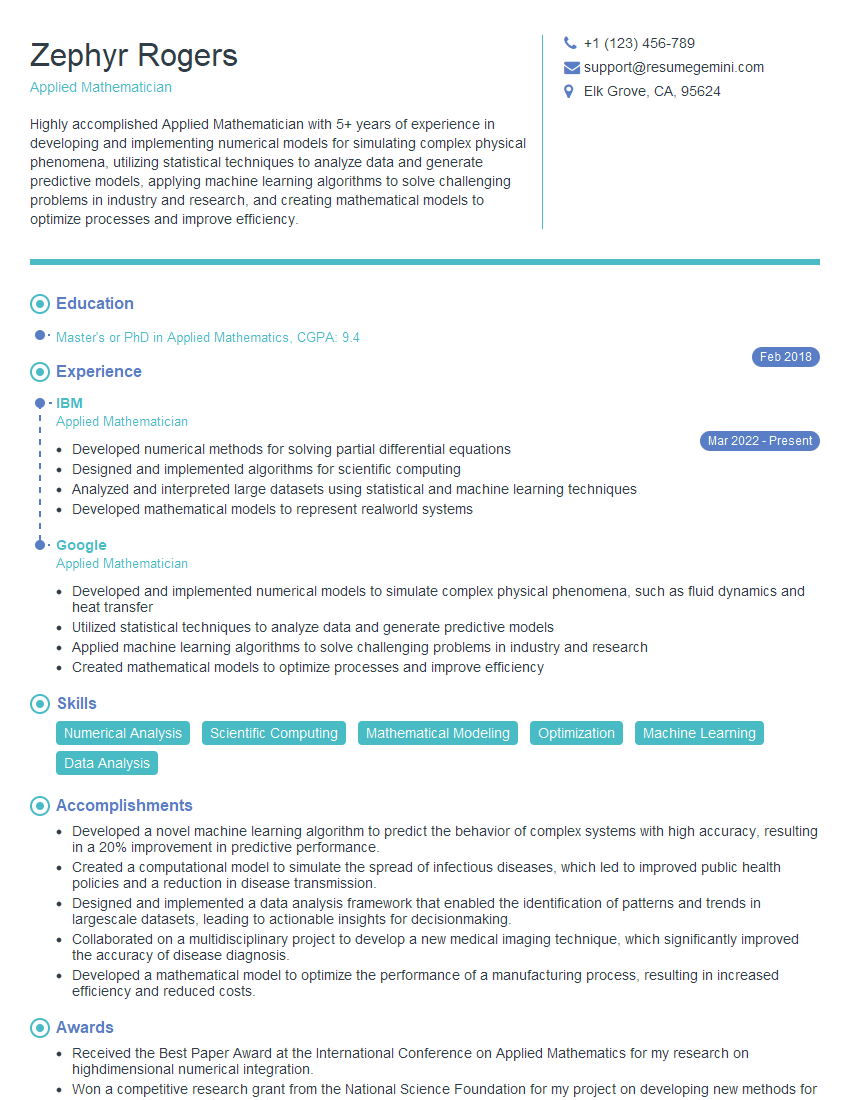
Applied Mathematician Resume Sample

Cryptographer Resume Sample
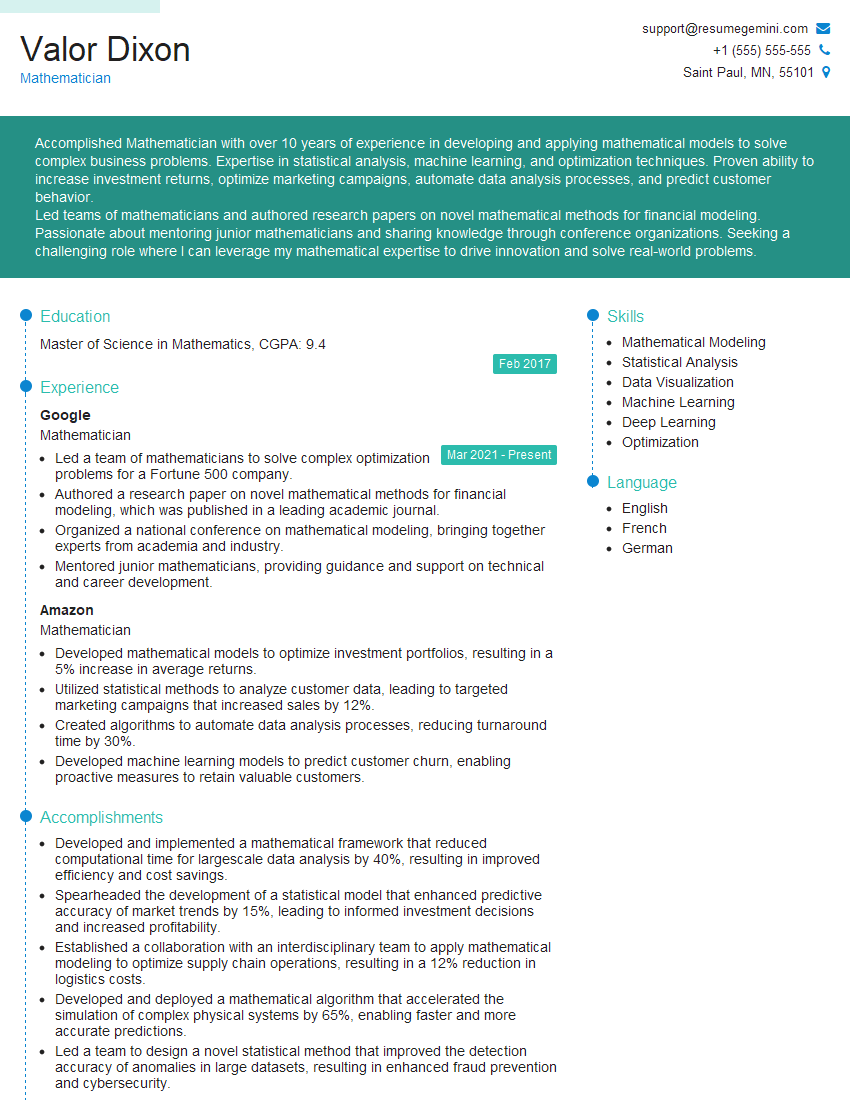
Mathematician Resume Sample

Operations Research Analyst Resume Sample
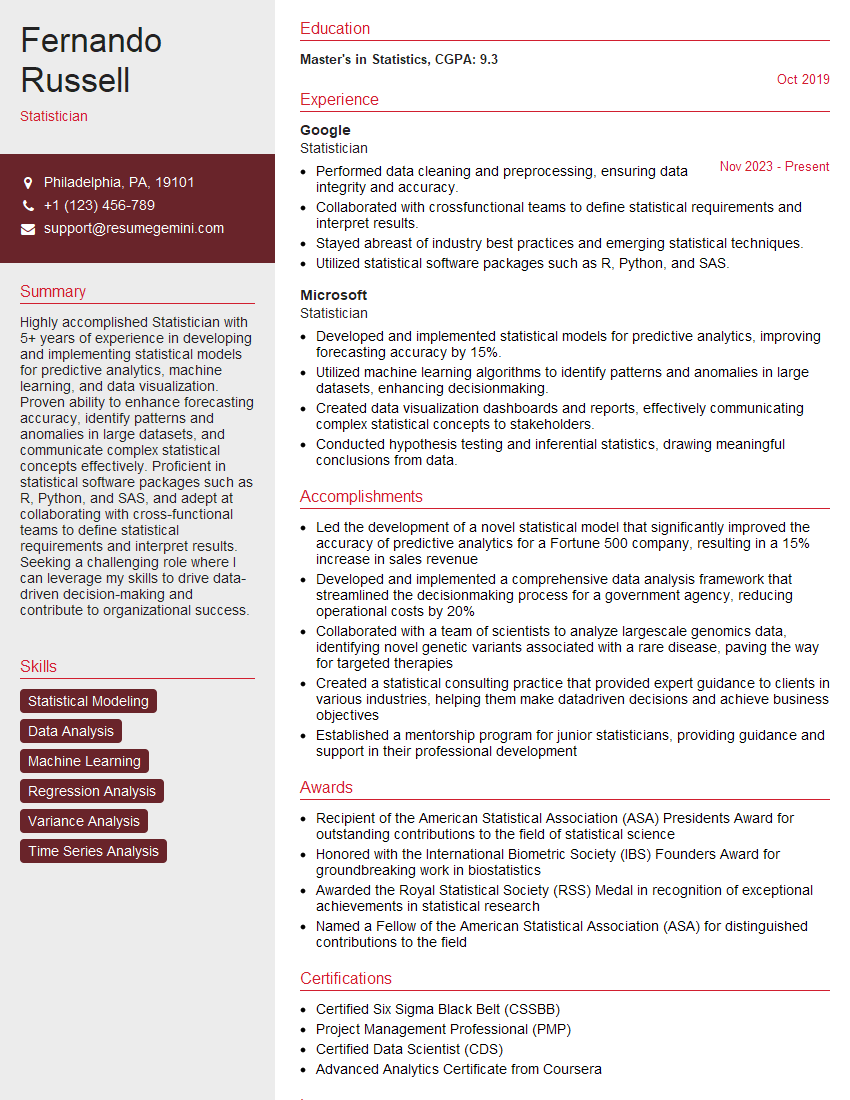
Statistician Resume Sample
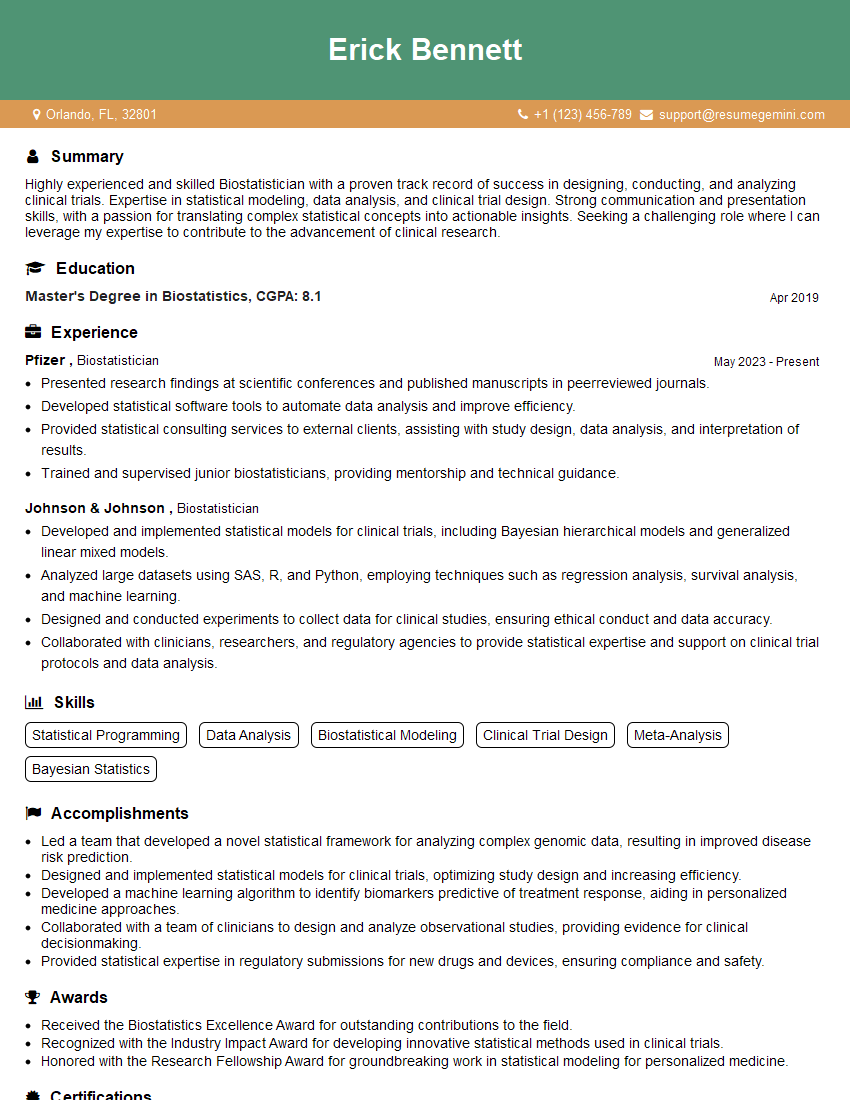
Biostatistician Resume Sample

Control Systems Engineer Resume Sample

Robotics Engineer Resume Sample
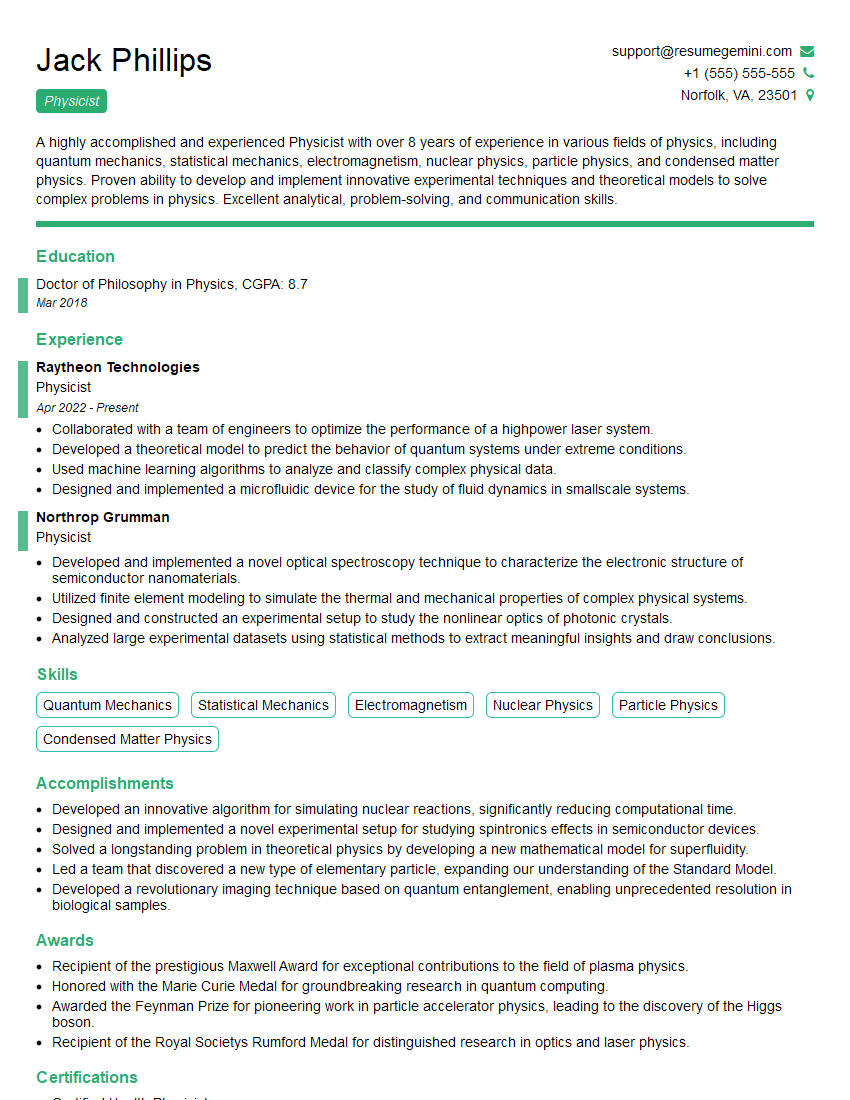
Physicist Resume Sample

Economist Resume Sample
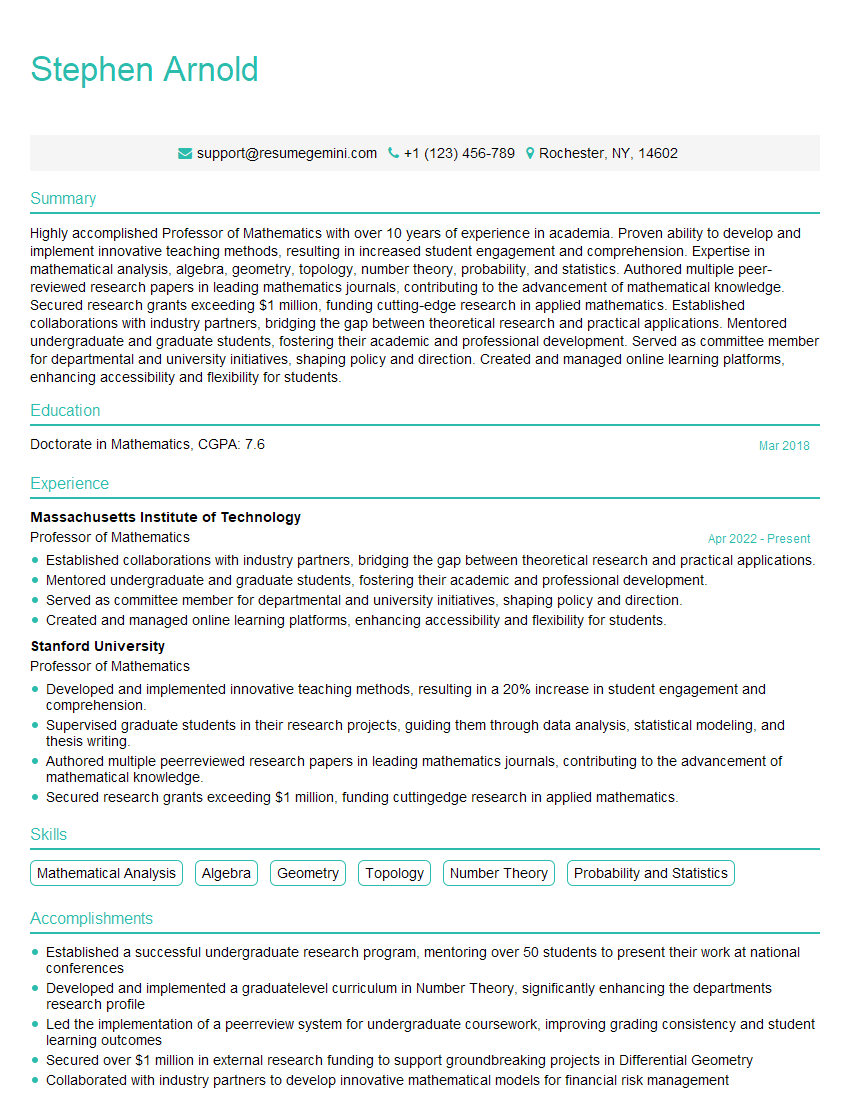
Professor of Mathematics Resume Sample

Machine Learning Engineer Resume Sample
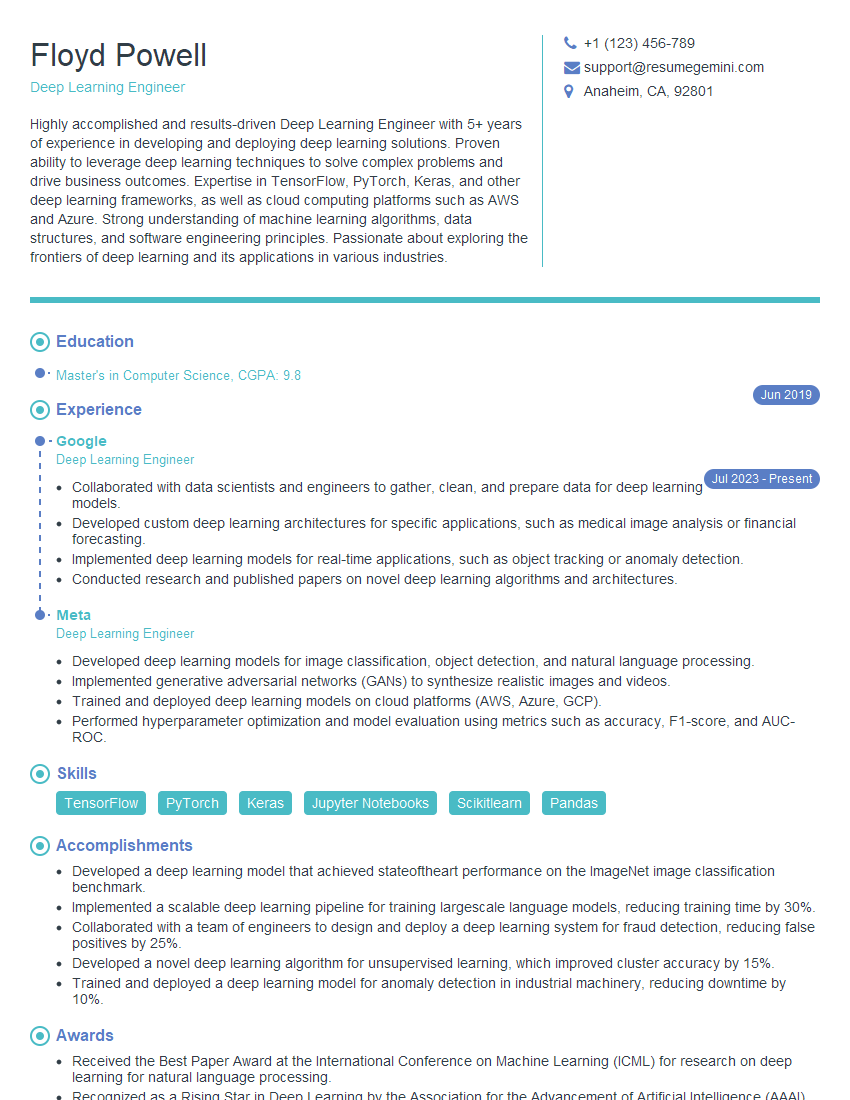
Deep Learning Engineer Resume Sample
- Financial Analyst
- Data Scientist
- Research Scientist
- Actuary
- Applied Mathematician
- Cryptographer
- Mathematician
- Operations Research Analyst
- Statistician
- Biostatistician
- Control Systems Engineer
- Robotics Engineer
- Physicist
- Economist
- Professor of Mathematics
- Machine Learning Engineer
- Deep Learning Engineer
Explore more articles
Users Rating of Our Blogs
Share Your Experience
We value your feedback! Please rate our content and share your thoughts (optional).
What Readers Say About Our Blog
Very informative content, great job.
good