Interviews are opportunities to demonstrate your expertise, and this guide is here to help you shine. Explore the essential Logging Truck Operation interview questions that employers frequently ask, paired with strategies for crafting responses that set you apart from the competition.
Questions Asked in Logging Truck Operation Interview
Q 1. Describe your experience operating different types of logging trucks.
Over my 15 years in the logging industry, I’ve operated a variety of logging trucks, each suited to different tasks and terrains. This includes conventional logging trucks with single or tandem axles, heavy-duty articulated trucks capable of navigating challenging slopes and rough terrain, and smaller, more maneuverable trucks ideal for accessing tight logging sites. For instance, I’ve used a Kenworth T800 for long-haul transport of large log loads, while a smaller Western Star 4900 was better suited for steep, narrow mountain roads. The choice of truck always depends on the specific job requirements – payload capacity, terrain, and distance to the mill.
My experience extends to operating trucks with different powertrains – both diesel and, more recently, some incorporating hybrid technology for improved fuel efficiency. This experience has provided a deep understanding of the nuances of each truck type, from maintenance needs to optimal operating techniques in various conditions.
Q 2. What are the different types of logging trailers and their applications?
Logging trailers are crucial for efficient log transportation, and several types exist, each with specific applications.
- Conventional trailers: These are the most common, with various lengths and axle configurations designed for carrying large volumes of logs. They’re generally suited for relatively flat terrain and well-maintained roads.
- Lowboy trailers: These have a low deck height, making them ideal for carrying exceptionally long or tall logs that might otherwise exceed height restrictions. I’ve used these frequently for transporting specialty timber.
- Pole trailers: These specialized trailers are designed for transporting long, slender poles, often used in utility or construction projects. They provide superior stability and reduce the risk of damage during transit.
- Bunk trailers: These feature individual bunks (supports) for each log, reducing friction and risk of damage. Ideal for high-value or fragile timber.
The selection of a trailer depends on factors such as log size, type of wood, road conditions, and legal weight limitations. For example, in mountainous terrain, a lighter lowboy trailer might be safer than a heavy conventional trailer.
Q 3. Explain the importance of pre-trip inspections for logging trucks.
Pre-trip inspections are paramount for ensuring the safety and efficiency of logging operations. They’re more than just a checklist; they are a critical preventative measure. A thorough inspection includes checking:
- Brakes: Functioning correctly is crucial for safe operation, particularly on steep inclines.
- Tires: Proper inflation and condition are vital to prevent blowouts and maintain traction.
- Lights and Signals: Ensuring all lights are functioning properly is critical for visibility, especially in low-light conditions.
- Steering: Checking for responsiveness and any unusual play.
- Suspension: Inspecting for damage or excessive wear.
- Cargo Securement: Verifying that the logs are properly loaded and secured to prevent shifting or spillage.
- Leaks: Checking for fuel, oil, or hydraulic fluid leaks.
Failure to conduct a thorough pre-trip inspection can lead to accidents, delays, and costly repairs. I always allocate sufficient time for this critical step before commencing any journey, making it a non-negotiable part of my routine.
Q 4. How do you ensure the safe loading and securing of logs on your truck?
Safe loading and securing of logs is crucial to prevent accidents and damage. This involves a systematic approach:
- Proper Placement: Logs are loaded strategically, distributing weight evenly across the trailer to maintain balance and prevent overloading.
- Binding Techniques: We use appropriate chains, binders, and straps to secure the logs tightly against movement during transit. The tension must be adjusted for the terrain.
- Load Stability: Logs should be interlocked to prevent shifting, especially during turns or on uneven terrain. Consider the weight and distribution when arranging the logs.
- Weight Distribution: Using load-measuring devices helps ensure that the legal weight limits are not exceeded.
- Inspection: Before moving, the entire load is inspected to confirm securement. Any potential issues are addressed immediately.
I’ve seen firsthand the devastating consequences of improperly secured loads, emphasizing the importance of meticulous attention to detail in this process. Safety is never compromised.
Q 5. What are the legal weight limits and regulations for logging trucks in your area?
Legal weight limits and regulations for logging trucks vary significantly by jurisdiction. In my area, the gross vehicle weight rating (GVWR) is strictly enforced, usually around 80,000 lbs, though this can vary based on axle configuration and specific road designations. Exceeding these limits results in hefty fines and potential legal ramifications. Permitting is often required for loads exceeding these limits. Moreover, specific regulations often dictate allowed hours of operation, speed restrictions on certain roads, and mandatory equipment (like underride guards) for enhanced safety.
I meticulously track weights and comply fully with all regulations, understanding that safety and legal compliance are paramount. Maintaining detailed records is also essential.
Q 6. Describe your experience with different types of logging roads and terrains.
My experience encompasses diverse logging road conditions, from well-maintained gravel roads to rough, unimproved trails and steep mountain passes. Navigating these varying terrains requires adapting driving techniques, adjusting speed, and employing careful route planning. For example, using lower gears and reduced speed on steep inclines is crucial to maintain control. On unimproved roads, I’ve had to be extra vigilant about potential hazards like deep ruts, potholes, and uneven surfaces.
I’m adept at using different driving techniques, such as using momentum on inclines while carefully controlling the brakes on descents. Experience helps recognize potential obstacles and makes proactive decisions on safe paths.
Q 7. How do you handle challenging weather conditions while operating a logging truck?
Challenging weather conditions present significant challenges for logging truck operators. I’ve had to adapt to everything from heavy rain and snow to freezing temperatures and high winds. My approach prioritizes safety and includes:
- Reduced Speed: Significantly reducing speed in adverse conditions enhances safety and improves traction.
- Increased Following Distance: Maintaining a larger following distance allows for more reaction time and prevents rear-end collisions.
- Careful Route Planning: Avoiding potentially hazardous areas during inclement weather is key. Sometimes, it’s best to wait for conditions to improve.
- Tire Chains: When snow or ice is present, using appropriate chains is essential for maintaining traction and stability.
- Increased Vigilance: Enhanced alertness and focus is needed due to decreased visibility and reduced road conditions. Extra caution is applied when approaching intersections or turns.
Safety is my top priority in any situation, and the decision to delay a trip due to severe weather is always justified. Weather forecasting plays a vital role in my daily planning.
Q 8. What are the common safety hazards associated with logging truck operation?
Operating a logging truck presents unique safety hazards, significantly different from other trucking operations. The biggest risks stem from the nature of the load itself – heavy, unevenly distributed timber – and the often-challenging terrain.
- Load instability: Improperly secured logs can shift during transit, leading to rollovers or loss of cargo. Imagine a stack of dominoes; one wrong move can bring the whole thing crashing down.
- Road conditions: Logging roads are frequently narrow, unpaved, and subject to damage from weather and heavy traffic. Mud, ruts, and steep inclines increase the risk of accidents.
- Visibility issues: The size and shape of the log load can obstruct the driver’s vision. Adding low-light conditions or heavy fog multiplies the danger.
- Blind spots: Logging trucks have extensive blind spots, making it crucial to use mirrors effectively and be extra cautious when changing lanes or making turns.
- Tree hazards: Falling trees or branches along logging routes are a constant concern.
- Fatigue and long hours: The demanding nature of the job and long hours behind the wheel contribute significantly to driver fatigue, increasing the likelihood of errors.
Regular vehicle inspections, adherence to safe loading practices, and driver training focused on hazard awareness are vital for mitigating these risks.
Q 9. Explain your understanding of load distribution and stability.
Load distribution and stability are paramount in logging truck operation. An unevenly distributed load creates an unstable center of gravity, dramatically increasing the risk of a rollover, especially on curves or inclines. Think of it like balancing a stack of books – a perfectly balanced stack is stable, but if you place a heavy book off-center, the whole thing topples.
Understanding load distribution involves ensuring weight is evenly spread across the truck’s axles. This usually involves careful placement of logs, potentially using binders and chains to secure them against shifting. Stability is then influenced by factors such as the truck’s center of gravity, tire pressure, and the road surface.
For example, loading heavier logs towards the center and securing them tightly prevents shifting and maintains a lower center of gravity. Regular inspections of the load’s security throughout the journey are also key to preventing accidents.
Q 10. How do you maintain a safe following distance while driving a logging truck?
Maintaining a safe following distance with a logging truck is crucial due to its size, weight, and longer stopping distance compared to other vehicles. The general rule of thumb of ‘three seconds’ needs adjustment.
I always apply the ‘five-second rule’ or even more, depending on road conditions. That’s the time it takes me to reach the same spot on the road as the vehicle in front of me after it has passed a fixed point (e.g., a signpost). This allows ample reaction time to brake or maneuver safely. Factors influencing this include speed, road conditions (rain, ice, curves), and the load’s weight. If the road is wet or icy, I significantly increase the following distance.
It’s not just about reaction time but also anticipating potential problems. If the vehicle in front suddenly brakes hard, a logging truck requires a considerably longer distance to stop safely. This extra precaution prevents rear-end collisions and other dangerous scenarios.
Q 11. Describe your experience with using GPS and other navigation systems.
GPS and other navigation systems are indispensable for efficient and safe logging operations. My experience includes using various GPS devices and mapping software. These tools help me plan optimal routes, avoiding unnecessary detours and areas with potentially challenging road conditions.
I rely on GPS to locate logging sites, plan efficient routes taking into account weight restrictions, bridge clearances, and terrain. Advanced systems provide real-time traffic updates and alternative routes to avoid congestion or delays. On particularly challenging routes, I might use a combination of GPS with paper maps as a backup.
Furthermore, some systems can record my driving data, helping identify areas for improvement in terms of fuel efficiency or route planning. The accuracy and reliability of these systems are critical, and I always double-check the information provided with other sources when necessary.
Q 12. How do you manage your time effectively during a long logging haul?
Managing time effectively during long logging hauls is crucial for both safety and efficiency. My strategy involves careful planning and adherence to a disciplined schedule.
Pre-trip planning includes confirming the route, checking load security, ensuring sufficient fuel and supplies, and estimating travel time, factoring in potential delays. I also plan for regular breaks, ensuring I get adequate rest to avoid fatigue. These breaks are not just for resting but also for checking the load and the vehicle’s condition.
On the road, I maintain consistent speeds, observe traffic laws, and avoid unnecessary stops. Effective communication with dispatchers or clients helps me manage expectations and keep them updated on my progress. Utilizing technology like GPS for route optimization and load tracking allows for efficient time management.
Post-trip, I meticulously record my hours of service, document any incidents or delays, and conduct a thorough post-trip inspection of the truck. This detailed record-keeping helps improve future planning and ensures compliance with regulations.
Q 13. How do you handle mechanical issues or breakdowns while on the road?
Handling mechanical issues or breakdowns on the road requires a combination of preparedness, problem-solving skills, and adherence to safety protocols.
First and foremost, I conduct pre-trip inspections to minimize the risk of breakdowns. If a problem does occur, I immediately pull over to a safe location, away from traffic and preferably onto a level surface. I then activate hazard lights, place warning triangles, and if possible, contact my dispatch or roadside assistance.
My experience includes diagnosing minor issues, such as tire changes or minor electrical faults. I have the necessary tools and knowledge to handle some basic repairs. For more complex problems, I rely on professional assistance, ensuring the repair is done correctly and safely before resuming the journey. Safety is paramount; I will not compromise on safety to save time.
Q 14. What are your strategies for fuel efficiency while operating a logging truck?
Fuel efficiency is a significant operational cost in logging trucking. My strategies focus on minimizing fuel consumption without compromising safety.
Driving techniques: This includes maintaining a consistent speed, avoiding aggressive acceleration and braking, anticipating traffic flow to minimize unnecessary stops and starts. Smooth driving reduces wear and tear, further contributing to better fuel economy.
Route planning: Choosing the most efficient route, avoiding unnecessary hills and detours, and adhering to the posted speed limits are important strategies. GPS navigation systems often offer optimized routes that factor in fuel consumption.
Vehicle maintenance: Regular maintenance, including tire inflation checks, engine tuning, and ensuring optimal aerodynamic performance, is crucial. A well-maintained truck is significantly more fuel-efficient.
Load optimization: Efficiently loading and distributing the weight helps reduce drag and improve fuel consumption. Avoiding excessive weight ensures optimal engine performance, leading to better fuel efficiency.
Q 15. Explain your understanding of chain-up and chain-down procedures.
Chain-up and chain-down procedures are crucial for securing a log load on a logging truck, ensuring safe transportation. Chain-up refers to the initial securing of the logs, while chain-down involves additional securing to prevent shifting during transit. Think of it like building a strong, stable structure with multiple points of support.
- Chain-up: This involves strategically placing binders and chains around the logs, starting with the base logs and working upwards. We use chokers (loops of chain) to secure individual logs, then main chains to bind the entire load together. Proper tension is key; the load should be snug but not excessively tight, to avoid damaging the wood or the truck.
- Chain-down: Once the main load is chained up, additional chains (often running diagonally across the load) are used to provide extra support and prevent any shifting. These are usually tensioned more tightly than the initial chains. We consider the weight distribution and terrain – a steeper route requires more secure chain-downs.
- Example: Imagine building a brick wall. Chain-up is like laying the first few rows – solid and even. Chain-down is like adding supporting buttresses to prevent the wall from collapsing under pressure.
Failure to properly chain-up and chain-down can lead to dangerous load shifts, potentially causing accidents. Regular inspections and adherence to safety guidelines are vital.
Career Expert Tips:
- Ace those interviews! Prepare effectively by reviewing the Top 50 Most Common Interview Questions on ResumeGemini.
- Navigate your job search with confidence! Explore a wide range of Career Tips on ResumeGemini. Learn about common challenges and recommendations to overcome them.
- Craft the perfect resume! Master the Art of Resume Writing with ResumeGemini’s guide. Showcase your unique qualifications and achievements effectively.
- Don’t miss out on holiday savings! Build your dream resume with ResumeGemini’s ATS optimized templates.
Q 16. How do you communicate effectively with dispatchers and other team members?
Effective communication is paramount in logging. I use a combination of methods to ensure clear and timely communication with dispatchers and team members.
- Clear and Concise Language: I avoid jargon and use plain language when reporting on my location, load status, any issues encountered, and estimated arrival times. For example, instead of saying ‘I’m experiencing a significant delay due to unforeseen circumstances’, I would say ‘I’m stuck in mud; ETA delayed by 2 hours’.
- Radio Communication: I use the radio to provide frequent updates on my progress, especially when navigating challenging terrain or facing unexpected delays. I acknowledge all messages promptly to confirm receipt.
- Dispatch Software/Apps: I utilize dispatch software to update my location and status in real-time, making it easy for the dispatcher to monitor my progress and respond to any requests or changes.
- Pre-Trip and Post-Trip Briefings: Before each haul, I discuss the route, load specifics, and any potential hazards with the dispatcher and loading crew. After completing the haul, I provide a concise report of any unusual events or issues.
Proactive communication prevents misunderstandings and improves overall efficiency and safety. It is all about preventing problems before they occur.
Q 17. How do you maintain accurate log tracking and documentation?
Accurate log tracking and documentation are essential for compliance, billing, and efficient operations. I utilize a combination of methods to ensure this accuracy.
- Bill of Lading: I meticulously check the bill of lading against the load before departure, verifying species, quantity, and destination. Any discrepancies are immediately reported to the dispatcher.
- Electronic Logging Devices (ELDs): I ensure accurate recording of hours of service and mileage using the ELD system. This data is crucial for compliance with regulations.
- Load Manifest: I maintain a detailed load manifest, noting the species, volume, and weight of each log, along with any damage or defects. This helps with inventory control and potential claims.
- Digital Cameras and Reporting Systems: I utilize digital cameras to document the load both before departure and upon arrival. This provides visual evidence of the condition of the logs and can assist in resolving any disputes.
- Paper Log Books: Despite the digital age, some aspects are still logged traditionally, ensuring a backup system is in place.
Maintaining accurate records is not just about following rules, it’s about safeguarding the business and ensuring accountability throughout the entire process.
Q 18. Describe your experience with different types of log species and their handling requirements.
Experience with various log species and their handling requirements is crucial. Different species have unique characteristics affecting handling and transportation.
- Softwoods (e.g., Pine, Fir, Spruce): These are generally lighter and easier to handle, but can be more prone to breakage if improperly secured.
- Hardwoods (e.g., Oak, Maple, Birch): These are denser and heavier, requiring more careful loading and securing to prevent load shifting. They can also cause damage to the truck or other equipment if improperly managed.
- Handling Considerations: The moisture content of the wood impacts its weight and fragility; freshly cut logs are heavier and more likely to cause damage, and wet wood is incredibly heavy.
- Specific Examples: Pine logs might require less secure chains than oak logs of a similar size and weight, but all logs require proper weight distribution to avoid overstressing the truck chassis.
Knowledge of wood species helps in selecting appropriate securing techniques, optimizing load distribution, and minimizing damage during transportation. Improper handling can lead to significant financial losses and safety hazards.
Q 19. Explain your understanding of load shifting and how to prevent it.
Load shifting is a dangerous situation where the logs on a truck move during transit, often leading to accidents. Preventing it requires careful planning and execution.
- Proper Load Distribution: Distribute the weight evenly across the truck bed. Avoid concentrating heavy logs in one area. Think of it like balancing a seesaw.
- Secure Binding: Employ robust chain-up and chain-down procedures with appropriate tension. Regularly inspect the chains and binders for wear or damage during the haul.
- Appropriate Log Placement: Position logs strategically, larger, heavier logs at the bottom, to create a stable base.
- Avoid Overloading: Never exceed the truck’s weight capacity. Overloading increases the risk of load shifting significantly.
- Regular Inspections: Conduct frequent checks during the journey, particularly on longer routes and rough terrain. A quick stop to ensure the load hasn’t moved can save lives and prevent accidents.
Load shifting is preventable through meticulous planning and careful execution of safety procedures. Regular training and awareness are key to maintaining a safe working environment.
Q 20. How do you ensure compliance with all relevant safety regulations and company policies?
Compliance with safety regulations and company policies is non-negotiable. My commitment to safety is unwavering.
- Pre-Trip Inspections: I meticulously inspect the truck and trailer before each trip, verifying brakes, lights, tires, and securing mechanisms. I document any issues and report them immediately.
- Hours of Service Regulations: I strictly adhere to the hours-of-service regulations, ensuring sufficient rest and avoiding fatigue. Using the ELD properly helps with this.
- Safe Driving Practices: I maintain safe driving practices, observing speed limits, and avoiding risky maneuvers, especially on challenging terrain.
- Personal Protective Equipment (PPE): I always wear appropriate PPE, including hard hats, safety glasses, and work boots. I also have a first-aid kit in the truck.
- Company Policy Adherence: I familiarize myself with and diligently follow all company policies and procedures.
Safety is not just a set of rules; it’s a mindset. Proactive adherence to regulations and company policies protects me, my colleagues, and the public.
Q 21. Describe your experience working with various forestry equipment and machinery.
My experience encompasses a range of forestry equipment and machinery.
- Logging Trucks: I’m proficient in operating various types of logging trucks, including both single-axle and tandem-axle models. I understand the weight limits, suspension systems, and braking systems of these vehicles.
- Loaders and Skidders: I’m familiar with the operation and safety procedures associated with loaders and skidders, which are often used to load logs onto trucks.
- Feller Bunchers and Harvesters: While I don’t personally operate these machines, I understand their capabilities and limitations. My experience allows me to communicate effectively with operators and anticipate potential issues regarding log handling and loading.
- Chain Saws: I’m skilled in the safe and efficient use of chain saws for smaller tasks as needed.
Understanding the capabilities and limitations of different equipment allows for safer and more efficient log transportation. Working collaboratively with other operators and having a comprehensive understanding of all machinery involved is vital for efficiency and safety.
Q 22. What are your strategies for preventing accidents and injuries while operating a logging truck?
Preventing accidents and injuries while operating a logging truck requires a multifaceted approach prioritizing safe driving practices, vehicle maintenance, and adherence to regulations.
Defensive Driving: This is paramount. I always anticipate the actions of other drivers, especially on narrow forest roads, and maintain a safe following distance, significantly increasing my reaction time. I avoid distractions like cell phones completely.
Pre-Trip Inspections: Before every trip, I meticulously inspect the truck, including brakes, lights, tires, load securement, and the overall structural integrity of the vehicle. A simple check of tire pressure can prevent a blowout. I document any issues and report them immediately.
Load Securement: Improperly secured logs are a major hazard. I follow all regulations and best practices for load binding, using appropriate chains, binders, and dunnage to prevent shifting during transport. I’ve personally witnessed the devastating consequences of a shifting load, underscoring the importance of this step.
Awareness of Surroundings: Logging roads are often unpredictable. I am constantly aware of my surroundings, watching for wildlife, changing weather conditions (especially fog and rain), and other vehicles or equipment. Using my mirrors effectively is critical.
Fatigue Management: Fatigue significantly impairs judgment and reaction time. I strictly adhere to hours-of-service regulations and prioritize getting adequate rest before and between shifts. Safety is not worth compromising on.
Q 23. How do you handle emergency situations, such as accidents or breakdowns?
Handling emergencies requires quick thinking and a calm demeanor. My response depends on the nature of the emergency.
Accidents: In case of an accident, my first priority is ensuring the safety of myself and others involved. I immediately secure the scene, contact emergency services (911 or equivalent), and provide any necessary assistance while waiting for first responders. I’ll then cooperate fully with any investigations.
Breakdowns: If the truck breaks down, I activate hazard lights, place warning triangles, and assess the situation. Depending on the severity and location, I might attempt minor repairs if I’m qualified and it’s safe to do so. Otherwise, I contact my dispatcher and arrange for roadside assistance or a replacement truck. Safety is the top priority – I won’t attempt risky repairs.
Weather-Related Emergencies: Adverse weather conditions require immediate action. If visibility drops significantly due to fog or snow, I immediately pull over to a safe location and wait until conditions improve. I am always prepared with emergency supplies, like blankets and extra water, particularly during winter months.
Q 24. What is your experience with different types of braking systems in logging trucks?
My experience encompasses various braking systems common in logging trucks, each with its own strengths and weaknesses.
Air Brakes: These are standard in heavy-duty logging trucks. I’m proficient in understanding and maintaining air brake systems, including regular checks of air pressure, brake lines, and components. I’m familiar with the importance of proper air pressure for safe and effective braking.
Exhaust Brakes (Jake Brakes): These are vital for slowing heavy loads down steep inclines, reducing wear and tear on the service brakes. I understand their limitations and use them strategically. They’re not suitable for all terrains and driving conditions.
Retarders: These supplementary braking systems provide extra stopping power, especially beneficial for descending grades. I’m familiar with their operation and how to integrate them effectively with air brakes and exhaust brakes for maximum control.
Understanding the nuances and limitations of each system is crucial for safe operation, especially in challenging terrain.
Q 25. How do you stay updated on the latest regulations and best practices in logging transportation?
Staying current on regulations and best practices is an ongoing process that I take very seriously. I utilize several methods:
Professional Organizations: I’m a member of [mention relevant professional organizations, e.g., logging associations], providing access to industry publications, workshops, and updates on regulations and safety procedures.
Government Websites: I regularly check websites of relevant government agencies [mention agencies specific to your region] for changes in regulations related to load limits, hours of service, and safety standards.
Industry Publications: I subscribe to industry magazines and journals to remain abreast of new technologies, best practices, and accident reports that can help avoid potential hazards. Learning from others’ mistakes is invaluable.
Company Training: I actively participate in all company-mandated training programs on safety, vehicle maintenance, and regulatory updates. Regular refresher courses ensure my knowledge is current.
Q 26. Describe your experience with log scaling and measurement.
Log scaling and measurement are essential for accurate payment and inventory management. My experience involves both traditional and modern methods.
Traditional Scaling: I’m proficient in using a scaling stick and diameter tape to measure log lengths and diameters, calculating volumes using established formulas. This is important for smaller operations or when electronic methods are unavailable.
Electronic Scaling: I’m also experienced with using electronic scaling systems integrated into logging trucks or handheld devices. These systems often use laser or ultrasound technology for more efficient and accurate measurements. This method significantly speeds up the scaling process.
Record Keeping: Accuracy in record keeping is critical. I maintain meticulous records of each load, documenting the species, dimensions, volume, and destination. These records are vital for billing and auditing purposes.
Q 27. Explain your knowledge of different logging techniques and their impact on transportation.
Different logging techniques significantly impact transportation. Understanding these techniques helps optimize logistics and safety.
Selective Logging: This method focuses on harvesting specific trees, leaving the rest of the forest intact. This often results in smaller loads, potentially requiring more trips but reducing environmental impact and making road access easier.
Clear-Cutting: This involves removing all trees from a designated area. This generates larger, heavier loads, requiring specialized trucks and potentially posing greater transportation challenges due to increased weight and size.
Shelterwood Logging: This method gradually removes trees over time, leaving some behind to provide shade and protection for regeneration. The transportation requirements vary depending on the stage of the operation.
My experience allows me to adapt my driving and load-securing techniques based on the specific logging method employed, ensuring safe and efficient transportation regardless of the logging technique used.
Q 28. What are your salary expectations for this position?
My salary expectations are in the range of $[insert salary range] per year. This is based on my experience, skills, and the requirements of this position. I am open to discussing this further based on the complete compensation package, including benefits.
Key Topics to Learn for Logging Truck Operation Interview
- Vehicle Operation & Maintenance: Understanding the mechanics of logging trucks, including engine systems, braking systems, and transmission. Knowing preventative maintenance schedules and procedures is crucial.
- Load Security & Transportation: Safe and efficient loading techniques, proper securing of logs to prevent shifting or damage during transport, and adherence to weight limits and regulations.
- Safety Procedures & Regulations: Thorough knowledge of all relevant safety regulations, including load securing, driving in challenging terrain, and emergency procedures. Demonstrating a commitment to safety is paramount.
- Navigation & Route Planning: Efficient route planning considering terrain, weather conditions, and traffic. Understanding the use of GPS and mapping systems for optimal delivery routes.
- Log Handling & Forestry Practices: Familiarity with different logging techniques and the impact on log handling and transportation. Understanding the importance of sustainable forestry practices.
- Communication & Teamwork: Effective communication with dispatchers, fellow drivers, and forestry crews. Understanding the importance of teamwork in a demanding environment.
- Problem-Solving & Troubleshooting: Ability to identify and resolve mechanical issues, navigate challenging terrain, and manage unexpected delays or situations safely and efficiently. Describe your approach to problem-solving with examples.
- Regulations and Compliance: Deep understanding of all relevant federal, state, and local regulations regarding logging truck operation, load limits, and safety protocols.
Next Steps
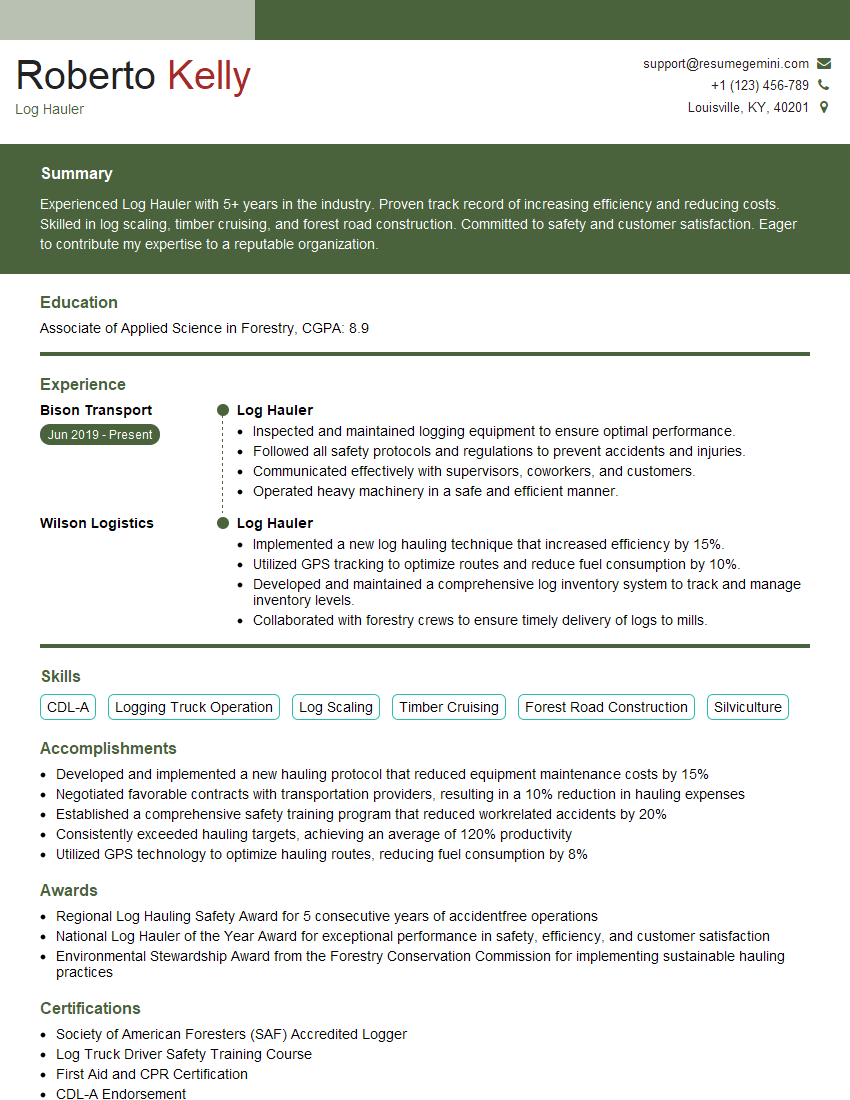
Mastering Logging Truck Operation opens doors to a rewarding career with excellent earning potential and opportunities for advancement within the forestry industry. Your expertise in safe and efficient log transportation is highly valued. To maximize your job prospects, creating a strong, ATS-friendly resume is critical. ResumeGemini is a trusted resource that can help you build a professional resume tailored to highlight your skills and experience. Examples of resumes tailored specifically to Logging Truck Operation are available through ResumeGemini, allowing you to craft a compelling application that showcases your qualifications effectively.






Explore more articles
Users Rating of Our Blogs
Share Your Experience
We value your feedback! Please rate our content and share your thoughts (optional).
What Readers Say About Our Blog
Very informative content, great job.
good