Cracking a skill-specific interview, like one for Machine-Stitching, requires understanding the nuances of the role. In this blog, we present the questions you’re most likely to encounter, along with insights into how to answer them effectively. Let’s ensure you’re ready to make a strong impression.
Questions Asked in Machine-Stitching Interview
Q 1. What types of sewing machines are you familiar with?
My experience encompasses a wide range of sewing machines, from basic mechanical models to advanced computerized machines. I’m proficient with both industrial and domestic machines. For example, I’ve extensively used Singer heavy-duty machines for projects requiring durability and high-volume stitching, and I’m also comfortable with Brother computerized machines offering intricate stitch patterns and programmable features. My familiarity extends to specialized machines like sergers (overlock machines) for professional-quality seam finishes and embroidery machines for detailed decorative stitching.
- Mechanical Machines: These are straightforward, reliable workhorses, ideal for basic sewing and repairs. They rely on manual adjustments for stitch length and width.
- Computerized Machines: Offer a wide array of pre-programmed stitches, adjustable settings, and often include features like automatic needle threading and tension control.
- Industrial Machines: Built for heavy-duty work, these are robust and fast, typically found in manufacturing settings.
- Specialized Machines (Sergers/Embroidery Machines): These machines cater to specific needs, offering unique functionalities like creating professional-looking seams (sergers) or intricate embroidered designs (embroidery machines).
Q 2. Describe your experience with different stitch types.
My experience with stitch types is comprehensive. I understand the properties and applications of various stitches, from basic straight stitches to complex decorative stitches. A straight stitch is the foundational stitch, used for seams and construction. A zig-zag stitch is versatile, used for securing edges, creating decorative effects, and mending. Beyond these basics, I’m skilled in using satin stitches for filling areas with smooth color, blanket stitches for decorative edges, buttonhole stitches for precise openings, and blind stitches for invisible seam finishes. I frequently use different stitch types based on the fabric type and the project requirements. For example, a delicate silk garment requires finer stitches than a sturdy denim jacket. I can also select appropriate stitch types for specific textile needs, such as stretch stitches for elastic fabrics to prevent seam breakage.
- Straight Stitch:
(represented by a single line)– Strong and versatile, suitable for seams, top stitching and general construction. - Zig-zag Stitch:
(represented by a zig-zag line)– Useful for preventing fraying, finishing edges, and creating decorative effects. - Satin Stitch:
(represented by closely packed parallel lines)– Fills in an area to create a solid, smooth surface.
Q 3. How do you troubleshoot common sewing machine malfunctions?
Troubleshooting sewing machine malfunctions requires a systematic approach. I start by identifying the problem – is the machine not stitching at all, stitching unevenly, or producing skipped stitches? Then I proceed with a series of checks. First, I inspect the needle for bending or damage, and replace it if necessary. I then check the bobbin case and bobbin for proper winding and placement, ensuring the bobbin thread is correctly tensioned and not tangled. Next, I examine the tension settings, adjusting them accordingly if the stitches are too loose or too tight. If the problem persists, I check the feed dogs to ensure proper fabric movement, and the timing of the machine’s internal mechanisms (if I have the expertise to do so, which I usually do.) Cleaning the machine of lint and debris is a critical step, as build-up can cause jams and inconsistent stitching. If none of these steps resolves the problem, I consult the machine’s manual or seek professional assistance.
For example, a skipped stitch problem could be caused by a dull needle, incorrect tension, a broken bobbin case spring, or lint build up around the shuttle hook.
Q 4. Explain your process for setting up a sewing machine for a specific project.
Setting up a sewing machine for a specific project is crucial for a successful outcome. It begins with selecting the appropriate needle type and size for the fabric. Then, I choose the correct stitch type, length, and width based on the project’s requirements. For example, heavier fabrics like denim require a heavier needle and longer stitch length compared to lightweight fabrics like silk which need a finer needle and shorter stitch length. I thread the machine correctly, paying attention to proper tension settings, which is highly dependent on both the fabric and the thread type. Before starting the actual sewing, I do a test run on a scrap piece of the same fabric to check if the settings are optimal and make any necessary adjustments. Using a test piece ensures consistency and minimizes waste on the final product.
Q 5. How do you maintain the cleanliness and upkeep of a sewing machine?
Maintaining a sewing machine’s cleanliness is essential for its longevity and optimal performance. After each use, I remove any lint, thread scraps, and dust from around the needle area, bobbin case, and feed dogs using a small brush or compressed air. I regularly lubricate the moving parts according to the manufacturer’s instructions, typically using sewing machine oil. I also periodically clean the bobbin case thoroughly to prevent build up that could hinder smooth operation. For more extensive cleaning, I may use a sewing machine cleaning kit, taking care to follow the instructions for disassembling and reassembling the parts. This type of preventative maintenance, as well as taking the machine to a qualified technician for an annual service, is crucial in preserving the longevity and performance of the sewing machine.
Q 6. What safety precautions do you follow while operating sewing machinery?
Safety is paramount when working with sewing machines. I always keep my fingers away from the needle and moving parts, using a seam guide or finger guard for protection, particularly when sewing curves or complex designs. I ensure the machine is unplugged before cleaning, oiling, or making any adjustments. Long hair should be tied back to prevent entanglement, and loose clothing should be avoided. I regularly inspect the machine for any loose parts or frayed cords, and I immediately stop working if I notice anything unusual or unsafe. Working in a well-lit area is vital to minimize eye strain and prevent accidents. Never attempt to force the machine, and always take breaks to avoid fatigue.
Q 7. What is your experience with different needle types and their applications?
My experience includes a wide variety of needle types, each designed for specific fabric types and sewing applications. For example, universal needles are the most common and work well on various fabrics. Ballpoint needles are designed for knit fabrics, preventing snags and skipped stitches. Sharp needles are ideal for woven fabrics such as cotton, linen, and silk. I am also familiar with needles for heavier fabrics like denim (heavy duty needles) and delicate fabrics like chiffon (microtex needles). The selection of needle type directly affects the quality and integrity of the seams produced. Using the wrong needle on a given fabric can result in broken needles, damage to the fabric, or inconsistent stitching.
- Universal Needles: Suitable for a wide range of woven and knit fabrics.
- Ballpoint Needles: Specifically designed for knit fabrics to prevent skipped stitches and snags.
- Sharp Needles: Used for woven fabrics like cotton, linen, and silk.
- Heavy-Duty Needles: Ideal for thick fabrics like denim and canvas.
- Microtex Needles: Designed for fine, delicate fabrics like chiffon and silk.
Q 8. How do you adjust stitch length and tension for various fabrics?
Adjusting stitch length and tension is crucial for achieving professional-quality machine stitching. The ideal settings depend heavily on the fabric’s weight, weave, and fiber content. Think of it like writing with a pen – a fine nib for delicate paper (lightweight fabric), a broader nib for heavier cardstock (heavyweight fabric).
- Lightweight fabrics (silk, chiffon): Require a shorter stitch length (around 10-12 stitches per inch) and lower tension to prevent puckering. Too much tension will pull the fabric, creating unsightly gathers. Too long a stitch will make it weak and prone to tearing.
- Medium-weight fabrics (cotton, linen): Typically use a medium stitch length (12-15 stitches per inch) and moderate tension. This provides strength and a nice, even appearance.
- Heavyweight fabrics (denim, canvas): Need a longer stitch length (8-10 stitches per inch) and higher tension. The longer stitch allows the needle to penetrate the thick material easily, while the higher tension helps secure the stitches tightly and prevent skipped stitches.
Experimentation is key. Always test your settings on a scrap piece of the fabric before starting your project. Adjusting the tension dial on your machine (usually a numbered dial) allows you to fine-tune the tension according to your fabric.
Q 9. Explain your experience with industrial sewing machine maintenance.
My experience with industrial sewing machine maintenance is extensive. I’ve worked with a range of machines, from single-needle to multi-needle models, and I’m proficient in preventative maintenance as well as troubleshooting. Regular maintenance is paramount for preventing costly breakdowns and ensuring consistent stitch quality.
- Preventative Maintenance: This involves daily tasks like cleaning lint and debris from the bobbin case, hook, and feed dogs. Regular lubrication of moving parts, including the needle bar, feed mechanism, and presser foot, is also vital. Replacing the needle regularly (after every 8-10 hours of use) is essential to prevent broken needles and damaged fabric.
- Troubleshooting: I’m adept at diagnosing and rectifying issues like skipped stitches (often due to dull needles, improper tension, or lint buildup), broken needles (caused by hitting pins or sewing over metal parts), and inconsistent stitch length (resulting from incorrect machine settings or worn parts).
I always follow the manufacturer’s recommended maintenance schedule and keep detailed records of all maintenance performed. This allows me to track potential problems and prevent future issues. For example, a pattern of regularly broken needles might indicate a problem with the needle plate or presser foot.
Q 10. Describe your proficiency in reading and interpreting sewing patterns.
Reading and interpreting sewing patterns is fundamental to my skillset. I’m proficient in understanding pattern markings, symbols, and instructions. I can readily identify seam allowances, notches, grainlines, and other crucial elements.
I approach pattern interpretation systematically. I start by studying the pattern instructions thoroughly before cutting any fabric. I carefully check for sizing accuracy and make any necessary adjustments. I understand how to lay out patterns according to the fabric’s grain and minimize fabric waste. I am also experienced in grading patterns to adjust for different sizes.
For example, understanding the difference between a ‘straight grain’ and a ‘bias’ cut is crucial in achieving the desired drape and appearance in a garment. I can confidently select the appropriate cut based on the fabric properties and design specifications to achieve a quality end product.
Q 11. How do you ensure consistent stitch quality throughout a production run?
Maintaining consistent stitch quality throughout a production run is achieved through meticulous attention to detail and adherence to best practices. This goes beyond simply setting the machine correctly at the start. It’s about continuous monitoring and adjustment.
- Regular Inspections: Regularly inspecting the stitches during production allows me to catch small variations early, avoiding large-scale quality issues later.
- Consistent Fabric Handling: Ensuring the fabric is fed smoothly and consistently into the machine is essential. Variations in feed rate can impact stitch quality and consistency.
- Needle and Bobbin Management: Using the correct needle type for the fabric and regularly changing the needle and bobbin when necessary significantly contributes to consistent stitches.
- Machine Maintenance: Preventative machine maintenance ensures the machine functions optimally throughout the production run.
For example, a slight change in the fabric’s tension can be readily spotted during inspection, and the tension can be adjusted accordingly. I have a system in place for noting any adjustments made to ensure consistency. If there is a significant deviation, it immediately signals a potential problem—perhaps a dull needle or a minor machine malfunction—which I address promptly.
Q 12. What is your experience with different sewing machine attachments?
I have extensive experience with a variety of sewing machine attachments, expanding the capabilities of my machine for different applications. This allows for greater versatility and efficiency in completing a wide range of projects.
- Walking Foot: This attachment is crucial for sewing multiple layers of fabric or slippery materials consistently. It prevents the layers from shifting and ensures even stitching.
- Zipper Foot: This specialized foot aids in the precise sewing of zippers, ensuring a clean and professional finish.
- Buttonhole Foot: This attachment enables the creation of neat and uniform buttonholes.
- Rolled Hem Foot: This foot allows for the creation of delicate rolled hems on lightweight fabrics.
Knowing when and how to use each attachment efficiently is essential for optimizing sewing speed and producing high-quality results. Each attachment has specific requirements regarding needle position, stitch length, and tension, and I’m familiar with these nuances.
Q 13. How do you handle fabric that is difficult to sew?
Sewing difficult fabrics requires a tailored approach. The specific technique depends on the challenges posed by the fabric. This often involves adjusting the machine settings and utilizing different sewing techniques.
- Slippery fabrics (silk, satin): Require a walking foot to prevent slippage and maintain consistent feed.
- Stretchy fabrics (lycra, jersey): Benefit from a ballpoint needle to prevent snagging and a slightly looser tension to allow for the fabric’s stretch.
- Thick fabrics (denim, leather): Require a strong needle, a longer stitch length, and possibly a stronger sewing machine.
- Fraying fabrics: Need careful pre-treatment like serging or using a zig-zag stitch to secure the edges.
Problem-solving is crucial here. For instance, when sewing leather, I might use specialized leather needles and reduce the sewing speed to prevent damage to the needle and the fabric. For very delicate fabrics, I might use a smaller stitch size and lower the machine’s presser foot pressure to avoid damaging the fabric.
Q 14. How do you measure and cut fabric accurately?
Accurate fabric measurement and cutting are vital for achieving precise results. I use a combination of tools and techniques to ensure accuracy.
- Accurate Measuring Tools: I use a flexible measuring tape for accurate measurements and a ruler or cutting mat with marked gridlines for precise cutting. A rotary cutter and self-healing mat are also essential tools for clean cuts.
- Grainlines: I carefully align the fabric’s grainlines with the pattern pieces to ensure correct garment shape and drape.
- Sharp Cutting Tools: Sharp scissors or a rotary cutter are essential for clean, accurate cuts to prevent fraying or jagged edges.
- Pinning Techniques: I use pins perpendicular to the cut edges to secure the pattern pieces to the fabric, ensuring accurate placement and preventing slippage during cutting.
For example, before cutting any fabric, I always double-check my measurements and carefully pin the pattern pieces in place. I make sure the grainlines are aligned and I use sharp scissors or a rotary cutter to ensure clean cuts. Any mistakes at this stage can significantly impact the final garment.
Q 15. Describe your experience working with different types of fabric.
My experience spans a wide range of fabrics, from delicate silks and chiffons to robust denim and heavy canvas. Understanding fabric properties is crucial for successful machine stitching. For instance, delicate fabrics require finer needles and slower stitch speeds to prevent damage, while heavier fabrics necessitate stronger needles and potentially a heavier-duty machine to ensure proper penetration and consistent stitching. I’ve worked extensively with knits (requiring special needles and stitch types to prevent skipped stitches), wovens (offering greater stability and allowing for a wider variety of stitches), and even non-woven materials like felt, each demanding a unique approach.
- Silks and chiffons: Require fine needles (size 60/8), slow speeds, and a light touch to avoid snags and puckering.
- Denim: Needs a heavier-duty needle (size 16/100) and potentially a higher stitch density for strength and durability.
- Knits: Best sewn with a ballpoint needle (to avoid snagging the loops) and a stretch stitch to accommodate the fabric’s elasticity.
Adapting my technique to each fabric type ensures a high-quality, professional finish. I always pre-test my stitch settings on a scrap piece of the same fabric before beginning the main project.
Career Expert Tips:
- Ace those interviews! Prepare effectively by reviewing the Top 50 Most Common Interview Questions on ResumeGemini.
- Navigate your job search with confidence! Explore a wide range of Career Tips on ResumeGemini. Learn about common challenges and recommendations to overcome them.
- Craft the perfect resume! Master the Art of Resume Writing with ResumeGemini’s guide. Showcase your unique qualifications and achievements effectively.
- Don’t miss out on holiday savings! Build your dream resume with ResumeGemini’s ATS optimized templates.
Q 16. What is your preferred method for managing thread tension?
Consistent thread tension is paramount for even, attractive stitching. My preferred method involves a combination of machine adjustments and careful fabric management. I always start by ensuring my machine is properly threaded and that the bobbin is correctly wound and inserted. Then I fine-tune the tension dial, usually starting at the machine’s default setting and making small adjustments as needed, observing the stitching on a test piece. If the top thread is pulling too tightly, creating puckers on the underside, I’ll loosen the tension. Conversely, if the bobbin thread is showing too much on the top, I’ll increase the tension.
Beyond machine settings, I pay close attention to the fabric itself. Working with multiple layers or bulky fabrics may require adjusting the tension to prevent the stitches from being too loose or too tight. I often employ a test seam before beginning my main project, carefully checking the top and bottom stitching to ensure a balanced look. Think of it like balancing a scale – both top and bottom threads should be equally visible and neatly integrated.
Q 17. How do you identify and correct common sewing errors?
Identifying and correcting sewing errors requires a keen eye and systematic approach. Common errors include skipped stitches, uneven stitching, broken needles, and puckering. I first examine the stitches closely, checking for patterns or inconsistencies. For example, skipped stitches often indicate a dull needle, improper threading, or problems with the feed dogs. Uneven stitching can stem from inconsistent tension or incorrect needle placement. Puckering usually results from too much tension or the use of an inappropriate stitch length for the fabric.
- Skipped Stitches: Replace the needle, check threading, and adjust stitch length or tension.
- Uneven Stitching: Adjust tension, check needle placement, and ensure consistent fabric feed.
- Puckering: Reduce tension, use a more appropriate stitch length, and consider using a different needle.
- Broken Needles: Replace the needle immediately and inspect the fabric for any damage.
Troubleshooting involves a combination of observation, adjustment, and methodical elimination of possible causes. I often consult the machine’s manual for specific guidance, and keep a small toolkit handy for quick repairs and adjustments. Documenting errors and their solutions also helps prevent repeating them in the future.
Q 18. How do you manage your workflow when working under pressure?
Managing workflow under pressure involves prioritizing tasks, maintaining focus, and utilizing time management techniques. I approach high-pressure situations by first breaking down the project into smaller, manageable tasks. This creates a sense of progress and helps prevent feeling overwhelmed. I prioritize tasks based on urgency and importance, focusing on the most critical elements first. For example, if I have a deadline for a large batch of identical items, I’ll set up my machine for optimal efficiency, ensuring consistent speed and stitch quality throughout the process.
I find that a clean and organized workspace significantly improves efficiency and reduces errors. Keeping my tools and materials readily accessible saves valuable time. Taking short breaks to stretch and refocus helps maintain concentration and prevent fatigue. Finally, open communication with supervisors or colleagues ensures everyone is aware of potential issues and allows for collaborative problem-solving. A calm and organized approach is key to navigating pressure effectively.
Q 19. What is your understanding of quality control in machine stitching?
Quality control in machine stitching encompasses several key aspects: consistent stitch quality, accurate seam allowances, proper fabric handling, and attention to detail. It begins even before stitching begins – selecting the right needle and thread for the fabric and project, and testing stitch settings on a scrap piece. During stitching, maintaining consistent speed and tension, as well as accurately following patterns, is critical. Regular inspections during the stitching process, looking for any inconsistencies in stitch length, tension, or fabric alignment, are paramount.
Post-stitching inspection involves carefully checking seams for skipped stitches, uneven stitching, puckering, or any other flaws. The final product should meet or exceed the client’s expectations in terms of appearance, strength, and overall durability. Proper quality control enhances the value and reputation of my work. It prevents costly mistakes and rework, leading to greater efficiency and customer satisfaction. I view quality control as an ongoing process, constantly evaluating my work and refining my technique.
Q 20. Describe your experience with different sewing machine brands.
My experience includes working with various sewing machine brands, each with its unique features and capabilities. I’ve worked extensively with industrial machines from brands like Singer, Juki, and Brother, appreciating their robustness and efficiency for high-volume work. I’m also familiar with domestic machines from brands like Bernina and Pfaff, which offer greater precision and versatility for more intricate projects. For example, industrial machines excel in straight-stitch applications, while machines like Berninas are better suited for decorative stitching and complex embroidery.
The choice of machine depends largely on the type of project and volume. Industrial machines are excellent for repetitive tasks, offering high speeds and durability, while domestic machines are more suitable for varied projects requiring greater stitch variety and customization. Understanding the strengths and limitations of each brand allows me to select the most appropriate machine for any task, ensuring optimal efficiency and superior quality.
Q 21. How do you handle a broken needle during production?
Handling a broken needle during production requires immediate attention to prevent further damage to the machine or the fabric. The first step is to safely remove the broken needle, ensuring that no sharp fragments remain. This often involves using needle nose pliers or tweezers to carefully extract the pieces. Once the needle is removed, I inspect the machine for any damage to the needle plate or other components. If there is damage, I would stop work and contact a maintenance technician.
Following the removal of the broken needle, I would replace it with a new needle of the same type and size, and check the threading to ensure it is properly seated. I’d then test the machine on a scrap piece of fabric before resuming work to ensure everything is functioning correctly. In addition to replacing the needle, I analyze the situation. A broken needle can be a sign of a worn needle, a faulty machine component, or working with inappropriate fabrics or thread. Identifying the cause helps prevent future needle breakages and ensures consistent production. Keeping a supply of needles of various sizes on hand is essential for uninterrupted workflow.
Q 22. What is your experience with computerized sewing machines?
My experience with computerized sewing machines spans over 15 years, encompassing various brands and models, from basic single-needle machines to advanced multi-needle systems with automated features. I’m proficient in programming stitch patterns, adjusting stitch parameters like length, width, and density, and troubleshooting machine malfunctions. I’ve worked extensively with machines incorporating features like automatic thread trimming, needle positioners, and integrated pattern design software. For example, in my previous role, I utilized a computerized sewing machine with a built-in camera system to precisely align fabric pieces for high-precision stitching on automotive seat covers, ensuring a consistent, high-quality finish.
My expertise extends to understanding the intricacies of different control systems, including both touch screen and keypad interfaces, and I’m comfortable working with a variety of machine types, from those used in small-scale garment production to high-speed industrial machines used in large-scale manufacturing.
Q 23. How do you ensure the accuracy of stitching in high-volume production?
Ensuring stitch accuracy in high-volume production requires a multi-pronged approach. Firstly, meticulous machine calibration is paramount. This involves regular checks and adjustments to ensure consistent stitch length, width, and tension. Secondly, rigorous quality control measures are implemented throughout the production process. This includes regular inspections of finished products, alongside statistical process control (SPC) techniques to identify and address any deviations early on. For instance, we might use control charts to monitor stitch density and identify trends suggesting machine malfunction or operator error.
Thirdly, operator training is crucial. Skilled operators are trained to identify and correct minor inconsistencies before they escalate into larger problems. Finally, using high-quality materials, such as consistent thread and well-maintained needles, contributes significantly to accuracy. Ignoring any of these steps can lead to costly errors and inconsistent product quality.
Q 24. How do you adapt your approach to different stitching techniques?
Adapting to different stitching techniques requires a deep understanding of the nuances of each. This includes recognizing the appropriate stitch type for different fabrics and applications. For example, a zigzag stitch is ideal for stretchy fabrics, preventing unraveling, whereas a straight stitch is suitable for crisp materials like cotton. Beyond stitch type, understanding thread tension, needle type, and stitch density are crucial for optimizing each technique.
My approach involves a thorough understanding of the project requirements, careful fabric analysis, and selection of the appropriate sewing machine and settings. For instance, when working with delicate fabrics, I’d adjust the machine settings to use a finer needle and lower stitch density to prevent damage. Conversely, when dealing with heavy-duty materials like canvas, I’d select a heavier-duty needle and potentially a stronger stitch. This adaptability ensures the creation of high-quality finished products tailored to the specific demands of each project.
Q 25. Describe a situation where you had to troubleshoot a complex sewing problem.
In one project involving the production of embroidered patches, we encountered a consistent problem with thread breakage during high-speed production. Initial troubleshooting focused on checking the thread quality and needle condition, but these checks proved fruitless. Further investigation revealed that a small vibration in the machine’s frame, imperceptible at low speeds, was causing the thread to snap under the increased tension at higher speeds.
My solution involved a systematic approach. First, I isolated the vibration source through careful observation and analysis of the machine’s operation. Second, I identified and implemented a targeted solution – a simple adjustment to tighten a loose bolt in the machine’s frame, effectively eliminating the vibration. This simple fix resolved the thread breakage issue, restoring production to its previous efficiency. This highlighted the importance of meticulous attention to detail and systematic problem-solving in complex stitching environments.
Q 26. What are your strengths and weaknesses in machine stitching?
My strengths lie in my ability to quickly diagnose and resolve machine malfunctions, my proficiency in a wide range of stitching techniques, and my attention to detail which guarantees high-quality results, even in high-pressure situations. I am also adept at adapting my approach to different materials and production requirements.
One area I’m continually striving to improve is my expertise in the latest 3D automated stitching technologies. While I have some experience, I aim to deepen my knowledge in this rapidly evolving field to enhance my skillset further. I actively seek out opportunities to learn and grow in this area.
Q 27. How do you stay updated on the latest techniques and technologies in machine stitching?
Staying updated on the latest techniques and technologies is crucial in this dynamic field. I achieve this through a variety of methods. I regularly attend industry conferences and workshops to learn about the latest innovations in machine stitching. Furthermore, I actively participate in online forums and subscribe to industry journals and publications to stay abreast of current trends and best practices.
I also actively seek out opportunities to experiment with new technologies and techniques. This includes participating in training programs offered by sewing machine manufacturers and collaborating with colleagues in the industry to share knowledge and experiences. This multifaceted approach ensures I remain at the forefront of machine stitching expertise.
Key Topics to Learn for Your Machine-Stitching Interview
- Machine Operation & Maintenance: Understanding the mechanics of various sewing machines, including industrial models; routine maintenance procedures; troubleshooting common malfunctions.
- Stitch Types & Applications: Knowledge of different stitch types (e.g., straight stitch, zigzag, overlock) and their appropriate applications in various fabrics and projects. Understanding stitch tension and its impact on seam quality.
- Fabric Selection & Handling: Identifying suitable fabrics for different projects; understanding fabric properties and their influence on stitch selection and machine settings; techniques for handling delicate or difficult fabrics.
- Seam Construction & Finishing: Mastering various seam constructions (e.g., French seams, flat felled seams); techniques for professional seam finishing (e.g., serging, pinking); understanding the importance of accurate seam allowances.
- Pattern Interpretation & Cutting: Ability to interpret sewing patterns; accurate fabric cutting techniques; understanding pattern markings and their significance.
- Industrial Sewing Techniques: Familiarity with high-speed industrial sewing machines, including specialized attachments and their applications (if applicable to the role).
- Quality Control & Troubleshooting: Identifying and correcting stitching errors; maintaining consistent stitch quality; implementing quality control measures throughout the sewing process.
- Safety Procedures & Ergonomics: Understanding and adhering to safety regulations when operating sewing machinery; practicing proper ergonomics to prevent injuries.
Next Steps
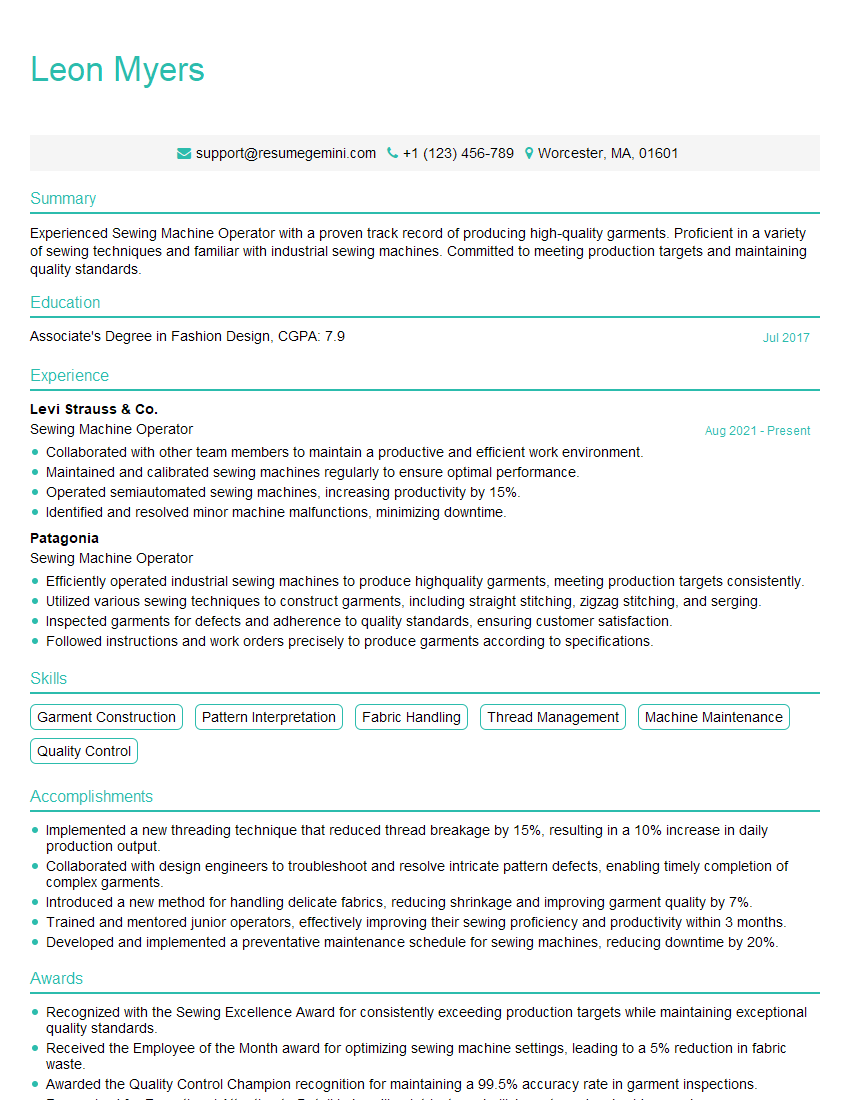
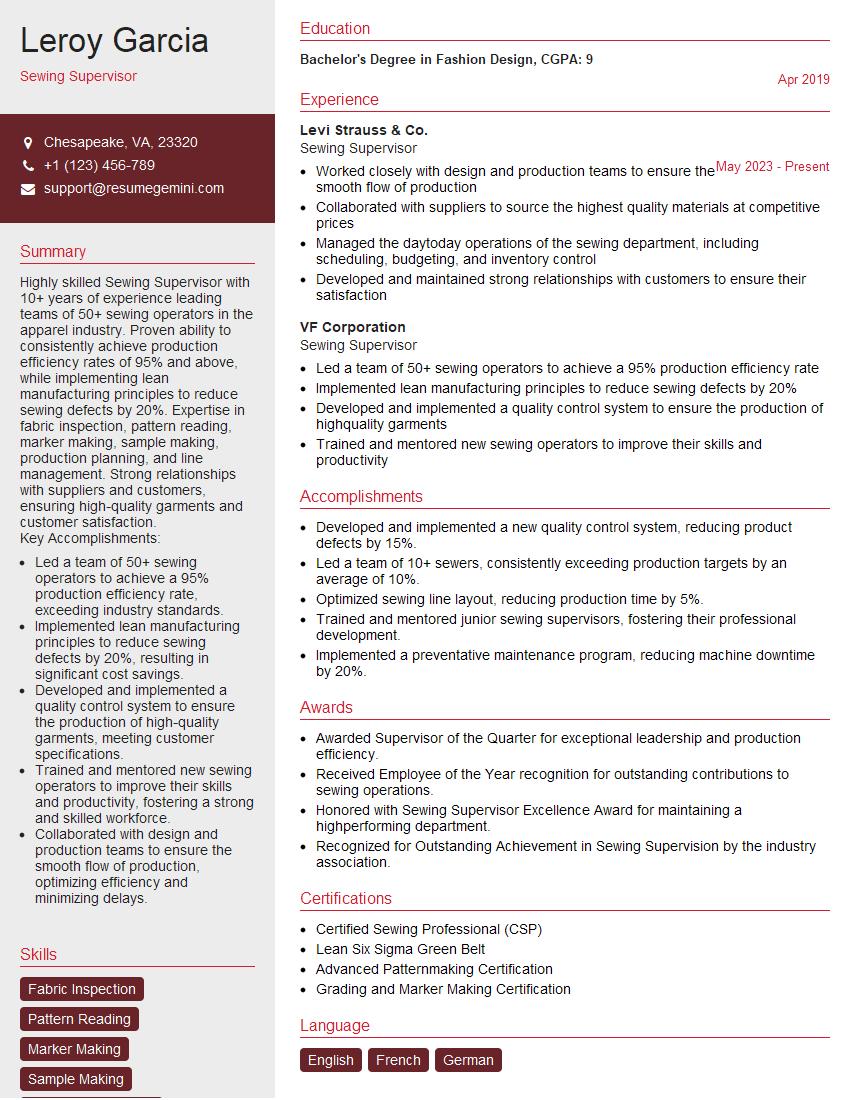
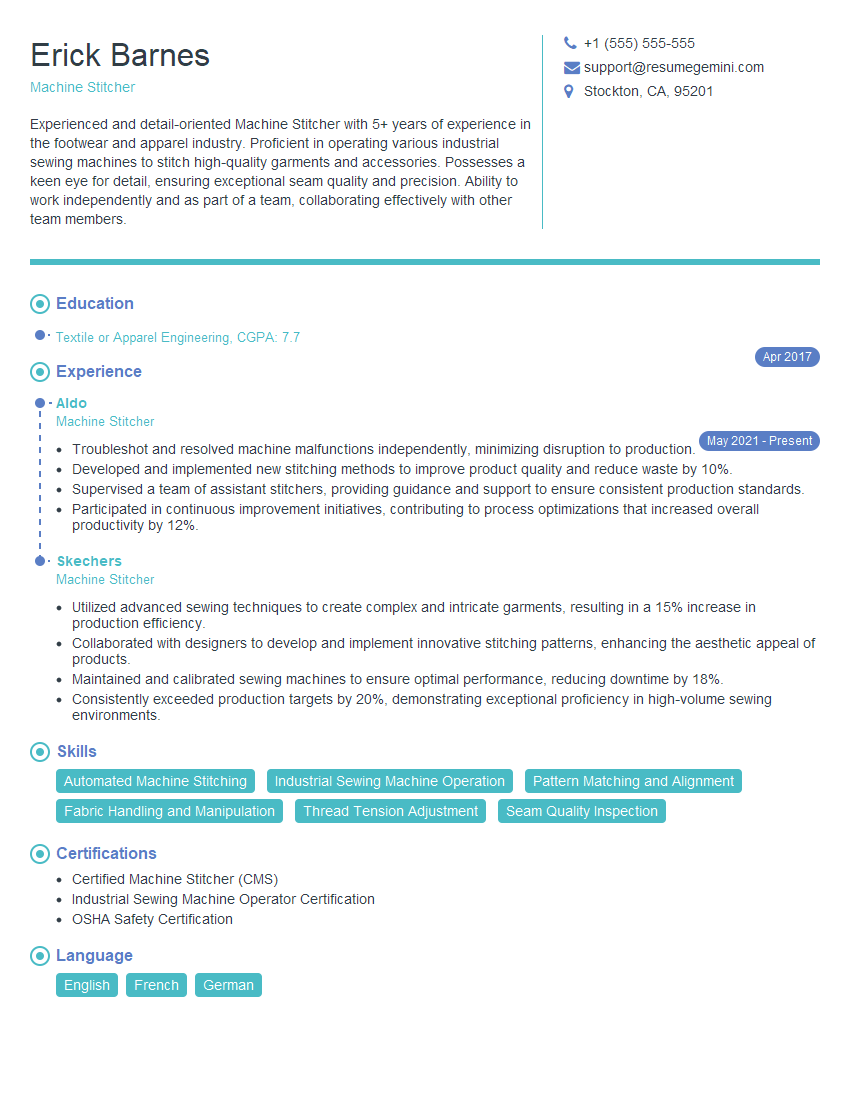
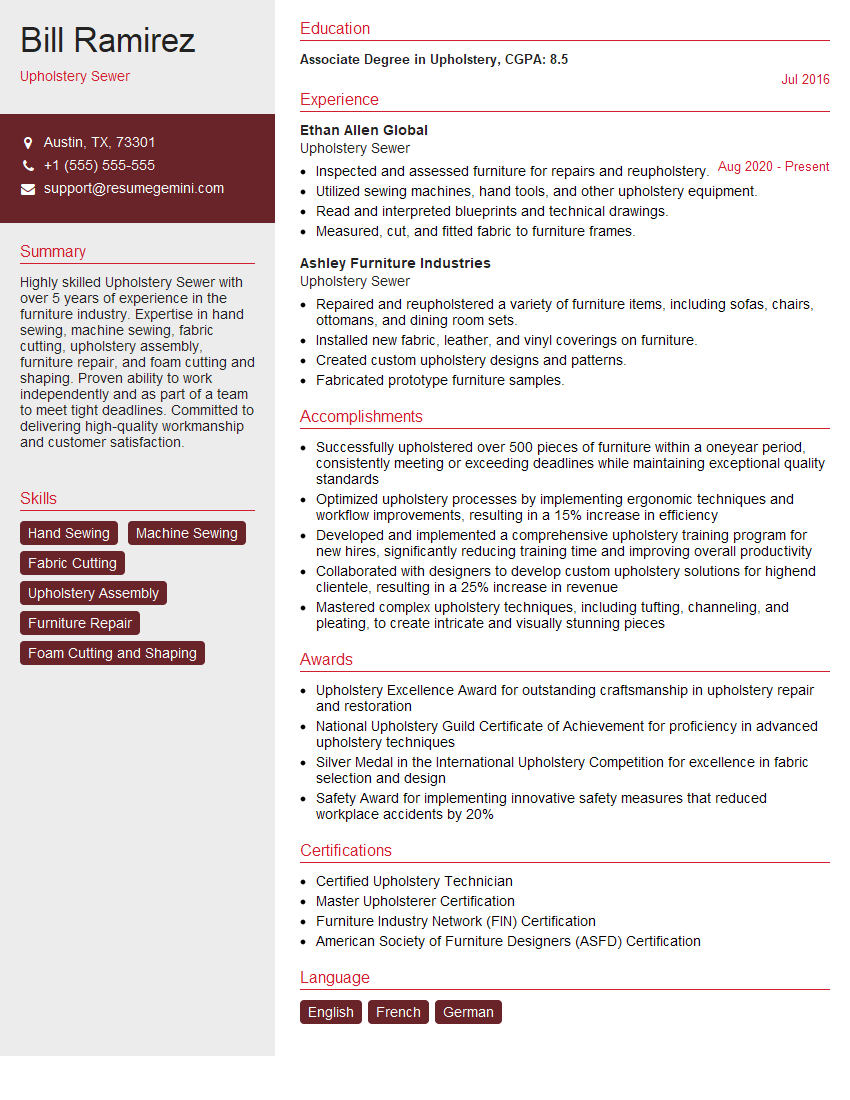
Mastering machine stitching opens doors to exciting career opportunities in the fashion, textile, and manufacturing industries. To stand out, a strong, ATS-friendly resume is crucial. Highlight your skills and experience effectively to maximize your chances of securing your dream role. ResumeGemini is a trusted resource to help you build a professional and impactful resume. They provide examples of resumes tailored to the Machine-Stitching field, helping you showcase your expertise effectively. Take the next step towards your career success today!
Explore more articles
Users Rating of Our Blogs
Share Your Experience
We value your feedback! Please rate our content and share your thoughts (optional).
What Readers Say About Our Blog
Very informative content, great job.
good