Unlock your full potential by mastering the most common Maintainability Analysis interview questions. This blog offers a deep dive into the critical topics, ensuring you’re not only prepared to answer but to excel. With these insights, you’ll approach your interview with clarity and confidence.
Questions Asked in Maintainability Analysis Interview
Q 1. Explain the key factors influencing software maintainability.
Software maintainability hinges on how easily a software system can be modified after its initial development. Several key factors influence this. Think of it like building a house – a well-designed house is easier to renovate or expand. Similarly, well-structured code is easier to maintain.
- Code Readability and Understandability: Clean, well-commented code with clear naming conventions is crucial. Imagine trying to understand code written without any comments – a nightmare!
- Modularity and Coupling: A modular design, where the system is broken down into independent modules, makes it easier to change one part without affecting others. High coupling, meaning modules are highly dependent on each other, makes modifications risky.
- Complexity: Systems with high cyclomatic complexity (a measure of the number of linearly independent paths through a program) are harder to understand and maintain. Think of a tangled ball of yarn versus neatly organized strands.
- Testability: Code that’s easy to test is easier to maintain. Thorough testing helps identify and fix issues quickly before they become bigger problems.
- Documentation: Comprehensive and up-to-date documentation, including design documents, API specifications, and user manuals, is essential for understanding the system and making changes confidently. Imagine trying to fix a car without a repair manual!
- Use of Design Patterns and Best Practices: Adhering to established design patterns and best practices helps create consistent and maintainable code. These patterns provide proven solutions to common software problems.
Q 2. Describe different metrics used to measure maintainability.
Numerous metrics exist to measure maintainability, often categorized into static and dynamic measures. Static metrics analyze code without execution, while dynamic metrics are obtained during runtime. Some widely used ones include:
- Cyclomatic Complexity: Measures the number of independent paths through code. Higher complexity indicates lower maintainability.
- Halstead Metrics: A set of metrics based on the number of operators and operands in code, reflecting code size and complexity.
- Lines of Code (LOC): A simple metric, but often a strong indicator of complexity (though not always a direct correlation to maintainability). Very long functions are generally a red flag.
- Number of Comments: Indicates the effort put into documenting the code. A sufficient number shows an attempt at clarity, but too many comments might imply poorly written code.
- Code Churn: The frequency of changes made to a code module over time. High churn can suggest instability and potential maintenance challenges.
- Defect Density: The number of bugs per line of code or per module. Lower defect density usually indicates better maintainability.
Tools like SonarQube and PMD analyze code and provide these metrics, giving a quantitative assessment of maintainability.
Q 3. How do you assess the maintainability of existing software systems?
Assessing the maintainability of existing systems involves a multi-faceted approach. It’s not just about numbers; it’s about understanding the system’s overall health.
- Code Review: Manually examining the codebase to identify areas of complexity, poor design, and lack of documentation. Peer reviews are especially helpful.
- Static Analysis: Using automated tools to analyze the code for potential issues, such as code smells, security vulnerabilities, and violations of coding standards.
- Metric Analysis: Gathering and analyzing maintainability metrics (as described in the previous answer) to get a quantitative understanding.
- Dynamic Analysis: Monitoring the system’s performance and behavior during runtime to identify bottlenecks and areas for improvement.
- Interviews with Developers: Talking to developers who work on the system to understand their experiences and challenges in maintaining it. Their feedback is invaluable.
- Documentation Review: Checking the completeness and accuracy of existing documentation to ensure it accurately reflects the current state of the system.
The combined results of these analyses provide a comprehensive assessment, allowing for prioritization of maintenance efforts.
Q 4. What are some common maintainability issues you’ve encountered?
Throughout my career, I’ve frequently encountered several common maintainability issues:
- Spaghetti Code: Highly tangled and unstructured code, making it extremely difficult to understand and modify.
- Lack of Documentation: Insufficient or outdated documentation makes it hard for developers to understand the system’s functionality and design.
- Tight Coupling: High dependency between modules, making changes in one area potentially disruptive elsewhere.
- Duplicated Code: Repeated code sections increase the effort required for updates and bug fixes. It creates inconsistency.
- Inconsistent Coding Styles: A lack of consistent coding standards makes the code harder to read and understand. It hampers teamwork.
- Magic Numbers and Strings: Hardcoded values without clear meaning, making the code harder to understand and maintain.
- Insufficient Testing: Lack of proper testing increases the risk of introducing bugs with each modification.
These issues often compound each other, making maintenance a much bigger challenge than it needs to be.
Q 5. Explain your experience with maintainability analysis tools and techniques.
I’ve extensively used several tools and techniques for maintainability analysis. My experience includes:
- SonarQube: A widely used platform for continuous inspection of code quality. It provides various metrics, code analysis, and reporting features.
- PMD: An open-source tool for static code analysis, detecting potential bugs, code smells, and violations of coding standards.
- FindBugs/SpotBugs: Static analysis tools to detect potential bugs in Java code.
- Code Review Practices: I’ve actively participated in and led code reviews, using checklists and guidelines to ensure consistent code quality.
- Design Reviews: I’ve used design reviews to evaluate the architectural choices and identify potential maintainability issues early in the development cycle.
Combining these tools and techniques gives a robust approach to analyzing and improving maintainability.
Q 6. How do you balance maintainability with other software development priorities?
Balancing maintainability with other priorities (like speed of development or feature additions) is a crucial aspect of software development. It’s not an either/or situation but a trade-off. Think of it as investing in preventative maintenance for a car – it costs time and money upfront but saves you more significant expenses later.
Here are strategies I use:
- Prioritize Refactoring: Dedicate time to improve code quality, focusing on areas with high complexity or technical debt. Small, incremental changes can significantly improve maintainability over time.
- Technical Debt Tracking: Maintain a log of known maintainability issues, assessing their impact and prioritizing their resolution based on risk and impact. This avoids neglecting maintainability entirely.
- Continuous Integration/Continuous Delivery (CI/CD): Implement CI/CD to automate testing and deployment, minimizing the risk of introducing bugs and enabling faster feedback loops. This improves quality in the long run.
- Code Style Guidelines and Enforcement: Establish clear coding standards and enforce them using automated tools (e.g., linters) to ensure consistency and readability.
- Training and Knowledge Sharing: Investing in training for developers on best practices and design principles enhances the overall understanding and improves long-term maintainability.
By integrating maintainability considerations throughout the development lifecycle, rather than treating it as an afterthought, you can achieve a better balance.
Q 7. Describe a situation where you improved the maintainability of a system.
In a previous project, we inherited a legacy system with significant maintainability issues. The code was poorly structured, lacked documentation, and had high cyclomatic complexity. Modifying it was a risky and time-consuming task.
To improve maintainability, we implemented a phased approach:
- Documentation: We first focused on documenting the existing codebase, creating detailed diagrams and explanations of the system’s architecture and functionality. This improved understanding greatly.
- Refactoring: We started refactoring critical modules, breaking down large, complex functions into smaller, more manageable units. This involved introducing new classes and methods with clear responsibilities.
- Automated Testing: We implemented comprehensive unit and integration tests to minimize the risk of introducing new bugs during refactoring. This gave us confidence in our changes.
- Code Style Enforcement: We adopted consistent coding standards and enforced them using automated tools. This vastly improved code readability.
The result was a system that was significantly easier to understand, modify, and maintain. Bug fixes became faster, and new features could be added with less risk. The impact was a significant reduction in maintenance costs and improved developer satisfaction.
Q 8. How do you incorporate maintainability considerations into the software development lifecycle?
Maintainability is a crucial aspect of software development, and ignoring it leads to costly and time-consuming issues down the line. Instead of treating it as an afterthought, we should weave maintainability considerations into every stage of the Software Development Life Cycle (SDLC). This means proactively designing for future changes, using clear and consistent coding standards, and rigorously testing throughout the process.
Requirements Gathering: Discussions with stakeholders should explicitly consider future modifications. For instance, if a system needs to support additional platforms or features in the future, the initial design needs to accommodate that scalability.
Design Phase: This is where the bulk of maintainability decisions are made. Employing modular design (explained further in the next answer), adopting well-defined interfaces, and creating comprehensive documentation are vital.
Implementation: Maintainable code is clean, well-commented, and follows established coding standards. Regular code reviews and automated testing significantly improve the chances of creating maintainable software.
Testing: Thorough testing, including unit, integration, and system testing, helps find bugs early. Unit tests are particularly important as they provide a safety net when making changes.
Deployment and Maintenance: A robust deployment process is key. Post-release monitoring and continuous integration/continuous deployment (CI/CD) pipelines ease updates and bug fixes.
In essence, integrating maintainability into the SDLC means thinking about the future throughout the software’s lifecycle.
Q 9. What are the benefits of modular design in improving maintainability?
Modular design is a cornerstone of maintainability. Think of it like building with LEGOs – independent, self-contained blocks that can be easily assembled and re-assembled. In software, modules are self-contained units with well-defined interfaces. This allows for:
Easier Modification: Changes within one module are less likely to impact other parts of the system. If a bug is found in one module, the fix is contained and less risky.
Reusability: Modules can be reused in different projects or parts of the same project, saving development time and effort. A well-written authentication module can be deployed across many applications.
Improved Testing: Smaller, independent modules are easier to test thoroughly. Testing each module independently ensures the overall system’s reliability.
Parallel Development: Different teams can work on different modules simultaneously, speeding up development. This is extremely important in larger projects.
Example: Imagine an e-commerce application. You could have separate modules for user accounts, product catalog, shopping cart, and payment processing. If you need to upgrade the payment gateway, only the payment processing module needs modification, minimizing the risk of breaking other functionalities.
Q 10. Explain the concept of technical debt and its impact on maintainability.
Technical debt is like accumulating debt in your personal finances. It’s the implied cost of rework caused by choosing an easy (often quick) solution now instead of using a better approach that would take longer. This can range from poorly written code to inadequate documentation or insufficient testing.
Impact on Maintainability: Technical debt makes software harder and more expensive to maintain. It increases the time and effort required to make changes, fix bugs, add new features, and understand the system. It can lead to:
Increased Bug Count: Poorly written code is more prone to errors, leading to more bugs and longer debugging times.
Slower Development: Understanding and modifying complex, undocumented code takes significantly more time.
Higher Risk: Making changes to a system riddled with technical debt is riskier, as unforeseen side effects are more likely.
Increased Costs: The long-term cost of resolving technical debt can far exceed the initial time saved by choosing a quick fix. This is a hidden cost that impacts budget and timeline.
Example: Using a quick-and-dirty solution to meet a deadline, without proper error handling or documentation, is a form of technical debt. Later, fixing bugs or extending the functionality will become exponentially harder.
Q 11. How do you handle legacy code during maintainability analysis?
Legacy code, often poorly documented and using outdated technologies, presents a significant challenge during maintainability analysis. The first step is understanding the system’s functionality and dependencies, often involving reverse engineering. This usually includes:
Documentation Review: Gather any existing documentation, however incomplete. This helps build a baseline understanding.
Code Analysis: Utilize static analysis tools to identify potential issues, understand code structure, and flag areas of concern like code duplication or complexity.
Testing: Carefully conduct tests to understand how the legacy system behaves. This helps identify potential risks before making changes.
Refactoring (Strategic): Refactoring should be done incrementally, starting with the most critical or problematic sections. Prioritize changes that reduce complexity and improve understandability.
Incremental Modernization: Rather than a complete rewrite (usually very costly and risky), a gradual modernization approach is often preferred. This means replacing outdated modules or components with newer ones one by one.
Example: A company might have a critical legacy system written in COBOL. Instead of a complete rewrite, they might gradually replace specific modules with more modern Java components while ensuring the system remains functional and stable throughout the transition. This ensures minimal disruption to operations.
Q 12. What are some best practices for writing maintainable code?
Writing maintainable code is about thinking about the future – how others (or your future self) will understand, modify, and extend your code. Key practices include:
Clear and Concise Code: Use descriptive variable and function names. Avoid overly complex logic and nested structures.
Comments and Documentation: Provide clear comments explaining the purpose and logic of your code. Maintain up-to-date documentation of the system architecture and APIs.
Consistent Formatting and Style: Follow a consistent coding style guide (e.g., PEP 8 for Python). This improves code readability and consistency.
Modular Design: Break down complex tasks into smaller, independent modules. (As discussed previously).
Error Handling: Implement proper error handling using try-except blocks (or similar mechanisms) to prevent unexpected crashes and to provide informative error messages.
Unit Testing: Write unit tests to ensure that individual components of your code work as expected.
Code Reviews: Incorporate code reviews as part of your workflow. Fresh eyes help catch potential problems or inconsistencies.
Example: Instead of writing cryptic one-line functions, clearly define the function’s purpose and provide well-structured code with comments.
// Bad example int c = a + b; //Add a and b // Good example int calculateSum(int a, int b) { //Calculates the sum of two integers. return a + b; } Q 13. How do you measure the effectiveness of your maintainability improvement efforts?
Measuring the effectiveness of maintainability improvements involves both quantitative and qualitative methods. Quantitative measurements can include:
Bug Fix Time: Track the time it takes to fix bugs before and after improvements. A reduction suggests improved maintainability.
Code Complexity Metrics: Use tools like cyclomatic complexity to measure code complexity. Lower complexity scores indicate improved maintainability.
Defect Density: Compare the number of defects found per line of code before and after the improvements.
Deployment Frequency: Improved maintainability often leads to more frequent and reliable deployments.
Qualitative measurements focus on developer feedback and perceptions:
Developer Surveys: Ask developers how easily they can understand, modify, and debug the code.
Code Review Feedback: Analyze comments and suggestions from code reviews to identify areas for improvement.
Combining both quantitative and qualitative data provides a holistic view of the effectiveness of your maintainability efforts. For example, a decrease in bug fix time coupled with positive developer feedback provides strong evidence of improvement.
Q 14. Explain your experience with code refactoring techniques to improve maintainability.
Refactoring is a crucial technique for improving maintainability without changing the software’s external behavior. I have extensive experience applying various refactoring techniques, including:
Extract Method: Breaking down large methods into smaller, more manageable ones. This increases readability and makes testing easier.
Rename Variable/Method: Improving the clarity and consistency of names to reflect their purpose.
Introduce Explaining Variable: Creating new variables to simplify complex expressions and make the code easier to understand.
Remove Duplicated Code: Consolidating duplicated code into reusable functions or classes to improve maintainability and reduce the risk of inconsistencies.
Move Method/Field: Relocating methods or fields to a more appropriate class to improve the organization and cohesion of the codebase.
In one project, we had a large, monolithic function handling user authentication. By applying the ‘Extract Method’ refactoring technique, we broke this function down into smaller units responsible for specific tasks (e.g., password validation, token generation, database interaction). This significantly improved the code’s readability and reduced the complexity of testing and debugging.
Before refactoring, the code was difficult to understand and modify. After refactoring, the separate functions were much more manageable and testable, leading to faster development and fewer bugs. Crucially, the changes did not impact the functionality of the authentication system; only the internal organization and structure were improved.
Q 15. How do you collaborate with developers to improve maintainability?
Improving maintainability requires a collaborative approach with developers. I believe in fostering a culture of shared responsibility and proactive improvement. This starts with open communication and regular discussions about code quality and design. I work closely with developers throughout the software development lifecycle (SDLC), from initial design to deployment and beyond.
My strategy involves:
- Code Reviews: Conducting thorough code reviews, focusing not only on functionality but also on readability, adherence to coding standards, and overall maintainability. I provide constructive feedback, suggesting improvements in areas like naming conventions, modularity, and comment clarity.
- Training and Workshops: Offering training sessions and workshops on best practices for maintainable code, including topics like SOLID principles, design patterns, and testing strategies. This helps equip developers with the knowledge and tools to write better code from the start.
- Tool Integration: Introducing and integrating static analysis tools (like SonarQube or ESLint) into the development workflow to automate code quality checks and flag potential maintainability issues early on.
- Refactoring Initiatives: Collaboratively identifying and prioritizing areas of the codebase that require refactoring. This involves incremental improvements to enhance readability, reduce complexity, and improve the overall design.
For example, I recently worked with a team struggling with a monolithic application. By introducing microservices architecture and employing agile methodologies, we were able to improve maintainability significantly, reducing bug fixing time and improving feature delivery speed.
Career Expert Tips:
- Ace those interviews! Prepare effectively by reviewing the Top 50 Most Common Interview Questions on ResumeGemini.
- Navigate your job search with confidence! Explore a wide range of Career Tips on ResumeGemini. Learn about common challenges and recommendations to overcome them.
- Craft the perfect resume! Master the Art of Resume Writing with ResumeGemini’s guide. Showcase your unique qualifications and achievements effectively.
- Don’t miss out on holiday savings! Build your dream resume with ResumeGemini’s ATS optimized templates.
Q 16. Describe your approach to identifying and prioritizing maintainability issues.
My approach to identifying and prioritizing maintainability issues is systematic and data-driven. It involves a multi-pronged strategy:
- Code Metrics Analysis: Utilizing static analysis tools to measure various code metrics, such as cyclomatic complexity, code churn (frequency of changes), and coupling. High values in these metrics indicate potential maintainability problems. For example, high cyclomatic complexity often implies difficult-to-understand logic.
- Bug Tracking and Analysis: Analyzing bug reports to identify recurring issues or areas of the codebase prone to frequent bugs. These often pinpoint maintainability bottlenecks.
- Developer Feedback: Gathering feedback from developers on areas they find difficult to understand, modify, or test. This provides invaluable insights into the practical challenges of maintaining the codebase.
- Technical Debt Assessment: Regularly assessing the technical debt (the implied cost of rework caused by choosing an easy (limited) solution now instead of using a better approach that would take longer). This helps quantify the impact of maintainability issues on future development efforts.
Prioritization is based on a combination of severity (impact on users), frequency (how often the issue arises), and effort (the cost to fix). We utilize a risk matrix to categorize issues and allocate resources accordingly. For instance, high-severity, frequent issues are addressed first, even if they require more effort.
Q 17. What are the implications of poor maintainability on business outcomes?
Poor maintainability significantly impacts business outcomes. Think of it like this: a poorly maintained house will eventually require extensive and expensive repairs. Similarly, poorly maintained software leads to:
- Increased Development Costs: Higher costs associated with bug fixes, feature additions, and enhancements. Simple changes become complex and time-consuming.
- Delayed Time to Market: Slower release cycles due to the difficulty in making changes. New features take longer to implement and deploy.
- Reduced Software Quality: More bugs and vulnerabilities due to complex and poorly understood code. This can lead to security breaches and customer dissatisfaction.
- Higher Risk of Failure: The system becomes more fragile and prone to unexpected failures, leading to downtime and loss of revenue.
- Decreased Developer Morale: Developers become frustrated working with difficult code, impacting productivity and potentially leading to attrition.
These combined factors can significantly hinder innovation and competitiveness, ultimately affecting the bottom line.
Q 18. How do you use static and dynamic code analysis tools for maintainability analysis?
Static and dynamic code analysis tools are invaluable for maintainability analysis. Static analysis examines the code without actually executing it, while dynamic analysis involves running the code and observing its behavior.
- Static Analysis: Tools like SonarQube, FindBugs, and ESLint analyze code for potential issues like code smells, violations of coding standards, and potential bugs. They provide metrics like cyclomatic complexity and code duplication, which are direct indicators of maintainability. For example, SonarQube can highlight areas with excessive complexity or duplicated code, making it easier to identify and refactor them.
- Dynamic Analysis: Tools like JProfiler and YourKit profile the application during runtime, identifying performance bottlenecks and memory leaks. These often stem from poorly designed or implemented code, impacting maintainability. Understanding the runtime behavior helps pinpoint areas needing architectural or code-level improvements.
I use these tools to proactively identify maintainability issues early in the development cycle. The results are used to guide refactoring efforts, improve coding practices, and enhance the overall quality of the software.
Q 19. Explain your experience with different software architecture patterns and their impact on maintainability.
Software architecture patterns significantly influence maintainability. Choosing the right pattern is crucial. My experience spans several patterns, and I’ve witnessed their impact firsthand:
- Microservices: Smaller, independent services improve maintainability by allowing for independent development, deployment, and scaling. Changes in one service don’t ripple through the entire system, as happens in monolithic architectures.
- Layered Architecture: Separating concerns into distinct layers (presentation, business logic, data access) enhances modularity and understandability, making it easier to make changes within a specific layer without affecting others.
- Event-Driven Architecture: Loosely coupled components communicate through events, promoting flexibility and resilience. Changes in one part of the system are less likely to affect others.
- Model-View-Controller (MVC): A well-known pattern that separates concerns into model (data), view (presentation), and controller (logic), resulting in more manageable and testable code.
In a previous project, we migrated from a monolithic architecture to microservices. This resulted in a significant improvement in maintainability, enabling faster development cycles and reduced deployment risks. However, choosing the right pattern depends on specific project needs and constraints.
Q 20. How do you address maintainability challenges in distributed systems?
Maintainability in distributed systems poses unique challenges due to the complexity of interactions between multiple components across different networks. Key strategies include:
- Service Discovery and Registration: Utilizing mechanisms like Consul or Kubernetes to automatically discover and register services, making it easier to manage and track components across the distributed system.
- API Design and Versioning: Following consistent API design principles and implementing versioning strategies to minimize disruption when changes are made to services.
- Monitoring and Logging: Comprehensive monitoring and logging are vital for understanding system behavior and diagnosing issues across the distributed environment. Distributed tracing tools help track requests across multiple services.
- Automated Testing: Implementing robust automated testing strategies, including integration tests, to ensure that different components work correctly together.
- Fault Tolerance and Resilience: Designing the system to be fault-tolerant and resilient to failures in individual components, preventing cascading failures and ensuring continuous operation.
For instance, in a recent project, we used circuit breakers and retries to enhance the resilience of our distributed system, minimizing the impact of temporary service outages on overall functionality.
Q 21. What are some common challenges in measuring and improving maintainability?
Measuring and improving maintainability presents several challenges:
- Subjectivity of Metrics: Many maintainability metrics are subjective and don’t always accurately reflect the true maintainability of the code. For example, lines of code can be misleading.
- Lack of Standardized Metrics: There isn’t a universally accepted set of metrics for measuring maintainability, making comparisons between different projects difficult.
- Context-Specific Challenges: Maintainability is highly context-dependent. What makes one codebase easy to maintain might be difficult for another, depending on factors like team experience and project requirements.
- Balancing Maintainability with other Factors: Maintainability often needs to be balanced against other important aspects, such as performance, security, and time-to-market. Optimizing for one can sometimes compromise others.
- Cost of Improvement: Improving maintainability often requires significant effort and resources, which can be a barrier for organizations with limited budgets or time constraints.
Overcoming these challenges requires a holistic approach combining quantitative metrics (e.g., code complexity) with qualitative assessments (e.g., developer feedback), coupled with a commitment to continuous improvement and a focus on long-term value.
Q 22. Describe your experience with using version control systems to maintain code.
Version control systems (VCS) are the backbone of maintainable code. My experience spans several systems, primarily Git, but also includes SVN and Mercurial. I’m proficient in branching strategies like Gitflow, which allows for parallel development and feature isolation, crucial for maintaining a clean and understandable codebase. I utilize feature branches extensively, ensuring that changes are thoroughly tested before merging into the main branch. This minimizes the risk of introducing bugs and simplifies rollback if necessary. Furthermore, I consistently write clear, concise commit messages that accurately reflect the changes made, aiding future understanding and debugging. For example, instead of a commit message like “fixed stuff,” I would use something like “Fixed bug #123: Incorrect calculation in the tax function. Corrected the formula and added unit tests.”
Beyond the technical aspects, I leverage VCS features for collaboration. Pull requests allow for code reviews, ensuring adherence to coding standards and identifying potential issues before they reach production. This collaborative approach is essential for enhancing maintainability and preventing technical debt from accumulating.
Q 23. How do you communicate technical maintainability issues to non-technical stakeholders?
Communicating technical maintainability issues to non-technical stakeholders requires translating complex technical jargon into plain language. I avoid using technical terms whenever possible, instead focusing on the impact of the issues. For instance, instead of saying “high cyclomatic complexity increases code fragility,” I might say “The code is difficult to change without introducing new errors, which could lead to delays and increased costs.”
I often use analogies to explain complex concepts. For example, to explain technical debt, I might compare it to neglecting home maintenance: small problems ignored today lead to larger, more expensive problems later. Visual aids like charts and graphs, showing the impact of maintainability issues on project timelines or budgets, are also very effective. Focusing on the business implications—like missed deadlines, increased bug fixes, or higher development costs—directly resonates with non-technical stakeholders and encourages them to prioritize maintainability.
Q 24. How do you track and manage maintainability improvements over time?
Tracking and managing maintainability improvements requires a multi-faceted approach. I leverage metrics such as cyclomatic complexity, code coverage, and lines of code to quantify the level of maintainability. These metrics, tracked over time using tools like SonarQube or similar platforms, provide a clear picture of progress. We establish baselines at the beginning of a project and set targets for improvement. Regular monitoring allows us to identify areas that need attention and measure the effectiveness of our improvement strategies.
Furthermore, I utilize project management tools like Jira or Azure DevOps to track specific tasks related to improving maintainability, linking them to the identified metrics. This allows us to show the direct impact of our efforts. For instance, if we refactor a complex module, we can track the decrease in cyclomatic complexity, the increase in test coverage, and the time saved during subsequent maintenance tasks. This data-driven approach demonstrates the value of maintaining code quality and helps secure ongoing investment in maintainability improvements.
Q 25. Explain your familiarity with different standards and guidelines for software maintainability.
My familiarity with software maintainability standards and guidelines is extensive. I’m well-versed in standards like MISRA C for safety-critical systems, which defines strict rules for coding style and complexity to enhance reliability and maintainability. I also have experience applying SOLID principles (Single Responsibility, Open/Closed, Liskov Substitution, Interface Segregation, Dependency Inversion) to design modular, flexible, and easy-to-maintain software. Additionally, I am familiar with coding style guides like PEP 8 (for Python) and the various language-specific best practices that promote readability and consistency.
Beyond specific standards, I understand the importance of using consistent naming conventions, writing clear and concise comments, and avoiding code duplication. These seemingly small details greatly contribute to a codebase that is easier to understand, modify, and debug. Applying these principles consistently across a project is a cornerstone of good software maintainability.
Q 26. How do you ensure the maintainability of code written by others?
Ensuring the maintainability of code written by others requires a proactive approach. Code reviews are essential—not just for identifying bugs, but also for evaluating the code’s design, readability, and adherence to coding standards. I provide constructive feedback, focusing on improving the code’s structure, clarity, and testability. This includes suggesting improvements to variable names, function designs, and overall architecture to make the code easier to understand and modify in the future.
If the code is poorly written and difficult to understand, I might pair program with the original author to improve their understanding of good coding practices. In cases of truly unmaintainable legacy code, refactoring becomes necessary. This process involves carefully restructuring existing code to improve its internal structure, without changing its external behavior. Refactoring is often done iteratively, with thorough testing at each step to ensure that the functionality remains unchanged. Documentation plays a key role; I ensure any code that is modified is thoroughly documented, making it easier for future developers to understand its purpose and function.
Q 27. Describe a time you had to make a trade-off between maintainability and other project goals.
In a previous project developing a real-time data processing system, we faced a trade-off between maintainability and performance. The initial design prioritized speed, using highly optimized but complex algorithms. While this met the performance requirements, the code became extremely difficult to understand and maintain. Changes were risky and slow, and debugging was a nightmare.
We decided to refactor a critical section of the code, sacrificing some performance in exchange for significantly improved maintainability. This involved using simpler algorithms, albeit slightly less efficient ones, and introducing comprehensive unit tests. The result was a slight performance decrease, but a much more robust and maintainable system. This was deemed a necessary trade-off since future modifications and debugging were expected to far outweigh the minor performance loss. The team ultimately agreed this was the right decision as long-term maintainability was a higher priority than marginal performance gains.
Q 28. How do you adapt your maintainability analysis approach depending on the specific system or project?
My approach to maintainability analysis adapts to the specific system and project. For a small, simple project, a less formal approach might suffice, focusing on code reviews and adherence to basic coding standards. However, for large, complex systems, a more rigorous approach is necessary, involving static code analysis, automated testing, and the use of metrics to track progress.
The context of the system is also crucial. For safety-critical systems (like those in aerospace or medical devices), standards like MISRA C dictate more stringent rules and require greater attention to detail. In contrast, a web application might prioritize rapid development, requiring a more agile approach to maintainability, but still with a focus on clean code and good testing practices. Essentially, the analysis adapts to the project’s complexity, risk profile, and technical constraints, always striving for a balance between speed of development and long-term maintainability.
Key Topics to Learn for Maintainability Analysis Interview
- Metrics and Measurement: Understanding key maintainability metrics like Halstead complexity, cyclomatic complexity, and code churn. Learn how to apply these to assess code quality and predict future maintenance effort.
- Code Readability and Style: Discuss the importance of consistent coding style, clear naming conventions, and effective commenting. Practice analyzing code examples for readability and identifying areas for improvement.
- Modular Design and Decomposition: Explore the principles of modular design, including loose coupling and high cohesion. Learn how to evaluate the modularity of existing codebases and suggest improvements.
- Software Architecture and Design Patterns: Understand how different architectural patterns (e.g., microservices, layered architecture) impact maintainability. Analyze how design patterns contribute to or hinder maintainability.
- Testing and Testability: Discuss the relationship between testability and maintainability. Learn how to assess the testability of code and identify areas that need refactoring to improve testability.
- Refactoring Techniques: Explore common refactoring techniques to improve code maintainability. Practice identifying code smells and applying appropriate refactoring strategies.
- Tooling and Automation: Familiarize yourself with tools and techniques used for static code analysis, code review, and automated testing. Understand how these tools contribute to a more maintainable codebase.
- Case Studies and Practical Application: Prepare examples from your experience where you’ve analyzed code maintainability or improved it. Be ready to discuss the challenges and solutions you encountered.
Next Steps
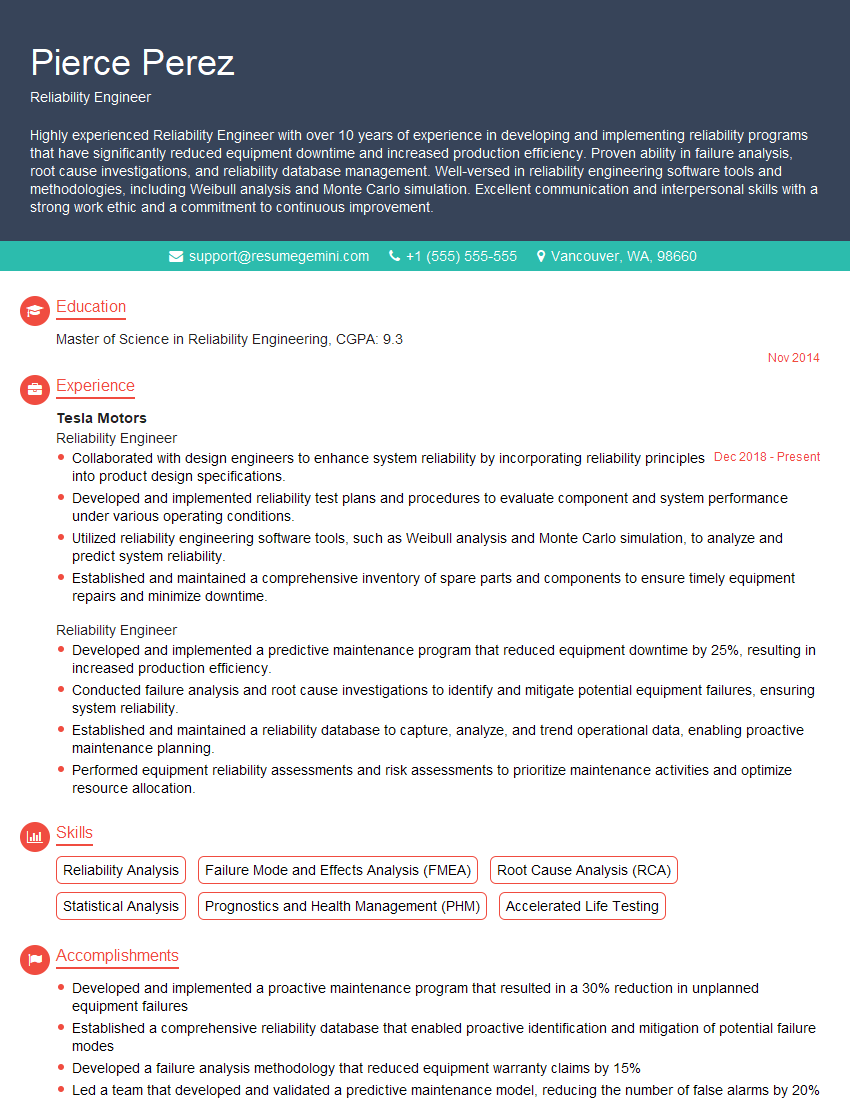
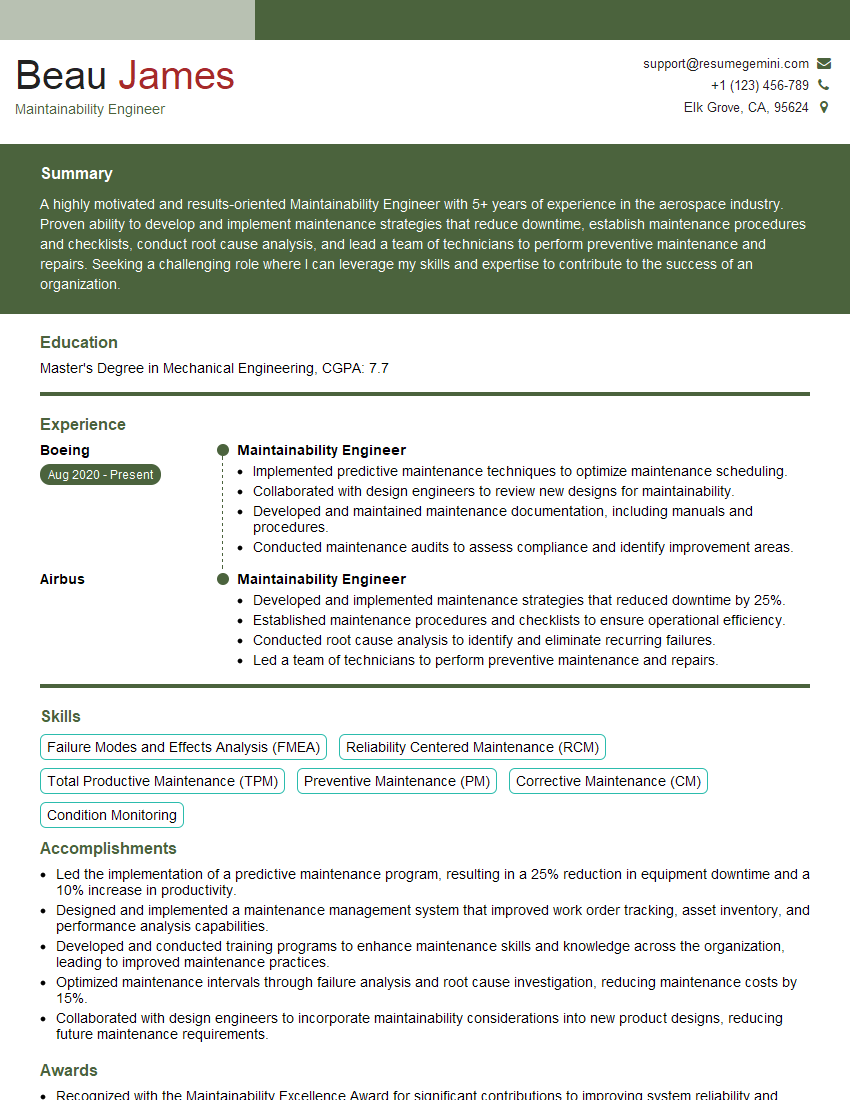
Mastering Maintainability Analysis significantly enhances your value as a software engineer, opening doors to more challenging and rewarding roles. A strong understanding of these principles showcases your commitment to quality and your ability to contribute to long-term software success. To maximize your job prospects, create an ATS-friendly resume that effectively highlights your skills and experience. ResumeGemini is a trusted resource that can help you build a professional resume tailored to your experience. Examples of resumes specifically designed for Maintainability Analysis professionals are available, helping you present yourself in the best possible light.
Explore more articles
Users Rating of Our Blogs
Share Your Experience
We value your feedback! Please rate our content and share your thoughts (optional).
What Readers Say About Our Blog
Very informative content, great job.
good