Interviews are more than just a Q&A session—they’re a chance to prove your worth. This blog dives into essential Manufacturing Best Practices interview questions and expert tips to help you align your answers with what hiring managers are looking for. Start preparing to shine!
Questions Asked in Manufacturing Best Practices Interview
Q 1. Describe your experience implementing Lean Manufacturing principles.
Lean Manufacturing focuses on eliminating waste and maximizing value. My experience includes leading several Lean implementations, focusing on value stream mapping to identify bottlenecks and areas for improvement. In one project, we mapped the entire production process of a high-volume assembly line, revealing significant delays at the inspection station. By implementing a poka-yoke (error-proofing) system and optimizing the layout, we reduced inspection time by 40%, directly impacting throughput and reducing inventory.
- Value Stream Mapping: This technique visually maps the entire process, helping pinpoint non-value-added steps.
- 5S Methodology: We implemented 5S (Sort, Set in Order, Shine, Standardize, Sustain) to improve workplace organization and efficiency.
- Kaizen Events: I’ve facilitated numerous Kaizen events, bringing together cross-functional teams to identify and immediately implement small, incremental improvements.
The results were quantifiable – increased production efficiency, reduced lead times, and a significant decrease in waste, demonstrating a tangible return on investment.
Q 2. Explain the DMAIC methodology in Six Sigma.
DMAIC, a core methodology in Six Sigma, is a data-driven approach to process improvement. It stands for Define, Measure, Analyze, Improve, and Control. Think of it as a structured problem-solving framework.
- Define: Clearly define the problem, its impact, and the project goals. This involves understanding customer requirements and setting measurable targets.
- Measure: Collect data to understand the current process performance. This often includes statistical process control (SPC) charts to monitor variation.
- Analyze: Identify the root causes of the problem using tools like Fishbone diagrams (Ishikawa diagrams) and Pareto charts.
- Improve: Develop and implement solutions to address the root causes. This might involve process redesign, technology upgrades, or training improvements.
- Control: Establish monitoring systems to ensure the improvements are sustained. This often includes ongoing data collection and regular process checks.
For example, in a previous role, we used DMAIC to reduce defects in a packaging process. We defined the defect rate as our target, measured it using SPC, analyzed the data to pinpoint a faulty machine setting, improved the process by recalibrating, and then implemented regular checks to maintain the improved performance.
Q 3. How would you improve the efficiency of a production line?
Improving production line efficiency involves a multi-pronged approach, focusing on both optimizing the process and the equipment. I’d start by conducting a thorough analysis using methods like value stream mapping and OEE calculations.
- Bottleneck Identification: Pinpoint the slowest stages in the production line, often using visual tools and data analysis.
- Process Optimization: Streamline processes to reduce non-value-added steps. This could involve improving workflow, eliminating unnecessary handoffs, or implementing automation.
- Equipment Maintenance: Ensure equipment is well-maintained to minimize downtime. Implementing a preventative maintenance program is critical.
- Employee Training and Empowerment: Well-trained employees are more efficient. Providing adequate training and empowering them to solve problems on the line will significantly impact efficiency.
- Layout Optimization: Efficient layout reduces material handling and improves workflow. This might involve rearranging machines or implementing a U-shaped line.
A practical example involves a project where we reduced cycle time by 25% by identifying a bottleneck in the assembly process and implementing a new automated assembly station. We also improved the layout reducing the movement of materials.
Q 4. What are your strategies for reducing manufacturing costs?
Reducing manufacturing costs requires a holistic strategy, impacting various aspects of the operation.
- Waste Reduction (Lean): Implementing Lean principles directly reduces waste in materials, time, and effort.
- Supply Chain Optimization: Negotiating better prices with suppliers, streamlining procurement processes, and optimizing inventory management can significantly reduce material costs.
- Energy Efficiency: Implementing energy-saving measures in equipment and processes can reduce operational costs.
- Automation and Technology: Investing in automation can reduce labor costs and improve efficiency in the long run, albeit with an initial investment.
- Process Improvement (Six Sigma): Using DMAIC to identify and eliminate defects reduces waste and improves efficiency, translating to cost savings.
In a prior role, we reduced material costs by 15% by renegotiating contracts with our key suppliers and optimizing our inventory control system, reducing waste and storage costs simultaneously.
Q 5. How do you measure and improve overall equipment effectiveness (OEE)?
Overall Equipment Effectiveness (OEE) measures the effectiveness of equipment utilization. It’s calculated as the product of Availability, Performance, and Quality.
- Availability: The percentage of time the equipment is available for production (uptime vs. downtime).
- Performance: The ratio of actual production rate to the ideal production rate.
- Quality: The percentage of good units produced versus total units produced.
OEE = Availability x Performance x Quality
To improve OEE, I would focus on systematically addressing each factor. Improving availability often involves preventative maintenance and reducing unplanned downtime. Enhancing performance requires optimizing machine settings, reducing changeover times, and improving workflow. Improving quality focuses on reducing defects through process improvements and better quality control.
For example, in one project, we used OEE as a key metric to track improvements in a packaging line. By implementing a preventative maintenance program and reducing changeover time, we increased OEE from 60% to 85%, a significant boost in productivity.
Q 6. What experience do you have with Total Productive Maintenance (TPM)?
Total Productive Maintenance (TPM) is a proactive approach to equipment maintenance involving all employees. My experience with TPM includes implementing and managing programs focused on reducing equipment downtime and maximizing equipment lifespan.
- Preventative Maintenance Schedules: Implementing and adhering to rigorous preventative maintenance schedules to minimize unexpected breakdowns.
- Autonomous Maintenance: Empowering operators to perform basic maintenance tasks, increasing their ownership and reducing reliance on specialized technicians.
- Planned Maintenance System: Developing a robust system for scheduling and tracking maintenance activities.
- Training and Skill Development: Equipping operators and maintenance staff with the necessary skills to perform maintenance effectively.
In a previous role, we implemented a TPM program that reduced downtime by 30% within a year, resulting in significant cost savings and increased production output. This was achieved through a combination of preventative maintenance, operator training, and a more efficient maintenance planning system.
Q 7. Describe a time you solved a complex manufacturing problem.
In a previous role, we faced a significant issue with a critical component failing frequently on our assembly line, leading to production stoppages and high scrap rates. The initial diagnosis pointed to a supplier defect, but after a thorough investigation using root cause analysis, we discovered the real problem was in our assembly process itself. We found that the component was being subjected to excessive vibration during a specific stage of assembly, leading to premature failure.
My approach involved a structured problem-solving process:
- Data Collection: We systematically collected data on failures, pinpointing the specific stage of assembly where most failures occurred.
- Root Cause Analysis: Using tools like 5 Whys and Fishbone diagrams, we traced the root cause to excessive vibration.
- Solution Development: We tested different solutions, such as modifying the assembly fixture to reduce vibration and adjusting the assembly speed.
- Implementation and Monitoring: After implementing the solution, we carefully monitored the failure rate. This confirmed that our changes solved the problem.
The successful resolution involved collaborative teamwork, data-driven decision-making, and creative problem-solving. It resulted in a significant reduction in component failures, reduced scrap rates, improved production efficiency and customer satisfaction. The solution also highlighted the importance of thoroughly investigating potential problems beyond initial assumptions, demonstrating the power of structured problem-solving methodologies.
Q 8. What are the key performance indicators (KPIs) you monitor in a manufacturing setting?
In manufacturing, we monitor a variety of Key Performance Indicators (KPIs) to gauge efficiency, quality, and profitability. These KPIs are categorized for better understanding and action. Think of them as vital signs for a manufacturing facility.
- Production KPIs: These focus on output and efficiency. Examples include Overall Equipment Effectiveness (OEE), which measures the percentage of time a machine is producing good parts; Production Rate, measuring units produced per hour or day; and Cycle Time, the time taken to complete a single production cycle.
- Quality KPIs: These measure the defect rate and adherence to quality standards. Examples include Defect Rate (the percentage of defective products), First Pass Yield (the percentage of products passing inspection on the first attempt), and Customer Returns, measuring the number of returned products due to quality issues.
- Inventory KPIs: These focus on inventory levels and their impact on operations. Examples include Inventory Turnover, measuring how often inventory is sold and replaced; Days Sales of Inventory (DSI), indicating the number of days it takes to sell existing inventory; and Stockout Rate, the percentage of time an item is unavailable.
- Financial KPIs: These KPIs measure the financial health and performance of the manufacturing process. Examples include Cost of Goods Sold (COGS), representing the direct costs associated with production; Manufacturing Lead Time, the time from order placement to product delivery; and Return on Investment (ROI), the profitability of investments in manufacturing equipment or processes.
Regularly monitoring and analyzing these KPIs allows for proactive adjustments to optimize processes and maximize profitability. For instance, a high defect rate might signal a need for operator retraining or equipment recalibration, while low inventory turnover could indicate overstocking and potential storage cost overruns.
Q 9. How do you ensure quality control in a manufacturing process?
Ensuring quality control is a multi-faceted process that starts from the design phase and continues through production and delivery. It’s like building a house – you wouldn’t skip inspections just because you laid a good foundation.
- Incoming Inspection: We rigorously inspect all raw materials and components upon arrival to ensure they meet the required specifications. This prevents faulty materials from entering the production line.
- In-process Inspection: Regular checks are conducted at various stages of the production process. This early detection of defects prevents costly rework or scrap later in the process. Statistical Process Control (SPC) charts are frequently used to monitor these processes.
- Final Inspection: Every finished product undergoes a final quality check before packaging and shipment. This ensures that only products meeting our quality standards are delivered to customers. This may include functional testing, visual inspection, and dimensional checks.
- Corrective and Preventive Actions (CAPA): When defects are found, a robust CAPA system is crucial. This involves identifying the root cause of the problem, implementing corrective actions to address the immediate issue, and preventive actions to avoid future occurrences. This is often documented using a 5 Whys analysis.
- Continuous Improvement: Quality control isn’t a one-time event; it’s an ongoing process. We regularly review our quality management system to identify areas for improvement and implement updates to enhance our processes and products.
Imagine a car manufacturer. They wouldn’t just test the final product; they’d test components along the way, ensuring the engine, brakes, and transmission all meet standards. This proactive approach prevents massive recalls and ensures customer satisfaction.
Q 10. What is your experience with different inventory management systems?
My experience encompasses several inventory management systems, each with its strengths and weaknesses, selected based on the organization’s needs and scale.
- Just-in-Time (JIT): I’ve implemented JIT in high-volume manufacturing environments where minimizing inventory holding costs is paramount. This system requires precise forecasting and strong supplier relationships to ensure materials arrive just as they are needed.
- Material Requirements Planning (MRP): I’ve utilized MRP in situations requiring more complex production planning, managing multiple components and bill of materials. This system helps optimize inventory levels based on production schedules and demand forecasts.
- Enterprise Resource Planning (ERP): In larger organizations, I’ve worked with ERP systems which integrate inventory management with other business functions like accounting, finance, and human resources, providing a holistic view of the entire operation. This offers excellent visibility and control over inventory.
- Kanban: In lean manufacturing settings, I’ve used Kanban systems for visual inventory management. This simple, yet effective method uses cards to signal the need for replenishment, reducing waste and improving workflow.
The choice of system depends heavily on factors like production volume, product complexity, and supply chain dynamics. For instance, a small-batch, customized manufacturing facility might favor Kanban, while a large-scale automotive manufacturer would likely rely on an integrated ERP system.
Q 11. Explain your understanding of supply chain management principles.
Supply chain management (SCM) is the strategic management of the flow of goods and services, encompassing all processes from the origin of raw materials to the delivery of finished products to the end customer. It’s a complex network of interconnected activities.
- Planning and Forecasting: Accurate demand forecasting is vital to ensure sufficient supply without overstocking. This involves analyzing historical data, market trends, and seasonal variations.
- Sourcing and Procurement: Selecting reliable suppliers, negotiating favorable terms, and managing supplier relationships are critical for ensuring a consistent flow of quality materials at competitive prices.
- Production and Inventory Management: Efficient production processes, optimized inventory levels, and effective warehouse management are essential for timely delivery and minimized costs. This also involves integrating production planning with inventory control.
- Logistics and Distribution: Efficient transportation and warehousing are essential for getting products to customers on time and in good condition. This includes managing transportation modes, optimizing routes, and tracking shipments.
- Customer Relationship Management (CRM): Building strong relationships with customers and providing excellent customer service are vital for long-term success. This involves gathering feedback, addressing complaints, and ensuring customer satisfaction.
Think of SCM as a relay race: each stage—sourcing, production, logistics—must work seamlessly to ensure the baton (the product) reaches the finish line (the customer) efficiently and on time. A breakdown at any stage impacts the entire race.
Q 12. How would you handle a sudden production line breakdown?
Handling a sudden production line breakdown requires a swift and systematic response to minimize downtime and production losses. It’s like dealing with a medical emergency – speed and precision are crucial.
- Immediate Actions: First, ensure the safety of personnel. Isolate the affected area and prevent further damage. Then, initiate the emergency shutdown procedures.
- Problem Assessment: Quickly assess the nature and extent of the breakdown. Gather information from operators and maintenance personnel to understand the root cause if possible.
- Repair or Replacement: Based on the assessment, determine if the issue can be quickly repaired or requires replacement of components. If needed, contact external maintenance services or suppliers.
- Alternative Production Plans: Explore alternative production strategies to maintain some level of output. This might include shifting production to other lines or temporarily outsourcing some tasks.
- Communication: Keep all stakeholders informed about the situation, the planned actions, and the estimated downtime. This includes notifying customers about potential delays.
- Root Cause Analysis (RCA): Once the line is back online, conduct a thorough RCA to understand why the breakdown happened and implement corrective measures to prevent recurrence.
A well-defined emergency response plan, regular maintenance, and a skilled maintenance team can minimize the impact of unexpected breakdowns. Regular drills and training also make the process smoother.
Q 13. Describe your experience with root cause analysis techniques.
Root cause analysis (RCA) is a systematic approach to identifying the underlying causes of problems. It’s not just about fixing the symptom; it’s about addressing the disease itself.
- 5 Whys: This simple yet effective technique involves repeatedly asking ‘why’ to uncover the root cause. For example: Problem: Machine stopped. Why? Power failure. Why? Circuit breaker tripped. Why? Overload. Why? Faulty motor. Why? Lack of preventative maintenance.
- Fishbone Diagram (Ishikawa Diagram): This visual tool helps brainstorm potential causes grouped by categories such as people, machines, materials, methods, environment, and measurement. It’s useful for complex problems with multiple contributing factors.
- Fault Tree Analysis (FTA): This method uses a top-down approach to graphically represent how different events can lead to a specific failure. It’s particularly useful for analyzing complex systems.
- Pareto Analysis: This technique identifies the ‘vital few’ causes that contribute to the majority of problems. It focuses efforts on resolving the most impactful issues first.
The choice of technique depends on the complexity of the problem and the available data. Effective RCA leads to targeted solutions and prevents similar issues from recurring. In my experience, using a combination of techniques often provides the most comprehensive results.
Q 14. What software or tools do you use for production planning and scheduling?
I’ve used various software and tools for production planning and scheduling, depending on the scale and complexity of the manufacturing operations.
- Manufacturing Execution Systems (MES): These systems provide real-time visibility into production processes, enabling better control and optimization. They often integrate with ERP systems, providing a comprehensive view of operations.
- Advanced Planning and Scheduling (APS) Software: APS software uses advanced algorithms to optimize production schedules, considering factors such as capacity constraints, material availability, and demand forecasts. This helps improve efficiency and reduce lead times.
- Microsoft Project or similar project management software: For smaller-scale projects or managing individual tasks, project management tools are beneficial for creating Gantt charts, tracking progress, and managing resources.
- Spreadsheet Software (Excel): While not as sophisticated as specialized software, spreadsheets can be helpful for simpler scheduling tasks, especially for smaller manufacturing operations or for creating initial production plans.
The selection of the right tool depends on various factors, including budget, complexity of the production process, the level of integration with other systems, and the overall needs of the organization. A larger company with complex production lines would benefit from an MES or APS system, whereas a smaller workshop might manage effectively with a spreadsheet and project management software.
Q 15. How do you manage and motivate a manufacturing team?
Managing and motivating a manufacturing team requires a multifaceted approach focusing on both individual needs and team cohesion. It’s not just about assigning tasks; it’s about fostering a culture of collaboration, respect, and continuous improvement.
- Clear Communication and Expectations: Regular team meetings, one-on-one check-ins, and transparent communication about company goals and individual performance are crucial. Everyone needs to understand their role and how it contributes to the bigger picture.
- Recognition and Rewards: Acknowledging individual and team accomplishments, both big and small, boosts morale and motivation. This can include verbal praise, bonuses, promotions, or even simple gestures like team lunches.
- Empowerment and Autonomy: Empowering team members to take ownership of their work and make decisions within their scope of responsibility increases engagement and job satisfaction. Avoid micromanagement; trust your team to do their job effectively.
- Training and Development: Investing in employee training and development demonstrates your commitment to their growth and career advancement, fostering loyalty and motivation. Opportunities to learn new skills and advance within the company are highly motivating.
- Positive Work Environment: A positive and supportive work environment, where team members feel valued and respected, is essential for motivation. This includes addressing conflicts promptly and fairly, promoting open communication, and celebrating successes together.
For example, during my time at Acme Manufacturing, we implemented a peer-recognition program where employees could nominate colleagues for exceptional work. This simple initiative significantly boosted team morale and collaboration.
Career Expert Tips:
- Ace those interviews! Prepare effectively by reviewing the Top 50 Most Common Interview Questions on ResumeGemini.
- Navigate your job search with confidence! Explore a wide range of Career Tips on ResumeGemini. Learn about common challenges and recommendations to overcome them.
- Craft the perfect resume! Master the Art of Resume Writing with ResumeGemini’s guide. Showcase your unique qualifications and achievements effectively.
- Don’t miss out on holiday savings! Build your dream resume with ResumeGemini’s ATS optimized templates.
Q 16. What is your experience with Kaizen events?
Kaizen events, or rapid improvement workshops, are a cornerstone of lean manufacturing. My experience involves leading and participating in numerous Kaizen events focused on eliminating waste and improving efficiency.
A typical Kaizen event involves a cross-functional team focusing on a specific process for a short, intense period (typically a few days). We use tools like Value Stream Mapping (VSM) to visually identify bottlenecks and areas for improvement. The team brainstorms solutions, implements pilot projects, and tracks results. The focus is on rapid experimentation and small, incremental changes that deliver immediate, measurable improvements.
In one instance, we tackled a bottleneck in our assembly line. Through a Kaizen event, we identified an inefficient hand-off process between two workstations. By implementing a simple Kanban system and re-organizing the workstation layout, we reduced cycle time by 15% and eliminated significant waste.
Q 17. Explain your understanding of Value Stream Mapping.
Value Stream Mapping (VSM) is a lean manufacturing technique used to visually represent the flow of materials and information involved in a process, from beginning to end. It helps identify waste (muda) and bottlenecks that hinder efficiency.
A VSM typically includes:
- Process Steps: Each step involved in the process is shown sequentially.
- Data Points: Key data such as lead time, cycle time, inventory levels, and defect rates are included.
- Inventory Levels: Displays the amount of work-in-progress (WIP) at each stage.
- Waste Identification: Highlights areas of waste such as transportation, inventory, motion, waiting, overproduction, over-processing, and defects.
By creating a visual representation of the process, we can easily identify areas of improvement. For instance, a long lead time between steps might indicate a bottleneck requiring attention. VSM allows for a data-driven approach to process improvement, facilitating collaborative problem-solving and the implementation of targeted solutions. It’s a powerful tool for identifying and eliminating waste, leading to significant improvements in efficiency and cost reduction.
Q 18. How do you ensure safety compliance in a manufacturing environment?
Ensuring safety compliance in a manufacturing environment is paramount. It requires a proactive and multifaceted approach that combines stringent policies, comprehensive training, and constant monitoring.
- Safety Policies and Procedures: Implementing comprehensive safety policies and procedures that comply with all relevant regulations (OSHA, etc.) is the foundation. These policies must be clearly communicated and readily accessible to all employees.
- Regular Safety Training: Providing regular and comprehensive safety training to all employees is essential. This includes training on the specific hazards of their jobs, the use of personal protective equipment (PPE), emergency procedures, and safe work practices.
- Hazard Identification and Risk Assessment: Conducting regular hazard identification and risk assessments is critical. This involves systematically identifying potential hazards, assessing the risks associated with them, and implementing control measures to mitigate those risks.
- Personal Protective Equipment (PPE): Providing and enforcing the use of appropriate PPE is crucial for employee safety. This includes safety glasses, hearing protection, gloves, steel-toed boots, and other equipment as necessary.
- Regular Inspections and Audits: Regular inspections and audits of the manufacturing facility are needed to identify and address safety hazards. Corrective actions should be promptly implemented to address any deficiencies found.
- Incident Reporting and Investigation: Establishing a robust incident reporting system is vital. All incidents, no matter how minor, should be reported and thoroughly investigated to identify root causes and prevent future occurrences.
Furthermore, creating a strong safety culture is essential. Employees must feel empowered to report safety concerns without fear of reprisal. Regular safety meetings, employee involvement in safety initiatives, and visible leadership commitment are key to creating a safe and productive workplace.
Q 19. What is your experience with different manufacturing processes (e.g., injection molding, machining)?
My experience encompasses a wide range of manufacturing processes, including injection molding, machining, and assembly.
Injection Molding: I’ve worked extensively with injection molding machines, overseeing the production of various plastic components. This includes experience in mold design, material selection, process optimization, and quality control. I understand the importance of parameters like injection pressure, temperature, and cooling time to achieve the desired part quality.
Machining: I have experience with CNC machining centers and various machining operations such as milling, turning, and drilling. I’m familiar with different cutting tools, materials, and programming techniques. My expertise includes optimizing machining parameters to achieve high precision and surface finish, while minimizing cycle time and tool wear.
Assembly: I have hands-on experience with various assembly methods, including manual, semi-automated, and fully automated assembly lines. I have been involved in line balancing, process improvement, and the implementation of lean manufacturing principles in assembly operations.
This diverse experience allows me to effectively manage and optimize various manufacturing processes, ensuring efficient production and high-quality output.
Q 20. How do you handle conflict resolution within a manufacturing team?
Conflict resolution within a manufacturing team requires a fair, timely, and effective approach. The goal is to address the underlying issues while preserving team morale and productivity.
- Active Listening: The first step is to listen actively to all parties involved, understanding their perspectives and concerns without judgment. This ensures everyone feels heard and respected.
- Identify the Root Cause: Once you understand the perspectives, identify the root cause of the conflict. Is it a misunderstanding, personality clash, or a systemic issue?
- Facilitate a Collaborative Solution: Guide the parties involved to work collaboratively towards a mutually acceptable solution. Encourage compromise and focus on finding common ground.
- Mediation if Necessary: If the conflict cannot be resolved through direct discussion, mediation by a neutral third party may be necessary.
- Follow-up and Prevention: After resolving the conflict, follow up to ensure the solution is working effectively and to prevent similar conflicts in the future. This might involve addressing systemic issues or providing additional training.
For example, I once mediated a conflict between two team members over responsibility for a production delay. By facilitating open communication and exploring the root causes, we identified process inefficiencies that contributed to the problem. We implemented corrective actions, and the conflict was successfully resolved, leading to improved teamwork and process efficiency.
Q 21. What are your strategies for continuous improvement in manufacturing?
Continuous improvement in manufacturing is an ongoing journey, not a destination. My strategies for driving continuous improvement are centered around data-driven decision-making and a culture of continuous learning.
- Data Collection and Analysis: Regularly collecting and analyzing production data, including key performance indicators (KPIs) such as cycle time, defect rates, and overall equipment effectiveness (OEE), is essential. This data provides insights into areas needing improvement.
- Lean Manufacturing Principles: Implementing and continuously refining lean manufacturing principles, such as 5S, Kaizen events, and Value Stream Mapping, helps eliminate waste and improve efficiency.
- Process Optimization: Continuously evaluating and optimizing manufacturing processes, identifying and removing bottlenecks, and improving workflow are key. This could involve automating repetitive tasks or streamlining procedures.
- Technology Adoption: Embracing new technologies, such as automation, robotics, and advanced data analytics, can significantly improve efficiency and quality.
- Employee Involvement: Encouraging employee involvement in continuous improvement initiatives fosters ownership and commitment. Ideas and suggestions from the shop floor can be invaluable.
- Benchmarking: Comparing performance against industry best practices and competitors helps identify areas for improvement and set ambitious goals.
By systematically addressing areas for improvement and embracing a culture of continuous learning and adaptation, a manufacturing operation can consistently enhance its efficiency, quality, and profitability.
Q 22. Describe your experience with implementing new manufacturing technologies.
Implementing new manufacturing technologies requires a structured approach that balances technological advancements with operational realities. My experience encompasses the entire lifecycle, from initial assessment and selection to deployment, training, and ongoing optimization. I’ve successfully overseen the integration of several technologies, including automated guided vehicles (AGVs) for material handling, computer numerical control (CNC) machining centers for enhanced precision, and enterprise resource planning (ERP) systems for streamlined data management.
For instance, in a previous role, we integrated a new CNC machining center. This involved a detailed needs assessment to identify bottlenecks and optimize the machine’s capabilities to match our specific production needs. Then came the crucial phase of employee training to ensure seamless operation and maintain high productivity. We utilized a blended learning approach combining classroom instruction with hands-on practical sessions. Post-implementation, continuous monitoring and adjustments were made to fine-tune processes and maximize return on investment. This systematic approach ensured a smooth transition and a significant improvement in efficiency and product quality.
Another example involves the implementation of an ERP system. This was a more complex undertaking requiring detailed data migration, thorough user training across various departments, and robust change management strategies to address employee concerns and ensure smooth adoption. The result was a centralized, real-time data system, providing crucial insights into production, inventory, and sales.
Q 23. How do you ensure the accuracy of production data?
Ensuring the accuracy of production data is paramount for effective decision-making and maintaining operational efficiency. This involves a multi-layered approach incorporating rigorous data collection methods, validation processes, and regular audits. We leverage automated data acquisition systems whenever possible, reducing manual entry and minimizing human error. For example, machine sensors directly feed data to the central system, eliminating the need for manual recording of production counts.
Data validation is crucial. We employ cross-checking mechanisms, comparing data from different sources to identify discrepancies. For instance, the number of units produced reported by a machine is compared against the inventory system’s record of finished goods. Any deviation triggers an immediate investigation. Regular audits, conducted both internally and by third-party firms, further enhance accuracy by identifying systematic errors and areas for improvement in data management processes.
Finally, robust data management systems are vital. We use sophisticated software with built-in data integrity checks and reporting functionalities. These systems track data lineage, allowing us to trace data back to its source, facilitating error correction and investigation in case of discrepancies.
Q 24. What is your understanding of different quality control methodologies?
My understanding of quality control methodologies spans various approaches, each with its strengths and weaknesses. Statistical Process Control (SPC) is fundamental. It uses statistical methods to monitor and control processes, identifying variations and preventing defects before they occur. Control charts, for example, visually represent process performance, flagging anomalies that necessitate corrective action.
Six Sigma, a data-driven methodology, aims to reduce defects to near zero by identifying and eliminating the root causes of variation. This involves using tools like DMAIC (Define, Measure, Analyze, Improve, Control) to systematically address process improvement opportunities.
Total Quality Management (TQM) focuses on a holistic approach, encompassing all aspects of the organization and emphasizing continuous improvement across all departments. It involves customer feedback loops, employee empowerment, and a proactive approach to preventing defects. I have practical experience applying each of these methodologies, adapting them to specific organizational contexts and product requirements.
For instance, in one project, we implemented SPC to monitor the dimensions of a critical component. The resulting control chart immediately highlighted a drift in the process mean, enabling prompt corrective actions and preventing significant scrap. In another project, we utilized Six Sigma’s DMAIC framework to streamline a complex assembly process, reducing defects by 70% and improving productivity.
Q 25. How do you manage inventory levels to avoid stockouts and overstocking?
Managing inventory effectively is a delicate balancing act between avoiding stockouts that halt production and preventing overstocking that ties up capital and increases storage costs. We employ a combination of strategies to achieve this balance. The most effective approach is implementing robust demand forecasting. This involves analyzing historical sales data, considering seasonal trends, and factoring in market forecasts. We use various forecasting models – moving averages, exponential smoothing, and even more sophisticated AI-driven predictive analytics – to refine our projections.
Once we have a reliable demand forecast, we utilize inventory management techniques such as the Economic Order Quantity (EOQ) model to determine the optimal order size that minimizes total inventory costs. We also employ Just-in-Time (JIT) inventory management principles where feasible. This involves coordinating with suppliers to receive materials only when needed, minimizing storage requirements and reducing waste.
Regular inventory audits, both physical and system-based, are essential for maintaining accuracy and identifying potential discrepancies. Automated inventory tracking systems, using barcodes or RFID tags, improve data accuracy and efficiency. Finally, a well-defined inventory control system, specifying reorder points and safety stock levels, ensures that we have enough materials on hand to meet production demands while avoiding excessive inventory.
Q 26. Describe your experience with capacity planning and forecasting.
Capacity planning and forecasting are critical for aligning production capacity with demand, preventing bottlenecks and ensuring efficient resource allocation. My experience involves using a variety of techniques, starting with a thorough assessment of current production capacity, identifying constraints like machine limitations or labor availability. Then, I analyze historical production data and market forecasts to project future demand.
We utilize various forecasting methods, selecting the most appropriate based on data availability and the product’s lifecycle. This often includes incorporating seasonality and trends. For instance, we may use exponential smoothing for relatively stable demand and ARIMA models for more volatile products. The forecasts are then translated into capacity requirements, considering factors such as machine utilization rates and employee productivity.
Once we have a projected capacity requirement, we evaluate different options for adjusting capacity, including adding shifts, investing in new equipment, or outsourcing. A crucial element is scenario planning – exploring different demand scenarios and developing contingency plans for each possibility. This proactive approach enables us to be flexible and responsive to unforeseen changes in the market or production environment.
Q 27. What are your strategies for reducing lead times in manufacturing?
Reducing lead times in manufacturing is essential for improving competitiveness and responsiveness to customer needs. My strategies focus on identifying and eliminating bottlenecks in the production process. This usually starts with a detailed process mapping exercise, identifying all steps involved in manufacturing a product, and their durations. This allows us to pinpoint the critical path, the sequence of steps that determine the overall lead time.
Once we’ve identified the bottlenecks, we focus on improving efficiency in those areas. This can involve several approaches. Investing in automation, such as robotic systems or automated guided vehicles (AGVs), can significantly reduce manual handling time and improve throughput. Lean manufacturing principles, such as Kaizen (continuous improvement) and eliminating waste, are vital for optimizing workflows and reducing unnecessary steps.
Improved communication and collaboration across departments are equally important. Reducing lead times often requires better coordination between different stages of production, ensuring smooth material flow and avoiding delays. Implementing effective inventory management, as discussed earlier, also plays a critical role, ensuring that necessary materials are readily available when needed. Finally, we regularly review and update our processes, constantly striving for improvement and leveraging data analysis to inform these improvements.
Key Topics to Learn for Manufacturing Best Practices Interview
- Lean Manufacturing Principles: Understand the core tenets of Lean, including value stream mapping, 5S methodology, Kaizen events, and waste reduction techniques (e.g., eliminating Muda). Consider how these principles are applied in real-world scenarios to optimize processes and improve efficiency.
- Six Sigma Methodology: Grasp the DMAIC (Define, Measure, Analyze, Improve, Control) cycle and its application in identifying and eliminating defects. Be prepared to discuss practical examples of how Six Sigma has improved quality and reduced variation in manufacturing processes. Explore different Six Sigma tools and techniques.
- Total Productive Maintenance (TPM): Learn the principles of TPM and how it integrates maintenance into all aspects of manufacturing. Be able to discuss its benefits for equipment reliability, overall equipment effectiveness (OEE), and reduced downtime. Explore the roles and responsibilities involved in implementing a successful TPM program.
- Supply Chain Management: Understand the key elements of a robust supply chain, including sourcing, procurement, inventory management, and logistics. Be ready to discuss strategies for optimizing the supply chain to minimize costs, improve responsiveness, and enhance customer satisfaction. Explore different supply chain models and their suitability for different manufacturing contexts.
- Quality Control and Assurance: Familiarize yourself with various quality control methodologies, including statistical process control (SPC), quality audits, and corrective actions. Be prepared to discuss how quality is built into the manufacturing process from design to delivery. Understand different quality certifications (e.g., ISO 9001).
- Safety and Ergonomics in Manufacturing: Understand the importance of a safe and ergonomic work environment. Be able to discuss relevant safety regulations, risk assessment procedures, and strategies for preventing workplace accidents and injuries. Consider how ergonomic principles can improve worker productivity and reduce musculoskeletal disorders.
- Data Analysis and Process Improvement: Understand how data is used to monitor performance, identify areas for improvement, and drive decision-making in manufacturing. Familiarize yourself with relevant data analysis tools and techniques, such as control charts and process capability analysis.
Next Steps
Mastering Manufacturing Best Practices is crucial for advancing your career. A strong understanding of these principles demonstrates your commitment to efficiency, quality, and continuous improvement – highly sought-after qualities in today’s competitive manufacturing landscape. To significantly boost your job prospects, focus on creating an ATS-friendly resume that highlights your skills and experience effectively. ResumeGemini is a trusted resource that can help you build a professional, impactful resume. We provide examples of resumes tailored to Manufacturing Best Practices to guide you. Take the next step and craft a resume that showcases your expertise and lands you your dream manufacturing role.
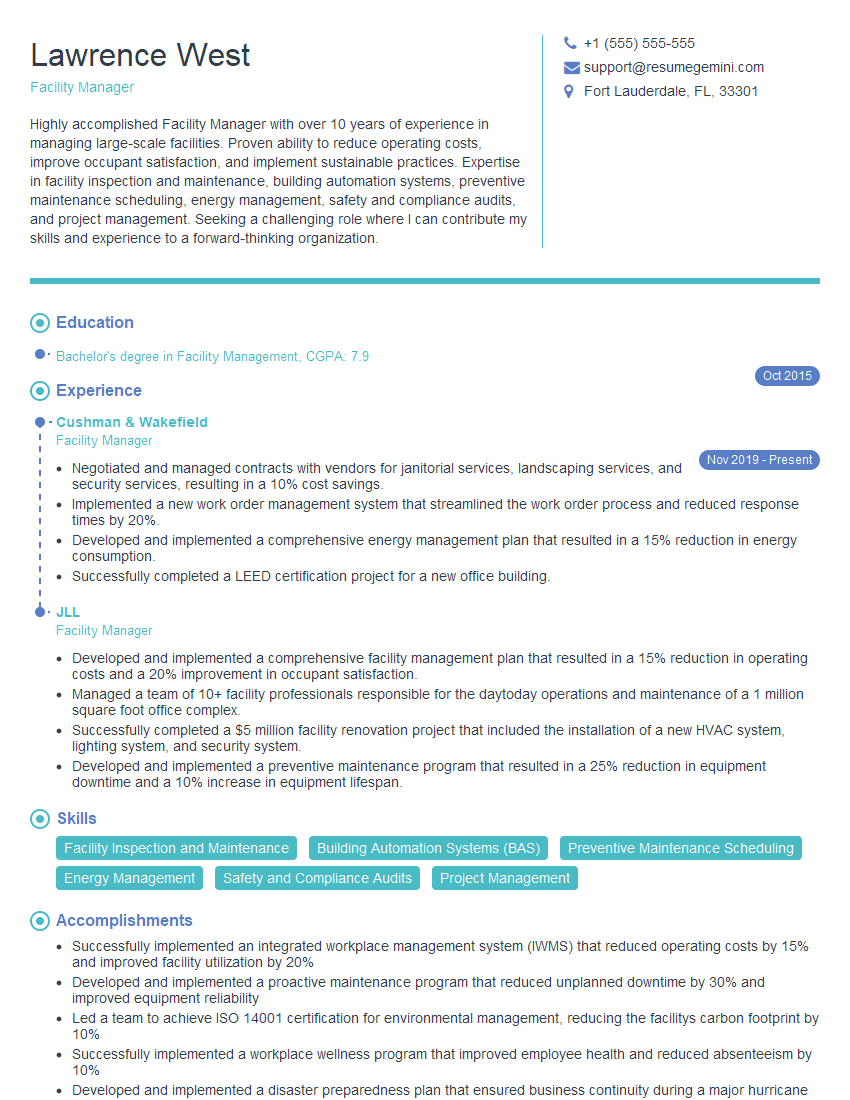
Facility Manager Resume Sample
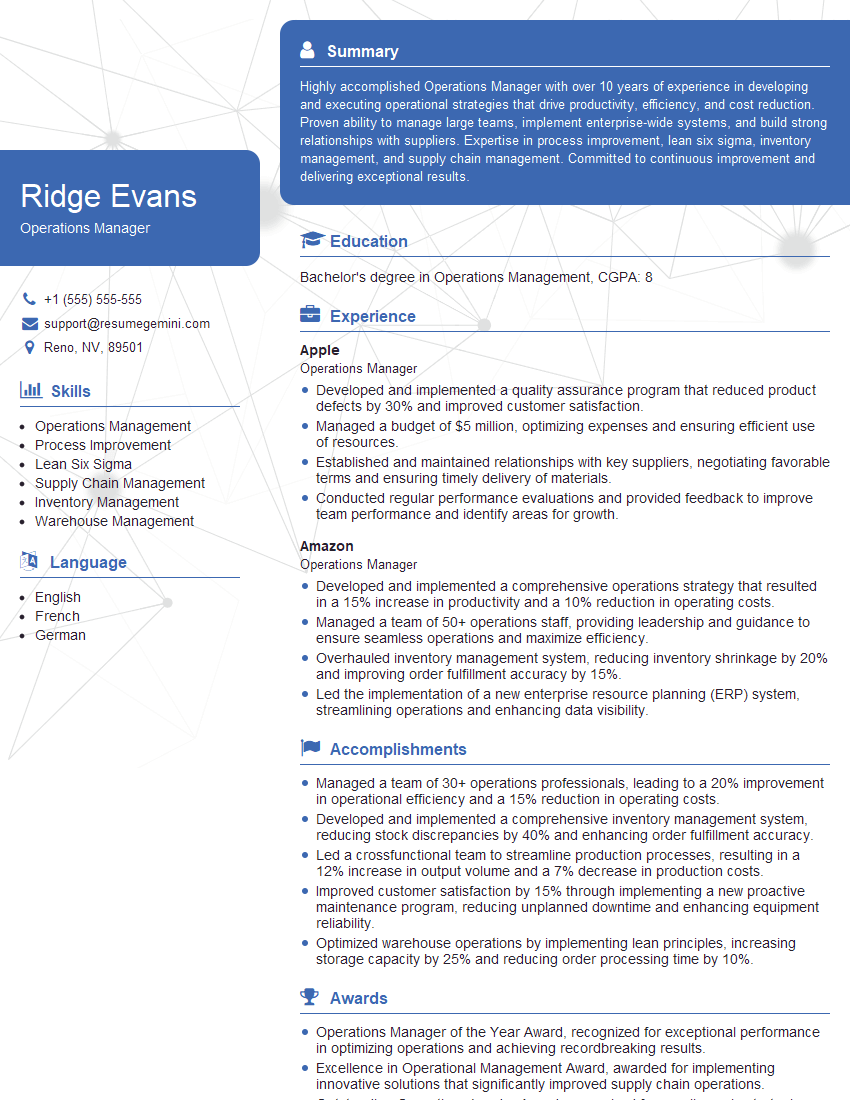
Operations Manager Resume Sample
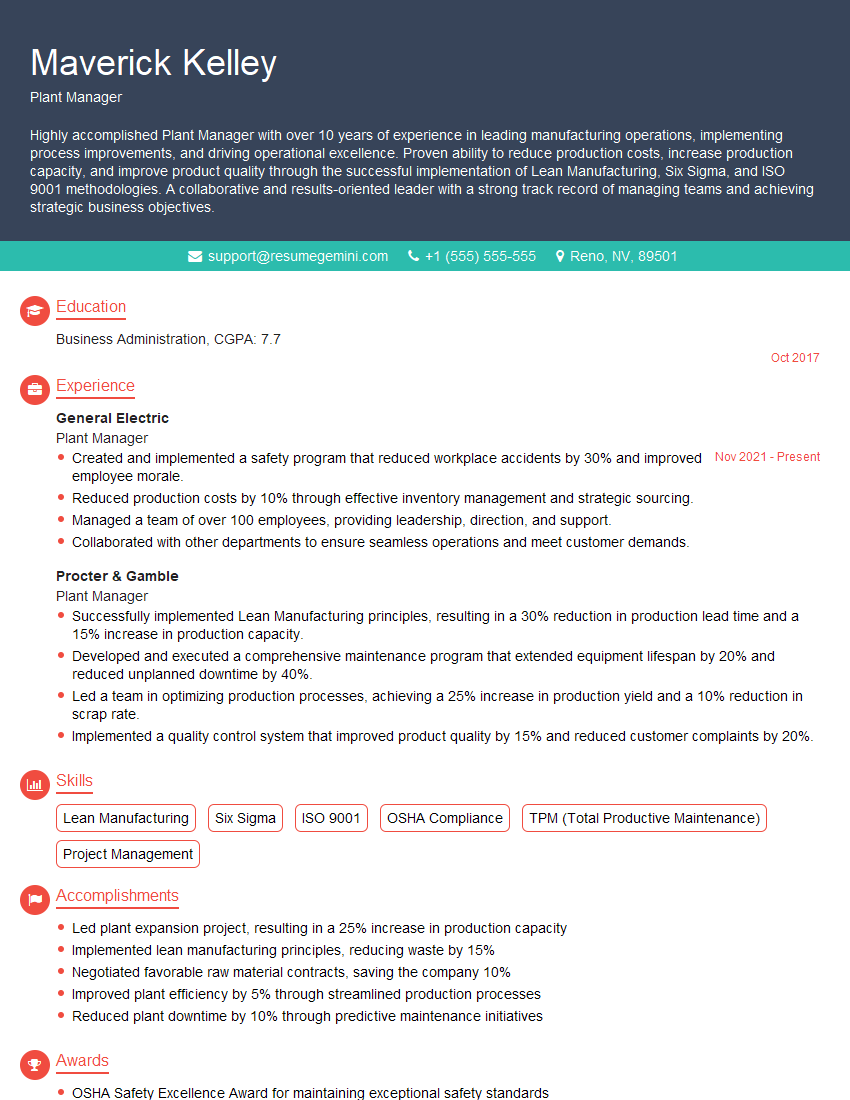
Plant Manager Resume Sample
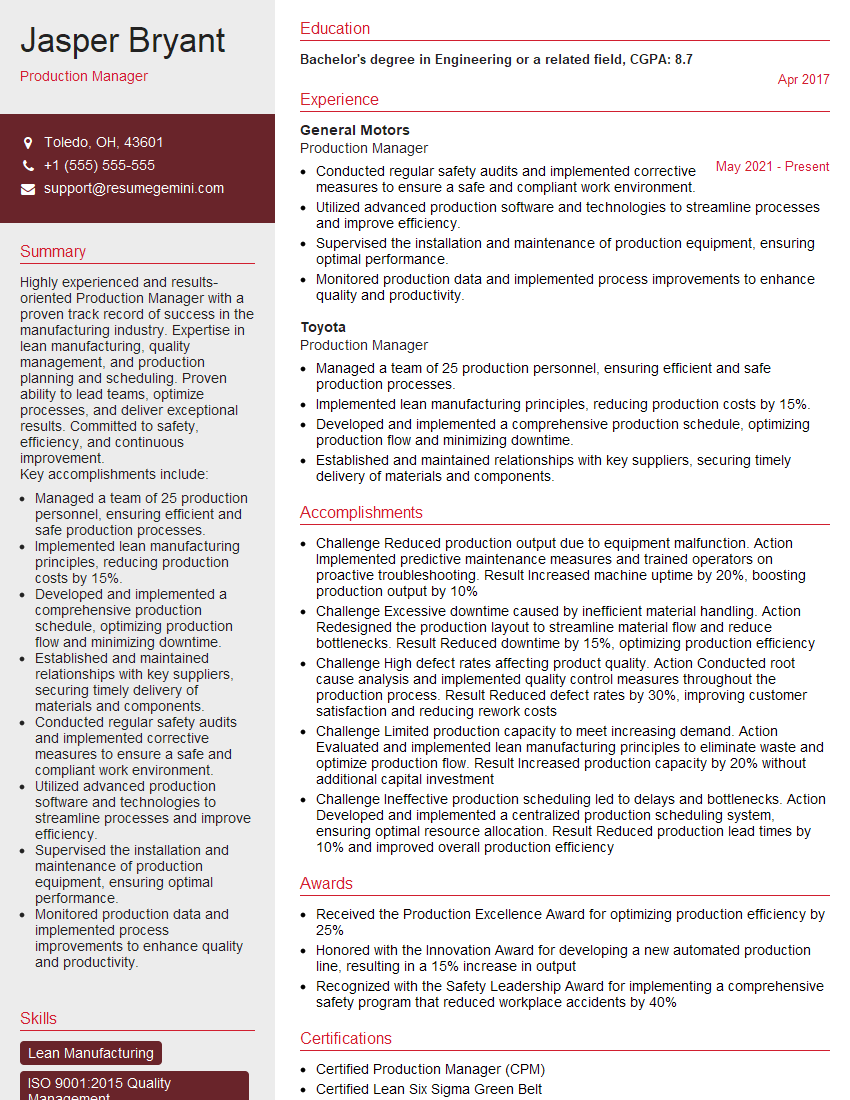
Production Manager Resume Sample
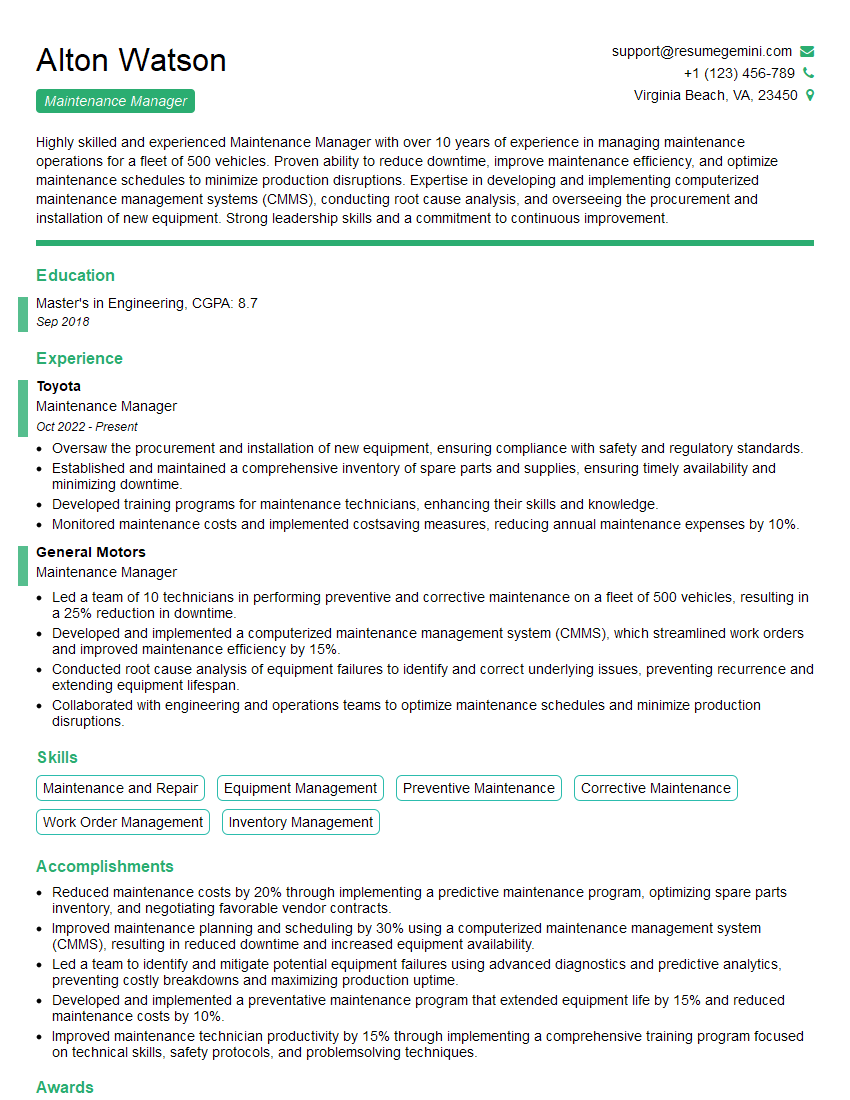
Maintenance Manager Resume Sample
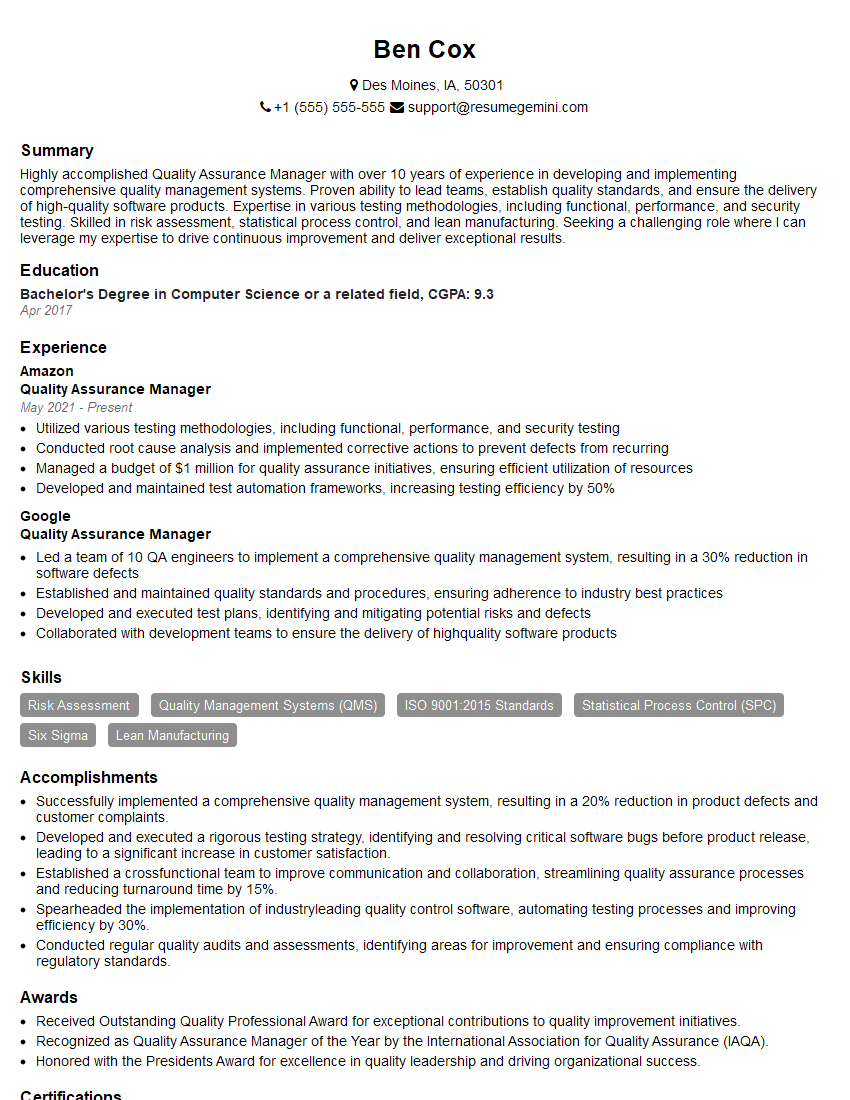
Quality Assurance Manager Resume Sample
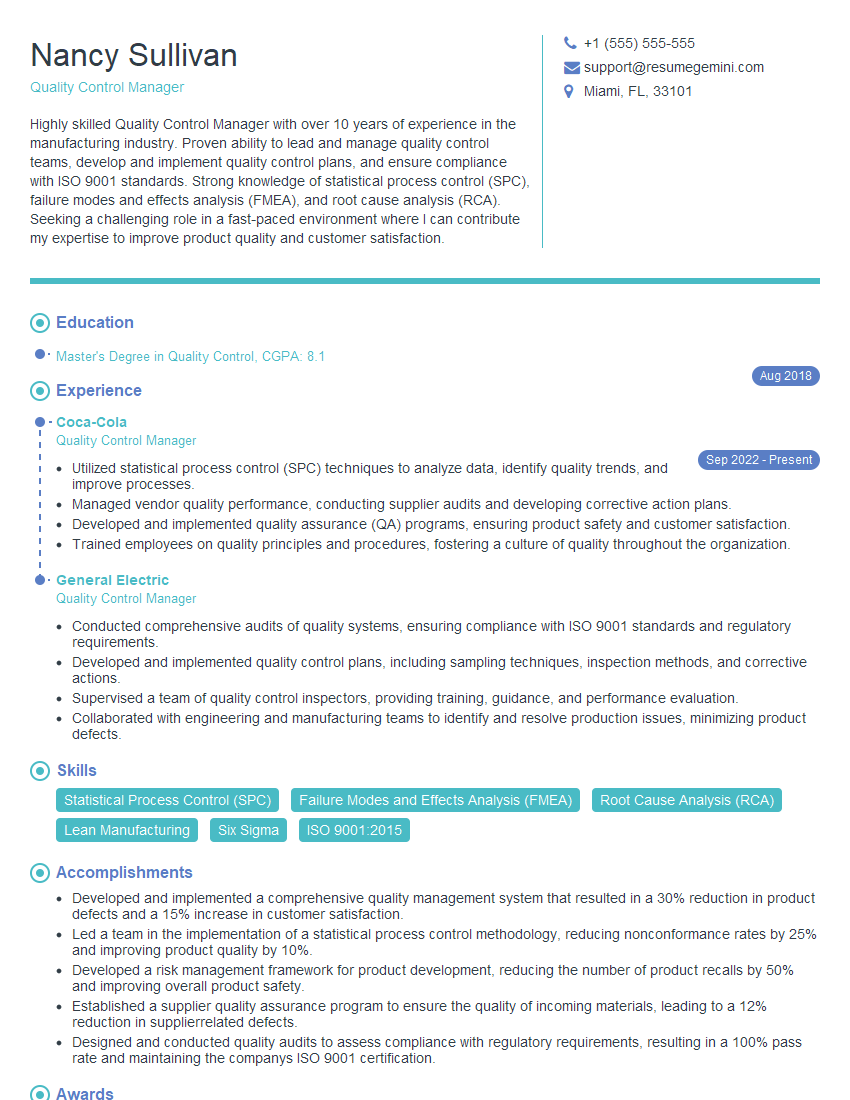
Quality Control Manager Resume Sample
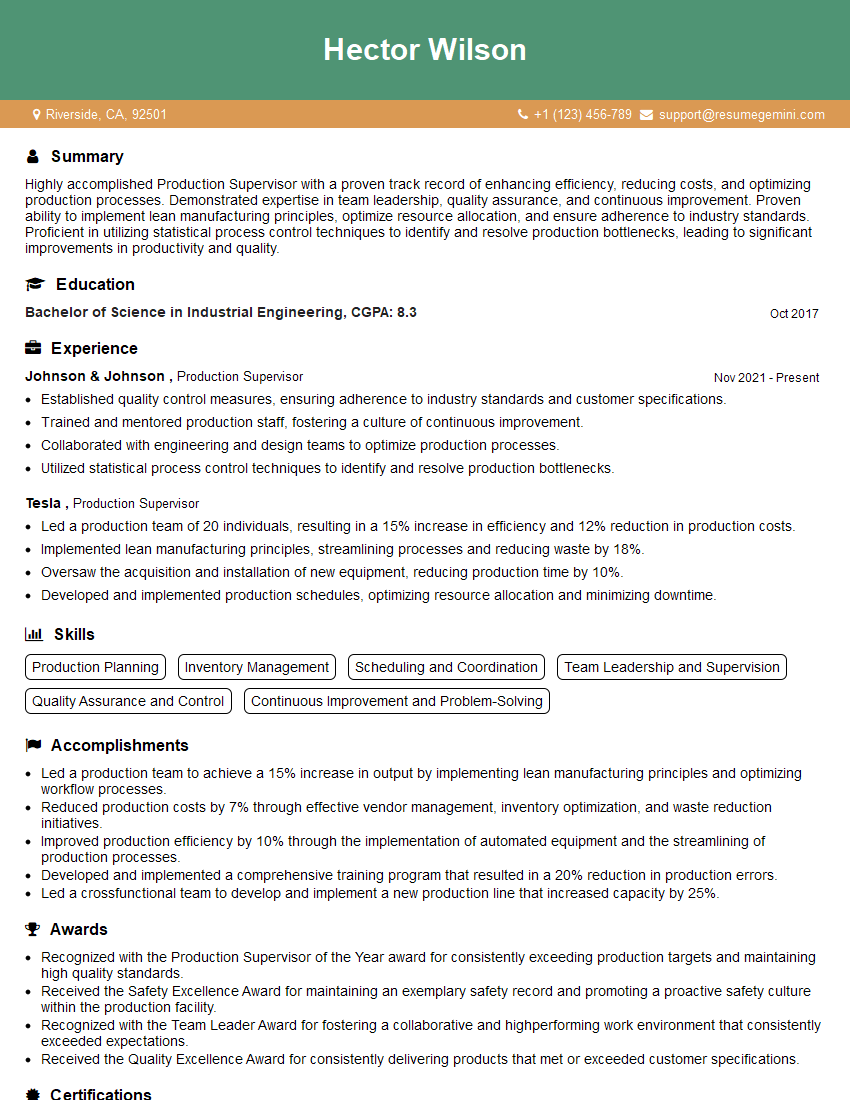
Production Supervisor Resume Sample
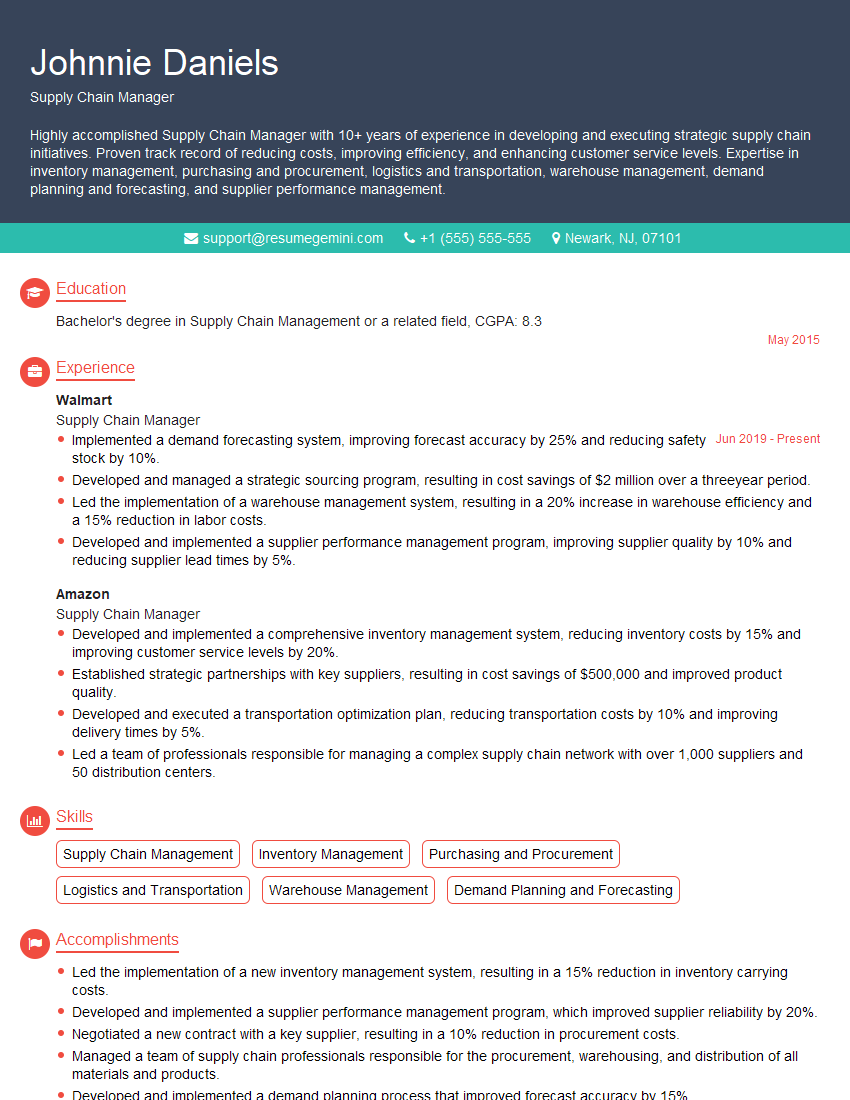
Supply Chain Manager Resume Sample
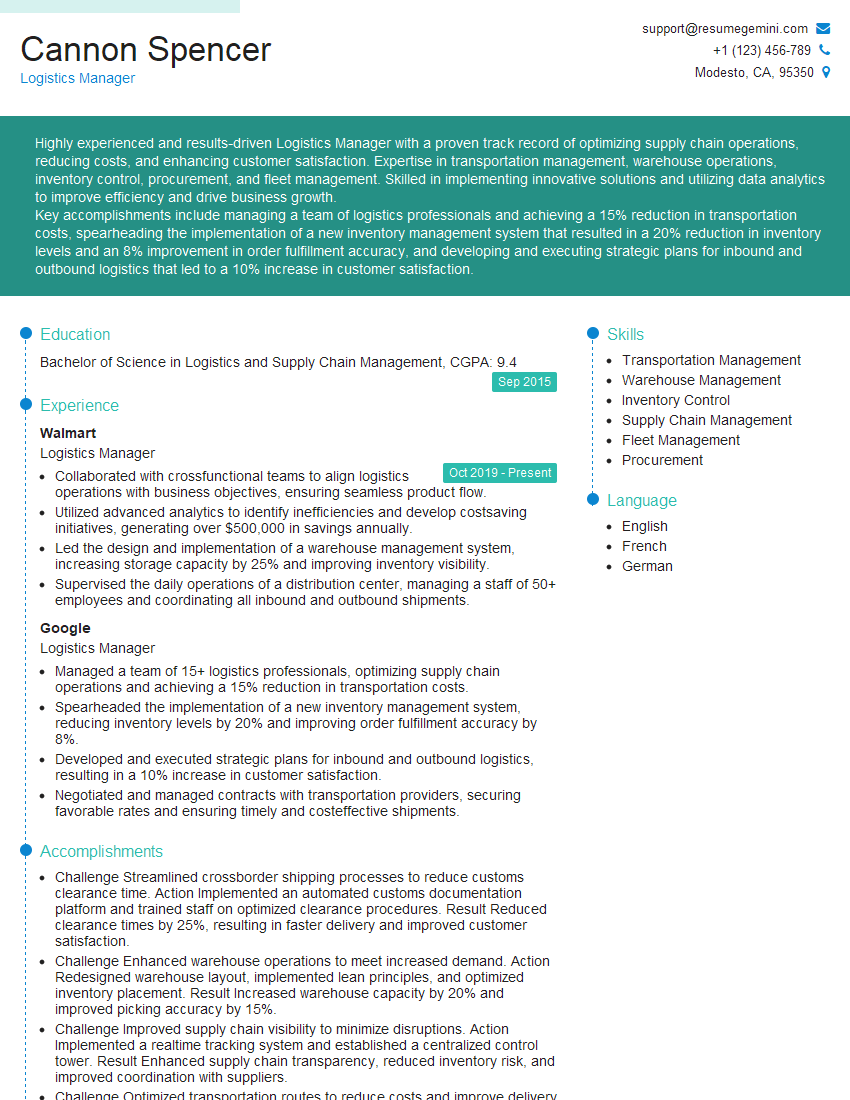
Logistics Manager Resume Sample
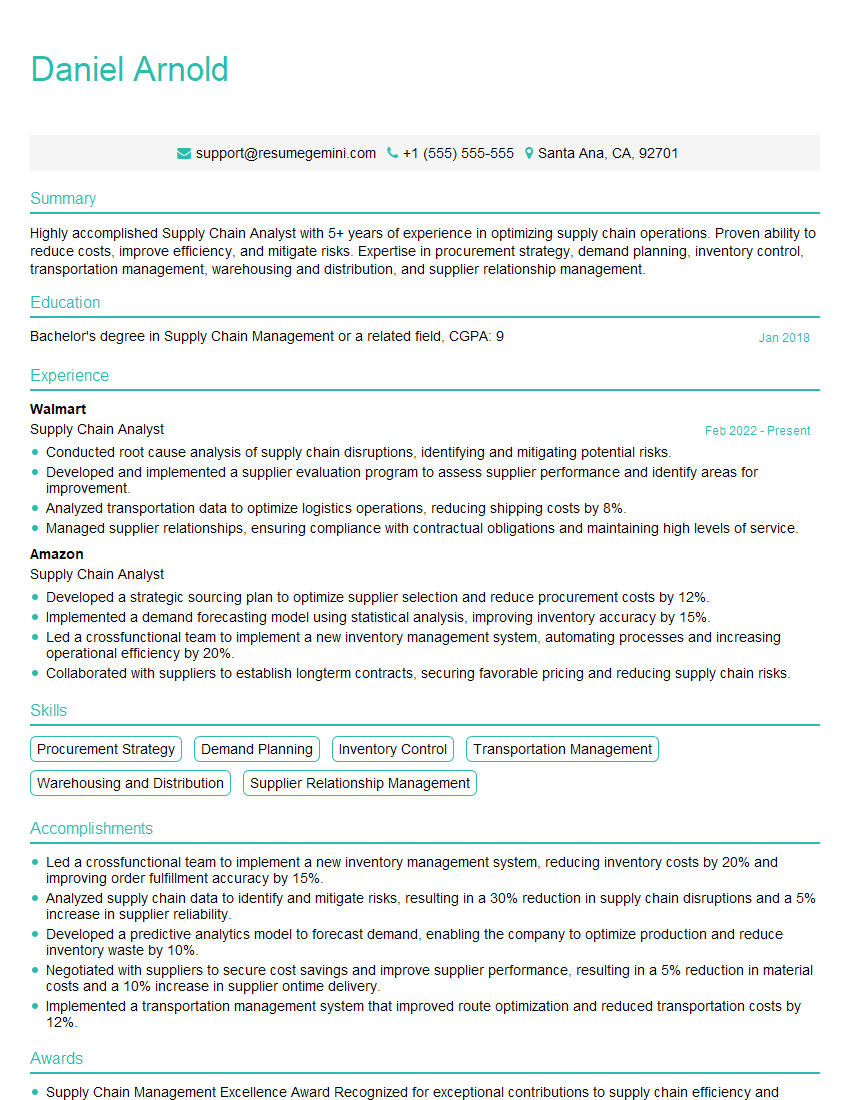
Supply Chain Analyst Resume Sample
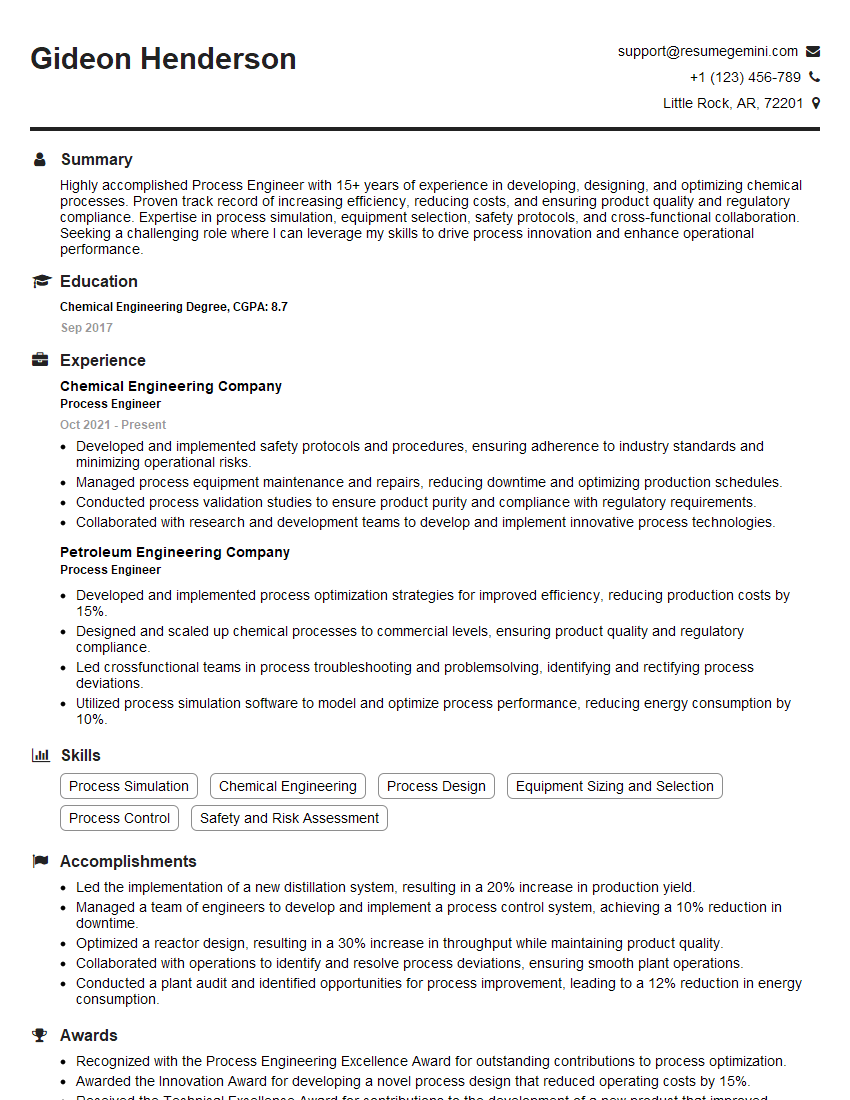
Process Engineer Resume Sample
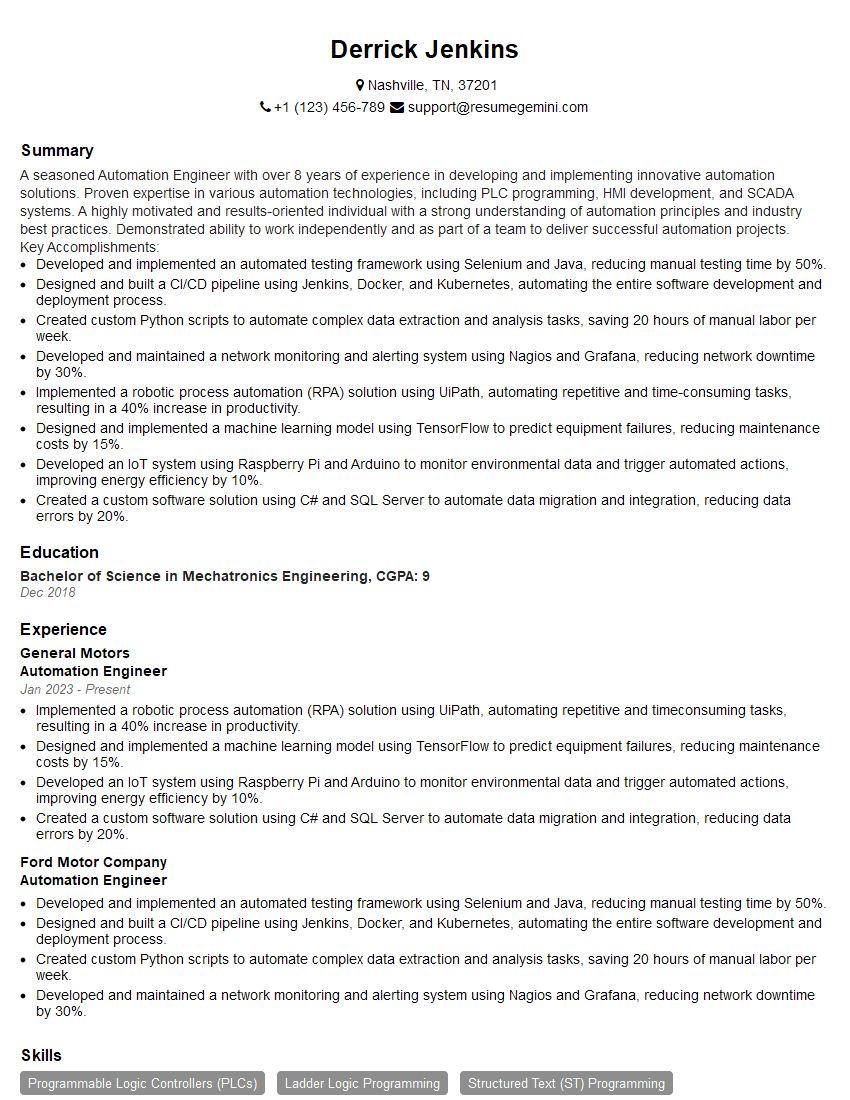
Automation Engineer Resume Sample
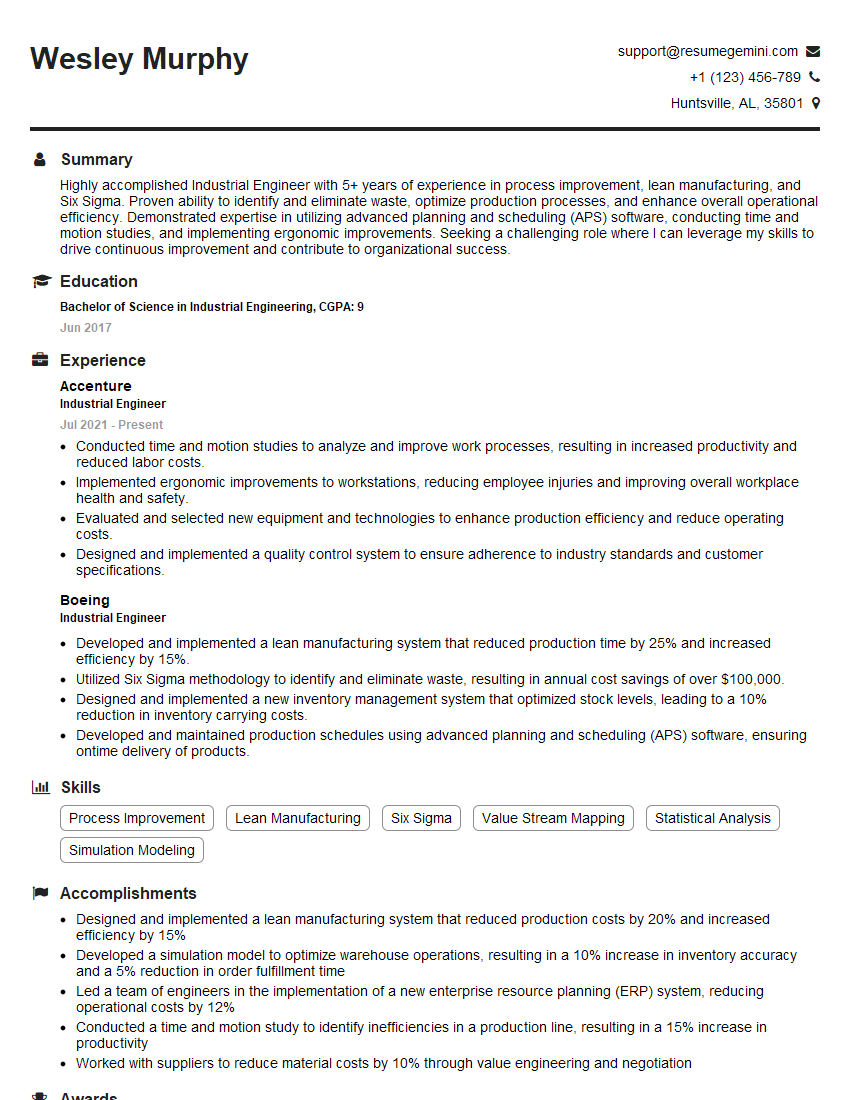
Industrial Engineer Resume Sample
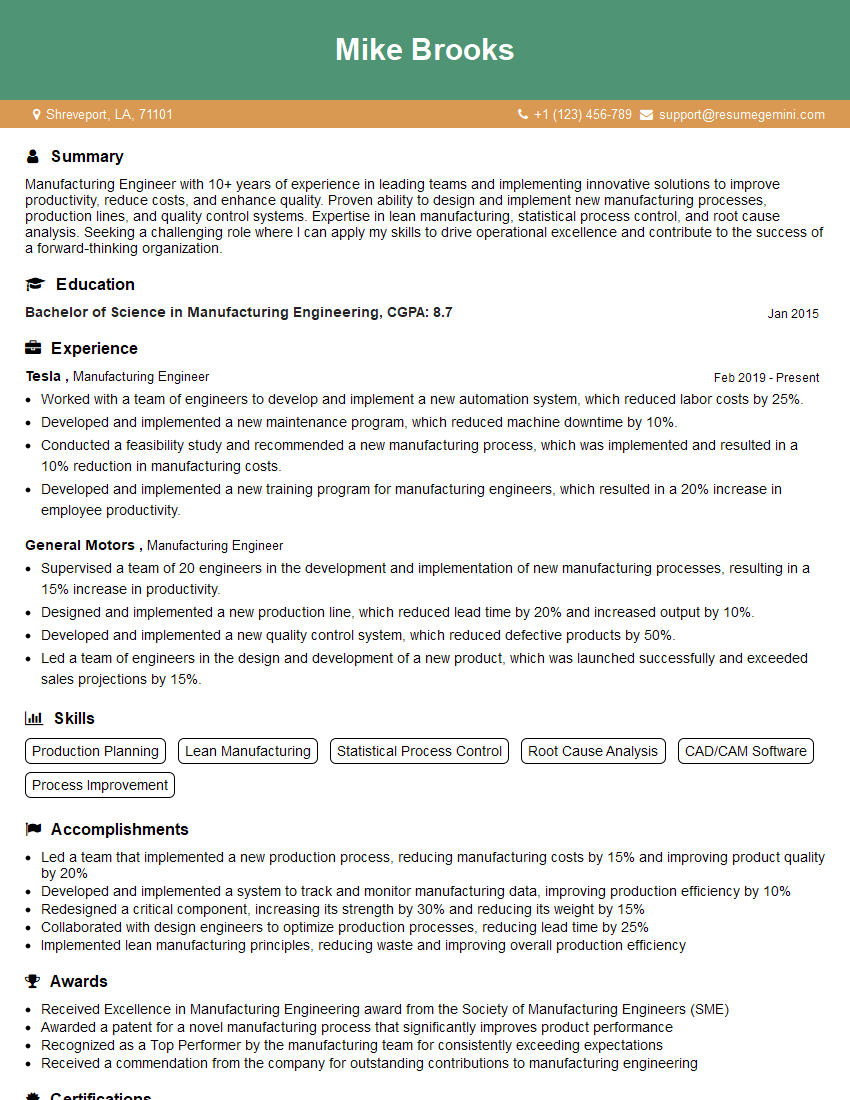
Manufacturing Engineer Resume Sample
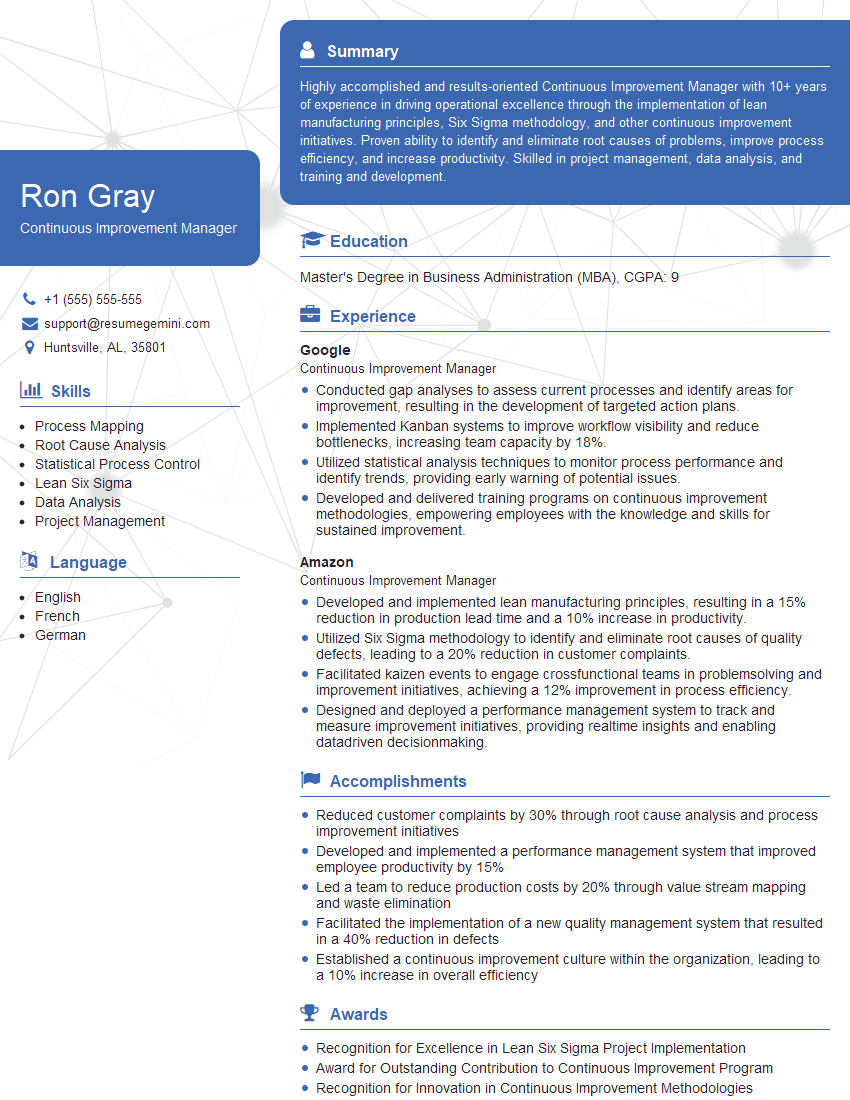
Continuous Improvement Manager Resume Sample
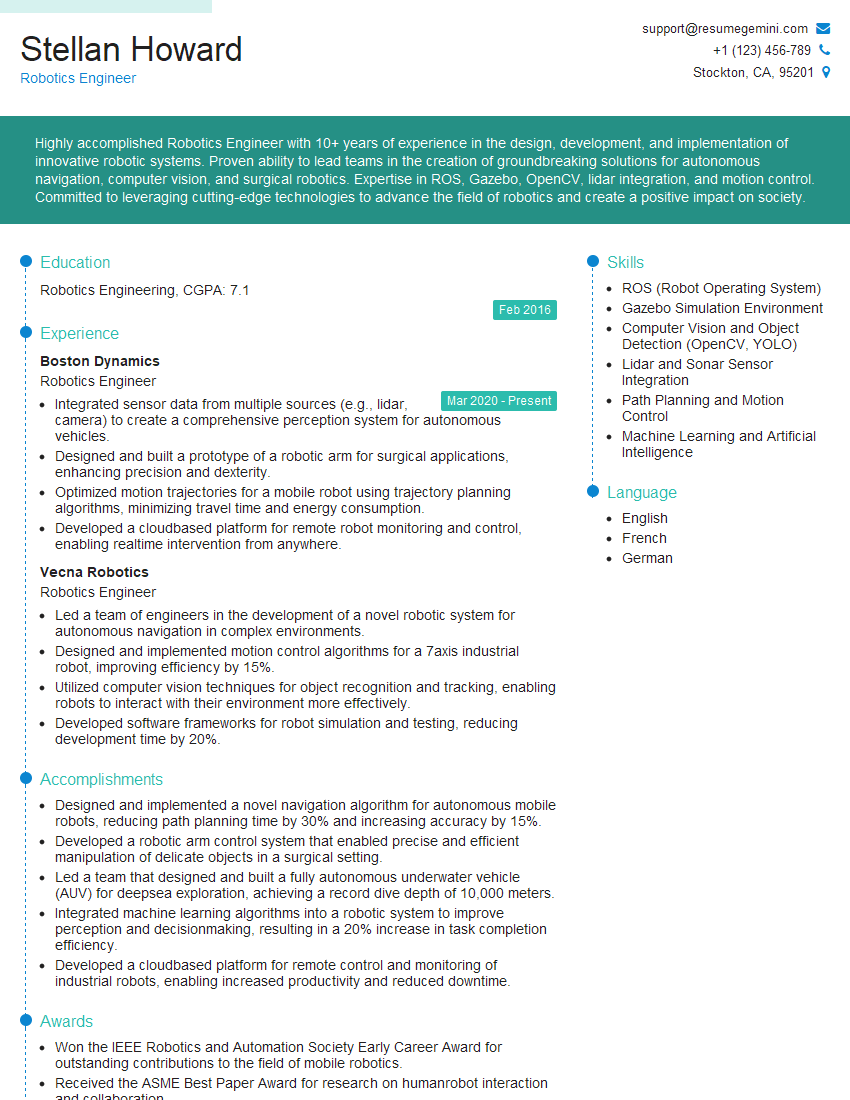
Robotics Engineer Resume Sample
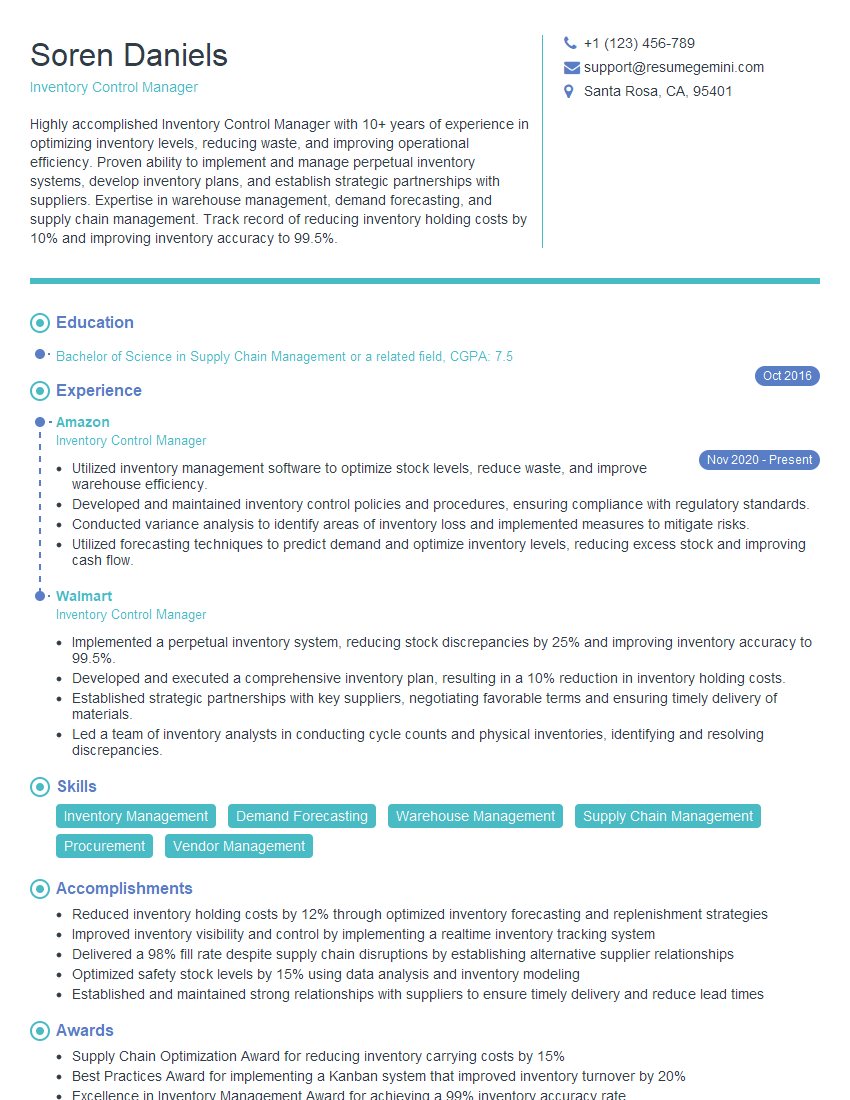
Inventory Control Manager Resume Sample
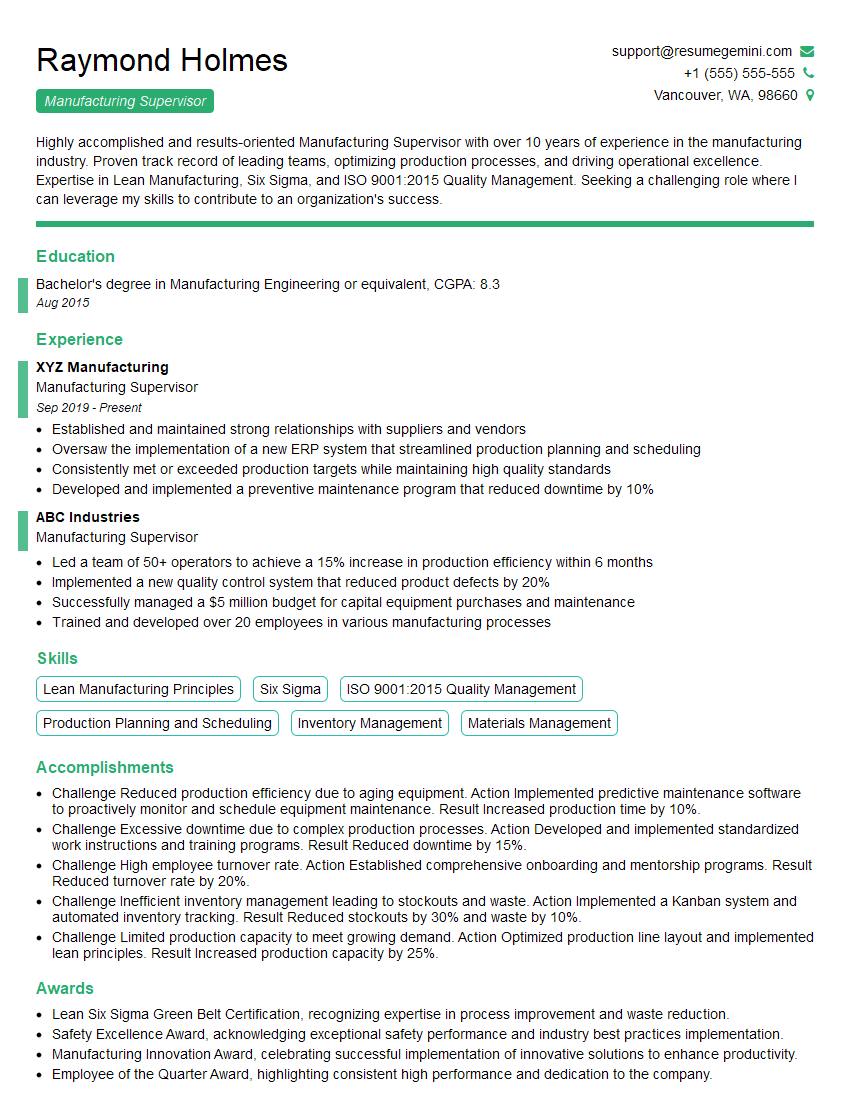
Manufacturing Supervisor Resume Sample
- Facility Manager
- Operations Manager
- Plant Manager
- Production Manager
- Maintenance Manager
- Quality Assurance Manager
- Quality Control Manager
- Production Supervisor
- Supply Chain Manager
- Logistics Manager
- Supply Chain Analyst
- Process Engineer
- Automation Engineer
- Industrial Engineer
- Manufacturing Engineer
- Continuous Improvement Manager
- Robotics Engineer
- Inventory Control Manager
- Manufacturing Supervisor
Explore more articles
Users Rating of Our Blogs
Share Your Experience
We value your feedback! Please rate our content and share your thoughts (optional).
What Readers Say About Our Blog
Very informative content, great job.
good