Feeling uncertain about what to expect in your upcoming interview? We’ve got you covered! This blog highlights the most important Geophysical Software Proficiency interview questions and provides actionable advice to help you stand out as the ideal candidate. Let’s pave the way for your success.
Questions Asked in Geophysical Software Proficiency Interview
Q 1. Explain the workflow of a typical seismic processing sequence.
Seismic processing is a multi-step procedure that transforms raw seismic data into interpretable images of the subsurface. Think of it like developing a photo – you start with a negative (raw data) and end up with a clear picture (subsurface image). A typical workflow looks something like this:
- Data Input and Preprocessing: This involves organizing the raw seismic data, correcting for instrument and environmental effects (like removing glitches from the recording equipment or correcting for variations in the Earth’s surface), and potentially demultiplexing the data (separating individual channels).
- Geometry Definition: This stage accurately defines the positions of sources and receivers used during data acquisition. Inaccurate geometry leads to mispositioning of subsurface features in the final image.
- Deconvolution: This step aims to remove the wavelet – the characteristic shape of the seismic signal – improving the resolution of the seismic data. Imagine sharpening a blurry picture; deconvolution is analogous to that.
- Amplitude and Phase Compensation: This corrects variations in the amplitude and phase of the seismic signal caused by factors like wave attenuation (energy loss) and geometrical spreading. Think of it like adjusting the brightness and contrast of an image.
- Noise Attenuation: Various filtering techniques are applied to reduce or eliminate unwanted noise (random signals that mask the desired seismic reflections) from the data. Examples include predictive filtering and f-k filtering.
- Velocity Analysis: This crucial step determines the velocity of seismic waves at different depths. Accurate velocity information is fundamental to properly positioning reflections in depth.
- Stacking: Multiple seismic traces are combined to improve the signal-to-noise ratio. This is analogous to averaging multiple photos of the same scene to reduce blur.
- Migration: This is where the subsurface image is created by repositioning seismic reflections to their correct locations in space. It corrects for the effects of wave propagation in complex geological structures.
- Interpretation: Geologists and geophysicists interpret the migrated seismic image, identifying geological features like faults, layers and potential hydrocarbon reservoirs.
Each step relies heavily on software packages designed to handle massive datasets and complex algorithms. The specific workflow can vary considerably depending on the type of seismic survey and the geological setting.
Q 2. Describe different types of seismic data acquisition methods and their applications.
Seismic data acquisition methods involve different ways of generating and recording seismic waves. The choice depends on the geological setting and exploration objectives.
- Land Acquisition: Involves using vibroseis trucks (which generate controlled vibrations) or explosives to create seismic waves. Geophones, which are essentially very sensitive microphones for ground vibrations, record the returning waves. This is commonly used for onshore exploration.
- Marine Acquisition: Uses air guns to generate seismic waves underwater. Hydrophones, underwater microphones, record the returning signals. This is extensively used for offshore exploration and is particularly useful in deep waters where land acquisition is not feasible. There are different types of marine acquisition, such as streamer acquisition (using long cables of hydrophones towed behind a ship) and ocean-bottom cable (OBC) acquisition (hydrophones are placed on the seafloor).
- 3D Seismic Acquisition: This method involves a densely spaced array of sources and receivers covering a large area, creating a three-dimensional image of the subsurface. This gives a far more detailed representation compared to 2D surveys.
- 4D Seismic Acquisition: This involves repeating 3D surveys over time to monitor changes in the subsurface, typically used in reservoir monitoring to track fluid movement and production in oil and gas fields.
Each method has its strengths and weaknesses concerning cost, data quality, and the type of geological information it provides. For example, marine acquisition is generally more expensive than land acquisition but can access areas inaccessible to land surveys.
Q 3. How do you handle noise in seismic data?
Noise in seismic data comes from various sources, both natural and anthropogenic (human-made). Handling this noise is crucial for obtaining a clear image of the subsurface. We employ various techniques:
- Filtering: This involves removing frequencies associated with noise. Different types of filters exist, including band-pass filters (preserving certain frequencies), high-pass filters (removing low-frequency noise), and low-pass filters (removing high-frequency noise). The choice of filter depends on the nature of the noise.
- Predictive Filtering: This is a sophisticated method used to remove multiple reflections which are a common type of seismic noise.
- f-k Filtering: This filter operates in the frequency-wavenumber domain, suppressing noise with specific spatial and frequency characteristics. It’s particularly effective for removing linear noise, such as ground roll.
- Deconvolution: As mentioned earlier, this technique helps improve resolution by removing the wavelet and other aspects of the seismic source. By doing so, it effectively reduces the interference caused by source-related noise.
- Stacking: This improves the signal-to-noise ratio by averaging multiple traces. The coherent seismic reflections will reinforce each other, while the random noise tends to cancel out.
- Attenuation using Singular Value Decomposition (SVD): SVD can decompose the seismic data matrix and help isolate and suppress noise based on its singular values and vectors.
The selection of noise reduction techniques depends on the type and severity of the noise present in the data. Often, a combination of methods is employed for optimal results.
Q 4. What are the different types of seismic waves and their characteristics?
Seismic waves are elastic waves that propagate through the Earth. They are classified based on their mode of propagation:
- P-waves (Primary waves): These are compressional waves, meaning that the particle motion is parallel to the direction of wave propagation. They are the fastest seismic waves and travel through solids, liquids, and gases. Think of pushing and pulling a slinky – the compression and rarefaction represent the P-wave motion.
- S-waves (Secondary waves): These are shear waves, where particle motion is perpendicular to the direction of wave propagation. They are slower than P-waves and cannot travel through liquids or gases. Think of shaking a rope up and down – the sideways movement represents the S-wave motion.
- Surface waves: These waves propagate along the Earth’s surface and have larger amplitudes than body waves (P-waves and S-waves). Two main types are:
- Rayleigh waves: These waves have a retrograde elliptical particle motion. They’re slower than both P- and S-waves and cause significant ground motion during earthquakes.
- Love waves: These waves have a horizontal particle motion perpendicular to the direction of wave propagation. They are also slower than P- and S-waves and are primarily found in the Earth’s crust.
Understanding the characteristics of these waves is crucial for seismic data interpretation. For instance, the difference in arrival times of P- and S-waves helps determine the distance to an earthquake’s epicenter.
Q 5. Explain the concept of velocity analysis and its importance in seismic processing.
Velocity analysis is the process of determining how seismic waves travel through different layers of the subsurface. This is vital because the speed of seismic waves is directly related to the properties of the rock layers they travel through (density and elastic moduli). Accurate velocity information is essential for correctly positioning seismic reflections in depth (time-to-depth conversion).
The process typically involves analyzing the seismic data to identify events that represent reflections from the same subsurface layer at different offsets (distances between source and receiver). Different velocity models are tested and the best-fitting model is selected based on criteria such as the clarity and alignment of the stacked seismic section. Techniques such as semblance analysis are frequently used in velocity analysis. Semblance is a measure of the similarity or coherence of seismic traces that helps identify the correct velocities.
Without accurate velocity analysis, the seismic image will be distorted and will not accurately represent the subsurface structure. This can lead to misinterpretations of geological features, potential hydrocarbon reservoirs, and the overall structural framework.
Q 6. Describe the principles of migration and its role in seismic imaging.
Migration is a crucial step in seismic processing that corrects for the apparent displacement of seismic reflections caused by the complex geometry of wave propagation paths. Imagine dropping a pebble into a pond – the waves don’t travel directly outwards from the point of impact if there are rocks or uneven terrain. Migration ‘repositions’ these distorted reflections to their true subsurface locations.
Several migration techniques exist, with the choice depending on factors such as the complexity of the geology and the computational resources available. Common methods include:
- Kirchhoff Migration: A summation method that uses ray tracing to account for the travel times along different paths.
- Finite-Difference Migration: Solves the wave equation numerically to reconstruct the subsurface image.
- Frequency-wavenumber Migration (f-k Migration): Performs migration in the frequency-wavenumber domain. This is computationally efficient and particularly suitable for simple geological structures.
Migration’s importance lies in its ability to produce a more accurate and geologically realistic image of the subsurface. Without migration, reflections would be incorrectly positioned, leading to a distorted and possibly misleading image. This would dramatically hinder geological interpretations and exploration decisions.
Q 7. What are the different types of seismic attributes and how are they used in interpretation?
Seismic attributes are quantitative measures derived from seismic data that provide additional information beyond the basic amplitude and time information. They enhance interpretation by highlighting specific geological features and characteristics. Some common seismic attributes include:
- Amplitude: The strength of the seismic reflection, often related to the properties of the reflecting interface (e.g., a strong reflection might indicate a significant change in rock properties).
- Frequency: The dominant frequencies of the seismic signal, which can be related to the lithology (rock type) and the pore fluid properties.
- Instantaneous Phase: The phase of the seismic wavelet at any given point in time, which can be useful in identifying changes in lithology.
- Instantaneous Frequency: The frequency at any given point in time, which changes with lithology and helps in resolving thin layers.
- Reflection Strength: A measure of the amplitude of reflection, helpful in identifying strong reflectors like faults or channel boundaries.
- AVO (Amplitude Versus Offset): Analyzes how the amplitude of a reflection changes with the source-receiver offset, often used to identify hydrocarbon reservoirs.
- RMS (Root Mean Square) Amplitude: Provides an average amplitude of a reflection over a certain time window, used to identify continuous reflectors or boundaries.
These attributes are often displayed as maps or sections overlaid on the seismic image, helping to identify and delineate geological structures, predict reservoir properties, and guide drilling decisions. For example, AVO analysis can help distinguish between gas-filled and water-filled sandstones.
Q 8. How do you interpret seismic sections to identify geological features?
Interpreting seismic sections involves analyzing the reflected seismic waves to understand the subsurface geology. Think of it like looking at an ultrasound of the Earth. Different geological layers reflect waves differently, creating distinct patterns on the section. We look for:
- Reflections: These represent boundaries between layers with different acoustic impedance (density times velocity). Strong reflections indicate a significant change in properties, like the contact between sandstone and shale.
- Faults: Disruptions in the continuous reflection patterns indicate faults, fractures, or other geological discontinuities. These can be identified by offset reflections, changes in reflection continuity, or termination of reflections.
- Unconformities: These are gaps in the geological record, often representing periods of erosion or non-deposition. They appear as irregular or wavy reflection patterns.
- Structures: Features like anticlines (upward folds) and synclines (downward folds) can trap hydrocarbons, so identifying these structures is crucial. We recognize them through their characteristic reflection patterns.
- Stratigraphic features: Changes in the thickness and character of reflections indicate variations in lithology (rock type) and depositional environments.
For example, a strong, continuous reflection might indicate a thick sandstone reservoir, while a chaotic reflection pattern could suggest a fractured shale formation. Experienced interpreters also utilize color and other attributes to enhance feature identification.
Q 9. Explain the concept of amplitude versus offset (AVO) analysis.
Amplitude Versus Offset (AVO) analysis examines the change in seismic reflection amplitude as a function of the source-receiver offset (distance). Imagine throwing a pebble in a pond; the waves’ intensity changes depending on how far from the impact you are. Similarly, seismic waves reflect differently depending on the distance between the source and receiver. AVO analysis is sensitive to changes in the properties of the subsurface, like the presence of hydrocarbons.
The key concept is that different lithologies have different elastic properties (P-wave velocity, S-wave velocity, density). Hydrocarbons often have lower acoustic impedance than the surrounding rock, leading to specific AVO signatures. A ‘Class 1’ AVO response is characterized by increasing reflection amplitude with offset, often indicating a gas reservoir. A ‘Class 2’ AVO response is characterized by a decrease in amplitude with offset, frequently associated with gas or a gas-water contact. A ‘Class 3’ AVO response can exhibit a polarity reversal of the reflection.
AVO is a powerful technique for identifying potential hydrocarbon reservoirs before drilling, helping to reduce exploration risk.
Q 10. Describe different techniques for reservoir characterization using seismic data.
Reservoir characterization uses seismic data to define the properties of a reservoir rock. It goes beyond simply identifying its presence; we aim to understand its volume, porosity (amount of pore space), permeability (how easily fluids flow), and fluid saturation (what fills those pores – oil, gas, or water).
- Seismic inversion: This technique transforms seismic amplitudes into rock properties such as impedance or porosity. We can then visualize these properties in 3D to better understand the reservoir.
- Pre-stack seismic analysis: This involves analyzing seismic data before stacking (combining traces), allowing for more detailed reservoir analysis, including AVO analysis as discussed earlier.
- Seismic attributes: Various attributes like sweetness, coherence, and curvature can be extracted from seismic data to delineate reservoir boundaries, fractures, and other features. These attributes provide visual cues often missed in standard seismic displays.
- Multi-component seismic data: Using multiple seismic sensors (measuring different wave types) leads to higher-resolution images and a better understanding of reservoir properties.
- 4D seismic (time-lapse): Repeating seismic surveys over time allows us to monitor changes in reservoir pressure, saturation, and production performance.
These techniques are integrated with well log data (measurements from wells) for accurate and reliable reservoir characterization. The goal is to create a comprehensive geological model of the reservoir for optimal production planning.
Q 11. What are the common software packages used in geophysical data processing and interpretation (e.g., Petrel, Kingdom, SeisSpace)?
Several leading software packages are used in geophysical data processing and interpretation. The choice often depends on the specific needs of a project and company preference.
- Petrel: A widely used integrated reservoir characterization platform that includes seismic interpretation, modeling, and simulation capabilities. It is known for its user-friendly interface and powerful features.
- Kingdom: Another integrated software suite offering extensive seismic processing, interpretation, and reservoir modeling capabilities, renowned for its sophisticated algorithms and advanced functionalities.
- SeisSpace: Offers a range of processing and interpretation tools, often favoured for its powerful processing capabilities and suitability for large datasets. It’s particularly adept at handling seismic volumes of considerable size.
- OpendTect: A open-source option that provides a robust set of interpretation tools, and is popular for its flexibility and cost-effectiveness.
Many other specialized software packages exist, each tailored to specific aspects of geophysical workflows. Proficiency in one or more of these packages is essential for a geophysicist.
Q 12. How familiar are you with depth conversion techniques?
Depth conversion is the process of transforming seismic data from the time domain (reflection time) to the depth domain (actual depth). This is crucial for accurate subsurface imaging and reservoir modeling because seismic data are initially recorded as reflection times, not true depths.
The process requires a velocity model, which represents the speed of seismic waves at different depths. This model is derived from well velocities and seismic data. Accurate velocity models are critical; incorrect models lead to depth errors that misrepresent subsurface structures and potentially impact drilling decisions.
Common depth conversion techniques include:
- Normal moveout (NMO) correction: Accounts for the time difference caused by varying offsets.
- Velocity analysis: Estimates velocities needed for depth conversion, often using techniques like common midpoint (CMP) gathers or tomography.
- Depth migration: This moves reflections to their correct location in depth, accounting for wave propagation paths.
I have extensive experience with depth conversion, using different methods and software packages to ensure accurate depth imaging, paying careful attention to velocity model building and validation. Inaccurate velocity models can significantly impact the resulting depth maps.
Q 13. Explain the concept of well log interpretation and its integration with seismic data.
Well log interpretation involves analyzing data recorded by instruments lowered into boreholes. This data includes porosity, permeability, water saturation, lithology, and other reservoir properties. Seismic data, on the other hand, provides a broad overview of the subsurface. Integrating well logs with seismic data is essential for creating accurate and detailed subsurface models.
The integration process commonly involves:
- Calibration: Well logs provide ground truth for calibrating seismic data. For instance, we can correlate well log porosity with seismic attributes to create a porosity model from seismic data.
- Well-to-seismic tie: Precisely aligning well logs with seismic data, matching specific horizons or layers on the seismic section to the corresponding depths in the well. This ensures that the well data is correctly positioned within the larger seismic framework.
- Seismic attribute analysis: Using well log data to understand and interpret seismic attributes, such as understanding how changes in porosity might impact seismic amplitude.
- Rock physics modeling: Developing relationships between rock properties (derived from logs) and seismic attributes, allowing for predicting reservoir properties based on seismic data.
For example, a well log might indicate a highly porous sandstone, while the seismic data shows a strong reflection in that area; integration verifies the presence of the potential reservoir, improving confidence in our model. Without this integration, the seismic data interpretation would lack the detail and accuracy provided by the direct measurements from well logs.
Q 14. Describe your experience with 3D seismic data visualization and interpretation.
3D seismic data visualization and interpretation involves analyzing three-dimensional seismic datasets to build an understanding of the subsurface geology. This is significantly more complex than interpreting 2D sections; it provides a far more complete and realistic representation of the subsurface.
My experience includes:
- Seismic volume visualization: Using advanced visualization tools to interpret seismic data in 3D, including interactive horizon tracking, fault mapping, and volume rendering.
- 3D interpretation techniques: Employing techniques like horizon slicing, volumetric interpretation, and structural modeling to accurately define geological features in three dimensions.
- Geobody modeling: Creating 3D models of geological bodies like reservoirs, faults, and channels, based on seismic data. This aids in better understanding their geometry and properties.
- Integration with other data: Integrating 3D seismic interpretation with other data types such as well logs, geological maps, and other geophysical datasets to develop a comprehensive subsurface model.
I’m proficient in using software like Petrel and Kingdom to efficiently process, visualize, and interpret 3D seismic data. A recent project involved interpreting a large 3D seismic survey to define a complex fault system impacting reservoir connectivity; 3D visualization was critical to correctly map the faults and ultimately assist in reservoir simulation and production optimization.
Q 15. How do you handle uncertainties in geophysical data interpretation?
Uncertainty is inherent in geophysical data due to noise, limitations of measurement techniques, and the complex nature of the subsurface. Handling this requires a multi-pronged approach.
- Statistical Analysis: Employing techniques like error propagation, Bayesian inference, and Monte Carlo simulations allows us to quantify the uncertainty associated with our interpretations. For example, we might use a Monte Carlo simulation to assess the range of possible reservoir volumes given the uncertainties in seismic amplitude measurements.
- Multiple Data Integration: Combining data from different geophysical surveys (e.g., seismic, gravity, magnetic) provides a more robust and complete picture of the subsurface, reducing reliance on any single data set and its associated uncertainties. Each dataset has its strengths and weaknesses; a combined interpretation provides a stronger overall result.
- Geologic Context: Incorporating geological knowledge and well data into the interpretation is crucial. This allows us to constrain the possible models and filter out geophysically plausible but geologically implausible interpretations. This acts as a form of ‘prior knowledge’ in a Bayesian framework.
- Sensitivity Analysis: We can evaluate how sensitive our interpretation is to variations in the input data or model parameters. If a slight change in a parameter results in a significant change in the interpretation, we know that parameter’s uncertainty heavily influences our results. This leads to a focused investigation of the sources of uncertainty affecting that parameter.
Essentially, managing uncertainty is not about eliminating it, but about quantifying it and understanding its impact on our conclusions. Transparency about these uncertainties is key to responsible geophysical interpretation.
Career Expert Tips:
- Ace those interviews! Prepare effectively by reviewing the Top 50 Most Common Interview Questions on ResumeGemini.
- Navigate your job search with confidence! Explore a wide range of Career Tips on ResumeGemini. Learn about common challenges and recommendations to overcome them.
- Craft the perfect resume! Master the Art of Resume Writing with ResumeGemini’s guide. Showcase your unique qualifications and achievements effectively.
- Don’t miss out on holiday savings! Build your dream resume with ResumeGemini’s ATS optimized templates.
Q 16. Explain the difference between pre-stack and post-stack seismic processing.
The core difference between pre-stack and post-stack processing lies in the timing of the key processing steps relative to the process of stacking seismic traces. Stacking is the process of summing multiple seismic traces together to improve the signal-to-noise ratio.
- Pre-stack processing involves applying corrections and transformations to individual seismic traces before they are stacked. This allows for greater flexibility in handling complex subsurface structures and variations in velocity. Key steps include: deconvolution, amplitude correction, multiple attenuation, velocity analysis, and various migration techniques (e.g., pre-stack depth migration). The advantage is that pre-stack processing is more adaptable to the complexities and heterogeneities of the subsurface. However, it’s computationally more intensive.
- Post-stack processing involves applying corrections and transformations to the already stacked seismic data. This means corrections need to have been sufficiently accurate earlier. It’s simpler and faster than pre-stack, but it loses some of the flexibility in handling complex subsurface features. Steps include: deconvolution, filtering, migration, and attribute extraction.
Imagine you’re building a house. Pre-stack is like meticulously crafting each individual brick before assembling the wall, ensuring each brick is perfectly shaped and positioned for a superior structure. Post-stack is like building the wall with pre-made blocks, which is faster but potentially less precise in its final form. The choice depends on the complexity of the project (subsurface) and available resources (computational power).
Q 17. What are some common challenges faced in geophysical data processing and how do you overcome them?
Geophysical data processing faces several challenges, many stemming from the limitations of sensors, the complexities of the Earth, and the volume of data.
- Noise Attenuation: Seismic data, for example, is often contaminated by various types of noise (random, coherent, etc.). We use sophisticated filtering techniques (e.g., wavelet transforms, f-k filtering) to minimize the impact of noise while preserving the desired signal. Careful analysis of the noise characteristics and the choice of appropriate filters are essential.
- Multiple Reflections: Seismic waves can reflect multiple times within the subsurface, creating unwanted artifacts in the data. Techniques like predictive deconvolution and surface-related multiple elimination (SRME) help suppress these multiples.
- Velocity Model Building: Accurate velocity models are crucial for migration, a process that positions reflectors to their correct subsurface location. Building accurate velocity models can be challenging, especially in complex geological settings. We use methods like tomography and full-waveform inversion to refine these models.
- Dealing with Large Datasets: The sheer volume of data generated by modern geophysical surveys necessitates the use of high-performance computing and efficient processing workflows. The need for parallel processing, optimized algorithms, and cloud computing is increasingly important.
Overcoming these challenges requires a deep understanding of geophysical principles, experience with various software packages, and a proficiency in problem-solving. Iterative approaches, where we analyze the results of each processing step and refine our strategy accordingly, are often necessary.
Q 18. Describe your experience with geophysical modeling techniques.
My experience encompasses a range of geophysical modeling techniques, both forward and inverse. Forward modeling simulates the response of the Earth to a geophysical source, while inverse modeling uses observed data to infer the subsurface properties.
- Seismic Forward Modeling: I’ve used finite-difference and finite-element methods to simulate seismic wave propagation in complex geological models. This is invaluable for understanding the seismic response of specific geological structures, designing surveys and interpreting complex seismic images.
- Gravity and Magnetic Modeling: I have experience with modeling gravity and magnetic anomalies using both analytical and numerical methods. This includes using software to model the gravitational and magnetic fields generated by subsurface density and magnetic susceptibility variations. This type of modeling is crucial for mapping geological structures at depth based on potential field data.
- Electromagnetic Modeling: I have worked with electromagnetic modeling, particularly using finite-difference time-domain (FDTD) and finite-element methods to simulate electromagnetic wave propagation. This has applications in mineral exploration and groundwater investigation.
- Seismic Inversion: I’m proficient in various seismic inversion techniques, including full-waveform inversion (FWI), which aims to directly recover subsurface properties from seismic data. This is the most computationally intensive but potentially most accurate method.
In each case, model building and evaluation are iterative processes involving model parameter adjustments, careful analysis of the model fit to observed data, and ongoing sensitivity analyses.
Q 19. How familiar are you with different types of geophysical surveys (e.g., gravity, magnetic, electromagnetic)?
I am familiar with a broad range of geophysical surveys and their applications.
- Seismic Surveys: My expertise is strongest here, encompassing reflection, refraction, and wide-angle seismic methods. I understand the principles of wave propagation, data acquisition, and processing for both land and marine environments.
- Gravity Surveys: I understand how variations in subsurface density cause variations in the Earth’s gravitational field, and how this data can be used to map geological structures such as salt domes and buried intrusions. I am familiar with data reduction techniques such as terrain corrections.
- Magnetic Surveys: I’m familiar with how variations in magnetic susceptibility create magnetic anomalies, and how these anomalies are used to map igneous rocks, mineral deposits, and other magnetic features. I am proficient in removing regional magnetic fields and interpreting local anomalies.
- Electromagnetic Surveys: I’m experienced with various electromagnetic methods (e.g., controlled-source EM, magnetotellurics) and their applications in detecting conductive or resistive subsurface targets. I am familiar with the principles of induction and wave propagation in conductive media.
The choice of geophysical method depends on the specific geological problem, the target properties, and the available budget and resources. Often, an integrated approach using multiple methods provides the most complete and reliable results.
Q 20. Describe your experience with quality control procedures in geophysical data processing.
Quality control (QC) is paramount in geophysical data processing, ensuring reliable and accurate interpretations. My QC procedures are integrated throughout the entire workflow.
- Data Acquisition QC: This involves verifying the proper functioning of the equipment, checking navigation data, and assessing the quality of the acquired data in real-time. This includes checks for any obvious errors in sensor readings or system malfunctions during data acquisition.
- Processing QC: At each step of the processing flow, I perform rigorous QC checks. This includes visual inspection of the data, statistical analysis, and comparison to known geological information. For example, I regularly review amplitude sections, velocity models, and migrated images to identify potential artifacts or anomalies.
- Interpretation QC: The final interpretations are reviewed critically, checking for consistency with other geological data and previous results. This involves a process of independent verification and model validation against independent constraints.
- Documentation: All QC steps, findings, and decisions are meticulously documented, allowing traceability and reproducibility of the results. Detailed logs and reports are maintained.
QC is not just a series of checks; it’s an iterative process that involves continuous monitoring and refinement of the processing and interpretation workflow. A strong QC program significantly enhances the reliability and value of the geophysical results.
Q 21. Explain your understanding of the limitations of geophysical methods.
Geophysical methods have inherent limitations, and it’s crucial to understand these limitations to avoid misinterpretations.
- Ambiguity: Geophysical data can often be ambiguous. Multiple subsurface models can potentially explain the same observed data. Resolving this ambiguity requires integrating other data sources (e.g., well logs, geological maps) and employing robust inversion techniques.
- Resolution: Geophysical methods have limited resolution. The ability to distinguish between closely spaced features is often constrained by the wavelength of the geophysical signal and the noise level. Smaller features may simply be undetectable.
- Depth of Penetration: The depth to which different geophysical methods can penetrate the Earth varies. Shallow methods like ground-penetrating radar are only effective to relatively shallow depths, whereas seismic methods can penetrate much deeper.
- Assumptions: Geophysical interpretations often rely on certain assumptions about the Earth’s properties (e.g., homogeneity, isotropy). These assumptions may not always hold true, leading to errors in interpretation. These assumptions need to be documented, and their implications considered.
Understanding these limitations is crucial for interpreting geophysical data responsibly. Transparency about these limitations, along with a realistic assessment of the uncertainties, is essential for providing reliable and meaningful results.
Q 22. How do you evaluate the accuracy and reliability of geophysical interpretations?
Evaluating the accuracy and reliability of geophysical interpretations is crucial for making informed decisions. It’s a multi-faceted process that involves a combination of quantitative and qualitative assessments. We need to consider the quality of the input data, the appropriateness of the processing and interpretation methods used, and the geological context.
Data Quality: We begin by assessing the quality of the raw geophysical data. This involves examining noise levels, signal-to-noise ratio, and the spatial and temporal sampling rates. Poor quality data inevitably leads to unreliable interpretations. For example, excessive noise in seismic data can obscure subtle reflections, leading to inaccurate structural mapping.
Methodological Rigor: The chosen processing and interpretation workflows must be appropriate for the specific geophysical data and geological setting. For instance, using a migration algorithm unsuitable for the type of seismic data can produce artifacts that misrepresent subsurface structures. We also verify the accuracy of each step in the workflow, including preprocessing, processing, and interpretation.
Geological Validation: Interpretations are always validated against existing geological knowledge. This could involve comparing the geophysical results with well logs, core samples, outcrop data, or previous geological studies. Discrepancies between the geophysical interpretations and geological data necessitate a critical review of the entire workflow and potential adjustments.
Uncertainty Quantification: A critical aspect of reliability assessment is quantifying the uncertainty associated with the interpretations. This is often achieved through techniques like stochastic inversion or Monte Carlo simulations. These methods help determine the range of possible interpretations given the inherent uncertainties in the data and methods.
In essence, it’s a continuous process of critical evaluation, where each stage is meticulously examined to ensure the reliability of the final interpretation. I always aim to document the entire process clearly, including assumptions, limitations, and uncertainties.
Q 23. How familiar are you with data filtering techniques in geophysical data processing?
I’m very familiar with various data filtering techniques. Filtering is essential to enhance the signal-to-noise ratio in geophysical data, making it easier to identify the features of interest. The choice of filter depends heavily on the type of noise and the characteristics of the signal.
Frequency Filtering: This is commonly used to remove high-frequency noise (e.g., random noise) or low-frequency noise (e.g., drift). Examples include band-pass filters, high-pass filters, and low-pass filters. The choice depends on the noise characteristics of the data. For instance, a high-pass filter would remove a low-frequency trend, while a band-pass filter would preserve a specific frequency range.
Spatial Filtering: This involves applying filters in the spatial domain, commonly used to suppress random noise or enhance lateral continuity in seismic data. Techniques like median filtering and moving average filters are examples.
Wavelet Transform: Wavelet transforms decompose the data into different frequency bands and spatial scales, allowing for targeted noise reduction in specific frequency ranges or locations. This is a powerful technique for handling complex noise patterns.
Predictive Filtering: This is a powerful technique commonly used to predict and subtract noise from seismic data. It’s particularly effective for removing coherent noise, like ground roll or multiples.
I have extensive experience applying these techniques using software like Seismic Unix (SU), ProMAX, and Kingdom. I carefully select the appropriate filter considering the type of geophysical data and noise characteristics, always mindful of potential filter artifacts that might distort the underlying signal.
Q 24. Describe your experience with time-lapse seismic monitoring (4D seismic).
Time-lapse seismic monitoring, or 4D seismic, involves acquiring repeated seismic surveys over a reservoir’s lifespan to track changes in subsurface properties. This technique is invaluable in reservoir management, particularly in monitoring hydrocarbon production, enhanced oil recovery (EOR) processes, or CO2 sequestration.
My experience with 4D seismic encompasses all stages, from survey design and acquisition to processing and interpretation. I’ve been involved in projects using both land and marine seismic data.
Processing Challenges: A critical aspect of 4D seismic processing is ensuring repeatability and minimizing artifacts caused by differences in acquisition parameters or environmental conditions between surveys. Careful attention is paid to pre-processing steps, such as noise attenuation and multiple suppression, to maximize the reliability of the time-lapse differences. We use techniques like cross-equalization to reduce variations between surveys.
Interpretation: Interpreting the 4D seismic data involves identifying and quantifying changes in seismic attributes such as amplitude, frequency, and phase shift. These changes can be indicative of reservoir fluid movement, pressure changes, or changes in saturation. I use specialized software and visualization techniques to effectively highlight the differences between surveys and integrate the results with reservoir simulation models.
Real-World Applications: I’ve witnessed firsthand how 4D seismic can significantly improve reservoir management decisions. For example, in one project, 4D seismic data helped optimize well placement, leading to increased hydrocarbon production. In another project, it was used to track the effectiveness of an EOR project, providing crucial information for operational adjustments.
I am proficient in using specialized software for 4D seismic processing and interpretation, and I have a strong understanding of the geological and geophysical principles involved.
Q 25. How do you handle missing data in seismic datasets?
Missing data in seismic datasets is a common problem that can significantly affect the accuracy of interpretations. Several techniques can be employed to handle this issue, and the optimal choice depends on the extent and nature of the missing data.
Interpolation: This is a common approach where missing data points are estimated based on the values of surrounding data points. Simple methods include linear or nearest-neighbor interpolation, while more sophisticated techniques use kriging or spline interpolation. The selection of the interpolation method is crucial as inappropriate choices can introduce artifacts or distort the signal.
Prediction: This involves using predictive filtering techniques to estimate the missing data based on the known data and the statistical properties of the data. This is a more advanced approach that often produces better results than simple interpolation, particularly for larger gaps in the data.
Inversion: Seismic inversion techniques can be used to estimate the missing data by using a model of the subsurface and the observed seismic data. This is computationally more intensive but can provide high-quality results.
Data Redundancy: If there’s significant redundancy in the dataset, one can use the known data to reconstruct the missing data. In seismic data, for example, redundancy is seen in multiple traces recording the same reflections from different viewpoints.
The choice of method involves balancing computational cost, accuracy, and the preservation of the original signal characteristics. I carefully evaluate the impact of each method on the overall dataset before making a decision. Documenting the method and its effects is crucial for ensuring transparency and avoiding misinterpretations.
Q 26. Explain the principles of seismic inversion.
Seismic inversion is the process of estimating subsurface properties, such as acoustic impedance or elastic parameters, from seismic reflection data. It’s an inverse problem, meaning we’re trying to find a model that best explains the observed data. This is in contrast to forward modeling, where we use a known model to predict the seismic response.
Several types of seismic inversion exist, each with its own advantages and limitations:
Post-stack inversion: This is a relatively simple method that uses post-stack seismic data (data after processing steps such as stacking have been performed) to estimate acoustic impedance. It is based on the relationship between seismic reflectivity and acoustic impedance. This is computationally less intensive.
Pre-stack inversion: This uses pre-stack seismic data (data before stacking) and provides more detailed information about the subsurface because it takes into account the effects of angle-of-incidence. Pre-stack inversion can estimate a larger number of elastic parameters.
Model-based inversion: This approach utilizes prior geological information to constrain the inversion process, leading to more geologically realistic results. This involves using well logs or other geological data to build a starting model, which is then refined through the inversion process.
Seismic inversion requires careful consideration of several factors, including the quality of the seismic data, the choice of inversion algorithm, and the incorporation of prior geological information. The results are usually not unique, and uncertainties need to be properly quantified and interpreted.
Q 27. Describe your experience with different types of seismic deconvolution techniques.
Seismic deconvolution is a crucial processing step aimed at improving the resolution of seismic data by removing the wavelet effect—the convolution of the earth’s reflectivity with the seismic source wavelet. This improves the definition of reflectors in the seismic section, and the identification of different geological layers. Several deconvolution techniques exist, and their suitability depends on the characteristics of the seismic data and the objectives.
Spiking Deconvolution: This is designed to transform the seismic wavelet into a spike, effectively improving the resolution of the seismic data. It’s a relatively simple method but can sometimes amplify noise.
Predictive Deconvolution: This method utilizes the autocorrelation of the seismic trace to estimate and remove the wavelet, assuming that the wavelet is stationary. It’s often more effective than spiking deconvolution in handling noise.
Wiener Deconvolution: This is an optimal deconvolution method that minimizes the mean-squared error between the deconvolved trace and the true reflectivity. It’s more sophisticated than spiking or predictive deconvolution and takes into account the noise characteristics of the data.
Wavelet Estimation/Adaptive Deconvolution: These methods aim to estimate and deconvolve the seismic wavelet more accurately than simple techniques, especially in the presence of non-stationary wavelets.
My experience involves applying these various techniques in different geological settings. The selection of the appropriate deconvolution technique requires careful consideration of the data quality, the presence of noise, and the desired resolution enhancement. I always carefully assess the results of deconvolution to ensure that it has improved the interpretability of the data without introducing artifacts.
Q 28. What is your experience with automated interpretation techniques?
Automated interpretation techniques are becoming increasingly important in geophysical data processing, given the vast amounts of data we now routinely handle. These techniques can significantly improve efficiency and consistency, although they must be used judiciously and carefully validated.
Seismic Attribute Analysis: Automated extraction of various seismic attributes (e.g., amplitude, frequency, instantaneous phase) allows for rapid identification of potential hydrocarbon reservoirs or geological features. Sophisticated algorithms can automatically identify patterns or anomalies that may be difficult for a human interpreter to detect.
Machine Learning in Seismic Interpretation: Machine learning (ML) techniques like neural networks, support vector machines, and random forests are increasingly applied for tasks such as fault detection, horizon picking, and lithology prediction. ML algorithms can learn complex relationships in the seismic data and improve interpretation accuracy.
Automated Well Tie: Automated well-tie procedures improve the efficiency and consistency of correlating seismic data with well logs, crucial for calibration and validation of interpretations.
While automated techniques offer significant advantages, it’s crucial to remember that they’re tools to assist, not replace, human expertise. I always validate automated results by carefully comparing them with manual interpretations and geological context. Over-reliance on automation can lead to significant errors. My approach emphasizes a careful balance between leveraging the power of automated methods while maintaining rigorous quality control through human oversight.
Key Topics to Learn for Geophysical Software Proficiency Interview
- Seismic Data Processing: Understanding fundamental concepts like data acquisition, pre-processing (noise reduction, filtering), and post-processing (migration, velocity analysis). Practical application includes interpreting seismic sections and identifying geological features.
- Geophysical Modeling & Inversion: Grasping the theoretical basis of various geophysical methods (gravity, magnetic, electromagnetic) and their associated inversion techniques. Practical application involves building and interpreting 2D/3D models to solve real-world exploration problems.
- Interpretation & Visualization: Proficiency in interpreting geophysical data using specialized software. This includes visualizing 3D datasets, creating maps and cross-sections, and identifying key geological features and subsurface structures.
- Software Packages: Hands-on experience with industry-standard software like Petrel, Kingdom, SeisSpace, or similar packages. Demonstrate familiarity with their functionalities and workflows.
- Data Analysis & Interpretation Techniques: Mastering statistical analysis methods relevant to geophysical data, including understanding uncertainties and errors in interpretation.
- Well Log Analysis: Understanding the principles of well log interpretation and integrating this data with seismic and other geophysical information for improved subsurface characterization.
- Problem-Solving & Algorithm Understanding: Ability to approach geophysical problems systematically, understand the underlying algorithms of the software, and troubleshoot issues effectively.
Next Steps
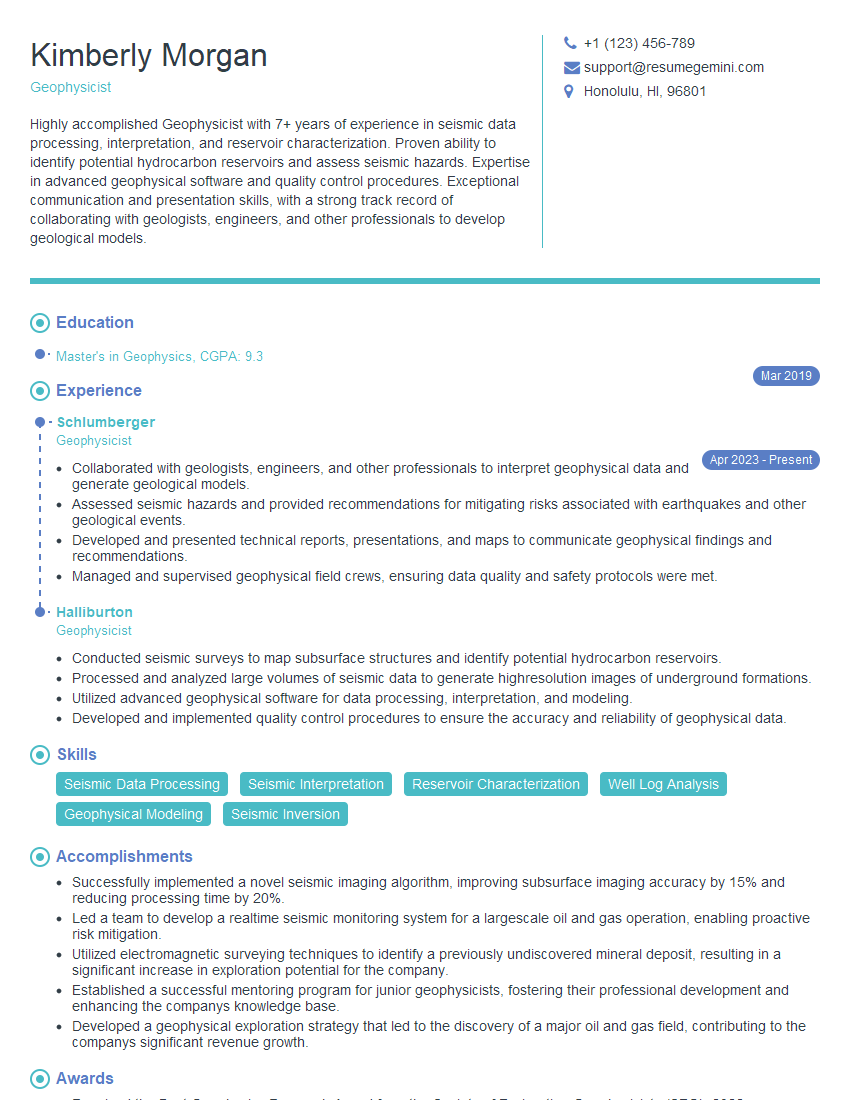
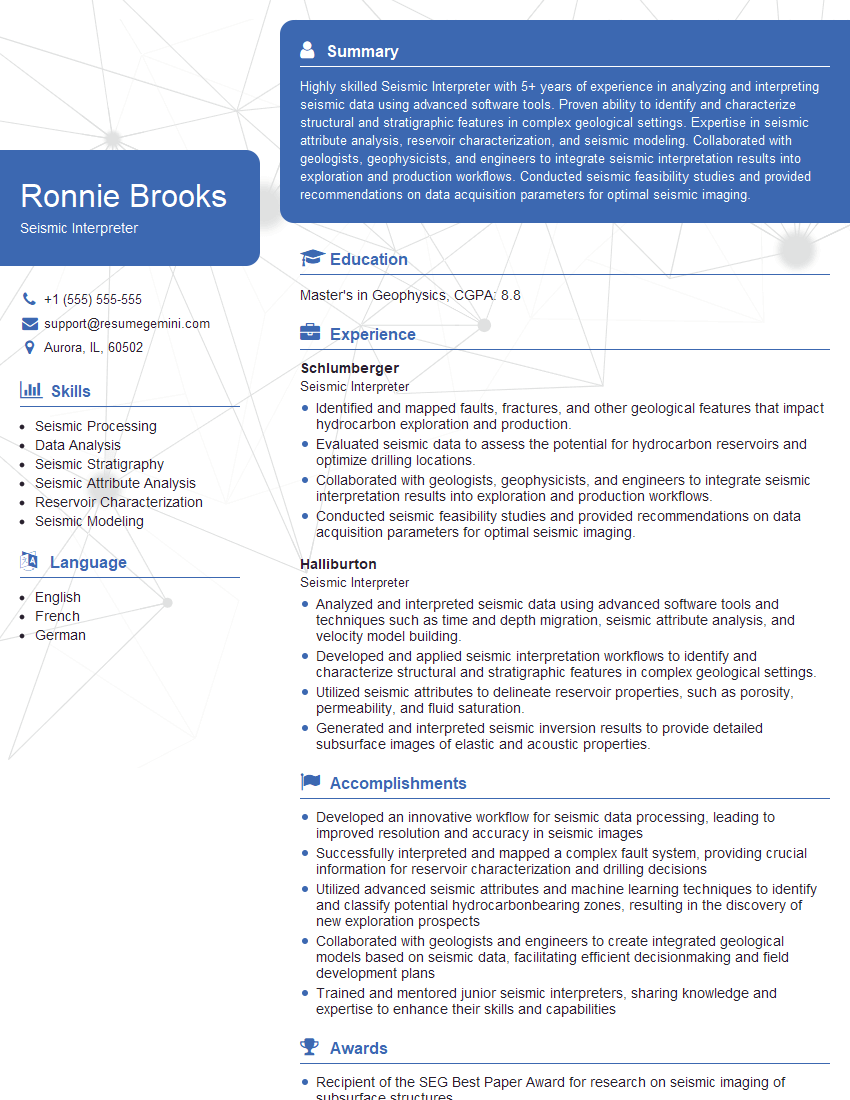
Mastering Geophysical Software Proficiency is crucial for career advancement in the energy sector and beyond. A strong understanding of these tools and techniques opens doors to exciting opportunities and positions you as a highly valuable asset to any team. To maximize your job prospects, create an ATS-friendly resume that highlights your skills and experience effectively. ResumeGemini is a trusted resource that can help you build a professional and impactful resume tailored to the specific requirements of Geophysical Software Proficiency roles. Examples of resumes tailored to this field are provided to help guide you.

Explore more articles
Users Rating of Our Blogs
Share Your Experience
We value your feedback! Please rate our content and share your thoughts (optional).
What Readers Say About Our Blog
Very informative content, great job.
good