Interviews are more than just a Q&A session—they’re a chance to prove your worth. This blog dives into essential Marine Equipment Inspection and Certification interview questions and expert tips to help you align your answers with what hiring managers are looking for. Start preparing to shine!
Questions Asked in Marine Equipment Inspection and Certification Interview
Q 1. Explain the different types of marine equipment inspections.
Marine equipment inspections are categorized based on several factors, including the type of equipment, its operational history, and regulatory requirements. These inspections can broadly be classified into:
- Initial Inspections: Conducted before the equipment is put into service to verify compliance with design specifications and standards. Think of it like a final quality check before a new car leaves the factory.
- Routine Inspections: Regularly scheduled inspections (daily, weekly, monthly, etc.) to identify potential problems early on. This is like your regular car maintenance check-up.
- Periodic Inspections: More thorough inspections carried out at longer intervals (e.g., annually, biennially) to assess the overall condition of the equipment. This is analogous to a major car service.
- Special Surveys: Extraordinary inspections triggered by an incident, damage, or repair, ensuring the equipment’s continued seaworthiness. This would be like getting your car inspected after an accident.
- Insurance Inspections: Inspections conducted by insurance companies to assess risk and determine insurance premiums. These are crucial for obtaining and maintaining insurance coverage for marine vessels and equipment.
The frequency and scope of each inspection type are defined by international conventions, national regulations, and classification society rules, tailored to the specific equipment and its operational context.
Q 2. Describe the process of certifying marine equipment.
Certifying marine equipment is a rigorous process ensuring it meets stringent safety and performance standards. It typically involves these steps:
- Application and Documentation: The manufacturer submits an application, including detailed design plans, material specifications, and test results.
- Plan Review: A certifying authority (e.g., a classification society like DNV, ABS, or Lloyd’s Register) reviews the submitted documentation to assess compliance with relevant regulations and standards.
- Type Approval Testing: The equipment undergoes rigorous testing to demonstrate compliance with performance requirements. This might include load testing, endurance testing, and other relevant tests.
- Factory Inspection: The certifying authority inspects the manufacturing facility to verify that production processes adhere to approved plans and standards.
- Certification Issuance: Upon successful completion of all stages, the certifying authority issues a certificate confirming the equipment meets the required standards. This certificate is crucial for operation and demonstrates the equipment’s seaworthiness.
The certificate often contains details such as the equipment’s type, manufacturer, serial number, and the validity period. This process ensures a consistent level of safety and reliability for marine equipment worldwide.
Q 3. What are the key regulations and standards governing marine equipment inspections?
Marine equipment inspections are governed by a complex web of international conventions, national regulations, and classification society rules. Key regulations include:
- SOLAS (Safety of Life at Sea) Convention: Sets minimum safety standards for ships, including requirements for life-saving appliances and other critical equipment.
- IMO (International Maritime Organization) Codes: Provides detailed technical guidelines for the design, construction, testing, and certification of various types of marine equipment.
- National Maritime Administrations’ Regulations: Each country has its own regulations which may add further requirements beyond international standards. These often address specific national conditions or prioritize additional safety aspects.
- Classification Society Rules: Organizations like DNV, ABS, and Lloyd’s Register issue their own rules, which often exceed minimum regulatory requirements. Compliance with these rules is crucial for maintaining a good safety record and obtaining insurance.
These regulations and standards work together to establish a robust framework for ensuring the safety and reliability of marine equipment.
Q 4. How do you assess the risk associated with marine equipment failures?
Risk assessment for marine equipment failures uses a systematic approach, often involving a combination of qualitative and quantitative methods. We consider the following:
- Probability of Failure: How likely is the equipment to fail? This is influenced by factors like age, operational history, maintenance records, and environmental conditions.
- Severity of Consequences: What would happen if the equipment failed? A failure of a lifeboat has far more serious consequences than a minor malfunction in a navigation system. We use consequence matrices that consider the impact on human life, environment, and financial costs.
- Exposure to Hazard: How often is the equipment used, and how many people are potentially at risk? Critical equipment used frequently in harsh conditions presents a higher risk.
Techniques like Failure Mode and Effects Analysis (FMEA) and Fault Tree Analysis (FTA) are commonly used to systematically identify potential failure modes and their associated risks. This helps in prioritizing maintenance tasks and developing mitigation strategies.
For example, a failure of a crane on an offshore platform during lifting operations can lead to significant injuries, damage to equipment, and environmental pollution, therefore having a high risk level.
Q 5. What are the common causes of marine equipment malfunctions?
Marine equipment malfunctions stem from a variety of causes, often interlinked. Common causes include:
- Corrosion: The marine environment is highly corrosive, leading to deterioration of metallic components. This is particularly problematic in saltwater environments.
- Fatigue: Repeated stress and loading can cause material fatigue, leading to cracks and eventual failure. This is a common concern in cyclically loaded components such as crane booms.
- Wear and Tear: Normal operation causes wear and tear on moving parts, reducing their functionality and lifespan. Regular lubrication and replacement of worn components are essential.
- Lack of Maintenance: Inadequate or delayed maintenance is a major contributor to malfunctions. Preventive maintenance schedules are crucial for preventing more extensive failures.
- Improper Operation: Incorrect operation or overloading of equipment can lead to immediate failure or accelerated wear.
- Design Defects: Faulty design, substandard materials, or manufacturing errors can lead to premature failure.
Understanding these causes allows for proactive maintenance strategies and improved design standards.
Q 6. Explain your experience with non-destructive testing (NDT) methods in marine equipment inspection.
I have extensive experience using various Non-Destructive Testing (NDT) methods in marine equipment inspection. These methods allow us to assess the condition of equipment without causing damage. Some of the NDT methods I’ve utilized include:
- Visual Inspection (VI): A basic yet crucial method to identify visible defects like cracks, corrosion, and damage. This is often the first step in any NDT assessment.
- Ultrasonic Testing (UT): Uses high-frequency sound waves to detect internal flaws like cracks and voids in materials. This is particularly useful for inspecting welds and thick sections.
- Magnetic Particle Inspection (MPI): Detects surface and near-surface flaws in ferromagnetic materials by magnetizing the component and applying magnetic particles. This is excellent for detecting cracks in welds or castings.
- Radiographic Testing (RT): Uses X-rays or gamma rays to create images of internal structures. This allows for detection of internal defects, such as porosity, inclusions, and cracks.
The choice of NDT method depends on the type of equipment, material, and the type of defects being investigated. For example, UT is frequently used to inspect the hull plating of ships, while MPI is ideal for inspecting the welds of critical components like davits or cranes.
Accurate interpretation of NDT results requires significant expertise and experience. I regularly utilize NDT results to assess the remaining life expectancy of components and recommend repair strategies.
Q 7. Describe your experience with different types of marine equipment, such as lifeboats, cranes, and cargo handling gear.
My experience encompasses a wide range of marine equipment, including:
- Lifeboats and Life-saving Appliances: I’ve inspected various types of lifeboats, liferafts, and other lifesaving equipment, focusing on their operational readiness, structural integrity, and compliance with SOLAS regulations. I’ve conducted both routine inspections and more thorough periodic surveys. A memorable experience was inspecting a davit system that had signs of significant corrosion, necessitating immediate repairs to ensure its reliability in an emergency.
- Cranes and Lifting Gear: I have considerable experience inspecting various types of cranes, including deck cranes, offshore cranes, and cargo handling cranes. This involves verifying structural integrity, checking load-bearing capacity, and inspecting lifting mechanisms (wire ropes, shackles, etc.). One specific case involved identifying a crucial flaw in a crane’s main hoisting wire through UT inspection.
- Cargo Handling Gear: This includes winches, mooring equipment, and other gear used in cargo handling operations. Inspections focus on ensuring they can safely handle the intended loads and are properly maintained. I’ve seen instances where improper use led to significant damage and needed swift intervention.
In each case, my inspections adhere to relevant regulations and standards, ensuring that the equipment is safe and fit for purpose.
Q 8. How do you ensure compliance with international maritime regulations during inspections?
Ensuring compliance with international maritime regulations during inspections is paramount. My approach involves a multi-step process. First, I thoroughly review all applicable regulations, including SOLAS, MARPOL, and relevant IMO codes, specific to the vessel type and the equipment being inspected. I then develop a detailed inspection checklist tailored to these regulations. During the inspection, I meticulously cross-reference the equipment’s condition and documentation against these regulations. This includes verifying certificates, manufacturer’s specifications, and maintenance records. Any non-compliance is documented with photographic evidence and detailed descriptions. Finally, I communicate my findings clearly to the vessel owner or operator, providing recommendations for corrective actions and outlining the necessary steps for regaining compliance.
For example, during an inspection of a lifeboat, I would verify its seaworthiness certificate is valid, check the launching mechanism’s operational status against the manufacturer’s guidelines as per SOLAS Chapter III, and ensure the appropriate number of life jackets and other safety equipment are present and in good condition as per the vessel’s safety management system. Failure to meet any of these requirements would be flagged as a non-compliance issue.
Q 9. How do you document your findings during a marine equipment inspection?
Documentation is the cornerstone of a successful marine equipment inspection. My documentation process is thorough and systematic. I utilize a standardized inspection report template that includes sections for identifying the vessel, equipment, date, inspector details, and regulatory references. Findings are recorded precisely, with clear descriptions and high-quality photographic or video evidence. I employ a clear rating system, often using a scale (e.g., satisfactory, unsatisfactory, requires repair) to categorize each observation. All discrepancies or deviations from regulations are highlighted. Crucially, the report includes my recommendations for corrective actions and any necessary follow-up inspections.
Imagine a scenario where a fire-fighting pump is found to have a faulty pressure gauge. My report would include: a photograph of the faulty gauge, a description of its malfunction, reference to the relevant SOLAS regulation (e.g., SOLAS Chapter II-2), a classification of ‘unsatisfactory,’ and a clear recommendation for repair or replacement of the gauge, along with a deadline for corrective action. All this ensures clear communication and prevents future disputes.
Q 10. How do you handle disagreements with vessel owners or operators during inspections?
Disagreements during inspections are handled professionally and diplomatically. My primary approach is to foster open communication. I clearly explain my findings, referencing the relevant regulations and providing supporting evidence. I actively listen to the vessel owner or operator’s perspective, considering their explanations and arguments. If the disagreement persists, I document all perspectives thoroughly and offer to collaborate on independent testing or expert consultation. If necessary, escalation procedures outlined in the inspection contract are followed, ensuring the dispute is resolved fairly and in accordance with established protocols.
For example, if a disagreement arises regarding the condition of a cargo securing system, I might suggest engaging a certified cargo securing expert for an independent assessment. This approach ensures objectivity and helps to resolve the issue professionally.
Q 11. Describe your experience in using specific inspection tools and equipment.
My experience encompasses a wide range of inspection tools and equipment. I am proficient in using non-destructive testing (NDT) methods like ultrasonic testing (UT) to assess the integrity of welds and metallic structures; magnetic particle testing (MT) for surface and near-surface crack detection; and visual inspection using high-resolution cameras and borescopes for reaching hard-to-access areas. I am also skilled in using specialized tools for measuring dimensions, pressure testing hydraulic systems, checking electrical continuity, and analyzing gas detection readings. I’m comfortable using various types of thickness gauges and calipers for evaluating corrosion and wear. Safety equipment such as personal protective equipment (PPE) including gas masks, harnesses, and safety helmets is always used according to the situation.
For instance, when inspecting a rudder stock, I would use UT to assess its structural integrity, looking for signs of fatigue or internal defects that might compromise its strength. I regularly calibrate all measuring and testing equipment to ensure accuracy and reliability.
Q 12. What are your experiences in writing inspection reports?
Writing comprehensive and concise inspection reports is a crucial part of my role. My reports are structured, objective, and easy to understand, even for those without a deep technical background. They always clearly outline the scope of the inspection, the methodology used, and detailed findings with supporting evidence. They follow a consistent format, employing headings, subheadings, and clear numbering for ease of navigation. My reports also include recommendations for corrective actions, outlining timelines and expected outcomes. I aim to make the reports actionable and helpful for the vessel operators and owners.
I strive to maintain a neutral and professional tone. For instance, instead of saying ‘The equipment is terrible,’ I would state ‘The equipment exhibits significant corrosion and requires immediate repair.’ This ensures clarity and avoids subjective language.
Q 13. Explain your understanding of SOLAS regulations and their relevance to marine equipment.
SOLAS (Safety of Life at Sea) regulations are fundamental to marine equipment inspection. They establish minimum safety standards for vessels, covering numerous aspects, including life-saving appliances, fire protection, and radio communications. My understanding of SOLAS is comprehensive, and I regularly consult the latest amendments to ensure compliance. SOLAS regulations dictate specific requirements for the design, construction, testing, maintenance, and operational readiness of essential marine equipment. Any non-compliance with SOLAS can result in serious consequences, including detention of the vessel. During inspections, I meticulously check compliance with all relevant SOLAS chapters relating to the equipment under scrutiny.
For instance, SOLAS Chapter III sets stringent requirements for lifeboats, life rafts, and other life-saving appliances. I would verify that the lifeboats are properly equipped, seaworthy, and regularly maintained according to the SOLAS guidelines. This includes checking the condition of the lifeboat davits, the functionality of the releasing mechanisms, and the availability of sufficient life jackets and other survival gear.
Q 14. How do you determine the service life of marine equipment?
Determining the service life of marine equipment involves a multi-faceted approach that considers several factors. Manufacturer’s recommendations provide a starting point but are not always definitive. I assess the equipment’s operational history, considering its usage, environmental exposure, and maintenance records. Regular inspections, including visual checks and NDT, are critical in assessing the equipment’s condition and identifying any signs of wear, corrosion, or fatigue. The results of these inspections help determine whether the equipment can continue to operate safely or requires replacement or refurbishment. Industry best practices, relevant standards, and regulatory guidelines also play an important role. Sometimes, expert consultations might be necessary for complex cases.
For example, a propeller might have a manufacturer-stated lifespan of 15 years, but if it’s been subjected to frequent impacts with debris or operates in a highly corrosive environment, its actual service life might be significantly shorter. Regular inspections and detailed condition assessments would allow for a more accurate prediction of when it needs to be replaced.
Q 15. How do you manage multiple inspections simultaneously?
Managing multiple simultaneous inspections requires a structured approach. I utilize project management techniques, similar to those used in any complex project. This involves creating a detailed schedule, prioritizing tasks based on urgency and risk, and allocating appropriate resources.
For example, I might use a spreadsheet or specialized software to track the progress of each inspection, including deadlines, required documentation, and assigned personnel. Crucially, clear communication with all stakeholders (clients, crew, other inspectors) is paramount to ensure everyone is informed and coordinated. Regular progress meetings, detailed reports, and proactive identification of potential bottlenecks prevent delays and ensure timely completion of all inspections.
I also leverage technology where possible. Digital checklists and reporting systems allow for real-time updates and efficient data management, streamlining the entire process. This method helps me maintain accuracy and consistency across multiple inspections, even under pressure.
Career Expert Tips:
- Ace those interviews! Prepare effectively by reviewing the Top 50 Most Common Interview Questions on ResumeGemini.
- Navigate your job search with confidence! Explore a wide range of Career Tips on ResumeGemini. Learn about common challenges and recommendations to overcome them.
- Craft the perfect resume! Master the Art of Resume Writing with ResumeGemini’s guide. Showcase your unique qualifications and achievements effectively.
- Don’t miss out on holiday savings! Build your dream resume with ResumeGemini’s ATS optimized templates.
Q 16. Explain your experience with different types of marine surveys.
My experience encompasses a wide range of marine surveys, including but not limited to:
- Hull surveys: Assessing the structural integrity of the vessel’s hull, including plating, framing, and tank systems. This often includes underwater inspections using divers or remotely operated vehicles (ROVs).
- Machinery surveys: Evaluating the condition and performance of all onboard machinery, from main engines and generators to pumps and auxiliary systems. This requires a strong understanding of mechanical engineering principles and operational procedures.
- Cargo surveys: Inspecting cargo holds and equipment to ensure seaworthiness and prevent cargo damage. Different cargo types require specialized knowledge and procedures.
- Special surveys: These are more in-depth examinations typically performed at scheduled intervals (e.g., every 5 years) to verify compliance with classification society rules and regulations. They involve a more rigorous assessment than annual surveys.
- Damage surveys: Investigating and assessing the extent of damage to a vessel following an incident, such as a collision or grounding. This requires meticulous documentation and analysis to determine the cause and extent of repairs needed.
Each survey type requires specific expertise and adherence to relevant standards and regulations. My proficiency spans these various types, allowing me to adapt my approach to the unique demands of each inspection.
Q 17. Describe a situation where you had to identify a critical safety issue during an inspection.
During a recent inspection of a cargo vessel’s lifeboat davit system, I identified a critical safety issue. The release mechanism showed significant corrosion and wear, indicating a potential failure during an emergency launch. The pins were also showing signs of excessive stress.
Following established protocol, I immediately documented the finding with detailed photographs and measurements. This critical safety issue was flagged as a major non-compliance, and I immediately recommended immediate repair and replacement of the faulty components before further operations.
I then escalated the issue to the vessel’s captain and the classification society surveyor, ensuring all parties were aware of the potential hazard and the necessary corrective actions. By promptly addressing this issue, I prevented what could have been a catastrophic event.
Q 18. What is your experience with the different classification societies (e.g., ABS, DNV, LR)?
I have extensive experience working with major classification societies like ABS (American Bureau of Shipping), DNV (Det Norske Veritas), and LR (Lloyd’s Register). My understanding extends beyond simply knowing their regulations; I understand the nuances and differences in their respective approaches and standards.
For instance, I know that ABS might focus on specific aspects of welding procedures whereas DNV might have a slightly different emphasis on structural analysis methods. This knowledge is crucial for ensuring that any inspection I conduct is compliant with the specific requirements of the applicable classification society for a particular vessel.
Furthermore, I understand the importance of maintaining open communication and collaboration with these societies. Their expertise is invaluable, and a collaborative approach is essential for ensuring safe and efficient maritime operations.
Q 19. How do you stay up-to-date on the latest regulations and best practices in marine equipment inspection?
Keeping abreast of the latest regulations and best practices is crucial in this field. I achieve this through several methods:
- Regularly reviewing updates from classification societies: I subscribe to newsletters and updates from ABS, DNV, LR, and other relevant organizations. These updates provide information on changes in regulations and best practices.
- Participating in industry conferences and seminars: Attending industry events keeps me up-to-date on new technologies, emerging challenges, and discussions among industry experts.
- Professional memberships and networking: Memberships in professional bodies like the Institute of Marine Engineering, Science, and Technology (IMarEST) provide access to publications, resources, and networking opportunities to enhance my knowledge.
- Ongoing training and professional development: I regularly participate in relevant training courses to enhance my skills and maintain my professional certifications. This ensures my expertise remains current and robust.
This multi-pronged approach ensures I remain a highly competent and informed inspector.
Q 20. How would you handle a situation where you find non-compliant equipment?
Discovering non-compliant equipment triggers a systematic response. First, I meticulously document the non-compliance, including detailed descriptions, photographs, and measurements. I clearly explain the specific regulation being violated.
Next, I communicate the findings to the vessel’s operator or owner, explaining the potential safety and operational risks. I then outline the necessary corrective actions required to achieve compliance. Depending on the severity of the non-compliance, I may issue a temporary or permanent prohibition of the equipment’s use until it is rectified.
Throughout the process, clear communication is essential. I maintain a professional yet firm approach, ensuring that the corrective actions are taken promptly and effectively. In cases of particularly serious non-compliance, I may involve the relevant authorities, depending on the specific circumstances and regulations.
Q 21. How do you prioritize your inspection tasks?
Prioritizing inspection tasks involves a risk-based approach. I consider several factors:
- Safety criticality: Items directly impacting safety (e.g., life-saving equipment) are always prioritized.
- Regulatory deadlines: Inspections required for compliance with statutory or classification society deadlines take precedence.
- Operational impact: Equipment crucial for the vessel’s operation is given higher priority to minimize operational downtime.
- Potential consequences of failure: The severity of potential consequences (environmental damage, injury, etc.) guides prioritization.
I often use a combination of risk matrices and scheduling tools to visualize and manage these priorities effectively. This method allows for efficient allocation of time and resources, ensuring the most critical aspects of the vessel are addressed first.
Q 22. Explain your experience with conducting audits of marine equipment maintenance programs.
Auditing marine equipment maintenance programs involves a systematic review of a company’s processes to ensure compliance with regulations and best practices. This goes beyond simply checking records; it’s about verifying the effectiveness of the entire maintenance system. My experience encompasses assessing various aspects, from the initial planning and scheduling of maintenance activities to the actual execution, record-keeping, and corrective action processes.
For example, in a recent audit of a cruise ship’s engine room maintenance program, I reviewed their planned maintenance system (PMS) documentation, verifying that scheduled overhauls for critical components like the main engines and generators were properly planned and executed. I then examined the associated work orders, spare parts inventory, and maintenance logs to ensure consistency and adherence to manufacturer’s recommendations. I also interviewed engineering staff to understand their day-to-day processes and identify potential weaknesses. Through this, I identified a gap in their lubrication scheduling for a specific auxiliary pump, leading to a potential reliability issue that was promptly addressed.
Another key aspect is evaluating the competency of personnel involved in the maintenance tasks. I assess training records, observe practical work if possible, and evaluate the overall safety culture within the maintenance department. A strong safety culture directly impacts the reliability and quality of maintenance work.
Q 23. What is your understanding of the International Maritime Organization (IMO) and its role in marine safety?
The International Maritime Organization (IMO) is a specialized agency of the United Nations responsible for improving maritime safety and security, preventing pollution from ships, and facilitating international cooperation in these areas. Think of them as the global governing body for shipping. They develop and adopt international maritime regulations, such as the International Convention for the Safety of Life at Sea (SOLAS) and the International Convention for the Prevention of Pollution from Ships (MARPOL). These conventions set minimum standards that all member states are expected to implement into their national laws.
The IMO’s role is crucial because it creates a level playing field for shipping worldwide. Without international standards, different countries might have wildly different safety and environmental requirements, making it difficult and potentially dangerous for ships to operate globally. The IMO’s work ensures a baseline level of safety and environmental protection across the industry, protecting both the environment and the crews and passengers on board.
Q 24. Describe your familiarity with various marine equipment maintenance schedules and procedures.
My familiarity with marine equipment maintenance schedules and procedures is extensive, covering a wide range of equipment types and vessel classes. These schedules are typically based on factors such as manufacturer’s recommendations, operational hours, and regulatory requirements. For example, lifeboats require regular inspections and servicing according to their specific design and usage. This might involve visual inspections, operational tests, and checks of safety features like the release mechanism and the radio equipment.
Other examples include:
- Main Engines: Overhauls are planned based on accumulated running hours, following a strict schedule of inspections, lubrication changes, and component replacements.
- Life-Saving Appliances: Regular drills and inspections are mandatory for lifeboats, life rafts, and other safety equipment, often with strict frequency dictated by regulations like SOLAS.
- Navigation Equipment: Calibration and testing of GPS, radar, and other navigation systems are crucial, usually based on operational hours or scheduled maintenance cycles.
Procedures are vital and often involve detailed checklists ensuring that each step is performed accurately and safely. These procedures usually incorporate safety precautions and highlight potential hazards associated with the maintenance activity. Deviation from approved procedures is carefully documented and investigated.
Q 25. How do you communicate your inspection findings effectively to clients?
Effective communication of inspection findings is paramount. My approach involves providing clear, concise, and objective reports. These reports typically include a summary of the inspection scope, a detailed list of findings (classified by severity – minor, major, critical), supporting photographic evidence, and recommendations for corrective action. I avoid technical jargon wherever possible, tailoring the report’s complexity to the client’s level of technical understanding.
Beyond written reports, I emphasize direct communication with the client. I schedule meetings to explain the findings in person, answer questions, and clarify any uncertainties. This face-to-face interaction ensures that the client fully understands the implications of the findings and the recommended corrective actions. A collaborative approach is key, working with the client to develop a feasible and effective plan to address any deficiencies identified.
For instance, if a major deficiency is found, I will clearly articulate the safety risks associated with the issue and explain the urgency of the necessary repairs. I’ll also assist the client in finding qualified personnel or suppliers if needed, facilitating the rectification process.
Q 26. What are the ethical considerations involved in marine equipment inspection and certification?
Ethical considerations in marine equipment inspection and certification are critical. Maintaining impartiality and objectivity is paramount. This means avoiding any conflicts of interest, such as accepting gifts or favors that could compromise an inspector’s judgment. Integrity dictates that inspections are thorough and unbiased, regardless of the client’s relationship or the financial implications of the findings.
Confidentiality is another key ethical principle. Inspection reports and findings should only be shared with authorized personnel. Maintaining the confidentiality of client information protects their business interests and fosters trust. Professional competence is essential, demanding ongoing professional development and adherence to relevant codes of conduct and best practices.
Transparency is also crucial. Inspectors should be open and honest about their findings and methodology, avoiding any attempts to manipulate or misrepresent information. Ultimately, ethical conduct ensures the safety and reliability of marine equipment and promotes public trust in the inspection and certification process. A lack of ethical conduct can lead to serious safety risks and damage to reputations.
Q 27. Explain your understanding of the consequences of failing to comply with marine equipment regulations.
Failure to comply with marine equipment regulations can have severe consequences, ranging from minor financial penalties to catastrophic accidents with loss of life. Non-compliance can result in detention of the vessel by port state control authorities, preventing it from sailing until deficiencies are rectified. This leads to significant financial losses due to downtime and repair costs.
More seriously, deficiencies in safety-critical equipment can lead to accidents, potentially resulting in injuries, fatalities, and environmental damage. This can lead to significant legal repercussions, including heavy fines, criminal charges, and civil lawsuits. The reputational damage to the shipping company involved can be devastating, potentially impacting future business and hindering their ability to operate.
For example, a failure to maintain life-saving appliances could result in a tragic loss of life in an emergency situation. Similarly, defects in navigation equipment could lead to collisions or groundings, causing severe environmental pollution and economic losses.
Q 28. Describe your experience with using specialized software for marine equipment inspection and reporting.
I have extensive experience using specialized software for marine equipment inspection and reporting. This includes software that helps manage inspection schedules, generate reports, and store data securely. Such software typically has features to track equipment maintenance history, generate customized reports tailored to client needs, and even integrate with GPS systems to log inspection locations. Some systems allow for digital signature capture and secure document sharing, streamlining the workflow.
For example, I’ve used software that allows for the creation of digital checklists, making on-site inspections more efficient and less prone to errors. The software automatically populates reports with relevant information, reducing administrative time and improving accuracy. The ability to store all inspection data securely in a centralized database simplifies the auditing process and provides a comprehensive history of equipment maintenance for future reference.
The use of such specialized software improves the overall efficiency and accuracy of inspections, leading to better-maintained equipment and enhanced safety within the maritime industry.
Key Topics to Learn for Marine Equipment Inspection and Certification Interview
- International Maritime Organization (IMO) Conventions and Regulations: Understanding key conventions like SOLAS, MARPOL, and relevant codes is crucial. Focus on their practical implications for equipment inspection and certification.
- Types of Marine Equipment: Gain a solid grasp of various equipment types (life-saving appliances, fire-fighting systems, navigation equipment, etc.) and their operational principles. Be prepared to discuss specific examples and their unique inspection requirements.
- Inspection Procedures and Techniques: Familiarize yourself with different inspection methods (visual, non-destructive testing, etc.) and their application based on equipment type and regulatory requirements. Practice explaining your approach to identifying potential defects.
- Certification Processes and Documentation: Understand the documentation requirements, including certificates of compliance, maintenance records, and the importance of accurate record-keeping throughout the inspection and certification lifecycle.
- Risk Assessment and Management: Demonstrate your understanding of identifying potential hazards related to marine equipment and implementing appropriate risk mitigation strategies during inspections.
- Defect Reporting and Corrective Actions: Know how to effectively document identified defects, recommend corrective actions, and ensure compliance with regulatory standards.
- Relevant Standards and Codes: Study relevant industry standards and codes (e.g., those published by classification societies) to demonstrate a deep understanding of best practices.
- Practical Problem Solving: Prepare to discuss scenarios where you had to troubleshoot issues during an inspection or address unexpected challenges. Highlight your analytical and problem-solving abilities.
Next Steps
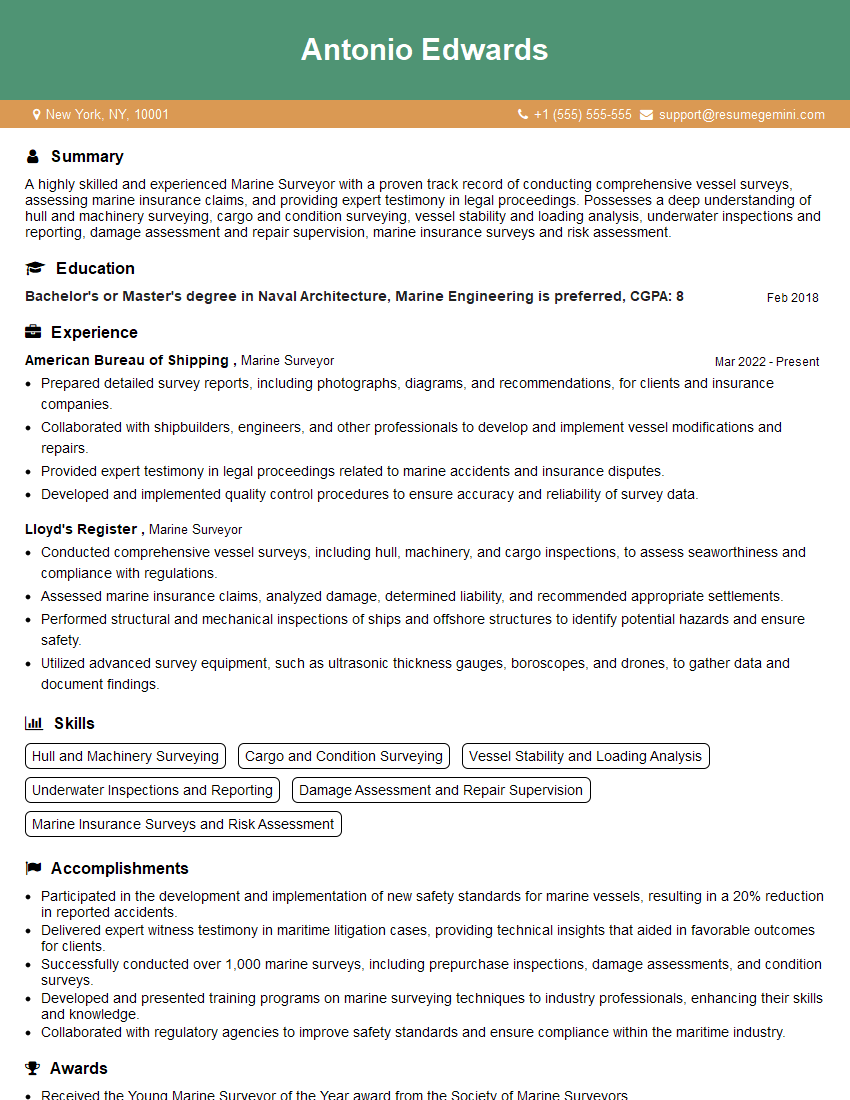
Mastering Marine Equipment Inspection and Certification opens doors to rewarding career opportunities with significant growth potential. A strong understanding of these topics is essential for securing your dream role. To significantly boost your job prospects, it’s vital to create an ATS-friendly resume that highlights your skills and experience effectively. ResumeGemini is a trusted resource that can help you build a professional resume tailored to the specific demands of this field. We offer examples of resumes tailored to Marine Equipment Inspection and Certification to help guide you in crafting a compelling application that stands out.
Explore more articles
Users Rating of Our Blogs
Share Your Experience
We value your feedback! Please rate our content and share your thoughts (optional).
What Readers Say About Our Blog
Very informative content, great job.
good