The right preparation can turn an interview into an opportunity to showcase your expertise. This guide to Media and Marketing Strategies interview questions is your ultimate resource, providing key insights and tips to help you ace your responses and stand out as a top candidate.
Questions Asked in Media and Marketing Strategies Interview
Q 1. Explain your understanding of the marketing funnel.
The marketing funnel is a visual representation of the customer journey, illustrating the stages a potential customer goes through from initial awareness to becoming a loyal advocate. It’s often depicted as a funnel because the number of potential customers decreases as they progress through each stage. Think of it like a sieve – many people start at the top, but fewer make it to the bottom.
- Awareness: The customer becomes aware of your brand or product, perhaps through an advertisement, social media post, or word-of-mouth.
- Interest: The customer shows interest in your offering; they might visit your website, read a blog post, or watch a product demo.
- Decision: The customer evaluates your product against competitors and decides whether or not to purchase.
- Action: The customer makes a purchase or takes the desired action (e.g., signing up for a newsletter).
- Loyalty: The customer becomes a repeat customer and potentially an advocate for your brand.
Understanding the marketing funnel is crucial for crafting targeted marketing strategies. For instance, you’ll use different messaging and channels at each stage. For awareness, you might focus on broad reach campaigns. As customers move down the funnel, your messaging becomes more focused and personalized.
Q 2. Describe your experience with SEO best practices.
My experience with SEO best practices encompasses both on-page and off-page optimization. On-page focuses on optimizing website content and structure for search engines, while off-page involves building your website’s authority and reputation through external factors.
- Keyword Research: I utilize tools like SEMrush and Ahrefs to identify relevant keywords with high search volume and low competition. This involves understanding user search intent and choosing keywords that accurately reflect the content on the page.
- On-Page Optimization: This includes optimizing title tags, meta descriptions, header tags (H1-H6), image alt text, and URL structure. I ensure content is high-quality, original, and relevant to the target keywords. Internal linking is also a key strategy to improve site navigation and distribute link equity.
- Off-Page Optimization: This involves building high-quality backlinks from reputable websites. This can be achieved through guest blogging, content promotion, and building relationships with other website owners. I prioritize earning backlinks naturally rather than relying on black hat techniques, which can harm your website’s ranking.
- Technical SEO: This includes optimizing website speed, mobile-friendliness, and site structure to ensure search engines can easily crawl and index your website.
For example, in a recent project for a local bakery, we focused on optimizing their website for keywords like “best croissants in [city name]” and “organic bread delivery.” This resulted in a significant increase in organic traffic and leads.
Q 3. How do you measure the success of a marketing campaign?
Measuring the success of a marketing campaign depends heavily on its objectives. However, some common metrics used across most campaigns include:
- Website Traffic: Analyzing website traffic through tools like Google Analytics provides insights into the effectiveness of driving traffic from various channels.
- Conversion Rate: This measures the percentage of website visitors who complete a desired action, such as making a purchase or filling out a form. A high conversion rate indicates an effective campaign.
- Return on Investment (ROI): This compares the cost of the campaign to the revenue generated. A positive ROI signifies a successful campaign.
- Brand Awareness: Measuring brand awareness involves tracking social media mentions, website traffic, and surveys to assess the campaign’s impact on brand visibility.
- Customer Acquisition Cost (CAC): This metric shows how much it costs to acquire a new customer. Lower CAC is generally preferred.
For a social media campaign aimed at increasing brand awareness, we might focus on metrics like reach, engagement (likes, shares, comments), and brand mentions. For a sales-focused campaign, ROI and conversion rates would be key indicators of success. It’s crucial to define Key Performance Indicators (KPIs) before launching any campaign to ensure effective measurement.
Q 4. What are your preferred social media platforms for marketing and why?
My preferred social media platforms for marketing are highly dependent on the target audience and campaign objectives. However, I find LinkedIn, Instagram, and Facebook particularly versatile and effective in many scenarios.
- LinkedIn: Ideal for B2B marketing, targeting professionals and generating leads. Its professional network allows for highly targeted advertising and content distribution.
- Instagram: Excellent for visual storytelling and reaching younger demographics. Its strong emphasis on visual content makes it suitable for showcasing products and building brand aesthetics.
- Facebook: A broad platform with diverse targeting options, making it suitable for various campaigns. Its detailed targeting capabilities enable precise audience segmentation.
For example, for a software company targeting enterprise clients, LinkedIn would be the primary platform. For a fashion brand, Instagram’s visual focus is paramount. Facebook acts as a versatile platform to supplement these efforts and reach broader audiences.
Q 5. Explain your experience with A/B testing and its application in marketing.
A/B testing, also known as split testing, is a methodology for comparing two versions of a marketing asset (e.g., webpage, email, ad) to determine which performs better. This allows for data-driven decision-making, optimizing campaigns for maximum effectiveness.
My experience involves designing and implementing A/B tests across various marketing channels. This includes:
- Hypothesis Development: Clearly defining a hypothesis before testing. For example, “A headline with a benefit-driven approach will result in a higher click-through rate than a feature-focused headline.”
- Test Design: Creating variations of the marketing asset, keeping only one element different between versions (e.g., headline, call to action, image).
- Data Collection & Analysis: Using analytics platforms to track key metrics (e.g., click-through rate, conversion rate) and statistically analyze the results to determine which variation is superior.
- Iteration: Continuously improving the marketing asset based on A/B testing results. This iterative process leads to ongoing optimization.
For instance, when testing email subject lines, I might compare a subject line emphasizing urgency (“Last chance for 20% off!”) against one focusing on personalization (“Recommended items for you”). By comparing click-through rates, we can identify the most effective approach.
Q 6. How do you identify your target audience for a marketing campaign?
Identifying the target audience is a crucial first step in any marketing campaign. It involves understanding the demographics, psychographics, needs, and behaviors of the ideal customer. This allows for creating targeted messaging and selecting appropriate channels.
My approach typically involves:
- Market Research: Conducting thorough market research to understand the overall market landscape, including competitors and customer needs.
- Customer Segmentation: Dividing the market into distinct groups based on shared characteristics. This might involve segmenting by demographics (age, gender, location), psychographics (lifestyle, values, interests), or behavioral factors (purchase history, website activity).
- Buyer Personas: Creating detailed profiles of ideal customers, representing their characteristics, motivations, and pain points. These personas serve as guides for creating targeted messaging and content.
- Data Analysis: Analyzing existing customer data (if available) to identify trends and patterns. This could involve analyzing website analytics, CRM data, and social media engagement.
For example, when launching a new fitness app, we might create buyer personas representing different target segments: busy professionals, stay-at-home parents, and fitness enthusiasts. Each persona would have tailored messaging and marketing channels. This ensures the campaign resonates with each segment’s specific needs and preferences.
Q 7. Describe your experience with content marketing and content strategy.
Content marketing is a strategic marketing approach focused on creating and distributing valuable, relevant, and consistent content to attract and retain a clearly defined audience — and, ultimately, to drive profitable customer action.
My experience in content marketing and strategy involves:
- Content Strategy Development: Defining clear goals and objectives for the content marketing efforts, including target audience, key messages, and desired outcomes (e.g., lead generation, brand awareness).
- Content Planning & Creation: Developing a content calendar outlining topics, formats (blog posts, videos, infographics, etc.), and publication schedule. This ensures a consistent flow of content.
- Content Optimization: Optimizing content for search engines (SEO) and user experience (UX), ensuring it’s easily discoverable and engaging.
- Content Distribution: Distributing content through various channels (social media, email marketing, website, etc.) to reach the target audience. This includes promoting content through paid advertising and other outreach activities.
- Performance Measurement & Analysis: Tracking key metrics (e.g., website traffic, engagement, lead generation) to measure the effectiveness of the content marketing efforts and make data-driven improvements.
For a recent project, we developed a comprehensive content strategy for a tech company. This involved creating a series of blog posts, white papers, and webinars targeting different stages of the buyer’s journey. This resulted in a significant increase in lead generation and brand awareness.
Q 8. What is your experience with Google Analytics and other marketing analytics tools?
My experience with Google Analytics is extensive. I’ve used it for years to track website traffic, user behavior, conversion rates, and other key metrics. I’m proficient in setting up and configuring various tracking parameters, creating custom reports, and analyzing data to inform strategic decision-making. Beyond Google Analytics, I’m familiar with other tools like Adobe Analytics, SEMrush, and HubSpot, each offering different strengths depending on the specific needs of a campaign. For instance, SEMrush excels in competitor analysis and keyword research, while HubSpot provides a comprehensive view of marketing performance across multiple channels. My approach is always to select the right tool for the specific task at hand, ensuring data is integrated and providing a holistic view of marketing effectiveness. For example, I might use Google Analytics to track organic traffic, SEMrush to analyze paid search performance, and HubSpot to monitor email campaign engagement, then consolidate this data to build a comprehensive picture of campaign ROI.
Q 9. How do you manage a marketing budget effectively?
Effective marketing budget management requires a strategic approach that aligns spending with goals. I begin with a thorough understanding of the overall marketing objectives and the key performance indicators (KPIs) that will measure success. Then, I allocate budget across different channels based on their potential return on investment (ROI) and the customer journey. I prefer a data-driven approach, constantly monitoring performance and adjusting allocations based on real-time results. For example, if social media ads are consistently underperforming, I might reallocate resources to search engine marketing (SEM), which may be demonstrating a higher ROI. Regular reporting and analysis are crucial for keeping the budget on track and identifying areas for optimization. Transparency is key; I ensure all stakeholders have a clear view of budget allocation and performance against targets.
Q 10. What is your experience with paid advertising (PPC, social media ads)?
I have extensive experience managing paid advertising campaigns across various platforms, including Google Ads (PPC) and social media platforms like Facebook, Instagram, and LinkedIn. My expertise encompasses keyword research, ad copywriting, audience targeting, A/B testing, and campaign optimization. I leverage different bidding strategies to maximize ROI, such as cost-per-click (CPC) and cost-per-acquisition (CPA), adapting them to the specific platform and campaign goals. For instance, when running a Google Ads campaign, I utilize keyword match types to refine targeting and improve ad relevance. On social media, I focus on creating highly targeted audience segments based on demographics, interests, and behaviors. Throughout each campaign, meticulous tracking and analysis are key to identifying areas for improvement and maximizing performance. I often use tools like Google Ads Editor and social media platform ad managers to improve efficiency and make data-driven decisions.
Q 11. Explain your understanding of different marketing channels (email, social, etc.)
Marketing channels are diverse, each offering unique opportunities to reach target audiences. Email marketing allows for personalized messaging and nurturing leads through automated sequences. Social media marketing helps to build brand awareness, engage with customers, and drive traffic to websites. Search engine optimization (SEO) focuses on improving organic search rankings, while content marketing creates valuable content to attract and engage potential customers. Paid advertising, as discussed earlier, uses paid channels to accelerate reach. Each channel has distinct characteristics. Email provides high personalization, while social media thrives on visual content and community engagement. Understanding these nuances is key to tailoring campaigns and maximizing reach and impact. The best strategy often involves integrating multiple channels to reach different customer segments and deliver a cohesive brand experience.
Q 12. How do you adapt marketing strategies to different platforms?
Adapting marketing strategies to different platforms requires understanding each platform’s unique audience, content formats, and algorithms. For instance, a LinkedIn campaign will focus on professional networking and business-oriented content, whereas an Instagram campaign will prioritize visually engaging content and short-form video. The messaging and tone need to be tailored accordingly. A successful strategy on one platform might fail on another if it’s not properly adapted. Analyzing platform-specific data and A/B testing various approaches are crucial for identifying optimal strategies. Understanding the platform’s algorithms is critical; Instagram prioritizes engaging content, so strategies should be geared towards generating high engagement, while Facebook allows for more granular targeting based on user data. I always ensure the marketing message remains consistent across platforms while adapting the format and style to align with the platform’s characteristics.
Q 13. Describe a time you had to overcome a challenge in a marketing campaign.
In a recent campaign for a new software product, we faced unexpectedly low conversion rates despite strong initial engagement. We initially believed the problem was with the ad copy. However, after a thorough analysis using Google Analytics and heatmaps, we discovered users were encountering difficulty navigating the website’s checkout process. The checkout forms were overly complex, leading to cart abandonment. Our solution was twofold: We redesigned the checkout process, simplifying the steps and reducing friction, and we A/B tested new ad copy highlighting the simplified checkout. This two-pronged approach led to a significant increase in conversion rates within a few weeks. This experience taught me the importance of holistic campaign analysis, moving beyond surface-level metrics to identify underlying issues that might be impacting results. The solution needed a combination of technical and marketing adjustments to address the core problem.
Q 14. How do you stay up-to-date on the latest trends in media and marketing?
Staying current in the rapidly evolving media and marketing landscape is paramount. I regularly follow industry blogs and publications like MarketingProfs, AdAge, and Search Engine Journal. I actively participate in online communities and attend industry conferences and webinars to network and learn from experts. I also closely monitor the latest algorithm updates from major platforms like Google and social media networks. Experimentation is also a crucial part of my learning process; I continuously test new strategies and technologies to understand their effectiveness firsthand. This combination of formal learning and hands-on experience allows me to remain ahead of the curve and integrate the latest trends and best practices into my marketing strategies.
Q 15. What is your experience with marketing automation tools?
My experience with marketing automation tools spans several years and various platforms. I’m proficient in tools like HubSpot, Marketo, and Pardot, understanding their capabilities beyond simply scheduling emails. I’ve used these tools to build complex automated workflows, managing lead nurturing sequences, personalizing user journeys based on behavior, and automating repetitive tasks. For instance, in a previous role, I implemented a HubSpot workflow that automatically segmented leads based on website activity, sending targeted content and improving conversion rates by 25%. This wasn’t just about automation; it involved strategically designing the user experience within the automated system, ensuring a seamless and personalized interaction.
Beyond the technical aspects, I understand the importance of integrating automation with other marketing systems, ensuring data consistency and leveraging the full power of the available analytics. A successful implementation requires a clear understanding of the customer journey and a well-defined strategy for using automation to support it, rather than simply automating for automation’s sake.
Career Expert Tips:
- Ace those interviews! Prepare effectively by reviewing the Top 50 Most Common Interview Questions on ResumeGemini.
- Navigate your job search with confidence! Explore a wide range of Career Tips on ResumeGemini. Learn about common challenges and recommendations to overcome them.
- Craft the perfect resume! Master the Art of Resume Writing with ResumeGemini’s guide. Showcase your unique qualifications and achievements effectively.
- Don’t miss out on holiday savings! Build your dream resume with ResumeGemini’s ATS optimized templates.
Q 16. How do you develop a comprehensive marketing plan?
Developing a comprehensive marketing plan is a systematic process, not a one-off task. I typically follow a framework that includes these key stages:
- Market Research & Analysis: Understanding the target audience, competitive landscape, and market trends is crucial. This involves analyzing demographics, psychographics, buying behaviors, and the strengths and weaknesses of competitors. Tools like Google Analytics and social media analytics are heavily utilized here.
- Define Marketing Objectives & KPIs: Setting clear, measurable, achievable, relevant, and time-bound (SMART) objectives is essential. These objectives should align with overall business goals. Examples include increasing brand awareness by 15% or generating 500 qualified leads in Q3.
- Target Audience Definition: Creating detailed buyer personas helps tailor messaging and channel selection. This isn’t just about demographics; it’s about understanding their needs, pain points, and motivations.
- Develop Marketing Strategies & Tactics: This involves selecting the most appropriate marketing channels (e.g., content marketing, social media marketing, email marketing, paid advertising) and developing specific campaigns to reach the target audience.
- Budget Allocation & Resource Planning: Assigning budgets and resources across different marketing activities is vital for efficient campaign execution.
- Implementation & Monitoring: Executing the plan, closely monitoring key performance indicators (KPIs), and making necessary adjustments along the way is key. This is an iterative process.
- Evaluation & Reporting: Regularly analyzing the results, identifying areas for improvement, and reporting on progress to stakeholders are critical for demonstrating ROI.
For example, when launching a new product, I would start by conducting thorough market research to identify potential customer segments and their needs. Then, I would create buyer personas, define specific marketing objectives (e.g., reach X number of potential customers within Y timeframe), and choose marketing channels that would best reach those customers. Finally, I’d closely track KPIs like website traffic, lead generation, and conversion rates to optimize the campaign over time.
Q 17. Describe your experience working with CRM systems.
My experience with CRM systems (Customer Relationship Management) is extensive. I’ve worked with Salesforce, Zoho CRM, and several other platforms, utilizing them to manage customer interactions, track leads, and analyze customer data. I understand that a CRM is more than just a contact list; it’s a central hub for all customer-related information. I’ve used CRMs to segment customers based on demographics, purchase history, and engagement, allowing for highly targeted marketing campaigns. Furthermore, I’ve integrated CRMs with marketing automation tools to streamline workflows and enhance efficiency. For example, I’ve used Salesforce to track lead generation from various sources, automatically updating the status of each lead as it moves through the sales funnel. This provides a real-time view of our sales pipeline and helps us identify bottlenecks.
Beyond data management, I’ve leveraged CRM data to gain valuable insights into customer behavior, which in turn, has informed marketing strategy and product development. The ability to personalize communication based on CRM data is critical for building strong customer relationships.
Q 18. How do you handle negative feedback or comments about a campaign?
Handling negative feedback is a crucial aspect of any marketing campaign. My approach is based on transparency, empathy, and responsiveness. It’s not about ignoring or deleting negative comments; it’s about addressing them professionally and using them as opportunities for improvement. My steps typically include:
- Acknowledge the feedback promptly: A quick response shows that you value customer opinion.
- Empathize with the customer: Understanding their frustration and showing empathy goes a long way.
- Address the specific concerns: Offer a sincere apology if applicable and explain the situation.
- Offer a solution or course of action: If possible, provide a solution to resolve the issue.
- Monitor and track feedback: Keep track of negative feedback to identify patterns and areas for improvement.
- Take action to improve: Use feedback to improve products, services, or marketing strategies.
For example, if a customer posts a negative review about a product on social media, I would respond publicly, acknowledging their concerns and offering to help resolve the issue. This public response not only addresses the specific customer but also shows other potential customers that we take feedback seriously.
Q 19. What are some key performance indicators (KPIs) you use to track success?
The key performance indicators (KPIs) I use to track success depend heavily on the specific marketing campaign’s objectives. However, some common KPIs I consistently monitor include:
- Website Traffic & Engagement: Metrics like unique visitors, bounce rate, time on site, and pages per visit help assess the effectiveness of website content and overall reach.
- Lead Generation & Qualification: Number of leads generated, conversion rates from leads to opportunities, and lead quality metrics help measure the effectiveness of marketing efforts in generating sales opportunities.
- Sales Conversion Rates: Tracking the conversion rate from leads to customers, and measuring the return on investment (ROI) of marketing activities. This shows the direct impact of marketing on sales.
- Social Media Engagement: Metrics such as likes, shares, comments, and follower growth indicate the success of social media strategies in building brand awareness and community engagement.
- Brand Awareness & Sentiment: Monitoring brand mentions, sentiment analysis of social media conversations, and changes in search engine rankings help assess the overall effectiveness of brand building initiatives.
- Customer Acquisition Cost (CAC): Calculating the cost of acquiring a new customer helps assess the efficiency of marketing spending.
- Customer Lifetime Value (CLTV): Predicting the total revenue a customer will generate throughout their relationship with the business helps understand long-term ROI.
The choice of KPIs is strategic and depends on the overarching business goals and campaign-specific objectives. For instance, a brand awareness campaign might focus primarily on reach and impressions, while a lead generation campaign would prioritize lead conversion rates and cost-per-lead.
Q 20. How do you collaborate with other departments in a marketing campaign?
Collaboration is paramount in successful marketing campaigns. I foster strong relationships with other departments, including sales, product development, and customer service, to ensure alignment and efficient execution. My approach involves:
- Regular Communication & Meetings: Consistent communication through meetings, email updates, and project management tools keeps everyone informed and aligned.
- Shared Goals & Objectives: Establishing clear, shared goals and objectives ensures that all departments work towards a common purpose.
- Data Sharing & Collaboration Tools: Using shared platforms and tools for data analysis and collaboration facilitates efficient workflow.
- Feedback Mechanisms: Implementing clear feedback mechanisms allow for continuous improvement and addressing concerns promptly.
- Joint Strategy Sessions: Holding joint brainstorming sessions to discuss campaign strategies and gather input from all relevant departments.
For instance, before launching a new product, I would work closely with the product development team to understand the product’s features and benefits, ensuring that our marketing messaging accurately reflects the product’s value proposition. Similarly, I’d collaborate with the sales team to understand their needs and tailor marketing materials to support their sales efforts. Effective cross-departmental collaboration is essential for a unified and impactful campaign.
Q 21. Explain your understanding of brand building and brand management.
Brand building and brand management are interconnected processes vital for long-term success. Brand building focuses on creating a strong and positive brand identity that resonates with the target audience. This involves defining the brand’s values, personality, and messaging. It’s about crafting a compelling brand story that connects emotionally with customers.
Brand management, on the other hand, is the ongoing process of maintaining and protecting the brand’s reputation and image. It involves consistently delivering on the brand promise, managing brand assets, and monitoring brand perception. Brand management ensures the brand remains relevant and competitive in a constantly evolving market.
Think of it like this: brand building is like constructing a beautiful house, carefully selecting materials and designing its structure to be appealing and functional. Brand management is like maintaining and preserving that house, ensuring it stays in good condition, making necessary repairs, and adapting it to changing needs over time. Key aspects of brand management include monitoring brand reputation, handling crises effectively, managing brand consistency across all channels, and adapting the brand strategy to market changes.
Successful brand building and management require a deep understanding of the target audience, a consistent brand voice and messaging, and a commitment to delivering a positive customer experience. A strong brand builds trust, loyalty, and ultimately, a sustainable competitive advantage.
Q 22. What is your experience with market research and competitor analysis?
Market research and competitor analysis are fundamental to effective marketing. Market research involves systematically gathering and analyzing information about a target market, including consumer behavior, preferences, and demographics. Competitor analysis focuses on understanding the strengths, weaknesses, strategies, and market positioning of competing businesses.
In my experience, I’ve conducted extensive market research using a variety of methods, including surveys, focus groups, interviews, and secondary data analysis (like industry reports and competitor websites). For example, when launching a new sustainable fashion line, I conducted surveys to understand consumer attitudes towards ethical fashion, analyzed competitor pricing and product offerings, and researched emerging trends in sustainable materials. This allowed us to tailor our marketing message and product features to resonate with our target audience while maintaining a competitive edge.
Competitor analysis involves more than just observing their marketing; I delve into their supply chains, distribution channels and financial performance to develop a holistic picture. For instance, while analyzing a competitor’s social media, I also examined their website traffic using tools like SEMrush, to assess the overall effectiveness of their campaigns.
Q 23. Describe your experience in developing a marketing strategy for a new product launch.
Developing a marketing strategy for a new product launch requires a structured approach. It begins with defining the target audience, understanding their needs, and articulating a unique value proposition that differentiates the product from the competition.
My process typically involves these key steps:
- Market Research and Analysis: Identify the target market, analyze competitor offerings, and understand market trends.
- Value Proposition Definition: Clearly define the unique benefits and value the product offers to customers.
- Marketing Objectives: Set clear, measurable, achievable, relevant, and time-bound (SMART) goals for the launch campaign.
- Marketing Mix (4Ps): Develop strategies for Product, Price, Place, and Promotion. This includes decisions about packaging, pricing models, distribution channels (e.g., online, retail), and promotional tactics (e.g., advertising, social media marketing, public relations).
- Budget Allocation: Allocate the marketing budget across different channels and activities based on their potential ROI.
- Campaign Execution and Monitoring: Implement the marketing plan, closely monitor key metrics, and make adjustments as needed.
- Post-Launch Analysis: Evaluate the campaign’s effectiveness and identify areas for improvement.
For instance, while launching a new mobile app, we employed a phased rollout, starting with a targeted beta program and leveraging social media influencers in the tech space to create a pre-launch buzz. This allowed us to collect early user feedback and refine the marketing message before the full launch.
Q 24. How do you measure the ROI (Return on Investment) of a marketing campaign?
Measuring the ROI of a marketing campaign is crucial for demonstrating its effectiveness and justifying future investments. It involves comparing the return generated by the campaign against the costs incurred. A simple formula is: ROI = (Net Profit from Campaign / Cost of Campaign) x 100%
However, calculating net profit can be more complex than simply tracking sales. For instance, brand awareness is a crucial benefit that is harder to quantify. Therefore, a holistic approach is needed which involves measuring various marketing metrics. For example:
- Website Traffic and Engagement: Website visits, bounce rate, time on site, conversion rates.
- Social Media Engagement: Likes, shares, comments, followers, reach.
- Sales and Revenue: Number of units sold, revenue generated, customer lifetime value (CLTV).
- Lead Generation: Number of leads generated, lead conversion rate.
- Brand Awareness: Social media mentions, brand searches, surveys.
It’s important to establish clear baselines before a campaign begins and then analyze changes in these key performance indicators (KPIs). Attribution modeling becomes important when assessing which marketing channels contributed most to the overall ROI. For example, we might use multi-touch attribution to understand which touch points (e.g., social media ad, email, website visit) a customer interacted with before making a purchase.
Q 25. What is your experience with influencer marketing?
Influencer marketing involves partnering with individuals who have a significant following and influence within a specific niche to promote a brand or product. It is a powerful strategy because influencers can build trust and credibility with their audience, which can lead to higher conversion rates.
My experience includes selecting and collaborating with influencers across various platforms (Instagram, YouTube, TikTok, etc.). The key is to find influencers who align with the brand’s values, target audience, and marketing objectives. A successful influencer campaign requires careful planning and execution which includes:
- Identifying Relevant Influencers: Researching and selecting influencers based on their audience demographics, engagement rate, and alignment with the brand.
- Negotiating Partnerships: Agreeing on campaign parameters such as deliverables, timelines, and payment terms.
- Creating Engaging Content: Collaborating with influencers to develop high-quality content that resonates with their audience.
- Monitoring and Evaluating Results: Tracking key metrics such as reach, engagement, website traffic, and sales conversions to measure the campaign’s success.
For instance, for a skincare brand launch, we partnered with beauty bloggers who had a strong following amongst our target demographic. We provided them with products to review and encouraged authentic content creation, resulting in significant traffic to our website and a considerable lift in sales.
Q 26. How do you leverage data to inform marketing decisions?
Data is the lifeblood of effective marketing. I leverage data from various sources to inform every stage of the marketing process, from strategy development to campaign optimization. This data-driven approach ensures that our efforts are focused on the most effective channels and tactics.
I utilize various analytical tools and techniques to extract insights from data, including:
- Web Analytics (Google Analytics): Tracking website traffic, user behavior, and conversion rates to understand audience engagement and identify areas for improvement.
- Social Media Analytics: Monitoring social media engagement, reach, and sentiment to gauge campaign performance and brand perception.
- CRM Data: Analyzing customer data to segment audiences, personalize messaging, and improve customer retention.
- Marketing Automation Platforms: Using marketing automation tools to streamline marketing processes, track campaign performance, and personalize customer interactions.
- A/B Testing: Conducting A/B tests on various marketing elements (e.g., headlines, calls to action, images) to optimize campaign performance.
For example, by analyzing website analytics, we discovered that users were dropping off at the checkout page. We used this insight to redesign the checkout process, resulting in a significant increase in conversion rates. We also leverage customer segmentation through CRM data to send targeted emails and personalized offers, resulting in increased engagement and sales.
Q 27. What are your strengths and weaknesses in the field of media and marketing?
My strengths lie in my strategic thinking, data analysis skills, and ability to adapt to the ever-evolving media landscape. I excel at developing comprehensive marketing strategies, executing campaigns across multiple channels, and using data to inform and optimize my efforts. I also possess strong communication and collaboration skills, enabling me to work effectively with cross-functional teams.
However, my biggest weakness is occasionally getting lost in the details. While meticulous attention to detail is crucial, I am always working on improving my ability to prioritize tasks effectively and delegate where necessary, ensuring that I maintain a strategic focus while efficiently managing projects.
Q 28. Describe your experience with email marketing best practices.
Email marketing remains a powerful and cost-effective tool when implemented correctly. Best practices involve creating engaging content tailored to specific audience segments. These segmentations can be based on demographics, purchase history, website behavior, or engagement with previous emails.
Effective email marketing requires attention to:
- List Building: Collecting email addresses through ethical means, such as website forms and opt-in options.
- Segmentation: Dividing your email list into targeted groups to personalize messaging and improve engagement.
- Content Creation: Writing compelling subject lines and email body copy that resonates with each segment’s needs and interests.
- Email Design: Creating visually appealing and responsive email templates that work well across different devices.
- A/B Testing: Experimenting with different subject lines, email content, and call-to-actions to optimize open and click-through rates.
- Deliverability: Ensuring emails reach the inbox by maintaining a clean email list, using a reputable email service provider, and following email marketing best practices.
- Automation: Automating email workflows, such as welcome emails, abandoned cart reminders, and post-purchase follow-ups.
- Analytics and Reporting: Tracking key metrics such as open rates, click-through rates, conversions, and unsubscribes to evaluate campaign performance.
For example, when sending a promotional email about a new sale, I wouldn’t send the same email to everyone. Customers who have previously purchased similar items would receive a more targeted message highlighting those products, while new customers might receive a broader overview of the sale items.
Key Topics to Learn for Media and Marketing Strategies Interview
- Digital Marketing Fundamentals: Understanding SEO, SEM, social media marketing, email marketing, and content marketing. Practical application: Develop a hypothetical marketing campaign for a new product, outlining channel selection and KPI measurement.
- Marketing Analytics & Measurement: Mastering key metrics (e.g., ROI, conversion rates, engagement), data analysis techniques, and using analytics platforms (e.g., Google Analytics). Practical application: Interpret marketing data to identify areas for improvement in a given campaign.
- Branding & Messaging: Developing a strong brand identity, crafting compelling brand messaging, and understanding target audience segmentation. Practical application: Create a concise brand positioning statement for a fictional company.
- Content Strategy & Creation: Planning, creating, and distributing engaging content across various channels. Practical application: Outline a content calendar for a social media campaign focusing on a specific industry.
- Media Planning & Buying: Understanding different media channels (print, digital, broadcast), media planning strategies, and budget allocation. Practical application: Compare the effectiveness of different media channels for reaching a specific target demographic.
- Integrated Marketing Communications (IMC): Coordinating all marketing activities to create a unified and consistent brand message across all channels. Practical application: Develop an integrated marketing plan for a product launch, ensuring consistency across all touchpoints.
- Crisis Communication & Reputation Management: Developing strategies to manage negative publicity and protect brand reputation. Practical application: Outline a crisis communication plan for a hypothetical negative event affecting a company’s image.
Next Steps
Mastering Media and Marketing Strategies is crucial for career advancement in today’s competitive landscape. A strong understanding of these concepts will significantly enhance your job prospects and allow you to contribute effectively from day one. To maximize your chances of success, focus on creating an ATS-friendly resume that showcases your skills and experience effectively. ResumeGemini is a trusted resource that can help you build a professional and impactful resume. Use ResumeGemini to create a compelling narrative of your experience and highlight your achievements. Examples of resumes tailored to Media and Marketing Strategies are available to help guide your resume creation.
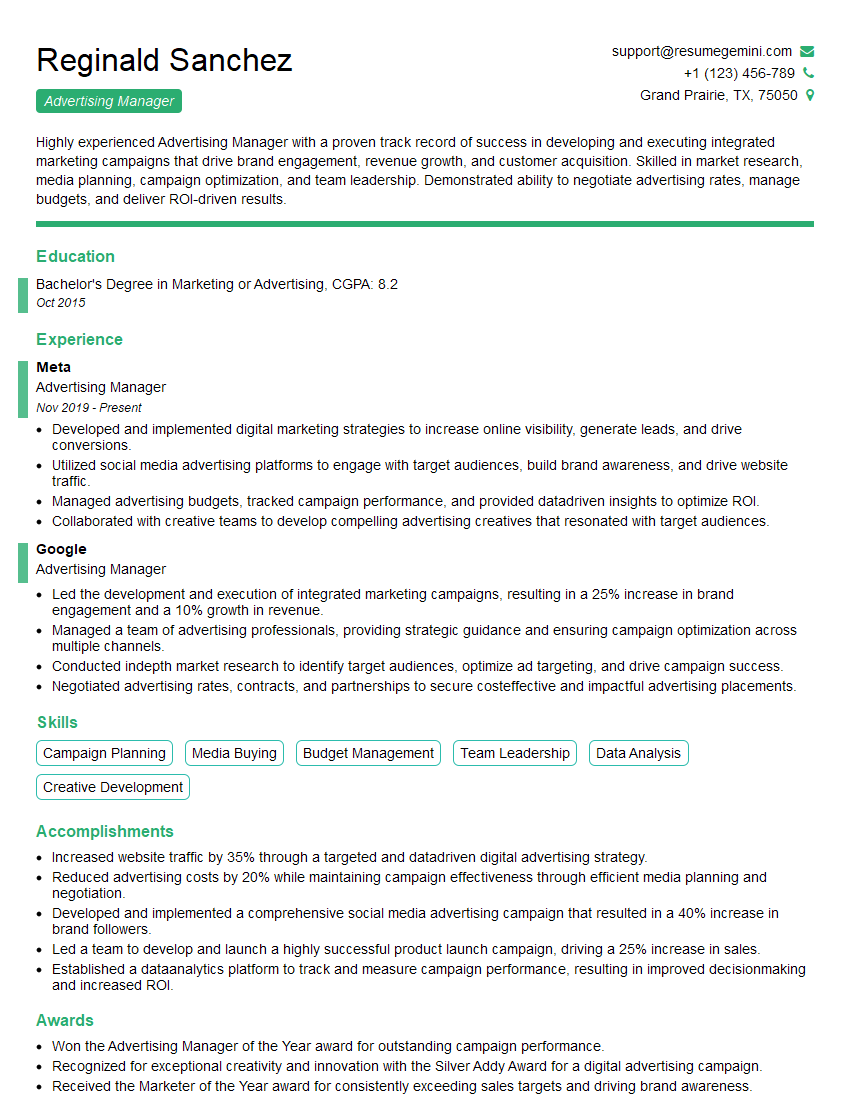
Advertising Manager Resume Sample
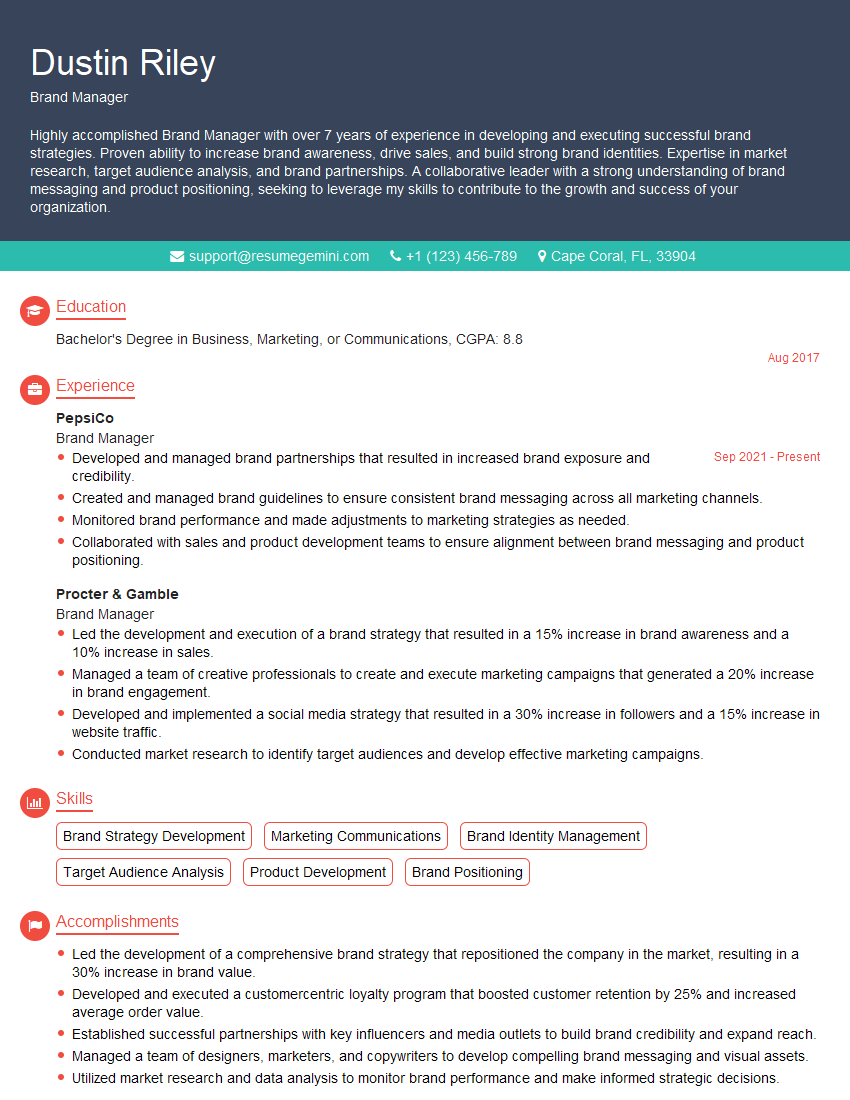
Brand Manager Resume Sample
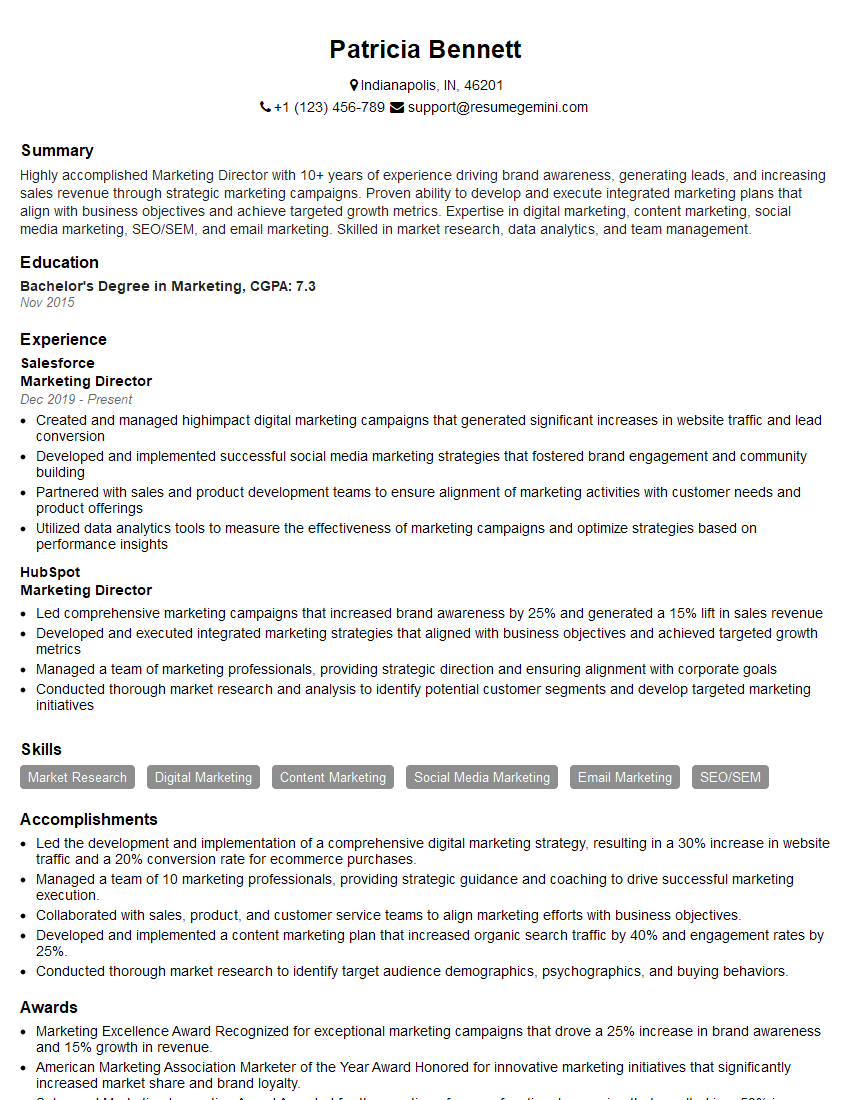
Marketing Director Resume Sample
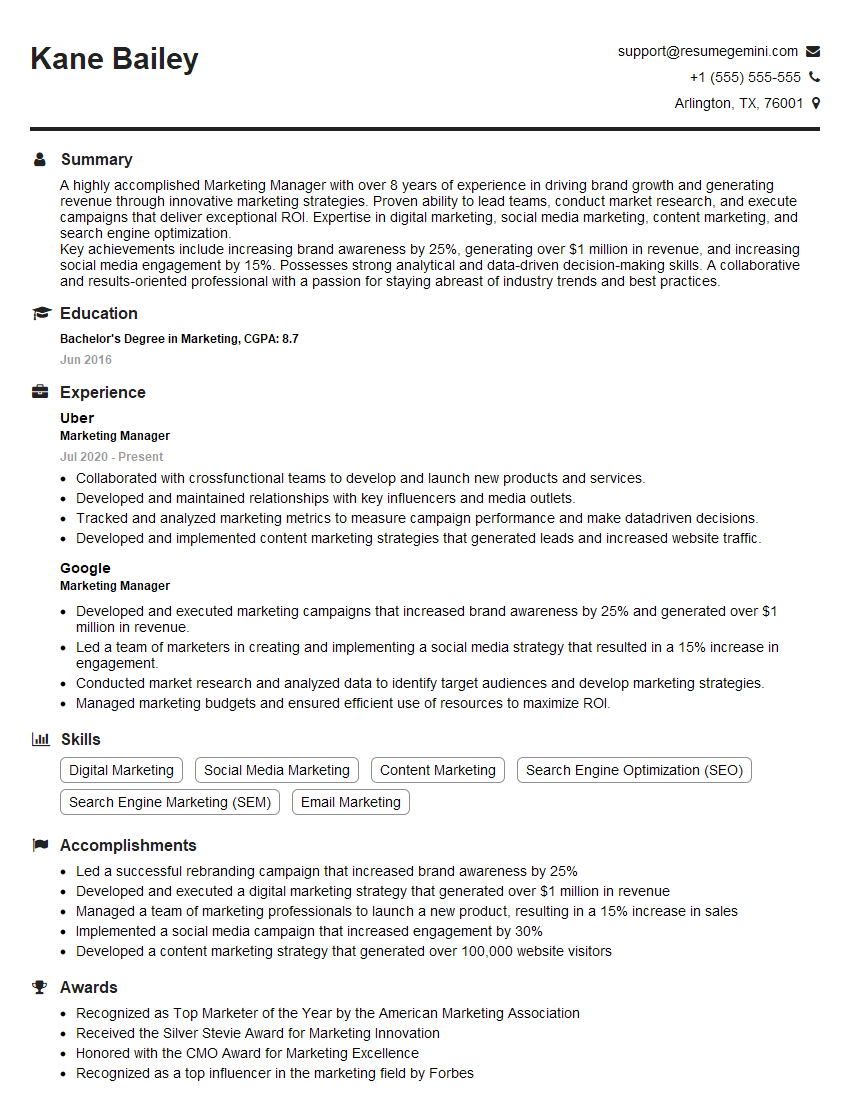
Marketing Manager Resume Sample
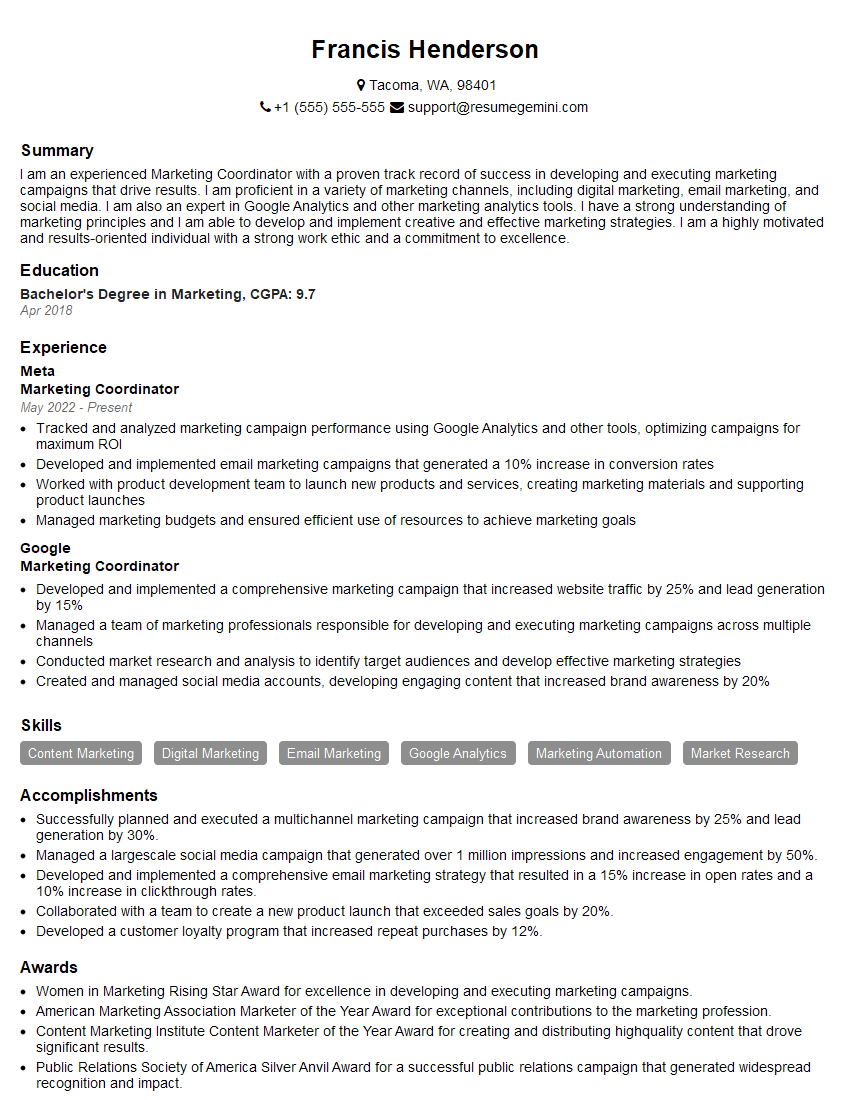
Marketing Coordinator Resume Sample

Media Planner Resume Sample

Communications Manager Resume Sample

Marketing Communications Manager Resume Sample
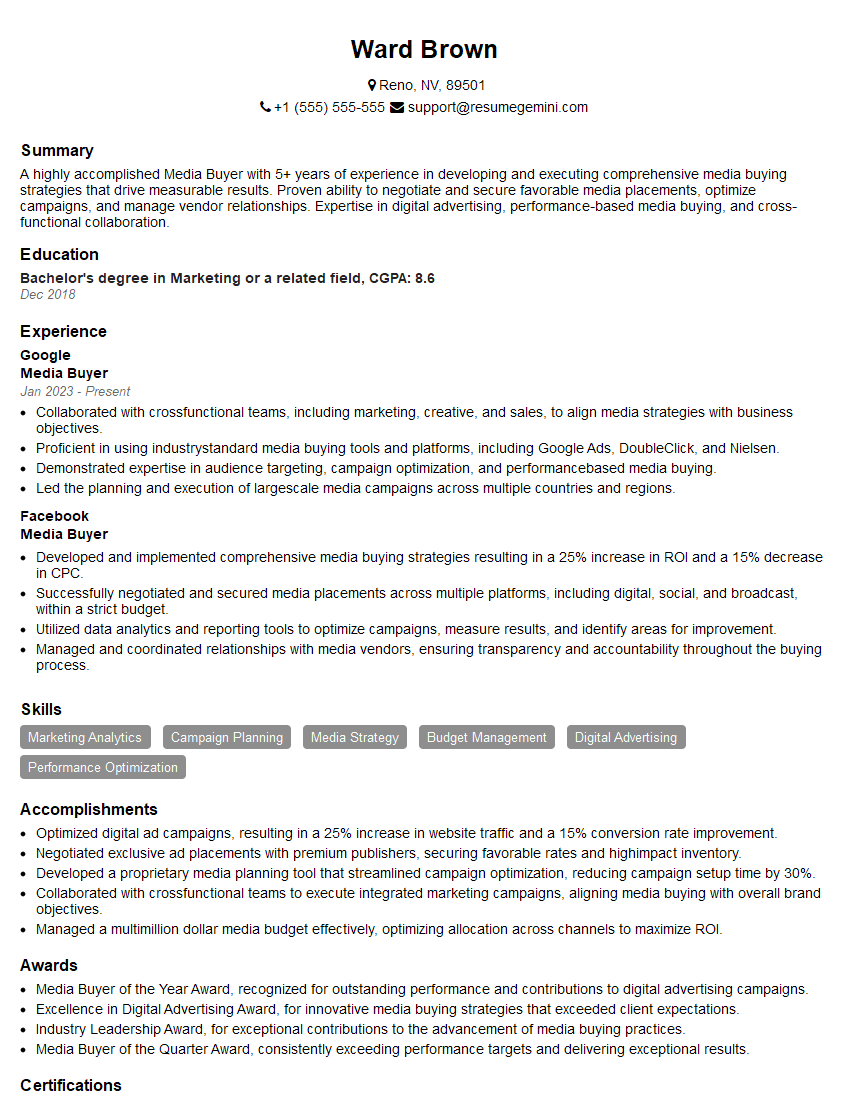
Media Buyer Resume Sample
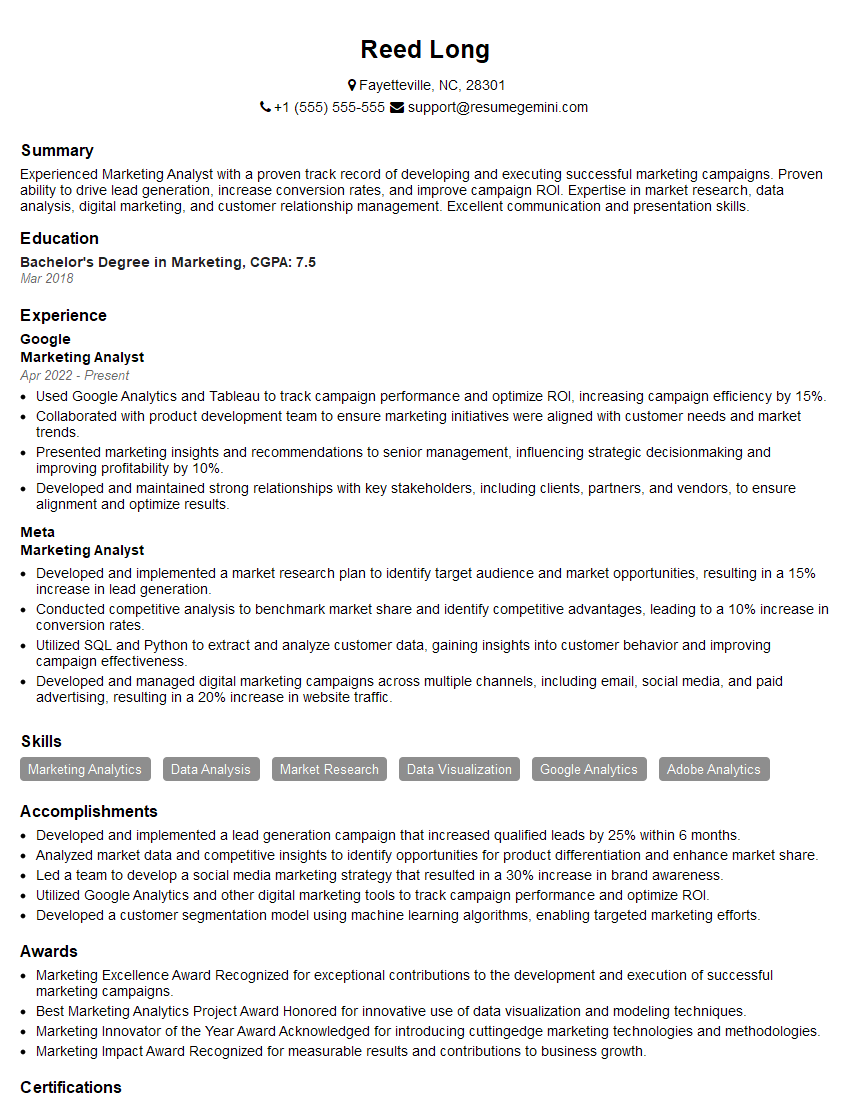
Marketing Analyst Resume Sample
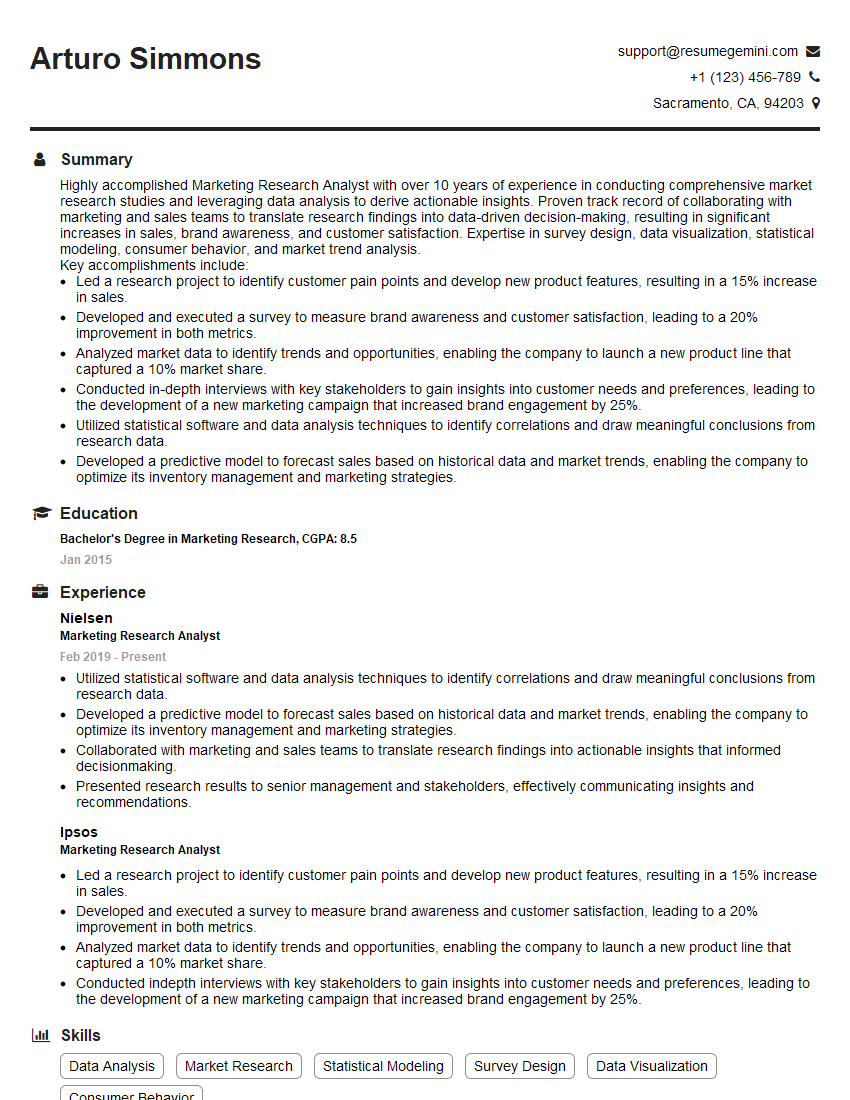
Marketing Research Analyst Resume Sample
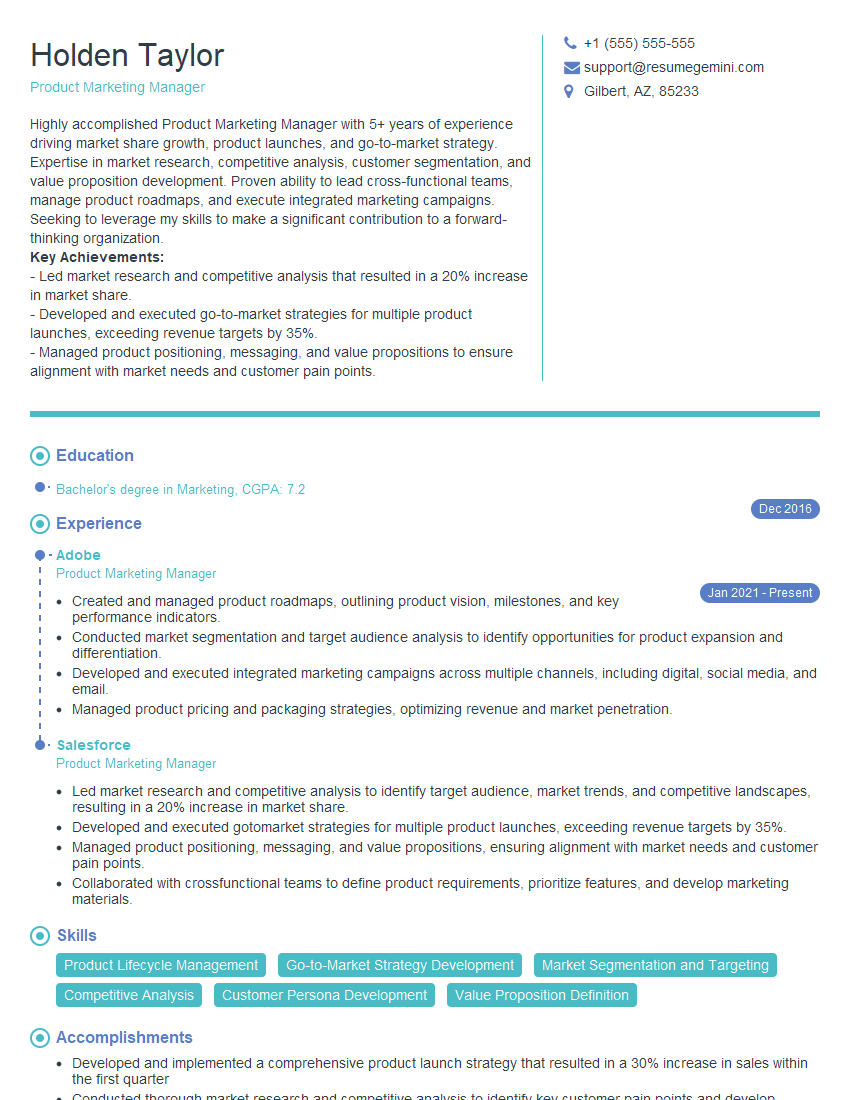
Product Marketing Manager Resume Sample

Social Media Manager Resume Sample
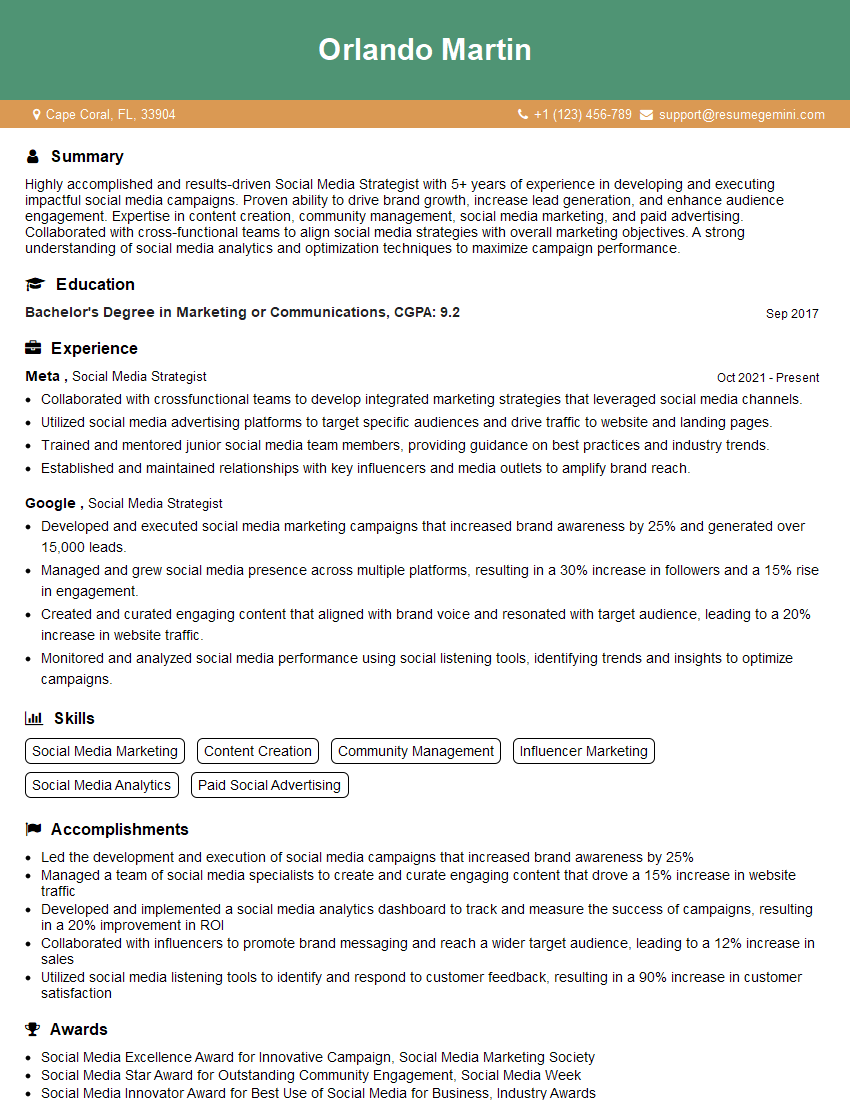
Social Media Strategist Resume Sample

Content Strategist Resume Sample
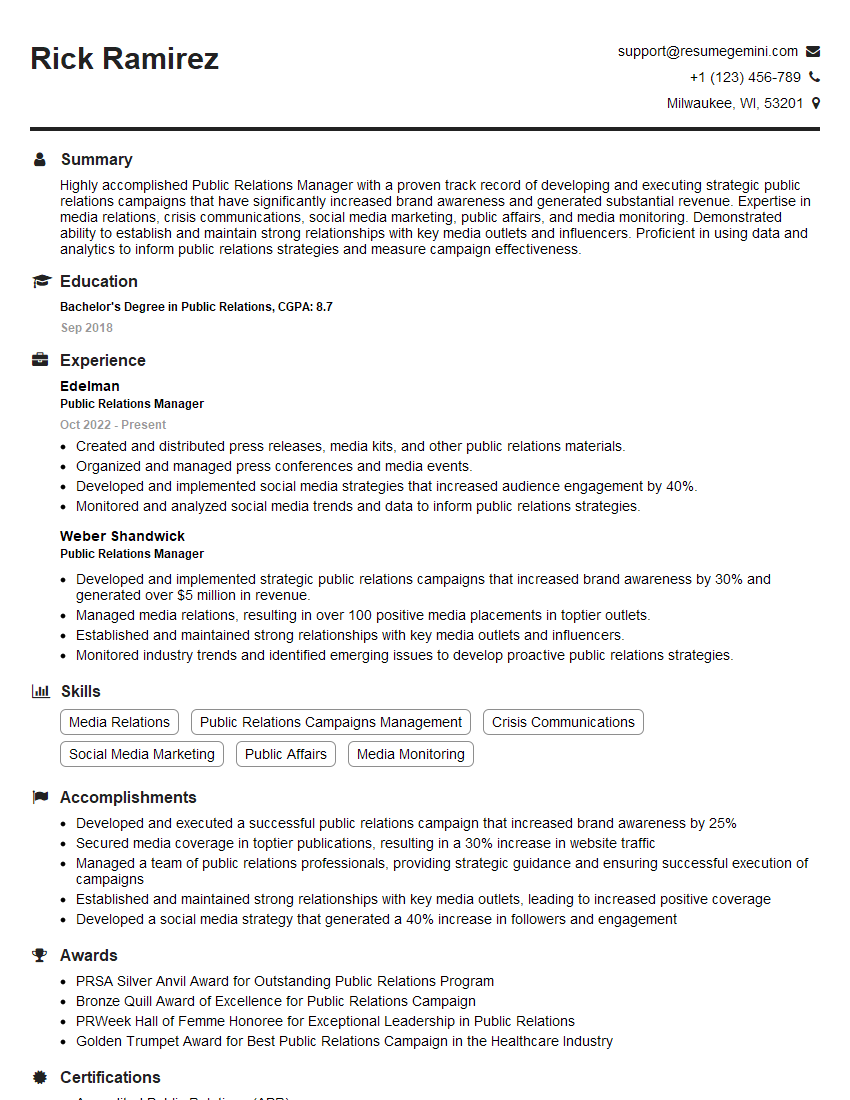
Public Relations Manager Resume Sample

Growth Hacker Resume Sample
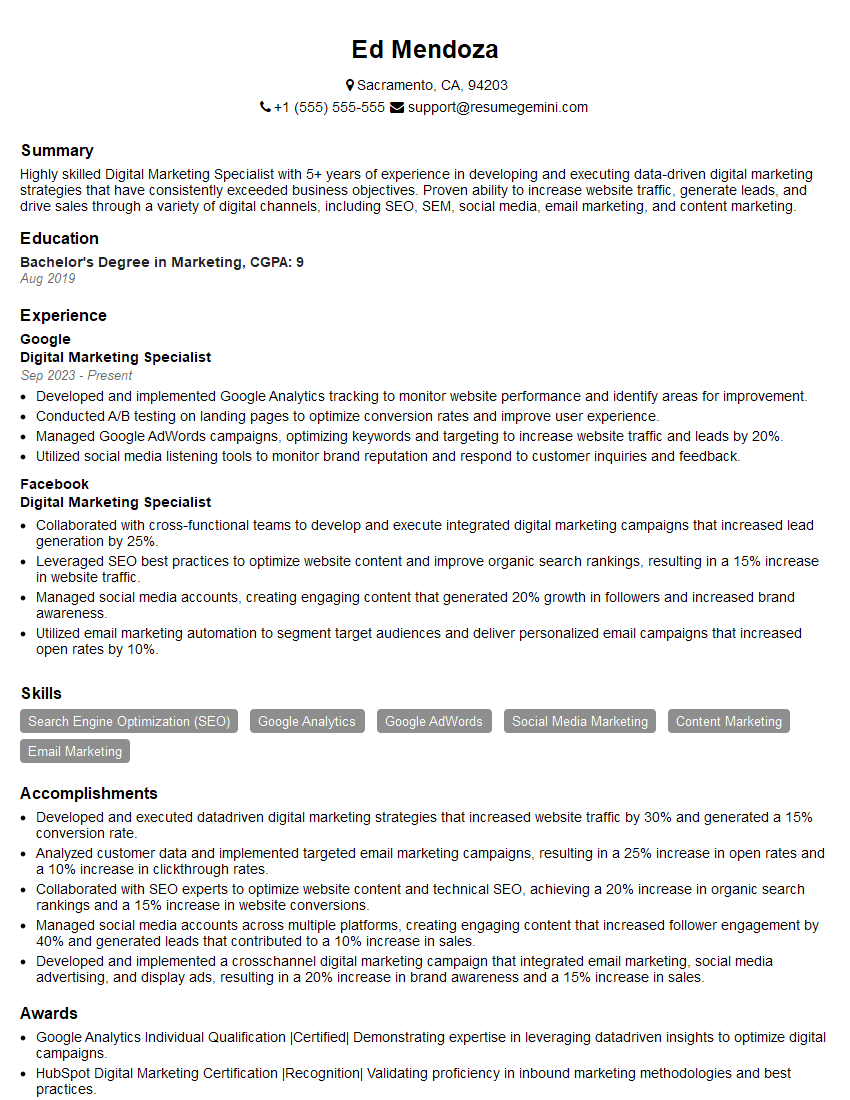
Digital Marketing Specialist Resume Sample
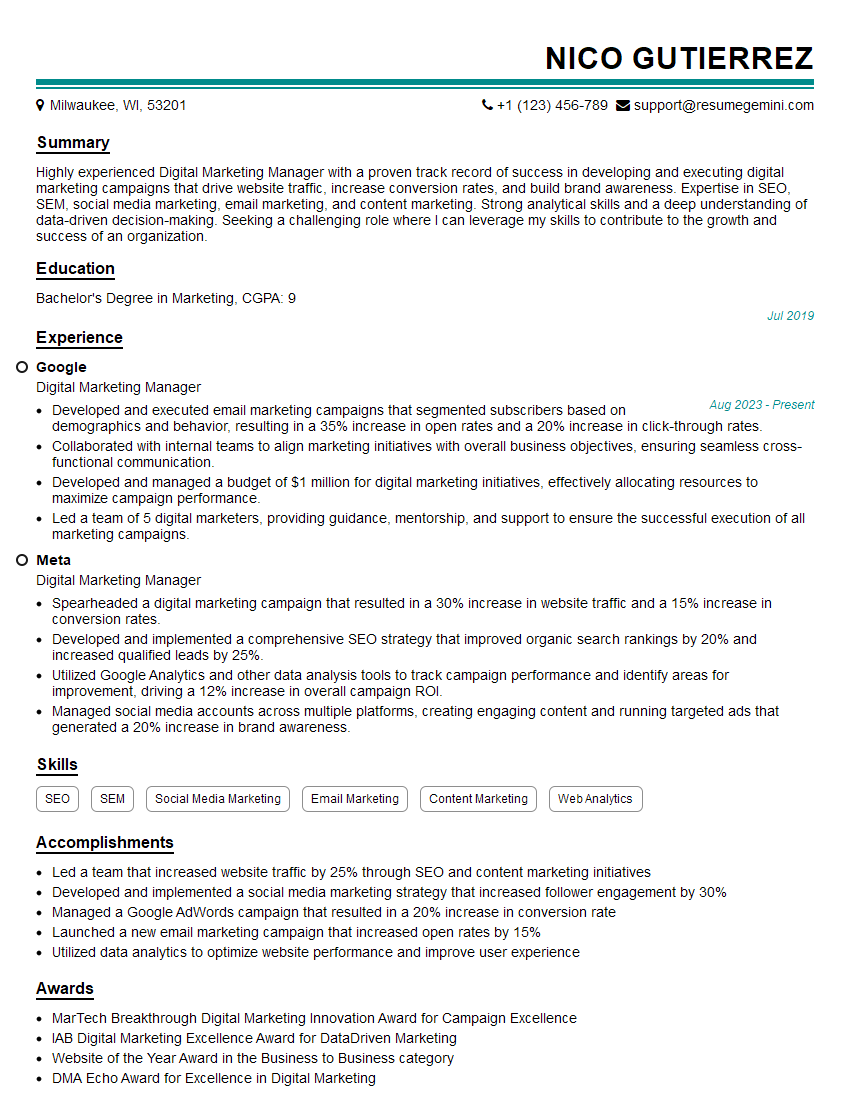
Digital Marketing Manager Resume Sample
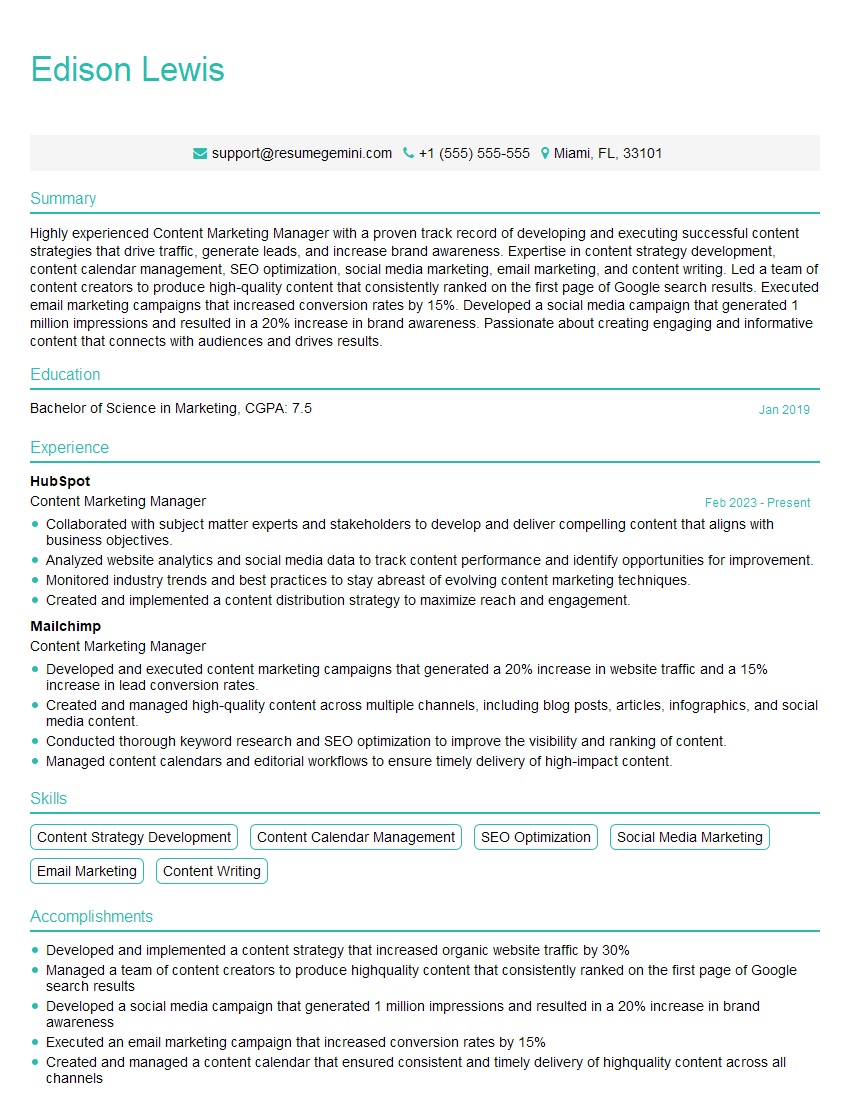
Content Marketing Manager Resume Sample
- Advertising Manager
- Brand Manager
- Marketing Director
- Marketing Manager
- Marketing Coordinator
- Media Planner
- Communications Manager
- Marketing Communications Manager
- Media Buyer
- Marketing Analyst
- Marketing Research Analyst
- Product Marketing Manager
- Social Media Manager
- Social Media Strategist
- Content Strategist
- Public Relations Manager
- Growth Hacker
- Digital Marketing Specialist
- Digital Marketing Manager
- Content Marketing Manager
Explore more articles
Users Rating of Our Blogs
Share Your Experience
We value your feedback! Please rate our content and share your thoughts (optional).
What Readers Say About Our Blog
Very informative content, great job.
good