Every successful interview starts with knowing what to expect. In this blog, we’ll take you through the top Media Content Management interview questions, breaking them down with expert tips to help you deliver impactful answers. Step into your next interview fully prepared and ready to succeed.
Questions Asked in Media Content Management Interview
Q 1. Explain your experience with content management systems (CMS) like WordPress, Drupal, or Adobe Experience Manager.
My experience with Content Management Systems (CMS) spans several platforms, including WordPress, Drupal, and Adobe Experience Manager (AEM). Each offers unique strengths depending on project needs. WordPress, known for its user-friendliness and vast plugin ecosystem, is ideal for smaller websites and blogs requiring quick setup and easy content updates. I’ve leveraged its flexibility to build numerous websites, customizing themes and integrating plugins for SEO optimization, e-commerce functionality, and social media integration. For instance, I once used WordPress to build a website for a small non-profit, incorporating a custom donation plugin and integrating with Mailchimp for email marketing. Drupal, on the other hand, provides a more robust and scalable solution for larger, complex websites requiring advanced functionalities and granular content control. I’ve worked on several enterprise-level Drupal projects, managing content workflows, user permissions, and complex content hierarchies. Finally, AEM, a powerful enterprise-grade CMS, is perfect for managing large-scale content across multiple channels. I’ve utilized AEM’s sophisticated features for managing digital assets, personalized content delivery, and complex workflow automation on projects for major brands. In all cases, I focus on optimizing the CMS for performance, security, and user experience, tailoring my approach to the specific requirements of each project.
Q 2. Describe your process for developing a content strategy.
Developing a content strategy is a multifaceted process that starts with a thorough understanding of the target audience, business objectives, and competitive landscape. My process typically involves these key steps:
- Audience Analysis: Defining ideal customer personas, understanding their needs, pain points, and preferred content formats.
- Goal Setting: Establishing clear, measurable, achievable, relevant, and time-bound (SMART) goals. These might include increased website traffic, lead generation, brand awareness, or sales conversions.
- Keyword Research: Identifying relevant keywords and phrases that potential customers use to search for information online.
- Content Planning: Creating a content calendar outlining the types of content to be created, their publishing schedule, and assigned resources.
- Content Creation & Optimization: Developing high-quality, engaging content optimized for search engines and user experience.
- Content Distribution & Promotion: Strategically distributing content across various channels to reach the target audience.
- Performance Measurement & Analysis: Tracking key metrics to assess the effectiveness of the content strategy and making necessary adjustments.
For example, when developing a content strategy for a B2B SaaS company, I would focus on creating in-depth case studies, white papers, and webinars targeting decision-makers. Conversely, a B2C fashion brand might benefit from visually rich content such as Instagram posts, blog articles on style trends, and short, engaging videos.
Q 3. How do you measure the success of a content marketing campaign?
Measuring the success of a content marketing campaign requires a holistic approach, going beyond vanity metrics like likes and shares. I focus on key performance indicators (KPIs) aligned with the campaign’s objectives. These KPIs can include:
- Website Traffic: Measuring increases in website visits, bounce rates, and time spent on site using tools like Google Analytics.
- Lead Generation: Tracking the number of leads generated through forms, downloads, or other calls to action.
- Conversion Rates: Monitoring the percentage of website visitors who complete desired actions, such as making a purchase or signing up for a trial.
- Social Media Engagement: Analyzing metrics like likes, shares, comments, and retweets to gauge audience interaction.
- Brand Awareness: Tracking mentions of the brand across social media and online publications.
- Return on Investment (ROI): Calculating the return on investment by comparing the cost of the campaign to the revenue generated.
For example, a successful content marketing campaign for an e-commerce store might demonstrate a significant increase in conversion rates and a positive ROI, while a campaign aimed at increasing brand awareness could be measured by an increase in social media followers and brand mentions.
Q 4. What are your preferred methods for content distribution and promotion?
My preferred methods for content distribution and promotion are multifaceted and depend heavily on the target audience and the content itself. I leverage a combination of techniques, including:
- Social Media Marketing: Sharing content across relevant platforms like LinkedIn, Twitter, Facebook, and Instagram, tailoring the message to each platform’s audience.
- Email Marketing: Building email lists and sending targeted email newsletters to nurture leads and promote new content.
- Search Engine Optimization (SEO): Optimizing content for search engines to improve organic visibility and drive traffic from search results.
- Paid Advertising: Running targeted advertising campaigns on platforms like Google Ads and social media to reach a wider audience.
- Content Syndication: Republishing content on other websites and platforms to increase reach and visibility.
- Influencer Marketing: Partnering with industry influencers to promote content to their followers.
For example, a long-form blog post might be promoted through social media, email marketing, and SEO, while a short video could be shared across multiple social media platforms and embedded on the website.
Q 5. How do you ensure brand consistency across all content platforms?
Ensuring brand consistency across all content platforms is crucial for building a strong brand identity. My approach involves:
- Brand Style Guide: Creating a comprehensive style guide that outlines brand voice, tone, messaging, and visual elements (logo usage, color palette, typography).
- Content Template Development: Establishing consistent templates for various content formats (blog posts, social media updates, email newsletters) to maintain a cohesive look and feel.
- Content Review & Approval Process: Implementing a formal review process to ensure all content aligns with brand guidelines before publication.
- Centralized Content Repository: Utilizing a central platform for storing and managing brand assets (logos, images, fonts) to maintain consistency.
- Training and Communication: Providing training to content creators on brand guidelines and best practices.
For example, I might create templates for social media posts that include specific hashtags, brand colors, and a consistent tone of voice. This ensures that all social media content reflects the brand’s personality and messaging consistently.
Q 6. Describe your experience with content repurposing and optimization.
Content repurposing and optimization are key to maximizing the value of existing content. I regularly repurpose content to reach new audiences and enhance its impact. This includes:
- Transforming Blog Posts into Videos or Infographics: Turning written content into visually appealing formats to appeal to different learning styles.
- Creating Short Social Media Snippets from Longer Content: Extracting key takeaways from longer pieces and adapting them for various social media platforms.
- Turning Webinars into Blog Posts, Slideshares, or Podcast Episodes: Leveraging content from different formats for cross-promotion and broader reach.
- Updating and Refreshing Older Content: Reviewing older content for relevance and accuracy, updating it with new information and optimizing it for SEO.
For instance, a comprehensive blog post on a specific topic could be repurposed into a series of shorter social media posts, a concise infographic, and a short video summarizing the main points. This extends the reach and lifespan of the original content.
Q 7. How do you manage and prioritize competing content deadlines?
Managing competing content deadlines requires effective prioritization and project management skills. My approach involves:
- Prioritization Matrix: Using a prioritization matrix (e.g., Eisenhower Matrix) to categorize tasks based on urgency and importance, focusing on high-impact tasks first.
- Detailed Content Calendar: Creating a detailed content calendar that outlines all upcoming deadlines and assigns tasks to team members.
- Project Management Tools: Utilizing project management software (e.g., Asana, Trello) to track progress, manage tasks, and collaborate with team members.
- Regular Team Meetings: Holding regular team meetings to discuss progress, address challenges, and re-prioritize tasks as needed.
- Communication and Collaboration: Maintaining open communication with team members and stakeholders to ensure everyone is aware of deadlines and potential delays.
For example, if I have multiple content pieces due, I’d prioritize those with the most significant impact on business goals and those with the shortest deadlines. This ensures that crucial content is delivered on time and that resources are allocated effectively.
Q 8. Explain your understanding of SEO best practices and how they relate to content creation.
SEO, or Search Engine Optimization, is the practice of increasing the quantity and quality of traffic to your website through organic search engine results. In the context of content creation, SEO best practices ensure your content is discoverable by search engines and relevant to your target audience. This involves a multi-faceted approach.
- Keyword Research: Identifying relevant keywords your target audience uses to search for information related to your content is crucial. Tools like Google Keyword Planner help determine search volume and competition.
- On-Page Optimization: This focuses on optimizing individual web pages to rank higher and earn more relevant traffic in search engines. This includes using relevant keywords in titles, headings (H1-H6), meta descriptions, and image alt text. Ensuring your content is well-structured and easy to read is also essential.
- Off-Page Optimization: This involves building your website’s authority through backlinks from other reputable websites. High-quality backlinks signal to search engines that your content is valuable and trustworthy.
- Content Quality: The most critical aspect. High-quality, informative, engaging, and original content is key. Think about providing value to the reader, answering their questions thoroughly, and offering a unique perspective.
For example, if creating a blog post about “best hiking trails near Denver,” keyword research would reveal terms like “Denver hiking trails,” “easy hikes Denver,” and “best views Denver hikes.” On-page optimization would involve incorporating these keywords naturally within the text, headings, and meta description. Off-page optimization would involve promoting the blog post on social media and trying to get it linked to from other relevant websites, like local tourism blogs.
Q 9. How familiar are you with content analytics tools like Google Analytics?
I’m highly proficient with Google Analytics. It’s an indispensable tool for understanding website traffic and user behavior. I regularly use it to track key metrics such as:
- Website traffic sources: Identifying where users are coming from (organic search, social media, paid advertising, etc.).
- User demographics and behavior: Understanding who is visiting the site, what pages they’re viewing, how long they stay, and their bounce rate.
- Conversion rates: Measuring the success of marketing campaigns and website content in achieving specific goals (e.g., form submissions, purchases).
- Content performance: Analyzing which pieces of content are performing well and which need improvement. This includes looking at metrics like page views, time on page, and social shares.
I use this data to inform content strategy, identify areas for improvement on the website, and measure the effectiveness of marketing campaigns. For instance, if Google Analytics shows low engagement with a specific blog post, I might analyze why (poor quality, irrelevant keywords, poor formatting). Then I’d potentially rewrite or repurpose the content.
Q 10. Describe your experience with content audits and how you identify areas for improvement.
A content audit is a systematic review of existing content to assess its quality, relevance, and effectiveness. My approach involves several steps:
- Inventorying Existing Content: Creating a comprehensive list of all website content (blog posts, pages, videos, etc.), including URLs and metadata.
- Analyzing Content Performance: Using tools like Google Analytics to analyze traffic, engagement metrics, and conversion rates for each piece of content.
- Assessing Content Quality: Evaluating the quality, accuracy, and relevance of each piece of content. This might involve checking for outdated information, broken links, grammatical errors, and overall clarity.
- Identifying Gaps and Opportunities: Pinpointing areas where content is missing or needs improvement. This could involve identifying new topics to cover, updating outdated content, or improving the overall user experience.
- Prioritizing Improvements: Focusing on the most impactful areas for improvement, based on the analysis and business objectives.
For example, a content audit might reveal that older blog posts are generating little traffic and have outdated information. This would highlight the need for updating or removing those posts and potentially creating new content focused on relevant keywords based on current audience trends.
Q 11. How do you handle negative feedback or criticism of published content?
Negative feedback is valuable. I approach it constructively, viewing it as an opportunity for improvement. My process is:
- Acknowledge and Respond: I thank the commenter for their feedback and acknowledge their points.
- Analyze the Criticism: I carefully examine the feedback to understand the issues raised. Is it related to accuracy, clarity, tone, or something else?
- Determine Validity: I assess whether the criticism is valid. Is there a factual inaccuracy? Could the content be clearer or more engaging?
- Take Action: If the feedback is valid, I address it. This might involve updating the content, adding clarification, or even issuing a correction.
- Learn and Improve: I use the feedback to learn and improve my future content creation process. What can I do differently next time?
For instance, if a reader points out an error in a fact, I correct the error and thank them for bringing it to my attention. If the feedback is about engagement, I might analyze what aspects made the content less engaging and brainstorm improvements for future pieces.
Q 12. What is your approach to creating engaging and shareable content?
Creating engaging and shareable content requires understanding your audience and delivering value in a compelling way. My approach involves:
- Audience Research: Thorough understanding of the target audience’s needs, interests, and preferences.
- Compelling Storytelling: Crafting narratives that resonate with the audience, using relatable examples and emotional appeals.
- Visual Appeal: Using high-quality images, videos, and infographics to enhance the visual appeal and engagement.
- Clear and Concise Writing: Using clear, concise language that is easy to understand and digest.
- Social Media Optimization: Formatting content to be easily shareable across different social media platforms. This could involve using eye-catching visuals and compelling captions.
- Call to Action: Including a clear call to action that encourages the audience to engage with the content (e.g., leave a comment, share the post, visit a website).
For example, a blog post about sustainable living could be made more engaging by using storytelling to highlight real-life examples of individuals making sustainable choices, and accompanying this with visually appealing images of nature and sustainable practices. The post would be optimized for social media sharing with clear calls to action like ‘Share your sustainability tips in the comments!’
Q 13. Describe your experience with different content formats (blog posts, videos, infographics, etc.)
I have extensive experience with various content formats, including:
- Blog Posts: I’m skilled in writing informative, engaging, and SEO-optimized blog posts on a variety of topics.
- Videos: I can develop video scripts, oversee video production, and ensure effective video editing, integrating them seamlessly into marketing strategies.
- Infographics: I’m proficient in collaborating with designers to create visually appealing and informative infographics that communicate complex information in an easily digestible format.
- Ebooks and White Papers: I’m capable of creating in-depth, comprehensive resources that provide valuable information to target audiences.
- Social Media Posts: I understand the nuances of different social media platforms and can create engaging content tailored to each platform.
- Podcasts: I can assist in the development of podcast concepts, guest selection, and script writing.
My experience allows me to choose the most suitable format for conveying a particular message and reaching the target audience effectively. For instance, a complex technical topic might be best explained through a white paper or video tutorial, while a quick update or tip might be best suited for a social media post.
Q 14. How do you work with designers and developers to ensure seamless content integration?
Collaboration with designers and developers is critical for seamless content integration. My approach emphasizes clear communication and a shared understanding of the project goals.
- Clear Briefs: I provide designers and developers with detailed briefs that outline the content requirements, including style guidelines, technical specifications, and target audience.
- Regular Communication: I maintain consistent communication throughout the process, providing updates and feedback to ensure everyone is on the same page.
- Version Control: I utilize version control systems (like Git) to track changes and ensure the content is easily managed and updated.
- Testing and QA: I participate in testing and quality assurance to ensure the content is correctly implemented and functions as intended across all platforms.
- Content Management System (CMS) Proficiency: I am proficient with various CMS platforms (e.g., WordPress, Drupal) to ensure the content is easily managed and updated.
For example, when working on a new website section, I’ll provide the design team with detailed specifications for images, layouts, and copy. I’ll then work with the developers to ensure the content is correctly implemented on the CMS and integrates well with other website elements. Throughout, regular meetings and feedback sessions ensure alignment.
Q 15. How do you stay up-to-date with the latest trends in media content management?
Staying current in the dynamic field of media content management requires a multifaceted approach. It’s not enough to simply read industry news; active engagement is key.
- Industry Publications and Blogs: I regularly follow leading publications like CMS Wire, Content Marketing Institute, and specialized blogs focusing on digital asset management (DAM) and media workflow optimization. These provide insights into emerging technologies, best practices, and evolving challenges.
- Conferences and Webinars: Attending industry conferences like NAB Show, IBC, and Streaming Media East offers invaluable networking opportunities and exposure to the latest innovations. Webinars provide a more convenient way to learn about specific tools and techniques.
- Professional Networks: Active participation in online communities like LinkedIn groups and forums dedicated to media content management allows for knowledge sharing and discussion of real-world issues. This provides a chance to learn from others’ experiences and perspectives.
- Hands-on Experimentation: I actively test new tools and technologies relevant to media content management. This hands-on experience provides a deeper understanding of their capabilities and limitations, which is crucial for effective implementation.
- Continuous Learning Platforms: Platforms like Coursera, edX, and LinkedIn Learning offer structured courses on various aspects of media content management, allowing me to formally upskill and stay ahead of the curve.
By combining these methods, I ensure my knowledge remains relevant and adaptable to the constantly evolving media landscape.
Career Expert Tips:
- Ace those interviews! Prepare effectively by reviewing the Top 50 Most Common Interview Questions on ResumeGemini.
- Navigate your job search with confidence! Explore a wide range of Career Tips on ResumeGemini. Learn about common challenges and recommendations to overcome them.
- Craft the perfect resume! Master the Art of Resume Writing with ResumeGemini’s guide. Showcase your unique qualifications and achievements effectively.
- Don’t miss out on holiday savings! Build your dream resume with ResumeGemini’s ATS optimized templates.
Q 16. Describe a time you had to manage a crisis related to content.
During a large-scale product launch, a critical video asset—the cornerstone of our marketing campaign—became corrupted just hours before its scheduled release. This was a true crisis.
My immediate response involved a multi-pronged approach:
- Damage Control: We immediately alerted all stakeholders, including the marketing and PR teams, to the situation. Transparency was key to mitigating potential damage.
- Problem Diagnosis: Our team swiftly investigated the cause of the corruption, checking storage integrity and backup systems. We discovered a software glitch responsible for the damage.
- Emergency Solution: We had several backup versions of the video, albeit at slightly lower quality. We quickly rendered and prepared one of these backups for release, minimizing the disruption.
- Communication: We issued a brief statement explaining the minor video quality issue to our audience, emphasizing that the core message remained intact and apologizing for any inconvenience. This demonstrated our commitment to transparency and responsible communication.
- Post-Mortem Analysis: Following the launch, we conducted a thorough post-mortem to analyze the root cause of the failure, implement safeguards to prevent future occurrences (including improved redundancy and automated backups), and refine our crisis management protocols.
This experience underscored the critical importance of robust backup strategies, proactive risk management, and transparent communication during crises in media content management.
Q 17. How do you ensure the accessibility of your content for diverse audiences?
Ensuring content accessibility for diverse audiences is paramount and involves a multi-faceted approach focusing on inclusivity and user experience.
- Closed Captions and Subtitles: We always provide accurate closed captions and subtitles for all video content. This caters to individuals who are deaf or hard of hearing, and also improves accessibility for viewers in noisy environments or those who prefer to read along.
- Alternative Text (Alt Text): All images and multimedia content include descriptive alt text. This enables screen readers to convey visual information to visually impaired users. Descriptive alt text also boosts search engine optimization (SEO).
- Transcripts: Providing full transcripts of audio and video content makes the information accessible to individuals who may have difficulty processing audio or video formats.
- Keyboard Navigation: We ensure all interactive elements are fully accessible via keyboard navigation, benefiting users who may not be able to use a mouse.
- Color Contrast: Sufficient color contrast between text and background is crucial for readability, especially for users with low vision.
- ARIA Attributes: Using appropriate ARIA attributes (Accessible Rich Internet Applications) enhances the semantic understanding of web content by assistive technologies.
- Testing with Assistive Technologies: We regularly test our content using screen readers and other assistive technologies to ensure functionality and usability for diverse users.
Adhering to accessibility guidelines like WCAG (Web Content Accessibility Guidelines) is fundamental to building truly inclusive media experiences.
Q 18. What is your experience with content localization and translation?
My experience in content localization and translation is extensive. It’s a process that goes far beyond simple word-for-word translation; it requires cultural sensitivity and linguistic expertise.
I’ve managed projects involving:
- Translation Management Systems (TMS): I’m proficient in using TMS software to manage translation workflows, ensuring consistency and quality across different languages.
- Localization of Metadata: This is crucial for searchability and discoverability of content in different regions. It’s not simply translating titles; it includes adapting descriptions, keywords, and other metadata to reflect cultural nuances.
- Cultural Adaptation: This is a critical step. We don’t simply translate; we adapt. For example, colors, imagery, and even humor can need adjustment to resonate with the target audience. A campaign successful in one culture might fail miserably in another if it isn’t carefully adapted.
- Quality Assurance (QA): Thorough QA is vital. This usually involves native speakers reviewing translations to ensure accuracy, natural language flow, and cultural appropriateness.
My approach is always collaborative, engaging translators and cultural experts to achieve high-quality, culturally sensitive localized content.
Q 19. How do you handle copyright and licensing issues related to content?
Copyright and licensing are critical aspects of media content management. Neglecting them can lead to significant legal and financial repercussions.
My approach involves:
- Comprehensive Rights Management: This includes meticulously documenting the source and ownership of all content, acquiring necessary licenses, and tracking usage rights. We maintain a detailed database tracking licenses and usage rights.
- Due Diligence: Before using any content, we conduct thorough due diligence to verify ownership and licensing terms. This might involve contacting copyright holders directly.
- Clear Licensing Agreements: We ensure all licenses are clearly defined, specifying the permitted uses, territories, durations, and any restrictions.
- Copyright Notices: All published content includes appropriate copyright notices and attribution, where needed.
- Regular Audits: Regular audits of our content library are conducted to ensure ongoing compliance with licensing agreements.
- Content Usage Tracking: We employ systems to track the usage of licensed content to avoid exceeding the scope of the license.
Proactive copyright management is not just a legal obligation; it’s also crucial for maintaining brand reputation and trust.
Q 20. Describe your approach to content governance and compliance.
Content governance and compliance are crucial for maintaining data integrity, ensuring legal and regulatory adherence, and protecting intellectual property. It’s an ongoing process that needs to be systematically implemented.
My approach involves:
- Establishing Clear Policies and Procedures: This includes defining roles and responsibilities, content creation guidelines, and workflows for content approval and publication.
- Metadata Management: A robust metadata strategy is essential for organizing, tagging, and tracking content, ensuring searchability and compliance with usage rights.
- Access Control and Permissions: Strict access control measures are implemented to prevent unauthorized access to sensitive or confidential content. Role-based access control (RBAC) is frequently utilized.
- Version Control: Using version control systems allows for tracking changes, managing revisions, and reverting to previous versions if necessary.
- Regular Audits and Compliance Checks: Regular internal audits and external compliance reviews are conducted to assess adherence to policies, regulations (like GDPR or CCPA), and industry best practices.
- Training and Awareness: Regular training sessions are provided to employees on content governance policies and compliance requirements.
A proactive and comprehensive content governance framework minimizes risks, strengthens compliance, and fosters a culture of responsible content handling.
Q 21. What is your experience with content archiving and retrieval?
Content archiving and retrieval are vital for long-term preservation and efficient access to media assets. The process requires careful planning and implementation.
My experience includes:
- Selecting Appropriate Archiving Systems: Choosing a suitable archiving system, whether cloud-based or on-premises, depends on factors like content volume, type, and required access speed. We consider scalability, security, and long-term sustainability when selecting a system.
- Metadata Enrichment: Comprehensive metadata is crucial for effective retrieval. This includes descriptive metadata (title, keywords, description) as well as technical metadata (file format, creation date). We often utilize standardized metadata schemas for interoperability.
- Data Migration: Migrating content to the archive may involve specialized tools and processes to ensure data integrity and compatibility with the archiving system.
- Retention Policies: We implement and adhere to clearly defined retention policies, determining how long content needs to be preserved and how it should be managed.
- Disaster Recovery Planning: Archiving isn’t complete without a robust disaster recovery plan. This includes measures for offsite backup and secure restoration in case of data loss or system failure.
- Retrieval Mechanisms: Establishing efficient retrieval methods, whether through keyword search, metadata filters, or advanced search queries, is crucial for easy access to archived content.
Effective archiving ensures content longevity, reduces storage costs, and enables efficient retrieval for future use. It’s an investment in preserving organizational knowledge and digital assets.
Q 22. Explain your experience with content workflow management tools.
My experience with content workflow management tools spans several platforms, from traditional DAM (Digital Asset Management) systems like Adobe Experience Manager (AEM) and Bynder to more agile solutions like Widen and Cloudinary. I’m proficient in using these tools to streamline the entire content lifecycle, from ingestion and metadata tagging to version control, approval workflows, and distribution.
For instance, in a previous role at a large publishing house, we utilized AEM to manage thousands of assets. I implemented a customized workflow using AEM’s built-in functionalities and custom scripts to automate tasks like image resizing and metadata extraction, significantly reducing processing time and improving team efficiency. This involved setting up specific roles and permissions, defining approval stages for different content types (e.g., articles, images, videos), and integrating the DAM with our CMS (Content Management System) to ensure seamless content delivery. I also have experience with tools that facilitate collaborative content creation and review, leading to faster turnaround times and improved content quality.
- Experience with metadata schemas and taxonomy: I’ve developed and implemented robust metadata schemas to ensure efficient asset search and retrieval.
- Workflow automation expertise: I’ve automated repetitive tasks, reducing manual effort and minimizing errors.
- Integration with other systems: I’ve successfully integrated DAM systems with CMS, CRM, and marketing automation platforms.
Q 23. How do you build and maintain positive relationships with stakeholders?
Building and maintaining positive relationships with stakeholders is crucial in media content management. I approach this by focusing on clear communication, active listening, and collaborative problem-solving. I regularly schedule meetings with stakeholders to discuss project updates, address concerns, and gather feedback. I believe in transparency and proactively share information, even if it involves challenges or setbacks.
For example, when working on a complex video project with multiple teams (production, marketing, legal), I implemented regular status reports with clearly defined roles and responsibilities. This fostered accountability and allowed for early detection and resolution of any conflicts. I also actively sought input from stakeholders at each stage of the process, ensuring alignment on goals and expectations. Building trust takes time, but consistent communication and a demonstrable commitment to collaboration are key ingredients.
Beyond formal meetings, I cultivate informal relationships through regular check-ins and open communication channels. Understanding individual needs and communication styles is essential for effective collaboration.
Q 24. Describe your experience with A/B testing and content optimization.
A/B testing and content optimization are fundamental aspects of my work. I have extensive experience designing and executing A/B tests to improve content performance across various channels, including websites, email marketing, and social media. This involves creating variations of content, such as headlines, images, and calls to action, and analyzing the results to determine which version performs better.
For instance, I once ran an A/B test on email subject lines for a client’s newsletter. We tested three different subject lines – one focusing on urgency, another on personalization, and a third on curiosity. By tracking open rates and click-through rates, we identified the most effective subject line, resulting in a 20% increase in engagement.
The process typically involves:
- Defining clear objectives: What are we trying to improve?
- Hypothesis generation: What changes might improve performance?
- A/B test design: Creating variations while controlling other variables.
- Data analysis: Measuring key metrics to determine the winning variation.
- Iteration and refinement: Continuously testing and optimizing based on results.
Beyond A/B testing, I use data analytics tools to track content performance and identify areas for improvement. This includes using Google Analytics and other similar platforms to understand audience behavior and tailor content accordingly.
Q 25. How do you ensure the quality and accuracy of published content?
Ensuring the quality and accuracy of published content is paramount. My approach involves a multi-layered quality assurance process. This begins with establishing clear style guides and editorial guidelines that all content creators must adhere to.
Next, a rigorous review and editing process is implemented. This often includes multiple stages of review, with different individuals checking for factual accuracy, grammatical correctness, style consistency, and brand alignment. I frequently use checklists and style guides to ensure consistency.
For complex or sensitive content, I may incorporate subject matter experts in the review process. Finally, before publishing, a final proofread is conducted to catch any remaining errors.
In addition to manual checks, I leverage technology to aid in quality control. This includes using grammar and spell-checking tools, plagiarism detection software, and automated content validation systems.
Furthermore, establishing a feedback loop with the audience is crucial to understand content impact and identify areas for improvement. This allows continuous learning and improvement to maintain the highest quality standards.
Q 26. What is your budget management experience related to content creation?
My budget management experience in content creation involves careful planning, resource allocation, and cost tracking. I’ve been responsible for developing and managing budgets ranging from small-scale projects to large-scale campaigns, ensuring all expenses remain within the allocated limits.
This includes forecasting costs for various aspects of content creation, such as:
- Talent fees: Writers, editors, designers, photographers, videographers.
- Production costs: Equipment rental, location fees, travel expenses.
- Software and tools: Subscription fees for design software, project management tools, etc.
- Distribution costs: Advertising spend, social media promotion.
I utilize spreadsheets and project management software to track expenses, monitor progress against the budget, and identify potential cost overruns. I also work closely with stakeholders to ensure budget alignment and secure necessary approvals for any deviations from the plan. Furthermore, I actively seek cost-effective solutions without compromising quality, such as leveraging stock footage or exploring alternative production methods.
Q 27. How do you adapt your content strategy to different target audiences?
Adapting content strategy to different target audiences is critical for success. My approach involves a deep understanding of each audience’s demographics, psychographics, needs, and preferences. I start by segmenting the audience based on relevant criteria, such as age, location, interests, and online behavior.
For example, a social media campaign targeting teenagers would require a very different approach than one targeting senior citizens. Teenagers might respond better to short, visually engaging content on platforms like TikTok and Instagram, while seniors might prefer longer-form content on platforms like Facebook or email newsletters.
Once the audience segments are defined, I tailor the content’s messaging, style, tone, and format to resonate with each group. This includes using appropriate language, imagery, and platforms. I also leverage data analytics to understand how each audience segment interacts with the content, enabling continuous refinement and optimization of the content strategy.
Essentially, it’s about speaking the language of your audience and delivering the right message through the right channels.
Key Topics to Learn for Media Content Management Interview
- Content Strategy & Planning: Understanding the process of developing and implementing content strategies aligned with business objectives. This includes audience analysis, content calendars, and KPI definition.
- Content Creation & Curation: Knowledge of various content formats (text, video, audio, images), their creation process, and effective curation techniques for diverse platforms. Consider practical applications like optimizing content for SEO and different social media channels.
- Content Distribution & Promotion: Mastering the art of disseminating content across various channels to reach the target audience effectively. Explore strategies like social media marketing, email marketing, and paid advertising.
- Content Management Systems (CMS): Familiarity with popular CMS platforms (e.g., WordPress, Drupal) and their functionalities, including content creation, editing, publishing, and workflow management. Be prepared to discuss your experience with specific CMS platforms.
- Content Analytics & Reporting: Analyzing content performance using web analytics tools (e.g., Google Analytics) to track key metrics and make data-driven decisions for optimization. Practice interpreting data and presenting insights clearly.
- Digital Asset Management (DAM): Understanding the principles of organizing, storing, and retrieving digital assets efficiently. Discuss your experience with different DAM systems or approaches.
- Copyright & Licensing: Knowledge of copyright laws, fair use principles, and licensing agreements related to media content. This is crucial for legal compliance and ethical content management.
- Workflow & Collaboration: Understanding effective teamwork and collaboration processes within a content management team. Discuss your experience with project management tools and methods.
Next Steps
Mastering Media Content Management is crucial for career advancement in today’s digital landscape. A strong understanding of these concepts opens doors to exciting roles with increasing responsibility and higher earning potential. To significantly boost your job prospects, focus on crafting an ATS-friendly resume that highlights your skills and experience effectively. ResumeGemini is a trusted resource to help you build a professional and impactful resume. We provide examples of resumes tailored to Media Content Management to guide you through the process. Invest time in creating a compelling resume – it’s your first impression on potential employers.

Social Media Manager Resume Sample

Information Architect Resume Sample
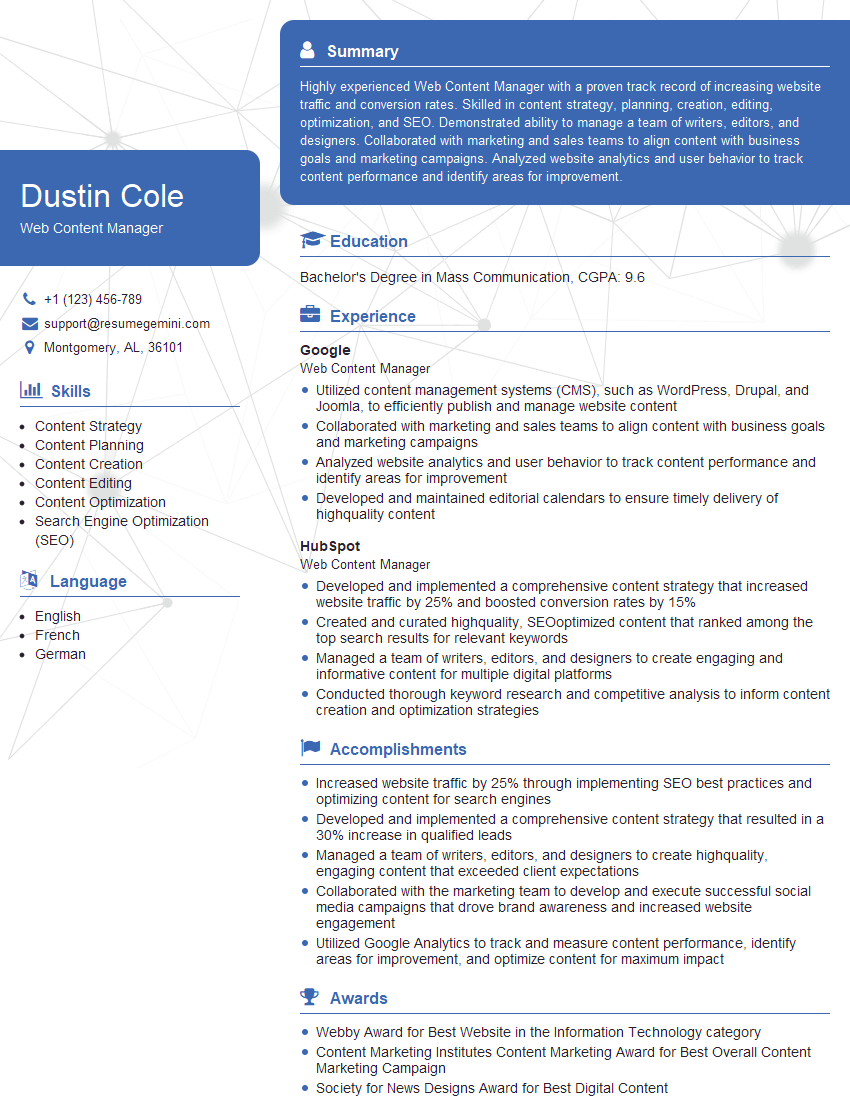
Web Content Manager Resume Sample
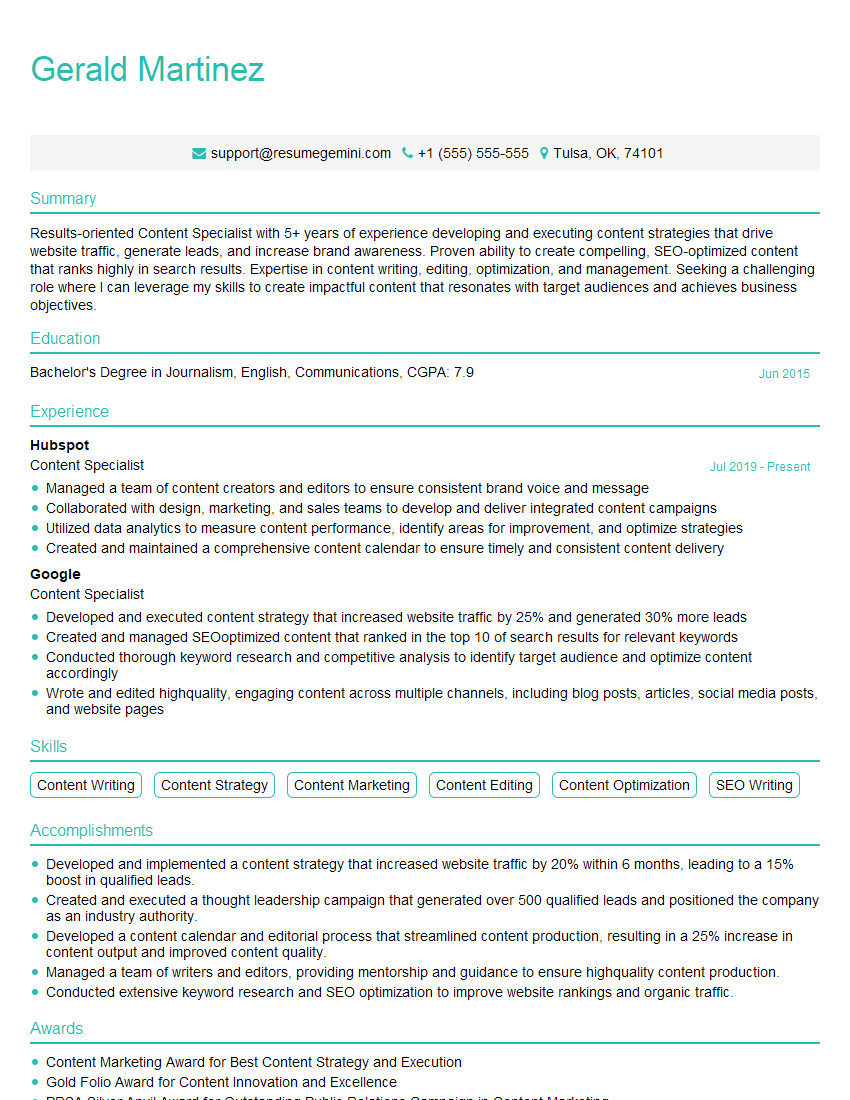
Content Specialist Resume Sample

Content Strategist Resume Sample
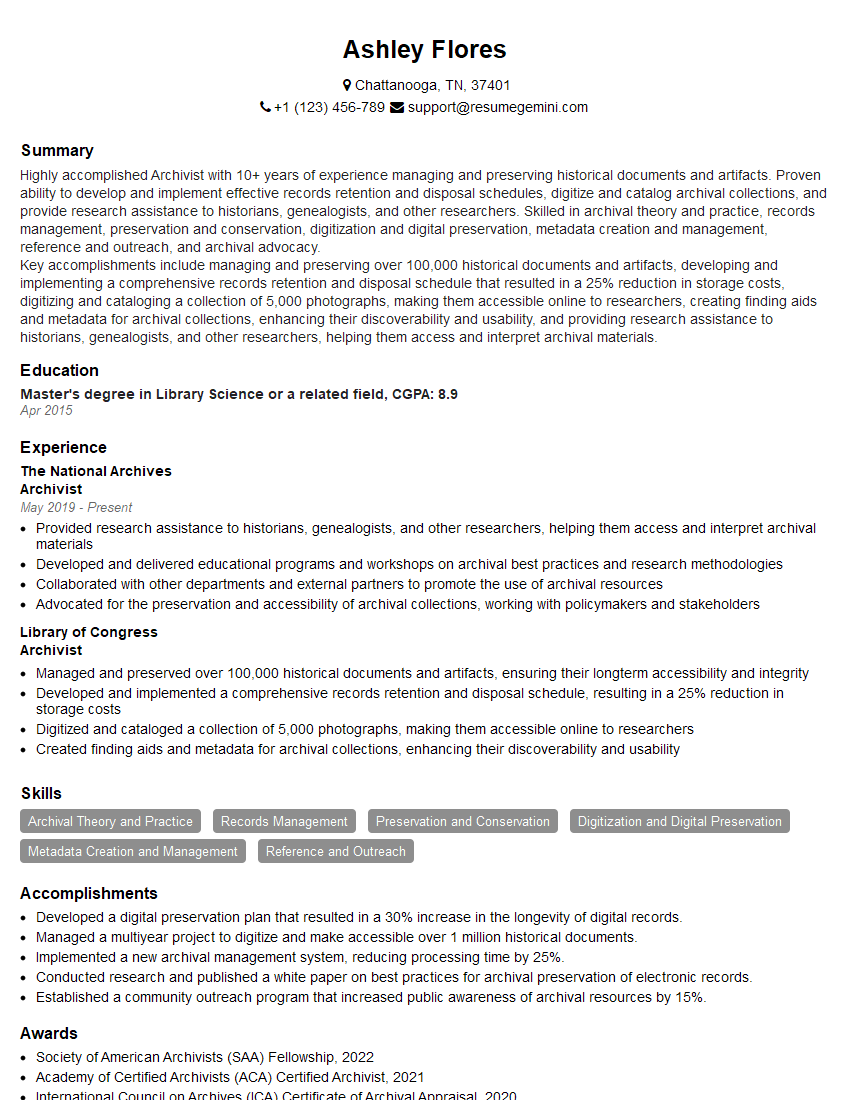
Archivist Resume Sample
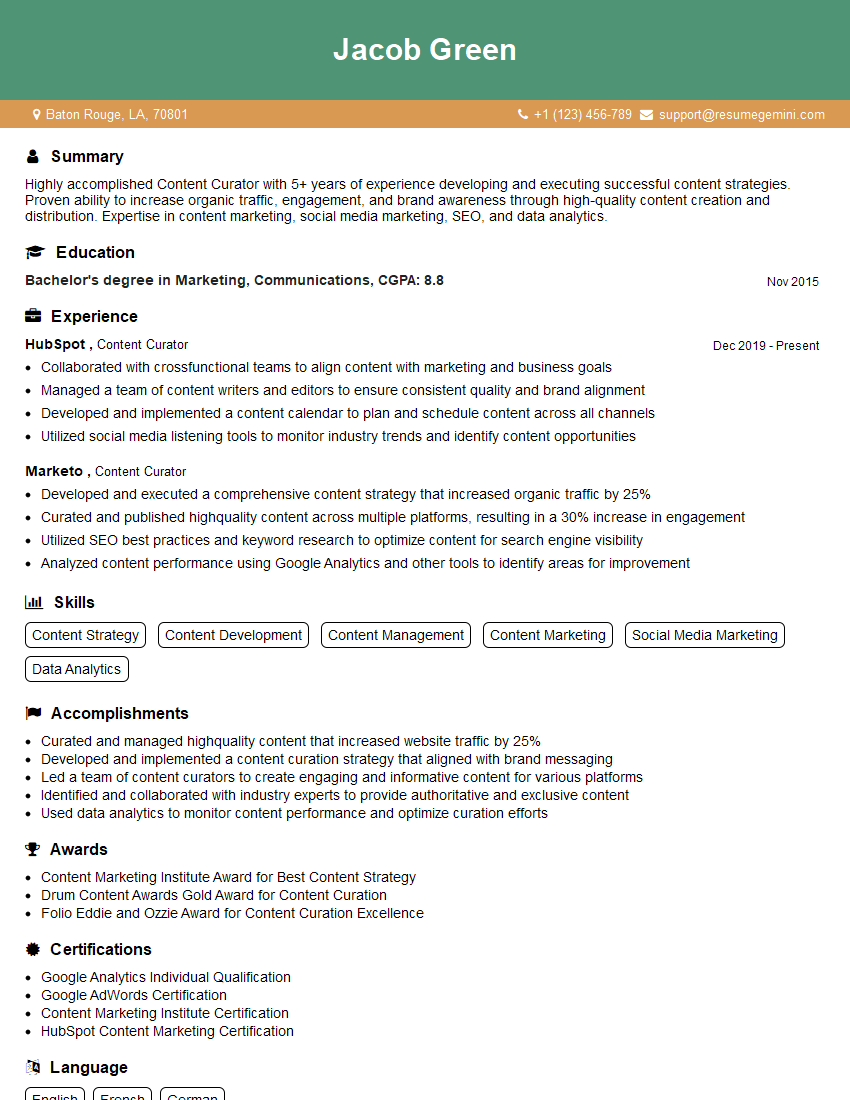
Content Curator Resume Sample
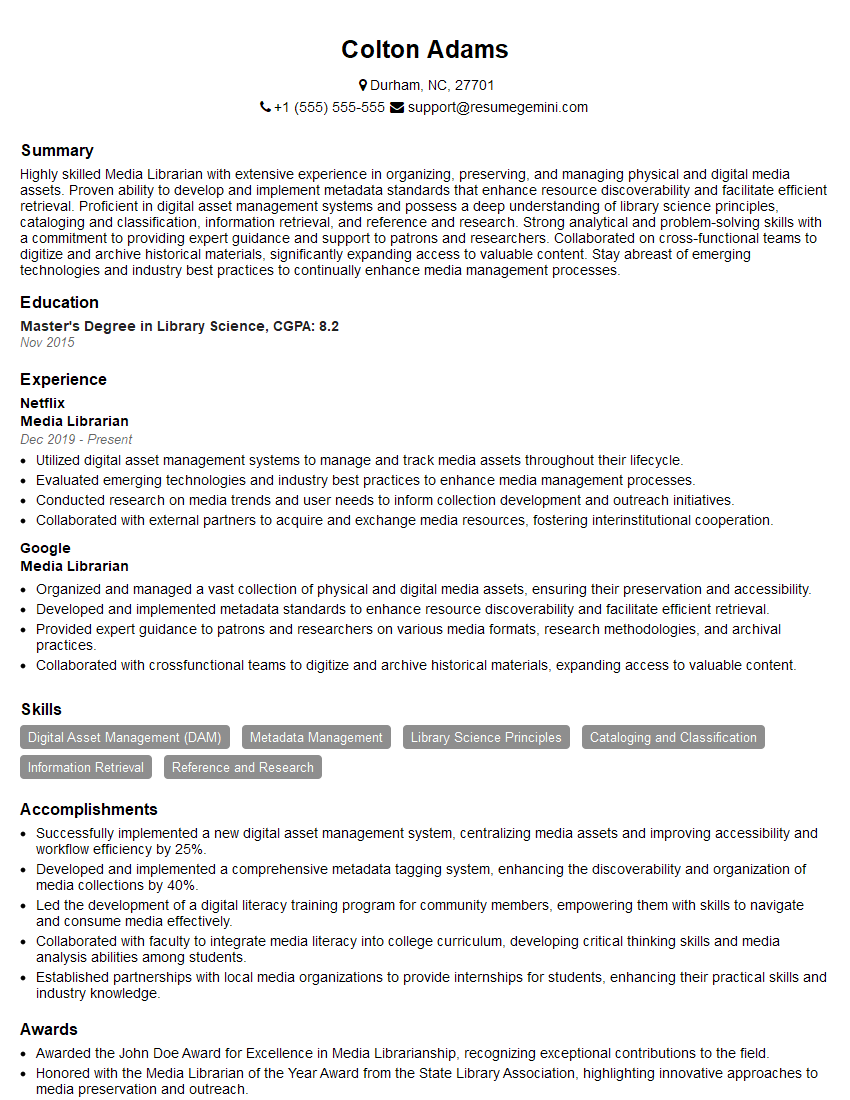
Media Librarian Resume Sample
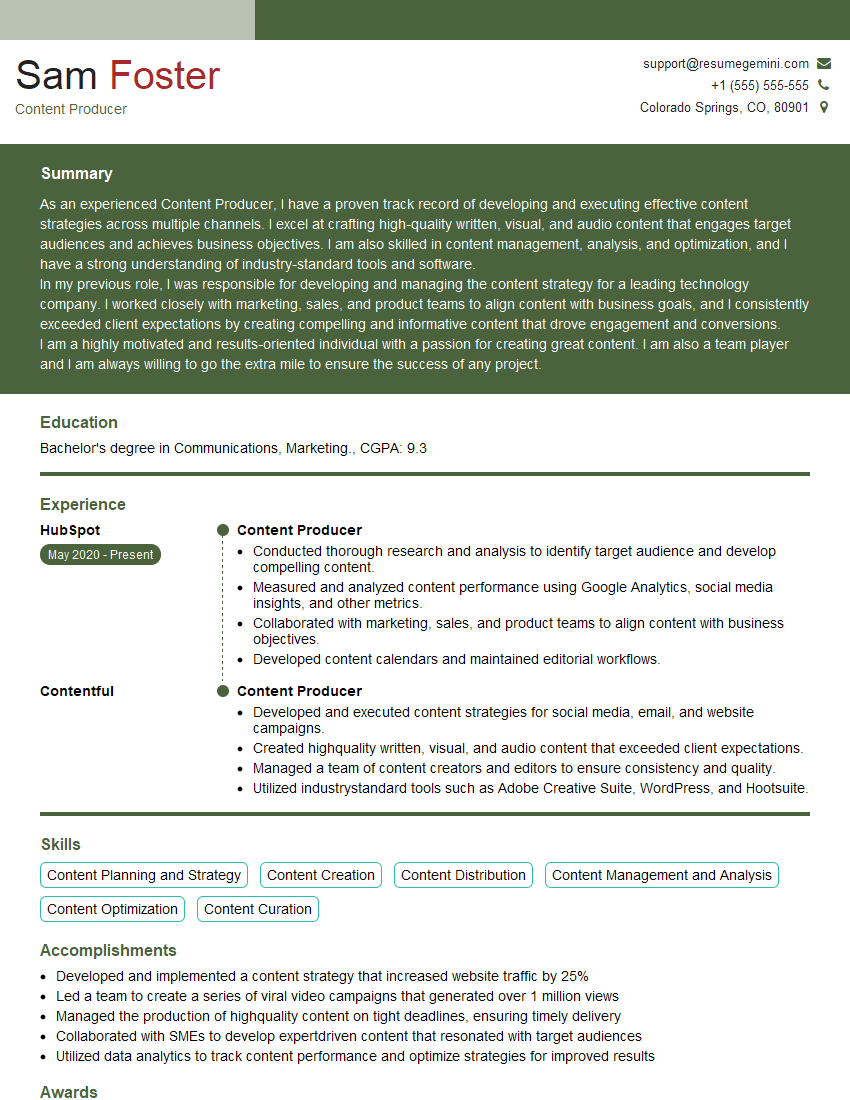
Content Producer Resume Sample
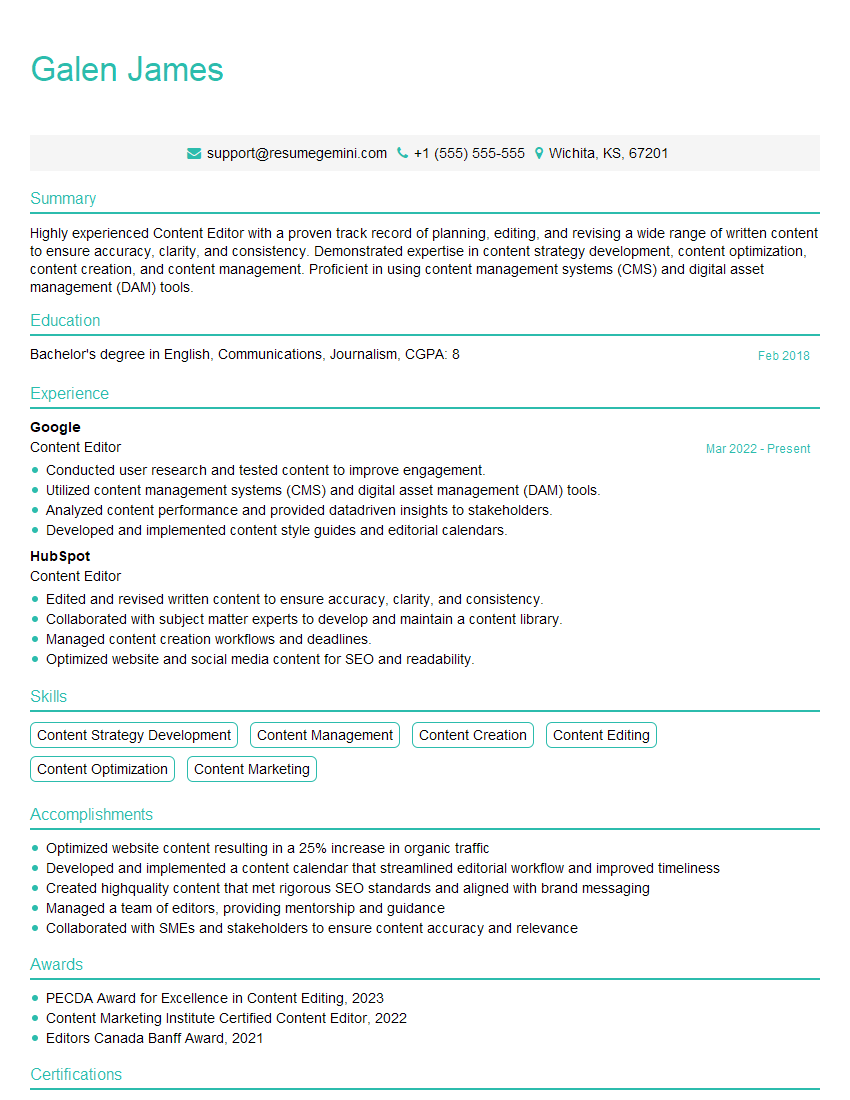
Content Editor Resume Sample
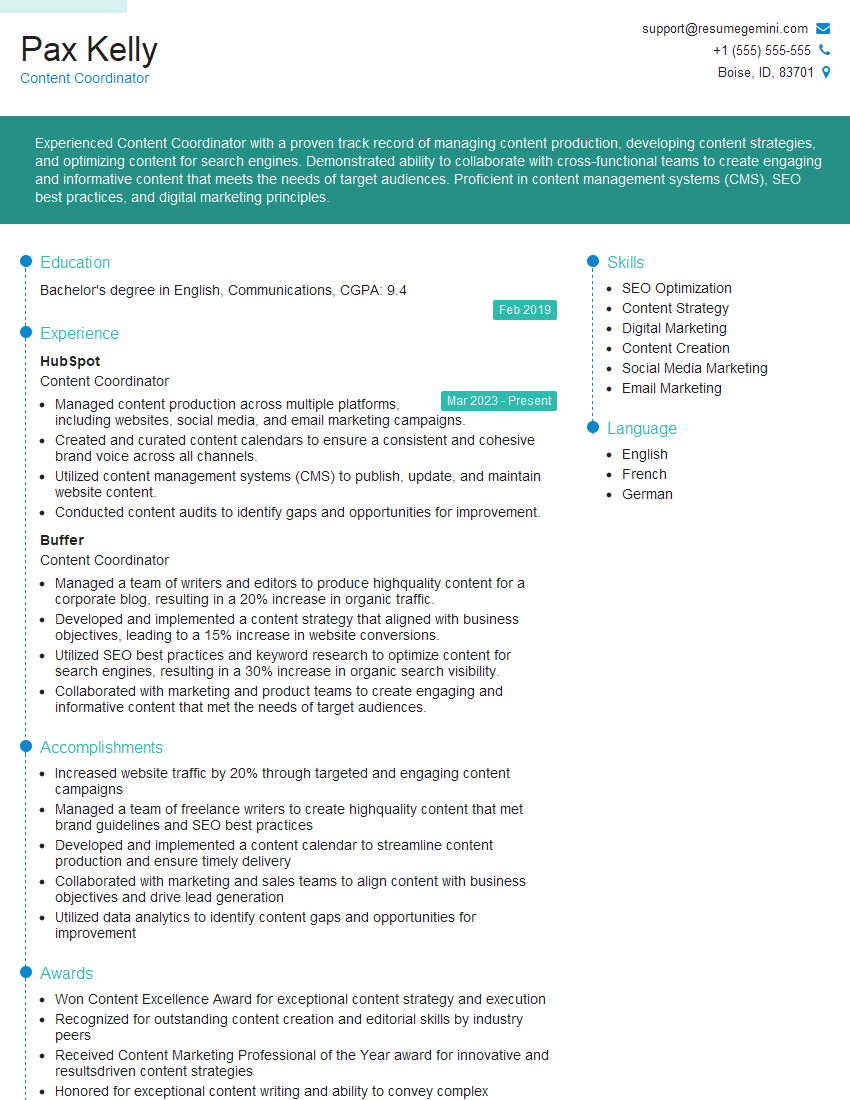
Content Coordinator Resume Sample
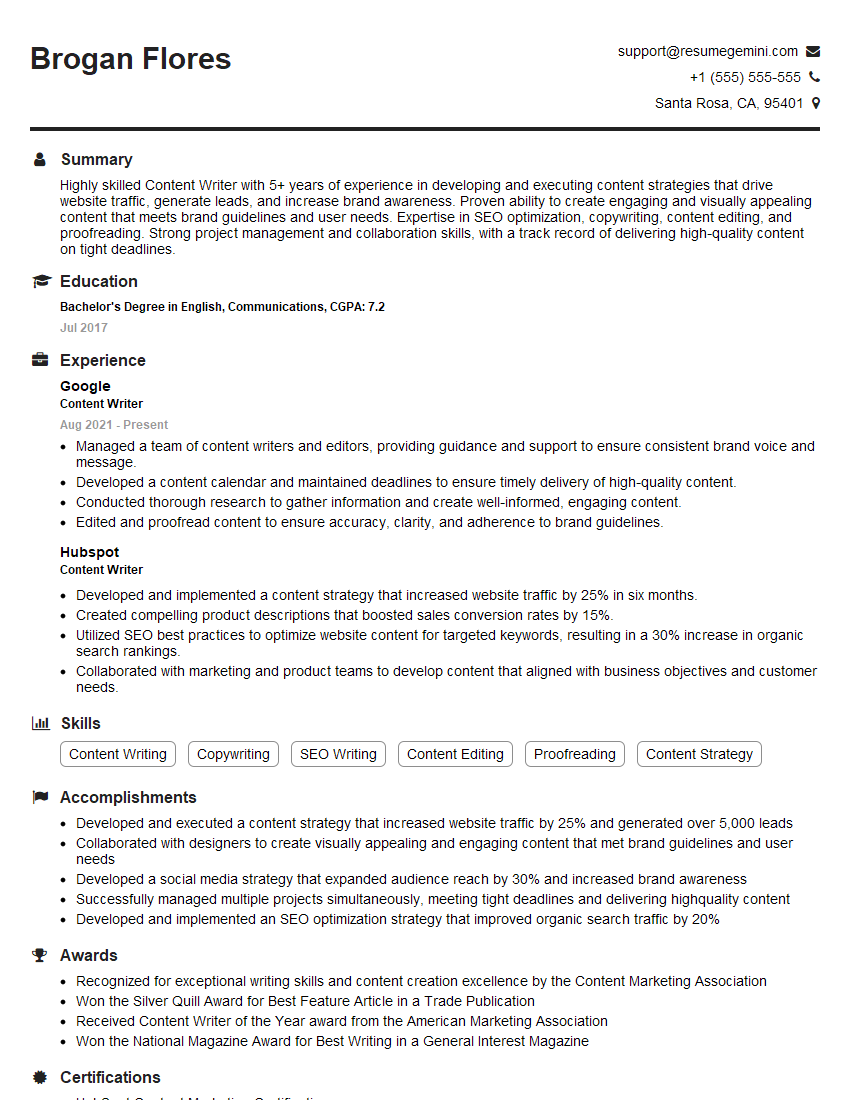
Content Writer Resume Sample
Explore more articles
Users Rating of Our Blogs
Share Your Experience
We value your feedback! Please rate our content and share your thoughts (optional).
What Readers Say About Our Blog
Very informative content, great job.
good