Cracking a skill-specific interview, like one for Media relations evaluation, requires understanding the nuances of the role. In this blog, we present the questions you’re most likely to encounter, along with insights into how to answer them effectively. Let’s ensure you’re ready to make a strong impression.
Questions Asked in Media relations evaluation Interview
Q 1. Define media relations evaluation and its importance.
Media relations evaluation is the systematic process of measuring the effectiveness of a media relations strategy. It involves assessing the quantity, quality, and impact of media coverage earned by an organization or individual. Its importance lies in demonstrating the return on investment (ROI) of PR efforts, identifying areas for improvement, and justifying future media strategies. Without evaluation, it’s difficult to know what’s working and what’s not, leading to wasted resources and missed opportunities.
For example, imagine launching a new product. A strong media relations strategy should secure positive coverage in relevant publications. Evaluation helps determine if the coverage reached the target audience, improved brand awareness, generated sales leads, or influenced consumer perception.
Q 2. Explain different methods for measuring media coverage.
Measuring media coverage involves a multi-faceted approach. Methods include:
- Media Monitoring Tools: These tools (like Cision, Meltwater, Brandwatch) track mentions across various media outlets (newspapers, magazines, websites, blogs, etc.). They offer quantitative data such as the number of mentions and the reach of the publications.
- Clipping Services: These services provide physical or digital copies of media articles, allowing for qualitative analysis of the content and tone.
- Social Media Analytics: Platforms like Facebook, Twitter, and Instagram offer built-in analytics to track mentions, engagement (likes, shares, comments), and sentiment.
- Share of Voice (SOV): This metric compares the volume of media coverage for a client to that of its competitors, providing a competitive benchmark.
- Media Impression Analysis: This focuses on calculating the potential audience reached through media placements, considering the circulation or website traffic of each publication.
The choice of methods depends on the campaign goals, budget, and desired level of detail.
Q 3. How do you calculate media mentions?
Calculating media mentions is relatively straightforward, especially with media monitoring tools. It involves counting each instance where your organization, product, or campaign is named in a news article, blog post, social media update, etc. This number represents the raw quantity of media coverage. However, it’s crucial to distinguish between positive, negative, and neutral mentions, which require more sophisticated analysis.
For example, if your company’s name is mentioned 10 times in different news articles, your total media mentions are 10. However, if 7 mentions are positive, 2 are negative, and 1 is neutral, that qualitative data is far more significant than the raw number.
Q 4. What are key performance indicators (KPIs) for media relations?
Key Performance Indicators (KPIs) for media relations are metrics used to track progress towards specific objectives. These can include:
- Media Mentions: The total number of times your organization is mentioned in the media.
- Reach: The total number of people potentially exposed to media coverage.
- Share of Voice (SOV): Your organization’s share of media coverage compared to competitors.
- Sentiment Analysis: The proportion of positive, negative, and neutral mentions.
- Website Traffic from Media Coverage: The number of visits to your website driven by media mentions.
- Lead Generation: The number of leads generated as a direct result of media coverage.
- Brand Awareness: Changes in brand awareness and recall measured through surveys or other market research.
Selecting appropriate KPIs is vital for assessing the overall impact of your media relations activities. They should be aligned with the specific goals of the campaign or strategy.
Q 5. Describe your experience using media monitoring tools.
I have extensive experience utilizing various media monitoring tools, including Cision and Meltwater. These platforms allow for comprehensive tracking of media coverage across multiple sources. I’ve used them to identify relevant articles, analyze sentiment, track media mentions over time, and generate reports to demonstrate the impact of PR campaigns. For instance, in a recent campaign, we used Meltwater to track mentions across hundreds of online news sources and social media platforms, allowing us to quickly assess the reach and effectiveness of our efforts. This real-time data provided valuable insights for optimizing the campaign mid-way.
Q 6. How do you track social media mentions related to a campaign?
Tracking social media mentions requires a combination of strategies. Firstly, I use social listening tools (like Brandwatch, Talkwalker) to monitor mentions of relevant keywords across major social media platforms. This allows for the identification of both brand mentions and mentions of campaign-specific hashtags or topics. These tools often offer robust analytics, including sentiment analysis and reach metrics. Secondly, the platform’s built-in analytics (Facebook Insights, Twitter Analytics, etc.) provide valuable data on engagement and reach.
For example, in a recent campaign, we used a social listening tool to track mentions of our campaign hashtag, capturing both positive and negative comments. We responded to queries and negative comments in a timely manner, mitigating potential reputational damage and nurturing our online relationships.
Q 7. How do you assess the sentiment of media coverage (positive, negative, neutral)?
Assessing the sentiment of media coverage involves both automated and manual methods. Media monitoring tools often incorporate sentiment analysis algorithms that automatically categorize mentions as positive, negative, or neutral. However, these algorithms are not always perfect. A crucial step is to manually review a sample of the mentions to verify the automated analysis and ensure accuracy, particularly for nuanced or complex statements.
For example, an article mentioning a product recall might be flagged as negative by the algorithm, but a closer reading might reveal that the company handled the recall responsibly, mitigating the negative impact. Manual review allows for a more accurate interpretation of the sentiment expressed. This is critical for crafting effective responses and adjusting media relations strategies as needed.
Q 8. Explain the concept of ‘share of voice’ in media relations.
Share of voice (SOV) in media relations measures the proportion of media coverage your brand receives compared to your competitors. It’s essentially your brand’s prominence in the media landscape. A higher SOV generally indicates greater brand awareness and influence.
Think of it like a conversation at a party. If you’re talking more than others, you have a larger share of voice. Similarly, if your brand is mentioned more frequently in media outlets than your competitors, you have a higher SOV.
Calculating SOV often involves monitoring media mentions (news articles, blog posts, social media posts) and comparing the number of mentions for your brand against your key competitors. Tools like media monitoring platforms can automate this process. For example, if your brand receives 100 mentions and your main competitor receives 50, your SOV would be approximately 67% (100 / (100 + 50) * 100).
Q 9. How do you measure the impact of media relations on brand awareness?
Measuring the impact of media relations on brand awareness involves tracking metrics that reflect how familiar people are with your brand. This isn’t a simple equation; it’s a multi-faceted approach.
- Brand Mentions and Reach: Track the number of media mentions and the potential audience reached through those mentions (e.g., website traffic from media links, social media engagement).
- Website Traffic: Increased website traffic following positive media coverage suggests improved awareness and interest.
- Social Media Engagement: Monitor mentions and engagement (likes, shares, comments) related to your brand on social media platforms.
- Surveys and Polls: Conduct surveys or polls to directly assess brand awareness before and after media campaigns.
- Brand Sentiment Analysis: Analyze the tone of media coverage to understand if it’s positive, negative, or neutral. Positive sentiment contributes more effectively to brand awareness.
For instance, a successful media campaign could lead to a 20% increase in website traffic and a 15% rise in social media mentions, indicating a clear impact on brand awareness.
Q 10. How do you measure the impact of media relations on sales?
Measuring the impact of media relations on sales is challenging because it’s rarely a direct, immediate relationship. Media coverage influences sales indirectly, building brand credibility and generating leads over time. Therefore, attribution is key. It’s about identifying the *influence*, not necessarily the *direct cause*.
- Track Sales Following Media Coverage: Monitor sales data in the weeks and months following positive media coverage to look for correlations.
- Use Unique Promo Codes/Links: Include unique promo codes or trackable links in media releases to directly attribute sales to specific campaigns.
- Monitor Lead Generation: Track inbound leads (e.g., website contact forms, email subscriptions) generated after media coverage.
- Sales Attribution Modeling: Employ more advanced analytics models (often requiring dedicated marketing analytics platforms) to estimate the contribution of media relations to overall sales.
For example, a robust media campaign might not show an immediate sales spike, but it could lead to a measurable increase in qualified leads over the next quarter, indicating positive influence on the sales pipeline.
Q 11. How do you analyze qualitative data from media coverage?
Analyzing qualitative data from media coverage requires a systematic approach to understand the narrative, sentiment, and overall message communicated.
- Content Analysis: Carefully read and categorize articles, identifying key themes, messages, and sentiment (positive, negative, neutral). Look for recurring words, phrases, and concepts.
- Sentiment Analysis: Use tools or manually assess the tone of the media coverage. Determine if the articles portray your brand favorably or unfavorably.
- Framing Analysis: Analyze how the story is framed— the context, angle, and overall narrative presented. Does it align with your brand’s messaging?
- Topic Coding: Develop a coding system to systematically categorize media mentions by topic or theme, allowing for better organization and pattern identification.
Imagine a media article highlighting your company’s commitment to sustainability. A qualitative analysis would capture the positive sentiment, the detailed description of your practices, and how this resonates with the target audience’s values.
Q 12. How do you present media relations evaluation results to stakeholders?
Presenting media relations evaluation results effectively involves clear communication and visual storytelling. Avoid overwhelming stakeholders with data; focus on key findings and insights.
- Executive Summary: Begin with a concise summary of the key findings and impact.
- Visualizations: Use charts and graphs to present data in an easy-to-understand format (e.g., bar charts for SOV, line graphs for trend analysis).
- Key Performance Indicators (KPIs): Focus on the most relevant KPIs that align with stakeholder objectives (e.g., brand awareness, lead generation, sales).
- Narrative Storytelling: Weave a narrative around the data, explaining the context, challenges, and successes of your media relations efforts.
- Recommendations: Conclude with actionable recommendations for future media relations strategies based on the evaluation findings.
For instance, a visually appealing presentation showing a 30% increase in brand mentions alongside a 15% rise in website traffic from media sources would clearly demonstrate the success of a campaign.
Q 13. What are some challenges in media relations evaluation, and how have you overcome them?
Challenges in media relations evaluation include difficulty in attributing results directly to media efforts, the subjectivity of qualitative data analysis, and the constantly evolving media landscape.
- Attribution Challenges: Overcoming this involves using methods like unique tracking links and advanced analytics to better associate media coverage with specific outcomes.
- Subjectivity in Qualitative Analysis: Mitigating this involves using clear coding systems, multiple analysts, and well-defined criteria for qualitative assessment.
- Evolving Media Landscape: To address this, continuous monitoring of emerging platforms and trends and adapting measurement methods accordingly is essential. Staying updated on new analytical tools is also critical.
For example, I once faced difficulty attributing sales to a specific media campaign. To overcome this, we implemented a unique discount code mentioned only in that campaign’s press releases, allowing us to directly track its sales impact.
Q 14. How do you determine the return on investment (ROI) of media relations activities?
Determining the ROI of media relations is complex because the effects are often indirect and long-term. However, a structured approach is crucial.
- Quantify Media Value: Assign monetary value to media coverage based on factors such as advertising equivalent value (AEV) or the estimated cost of achieving similar reach through paid advertising.
- Track Key Metrics: Monitor changes in brand awareness, lead generation, and sales following media campaigns. Link increases in these areas back to the media efforts.
- Compare Costs and Benefits: Calculate the total cost of your media relations activities (staff time, resources, etc.) and compare it to the estimated value generated through increased brand awareness, leads, and sales.
- Use a Balanced Scorecard: Don’t solely rely on financial metrics. Include qualitative measures like brand sentiment and media coverage reach in your ROI assessment.
For example, if a media campaign cost $10,000 and generated $50,000 in sales, the ROI would be 400%. However, a comprehensive ROI calculation would also consider the qualitative impact, such as improved brand reputation.
Q 15. Explain your experience with different media evaluation software/platforms.
My experience with media evaluation software and platforms is extensive. I’ve worked with a range of tools, from basic media monitoring services to sophisticated analytics platforms. This includes tools like Meltwater, Cision, and Brandwatch, each offering unique strengths. For instance, Meltwater excels at broad media monitoring across various sources, while Cision is particularly strong in its media database and contact management features. Brandwatch shines in its sentiment analysis capabilities, providing valuable insights into public perception. My selection of the right platform depends heavily on the specific campaign goals and the type of media coverage we are analyzing. For smaller campaigns, a simpler, more affordable tool might suffice, whereas for large-scale, multi-national campaigns, a more robust platform with advanced features is needed. I’m also proficient in using custom scripts and APIs to extract data from various sources and integrate it into custom dashboards, offering a more tailored and in-depth analysis.
Career Expert Tips:
- Ace those interviews! Prepare effectively by reviewing the Top 50 Most Common Interview Questions on ResumeGemini.
- Navigate your job search with confidence! Explore a wide range of Career Tips on ResumeGemini. Learn about common challenges and recommendations to overcome them.
- Craft the perfect resume! Master the Art of Resume Writing with ResumeGemini’s guide. Showcase your unique qualifications and achievements effectively.
- Don’t miss out on holiday savings! Build your dream resume with ResumeGemini’s ATS optimized templates.
Q 16. What metrics would you use to evaluate the success of a product launch press release?
Evaluating the success of a product launch press release requires a multi-faceted approach. Key metrics I would use include:
- Media Impressions: The total number of times the press release and related articles were viewed or read. This gives a sense of the overall reach.
- Media Coverage: The number of publications, websites, and blogs that published stories related to the product launch. This indicates the level of interest from the media.
- Website Traffic: Tracking increases in website traffic from specific media outlets shows whether the press release effectively drove visitors to the company website.
- Social Media Engagement: Monitoring social media mentions, shares, and sentiment around the product launch provides insight into public perception. This is particularly important in today’s social media-driven environment.
- Sales Leads: Measuring an increase in qualified leads directly attributable to the press release demonstrates the direct impact on business outcomes.
- Brand Mentions: Tracking mentions of the company’s brand name across various media outlets, noting the tone (positive, negative, neutral), helps assess brand perception and overall message effectiveness.
By combining these metrics, we get a comprehensive understanding of the press release’s impact. For instance, high media impressions with low website traffic might indicate a disconnect between the message and call to action. A strong positive social media sentiment paired with increased sales leads signals a highly successful campaign.
Q 17. How do you track and analyze the reach of a media campaign across various channels?
Tracking and analyzing the reach of a media campaign across various channels involves a systematic approach. I typically use a combination of media monitoring tools and analytics platforms. This starts with identifying all relevant channels—traditional media (print, broadcast, online news), social media platforms (Twitter, Facebook, Instagram, LinkedIn, etc.), and online forums and blogs. Each channel requires a tailored approach to data collection. For example, media monitoring tools effectively track traditional media and online news, while social listening tools are crucial for analyzing social media conversations. Once data is collected, I analyze reach by various metrics, including:
- Total reach (impressions): The aggregate number of people exposed to the campaign message across all channels.
- Unique reach: The number of unique individuals exposed, eliminating duplicate counts.
- Channel-specific reach: Analyzing reach within each channel to identify top-performing ones.
- Share of voice (SOV): Measuring the campaign’s visibility compared to competitors.
Data visualization tools, like dashboards, are essential to represent the data in a clear and understandable way, facilitating insightful conclusions and action planning.
Q 18. How do you differentiate between earned, owned, and paid media in your evaluations?
Differentiating between earned, owned, and paid media is crucial for a comprehensive media evaluation.
- Earned Media: This refers to unpaid media coverage earned through press releases, media outreach, and positive reviews. Evaluation focuses on metrics like media mentions, sentiment analysis, and reach in publications.
- Owned Media: This encompasses content created and controlled by the organization, such as website content, blog posts, and social media accounts. Evaluation involves website traffic, engagement on owned platforms, and content performance.
- Paid Media: This refers to advertising and sponsored content on various platforms. Evaluation includes cost per click (CPC), cost per thousand impressions (CPM), conversion rates, and return on investment (ROI).
Each category contributes differently to the overall campaign success and requires distinct measurement strategies. For example, a successful earned media campaign might generate significant media coverage and positive sentiment, while a strong owned media strategy can foster a loyal audience and improve brand awareness. Paid media delivers targeted reach and allows for precise measurement of ROI. Combining these approaches provides a holistic view of media effectiveness.
Q 19. Describe your experience with media audits.
My experience with media audits involves a systematic review of an organization’s media relations activities to identify strengths, weaknesses, opportunities, and threats (SWOT). This involves examining past media coverage, analyzing media lists, and evaluating the effectiveness of communications strategies. A typical media audit includes a review of media coverage to understand the brand’s current image and reputation. I also examine current media lists to gauge comprehensiveness and identify key media contacts. I scrutinize past press releases and other communication materials to see whether they align with the organization’s goals. Finally, I assess the effectiveness of the organization’s media relations strategies and recommend improvements, often involving updated media strategies or re-training staff on communication best practices. The end result is a comprehensive report that provides actionable recommendations for strengthening the organization’s media relations program.
Q 20. How do you handle conflicting data points when analyzing media coverage?
Handling conflicting data points during media analysis requires a careful and methodical approach. It’s common to encounter discrepancies between different data sources or metrics. The first step involves identifying the source of the conflict. This could be due to different methodologies, measurement periods, or data errors. Once identified, I’d cross-reference the data with other sources to verify accuracy. Data triangulation—using multiple data sources to corroborate findings—is crucial. If the conflict persists, I might need to examine the data collection process for potential biases or inaccuracies. For example, a discrepancy between a media monitoring tool and a manual count of mentions might indicate limitations of the tool or inconsistencies in coding. When resolving conflicts, I prioritize data from the most reliable and validated sources. In cases where irreconcilable differences remain, I explicitly address the inconsistencies in the report, explaining the limitations and potential reasons for the discrepancy. Transparent reporting is key to maintaining credibility.
Q 21. How do you stay updated on the latest trends and best practices in media relations evaluation?
Staying updated on the latest trends and best practices in media relations evaluation is paramount. I actively engage in several strategies:
- Industry Publications and Conferences: I regularly read publications like PRWeek, The Holmes Report, and attend industry conferences to stay abreast of new techniques and technologies.
- Professional Networks: Membership in professional organizations like the Public Relations Society of America (PRSA) keeps me connected with peers and provides access to the latest research and insights.
- Online Resources and Webinars: I actively participate in online webinars and follow thought leaders in the field through social media and blogs.
- Continuing Education: I pursue continuous professional development through workshops and courses focused on data analytics, social media analysis, and emerging technologies related to media measurement.
By utilizing these methods, I ensure my evaluation methods remain current and aligned with industry best practices, enabling me to provide the most accurate and relevant insights to my clients.
Q 22. What is the difference between quantitative and qualitative data in media relations evaluation?
In media relations evaluation, quantitative and qualitative data offer different but complementary perspectives on the effectiveness of your efforts. Think of it like this: quantitative data tells you how much, while qualitative data tells you how well.
Quantitative data focuses on numerical measurements. This includes metrics like the number of media mentions, reach (total audience impressions), website traffic from media coverage, share of voice (your brand’s prominence relative to competitors), and sentiment analysis scores (percentage of positive, negative, and neutral mentions).
Qualitative data, on the other hand, explores the ‘why’ behind the numbers. It delves into the nature of the coverage. Examples include analyzing the tone of articles (positive, negative, neutral, or mixed), assessing the accuracy and depth of reporting, identifying key themes and messages that resonated with the media, and evaluating the overall impact of the coverage on brand perception and reputation. Qualitative data might come from analyzing the content of articles, conducting media interviews with reporters, and analyzing social media conversations spurred by your media outreach.
- Example: A quantitative analysis might show 100 media mentions. A qualitative analysis would then examine the content of those mentions: Were they overwhelmingly positive? Did they accurately reflect your key messages? Did they drive significant website traffic or social media engagement?
Q 23. How do you use data analytics to inform media relations strategy?
Data analytics is crucial for a data-driven media relations strategy. We use analytics to understand what’s working, what’s not, and to optimize future campaigns. It’s about moving beyond gut feelings to informed decision-making.
Here’s how we use data analytics:
- Identifying Key Influencers: We analyze media coverage to identify journalists and publications that consistently cover our industry or client, assessing their reach and influence. This helps us prioritize media outreach efforts.
- Measuring Campaign Effectiveness: We track key metrics like website traffic, social media engagement, and brand mentions before, during, and after a campaign. This provides insights into campaign performance and areas for improvement.
- Optimizing Messaging: By analyzing sentiment and analyzing the content of media mentions, we identify what messages resonate best with media and audiences. This data allows us to refine our messaging for future campaigns.
- Understanding Audience: We analyze data to better understand the demographics and psychographics of the audiences reached through media coverage, allowing for targeted future outreach.
- Benchmarking and Reporting: Data analytics helps us compare our performance to competitors and industry standards, and it provides essential data for reporting on campaign ROI (Return on Investment) to clients.
Example: If a campaign focusing on a particular product launch generated significantly lower-than-expected engagement despite robust media coverage, we’d analyze the data to discover why – was the messaging off, was the timing wrong, or were there underlying issues with the product itself? The data provides the clues we need to adjust the strategy.
Q 24. Describe a time you had to explain complex data to a non-technical audience.
I once had to explain a complex analysis of media sentiment—detailed breakdowns of positive, negative, and neutral mentions across various platforms—to a board of directors with limited data analysis experience. Instead of overwhelming them with numbers and charts, I used a simple analogy.
I explained it like a thermometer: positive mentions raised the temperature, negative mentions lowered it, and neutral mentions kept it steady. I then showed a visual representation—a simple line graph—depicting the overall sentiment trend over time. This made it clear at a glance whether the overall brand perception was improving, worsening, or staying the same. I followed up with specific examples of positive and negative articles to illustrate the data points, making the explanation relatable and memorable. This approach successfully communicated the key insights without losing them in technical details.
Q 25. How do you incorporate media relations evaluation into overall communication planning?
Media relations evaluation isn’t an afterthought; it’s an integral part of the entire communication planning process. It informs strategy at every stage:
- Planning Phase: Evaluation data from past campaigns helps us set realistic goals and identify target audiences and media outlets. We analyze past performance to inform the selection of tactics and channels.
- Execution Phase: During the campaign, we track key metrics in real-time to monitor progress, make adjustments as needed, and address any emerging issues.
- Post-Campaign Analysis: A thorough post-campaign evaluation is vital to assess overall performance against set goals. This data identifies what worked, what didn’t, and what lessons can be applied to future campaigns.
Example: If a previous campaign targeting a specific demographic through a particular publication yielded poor results, this evaluation informs the next campaign to explore alternative strategies for reaching that demographic or to avoid that publication in the future. This iterative process of evaluation and refinement allows for continuous improvement in our media relations efforts.
Q 26. What are some common pitfalls to avoid when evaluating media relations?
Several common pitfalls can undermine the accuracy and usefulness of media relations evaluations. It’s crucial to be aware of these and take steps to avoid them:
- Focusing solely on quantity over quality: A high number of mentions doesn’t automatically equal success. The tone, reach, and influence of the media outlet all matter. Counting mentions without considering quality is misleading.
- Ignoring qualitative data: Relying solely on quantitative metrics provides an incomplete picture. Qualitative analysis reveals the ‘why’ behind the numbers, offering deeper insights into the effectiveness of your message.
- Failing to set clear goals and metrics: Without predefined goals, you lack a benchmark for success. Establish clear, measurable, achievable, relevant, and time-bound (SMART) goals before starting any campaign.
- Using unreliable data sources: Ensure that your data comes from reputable and verifiable sources. Improperly collected or biased data can lead to inaccurate conclusions.
- Not considering the broader context: The media landscape is dynamic. Your evaluation must consider external factors like industry trends, competitive activity, and overall news cycle.
Q 27. How do you ensure the accuracy and reliability of your media relations data?
Ensuring the accuracy and reliability of media relations data requires a systematic approach. Here’s how we do it:
- Utilizing Multiple Data Sources: We don’t rely on a single platform for data collection. We combine data from media monitoring tools, social listening platforms, web analytics, and even manual review of articles to get a comprehensive picture.
- Establishing Clear Data Collection Protocols: We define clear criteria for what constitutes a ‘mention’ and how different types of mentions (e.g., positive, negative, neutral) are categorized. This ensures consistency across different data sources.
- Implementing Quality Control Measures: We regularly audit our data collection processes and conduct manual checks to identify and correct errors. Data validation is essential.
- Employing Robust Analytics Tools: We use sophisticated media monitoring and analytics platforms that provide accurate and reliable data. These tools often incorporate AI-powered sentiment analysis and other advanced capabilities.
- Cross-referencing and Triangulation: We corroborate data from different sources to ensure accuracy. If there are discrepancies, we investigate to determine the reason.
Example: If our media monitoring tool reports a high number of negative mentions, we don’t automatically accept that at face value. We manually review some of the articles to assess the accuracy of the sentiment analysis and ensure that the negative sentiment aligns with our interpretation. This multi-faceted approach minimizes bias and enhances data reliability.
Key Topics to Learn for Media Relations Evaluation Interview
- Measuring Campaign Effectiveness: Understand key performance indicators (KPIs) like media coverage reach, tone of coverage (positive, negative, neutral), and audience engagement. Learn how to analyze data from various sources to demonstrate the impact of media relations activities.
- Qualitative Analysis of Media Coverage: Go beyond simple metrics. Practice assessing the quality and influence of media placements. Consider factors like the publication’s credibility, the journalist’s reputation, and the overall narrative presented.
- Attribution Modeling: Develop your ability to connect media relations efforts directly to tangible business outcomes (e.g., increased brand awareness, lead generation, sales). Explore different models for assigning credit to various marketing channels.
- Reporting and Presentation of Findings: Master the art of clearly communicating your evaluation results to stakeholders. Practice creating compelling visualizations and narratives to support your data-driven insights.
- Benchmarking and Best Practices: Familiarize yourself with industry benchmarks and best practices for media relations evaluation. Understand how to compare your results against established standards and identify areas for improvement.
- Technological Tools for Media Monitoring and Analysis: Gain familiarity with software and platforms used for media monitoring, analysis, and reporting. Understanding the capabilities and limitations of these tools is crucial.
- Addressing Challenges and Limitations: Prepare to discuss potential challenges in media relations evaluation, such as incomplete data, difficulties in attributing results, or biases in media coverage. Demonstrate your problem-solving skills in these scenarios.
Next Steps
Mastering media relations evaluation is crucial for career advancement in communications and public relations. It demonstrates your analytical skills, strategic thinking, and ability to deliver tangible results. To maximize your job prospects, creating a strong, ATS-friendly resume is essential. ResumeGemini is a trusted resource to help you build a professional and impactful resume that highlights your skills and experience effectively. Examples of resumes tailored to media relations evaluation are available to guide your process.

Communications Director Resume Sample

Communications Manager Resume Sample

Marketing Communications Manager Resume Sample
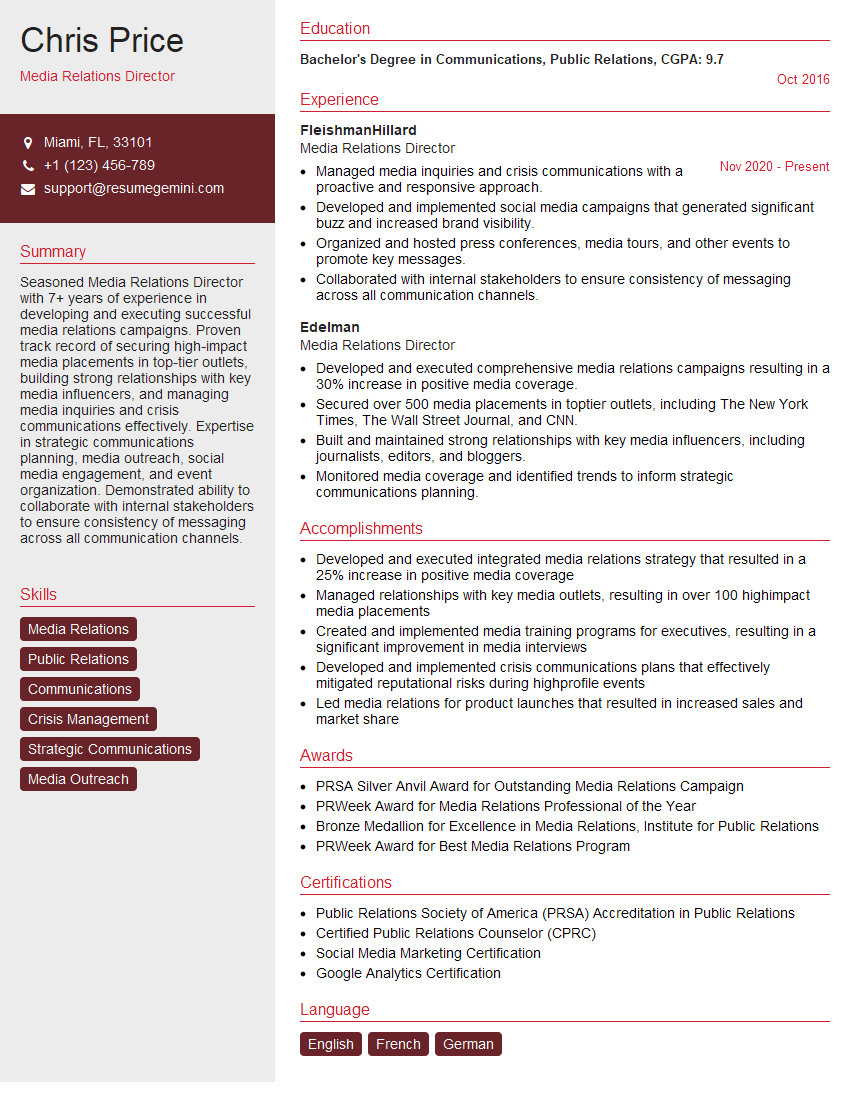
Media Relations Director Resume Sample
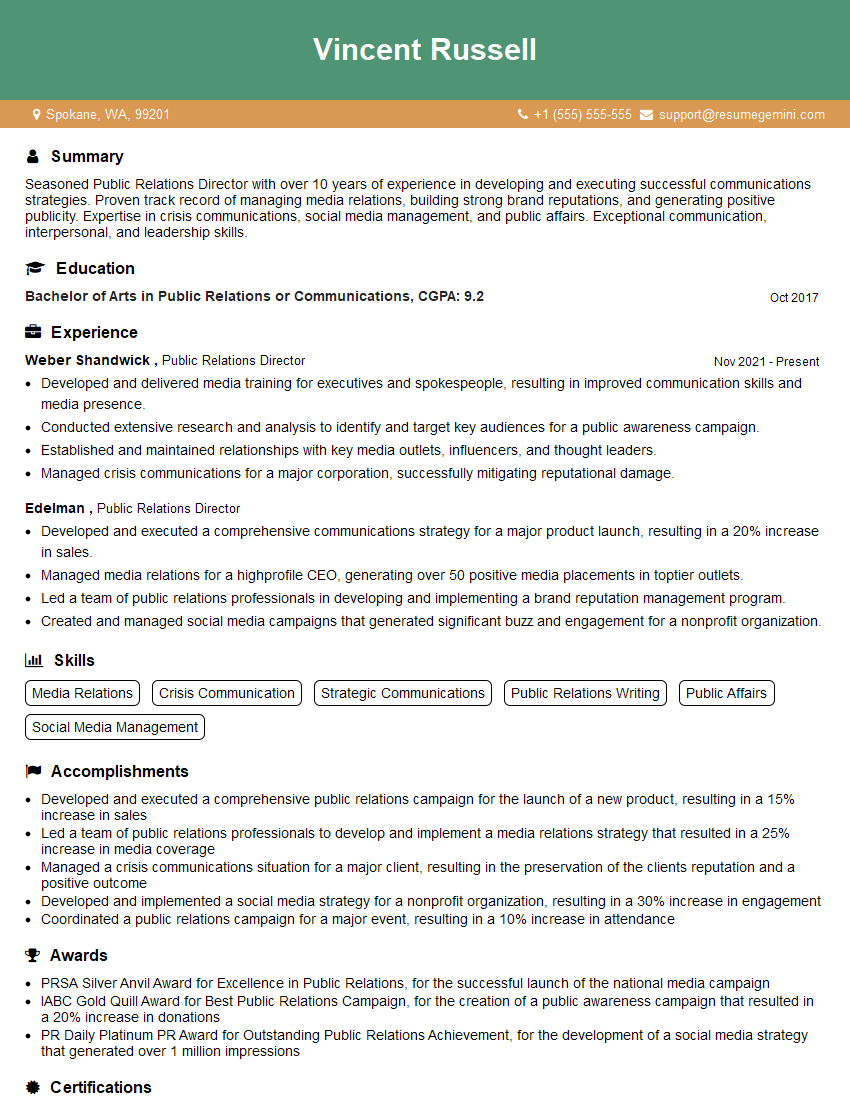
Public Relations Director Resume Sample
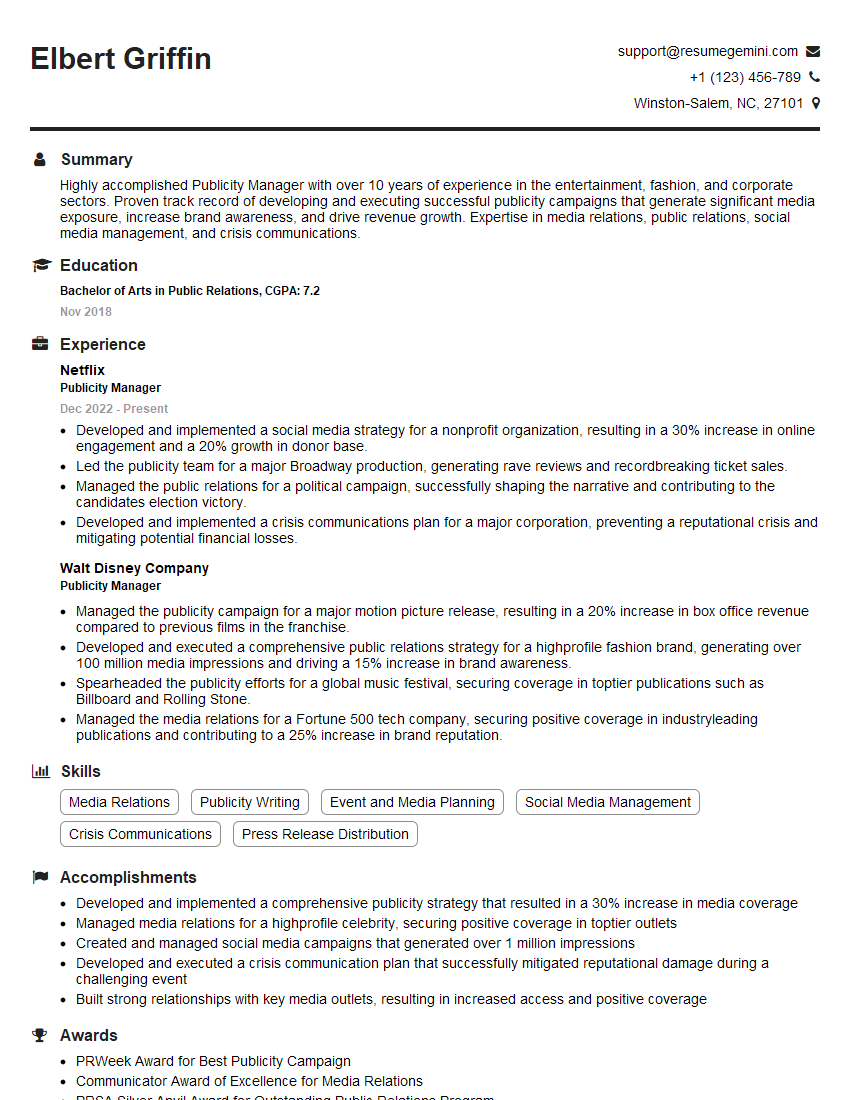
Publicity Manager Resume Sample

Social Media Manager Resume Sample
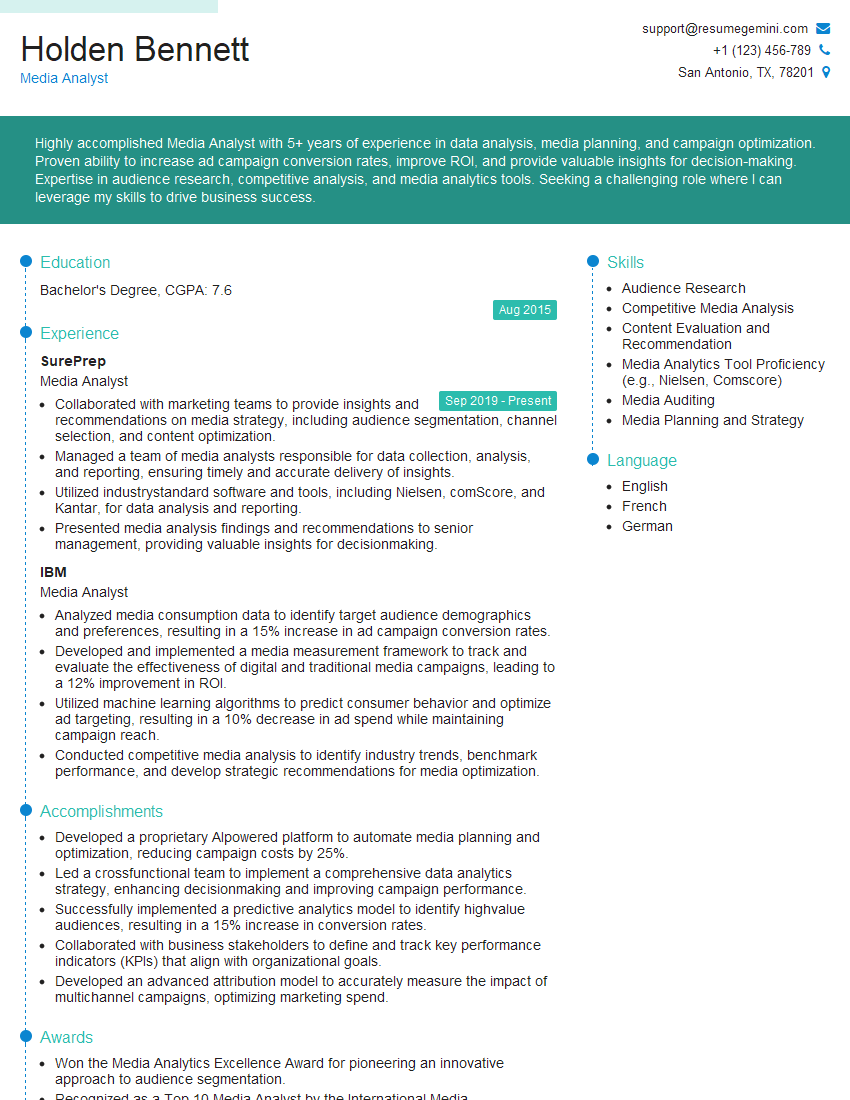
Media Analyst Resume Sample
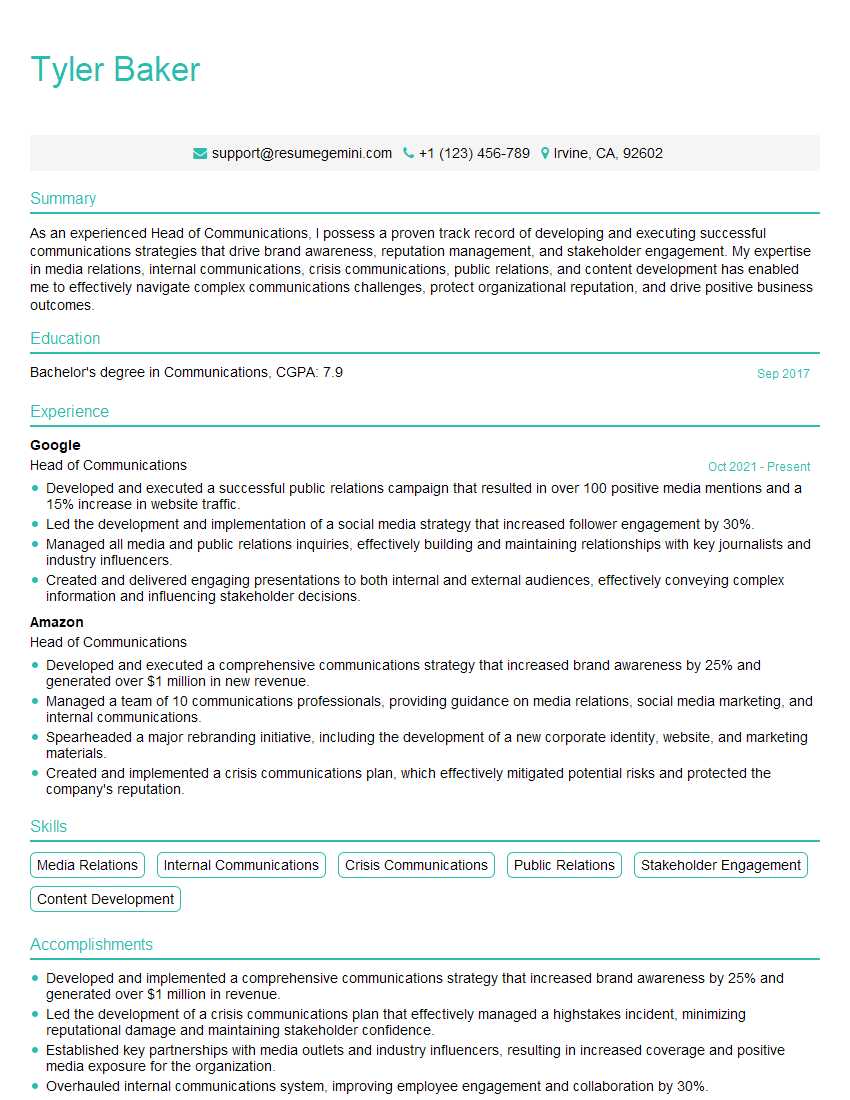
Head of Communications Resume Sample
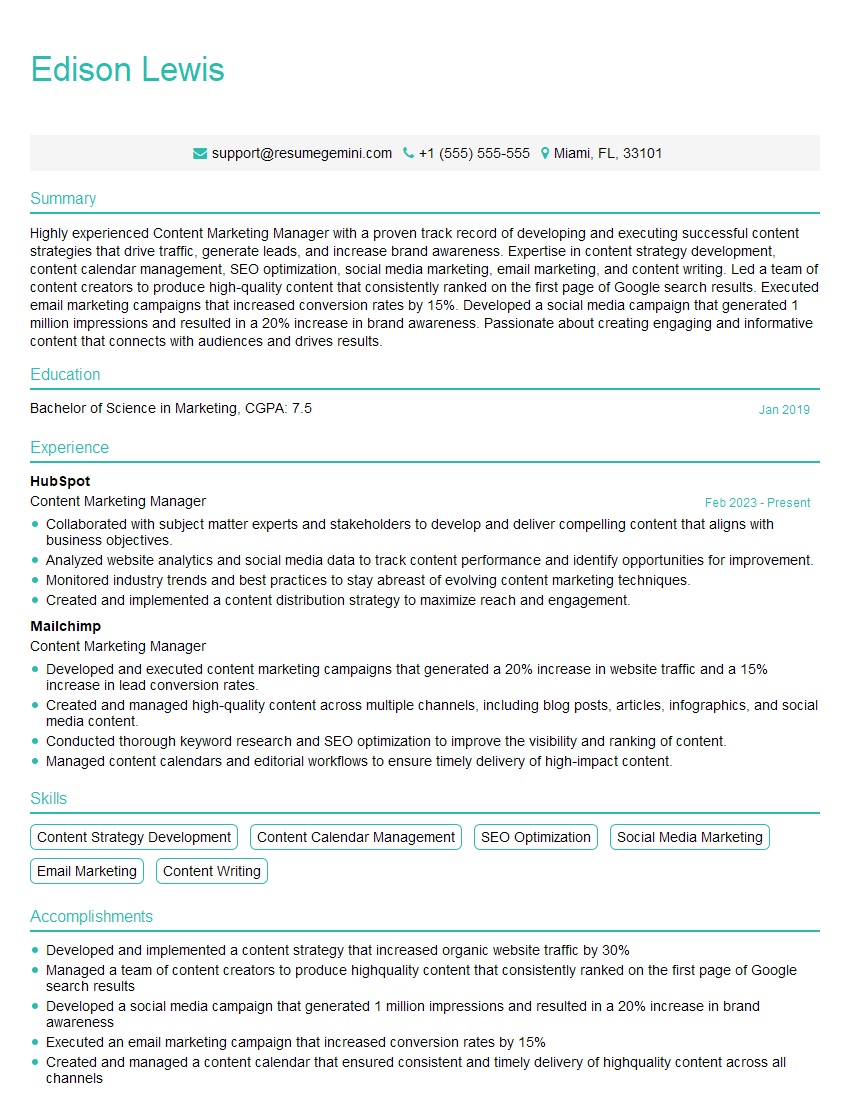
Content Marketing Manager Resume Sample
Explore more articles
Users Rating of Our Blogs
Share Your Experience
We value your feedback! Please rate our content and share your thoughts (optional).
What Readers Say About Our Blog
Very informative content, great job.
good