The thought of an interview can be nerve-wracking, but the right preparation can make all the difference. Explore this comprehensive guide to Temporary Fence Installation interview questions and gain the confidence you need to showcase your abilities and secure the role.
Questions Asked in Temporary Fence Installation Interview
Q 1. Describe your experience with different types of temporary fence materials.
My experience encompasses a wide range of temporary fence materials, each with its own strengths and weaknesses. The most common are chain link, plastic/vinyl, and metal (often steel).
- Chain link: This is a workhorse, known for its strength, durability, and cost-effectiveness. It’s highly versatile and suitable for various applications, from construction sites to sporting events. However, it can be susceptible to rust and damage if not properly maintained.
- Plastic/Vinyl: Lightweight and easy to handle, these fences are ideal for shorter-term projects or situations where aesthetics are prioritized. They are less durable than chain link and can be easily damaged by strong winds or impacts. They’re also not as secure.
- Metal (Steel): These fences are typically the most robust and secure option, often used for high-security areas or sites requiring greater protection against intrusion. They are heavier, more expensive, and require more expertise for proper installation.
I’ve worked extensively with all three, adapting my techniques to each material’s specific properties. For instance, chain link requires careful tensioning to avoid sagging, while plastic fences need more attention to anchoring to prevent wind damage. The choice of material always depends on the project’s specific requirements – budget, duration, security level, and aesthetic considerations.
Q 2. Explain the process of planning a temporary fence installation.
Planning a temporary fence installation is crucial for a successful and safe project. It involves several key steps:
- Site Survey: This involves a thorough assessment of the area, measuring the perimeter, identifying obstacles like trees, underground utilities, and uneven terrain. I use surveying equipment for accurate measurements and create detailed site plans.
- Material Selection: Based on the site survey, I determine the appropriate fence type and material. Factors include the project duration, security needs, and budget.
- Permitting and Approvals: I check for any necessary permits or approvals from local authorities, ensuring compliance with all regulations.
- Logistics: Planning the transportation and delivery of materials to the site is critical. I schedule deliveries to minimize disruption and ensure timely project completion.
- Work Schedule and Crew Allocation: I plan the work schedule, considering weather conditions, ensuring sufficient manpower, and organizing the team. I communicate the plan clearly to everyone involved.
Careful planning minimizes delays, ensures the efficient use of resources, and contributes to a safe and productive installation.
Q 3. How do you ensure the safety of workers during installation?
Worker safety is paramount. I implement a comprehensive safety plan before, during, and after every installation. This involves:
- Pre-Installation Briefing: A mandatory briefing to all team members covers site-specific hazards, safe work practices, use of personal protective equipment (PPE), and emergency procedures.
- PPE Provision and Enforcement: Ensuring everyone has and uses appropriate PPE, including safety boots, gloves, high-visibility vests, and safety glasses. I enforce consistent PPE use throughout the project.
- Safe Equipment Operation: Proper training and supervision for the use of power tools and machinery, ensuring adherence to manufacturer instructions. Regular equipment inspections are mandatory.
- Hazard Mitigation: Identifying and addressing potential hazards, like trip hazards, uneven ground, and traffic, through appropriate measures, such as signage, barriers, and traffic control.
- Emergency Preparedness: Having a clearly defined emergency plan, including communication protocols, first-aid procedures, and contact information for emergency services. Regular emergency drills further enhance our preparedness.
My commitment to safety has resulted in a zero-incident record on all my projects. Safety is not just a policy; it’s an ingrained part of our work culture.
Q 4. What are the common challenges in temporary fence installation and how do you overcome them?
Several challenges can arise during temporary fence installation. Some common ones include:
- Difficult Terrain: Uneven ground, slopes, and obstacles can make installation difficult. (This is discussed in more detail below)
- Adverse Weather: Extreme heat, cold, rain, or wind can impact progress and worker safety.
- Unexpected Utilities: Discovering underground utilities during excavation requires immediate action and can cause delays.
- Site Access Restrictions: Limited access to the site can impede material delivery and installation.
To overcome these, I employ proactive measures:
- Thorough Site Surveys: Detailed site surveys help anticipate potential problems.
- Weather Monitoring and Contingency Planning: I carefully monitor weather forecasts and adjust schedules as needed.
- Utility Location Services: I utilize utility location services to pinpoint underground utilities before excavation.
- Flexible Scheduling and Resource Management: I have backup plans for unexpected delays.
Problem-solving is a critical skill; adaptability and proactive planning are key to successfully navigating unforeseen obstacles.
Q 5. How do you handle difficult terrain during installation?
Difficult terrain presents significant challenges. My approach focuses on careful planning and the use of appropriate techniques and equipment:
- Grading and Leveling: For uneven ground, I may need to grade and level sections of the site to create a stable base for the fence posts.
- Auger Drilling: I use specialized auger drills to penetrate hard or rocky ground, ensuring secure post placement.
- Anchoring Systems: On slopes or unstable ground, I utilize anchoring systems like concrete footings or specialized ground anchors to provide added stability.
- Terracing: In some cases, terracing the ground might be necessary to create level areas for fence sections.
- Alternative Post Types: I might opt for different post types better suited to the terrain, such as driven posts or helical piles.
Safety is paramount when working on uneven terrain. Extra precautions, such as additional fall protection and spotters, are always employed.
Q 6. What safety regulations do you adhere to when installing temporary fences?
Adherence to safety regulations is non-negotiable. I comply with all relevant Occupational Safety and Health Administration (OSHA) standards, local building codes, and any other applicable regulations. This includes:
- Proper Training and Certification: I ensure all team members have the necessary training and certifications to handle equipment and perform tasks safely.
- Fall Protection: Appropriate fall protection is implemented when working at heights.
- Excavation Safety: OSHA regulations regarding trenching and excavation are strictly followed.
- Traffic Control: Proper signage and traffic control measures are in place to ensure the safety of workers and the public.
- Emergency Response Procedures: A comprehensive emergency response plan is in place, with regular drills to maintain preparedness.
Regular safety inspections and documentation ensure ongoing compliance and a safe working environment for my team.
Q 7. How do you calculate the amount of materials needed for a project?
Calculating material needs requires careful measurement and planning. The process involves:
- Accurate Perimeter Measurement: Precise measurement of the perimeter to be fenced is fundamental. I use measuring tapes and surveying equipment to ensure accuracy.
- Post Spacing Determination: Determining the appropriate spacing between fence posts depends on the material type, terrain, and local codes. Typical spacing ranges from 6 to 8 feet.
- Material Calculation: Once post spacing is determined, I calculate the number of posts, fence panels, fasteners, and any other necessary materials.
- Waste Factor Inclusion: A waste factor (typically 5-10%) is added to the calculations to account for cuts, damage, and unforeseen issues.
- Gate Inclusion: If gates are required, their dimensions and material requirements are included in the calculation.
Example: For a 100-foot perimeter with 8-foot post spacing, approximately 13 posts would be needed. The number of panels and fasteners would be calculated based on the post number and panel dimensions. Always round up to ensure sufficient material. Accurate calculations minimize material waste and project costs.
Q 8. Describe your experience with different types of ground conditions and how you adapt.
Ground conditions significantly impact temporary fence installation. My experience spans various terrains, from soft soil and sand to hard-packed earth and even rocky areas. Adapting requires careful planning and the right tools. For instance, in soft soil, I’d use longer fence posts or even ground anchors to ensure stability. In rocky ground, a post driver might be ineffective, so I’d utilize a sledgehammer and possibly a post hole digger to create suitable holes for the posts. I’ve also encountered areas with underground utilities; in such cases, I always use a utility locator beforehand to avoid damage and ensure worker safety. I always assess the site before starting to determine the best approach and select the appropriate equipment.
For example, on a recent construction site with sandy soil, we used additional bracing and longer posts to compensate for the loose ground. The added support prevented the fence from collapsing under slight pressure.
Q 9. How do you ensure the stability and security of the installed fence?
Stability and security are paramount. I achieve this through a multi-pronged approach. Firstly, I ensure the posts are firmly driven into the ground using appropriate methods for the ground conditions. Secondly, I always use sufficient bracing, particularly at corners and gates, creating a rigid structure that can withstand wind and potential impacts. Thirdly, I use high-quality connectors to securely join the fence panels and posts, preventing any gaps or weak points. Finally, for higher-security needs, I can incorporate additional measures like weighted bases or even concrete footings for added stability. Regular inspection during the project life is critical, to ensure no looseness or damage occurs.
For instance, during a recent event where high winds were anticipated, we employed extra bracing and used heavier-duty clamps to secure the fence panels. This precaution ensured the fence remained securely in place throughout the event.
Q 10. Explain your experience with using post drivers or other equipment.
I’m proficient in using a variety of equipment for post installation. My go-to tool is a powerful post driver, which significantly speeds up the process and ensures consistent depth for optimal stability, especially on softer ground. I also know how to effectively use sledgehammers for more challenging terrains. In instances where a post driver isn’t practical or the ground is particularly hard or rocky, I’ll use a post hole digger and manually place the posts. Safety is paramount; I always wear appropriate safety gear like gloves and eye protection when operating heavy equipment and ensure the area is clear of obstacles and people.
For instance, on a project with a very hard clay soil, the post driver was struggling. We switched to a post hole digger and a sledgehammer to successfully install the posts, prioritizing the job’s quality over speed.
Q 11. Describe your experience with measuring and cutting fence materials.
Precise measurement and cutting are crucial for a professional finish and to minimize material waste. I begin by carefully measuring the required fence length and making detailed plans on paper, accounting for gate placement, corners, and any obstacles. Then, using a measuring tape and a marking tool, I accurately transfer those measurements to the fence panels. I utilize a variety of cutting tools, including a hand saw for smaller adjustments and a power saw for quicker and more precise cuts on larger sections. For panels needing to be adjusted, I always double-check my measurements before cutting. I prioritize safety while using power tools, adhering to safety protocols and wearing protective equipment.
For example, in a recent project with many curves, I used a chalk line and a flexible measuring tape to get precise measurements before making the cuts for seamless integration.
Q 12. What are the steps for properly securing a temporary fence to the ground?
Securing a temporary fence involves several key steps: First, the posts are firmly set into the ground using a post driver, sledgehammer, or post hole digger, depending on ground conditions. Next, the fence panels are securely attached to the posts using robust connectors. Ground anchors or bracing are then added for enhanced stability, particularly in exposed areas or if wind is a factor. Finally, a final inspection ensures that the entire fence is securely fastened and able to withstand intended pressures. Ground conditions will dictate specific anchor types or additional bracing needs. The process ensures stability and safety.
For instance, on a windy site, we used ground anchors at every third post and added additional horizontal bracing between the posts to counteract wind pressure.
Q 13. What are some common issues with temporary fences and their solutions?
Common issues include loose posts, damaged panels, and inadequate bracing. Loose posts can be addressed by re-securing them in the ground or adding more support. Damaged panels are usually replaced with spares or repaired if possible. Inadequate bracing is dealt with by adding extra bracing materials like metal supports or sandbags depending on the issue’s severity and the ground conditions. Regular inspection is crucial for catching and addressing these problems early, ensuring fence integrity. Prevention is key; using high-quality materials and proper installation methods minimizes these problems.
For example, we once encountered a section that had been weakened due to vandalism. We immediately reinforced the affected area with additional bracing and stronger clamps to restore security and stability.
Q 14. How do you handle changes or unexpected issues during a project?
Flexibility is vital. When encountering unexpected issues, I first assess the situation to fully understand the problem. This might involve re-evaluating measurements, adapting to changes in the site, or sourcing additional materials. Open communication with the client or supervisor is crucial to find the best solution. If necessary, I adjust the plan to accommodate unexpected problems without compromising safety or project quality. Sometimes, this may involve a change in materials or methods. The goal is always to find a solution that ensures the project is completed efficiently and to a high standard.
For instance, we once encountered a previously unknown underground pipe while digging a hole for a post. We immediately stopped work, contacted the relevant authorities, and adjusted the fence line to avoid damaging the pipe. This delay was inconvenient but crucial for safety and preventing damage to underground utilities.
Q 15. How do you manage a team during a fence installation project?
Managing a temporary fence installation team requires clear communication, delegation, and a focus on safety. I start by holding a pre-job briefing to review the project plans, safety procedures, and individual roles. I assign tasks based on team members’ skills and experience, ensuring everyone understands their responsibilities. Regular check-ins throughout the day help monitor progress, address any challenges, and maintain team morale. For instance, on a recent large-scale event setup, I divided the team into smaller groups responsible for different sections of the perimeter. This approach improved efficiency and allowed for more focused supervision. Open communication channels – whether it’s a quick huddle or a formal progress meeting – are key to keeping everyone informed and motivated.
- Pre-job briefing: Essential for clarifying roles, safety protocols, and project goals.
- Task delegation: Matching tasks to team members’ strengths for optimized performance.
- Regular check-ins: Monitoring progress, addressing issues, and boosting team spirit.
- Open communication: Facilitating information flow and collaboration.
Career Expert Tips:
- Ace those interviews! Prepare effectively by reviewing the Top 50 Most Common Interview Questions on ResumeGemini.
- Navigate your job search with confidence! Explore a wide range of Career Tips on ResumeGemini. Learn about common challenges and recommendations to overcome them.
- Craft the perfect resume! Master the Art of Resume Writing with ResumeGemini’s guide. Showcase your unique qualifications and achievements effectively.
- Don’t miss out on holiday savings! Build your dream resume with ResumeGemini’s ATS optimized templates.
Q 16. Describe your experience with different types of connectors and fasteners.
My experience encompasses a wide range of connectors and fasteners commonly used in temporary fence installations. This includes:
- Quick-release pins: These are essential for rapid assembly and disassembly, offering a secure and easy-to-use connection between fence panels and posts. I prefer those with a locking mechanism to prevent accidental dislodgement.
- Clamps: Various types of clamps, including those with swiveling action, are used to secure fence panels to posts and support structures. The choice depends on the specific fence material and site conditions.
- Bolts and nuts: In more permanent setups or heavy-duty applications, bolts and nuts provide robust connections. The use of lock washers is crucial to prevent loosening due to vibrations.
- Wire ties and zip ties: These are excellent for securing smaller details like warning tape or for temporary bracing.
Selecting the right connector is crucial for safety and stability. For instance, using quick-release pins in high-wind areas requires careful consideration of their secure locking mechanisms to prevent panels from blowing over. Incorrect fastener selection can lead to instability or collapse, creating safety risks and project delays.
Q 17. How do you prioritize tasks to ensure efficient installation?
Prioritizing tasks efficiently is key to timely and successful fence installations. My approach involves a multi-step process:
- Site survey and assessment: This initial step helps identify potential challenges and allows for a prioritized task list. Consider terrain, access points, and any obstacles.
- Establish baselines: Begin with tasks that set the groundwork – for example, laying out the fence line and installing corner posts before setting up the intermediate sections.
- Critical path method: I identify tasks that are dependent on others and sequence them accordingly. For instance, installing gate hardware is dependent on the completion of the related fence section. If we run into problems with foundation work, it will effect the installation of the posts.
- Resource allocation: Matching available resources (personnel, equipment) to tasks. Using different teams for different tasks can improve efficiency.
- Regular monitoring: Continuously assessing progress and making adjustments as needed. This involves daily briefings with my team. This ensures everyone is aware of any changes in schedule or priority.
A clear understanding of task dependencies and resource availability is paramount. Ignoring these factors can lead to delays and compromised safety.
Q 18. How do you maintain a clean and organized job site?
Maintaining a clean and organized job site is crucial for safety and efficiency. It also projects professionalism. My methods include:
- Designated material storage areas: Organizing tools, materials, and equipment in clearly defined areas prevents clutter and facilitates quick access.
- Daily cleanup: At the end of each day, the site is cleared of debris and waste. This minimizes tripping hazards and improves the overall look of the site.
- Waste disposal plan: Following proper procedures for waste disposal to comply with environmental regulations.
- Tool management: Tools are accounted for at the end of each day, preventing loss or theft.
- Designated traffic routes: Setting up clear pathways reduces congestion and improves site safety.
On a large-scale project, I may employ a dedicated cleanup crew or assign specific team members rotating cleanup duties. This ensures the job site remains organized and functional throughout the installation process. A well-organized site reduces the risk of accidents and enhances overall efficiency.
Q 19. Explain your experience with site surveying for fence installation.
Site surveying for temporary fence installation involves accurately measuring the perimeter and identifying any obstacles or challenges that might influence the fence layout. This typically involves:
- Measuring the perimeter: Using measuring tapes and other surveying tools to determine the exact length of the fence line. Accuracy is critical for ordering the correct amount of fencing materials.
- Identifying obstacles: Noting features such as trees, utility lines, existing structures, and changes in terrain. This helps in planning the fence’s route and adjusting the layout as needed.
- Marking the fence line: Using stakes or paint to mark the exact location of the fence along the perimeter. This is particularly essential when dealing with irregular terrain or obstacles.
- Checking for access points: Ensuring the chosen location allows easy access for installation and future maintenance. Any obstructions must be noted and factored into the overall design.
- Documenting findings: Creating a detailed site survey report with sketches, measurements, and notes on any challenges that may impact installation.
I’ve found using GPS-enabled devices and digital mapping tools incredibly helpful for precise measurements and creating detailed site maps. A thorough site survey minimizes surprises during installation, avoiding costly delays and ensuring a successful project.
Q 20. What is your experience with working at heights and using fall protection?
Safety is my top priority, and I have extensive experience working at heights and using fall protection equipment. This involves:
- Risk assessment: Before commencing work, I thoroughly assess the site for potential fall hazards. This includes considering the terrain, height of the work area, and any nearby obstacles.
- Proper equipment selection: I ensure we use appropriate fall protection equipment, such as harnesses, lanyards, and anchor points, that meet industry safety standards. Regular inspection of equipment is critical.
- Training and supervision: All team members involved in work at heights are properly trained in the safe use of fall protection equipment. I supervise these activities closely to ensure compliance with safety protocols.
- Emergency procedures: A clear emergency plan is established, including procedures for rescue in the event of a fall.
- Compliance with regulations: All work at heights is conducted in strict compliance with relevant safety regulations and guidelines.
In one instance, we used a fall arrest system when installing a temporary fence around a steep embankment. This system ensured the safety of our team even in challenging terrain. Our safety record shows we’ve never had a fall-related incident because we take fall protection extremely seriously.
Q 21. How do you handle clients or supervisors during the installation process?
Effective communication is key to maintaining positive relationships with clients and supervisors during the installation process. I start by establishing clear expectations at the outset, outlining the timeline, deliverables, and communication protocols. I regularly provide updates on progress, addressing any concerns promptly and professionally. For example, if unforeseen issues arise, I immediately inform the client or supervisor, suggesting alternative solutions and obtaining their approval before proceeding.
- Proactive communication: Regular updates keep stakeholders informed and manage expectations.
- Problem-solving approach: Addressing challenges proactively and offering solutions builds trust and confidence.
- Professional demeanor: Maintaining a professional and courteous manner throughout the project fosters positive relationships.
- Documentation: Maintaining detailed records of communication, progress, and any changes made to the project.
Transparency and responsiveness are crucial for building strong working relationships. A collaborative approach helps ensure a smooth installation process and a successful outcome that meets client expectations.
Q 22. Describe your knowledge of local building codes and regulations concerning temporary fencing.
Understanding and adhering to local building codes and regulations is paramount in temporary fence installation. These codes vary by location and often dictate factors like fence height, materials allowed, permitted locations, and required permits. For example, a construction site near a school might have stricter regulations regarding fence height and visibility to ensure children’s safety. I always begin a project by thoroughly researching the specific regulations for the project location. This involves consulting the local government’s building department website, contacting them directly if needed, and reviewing any relevant site-specific plans or permits. Failure to comply can result in delays, fines, or even project shutdowns. I maintain a constantly updated database of these regulations for various localities within my operational area.
For instance, some areas might mandate a specific type of fencing (e.g., chain link) around certain hazardous materials, while others might have restrictions on the use of certain materials due to environmental concerns. My process includes documenting all relevant code references and including this information in my project proposals and reports, ensuring transparency and accountability.
Q 23. How do you handle damaged or defective materials during installation?
Handling damaged or defective materials is crucial for both project safety and cost-effectiveness. Upon delivery, I meticulously inspect all materials for damage, such as bent posts, torn mesh, or broken connectors. Any defective components are immediately documented with photographic evidence and reported to the supplier. We follow a strict ‘no exceptions’ policy when it comes to using damaged materials. Safety is never compromised.
Our procedure involves replacing the defective components with new, undamaged ones. We keep a readily available inventory of common replacement parts to minimize project delays. Proper documentation of the damaged materials, their replacement, and communication with the supplier ensures a smooth process and protects against liability issues. For instance, if a damaged post compromises structural integrity, it could lead to a collapse, resulting in accidents or property damage. This meticulous approach to material inspection and replacement safeguards against such scenarios. The damaged materials are then set aside according to our waste management protocol.
Q 24. What is your experience with removing and dismantling temporary fencing?
Removing and dismantling temporary fencing requires careful planning and execution to ensure safety and efficiency. Our removal process mirrors the installation in reverse, with a focus on systematic dismantling. We begin by assessing the fence’s overall condition, taking note of any potential hazards or difficulties in removal. We start at a designated point, typically a corner, carefully removing fasteners and dismantling sections sequentially.
Safety is the top priority during removal. The team follows strict safety protocols, including wearing appropriate protective gear and using caution when handling sharp or heavy materials. For instance, in removing a large section, we might divide the task into smaller, manageable sub-tasks to avoid strain and maintain control. Once dismantled, the fencing components are thoroughly inspected, cleaned, and organized for storage or disposal. The area is then cleaned of any debris. This thorough process ensures efficient reuse or responsible disposal, minimizing environmental impact and maximizing material reusability.
Q 25. How do you ensure proper disposal of materials after installation?
Proper disposal of materials after installation is a critical aspect of responsible and environmentally conscious temporary fencing practices. We adhere strictly to local regulations and utilize licensed waste disposal companies to manage the disposal process. Different materials require different disposal methods. For example, some plastics might be recyclable, while others might need to be sent to a landfill.
Before starting any project, we develop a detailed waste management plan that outlines how different materials will be handled and disposed of. This plan is submitted to the relevant authorities as part of our project proposal and includes photographic records of waste streams, providing a complete audit trail. This comprehensive approach minimizes environmental impact and ensures compliance with all regulations. We strive to minimize waste by reusing or repurposing materials whenever possible, reducing our carbon footprint.
Q 26. What are the key differences between various types of temporary fencing systems?
Several types of temporary fencing systems exist, each with distinct characteristics. Common types include chain link, plastic mesh, temporary panel fencing, and even temporary hoarding systems used in urban environments.
- Chain link fencing is known for its durability and affordability but can lack visual appeal.
- Plastic mesh fencing is lightweight, easy to install, and relatively inexpensive, but less robust than chain link.
- Temporary panel fencing offers a more aesthetically pleasing and secure option, often used for events or construction sites demanding higher security and visual appeal. The panel system offers superior stability to chain link systems.
- Temporary hoarding systems are often used for larger-scale urban construction projects requiring more substantial barriers for pedestrian safety. These systems are often made from heavy-duty materials.
The choice of fencing depends heavily on the specific project needs. Understanding these differences is crucial for selecting the most suitable system.
Q 27. How do you assess the suitability of various fence types for different applications?
Assessing the suitability of various fence types is a key aspect of effective temporary fencing. The choice depends on several factors: security needs, aesthetics, temporary vs. long-term, budget constraints, and site conditions (terrain, wind exposure, etc.).
For instance, a high-security construction site might necessitate a robust temporary panel fence with locked gates. An outdoor event might prioritize aesthetics and choose a visually appealing plastic mesh fence or a temporary panel system with branding capabilities. A construction site near a busy street may require a higher fence and perhaps signage as well. Conversely, a temporary barrier for a short-term event could use a much simpler, lightweight plastic mesh fence. I carefully consider these factors to provide appropriate recommendations.
Q 28. Explain your understanding of load bearing capacity for different temporary fence systems.
Understanding load-bearing capacity is critical for ensuring the safety and stability of the temporary fence. Different systems have varying load-bearing capabilities; chain link is generally suitable for light to moderate wind loads, while temporary panel fences are designed to withstand stronger winds and pressures. This capacity is influenced by factors such as post spacing, ground conditions, and the weight of the fencing material itself.
For example, a fence in a high-wind area requires robust posts set deep into the ground and potentially additional bracing or anchoring, whereas one in a sheltered location might not need such extensive measures. We use engineering calculations and industry standards to determine appropriate post spacing and anchoring techniques to ensure the fence can withstand expected loads safely. Failure to consider load-bearing capacity can lead to structural failure, posing serious safety risks. This requires both theoretical understanding and practical experience with different system types and environmental conditions.
Key Topics to Learn for Temporary Fence Installation Interview
- Site Assessment and Planning: Understanding site conditions, identifying potential challenges (terrain, existing structures, utilities), and developing a safe and efficient installation plan.
- Material Selection and Handling: Choosing appropriate fence materials based on project requirements (strength, height, duration), and safely handling and storing these materials.
- Ground Preparation and Base Installation: Techniques for preparing the ground (leveling, compacting), and securely installing base plates or footings for optimal stability.
- Panel Installation and Connections: Correctly assembling and connecting fence panels, ensuring secure and straight alignment, and understanding different types of panel connections.
- Gate Installation and Functionality: Installing and adjusting gates, ensuring proper latching mechanisms, and adhering to safety regulations for gate operation.
- Safety Procedures and Regulations: Adhering to OSHA and other relevant safety regulations, using appropriate personal protective equipment (PPE), and implementing safe work practices.
- Troubleshooting and Problem-Solving: Identifying and resolving common installation issues (uneven terrain, damaged materials, incorrect measurements), and employing effective problem-solving strategies.
- Post-Installation Inspection and Clean-up: Performing a thorough inspection to ensure the fence meets specifications, and properly cleaning up the site after completion.
- Understanding different fence types: Familiarize yourself with various temporary fence types, their applications, and their respective installation techniques (e.g., chain link, wire mesh, etc.).
Next Steps
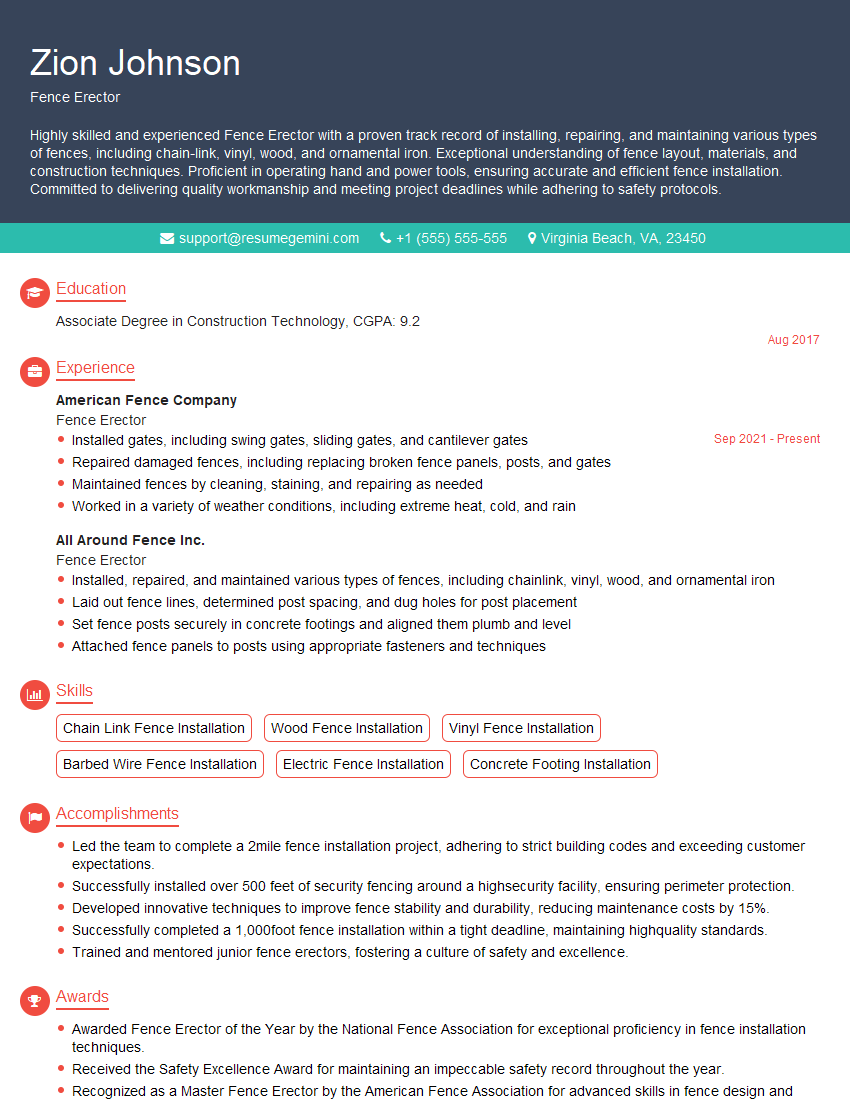
Mastering temporary fence installation opens doors to diverse opportunities within the construction and events industries. Developing a strong skill set in this area positions you for career advancement and higher earning potential. To maximize your job prospects, creating a professional, ATS-friendly resume is crucial. ResumeGemini is a trusted resource to help you build a compelling resume that highlights your abilities and experience. ResumeGemini provides examples of resumes tailored to Temporary Fence Installation, guiding you to present your qualifications effectively. Invest time in crafting a strong resume—it’s your first impression on potential employers.
Explore more articles
Users Rating of Our Blogs
Share Your Experience
We value your feedback! Please rate our content and share your thoughts (optional).
What Readers Say About Our Blog
Very informative content, great job.
good