Interviews are more than just a Q&A session—they’re a chance to prove your worth. This blog dives into essential Medication Counting interview questions and expert tips to help you align your answers with what hiring managers are looking for. Start preparing to shine!
Questions Asked in Medication Counting Interview
Q 1. Explain the importance of accurate medication counting.
Accurate medication counting is paramount in healthcare for patient safety and legal compliance. A simple error in counting can lead to underdosing, resulting in treatment failure, or overdosing, potentially causing serious adverse effects or even death. Accurate counts also ensure proper inventory management, preventing stockouts and minimizing waste.
Think of it like this: if you’re a baker and miscount ingredients, your cake might not rise or taste right. Similarly, in medication management, an inaccurate count can have far-reaching and potentially life-threatening consequences.
Q 2. Describe your experience with different medication counting techniques.
Throughout my career, I’ve utilized various medication counting techniques. Manual counting, involving visually inspecting and counting each medication unit, is the most basic method, suitable for smaller quantities. However, it’s prone to human error, especially with larger counts or similar-looking medications. I’ve also extensively used automated counting machines, which significantly improve accuracy and speed, particularly in high-volume settings like hospital pharmacies. These machines use optical or weight-based sensors to verify counts. Furthermore, I am experienced with using batch counting systems for large volume medications, streamlining the process and increasing efficiency.
Finally, I’ve worked with barcode scanning systems integrated with electronic health records (EHRs), which not only count medications accurately but also help prevent dispensing errors by cross-checking medication information with patient records.
Q 3. How do you ensure accuracy when counting medications?
Ensuring accuracy is a multi-step process that begins with creating a calm and focused environment. This reduces distractions and minimizes errors. I always double-check my counts, employing independent verification wherever possible – having a colleague verify my count is a crucial step in minimizing errors. When manually counting, I use methodical techniques, such as counting in groups of five or ten, to maintain focus. I carefully inspect each medication unit for damage or defects and always verify the medication name, dosage, and strength against the prescription order. With automated systems, I regularly perform quality control checks, ensuring the machine’s calibration and functionality are optimal. Regular training and adherence to strict protocols are essential. For instance, I might perform a mock count with known quantities to validate my technique.
Q 4. What steps do you take to prevent medication errors during counting?
Preventing errors is a proactive approach. Maintaining a clean and organized workspace is the first step, minimizing the chance of misplacing medications. Adhering to strict counting procedures is crucial, always following the same method consistently. This also involves regular equipment maintenance and calibration to prevent malfunctioning of automated counting machines. Clear and legible labeling of medications is essential to avoid confusion. Before dispensing any medication, I always verify the medication against the patient’s medical record. Regular staff training and competency assessment are also key, especially regarding the use of automated systems and potential error sources. Implementing a system of checks and balances, such as requiring a second person to verify high-risk medications, is an extra safety measure.
Q 5. How do you handle discrepancies during medication counting?
Discrepancies are addressed immediately and systematically. The first step is to recount the medication carefully, using a different technique than initially used to reduce the possibility of repeating the same error. I then thoroughly investigate potential causes, such as damaged packaging, inaccurate initial count, or machine malfunction. If the discrepancy cannot be readily resolved, I initiate a full investigation, documenting all steps taken, including personnel involved and potential causes identified. Depending on the nature and severity of the discrepancy, I may need to involve my supervisor or a quality assurance team. All discrepancies, and the actions taken to resolve them, are meticulously documented in the medication records.
Q 6. Describe your experience with automated medication dispensing systems.
I have extensive experience with automated medication dispensing systems (AMDS), including robotic dispensing units and carousel systems. These systems improve efficiency, reduce manual handling, and decrease the likelihood of human error. However, it’s crucial to understand that these systems are not foolproof. Regular maintenance, software updates, and quality control checks are paramount to ensure their accuracy and reliability. It’s vital to be proficient in using these systems, understanding their functionalities, limitations, and potential error sources. I’m trained to troubleshoot common problems and am adept at recognizing and correcting potential issues before they result in medication errors. For example, I am trained to recognize and resolve issues such as system malfunctions and barcode reading problems. The integration of AMDS with EHRs enhances patient safety by verifying medication orders and reducing the risk of dispensing the wrong medication.
Q 7. Explain the importance of proper documentation in medication counting.
Proper documentation is the cornerstone of accountable medication counting. Every step, from the initial count to the final verification, should be meticulously recorded. This includes the date, time, medication name, dosage, batch number, quantity counted, method of counting, any discrepancies encountered, and the steps taken to resolve them. Accurate documentation is essential for tracking medication usage, ensuring inventory control, and meeting regulatory requirements. Detailed records are vital for audits and investigations, should a medication error occur. This meticulous approach provides a clear audit trail and protects both the patient and the healthcare provider.
Q 8. How do you reconcile medication counts?
Reconciling medication counts is a crucial process to ensure accuracy and prevent medication errors. It involves comparing the physical count of medications against the documented inventory levels. This process typically involves a series of steps, beginning with an initial count of medications on hand. Then, this count is compared to the expected count based on records of medications dispensed, received, and wasted. Any discrepancies are investigated to identify the source of the error, whether it’s a dispensing error, a record-keeping error, or theft.
For example, imagine a pharmacy with 100 units of a particular drug. After a period, the records show 80 units dispensed and 2 units wasted. A physical count reveals only 75 units remaining. The discrepancy of 5 units requires investigation, potentially involving checking dispensing logs, reviewing waste records, or even checking for potential stock loss due to damage or expiry.
Think of it like balancing your checkbook: you compare the money you have in your account with your transactions to make sure everything adds up. Medication reconciliation is the same – it ensures that what’s on paper matches what’s physically present.
Q 9. What are common challenges in medication counting, and how do you address them?
Common challenges in medication counting include human error (incorrect counting, inaccurate recording), damaged or deteriorated packaging that makes accurate counting difficult, pilferage or theft, and the sheer volume of medications to count, especially in large facilities. Addressing these requires a multi-pronged approach.
- Human Error: Employing double-checking mechanisms, using barcoding systems for automated counting and verification, and providing regular staff training can significantly reduce errors.
- Damaged Packaging: Implementing proper storage conditions and regular stock checks to identify damaged packaging early on can help. When encountering damaged packaging, careful handling and additional verification steps are necessary.
- Pilferage/Theft: Implementing robust security measures, including controlled access to medication storage areas, regular inventory checks, and video surveillance, is crucial. Strict adherence to inventory control procedures and regular audits also play a vital role.
- Volume of Medications: Utilizing technology like automated counting machines and implementing efficient counting procedures can alleviate this challenge. Prioritization of high-risk medications and a systematic approach to counting can improve efficiency.
Q 10. How do you maintain inventory control while ensuring accurate medication dispensing?
Maintaining inventory control while ensuring accurate medication dispensing requires a well-structured system integrating various components. This includes utilizing a robust inventory management software, employing a first-in, first-out (FIFO) stock rotation system, conducting regular cycle counts (counting a subset of inventory regularly instead of a full count less frequently), and implementing a secure storage system. The system should seamlessly integrate with the dispensing process to minimize chances of errors. For example, the dispensing system should automatically update inventory levels after each dispensing event.
Imagine a restaurant managing its ingredients. They need to know what they have, when it expires, and ensure that it’s used in a timely manner, just as a pharmacy needs to manage its medication inventory. A well-organized system helps in predicting medication needs, prevent stockouts, and ensures that medications are dispensed correctly and timely.
Q 11. Explain your understanding of controlled substances and their handling in medication counting.
Controlled substances require significantly stricter handling and counting procedures compared to other medications. This is due to their high potential for abuse and misuse. Strict adherence to regulatory guidelines, like those from the Drug Enforcement Agency (DEA) in the US, is mandatory. This includes maintaining separate storage areas, double-locking mechanisms, and meticulous documentation of each transaction, including the person dispensing, receiving and witnessing the count, along with the date and time. Regular audits and inventories are crucial to monitor discrepancies and prevent diversion.
The counting process often involves two authorized individuals performing and verifying the count, and discrepancies are immediately investigated and reported. Special logs and controlled substance inventory sheets must be meticulously maintained.
Think of a high-security vault – controlled substances require similar stringent control measures. The emphasis is on accountability and prevention of misuse at every stage of handling.
Q 12. Describe your experience with different types of medication packaging.
My experience encompasses a wide range of medication packaging, including unit-dose packaging (individually wrapped medications), bulk packaging (bottles, vials), multi-dose packaging (blister packs), and specialized packaging for controlled substances. Each type requires a tailored approach to counting. Unit-dose packaging is generally easier to count, but requires careful checking for any missing or damaged packets. Bulk packaging demands careful pouring and weighing, potentially using specialized counting equipment for high-volume situations. Blister packs, with their multiple compartments, necessitate thorough inspection of each compartment to confirm the presence and integrity of all medications. Controlled substance packaging often includes tamper-evident features, adding another level of verification.
Just as a chef uses different techniques to handle various ingredients, a medication counter adjusts their methods based on the type of packaging.
Q 13. How do you manage medication waste during counting?
Medication waste during counting is a critical aspect of medication management and requires strict adherence to protocols to ensure safety and regulatory compliance. Any discarded medication must be documented meticulously, including the type of medication, quantity, reason for disposal, and the individuals involved in the disposal process. The disposal method should adhere to established guidelines, potentially involving witnessed destruction or specialized waste disposal services for controlled substances. This meticulous documentation helps ensure accountability and traceability.
A detailed waste log, much like a meticulously kept receipt, can assist in reconciliation and prevent discrepancies in future counts.
Q 14. What are your preferred methods for verifying medication counts?
My preferred methods for verifying medication counts include a combination of techniques to ensure accuracy. This typically involves a visual double-check of the counted medications against the inventory records, followed by a reconciliation process to identify and address discrepancies. Technology plays a crucial role – barcode scanners and automated counting machines can significantly enhance accuracy and efficiency. In the case of controlled substances, a second individual independently verifies the count. Random sampling and cycle counting of high-risk medications provide additional verification measures.
Think of it as a layered security approach: multiple methods working in concert ensure a high degree of accuracy and accountability.
Q 15. How do you adapt your medication counting techniques to different medications (e.g., tablets, capsules, liquids)?
Adapting medication counting techniques to different forms requires a nuanced approach. The core principle remains consistent: accuracy and safety. However, the method changes based on the medication’s physical properties.
Tablets: These are usually counted using a simple visual method, often aided by counting trays or automated pill counters. For large quantities, I employ the ‘count-by-tens’ method, ensuring consistent accuracy. Regular checks are crucial to avoid errors.
Capsules: Similar to tablets, visual counting is effective, but extra care is needed to avoid damage. Gentle handling and appropriate containers minimize the risk of capsule breakage or spillage.
Liquids: This requires a different approach entirely. Precise measurement is paramount, utilizing graduated cylinders or syringes for accurate dispensing. Double-checking the volume against the prescription is an essential step. For viscous liquids, special attention is paid to ensure complete drainage from the measuring device.
In all cases, clear documentation is essential. I meticulously record the medication name, dosage form, quantity counted, and any observations, such as damage or spillage. This provides an auditable trail for regulatory compliance and quality control.
Career Expert Tips:
- Ace those interviews! Prepare effectively by reviewing the Top 50 Most Common Interview Questions on ResumeGemini.
- Navigate your job search with confidence! Explore a wide range of Career Tips on ResumeGemini. Learn about common challenges and recommendations to overcome them.
- Craft the perfect resume! Master the Art of Resume Writing with ResumeGemini’s guide. Showcase your unique qualifications and achievements effectively.
- Don’t miss out on holiday savings! Build your dream resume with ResumeGemini’s ATS optimized templates.
Q 16. What safety measures do you implement during medication counting?
Safety is paramount. My medication counting process emphasizes several key safety measures:
Designated Area: Counting always happens in a clean, well-lit, and designated area free from distractions. This minimizes the risk of errors and contamination.
Personal Protective Equipment (PPE): Depending on the medication’s nature, I might utilize gloves to prevent contamination or skin irritation.
Double-Checking: I always perform a double count, or have a colleague independently verify the count, to minimize human error. Independent verification is particularly crucial for high-potency medications.
Regular Equipment Checks: Counting trays and automated counters undergo routine maintenance and calibration to ensure accuracy. This ensures consistent and reliable performance.
Strict Adherence to Protocols: All counting procedures strictly adhere to established protocols and guidelines, including those set by regulatory bodies.
Q 17. How do you handle damaged or expired medications during the counting process?
Damaged or expired medications require immediate attention. They are never used, and their disposal must follow strict protocols.
Segregation: Damaged or expired medications are immediately segregated from the usable stock.
Documentation: The quantity and reason for discarding (damage or expiry) are meticulously documented. This is vital for inventory management and regulatory compliance.
Safe Disposal: Disposal follows facility-specific procedures, which might involve specialized waste disposal contractors for controlled substances. This ensures compliance with environmental regulations and prevents accidental misuse.
Clear documentation of the disposal process is crucial. This could involve witness signatures and waste disposal tracking numbers, depending on the regulatory requirements.
Q 18. Describe your experience with inventory software or systems used for medication management.
I have extensive experience with various inventory management software systems, including MedTrak and RxNorm. These systems automate many aspects of medication management, significantly improving accuracy and efficiency.
Automated Counting: Some systems integrate with automated pill counters, eliminating manual counting and reducing human error. Data is directly entered into the system, minimizing the risk of transcription errors.
Inventory Tracking: Real-time inventory tracking allows for precise monitoring of medication stock levels, preventing shortages and expirations. Automated alerts signal low stock or approaching expiry dates.
Reporting and Analytics: These systems provide comprehensive reports on medication usage, stock levels, and expiry dates, providing valuable data for analysis and operational improvements.
My experience with these systems has led to improved workflow and reduced errors, contributing significantly to patient safety and regulatory compliance. The ability to generate reports is invaluable for audits and performance evaluation.
Q 19. How do you ensure the security of medications during counting and storage?
Medication security is paramount. This involves measures to prevent theft, loss, or misuse, particularly for controlled substances.
Controlled Access: Medication storage areas are secured with restricted access, often requiring electronic access control and surveillance.
Secure Counting Areas: Counting only occurs in designated, secure areas with limited access.
Regular Audits: Regular audits of medication stock levels are essential to identify any discrepancies. Discrepancies are investigated immediately to determine their cause.
Proper Storage: Medications are stored appropriately according to their specific storage requirements (temperature, humidity, etc.).
For controlled substances, an additional layer of security is implemented, often involving dual-signature requirements for dispensing and a locked, monitored storage cabinet.
Q 20. How do you prioritize accuracy and efficiency when counting medications?
Prioritizing accuracy and efficiency requires a multi-faceted approach. It’s not about speed at the cost of accuracy; instead, it’s about optimizing the process for both.
Streamlined Workflow: A well-organized workflow minimizes unnecessary steps and movement, enhancing efficiency. This includes having all necessary supplies readily available.
Technology Utilization: Employing automated counting systems and inventory management software significantly improves accuracy and efficiency. These tools reduce manual work and minimize errors.
Double-Checking: Although seemingly time-consuming, double-checking is the best method for ensuring accuracy. This can be done independently or through the use of automated verification systems.
Regular Training: Consistent training and competency assessments for all staff involved in medication handling are crucial to maintain high standards of accuracy and efficiency.
Accuracy is non-negotiable. I’d rather take a little longer and ensure accuracy than rush the process and risk a critical error. Finding that balance is key.
Q 21. How do you communicate medication discrepancies to the appropriate personnel?
Medication discrepancies require immediate attention and prompt communication. The process varies depending on the nature and magnitude of the discrepancy.
Minor Discrepancies: Small discrepancies (e.g., a few missing tablets due to breakage) are usually documented and reported to the supervisor or pharmacy manager. This might involve updating the inventory system and documenting the loss.
Significant Discrepancies: Significant discrepancies (e.g., large quantities missing, possible theft) require immediate investigation and notification to the appropriate personnel, including possibly the police or regulatory bodies. A thorough investigation is launched to determine the cause and prevent future occurrences. Documentation of the entire process is paramount.
Clear and concise communication is key. Reports include specific details about the discrepancy, including the medication, quantity, date, and any potential causes identified during the investigation.
Q 22. Describe your understanding of medication labels and their significance in counting.
Medication labels are crucial for accurate counting. They’re like a medication’s passport, providing vital information. Think of it like this: you wouldn’t board a plane without checking your ticket; similarly, you shouldn’t count medication without verifying the label.
- Medication Name: The precise name ensures you’re handling the correct drug. For instance, differentiating between ‘Aspirin’ and ‘Acetylsalicylic Acid’ is vital, though they’re the same drug.
- Dosage Strength: This specifies the amount of medication per unit (e.g., 10mg tablets, 250mg capsules). Incorrect dosage can lead to serious patient harm.
- Dosage Form: Indicates how the medication is administered (tablets, capsules, liquid, etc.). This ensures you are counting the right type of medication.
- National Drug Code (NDC): A unique identifier preventing confusion between similar-looking medications from different manufacturers.
- Expiration Date: Expired medications are ineffective and potentially harmful. Counting requires checking that all medications are within their shelf life.
Missing or illegible labels render the medication unusable for patient care and requires immediate attention. Always double-check labels before and during the counting process. A simple mistake can have severe consequences.
Q 23. How do you ensure that you are counting the correct medication?
Ensuring you’re counting the correct medication is paramount. It’s a multi-step process involving meticulous verification.
- Visual Inspection: Carefully examine the medication’s physical characteristics (shape, color, size, markings) to confirm they match the label description.
- Label Verification: Triple-check the medication name, dosage strength, and dosage form against the prescription or inventory list. Any discrepancy necessitates immediate investigation and clarification.
- NDC Verification (if applicable): Verify the NDC number to confirm it aligns with the order or inventory records. This added layer reduces errors associated with similar-looking drugs.
- Cross-referencing: Compare the medication with the original source document (e.g., prescription, purchase order). This helps identify any errors early on.
- Second Count (best practice): A second independent count by a different person reduces human error significantly. This is often a regulatory requirement in many healthcare settings.
Remember, in medication counting, accuracy trumps speed. Taking the time to meticulously verify each step is far better than rushing and making a potentially dangerous mistake.
Q 24. Explain your understanding of different units of measurement used in medication counting.
Medication counting involves various units of measurement, demanding a clear understanding. Inconsistent units can lead to critical errors. Imagine measuring water in liters instead of milliliters – the difference is significant.
- Number of Units: The simplest form: counting individual tablets, capsules, or vials.
- Milligrams (mg): Commonly used for powdered medications or those dissolved in liquid.
- Grams (g): For larger quantities or potent medications.
- Milliliters (mL): For liquid medications. Syringes and graduated cylinders are vital for accurate measurement.
- International Units (IU): Used for specific medications, like vitamins and hormones, where the quantity is expressed as units of biological activity.
Always use the units specified on the medication label and the accompanying documentation. Converting between units requires careful calculation to avoid errors. If unsure, always seek clarification from a pharmacist or supervisor.
Q 25. Describe your process for checking for medication recalls or alerts during inventory.
Regularly checking for medication recalls and alerts is crucial. This prevents the dispensing or use of potentially harmful medications.
- Subscription to Alert Systems: Subscribe to FDA (or equivalent national agency) and pharmaceutical company recall notification services. This provides immediate alerts about recalled medications.
- Regular Inventory Review: During inventory, scan each medication’s label against the recall databases. Utilize barcode scanners or specialized software to automate this process, if available.
- Internal Database Updates: Maintain an up-to-date internal database of medications, ensuring it’s constantly synced with the official recall databases.
- Visual Inspection for Recall Labels: Look for any physical recall labels affixed to the packaging. These are clear indicators that a medication has been recalled.
- Immediate Action: If a recalled medication is identified, immediately quarantine it and follow the recall instructions provided by the manufacturer or regulatory agency.
Medication recalls can impact patient safety, and proactiveness is key to mitigating risks.
Q 26. How do you maintain your knowledge of current medication counting standards and best practices?
Staying current with medication counting standards and best practices requires ongoing professional development.
- Professional Organizations: Join relevant professional organizations like pharmacy technician associations, which offer continuing education courses, webinars, and publications on best practices.
- Regulatory Updates: Regularly review guidelines and regulations from bodies like the FDA (or your equivalent national authority) to ensure compliance.
- Journal Articles and Research: Stay informed about new research and advances in medication management through relevant journals and publications.
- Workshops and Conferences: Participate in workshops and conferences that focus on medication safety and inventory management. Networking with peers provides additional learning.
- Internal Training Programs: Participate in any internal training programs offered by your employer to update your knowledge of specific policies and procedures.
Continuous learning is essential to maintaining the high standards required in this field. Staying updated protects patients and maintains professional credibility.
Q 27. What steps would you take if you discovered a significant discrepancy in a medication count?
Discovering a significant discrepancy in medication count is a serious event requiring immediate action. It suggests a potential error, loss, or theft.
- Immediate Stop: Halt all activities related to the affected medication.
- Thorough Recount: Perform an independent recount of the medication by a different team member. This verifies the initial count’s accuracy.
- Investigate Potential Causes: Examine all records (orders, receipts, dispensing logs) to identify discrepancies. Look for potential reasons for shortages or overages.
- Documentation: Meticulously document all steps taken, including the initial count, recount, discrepancies, and the investigation’s findings.
- Report to Supervisor: Immediately notify your supervisor or manager of the discrepancy and the findings of your investigation.
- Potential Incident Reporting: Depending on the severity of the discrepancy and institutional policies, file an incident report. This is essential for tracking, analysis, and preventing future similar incidents.
Discrepancies highlight potential weaknesses in the medication management system. A thorough investigation is vital to ensure patient safety and procedural integrity.
Q 28. How do you handle stressful situations while performing medication counting tasks?
Medication counting demands precision and focus, and stressful situations can easily compromise accuracy. Strategies are needed to maintain composure.
- Organized Workspace: A well-organized and clutter-free workspace reduces stress and improves efficiency.
- Time Management: Effective time management prevents rushing, a major source of errors. Break down tasks into smaller, manageable steps.
- Prioritization: Prioritize tasks according to urgency and importance. Focus on high-risk medications first.
- Deep Breathing Exercises: Take short breaks to practice deep breathing or other relaxation techniques to manage stress and improve focus.
- Teamwork and Support: Don’t hesitate to ask for help from colleagues or supervisors when overwhelmed. Teamwork significantly reduces stress and errors.
- Self-Care: Ensure adequate rest and maintain a healthy work-life balance to reduce overall stress levels. Burnout is a significant risk in high-pressure environments.
Handling stress effectively is vital for maintaining accuracy, preventing errors, and protecting patient safety.
Key Topics to Learn for Medication Counting Interview
- Understanding Medication Labels: Learn to accurately interpret medication labels, including dosage, route of administration, and potential warnings.
- Unit Conversions: Master the conversion of medication units (e.g., milligrams to grams, milliliters to liters) to ensure accurate dispensing.
- Counting Techniques: Become proficient in various medication counting methods, including manual counting, using automated counting machines, and understanding the importance of double-checking counts.
- Inventory Management: Understand the principles of inventory management related to medications, including tracking stock levels, ordering new supplies, and managing expiration dates.
- Safety and Compliance: Familiarize yourself with relevant safety regulations and compliance procedures for medication handling and counting, including error prevention strategies.
- Record Keeping and Documentation: Understand the importance of accurate and meticulous record-keeping for all medication counting activities, adhering to all relevant regulations and standards.
- Problem-Solving Scenarios: Practice identifying and resolving potential issues that may arise during the medication counting process, such as discrepancies in counts or damaged packaging.
- Technological Proficiency: Familiarize yourself with any technology used in your target workplace for medication counting, such as automated dispensing systems or inventory management software.
Next Steps
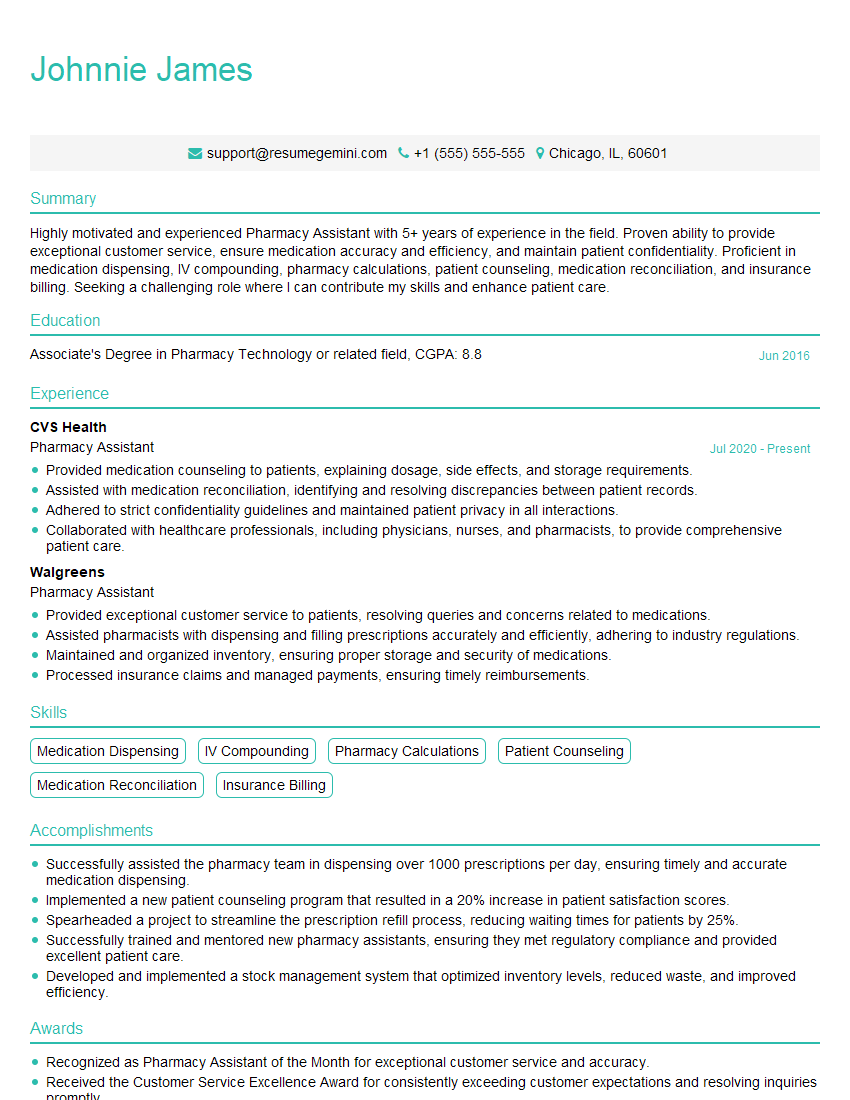
Mastering medication counting is crucial for a successful and rewarding career in healthcare. Accuracy and attention to detail in this area are paramount, directly impacting patient safety and overall operational efficiency. To significantly boost your job prospects, invest time in crafting an ATS-friendly resume that highlights your skills and experience effectively. ResumeGemini is a trusted resource that can help you create a professional and impactful resume tailored to the specific demands of medication counting roles. Examples of resumes optimized for this field are available to help you get started. Take the next step towards your dream job!


Explore more articles
Users Rating of Our Blogs
Share Your Experience
We value your feedback! Please rate our content and share your thoughts (optional).
What Readers Say About Our Blog
Very informative content, great job.
good