Preparation is the key to success in any interview. In this post, we’ll explore crucial Microchip Application Notes interview questions and equip you with strategies to craft impactful answers. Whether you’re a beginner or a pro, these tips will elevate your preparation.
Questions Asked in Microchip Application Notes Interview
Q 1. Explain your understanding of Microchip’s AN1001.
Microchip’s AN1001, while not a publicly available application note with that exact number, likely refers to a document within their extensive library. Microchip application notes generally provide practical guidance on using their microcontrollers and other components. They often cover specific applications, peripherals, or design techniques. Let’s assume AN1001 (hypothetically) is about using a specific ADC (Analog-to-Digital Converter) on a PIC microcontroller. The document would likely walk through the hardware setup, including pin configuration, clock settings, and reference voltage selection. Then, it would explain the software implementation, showing how to initialize the ADC, start a conversion, read the results, and perform any necessary calibration. It would also likely include example code snippets in C or assembly, along with explanations of important registers and bit fields. Finally, it would probably present typical application scenarios and troubleshooting tips.
For instance, a hypothetical AN1001 might cover achieving high accuracy in temperature measurements using the ADC, including details on reducing noise and compensating for temperature drift. It would highlight important considerations such as choosing appropriate sampling rates and filter techniques. This level of detail is typical of Microchip application notes; their focus is to make using their products as straightforward as possible.
Q 2. Describe a time you used a Microchip application note to solve a design challenge.
I once faced a challenge integrating a real-time clock (RTC) module with a PIC18F microcontroller for a data logging project. The RTC needed to maintain accurate time even when the main microcontroller was powered down. The datasheet for the RTC was dense, and I struggled with the initialization sequence and interrupt handling. Then, I found a Microchip application note detailing RTC integration with the specific PIC18F family. The note provided a comprehensive example with clear explanations of register settings, interrupt configuration, and code snippets illustrating power-saving techniques. It also addressed potential issues such as calendar roll-over and clock synchronization.
The application note served as a blueprint. I adapted the code example to my exact needs, incorporating error handling and additional features like automatic data logging at pre-defined intervals. The application note significantly reduced development time and ensured the RTC integration was robust and reliable, achieving the required accuracy for the data logging system. Without it, I would have spent considerably more time troubleshooting and experimenting.
Q 3. How do Microchip application notes aid in troubleshooting hardware issues?
Microchip application notes are invaluable for hardware troubleshooting. They often contain detailed schematics, circuit diagrams, and explanations of the expected behavior of various peripherals. If a circuit isn’t working as intended, consulting relevant application notes helps identify potential problems. For example, if a communication protocol like SPI or I2C isn’t functioning, an application note might highlight common wiring errors, clocking issues, or register settings that can lead to malfunctions.
They often provide debugging strategies, such as signal tracing techniques, recommended test equipment, and common error messages and their solutions. Let’s say you are having issues with a particular peripheral’s interrupt: the application note might detail how to properly configure the interrupt vector, priorities, and masking registers. This detailed information can save considerable time and effort in tracking down the root cause of hardware failures. They effectively serve as a comprehensive guide to properly implementing and debugging Microchip’s devices.
Q 4. Compare and contrast different Microchip device families based on application notes.
Microchip offers a diverse range of microcontroller families, each with its strengths and weaknesses. Application notes help illuminate these differences. For instance, comparing the PIC16, PIC18, and PIC32 families reveals distinct architectural characteristics reflected in their application notes. PIC16 is often highlighted in notes focusing on low-power, cost-sensitive applications, with a focus on simpler peripheral configurations. PIC18 notes often emphasize more sophisticated peripherals and robust interrupt handling, useful in industrial control or data acquisition systems. PIC32 application notes, on the other hand, typically address more complex applications requiring high processing power and extensive peripheral integration, like those found in embedded graphics or networking solutions.
Similarly, the SAM series (ARM-based) often has application notes focused on advanced features like DMA (Direct Memory Access) controllers and complex communication protocols. By studying these differences in the application notes, developers can easily choose the right family for a given project. The type of applications covered in each family’s application notes directly relates to its capabilities.
Q 5. What are the key parameters to consider when selecting a microcontroller based on Microchip’s ANs?
When selecting a microcontroller, Microchip’s application notes guide the decision-making process by highlighting critical parameters. Key considerations include:
- Memory Requirements: Application notes will often indicate the amount of flash and RAM needed for the intended application, allowing a developer to choose a microcontroller with sufficient resources.
- Processing Power: Notes will often specify the clock speed and instruction set architecture, providing insights into the microcontroller’s processing capabilities for the application’s computational demands.
- Peripheral Availability: The application notes showcase the peripherals offered (ADC, UART, SPI, I2C, timers, etc.). This is critical for selecting a microcontroller that seamlessly supports all the needed interfaces.
- Power Consumption: Power budgets are critical for many embedded designs. Microchip’s application notes frequently specify power consumption at different operating modes, enabling developers to make informed decisions.
- Packaging and Operating Voltage: The notes will specify details about the microcontroller’s physical form factor and voltage ranges, critical for the design’s physical layout and power supply.
By meticulously considering these factors, based on information provided in Microchip’s Application Notes, developers can select a microcontroller that perfectly matches their needs, ensuring optimal performance and efficiency.
Q 6. How do you interpret data sheets and application notes in conjunction for optimal results?
Datasheets and application notes are complementary resources. The datasheet provides a detailed technical specification of the device – a comprehensive but often dry and technical description. Application notes, on the other hand, provide practical examples and guidance, effectively bridging the gap between the datasheet’s technical details and real-world implementation.
I start by reviewing the datasheet to understand the device’s capabilities and limitations. I’ll then seek relevant application notes that demonstrate how to use the device in my specific application. The application notes typically provide code examples, design recommendations, and troubleshooting tips. The combination ensures that the implementation will not only function correctly but be optimized for performance and robustness. For example, the datasheet might specify the ADC’s resolution and sampling rate, while the application note demonstrates proper configuration and calibration techniques to maximize accuracy and minimize noise.
Q 7. Explain your experience using Microchip’s MPLAB Harmony framework.
I have extensive experience using Microchip’s MPLAB Harmony framework. It’s a comprehensive middleware framework that significantly simplifies the development process for Microchip’s PIC32 microcontrollers. Harmony’s modular design allows developers to select only the necessary drivers and libraries, reducing code complexity and project size. Its driver abstraction layers make it much easier to switch between different hardware configurations. I’ve used Harmony for various projects including motor control systems, data acquisition systems, and embedded graphical user interfaces (GUIs).
One notable project involved building a custom graphical user interface (GUI) for a portable data logger. Using Harmony’s Graphics Library, I was able to rapidly develop a responsive and intuitive interface. Harmony’s built-in support for various communication protocols greatly simplified the integration of sensors and other peripherals. The modular nature of the framework allowed for easy testing and debugging. The framework’s extensive documentation and example projects further accelerated the development process, enabling me to deliver the project efficiently and effectively.
Q 8. Discuss the importance of safety and security considerations detailed in relevant Microchip ANs.
Microchip Application Notes (ANs) place significant emphasis on safety and security, recognizing that embedded systems often control critical functions. Ignoring these aspects can lead to catastrophic failures or security breaches. Safety considerations cover aspects like preventing unintended operation, managing fault conditions, and ensuring reliable system behavior even under stress. This might involve discussions on watchdog timers, error detection and correction codes, and robust design practices to prevent unintended hardware or software actions. Security, on the other hand, focuses on protecting the system from unauthorized access, modification, or data breaches. This is addressed through secure boot mechanisms, encryption techniques, and secure communication protocols. Specific ANs detail appropriate hardware and software implementations for these concerns. For example, ANs might cover the proper use of cryptographic libraries, secure storage of sensitive data, and protection against common attacks like buffer overflows.
A practical example involves a medical device. A faulty sensor reading leading to an incorrect drug dosage could have severe consequences. A Microchip AN would guide the design to include redundant sensor readings, self-tests, and fail-safe mechanisms to mitigate such risks. Similarly, a smart home security system requires robust security measures against hacking. The ANs would provide detailed guidance on implementing secure communication channels and protecting sensitive user data.
Q 9. How would you apply the information from a specific Microchip AN (e.g., AN2149) to a real-world project?
AN2149, focusing on USB implementation, offers invaluable insights for projects involving USB communication. Let’s say I’m working on a project that requires a microcontroller to communicate with a PC via USB to transfer sensor data. AN2149 details the various USB device classes, the different configurations, and the necessary firmware drivers. It guides you through setting up the USB peripheral in the microcontroller and properly handling interrupts.
In my real-world project, I’d leverage AN2149 to understand how to configure the USB device descriptors correctly to match my sensor’s characteristics. I would then implement the data transfer protocols described in the AN, possibly using the provided code examples as a starting point. Furthermore, the AN provides invaluable advice on handling error conditions and ensuring robust USB communication even in noisy environments. I would use the debugging techniques mentioned in the AN to test and validate my implementation. This includes utilizing a logic analyzer to examine the USB data packets and ensuring that the data is transferred correctly, and paying close attention to the timing considerations detailed in the AN. The application note also offers troubleshooting advice, saving me significant time during the development process.
// Example code snippet (Illustrative - would be much more extensive) #include // Microchip header file // ... USB initialization code ... while(1){ // ... Code to read sensor data ... // ... USB data transfer code (based on AN2149) ... } Q 10. Describe your proficiency in using different debugging tools as guided by Microchip ANs.
My proficiency in debugging tools is deeply rooted in the guidance provided by Microchip ANs. They often recommend and detail the usage of tools like MPLAB X IDE, debuggers like the ICD 3 or PICKit 4, and logic analyzers. I’m adept at using the integrated debugger in MPLAB X to set breakpoints, step through code, examine variables, and analyze the program’s execution flow. This allows me to isolate and fix bugs efficiently. Logic analyzers are indispensable for analyzing the timing and signal integrity of various microcontroller peripherals. I’ve used these tools extensively to debug complex USB, SPI, and I2C communication protocols, often referencing Microchip ANs for detailed signal analysis and timing diagrams.
For instance, during a project using SPI communication, I faced unexpected timing errors. By utilizing a logic analyzer guided by the appropriate Microchip AN’s timing diagrams, I was able to pinpoint the specific timing violation in my SPI configuration, directly identifying the root cause of the communication failure. This precise analysis, guided by the AN, helped me resolve the issue quickly, without resorting to trial-and-error approaches.
Q 11. What is the role of peripheral drivers mentioned in Microchip application notes?
Peripheral drivers, as described in Microchip ANs, are crucial software components that simplify interaction with the microcontroller’s peripherals. They provide a higher-level abstraction, shielding the developer from the low-level register configurations and complexities. Instead of manually manipulating individual registers to control a specific peripheral (like a UART, SPI, or ADC), a peripheral driver provides functions to easily send data through the UART, configure SPI settings, or read data from the ADC. This reduces development time, improves code readability, and minimizes errors.
Think of it as driving a car: you don’t need to know how the engine, transmission, or brakes work at the mechanical level to drive. The driver provides a simplified interface. Similarly, peripheral drivers abstract away the complexities of microcontroller peripherals, making it much easier for developers to focus on the application logic. This also makes the code more portable, as the driver can be easily adapted across different Microchip devices supporting the same peripheral.
Q 12. How do you approach interpreting circuit diagrams and schematics found within application notes?
Interpreting circuit diagrams and schematics is a fundamental skill. Microchip ANs often include these diagrams to illustrate hardware connections, peripheral configurations, and power supply designs. My approach starts by understanding the overall system architecture shown in the schematic. I identify the main components, such as the microcontroller, sensors, actuators, and other peripherals. I then trace the connections between these components, paying close attention to signal paths, power supply rails, and grounding techniques.
I use standard schematic symbols and notations to understand component values, signal names, and bus configurations. In practice, I systematically analyze each section of the schematic, cross-referencing it with the bill of materials and the AN’s textual description to get a holistic understanding. The ability to understand these schematics is critical to avoid hardware-related issues when implementing the design. For example, a misinterpretation of a pull-up resistor’s value could lead to an incorrect signal level, causing the application to malfunction.
Q 13. Explain your experience in utilizing Microchip’s code examples from their application notes.
Microchip ANs frequently include code examples demonstrating how to use their peripherals and libraries. I’ve extensively utilized these code examples, not just as ready-to-use solutions, but also as learning aids and starting points for my projects. I don’t simply copy-paste; I carefully analyze the code’s structure, functionality, and the underlying principles. I modify and adapt these examples to fit the specific requirements of my project, learning how different parts of the code interact and how to address potential issues based on the AN’s explanations.
In one instance, I was using an external EEPROM. Microchip’s AN provided a code example demonstrating EEPROM communication using I2C. I adapted this example, changing the I2C address to match my EEPROM and modifying data structures to accommodate the specific data I needed to store. The code example laid the foundation for my communication; however, the AN’s explanation of error handling helped me correctly handle potential communication failures. This demonstrates a proactive approach to understanding the code’s functionality.
Q 14. How do Microchip’s ANs address power management considerations in embedded designs?
Microchip ANs consistently address power management, a critical aspect of embedded system design, particularly for battery-powered applications. They discuss various techniques to minimize power consumption, extend battery life, and improve efficiency. This includes topics like using low-power modes, optimizing clock frequencies, utilizing sleep timers, and selecting appropriate components. Specific ANs might detail the use of low-power peripherals, efficient power supply designs, and the utilization of power management units (PMUs) built into the microcontroller.
For example, an AN might demonstrate how to put the microcontroller into a sleep mode during periods of inactivity, waking it up only when necessary via an interrupt. Another AN might show how to configure peripherals to operate in a low-power mode, reducing their power consumption without compromising functionality. The ANs emphasize the importance of thorough power budgeting and offer strategies for minimizing power consumption in different parts of the system. In one project, using the power management techniques detailed in a relevant AN helped me extend the battery life of a sensor node from 24 hours to over 72 hours.
Q 15. Discuss your understanding of different communication protocols (SPI, I2C, UART) as detailed in ANs.
Microchip Application Notes frequently detail three primary communication protocols: SPI, I2C, and UART. Each offers a unique balance of speed, complexity, and wiring requirements. SPI (Serial Peripheral Interface) is a synchronous, full-duplex protocol known for its speed and simplicity. Think of it as a dedicated, high-speed highway for data transfer between a microcontroller and peripherals. Data is transferred in parallel, often utilizing multiple lines for speed. An example would be connecting a fast ADC or an LCD display. The ANs will typically cover clocking configurations, data order (MSB/LSB), and different SPI modes (modes 0-3).
I2C (Inter-Integrated Circuit) is a synchronous, multi-master protocol ideal for connecting multiple devices on a shared bus using fewer wires. Imagine it as a more sophisticated, multi-lane road where several devices can communicate, but with a more regulated system to prevent collisions. Addressing is crucial; each device has a unique address allowing the microcontroller to target specific peripherals. I2C ANs frequently explain bus arbitration, speed adjustments (via clock stretching), and handling multiple devices on the same bus.
UART (Universal Asynchronous Receiver/Transmitter) is an asynchronous, half-duplex protocol suited for simpler, point-to-point communication. This is like a single-lane road where communication occurs in one direction at a time. It’s simpler to implement than SPI or I2C but significantly slower. Common applications include communicating with serial terminals, GPS modules, or other low-speed devices. The ANs often cover baud rate configuration, parity settings, and flow control mechanisms.
- SPI: High speed, simple, full-duplex, multiple devices possible but usually requires dedicated lines for each.
- I2C: Multi-master, fewer wires, slower than SPI, good for connecting multiple devices.
- UART: Simple, asynchronous, point-to-point, slow speed, ideal for basic communication.
Career Expert Tips:
- Ace those interviews! Prepare effectively by reviewing the Top 50 Most Common Interview Questions on ResumeGemini.
- Navigate your job search with confidence! Explore a wide range of Career Tips on ResumeGemini. Learn about common challenges and recommendations to overcome them.
- Craft the perfect resume! Master the Art of Resume Writing with ResumeGemini’s guide. Showcase your unique qualifications and achievements effectively.
- Don’t miss out on holiday savings! Build your dream resume with ResumeGemini’s ATS optimized templates.
Q 16. How do you assess the reliability and validity of information presented in Microchip ANs?
Assessing the reliability and validity of Microchip ANs involves a multi-step process. Firstly, I check the AN’s revision number; a later revision generally suggests updates addressing earlier issues. I also look for the author’s credentials and any affiliations indicating expertise. The AN’s date is important as technology evolves; outdated information might not reflect current best practices. Cross-referencing information with other reputable sources, such as the official datasheets, is crucial. If the AN proposes code, I’d thoroughly examine the code’s style, comments, and adherence to best practices. Finally, testing the provided code or methods on my own hardware provides the ultimate validation – practical application is key.
I always remember a case where an early revision of an AN on USB communication had a subtle timing issue. By cross-referencing with a later revision and the datasheet, I identified and corrected the problem, preventing a significant delay in my project.
Q 17. Describe your experience with different Microchip development tools and their related ANs.
My experience encompasses various Microchip development tools, often supported by accompanying ANs. I’m proficient with MPLAB X IDE, using its integrated debugger and simulator extensively. Many ANs directly support the debugger functionalities or provide code examples specifically designed for MPLAB X. I’ve used the Real ICE in-circuit emulator for advanced debugging, often referencing ANs on advanced debugging techniques such as breakpoints and watchpoints. Furthermore, I’ve utilized Harmony, Microchip’s embedded software framework, extensively, leveraging the numerous ANs that provide examples and best practices for using specific Harmony modules. These ANs often cover aspects like peripheral configuration, driver implementation, and advanced features within Harmony.
For example, I once used an AN detailing a specific Harmony driver for a CAN controller to solve a complex communication problem with a motor control system. The AN provided clear examples and explanations, significantly accelerating my development process.
Q 18. How would you identify and resolve conflicts between different Microchip application notes?
Conflicting information across Microchip ANs is rare but possible due to evolving technology and different versions of hardware or software. My approach is methodical. I first verify the applicability of each AN to my specific hardware and software versions. If the conflict persists, I’ll check the revision dates of the ANs; the most recent revision usually supersedes older ones. If the conflict remains, I carefully examine the underlying assumptions and methodologies of both ANs. I’ll prioritize information from official datasheets, which often provide the most definitive answers. If all else fails, I might contact Microchip’s support team for clarification.
In one instance, two ANs described slightly different configurations for the same peripheral. By referring back to the datasheet and testing both configurations, I determined one AN had a minor typographical error, resolving the conflict.
Q 19. What is your experience with real-time operating systems (RTOS) as discussed in Microchip ANs?
My experience with RTOS (Real-Time Operating Systems), as detailed in Microchip ANs, is substantial. I’ve worked extensively with FreeRTOS, a popular choice for Microchip microcontrollers. Many ANs provide detailed guides on integrating FreeRTOS with specific microcontrollers and peripherals, covering topics like task scheduling, inter-task communication (using semaphores, mutexes, queues), and memory management. These ANs are invaluable for efficient resource allocation in complex embedded systems. I’ve used ANs to understand the best practices for designing real-time applications focusing on concepts like priority inversion and deadline scheduling. Understanding the intricacies of RTOS scheduling and context switching is crucial for building reliable and responsive systems.
For example, I used a Microchip AN on FreeRTOS to implement a precise control loop for a robotic arm, ensuring the responsiveness needed for the complex control algorithms. Without the AN, the development process would have been much more difficult.
Q 20. Explain your process for optimizing code based on the efficiency guidelines in relevant ANs.
Optimizing code based on Microchip ANs’ efficiency guidelines involves a structured approach. I start by profiling my code using tools integrated into the MPLAB X IDE to identify performance bottlenecks. Then, I consult relevant ANs for specific optimizations for my target microcontroller architecture. These ANs often cover techniques like loop unrolling, reducing function call overhead, using compiler intrinsics, and optimizing data structures. I always focus on minimizing memory usage (both RAM and flash) and reducing execution time. After applying optimizations, I re-profile the code to measure the effectiveness of the changes. Iterative testing and profiling are crucial for ensuring that optimizations indeed improve performance and do not introduce unforeseen bugs.
In a project involving data acquisition and processing, I used ANs to guide me in optimizing a critical signal processing algorithm. By carefully implementing techniques like loop unrolling and using compiler intrinsics, I was able to reduce execution time by over 30%, enabling faster data processing and better real-time performance.
Q 21. How do you handle situations where Microchip ANs lack specific information or solutions?
When Microchip ANs lack specific information or solutions, I employ several strategies. First, I meticulously search the Microchip website for related documents, including datasheets, errata, and FAQs. I also explore Microchip’s forums and communities to see if other users have encountered and solved similar problems. If necessary, I leverage external resources such as online technical forums and libraries to gain a deeper understanding of the problem. Finally, as a last resort, I may contact Microchip’s support team for direct assistance. This multifaceted approach increases the chances of finding a solution, even when the initial AN is insufficient.
I remember a project where I needed to integrate a specific sensor not fully documented in the existing ANs. Through online searches and community forums, I found solutions from other developers and combined that information with the datasheet to successfully integrate the sensor.
Q 22. Explain your understanding of the different memory types in Microchip MCUs based on ANs.
Microchip MCUs typically feature a variety of memory types, each optimized for different tasks. Understanding these differences is crucial for efficient code execution and resource management. Microchip Application Notes often detail the specifics for each device family. Let’s explore the common types:
- Flash Memory: This is non-volatile memory, meaning data is retained even when power is lost. It’s primarily used to store the program code and configuration data. Think of it as the hard drive of your MCU. Writing to flash memory is generally slower than other memory types but offers persistence.
- SRAM (Static Random Access Memory): This is volatile memory, meaning data is lost when power is removed. It’s faster than flash and is typically used for storing variables, temporary data, and the stack. Imagine it as the MCU’s fast, short-term memory. It’s excellent for quick access but requires power to hold its contents.
- EEPROM (Electrically Erasable Programmable Read-Only Memory): This is non-volatile memory that can be programmed and erased electrically, in smaller blocks, multiple times. It’s often used for storing configuration parameters that need to be persistent but don’t require the high capacity of flash memory. Think of it as a small, persistent storage area for configuration options.
- Data EEPROM: Similar to EEPROM, but specifically designed for data storage, often with features for enhanced reliability and protection.
Application Notes will specify the size and organization of each memory type for a given MCU. For instance, an AN might detail the different memory spaces, their addresses, and how to access them using specific instructions. Understanding these details is vital for efficient memory allocation and preventing memory conflicts.
Q 23. How do you incorporate interrupts effectively in your designs according to Microchip ANs?
Interrupt handling is critical for responsiveness in embedded systems. Microchip ANs provide detailed guidance on effectively using interrupts. The process typically involves these steps:
- Identify Interrupt Sources: Determine the peripherals that will generate interrupts (e.g., timers, UART, ADC). Microchip ANs often provide tables showing all available interrupt sources for a particular MCU.
- Configure Interrupt Priority: Assign priority levels to different interrupts to handle critical events first. ANs explain how to configure the interrupt controller and prioritize requests. Higher priority interrupts will preempt lower priority ones.
- Write Interrupt Service Routine (ISR): Create a function (the ISR) that executes when an interrupt occurs. This function should be short, efficient and handle the specific interrupt event. ANs usually offer example code and templates for ISRs.
- Enable Interrupts: Enable both the global interrupt flag and the specific interrupt source in the MCU’s configuration registers. ANs will outline the specific register bits you need to set.
- Handle Interrupt Context: Be mindful of the context within an ISR. Avoid lengthy computations or blocking operations to minimize interrupt latency. ANs may suggest strategies for handling potential resource conflicts.
Example: Consider a system that needs to read data from an ADC and respond to button presses. The ADC conversion completion could trigger an interrupt to process the data, while the button press could trigger a separate interrupt to update a variable. Proper priority management ensures the ADC interrupt completes before potentially critical button-press processing is stalled.
// Example ISR for ADC conversion completion
void __interrupt() ADC_ISR(void){
  //Read ADC data
  //Process data
}
Q 24. Describe your experience with implementing different timer and counter functions as explained in ANs.
Microchip ANs provide comprehensive information on the various timer and counter modules found in their MCUs. These peripherals are fundamental for tasks like timing events, generating PWM signals, and creating precise delays. The implementation process generally involves:
- Selecting the Appropriate Timer/Counter: Choose the timer/counter module that best suits your needs based on its resolution, operating modes, and features (e.g., capture mode, compare mode, PWM mode). ANs usually provide a detailed comparison of the available options for a given MCU.
- Configuring Timer/Counter Modes: Configure the timer/counter’s operating mode (e.g., free-running, one-shot, periodic), prescaler, and other settings to achieve the desired timing characteristics. ANs are essential for understanding the specific registers and their bit fields for each timer/counter.
- Setting Prescaler and Clock Source: Define the prescaler value to adjust the timer’s clock frequency and select the appropriate clock source (e.g., system clock, peripheral clock). Proper clock configuration is critical for accurate timing.
- Setting Compare/Capture Values: If using compare mode, set the compare register value to trigger an interrupt at a specific time. In capture mode, capture the value of the timer when an event occurs. ANs carefully explain these concepts with register descriptions and example code.
- Handling Timer/Counter Interrupts (if necessary): If needed, configure and implement an ISR to respond to timer/counter interrupts. This involves setting up the interrupt vector and writing the appropriate ISR code.
For example, a real-world application would involve using a timer to generate a PWM signal for motor control or a counter to measure the frequency of an external signal. Microchip ANs will often include complete examples showing how to achieve these functionalities.
Q 25. Discuss your understanding of analog-to-digital converters (ADCs) and digital-to-analog converters (DACs) from Microchip ANs.
Analog-to-digital converters (ADCs) and digital-to-analog converters (DACs) are essential for interfacing with the analog world. Microchip ANs thoroughly explain their use and configuration. Understanding the key aspects of each is vital:
- ADCs: Convert analog signals (voltage or current) into digital representations. Key parameters include resolution (number of bits), sampling rate, and input range. ANs will guide you through configuring the reference voltage, sampling rate, input channel, and trigger source. Understanding the tradeoffs between resolution and speed is important. Choosing the correct sampling mode (e.g., continuous, triggered) is essential for the application’s requirements.
- DACs: Convert digital values into analog signals. Resolution and output range are key considerations. ANs will typically cover setting the output voltage, managing resolution, and handling potential errors (e.g., quantization noise). Careful consideration of output impedance and load capacity is critical for DAC operation.
In practice, ANs might discuss different ADC conversion modes (e.g., successive approximation, sigma-delta) and how these modes affect the speed and accuracy of the conversion. Similarly, for DACs, ANs will provide information on different output structures and how to manage potential glitches in the output signal. Careful reading of these ANs is essential for selecting and implementing the most suitable ADCs and DACs for a particular embedded design.
Q 26. How familiar are you with the various clock configurations and options described in Microchip ANs?
Microchip MCUs offer flexible clock configurations. Understanding these configurations is critical for optimal performance and power consumption. Microchip ANs typically explain the available clock sources (e.g., internal RC oscillator, external crystal, PLL), clock dividers, and clock switching mechanisms. The process typically involves:
- Selecting the Clock Source: Choose a clock source based on accuracy, stability, and power consumption requirements. High-accuracy applications may require a crystal oscillator, while low-power applications may use an internal RC oscillator.
- Configuring the PLL (Phase-Locked Loop): If using a PLL, configure the multiplication factor and feedback divider to generate the desired system clock frequency. ANs often provide detailed explanations of PLL operation and configuration.
- Setting Clock Dividers: Use clock dividers to reduce the frequency of the system clock for peripheral modules or to control the MCU’s overall speed. This is important for power optimization.
- Enabling Peripheral Clocks: Enable the clocks for the peripheral modules that are being used. This is crucial for functionality.
- Switching Clock Sources (if supported): Some MCUs allow switching between different clock sources during operation. ANs will detail how this can be achieved, which is often important for power management scenarios.
Proper clock configuration is critical for ensuring the MCU operates at the correct speed and peripherals function as intended. Incorrect clock configuration can lead to malfunctions and unpredictable behavior. Microchip ANs provide specific register settings and configuration steps to guide developers through this process.
Q 27. How do you ensure code readability and maintainability following Microchip’s best practices from ANs?
Code readability and maintainability are crucial for long-term project success. Microchip ANs often emphasize best practices aligned with industry standards. These include:
- Consistent Naming Conventions: Use descriptive variable and function names that clearly communicate their purpose. This makes the code easier to understand and maintain.
- Modular Design: Break down the code into smaller, reusable modules with well-defined interfaces. This improves organization and reduces complexity.
- Comments and Documentation: Add clear and concise comments to explain the code’s logic and purpose. Use documentation tools to generate comprehensive documentation for the project.
- Code Formatting: Follow a consistent code formatting style (e.g., indentation, spacing) to enhance readability. This improves code aesthetics and makes it easier to navigate.
- Version Control: Use a version control system (e.g., Git) to track changes and collaborate effectively. This is critical for maintaining code integrity and managing revisions.
- Avoid Magic Numbers: Define constants for frequently used numeric values to improve clarity and maintainability.
- Error Handling: Implement robust error handling mechanisms to identify and handle potential issues gracefully.
By following these best practices, developers can create code that’s easier to understand, debug, and modify. This reduces development time and improves the overall quality of the embedded system.
Key Topics to Learn for Microchip Application Notes Interview
- Microcontroller Architecture: Understanding the core architecture of Microchip microcontrollers (PIC, AVR, etc.), including registers, memory organization, and peripherals.
- Peripheral Interfacing: Mastering the practical application of interfacing with various peripherals like ADC, DAC, UART, SPI, I2C, and timers. Practice configuring these peripherals using Microchip’s application notes.
- Real-Time Operating Systems (RTOS): Familiarity with RTOS concepts and their implementation using Microchip microcontrollers, including task scheduling, interrupt handling, and resource management. Explore application notes demonstrating RTOS integration.
- Power Management Techniques: Learn about low-power design techniques and their implementation using Microchip’s power management peripherals and application notes. Understand sleep modes and power optimization strategies.
- Software Development Tools and Debuggers: Gain proficiency in using Microchip’s development tools (MPLAB X IDE, debuggers) and effectively interpreting debugging information from application notes and example projects.
- Analog Circuit Design Considerations: Understand the interaction between analog circuitry and the microcontroller. Review application notes focusing on signal conditioning, sensor interfacing, and analog-to-digital conversion.
- Problem-Solving using Application Notes: Practice troubleshooting common microcontroller issues using the problem-solving approaches and examples outlined in Microchip’s application notes.
Next Steps
Mastering Microchip Application Notes demonstrates a strong practical understanding of embedded systems and significantly enhances your candidacy for roles involving microcontroller development. This knowledge showcases your ability to apply theoretical concepts to real-world problems, a crucial skill sought after by employers. To further strengthen your application, creating an ATS-friendly resume is essential for maximizing your chances of getting noticed by recruiters. ResumeGemini is a trusted resource to help you build a professional and impactful resume tailored to your skills and experience. Examples of resumes tailored to showcasing expertise in Microchip Application Notes are available to help guide you. Take the next step towards your dream career today!

Systems Architect Resume Sample
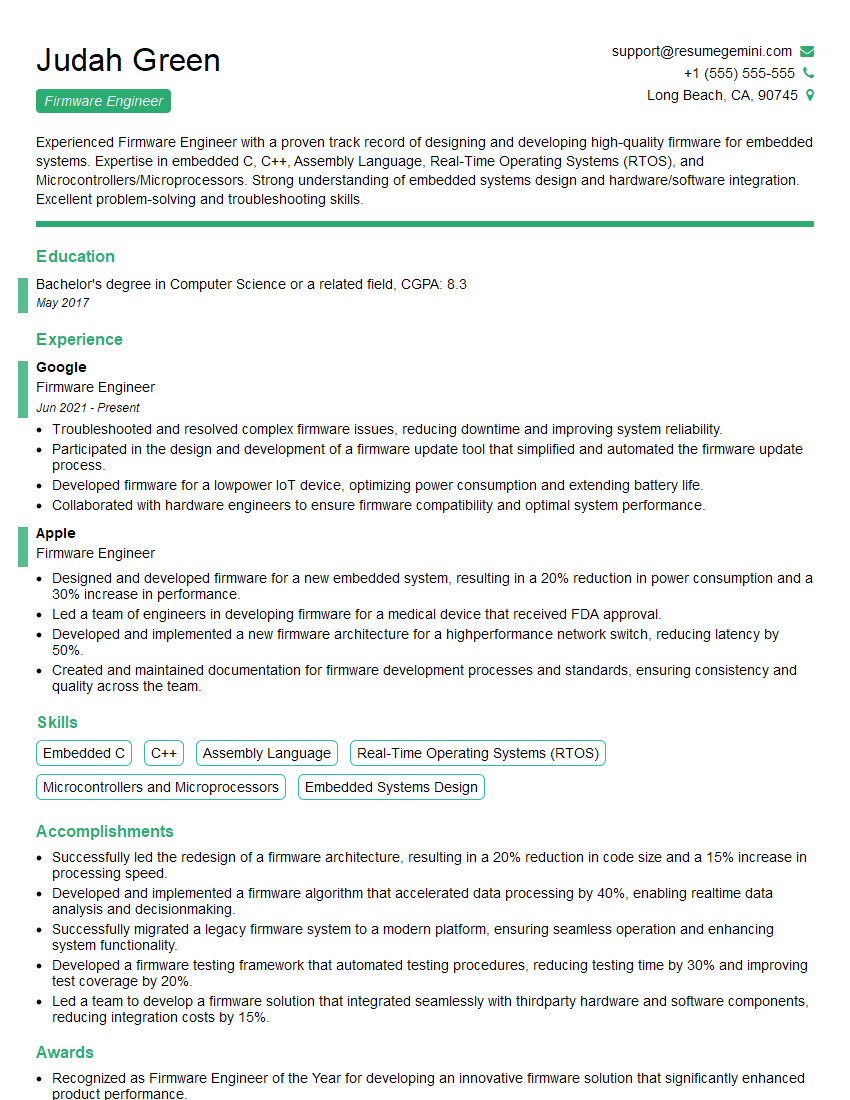
Firmware Engineer Resume Sample

Technical Support Engineer Resume Sample

Test Engineer Resume Sample

Design Engineer Resume Sample

Hardware Engineer Resume Sample

Product Engineer Resume Sample

Validation Engineer Resume Sample

Robotics Engineer Resume Sample

Analog Design Engineer Resume Sample
Explore more articles
Users Rating of Our Blogs
Share Your Experience
We value your feedback! Please rate our content and share your thoughts (optional).
What Readers Say About Our Blog
Very informative content, great job.
good