Preparation is the key to success in any interview. In this post, we’ll explore crucial Microchip Integrated Development Environment (IDE) interview questions and equip you with strategies to craft impactful answers. Whether you’re a beginner or a pro, these tips will elevate your preparation.
Questions Asked in Microchip Integrated Development Environment (IDE) Interview
Q 1. Explain the architecture of the MPLAB X IDE.
MPLAB X IDE is a sophisticated, plugin-based Integrated Development Environment. Its architecture is based on a modular design, allowing for flexibility and extensibility. Think of it like a toolbox – the core provides the basic functionality, and you add specialized tools (plugins) as needed. Key components include:
- NetBeans Platform: This forms the foundation of MPLAB X, providing the user interface, project management, and core features. It’s a robust platform known for its stability and customization options.
- Project Manager: This component manages your projects, including source files, libraries, and compiler settings. It ensures a consistent build process across different projects and configurations.
- Editor: The code editor is intelligent and supports syntax highlighting, code completion, and other features that greatly enhance developer productivity. It’s designed to handle various programming languages, including C and assembly, commonly used with Microchip microcontrollers.
- Compiler and Toolchain: This is where the magic happens – the compiler translates your human-readable code into machine code understood by the microcontroller. MPLAB X integrates seamlessly with Microchip’s XC compilers, offering different optimization levels and debugging capabilities.
- Debugger: The debugger is crucial for identifying and fixing errors. It allows you to step through your code, inspect variables, and set breakpoints, providing a detailed look into your program’s execution.
- Plugins: These add-on components extend MPLAB X’s functionality. Examples include support for specific microcontrollers, specialized debuggers, and third-party libraries.
This modular architecture allows for easy updates and additions without affecting the core stability of the IDE. This makes it very adaptable to the ever-evolving landscape of microcontrollers and their associated tools.
Q 2. Describe the process of creating a new project in MPLAB X.
Creating a new project in MPLAB X is straightforward. Imagine you’re starting a new construction project – you need a blueprint (project) before you begin. Here’s how you do it:
- Launch MPLAB X: Open the IDE.
- Create a New Project: Select ‘File’ -> ‘New Project’.
- Select Device: Choose the specific Microchip microcontroller you’re targeting from the extensive list provided. This is crucial as it determines the compiler settings and available peripherals.
- Select Tool: Select the programmer/debugger you’ll use to upload your code to the microcontroller. This will depend on your hardware setup.
- Select Project Settings: Choose a project name and location. You’ll also set the compiler type (usually XC8, XC16, or XC32 depending on the microcontroller architecture). The IDE provides default settings that are often a great starting point.
- Project Creation: Click ‘Finish’. The IDE will create the project directory and set up the necessary files.
The IDE will then present a basic project structure, ready for you to add your source code files. This process ensures a consistent environment for your projects, minimizing configuration errors.
Q 3. How do you configure project settings in MPLAB X for different microcontrollers?
Configuring project settings is vital for successful development. Think of it as tailoring a suit to fit perfectly – the wrong settings can lead to serious problems. Different microcontrollers have varying architectures, clock speeds, and peripherals. Here’s how you configure settings:
- Right-click on the Project: In the ‘Projects’ window, right-click on your project name.
- Select ‘Properties’: This opens the project properties dialog.
- Navigate to the relevant category: Configure settings in categories like ‘Conf’, ‘XC[Compiler]’,’Linker’ and ‘Debugger’. These settings influence various aspects of your project, from compiler optimization level to linker scripts and debugging options.
- Device Configuration: Verify the correct microcontroller is selected. This includes crucial details like clock frequency, oscillator type, and memory configuration.
- Compiler Settings: Optimize code size and speed through various options. You can select optimization levels, warnings, and include paths for your source files.
- Linker Settings: Configure how the compiled code is linked to create the final executable. This involves specifying the memory map and libraries.
- Debugger Settings: Set up the debugger settings, including the communication interface, clock speed, and debugging tools. It’s important to ensure the settings match your hardware setup.
- Apply and Close: Apply the changes and close the properties dialog. The IDE will update your project based on these settings.
Incorrect settings can result in compilation errors, unexpected behavior, or even damage to your hardware. Careful configuration ensures a smooth and efficient development process.
Q 4. Explain the debugging capabilities of MPLAB X IDE.
MPLAB X provides powerful debugging capabilities, allowing you to thoroughly test and debug your code. Think of it as having a magnifying glass to inspect your program’s behavior. Key features include:
- Step-by-step execution: Single-step through your code line by line, observing the program’s flow and variable values.
- Breakpoints: Pause execution at specific lines of code to examine variables and program state. This allows you to pinpoint exactly where errors are occurring.
- Watchpoints: Pause execution when a specific variable changes value, useful for tracking down subtle bugs.
- Variable inspection: Monitor the values of variables in real-time during execution.
- Memory inspection: Examine the contents of memory locations. This is useful for analyzing data structures or identifying memory leaks.
- Real-time data visualization: Some plugins offer visual representations of data, making it easier to understand program behavior.
- Peripheral observation: Observe the status and registers of various peripherals (timers, UARTs, etc.) on the microcontroller. This allows for detailed debugging of hardware interactions.
The debugger enables you to identify and fix errors quickly and efficiently, saving considerable development time and frustration. It is an essential tool for any serious embedded systems developer.
Q 5. How do you use breakpoints and watchpoints in MPLAB X?
Breakpoints and watchpoints are fundamental to effective debugging. They’re like strategically placed checkpoints in your program. To use them:
- Breakpoints: Click in the gutter (the area to the left of the code) to set a breakpoint. When the program reaches this line, execution will pause. You can then examine variable values and program state using the debugger’s tools.
- Watchpoints: Right-click a variable, and select ‘Add Watch’. This adds the variable to the ‘Watch’ window. When the value of the watched variable changes, execution will pause. This is useful for identifying when and why variables are unexpectedly altered.
// Example: setting a breakpoint on line 10 int main() { int x = 5; // Set a breakpoint here (click in the gutter) int y = 10; int z = x + y; return 0; }
Effective use of breakpoints and watchpoints dramatically reduces debugging time and enhances code understanding. They are crucial tools for any experienced embedded systems developer.
Q 6. Describe the process of compiling and linking code in MPLAB X.
Compiling and linking your code transforms your source code into an executable file that can run on the target microcontroller. Think of this process as transforming blueprints into a finished house. In MPLAB X:
- Build the Project: Click the ‘Build Project’ button (hammer icon) in the toolbar. This initiates the compilation and linking process.
- Compilation: The compiler translates your source code (typically written in C or assembly) into assembly code, and then into machine code specific to your microcontroller’s architecture. Each source file (.c or .asm) is compiled independently.
- Linking: The linker combines the compiled object files (.o or .obj), along with any necessary libraries, into a single executable file (.hex or .elf). The linker resolves references between different parts of the code and ensures that all necessary components are combined correctly.
- Output: The successful build produces an executable file which can be uploaded to your microcontroller for testing and use.
Errors during compilation or linking are reported in the ‘Output’ window, highlighting issues that need to be addressed. Understanding the compilation and linking processes enables you to efficiently resolve issues during development.
Q 7. How do you manage different versions of your code using MPLAB X?
Version control is crucial for managing code changes. Think of it as keeping a detailed log of your construction project – it lets you revisit previous stages easily. While MPLAB X doesn’t have built-in version control, it seamlessly integrates with popular systems like Git. Here’s how you can manage versions:
- Use a Version Control System (VCS): Use a external VCS such as Git.
- Integrate with Git Clients: Use a Git client such as SourceTree or GitKraken which provides a visual user interface to interact with Git repositories.
- Repository Management: Create a repository on a platform like GitHub, GitLab, or Bitbucket. Then, using the Git client clone the repository to your local machine.
- Commit Changes: Regularly commit your code changes with descriptive messages. This creates snapshots of your project at various points in time.
- Branching: Use branches to work on different features or bug fixes independently without affecting the main codebase.
- Merge Changes: Merge changes from different branches into the main branch when they’re complete and tested.
Integrating with Git is highly recommended for effective project management, especially on larger projects or when working in teams. This allows easy rollback to earlier versions if required.
Q 8. Explain the use of the simulator in MPLAB X.
The simulator in MPLAB X is a powerful tool that allows you to test your microcontroller code without needing actual hardware. Think of it as a virtual microcontroller residing within your computer. It mimics the behavior of the target device, enabling you to debug your code, step through instructions, and observe variable values – all within the safety and convenience of your IDE. This is incredibly useful during the early stages of development, allowing you to quickly identify and correct logical errors before burning code onto expensive hardware. For instance, you can simulate sensor readings, external interrupts, and other peripheral interactions to ensure your code responds correctly under various conditions. The simulator won’t perfectly replicate every nuanced aspect of real-world hardware, but it significantly accelerates the debugging process and reduces the risk of damaging your hardware.
Q 9. How do you program a Microchip microcontroller using MPLAB X?
Programming a Microchip microcontroller using MPLAB X involves several key steps. First, you’ll write your code using a supported compiler (like XC8 for 8-bit PICs). Then, you compile your code to generate a hex file, which is the machine-readable instruction set for your microcontroller. Next, you select your programmer/debugger (like an ICD 3 or PICKit 3) in MPLAB X, making sure the correct communication settings are configured. Finally, you initiate the programming process through MPLAB X, which sends the hex file to the microcontroller via the programmer/debugger. The process might seem daunting at first, but MPLAB X provides a user-friendly interface that guides you through each step. Imagine it like baking a cake: the code is the recipe, the compiler is the mixer, the hex file is the batter, and the programmer/debugger is the oven that bakes the final product (your programmed chip).
// Example code snippet (XC8): #include void main(void) { TRISBbits.RB0 = 0; // RB0 as output while (1) { LATBbits.LB0 = 1; // Set RB0 high __delay_ms(1000); // Delay 1 second LATBbits.LB0 = 0; // Set RB0 low __delay_ms(1000); // Delay 1 second } } Q 10. Describe the different programming methods available in MPLAB X.
MPLAB X supports various programming methods, each suited to different needs and hardware setups. The primary methods include:
- ICSP (In-Circuit Serial Programming): This is a common method using a programmer/debugger like the ICD 3 or PICKit 3. It connects to the microcontroller through a six-pin header on your board and programs the chip directly in-circuit, without needing to remove it. This is often the preferred approach for development and debugging.
- Bootloader Programming: Some microcontrollers have built-in bootloaders, allowing them to be programmed through a serial port (e.g., UART or USB). This method is advantageous for field updates or when physical access to the six-pin header might be difficult.
- External Programmer: Specialized programmers might offer alternative programming interfaces, potentially providing faster programming speeds or compatibility with older devices.
The choice of method depends on the specific microcontroller, the available hardware, and the desired programming workflow.
Q 11. How do you handle errors and warnings during compilation in MPLAB X?
MPLAB X provides excellent error and warning handling. During compilation, the compiler will generate detailed messages within the output window, highlighting any syntax errors, semantic issues (like type mismatches), or potential problems. Warnings often point to less critical issues, but they’re worth attention as they might indicate potential bugs or inefficient code. Understanding compiler messages is crucial. Each message usually contains a file name, line number, and a description of the error or warning. Click on the message, and the IDE will take you directly to the line of code where the problem was detected. For example, a missing semicolon might generate a syntax error, while an uninitialized variable could lead to a warning. Addressing warnings early is important because they can lead to unpredictable behavior in the deployed code.
Q 12. Explain the use of the ICD 3 or similar programmer/debugger with MPLAB X.
The ICD 3 (In-Circuit Debugger 3) and similar programmers/debuggers are essential tools for interacting with your microcontroller in MPLAB X. They provide a bridge between the IDE and your hardware, enabling you to program the chip, download and debug code in real-time, and monitor the microcontroller’s behavior. Beyond simply programming, they allow you to set breakpoints, step through code, inspect variables, and analyze memory, providing deep insights into your program’s execution. The ICD 3 often has advanced features like real-time data logging, which can be invaluable for complex projects. Think of it as a sophisticated multimeter and logic analyzer, combined with a programming interface. Using the debugger is crucial for proper code validation and efficient problem solving.
Q 13. How do you configure the communication settings between MPLAB X and a programmer/debugger?
Configuring communication between MPLAB X and a programmer/debugger involves selecting the correct tool in the IDE’s settings. MPLAB X typically auto-detects connected programmers. You might need to specify the communication interface (like USB or parallel port) and the device type. The IDE’s “Tools” menu usually houses the “Options” dialog where you set the programmer/debugger settings. Incorrect settings will prevent successful connection and programming. For example, selecting the wrong device family or communication port will result in connection errors. It’s crucial to ensure that the drivers for your specific programmer/debugger are properly installed on your system. Always check the device manager on Windows or System Information on macOS to verify driver installation.
Q 14. Describe the process of troubleshooting hardware issues using MPLAB X.
Troubleshooting hardware issues using MPLAB X involves a systematic approach. First, verify your hardware connections: make sure the programmer/debugger is correctly connected to both the computer and the microcontroller board. Next, check the power supply to the microcontroller; insufficient voltage can lead to unpredictable behavior. The MPLAB X debugger can help with this; if it can’t connect or program, it points to a wiring problem, power supply issue, or a faulty device. You can also use MPLAB X’s debugging capabilities to check if specific signals are behaving as expected – perhaps an output pin is stuck high or low, revealing an issue with the circuitry. Examine your circuit diagram and PCB for any shorts or open circuits. Often, simple checks like these can quickly identify and resolve the root cause. Finally, if the problem persists, consider employing an oscilloscope or logic analyzer to directly examine signal behavior.
Q 15. How do you use the integrated profiler in MPLAB X?
MPLAB X’s integrated profiler helps you analyze your code’s performance by measuring execution time and resource usage. It’s invaluable for optimizing code for speed and efficiency. Think of it as a detective investigating where your program spends its time. To use it, you first need to build your project with debugging enabled. Then, you launch the debugger and set breakpoints where you want to start and stop profiling. Once you’ve run your code through the debugger, the profiler displays a detailed report, typically showing a call graph, highlighting functions consuming the most CPU cycles or memory. This allows you to identify bottlenecks and areas for improvement. For instance, a long loop in a real-time control system could be revealed as the performance culprit, leading to code optimization strategies like reducing iterations or using more efficient algorithms.
The process generally involves these steps:
- Build the project for debugging: This ensures the necessary profiling information is included in the compiled code.
- Set breakpoints: Define the start and end points for your profiling session.
- Run the debugger: Execute your code under the debugger’s control.
- Analyze the profile report: Examine the profiler’s output to identify performance bottlenecks.
Remember to use the profiler strategically; profiling everything can be overwhelming. Focus on sections of code you suspect are performance critical.
Career Expert Tips:
- Ace those interviews! Prepare effectively by reviewing the Top 50 Most Common Interview Questions on ResumeGemini.
- Navigate your job search with confidence! Explore a wide range of Career Tips on ResumeGemini. Learn about common challenges and recommendations to overcome them.
- Craft the perfect resume! Master the Art of Resume Writing with ResumeGemini’s guide. Showcase your unique qualifications and achievements effectively.
- Don’t miss out on holiday savings! Build your dream resume with ResumeGemini’s ATS optimized templates.
Q 16. What are the different memory spaces in a microcontroller and how do you manage them in MPLAB X?
Microcontrollers have distinct memory spaces, each with its characteristics and usage. Managing them effectively is crucial for proper program function and avoiding errors. Common spaces include:
- Program Memory (Flash): Stores the program instructions. It’s read-only during normal operation but can be written to during programming. Think of it like a library where your instructions reside.
- Data Memory (RAM): Stores variables and other data your program uses during execution. It’s read-write and volatile, meaning its contents are lost when the power is turned off. This is your program’s workspace.
- EEPROM (Electrically Erasable Programmable Read-Only Memory): Stores non-volatile data; its contents persist even when the power is off. Use it for persistent settings or configuration data that need to survive power cycles – like the settings for a microwave oven.
- Special Function Registers (SFRs): These registers control the microcontroller’s peripherals and internal operations. They’re often mapped within the data memory space.
MPLAB X helps manage these spaces through:
- Memory Viewers: Allow you to inspect the contents of different memory regions during debugging.
- Compiler Directives: Allow you to place variables in specific memory locations (e.g.,
__attribute__((space(progmem)))in some compilers for placing variables in program memory). - Linker Scripts: Provide fine-grained control over how memory is allocated to different program sections.
For example, a configuration variable that needs to be retained after a power failure should be stored in EEPROM, while temporary calculation results can reside in RAM. Careful memory management prevents overwriting data or running out of space, leading to a stable and robust program.
Q 17. Explain the importance of Real-Time Operating Systems (RTOS) in embedded systems and how you would integrate them within MPLAB X.
Real-Time Operating Systems (RTOS) are crucial for complex embedded systems, providing a structured approach to managing multiple tasks concurrently. They ensure timely execution of critical functions, even under high loads. Imagine an RTOS as an air traffic controller, managing multiple aircraft (tasks) to prevent collisions (deadlocks) and ensuring efficient air space usage (resource allocation).
Integrating an RTOS in MPLAB X typically involves:
- Choosing an RTOS: Selecting an appropriate RTOS like FreeRTOS, ThreadX, or Micrium is crucial based on the system’s requirements and microcontroller resources.
- Installing the RTOS components: Including necessary RTOS libraries and headers in the MPLAB X project.
- Configuring the RTOS: Setting parameters such as the number of tasks, task priorities, and memory allocation.
- Creating and managing tasks: Designing tasks to implement individual functionalities and using RTOS APIs (Application Programming Interfaces) to coordinate their execution.
- Debugging and testing: Using MPLAB X’s debugging tools to verify the RTOS’s behavior and ensure tasks are executing correctly.
MPLAB X supports various RTOSes through plugins and examples, simplifying the integration process. The RTOS handles scheduling, inter-task communication, and resource management, significantly streamlining the development of multi-threaded embedded applications such as those found in industrial automation, robotics, and medical devices.
Q 18. How do you handle interrupts in a microcontroller program using MPLAB X?
Interrupt handling is fundamental for responsive embedded systems. Interrupts signal the occurrence of an event, allowing the microcontroller to react immediately without waiting for a scheduled task. Think of it like a phone call interrupting a meeting – important enough to temporarily stop other activities.
In MPLAB X, interrupt handling involves:
- Identifying the interrupt source: Determining which peripheral or event triggered the interrupt (e.g., a button press, timer overflow, or serial communication data arrival).
- Defining the interrupt service routine (ISR): Writing a dedicated function to handle the interrupt event. This function should execute efficiently to minimize the disruption to other program activities.
- Enabling the interrupt: Configuring the microcontroller to enable the specific interrupt source using appropriate register settings in your code (often involving setting bits in SFRs).
- Using compiler directives or configurations: The specific syntax for defining ISRs depends on the microcontroller family and compiler. Many compilers allow specifying `__interrupt` or similar keywords to declare the ISR.
Example (Illustrative, syntax might vary depending on the specific microcontroller and compiler):
void __interrupt() myISR(void) { // Interrupt Service Routine // Code to handle the interrupt event // ... }Efficient ISR writing is critical. Long or complex ISRs can lead to latency issues. Keep them short and focused on the essential tasks related to the interrupting event. Proper interrupt handling is vital for responsive embedded systems such as automotive control units and industrial sensors where immediate response to events is essential.
Q 19. Describe your experience with different Microchip microcontroller families (e.g., PIC, AVR).
My experience spans various Microchip microcontroller families, primarily PIC and AVR. I’ve worked extensively with PIC16, PIC18, PIC24, and PIC32 families, appreciating their diverse architectures and capabilities. PIC microcontrollers are known for their ease of use and wide range of peripherals; I often choose them for projects requiring cost-effectiveness and simplicity. On the other hand, I’ve leveraged AVR microcontrollers, specifically the ATmega series, for projects demanding high performance and specialized features. The choice depends heavily on the project’s specific requirements, such as processing power, memory needs, and the availability of peripheral resources. For instance, a simple LED blinking project might use a low-cost PIC16, while a complex motor control system could benefit from the processing power of a PIC32 or the precise timing capabilities of an AVR.
I’m proficient in using MPLAB X IDE with both families, adept at configuring their various peripherals and writing optimized code for each architecture’s specifics. My experience includes working with different memory models and handling various clock configurations, ensuring compatibility between the microcontroller and external components.
Q 20. Explain your experience using different peripherals available on Microchip microcontrollers (e.g., UART, SPI, I2C).
I have extensive experience with several Microchip microcontroller peripherals, including UART, SPI, and I2C. Each offers a unique approach to communication, and the selection depends on the application’s requirements for speed, data integrity, and complexity.
- UART (Universal Asynchronous Receiver/Transmitter): I frequently use UART for simple serial communication, such as sending data to a computer terminal or communicating with other devices over RS-232 or TTL serial lines. It’s straightforward to implement and widely used.
- SPI (Serial Peripheral Interface): For high-speed communication with peripherals like sensors or displays, SPI is my preferred choice. It offers a flexible master-slave communication method, ensuring efficient data transfer.
- I2C (Inter-Integrated Circuit): I leverage I2C for multi-master communication scenarios, particularly when communicating with multiple devices on a shared bus. Its simplicity and ability to handle multiple devices make it ideal for applications like sensor networks.
My experience extends beyond just basic usage. I’m comfortable configuring advanced features such as different baud rates, interrupt handling, and multiple communication channels. For example, in a robotics project, I might use SPI for fast sensor readings and I2C for communicating with a control module. This requires precise understanding of timing, interrupts, and handling various communication protocols.
Q 21. How do you ensure code quality and maintainability within the MPLAB X environment?
Ensuring code quality and maintainability within MPLAB X is paramount for successful embedded system development. I employ several strategies:
- Modular Design: Breaking down the code into smaller, well-defined modules enhances readability, testability, and reusability. Each module should have a clear purpose and interface.
- Consistent Coding Style: Adhering to a consistent coding style (e.g., using a style guide or IDE’s built-in formatting features) improves code readability and reduces errors.
- Meaningful Variable and Function Names: Choosing clear and descriptive names for variables and functions makes the code self-documenting and easier to understand.
- Comments and Documentation: Adding clear and concise comments to explain complex logic or non-obvious code sections aids future maintenance and collaboration.
- Version Control (Git): Using Git or a similar version control system allows me to track changes, collaborate with others, and revert to previous versions if necessary.
- Static Code Analysis: Using static code analysis tools (often integrated into MPLAB X or available as plugins) helps identify potential bugs and code style violations before compilation.
- Unit Testing: Writing unit tests for individual modules verifies their correctness and improves the overall code robustness.
By combining these practices, I create a robust, maintainable codebase that minimizes future issues and enables easier collaboration. This is especially crucial in complex projects where multiple developers are involved or when the project needs to be modified later.
Q 22. Describe your approach to debugging complex issues in embedded systems using MPLAB X.
Debugging complex embedded systems in MPLAB X requires a systematic approach. I begin by meticulously examining the error messages and logs generated by the compiler and debugger. This often points to the general area of the problem. Then, I employ a combination of techniques:
- Breakpoints and Step-Through Debugging: Strategically placing breakpoints allows me to observe variable values and program flow at critical points. Step-through debugging helps me understand the execution path line by line. For example, if a function isn’t returning the expected value, I would step through it to identify the exact point of failure.
- Watch Variables: I extensively use the watch window to monitor the values of key variables throughout the program’s execution. This helps in identifying unexpected changes or values that deviate from the expected behavior. Imagine tracking a sensor reading – if the value is consistently incorrect, the watch window helps pinpoint the cause immediately.
- Logic Analyzer and Oscilloscope Integration: For hardware-related issues, I integrate MPLAB X with logic analyzers and oscilloscopes to visualize signals and verify hardware functionality. This helps in diagnosing issues related to timing, signal integrity, or communication protocols.
- Peripheral Module Analysis: For microcontroller-specific problems involving peripherals (timers, UART, SPI, etc.), I leverage the documentation and example code provided by Microchip to understand their configuration and operation. MPLAB X’s peripheral view allows direct observation of register values, aiding in troubleshooting.
- Code Reviews and Modular Design: To prevent complex issues from arising in the first place, I prefer a modular code design that promotes code readability and testability. Regular code reviews help identify potential bugs early in the development cycle.
In a recent project involving a motor control system, a seemingly random motor stall was traced using this approach. By carefully examining the motor control algorithm using breakpoints and watch variables, I discovered a race condition in the interrupt service routine. Restructuring the code and adding appropriate synchronization mechanisms resolved the issue.
Q 23. Explain your experience with using version control systems like Git with MPLAB X projects.
Version control is crucial for any collaborative project, and I’m proficient in using Git with MPLAB X. I typically integrate Git using a command-line interface or a GUI client like Sourcetree or GitKraken, directly from my development machine. My workflow involves:
- Repository Initialization: Before starting a project, I create a new Git repository in the project’s root directory. This ensures that all project files are tracked.
- Regular Commits: I make frequent commits to the repository, with concise and descriptive commit messages. This makes it easy to track changes and revert to earlier versions if needed.
- Branching Strategy: I leverage Git branching for managing different features and bug fixes simultaneously. This avoids conflicts and allows for parallel development.
- Pull Requests (PRs): For collaborative projects, I utilize pull requests for code review and merge requests. This fosters collaboration and helps ensure code quality.
- MPLAB X Integration (Limited): While MPLAB X doesn’t have built-in Git capabilities as comprehensive as some IDEs, I seamlessly use Git via the command line or an external client. The MPLAB X project files are usually part of the Git repository, ensuring that the entire development environment is version-controlled.
For example, during a recent firmware update, I utilized branching to develop a new feature independently. Once tested, I created a pull request for review and merged it into the main branch, ensuring a smooth and documented release.
Q 24. How do you optimize code for performance and memory usage in MPLAB X?
Optimizing code for performance and memory usage in MPLAB X involves a multi-pronged approach that starts with careful code design and continues with compiler optimizations.
- Data Structures and Algorithms: Choosing the right data structure and algorithm is crucial. For embedded systems with limited memory, arrays often outperform dynamic data structures like linked lists. Selecting efficient algorithms minimizes processing time.
- Compiler Optimizations: MPLAB X compilers (XC8, XC16, XC32) offer various optimization levels. Higher optimization levels (-O2 or -O3) can significantly reduce code size and improve execution speed. However, higher optimization levels can make debugging more challenging. I carefully weigh the trade-offs. The specific optimization flags need adjustment based on the target architecture and the requirements of the project.
- Inline Functions: For frequently called, small functions, inlining can reduce function call overhead. However, overusing inlining can increase code size.
- Memory Allocation: Efficient memory management is crucial. Static allocation is preferred where possible to avoid the overhead of dynamic memory allocation. Static allocation is memory-efficient, while dynamic memory allocation should be used cautiously to avoid fragmentation and memory leaks.
- Code Profiling: To identify performance bottlenecks, I utilize profiling tools to measure the execution time of different code sections. This helps direct optimization efforts to the most critical parts of the code.
In a real-world example, I optimized a data logging routine by switching from a dynamically allocated buffer to a statically allocated circular buffer. This reduced memory consumption and improved data throughput, preventing data loss in a sensor monitoring application.
Q 25. Describe your experience with testing methodologies (Unit testing, integration testing) within the MPLAB X environment.
While MPLAB X doesn’t have built-in unit testing frameworks as comprehensive as some other IDEs, I incorporate testing methodologies using external frameworks and tools. My approach involves:
- Unit Testing: I often use external frameworks like Unity or Ceedling, integrating them with my MPLAB X projects. Unit tests are designed to test individual modules or functions in isolation. This helps identify and fix bugs early in the development process, preventing cascading failures.
- Integration Testing: Once unit tests pass, I move on to integration testing, which focuses on verifying the interaction between different modules. This involves simulating real-world scenarios and testing the overall system behavior. This frequently involves using a hardware simulator or an emulator to mimic the target system.
- Test-Driven Development (TDD): For projects requiring high reliability, I sometimes apply Test-Driven Development, where tests are written before the code itself. This approach ensures that code is written with testability in mind and helps prevent defects.
For instance, while developing a communication protocol module, I used Unity to write unit tests for each function related to data packaging, checksum calculation, and transmission. This ensured that each component worked correctly before integrating them to form the complete protocol.
Q 26. How would you approach integrating third-party libraries into your MPLAB X project?
Integrating third-party libraries into an MPLAB X project involves careful consideration of several factors. The process depends on the library’s format (source code, pre-built libraries, etc.).
- Source Code Libraries: If the library is provided as source code, I simply add the library’s source files and header files to the project. It may be necessary to adjust include paths and linker settings to ensure proper compilation and linking. I may need to modify makefiles to accommodate the library.
- Pre-built Libraries (.lib, .a): For pre-built libraries, I add the library files to the project’s linker settings. The location of these libraries needs to be specified using the correct paths. This usually involves setting linker options such as
-L-l - Library Dependencies: Many libraries rely on other libraries. It’s crucial to identify and include all necessary dependencies in the project’s build settings. Failing to include dependencies will lead to compilation errors.
- Header Files: Ensure that header files for the third-party library are correctly included in your source files using the
#includedirective. The compiler should be able to find these header files through the correct include paths. - Build System: Using a build system (make, CMake) can simplify the management of dependencies when working with multiple libraries and source files. This helps to automate the build process and improve reproducibility.
For example, when integrating a FreeRTOS library, I added the source files and header files to my MPLAB X project and adjusted the include paths to point to the library’s location. I also configured the linker settings to correctly link against the FreeRTOS library. Ensuring all dependencies (like other FreeRTOS-related modules) were included was crucial to the success of the integration.
Q 27. Explain your experience with using different compilers within MPLAB X (e.g., XC8, XC16).
MPLAB X supports various Microchip compilers, including XC8 (8-bit), XC16 (16-bit), and XC32 (32-bit). My experience spans all three, and the choice depends on the target microcontroller.
- XC8: I’ve extensively used XC8 for 8-bit PIC microcontrollers. I’m familiar with its optimization options, debugging features, and specific instructions. XC8 excels at generating compact and efficient code for resource-constrained 8-bit devices.
- XC16: XC16 is my go-to compiler for 16-bit PIC microcontrollers. I understand its strengths in handling more complex data structures and algorithms than XC8 can handle easily. I’m adept at leveraging its optimization features to improve performance and code size.
- XC32: For 32-bit PIC microcontrollers, I use XC32. Its capabilities in handling complex data structures, larger memory spaces, and advanced features like floating-point operations are crucial in many projects. Understanding the nuances of the compiler’s optimizations is essential for maximizing performance on 32-bit systems.
- Compiler Selection: The selection of the compiler is guided by the microcontroller architecture and the project’s requirements. Factors such as code size, execution speed, memory availability, and complexity of the application influence the choice.
In a recent project requiring high-speed data processing, the use of XC32’s optimized libraries for floating-point arithmetic was instrumental in achieving the required performance goals on a 32-bit PIC microcontroller.
Q 28. How do you handle different clock configurations in a Microchip microcontroller using MPLAB X?
Handling different clock configurations in Microchip microcontrollers using MPLAB X is a crucial aspect of embedded systems development. It involves configuring the microcontroller’s internal oscillator, external crystal, or PLL (Phase-Locked Loop) according to the project’s requirements.
- Configuration Bits: The clock configuration is primarily determined by setting the appropriate configuration bits in the microcontroller’s configuration registers. MPLAB X provides a user-friendly interface to modify these bits. Care needs to be taken, as incorrect configuration can lead to system malfunction.
- Clock Source Selection: The first step is selecting the clock source (internal oscillator, external crystal, or PLL). The selection depends on factors like accuracy, stability, and power consumption requirements.
- PLL Configuration (If Applicable): If using a PLL, additional configuration is needed to set the desired multiplication factor and other parameters. This affects the system clock frequency.
- System Clock Frequency: The configured clock settings directly determine the microcontroller’s operating frequency. This has implications for timing-critical tasks and peripheral operation. Proper calculation of the system clock is essential. Mistakes here could lead to incorrect timings and device malfunction.
- Peripheral Clock Configuration: Many peripherals operate using a fraction of the system clock. These peripheral clocks must be configured to match the requirements of the specific peripheral (e.g., baud rate for UART, timer frequency, etc.).
- MPLAB X Configuration Tools: MPLAB X offers tools that help in calculating and setting the correct clock configurations. This includes built-in calculators and configuration bit setting utilities that reduce errors and improve workflow.
In a project involving precise timing for a real-time application, accurate clock configuration was critical. I used MPLAB X’s tools to select an external crystal as the clock source and carefully configure the PLL to achieve the desired system clock frequency. Then, peripheral clocks were configured accordingly for precise timing control.
Key Topics to Learn for Microchip Integrated Development Environment (IDE) Interview
- Project Setup and Configuration: Understanding how to create new projects, configure compiler settings (optimizations, warnings), and manage project dependencies within the Microchip IDE. Practical application: Successfully building and deploying a simple embedded system application.
- Debugger Utilization: Mastering the debugger to step through code, set breakpoints, inspect variables, and analyze program execution. Practical application: Effectively debugging complex issues in firmware, identifying and resolving runtime errors.
- Peripheral Configuration: Working with the IDE’s tools to configure microcontroller peripherals (timers, UART, SPI, I2C, ADC, etc.). Practical application: Implementing communication protocols and interfacing with external sensors or devices.
- Memory Management: Understanding memory allocation, addressing modes, and potential memory-related issues (stack overflow, heap fragmentation). Practical application: Optimizing code for memory efficiency in resource-constrained embedded systems.
- Real-Time Operating Systems (RTOS) Integration (if applicable): If your target role involves RTOS, understanding how to integrate and utilize an RTOS (like FreeRTOS) within the Microchip IDE. Practical application: Developing multi-threaded applications and managing concurrent processes.
- Code Optimization and Profiling: Techniques for improving code performance and identifying bottlenecks. Practical application: Analyzing code execution time and memory usage to optimize for real-time constraints.
- Version Control (Git): Using Git for code management, collaboration, and tracking changes. Practical application: Effectively managing code updates, branching strategies, and merging code from different developers.
Next Steps
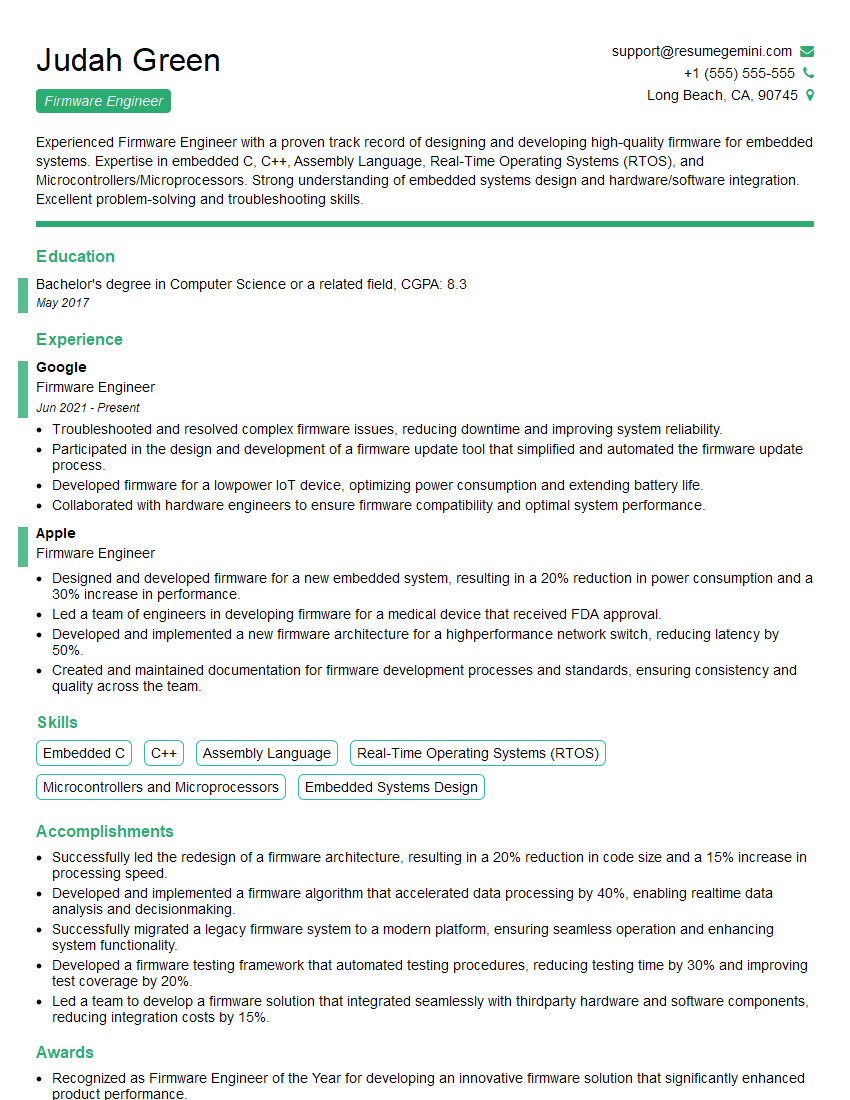
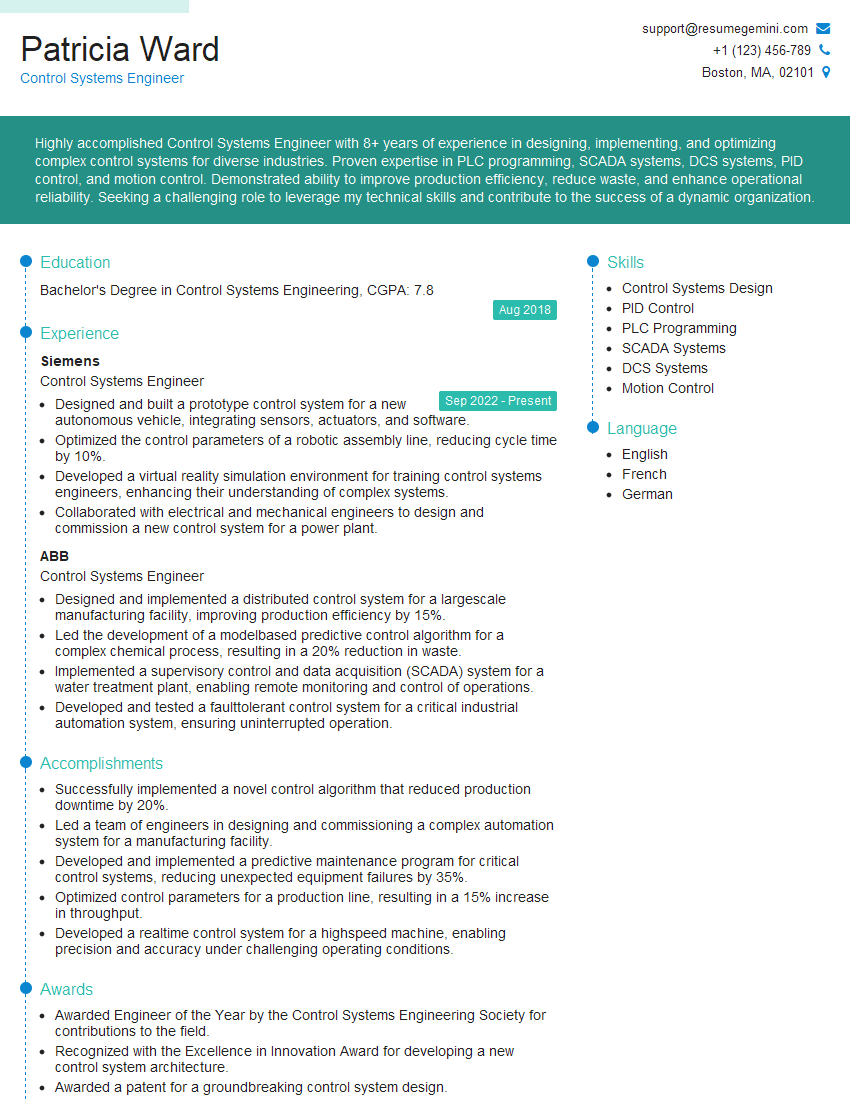
Mastering the Microchip Integrated Development Environment is crucial for success in embedded systems development, opening doors to exciting career opportunities and higher earning potential. To maximize your job prospects, crafting a strong, ATS-friendly resume is vital. ResumeGemini is a trusted resource that can help you build a professional resume that highlights your skills and experience effectively. Examples of resumes tailored to Microchip Integrated Development Environment (IDE) expertise are available to help you present your qualifications in the best possible light.


Explore more articles
Users Rating of Our Blogs
Share Your Experience
We value your feedback! Please rate our content and share your thoughts (optional).
What Readers Say About Our Blog
Very informative content, great job.
good