The right preparation can turn an interview into an opportunity to showcase your expertise. This guide to Molding & Casting interview questions is your ultimate resource, providing key insights and tips to help you ace your responses and stand out as a top candidate.
Questions Asked in Molding & Casting Interview
Q 1. Explain the difference between injection molding and die casting.
Injection molding and die casting are both methods for mass-producing parts, but they differ significantly in the materials used, the process involved, and the resulting product characteristics. Injection molding uses molten plastic, pushed into a mold under high pressure, while die casting uses molten metal, poured into a mold under high pressure.
- Injection Molding: Think of it like squeezing toothpaste from a tube into a custom-shaped mold. The plastic cools and hardens within the mold, creating the final part. It’s ideal for creating complex shapes with intricate details in high volumes from thermoplastic polymers. For example, many plastic housings for electronics are made this way.
- Die Casting: Imagine pouring molten metal into a highly detailed mold. This process is faster than injection molding for metal parts but is more expensive in terms of tooling. Die casting offers excellent dimensional accuracy and surface finish for metal parts; think of car engine blocks or parts of consumer electronics with metal enclosures.
The key differences lie in the material (plastic vs. metal), the manufacturing process (injection vs. pouring), and the resulting part properties (plastic vs. metal). Each method excels in different applications based on the desired material characteristics and production volume.
Q 2. Describe the various types of molding resins used in injection molding.
A wide variety of molding resins are used in injection molding, each offering unique properties suited to specific applications. These are broadly categorized by their chemical composition and resulting characteristics.
- Thermoplastics: These resins soften when heated and harden when cooled, allowing for repeated melting and remolding. Common examples include:
- Polyethylene (PE): Known for its flexibility and low cost, used in bags, films, and bottles.
- Polypropylene (PP): Strong, resistant to chemicals and heat, commonly used in containers, automotive parts, and fibers.
- Polyvinyl Chloride (PVC): Rigid or flexible, used in pipes, window frames, and flooring.
- Polystyrene (PS): Inexpensive and easily molded, often used in disposable tableware and packaging.
- Acrylonitrile Butadiene Styrene (ABS): Tough, impact-resistant, commonly used in automotive parts, toys, and appliance housings.
- Polycarbonate (PC): High-strength, impact-resistant and transparent, utilized in lenses, safety helmets, and electronic components.
- Thermosets: These resins undergo an irreversible chemical change upon curing, resulting in a permanently hardened structure. They can’t be remelted. Examples include:
- Epoxy resins: High strength, chemical resistance, used in adhesives, coatings, and composites.
- Polyester resins: Used in fiberglass-reinforced plastics.
- Phenolic resins: High-heat resistance, commonly used in electrical insulators.
The choice of resin depends heavily on the desired properties of the final product such as strength, flexibility, temperature resistance, chemical resistance, and cost.
Q 3. What are the key considerations for selecting a molding material?
Selecting a molding material involves a careful consideration of several factors, balancing performance requirements with cost-effectiveness. The key considerations include:
- Mechanical properties: Strength, stiffness, toughness, fatigue resistance, creep resistance, etc. What kind of stresses will the part endure?
- Thermal properties: Heat deflection temperature, thermal expansion coefficient, thermal conductivity. Will it be exposed to high or low temperatures?
- Chemical resistance: Resistance to solvents, acids, bases, and other chemicals. Will it be exposed to any substances that could degrade it?
- Electrical properties: Insulating properties, conductivity. Is electrical insulation required?
- Appearance: Color, gloss, texture. Does the final look matter?
- Cost: Material cost, processing cost, and tooling cost need to be carefully evaluated.
- Recyclability: The environmental impact and the potential to recycle the material are increasingly important considerations.
For example, choosing a material for a car bumper necessitates high impact strength, while selecting material for a food container prioritizes food safety and chemical inertness. The right choice comes from a thorough understanding of the final product’s intended use.
Q 4. Explain the process of designing a mold for injection molding.
Designing a mold for injection molding is a complex process requiring expertise in mold design software and a thorough understanding of injection molding principles. It involves several key stages:
- Part Design: The first step is to design the plastic part itself, considering manufacturability, functionality, and aesthetics. This often involves using CAD software.
- Mold Base Selection: The appropriate size and type of mold base are chosen based on the part size and complexity.
- Cavity and Core Design: The cavities and cores form the shape of the part. Careful consideration is given to draft angles (the slight taper added to allow for easy part ejection), parting lines (where the mold halves separate), and gate locations (where the molten plastic enters the cavity).
- Gating System Design: The gating system directs the molten plastic from the sprue (the main channel) to the cavities. Careful design ensures that the plastic fills the cavities evenly and minimizes stress on the part.
- Cooling System Design: The cooling system is critical for controlling the cooling rate of the plastic and preventing warping or deformation. The placement and design of cooling channels greatly affect the cycle time and the quality of the molded parts.
- Ejection System Design: The ejection system is responsible for removing the molded part from the cavity once it has cooled. This may involve ejector pins, springs, and other mechanisms.
- Mold Flow Analysis (MFA): Simulation software is typically used to predict the flow of molten plastic, identify potential problems, and optimize the mold design for optimal filling.
The design process necessitates iterative refinement and testing to ensure the mold produces parts of acceptable quality and within the expected cycle time. Expert mold makers often utilize experienced mold designers and advanced simulation to minimize risk and costs.
Q 5. How do you troubleshoot common problems in injection molding, such as short shots or flashing?
Troubleshooting injection molding problems requires a systematic approach, often involving careful observation and analysis. Let’s consider two common issues:
- Short Shots: This happens when the plastic doesn’t completely fill the mold cavity. Possible causes include insufficient melt pressure, insufficient melt temperature, a clogged gating system, or an improperly designed mold. The troubleshooting involves checking the machine settings (pressure and temperature), inspecting the gating system for blockages, and examining the mold design for potential flow problems. MFA simulations can be incredibly useful in identifying the root cause.
- Flashing: This occurs when molten plastic escapes between the mold halves, causing an undesirable excess material on the part. This usually indicates excessive clamping force, insufficient mold clamping, wear or damage to the mold, or poor mold fit. The solution involves tightening the mold clamping force, inspecting and repairing the mold (especially the parting line), and adjusting the injection pressure if necessary.
In general, troubleshooting involves checking machine settings, inspecting the mold, examining the part itself, and possibly reviewing the mold design and injection parameters. Keeping detailed records and analyzing the results of each modification is crucial for effective problem-solving. Using data logging and statistical process control (SPC) can be valuable in long-term monitoring and prevention of issues.
Q 6. What are the different types of die casting processes?
Several types of die casting processes exist, categorized primarily by the type of mold used and the method of injecting the molten metal:
- High-Pressure Die Casting (HPDC): This is the most common type, employing a high-pressure injection system to rapidly fill the mold. It offers high production rates and excellent dimensional accuracy, ideal for high-volume production of complex parts. Think of car engine blocks or pump housings.
- Low-Pressure Die Casting (LPDC): In this process, the molten metal is slowly forced into the mold under low pressure from the bottom, resulting in superior surface quality and less porosity. This method is particularly suitable for large parts or parts with thin walls.
- Gravity Die Casting: This is a simpler method that relies on gravity to fill the mold. It’s less expensive than HPDC but results in lower production rates and may produce parts with less consistent quality.
- Semi-Solid Die Casting (SSDC): This method involves using a metal partially solidified (a slurry) which is then injected into the mold, offering advantages in terms of improved dimensional accuracy and reduced porosity compared to conventional die casting.
The selection of die casting processes depends primarily on the part design, required quality, desired production rate, and cost considerations. Each process has strengths and weaknesses making them suited to specific manufacturing needs.
Q 7. Explain the role of gating systems in die casting.
The gating system in die casting is crucial for the successful filling of the mold cavity. It controls the flow of molten metal from the injection system into the mold, influencing the quality, productivity, and efficiency of the die casting process. A well-designed gating system is essential to ensure complete filling of the mold cavity without creating defects in the final product.
- Runner System: The runner system is a network of channels that distribute the molten metal from the sprue to the individual cavities of the mold. It must be designed to minimize turbulence and ensure uniform metal flow.
- Ingates: Ingates are the points of entry where the molten metal enters the cavity. The size, shape, and location of the ingate significantly influence the flow pattern and filling characteristics. A properly designed ingate will facilitate smooth, consistent flow, minimizing air entrapment and turbulence.
- Sprue: The sprue is the main channel through which the molten metal enters the die casting mold. The design of the sprue affects the flow of metal into the runner system, thereby affecting the overall quality of the casting.
- Ejector pins: While not strictly part of the gating system itself, ejector pins interact with the casting at the end of the process, so their correct placement and function are critical to the overall molding process.
Poorly designed gating systems can lead to incomplete filling, cold shuts (incomplete fusion of metal streams), porosity (air bubbles trapped in the casting), and other casting defects. Therefore, a thorough understanding of fluid dynamics and casting metallurgy is crucial for optimal gating system design. Often, simulation software is used to evaluate different gating configurations before production.
Q 8. How do you prevent defects such as porosity in die castings?
Porosity in die castings, those annoying little air pockets, is a common defect stemming from trapped gases during the filling process. Preventing it requires a multi-pronged approach focusing on the metal, the mold, and the casting process itself.
Mold Design: Proper venting is crucial. Think of it like providing escape routes for the air. Insufficient venting leads to trapped air, causing porosity. Careful design with strategically placed vents allows the air to escape as the molten metal flows into the mold cavity. The vent design needs to be optimized for the specific casting geometry and metal used.
Melting and Pouring Techniques: Turbulence in the molten metal can trap gases. Smooth, controlled pouring minimizes this. Techniques like using a bottom-pour setup or employing degassing methods (like vacuum degassing or inert gas purging) before pouring can significantly reduce gas inclusion.
Metal Quality: The cleanliness of the molten metal is paramount. Impurities can act as nucleation sites for gas bubbles. Proper filtration and careful control of the melting process help in producing clean metal, free of oxides and other contaminants.
Mold Material and Condition: A well-maintained mold is essential. Any surface imperfections in the die can hinder the flow of molten metal and trap air. Regular inspection and timely repair or replacement of the mold are needed. The mold material also plays a critical role; choosing a material suitable for the casting alloy and process temperature is important.
For instance, I once worked on a project where porosity was a significant issue. By carefully analyzing the mold design and implementing changes to improve venting and metal flow, we were able to significantly reduce porosity and improve the quality of the castings.
Q 9. What are the safety precautions associated with operating molding and casting equipment?
Safety in molding and casting is paramount. It’s not just about following rules; it’s about a mindset of proactive risk mitigation. Here are some key precautions:
Personal Protective Equipment (PPE): This includes safety glasses, hearing protection, heat-resistant gloves, and protective clothing. Molten metal splashes, noise, and high temperatures demand it.
Machine Guarding: All moving parts of the molding and casting equipment should have appropriate guarding to prevent accidental contact. Regular inspection of these guards is crucial.
Emergency Procedures: Everyone working with the equipment should be trained in emergency procedures, including handling spills of molten metal, dealing with fires, and knowing the location and use of fire extinguishers and first-aid kits.
Lockout/Tagout Procedures: Before any maintenance or repair work, the equipment must be properly locked out and tagged out to prevent accidental start-up. This is a critical safety measure.
Proper Ventilation: Adequate ventilation is needed to remove fumes and dust generated during the process. Poor ventilation can lead to respiratory problems.
Training and Supervision: Operators must receive thorough training on safe operating procedures and emergency responses. Supervisors should regularly monitor operations to ensure compliance with safety regulations.
Imagine the consequences of neglecting these precautions – serious burns, injuries, or even fatalities. Safety isn’t optional; it’s a fundamental aspect of this industry.
Q 10. Describe the process of mold maintenance and repair.
Mold maintenance and repair are crucial for extending mold lifespan and maintaining consistent casting quality. It’s a continuous process, not a one-time event.
Regular Inspection: Molds should be inspected regularly for wear and tear, cracks, erosion, and any other damage. This often involves visual inspection aided by tools like magnifying glasses or boroscopes to detect minute imperfections.
Cleaning: After each casting cycle, molds need to be thoroughly cleaned to remove residual casting material, release agents, and other debris. This prevents build-up, which could negatively affect casting quality and mold longevity. The cleaning method depends on the mold material and the casting material used.
Repair: Minor repairs, such as filling small cracks or repairing surface scratches, can often be done using specialized welding techniques or epoxy resins. More extensive damage may require more advanced repair methods or even mold replacement.
Surface Treatment: Regular surface treatments, such as polishing or coatings, can help to improve the mold’s surface finish and extend its lifespan. These treatments are designed to improve the mold’s resistance to wear and tear and ensure smooth part ejection.
Storage: When not in use, molds should be stored properly to prevent damage. This might involve storing them in a climate-controlled environment, using protective coatings, or packaging them in protective materials.
Think of a mold like a high-precision tool. Proper maintenance ensures its accuracy and prolongs its working life, ultimately saving costs and minimizing downtime.
Q 11. Explain the importance of quality control in molding and casting.
Quality control in molding and casting isn’t just about catching defects; it’s about proactively building quality into every stage of the process. It’s about preventing defects before they even happen.
Material Inspection: This begins with incoming raw materials. Rigorous checks ensure the metal alloys meet the required specifications, both chemically and physically.
Process Monitoring: Continuous monitoring of the melting, pouring, and cooling processes is crucial. Temperature, pressure, and time are key parameters that need to be carefully controlled and recorded.
Dimensional Inspection: Regular checks using tools like calipers, micrometers, and coordinate measuring machines (CMMs) ensure the castings meet the required dimensional tolerances.
Visual Inspection: A thorough visual inspection checks for surface defects like porosity, cracks, and shrinkage. This often includes the use of magnification tools to identify subtle imperfections.
Mechanical Testing: Mechanical tests, such as tensile strength, hardness, and impact testing, verify that the castings meet the required mechanical properties.
Statistical Process Control (SPC): Using SPC techniques helps to identify trends and patterns in the production process. This allows for proactive adjustments to prevent future defects.
Imagine the costs of delivering defective parts. Quality control not only saves money but also safeguards the reputation and customer trust built around a company’s products. It is an investment in consistent, high-quality output.
Q 12. How do you measure the dimensional accuracy of a molded part?
Measuring the dimensional accuracy of a molded part involves a combination of techniques depending on the part’s complexity and the required precision.
Calipers and Micrometers: For simple parts with basic dimensions, calipers and micrometers provide accurate measurements of length, width, and thickness. These are easy-to-use and readily available tools in any molding facility.
Coordinate Measuring Machines (CMMs): For more complex parts or those requiring higher precision, CMMs are indispensable. These machines use probes to scan the part’s surface, creating a three-dimensional model and providing precise measurements of all dimensions.
Optical Comparators: These are useful for checking the overall shape and contours of a molded part against a master template. They use optical projection to compare the part to the designed dimensions.
Vision Systems: Automated vision systems are often integrated into production lines. These systems use cameras and image analysis software to rapidly and accurately measure critical dimensions and identify defects.
The choice of measurement method depends on factors like the part’s size, complexity, material, the level of accuracy required, and the production volume. For instance, while calipers might suffice for a small, simple plastic part, a CMM might be necessary for a complex aluminum die casting.
Q 13. What are the different types of mold release agents?
Mold release agents are crucial for preventing the molded part from sticking to the mold surface, ensuring easy ejection and preventing damage to both the part and the mold. There’s a wide variety of agents, each suited for specific applications.
Silicone-based release agents: These are very common, providing excellent release properties and heat resistance. They come in various viscosities to suit different applications.
Water-based release agents: Environmentally friendly and easy to clean, these are suitable for many applications, but their heat resistance might be lower than silicone-based ones.
Fluorocarbon-based release agents: Excellent for high-temperature applications and offer superior release properties. They are typically more expensive than other types.
Dry film release agents: Applied as a powder or spray, these create a thin layer on the mold surface. They are suitable for applications where liquid agents are not preferred.
Waxes: Often used for specialized applications, especially when a specific surface finish is needed. The selection depends on the specific material being molded.
The choice of release agent is not arbitrary. The right agent ensures smooth production and avoids defects. Incorrect selection could lead to sticking, damage to the part, or contamination.
Q 14. How do you choose the appropriate mold release agent for a specific application?
Choosing the right mold release agent requires careful consideration of several factors:
Material Compatibility: The release agent must be compatible with both the mold material and the casting material. It should not react with either material, causing damage or contamination.
Temperature Requirements: The release agent must withstand the temperatures encountered during the molding process. High-temperature applications require agents with higher thermal stability.
Release Properties: The agent must provide sufficient release to prevent sticking without leaving excessive residue on the molded part.
Environmental Concerns: The environmental impact of the release agent should be considered. Water-based agents are generally preferred for their lower environmental impact.
Cost: While cost is a factor, it should not be the sole determining factor. The long-term cost of using an inferior release agent, resulting in defects or mold damage, could far outweigh any initial savings.
For example, for high-temperature aluminum die casting, a fluorocarbon-based agent might be the best choice due to its heat resistance and superior release properties. However, for a low-temperature plastic injection molding process, a water-based agent might be perfectly suitable and more environmentally friendly.
Q 15. Explain the concept of cycle time in injection molding.
Cycle time in injection molding refers to the total time required to complete one cycle of the molding process. Think of it like baking a cake: from putting the ingredients in the oven to taking it out and letting it cool. In injection molding, this includes all stages from injecting molten plastic into the mold to ejecting the finished part. A shorter cycle time translates directly to higher production output and lower manufacturing costs.
A typical cycle includes:
- Mold closing
- Plasticizing (melting the plastic)
- Injection (filling the mold)
- Holding (allowing the part to cool and solidify)
- Cooling
- Mold opening
- Ejection (removing the part from the mold)
Understanding and optimizing cycle time is crucial for profitability.
Career Expert Tips:
- Ace those interviews! Prepare effectively by reviewing the Top 50 Most Common Interview Questions on ResumeGemini.
- Navigate your job search with confidence! Explore a wide range of Career Tips on ResumeGemini. Learn about common challenges and recommendations to overcome them.
- Craft the perfect resume! Master the Art of Resume Writing with ResumeGemini’s guide. Showcase your unique qualifications and achievements effectively.
- Don’t miss out on holiday savings! Build your dream resume with ResumeGemini’s ATS optimized templates.
Q 16. How can you optimize cycle time in injection molding?
Optimizing cycle time requires a multifaceted approach. It’s not just about speeding up individual steps; it’s about finding the best balance between speed and part quality. Here are some key strategies:
- Mold Design Improvements: Thinner wall sections, optimized cooling channels, and strategically placed gates can significantly reduce cooling time. Think of it like designing a cake pan – a thinner pan cools faster.
- Process Parameter Adjustments: Fine-tuning injection pressure, melt temperature, and holding pressure can optimize filling and cooling. It’s like adjusting the oven temperature and baking time for the perfect cake.
- Mold Temperature Control: Precise temperature control of the mold helps to achieve consistent cooling and prevent warping. This is akin to using a consistent oven temperature throughout the baking process.
- Material Selection: Choosing a plastic with a faster cooling rate can dramatically decrease cycle time. Some cake batters set faster than others.
- Automation: Automating tasks such as part removal, sprue cutting, and material handling significantly reduces manual labor time. This is analogous to using a timer and automated oven shut-off.
Careful monitoring and data analysis are essential for continuous improvement. Tracking cycle times allows you to identify bottlenecks and refine your optimization efforts.
Q 17. What are the different types of molding machines?
Molding machines come in various types, each suited for specific applications and materials. The key differences often lie in the injection mechanism and the clamping system.
- Reciprocating Screw Machines: These are the most common type for thermoplastic injection molding. They use a rotating screw to melt and inject the plastic.
- Hydraulic Injection Molding Machines: These machines use hydraulic cylinders to provide the injection force and clamping force. They are known for their high clamping force capacity, suitable for large and complex parts.
- Electric Injection Molding Machines: These utilize electric motors to provide both injection and clamping force, resulting in energy efficiency and precise control.
- Two-Platen Machines: These machines have two platens that move independently, making them suitable for complex molds with multiple cavities.
- Three-Platen Machines: Similar to two-platens, but with an extra platen, often used for in-mold assembly and larger molds.
The choice of machine depends on factors like part size, complexity, production volume, and budget. For example, a small-scale operation might opt for an electric machine for its energy efficiency, while large-scale production might require a hydraulic machine for its power and speed.
Q 18. What is the role of automation in molding and casting?
Automation plays a crucial role in boosting efficiency, improving consistency, and enhancing safety in both molding and casting. It reduces reliance on manual labor, minimizing human error and increasing productivity.
Examples of automation include:
- Robotic Part Removal: Robots swiftly remove finished parts from the mold, significantly speeding up the cycle.
- Automated Material Handling: Automated systems move raw materials and finished goods, optimizing workflow and reducing labor costs.
- Automated Inspection Systems: Vision systems and other sensors automatically inspect parts for defects, ensuring high quality.
- Process Control Systems: Sophisticated software controls and monitors the entire molding or casting process, adjusting parameters as needed to maintain consistency.
Automation leads to higher throughput, reduced production costs, and improved part quality, ultimately improving the competitiveness of manufacturing businesses. It’s a key factor in modern high-volume production.
Q 19. Explain the process of designing a gating system for die casting.
Designing a gating system in die casting is critical for ensuring proper filling of the mold cavity, minimizing turbulence and air entrapment, and preventing defects in the final casting. It’s like designing the plumbing system of a building – it needs to be well-planned for optimal flow and functionality.
Key considerations in designing the system include:
- Runner System: This is the main channel that carries molten metal from the pouring basin to the individual gates.
- Gates: These are the openings that allow molten metal to enter the mold cavity. Their design affects the filling speed and flow pattern.
- Sprue: This is the vertical channel that leads from the pouring basin to the runner system.
- Ingates: Control the flow of molten metal into the mold cavity, influencing the casting quality.
- Ejector Pins and System: Allow for smooth removal of the casting from the mold after solidification.
The design must minimize turbulence to prevent air entrapment and ensure complete filling of the mold. Simulations and prototyping are often used to fine-tune the gating system before full-scale production.
Q 20. How do you calculate the required clamping force for injection molding?
Calculating the required clamping force in injection molding is essential to prevent mold opening during the injection phase. This force needs to be sufficient to withstand the pressure exerted by the molten plastic and ensure a clean, well-formed part.
There’s no single formula, as the calculation is complex and depends on several factors:
- Projected Area of the Mold: The larger the mold, the greater the clamping force required.
- Injection Pressure: Higher injection pressures necessitate higher clamping forces.
- Melt Viscosity: Higher viscosity materials require more clamping force.
- Mold Design: Complex molds with deep cavities might need higher clamping forces.
- Safety Factor: A safety factor is usually added to account for variations and uncertainties.
Manufacturers often rely on empirical data and established rules of thumb based on experience and past projects. Software packages are also used to simulate mold filling and determine the optimal clamping force. Underestimating clamping force can lead to flash (plastic leaking from the mold) and part defects, while overestimating leads to unnecessary machine cost and slower cycle times.
Q 21. What are the environmental considerations for molding and casting processes?
Molding and casting processes have significant environmental implications. Minimizing environmental impact requires careful consideration throughout the entire process.
Key environmental concerns include:
- Waste Generation: This includes runners, sprues, and defective parts. Recycling and waste reduction strategies are vital.
- Energy Consumption: Molding and casting processes are energy-intensive. Energy-efficient machines and processes can mitigate this.
- Emissions: Volatile organic compounds (VOCs) and other emissions from plastics and casting materials can contribute to air pollution. Proper ventilation and emission control systems are necessary.
- Water Usage: Some processes require significant water usage for cooling. Water conservation strategies are essential.
- Material Selection: Choosing sustainable and recyclable materials, such as bioplastics or recycled materials, minimizes the environmental footprint.
Adopting environmentally friendly practices, such as implementing lean manufacturing principles and using recycled materials, is crucial for sustainability in the molding and casting industries.
Q 22. Describe the different types of casting defects and their causes.
Casting and molding defects can significantly impact product quality and production efficiency. Understanding their causes is crucial for preventative measures. These defects can broadly be classified into surface defects, internal defects, and dimensional defects.
- Surface Defects: These are visible on the part’s surface. Examples include:
- Cold Shut: Incomplete fusion of two streams of molten metal, resulting in a visible seam. This often happens due to insufficient melt temperature or poor mold design.
- Scab: A surface imperfection caused by sand or other mold material adhering to the casting. This results from poor mold preparation or improper venting.
- Rough Surface: Uneven surface texture, often caused by mold roughness, improper mold release, or rapid cooling.
- Internal Defects: These occur within the casting and are often detected through non-destructive testing methods.
- Porosity: Presence of small holes or voids within the casting, often caused by dissolved gases escaping during solidification. This can be mitigated by proper degassing techniques.
- Shrinkage Cavity: A large void formed due to volumetric contraction during cooling. Proper gating and riser design are crucial to prevent this.
- Inclusions: Foreign materials embedded in the casting, such as sand, metal oxides, or refractory materials. This arises from poor mold material control or contamination.
- Dimensional Defects: These relate to the inaccurate size or shape of the casting.
- Warping: Distortion of the casting’s shape after solidification, often caused by uneven cooling or internal stresses.
- Flash: Excess molten material that escapes from the mold cavity, resulting in unwanted protrusions. This is usually due to improper mold clamping pressure or mold wear.
- Misruns: Incomplete filling of the mold cavity, resulting in a short casting. This is commonly caused by insufficient melt pressure or poor fluidity of the molten material.
Identifying the root cause requires careful analysis of the process parameters and defect morphology. Often, a combination of factors contributes to a single defect. Understanding these factors enables targeted corrective actions.
Q 23. How do you improve the surface finish of a molded part?
Improving the surface finish of a molded part hinges on several key factors related to mold design, material selection, and processing parameters.
- Mold Surface Finish: A smooth, highly polished mold surface is paramount. Using fine-grained mold materials and employing polishing techniques like electropolishing or vibratory finishing can drastically improve surface quality.
- Mold Release Agents: Selecting the appropriate release agent is crucial. This agent should ensure easy part ejection without leaving residue or damaging the surface. The proper application technique is also critical to avoid streaks or uneven coatings.
- Material Properties: The fluidity and viscosity of the molten material directly impact surface finish. High fluidity reduces surface imperfections, while good viscosity prevents sagging and collapse.
- Processing Parameters: Parameters like injection pressure, mold temperature, and cooling rate must be meticulously controlled. High injection pressures can cause surface blemishes, while inadequate cooling can lead to warping and sink marks.
- Post-Processing Techniques: Several post-processing techniques enhance surface finish. These can include:
- Tumbling: Using abrasive media to remove minor surface imperfections.
- Vibratory Finishing: Utilizing a slurry of abrasive media and chemicals to polish and smooth surfaces.
- Electroplating: Applying a thin layer of metal to enhance both appearance and durability.
- Painting/Coating: Applying a protective or decorative coating.
For instance, in automotive parts manufacturing, where surface aesthetics are crucial, a multi-stage approach involving mold polishing, optimized injection parameters, and vibratory finishing is commonly employed to achieve a superior surface finish.
Q 24. Explain the process of validating a new mold design.
Validating a new mold design is a critical step ensuring the mold produces parts that meet specifications. It involves a series of rigorous tests and inspections across various stages.
- Design Review: Thorough review of the mold design by experienced engineers, checking for manufacturability, potential defects, and compliance with design requirements.
- Mold Construction and Inspection: Close monitoring of the mold’s fabrication process, including inspection for dimensional accuracy, surface finish, and the absence of defects.
- Trial Runs and Testing: Conducting trial runs to assess mold performance. This includes:
- Part Dimensions: Precise measurement of molded parts to verify conformance with design specifications using Coordinate Measuring Machines (CMM).
- Surface Finish: Inspection of the part’s surface for defects like sink marks, flash, or scratches.
- Mechanical Properties: Testing the molded part’s strength, durability, and other relevant mechanical properties.
- Cycle Time: Measuring the time required to complete a molding cycle for optimization of production speed.
- Mold Modifications and Re-testing: Addressing any issues identified during trial runs. This might involve adjustments to mold design, processing parameters, or material properties. Further trials are necessary to validate these changes.
- Documentation and Approval: Documenting all test results and obtaining approval from relevant stakeholders before proceeding to full-scale production.
A comprehensive validation process, like the one described, minimizes risks associated with launching a new product and ensures that the final product consistently meets the required quality standards.
Q 25. What experience do you have with different types of mold materials (e.g., steel, aluminum)?
My experience encompasses a wide range of mold materials, each with its own strengths and weaknesses. The choice of material is determined by factors like part complexity, production volume, and cost considerations.
- Steel: Steel molds are known for their durability and longevity, making them suitable for high-volume production runs. They’re ideal for complex parts requiring precise tolerances. I’ve worked extensively with various steel grades, including P20, H13, and S7, each with unique characteristics in terms of hardness, wear resistance, and heat treatment capabilities. For example, H13 is preferred for high-temperature applications due to its excellent heat resistance.
- Aluminum: Aluminum molds offer significant advantages in terms of cost and ease of machining. Their lower thermal conductivity compared to steel can lead to faster cycle times. However, they are less durable and unsuitable for high-temperature applications or very high production volumes. I’ve used aluminum extensively for prototyping and low-volume production runs, finding it ideal for rapid iteration and design verification.
- Other Materials: I’ve also worked with other mold materials such as beryllium copper (for its high strength and conductivity) and various polymers (for low-volume prototypes and specific applications). The selection process always involves a thorough evaluation of the project requirements and material properties.
My experience enables me to effectively select and utilize the optimal mold material for diverse projects, considering factors beyond just material cost. I am adept at understanding and managing the processing needs for each material type.
Q 26. How do you handle a situation where a mold breaks down during production?
Mold breakdowns during production are unfortunately a common occurrence. Effective handling involves a structured approach that minimizes downtime and production losses.
- Immediate Assessment: The first step is to quickly and safely shut down the affected molding machine and assess the extent of the damage. This includes determining whether it’s a minor repair or a significant issue requiring mold replacement or major repair.
- Root Cause Analysis: Once the immediate situation is under control, a thorough root cause analysis (RCA) is crucial. This involves identifying the factors that led to the mold failure, which might include operator error, material defects, excessive wear, or design flaws. The RCA will guide preventive measures.
- Repair or Replacement: Based on the RCA, a decision is made to either repair the mold or replace it. Minor repairs might be handled in-house, while significant damage requires outsourcing to a specialized mold repair shop. The choice depends on the severity, cost, and time constraints.
- Production Resumption: Once the mold is repaired or replaced, a controlled restart of production is necessary. This usually involves a short trial run to verify the mold’s functionality and ensure parts meet quality specifications.
- Preventive Maintenance: Implementing a robust preventive maintenance program for molds is essential to prevent future breakdowns. This could include regular inspections, cleaning, and lubrication, as well as scheduled replacements of worn components.
For example, in a past situation involving a cracked mold cavity, a timely RCA revealed the cause to be inconsistent cooling leading to thermal stress. This led to a redesign of the cooling system and prevented future occurrences.
Q 27. Describe your experience with statistical process control (SPC) in molding and casting.
Statistical Process Control (SPC) is integral to achieving and maintaining consistent product quality in molding and casting. My experience involves implementing and managing SPC charts to monitor key process parameters and identify potential problems before they lead to significant defects.
- Control Charts: I’m proficient in utilizing various control charts like X-bar and R charts, p-charts, and c-charts to monitor parameters such as injection pressure, mold temperature, cycle time, and defect rates. These charts visually display process variability and help detect trends or shifts indicating potential problems.
- Process Capability Analysis: I have experience conducting process capability studies (e.g., Cpk analysis) to determine whether a process is capable of meeting specified tolerances. This analysis helps identify areas for improvement and ensures consistency.
- Data Analysis and Interpretation: I’m skilled in analyzing SPC data to identify root causes of variation and implement corrective actions. This involves understanding statistical methods and employing data visualization techniques to effectively communicate findings to the team.
- Continuous Improvement: SPC is an integral part of a continuous improvement strategy. By regularly monitoring key process parameters and identifying areas for improvement, we can enhance efficiency, minimize waste, and reduce defect rates. This often involves implementing DMAIC (Define, Measure, Analyze, Improve, Control) methodology.
In a previous role, implementing an SPC system for injection molding resulted in a 30% reduction in defect rates within six months, demonstrating the power of data-driven process control.
Q 28. What are your salary expectations for this position?
My salary expectations for this position are in the range of $ [Insert Lower Bound] to $[Insert Upper Bound] annually. This range reflects my experience, skills, and the responsibilities of the role. I am flexible and willing to discuss this further based on a comprehensive understanding of the total compensation package, including benefits and potential for growth.
Key Topics to Learn for Molding & Casting Interview
- Mold Design & Engineering: Understanding principles of mold design, including gate locations, runner systems, venting, and ejection mechanisms. Practical application: Analyzing existing mold designs for potential improvements in efficiency and quality.
- Casting Processes: Deep knowledge of various casting methods (e.g., die casting, investment casting, sand casting) including their advantages, limitations, and material suitability. Practical application: Selecting the optimal casting process for a specific part based on design, material, and production volume requirements.
- Materials Science: Understanding the properties of various metals and polymers used in casting, including their melting points, fluidity, and shrinkage characteristics. Practical application: Troubleshooting casting defects related to material selection and processing parameters.
- Quality Control & Inspection: Familiarization with quality control techniques used in casting, including visual inspection, dimensional measurement, and non-destructive testing methods. Practical application: Implementing effective quality control measures to minimize defects and ensure consistent product quality.
- Troubleshooting & Problem Solving: Ability to identify and resolve common casting defects, such as porosity, shrinkage, and cold shuts. Practical application: Diagnosing the root cause of casting defects and implementing corrective actions.
- Safety Procedures & Regulations: Knowledge of safety protocols and industry regulations related to molding and casting operations. Practical application: Maintaining a safe working environment and adhering to all relevant safety standards.
- Automation & Robotics in Casting: Familiarity with automated casting systems and robotic integration in the molding and casting process. Practical application: Evaluating the feasibility and benefits of automation for increased efficiency and reduced labor costs.
Next Steps
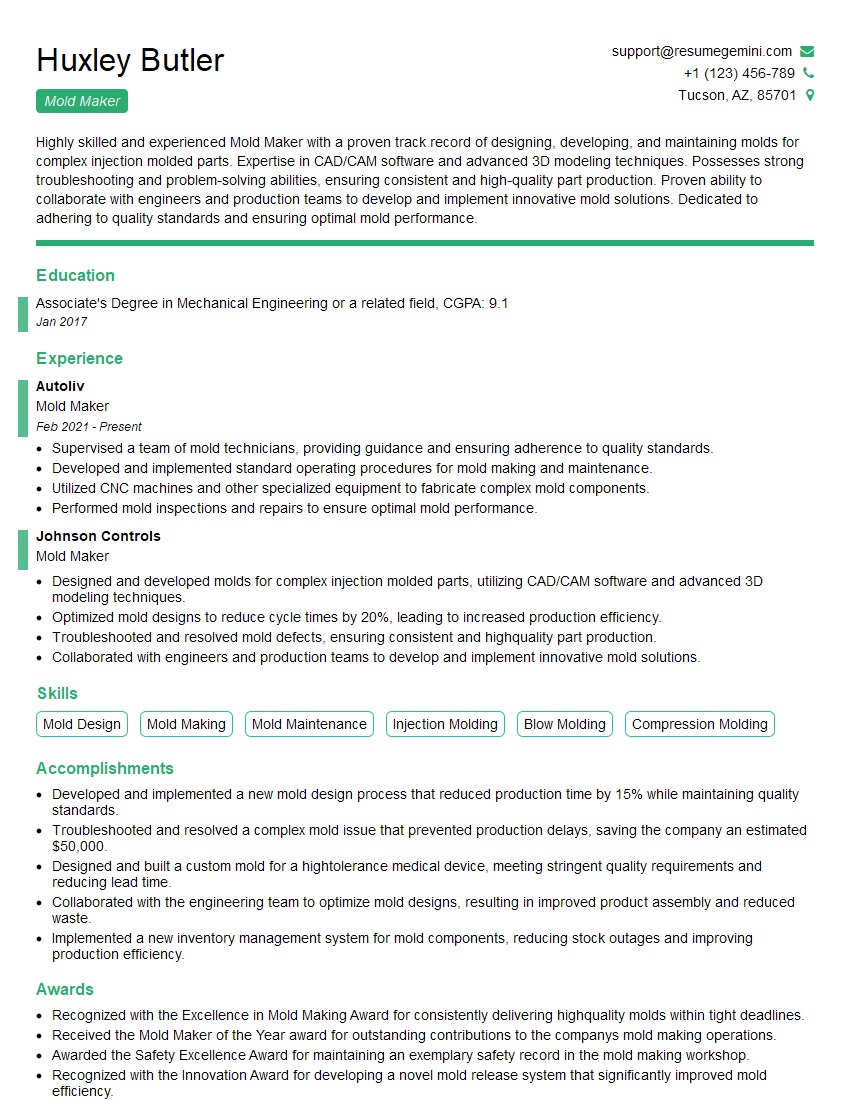
Mastering Molding & Casting principles is crucial for a rewarding and progressive career in manufacturing. A strong understanding of these concepts significantly enhances your marketability and opens doors to advanced roles and higher earning potential. To maximize your job prospects, it’s vital to present your skills effectively. Creating an ATS-friendly resume is paramount in today’s job market. We highly recommend leveraging ResumeGemini to build a professional and impactful resume that gets noticed. ResumeGemini provides valuable tools and resources, including examples of resumes tailored to the Molding & Casting industry, to help you present your qualifications effectively and land your dream job.
Explore more articles
Users Rating of Our Blogs
Share Your Experience
We value your feedback! Please rate our content and share your thoughts (optional).
What Readers Say About Our Blog
Very informative content, great job.
good