Unlock your full potential by mastering the most common Monument Lettering interview questions. This blog offers a deep dive into the critical topics, ensuring you’re not only prepared to answer but to excel. With these insights, you’ll approach your interview with clarity and confidence.
Questions Asked in Monument Lettering Interview
Q 1. What types of stone are best suited for monument lettering and why?
Choosing the right stone is paramount for lasting monument lettering. Durability, workability, and aesthetic appeal are key factors. Granites, for example, are incredibly popular due to their hardness, resistance to weathering, and wide range of colors and textures. Their crystalline structure allows for crisp, clean lettering that will endure for generations. Marble, while beautiful and offering a softer, more classic look, is less durable and more susceptible to erosion and staining, requiring more meticulous care and potentially shorter lifespan. Other suitable options include limestone and sandstone, each possessing unique characteristics affecting their suitability for lettering and the overall design. Sandstone, for instance, is relatively soft, making it easier to carve intricate details, but it requires more frequent cleaning and protection from the elements. The final choice depends on the client’s preferences, budget, and the desired longevity of the inscription.
- Granite: Hard, durable, wide color variety.
- Marble: Beautiful, softer, requires more maintenance.
- Limestone: Porous, requires sealing, softer than granite.
- Sandstone: Soft, easily carved, needs protection.
Q 2. Explain the difference between hand-tooling and machine-based lettering techniques.
Hand-tooling and machine-based lettering represent distinct approaches with unique advantages. Hand-tooling, using chisels, mallets, and other specialized tools, offers an unparalleled level of artistry and control. The craftsman’s skill is evident in the nuanced variations in letterforms, creating a unique and often irreplaceable piece. Machine-based lettering, employing pneumatic tools like air scribes or routers, allows for faster production and greater consistency, particularly for large or complex inscriptions. However, the human touch is somewhat lessened, resulting in a more uniform, potentially less expressive result. Think of it like the difference between a hand-painted portrait and a high-quality print: one is uniquely human, the other is meticulously precise. My experience encompasses both, and I often combine the two, utilizing hand-tooling for fine details and machine-based techniques for efficiency on larger areas.
Q 3. Describe your experience with various lettering styles (e.g., serif, sans-serif, script).
My experience spans a wide range of lettering styles, each with its own distinct character and suitability for different monument designs. Serif styles, with their small decorative flourishes at the ends of strokes, offer a classic, traditional feel, often associated with timeless elegance and formality. Sans-serif styles, lacking these flourishes, project a more modern and minimalist aesthetic, clean and uncluttered. Script styles, mimicking handwriting, bring a personal and often sentimental touch, conveying emotion and individuality. The choice of style depends heavily on the tone and message the client wishes to convey. For example, a traditional serif font might be appropriate for a formal memorial, while a modern sans-serif font would suit a contemporary design. Script is often reserved for more intimate or personalized inscriptions. I’ve worked with many variations within each style, adapting them to specific monument designs and client requests, ensuring the chosen font complements the stone and the overall aesthetic.
Q 4. How do you ensure accurate lettering placement and proportions on a monument?
Accurate lettering placement and proportions are critical. I begin with meticulous planning, creating detailed sketches and often digital mock-ups that are carefully reviewed with the client. These plans indicate the exact placement of the inscription, the size and style of the lettering, and any additional design elements. I then transfer these designs onto the monument using a variety of methods, including projection, tracing, and precise measurements. Throughout the process, I employ calibrated tools and templates to ensure consistent letter spacing, height, and overall proportions. Regular checks and adjustments are made throughout the carving process to maintain accuracy and prevent errors. Think of it as building a house – a solid foundation (planning) and careful measurements (execution) are crucial for a structurally sound and aesthetically pleasing result.
Q 5. What safety precautions do you take when working with stone carving tools?
Safety is my absolute priority. Working with stone carving tools involves inherent risks, so I meticulously follow safety protocols. This includes wearing appropriate personal protective equipment (PPE) at all times: safety glasses, dust masks (especially with pneumatic tools), gloves to protect against cuts and abrasions, and hearing protection when using power tools. I ensure my workspace is well-lit, clean, and organized to prevent accidents. Tools are regularly inspected and maintained to ensure they’re in perfect working order. Furthermore, I take extra precautions when handling sharp tools, employing secure storage and mindful movement to avoid injuries. For larger projects, I may employ additional safety measures like scaffolding or harnesses to ensure stability and prevent falls.
Q 6. How do you handle corrections or errors during the lettering process?
Even the most experienced craftsperson makes occasional errors. My approach to corrections depends on the nature and extent of the mistake. Minor imperfections, such as slight inconsistencies in letter spacing, can often be addressed with careful hand-tooling. For more significant errors, I may employ a combination of techniques, including removing the incorrect section and carefully recarving it. In some cases, especially with larger or deeper mistakes, it might be necessary to use fillers or patching compounds to restore the stone surface before recarving. The key is careful planning and meticulous attention to detail throughout the process to minimize the likelihood of errors in the first place. It’s crucial to be transparent with the client about any necessary corrections, explaining the process and ensuring they approve the solution.
Q 7. Describe your experience with different lettering depths and their impact on visual appeal.
Letter depth significantly impacts visual appeal and readability. Shallow lettering, while easier to carve, can appear less prominent and may be harder to read, especially from a distance. Deeper lettering offers greater contrast and three-dimensionality, enhancing readability and creating a more striking visual impact. However, excessively deep lettering can make the inscription appear heavy or out of proportion to the monument. The optimal depth depends on several factors, including the size of the lettering, the type of stone, and the overall design. I work closely with clients to determine the appropriate depth, balancing aesthetic appeal with durability and legibility. For example, a deep, well-defined inscription is ideal for large monuments and bold statements, while shallower lettering might suit smaller monuments or delicate script styles.
Q 8. How familiar are you with various types of stone engraving machines?
My familiarity with stone engraving machines is extensive. I’ve worked with a wide range, from traditional pneumatic chisels and hand-held routers to sophisticated CNC (Computer Numerical Control) routers and laser engravers. Each machine offers unique advantages depending on the project requirements.
- Pneumatic chisels: Excellent for detail work and creating textured effects, but require a high level of skill and are relatively slow.
- Hand-held routers: Offer greater speed and precision than chisels, but still demand considerable operator expertise.
- CNC routers: Provide unparalleled accuracy and repeatability, ideal for large-scale projects or intricate designs. They allow for precise depth control and consistent lettering across multiple stones.
- Laser engravers: Offer a clean, precise engraving with minimal material removal, suitable for delicate lettering on softer stones, but may not be as effective on harder materials.
Understanding the capabilities and limitations of each machine is crucial for selecting the most appropriate tool for a given job, ensuring both quality and efficiency.
Q 9. Explain your process for transferring lettering designs onto stone.
Transferring lettering designs onto stone involves several steps, and the exact process depends on the chosen engraving method. A common approach involves:
- Digital Design: Creating the lettering design using specialized software (more on this in a later answer). This stage includes font selection, sizing, kerning (spacing between letters), and overall layout.
- Printout and Transfer: The design is printed onto special transfer paper, often using a laser printer for optimal results. The image is then carefully applied to the stone surface, ensuring accurate placement.
- Tracing and Marking: Using a sharp stylus or similar tool, the design is meticulously traced onto the stone, transferring the outline of the lettering. For intricate designs or those requiring higher precision, I may use a projector to directly project the design onto the stone.
- Engraving: This is where the chosen engraving machine comes into play. The outline serves as a guide, and the engraving process begins.
For more intricate designs or larger projects, I might employ a combination of these methods to ensure accuracy.
Q 10. How do you maintain the precision and consistency of lettering throughout a project?
Maintaining precision and consistency is paramount. This involves a multi-pronged approach:
- Calibration: Regularly calibrating the engraving machine ensures that its movements are accurate and consistent. This is especially important for CNC routers.
- Test Runs: Before working on the actual stone, I always conduct test runs on a sample piece of similar material. This allows me to fine-tune settings and confirm the accuracy of the lettering before proceeding with the final piece.
- Consistent Tooling: Using sharp, well-maintained tools is essential. Dull tools lead to inconsistent results and can damage the stone.
- Careful Planning and Layout: Meticulous planning of the layout on the stone avoids issues such as uneven spacing or crowding of letters.
- Regular Quality Checks: Throughout the process, I meticulously check the work for any inconsistencies, making adjustments as needed.
By adhering to these practices, I ensure that the final product meets the highest standards of quality and precision.
Q 11. What software programs are you proficient in for designing and creating monument lettering?
I’m proficient in several software programs crucial for monument lettering design:
- Adobe Illustrator: Excellent for vector-based design, allowing me to create scalable and highly detailed lettering.
- CorelDRAW: Another robust vector-based program offering similar capabilities to Illustrator.
- AutoCAD: Primarily used for more technical aspects, including creating precise dimensional drawings and managing complex layouts for larger monuments.
- Specialized CNC software: Software specific to my CNC router, which allows me to translate the designs created in Illustrator or CorelDRAW into machine-readable code for precise cutting and engraving.
The choice of software often depends on the project’s complexity and the type of engraving machine being used. My versatility across these platforms allows me to adapt my workflow efficiently.
Q 12. Describe your experience with sandblasting techniques for monument lettering.
Sandblasting is a technique that offers a matte, etched finish on stone. My experience with it involves using various techniques to achieve different effects:
- Stenciling: A stencil, often made of vinyl or other suitable material, is applied to the stone, and the sandblasting process etches the exposed areas, creating sharp lettering.
- Mask Application: Similar to stenciling, but allows for more nuanced control over the depth and texture of the etching. This is often done for shading or textured backgrounds.
- Pressure Control: Adjusting the pressure of the sandblasting equipment allows me to fine-tune the depth of the etching, creating subtle variations in texture and appearance.
- Abrasive Selection: Different abrasives can be used for varied effects. Choosing the right abrasive is critical in achieving the desired finish and preventing damage to the stone.
Sandblasting is a powerful technique but requires careful control to avoid damaging the stone or creating unwanted inconsistencies.
Q 13. How do you determine the appropriate font size and style for a given monument size and inscription length?
Determining the appropriate font size and style requires careful consideration of several factors:
- Monument Size: Larger monuments naturally accommodate larger lettering, while smaller ones require smaller, more refined fonts.
- Inscription Length: A longer inscription requires a smaller font size to fit within the available space. Line spacing also needs careful management to avoid crowding.
- Readability: The chosen font should be easily legible from a reasonable viewing distance. Simple, classic fonts generally offer better readability.
- Aesthetic Considerations: The font style should complement the monument’s design and overall aesthetic. Modern or traditional designs might call for different font styles.
- Stone Type: The type of stone can also influence font selection. Porous stones might benefit from slightly bolder lettering for better visibility.
I typically create multiple mockups with different font sizes and styles, allowing clients to visualize the final product and make informed decisions. A balance between aesthetics and readability is key.
Q 14. Explain your understanding of the importance of material compatibility in monument lettering.
Material compatibility is crucial. Using an inappropriate engraving method or abrasive can damage the stone, leading to premature deterioration or an unsatisfactory finish. My understanding involves:
- Stone Type: Different stones have varying hardness and porosity. Granite, for example, is much harder than marble, and requires different engraving techniques.
- Engraving Method: Sandblasting might be suitable for softer stones, but could create an uneven finish on harder stones. CNC routers offer more precise control across a wider range of stone types.
- Abrasive Selection: The type of abrasive used in sandblasting or other techniques must be compatible with the stone’s composition to prevent damage.
- Durability: The chosen method and materials should ensure the lettering remains legible and aesthetically pleasing for many years. This involves considering weathering and other environmental factors.
Thorough knowledge of material properties allows me to select the appropriate methods and materials, guaranteeing a lasting and visually appealing outcome.
Q 15. How do you manage deadlines and multiple projects simultaneously?
Managing deadlines and multiple monument lettering projects requires a structured approach. I utilize project management software to track deadlines, allocate resources, and monitor progress for each commission. This allows me to visualize the workload and prioritize tasks effectively. For instance, I might prioritize projects with imminent deadlines or those requiring specialized skills. I also break down large projects into smaller, manageable phases with individual deadlines, making the overall process less overwhelming and easier to track. Regular client communication is key; keeping them updated on progress prevents unexpected delays and ensures everyone is on the same page. Finally, I’ve learned to realistically estimate project timelines, accounting for potential unforeseen challenges like material delays or intricate design complexities.
Career Expert Tips:
- Ace those interviews! Prepare effectively by reviewing the Top 50 Most Common Interview Questions on ResumeGemini.
- Navigate your job search with confidence! Explore a wide range of Career Tips on ResumeGemini. Learn about common challenges and recommendations to overcome them.
- Craft the perfect resume! Master the Art of Resume Writing with ResumeGemini’s guide. Showcase your unique qualifications and achievements effectively.
- Don’t miss out on holiday savings! Build your dream resume with ResumeGemini’s ATS optimized templates.
Q 16. Describe your experience working with clients to finalize lettering designs.
Collaborating with clients on lettering designs involves a multi-stage process. It begins with an initial consultation to understand their vision, the deceased’s personality, and any specific requests they might have. I then present initial design sketches, often incorporating different font styles, sizes, and layout options. This phase involves detailed discussions about the balance between artistic expression and the client’s personal preferences. For example, I might present options ranging from traditional serif fonts to more modern sans-serif styles, depending on the overall aesthetic the client desires. We’ll refine the design iteratively, incorporating feedback at each stage. Digital mock-ups on photographs of the actual monument are invaluable at this point, allowing the client to visualize the final product accurately before the actual inscription work begins. I consider it essential to maintain open communication, patience, and understanding throughout the design process to ensure the final design is a meaningful and fitting tribute.
Q 17. How do you ensure the longevity and durability of your lettering work?
Ensuring the longevity and durability of my lettering involves meticulous attention to detail throughout the entire process. Firstly, I select high-quality, weather-resistant materials like specialized stone-based paints or inks designed for outdoor applications. The depth of the carving or engraving also plays a crucial role; deeper inscriptions are more resistant to weathering and erosion. I tailor the choice of lettering technique – whether it’s hand-carved, sandblasted, or digitally engraved – based on the type of stone and the desired aesthetic. For instance, hand-carving allows for greater artistic control and detail, especially on softer stones, whereas sandblasting is more efficient for larger, simpler inscriptions. Finally, I advise clients on proper maintenance, such as regular cleaning with appropriate materials to prevent staining and damage. This comprehensive approach ensures that the lettering remains legible and aesthetically pleasing for generations to come.
Q 18. What are the common challenges encountered in monument lettering, and how do you overcome them?
Monument lettering presents unique challenges. One common issue is working with different stone types, each with its own properties affecting the carving or engraving process. Harder stones require specialized tools and techniques, while softer stones are more susceptible to damage. Another challenge is accurately rendering intricate designs or calligraphy onto curved surfaces. This requires precision and skill to ensure the lettering looks proportional and aesthetically pleasing. Weathering and environmental factors, like extreme temperature changes and acid rain, can also degrade the lettering over time. I overcome these challenges through careful material selection, using appropriate tools and techniques for each stone type, and employing specialized protective coatings where necessary. Extensive experience allows me to anticipate and mitigate potential issues during the design and execution phases.
Q 19. Describe your experience with different types of stone finishes and their effect on lettering.
Different stone finishes significantly impact lettering. A polished finish, for instance, provides a smooth, reflective surface ideal for showcasing elegant, finely detailed lettering. However, it might also highlight imperfections in the inscription. Conversely, a honed or leathered finish creates a more matte, textured appearance, which can subtly mask minor imperfections, but finer details might be less prominent. Rougher finishes, like flamed or tumbled, might not be suitable for intricate lettering due to the texture’s interference with fine lines. The choice of finish dictates the appropriate lettering style and technique. I work closely with clients to select the best finish that complements both the chosen lettering style and the overall aesthetic of the monument. Understanding the interplay between stone texture and inscription technique is crucial for achieving a harmonious result.
Q 20. How do you maintain the artistic integrity of the lettering while adhering to client specifications?
Balancing artistic integrity with client specifications is a delicate dance. I strive to create designs that honor the client’s vision while remaining true to the artistic principles of lettering. This involves thoughtful communication and creative problem-solving. If a client requests a design element that compromises the legibility or aesthetic balance of the piece, I’ll suggest alternative approaches that achieve the same effect without sacrificing artistic quality. For instance, I might propose a subtle variation in font or placement that better suits the stone’s character. My aim is to guide clients towards informed decisions that result in a visually appealing and timeless memorial that respects both their preferences and the art form.
Q 21. Explain your process for creating custom lettering designs based on client requests.
Creating custom lettering designs begins with a thorough discussion with the client to fully grasp their vision. I gather information about the deceased, their personality, and any preferred themes or symbols. Following this, I conduct research on appropriate lettering styles and fonts that align with the overall aesthetic. I then create several preliminary sketches incorporating various font options, sizes, and layouts. These sketches, often presented digitally using design software, allow the client to visualize how different design elements might work. This is followed by iterative refinements based on client feedback. The process usually involves creating digital mock-ups using high-resolution images of the actual monument, enabling the client to preview the design on the actual stone. This ensures the final design perfectly aligns with the client’s expectations and the characteristics of the stone.
Q 22. How do you handle situations where the client requests a design that is technically challenging or impractical?
When a client proposes a technically challenging or impractical design, my approach prioritizes open communication and creative problem-solving. I begin by carefully analyzing the request, understanding its artistic intent and the limitations imposed by the monument’s material, size, and existing condition. For instance, a client might envision intricate, deeply recessed lettering on a small, fragile granite stone. This is impractical as it risks damage during the lettering process or over time due to stress on the material.
My response involves a collaborative discussion. I explain the technical challenges, providing alternative solutions that achieve a similar aesthetic effect while remaining structurally sound. This might involve suggesting a different lettering style, material, or size, or proposing a slightly modified design that can be executed safely and effectively. We explore options together, aiming for a beautiful and lasting result that balances artistic vision with practicality. Sometimes, a digitally rendered mockup can help the client visualize how the adjustments would look. Ultimately, client satisfaction and the longevity of the lettering are paramount.
Q 23. Describe your experience with restoring or repairing damaged monument lettering.
Restoring or repairing damaged monument lettering is a specialized skill requiring precision and patience. My experience includes working with various types of damage, from minor scratches and fading to significant chipping and loss of lettering. The process begins with a thorough assessment of the damage, determining its extent and cause. This informs the selection of the appropriate repair method.
For minor damage, careful cleaning and touch-up using specialized paints or matched materials might suffice. For more extensive damage, more advanced techniques might be necessary. This could include re-carving letters (if the original is still somewhat present) or creating new letters entirely to match the existing style. In cases of significant loss, creating a digital reconstruction for accurate replacement is sometimes helpful, or even using 3D printing to create a close match. Matching the original material and color is critical, and I use a variety of techniques – such as color matching paint or using specialized stone restoration materials – to achieve this. The choice of materials and methodology is heavily reliant on the type of stone and the original lettering method.
Q 24. What are your preferred methods for cleaning and maintaining lettered monuments?
Cleaning and maintaining lettered monuments requires a gentle touch and the right products to avoid damaging the stone or lettering. My preferred methods depend on the material and the type of soiling present. For general cleaning, I recommend a soft-bristled brush and a solution of mild soap and water. Always test any cleaning solution in an inconspicuous area first. For tougher stains, more specialized stone cleaners might be used, but these must always be used with care and according to the manufacturer’s instructions. Power washing is generally avoided, as it can cause damage.
Regular, gentle cleaning is key to preventing long-term damage. I always advise clients to avoid harsh chemicals and abrasive materials. For monuments exposed to harsh weather conditions, a sealant can help protect the stone and lettering, enhancing longevity. In situations with extensive staining or lichen growth, I’ll recommend professional stone cleaning services. Regular inspections and proactive maintenance are crucial for preserving the beauty and integrity of the monument lettering over time.
Q 25. How do you stay updated on the latest trends and techniques in monument lettering?
Staying current in the field of monument lettering requires continuous learning. I regularly attend industry workshops, conferences, and trade shows to learn about new techniques, materials, and technologies. Membership in professional organizations provides access to the latest information and best practices. Many resources are also available online, from industry publications to educational websites. Additionally, I actively seek out opportunities to collaborate with other professionals in related fields, sharing knowledge and techniques. This proactive approach to continuing education ensures that I remain at the forefront of innovation within the field.
Q 26. Explain your experience with working with different types of lettering materials (e.g., gold leaf, paint).
My experience encompasses a broad range of lettering materials. Gold leaf application, for example, requires extreme precision and care. It involves careful preparation of the surface, followed by the meticulous application and burnishing of the gold leaf to ensure a smooth, durable finish. There are several methods of applying gold leaf, and the correct one must be chosen based on the specific circumstances. The techniques used to create beautiful gold lettering are refined over time. Paint application requires different techniques. Depending on the material of the monument, choosing the right type of paint is crucial for longevity and color retention. The right paint will not only look good but also protect the underlying material.
Other materials I regularly work with include various types of stone carving and inlays. Each material presents unique challenges and opportunities, requiring specialized skills and knowledge. I always strive to use materials that are durable, weather-resistant, and aesthetically appropriate for the monument.
Q 27. Describe your experience with quality control measures in monument lettering.
Quality control is essential in monument lettering. My approach incorporates quality checks at every stage of the process, from initial design consultation to final installation. I begin with a thorough review of the design, ensuring it is technically feasible and aesthetically pleasing. During the fabrication process, I implement regular inspections to identify and correct any flaws or inconsistencies. This might include checking for inconsistencies in lettering depth, spacing, or alignment. Before installation, I perform a final inspection to verify that the lettering is properly secured and meets the client’s expectations. Once the monument is installed, a final check ensures all elements are as originally discussed, designed, and planned.
Photography and detailed documentation of each step are vital to ensuring proper quality control and client communication. This records the process for reference, which can prove very useful in case of any issues or discrepancies. A high standard of quality control not only ensures client satisfaction but also preserves the monument’s beauty and integrity for generations to come.
Q 28. How do you price your monument lettering services?
Pricing monument lettering services involves a multifaceted approach. Several factors are taken into account to arrive at a fair and competitive price. These include the size and complexity of the lettering, the type of material used (stone, metal, etc.), the level of detail required, and the amount of time and labor involved. The condition of the existing monument, if any restoration is required, and any special techniques or materials also affect the final cost. Sometimes, there may be extra charges for materials, transportation, and any special conditions of the job.
I typically provide clients with a detailed, itemized estimate outlining all costs before starting the work. This ensures transparency and allows for informed decision-making. The approach is always collaborative, providing options for various cost points and balancing quality with budget constraints. My goal is to provide high-quality service that meets the client’s needs while maintaining a fair and reasonable pricing structure.
Key Topics to Learn for Monument Lettering Interview
- Design Principles: Understanding classical design elements, proportions, and stylistic choices in monument lettering. Consider the impact of different fonts and their historical context.
- Material Selection & Properties: Knowledge of various materials used (stone, bronze, etc.) and their impact on lettering techniques, durability, and aesthetic outcomes. Explore the challenges of working with different materials.
- Lettering Techniques: Familiarity with traditional hand-carving techniques, modern digital methods (e.g., CNC routing), and the application of paints and finishes. Be prepared to discuss the pros and cons of each.
- Typography & Font Selection: Demonstrate understanding of different lettering styles (e.g., Roman, Gothic, etc.) and their appropriate applications for various monument types and client needs. Consider readability and aesthetic impact.
- Project Management & Client Communication: Discuss your experience in managing projects, meeting deadlines, and effectively communicating with clients to understand their vision and expectations. This includes managing budgets and timelines.
- Design Software Proficiency: Showcase your skills in relevant software (e.g., CAD programs, vector graphics editors) used for designing and preparing monument lettering for production. Be ready to discuss specific software you’re proficient in.
- Problem-Solving & Adaptability: Highlight your ability to troubleshoot issues during the design or production process, adapting to unexpected challenges and finding creative solutions. Provide examples of situations where you had to problem-solve.
- Safety & Regulations: Demonstrate awareness of safety procedures related to the handling of materials and equipment involved in monument lettering. Discuss any relevant industry regulations or standards.
Next Steps
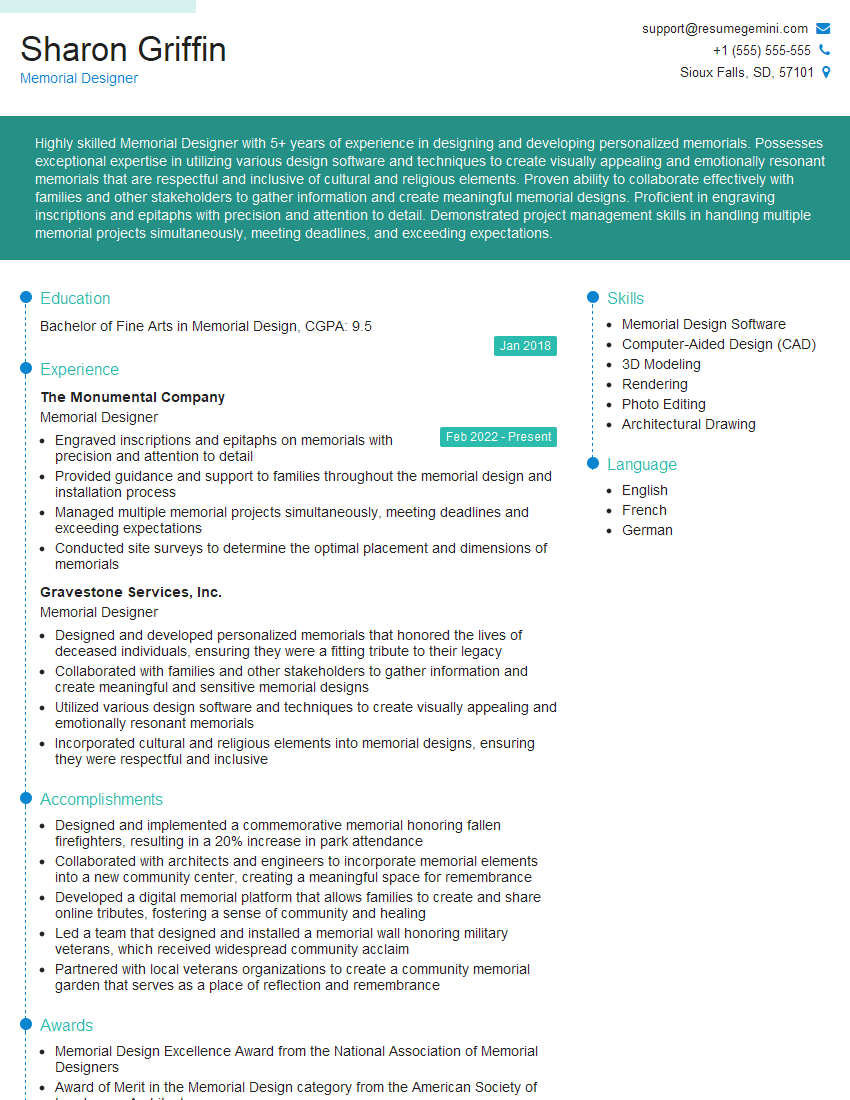
Mastering monument lettering opens doors to a rewarding career in a specialized and highly skilled craft. Your expertise in this field will be highly valued by employers. To significantly boost your job prospects, crafting an ATS-friendly resume is crucial. This ensures your application is effectively screened by applicant tracking systems, giving you a better chance to land an interview. ResumeGemini is a trusted resource to help you build a professional and impactful resume tailored to the monument lettering industry. Examples of resumes tailored specifically to this field are available to guide you. Invest time in creating a strong resume – it’s your first impression on potential employers.
Explore more articles
Users Rating of Our Blogs
Share Your Experience
We value your feedback! Please rate our content and share your thoughts (optional).
What Readers Say About Our Blog
Very informative content, great job.
good