Every successful interview starts with knowing what to expect. In this blog, we’ll take you through the top Motion Planning interview questions, breaking them down with expert tips to help you deliver impactful answers. Step into your next interview fully prepared and ready to succeed.
Questions Asked in Motion Planning Interview
Q 1. Explain the difference between path planning and trajectory planning.
Path planning and trajectory planning are both crucial aspects of motion planning, but they differ significantly in their scope and output. Think of it like this: path planning is finding the route, while trajectory planning is determining the trip.
Path planning focuses on finding a collision-free sequence of configurations that connect a start and goal state. It defines the geometric path, often as a series of points or waypoints, without considering time or dynamics. The output is a sequence of positions the robot needs to reach.
Trajectory planning, on the other hand, builds upon the path by adding temporal information and dynamics. It specifies not only where the robot should go, but also when it should arrive at each point along the path, considering factors like velocity, acceleration, and jerk. This ensures smooth and feasible movements for the robot.
Example: Imagine a robot navigating a maze. Path planning would find a sequence of corridors leading from the start to the finish. Trajectory planning would then determine the speed and acceleration profile for the robot to smoothly traverse each corridor, avoiding abrupt stops and starts.
Q 2. Describe A* search algorithm and its applications in motion planning.
The A* search algorithm is a graph traversal and path search algorithm, widely used in motion planning for its efficiency in finding optimal paths. It’s a best-first search that utilizes a heuristic function to estimate the cost from a node to the goal. This heuristic guides the search towards promising areas, significantly reducing the search space compared to exhaustive methods.
A* works by maintaining an open set of nodes to be explored and a closed set of nodes already visited. At each step, it selects the node with the lowest f-cost, where f(n) = g(n) + h(n).
g(n): The cost of the path from the start node to noden.h(n): A heuristic estimate of the cost from nodento the goal node. This must be admissible (never overestimates the actual cost) and consistent (the estimated cost fromnto the goal is less than or equal to the cost of going through a neighbormand then to the goal).
A* is applied extensively in motion planning for robots navigating static environments, such as warehouse robots finding the shortest path to a destination, or autonomous vehicles planning routes on roads.
Example: In a grid-based map, g(n) might be the number of cells traversed, and h(n) could be the Manhattan distance (sum of absolute differences in x and y coordinates) to the goal.
Q 3. What are RRTs and how do they work? Discuss their advantages and disadvantages.
Rapidly-exploring Random Trees (RRTs) are probabilistic sampling-based motion planning algorithms particularly well-suited for high-dimensional configuration spaces and complex environments. Unlike grid-based methods, RRTs don’t require explicit discretization of the environment.
How RRTs work: RRTs build a tree of configurations by iteratively adding new nodes. Each iteration involves:
- Sampling: A random configuration (pose) is sampled from the configuration space.
- Nearest Neighbor: The closest node in the existing tree to the sampled configuration is found.
- Extension: A new node is created by extending from the nearest node towards the sampled configuration. This extension is often limited by a maximum step size to avoid large jumps that may lead to collisions.
- Collision Check: If the path from the nearest node to the new node is collision-free, the new node is added to the tree. Otherwise, the iteration is repeated.
This process continues until a node is found within a certain radius of the goal configuration. A path is then extracted by backtracking from the goal node to the root of the tree.
Advantages:
- Handles high-dimensional spaces: RRTs efficiently explore high-dimensional configuration spaces where other methods struggle.
- Works well with complex environments: They can handle obstacles of arbitrary shape and size.
- Probabilistic completeness: Given enough iterations, an RRT will find a solution if one exists.
Disadvantages:
- Not optimal: The paths found by RRTs are usually not optimal (shortest or fastest).
- Computationally expensive: Finding the nearest neighbor can be time-consuming in high-dimensional spaces.
- Sensitivity to parameters: The performance of RRTs can be sensitive to the choice of parameters such as the step size and number of iterations.
Q 4. Explain the concept of potential fields in motion planning.
Potential field methods represent the configuration space as a landscape of attractive and repulsive forces. Imagine the robot being attracted to the goal and repelled by obstacles. This creates a potential field where the robot ‘rolls downhill’ towards the goal while avoiding obstacles.
Attractive potential: This force pulls the robot towards the goal configuration. It’s typically a decreasing function of the distance to the goal. A simple example is a negative quadratic potential.
Repulsive potential: This force pushes the robot away from obstacles. It’s typically an increasing function of the distance to the obstacle, becoming very strong as the robot gets close. The potential is often zero beyond a certain distance.
The robot’s movement is determined by the combined effect of these forces. By following the negative gradient of the total potential field, the robot moves towards the goal while avoiding obstacles.
Challenges: Local minima are a significant problem with potential field methods. The robot can get stuck in regions of high repulsive potential, unable to find a path to the goal. Various techniques have been developed to address this, such as adding random perturbations or using more sophisticated potential functions.
Q 5. What are some common challenges in motion planning for robots in dynamic environments?
Motion planning in dynamic environments presents a significant challenge compared to static environments. The presence of moving obstacles requires the planner to constantly adapt and replan. Here are some key challenges:
- Predicting the motion of obstacles: Accurate prediction of the future positions of moving obstacles is crucial. This requires robust object detection and tracking, often using sensors like lidar or cameras. Uncertainty in the prediction must also be accounted for.
- Dealing with unpredictable behavior: Unpredictable movements by humans or other agents introduce further complexity. The planner must be robust to unexpected changes in the environment.
- Real-time constraints: Dynamic environments often demand real-time planning, as the robot must react quickly to changes. Computational efficiency is essential.
- Safety: Collision avoidance is paramount in dynamic environments. The planner must ensure that the robot’s motion is safe and avoids collisions with moving obstacles.
- Coordination with multiple robots: In multi-robot scenarios, coordination between robots is necessary to avoid collisions and optimize overall performance. This can involve distributed planning algorithms.
Q 6. How do you handle collision avoidance in motion planning?
Collision avoidance is a crucial aspect of motion planning. Several strategies are employed, often in combination:
- Geometric collision checking: This involves checking for intersections between the robot’s geometry and the obstacles’ geometry at various points along a planned path. Techniques like bounding volume hierarchies can improve efficiency.
- Configuration space (C-space): This transforms the problem by representing the robot as a point and expanding obstacles to reflect the robot’s size and shape. Planning then becomes simpler in this transformed space.
- Artificial potential fields: As mentioned previously, repulsive potentials can effectively keep the robot away from obstacles.
- Velocity obstacles: This method computes the set of velocities the robot can take without colliding with other moving objects. It is particularly useful for dynamic environments.
- Sampling-based methods with collision checks: RRTs and other sampling-based planners inherently include collision checking in their algorithms. Any proposed motion is rejected if it leads to a collision.
- Reactive collision avoidance: This approach relies on real-time sensor feedback to react to unexpected obstacles. For example, if a sensor detects an object close to the robot, emergency braking or avoidance maneuvers are initiated.
The choice of method depends on the complexity of the environment, the robot’s dynamics, and the available computational resources.
Q 7. Describe different sampling-based planning methods (e.g., PRM, RRT*).
Sampling-based planning methods are powerful tools for motion planning, especially in high-dimensional spaces and complex environments. They construct a roadmap or tree of possible configurations by randomly sampling the configuration space.
Probabilistic Roadmaps (PRMs): PRMs build a roadmap by randomly sampling configurations and connecting nearby collision-free configurations with edges. The roadmap is constructed offline and then used for query-based path planning. A query involves finding the nearest nodes in the roadmap to the start and goal configurations and searching for a path between them.
RRT* (Rapidly-exploring Random Trees*): RRT* is an improvement over the basic RRT algorithm. It’s an asymptotically optimal algorithm, meaning that as the number of iterations increases, the solution converges to the optimal path. RRT* re-wires the tree to connect nodes with shorter paths, improving the quality of the resulting solution. It uses a similar sampling process to RRT but adds a rewiring step to improve path optimality.
Other sampling-based methods: Numerous variations and extensions exist, such as RRT-Connect, which connects two trees growing from the start and goal configurations, and KPIECE, which focuses on improving the exploration of narrow passages.
The choice of method depends on factors like the desired optimality, computational resources, and the characteristics of the configuration space.
Q 8. Explain the concept of kinodynamic constraints in motion planning.
Kinodynamic constraints in motion planning refer to the limitations imposed by the dynamics of the robot itself. Unlike purely kinematic constraints which only consider the robot’s geometry and position, kinodynamic constraints encompass the robot’s velocity, acceleration, and even jerk (the rate of change of acceleration). Imagine driving a car: you can’t instantly change speed or direction; there are physical limitations on how quickly you can accelerate or turn. These limitations are precisely what kinodynamic constraints model.
These constraints are crucial because they ensure the planned path is physically feasible. A path that’s geometrically valid (avoiding obstacles) might be impossible for the robot to execute if it requires instantaneous changes in velocity or acceleration exceeding its capabilities. For instance, a sharp turn at high speed might cause the robot to skid or tip over, violating the constraints.
Examples of kinodynamic constraints include:
- Maximum velocity and acceleration limits: A car can only accelerate up to a certain rate, and has a maximum speed.
- Minimum turning radius: A car can’t turn on a dime; there’s a minimum radius it can turn in.
- Actuator limitations: The motors or joints of a robot have limited torque and speed.
Ignoring kinodynamic constraints can lead to unrealistic plans that are impossible to execute. Therefore, incorporating these constraints into motion planning algorithms is vital for generating feasible and safe robot trajectories.
Q 9. How do you evaluate the quality of a planned path or trajectory?
Evaluating the quality of a planned path or trajectory depends heavily on the specific application and priorities. However, several key metrics are commonly used:
- Path length: Shorter paths generally require less energy and time.
- Smoothness: A smooth path with minimal changes in curvature is easier to follow and less prone to causing wear and tear on the robot.
- Execution time: This considers the robot’s dynamics and speed limits, ensuring the plan is both feasible and efficient.
- Obstacle clearance: The distance between the planned path and obstacles should be sufficient to account for uncertainties in robot control and sensor data.
- Computational cost: The time it takes to compute the path is crucial, especially in real-time applications.
Often, there’s a trade-off between these metrics. For example, the shortest path might be jerky and require high acceleration, while a smoother path might be longer. A good planning algorithm balances these factors based on the application’s needs. For a delivery robot, minimizing path length might be paramount, whereas for a surgical robot, smoothness and safety become extremely important.
Q 10. What is the difference between global and local planning?
Global and local planning are two distinct stages in many motion planning systems, working together to find a complete path. Think of it like planning a road trip: global planning is like choosing the overall route across the country, while local planning is like navigating around individual traffic jams or obstacles along the way.
Global planning aims to find a collision-free path from the start to the goal, considering the global environment. It typically uses algorithms like A*, RRT, or PRM which operate on a simplified representation of the environment (e.g., a graph or occupancy grid). The output is a high-level path that may not be detailed enough for execution.
Local planning refines the global path, taking into account finer details of the environment and robot dynamics. It often uses techniques like potential fields or trajectory optimization to produce a smooth and executable trajectory that avoids local obstacles and satisfies kinodynamic constraints. Local planners often work incrementally, adjusting the robot’s path in response to sensor feedback.
In essence: global planning provides the big picture, while local planning fills in the details and handles unforeseen events.
Q 11. Discuss various path smoothing techniques.
Path smoothing techniques aim to improve the quality of a planned path by reducing its curvature and jerk. This leads to smoother motion, less wear and tear on the robot, and improved energy efficiency. Common techniques include:
- Cubic Splines: These smooth curves are defined by piecewise cubic polynomials, fitting smoothly between waypoints while ensuring continuous velocity and acceleration.
- B-splines: Similar to cubic splines, but offer more flexibility in controlling the curve’s shape and smoothness. They’re often used for higher-order smoothness (continuous jerk).
- Polynomial Trajectory Generation: This involves finding a polynomial that fits the desired waypoints and satisfies specified boundary conditions on velocity and acceleration.
- Optimization-based methods: These techniques formulate the smoothing problem as an optimization problem, aiming to minimize a cost function that incorporates path length, curvature, and jerk. This often involves numerical optimization algorithms.
The choice of smoothing technique depends on the specific requirements, computational resources, and desired level of smoothness. For example, cubic splines are computationally efficient but may not offer the same level of smoothness as optimization-based methods.
Q 12. Explain how you would handle obstacles of different shapes and sizes.
Handling obstacles of different shapes and sizes requires a robust representation of the environment and algorithms that can effectively reason about these variations. Common approaches include:
- Occupancy grids: Represent the environment as a grid, with each cell marked as occupied or free. This approach handles diverse shapes by approximating them with grid cells. Resolution needs to be fine enough to represent smaller obstacles.
- Polygon representations: Obstacles are defined as polygons, allowing for precise representation of their boundaries. Algorithms like Voronoi diagrams or configuration space (C-space) techniques can efficiently handle these representations.
- Point cloud-based methods: Utilize point clouds obtained from sensors like LiDAR or depth cameras to represent the environment. Algorithms process these point clouds to detect obstacles and plan paths.
- Hybrid approaches: Combine different representations to exploit the strengths of each method. For example, an occupancy grid could be used for global planning, while polygon representations are used for local planning around specific obstacles.
Efficient algorithms like A*, RRT, and PRM can be adapted to work with these different representations. The key is to choose the representation and algorithm that are best suited to the specific environment and robot capabilities. For complex, dynamic environments, sensor fusion and probabilistic methods are often necessary to handle uncertainties.
Q 13. Describe your experience with different motion planning libraries (e.g., OMPL, MoveIt!).
I have extensive experience with several popular motion planning libraries, including OMPL and MoveIt!.
OMPL (Open Motion Planning Library) is a powerful and versatile C++ library providing a wide range of planning algorithms, including sampling-based methods like RRT, PRM, and KPIECE. Its modular design allows for easy integration with different robot models and environments. I’ve used OMPL in several projects requiring complex robot manipulation and path planning in cluttered environments. For example, I used it to plan collision-free trajectories for a multi-legged robot navigating uneven terrain.
MoveIt! is a popular ROS (Robot Operating System) package for robot manipulation that incorporates OMPL. MoveIt! provides a higher-level interface, simplifying the process of creating and executing motion plans. I’ve used MoveIt! extensively for robotic arm manipulation tasks, including pick-and-place operations and complex assembly sequences. Its collision detection capabilities and integration with ROS made it ideal for these tasks. I particularly appreciate its intuitive interface for defining constraints and visualizing planned trajectories.
My experience with these libraries has enabled me to efficiently develop and implement robust motion planning solutions for various robotic systems.
Q 14. How do you deal with uncertainty in sensor data during motion planning?
Dealing with uncertainty in sensor data is a crucial aspect of robust motion planning. Sensor noise, limited range, and occlusions can lead to inaccurate environment representations. Here’s how I address these challenges:
- Probabilistic methods: Employing probabilistic representations of the environment, such as occupancy grids with probability values rather than just occupied/free. This allows for modeling the uncertainty associated with sensor readings.
- Sensor fusion: Combining data from multiple sensors (e.g., LiDAR, cameras, IMU) to reduce uncertainty. This improves the accuracy of the environment model and reduces the impact of individual sensor errors.
- Monte Carlo methods: Generating multiple potential paths and evaluating their feasibility considering the uncertainty. This can identify paths that are likely to be collision-free even with sensor noise.
- Replanning and adaptation: Implementing mechanisms for online replanning based on updated sensor data. If unexpected obstacles are detected, the system can adjust the path to avoid them. This is critical for dynamic environments.
- Safety margins: Incorporating safety margins around obstacles to account for uncertainties in robot pose and sensor readings. This ensures that the robot maintains a safe distance even with imperfect knowledge of the environment.
These techniques help create motion plans that are both feasible and safe, even in the face of uncertain sensor data. This is vital for robust and reliable robot operation in real-world scenarios.
Q 15. Explain the concept of configuration space in robotics.
Imagine you’re trying to navigate a robot through a room filled with obstacles. Configuration space (C-space) is a mathematical representation of all the possible positions and orientations the robot can adopt without colliding with anything. Instead of focusing on the robot’s physical shape, we represent it as a point in C-space. The obstacles are also transformed into C-space, effectively simplifying the problem to point navigation.
For example, consider a square robot navigating a room with a circular obstacle. In real space, the robot’s collision is complex. However, in C-space, the robot becomes a point, and the obstacle is inflated by the robot’s size (the Minkowski sum). Now, path planning becomes finding a path for a point around an inflated obstacle. This simplifies the computation significantly.
C-space is crucial because it allows us to treat path planning as a geometric problem regardless of the robot’s shape and allows us to use powerful algorithms designed for point navigation.
Career Expert Tips:
- Ace those interviews! Prepare effectively by reviewing the Top 50 Most Common Interview Questions on ResumeGemini.
- Navigate your job search with confidence! Explore a wide range of Career Tips on ResumeGemini. Learn about common challenges and recommendations to overcome them.
- Craft the perfect resume! Master the Art of Resume Writing with ResumeGemini’s guide. Showcase your unique qualifications and achievements effectively.
- Don’t miss out on holiday savings! Build your dream resume with ResumeGemini’s ATS optimized templates.
Q 16. What are some common metrics used to evaluate motion planning algorithms (e.g., completeness, optimality)?
Evaluating motion planning algorithms involves considering several key metrics:
- Completeness: Does the algorithm guarantee finding a solution if one exists? Complete algorithms always find a path if a feasible path exists, but they might take a long time. Incompletely algorithms are faster, but may fail to find a path even when one is available.
- Optimality: Does the algorithm find the shortest or best path? Optimal algorithms find the best path according to a predefined cost function (e.g., shortest distance, minimum energy consumption), while suboptimal algorithms find a solution, but not necessarily the best one.
- Computational Complexity: How much time and memory does the algorithm require? This is crucial for real-time applications. Algorithms with lower complexity are preferred for faster planning.
- Robustness: How well does the algorithm handle uncertainties in the environment or the robot’s model? A robust algorithm can cope with minor changes in the environment or inaccuracies in the robot’s sensors without failing.
- Resolution Completeness: A variant of completeness for sampling-based planners. It guarantees that a solution will be found if the sampling resolution is sufficiently high.
The choice of metrics depends heavily on the application. For a robot exploring an unknown environment, completeness might be prioritized. In a factory setting with predictable obstacles, optimality and computational complexity are more critical.
Q 17. Describe your experience with different types of robots and their motion planning challenges.
I’ve worked with various robots, each presenting unique motion planning challenges:
- Industrial robots (articulated arms): These robots have complex kinematics, requiring sophisticated algorithms to handle their multiple joints and avoid self-collisions. The workspace is often constrained, necessitating careful consideration of joint limits and workspace boundaries.
- Mobile robots (wheeled or legged): Motion planning for these robots needs to account for nonholonomic constraints (limitations on the robot’s ability to move in certain directions). For legged robots, gait planning becomes a crucial aspect, determining how the legs should move to achieve stable and efficient locomotion.
- Aerial robots (drones): These robots operate in three dimensions and are affected by aerodynamics. Motion planning must consider factors like wind, battery life, and obstacle avoidance in a 3D environment.
My experience includes developing and implementing motion planning solutions using different techniques for each robot type, optimizing algorithms for real-time performance and adapting to the specific challenges presented by each robot’s capabilities and operating environment.
Q 18. How do you handle narrow passages or tight spaces during path planning?
Navigating narrow passages requires algorithms capable of handling tight constraints. Several approaches are effective:
- Path widening techniques: These methods expand the robot’s shape to account for potential errors or uncertainties, effectively making the passages appear wider in C-space. The path is then planned for this widened robot, providing a margin of safety.
- Optimization-based approaches: Formulating the path planning problem as an optimization problem with constraints ensures the generated path remains within the allowable space. This is particularly effective when dealing with complex shapes and multiple constraints.
- Local path smoothing: After generating an initial path, smoothing algorithms can refine the path to reduce sharp turns and ensure it fits comfortably within the narrow passages. This can be achieved using techniques like Bézier curves or spline interpolation.
- Sampling-based planners with bias towards narrow passages: Techniques like RRT* can be modified to prioritize sampling near the passage boundaries, improving the chance of finding a solution.
The specific technique employed depends on the complexity of the environment, the robot’s dynamics, and the desired path quality. Often, a combination of methods proves most effective.
Q 19. Explain the concept of graph search algorithms in motion planning.
Graph search algorithms represent the environment as a graph where nodes represent valid robot configurations and edges represent possible transitions between configurations. Path planning then becomes finding a path in this graph from the start node to the goal node.
Popular algorithms include:
- A*: A best-first search algorithm that uses a heuristic function to estimate the distance to the goal, guiding the search towards promising paths.
- Dijkstra’s algorithm: A uniform-cost search algorithm that finds the shortest path by exploring nodes in increasing order of their distance from the start node.
- Breadth-first search (BFS): Explores the graph layer by layer, finding the shortest path in terms of the number of edges.
These algorithms work well for discrete environments or when the configuration space can be efficiently discretized. However, for high-dimensional configuration spaces, the number of nodes can become extremely large, rendering these algorithms impractical.
Q 20. Describe your understanding of Rapidly-exploring Random Trees (RRTs) and their variants.
Rapidly-exploring Random Trees (RRTs) are sampling-based motion planning algorithms well-suited for high-dimensional spaces. They build a tree of robot configurations by randomly sampling the C-space and connecting the closest node in the tree to the sample point.
The algorithm’s key features include:
- Random sampling: This allows exploration of the entire C-space, even with complex geometries.
- Tree structure: The tree structure efficiently keeps track of explored configurations.
- Local connection: Connections are made only to nearby nodes, reducing computational cost.
Variants include RRT*, which optimizes the path by rewiring the tree and ensuring asymptotic optimality, and Informed RRT*, which incorporates prior knowledge to focus the search in more promising areas of the C-space. I have extensive experience utilizing RRT variants in various applications due to their efficiency and robustness in handling high-dimensional and complex environments.
Q 21. How do you handle dynamic obstacles in real-time motion planning?
Handling dynamic obstacles in real-time requires algorithms that can adapt quickly to changes in the environment. Several strategies are commonly used:
- Dynamic Window Approach (DWA): This algorithm evaluates a set of possible control actions within a short time window, selecting the action that leads to the best trajectory considering obstacle avoidance and goal reaching. It is simple to implement and effective for fast replanning.
- Receding Horizon Control (RHC): This approach solves an optimization problem repeatedly over a short time horizon (the receding horizon), accounting for the current state and predictions of future obstacle movements. It provides robustness and can handle complex dynamics.
- Probabilistic Roadmaps (PRM): While traditionally used for static environments, PRMs can be extended to dynamic scenarios by incorporating predictions of obstacle movements into the roadmap construction and path search. The roadmap is continuously updated based on new information about obstacles.
- Sampling-based planners with dynamic obstacle avoidance: RRT and its variants can be adapted to handle dynamic obstacles by incorporating obstacle prediction into the sampling and connection steps.
The choice of algorithm often involves a trade-off between computational cost and the level of responsiveness required. In high-speed scenarios, computationally efficient methods like DWA may be necessary, while in applications with more time available for planning, RHC or advanced sampling-based planners can offer improved performance.
Q 22. Discuss the trade-offs between computational cost and solution quality in motion planning.
Motion planning often involves a crucial trade-off between the computational cost of finding a solution and the quality of that solution. Imagine searching for the best route on a map: you could exhaustively check every possible path (high quality, high cost), or you could use a heuristic (faster, but might miss the optimal path). In motion planning, computationally expensive algorithms, like those employing exhaustive searches or exploring extremely fine-grained state spaces, guarantee finding the globally optimal path (if one exists), but this comes at the expense of potentially long computation times, making them unsuitable for real-time applications. Conversely, faster, less computationally intensive methods like sampling-based planners (e.g., RRT, PRM) may find suboptimal solutions quickly, making them better suited for real-time control of robots operating in dynamic environments. The choice hinges on the application’s requirements: a self-driving car needs near real-time solutions, whereas a robotic arm in a controlled factory setting might tolerate longer computation times for a better path.
For example, A* search provides a good balance, finding optimal paths while employing heuristics to limit its search space. However, its performance degrades significantly in high-dimensional spaces. On the other hand, Rapidly-exploring Random Trees (RRT) offer fast solutions, even in high-dimensional spaces, although these solutions might not be globally optimal.
Q 23. How would you approach motion planning for a multi-robot system?
Motion planning for multi-robot systems is significantly more complex than for a single robot due to the added consideration of inter-robot collision avoidance and coordination. It’s not simply a matter of planning individual paths; you must ensure that these paths are collision-free with respect to each other and the environment. Several approaches exist:
- Centralized Planning: A single planner coordinates the paths for all robots simultaneously. This guarantees collision avoidance but becomes computationally expensive as the number of robots increases.
- Decentralized Planning: Each robot plans its own path independently, using local information and possibly communicating with neighbors to avoid collisions. This approach scales better but may lead to suboptimal solutions or deadlocks.
- Hierarchical Planning: This approach combines centralized and decentralized approaches. High-level planning may determine the overall task allocation and broad trajectories, while lower-level planners refine these trajectories for each robot, addressing local constraints and collision avoidance.
The specific approach chosen depends on factors like the number of robots, the complexity of the environment, and the need for optimality versus scalability. Techniques like potential fields can be employed to incorporate collision avoidance in both centralized and decentralized methods.
Q 24. Explain your experience with different optimization techniques used in trajectory planning.
My experience encompasses various optimization techniques for trajectory planning, each suited for different scenarios and constraints. I’ve worked with:
- Gradient-based methods: These methods iteratively improve a trajectory by following the gradient of a cost function. They are efficient for smooth, differentiable cost functions but can get stuck in local optima. Examples include steepest descent and Newton’s method.
- Nonlinear programming: Techniques like Sequential Quadratic Programming (SQP) are powerful for handling constraints, such as velocity and acceleration limits. They are computationally more expensive but often yield higher-quality solutions.
- Dynamic programming: This method solves an optimization problem by breaking it down into smaller subproblems. It guarantees finding the globally optimal solution but suffers from the curse of dimensionality, becoming computationally intractable for high-dimensional problems.
- Evolutionary algorithms (e.g., Genetic Algorithms): These are population-based methods that iteratively improve a set of candidate trajectories through processes like selection, crossover, and mutation. They are robust but can be computationally expensive.
The choice of optimization technique is heavily influenced by the specific problem: the dimensionality of the search space, the nature of the cost function, the presence of constraints, and the available computation time.
Q 25. What are some common pitfalls to avoid during motion planning?
Several pitfalls should be avoided during motion planning. A common one is inaccurate modeling of the robot and environment. If your model doesn’t accurately represent the robot’s kinematics, dynamics, or the environment’s obstacles, your planned path may be infeasible or unsafe in reality. Another frequent mistake is ignoring constraints. Forgetting to consider constraints like joint limits, velocity limits, acceleration limits, or collision avoidance can lead to paths that cannot be executed by the robot. Oversimplifying the problem by assuming a simpler model can also result in failure. It’s crucial to include all relevant factors and constraints.
Furthermore, relying solely on local optimization methods can result in getting stuck in local optima, especially with complex cost functions. Choosing appropriate optimization techniques is crucial. Finally, poor path representation can significantly impact computational efficiency and solution quality. For example, using high-resolution grids for path representation can quickly become computationally prohibitive in large environments.
Q 26. Describe a time you had to overcome a challenging motion planning problem.
During a project involving autonomous navigation for a mobile robot in a cluttered warehouse environment, I encountered a significant challenge: the robot frequently got stuck in tight spaces due to the combination of its nonholonomic constraints (it couldn’t move sideways) and the highly irregular shapes of obstacles. Standard sampling-based planners like RRT struggled to find feasible paths. My solution involved a two-stage approach. First, I used a global planner (A*) to find a coarse path ignoring the nonholonomic constraints. Then, I employed a local planner based on a hybrid A*-based method that incorporated the nonholonomic constraints to refine the path, ensuring feasibility. This combination effectively addressed the problem by using the strengths of different algorithms to overcome the challenge of path planning in a challenging environment.
Q 27. How do you incorporate constraints like velocity, acceleration, and jerk limits into trajectory generation?
Incorporating constraints like velocity, acceleration, and jerk limits into trajectory generation is crucial for smooth and physically realistic robot motion. There are several methods:
- Constraint Satisfaction Techniques: These involve explicitly representing the constraints as inequalities and using optimization methods (like nonlinear programming or quadratic programming) to find a trajectory that satisfies these constraints. The cost function being optimized might prioritize factors like minimizing path length or execution time.
- Polynomial Trajectories: Polynomials can be used to define trajectories, where the coefficients are optimized to satisfy constraints. For instance, a quintic polynomial (fifth-order) allows specification of position, velocity, and acceleration at the start and end points, and constraints on jerk can be added as well.
- Trajectory Parameterization: This approach uses techniques to define the trajectory based on specific parameters (like via points) that ensure constraints are inherently satisfied.
For example, using a quintic polynomial, we could express the trajectory as a function of time (x(t) = a0 + a1t + a2t^2 + a3t^3 + a4t^4 + a5t^5), and then solve for the coefficients a0 to a5 subject to constraints on velocity (dx/dt), acceleration (d2x/dt2), and jerk (d3x/dt3) at the start and end points. This ensures a smooth trajectory without violating physical limits.
Q 28. Explain the differences between deterministic and probabilistic motion planning.
Deterministic and probabilistic motion planning differ fundamentally in how they handle uncertainty. Deterministic motion planning assumes perfect knowledge of the environment and robot dynamics. The planner knows exactly where obstacles are located, what the robot’s capabilities are, and how it will respond to control commands. Algorithms like A*, Dijkstra’s algorithm, and various graph search methods fall under this category. Their output is a guaranteed collision-free path (if one exists). However, real-world scenarios rarely offer perfect knowledge, thus deterministic planners can often fail in real-world applications.
Probabilistic motion planning, on the other hand, explicitly accounts for uncertainty. It might incorporate sensor noise, imprecise models of the environment or robot dynamics. Sampling-based planners like RRT and PRM are examples of probabilistic planners. These methods explore the configuration space by sampling points and connecting them to form paths. The resulting path is not guaranteed to be collision-free but provides a probabilistic guarantee of success, often suitable for applications with high levels of uncertainty. The probabilistic nature makes them more robust in unpredictable environments, but they might not find optimal solutions. This makes them suitable for applications where uncertainty is expected like autonomous driving in a busy city or mobile robotics in an unstructured environment.
Key Topics to Learn for Motion Planning Interview
- Path Planning Algorithms: Understand the strengths and weaknesses of various algorithms like A*, Dijkstra’s, RRT, RRT*, and rapidly-exploring random graphs (RRG). Be prepared to discuss their computational complexity and applicability to different scenarios.
- Search-based Methods: Demonstrate a grasp of heuristic functions, graph representations, and the trade-offs between optimality and computational efficiency in path planning.
- Trajectory Optimization: Discuss techniques for generating smooth and dynamically feasible trajectories, considering constraints like velocity, acceleration, and jerk limits. Be ready to explain concepts like polynomial interpolation and spline-based methods.
- Sampling-based Methods: Explain the probabilistic nature of sampling-based algorithms and their advantages in high-dimensional configuration spaces. Be prepared to compare and contrast different sampling strategies.
- Collision Detection: Understand different collision detection methods, including bounding volumes and spatial partitioning techniques. Be able to discuss their efficiency and limitations.
- Motion Planning in Robotics: Discuss real-world applications of motion planning in robotics, such as autonomous navigation, robotic manipulation, and multi-robot coordination. Provide examples of specific challenges and solutions.
- Local and Global Planning: Differentiate between local and global planning approaches and explain how they can be integrated for effective motion planning in complex environments.
- Kinodynamic Planning: Discuss the complexities of incorporating dynamics into motion planning problems and the techniques used to address them.
Next Steps
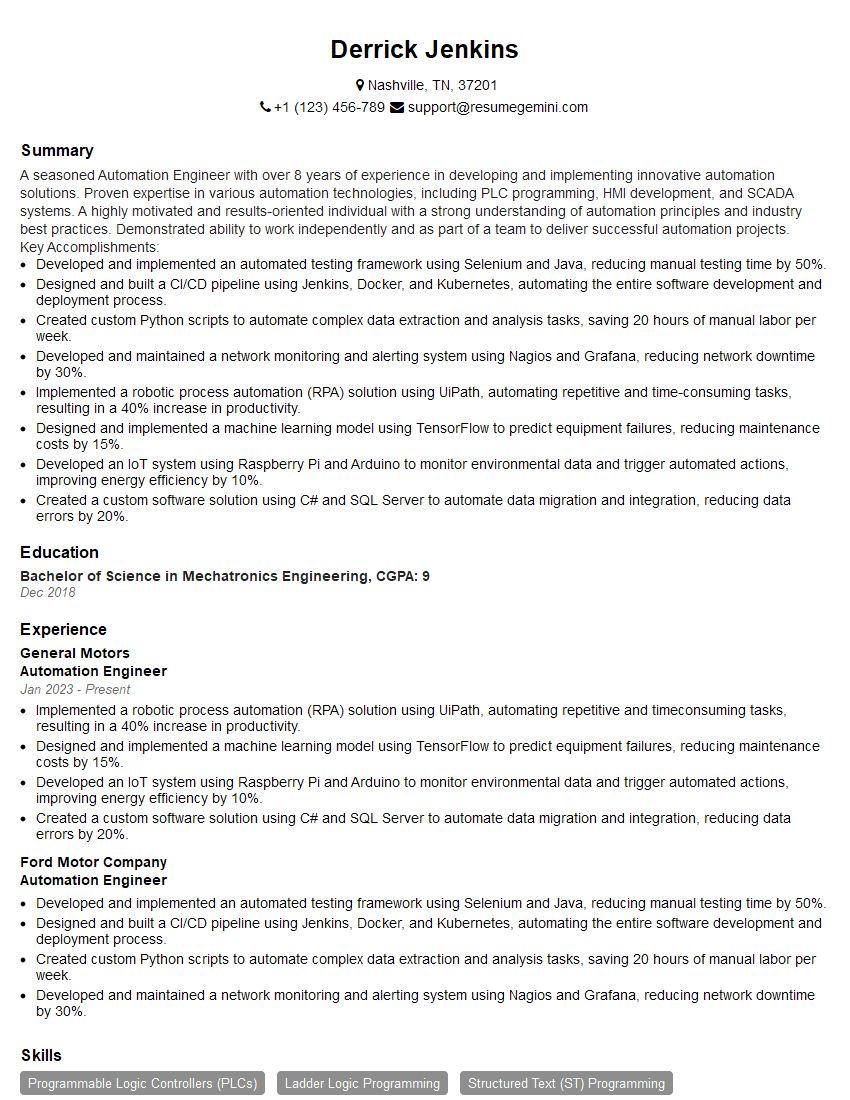
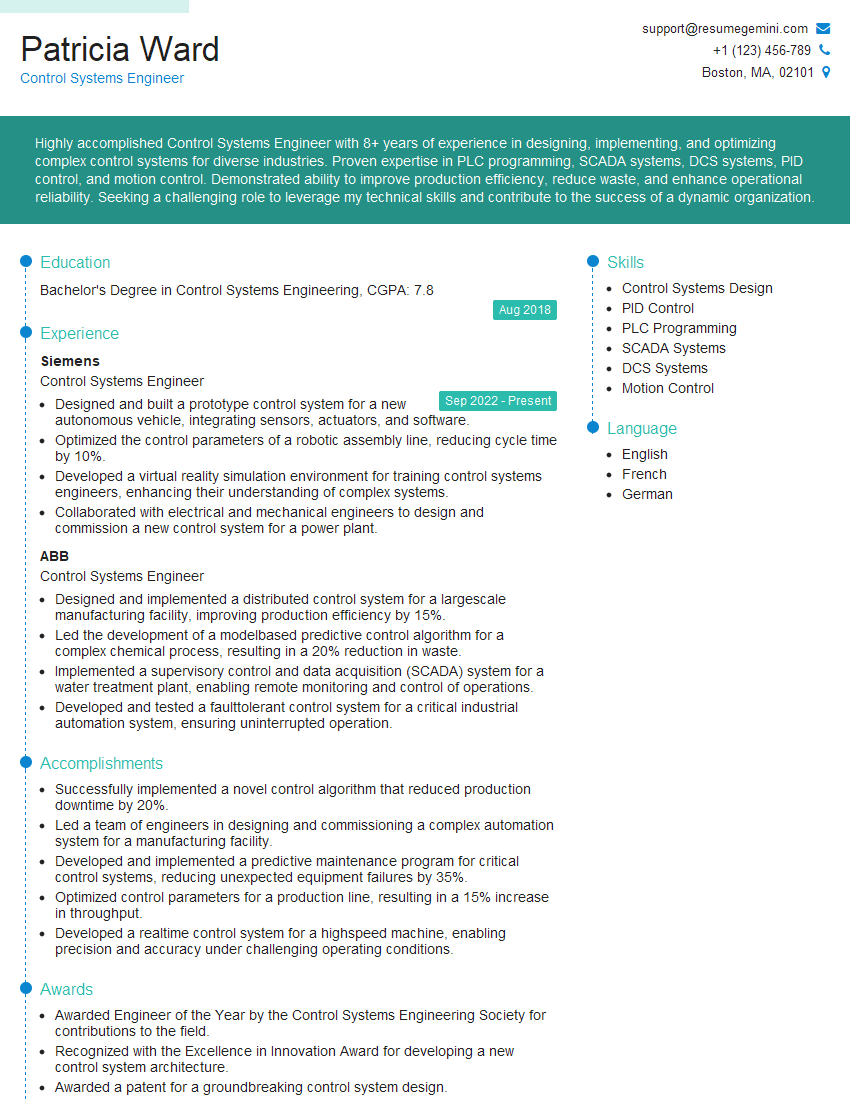
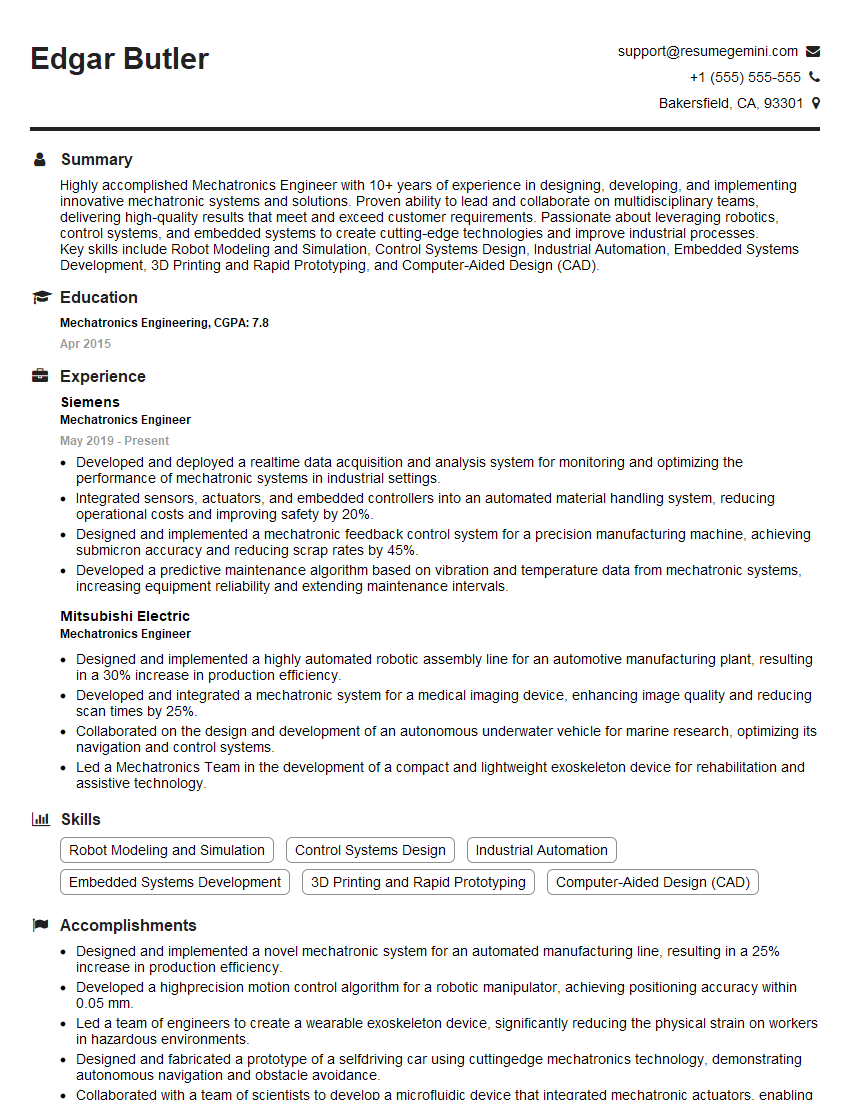
Mastering motion planning opens doors to exciting careers in robotics, autonomous systems, and artificial intelligence. A strong understanding of these concepts is highly sought after by leading companies. To maximize your job prospects, creating a compelling and ATS-friendly resume is crucial. ResumeGemini is a trusted resource that can significantly enhance your resume-building experience, helping you present your skills and experience effectively. Examples of resumes tailored specifically to Motion Planning are available to guide you through the process.

Explore more articles
Users Rating of Our Blogs
Share Your Experience
We value your feedback! Please rate our content and share your thoughts (optional).
What Readers Say About Our Blog
Very informative content, great job.
good