Unlock your full potential by mastering the most common Music Contract Negotiation interview questions. This blog offers a deep dive into the critical topics, ensuring you’re not only prepared to answer but to excel. With these insights, you’ll approach your interview with clarity and confidence.
Questions Asked in Music Contract Negotiation Interview
Q 1. Explain the key clauses in a standard recording agreement.
A standard recording agreement outlines the terms of a musical recording project between an artist and a record label. Key clauses typically include:
- Grant of Rights: This crucial clause details the specific rights the artist grants the label, such as the right to manufacture, distribute, and promote the recordings. It often specifies the geographical territory and duration of these rights.
- Royalty Rate: This clause dictates the percentage of revenue the artist receives from record sales, streaming, downloads, and other forms of exploitation. It’s often tiered, with higher percentages earned after exceeding certain sales thresholds.
- Advances: This section outlines the upfront payments the label provides the artist to finance recording costs. These advances are usually recoupable, meaning they’re deducted from future royalties.
- Term of Agreement: The length of the contract—this might encompass a specific number of albums or a set period. It’s crucial to understand the implications of options and extensions included.
- Exclusivity: This clause outlines the artist’s obligations to record exclusively for this label during the contract term. Any breach of exclusivity could have significant legal repercussions.
- Delivery of Masters: This clause specifies the artist’s obligations to deliver finished recordings to the label. It often includes deadlines and quality standards.
- Accounting and Audits: This clause details the label’s responsibility to provide regular financial statements to the artist, and the artist’s right to audit these statements independently. It’s crucial to have clear guidelines on accounting practices.
- Termination Clause: This outlines conditions under which either party can terminate the agreement, including reasons for breach of contract, options for renegotiation, and any related liabilities.
For example, a typical royalty rate might start at 12% of net sales and increase to 15% after the album sells 500,000 copies. Understanding these nuances is essential for securing a favorable deal.
Q 2. Describe the difference between a mechanical license and a synchronization license.
A mechanical license grants permission to reproduce and distribute a musical composition (the song) in physical or digital formats, like CDs, downloads, or streaming services. It covers only the underlying musical work, not the recording itself. Think of it as permission to *make* copies of the song. The license fee is usually a set amount per unit sold or streamed.
A synchronization license grants permission to use a musical composition in a visual media project, such as a film, television show, commercial, or video game. This license covers both the musical work and its use within the visual context. The fee is typically negotiated based on the length of the usage, the project’s budget, and the reach and impact of the project. Think of it as permission to *sync* the music to a visual.
For example, a record label needs a mechanical license to press an artist’s song onto a CD. A filmmaker needs a synchronization license to include the song in their movie trailer. It’s essential to understand the distinction to secure the appropriate licenses and avoid copyright infringement.
Q 3. How do you negotiate favorable royalty rates for an artist?
Negotiating favorable royalty rates involves a multifaceted approach:
- Market Research: Understand industry standard royalty rates for artists of comparable stature and genre. This provides a benchmark for your negotiations.
- Leverage and Track Record: Artists with strong sales history, significant social media following, or proven commercial appeal have greater negotiating power. Highlight your strengths.
- Creative Control: Be prepared to negotiate aspects like creative input and album production. Greater creative control can be used as leverage in securing higher royalty rates.
- Legal Representation: An entertainment lawyer specializing in music contracts is invaluable. They can navigate the complex legal language and advocate for your interests.
- Alternative Offers: Having multiple offers from different labels can improve your negotiating position, prompting competition among potential partners.
- Deal Structure: Negotiate for higher royalties in specific income streams (e.g., streaming versus physical sales) that are particularly relevant to your target audience and marketing strategy.
For example, a rising artist might start with a 15% royalty rate but aim to increase it to 18% or 20% after achieving certain sales milestones. Persistence, preparation, and expert legal counsel are key to achieving the best possible terms.
Q 4. What are the common pitfalls to avoid in music publishing agreements?
Common pitfalls in music publishing agreements include:
- Unclear Ownership: Ambiguity about who owns the copyright to the musical work can lead to disputes. Ensure clear assignment of ownership and proper credit to all contributing writers and composers.
- Insufficient Term Length: Shorter agreement terms may limit the income generated over the long term, especially for songs that gain popularity years after their initial release.
- Unfavorable Royalty Rates: Accepting low publishing royalties can significantly reduce income potential. Thoroughly research industry standards and negotiate for a fair percentage.
- Poor Administration: Unreliable collection and distribution of royalties can result in lost revenue. Choose a reputable publisher with a transparent royalty accounting system.
- Limited Rights Granted: Restricting the use of the compositions in specific territories or formats can limit income streams. A broader grant of rights can secure greater revenue generation.
- Lack of Termination Clauses: Failing to include provisions allowing you to terminate the agreement under specific circumstances can limit control and escape unfavorable arrangements.
For example, a poorly drafted agreement might only grant the publisher rights to the composition in the US, while neglecting international markets which could represent significant revenue potential. Always seek expert legal counsel for reviewing and amending contracts.
Q 5. How do you handle disputes regarding copyright infringement?
Handling copyright infringement requires a systematic approach:
- Identification and Documentation: Clearly identify the infringing work and gather evidence, including links to the infringing material, timestamps, and any other relevant documentation.
- Cease and Desist Letter: Issue a formal cease and desist letter to the infringer demanding immediate removal of the infringing material. This letter acts as formal notice and is a prerequisite for legal action.
- Legal Counsel: Consult with an entertainment lawyer experienced in copyright law. They will advise on the best course of action and represent you in legal proceedings.
- Digital Millennium Copyright Act (DMCA) Takedown Notice: For online infringement, file a DMCA takedown notice with the hosting platform (e.g., YouTube, SoundCloud) demanding removal of the copyrighted material.
- Litigation: If the infringer refuses to comply with the cease and desist letter, you may need to pursue legal action to seek damages, injunctions, and other remedies.
It’s crucial to act swiftly and decisively. A delayed response may weaken your legal position. Early intervention and strong legal representation are essential to protect your intellectual property.
Q 6. Explain the process of negotiating a touring agreement.
Negotiating a touring agreement involves detailed considerations:
- Venue Selection and Dates: Collaboration on the choice of venues, tour dates, and scheduling is crucial. The promoter’s expertise in venue selection is valuable, while the artist’s touring schedule needs to be respected.
- Guarantee vs. Percentage Deal: Determine whether the artist will receive a guaranteed payment (promoter assumes financial risk) or a percentage of ticket sales (shared risk). This choice impacts the potential income and risk tolerance for both parties.
- Expenses and Advances: Negotiate the promoter’s responsibility for expenses (travel, accommodation, production, marketing), any advances paid to the artist, and how these expenses are accounted for.
- Merchandising and Concessions: Define the sharing of revenue from merchandise sales, concessions, and other ancillary income generated during the tour. Different arrangements are possible (e.g., flat fee, percentage split).
- Marketing and Promotion: Clarify the promotional responsibilities of each party, including marketing budget allocations, advertising strategies, and press releases.
- Cancellation Clauses: Define contingencies for canceling shows due to unforeseen circumstances (illness, force majeure), and the related financial responsibilities.
A strong touring agreement protects both the artist and the promoter, ensuring a successful and profitable tour. Clear communication, transparency, and skilled negotiation are essential.
Q 7. What are the implications of a 360 deal for both the artist and the label?
A 360 deal is a comprehensive agreement where a label invests in various aspects of an artist’s career in exchange for a broader share of income streams.
Implications for the Artist:
- Potential for Higher Earnings: If successful, a 360 deal could generate significantly more revenue than a traditional record deal by encompassing a wider range of income.
- Greater Label Control: The label gains significant control over all aspects of the artist’s career, potentially limiting creative freedom and artistic direction.
- Increased Risk: The artist shares a larger portion of revenue, including potential losses from ventures like merchandise or touring.
Implications for the Label:
- Increased Investment and Risk: The label takes a greater financial risk by investing in a broader scope of activities but could reap significantly higher profits.
- Greater Return on Investment: Successful ventures outside recorded music (touring, merchandise) significantly increase the potential ROI.
- Increased Control and Management: The label has more extensive control over the artist’s overall brand and business operations.
Whether a 360 deal is advantageous depends on the artist’s career stage, existing infrastructure, and risk tolerance. Experienced legal representation is crucial for both parties to understand the complex implications of such an arrangement.
Q 8. How do you assess the value of a music catalog?
Assessing the value of a music catalog is a multifaceted process requiring a deep understanding of the music industry and financial modeling. It’s not simply about the number of songs; it’s about their potential for future revenue generation. We analyze several key factors:
- Historical Performance: Examining past streaming data, sales figures (physical and digital), licensing revenue, and synchronization placements provides a concrete basis for projecting future income. A track with consistent high streams on major platforms holds significantly more value than one with sporadic activity.
- Future Potential: This is where artistry and market trends come into play. Is the artist currently active and releasing new material? Are their songs experiencing a resurgence in popularity? Are there untapped licensing opportunities, like film or television placements? The potential for future growth significantly impacts valuation.
- Catalog Composition: A catalog’s overall quality and diversity influence its value. A catalog consisting entirely of one genre might be less desirable than a diverse catalog appealing to a broader audience. The presence of evergreen hits – songs that continue to generate revenue over many years – is a major asset.
- Ownership Structure: The complexities of ownership need thorough investigation. Are there any disputes or unresolved rights? Clear ownership and clear chain of title are essential for a high valuation.
- Market Conditions: Current industry trends, such as the evolution of streaming services and the value of specific genres, must be considered. The prevailing market values for similar catalogs provides a benchmark.
Ultimately, we use a combination of discounted cash flow analysis (DCF) and market comparable analysis to arrive at a fair market value. For example, if a catalog has consistently generated $100,000 in annual revenue over the past five years, and we project a 5% annual growth rate, the DCF model will provide a future value, while comparing it to the sales prices of comparable catalogs will validate the projection.
Q 9. What strategies do you employ to protect an artist’s intellectual property?
Protecting an artist’s intellectual property (IP) is paramount. This involves a multi-pronged approach:
- Registration of Copyrights: Prompt and thorough copyright registration with relevant organizations (like the US Copyright Office or equivalent in other countries) is crucial to establish legal ownership and facilitate legal action against infringement.
- Comprehensive Contracts: Watertight contracts with all collaborators, publishers, record labels, and distributors clearly define ownership, usage rights, and compensation. This includes detailed clauses regarding mechanical, performance, and synchronization rights.
- Digital Rights Management (DRM): Employing DRM technologies to control the distribution and access to the artist’s music can help prevent unauthorized copying and distribution online.
- Monitoring and Enforcement: Actively monitoring online platforms for copyright infringement and taking swift legal action when necessary is vital. We use dedicated monitoring services to track illegal uses of the artist’s work.
- Legal Counsel: Engaging experienced entertainment lawyers familiar with IP law is essential. They can advise on best practices, draft contracts, and represent the artist in legal disputes.
For instance, a recent case involved an artist whose music was used without authorization in a viral video. Thanks to prior copyright registration and swift action from our legal team, we successfully secured a takedown of the video and negotiated a substantial settlement.
Q 10. Explain the differences between exclusive and non-exclusive licenses.
The key difference between exclusive and non-exclusive licenses lies in the scope of rights granted:
- Exclusive License: This grants the licensee the sole right to use the music for a specific purpose within a defined territory and timeframe. The licensor (artist or rights holder) cannot grant the same rights to anyone else during that period. Think of it like giving someone the only key to a house. They have complete control during that period.
- Non-Exclusive License: This allows the licensor to grant the same rights to multiple licensees simultaneously. The licensor retains the right to use the music as well. It’s like sharing a key; multiple people can access the same resource.
Example: An exclusive license for a song to a movie studio means only that movie can use that track. A non-exclusive license for the same song to a radio station allows the station to play it, but the artist can still license it to other parties for use in commercials, video games, etc.
Q 11. How do you navigate complex royalty structures and accounting practices?
Navigating complex royalty structures and accounting practices requires meticulous attention to detail and a thorough understanding of industry standards. We employ these strategies:
- Detailed Contract Review: Closely scrutinizing all royalty clauses in contracts, including rates, payment schedules, reporting mechanisms, and audit rights. We often seek independent verification of the accounts and look for discrepancies.
- Regular Reporting and Reconciliation: Maintaining ongoing communication with accounting departments of record labels and distributors to ensure accurate and timely royalty statements. We request detailed breakdowns, not simply aggregate payments.
- Independent Audits: Conducting periodic independent audits to verify the accuracy of royalty payments received. This serves as a crucial check and balance, especially in complex deals.
- Specialized Software: Utilizing specialized software designed for music royalty tracking and management, automating the process and reducing errors.
- Building Relationships: Establishing strong working relationships with relevant accounting and finance personnel to facilitate open communication and resolve issues promptly.
For example, we recently uncovered a discrepancy in a major label’s royalty statement through an independent audit, resulting in a six-figure payment for the artist.
Q 12. How do you handle breach of contract situations?
Handling breach of contract situations requires a structured approach:
- Identify the Breach: Carefully review the contract and the alleged breach to determine if a violation has actually occurred and its severity.
- Attempt Negotiation: The initial response is typically an attempt to resolve the issue amicably through negotiation with the offending party. We aim for a mutually agreeable solution.
- Mediation or Arbitration: If negotiation fails, mediation or arbitration might be considered as less costly alternatives to litigation.
- Legal Action: If all other methods fail, legal action may be pursued to enforce contractual obligations and seek damages. This often involves expert witnesses, detailed financial documentation, and potentially lengthy court proceedings.
Documentation is critical. We maintain detailed records of all communications, payment schedules, and performance data to support legal actions if needed. A clearly defined contract and proactive monitoring can significantly reduce the likelihood of breaches.
Q 13. What are the ethical considerations in music contract negotiation?
Ethical considerations are fundamental in music contract negotiation. Transparency and fairness are paramount. We adhere to these principles:
- Full Disclosure: Providing clients with complete and transparent information about contract terms, implications, and risks.
- Fair Dealing: Negotiating contracts in good faith, seeking a balanced agreement that protects the artist’s rights while also accommodating the interests of other parties.
- Conflict of Interest Avoidance: Avoiding any conflicts of interest that could compromise the artist’s best interests.
- Confidentiality: Maintaining strict confidentiality regarding the artist’s financial information and contract terms.
- Respectful Communication: Maintaining respectful communication with all parties involved, even in the event of disputes.
For example, it would be unethical to accept a bribe from a label to push a less favorable contract for an artist. Our priority is to always act in the best interest of our clients.
Q 14. Explain the significance of force majeure clauses in music contracts.
Force majeure clauses address unforeseen events that prevent a party from fulfilling their contractual obligations. In music contracts, these events often involve natural disasters, pandemics, wars, or government actions. It’s essentially an escape clause for extraordinary circumstances beyond the parties’ control.
Significance: A well-drafted force majeure clause protects both parties from liability in situations where performance becomes impossible due to factors beyond their control. It allows for contract modification or termination without penalty for the affected party. For instance, a pandemic might prevent a scheduled tour, and a force majeure clause would prevent lawsuits from promoters for missed dates.
Example Clause: A contract might include a clause stating that neither party shall be liable for non-performance caused by a force majeure event, such as acts of God, war, civil commotion, or government regulations. The clause would also usually specify what the affected party must do to invoke the clause, such as providing prompt notification of the event and evidence that it is preventing performance. The specific definition of ‘force majeure’ will vary in each contract and should be carefully defined by legal professionals.
Q 15. How do you balance the artist’s creative vision with the business realities of a contract?
Balancing an artist’s creative vision with the business realities of a contract is a delicate dance requiring empathy, negotiation skills, and a deep understanding of both the artistic process and the music industry’s financial mechanisms. It’s about finding a mutually beneficial agreement where the artist retains creative control while the label has the confidence to invest.
For example, a contract might grant the artist final say on album artwork and song selection (creative control), while simultaneously outlining specific deliverables like the number of songs and deadlines (business reality). This is often achieved through tiered approval processes: the label might have input, but the final decision rests with the artist. We use a collaborative approach, fostering open communication and transparency to navigate potential conflicts early on. If disagreements arise, we explore alternative solutions that satisfy both parties; perhaps offering the artist a bonus for agreeing to a certain promotional strategy.
- Artist-centric clauses: We negotiate clauses that prioritize the artist’s creative freedom, such as veto rights over certain promotional activities.
- Realistic expectations: We work with the artist to set achievable goals and timelines that balance artistic expression with market demands.
- Open communication: We maintain open lines of communication between the artist, label, and management team, ensuring everyone is aligned on the goals and strategies.
Career Expert Tips:
- Ace those interviews! Prepare effectively by reviewing the Top 50 Most Common Interview Questions on ResumeGemini.
- Navigate your job search with confidence! Explore a wide range of Career Tips on ResumeGemini. Learn about common challenges and recommendations to overcome them.
- Craft the perfect resume! Master the Art of Resume Writing with ResumeGemini’s guide. Showcase your unique qualifications and achievements effectively.
- Don’t miss out on holiday savings! Build your dream resume with ResumeGemini’s ATS optimized templates.
Q 16. Describe your experience with negotiating digital distribution agreements.
My experience with negotiating digital distribution agreements spans various platforms, from major players like Spotify and Apple Music to smaller independent distributors. The key is understanding each platform’s unique offering – their royalty rates, marketing support, and data reporting capabilities. It’s not just about securing the highest royalty rate; it’s about finding the right partner who can effectively promote the artist’s music to their target audience.
For instance, I recently negotiated an agreement with a distributor that offered a slightly lower royalty rate but provided superior marketing resources and extensive data analytics. This strategy proved more beneficial in the long run, as the increased visibility generated higher overall revenue than a potentially higher royalty rate with less effective promotion. Negotiations often involve balancing factors such as:
- Royalty rates: We strive to achieve competitive rates that reflect the market value of the artist’s work.
- Marketing and promotional support: We secure commitments for promotional activities such as playlist placements, social media campaigns, and advertising.
- Data reporting and transparency: We ensure the distributor provides detailed and accurate reports on streams, downloads, and revenue.
- Territory rights: We carefully define the geographical areas where the distributor has the right to distribute the artist’s music.
Q 17. How do you ensure contracts comply with relevant copyright laws?
Ensuring contract compliance with copyright laws is paramount. We meticulously review each clause to guarantee adherence to international and national copyright regulations, particularly concerning ownership, licensing, and usage rights. We consult legal counsel specializing in intellectual property rights to avoid ambiguity and potential disputes.
For example, we clarify the ownership of the master recordings, publishing rights, and songwriting credits. We also define the permitted uses of the music, specifying the types of media (streaming, physical, sync licensing), territories, and duration of the license. Ignoring these aspects can lead to significant legal issues later. A well-drafted contract protects both the artist and the label by clearly outlining these rights and responsibilities.
- Clear ownership definitions: We ensure that the ownership of copyrights and mechanical rights is explicitly stated.
- Comprehensive license grants: We define the scope of the license, including permitted uses, territories, and duration.
- Termination clauses: We include provisions for terminating the contract under specific circumstances while protecting the parties’ rights.
- Legal review: We always seek expert legal advice to ensure compliance with copyright laws and regulations.
Q 18. What are your strategies for dealing with difficult negotiators?
Dealing with difficult negotiators requires patience, preparation, and a strategic approach. I focus on understanding their underlying motivations and finding common ground. Preparation is key – I thoroughly analyze their position and identify potential areas of compromise before entering negotiations. I also emphasize active listening and building rapport.
For example, if a label is reluctant to offer a favorable royalty rate, I might offer to negotiate different terms, such as enhanced marketing support or quicker turnaround times for payments. My strategy involves:
- Active listening: I listen carefully to the other party’s concerns and try to understand their perspective.
- Compromise and collaboration: I seek mutually beneficial solutions that address the interests of both sides.
- Professionalism and respect: I maintain a professional demeanor and treat the other party with respect, even when disagreements arise.
- Setting boundaries: I am clear about my client’s “walk-away” point, ensuring that we don’t compromise on core interests.
Q 19. How do you interpret and explain complex legal language to non-legal professionals?
Interpreting and explaining complex legal language to non-legal professionals requires clear, concise communication and the ability to translate jargon into plain English. I avoid using legal terminology whenever possible, opting for simple, easily understandable language. I also use analogies and real-world examples to illustrate complex concepts.
Imagine explaining “force majeure” to an artist. Instead of defining it directly, I might say, “This clause protects us both if something unexpected and uncontrollable happens, like a pandemic or a natural disaster, preventing us from fulfilling the contract.” This simple explanation eliminates confusion. My process involves:
- Breaking down complex sentences: I dissect long, complicated sentences into smaller, more manageable chunks.
- Using visual aids: Flowcharts or diagrams can help illustrate complex contractual relationships.
- Providing real-world examples: Illustrating legal concepts with relatable scenarios aids comprehension.
- Encouraging questions: I foster a comfortable environment where clients can ask questions freely.
Q 20. How do you stay up-to-date on changes in music industry laws and regulations?
Staying current in music industry laws and regulations is an ongoing process. I regularly subscribe to legal journals and newsletters specializing in entertainment law. I attend industry conferences and workshops, and actively participate in professional organizations focused on music law. Networking with colleagues and legal experts is crucial for sharing knowledge and insights.
Specifically, I monitor changes in copyright law, digital rights management (DRM), streaming royalties, and data privacy regulations (GDPR, CCPA). I also track the evolution of new technologies and their impact on music licensing and distribution. Keeping abreast of these changes is fundamental to offering my clients the best possible legal advice and contract negotiation support.
- Legal journals and newsletters: I subscribe to publications that cover music law updates.
- Industry conferences and workshops: I actively participate in events focusing on relevant legal issues.
- Networking with legal professionals: I maintain a network of contacts within the legal community.
- Online legal databases: I use online resources to access up-to-date legal information.
Q 21. Explain your experience in mediating disputes between artists and record labels.
My experience in mediating disputes between artists and record labels often involves facilitating communication and finding common ground. It’s about fostering a collaborative environment where both parties can express their concerns and work towards a mutually acceptable resolution. I act as a neutral facilitator, not an arbitrator. My approach is based on active listening, empathy, and a deep understanding of the music industry’s intricacies.
In one case, a dispute arose regarding the promotional budget allocation for an artist’s album. By understanding each party’s financial constraints and marketing strategies, I helped them develop a revised budget that satisfied both the label’s financial concerns and the artist’s need for effective promotion. This involved creative problem-solving, finding innovative ways to maximize the budget’s impact. My role is to guide them toward a solution that respects their individual needs while acknowledging the business aspects of the agreement.
- Active listening and empathy: I listen to both sides and try to understand their perspectives.
- Identifying common ground: I help the parties identify areas where they agree and can find common ground.
- Facilitating communication: I create a safe space for open and honest communication.
- Exploring creative solutions: I help the parties explore alternative solutions to resolve the dispute.
Q 22. What is your process for reviewing and analyzing music contracts?
My process for reviewing music contracts is meticulous and multi-phased. It begins with a thorough read-through, identifying all key clauses and potential areas of concern. I then break down the contract into manageable sections: Ownership and Rights (copyright, mechanical, synchronization, publishing), Compensation and Royalties (advance payments, royalty rates, payment schedules, reporting mechanisms), Term and Termination (contract length, renewal options, breach of contract clauses), Exclusivity and Restrictions (geographic limitations, types of usage), and Liability and Indemnification (insurance requirements, responsibility for losses). This segmented approach allows for a detailed analysis of each component. I utilize comparison matrices to benchmark clauses against industry standards and best practices, ensuring the agreement is fair and favorable to the artist. Finally, I prepare a detailed summary report highlighting key terms and potential risks or opportunities.
For instance, I’ll carefully examine royalty rates and payment structures, ensuring they are competitive and transparent. I’ll also scrutinize clauses related to ownership to safeguard the artist’s rights to their work. This involves comparing the terms to those in similar contracts for comparable artists and projects.
Q 23. How do you ensure that a contract is both legally sound and beneficial for the artist?
Balancing legal soundness and artist benefit requires a nuanced approach. Legally, I ensure the contract is compliant with all applicable copyright laws, intellectual property regulations, and relevant state and federal laws. This includes checking for ambiguities and ensuring that the language is precise and unambiguous. To benefit the artist, I focus on maximizing their financial return, protecting their creative control, and minimizing their liabilities. This often involves negotiating for higher royalty rates, clearer payment schedules, strong audit rights, and favorable termination clauses. I also strive to incorporate provisions that protect the artist’s creative vision and prevent exploitation.
For example, I’ll negotiate for a higher advance payment, ensuring the artist receives upfront compensation for their work, mitigating potential financial risks. Simultaneously, I’ll fight to secure favorable royalty rates and ensure transparency in royalty reporting to prevent shortchanging the artist. It’s a delicate balance – ensuring the contract is airtight while maximizing the artist’s financial and creative autonomy.
Q 24. What metrics do you use to measure the success of a negotiated contract?
Measuring the success of a negotiated contract goes beyond just the initial terms. I utilize several metrics to assess its long-term effectiveness. These include:
- Financial Returns: Comparing actual royalties received against projected earnings based on sales and streaming data.
- Creative Control: Assessing the extent to which the artist maintained creative autonomy during the project.
- Contractual Compliance: Monitoring adherence to the terms by all parties involved.
- Legal Protection: Evaluating how effectively the contract shielded the artist from potential liabilities or disputes.
- Industry Benchmarks: Comparing the negotiated terms to industry standards to ascertain competitiveness.
By tracking these metrics over the contract’s duration, I can identify areas where the contract performed exceptionally well or areas needing improvement in future negotiations.
Q 25. Describe a time you had to renegotiate a contract due to unforeseen circumstances.
In one instance, I represented a band whose album release was significantly delayed due to a pressing plant fire. The original contract had strict deadlines and royalty payment schedules tied to the release date. The delay threatened to significantly impact the band’s income and jeopardize their future projects. I initiated renegotiations with the record label, presenting evidence of the unforeseen circumstances – the fire and resulting production setbacks. We successfully negotiated an extension of the release deadlines, adjusted royalty payment schedules, and secured additional marketing support to compensate for the delay’s impact on album promotion. The renegotiated contract minimized financial losses for the band and preserved their relationship with the label, demonstrating the importance of adaptability in contract management.
Q 26. How do you handle confidential information in music contract negotiations?
Confidentiality is paramount in music contract negotiations. I adhere to strict confidentiality agreements and employ best practices to protect sensitive information. This includes using secure communication channels, limiting access to contract documents to authorized personnel, and maintaining detailed records of all communications and agreements. I also advise clients on the importance of maintaining confidentiality throughout the negotiation process. We use non-disclosure agreements (NDAs) as a standard practice, ensuring all parties are legally bound to maintain confidentiality. Furthermore, I store sensitive documents in encrypted formats and follow data security protocols to prevent unauthorized access or breaches.
Q 27. What software or tools do you use to manage and track music contracts?
I use a combination of software and tools to manage and track music contracts. This includes dedicated contract management software for storing and organizing documents, tracking deadlines, and managing revisions. I also leverage project management tools to track progress, collaborate with clients, and ensure timely completion of tasks. Secure cloud storage is used to safeguard sensitive data, ensuring easy access and version control. Spreadsheet software is employed for financial analysis and royalty tracking, enabling efficient monitoring of income streams. The choice of software depends on the complexity of the project and the client’s specific needs.
Q 28. Describe your experience negotiating contracts for various types of musical works (e.g., songs, albums, soundtracks).
My experience spans a wide range of musical works. I’ve negotiated contracts for individual songs, albums, soundtracks, publishing rights, synchronization licenses, and artist endorsements. Each type of contract presents unique challenges and opportunities. For instance, album contracts require a comprehensive understanding of royalty structures, manufacturing costs, and marketing strategies. Soundtracks involve navigating complex licensing agreements with film production companies. Publishing contracts demand expertise in copyright law and the intricate world of music publishing royalties. My approach involves tailoring each contract to the specific nuances of the musical work and the artist’s individual needs, ensuring their rights and interests are fully protected, and their potential for success is maximized. I understand the value chain in the music industry across all these elements and tailor my negotiation strategies accordingly.
Key Topics to Learn for Music Contract Negotiation Interview
- Understanding Royalties & Revenue Streams: Learn the different types of royalties (mechanical, performance, publishing, synchronization), how they are calculated, and their implications for artists and labels. Practical application: Analyze a hypothetical royalty statement and identify potential discrepancies.
- Contract Clauses & Legalese: Decipher key clauses like term length, termination rights, options, and advances. Practical application: Compare and contrast different contract clauses and analyze their potential impact on an artist’s career.
- Negotiation Strategies & Tactics: Master effective negotiation techniques, including active listening, identifying leverage points, and crafting win-win solutions. Practical application: Develop a negotiation strategy for a specific scenario, such as securing favorable royalty rates or extended contract terms.
- Intellectual Property Rights (IPR): Understand copyright law, ownership, and licensing agreements within the music industry. Practical application: Analyze a licensing agreement and identify potential risks and opportunities.
- Dispute Resolution & Legal Processes: Familiarize yourself with arbitration, mediation, and litigation processes relevant to music contract disputes. Practical application: Outline the steps involved in resolving a hypothetical contract breach.
- Industry Best Practices & Ethical Considerations: Understand fair dealing and ethical standards within music contract negotiation. Practical application: Evaluate the ethical implications of different contract provisions.
Next Steps
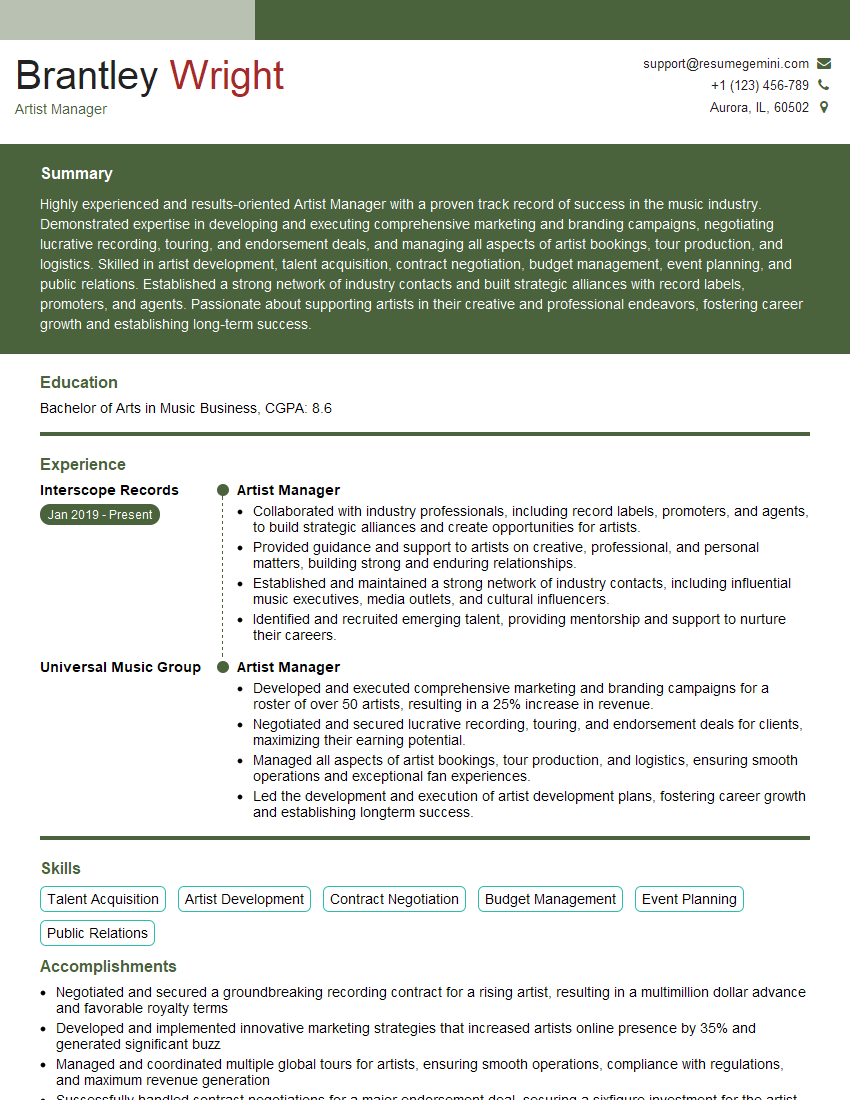
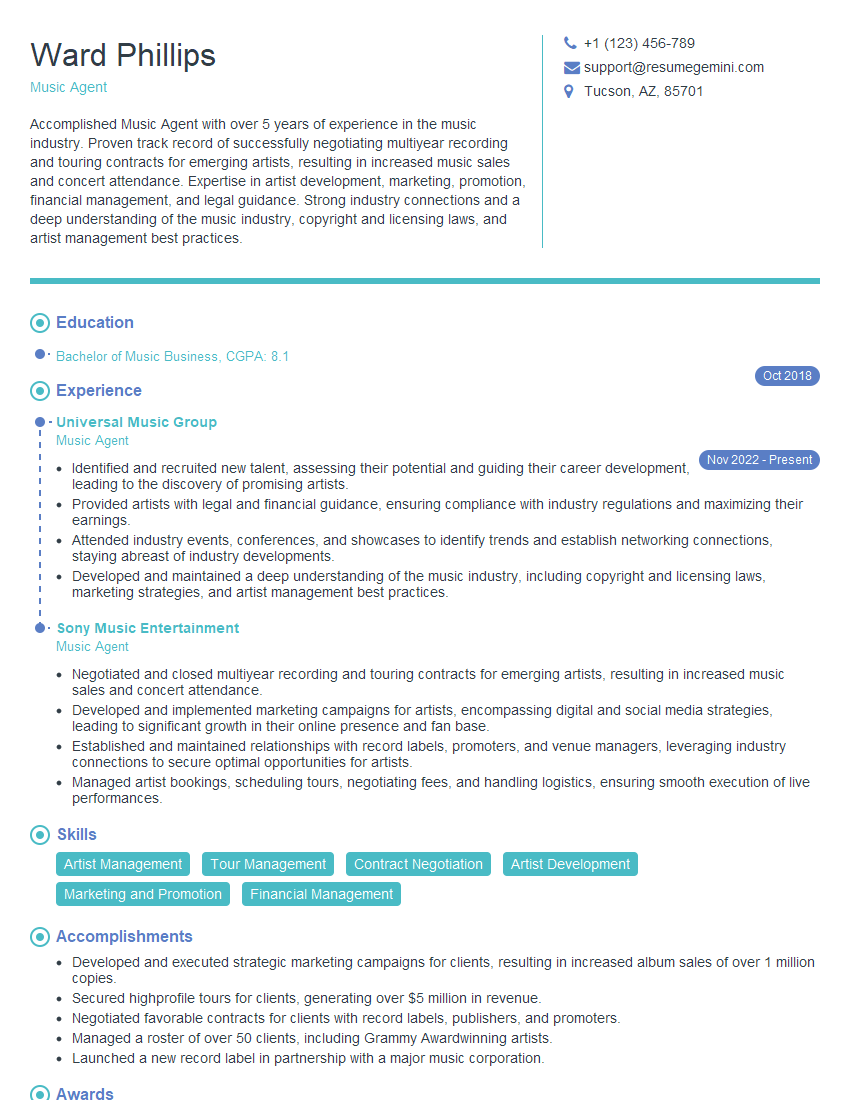
Mastering music contract negotiation is crucial for career advancement in the music industry, opening doors to higher-paying roles and greater influence. A strong resume is your first impression – make it count! Crafting an ATS-friendly resume significantly increases your chances of landing interviews. To build a professional and effective resume tailored to your skills and experience in music contract negotiation, we recommend using ResumeGemini. Examples of resumes specifically designed for Music Contract Negotiation roles are available to help guide you.
Explore more articles
Users Rating of Our Blogs
Share Your Experience
We value your feedback! Please rate our content and share your thoughts (optional).
What Readers Say About Our Blog
Very informative content, great job.
good