The thought of an interview can be nerve-wracking, but the right preparation can make all the difference. Explore this comprehensive guide to Knowledge of Die Casting Machines interview questions and gain the confidence you need to showcase your abilities and secure the role.
Questions Asked in Knowledge of Die Casting Machines Interview
Q 1. Explain the different types of die casting machines.
Die casting machines are categorized primarily by the type of metal they use and the method of metal injection. The two main categories are hot chamber and cold chamber machines.
- Hot Chamber Machines: These machines are suitable for low-melting-point metals like zinc, tin, and lead. The molten metal is held in a reservoir within the machine itself, directly connected to the injection cylinder. This makes them faster and simpler, but limits the metals that can be used due to the reservoir’s exposure to high temperatures. Imagine it like a constantly full cup, ready to pour.
- Cold Chamber Machines: These machines are used for higher-melting-point metals such as aluminum, magnesium, and copper-based alloys. The molten metal is ladled into the injection cylinder from an external source for each shot. This offers greater flexibility in material selection but requires more manual handling and is generally slower. Think of it like filling a cup from a separate container each time you need to pour.
- Other variations include machines categorized by their clamping mechanisms (hydraulic, mechanical, or toggle), their injection systems (plunger or air injection), and their overall size and capacity (ranging from small tabletop machines to massive industrial units capable of producing large parts).
The choice of machine depends heavily on the specific metal being cast, the complexity of the part, the production volume required, and the budget.
Q 2. Describe the die casting process in detail.
The die casting process is a high-pressure metal casting process where molten metal is injected into a mold cavity under high pressure. Here’s a step-by-step breakdown:
- Mold Preparation: The die, which is a precisely engineered two-part mold, is closed and locked tightly.
- Metal Melting: Molten metal is prepared in a furnace to a specific temperature depending on the alloy being used. Maintaining the correct temperature is critical for optimal casting results.
- Metal Injection: The molten metal is injected into the mold cavity at high velocity and pressure. The pressure ensures the metal completely fills the mold cavity, creating a highly detailed and accurate casting.
- Cooling and Solidification: The molten metal solidifies within the mold cavity. The mold is typically water-cooled to speed up this process.
- Ejection: Once the metal has solidified, the mold is opened, and the casting is ejected. This typically involves ejector pins within the die that push the casting out.
- Trimming and Finishing: The casting is then trimmed to remove any excess metal (flash) and may undergo further finishing operations such as machining, deburring, or surface treatment.
Imagine squeezing toothpaste from a tube — the high pressure ensures it reaches all corners of the tube (the die), similarly the high pressure in die casting fills all details of the mold.
Q 3. What are the common defects found in die castings?
Die casting, despite its precision, is prone to several defects. These can significantly impact the quality and functionality of the final product. Common defects include:
- Cold shuts: Two streams of molten metal fail to fuse completely, resulting in a weakness in the casting.
- Porosity: Small gas bubbles trapped within the casting, reducing its strength and potentially leading to leakage.
- Shrinkage: The metal contracts as it cools, leading to voids or dimensional inaccuracies in the casting.
- Hot tears: Cracks that form during solidification due to stresses from uneven cooling.
- Misruns: The molten metal fails to completely fill the mold cavity, leaving incomplete castings.
- Flash: Excess molten metal squeezed out between the mold halves.
- Surface defects: Scratches, pitting, or other imperfections on the surface of the casting.
Understanding these defects allows for better process control and quality assurance.
Q 4. How do you troubleshoot a die casting machine malfunction?
Troubleshooting a die casting machine malfunction requires a systematic approach. Here’s a general framework:
- Safety First: Always ensure the machine is completely shut down and locked out before attempting any repairs or inspections.
- Identify the Problem: Pinpoint the exact nature of the malfunction. Is it related to the injection system, clamping system, cooling system, or something else? Check error messages, listen for unusual sounds, and observe the machine’s operation closely.
- Check Hydraulics and Pneumatics: Examine fluid levels, pressure gauges, and air pressure regulators. Look for leaks in the hydraulic lines.
- Inspect the Die: Check for damage to the die, wear and tear on ejector pins, and ensure proper alignment. Contamination in the die can also cause problems.
- Examine the Mold Release Agent: Insufficient or improper mold release can lead to casting defects and machine malfunctions.
- Review Process Parameters: Verify that the injection pressure, speed, and holding time are correct. Incorrect parameters can cause many of the defects listed earlier.
- Consult Maintenance Logs: Review previous maintenance records to identify any recurring problems or patterns.
If the problem persists after these steps, contacting a qualified technician is crucial. Remember, attempting repairs without proper training can be dangerous and could further damage the machine.
Q 5. Explain the importance of die temperature control in die casting.
Die temperature control is critical for successful die casting. Maintaining the correct die temperature ensures proper metal flow, prevents sticking or seizing of the casting within the mold, and contributes to dimensional accuracy and surface finish.
Too hot: Can lead to premature wear and tear of the die, reduced casting life, and increased risk of hot tears and other casting defects.
Too cold: Can cause solidification of metal too quickly within the die, resulting in incomplete filling, cold shuts, and surface defects. It can also increase the stress on the machine’s components.
Effective temperature control involves using sophisticated systems such as circulating water cooling systems, temperature sensors, and sophisticated controllers to maintain the optimal temperature throughout the casting cycle.
Q 6. What are the safety precautions associated with operating die casting machines?
Operating die casting machines presents significant safety risks. Essential precautions include:
- Lockout/Tagout Procedures: Always follow strict lockout/tagout procedures before performing any maintenance or repair work on the machine.
- Personal Protective Equipment (PPE): Wear appropriate PPE, including safety glasses, hearing protection, heat-resistant gloves, and closed-toe shoes.
- Hot Metal Handling: Exercise extreme caution when handling molten metal. Avoid direct contact at all times. Use appropriate ladles and handling tools.
- Emergency Shut-off Procedures: Be familiar with the location and operation of all emergency shut-off switches and safety mechanisms.
- Proper Training: Only trained and authorized personnel should operate and maintain die casting machines.
- Regular Inspections: Conduct regular inspections of the machine and its safety features to ensure they are in proper working order.
Ignoring these safety precautions can result in serious injuries, including burns, hearing loss, and other physical trauma. Safety should be paramount at all times.
Q 7. How do you maintain and lubricate a die casting machine?
Regular maintenance and lubrication are essential for the longevity and efficient operation of die casting machines. This involves:
- Regular Lubrication: All moving parts, including hydraulic cylinders, pumps, and guide rails, require regular lubrication with the appropriate lubricants. This reduces friction, wear, and tear.
- Hydraulic System Maintenance: Regularly check hydraulic fluid levels, filter cleanliness, and system pressure. Flush and replace the hydraulic fluid as recommended by the manufacturer.
- Die Maintenance: Inspect dies for wear and tear, cracks, and damage after each run. Clean dies thoroughly and apply mold release agents as needed.
- Cooling System Maintenance: Regularly inspect and clean cooling lines and water tanks to ensure efficient heat removal. Check for leaks or blockages.
- Electrical System Inspection: Regularly inspect electrical wiring, controls, and safety devices. Ensure proper grounding.
- Preventive Maintenance Schedule: Develop and adhere to a regular preventive maintenance schedule that outlines the frequency of lubrication, inspections, and other maintenance tasks.
Proactive maintenance reduces downtime, extends machine life, and prevents unexpected failures, ultimately leading to cost savings and increased productivity.
Q 8. Explain the role of the shot sleeve in the die casting process.
The shot sleeve is a crucial component in die casting machines, acting as a precisely engineered cylinder responsible for metering and injecting molten metal into the die cavity. Think of it as the ‘gun barrel’ of the die casting process. It’s usually made from a high-strength, wear-resistant material like hardened steel or a specialized alloy. The sleeve’s inner surface must be exceptionally smooth to prevent metal sticking and ensure a consistent flow. Its precise dimensions are critical for accurate metal delivery. During the process, the molten metal is forced through the shot sleeve under high pressure, then quickly expelled into the die cavity to fill it completely. The design and condition of the shot sleeve directly affect the quality of the casting, influencing factors like surface finish, dimensional accuracy, and the presence of defects.
For instance, a worn or damaged shot sleeve can lead to inconsistent metal flow, resulting in short shots (incomplete filling of the die) or misaligned castings. Regular inspection and maintenance, including surface polishing and replacement when necessary, are crucial to maintain the shot sleeve’s performance and extend the machine’s lifespan.
Q 9. What are the different types of die casting alloys used?
Die casting utilizes a wide range of alloys, each selected based on the specific application requirements. The choice depends on factors such as strength, ductility, corrosion resistance, and cost. Some common types include:
- Aluminum Alloys: These are popular for their lightweight nature, high strength-to-weight ratio, and excellent castability. Common alloys include 380, 383, and 356. They’re used widely in automotive parts, electronics housings, and consumer goods.
- Zinc Alloys: Known for their superior surface finish, low melting point, and good corrosion resistance. They’re often chosen for intricate parts and decorative items. Zamak alloys are a common example.
- Magnesium Alloys: Extremely lightweight and possess high strength. These are ideal for applications where weight reduction is critical, like aerospace components and laptop casings. However, they’re more expensive and require specialized handling.
- Copper Alloys: Offer excellent strength, conductivity, and corrosion resistance. Brass and bronze alloys are employed for plumbing fittings, electrical connectors, and other high-performance parts. They’re harder to cast than aluminum or zinc.
- Tin Alloys: Used less frequently due to their high cost but are invaluable when exceptional corrosion resistance or low toxicity is needed.
Choosing the right alloy is crucial; a poor choice can lead to inferior castings that may fail in service, highlighting the need for careful materials selection during the design phase.
Q 10. How do you ensure the quality of die castings?
Ensuring the quality of die castings involves a multifaceted approach starting from the design stage and extending through the entire manufacturing process. Quality control measures include:
- Careful Die Design: Proper venting, cooling channels, and ejection systems in the die are critical to prevent defects like porosity, warping, and sticking.
- Alloy Selection & Control: Maintaining consistent alloy composition is essential for predictable casting properties. Regular checks of alloy chemistry are mandatory.
- Process Parameter Control: Precise control of temperature, injection pressure, and shot velocity is crucial for consistent casting quality. This often involves sophisticated monitoring and control systems.
- Regular Die Maintenance: Regular cleaning, polishing, and repair of the die are vital to maintain dimensional accuracy and surface finish. Dies often require scheduled preventative maintenance.
- Inspection and Testing: This includes visual inspection, dimensional measurement, and destructive/non-destructive testing (e.g., tensile testing, radiography) to detect internal defects and confirm conformance to specifications.
For example, regular monitoring of the die temperature helps prevent thermal cracking and ensures consistent metal fluidity. Similarly, maintaining consistent injection pressure ensures complete filling of the die cavity, preventing short shots.
Q 11. Describe the process of die casting mold design and maintenance.
Die casting mold design is a complex process requiring specialized CAD/CAM software and expertise. It involves creating a precise three-dimensional model of the part, considering factors such as draft angles, parting lines, core arrangements, and cooling systems. The design must ensure easy part ejection, prevent metal trapping, and minimize distortion. Once the design is finalized, the mold is usually manufactured using CNC machining, EDM (electrical discharge machining), or other advanced manufacturing processes.
Die maintenance is equally crucial. Regular cleaning, lubrication, and polishing help to prevent die wear and tear, extending its lifespan. Damaged areas often require repair using welding, grinding, or other techniques. Regular inspections are necessary to identify and address issues promptly, preventing costly downtime and quality problems. For instance, regular polishing of the die cavity surfaces maintains the surface finish of the cast parts and minimizes sticking.
Q 12. What are the advantages and disadvantages of different die casting processes?
Several die casting processes exist, each with its own advantages and disadvantages:
- High-Pressure Die Casting (HPDC): Offers high production rates, good dimensional accuracy, and excellent surface finish, but requires significant upfront investment in equipment and tooling. It’s ideal for high-volume production of complex parts.
- Low-Pressure Die Casting (LPDC): Produces castings with fewer defects and better mechanical properties compared to HPDC, but production rates are lower. It’s a good option for larger and thicker castings.
- Vacuum Die Casting: Reduces porosity and improves surface quality by removing air from the molten metal before injection. It’s often used for critical applications requiring high integrity.
The choice of process depends on factors like part complexity, required production volume, desired quality level, and budgetary constraints. For example, a company producing millions of small, intricate parts annually would likely favor HPDC, while a manufacturer of large, intricate parts with demanding quality standards might choose LPDC or vacuum die casting.
Q 13. How do you address porosity issues in die castings?
Porosity, the presence of small voids within the casting, is a common defect that can significantly compromise the part’s strength and integrity. Addressing porosity involves several strategies:
- Optimizing the Die Design: Ensuring adequate venting to allow air to escape during the filling process is crucial.
- Controlling Melt Parameters: Maintaining the correct temperature and fluidity of the molten metal minimizes gas entrapment.
- Vacuum Die Casting: Employing vacuum to remove dissolved gases before injection substantially reduces porosity.
- Degassing the Melt: Using specialized equipment to remove gases from the molten metal before injection can further minimize porosity.
- Post-Casting Heat Treatments: Certain heat treatments can help to seal some small pores, but this approach is not a cure-all.
For example, improper venting can lead to significant porosity, whereas maintaining proper melt temperature and employing vacuum die casting can dramatically reduce this defect. Identifying the root cause is key to effectively eliminating porosity.
Q 14. Explain the role of hydraulic pressure in the die casting process.
Hydraulic pressure is the driving force behind die casting. It’s responsible for injecting molten metal into the die cavity at high velocity and pressure, ensuring complete and rapid filling. The pressure needed varies depending on the alloy, part geometry, and die design. Typically, HPDC machines employ pressures ranging from 1000 to 20000 psi. The hydraulic system not only provides the injection force but also controls the clamping force that holds the die halves together during the injection process. The precise control of both injection and clamping pressures is critical to obtaining high-quality castings.
Imagine trying to fill a complex mold with water using only gravity; you’d likely get incomplete filling and air pockets. Hydraulic pressure in die casting mimics this, but with molten metal under significantly higher pressures to ensure complete and consistent filling, reducing defects like short shots.
Q 15. How do you calculate the shot weight for a given part?
Calculating shot weight in die casting is crucial for ensuring consistent part quality and minimizing material waste. It’s essentially determining the amount of molten metal needed to completely fill the die cavity and create the desired part. This calculation involves several factors.
Step 1: Determine the part volume. This can be done through various methods, including CAD software (the most accurate) or water displacement techniques for physical prototypes. Let’s say, for example, our part has a volume of 10 cubic centimeters (cc).
Step 2: Account for metal shrinkage. Molten metal contracts as it cools and solidifies. The shrinkage percentage varies depending on the metal alloy. For aluminum, a typical shrinkage is around 1.3%. This means we need to add that extra amount to our initial volume calculation.
Step 3: Consider the sprue, runners, and gates. These are the channels through which the molten metal flows into the die cavity. Their volume must be included in the total volume calculation. Let’s assume this adds another 2 cc to our total.
Step 4: Calculate the total metal volume. In our example: 10 cc (part) * 1.013 (1.3% shrinkage factor) + 2 cc (runners/sprue) = 12.13 cc.
Step 5: Convert volume to weight. We need the density of the molten metal. The density of aluminum is roughly 2.7 g/cc. Therefore, the required shot weight would be: 12.13 cc * 2.7 g/cc = 32.75 grams.
Important Note: This calculation provides a theoretical shot weight. In practice, adjustments are often needed based on empirical data from trial runs. Factors like machine parameters and die temperature significantly impact the final shot weight. Always conduct test shots and refine the calculation based on the results.
Career Expert Tips:
- Ace those interviews! Prepare effectively by reviewing the Top 50 Most Common Interview Questions on ResumeGemini.
- Navigate your job search with confidence! Explore a wide range of Career Tips on ResumeGemini. Learn about common challenges and recommendations to overcome them.
- Craft the perfect resume! Master the Art of Resume Writing with ResumeGemini’s guide. Showcase your unique qualifications and achievements effectively.
- Don’t miss out on holiday savings! Build your dream resume with ResumeGemini’s ATS optimized templates.
Q 16. What are the different types of die casting machine controls?
Die casting machines employ various control systems, ranging from simple hydraulic-based systems to sophisticated programmable logic controllers (PLCs) with integrated software. The choice depends on factors like machine size, complexity, and the required level of automation.
- Hydraulic Controls: These are commonly used in older or smaller machines. They rely on hydraulic cylinders and valves to control the various movements (injection, die clamping, ejection). They offer relatively straightforward operation but are less precise than other options.
- Electro-Hydraulic Controls: These systems combine the power of hydraulics with electronic controls for greater precision and repeatability. They often use servovalves for precise control of hydraulic pressure and flow rates.
- PLC-Based Controls: These are increasingly common in modern high-speed die casting machines. PLCs provide advanced process control, data acquisition, and monitoring capabilities. They enable closed-loop control, allowing adjustments in real-time based on sensor feedback.
- CNC (Computer Numerical Control) Integration: Advanced die casting machines can integrate with CNC systems, which allow for highly automated operation, complex die movements, and high levels of precision.
The level of control sophistication directly impacts the quality, consistency, and efficiency of the die casting process. Modern systems often incorporate data logging and analysis tools to help optimize production parameters.
Q 17. How do you optimize the die casting process for efficiency?
Optimizing the die casting process for efficiency requires a holistic approach, focusing on several key areas:
- Die Design: Efficient die design is paramount. It includes features like optimized gating and venting systems to minimize turbulence and air entrapment during the injection process. Properly designed ejection systems prevent part damage and speed up cycle times. Robust die construction improves lifespan and reduces downtime.
- Machine Parameters: Optimizing parameters like injection speed, pressure, and die temperature is critical. These parameters interact in complex ways, and finding the sweet spot requires careful experimentation and data analysis. Often, Design of Experiments (DOE) methodology is utilized.
- Material Selection: Choosing the right alloy for the part is vital. Factors like fluidity, thermal conductivity, and mechanical properties influence the casting process and final product quality.
- Process Monitoring & Control: Implementing real-time monitoring of key parameters using sensors and data acquisition systems allows for immediate adjustments and prevents defects. This includes tracking shot weight, injection pressure, and die temperature.
- Maintenance & Preventive Maintenance (PM): Regular maintenance and timely preventive maintenance are crucial for maximizing machine uptime and minimizing downtime due to unexpected failures. A robust PM program is a cornerstone of efficiency.
The goal is to achieve the highest possible production rate while maintaining consistent part quality and minimizing material waste. This often involves iterative improvements based on continuous data analysis and process refinement.
Q 18. Explain the concept of cold chamber die casting.
Cold chamber die casting involves injecting molten metal from an external source (a furnace or ladle) into the die cavity. The molten metal is not in direct contact with the injection mechanism. This method offers versatility in terms of the alloys that can be cast, as the injection mechanism is not subjected to the high temperatures of the molten metal.
Process Steps:
- Molten metal is transferred from an external source (furnace) to a shot sleeve using a ladle or other transfer method.
- The shot sleeve is moved into position, and a plunger injects the molten metal into the die cavity under high pressure.
- After solidification, the die opens, and the cast part is ejected.
Advantages of Cold Chamber Die Casting:
- Wider range of alloys can be used (including zinc, aluminum, magnesium, and copper-based alloys).
- Greater control over the casting process due to the separation of the molten metal from the injection mechanism.
- Less metal waste due to the precise control over the shot size.
Disadvantages:
- Lower production speeds compared to hot chamber die casting.
- Higher initial investment cost due to the need for an external melting and holding furnace.
Cold chamber is often preferred for higher-value parts requiring precise dimensions and complex geometries, or where a wider range of alloy options is needed.
Q 19. Explain the concept of hot chamber die casting.
Hot chamber die casting is a process where the molten metal is contained within a reservoir (gooseneck) that is directly integrated into the injection mechanism. The metal is kept molten within the machine itself, and the injection plunger dips directly into the molten metal during each casting cycle. This method is typically limited to low-melting-point alloys, mainly zinc.
Process Steps:
- Molten metal is kept molten in a reservoir (gooseneck).
- A plunger dips into the molten metal and draws a predetermined amount into the shot sleeve.
- The plunger then injects the molten metal into the die cavity.
- After solidification, the die opens, and the part is ejected.
Advantages of Hot Chamber Die Casting:
- Higher production speeds due to the continuous availability of molten metal.
- Lower capital cost compared to cold chamber machines (no separate furnace needed).
- Suitable for high-volume production runs of parts made from zinc-based alloys.
Disadvantages:
- Limited to low-melting-point alloys, primarily zinc.
- Potential for higher metal waste due to the continuous supply of metal.
- More difficult to maintain consistent alloy composition due to the continuous melting and re-use of the metal.
Hot chamber die casting is ideal for mass production runs of relatively simple parts using zinc alloys where speed and cost-effectiveness are paramount.
Q 20. What are the various types of ejection systems in die casting machines?
Ejection systems in die casting machines are crucial for safely and efficiently removing the solidified part from the die cavity. Several types exist, each suited to different part geometries and production requirements:
- Hydraulic Ejection: This is the most common type, using hydraulic cylinders to push ejector pins through the die to dislodge the part. It’s robust and versatile, capable of handling parts with complex shapes.
- Mechanical Ejection: This involves cams or levers that are mechanically linked to the die movement. It’s simple and reliable but less flexible than hydraulic ejection, better suited for simpler parts.
- Air Ejection: Compressed air is used to actuate ejector pins. It’s suitable for delicate parts where gentler ejection is required, minimizing the risk of damage.
- Combination Systems: Many machines use a combination of these methods, leveraging the strengths of each system to effectively handle diverse parts.
- Stripper Plates: These are flat plates that separate the part from the core pins and eject the part. They are especially useful for parts with undercuts or deep cavities.
The selection of the appropriate ejection system depends on the part design, the material used, and the desired production rate. Properly designed ejection systems prevent part damage, reduce cycle times, and ensure smooth production operation.
Q 21. Describe the importance of proper venting in the die casting process.
Proper venting in die casting is essential for preventing defects and ensuring the integrity of the finished part. During the injection process, trapped air in the die cavity can cause various problems, including:
- Porosity: Air bubbles become trapped in the solidifying metal, creating weak spots and reducing the strength of the part.
- Burn Marks: Trapped air can cause molten metal to splash, leaving burn marks or surface imperfections on the part.
- Incomplete Filling: Air pressure can impede the flow of molten metal, resulting in incompletely filled cavities.
Venting Strategies:
Effective venting is achieved through strategically placed vents in the die, allowing trapped air to escape easily. These vents are typically small channels machined into the die faces. The size and location of the vents are critical, and design optimization often involves using venting simulation software. Insufficient venting can lead to defects, while excessive venting may cause metal leakage.
Importance:
Proper venting ensures clean castings with consistent quality. It contributes to reduced scrap rates, improved production efficiency, and ultimately, improved product quality. Venting design is a crucial aspect of overall die design and plays a key role in successful die casting operations.
Q 22. How do you manage and reduce scrap in the die casting process?
Scrap reduction in die casting is crucial for profitability and efficiency. It involves a multi-pronged approach focusing on preventative measures and reactive solutions. Think of it like baking a cake – you wouldn’t start without the right ingredients or a properly calibrated oven, right? Similarly, die casting requires careful attention to detail throughout the entire process.
Process Optimization: This includes meticulous machine setup, precise control of casting parameters (e.g., injection pressure, die temperature, metal temperature), and regular monitoring of the process. For example, using advanced sensors to detect subtle variations in the molten metal can prevent defects before they occur.
Die Maintenance and Design: Regular die maintenance is paramount. This includes cleaning, lubrication, and timely repair of any damage. Proper die design, incorporating features like venting and ejection systems, minimizes defects from the outset. Think of it like regularly servicing your car to prevent breakdowns.
Material Control: Maintaining consistent metal quality is essential. Impurities in the molten metal can lead to defects. Regular checks and analysis of the metal composition help ensure its purity.
Operator Training: Well-trained operators are critical for consistent production. Proper training on machine operation, quality control, and troubleshooting reduces errors. Consider it like training a chef – the better the training, the better the dish.
Defect Analysis and Root Cause Correction: When scrap does occur, a thorough analysis must pinpoint the root cause. This often involves using statistical process control (SPC) and other analytical tools to identify recurring issues and implement corrective actions.
By addressing these areas, you can significantly reduce scrap generation and improve overall productivity.
Q 23. Explain the role of automation in modern die casting operations.
Automation plays a transformative role in modern die casting, improving efficiency, quality, and safety. Think of it as moving from a manual assembly line to a sophisticated robotic one. Automation encompasses several key areas:
Robotic Handling: Robots automate tasks such as die loading and unloading, part removal, and transfer to secondary operations. This increases speed, consistency, and reduces human error. For instance, a robot can consistently handle a hot die whereas a human operator would need significant safety precautions.
Automated Process Control: Automated systems monitor and adjust casting parameters in real-time, ensuring consistent quality and minimizing defects. This involves sophisticated sensors and algorithms to detect and correct anomalies.
Data Acquisition and Analysis: Automated systems collect vast amounts of data on process variables, allowing for detailed analysis and process optimization. This data can be used to identify trends and predict potential problems.
Integrated Systems: Modern die casting often integrates with other manufacturing processes, such as machining and finishing, through automated material handling and data exchange. Imagine a seamless flow of parts from die casting to machining without manual intervention.
Automation reduces labor costs, improves product quality, and enhances overall operational efficiency. It also improves workplace safety by minimizing exposure to high temperatures and hazardous materials.
Q 24. How do you perform preventative maintenance on a die casting machine?
Preventative maintenance (PM) on a die casting machine is crucial for maximizing uptime and minimizing costly repairs. Think of it as regular checkups for your car – it prevents major problems down the road. A well-structured PM program incorporates several key steps:
Regular Inspections: This involves visual inspections of all critical components, checking for wear, tear, leaks, and other signs of damage. Frequency depends on machine usage, but daily or weekly checks are common.
Lubrication: Regular lubrication of moving parts is vital to reduce friction and wear. Using the correct lubricants and adhering to lubrication schedules are key.
Hydraulic System Maintenance: Die casting machines rely heavily on hydraulic systems. Regular checks of fluid levels, cleanliness, and pressure are essential. Leaks should be addressed immediately.
Electrical System Checks: Inspecting wiring, electrical connections, and control systems is important to prevent electrical failures. Testing safety circuits is also crucial.
Die Maintenance: As mentioned before, proper die care is critical. This includes cleaning, lubrication, and timely repairs of any damage to the die itself.
Scheduled Overhauls: More extensive overhauls are planned periodically, involving component replacements, thorough cleaning, and system checks. These are often done based on machine usage or hours of operation.
Maintaining detailed records of all PM activities is essential for tracking performance and identifying potential issues.
Q 25. What are the environmental considerations associated with die casting?
Die casting has significant environmental implications, primarily related to energy consumption, emissions, and waste generation. Sustainability initiatives are increasingly important in this industry.
Energy Consumption: Die casting is energy-intensive, particularly during the melting and casting processes. Implementing energy-efficient equipment and processes is vital for reducing carbon footprint.
Emissions: The melting process generates greenhouse gas emissions, and some die casting operations may also release harmful air pollutants. Installing efficient emissions control systems and optimizing the casting process can mitigate this.
Waste Generation: Die casting generates various types of waste, including scrap metal, used oil, and cleaning solvents. Proper waste management strategies, such as recycling and responsible disposal, are crucial. This includes separating different materials for proper recycling.
Water Usage: Cooling systems in die casting operations use considerable amounts of water. Implementing water conservation measures and using closed-loop cooling systems can reduce water consumption.
Adopting sustainable practices is not only environmentally responsible but also often leads to cost savings in the long run. Companies are increasingly adopting cleaner technologies and more efficient practices.
Q 26. Describe your experience with different die casting machine brands.
Throughout my career, I’ve worked extensively with several leading die casting machine brands, including Frech, IDRA, and Italpresse. Each brand has its own strengths and weaknesses. For example, Frech machines are known for their reliability and precision, while IDRA machines are often favored for their high-speed capabilities. Italpresse is recognized for its robust construction and ability to handle large castings.
My experience spans various machine sizes and configurations, from smaller, more specialized machines to large, high-tonnage presses used for producing complex castings. This broad experience has given me a deep understanding of the nuances of each brand, allowing me to effectively troubleshoot problems and optimize processes for maximum efficiency. I can readily adapt to different machine interfaces and control systems.
Beyond the technical specifications, I also understand the importance of choosing a machine that’s well-suited to the specific casting application and production volume. The right machine will significantly improve quality, efficiency, and cost-effectiveness.
Q 27. How do you handle emergencies during die casting operations?
Emergency handling in die casting requires quick thinking and decisive action to prevent injury and damage. A well-defined emergency response plan is essential. Training is critical for all operators.
Safety Procedures: A clearly defined set of emergency procedures, including shutdown procedures and evacuation protocols, is crucial. Regular drills ensure everyone is prepared.
Rapid Response Team: Having a dedicated team trained to handle specific emergencies (e.g., hydraulic fluid leaks, electrical fires) ensures a swift and effective response.
Emergency Equipment: Having readily available fire extinguishers, first-aid kits, and other emergency equipment is vital. Regular checks ensure equipment is functional.
Communication Protocols: Clear communication channels are crucial to coordinate emergency responses effectively. This includes alarms, designated emergency contacts, and communication protocols.
Post-Incident Analysis: After any emergency, a thorough analysis is needed to identify the root cause, implement corrective actions, and prevent future occurrences.
Effective emergency response minimizes downtime, prevents accidents, and safeguards personnel. Regular review and updating of the emergency plan ensure its ongoing effectiveness.
Q 28. What software or tools are you familiar with in the context of die casting?
In the context of die casting, I’m proficient with several software and tools:
CAD/CAM Software: I’m experienced with SolidWorks, AutoCAD, and other CAD/CAM packages for designing and simulating dies.
Process Simulation Software: I use software to simulate the casting process, predicting potential defects and optimizing parameters. This allows for virtual testing before actual production.
Data Acquisition and Analysis Software: I utilize software to collect and analyze data from die casting machines, identifying trends and improving process control.
Statistical Process Control (SPC) Software: I apply SPC methods to monitor process parameters, identifying variations and implementing corrective actions to maintain consistent quality.
PLC Programming (if applicable): Depending on the machine and level of automation, I may be familiar with PLC programming for customizing machine controls.
Maintenance Management Software: I use software to manage preventative maintenance schedules and track machine performance.
Proficiency in these tools is crucial for optimizing the die casting process, ensuring high-quality castings, and efficient operations. I am constantly seeking to update my skills and knowledge in this rapidly evolving technological landscape.
Key Topics to Learn for a Knowledge of Die Casting Machines Interview
- Die Casting Processes: Understand the different types of die casting (high-pressure, low-pressure, etc.), their applications, and the advantages and disadvantages of each. Be prepared to discuss the entire process from molten metal preparation to ejection.
- Machine Components and Operation: Familiarize yourself with the key components of a die casting machine (e.g., hydraulic system, clamping unit, injection unit, ejection system) and how they interact during the casting cycle. Be able to troubleshoot common operational issues.
- Die Design and Construction: Gain a solid understanding of die design principles, including material selection, cooling systems, and ejection mechanisms. Discuss the impact of die design on casting quality and production efficiency.
- Material Properties and Selection: Know the properties of various casting alloys (aluminum, zinc, magnesium, etc.) and how to select the appropriate material for a given application. Understand the relationship between material properties and casting defects.
- Quality Control and Inspection: Become familiar with common casting defects and their causes. Understand the various quality control methods used in die casting, including visual inspection, dimensional measurement, and metallurgical analysis.
- Safety Procedures and Regulations: Demonstrate knowledge of safety protocols and regulations relevant to die casting operations, including lockout/tagout procedures and personal protective equipment (PPE).
- Maintenance and Troubleshooting: Be ready to discuss preventative maintenance procedures and common troubleshooting techniques for die casting machines. Understanding preventative maintenance is key.
- Automation and Robotics: Discuss the role of automation and robotics in modern die casting processes, including the advantages and challenges of integrating these technologies.
Next Steps
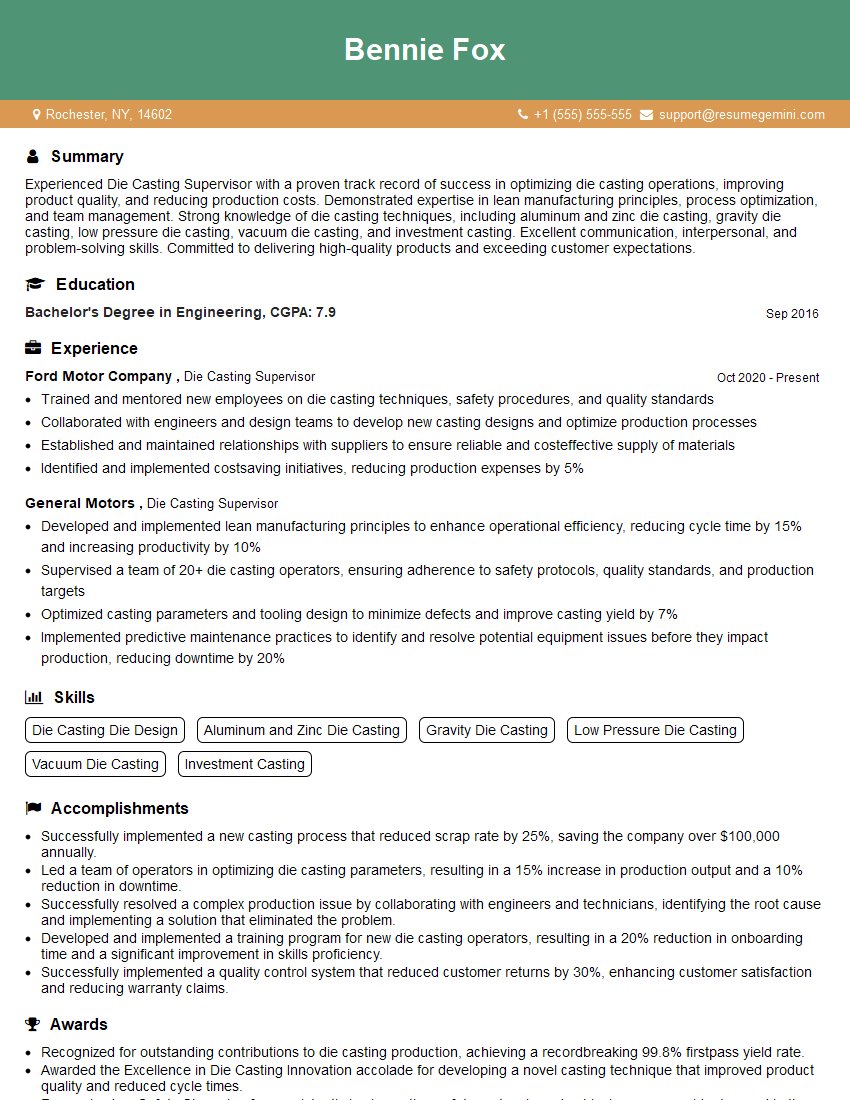
Mastering knowledge of die casting machines significantly enhances your career prospects in manufacturing and engineering. A strong understanding of these machines opens doors to specialized roles with higher earning potential and greater responsibility. To stand out, create an ATS-friendly resume that highlights your skills and experience effectively. ResumeGemini is a trusted resource to help you build a professional and impactful resume, showcasing your expertise in die casting. Examples of resumes tailored to this field are available to help you get started.
Explore more articles
Users Rating of Our Blogs
Share Your Experience
We value your feedback! Please rate our content and share your thoughts (optional).
What Readers Say About Our Blog
Very informative content, great job.
good