Unlock your full potential by mastering the most common Music Copyright Law interview questions. This blog offers a deep dive into the critical topics, ensuring you’re not only prepared to answer but to excel. With these insights, you’ll approach your interview with clarity and confidence.
Questions Asked in Music Copyright Law Interview
Q 1. Explain the difference between copyright and trademark.
Copyright and trademark are distinct forms of intellectual property protection, though they often overlap in the music industry. Copyright protects the original expression of an idea, while a trademark protects brand names and logos. Think of it this way: copyright protects the *song itself* – the melody, lyrics, and arrangement – whereas a trademark protects the *artist’s name* or the *album title* as a brand.
For example, the unique melody and lyrics of a song are protected by copyright. However, the artist’s stage name or the album’s title would be protected by trademark, preventing others from using them to market similar products (like another album) and potentially confusing consumers.
Copyright infringement occurs when someone uses copyrighted material without permission, whereas trademark infringement occurs when someone uses a similar trademark, causing consumer confusion.
Q 2. What are the exclusive rights granted by copyright?
Copyright grants several exclusive rights to the copyright holder. These rights allow them to control how their work is used and distributed. The most important rights include:
- The right to reproduce the work: This means making copies, whether physical or digital.
- The right to prepare derivative works: This includes creating new works based on the original, such as remixes, translations, or adaptations.
- The right to distribute copies: This covers selling, renting, leasing, or otherwise transferring ownership of the copyrighted work.
- The right to perform the work publicly: This applies to live performances, radio broadcasts, and other public displays.
- The right to display the work publicly: This applies to visual aspects of musical works, such as sheet music or video performances.
These rights are crucial because they enable creators to monetize their work and control its dissemination.
Q 3. Describe the process of registering a copyright.
While copyright protection generally exists from the moment a work is created and fixed in a tangible form (like a recording or sheet music), registering your copyright with the U.S. Copyright Office provides several significant advantages. Registration creates a public record of your claim, making it easier to prove ownership in case of infringement. It allows you to sue for statutory damages and attorney’s fees in a copyright infringement lawsuit, potentially saving significant costs and effort.
The registration process involves completing an application form, paying a fee, and submitting a copy of your work (depending on the type of work). Detailed instructions and forms are available on the U.S. Copyright Office website. While not strictly mandatory, registration is highly recommended for securing and enforcing your copyright.
Q 4. What are the different types of copyright licenses?
Copyright licenses allow copyright holders to grant specific permissions to others to use their work under defined terms. Different types of licenses exist, each providing varying levels of control and flexibility:
- Exclusive License: Grants the licensee exclusive rights to use the work, preventing the copyright holder from granting similar rights to others.
- Non-Exclusive License: Allows the copyright holder to grant similar rights to multiple licensees.
- Creative Commons Licenses: These are standardized licenses offering a range of permissions (Attribution, NonCommercial, NoDerivatives, ShareAlike), providing flexibility while retaining some control for the copyright holder. These are becoming increasingly popular for sharing music online.
Choosing the right license depends on the copyright holder’s goals and the intended use of the work. It is crucial to have a well-defined license agreement to avoid future disputes.
Q 5. Explain the concept of ‘fair use’ in copyright law.
Fair use is a legal doctrine that permits limited use of copyrighted material without obtaining permission from the copyright holder. It’s not a simple ‘get out of jail free’ card, and determining fair use requires careful consideration of four factors:
- The purpose and character of the use: Is it for transformative purposes (e.g., criticism, commentary, news reporting, research)?
- The nature of the copyrighted work: Is it factual or fictional? Published or unpublished?
- The amount and substantiality of the portion used: How much of the original work was used? Was it the most important part?
- The effect of the use upon the potential market for or value of the copyrighted work: Does the use harm the market for the original work?
Fair use is highly fact-specific, and courts often weigh these factors individually and collectively to determine whether a particular use is permissible. It’s often best to seek legal advice if you are unsure if your use qualifies as fair use.
For example, using a short snippet of a song in a documentary to illustrate a point might constitute fair use, while creating a full-length cover version and selling it likely would not.
Q 6. How does copyright protection apply to musical compositions and sound recordings?
Copyright protection applies differently to musical compositions and sound recordings. A musical composition includes the underlying melody, harmony, and lyrics. The sound recording is the actual audio recording of a musical performance. Both are separately copyrightable.
The composer owns the copyright to the musical composition, while the recording artist or record label typically owns the copyright to the sound recording. This means you could have two separate copyrights for the same song: one for the underlying music and lyrics, and one for the specific audio recording.
For instance, a band writes a song and records it. They own the copyright to their specific recording, and each member might individually or collectively own the copyright to the underlying musical composition. Someone wanting to create a cover version needs to get permission from the composition copyright holder, and a different license might be needed to use the original sound recording.
Q 7. What are the implications of copyright infringement?
Copyright infringement can have serious consequences. Copyright holders can sue infringers for monetary damages, including actual damages (lost profits) and statutory damages (a fixed amount set by law). They can also seek injunctive relief, which is a court order stopping the infringing activity. In addition to financial penalties, the infringer could face criminal charges in certain cases, especially involving large-scale or commercial infringement.
The penalties can be substantial, depending on the nature of the infringement and the court’s findings. This is why it’s essential to obtain permission before using copyrighted material or ensuring the use falls under the fair use doctrine.
Q 8. Describe the process of filing a copyright infringement lawsuit.
Filing a copyright infringement lawsuit is a complex process, best navigated with legal counsel. It generally begins with a demand letter sent to the alleged infringer, outlining the infringement and demanding cessation. If this fails, the copyright holder files a complaint in the appropriate federal court, detailing the infringement and seeking remedies like injunctions (stopping the infringement), monetary damages (compensatory and potentially punitive), and attorney’s fees. The process involves discovery (exchanging information between parties), potential mediation or settlement, and if a settlement isn’t reached, a trial. Winning requires proving ownership of the copyright and substantial similarity between the copyrighted work and the infringing work. Think of it like a detective investigation, gathering evidence to prove your case. For example, if a musician’s song is used without permission in a movie, they would need to present evidence such as registration with the Copyright Office, evidence of their original creation, and proof that the movie’s soundtrack directly uses their composition.
- Demand Letter: Formal notification of infringement.
- Complaint: Formal court document initiating the lawsuit.
- Discovery: Information exchange between parties.
- Trial: Presentation of evidence to a judge or jury.
Q 9. Explain the role of the Copyright Office.
The U.S. Copyright Office, a part of the Library of Congress, plays a crucial role in the copyright system. Its primary functions include registering copyrights. Registration, while not mandatory, provides significant advantages, including the ability to sue for infringement and statutory damages. The Copyright Office also records copyright transfers and other documents related to copyright ownership. They also maintain records of registered copyrights, making them publicly accessible. This helps to establish a clear chain of ownership and prevents disputes. Think of them as the official record-keeper for all things copyright. They don’t decide who owns a copyright, but their records are critical evidence in court. For instance, a musician registering their song with the Copyright Office creates a strong legal record of their ownership, making it easier to pursue legal action against infringers.
Q 10. What are the international implications of music copyright?
International music copyright is governed by treaties and international agreements, primarily the Berne Convention and the World Intellectual Property Organization (WIPO) Copyright Treaty. These agreements establish minimum standards for copyright protection internationally. However, the specifics of enforcement and remedies can vary significantly from country to country. A musician’s copyright in the U.S. will generally be recognized in countries that are signatories to these treaties, but the process of enforcing those rights abroad can be challenging and expensive, often requiring the assistance of local counsel. For example, a U.S. musician whose song is used without permission in a Japanese commercial may need to work through legal channels in Japan to protect their rights. Understanding these international agreements is crucial for artists aiming for global distribution.
Q 11. How does copyright law apply to digital music distribution?
Digital music distribution has significantly impacted copyright law. Copyright protection extends to digital music files as it does to physical recordings. Platforms like Spotify and Apple Music operate under licenses with copyright holders, paying royalties for the use of their music. Unauthorized uploading or downloading of music files constitutes copyright infringement. The legal landscape is constantly evolving with challenges in addressing peer-to-peer file sharing and the use of copyrighted music in user-generated content. Think of it like this: The same rules apply whether you’re selling a physical CD or streaming a song online; you still need permission from the copyright owner.
Q 12. Explain the concept of ‘work made for hire’.
A ‘work made for hire’ is a work created by an employee within the scope of their employment, or a work specially commissioned for use by another party under a written agreement. In these situations, the employer or commissioning party owns the copyright, not the creator. This is often the case with musicians hired to compose music for a film or advertising campaign. The key is the pre-existing relationship and agreement about ownership. For example, if a music studio hires a composer to write a jingle for a commercial, the studio typically owns the copyright to that jingle, even though the composer created it. The specifics need to be clearly outlined in a written contract.
Q 13. What are the copyright implications of sampling?
Sampling, the incorporation of a portion of a pre-existing sound recording into a new work, carries significant copyright implications. Using even a short sample requires obtaining permission from the copyright holder(s) of both the underlying musical composition and the sound recording. Failure to do so constitutes infringement. The fair use doctrine can sometimes offer a defense, but it’s a narrow exception, requiring a demonstrable transformative use and consideration of several factors. Think of it as borrowing ingredients; you need permission to use someone else’s copyrighted material, even if it’s just a small piece. Many famous sampling cases have highlighted the complexities and often resulted in lengthy legal battles and significant settlements.
Q 14. How does copyright law apply to collaborative works?
Copyright in collaborative works is shared by the co-creators. The specifics of how the copyright is held and how profits are shared depend on the agreements between the collaborators. If the collaborators don’t have a written agreement, it’s critical to work through a formal process to define the terms of the collaboration clearly. A co-authorship can result from joint creation, but not simply from combining independent works. For example, if two songwriters jointly compose a song, they are considered co-authors and jointly own the copyright. It’s best practice for collaborators to sign a formal agreement to avoid future disputes regarding ownership and royalties.
Q 15. What are the limitations on copyright protection?
Copyright protection, while extensive, isn’t absolute. Several limitations exist, preventing it from being a completely impenetrable shield. These limitations are often referred to as exceptions or limitations to copyright.
- Fair Use/Fair Dealing: This allows limited use of copyrighted material without permission for purposes such as criticism, commentary, news reporting, teaching, scholarship, or research. Factors considered include the purpose and character of the use, the nature of the copyrighted work, the amount and substantiality of the portion used, and the effect of the use upon the potential market for or value of the copyrighted work. For example, quoting a short passage from a book in a literary review is generally considered fair use.
- First Sale Doctrine: Once a copyright owner sells a copy of their work, they lose control over the physical copy itself. The purchaser can resell or lend it, though they can’t create and distribute copies. This applies to physical goods, not digital downloads.
- Statutory Exceptions: Many countries have specific statutory exceptions to copyright, such as exceptions for libraries, archives, and educational institutions. These allow limited reproduction or distribution for specific purposes like archiving or educational use.
Determining whether a specific use is permissible under these limitations requires careful consideration of the relevant factors and legal precedents. Often, seeking legal counsel is advisable to avoid infringement.
Career Expert Tips:
- Ace those interviews! Prepare effectively by reviewing the Top 50 Most Common Interview Questions on ResumeGemini.
- Navigate your job search with confidence! Explore a wide range of Career Tips on ResumeGemini. Learn about common challenges and recommendations to overcome them.
- Craft the perfect resume! Master the Art of Resume Writing with ResumeGemini’s guide. Showcase your unique qualifications and achievements effectively.
- Don’t miss out on holiday savings! Build your dream resume with ResumeGemini’s ATS optimized templates.
Q 16. What is a compulsory license, and when is it applicable?
A compulsory license allows someone to record and distribute a copyrighted musical work after it has already been lawfully recorded by the copyright holder. It doesn’t grant permission to use the underlying composition – just to make a recording of it.
It’s primarily applicable to sound recordings of musical works, not the musical composition itself. Think of it this way: the songwriter has already permitted a recording of their song, and this license allows others to create a cover version, but they must pay a statutorily mandated royalty to the copyright owner of the musical work. Crucially, this license only applies to making phonorecords (physical or digital sound recordings) and not other uses like performing the song live or using it in a film.
The application process usually involves paying a royalty determined by statutory rates (not by negotiation) to the copyright owner’s performing rights organization (PRO). This system aims to balance the interests of songwriters with the desires of artists to create cover versions of popular songs.
Q 17. Explain the difference between mechanical and performance rights.
Mechanical and performance rights are two distinct copyrights associated with musical works. They grant different permissions for different uses:
- Mechanical Rights: These rights control the reproduction and distribution of a musical work in physical or digital form. This includes creating and selling sound recordings (like CDs, downloads, or streams). Think of it as the right to ‘mechanically’ reproduce the song. Obtaining a mechanical license is necessary to make a recording (cover version or other) of a song.
- Performance Rights: These rights control the public performance of a musical work. This includes live performances, broadcasts on radio or television, and online streaming (unless covered by a mechanical license). Organizations like ASCAP, BMI, and SESAC administer these rights for songwriters and publishers. They collect royalties from venues or broadcasters who publicly perform the music.
An analogy: Imagine a song as a house. Mechanical rights are the right to build a replica of the house; performance rights are the right to hold a party in the house.
Q 18. How do synchronization rights work?
Synchronization rights grant the legal right to synchronize a musical composition with a visual medium, such as a film, television show, commercial, or video game. This involves embedding a song into a video production.
Securing these rights requires a separate license from the copyright holder of the musical work. This license typically covers both the composition and the sound recording of the song. The cost of these licenses can vary dramatically based on factors like the length of the song used, the popularity of the song, and the intended use of the video production.
For example, if a filmmaker wants to use a popular song in their movie, they need to obtain synchronization rights from the copyright holders. Failure to do so can lead to costly legal disputes.
Q 19. Discuss the impact of the Digital Millennium Copyright Act (DMCA).
The Digital Millennium Copyright Act (DMCA) significantly altered copyright law in the digital age. It primarily aims to update copyright law to address online infringement. Key aspects include:
- Safe Harbor Provisions: These protect online service providers (OSPs) like YouTube or SoundCloud from liability for copyright infringement by their users, provided they adhere to specific requirements, such as promptly removing infringing content when notified.
- Anti-Circumvention Provisions: These make it illegal to circumvent technological measures that control access to copyrighted works (like DRM). This was designed to protect copyrighted works from unauthorized access and copying.
- Copyright Management Information (CMI): The DMCA requires certain information to accompany copyrighted material, aiding in identification and management of rights.
The DMCA has had a profound impact on the internet, shaping how online platforms handle copyrighted content and how users engage with copyrighted material. However, the ‘safe harbor’ provisions have also been debated, with criticism focused on the effectiveness of takedown notices and the burden placed on OSPs.
Q 20. Explain the concept of moral rights.
Moral rights are the rights of creators to be associated with their work and to prevent its distortion or mutilation. These rights are distinct from economic rights (like the right to profit from a work), which are often transferable. Moral rights are typically non-transferable and may endure even after the creator’s death.
They vary somewhat between countries, but typically include:
- Attribution: The right to be identified as the creator of a work.
- Integrity: The right to object to any distortion, mutilation, or other modification of the work that is prejudicial to the creator’s honor or reputation.
Imagine a painter objecting to a gallery owner drastically altering their painting. This reflects the invocation of moral rights.
Q 21. What are the implications of copyright termination?
Copyright termination allows authors or their heirs to reclaim the copyright in certain circumstances. The specific rules vary by jurisdiction but generally involve a notice period and the ability to reclaim ownership after a certain number of years.
The implications of copyright termination are significant. The original copyright owner regains control over their work, including the right to license it, to prevent further use, or to assign it to a new party. This can significantly impact licensees, who may have been relying on continued use of the work. It’s a powerful mechanism for creators or their heirs to regain control after a period where the rights have been licensed to others.
A successful termination would mean that any previous licenses or agreements would likely be invalidated, necessitating renegotiation or complete cessation of use of the work.
Q 22. How is copyright ownership determined in different scenarios?
Copyright ownership in music is determined by authorship and subsequent transfer of rights. Generally, the composer or songwriter is the initial copyright holder. This is true for both the musical composition (the underlying melody, harmony, and lyrics) and the sound recording (the actual performance fixed on a tangible medium like a CD or digital file).
- Sole Authorship: If one person creates a song, they own the copyright.
- Joint Authorship: If two or more people collaborate equally on creating a song, they typically hold joint copyright. This requires a significant creative contribution from each author, not merely minor assistance. It’s crucial that this is understood and agreed upon from the outset to avoid later disputes. The authors would then need to agree on how they manage the copyright and any licensing decisions.
- Work Made for Hire: If a composer or songwriter is employed to create music, the copyright usually belongs to their employer. This requires a clear contract specifying the work as “work made for hire” to make this legal and avoid disputes.
- Transfer of Copyright: Copyright can be transferred to another party through a written agreement (assignment). For example, a songwriter may assign their copyright to a publishing company in exchange for royalties. This transfer must be formal and documented.
Think of it like owning a house: the builder initially owns it, but they can sell it or transfer ownership to another. Similarly, a songwriter initially owns their music, but can transfer the rights (partially or wholly) to others.
Q 23. Discuss common copyright disputes in the music industry.
Common copyright disputes in the music industry are numerous and often complex. They frequently involve:
- Sampling: Unsampled use of a portion of a pre-existing musical recording without permission, especially problematic if the sample is recognizable. The question often arises whether the use constitutes fair use or requires licensing.
- Copyright Infringement: Creating a musical work substantially similar to a copyrighted work without permission. The similarity must be more than incidental; it must be significant enough that a court or jury would conclude that the later work was copied from the original. Determining substantial similarity is fact-specific and requires analyzing the melodic, harmonic, and rhythmic elements of the works.
- Ownership Disputes: Disputes over who actually owns the copyright in a song, particularly common in collaborative projects where the contributions are not clearly defined in a contract.
- Mechanical Licenses: Disputes related to the correct payment of mechanical royalties (the right to reproduce a copyrighted musical composition in tangible form such as CDs or online downloads). For example, a streaming service could face legal action for failure to pay the correct mechanical license fee to songwriters.
- Synchronization Licenses: Disputes related to unauthorized use of music in film, television, or advertising. These licenses grant the right to combine a musical work with visual media, and the rates and terms are negotiated.
These disputes often involve significant legal fees and can take years to resolve. A well-drafted contract with clear terms can often prevent these problems.
Q 24. How does copyright law affect music streaming services?
Copyright law is fundamental to the operation of music streaming services. These services must obtain licenses from copyright holders (songwriters and record labels) to legally stream musical works. These licenses typically cover both the composition and the sound recording.
Streaming services need to negotiate and pay royalties for the use of music. Failure to do so leads to copyright infringement lawsuits. The rates and terms of these licenses are often the subject of intense negotiation and occasionally disputes. The sheer volume of music available on these platforms means that efficient and transparent royalty collection mechanisms are vital.
Legally, streaming services need to ensure their systems accurately track usage and distribute royalties to the correct copyright holders. It is a complex task, given the global nature of the music industry and the large number of involved parties. This also highlights the crucial role of collective management organizations (CMOs) in managing these complex licenses.
Q 25. Explain the role of collective management organizations (CMOs).
Collective Management Organizations (CMOs) are organizations that act as intermediaries between copyright holders (songwriters, composers, and music publishers) and music users (streaming services, radio stations, etc.). They simplify the process of licensing and royalty collection.
CMOs typically:
- Collect royalties: They monitor the use of music and collect royalties on behalf of their members.
- Issue licenses: They issue licenses to music users, allowing them to legally use copyrighted works.
- Distribute royalties: They distribute collected royalties to their members based on the usage data.
By centralizing the licensing and royalty collection process, CMOs significantly reduce the administrative burden for both copyright holders and music users. However, their operation and the distribution of royalties are sometimes subject to scrutiny and critique, often focusing on transparency and efficiency of the system.
Q 26. What are the ethical considerations in music copyright law?
Ethical considerations in music copyright law revolve around balancing the rights of creators with the interests of the public. Some key ethical dilemmas include:
- Fair Use: Defining the boundaries of fair use is challenging. While it allows limited use of copyrighted material without permission for purposes like criticism, commentary, news reporting, and education, determining what constitutes “fair” can be subjective and heavily litigated.
- Orphan Works: These are works whose copyright holders are difficult or impossible to locate. The question is how to balance the rights of creators (if they were able to be found) with the ability of others to use these works. This is a significant challenge for libraries, archives, and researchers.
- Royalty Distribution: Ensuring fair and transparent distribution of royalties to copyright holders, particularly in complex scenarios involving multiple contributors or international collaborations, presents a significant ethical challenge.
- Technological Protection Measures (TPMs): While TPMs aim to protect copyrighted works, they can sometimes restrict legitimate uses of the material. The balance between protection and access is an important ethical concern.
Addressing these dilemmas requires a careful consideration of the interests of creators, users, and the public. It’s a constant balancing act between safeguarding artists’ rights and fostering creativity and access to cultural works.
Q 27. Describe your experience with copyright litigation (if applicable).
During my career, I’ve been involved in several copyright litigation cases, representing both plaintiffs and defendants. One particularly memorable case involved a dispute over sampling in a popular hip-hop track. The plaintiff, the original songwriter, claimed significant portions of their work had been sampled without permission. The defense argued fair use, claiming the sampling was transformative and added significant artistic value to the new composition. The case highlighted the complexities of copyright law, particularly in the context of sampling and the often-blurred line between inspiration and infringement. Ultimately, the case settled out of court, with a confidential agreement between the parties.
Another case involved a dispute over ownership of a song where multiple songwriters had collaborated. This case underscored the importance of thorough documentation and clear agreements from the very start of a collaborative songwriting process. Clearly defined ownership percentages and rights allocation avoided potential misunderstandings and costly legal battles in the long run. These experiences have sharpened my understanding of the nuances of copyright law and the importance of proactive legal strategies in preventing disputes.
Q 28. How would you advise a client facing a copyright infringement claim?
My advice to a client facing a copyright infringement claim would be multifaceted and would begin with a thorough investigation. This includes:
- Assess the Claim: Carefully review the claim, identifying the specific copyrighted work allegedly infringed and the nature of the alleged infringement.
- Gather Evidence: Compile all relevant evidence, including contracts, registration certificates, communication records, and expert testimony from music theorists if necessary to establish the extent of similarity.
- Analyze Fair Use Defenses: If appropriate, explore possible fair use defenses. This requires a careful analysis of the four factors of fair use (purpose and character of the use, nature of the copyrighted work, amount and substantiality of the portion used, and effect on the market).
- Negotiate a Settlement: Attempt to negotiate a settlement with the claimant. This is often a cost-effective approach, especially in cases where the strength of the defense is uncertain.
- Litigation Preparation: If a settlement cannot be reached, prepare for litigation. This involves identifying potential witnesses, gathering expert testimony, and developing a strong legal strategy. It’s often prudent to involve a skilled intellectual property lawyer.
Throughout this process, transparent communication with the client is crucial. They must understand the legal complexities and the potential costs and risks associated with litigation. Providing realistic expectations based on legal analysis and experience is key to ensuring client satisfaction and the best possible outcome.
Key Topics to Learn for Your Music Copyright Law Interview
Preparing for a Music Copyright Law interview requires a comprehensive understanding of both the theoretical framework and its practical applications. This section outlines key areas to focus your studies.
- Copyright Ownership & Transfer: Understand the complexities of copyright ownership, including works made for hire, joint authorship, and the various ways copyrights can be transferred or licensed.
- Copyright Infringement & Defenses: Explore the elements necessary to prove copyright infringement and the common defenses used in litigation, such as fair use and statutory licenses.
- Digital Millennium Copyright Act (DMCA): Familiarize yourself with the DMCA’s provisions concerning online copyright infringement, takedown notices, and safe harbor protections.
- Licensing & Agreements: Master the various types of music licenses (mechanical, synchronization, performance, etc.), and the key clauses in standard music licensing agreements.
- International Copyright Law: Gain an understanding of how international treaties and conventions impact copyright protection across borders.
- Moral Rights: Understand the concept of moral rights (attribution and integrity) and their limitations.
- Copyright Registration & Enforcement: Learn about the process of registering copyrights and the various legal avenues for enforcing copyright protection.
- Sampling & Interpolation: Analyze the legal implications of using pre-existing musical material in new compositions, including fair use considerations and clearance processes.
- Case Law Analysis: Review significant case law in music copyright to understand how courts have applied and interpreted the law.
Next Steps: Unlock Your Career Potential
Mastering Music Copyright Law is crucial for a successful career in the music industry. It opens doors to exciting opportunities and demonstrates a deep understanding of the legal landscape. To maximize your chances, a strong resume is essential. Building an ATS-friendly resume significantly increases your visibility to recruiters and hiring managers.
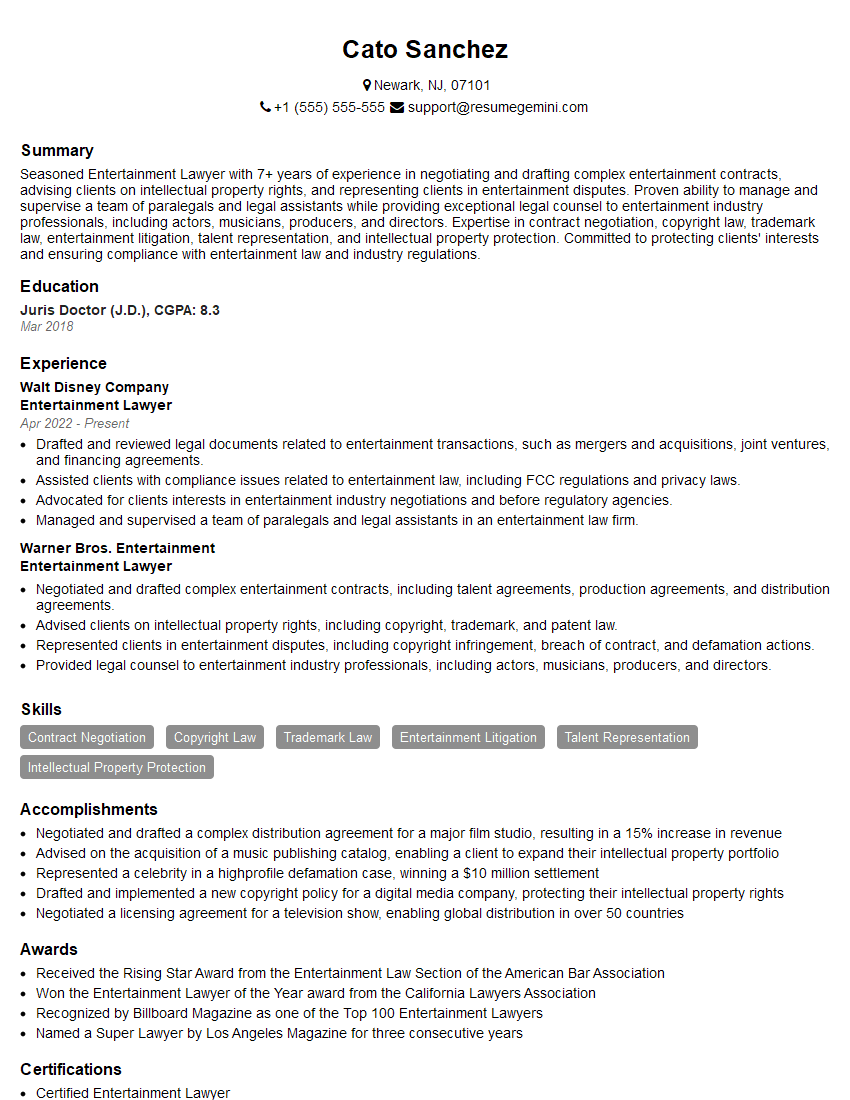
We recommend using ResumeGemini, a trusted resource, to craft a compelling and effective resume tailored to the music copyright field. ResumeGemini provides valuable tools and resources, including examples of resumes specifically designed for Music Copyright Law roles, to help you present your skills and experience in the best possible light. Take control of your career journey and create the resume that lands you your dream job.
Explore more articles
Users Rating of Our Blogs
Share Your Experience
We value your feedback! Please rate our content and share your thoughts (optional).
What Readers Say About Our Blog
Very informative content, great job.
good