Unlock your full potential by mastering the most common Music Education Curriculum Development interview questions. This blog offers a deep dive into the critical topics, ensuring you’re not only prepared to answer but to excel. With these insights, you’ll approach your interview with clarity and confidence.
Questions Asked in Music Education Curriculum Development Interview
Q 1. Describe your experience in developing a music curriculum aligned with national standards.
Developing a music curriculum aligned with national standards requires a thorough understanding of those standards and a deep knowledge of music pedagogy. My approach begins with a careful analysis of the specific standards, breaking them down into manageable learning objectives. For instance, if a standard focuses on understanding musical form, I would create learning objectives targeting specific forms like sonata form, rondo form, and binary form, each with progressively challenging activities.
Next, I design learning experiences that directly address these objectives. This involves selecting appropriate repertoire, composing engaging activities, and developing assessment strategies. For example, to teach sonata form, I might use excerpts from classical sonatas, have students analyze the structure, and then compose their own short pieces in that form. I also ensure the curriculum is sequential, building upon prior knowledge and skills. Finally, I create detailed lesson plans that outline the learning objectives, activities, assessments, and necessary resources. In my previous role at [Previous Institution Name], I successfully developed a K-12 music curriculum aligned with the National Core Arts Standards, resulting in a noticeable improvement in student performance as measured by standardized tests and teacher observations.
Q 2. How do you assess the effectiveness of a music curriculum?
Assessing the effectiveness of a music curriculum is a multifaceted process that goes beyond simply looking at test scores. A holistic approach is crucial. I use a mixed-methods approach, combining quantitative and qualitative data.
- Quantitative Data: This includes standardized test scores (if applicable), pre- and post-tests measuring specific skills, and participation rates in music programs. Analyzing trends in these data points provides a numerical understanding of student learning and program impact.
- Qualitative Data: This is equally, if not more, important. I gather data through observations of student performances and classroom activities, feedback from teachers and students (through surveys and interviews), and analysis of student work (compositions, written responses, projects). This richer data gives insight into the curriculum’s impact on students’ creativity, engagement, and overall musical understanding.
By combining these data sources, I can get a comprehensive picture of the curriculum’s effectiveness and identify areas for improvement. For example, if quantitative data shows low scores on a specific musical skill but qualitative data reveals high student engagement in related activities, it might indicate a need to adjust the teaching methods or assessment strategies rather than the curriculum content itself.
Q 3. Explain your approach to incorporating technology into music instruction.
Technology offers exciting opportunities to enhance music instruction, but it’s crucial to integrate it thoughtfully and purposefully. I believe technology should support, not replace, core musical skills. My approach focuses on using technology to:
- Enhance Accessibility: Online resources, such as virtual instruments and notation software, can broaden access to musical experiences for students with diverse backgrounds and needs.
- Increase Engagement: Interactive music software, apps, and online games can make learning fun and engaging. For instance, using GarageBand to compose music or using online platforms for collaborative projects can significantly boost student interest.
- Develop 21st-Century Skills: Technology facilitates collaboration, digital literacy, and problem-solving. Students can learn to use digital audio workstations (DAWs), create music videos, or design interactive music projects.
However, I emphasize responsible technology use. It’s essential to ensure equitable access, teach digital citizenship, and focus on using technology to achieve specific learning goals. I avoid relying solely on technology; instead, I see it as a powerful tool to augment, not replace, hands-on musical experiences.
Q 4. How do you differentiate instruction to meet the diverse learning needs of students?
Differentiation is essential in music education to cater to the diverse learning needs of students. My approach uses a multi-pronged strategy:
- Varied Learning Activities: I offer a range of activities that cater to different learning styles – kinesthetic, auditory, visual. Some students might benefit from hands-on composing using instruments, others from listening and analyzing recordings, and still others from creating visual representations of musical concepts.
- Differentiated Assessments: Assessments should be flexible. Some students might demonstrate their understanding through performance, others through written work, and others through multimedia projects. This allows students to showcase their understanding in ways that suit their strengths.
- Flexible Grouping: I use different grouping strategies—whole class, small group, individual work—depending on the activity and student needs. This allows for individualized support and collaborative learning opportunities.
- Assistive Technology: I use assistive technologies as needed to support students with disabilities. This might include specialized software, adapted instruments, or other tools to promote their participation and success.
Regular monitoring and assessment are crucial to ensure differentiation is effective. I regularly adjust my instruction based on individual student progress and needs.
Q 5. What strategies do you use to foster creativity and innovation in music education?
Fostering creativity and innovation in music education requires a classroom environment that encourages risk-taking, exploration, and experimentation. My strategies include:
- Open-ended Composing Activities: Instead of rigid assignments, I give students open-ended prompts that allow them to express themselves freely. For example, instead of requiring a piece in a specific form, I might ask students to compose a piece that evokes a particular emotion or tells a story.
- Improvisation and Exploration: Regular improvisation sessions allow students to experiment with sounds, rhythms, and melodies without fear of judgment. This helps them develop their musical voice and creative confidence.
- Technology-based Composition: Digital audio workstations (DAWs) and other music software offer powerful tools for creative exploration. Students can experiment with sounds, effects, and instruments in ways that are not possible with traditional instruments alone.
- Collaboration and Peer Feedback: Encouraging students to collaborate on projects and provide constructive feedback to each other fosters creativity and mutual learning.
Creating a supportive and non-judgmental atmosphere is critical. Students need to feel safe taking risks and making mistakes. Celebrating originality and diverse approaches to music making is key to nurturing creative talent.
Q 6. How do you design assessments that accurately measure student learning in music?
Designing assessments that accurately measure student learning in music requires a balanced approach that considers both performance and knowledge. I avoid relying solely on standardized tests, instead incorporating a variety of assessment methods:
- Performance Assessments: These are crucial in music education. I use rubrics that assess technical skills, musicality, expression, and interpretation. These assessments should be tailored to the specific learning objectives of the curriculum.
- Written Assessments: Tests and quizzes assess theoretical knowledge, such as music notation, music history, and musical concepts. These should be clear, concise, and directly aligned with the curriculum content.
- Portfolio Assessments: Students can maintain portfolios that showcase their progress over time. This includes compositions, performance recordings, written reflections, and other evidence of their learning.
- Informal Assessments: Ongoing observations of student participation, engagement, and progress during class are important for identifying individual needs and adjusting instruction.
It’s important to provide clear feedback to students on their assessments, emphasizing both strengths and areas for improvement. The goal is not simply to assign a grade but to help students learn and grow musically.
Q 7. Describe your experience in collaborating with teachers to implement a new music curriculum.
Collaborating with teachers to implement a new music curriculum is a crucial aspect of successful program development. My approach prioritizes open communication, shared ownership, and ongoing professional development.
I begin by involving teachers in the curriculum development process from the outset. This ensures the curriculum is practical, relevant, and aligns with their teaching styles and classroom realities. I hold workshops and meetings to explain the rationale behind the new curriculum, model effective teaching strategies, and address teachers’ concerns and questions.
Providing ongoing support is crucial. I offer regular coaching sessions, observation feedback, and collaborative lesson planning opportunities. I also organize professional development activities focused on the specific skills and knowledge needed to successfully implement the new curriculum. At [Previous Institution Name], I worked closely with a team of teachers to implement a new technology-integrated music curriculum. Through ongoing collaboration and professional development, we were able to achieve significant improvements in student learning outcomes and teacher satisfaction.
Q 8. How do you address challenges related to limited resources in music education?
Addressing limited resources in music education requires creativity and resourcefulness. It’s not about what you lack, but what you can leverage. My approach focuses on three key strategies:
- Community Partnerships: I actively seek collaborations with local businesses, community centers, and even parents to secure instruments, materials, or performance venues. For example, I’ve successfully partnered with a local music store to obtain discounted instruments for students and organized fundraising concerts to supplement the school budget.
- Digital Resources: The digital age offers a wealth of free and low-cost resources. I utilize online music libraries, educational apps, and free sheet music websites to supplement physical materials. This ensures students have access to a diverse range of musical styles and compositions, regardless of budget limitations. For instance, I use websites like YouTube EDU and free sheet music repositories to access a wide variety of musical pieces.
- Creative Curriculum Design: I design curricula that emphasize activities requiring minimal materials. Body percussion, vocal exercises, improvisation using found sounds, and composing with simple rhythms or melodies are all examples of engaging activities that don’t rely on expensive equipment. This approach fosters creativity and teaches fundamental musical concepts without significant resource investment.
Ultimately, resourceful curriculum design, strategic partnerships, and effective utilization of readily available digital resources allow me to provide a rich music education even in resource-constrained environments.
Q 9. What is your philosophy regarding music education?
My philosophy of music education centers on the holistic development of the individual. I believe music education is not just about learning to play an instrument or sing; it’s about fostering creativity, critical thinking, self-discipline, and collaboration. My approach emphasizes:
- Experiential Learning: Students learn best by doing. My curriculum incorporates hands-on activities, improvisation, composition, and performance opportunities to make learning active and engaging.
- Cultural Sensitivity: Music is universal, yet diverse. I believe it’s crucial to expose students to a wide range of musical styles and traditions from around the world, fostering cultural understanding and appreciation.
- Individualized Instruction: Every student learns differently. I tailor my instruction to meet the individual needs and learning styles of each student, fostering a supportive and inclusive learning environment. This includes differentiated instruction and offering alternative assessment methods.
- Lifelong Appreciation: My aim is to cultivate a lifelong love of music in my students. I emphasize the joy of making music and encourage them to explore their musical interests beyond the classroom.
In essence, I strive to create a vibrant and inclusive music program that empowers students to reach their full potential, both musically and personally.
Q 10. How do you incorporate diverse musical styles and traditions into your curriculum?
Incorporating diverse musical styles and traditions is crucial for a well-rounded music education. My approach involves several strategies:
- Global Music Exploration: I dedicate specific units of study to different musical cultures, exploring genres like African rhythms, Latin American folk music, Asian instruments, and classical music from various historical periods. This involves listening activities, discussions about cultural contexts, and potentially hands-on experiences with instruments or musical notations from diverse cultures.
- Guest Artists and Performances: I invite guest artists from diverse backgrounds to share their musical expertise and traditions with the students. This provides a direct and authentic connection to different musical styles and helps students appreciate the cultural significance of music.
- Cross-curricular Connections: I integrate music with other subjects, like history, social studies, and world languages, to provide a broader context for understanding different musical traditions. For example, studying the music of the Renaissance period alongside its historical and artistic context.
- Student-Led Exploration: I encourage students to research and present on musical styles that interest them. This empowers them to be active learners and share their discoveries with their classmates, leading to a more inclusive and dynamic curriculum.
By actively seeking and incorporating diverse musical traditions, I aim to broaden students’ musical horizons, foster cultural understanding, and equip them to engage with the richness of music from around the world.
Q 11. Explain your process for selecting appropriate music materials and resources.
Selecting appropriate music materials and resources is a crucial aspect of effective music education. My process involves a multifaceted approach:
- Alignment with Learning Objectives: I begin by defining clear learning objectives for each unit and selecting materials that directly support these objectives. This ensures that all activities and resources contribute to the overall learning goals.
- Age Appropriateness and Skill Level: I carefully consider the age and skill level of the students when choosing materials. The difficulty level of the music should be challenging yet achievable, fostering a sense of accomplishment.
- Variety and Diversity: I select a diverse range of materials, incorporating different genres, styles, and cultural traditions to cater to various interests and learning styles. This diversity is crucial to foster engagement and appreciation for different types of music.
- Accessibility and Quality: I prioritize materials that are readily accessible and of high quality, ensuring that they are accurate, engaging, and appropriate for the learning environment. This may include evaluating resources for pedagogical soundness and considering factors such as copyright permissions.
- Student Input: Whenever possible, I involve students in the selection process, allowing them to express their preferences and interests, fostering a sense of ownership and engagement in their learning.
Through this careful and thoughtful selection process, I ensure that the music materials I use are effective, engaging, and appropriate for fostering a love of music and musical learning.
Q 12. How do you ensure alignment between curriculum, instruction, and assessment?
Aligning curriculum, instruction, and assessment is vital for effective music education. This alignment ensures that what is taught is what is assessed, and the instructional methods support the learning objectives. My strategy involves:
- Backward Design: I start with clearly defined learning objectives and then design the curriculum and instructional strategies to meet those objectives. Assessment methods are then developed to measure student achievement of the stated objectives.
- Assessment for Learning: I incorporate formative assessments throughout the learning process, providing students with regular feedback and opportunities for improvement. This ensures that instruction is adjusted as needed to meet the learning needs of students.
- Summative Assessment: I use summative assessments, such as performances, written tests, and projects, to evaluate student learning at the end of a unit or course. These assessments reflect the key learning objectives of the curriculum.
- Data-Driven Instruction: I analyze assessment data to inform future instruction, ensuring that the curriculum and teaching methods are effective in helping students achieve the learning objectives. This involves identifying areas where students are struggling and adjusting instruction accordingly.
- Clear Communication: I clearly communicate the learning objectives, assessment criteria, and expectations to students and parents, fostering transparency and accountability.
By employing this comprehensive approach, I ensure that the curriculum, instruction, and assessment work together synergistically to promote effective and meaningful learning experiences.
Q 13. How do you engage parents and families in their child’s music education?
Engaging parents and families in their child’s music education is crucial for its success. I employ several strategies to foster strong home-school connections:
- Regular Communication: I maintain open communication with parents through newsletters, emails, and parent-teacher conferences, keeping them informed about their child’s progress, upcoming events, and assignments.
- Parent Workshops and Events: I organize workshops and events to educate parents about the music curriculum, teaching methods, and the benefits of music education. These events can involve demonstrating techniques, offering insights into curriculum goals, or simply showcasing student performances.
- Home-Based Activities: I provide parents with suggestions for home-based activities that reinforce what their children are learning in the classroom, such as listening to specific types of music, practicing musical skills, or engaging in family-based musical activities.
- Performance Opportunities: I encourage students to share their musical talents with their families through regular performances and recitals. This is a fantastic way to showcase progress and build student confidence, which is vital for maintaining parental engagement.
- Parent Volunteer Opportunities: I welcome parents to volunteer in the classroom to assist with various activities. This provides parents with a deeper understanding of the classroom setting and increases their connection to the program.
By actively involving parents and families, I foster a supportive learning environment that extends beyond the classroom and enhances the overall success of the music education program.
Q 14. Describe your experience in writing curriculum guides and lesson plans.
I have extensive experience in writing curriculum guides and lesson plans for various age groups and skill levels. My process is iterative and grounded in best practices in music education.
- Needs Assessment: I begin by conducting a thorough needs assessment to identify the learning needs and goals of the students. This might involve reviewing existing curricula, assessing student skill levels, and consulting with teachers and stakeholders.
- Curriculum Design: Based on the needs assessment, I develop a comprehensive curriculum guide that outlines the learning objectives, content, and assessment strategies for each unit. I organize content in a logical sequence, ensuring that concepts build upon each other.
- Lesson Plan Development: I then create detailed lesson plans for each unit, incorporating a variety of teaching methods, activities, and assessments. Each lesson plan includes specific learning objectives, materials, activities, procedures, and assessment methods. I also ensure that lessons are differentiated to meet the individual needs of students.
- Technology Integration: I incorporate technology effectively, using online resources, educational software, and multimedia presentations to enhance student engagement and learning. This often includes digital audio workstations and music notation software.
- Review and Revision: The curriculum and lesson plans are regularly reviewed and revised based on feedback from teachers, students, and administrators, ensuring that they remain relevant and effective.
Examples of curriculum guides I’ve developed include comprehensive K-12 music programs, specialized courses in jazz improvisation, and thematic units on world music. These documents typically include detailed learning objectives, scope and sequence charts, lesson plans, assessment strategies, and suggested resources. My lesson plans are similarly detailed, providing clear instructions, activities, and assessment criteria for each lesson. I’m proficient in using various curriculum development frameworks and software to produce clear, organized, and effective instructional materials.
Q 15. How do you use data to inform your curriculum development and instructional practices?
Data plays a crucial role in shaping effective music education curricula. I utilize data in two primary ways: formative and summative assessment. Formative assessment, which occurs throughout the learning process, involves collecting data on student progress through various methods such as observation, quizzes, informal performances, and student self-assessments. This data helps me identify areas where students are struggling and adjust my teaching strategies accordingly. For example, if I notice a significant number of students are having difficulty with rhythmic notation, I’ll incorporate more focused practice activities and differentiated instruction to address this specific skill gap. Summative assessment, such as end-of-unit tests or formal concerts, provides a broader picture of student learning outcomes. This data informs my curriculum revisions, highlighting areas of strength and weakness in the curriculum itself. For example, consistently low scores on a particular section of the curriculum may indicate a need for more engaging activities or a re-sequencing of learning objectives. Analyzing both formative and summative data, I can create a continuous feedback loop that enhances teaching effectiveness and student achievement.
I use various tools for data collection and analysis, including spreadsheets for tracking individual student progress, and software like learning management systems (LMS) for larger scale assessment. The key is to collect data that is meaningful, relevant, and actionable. This involves selecting assessment methods that are aligned with the learning objectives and using data to make informed decisions about curriculum and instruction.
Career Expert Tips:
- Ace those interviews! Prepare effectively by reviewing the Top 50 Most Common Interview Questions on ResumeGemini.
- Navigate your job search with confidence! Explore a wide range of Career Tips on ResumeGemini. Learn about common challenges and recommendations to overcome them.
- Craft the perfect resume! Master the Art of Resume Writing with ResumeGemini’s guide. Showcase your unique qualifications and achievements effectively.
- Don’t miss out on holiday savings! Build your dream resume with ResumeGemini’s ATS optimized templates.
Q 16. What is your familiarity with various music learning theories?
My understanding of music learning theories is extensive, encompassing various approaches. I’m particularly familiar with:
- Cognitive Load Theory: This theory emphasizes the limitations of working memory and suggests structuring learning experiences to minimize cognitive overload. In practice, this means breaking down complex musical concepts into smaller, manageable chunks and providing sufficient time for practice and consolidation.
- Sociocultural Theory: This perspective highlights the importance of social interaction and cultural context in learning. I incorporate collaborative learning activities, group performances, and exposure to diverse musical styles to foster a rich learning environment. For example, student-led workshops provide a platform for peer teaching and mentorship, promoting deeper understanding and confidence.
- Experiential Learning: This approach emphasizes learning through doing. My curriculum incorporates hands-on activities, improvisation, composition, and performance opportunities, allowing students to actively construct their musical knowledge. A real-world example includes composing original music to accompany a school play, integrating music and drama to enhance learning.
- Multiple Intelligences Theory: Recognizing that students learn in different ways, I design activities catering to a range of intelligences – musical, logical-mathematical, bodily-kinesthetic, linguistic, spatial, interpersonal, and intrapersonal. This ensures that all students have opportunities to succeed and demonstrate their musical understanding.
Understanding these theories allows me to create a flexible and engaging curriculum that caters to diverse learning styles and fosters deep musical understanding.
Q 17. How do you adapt your curriculum to meet the needs of students with disabilities?
Adapting the music curriculum to meet the diverse needs of students with disabilities is paramount. This requires a multifaceted approach, beginning with thorough understanding of each student’s Individualized Education Program (IEP) or 504 plan. This plan outlines specific learning goals and accommodations. For example, a student with visual impairments might require large-print materials or Braille music notation, while a student with auditory processing difficulties might benefit from visual aids or alternative assessment methods.
Adaptations extend beyond materials. Instructional strategies are equally crucial. A student with limited fine motor skills might use adapted instruments or assistive technology for note input. Students with ADHD might require frequent breaks, shorter learning periods, or movement-based activities to maintain focus. A key aspect of inclusive practice is providing differentiated instruction, tailoring activities to match each student’s abilities and needs. For example, allowing students to choose their preferred instrument or musical project, providing various levels of difficulty within the same assignment, or offering multiple pathways to demonstrate mastery, fostering inclusion and success.
Collaboration with special education teachers, therapists, and parents is essential in ensuring that all students can thrive in the music classroom.
Q 18. How do you address concerns about equity and access in music education?
Addressing equity and access in music education is a critical responsibility. It’s about ensuring that all students, regardless of background, have equal opportunities to engage in high-quality musical experiences. This begins with critically examining the curriculum itself, ensuring that it represents diverse musical styles and cultures. Exposure to a broad range of musical traditions and genres broadens students’ perspectives and cultivates appreciation for diverse artistic expressions. For example, including musical traditions from various cultures and time periods in the curriculum, not just Western classical music.
Addressing socioeconomic disparities requires providing access to instruments and resources for all students. This might involve establishing loaner instrument programs or partnering with community organizations to provide financial assistance. Removing financial barriers ensures that low-income students can actively participate. Creating equitable assessment practices, using diverse methods for evaluating student learning that accurately reflect students’ potential regardless of socioeconomic background, is equally crucial.
Equitable teaching practices involve adapting instruction to meet the diverse needs of all learners, recognizing that students’ learning styles and cultural backgrounds greatly influence their engagement with the material.
Q 19. Explain your process for evaluating and revising a music curriculum.
Evaluating and revising a music curriculum is an ongoing process. It begins with clearly defined learning objectives and assessment criteria. Regular formative assessment data, such as observations and informal performances, guides instructional adjustments throughout the year. At the end of each unit or term, I analyze student performance on summative assessments – formal tests, concerts, or projects – to identify areas where students excelled and areas requiring improvement.
This data informs revisions. For example, if students struggle with a particular concept, I might add more practice activities, use different teaching methods, or re-sequence the learning objectives. I also solicit feedback from students, using surveys or informal discussions to gauge their engagement and identify areas for improvement. Feedback from colleagues through peer observation and professional development opportunities also contributes to effective revisions. The process is iterative, with ongoing evaluation and revision leading to a dynamic and responsive curriculum that effectively meets the needs of all students.
Q 20. How do you stay current with best practices and research in music education?
Staying current in music education requires a multifaceted approach. I regularly attend professional development workshops and conferences, such as those offered by the National Association for Music Education (NAfME). These events offer insights into the latest research, innovative teaching strategies, and best practices. I actively participate in professional organizations, engaging with colleagues, sharing experiences, and benefiting from collective wisdom. Furthermore, I subscribe to professional journals, such as the *Journal of Research in Music Education*, and regularly read research articles and educational publications to stay informed about new trends and developments in the field. Online resources and educational communities also help to expand my understanding. This includes participation in online forums and webinars where professionals collaborate to share their expertise and discuss the latest research findings. This continuous pursuit of knowledge ensures that my curriculum is innovative, aligned with best practices, and relevant to contemporary educational needs.
Q 21. What is your experience with curriculum mapping and sequencing?
Curriculum mapping and sequencing are crucial for creating a cohesive and progressive learning experience. Curriculum mapping involves outlining the specific skills and knowledge students will acquire throughout the year, organizing them into units and lessons. This creates a visual representation of the entire curriculum, ensuring that all learning objectives are addressed. Sequencing refers to the order in which these objectives are taught, building upon prior knowledge and skills.
For example, in a beginning instrumental music class, I would sequence instruction from basic note reading and rhythm to more complex melodies and harmonies. This ensures that students build a strong foundational understanding before tackling more challenging concepts. I use various tools for curriculum mapping, including visual organizers, spreadsheets, and specialized curriculum mapping software. This ensures alignment across grade levels and subjects. This meticulous approach leads to an effective curriculum designed for optimal student learning and achievement.
Q 22. How do you utilize formative and summative assessment to inform instruction?
Formative and summative assessments are crucial for effective music instruction. Formative assessment is ongoing, providing feedback throughout the learning process to guide instruction and student progress. Summative assessment occurs at the end of a unit or term to evaluate overall learning. Think of it like this: formative assessment is like checking the seasoning while you’re cooking – you adjust along the way. Summative assessment is like tasting the finished dish – it tells you if the recipe was successful.
In my practice, I utilize a variety of formative assessment techniques including informal observation during rehearsals, listening to individual performances, analyzing student work in composition exercises, and using quick quizzes or short written reflections on musical concepts. This allows me to identify students’ strengths and weaknesses early on. I then use this information to adjust my teaching strategies, providing targeted support where needed. For example, if I notice several students struggling with rhythm, I’ll dedicate extra time to rhythm exercises and differentiated instruction.
Summative assessments might include formal performances, written exams, project-based assignments (like composing a song), or portfolio reviews. The data from these assessments helps me evaluate the effectiveness of the curriculum as a whole, identify areas for improvement in future iterations, and inform students’ grades.
Q 23. Describe your experience working with diverse stakeholders (teachers, administrators, parents).
Collaborating with diverse stakeholders is essential for building a strong music program. My experience involves working closely with teachers to ensure alignment between music instruction and overall school goals. I’ve facilitated professional development workshops for teachers, focusing on innovative teaching strategies and inclusive practices. I’ve also partnered with administrators to secure funding and resources for the music program, advocating for the importance of music education within the broader curriculum.
Building relationships with parents is crucial. I regularly communicate with parents through newsletters, email updates, concerts, and parent-teacher conferences. I aim to share the students’ progress, explain the curriculum goals, and emphasize the value of home practice. For example, I’ve developed parent workshops focusing on how to support their child’s musical development at home, covering topics like creating a practice routine and fostering a positive attitude toward music learning.
Q 24. How do you promote a positive and inclusive learning environment in music education?
Creating a positive and inclusive learning environment is paramount in music education. This starts with fostering a sense of belonging and respect for all students, regardless of their musical background, skill level, or cultural identity. I actively promote inclusive teaching practices that cater to diverse learning styles and needs. This includes incorporating a variety of musical styles and genres, using diverse musical examples representing different cultures and traditions, and employing differentiated instruction techniques.
I also prioritize creating a safe and supportive classroom environment where students feel comfortable taking risks, experimenting, and expressing themselves musically. Encouraging collaboration and peer learning is key. We regularly participate in group activities, ensemble rehearsals, and collaborative composition projects, fostering teamwork and mutual support. Celebratory events, like concerts and informal performances, are essential to building community and showcasing student achievement, boosting confidence and motivation.
Q 25. What are some common challenges in music curriculum development, and how have you addressed them?
Developing a music curriculum presents several challenges. One common issue is balancing breadth and depth of musical content. There’s a vast world of music to explore, and it’s difficult to cover everything within a limited timeframe. Another challenge is aligning the curriculum with standards and assessments while maintaining a creative and engaging approach. Resource limitations, including instruments, technology, and funding, are also significant factors.
I’ve addressed these challenges through careful curriculum design and thoughtful resource management. I utilize a thematic approach, integrating various musical elements and styles under overarching themes to create coherence and depth without overwhelming students. I also leverage free and low-cost resources like online music libraries and educational software, maximizing the impact of limited budgets. Regularly reviewing and revising the curriculum based on student feedback and assessment data is also crucial for continuous improvement.
Q 26. How do you balance the teaching of technical skills with musical expression?
Balancing technical skills with musical expression is a delicate but essential aspect of music education. Technical proficiency provides the foundation for musical expression; without a solid technical base, expressive performance is limited. However, focusing solely on technique can stifle creativity and diminish the joy of music-making.
My approach integrates technical training within the context of musical performance. Rather than isolating technical exercises, I incorporate them into meaningful musical contexts. For example, practicing scales and arpeggios might involve applying them within a piece of music students are learning. I regularly encourage students to explore musical interpretation and expression, encouraging them to develop their own unique style and voice. Assessment considers both technical accuracy and musicality, promoting a holistic understanding of musical performance.
Q 27. How familiar are you with different pedagogical approaches to music education (e.g., Kodály, Orff, Dalcroze)?
I’m familiar with several pedagogical approaches, including Kodály, Orff, and Dalcroze. The Kodály method emphasizes solfège (singing using syllables), folk music, and a gradual development of musical skills. Orff utilizes movement, instruments, and improvisation to encourage creativity and musical exploration. The Dalcroze approach integrates music with movement and improvisation, focusing on rhythmic and melodic awareness. Each method has unique strengths and can enhance music education.
I believe that a well-rounded music curriculum can benefit from integrating elements from various approaches, adapting them to fit the specific needs and learning styles of students. I might incorporate solfège from Kodály, movement activities from Orff, and improvisation exercises from Dalcroze to create a dynamic and engaging learning experience. The key is to use these methods thoughtfully and purposefully, not just for their sake, but to achieve specific pedagogical goals.
Q 28. Describe your experience in using technology to create engaging and interactive music learning experiences.
Technology plays a significant role in creating engaging and interactive music learning experiences. I utilize various software and apps for music notation, composition, audio recording, and virtual instrument simulation. Software like GarageBand or Ableton Live allows students to compose, arrange, and record their own music, enhancing creativity and technical skills. Interactive music theory websites and apps can supplement classroom instruction and provide personalized learning opportunities.
I also use technology to enhance collaboration and communication. Online platforms facilitate the sharing of musical scores, recordings, and feedback, enabling more effective communication between students and teachers, even outside of classroom settings. I’ve created online resources, including video tutorials and interactive exercises, to support student learning and enhance the learning experience beyond the classroom. This blended learning approach has proven highly effective in keeping students engaged and motivated.
Key Topics to Learn for Music Education Curriculum Development Interview
- Learning Theories and their Application in Music Education: Understanding pedagogical approaches like constructivism, cognitivism, and behaviorism, and how they inform curriculum design for diverse learners.
- Curriculum Design Models and Frameworks: Applying various models (e.g., backward design, thematic units) to create coherent and engaging music curricula. Practical application: Developing a unit plan demonstrating mastery of a chosen model.
- Assessment Strategies in Music Education: Designing formative and summative assessments that accurately measure student learning and inform instructional decisions. Examples: Rubrics, performance-based assessments, portfolio development.
- Technology Integration in Music Curriculum: Exploring the effective use of digital tools and resources (e.g., music software, online platforms) to enhance learning experiences and accessibility.
- Diversity, Equity, and Inclusion in Music Education: Creating culturally responsive curricula that celebrate diverse musical traditions and address equity concerns within the classroom.
- Curriculum Mapping and Sequencing: Developing a logical progression of learning experiences across grade levels or within a specific program. Practical application: Creating a scope and sequence document for a chosen instrument or musical concept.
- Collaboration and Communication: Understanding the importance of working effectively with colleagues, administrators, and parents to implement and evaluate the curriculum.
- Standards-Based Curriculum Development: Aligning curriculum with national or state learning standards in music education (e.g., National Core Arts Standards).
- Adaptation and Differentiation: Designing flexible curricula that cater to the diverse learning needs and styles of all students.
- Curriculum Evaluation and Revision: Utilizing data and feedback to refine and improve the effectiveness of the curriculum over time.
Next Steps
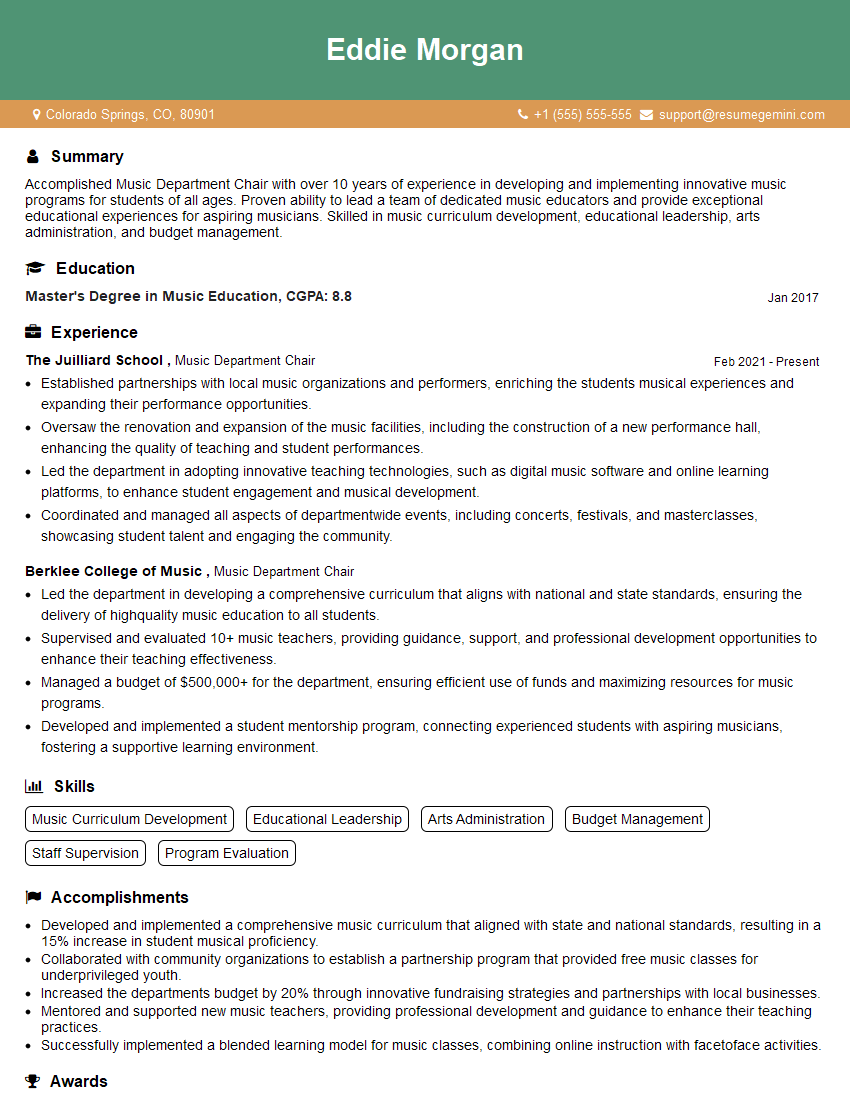
Mastering Music Education Curriculum Development is crucial for career advancement, opening doors to leadership roles and opportunities to shape the future of music education. A well-crafted resume is your key to unlocking these opportunities. Creating an ATS-friendly resume significantly increases your chances of getting noticed by recruiters. We strongly encourage you to utilize ResumeGemini, a trusted resource for building professional resumes. ResumeGemini offers examples of resumes tailored to Music Education Curriculum Development, providing a valuable template for your own unique application.
Explore more articles
Users Rating of Our Blogs
Share Your Experience
We value your feedback! Please rate our content and share your thoughts (optional).
What Readers Say About Our Blog
Very informative content, great job.
good