Feeling uncertain about what to expect in your upcoming interview? We’ve got you covered! This blog highlights the most important Music Educator interview questions and provides actionable advice to help you stand out as the ideal candidate. Let’s pave the way for your success.
Questions Asked in Music Educator Interview
Q 1. What teaching methodologies do you employ to cater to diverse learning styles in music?
Catering to diverse learning styles is paramount in music education. I employ a multifaceted approach, incorporating visual, auditory, kinesthetic, and reading/writing learning preferences.
- Visual Learners: I use color-coded charts for music theory, visual aids like diagrams for understanding musical notation, and videos demonstrating techniques.
- Auditory Learners: We engage in call-and-response activities, listening exercises to identify instruments or musical styles, and aural dictation exercises.
- Kinesthetic Learners: Hands-on activities like composing music using movement, playing instruments, and conducting exercises are integral to my teaching. I also incorporate games and interactive simulations.
- Reading/Writing Learners: We use music theory workbooks, journaling about musical experiences, composing essays analyzing musical pieces, and writing lyrics.
For example, when teaching rhythm, I’ll demonstrate the rhythms visually using clapping, then have students clap along, before finally writing the rhythms on the staff. This ensures all learning styles are addressed.
Q 2. Describe your experience in developing and implementing music curriculum.
Curriculum development is a crucial aspect of effective music teaching. My experience involves creating age-appropriate curricula that align with national standards and address diverse learning needs. I start by identifying learning objectives, selecting appropriate musical pieces and exercises, and designing engaging activities.
For instance, in a middle school curriculum I developed, I structured it around thematic units: ‘Music of the World,’ ‘Classical Composers,’ and ‘Contemporary Music.’ Each unit included listening activities, performance opportunities, composition exercises, and relevant historical and cultural context. Implementation involves ongoing assessment and adaptation to student needs and feedback. I regularly review and revise my curriculum to ensure its effectiveness and relevance.
I’ve also developed individualized learning plans for students with specific learning needs, using differentiated instruction to meet their unique strengths and challenges. For example, a student with dyslexia might benefit from using a keyboard to compose music rather than writing traditional notation.
Q 3. How do you assess student progress in music effectively?
Assessing student progress in music requires a holistic approach that goes beyond traditional grades. I utilize a variety of assessment methods to gain a comprehensive understanding of each student’s growth.
- Performance Assessments: Recitals, class performances, and solo assessments allow me to evaluate technical skills, musicality, and expression.
- Written Assessments: Tests on music theory, history, and notation provide a measure of theoretical understanding.
- Observational Assessments: I regularly observe students during rehearsals and classes to assess their participation, collaboration, and problem-solving skills.
- Self and Peer Assessments: Students participate in self-reflection and peer evaluation exercises to foster self-awareness and collaboration.
- Portfolio Assessments: Students maintain portfolios showcasing their work throughout the year, allowing for tracking of progress and self-evaluation.
For instance, instead of just grading a performance, I provide students with specific, constructive feedback on their technique, musicality, and stage presence. This feedback then guides future practice and improvement.
Q 4. Explain your approach to managing classroom behavior in a music setting.
Classroom management in a music setting requires a proactive and positive approach. I create a structured yet flexible learning environment where students feel safe, respected, and engaged.
- Establish Clear Expectations: From day one, clear rules and procedures are established and consistently enforced, emphasizing respect for oneself, peers, and instruments.
- Positive Reinforcement: I focus on positive reinforcement, praising effort and achievements, creating a positive and encouraging learning environment.
- Proactive Strategies: Engaging activities, varied teaching methods, and opportunities for student choice help prevent disruptive behavior.
- Address Behavior Respectfully: When addressing inappropriate behavior, I do so privately and respectfully, focusing on solutions rather than punishment.
- Collaboration with Parents/Guardians: Open communication with parents/guardians helps ensure consistency and support for classroom management strategies.
For example, instead of simply reprimanding a student for talking during a lesson, I’ll gently redirect them to the activity, perhaps by offering them a specific role in the lesson to keep them engaged.
Q 5. How do you incorporate technology into your music teaching?
Technology plays a vital role in enhancing my music teaching. I use various tools to improve student engagement, expand access to musical resources, and enhance learning outcomes.
- Music Software: Software like GarageBand, Sibelius, and Finale allows students to compose, arrange, and record their own music.
- Interactive Whiteboards: Interactive whiteboards enable dynamic and engaging lessons, allowing for visual demonstrations and interactive exercises.
- Online Music Resources: Websites and apps providing access to sheet music, backing tracks, and interactive music theory exercises enhance learning opportunities.
- Virtual Instruments: Virtual instruments allow students to explore a wider range of instruments and sounds than may be available physically.
- Educational Apps: Apps such as Tenuto and Teoria offer interactive lessons and games for practicing music theory and ear training.
For example, using GarageBand, students can create their own musical compositions, fostering creativity and developing technological literacy.
Q 6. Describe your experience with different musical genres and styles.
My experience encompasses a wide range of musical genres and styles. I’m proficient in classical music, jazz, world music, pop, rock, and folk music. This breadth of knowledge allows me to offer students a diverse and enriching musical experience.
My background includes formal training in classical music, but my passion extends to many other genres. I incorporate this diverse repertoire into my teaching, ensuring students are exposed to a rich tapestry of musical styles. For instance, we might analyze the structure of a Bach fugue one day, and explore the improvisation techniques of a jazz musician the next.
This broad musical understanding also helps me connect with students from various backgrounds and preferences, creating a more inclusive and engaging learning environment.
Q 7. How do you foster a positive and inclusive learning environment in your music class?
Creating a positive and inclusive learning environment is a top priority. I strive to foster a classroom where every student feels valued, respected, and empowered to participate fully.
- Respectful Communication: I foster open communication and encourage students to express their thoughts and ideas respectfully.
- Collaborative Learning: Group activities and ensemble work promote teamwork, collaboration, and a sense of shared accomplishment.
- Celebrating Diversity: We explore diverse musical traditions and styles, celebrating the richness and variety of musical cultures.
- Addressing Inequality: I am proactive in addressing any instances of bias or discrimination, creating a safe space for all students.
- Differentiated Instruction: I adapt my teaching to meet the individual needs and learning styles of all students.
For example, I regularly incorporate music from various cultures into our curriculum and encourage students to share their own musical backgrounds and experiences.
Q 8. How do you differentiate instruction to meet the needs of students with varying musical abilities?
Differentiated instruction in music is crucial for creating a learning environment where every student, regardless of their skill level, can thrive. It’s not about treating everyone the same; it’s about recognizing individual needs and adjusting teaching methods accordingly. This involves a multifaceted approach.
- Assessing Skill Levels: I begin by administering diagnostic assessments, including listening tests, performance evaluations, and written exercises, to gauge each student’s strengths and weaknesses in areas like rhythm, melody, harmony, and music theory.
- Grouping Strategies: Based on the assessments, I might use flexible grouping strategies, such as homogeneous grouping (students with similar skills working together) for focused skill-building, or heterogeneous grouping (students with diverse skills collaborating) to foster peer learning and collaboration. Sometimes, I’ll even use individual instruction tailored to specific challenges.
- Tiered Assignments: I design tiered assignments to cater to different skill levels. For example, in a composition activity, a beginner might compose a simple melody using a limited range of notes, while an advanced student could compose a more complex piece incorporating various musical elements.
- Adaptive Teaching Methods: I adjust my teaching methods based on student progress. For slower learners, I might provide more explicit instructions, additional practice, or use simpler examples. For advanced learners, I might introduce more challenging concepts or encourage independent exploration.
- Differentiated Assessment: Assessments are also differentiated. This means that assessment methods might vary based on the individual’s level. For example, a basic assessment might involve simple melodic dictation, while advanced students might be asked to analyze a musical score for form and harmony.
For instance, in a class learning about rhythm, I might provide basic rhythm patterns for beginners, more complex syncopated rhythms for intermediate students, and challenging polyrhythmic exercises for advanced students. This ensures everyone is challenged appropriately and feels a sense of accomplishment.
Q 9. How do you collaborate with parents/guardians to support student learning in music?
Collaboration with parents/guardians is essential for student success in music. Open communication and shared goals are key. I utilize several strategies to foster this collaboration.
- Regular Communication: I establish regular communication channels, such as email, newsletters, and parent-teacher conferences, to keep parents informed about their child’s progress, upcoming performances, and assignments.
- Performance Feedback: After concerts or recitals, I provide detailed feedback to both students and parents on the student’s strengths and areas for improvement, highlighting efforts and progress.
- Practice Strategies: I provide parents with practical tips on supporting their child’s home practice, suggesting effective practice strategies and resources. This often involves explaining concepts in a way that parents can understand and support.
- Parent Workshops: I organize workshops or informal sessions to educate parents about music theory, performance techniques, or the curriculum, fostering a deeper understanding of what their children are learning and how to best support them at home.
- Technology Integration: Utilizing online platforms and learning management systems allows for easy sharing of resources, assignments, and progress reports, keeping communication efficient and easily accessible.
For example, I recently worked with a parent whose child was struggling with rhythm. Through regular communication, we identified the issue, and I provided the parent with specific practice exercises that aligned with what we were doing in class. This collaborative approach resulted in significant improvement in the child’s rhythmic abilities.
Q 10. What strategies do you use to motivate students and encourage their musical development?
Motivation and encouragement are vital for fostering musical development. I employ a variety of strategies to keep students engaged and enthusiastic about music.
- Positive Reinforcement: I emphasize positive reinforcement, focusing on praising effort, improvement, and accomplishments, rather than solely focusing on perfection. I celebrate small wins.
- Student Choice: When possible, I incorporate student choice into lessons and activities, allowing students to select pieces they want to learn or participate in projects that align with their interests. This ownership increases engagement.
- Performance Opportunities: I provide ample opportunities for students to perform, both in class and in larger settings such as school concerts or community events. This gives students a sense of accomplishment and boosts their confidence.
- Gamification: I sometimes incorporate game-like elements into my lessons, such as points, rewards, and friendly competition, to make learning more fun and engaging. I do this in a way that maintains a positive and supportive atmosphere.
- Real-World Connections: I connect musical concepts to students’ lives and interests, showing them the relevance of music beyond the classroom. This could involve linking musical styles to their favourite films or incorporating contemporary music into activities.
For instance, after a successful performance, I’ll often take some time to appreciate students’ dedication and hard work, reinforcing their positive contributions to the ensemble and celebrating the collective achievement.
Q 11. Describe your experience in conducting or leading ensembles.
I have extensive experience conducting and leading ensembles, ranging from elementary school choirs to high school bands and orchestras. My approach emphasizes collaboration, clear communication, and a focus on musicality.
- Rehearsal Techniques: I employ various rehearsal techniques, including sectional rehearsals, whole group rehearsals, and individual coaching, to address the specific needs of each section and individual student. Effective use of time is key.
- Musical Interpretation: I emphasize musical interpretation, encouraging students to understand the composer’s intent and express their own creativity within the framework of the piece. This is where artistry is developed.
- Performance Preparation: My approach to performance preparation is comprehensive, covering aspects such as stage presence, articulation, dynamics, and balance, ensuring that performances are polished and engaging.
- Ensemble Building: I foster a strong sense of ensemble unity, promoting teamwork, mutual support, and a positive collaborative environment. This collaborative spirit improves cohesion in the music.
- Adaptability: I can adapt my conducting and leadership style to the specific needs and personalities of different ensembles, understanding that every group has its own dynamics.
One memorable experience involved leading a high school orchestra through a challenging piece of romantic-era music. Through patient instruction, clear communication, and building a supportive environment, we achieved a truly moving performance, demonstrating the power of collective effort and dedication.
Q 12. How do you handle challenging student behaviors related to music performance or practice?
Addressing challenging student behaviors requires a proactive and consistent approach that prioritizes understanding the root cause of the behavior and finding solutions that promote positive learning.
- Identifying the Root Cause: I begin by trying to understand the underlying reason for the behavior. Is it frustration with a particular skill? Lack of engagement? Social dynamics within the class? A more serious underlying issue outside of the classroom?
- Positive Communication: I establish clear expectations and communicate them clearly and consistently. This includes classroom rules, practice expectations, and performance standards. I use positive language and focus on what I want the student to do, not on what they shouldn’t do.
- Individualized Support: I work to develop a supportive relationship with the student, showing empathy and understanding. I try to find ways to tailor my instruction to their specific needs, making the experience more engaging and less frustrating.
- Collaboration: I work closely with parents, administrators, and other school professionals to address challenging behaviors. A multi-pronged approach is often necessary.
- Consequences & Rewards: I establish clear consequences for inappropriate behavior and ensure that these consequences are fair and consistently applied. I also incorporate a system of positive reinforcement, rewarding positive behaviors and effort.
For example, if a student is consistently disruptive during rehearsal, I might work with them individually to find ways to better manage their energy or frustration, perhaps by giving them more challenging tasks they can engage in, or giving them a different role in the ensemble that allows them to still contribute positively without interrupting the flow.
Q 13. What are your strategies for assessing student performance in music?
Assessing student performance in music requires a holistic approach that considers multiple aspects of musical development, rather than solely relying on a single metric.
- Performance Assessments: Formal and informal performance assessments are crucial, allowing students to demonstrate their skills in a variety of contexts. This could include solo performances, ensemble participation, improvisation exercises, or sight-reading tests.
- Written Assessments: Written assessments, such as music theory tests or composition assignments, can provide a different perspective on a student’s understanding of musical concepts and their ability to apply them practically.
- Practical Application: I observe students’ participation in class activities, their engagement in group projects, and their ability to apply musical concepts to new situations. This involves both observational and informal evaluation techniques.
- Self & Peer Assessment: Incorporating self and peer assessment can teach students to reflect critically on their performance and provide valuable feedback to their peers. This promotes self-awareness and musical understanding from multiple perspectives.
- Rubrics: Using rubrics for scoring provides a clear set of criteria and standards, promoting transparency and fairness. This ensures consistency and helps students understand what is expected of them.
For example, when assessing a student’s performance on a solo piece, I would use a rubric that considers technical proficiency, musical interpretation, expression, and stage presence. This provides a well-rounded evaluation rather than simply a numerical grade.
Q 14. How do you build relationships with students to create a supportive learning environment?
Building positive relationships with students is fundamental to creating a supportive and effective learning environment in music. I strive to establish a classroom atmosphere based on trust, respect, and mutual understanding.
- Getting to Know Students: I take time to get to know my students individually, understanding their interests, aspirations, and challenges. This can involve informal conversations, sharing personal anecdotes when appropriate, or engaging in activities that allow students to express themselves.
- Creating a Safe Space: I strive to create a safe and inclusive classroom where students feel comfortable taking risks, making mistakes, and expressing themselves creatively. I address any instances of negativity or exclusion immediately and firmly.
- Active Listening: I practice active listening, paying attention to both verbal and nonverbal cues from my students. This helps me understand their needs and concerns, and tailor my instruction accordingly.
- Showing Empathy & Understanding: I demonstrate empathy and understanding for students’ struggles and challenges, both inside and outside of the music classroom. I show support for students beyond just their musical development.
- Building a Community: I foster a sense of community within the classroom, encouraging collaboration, mutual support, and a sense of belonging. This could involve group projects, team-building activities, or simply fostering a supportive classroom culture.
I recall a student who was initially shy and hesitant to participate. By taking the time to get to know them, providing individualized support, and creating a welcoming classroom environment, I was able to build their confidence and help them flourish musically.
Q 15. Describe your experience working with different instruments or vocal techniques.
My experience spans a wide range of instruments and vocal techniques. I’ve worked extensively with woodwinds, specifically the flute and clarinet, guiding students from beginners to advanced levels. This includes teaching proper breathing techniques, finger placement, and articulation. I’ve also had significant experience with string instruments, particularly the violin and cello, focusing on bow control, intonation, and vibrato. In the vocal realm, I’ve taught a variety of techniques, including breath support, vocal placement, and stylistic approaches for different genres, from classical to contemporary.
For example, with beginning flute students, I start with simple breathing exercises and finger exercises, gradually introducing scales and melodies. With advanced students, we delve into complex etudes and explore interpretive nuances. Similarly, in vocal instruction, I adapt my approach depending on the student’s voice type and musical goals. A student aiming for operatic singing will require different training than a student pursuing pop music.
Career Expert Tips:
- Ace those interviews! Prepare effectively by reviewing the Top 50 Most Common Interview Questions on ResumeGemini.
- Navigate your job search with confidence! Explore a wide range of Career Tips on ResumeGemini. Learn about common challenges and recommendations to overcome them.
- Craft the perfect resume! Master the Art of Resume Writing with ResumeGemini’s guide. Showcase your unique qualifications and achievements effectively.
- Don’t miss out on holiday savings! Build your dream resume with ResumeGemini’s ATS optimized templates.
Q 16. How do you adapt your teaching methods to meet the specific needs of different age groups?
Adapting teaching methods to different age groups is crucial for effective music education. Younger children (elementary school) thrive on hands-on activities, games, and movement-based learning. For instance, I use rhythm games and colorful flashcards to teach basic musical concepts. Their lessons are shorter, more frequent, and focus on building foundational skills through play.
Middle school students begin to develop more abstract thinking skills, so I incorporate more structured lessons with a balance of theory and practice. Group projects and collaborative performances become important tools to foster teamwork and engagement. I might introduce music history in a more engaging way, perhaps through interactive timelines or multimedia presentations.
High school students are capable of more independent learning and critical thinking. I encourage them to explore different musical styles, compose their own music, and delve deeper into music theory. I often incorporate individualized learning plans based on their strengths and interests, preparing them for potential college applications or music careers. I might introduce them to advanced composition software or encourage them to explore jazz improvisation techniques.
Q 17. How familiar are you with different music notation systems?
I am proficient in various music notation systems, including standard Western notation (staff notation), tablature (used for fretted instruments like guitar and ukulele), and chord charts. I understand the nuances of each system and can effectively teach students to read, write, and interpret music across these different formats. I can also explain the historical context of each system and its specific applications.
For example, when teaching guitar students, I utilize tablature to visually represent finger placement on the fretboard, complementing standard notation to improve their understanding of music theory. With vocal students, we primarily use standard notation; however, I sometimes use simplified chord charts for accompaniment or songwriting exercises. My expertise ensures that I can adapt my teaching to meet the individual needs and instrumental preferences of my students.
Q 18. What is your approach to teaching music theory and its practical application?
My approach to teaching music theory is highly practical, emphasizing its application to actual musical performance and composition. I avoid rote memorization and instead focus on understanding the underlying principles. For example, when teaching scales, I show how they are used in different musical contexts and relate them to chord progressions. Similarly, when teaching harmony, I encourage students to compose simple melodies and harmonies using their knowledge of chords and intervals.
I believe music theory should be a tool for musical expression, not just an academic subject. I use a variety of teaching methods, including interactive exercises, group work, and individual projects. Students might analyze existing music pieces, compose their own songs, or arrange existing material. This approach ensures that they grasp the theory’s practical implications and can confidently apply it in their musical practice.
Q 19. Describe your experience in organizing and leading music events or concerts.
I have extensive experience in organizing and leading music events and concerts. This includes everything from planning the repertoire and selecting performers to managing logistics, such as venue booking, sound reinforcement, and program design. I’ve worked with ensembles of varying sizes, from small chamber groups to large choral and instrumental groups.
For example, in one instance, I organized a student-led concert showcasing original compositions. This involved collaborating with students on all aspects of the concert, from selecting the pieces to designing the program and marketing the event. I provided guidance and support while fostering their creativity and independence. The successful completion of this project demonstrates my ability to lead collaborative efforts and deliver high-quality musical performances.
Q 20. How do you use formative and summative assessments to track student progress?
Formative and summative assessments are integral parts of my teaching process. Formative assessments, like regular quizzes, in-class exercises, and informal feedback sessions, help me monitor student progress continuously and adjust my teaching accordingly. This allows me to identify areas where students might be struggling and provide targeted support before problems become insurmountable. For example, regular sight-reading exercises help me assess students’ ability to read and interpret music quickly.
Summative assessments, such as formal exams, performances, and projects, provide a comprehensive overview of student learning at the end of a unit or semester. This helps me evaluate student achievement against established learning objectives and identify areas for improvement in my teaching. For example, a final performance of a challenging piece will evaluate the students’ technical proficiency, musical expression, and overall performance skills.
Q 21. What professional development activities have you undertaken to enhance your music teaching skills?
I am committed to ongoing professional development to enhance my music teaching skills. I regularly attend workshops and conferences focused on innovative teaching methodologies and the latest pedagogical research. I’ve participated in workshops on inclusive music education, incorporating technology in music classrooms, and teaching diverse musical styles. I also actively seek opportunities to collaborate with other music educators, sharing best practices and engaging in peer review.
For instance, I recently completed a course on using digital audio workstations (DAWs) to enhance my teaching, allowing me to incorporate technology and composition into my curriculum in a more effective and engaging manner. This continuous professional development ensures that I remain at the forefront of music education best practices and effectively prepare my students for the evolving landscape of music.
Q 22. How do you integrate music with other subjects or disciplines in the curriculum?
Integrating music with other subjects strengthens learning by making connections explicit. For instance, in a history class studying ancient civilizations, we might explore the music of that era, analyzing its instruments, rhythms, and social context. This creates a multi-sensory learning experience, enhancing comprehension and retention. In a math class, students can explore musical concepts like rhythm and meter using fractions and ratios. A language arts class could incorporate songwriting, analyzing song lyrics for poetic devices, or creating scripts for musical theater. The possibilities are endless; the key is to find meaningful overlaps that resonate with the curriculum and student interests.
- Example: In a science class studying sound waves, we conduct experiments to understand how different frequencies and amplitudes affect musical tones, creating a direct link between scientific principles and musical practice.
- Example: A project based on a specific historical period could involve composing a piece of music reflecting the era’s style and social issues, thus bridging history, music theory, and composition.
Q 23. What is your approach to providing feedback to students on their musical performance?
Providing effective feedback requires a balanced approach that combines constructive criticism with encouragement. I focus on both the technical aspects of performance (intonation, rhythm, phrasing) and the expressive elements (emotion, dynamics, communication). Instead of solely focusing on mistakes, I highlight strengths and areas of improvement. This positive reinforcement is crucial to build confidence and motivate students to strive for excellence. My feedback is always specific and actionable, offering concrete suggestions for improvement. I encourage students to actively participate in the feedback process, asking them for self-reflection on their performance and what they might work on.
- Example: Instead of saying ‘Your rhythm was off,’ I might say, ‘In the second measure, let’s focus on counting the eighth notes precisely to create a steadier rhythm. Let’s try it again together.’
- Example: I might use recording technology to allow students to listen to their performance and identify areas they can improve independently.
Q 24. How do you encourage creativity and self-expression in your students?
Creativity and self-expression are fostered through a combination of structured activities and open-ended opportunities. We explore different musical styles, experiment with improvisation, and engage in collaborative projects. I provide a safe and supportive environment where students feel comfortable taking risks and expressing their unique perspectives, even if they make mistakes. Students may choose their own instruments, compose their own music, or arrange existing pieces. Offering choices allows for personalized engagement.
- Example: Improvisation exercises where students create melodies over chord progressions encourage spontaneous musical ideas.
- Example: Collaborative songwriting projects empower students to work together, contributing their individual ideas to a shared creative endeavor.
- Example: Providing open-ended composition assignments, such as ‘compose a piece of music that expresses a feeling’ allows for exploration of diverse emotional expression.
Q 25. Describe your experience using different assessment tools in music education.
Assessment in music education is multifaceted, encompassing performance, written tests, and projects. I utilize a variety of tools: formal performance assessments (recitals, concerts), informal assessments (classroom observations, peer feedback), written tests (theory exams, music history quizzes), practical assignments (composing, arranging, analyzing music), portfolios (collecting students’ work to demonstrate their growth), and rubrics (providing clear criteria for grading). Each method serves a distinct purpose, contributing to a comprehensive evaluation of student progress.
- Example: Performance rubrics outline specific criteria for judging technical skill, musicality, and expressiveness.
- Example: Portfolios showcase a student’s journey throughout the year, highlighting growth and development.
- Example: Written assessments gauge theoretical knowledge and understanding of musical concepts.
Q 26. How do you manage classroom resources and materials effectively in a music class?
Effective resource management is essential in a music classroom. I maintain an organized system for storing instruments, sheet music, and other materials. Regular inventory checks help prevent loss or damage. I involve students in the upkeep of the classroom and instruments, instilling a sense of responsibility. I also explore cost-effective solutions, such as creating DIY instruments or utilizing free online resources. Prioritizing resources and selecting high-quality, durable materials contributes to efficient resource management.
- Example: Creating a labeled storage system for instruments and sheet music makes them easily accessible and reduces clutter.
- Example: Regular cleaning and maintenance of instruments extends their lifespan.
- Example: Collaborating with parents or the school community for donations of materials can reduce costs.
Q 27. Describe your experience working with students with special educational needs in music.
Working with students with special educational needs requires individualized attention and adaptation. I adapt my teaching methods to accommodate diverse learning styles and abilities. For students with physical limitations, I might modify instrument techniques or provide alternative ways to participate in musical activities. For students with learning disabilities, I may break down complex tasks into smaller, more manageable steps. Collaboration with special education professionals and parents is crucial. The focus is on creating a supportive and inclusive learning environment where all students can feel successful and engaged.
- Example: Using assistive technology to help students with visual impairments learn music notation.
- Example: Adapting rhythmic exercises to cater to students with attention deficit disorders.
- Example: Offering alternative assessment methods for students with physical limitations.
Q 28. What are your expectations of a supportive school administration in terms of music education?
A supportive school administration plays a critical role in fostering a thriving music program. My expectations include adequate funding for instruments, materials, and technology; sufficient time allocated for music instruction; access to appropriate classroom space; opportunities for professional development; and recognition of the importance of music education within the broader school curriculum. Administrative support translates directly into the quality of instruction and the students’ overall musical experience.
- Example: Securing funding for new instruments or software upgrades ensures that students have access to the best possible resources.
- Example: Providing professional development opportunities helps me stay up-to-date with the latest teaching methods and best practices.
- Example: Allocating adequate time for rehearsals and performances demonstrates a commitment to musical excellence.
Key Topics to Learn for Music Educator Interview
- Curriculum Development & Implementation: Designing engaging and effective lesson plans tailored to diverse learning styles and abilities. Consider practical examples from your experience.
- Classroom Management & Student Engagement: Strategies for creating a positive and productive learning environment, fostering student participation, and addressing behavioral challenges. Think about specific techniques you’ve used successfully.
- Assessment & Evaluation: Developing and utilizing various assessment methods (formative and summative) to accurately gauge student progress and inform instruction. Be prepared to discuss your preferred assessment strategies.
- Music Theory & History: Demonstrate a strong understanding of fundamental music theory concepts and historical periods relevant to your teaching area. Be ready to discuss how you integrate this knowledge into your teaching.
- Instrumental/Vocal Techniques: Showcase your proficiency in your specific instrument(s) or vocal techniques, emphasizing your ability to effectively teach these skills to students of varying levels.
- Technology Integration: Discuss your experience using technology to enhance music education, such as music software, online resources, and digital audio workstations (DAWs).
- Collaboration & Communication: Highlight your ability to work effectively with colleagues, parents, and administrators. Be ready to discuss examples of successful collaborations.
- Differentiated Instruction: Explain your approaches to adapting instruction to meet the needs of students with diverse learning styles and abilities, including students with IEPs or 504 plans.
- Professional Development & Growth: Demonstrate a commitment to ongoing learning and professional development in music education. Share examples of workshops, conferences, or self-directed learning you’ve engaged in.
Next Steps
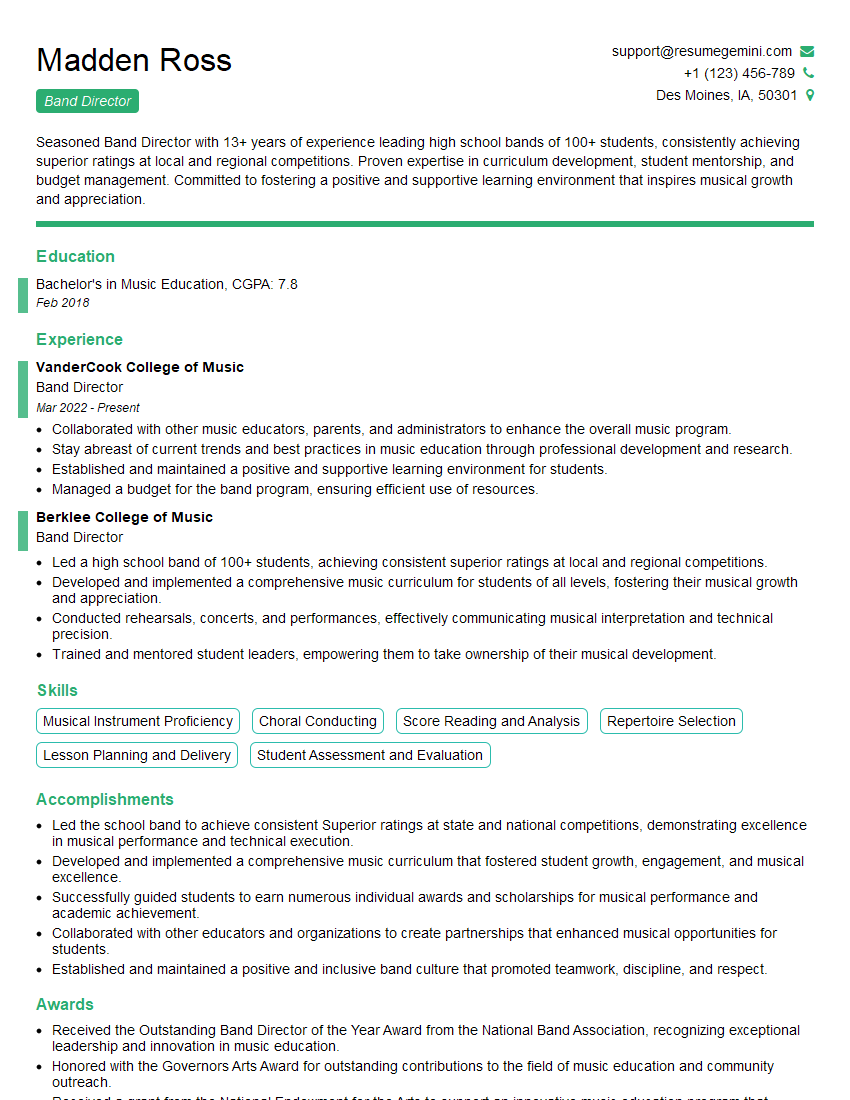
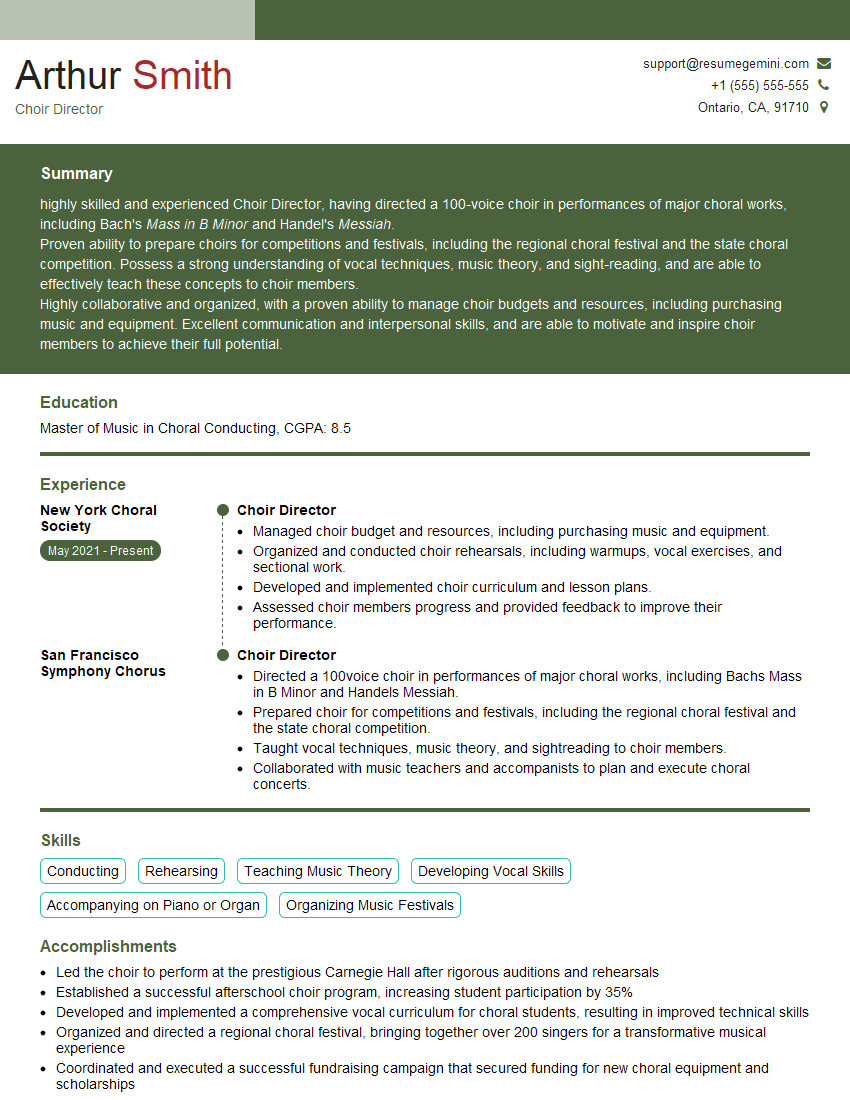
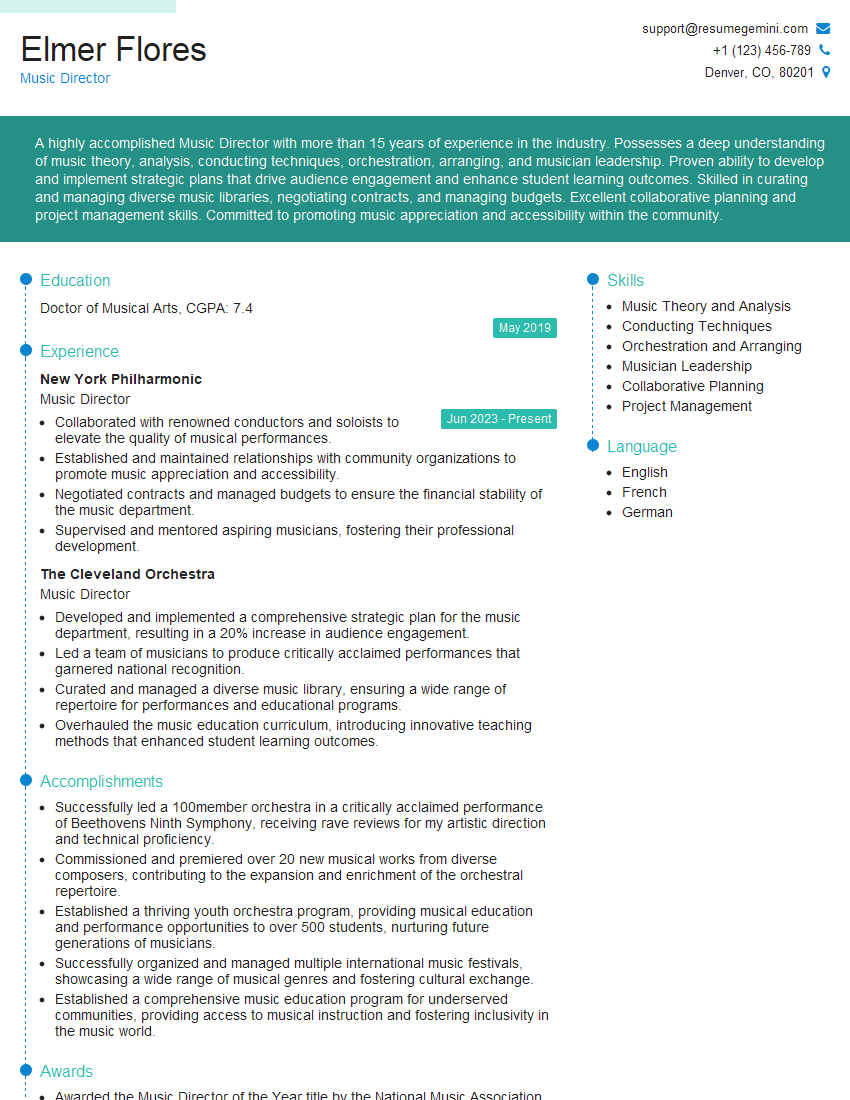
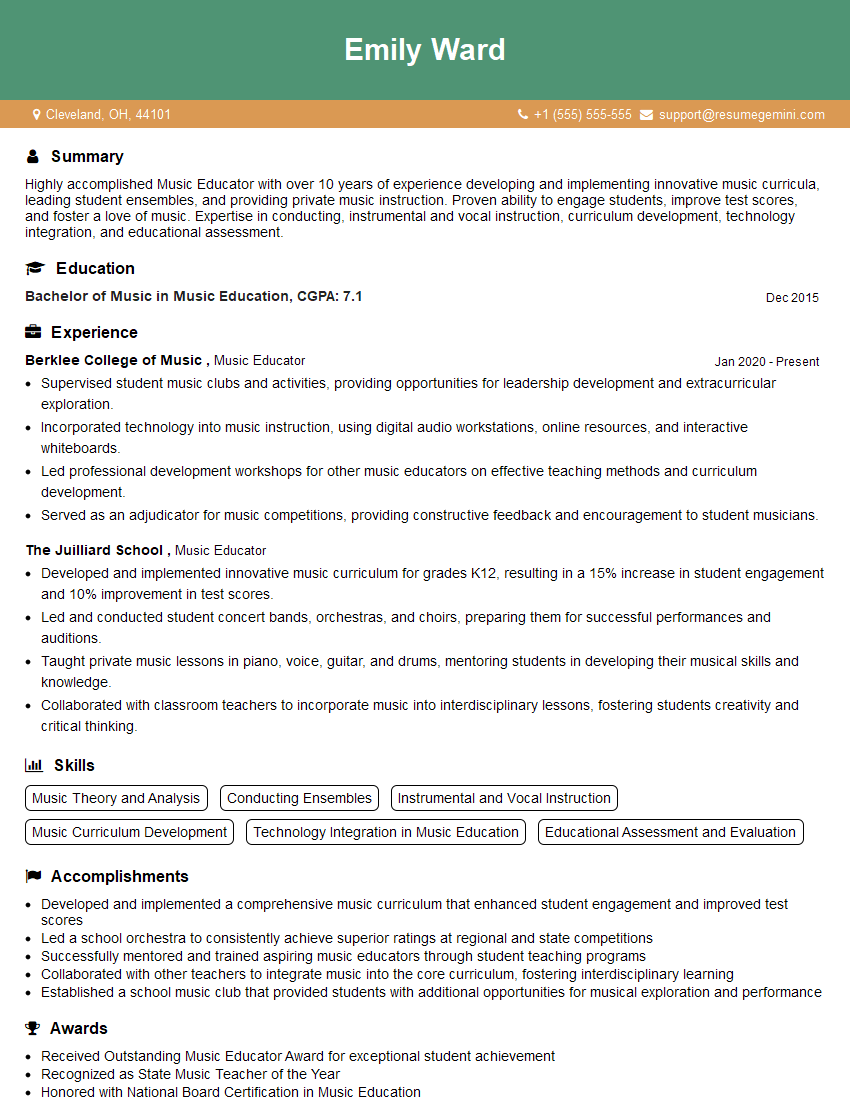
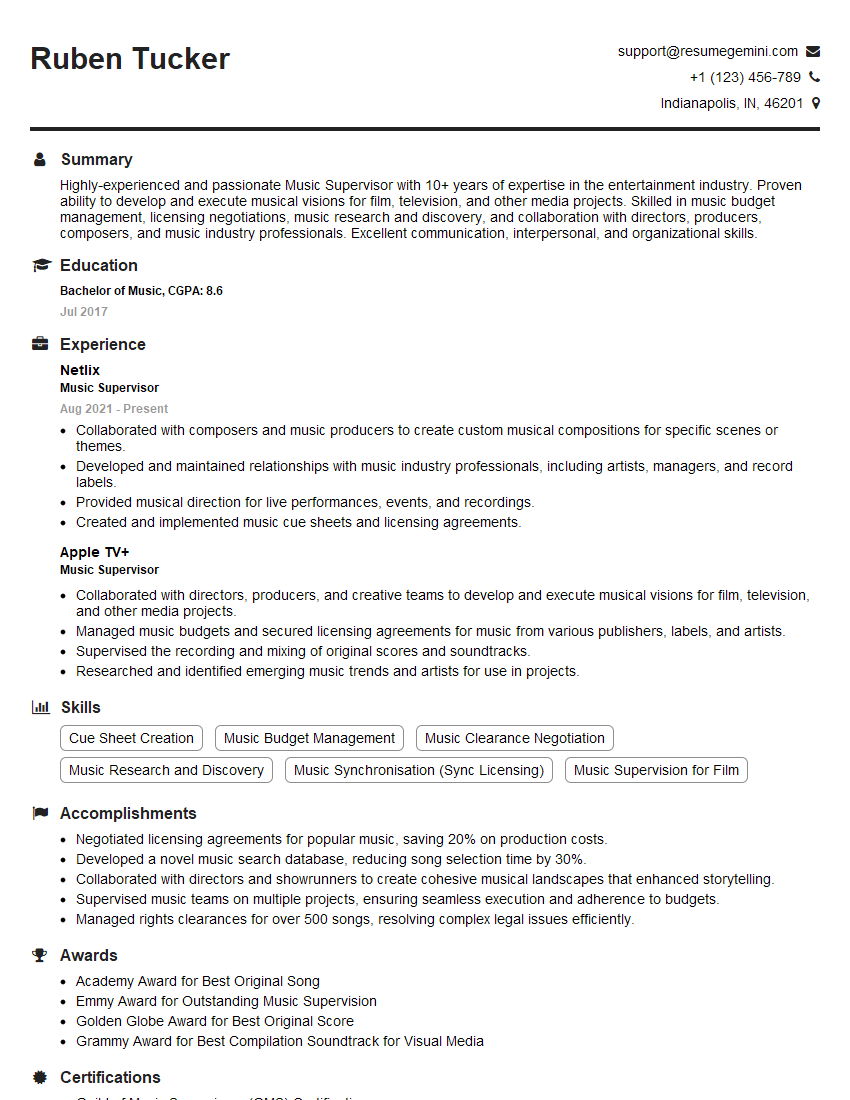
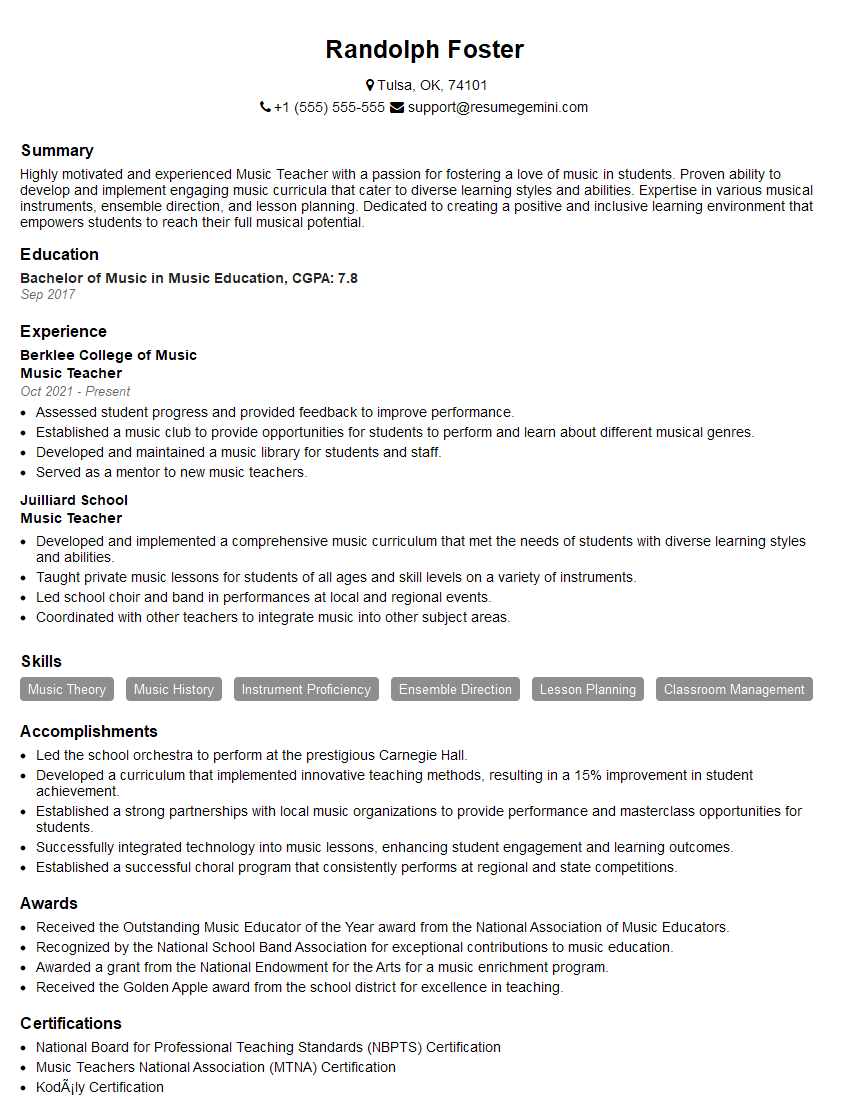
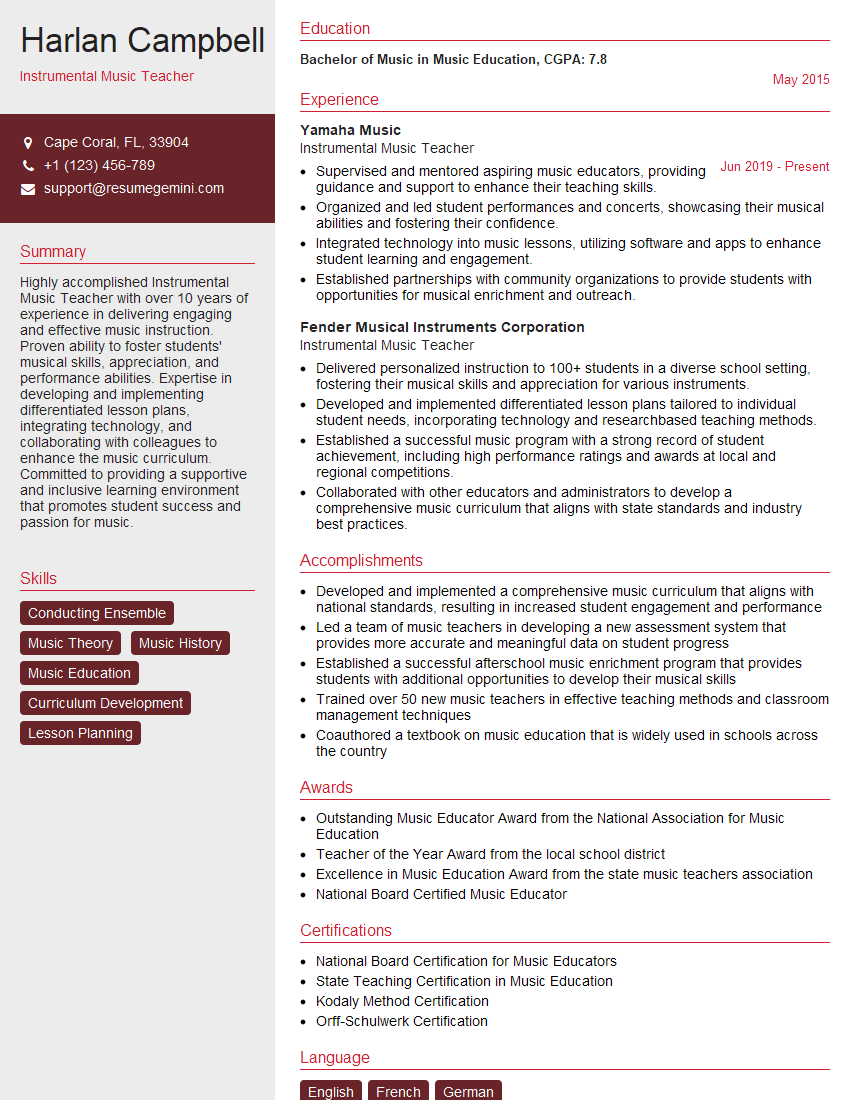
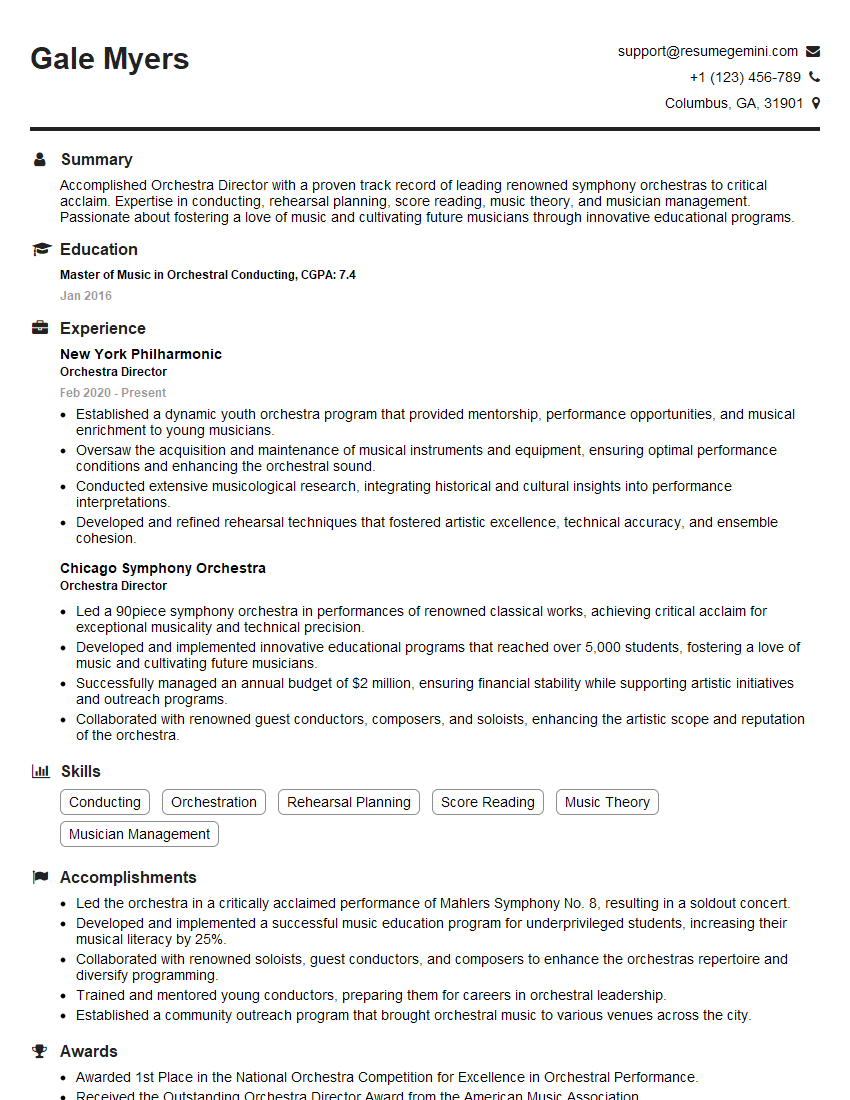
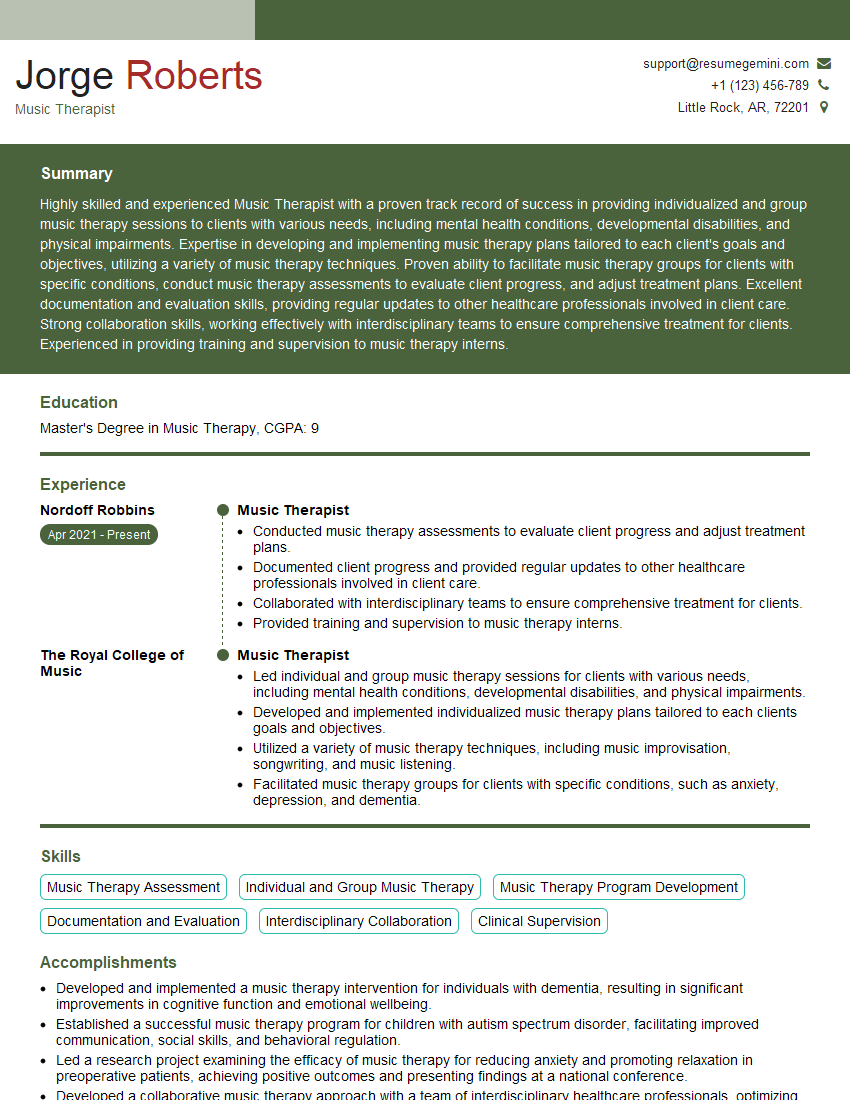
Mastering the art of music education opens doors to rewarding careers, impacting countless young lives. A strong resume is your key to unlocking these opportunities. Creating an ATS-friendly resume, optimized for Applicant Tracking Systems, is crucial for maximizing your job prospects. We highly recommend using ResumeGemini to build a professional and effective resume that showcases your skills and experience. ResumeGemini offers examples of resumes tailored specifically to Music Educator positions, providing you with a head start in crafting the perfect application.
Explore more articles
Users Rating of Our Blogs
Share Your Experience
We value your feedback! Please rate our content and share your thoughts (optional).
What Readers Say About Our Blog
Very informative content, great job.
good