Preparation is the key to success in any interview. In this post, we’ll explore crucial Music History and Theory interview questions and equip you with strategies to craft impactful answers. Whether you’re a beginner or a pro, these tips will elevate your preparation.
Questions Asked in Music History and Theory Interview
Q 1. Define counterpoint and give an example from a specific musical period.
Counterpoint is a compositional technique where two or more independent melodic lines are combined simultaneously. Think of it like a musical conversation where each voice has its own distinct personality and storyline, yet they weave together harmoniously. It’s not simply layering melodies; it involves careful consideration of melodic independence, rhythmic interplay, and harmonic relationships. The voices should be interesting in their own right, and their interaction should create a richer, more complex musical texture.
A prime example of counterpoint comes from the Baroque period, specifically in the works of Johann Sebastian Bach. His fugues, like the one from The Well-Tempered Clavier, are masterclasses in counterpoint. In a fugue, a single melodic theme (the subject) is introduced by one voice, then imitated by other voices, creating intricate interwoven lines. The interplay between these voices, their entrances and developments, showcase the sophisticated use of counterpoint in a highly structured form. The constant interplay of voices creates a sense of depth and complexity that is characteristic of Baroque music.
Q 2. Explain the difference between major and minor tonalities.
The difference between major and minor tonalities lies primarily in their characteristic scales and the emotional effect they evoke. Both are diatonic scales – meaning they have seven notes within an octave – but the arrangement of intervals is what sets them apart. A major scale is built with a pattern of whole and half steps: W-W-H-W-W-W-H (where W represents a whole step and H a half step). This creates a bright, optimistic, and generally happy sound.
In contrast, a minor scale’s formula is usually W-H-W-W-H-W-W (natural minor). This arrangement produces a darker, more melancholic, or sometimes mysterious mood. There are several types of minor scales (harmonic, melodic), each with slight variations in their intervals, further influencing the emotional character. Think of it like this: a major key is like a sunny day, while a minor key is more like a twilight or a rainy night. This fundamental difference in intervallic structure profoundly impacts the harmonic possibilities within each key.
Q 3. Describe the harmonic characteristics of the Baroque period.
Baroque harmony is characterized by a relatively simple, yet richly expressive, system built upon the foundation of basso continuo. The basso continuo was a foundational bass line played by a harpsichord or organ (often with a cello or bassoon doubling), providing a harmonic framework upon which other melodic lines were built. While generally based on triadic harmony (chords built from three notes), the Baroque period saw the use of:
- Frequent use of figured bass: A shorthand notation indicating chord inversions and embellishments for the basso continuo player, providing a degree of improvisation.
- Sequential progressions: Repeating harmonic patterns which created a sense of momentum and drive.
- Extensive use of suspensions and passing tones: Non-harmonic tones that added color and expressiveness to the texture, creating a sense of anticipation and resolution.
- Modal mixture: Borrowing chords from parallel modes (e.g., using minor chords within a major key context) to add unexpected harmonic color.
These features contributed to the richness and complexity of Baroque harmony, while still maintaining a sense of structure and clarity. The interplay between the basso continuo and the upper voices created an exciting interplay of counterpoint and harmonic progression.
Q 4. Discuss the development of opera from its origins to the Baroque period.
Opera’s origins can be traced back to the late 16th and early 17th centuries in Florence, Italy, emerging from the Florentine Camerata’s attempts to revive ancient Greek drama through music. Early operas, like Jacopo Peri’s Dafne (lost, but fragments survive), were characterized by relatively simple musical styles, often using recitative (speech-like singing) to drive the narrative and more elaborate arias (solo songs) for expressive moments. The focus was on dramatic storytelling through music.
By the Baroque period (roughly 1600-1750), opera had blossomed into a major art form. Composers like Claudio Monteverdi, George Frideric Handel, and Antonio Vivaldi developed opera’s musical language significantly. Larger ensembles, more complex instrumentation, and the development of distinct operatic forms like the aria, recitative, and chorus were key advancements. Monteverdi’s Orfeo represents a significant step forward in the development of opera, utilizing complex harmonies and dramatic musical expression. Baroque opera became grander in scale, incorporating spectacular staging, elaborate costumes, and complex plots, solidifying its position as a leading theatrical art form.
Q 5. Compare and contrast the musical styles of Bach and Mozart.
Johann Sebastian Bach (1685-1750) and Wolfgang Amadeus Mozart (1756-1791) are titans of music history, but their styles reflect distinct eras and aesthetics. Bach, a master of the Baroque, focused on counterpoint, intricate textures, and complex structures. His music displays a highly organized and intellectual approach, with a mastery of contrapuntal techniques and a preference for a relatively dense and polyphonic texture. He favored the use of fugue, concerto, and cantata forms, emphasizing formal structure and a clear harmonic language rooted in the Baroque tradition.
Mozart, on the other hand, epitomizes the Classical style. His music is characterized by clarity, elegance, and balance. Compared to Bach’s intricate polyphony, Mozart favors a more homophonic texture (a melody with accompanying harmony) with a greater emphasis on melodic grace and emotional expressiveness. His instrumental writing is brilliantly clear and transparent, and his operas are known for their sophisticated character development and dramatic structure. While both composers possessed unparalleled genius, Bach’s music is typically more complex and intellectually demanding, while Mozart’s often feels more immediately accessible and emotionally direct.
Q 6. Explain the impact of the Romantic era on musical form.
The Romantic era (roughly 1780-1900) profoundly impacted musical form, moving away from the strict Classical structures towards greater flexibility and expressive freedom. Classical forms like the sonata form and string quartet were not abandoned but were significantly expanded upon, becoming more elaborate and emotionally charged. Key developments include:
- Expansion of musical forms: Sonatas, symphonies, and concertos became longer and more complex, with more dramatic contrasts and emotional intensity.
- Development of new forms: The art song (Lied) became prominent, focusing on intense emotional expression in small, self-contained structures. Program music (music that tells a story or evokes a specific image or mood) also gained popularity.
- Emphasis on emotional expression: Romantic composers prioritized expressing a wide range of emotions – from joy and ecstasy to sorrow and despair – often resulting in longer, more elaborate musical structures to convey these feelings.
- Greater use of chromaticism and dissonance: To heighten the emotional impact, Romantic composers often used chromaticism (notes outside the diatonic scale) and dissonance (clashing chords) more liberally, creating a more dramatic and unstable harmonic language. These dissonances, however, usually led to satisfying resolutions, adding to the overall emotional arc.
In essence, Romantic composers sought to express their inner world and emotions through music, leading to a transformation in musical form and style.
Q 7. Analyze the use of dissonance in a specific 20th-century composition.
Igor Stravinsky’s The Rite of Spring (1913) is a seminal example of dissonance in 20th-century music. This ballet score challenges traditional tonal harmony, utilizing jarring dissonances to depict primal scenes of ancient pagan rituals. The work’s rhythmic complexity and unconventional melodic lines contribute to its overall sense of unease and raw power.
Stravinsky’s use of dissonance isn’t random; it is carefully constructed to convey specific emotional and dramatic effects. The rhythmic drive, combined with unexpected harmonic clashes, creates a feeling of primordial energy and unease. Instead of resolving dissonances traditionally, Stravinsky often prolongs them or uses them to create a new sense of stability, pushing the boundaries of harmonic language and unsettling the listener’s expectations of resolution. The impact is one of intense, almost violent emotional force, reflecting the ballet’s themes of sacrifice and renewal.
This use of dissonance is not merely an aesthetic choice; it reflects a broader movement in 20th-century music towards atonality and a rejection of traditional harmonic systems. Stravinsky’s work exemplifies the power of dissonance to create a dramatically different and uniquely expressive musical language.
Q 8. What are the defining characteristics of serialism?
Serialism, a compositional technique prominent in the mid-20th century, fundamentally rejects traditional tonality and harmony. Instead, it utilizes a series, or row, of twelve tones – the complete chromatic scale – arranged in a specific order. This primary series, called the prime, is then manipulated through various transformations (inversion, retrograde, retrograde inversion) to generate melodic and harmonic material throughout the composition. Think of it like a mathematical puzzle: the composer starts with a specific sequence and systematically explores all its variations.
Unlike traditional music where certain notes are considered ‘stronger’ or more important due to their harmonic function, serialism treats all twelve tones equally. This creates a sense of atonality – the absence of a tonal center – and a highly structured, often complex, musical landscape. The use of the series permeates every aspect of the piece, from melody and harmony to rhythm and texture.
A prime example is Arnold Schoenberg’s Pierrot Lunaire, although he didn’t strictly adhere to all aspects of later serial techniques. Later composers like Anton Webern and Alban Berg developed and refined serial techniques, pushing the boundaries even further. Their music is often characterized by its intense concentration and rigorous application of the serial method.
Q 9. Describe the influence of non-Western musical traditions on Western classical music.
Non-Western musical traditions have profoundly impacted Western classical music, often in subtle but significant ways. The exchange began centuries ago through trade, exploration, and cultural interaction, and continues to this day.
- Rhythmic Complexity: West African rhythms, with their intricate polyrhythms and syncopation, influenced composers like Stravinsky, whose Rite of Spring showcases a rhythmic complexity that echoes African musical traditions.
- Modal Systems: The modal systems of various cultures, including those of the Middle East and Asia, have enriched Western harmony. Composers have experimented with non-diatonic scales and modes, broadening the harmonic palette beyond the traditional major and minor scales.
- Melodic contours and ornamentation: The characteristic melodic shapes and ornamentation found in gamelan music of Indonesia, for instance, can be seen to have influenced some composers’ melodic writing.
- Instrumentation and timbre: The introduction of new instruments from different cultures, such as the sitar or gamelan instruments, expands the timbral possibilities available to composers.
It’s crucial to acknowledge that the influence isn’t always a direct ‘borrowing,’ but a creative dialogue. Composers are inspired by the sounds, structures, and philosophies of other cultures, incorporating them into their own unique musical language.
Q 10. Explain the concept of musical form (e.g., sonata form, rondo form).
Musical form refers to the overall structure of a piece of music. It’s the blueprint that organizes the musical ideas, creating a sense of coherence and direction. Think of it like the architecture of a building – it provides a framework that gives the individual rooms (musical sections) meaning and relationship.
Sonata Form: A cornerstone of classical music, sonata form typically consists of three sections: Exposition (presentation of themes), Development (exploration and transformation of themes), and Recapitulation (return of themes, often in the tonic key). It’s a dynamic and dramatic structure, often featuring contrasts in mood and intensity. Beethoven’s symphonies are prime examples of masterful sonata form usage.
Rondo Form: Rondo form is characterized by a recurring main theme (A) interspersed with contrasting themes (B, C, etc.). The structure often follows a pattern like A-B-A-C-A-B-A, creating a sense of unity and return. Mozart’s piano sonatas frequently utilize this form, creating a sense of playful repetition and contrast.
Many other forms exist, including binary form (two main sections), ternary form (three main sections), and theme and variations. Understanding musical forms is crucial for both composers and listeners to navigate and appreciate the architecture of a piece.
Q 11. Identify and explain the function of different musical textures (e.g., monophony, polyphony).
Musical texture refers to the way different melodic and harmonic lines are combined. It describes the density and layering of sound within a piece.
- Monophony: The simplest texture, featuring a single melodic line without accompaniment. Think of a Gregorian chant or a solo vocal line.
- Polyphony: Multiple independent melodic lines sounding simultaneously. A classic example is a fugue, where a single theme (subject) is developed and intertwined with other voices. Renaissance motets and Bach’s fugues are rich examples of polyphonic textures.
- Homophony: A texture where a melody is accompanied by chords. This is the most common texture in Western music, especially from the Classical period onwards. Most pop songs fall under this category.
- Heterophony: A texture where multiple performers play slight variations of the same melody simultaneously. This is common in some folk music traditions.
The texture significantly impacts the emotional effect and overall character of a piece. A dense polyphonic texture can create a feeling of richness and complexity, while a simple monophonic texture can sound serene and contemplative.
Q 12. Discuss the role of patronage in the development of music history.
Patronage played a pivotal role in the development of music history, particularly during the Medieval, Renaissance, and Baroque periods. Patronage refers to the financial and social support given to artists, including composers and performers, by wealthy individuals, institutions, or rulers.
Church patronage dominated the medieval and renaissance eras, with the Church commissioning religious music for services and rituals. This led to the development of genres like Gregorian chant and the mass.
Aristocratic patronage became increasingly important during the Renaissance and Baroque periods. Wealthy nobles and royalty employed composers and musicians to perform in their courts and provide entertainment. This led to the flourishing of secular music, including operas, concertos, and chamber music. For example, the patronage of the Medici family in Florence was instrumental in the development of opera.
The system of patronage directly influenced the types of music created. Commissioned works often reflected the tastes and interests of the patron, resulting in the development of diverse musical styles and genres.
Q 13. Explain the impact of technological advancements on music composition and performance.
Technological advancements have revolutionized music composition and performance in profound ways.
- Recording Technology: The invention of the phonograph and later, magnetic tape, allowed for the widespread dissemination of music. This democratized access to musical works and enabled composers to reach a wider audience. It also facilitated experimentation with sound manipulation and effects.
- Electronic Instruments: The development of synthesizers, samplers, and digital audio workstations (DAWs) has opened up new avenues for musical expression. Composers can now create sounds that were previously unimaginable, blurring the boundaries between acoustic and electronic music.
- Notation Software: Music notation software has significantly streamlined the composition process. Composers can create and edit scores efficiently, experimenting with various musical ideas easily.
- Digital Distribution: The internet and digital platforms have transformed music distribution. Artists can now bypass traditional record labels and share their music directly with audiences worldwide.
These advancements have not only changed how music is created and shared but have also impacted how we listen to and experience music.
Q 14. What is the difference between a fugue and a canon?
Both fugues and canons are contrapuntal forms, meaning they involve multiple independent melodic lines. However, they differ in their structure and development.
Fugue: A fugue features a main theme, called the subject, that is introduced by one voice and then imitated by other voices in succession. The subject is then developed throughout the fugue through various techniques, including counter-subjects (a contrasting melody accompanying the subject), episodes (sections without the subject), and stretto (overlapping entries of the subject).
Canon: A canon is a simpler contrapuntal form where one voice enters after another, mimicking the first voice exactly. Canons can be strict, where the voices are identical, or free, allowing for some variation in rhythm and ornamentation. Think of the familiar round ‘Row, Row, Row Your Boat’ – that’s a simple canon.
The key difference is in the degree of development and complexity. A fugue is a highly elaborate structure with sophisticated thematic development, while a canon is usually more straightforward, focusing on the imitation of a single melodic idea. Bach’s Well-Tempered Clavier is full of magnificent fugues, while many simpler pieces, like children’s songs, utilize canons.
Q 15. Explain the concept of musical meter and rhythmic notation.
Musical meter refers to the organized flow of strong and weak beats in music. It’s essentially the rhythmic framework that provides a sense of pulse and organization. Think of it like the underlying heartbeat of a piece. Rhythmic notation is the system of symbols used to represent these beats and the durations of notes and rests within that metrical framework. We use time signatures, like 4/4 (common time) or 3/4 (waltz time), to indicate the meter. The top number tells us how many beats are in each measure, and the bottom number tells us the type of note that receives one beat.
For example, in 4/4 time, there are four beats per measure, and a quarter note gets one beat. In 3/4 time, there are three beats per measure, and a quarter note gets one beat. Rhythmic notation also uses symbols like whole notes, half notes, quarter notes, eighth notes, etc., to represent different note durations, alongside rests to represent silence.
Understanding meter and rhythmic notation is crucial for both performance and composition. It allows musicians to interpret a piece accurately, ensuring the rhythmic integrity is preserved. Composers use meter and rhythm to create various effects, from a driving, energetic feel to a more lyrical and flowing one. Imagine trying to play a waltz in 4/4—it would sound completely wrong! The meter dictates the rhythmic pulse and fundamentally shapes the character of the music.
Career Expert Tips:
- Ace those interviews! Prepare effectively by reviewing the Top 50 Most Common Interview Questions on ResumeGemini.
- Navigate your job search with confidence! Explore a wide range of Career Tips on ResumeGemini. Learn about common challenges and recommendations to overcome them.
- Craft the perfect resume! Master the Art of Resume Writing with ResumeGemini’s guide. Showcase your unique qualifications and achievements effectively.
- Don’t miss out on holiday savings! Build your dream resume with ResumeGemini’s ATS optimized templates.
Q 16. Describe the different types of scales used in Western music.
Western music primarily utilizes diatonic scales, which are seven-note scales with specific intervallic relationships between the notes. The most common is the major scale, characterized by a bright, happy sound due to its intervals of whole and half steps (W-W-H-W-W-W-H, where W represents a whole step and H a half step). Conversely, the minor scale has a more somber or melancholic quality, with several variations like natural minor (W-H-W-W-H-W-W), harmonic minor (W-H-W-W-H-WW-H), and melodic minor (W-H-W-W-W-H-W ascending, and W-H-W-W-H-W-W descending).
Beyond the major and minor scales, we also find modal scales, which predate the major-minor system. These scales use different arrangements of whole and half steps, creating distinct melodic character. Examples include Dorian, Phrygian, Lydian, Mixolydian, Aeolian (natural minor), and Locrian. These modes were particularly prevalent in medieval and Renaissance music. Chromatic scales, which contain all 12 notes of the octave, are also important, used to create dramatic effects and modulate between keys.
The choice of scale significantly impacts the mood and character of a composition. For instance, a piece in a major key often evokes joy and optimism, while a piece in a minor key might express sadness or contemplation. Modal scales contribute a unique flavor, often used to create a more ancient or mystical sound.
Q 17. Analyze the use of dynamics and articulation in a given musical excerpt.
To analyze dynamics and articulation in a musical excerpt, we need the specific excerpt. However, I can explain the concepts. Dynamics refer to the loudness or softness of the music, typically indicated by terms like piano (soft), forte (loud), crescendo (gradually getting louder), and diminuendo (gradually getting softer). Articulation refers to how individual notes or groups of notes are played or sung. Common articulations include staccato (short, detached notes), legato (smooth, connected notes), marcato (emphasized notes), and tenuto (held notes).
Analyzing a given excerpt would involve identifying these dynamic and articulation markings and observing how they contribute to the overall expression and shape of the music. For example, a sudden forte passage might highlight a climax, while a pianissimo section could create a sense of intimacy or mystery. The use of staccato might convey a sense of urgency or dance-like quality, while legato could produce a more lyrical and flowing effect. The interplay between dynamics and articulation creates a nuanced and expressive performance.
Imagine a simple melody played first with legato and then with staccato – the same notes create vastly different emotional impacts.
Q 18. Discuss the development of musical instruments throughout history.
The development of musical instruments spans millennia, evolving from simple, rudimentary devices to the complex and sophisticated instruments we know today. Early instruments were often made from natural materials like wood, bone, and animal hide. Examples include bone flutes found in prehistoric caves, simple percussion instruments, and early string instruments like lyres and harps. The development of metalworking significantly impacted instrument making, leading to the creation of brass and percussion instruments with improved sound quality and projection.
The evolution continued throughout history, with significant advancements during various periods. The Renaissance saw the rise of the viol family and the lute, while the Baroque era brought the development of the harpsichord, organ, and the early forms of the violin family. The Classical period standardized instrument construction and tuning systems, leading to the orchestra as we know it. The Romantic era brought further refinement and innovations, along with the rise of the piano as a dominant solo instrument.
The 20th and 21st centuries have seen the development of electronic instruments and digital technology, significantly expanding the possibilities of musical expression and sound design. The ongoing evolution of materials, techniques, and technology continues to shape the future of musical instruments.
Q 19. Explain the principles of musical analysis.
Musical analysis involves a systematic examination of a musical work to understand its structure, form, harmony, melody, rhythm, and other elements. It’s like dissecting a piece of music to reveal its inner workings and understand the composer’s choices. A typical approach involves several steps:
- Identifying the Form: Determining the overall structure of the piece (e.g., sonata form, rondo, theme and variations).
- Analyzing the Melody: Examining the melodic contours, intervals, and motifs.
- Analyzing the Harmony: Studying the chord progressions, key changes, and harmonic functions.
- Analyzing the Rhythm: Investigating the meter, rhythmic patterns, and rhythmic motives.
- Analyzing the Texture: Determining the layering of musical lines (monophony, polyphony, homophony).
- Considering the Context: Understanding the historical and cultural context of the piece.
Different analytical techniques exist, including Schenkerian analysis (focused on structural levels), set theory (analyzing pitch-class sets), and narratological analysis (examining the narrative elements). The goal is to move beyond simply listening to a piece and gaining a deep understanding of its construction and artistic intent. This is crucial for musicologists, composers, performers, and music educators.
Q 20. What are the main features of a specific musical period (e.g., Classical, Romantic)?
Let’s examine the Classical period (roughly 1730-1820). This era, following the Baroque, is characterized by clarity, balance, and formal elegance. Composers emphasized structural symmetry and formal precision, often using established forms like sonata form, string quartet, and symphony. The texture was generally homophonic, with a clear melodic line supported by accompaniment. Harmony was primarily diatonic, with a preference for clear and unambiguous chord progressions.
Key features include:
- Formal clarity and structure: Composers meticulously crafted their works with balanced phrases and sections.
- Homophonic texture: A clear melody supported by accompaniment.
- Diatonic harmony: Relatively simple and predictable chord progressions.
- Emphasis on balance and symmetry: Formal structures were often symmetrical and well-proportioned.
- Development of the orchestra: The classical orchestra took on a standardized form.
- Important composers: Haydn, Mozart, Beethoven (early works).
The Classical period’s elegance and structural clarity paved the way for the greater emotional expression of the Romantic period that followed. Its formal structures remain foundational to Western music education and composition.
Q 21. Describe the historical context of a specific composer and their works.
Let’s consider Johann Sebastian Bach (1685-1750). Bach lived during the Baroque period, a time of great artistic and intellectual ferment in Europe. He held various positions as a church organist and Kapellmeister (director of music) in different German cities. His life was deeply rooted in the religious and courtly musical traditions of his time. He was a prolific composer, writing for a vast array of instruments and vocal ensembles.
Bach’s works are known for their intricate counterpoint, masterful use of harmony, and profound religious devotion (much of his work was for church services). He explored various musical forms, including fugues, concertos, cantatas, and passions. His music is intellectually stimulating and emotionally resonant, showcasing a deep understanding of musical structure and an unparalleled technical skill. His Well-Tempered Clavier, a collection of preludes and fugues in all 24 major and minor keys, is a testament to his mastery of harmony and counterpoint. His Mass in B Minor is considered one of the greatest choral works ever written.
Bach’s influence on subsequent composers is immeasurable. He is revered not only for his profound musical genius but also for his unwavering dedication to his craft and his significant contribution to the development of Western music.
Q 22. What are some common compositional techniques used in film scoring?
Film scoring leverages a variety of compositional techniques to enhance the narrative and emotional impact of a movie. These techniques often go beyond simply providing background music; they actively participate in storytelling.
Leitmotifs: Recurring musical themes associated with specific characters, objects, or ideas. Think of Darth Vader’s theme in Star Wars – its ominous chords immediately evoke his presence and power even before he appears on screen.
Mickey-Mousing: Music that directly mimics the onscreen action. This is often used for comedic effect or to emphasize physical movement, such as a chase scene.
Diegetic vs. Non-Diegetic Sound: Diegetic sound originates from within the film’s world (e.g., a radio playing), while non-diegetic sound is heard only by the audience (e.g., the score). Composers skillfully blend these to create immersion and emotional depth.
Changes in Tempo and Dynamics: Tempo (speed) and dynamics (loudness/softness) are powerful tools. A sudden crescendo can signify rising tension, while a slowing tempo might indicate a moment of reflection or sadness.
Instrumentation: The choice of instruments profoundly affects the mood. A string orchestra evokes elegance and romance, while brass instruments can convey power and heroism.
Harmony and Tonality: The use of major and minor keys, consonance (pleasant-sounding chords), and dissonance (unpleasant-sounding chords) guides the emotional trajectory of the scene. Dissonance is frequently employed to create tension, while consonance provides a sense of resolution.
Q 23. Explain the relationship between music and society.
Music and society are deeply intertwined; they influence and reflect each other in complex ways. Music acts as a mirror to society, reflecting its values, beliefs, and cultural norms. Consider the evolution of popular music genres – from the societal anxieties expressed in blues music to the rebellious spirit of rock and roll.
Social Commentary: Music often serves as a vehicle for social commentary, addressing political issues, social injustices, and cultural shifts. Protest songs, for example, have played a crucial role in social movements throughout history.
Cultural Identity: Musical traditions play a vital role in shaping cultural identity and fostering a sense of community. Folk music, for example, often preserves historical narratives and cultural practices.
Technological Influence: The evolution of musical technology and its accessibility has a direct impact on how music is created, distributed, and consumed, shaping musical trends and societal perceptions of music.
Commercialization: The commercialization of music through the recording industry and media influences both musical trends and societal values, often leading to discussions about the role of artistry and commercial success.
In essence, music doesn’t exist in a vacuum; it’s a dynamic entity continuously shaped by, and in turn, shaping society.
Q 24. Discuss ethical considerations in music scholarship and practice.
Ethical considerations in music scholarship and practice are crucial for ensuring fairness, accuracy, and respect within the field. These considerations encompass diverse aspects, including:
Authorship and Copyright: Proper attribution and adherence to copyright laws are paramount. This includes acknowledging sources, obtaining permissions for use of copyrighted material, and avoiding plagiarism.
Representation and Inclusivity: Scholarship should strive for diverse representation, avoiding biases and promoting inclusivity in the study and performance of music from various cultures and backgrounds. This necessitates a critical examination of power dynamics and historical narratives embedded in musical traditions.
Cultural Sensitivity: Researchers must approach the study of music from other cultures with respect and sensitivity, avoiding appropriation and recognizing the inherent cultural values associated with specific musical practices.
Objectivity and Bias: Scholars should strive for objectivity in their research and analysis, acknowledging potential biases and ensuring that their interpretations are supported by evidence.
Accessibility and Public Engagement: Making research accessible to a broader audience through public engagement initiatives is important to fostering broader understanding and appreciation of music.
Ultimately, ethical practices in music scholarship and practice aim to foster a more just and equitable environment for both researchers and the communities whose music is being studied.
Q 25. How would you teach the concept of chord progressions to beginners?
Teaching chord progressions to beginners requires a gradual approach, focusing on building foundational understanding. I would start with the concept of triads (three-note chords) and their construction.
Introduce Major and Minor Triads: Begin by explaining the difference between major and minor scales (using a simple scale like C major and A minor). Then show how triads are built by stacking thirds (intervals of three notes) within a scale. For example, a C major triad is C-E-G (C major scale notes 1-3-5).
Simple Progressions: Introduce simple, common progressions like I-IV-V-I (e.g., C-F-G-C in C major). Play these progressions on a piano or guitar, highlighting how they sound “resolved” or “satisfying.” Explain the function of each chord in the progression (I: tonic, IV: subdominant, V: dominant).
Hands-On Practice: Use aural exercises, having students identify chords and progressions. Encourage improvisation using the learned progressions.
Visual Aids: Use diagrams and color-coding to visualize chord construction and progressions, making it easier to understand the relationships between chords.
Gradual Progression: Slowly introduce more complex progressions, incorporating seventh chords (four-note chords) and secondary dominants. Show how these enrich the harmonic possibilities.
Relating these progressions to songs they already know can strengthen comprehension. For example, “Twinkle Twinkle Little Star” uses a simple I-V-I-V progression in C major.
Q 26. Explain the importance of music theory in music composition.
Music theory is indispensable for music composition. It provides the conceptual framework and tools necessary for creating coherent, expressive, and impactful music. It’s like the grammar and vocabulary of music, enabling composers to articulate their musical ideas effectively.
Harmony: Understanding harmony allows composers to create effective chord progressions, build tension and release, and establish a strong harmonic foundation.
Melody: Music theory helps composers craft melodic lines that are memorable, singable, and expressive. This includes understanding melodic intervals, phrasing, and contour.
Rhythm: A thorough grasp of rhythmic concepts—meter, time signatures, syncopation—is crucial for creating rhythmic interest and drive.
Form: Music theory provides knowledge of musical forms (sonata form, rondo, theme and variations), which are essential for structuring compositions logically and effectively.
Counterpoint: In more advanced composition, understanding counterpoint (the combination of independent melodic lines) enhances compositional sophistication and expressiveness.
While some composers might intuitively create beautiful music, a solid grasp of music theory significantly expands their compositional vocabulary and enables a more deliberate and controlled creative process.
Q 27. Describe your approach to analyzing a complex musical piece.
Analyzing a complex musical piece is a multifaceted process requiring careful listening and a systematic approach. My approach typically involves the following steps:
Initial Listening: I begin with several attentive listenings to grasp the overall structure, mood, and emotional impact of the piece.
Formal Analysis: I identify the formal structure (e.g., sonata form, variations, theme and variations), noting recurring themes, sections, and transitions.
Melodic Analysis: I examine melodic contours, intervals, and motives, identifying the main melodic ideas and their development throughout the piece.
Harmonic Analysis: I analyze the harmonic progressions, identifying chord functions, cadences, and any unusual harmonic choices. This may involve creating a Roman numeral analysis or a figured bass.
Rhythmic Analysis: I analyze the rhythmic patterns, meters, and syncopation, identifying rhythmic features that contribute to the piece’s character.
Textural Analysis: I examine the texture of the piece, noting whether it’s monophonic (single melodic line), polyphonic (multiple independent melodic lines), or homophonic (melody with accompaniment).
Contextualization: I consider the historical and cultural context of the piece, researching the composer’s life, influences, and the musical style of the period.
Synthesis: Finally, I synthesize my findings, formulating an interpretation that integrates all aspects of my analysis, explaining how the various musical elements work together to achieve the composer’s artistic goals.
This process requires a deep understanding of music theory, analytical tools, and a keen ear for detail. The goal isn’t just to describe the music, but to understand its underlying structure and aesthetic purpose.
Q 28. How would you assess a student’s understanding of musical concepts?
Assessing a student’s understanding of musical concepts requires a multifaceted approach, combining formal assessments with informal observations.
Written Tests: Tests assess theoretical knowledge (e.g., identifying intervals, analyzing chord progressions, writing in different musical styles). These can include multiple-choice questions, short answer questions, and more in-depth analysis tasks.
Practical Assessments: Practical assessments evaluate a student’s ability to apply theoretical knowledge, such as sight-reading, ear training exercises (identifying intervals, melodies, and chords), and performance tasks (playing or singing).
Aural Skills Tests: These tests assess the student’s ability to perceive and identify musical elements through listening, including intervals, rhythms, melodies, and harmonies.
Compositional Tasks: Students may be asked to compose short pieces, applying their knowledge of harmony, melody, and form. This helps assess their ability to create music according to specific instructions or stylistic guidelines.
Class Participation and Observation: Active engagement in class discussions and practical exercises provides valuable insights into a student’s understanding. Observing their ability to apply concepts in improvisational settings also provides key information.
Combining multiple assessment methods provides a comprehensive understanding of a student’s strengths and areas needing further development. Feedback should be constructive and tailored to each student’s individual progress.
Key Topics to Learn for Music History and Theory Interview
- Western Music History: A chronological overview, focusing on major periods (Medieval, Renaissance, Baroque, Classical, Romantic, 20th/21st Century), key composers, and stylistic developments. Consider the social and cultural contexts influencing musical trends.
- Musical Forms and Structures: Deep understanding of sonata form, rondo form, fugue, variations, and other common forms. Practice analyzing musical scores to identify these structures and their functions.
- Harmony and Counterpoint: Mastering basic concepts like triads, chords, inversions, cadences, and voice leading. Develop the ability to analyze and discuss harmonic progressions and contrapuntal textures in different musical styles.
- Melody and Rhythm: Analyze melodic contours, rhythmic patterns, and their expressive effects. Understand different rhythmic notations and their implications.
- Musical Analysis Techniques: Develop skills in formal analysis, harmonic analysis, and Schenkerian analysis, applying these techniques to diverse musical examples. Practice explaining your analytical process clearly and concisely.
- Specific Composers and their Works: In-depth knowledge of significant composers from various periods and styles. Be prepared to discuss their compositional techniques, stylistic innovations, and historical significance.
- Genre Studies: Demonstrate familiarity with key genres such as opera, symphony, concerto, chamber music, and their historical evolution.
- Ethnomusicology (Optional): Depending on the specific role, a basic understanding of non-Western musical traditions can be beneficial.
Next Steps
A strong foundation in Music History and Theory is essential for a successful career in music education, musicology, music journalism, and many other related fields. It demonstrates a deep understanding of the art form and allows you to engage with music on an intellectual and analytical level. To increase your job prospects, crafting an ATS-friendly resume is crucial. ResumeGemini is a trusted resource that can help you build a professional resume that showcases your skills and experience effectively. ResumeGemini provides examples of resumes tailored to Music History and Theory, helping you present your qualifications in the best possible light.

Music Publisher Resume Sample
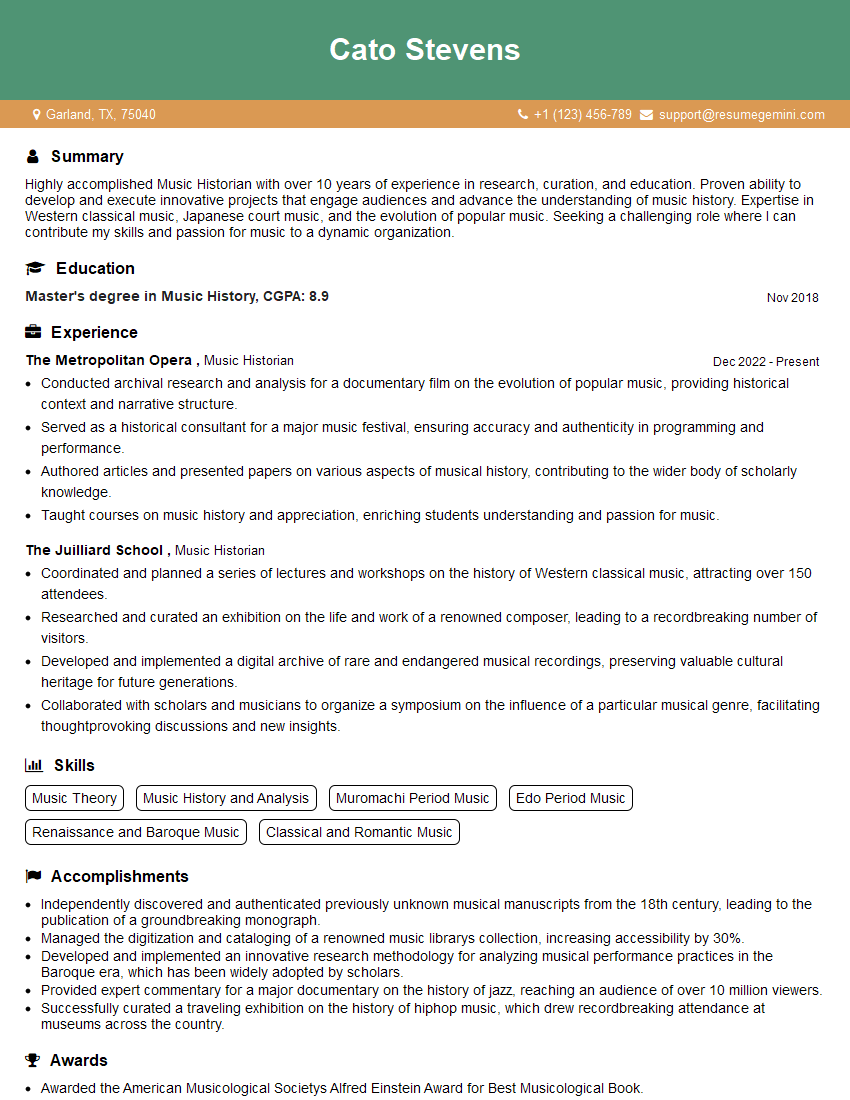
Music Historian Resume Sample
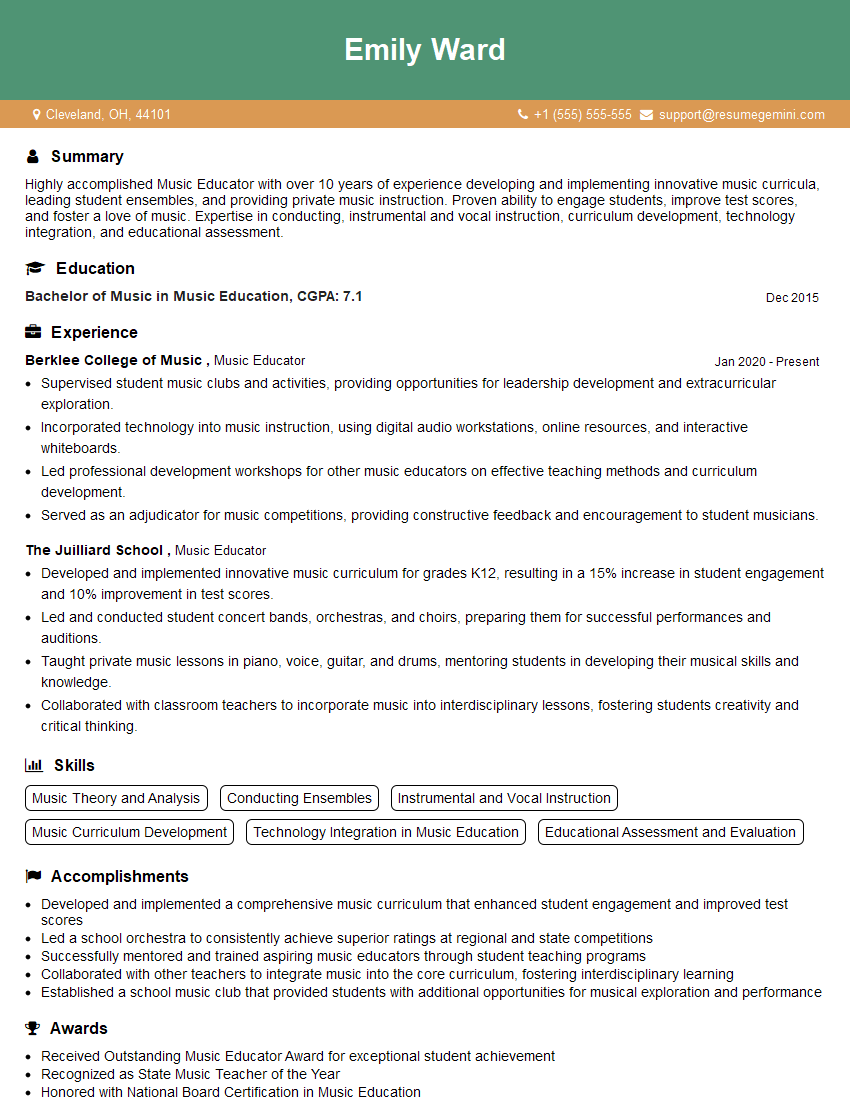
Music Educator Resume Sample

Music Supervisor Resume Sample
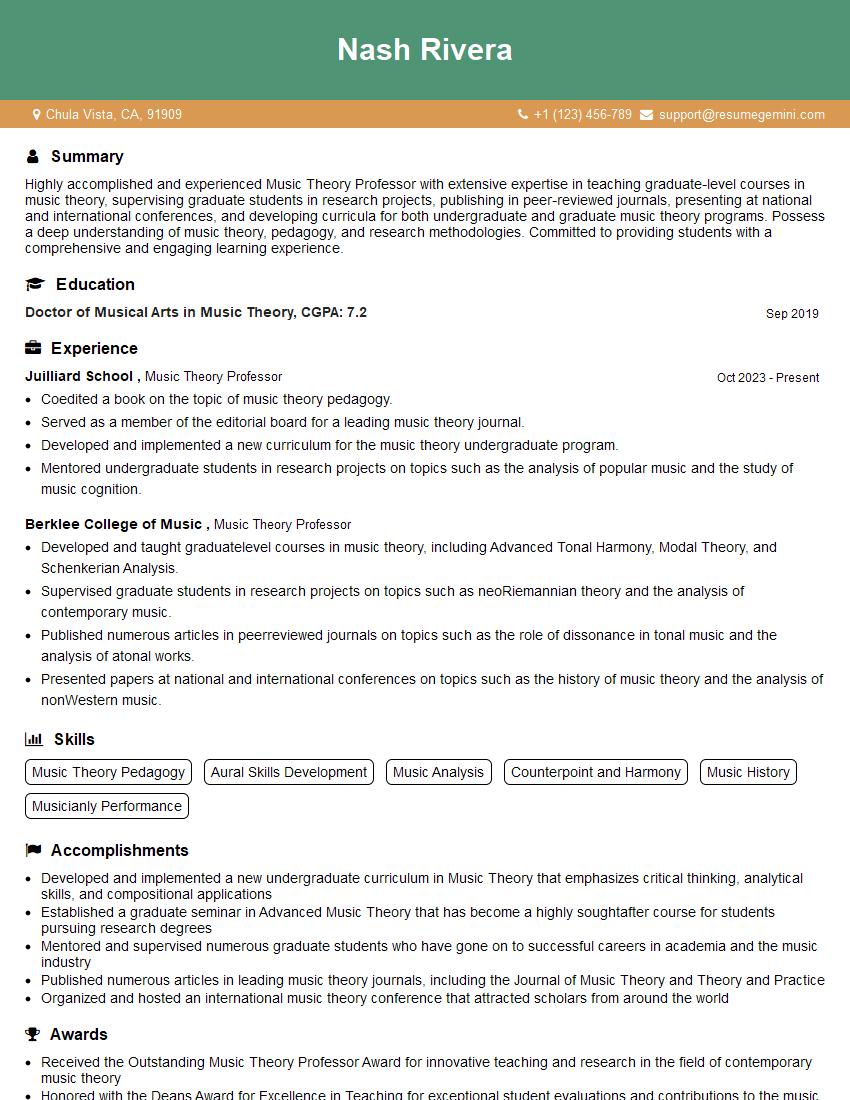
Music Theory Professor Resume Sample
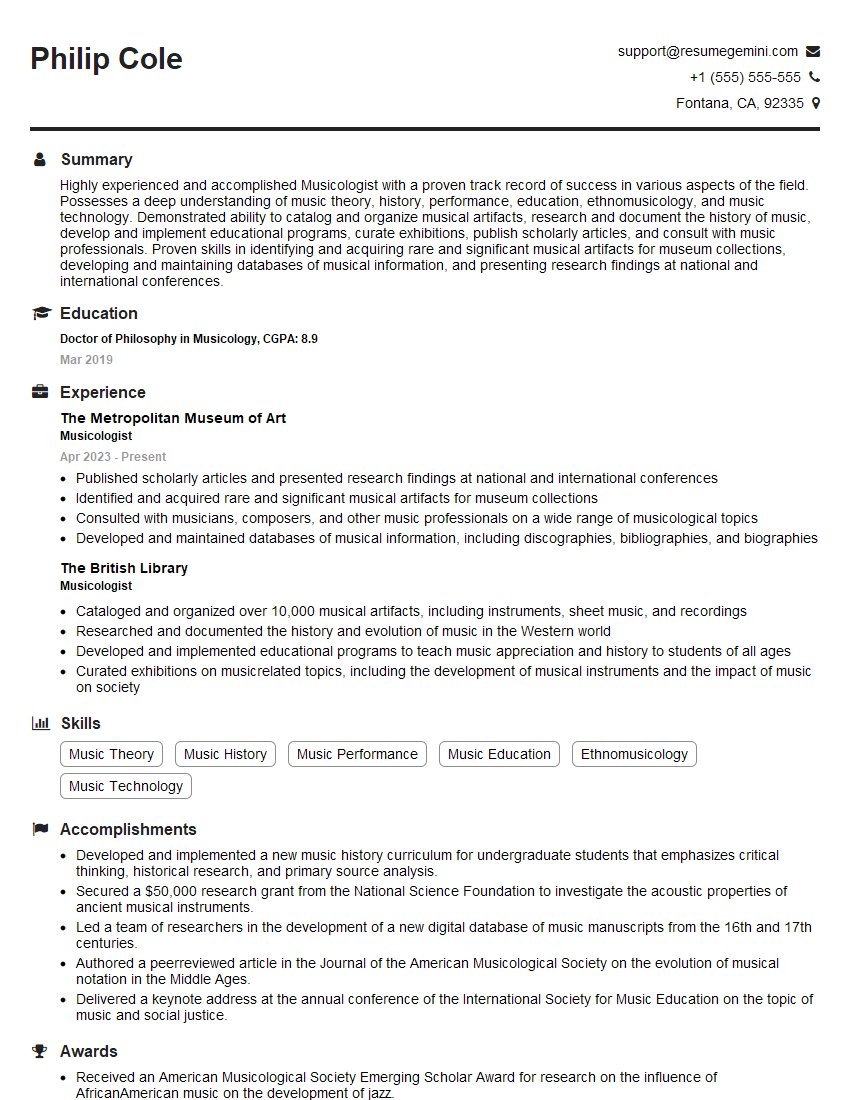
Musicologist Resume Sample
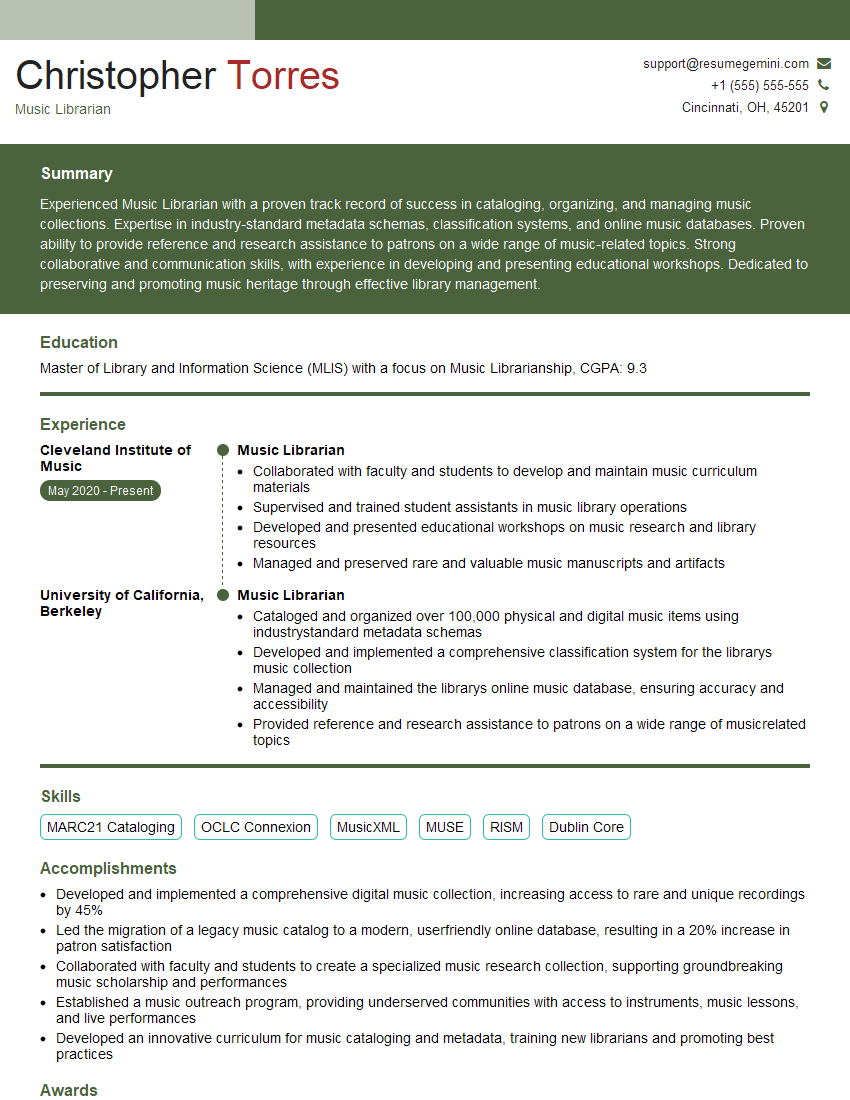
Music Librarian Resume Sample

Music Producer Resume Sample

Composer Resume Sample
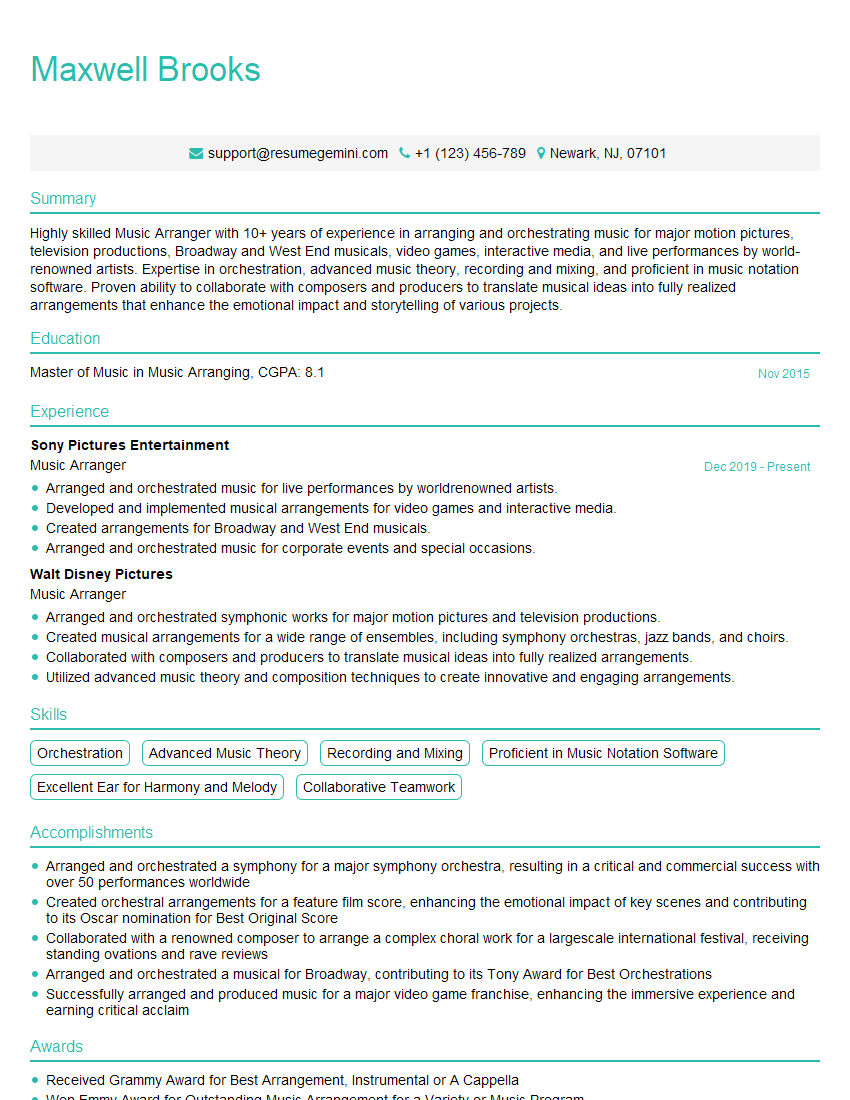
Music Arranger Resume Sample

Orchestrator Resume Sample
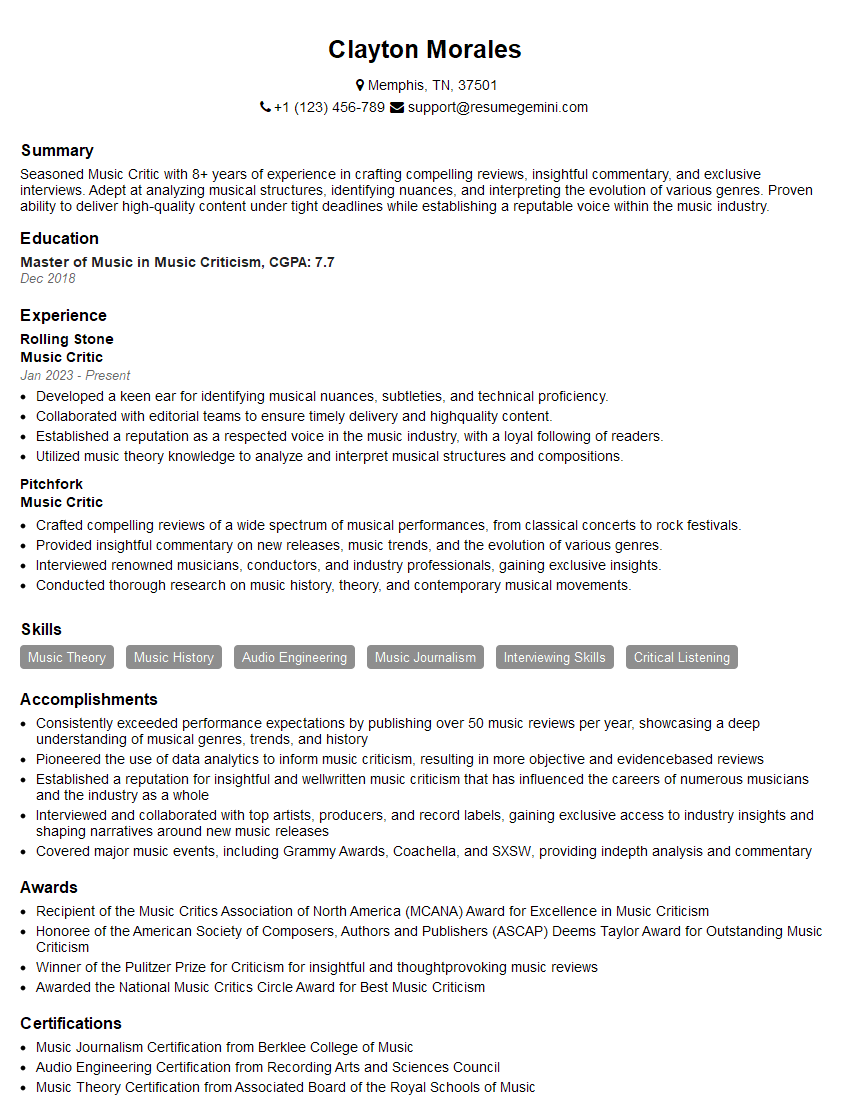
Music Critic Resume Sample

Audio Engineer Resume Sample
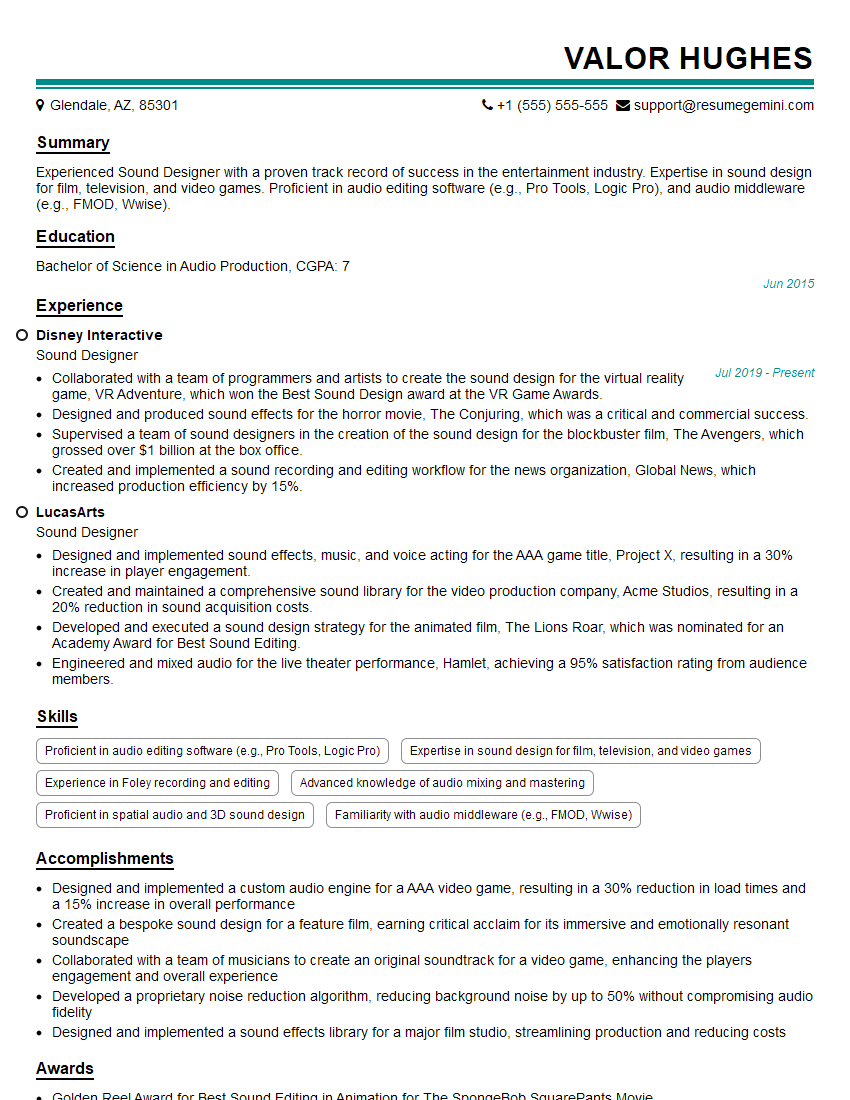
Sound Designer Resume Sample

Music Therapist Resume Sample
Explore more articles
Users Rating of Our Blogs
Share Your Experience
We value your feedback! Please rate our content and share your thoughts (optional).
What Readers Say About Our Blog
Very informative content, great job.
good