The right preparation can turn an interview into an opportunity to showcase your expertise. This guide to Music Supervision for Film and Television interview questions is your ultimate resource, providing key insights and tips to help you ace your responses and stand out as a top candidate.
Questions Asked in Music Supervision for Film and Television Interview
Q 1. Explain the process of securing music licenses for a film or television project.
Securing music licenses for film and television is a multi-step process requiring meticulous attention to detail and a deep understanding of copyright law. It begins with identifying the music needed – whether it’s pre-existing tracks or original compositions. For pre-existing music, we first identify the copyright holder (often a music publisher, record label, or the artist themselves). Then, we contact their licensing department or a specialized music licensing agency to negotiate a license. This involves submitting a detailed cue sheet outlining which song(s), how much of it will be used, and where in the project it will appear. The license agreement will specify the scope of use, the timeframe, and the associated fee (which can vary wildly depending on factors such as the song’s popularity, length of use, and the size of the project). For original music, the process involves commissioning a composer, agreeing upon creative direction, usage rights, and payment schedules. Throughout, thorough documentation and transparent communication are key to avoiding later disputes. Think of it like renting a car; you need a contract outlining the terms of use and the fees for that specific period.
Example: For a dramatic scene in a film, we may need to license a piece of classical music. We’d contact the copyright holder (possibly a music publisher holding rights to the composer’s work) with a detailed cue sheet specifying the scene, the segment of music used (e.g., 0:00-0:30), and the intended platform (e.g., theatrical release, streaming service). We then negotiate the license fee and secure the necessary rights.
Q 2. How do you manage budget constraints when selecting music for a project?
Budget constraints are a constant reality in film and television music supervision. Managing them effectively requires a strategic approach. We start by establishing a clear music budget early in the process, working closely with the producers. This involves prioritizing music cues based on their importance to the narrative. High-impact scenes, such as the climax or a crucial emotional moment, might justify higher-cost licenses, while less critical scenes can utilize more affordable options. We explore different licensing models, comparing fees for different types of licenses (e.g., full track vs. custom edit). We might also consider utilizing independent artists or composers who offer more competitive rates. Moreover, strategic use of original music can significantly reduce costs compared to licensing popular tracks.
Strategy: Imagine a layered approach: Tier 1 – essential scenes with high-profile music; Tier 2 – supporting scenes with mid-range licenses; Tier 3 – background music with budget-friendly options or royalty-free music.
Q 3. Describe your experience with music clearance and copyright issues.
Music clearance and copyright are paramount. My experience encompasses navigating the complexities of both domestic and international copyright laws. Many challenges arise, including ensuring the rights holder is correctly identified, accurately determining the scope of rights needed (e.g., synchronization, mechanical, master use), and verifying the accuracy of cue sheets. I’ve encountered instances where multiple parties hold rights to a single track, requiring negotiation with each. Cases of unregistered copyrights or unclear ownership structures present significant challenges, often necessitating thorough research and legal consultation. A well-documented, precise, and legally sound clearance process is crucial to avoid costly lawsuits.
Example: I once encountered a situation where a seemingly obscure track’s rights were split between a record label, a music publisher, and the artist’s estate. Securing clearance required careful negotiation with all three parties, ensuring each agreed to the terms and received their share of the licensing fee.
Q 4. How do you collaborate with composers to create original scores?
Collaborating with composers is a highly creative and rewarding aspect of the job. The process starts with detailed discussions about the project’s narrative, themes, and desired mood. I provide the composer with a comprehensive brief, including scene descriptions, mood boards, and reference tracks. This allows the composer to understand the vision and create a score that perfectly aligns with the film or show. We maintain constant communication throughout the composition process, providing feedback and making adjustments as needed. Regular listening sessions and detailed feedback rounds are crucial to ensure the score enhances the emotional impact of the narrative. The relationship is built on trust, open communication, and mutual respect for each other’s creative contributions.
Example: For a recent project, I collaborated with a composer who created a unique score using traditional instruments blended with electronic elements. The feedback process included numerous sessions where we discussed tempo, dynamics, and thematic development, refining the score to perfectly match the director’s vision.
Q 5. What strategies do you employ to find the right music for a specific scene or mood?
Finding the right music is often described as finding the ‘perfect needle in a haystack’. We use a multi-pronged approach: music libraries (both online and physical), independent artists, composers, and even exploring niche genres. For specific scenes or moods, I leverage detailed scene descriptions, storyboards, and mood boards to guide the search. Keywords, emotions, and even color palettes can be used to help pinpoint the right music. I might search for music using terms like ‘tense suspense’ or ‘eerie atmosphere’ or specific instrumentations. I also employ trial and error, listening to numerous tracks until the perfect fit is discovered. The use of music search engines and AI-powered tools also significantly accelerate this process.
Example: For a tense scene requiring a sense of impending doom, I used a combination of a music library search using keywords such as “ominous strings” and “low-frequency drones,” alongside exploring independent artists working in dark ambient music.
Q 6. How do you handle disputes or challenges with rights holders?
Disputes with rights holders are sometimes unavoidable. When such disagreements arise, clear, professional communication is paramount. I prioritize maintaining a respectful dialogue, clearly outlining the project’s scope and adhering to agreed-upon contractual obligations. Thorough documentation, including detailed cue sheets, contracts, and correspondence, is crucial in resolving disputes. If a friendly resolution is not possible, I consult with legal counsel specializing in copyright and entertainment law. Early intervention and mediation are often preferred methods to avoid litigation.
Example: In one instance, a disagreement arose over the length of a licensed track’s use. By referring to the original contract, providing detailed evidence of the actual use, and engaging in respectful dialogue, we were able to reach a mutually acceptable resolution.
Q 7. Explain your familiarity with different music licensing models (e.g., mechanical, synchronization).
Understanding music licensing models is crucial. Mechanical licenses grant the right to reproduce and distribute a musical work in physical or digital formats (e.g., CDs, downloads). Synchronization licenses grant the right to synchronize the musical work with visual media, like film or television. These two are often bundled for film or television projects. Master use licenses grant the right to use the specific recording of the song. Performance licenses are needed for public performances, relevant for screenings or broadcasts. Print licenses cover the reproduction of sheet music. The fees associated with each vary significantly. Clear understanding of these models allows for efficient negotiation and accurate budgeting. Incorrect licensing can result in infringement and costly consequences.
Example: When using a pre-existing song, we need a synchronization license to use it in the film and a master use license if the specific recording needs to be used. If we distribute the film on digital platforms, we may need mechanical licenses as well.
Q 8. How do you source music from independent artists and labels?
Sourcing music from independent artists and labels is crucial for finding unique and cost-effective sounds that fit a project’s specific needs. It’s a multi-faceted process that relies on a network of contacts and diligent research.
- Online Platforms: Websites like Bandcamp, SoundCloud, and even Instagram often showcase talented independent musicians. I actively browse these platforms, searching for artists whose styles align with the project’s aesthetic.
- Music Blogs and Curated Playlists: Many online blogs and publications focus on independent music. These can be invaluable resources for discovering emerging artists and genres. I often create custom playlists on Spotify or Apple Music to explore various styles systematically.
- Industry Networking: Attending industry events, conferences (like South by Southwest or CMJ), and connecting with other music supervisors broadens my network and leads to exciting discoveries. Word-of-mouth recommendations are often the best source of hidden gems.
- Direct Outreach: Once I’ve identified promising artists, I’ll often reach out directly through their website or social media. A personalized message expressing my interest in their music and how it might fit the project demonstrates genuine enthusiasm and professionalism.
- Independent Labels: I maintain a list of reputable independent labels known for specific genres. Reaching out to their A&R (artists and repertoire) teams can be a fruitful way to access a catalogue of established and emerging talent.
For example, I recently discovered a fantastic bluegrass band on Bandcamp whose music perfectly complemented a scene in a Western TV series. Their unique sound, unavailable through major libraries, added a distinct authenticity to the project.
Q 9. Describe your experience working with music libraries and publishers.
Music libraries and publishers are essential components of a music supervisor’s toolkit. They offer a vast catalogue of pre-cleared music, streamlining the licensing process and reducing the risk of copyright infringement. However, navigating these resources effectively requires careful understanding of their offerings and limitations.
- Music Libraries: Libraries like APM Music, Killer Tracks, and Extreme Music offer extensive catalogues, often organized by genre, mood, and instrumentation. They provide convenient access to a broad range of styles, making them ideal for quick turnaround projects or when a specific sound is readily available. However, their tracks are often generic, and finding truly unique sounds can be challenging.
- Publishers: Working with music publishers involves securing licenses for individual tracks from songwriters and composers. Publishers represent the rights holders, negotiating the terms of use and ensuring proper compensation. This approach gives access to a wider variety of high-quality music but often involves more complex licensing procedures and higher costs.
My experience spans both. I find that using a combination of libraries and publisher-represented music is often the most effective strategy. Libraries offer speed and efficiency for background scores, while direct publisher relations are crucial for securing unique compositions or iconic songs.
Q 10. How do you balance the creative vision with the budget and legal requirements?
Balancing creative vision with budget and legal requirements is the core challenge of music supervision. It’s a delicate dance requiring meticulous planning and effective communication.
- Prioritization: Early in the process, I collaborate with the director and producers to establish clear priorities. What aspects of the project are most important? A strong emotional core might justify a higher budget for a custom score, while a more visually driven project might allow for a greater reliance on cost-effective library music.
- Budget Allocation: Once priorities are defined, the budget is allocated accordingly. A detailed music budget, itemizing costs for licensing, clearances, and custom composition, is vital. This ensures transparency and prevents cost overruns.
- Negotiation: Negotiating favorable licensing deals requires skill and experience. I leverage my relationships with publishers and labels to secure the best possible terms within the established budget. This involves understanding the nuances of various licensing agreements (e.g., mechanical licenses, synchronization licenses).
- Legal Compliance: Every music selection must be legally cleared, ensuring all necessary rights (performance, mechanical, synchronization) are secured. This involves meticulous record-keeping and close collaboration with the project’s legal team.
For example, in a recent low-budget indie film, we opted for a largely library-based score, supplementing it with a few custom pieces for key emotional moments to maximize impact within the financial constraints.
Q 11. Explain your understanding of music cue sheets and their importance.
A music cue sheet is a crucial document that lists all the music used in a film or television project. It’s a legal and accounting necessity, providing essential information for royalty payments and copyright compliance.
The cue sheet typically includes:
- Scene Description: A brief description of the scene where the music appears.
- Start Time and End Time: Precise timestamps indicating the duration of each musical cue.
- Artist Name: The name of the performing artist or composer.
- Song Title: The title of the song or composition.
- Writer Name(s): Names of the songwriter(s) and composer(s).
- Publisher Name(s): Name(s) of the music publishers.
- Licensee: The entity that holds the license to use the music.
The importance of a meticulously prepared cue sheet cannot be overstated. It’s a cornerstone of legal compliance, ensuring that all rights holders are properly compensated and avoids potential copyright infringements, which could lead to costly lawsuits and project delays.
Q 12. How do you ensure that the music selected aligns with the overall tone and style of the project?
Aligning music with the overall tone and style is paramount. It’s about enhancing the emotional impact of the narrative without being distracting or incongruous. This requires a deep understanding of both the film/TV project and the nuances of music.
- Script Analysis: I begin by carefully analyzing the script, identifying key emotional beats, thematic elements, and the overall mood. This creates a foundation for choosing music that resonates with the narrative.
- Visual Storytelling: Collaborating closely with the director and editor is essential. Watching rough cuts and discussing the intended emotional impact of specific scenes helps me select music that enhances the visual storytelling.
- Genre Considerations: The genre of the project heavily influences music choices. A thriller needs a different sonic landscape compared to a romantic comedy. I select music that supports the project’s genre conventions while potentially adding unexpected twists.
- Mood Boards and Reference Tracks: I often create mood boards to visually represent the desired musical atmosphere. Sharing reference tracks with the creative team allows for clear communication and helps ensure everyone is on the same page.
For instance, when working on a period drama, I carefully selected classical compositions that were both historically appropriate and emotionally resonant, complementing the setting and the characters’ journeys.
Q 13. Describe your experience using music editing software (e.g., Pro Tools, Logic Pro).
Proficiency in music editing software like Pro Tools and Logic Pro is fundamental to a music supervisor’s role. It allows for precise manipulation of musical cues, creation of custom edits, and smooth integration into the visual medium.
My experience includes using both Pro Tools and Logic Pro extensively. I’m adept at:
- Editing and Sequencing: Precisely trimming and arranging musical cues to match the scene’s length and emotional flow.
- Tempo and Pitch Correction: Adjusting the tempo and pitch of music to match the visual pacing and overall feel of a scene.
- Sound Design Integration: Blending music with sound effects and dialogue to create a cohesive soundscape.
- Creating Custom Transitions: Crafting seamless transitions between musical cues to avoid jarring changes in the soundtrack.
For example, I recently used Pro Tools to create a custom edit of a song, subtly altering the tempo to synchronize perfectly with a fast-paced action sequence, resulting in a much more intense viewing experience.
Q 14. How do you handle the technical aspects of music integration, such as mixing and mastering?
Handling the technical aspects of music integration involves ensuring the music sits perfectly within the overall audio mix. This requires a strong understanding of audio engineering principles and collaboration with sound mixers and mastering engineers.
- Audio File Preparation: I ensure that all music files are properly formatted and delivered in high-quality audio formats (e.g., WAV, AIFF). Metadata is also meticulously checked for accuracy.
- Mixing Collaboration: I work closely with the sound mixer to ensure the music integrates seamlessly with the dialogue, sound effects, and overall soundscape. This often involves adjusting levels, EQ, and panning to create optimal balance and clarity.
- Mastering Coordination: Once the mix is finalized, I collaborate with a mastering engineer to optimize the final audio for broadcast and distribution. Mastering ensures consistency in volume levels and dynamic range across various platforms.
- Format Conversion and Delivery: I prepare the final music tracks in the appropriate formats for various delivery platforms, ensuring compliance with technical specifications for broadcasting and streaming services.
Effective communication and collaboration with the audio team are crucial throughout this process. It’s vital to have a shared understanding of the desired sonic outcome.
Q 15. What is your approach to finding needle-drop music for a project?
Finding the perfect needle-drop—that is, pre-existing music—is a blend of art and science. My approach begins with a deep understanding of the project’s tone, genre, and target audience. I start by collaborating closely with the director to define the emotional arc and key moments needing musical underscoring. Then, I utilize a multi-pronged strategy:
Keyword-driven searches: I use sophisticated search terms across major music libraries like ASCAP, BMI, and SESAC, as well as specialized platforms catering to licensing. This involves brainstorming synonyms and related concepts to cast a wide net.
Genre-based exploration: I delve into specific genres aligned with the project’s aesthetic. For example, a gritty crime drama might necessitate exploring blues, jazz, or even experimental electronic music, depending on the director’s vision.
Direct artist outreach: For unique sounds or a specific artist’s work, I directly contact publishers or their representatives. Building these relationships is crucial for securing exclusive licenses or custom-composed tracks.
Mood board creation: I often build a mood board containing visual references, color palettes, and even sample songs to refine the sonic direction and guide my search. This aids in communicating my vision to the team and the artists.
Finally, I always prioritize legal clearance. Each track’s licensing requirements are meticulously investigated to ensure compliance and avoid potential copyright issues.
Career Expert Tips:
- Ace those interviews! Prepare effectively by reviewing the Top 50 Most Common Interview Questions on ResumeGemini.
- Navigate your job search with confidence! Explore a wide range of Career Tips on ResumeGemini. Learn about common challenges and recommendations to overcome them.
- Craft the perfect resume! Master the Art of Resume Writing with ResumeGemini’s guide. Showcase your unique qualifications and achievements effectively.
- Don’t miss out on holiday savings! Build your dream resume with ResumeGemini’s ATS optimized templates.
Q 16. How do you work effectively with a director and other members of the production team?
Effective collaboration is paramount. I believe in establishing open communication from the outset. With the director, I participate actively in story discussions, reviewing cuts and providing musical suggestions early on. This proactive approach allows for seamless integration of the music into the narrative. With other team members, such as the editor and sound designer, I maintain regular check-ins, sharing updates and seeking feedback. For instance, the editor might suggest alternative placements for a track based on the pacing of a scene, and I would adapt accordingly. A collaborative environment encourages creative solutions and ensures everyone’s vision is considered. I firmly believe in transparent communication—openly sharing licensing costs and any potential challenges or opportunities.
Q 17. Describe your experience with temp tracks and how you use them in the process.
Temp tracks are crucial. They serve as placeholders, offering a temporary musical framework to guide the editing process and evoke the desired emotional response. I carefully select temp tracks that accurately represent the intended mood and pace of each scene. This can involve using existing music, or even composing simple instrumental pieces. I work closely with the editor to ensure the temp track’s timing and emotional rhythm align with the picture. Once the editing is finalized, I begin the process of finding the ‘real’ music, using the temp track as a guiding template. The process is iterative; sometimes the temp track becomes the inspiration, and we attempt to license it, other times it is merely a roadmap. The beauty of this process is in its flexibility – it allows for a smooth transition from temp to final music. Often, directors fall in love with the mood of the temp track, and we hunt for something similar or even seek an alternative license.
Q 18. How do you manage the logistical aspects of music acquisition and delivery?
Managing music acquisition and delivery involves meticulous record-keeping and proactive communication. I utilize project management software to track licenses, costs, deadlines, and communication with rights holders. Each track’s licensing information—usage rights, territories, duration, and fees—is meticulously documented. I coordinate the delivery of stems (individual tracks) to the sound mixer, ensuring that the correct version is provided in the appropriate format, as the mixer requires very high-quality audio. I maintain a close relationship with the music supervisors and licensing houses, providing timely updates and promptly addressing any issues. Clear communication and organization are key to ensuring the seamless integration of music into the post-production workflow.
Q 19. Explain your experience with various music genres and styles.
My experience spans a wide range of genres, from classic film scores to contemporary indie rock, hip-hop, electronic, and world music. Each genre presents unique challenges and opportunities. For example, licensing classic rock might be more expensive and complex due to high demand, while securing rights for lesser-known artists might require more extensive research. My versatility allows me to adapt my approach to suit the project’s stylistic needs and effectively search across all relevant libraries.
Recently, I worked on a documentary that required a blend of folk, traditional African, and ambient electronic music. This demanded a deep dive into specialized libraries and networking with independent artists, showcasing my adaptive skills within diverse genres.
Q 20. How do you ensure the quality of the music used in a project meets professional standards?
Quality assurance involves several steps. First, I prioritize high-fidelity audio from reputable sources. I work with experienced sound mixers and mastering engineers to ensure optimal audio quality. The music should be well-produced, and seamlessly integrated into the film’s soundscape. Additionally, I listen attentively for any inconsistencies or technical flaws. Before final approval, I conduct rigorous quality checks through listening tests on various playback systems. Ensuring consistent levels across scenes and maintaining a cohesive sonic palette are essential to meet professional standards.
Q 21. How do you track music costs and manage the music budget effectively?
Budget management is crucial. I meticulously track all music-related costs, from licensing fees and clearances to composer fees and any associated administrative costs. I create detailed budget spreadsheets that outline each track’s cost, payment schedule, and any potential overages. I regularly report on expenditures and anticipated costs to producers and other stakeholders, proactively identifying and managing any potential budget issues. By accurately forecasting costs and securing appropriate clearances early on, I help avoid unexpected expenses and maintain transparency. Negotiating favorable licensing agreements and exploring creative solutions, like using lesser-known artists, contribute to budget optimization without sacrificing quality.
Q 22. Describe your familiarity with music industry regulations and best practices.
My familiarity with music industry regulations and best practices is extensive. I have a deep understanding of copyright law, particularly as it relates to musical works, sound recordings, and synchronization rights. This includes knowledge of different licensing types – mechanical, performance, synchronization, master use – and the nuances of each. I’m also well-versed in the complexities of collecting societies like ASCAP, BMI, and SESAC, and how their licensing agreements impact music supervision. Best practices encompass ethical considerations, fair compensation for artists and rights holders, and maintaining transparent and collaborative relationships throughout the licensing process. This includes meticulous record-keeping and adherence to industry standards to prevent future legal issues.
- Understanding the difference between composition and master rights.
- Negotiating favorable terms within the legal framework.
- Managing the complexities of multiple rights holders for a single track.
- Staying up-to-date with evolving copyright laws and industry trends.
Q 23. How do you handle the legal aspects of music licensing and clearance?
Handling the legal aspects of music licensing and clearance is a crucial part of my role. It begins with identifying all necessary rights holders – the composer(s), publisher(s), and the master recording rights holder(s). I then prepare detailed cue sheets listing all music used in the project, specifying the exact timings and identifying the specific rights needed (e.g., synchronization, master use, performance). These cue sheets are essential for the legal clearance process. I work closely with music licensing companies and legal counsel to secure the necessary licenses, ensuring all clearances are obtained before the project is finalized. This includes negotiating license agreements, ensuring proper payment, and carefully reviewing all legal documents to ensure compliance. Failure to secure proper clearance can lead to costly legal battles and project delays.
Q 24. How do you negotiate with rights holders to secure favorable licensing terms?
Negotiating with rights holders requires a blend of diplomacy, strategic thinking, and a thorough understanding of market value. Before any negotiation, I conduct thorough research to determine the fair market value for the specific license based on factors such as the song’s popularity, the project’s budget, and the length of use. I always aim for a win-win scenario, offering a fair price while keeping the project’s budget in mind. Sometimes, this may involve negotiating different payment structures (upfront payment, royalties, deferred payments), usage territories, or offering creative trade-offs in exchange for favorable terms. Building strong relationships with artists, publishers, and their representatives is key to securing long-term, beneficial relationships. Open communication and transparency throughout the negotiation process are paramount.
For example, I might offer exposure on a high-profile project in exchange for a lower licensing fee for an independent artist seeking broader visibility.
Q 25. Describe your experience with music supervision for different platforms (e.g., streaming, broadcast).
My experience spans various platforms, including streaming services (Netflix, Hulu, Spotify), broadcast television (network and cable), film (feature films, independent films, documentaries), and commercials. Each platform has its own specific requirements and legal considerations. For instance, streaming services often require longer license terms and may have specific delivery formats for audio files. Broadcast television has stricter regulations regarding content and often involves clearance through different performing rights organizations. In film, the process is more involved, requiring extensive cue sheet preparation and meticulous legal review. My ability to adapt my approach to these differing platforms is crucial to my success. In all cases, I prioritize quality control and deliver high-quality audio files formatted to meet specific platform requirements.
Q 26. How do you adapt your approach to music supervision based on the project’s genre and target audience?
Adapting my approach to a project’s genre and target audience is paramount. For a period drama, the music will differ significantly from a fast-paced action thriller. Understanding the emotional tone, setting, and target demographic informs every decision – from the genre of music selected to the specific artists and styles considered. For instance, a family-friendly children’s show would require music free of explicit lyrics and potentially licensed through organizations specializing in children’s content. Conversely, a gritty crime drama might utilize more experimental or alternative music to reinforce the show’s atmosphere. I carefully analyze the script, storyboard, and target audience to ensure a seamless integration of music with the project’s overall aesthetic.
Q 27. How do you assess the potential risks associated with using particular music tracks?
Assessing potential risks involves a multi-faceted approach. This includes analyzing the song’s lyrical content for any potentially offensive or controversial material, checking for any existing legal disputes surrounding the song or artist, and verifying the availability of the rights. I also consider the song’s popularity and potential for future controversies. A song that’s currently popular might become associated with negative events later, affecting the project’s image. Thorough due diligence, including background checks on the artists and rights holders, helps mitigate these risks. Careful selection, informed by research and industry knowledge, is vital to minimizing potential legal and reputational problems. It’s better to be cautious and avoid potentially risky music than to face costly legal issues down the line.
Q 28. Describe a situation where you had to resolve a conflict regarding music licensing or clearance.
In one project, a crucial scene needed a specific track that proved exceptionally difficult to clear. The rights were split between multiple international publishers and obtaining their combined consent was proving impossible within the deadline. We initially attempted direct negotiations with each publisher, which stalled due to communication difficulties and conflicting legal interpretations of the license terms. The solution involved a three-pronged approach: Firstly, we engaged an international music licensing specialist to navigate the complex legal terrain and consolidate communications. Secondly, we prepared alternative musical options to be presented if negotiations failed. Finally, I worked directly with the director and editor to explore the possibility of minor script changes to reduce our reliance on this specific track. Through this collaborative effort, we eventually obtained the necessary clearances, but it highlighted the importance of proactive planning, thorough due diligence, and the value of strong professional networks in navigating these challenges.
Key Topics to Learn for Music Supervision for Film and Television Interview
- Understanding the Narrative: Analyzing scripts and storyboards to identify emotional arcs and musical needs. Practical application: Developing a musical strategy that complements the film’s narrative effectively.
- Copyright and Licensing: Navigating the complexities of music rights, clearances, and negotiations. Practical application: Budgeting for music and securing necessary licenses within time constraints.
- Building Relationships: Networking with composers, artists, publishers, and legal professionals. Practical application: Demonstrating your ability to collaborate and build strong working relationships to acquire the best music for a project.
- Budgeting and Resource Management: Effectively managing music budgets and allocating resources. Practical application: Creating detailed cost breakdowns and securing approval from producers and other stakeholders.
- Technical Aspects: Understanding audio post-production workflows, audio editing software, and sound design principles. Practical application: Knowing how to prepare and deliver music assets in various formats and resolutions for film and TV delivery.
- Pitching and Presentation: Effectively communicating musical ideas to producers and directors. Practical application: Preparing compelling presentations showcasing your creative vision and understanding of music’s role in storytelling.
- Legal and Ethical Considerations: Understanding the legal implications of music usage in film and television. Practical application: Demonstrating a strong understanding of copyright law and best practices for ethical music acquisition.
Next Steps
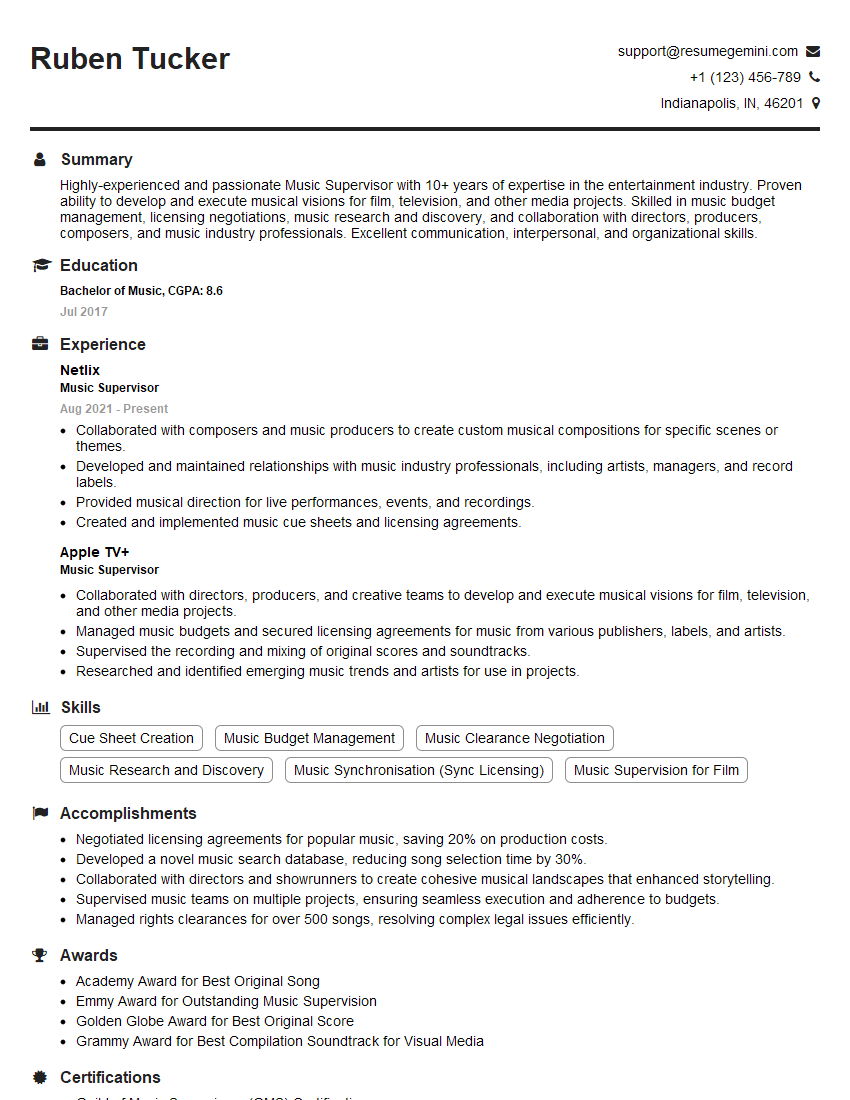
Mastering Music Supervision for Film and Television opens doors to a creatively fulfilling and highly sought-after career. It’s a field demanding both artistic sensibility and meticulous business acumen. To maximize your job prospects, crafting a compelling and ATS-friendly resume is paramount. ResumeGemini is a trusted resource to help you build a professional resume that showcases your skills and experience effectively. Examples of resumes tailored to Music Supervision for Film and Television are available to help guide your resume building process, allowing you to present your unique strengths and experience in the best possible light. Invest the time in creating a strong resume; it’s your first impression in this competitive landscape.
Explore more articles
Users Rating of Our Blogs
Share Your Experience
We value your feedback! Please rate our content and share your thoughts (optional).
What Readers Say About Our Blog
Very informative content, great job.
good