Are you ready to stand out in your next interview? Understanding and preparing for Music Synchronization and Copyright Management interview questions is a game-changer. In this blog, we’ve compiled key questions and expert advice to help you showcase your skills with confidence and precision. Let’s get started on your journey to acing the interview.
Questions Asked in Music Synchronization and Copyright Management Interview
Q 1. Explain the difference between mechanical and synchronization licenses.
Mechanical and synchronization licenses are both crucial for using pre-existing music in audiovisual projects, but they cover different rights. Think of it like this: the mechanical license covers the right to reproduce the musical composition (the song itself, the notes on paper), while the synchronization license covers the right to synchronize that composition with visual media (like a film or TV show).
Mechanical License: This license grants permission to reproduce and distribute a musical work in physical or digital formats. For example, if you want to include a cover version of a song in your film’s soundtrack album, you need a mechanical license. The rate is usually set by statutory rules or negotiated with the publisher.
Synchronization License: This license permits the synchronization of a musical composition with visual images in a film, television program, commercial, video game, etc. It covers the act of embedding the song within the visual medium. This license often involves higher fees than a mechanical license because it’s considered a more valuable use of the music.
Essentially, you need a mechanical license to make copies of the music and a synchronization license to use it in a video. Often, both are required for a single project.
Q 2. What are the key considerations when negotiating a synchronization license agreement?
Negotiating synchronization licenses requires careful consideration of several key factors. It’s not just about the fee; the agreement’s terms and conditions are critical. Key considerations include:
License Fee: This varies widely depending on factors like the song’s popularity, the length of the usage, the project’s budget, and the territory of distribution.
Term of the License: Defining the duration for which the license is granted, including options for extensions.
Territory of Use: Specifying where the project can be distributed, e.g., globally, within a specific country, or online only.
Media: Clarifying the platforms on which the project can be distributed (e.g., theatrical release, streaming services, television broadcast).
Exclusivity: Determining whether the license is exclusive (only one project can use the music) or non-exclusive (the song can be used in other projects simultaneously).
Credit and Promotion: Determining how the songwriter and publisher will be credited in the project and on any promotional materials.
Indemnification: A critical clause addressing the responsibility for potential legal claims relating to copyright infringement.
I always advise clients to consult with legal counsel to review and negotiate the agreement before signing, ensuring the terms are favorable and protect their interests.
Q 3. How do you identify and clear music rights for a film or television project?
Identifying and clearing music rights for a film or television project is a meticulous process. It’s akin to a detective investigation, requiring thorough research and careful documentation. Here’s a breakdown:
Music Selection: Identify the songs or musical compositions to be used. This is often done early in the production process to avoid delays.
Copyright Research: Determine the copyright holders of both the composition (the song itself) and the master recording (the actual recording of the song). This often involves searching online databases, contacting publishers, and potentially hiring specialized music rights clearance companies.
Contacting Rights Holders: Directly contacting the copyright owners (publishers and/or record labels) to request licenses. This usually involves providing detailed information about the project to help them assess the request.
Negotiating and Securing Licenses: Negotiating the terms of the license agreements, ensuring all details are clearly defined and acceptable to both parties. This includes obtaining mechanical and synchronization licenses as needed.
Documentation and Payment: Meticulously document all agreements and payments. Keep clear records of licenses, including the license agreements themselves, payment receipts, and communication with rights holders.
This entire process needs to be meticulously documented to avoid potential legal issues later on.
Q 4. Describe your experience with music licensing databases and platforms.
My experience with music licensing databases and platforms is extensive. I’ve worked with various platforms, including Harry Fox Agency (HFA), ASCAP, BMI, SESAC, and several specialized music libraries. Each platform has its strengths and weaknesses. For example, HFA specializes in mechanical licenses, while ASCAP, BMI, and SESAC are Performing Rights Organizations (PROs) that manage public performance rights. Specialized libraries offer curated collections with pre-cleared licenses. I find it beneficial to use a combination of resources for comprehensive research.
I’m proficient in using these platforms to search for compositions, identify copyright holders, and obtain license quotes. This expertise allows me to efficiently clear rights and manage licensing costs effectively. My experience also includes using custom-built internal databases for tracking licenses, payments, and other crucial details. These custom databases help maintain an organized and efficient workflow, especially for larger projects.
Q 5. What strategies do you employ to manage copyright compliance?
Managing copyright compliance involves a proactive and systematic approach. It’s not simply about obtaining licenses; it’s about ongoing monitoring and prevention. My strategies include:
Thorough Due Diligence: Conducting extensive research at the outset of any project to identify all potential copyright holders.
Centralized Database: Maintaining a centralized database to track all licenses, agreements, payments, and communication with rights holders. This allows for easy auditing and ensures nothing is overlooked.
Regular Audits: Periodically auditing the database and relevant agreements to verify that everything remains compliant. This helps identify potential lapses or issues early on.
Proactive Communication: Maintaining open and clear communication with rights holders throughout the project lifecycle to address any questions or concerns.
Legal Consultation: Consulting with legal counsel when required to resolve complex issues or provide guidance on specific legal matters.
By implementing these strategies, I minimize the risk of copyright infringement and ensure long-term compliance.
Q 6. How do you handle disputes over music rights?
Disputes over music rights can be complex and often require legal intervention. My approach involves:
Attempting Negotiation: First, I try to resolve the dispute through negotiation and communication with the involved parties. Often, misunderstandings can be clarified and resolved amicably.
Mediation: If negotiation fails, I might suggest mediation, a process where a neutral third party helps facilitate a resolution.
Legal Counsel: If mediation is unsuccessful, legal counsel is essential. This involves consulting with lawyers specializing in copyright law to assess the situation and advise on appropriate legal action.
Litigation: In extreme cases, litigation may be necessary, though it is often costly and time-consuming. This involves filing a lawsuit to resolve the dispute in court.
My experience shows that early intervention and proactive communication often prevent disputes from escalating into costly and drawn-out legal battles.
Q 7. Explain the process of obtaining a master use license.
A master use license grants permission to use a specific sound recording (the master) in a project. Unlike the composition license which covers the underlying musical work, the master use license focuses solely on the particular recording of that work. For example, the master is the actual recording by a specific artist, and the composition is the written music itself.
Obtaining a master use license typically involves contacting the record label or other copyright holder of the master recording. This process is similar to obtaining a synchronization license but specifically addresses the right to use that particular recording. The negotiation process includes discussing the fee, territory, media, and term of use. Similar to synchronization licensing, detailed documentation and payment are crucial for maintaining compliance.
In short, you would need a master use license in addition to a synchronization license to use a specific recording of a song in your project.
Q 8. How do you determine the fair market value of a synchronization license?
Determining the fair market value of a synchronization license is a multifaceted process that considers several key factors. It’s not a simple formula, but rather a negotiation based on the perceived value of the music in the context of the visual project. Think of it like this: a catchy song in a major Hollywood blockbuster will command a much higher fee than the same song used in a low-budget independent film.
Factors influencing fair market value include:
- The song’s popularity and usage history: A chart-topping hit will naturally command a higher fee than an obscure track.
- The length of the synchronization license: A longer license, covering more uses (e.g., theatrical release, television broadcast, streaming) will cost more.
- The nature of the visual project: High-profile projects with significant reach (major motion picture, primetime television) will pay more than low-profile projects.
- The intended use of the music: Is it crucial to the storyline, used subtly in the background, or prominently featured in a key scene? This greatly affects the value.
- Territory: The geographical area the licensed music is used in influences licensing costs. A worldwide license costs considerably more than a license for a single country.
- Negotiating power of both parties: A major record label with a successful artist will naturally hold more bargaining power than an independent artist with less exposure.
Often, a comparable analysis of past similar deals is employed, considering the song’s popularity, the project’s budget, and the specific licensing terms. This helps establish a reasonable range for negotiation.
Q 9. What are the legal implications of using copyrighted music without permission?
Using copyrighted music without permission carries significant legal implications, primarily centered around copyright infringement. This can result in severe consequences for both individuals and organizations. Think of it as stealing – it’s a violation of the copyright holder’s exclusive rights to reproduce, distribute, and publicly perform their work.
Legal implications include:
- Legal action from copyright holders: This can lead to lawsuits demanding significant financial compensation (potentially including damages, attorney fees, and profits made from the infringement).
- Injunctions: Courts can order the infringing material to be removed and prevent further use.
- Criminal penalties: In some cases, particularly for large-scale or commercial infringement, criminal charges can be filed, leading to fines or even imprisonment.
- Damage to reputation and brand image: Even if not legally pursued, unauthorized use can significantly damage the reputation and credibility of the infringing party.
It’s crucial to obtain proper synchronization licenses, ensuring compliance with copyright laws and protecting oneself from potential legal repercussions. Ignoring these laws is a considerable risk, both financially and legally.
Q 10. Describe your experience with international copyright laws.
My experience with international copyright laws involves navigating the complexities of diverse legal frameworks across different countries. Each country has its unique laws regarding copyright protection, including the length of protection, the required registration procedures, and the rights granted to copyright holders. This requires a thorough understanding of specific national laws and international treaties, such as the Berne Convention and the WIPO Copyright Treaty.
For instance, the duration of copyright protection can vary significantly across countries. Dealing with licensing across multiple territories requires detailed research and often necessitates engaging local legal counsel in specific jurisdictions to ensure full compliance with local regulations. A crucial aspect of this work includes understanding the differences in how different countries interpret fair use or fair dealing doctrines, as these exceptions to copyright infringement differ significantly in their application.
I’ve managed several international synchronization deals, requiring meticulous due diligence to ensure compliance with each territory’s copyright rules, which often involves collaboration with music rights organizations (MROs) and international licensing agencies to secure necessary permissions.
Q 11. How do you track and manage music licensing fees and payments?
Tracking and managing music licensing fees and payments requires a robust and organized system. This typically involves a combination of dedicated software, spreadsheets, and meticulous record-keeping. The complexity grows exponentially with the volume of licenses and the number of involved parties.
My approach involves:
- Dedicated software: Employing software specifically designed for royalty management, capable of tracking licenses, payments, and associated accounting data.
- Detailed spreadsheets: Maintaining detailed spreadsheets to track each license agreement, including details like the licensor, licensee, usage terms, payment schedules, and any outstanding amounts.
- Regular reconciliation: Regular reconciliation of income and expenditure, comparing figures from the software and bank statements to ensure accuracy and identify any discrepancies.
- Automated payment reminders: Setting up automated systems to send payment reminders to licensees and track payments from them.
- Secure storage of documents: Keeping all relevant licensing agreements, invoices, and payment confirmations securely stored for audit trail purposes.
A crucial element is clear and transparent communication with all stakeholders – composers, publishers, and licensees – ensuring everyone has access to up-to-date information.
Q 12. What is the difference between a composer’s share and a publisher’s share?
The distinction between a composer’s share and a publisher’s share relates to the division of royalties generated from the exploitation of a musical work. It’s essentially a contractual agreement defining how the revenue is split between the person who wrote the music (composer) and the entity that manages and promotes it (publisher).
The composer’s share represents the portion of the royalties earned that directly goes to the songwriter for creating the musical composition. This share is typically determined through the terms of a publishing agreement. The composer retains ownership of the copyright to their composition.
The publisher’s share is the portion that compensates the publisher for their services. These services include securing synchronization licenses, promoting the music to potential users, collecting royalties, handling administrative tasks, and actively marketing the compositions.
The exact split can vary significantly depending on the contract; typical arrangements range from a 50/50 split to a 60/40 or even 70/30 split, favoring either the composer or the publisher, based on negotiation and the terms of the agreement.
Q 13. How do you navigate complex music rights involving multiple publishers and songwriters?
Navigating complex music rights involving multiple publishers and songwriters requires a systematic and organized approach. It involves careful identification of all rights holders and securing the necessary permissions from each one. This task demands meticulous research, precise communication, and a deep understanding of copyright law.
My approach involves:
- Identifying all rights holders: Thoroughly researching the song’s ownership, identifying all composers, publishers, and any sub-publishers involved.
- Contacting each rights holder: Direct communication with each rights holder is crucial to negotiate licensing terms and secure agreements.
- Negotiating and documenting agreements: Detailed licensing agreements are crucial to outline the usage rights, territory, timeframe, fee structure, and payment terms for each rights holder.
- Managing multiple agreements: Tracking multiple agreements and ensuring timely payment to each rights holder requires a robust organizational system.
- Clear communication: Maintaining open communication with all stakeholders is critical to resolve any conflicts or ambiguities.
This can be likened to assembling a complex puzzle where each piece represents a different rights holder and agreement. Success requires patience, attention to detail, and clear communication to ensure each piece fits correctly.
Q 14. Explain your experience with various licensing agreements (e.g., blanket licenses, one-off licenses).
My experience encompasses a wide range of licensing agreements, each with its own distinct features and applications. Understanding the nuances of different licensing models is crucial for effective music synchronization.
Blanket Licenses: These licenses offer broad usage rights for a set fee, covering a large repertoire of music. They are commonly used by television networks, streaming services, and other organizations needing extensive music libraries. Negotiating blanket licenses requires extensive knowledge of the music catalog, usage projections, and agreement terms.
One-Off Licenses (or individual synchronization licenses): These licenses grant specific usage rights for a single piece of music within a particular project, such as a film, commercial, or video game. They usually involve individual negotiations with composers or publishers, focusing on the specifics of the intended usage. Examples include licensing a specific song for a movie scene or a jingle for a TV ad. Each one needs a separate contract.
Mechanical Licenses: These licenses grant permission to reproduce a musical work in a tangible form (CDs, downloads), separate from synchronization rights. Understanding the interplay between different license types is often crucial. For example, you might need a mechanical license in addition to a synchronization license if you intend to produce and distribute a sound recording of the synced music.
I have experience structuring and negotiating each of these license types, ensuring appropriate usage rights and fair compensation for all parties involved.
Q 15. How do you ensure the accuracy and completeness of music metadata?
Ensuring accurate and complete music metadata is paramount in music synchronization and copyright management. Think of metadata as the vital information passport for a song. Inaccurate metadata leads to licensing delays, payment issues, and even legal disputes. My approach involves a multi-layered system:
- Source Verification: I meticulously check all metadata sources, prioritizing primary sources like publisher websites and music databases over secondary sources. This helps to avoid propagation of errors.
- Data Standardization: I adhere to standardized metadata schemas like ISRC (International Standard Recording Code) and ISWC (International Standard Musical Work Code). Consistent formatting prevents ambiguity and ensures compatibility across different systems.
- Cross-referencing: I cross-check information from multiple sources to identify discrepancies and inconsistencies. For example, comparing artist names, song titles, and album titles across different databases.
- Automated Checks: I leverage automated tools to identify common metadata errors, such as missing information or inconsistent formats. These tools can significantly speed up the verification process and catch errors human eyes might miss.
- Human Review: Despite automation, human review is critical. I manually check a sample of the metadata to ensure the automated tools are functioning correctly and to catch subtle errors that might escape automated checks.
For instance, recently I identified a discrepancy in the composer’s name on a track. By cross-referencing several databases and the composer’s official website, I resolved the issue and prevented a potential licensing problem.
Career Expert Tips:
- Ace those interviews! Prepare effectively by reviewing the Top 50 Most Common Interview Questions on ResumeGemini.
- Navigate your job search with confidence! Explore a wide range of Career Tips on ResumeGemini. Learn about common challenges and recommendations to overcome them.
- Craft the perfect resume! Master the Art of Resume Writing with ResumeGemini’s guide. Showcase your unique qualifications and achievements effectively.
- Don’t miss out on holiday savings! Build your dream resume with ResumeGemini’s ATS optimized templates.
Q 16. Describe your experience with music clearance software and tools.
I have extensive experience with a variety of music clearance software and tools, including both dedicated music licensing platforms and general-purpose database management systems. My proficiency spans from using industry-standard platforms for searching and licensing music, to custom-built tools for managing metadata and tracking licenses. I’m comfortable working with tools that automate tasks such as generating licensing reports, managing royalty payments, and tracking usage rights.
For example, I’ve utilized platforms that integrate directly with music publishers’ catalogs to streamline the clearance process. This allows for efficient searching, license acquisition, and reporting. I’m also experienced with using custom database systems to manage complex projects involving many different music tracks and licenses, keeping everything organized and easily accessible.
My experience also includes using specialized tools for music recognition and identification. These are invaluable in identifying unlicensed music that may have inadvertently been included in a project.
Q 17. How do you prioritize music clearance tasks in a fast-paced environment?
Prioritizing music clearance tasks in a fast-paced environment requires a strategic approach. I employ a combination of techniques to ensure efficiency and meet deadlines:
- Urgency Assessment: I prioritize tasks based on their deadline and the potential impact of delay. Projects with imminent deadlines or significant consequences (e.g., a high-profile broadcast) receive top priority.
- Risk Assessment: I assess the risk associated with each clearance. Tracks with complex rights or limited availability warrant immediate attention to avoid delays.
- Track Categorization: I categorize tracks based on their licensing complexity and expected clearance time. This allows me to allocate my time effectively, tackling simpler clearances quickly while dedicating more time to complex ones.
- Communication: I maintain constant communication with stakeholders (producers, editors, etc.) to manage expectations and provide timely updates. Proactive communication helps prevent last-minute surprises.
- Task Management Tools: I use project management tools to track progress, assign tasks, and monitor deadlines. This ensures transparency and accountability.
Think of it like triage in a hospital – the most critical cases get immediate attention, and less urgent cases are addressed systematically.
Q 18. How familiar are you with the Harry Fox Agency (HFA) and other licensing bodies?
I am very familiar with the Harry Fox Agency (HFA) and other major music licensing bodies, including ASCAP, BMI, SESAC, and various international organizations. I understand their respective roles, licensing processes, and reporting requirements. HFA, for example, is a key player in mechanical licensing in the US. I know how to navigate their online systems, understand their licensing agreements, and effectively manage the process of obtaining mechanical licenses for musical compositions.
My understanding extends beyond the major agencies. I am also familiar with smaller, independent publishers and licensing houses and understand the nuances of dealing with various licensing models and rights holders, from independent artists to large multinational corporations.
Q 19. What is your approach to building and maintaining relationships with music publishers and rights holders?
Building and maintaining strong relationships with music publishers and rights holders is crucial for efficient music clearance. My approach is built on:
- Professionalism and Respect: I consistently treat all parties with respect, recognizing the value of their work and respecting their time.
- Clear Communication: I maintain open and clear communication, providing timely updates and proactively addressing any concerns.
- Transparency and Honesty: I’m transparent about my needs and the project timeline, and I’m honest about any potential challenges.
- Building Trust: Over time, consistently delivering on my commitments and acting ethically builds trust and fosters strong working relationships.
- Networking: Attending industry events and keeping up-to-date with industry trends helps expand my network and deepen existing relationships.
For example, I’ve nurtured a relationship with a specific independent publisher by consistently working with them and always ensuring prompt payments. This has resulted in faster clearance times and even prioritized service for urgent requests.
Q 20. Explain how you would handle a last-minute music clearance request.
Handling last-minute music clearance requests requires immediate action and resourcefulness. My approach involves:
- Assessing the Urgency: I immediately assess the urgency of the request and understand the consequences of delay.
- Identifying the Rights Holder: I swiftly identify the rights holder for the requested music using available resources.
- Contacting the Rights Holder: I contact the rights holder directly, explaining the urgency and providing all necessary information.
- Negotiating a License: I negotiate a license, emphasizing the time constraints. This might involve agreeing to expedited payment or other compromises.
- Documenting the Agreement: I document the agreement, even if it’s a verbal agreement, and confirm it in writing as soon as possible.
- Tracking Progress: I actively track the progress of the clearance until it’s finalized.
In a recent instance, we needed clearance for a track in just 24 hours for a live TV broadcast. Through direct communication and demonstrating the urgency, I secured the necessary licenses, avoiding a costly broadcast delay.
Q 21. How do you assess the risk of copyright infringement?
Assessing the risk of copyright infringement involves a thorough and multi-faceted approach:
- Identification of the Musical Work: Accurately identifying the musical work (including composition and recording) is the first step. This often involves using music identification software.
- Determining Ownership: Investigating and confirming the copyright ownership and its current status is crucial. This involves checking with relevant performing rights organizations (PROs) and publishers.
- Analyzing Usage: Carefully evaluating how the musical work is being used is vital. This includes determining the nature of the use (e.g., synchronization, performance, reproduction) and the scope (e.g., duration, geographic area).
- Assessing the Likelihood of Infringement: Based on the above analysis, assessing the likelihood of infringement is paramount. This includes considering fair use exceptions, if any. Legal counsel may be required for complex cases.
- Implementation of Mitigation Strategies: If the risk of infringement is high, appropriate mitigation strategies need to be implemented, including obtaining necessary licenses or removing the infringing material.
Essentially, it’s like a detective investigation. We carefully examine all evidence to assess the risks involved before acting. Ignoring potential infringement can lead to significant legal and financial consequences.
Q 22. How do you ensure compliance with relevant laws and regulations?
Ensuring compliance in music synchronization and copyright management is paramount. It involves a multi-faceted approach, beginning with a thorough understanding of copyright law, both domestically and internationally, depending on the project’s scope. This includes knowledge of different rights, such as mechanical, synchronization, performance, and master use licenses. We must meticulously identify all copyright holders – composers, publishers, and record labels – and secure the necessary licenses for each usage. This often requires navigating complex agreements and ensuring that all clearances are obtained before any use of the music. We maintain detailed records of all licenses, agreements, and payments, ensuring transparency and facilitating easy auditing. We also regularly consult with legal counsel specializing in copyright law to stay informed about evolving legal precedents and best practices, mitigating potential legal risks and preventing costly infringements.
For example, a project using a song in a commercial needs mechanical licenses (for reproduction of the musical composition), synchronization licenses (for the use of the music with visuals), and possibly master use licenses (for use of the specific recording). Ignoring any of these leads to copyright infringement.
Q 23. Describe a challenging music clearance project you successfully completed.
One particularly challenging project involved securing music rights for a major international advertising campaign. The campaign featured a relatively obscure song from the 1960s, with the original copyright holders deceased. Tracing the chain of ownership was incredibly complex, involving extensive research through various music publishing databases, contacting multiple licensing agencies across different territories, and deciphering often incomplete or conflicting information. We spent months meticulously piecing together the rights ownership history. This included researching probate records, contacting heirs directly, and navigating some ambiguous legal clauses in older contracts. Ultimately, we successfully secured all necessary licenses by collaborating closely with international copyright lawyers and meticulously documenting every step. This required patience, persistence, and a deep understanding of international copyright conventions. The success of this project was a testament to the importance of thorough research and global collaboration in securing music rights.
Q 24. What are your strategies for cost-effectively securing music licenses?
Cost-effective music licensing involves a strategic approach that begins before we even start searching for music. We prioritize identifying the most suitable music early in the project timeline, minimizing the need for extensive searches later. This allows us to focus our efforts on the most promising options. We also leverage a variety of resources, such as music libraries offering pre-cleared tracks and composers who understand the licensing process. Negotiating directly with rights holders can sometimes yield more favorable rates than using solely large clearing houses, especially when dealing with independent artists or smaller catalogs. We thoroughly analyze budgets to determine which types of licenses and usage durations are most cost-effective. Understanding the differences between one-time fees and royalty agreements is also critical to optimizing spending. Finally, we meticulously track all costs associated with music licensing to identify areas for improvement and to inform future budget planning.
For instance, using royalty-free music for non-critical sections of a project, while paying for premium clearances for key moments, is a common and effective strategy.
Q 25. How do you stay up-to-date on changes in copyright law and music licensing practices?
Staying current in this field is crucial. I subscribe to several legal and industry publications focused on copyright law and music licensing, attending relevant conferences and webinars, and actively engaging with professional organizations like the Harry Fox Agency (HFA). I maintain a network of colleagues and legal professionals in the music industry, exchanging information and best practices. Regularly reviewing updates from government agencies and international copyright bodies is essential. I also utilize online resources, such as legal databases and news sources covering copyright-related legislation and case law, to stay informed about landmark decisions and regulatory changes.
Q 26. How proficient are you with music industry software and databases?
I’m proficient with a range of industry-standard software and databases. This includes music information databases (MIDIs) for music identification and analysis, licensing platforms such as those offered by major publishers and royalty collection societies, and legal and accounting software for managing contracts and tracking payments. My skills extend to using digital audio workstations (DAWs) for basic audio editing when needed, facilitating communication with composers and producers. I’m also adept at using research tools to locate copyright holders and track down relevant information. My experience also includes familiarity with several Content Management Systems (CMS) used in the media and entertainment sectors.
Q 27. Describe your experience working within a budget for music licensing.
Working within a budget requires meticulous planning and careful negotiation. Before embarking on any project, I conduct a thorough budget analysis to understand the available funds allocated to music licensing. This dictates the type of music we can consider (e.g., independent artists versus major label releases), the scope of usage rights we can pursue, and the overall licensing strategy. I always explore cost-effective options, like negotiating bulk discounts for multiple tracks or considering alternative licensing models. Transparent communication with clients about budget limitations is crucial, so we can collaboratively select the best fit within the available funds. I also carefully track all licensing costs throughout the process, creating regular reports to monitor progress and identify potential cost overruns.
Q 28. How do you balance creative needs with budgetary constraints in music synchronization?
Balancing creative vision with budgetary restrictions is a constant challenge in music synchronization. We begin by establishing clear creative goals and prioritizing the most essential music cues within the project. We then explore various music options that align with the creative direction, ranging from custom compositions to pre-cleared tracks in music libraries. Early collaboration with the creative team allows for the exploration of alternative solutions. For example, instead of a high-budget, commercially successful track, we might consider a similar-sounding, lesser-known song at a more affordable price. Through transparent communication and creative problem-solving, we can often find cost-effective solutions that still achieve the desired creative impact. We often create a tiered list of music options, ranging from most to least expensive, to provide our clients with a range of choices within budget.
Key Topics to Learn for Music Synchronization and Copyright Management Interview
- Copyright Law Fundamentals: Understanding the legal framework governing musical works, including copyright ownership, licensing, and infringement.
- Synchronization Licensing: Mastering the process of securing synchronization licenses, negotiating fees, and understanding the nuances of different license agreements.
- Mechanical Licensing: Grasping the requirements for mechanical licenses, calculating royalty rates, and navigating the complexities of digital distribution.
- Music Publishing: Familiarizing yourself with the roles of publishers, songwriters, and composers in the music industry and their rights in synchronization.
- Clearance and Rights Management: Developing a practical understanding of identifying and obtaining necessary clearances for music use in various media (film, television, advertising, etc.).
- Contract Negotiation & Administration: Knowing how to analyze contracts, understand key clauses, and manage agreements efficiently and legally.
- Digital Rights Management (DRM): Exploring the use of technology to protect copyrighted music and manage digital distribution rights.
- International Copyright Law: Understanding the variations in copyright laws across different countries and how they affect synchronization deals.
- Best Practices and Ethical Considerations: Developing a strong understanding of ethical practices and industry standards in music synchronization and copyright management.
- Problem-Solving in Licensing Disputes: Exploring approaches to resolving conflicts and negotiating favorable outcomes in licensing negotiations.
Next Steps
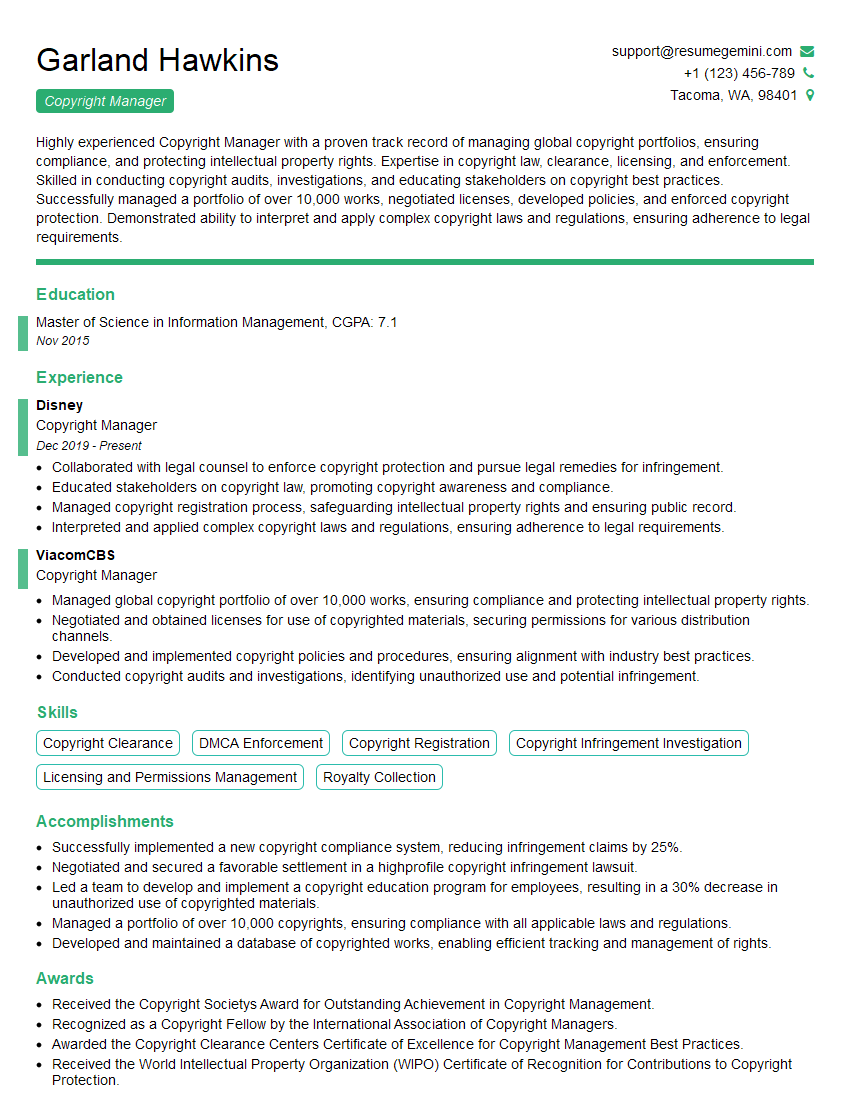
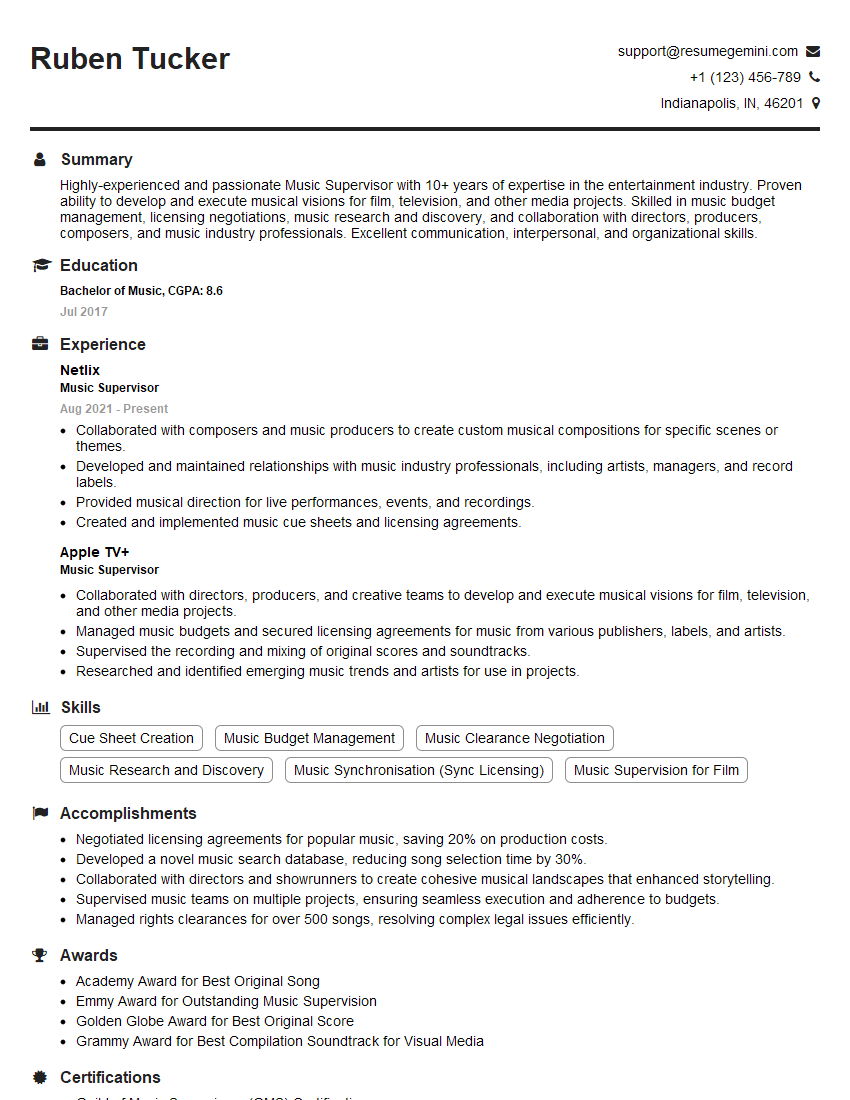
Mastering Music Synchronization and Copyright Management opens doors to exciting and rewarding careers in the music industry. This specialized knowledge is highly sought after, offering significant career advancement opportunities and competitive salaries. To maximize your job prospects, crafting a compelling and ATS-friendly resume is crucial. ResumeGemini can help you build a professional resume that highlights your skills and experience effectively. ResumeGemini provides examples of resumes tailored to Music Synchronization and Copyright Management, giving you a head start in showcasing your expertise to potential employers. Take the next step towards your dream career – invest in a strong resume.
Explore more articles
Users Rating of Our Blogs
Share Your Experience
We value your feedback! Please rate our content and share your thoughts (optional).
What Readers Say About Our Blog
Very informative content, great job.
good